Chiapas Support Committee
Home of the Compañero Manuel blog on zapatistas & mexico
Dispute over the past and internal colonialism

By: Luis Hernández Navarro
In his Memories, published for the first time in 1955, Jaime Torres Bodet bemoans how the historical interpretation of the conquest and the colonial past of México have painfully and pointlessly divided the country.
Secretary of Public Education for the first time during the government of Miguel Alemán, Torres Bodet laments: “One of the biggest difficulties that the director of public education faces is the essential lack of unity in the thinking of Mexicans. I am not referring to immediate political differences. I refer, more so, to their obscure and irreducible divergences about the very concept of the Mexican nation.”
According to the writer, these sobering differences have to do with the fact that, among us, Cuauhtémoc and Hernán Cortés continue fighting incessantly (…) Our entire history is a consequence of these two partial interpretations of our story. Under different names and with very different pretexts, the intrepid native is exalted as opposed to the cruel and cunning conqueror. Or the brave conqueror is praised opposed to the mysterious and impervious native… The Indigenous and Spanish have still not completely made peace in the hearts of all Mexicans.”
With the winds of Cardenism [1] still blowing at their backs, impatient to eliminate the vestiges of socialist education that survived even outside the dead letter of the Third Constitutional [2], the secretary invites professors to annul that which according to him was hatred in the historical narrative of our country. Concerned about the danger of the conflicting currents, he wants a history that, without lying to the people, is capable of reconciling them.
“It is no longer a matter — he writes— of choosing between indigenism and Hispanism. It is about understanding, with valor, all that we are: a complex and original people, in large part mestizo, that officially expresses itself in Spanish and who feel —at times— in Tarascan, or Mayan, or Otomí.”
As so often in the past, the August 13th commemoration of 500 years since the fall of Tenochtitlan has once again placed at the center of public debate the re-reading of the history promoted by Torres Bodet. Not that his fantasy of reconciliation has ever come to fruition. It didn’t even happen in 1992, in the context of the quincentennial of the discovery of America, when he wanted to disguise the colonial adventure with an aseptic concept of an encounter between two worlds. But the most recent presidential declarations, preceded by the request that the King of Spain and the Pope ask for the forgiveness of the indigenous people for violations of what are now known as human rights, have blown up the possibility of that reconciliation with our roots, as sought by the former Secretary of Public Education.
To the irritation of the most reactionary sectors of the country, President Andres Manuel López Obrador commemorated the date with a grand celebration in the capital’s Zocalo, apologizing to the victims of the catastrophe caused by the Spanish military occupation of Mesoamerica.
Before a crowd and without Adelfo Regino, the head of the National Institute of Indigenous Peoples (INPI), having a significant role in the ceremony, the President stated: “Let’s put an end to those anachronisms, to those atrocities, and let us say ‘never again an invasion, an occupation or a conquest,’ even if it is undertaken in the name of faith, of peace, of civilization, of democracy, or freedom.”
It is not the first time that the President incorporates indigenous peoples into his discourse and acts of government. Frequently he has made reference to their legacy and to what they represent as a moral reserve for the nation. With unorthodox rituals, sometimes closer to new age than indigenous traditions, in moments as distinct as his taking possession of the Zócalo (for the inauguration), or the launching of work on the Maya Train, or recently, in the request for forgiveness for the terrible abuses committed against the Mayas since the Spanish conquest in Chan Santa Cruz, the President has placed his vision of how to settle the historical debt with the ethnic groups at the center of his agenda.
However, beyond the public apologies, the actions of the 4T are closer to the indigenism of the traditional Mexican State, understood as a policy of the non-indigenous toward the indigenous, with the objective of assimilating them and trying to lift them out of poverty, than they are to demands for autonomy and for the rights of the indigenous peoples that proliferate in the country.
The new indigenous movement demands the exercise of self-determination and rights, not assistance. It is opposed to macro-projects, like the Maya Train and the Trans-Isthmic Corredor. It condemns the fact that in their implementation (of the projects), they have not been consulted in accordance with Convention 169 of the International Labor Organization (ILO). And it has elaborated its own vision of history, no longer as the vanquished but as peoples who resist, who struggle for life, and against capitalism and who have a distinct future outside of the current party system. That dispute of the past is also a struggle for another future.
Different as they are, the reflections of Torres Bodet and those of the 4T, both omit a central theme: the exploitation, discrimination, racism, oppression, and internal colonialism that the indigenous peoples suffer, are in part a product of history, but also of the actions of the modern State and the forces of capital against them. They are not merely issues of the past but of the present. This is why it is not enough to call for national unity, denounce the colonial atrocities, or offer apologies. It is necessary to put an end to internal colonial relations.
Notes:
[1] Cardenismo refers to support of progressive policies like those of Lázaro Cárdenas; for example, agrarian reform (land distribution) and labor rights, as well as nationalization of the oil industry. His administration implemented major educational reforms to schools run by the State, which removed them from the influence of the Church and declared them to be “socialist.” Many of these reforms were seen as institutionalizing the demands of the Mexican Revolution.
[2] This refers to Article 3 of the Constitution regarding education, and the 1934 modification of it, under Cárdenas.
———————————————————–
Originally Published in Spanish by La Jornada
Tuesday, August 25, 2021
https://www.jornada.com.mx/2021/08/24/opinion/015a1pol
English translation by Schools for Chiapas
Re-Published by the Chiapas Support Committee
Diverse collectives invite to prepare the reception of The Extemporaneous, the Zapatista airborne company

We’re going to prepare the reception for La Extemporánea (The Extemporaneous),
the Zapatista airborne company!
We’re all going to prepare the reception of The Extemporaneous (La Extemporánea), the Zapatista airborne company. There will be music, dance, the creation of murals, poetry, juggling and much more.
The date is Sunday, August 29, 2021 starting at 11:30 am.
Calle Carmona and Valle #32, Col. Doctores, a few blocks from the Cuauhtémoc metro station,
Mexico City
Bring gel, face masks and respect solidarity distance measures
Let’s all take care of each other!
Re-Published with English interpretation by the Chiapas Support Committee
Impunity of the Armed Forces faced with the climate crisis
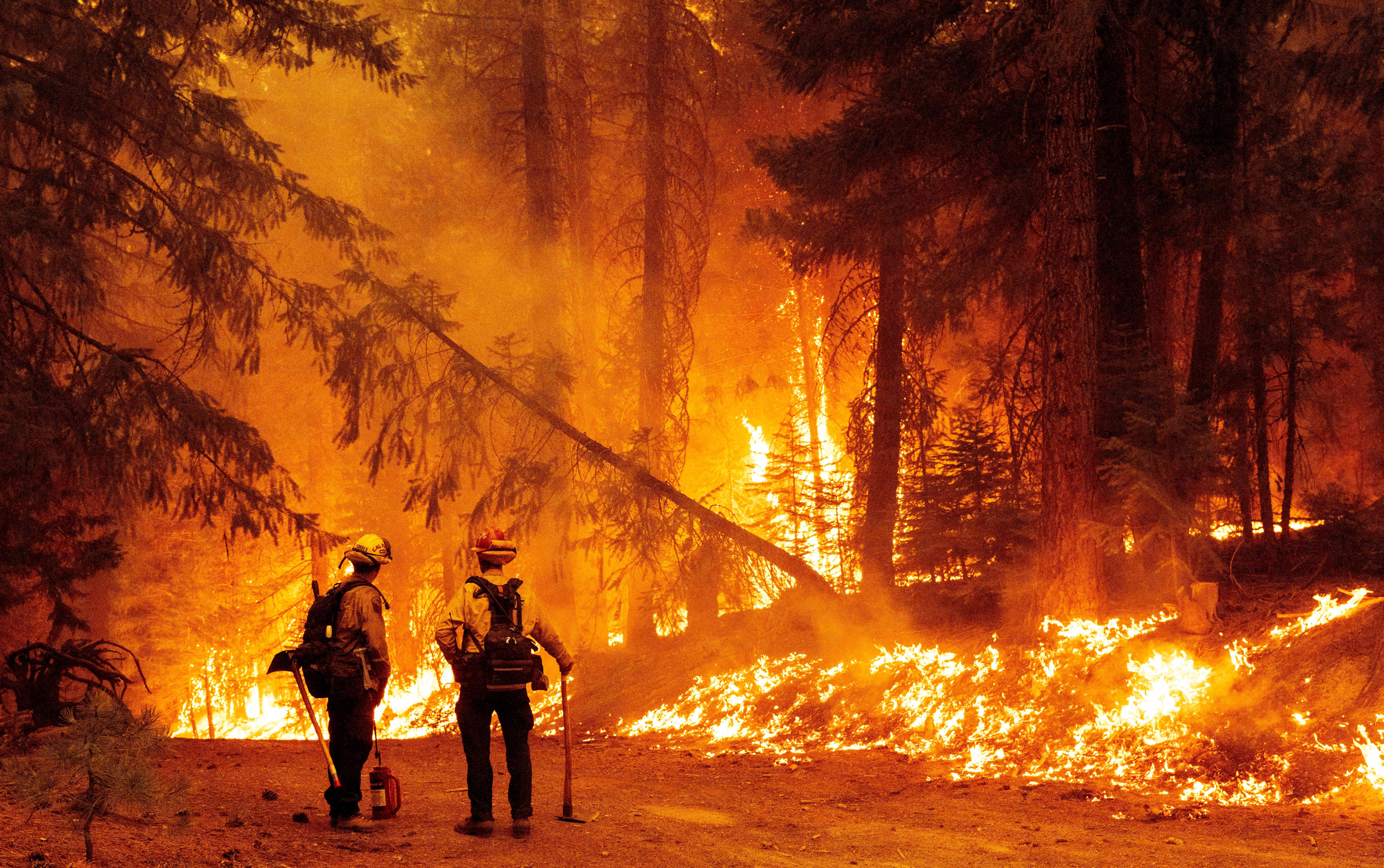
The Dixie fire, in Plumas County, California on July 23, 2021. – (Photo by JOSH EDELSON / AFP) (Photo by JOSH EDELSON/AFP via Getty Images)
By: Raúl Zibechi
It happens with the weather like it does with almost all issues: minor data transcend, but the really important ones remain in the shadows. Thus, through abstractions, it might seem that those of us who inhabit the planet are equally responsible.
Days ago, the Inter-governmental Panel on Climate Change published its sixth report. It says that the rise of the planet’s temperature will have “unprecedented” consequences, like droughts, floods and heat waves (https://bit.ly/2VK9LJD). The report records continued declines in Arctic permafrost, snow, glaciers and ice caps.
A tremendous piece of data comes from experts who assure that the Gulf Stream, the principal maritime mass of the Atlantic that brings warm water from the tropics to the north, could collapse, because it’s weakening rapidly (https://bit.ly/3fSzVAD).
There is much more data to add, because almost every year analyses emerge that ensure that the warming leads us into various abysses: climate, social and political. I would like to make three considerations.
1) I have no doubt that the information they provide is true. However, they are propped-up because they don’t say who contaminates the most, where the victims of climate change live and suffer. In particular, the commercial media persist in hiding what’s important.
The Pentagon is the largest institutional consumer of oil and, therefore, the largest individual emitter of greenhouse gases (GHG), according to the Costs of War report, issued by the Watson Institute of Brown University, in November 2019 (https://bit.ly/3yD3Jso). The data is well known, but every time an alert is issued about global warming, it doesn’t se mention who son the big polluters are.
In effect, the Pentagon’s emission of GHG surpasses that of many industrialized nations, like Denmark, Sweden and Portugal. In addition, the “war on terrorism” produced, between 2001 and 2018, 1.267 billion metric tons of GHG.
The Boeing B-52 Stratofortress, the Pentagon’s long-range bomber, consumes as much fuel in one hour as the average automobile driver in seven years (https://bit.ly/3jNKIx8).
2) After the dissemination of these studies by the mainstream media, politicians appear concerned, specialists say something, but everyone goes on with their life unchanged, so it’s worth asking how useful the data and statements of good intentions are, if there is not the slightest willingness to change habits and ways of life.
Additionally, the population perceives the reality and, consequently, the skepticism grows. According to the hegemonic media, if we are responsible and save water by turning off the tap while we brush our teeth, things will improve. “Man’s cries of anguish drown them with stories,” wrote León Felipe eight decades ago.
I believe that all of us must take care of the environment. But promoting the idea that climate change depends on individual attitudes is taking us for fools or acting cynically knowing that we don’t believe them.
The European Commission, for example, has published a table where we can consult the GHG emissions per person and those of household appliances and for each activity, but the major polluters never appear, especially if they are multi-national companies and armed forces, two pillars of the system (https://bit.ly/3AyYNFK).
3) Governments of any party violate those who least pollute, those who emit the least GHG, those who live in “sobriety and simplicity,” as Carlos Taibo defends for the North (https://bit.ly/3CDE84V), even knowing that it’s no longer possible because the culture of consumption colonized all space-times.
What infuriates is that the authorities make politically correct speeches about global warming and climate change, promising like Joe Biden, but not flinching when told that the Pentagon is the biggest polluter. The armed forces will be increasingly responsible for the climate crisis, especially during this hegemonic transition that promises gigantic mobilizations of weapons and combatants.
The more painful thing is seeing how the progressive governments launch their military and paramilitary forces against those who resist the extractive megaprojects, from the Maya Train to the Belo Monte Dam in the Amazon. The peoples of Maya roots, the Kayapó people of the Amazon and dozens of other peoples are the ones who are preserving the little surviving biodiversity.
That’s why they are attacked with utter contempt: they are the spearhead of resistance to this death model.
——-Ω——-
Originally Published in Spanish by La Jornada
Friday, August 13, 2021
https://www.jornada.com.mx/2021/08/13/opinion/015a2pol
Re-Published with English interpretation by the Chiapas Support Committee
The Maya Train’s development poles will destroy the richness, biodiversity and geomorphology of territories
 By: Yessica Morales
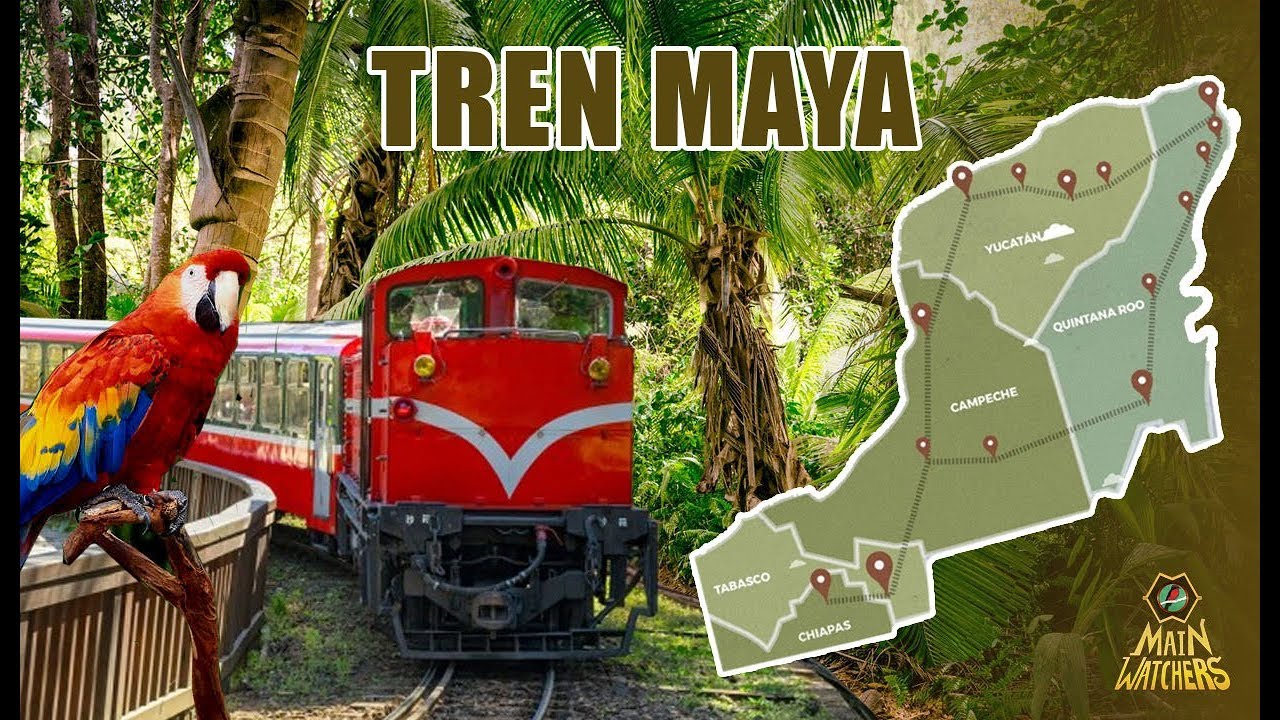
Ana Esther Ceceña, Coordinator of the Latin American Observatory of Geopolitics at the Institute for Economic Research, announced that given the Maya Train Comprehensive Development Project, the federal government proposes to reorder the productive, commercial, tourist and mobility activities in the 1,525 kilometers on which the tracks will run. The project proposes to generate 18 similar development poles with urbanization processes and generation of economic activities where the train stations are located, for the purpose of attracting the rural population to jobs, especially in the service sector.
The project comprises the area of the Yucatan Peninsula, Tabasco, Campeche and Chiapas where the southern oil basins are located, with 75.6 percent of the proven hydrocarbon reserves and 92 % of the total basic petrochemicals produced in the country, where the Dos Bocas refinery is being built.
The coordinator predicted that the freight train would transport hydrocarbons, minerals and food, principally for tourism and to promote it on a large scale, orienting economic activities to services.
Among these services is the production of foods with pork meat that the businessman Alfonso Romo produces in the vicinity of the ring of cenotes [1] and the Homún Wetland, recognized internationally for the species it contains and the at risk situation it presents. Ceceña pointed out that the production of food with pork meat represents the contamination and destruction of the big cenote inside the pig farm. There are no proposals for remediation and regulation within the project in cases like this, but rather, activities of this type are considered part of the development that is to be promoted. [Photo below is of a cenote in Homún.]

She pointed out that in Calakmul alone they predict an increase from the current 40,000 visits a year to 3 million, causing impacts on the environment, the archaeological wealth and local societies.
This morning, representatives of various civil society organizations, academics and campesinos of the Maya people, summoned by the National Indigenous Congress of the Yucatan Peninsula Region, participated in the “Forum in Defense of Life and Territory.”
They jointly declared their total rejection to construction of the project called the Maya Train and made it clear that they will not allow the consultation convoked by the federal government for August 14 and 15 to be carried out. “We consider that these megaprojects only intensify the dispossession of land, destruction of archaeological zones, the exploitation and enslavement of the Maya peoples who have always been seen as valuable objects for attracting tourism,” they pointed out.
Ceceña indicated that several promoters of the project point out that predatory processes are already present in the region and are caused by the residents’ poverty, for example: the Mennonite groups of the Ejido Paraíso in Bacalar, who cut down 3,000 hectares of jungle to plant soy, using agro-chemicals.
She added that these chemicals would directly affect plants and residents of the surrounding areas; they will be filtered towards the Yucatán Aquifer, having already adulterated the waters of the Bacalar Lagoon, thus making it sometimes lose the colors that make it unique in the world.
The coordinator said that every year tourist activity in Cancun contributes between 4 and 10 tourists per person, and generates an enormous quantity of non-organic waste, in addition to dumping its sewage on the Quintana Roo coasts; this has led to an extension of the tourist area towards Tulum and Bacalar inducing damage to reefs, destruction of wetlands and the privatization of the beaches.
These developments are risky and harmful, the highway that connects Cancun and Tulum just sunk because its weight finally overcame the support of the caverns or cenotes over which it was constructed. How will they be able to withstand a high-speed and heavy train that will multiply the vibrations, questioned the coordinator. From an environmental perspective, the type of train proposed and the route it would follow would cause a strong impact without any remedy in many cases.
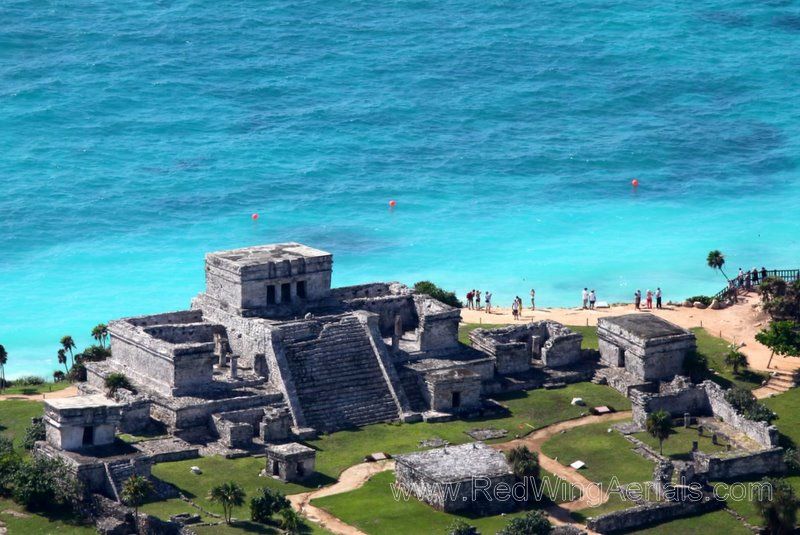
Above Photo: The archaeological site of Tulum on the Caribbean Coast of Quintana Roo.
Even the Environmental Impact Statement (EIS) that the National Fund for the Promotion of Tourism (FONATUR, its Spanish acronym) presented confirmed that: Special attention should be paid at the moment of the project’s final design in this zone (the Chicxulub ring of cenotes). It is recommended carrying out exhaustive geophysical studies on the final route, in order to determine with precision the probable existence of underground caverns (and indicates that) more detailed geology studies are carried out, using all the tools that constitute a geological study at the project executive level.
Ceceña emphasized that the impact is multiplied with the construction of the 18 development poles, considering that urban centers are the largest emitters of pollutants.
They are also generators of non-degradable garbage and carbon dioxide emissions. According to calculations, there are currently 31 megacities on the planet that occupy “less that 0.5% of the Earth’s surface,” however, these “cities are responsible for 70% of the greenhouse gas emissions and 65% of global energy consumption.”
Faced with the ecological catastrophe the planet is experiencing, she stressed that conservation of a jungle area like that of the Yucatan Peninsula is essential, since it’s part of the continent’s tropical biological complex.
On the other hand, the transit of species in the area feeds its versatility and the ability to continue harboring and generating endemic species that expand global biodiversity, but the train tracks will cut off passage and will cause a withdrawal of species due to the barrier effects, noise and vibration.
Added to that is the damage that the burned diesel would cause, which is the fuel selected for the operation of a transport that intends to be modernizing.
All this combined forms an environmental system of immense, but fragile value. It cannot be exploited without risks that, in this case, are even greater than those in other regions due to the peculiarity of its karst soil (calcareous and porous), which has high permeability and allows pollutants to pass quickly to the Aquifer.
She made visible that the weight of a fast train and the urbanizations that are planned, can tear some sections to pieces, thus the Environmental Impact Statement’s recommendation about the design; it would affect not only the environment but also the living conditions of the rural or semi-rural populations that would be attracted to the cities, where they would be able to aspire to precarious jobs a the expense of breaking the link to their community and campesino economies.
She recalled that the region of the Maya Train has the characteristic of being an important part of the seat of the Maya civilization; its inhabitants are the descendants of the builders of Tulum, Chichén Itzá, Edzná, Calakmul and other places that are now advertised as tourist attractions.
Said inhabitants coexist and are mixed with the populations that arrived with the Conquest or the area’s subsequent evolution, but have not lost their cultural identity, a territory of Mayas since at least the years 1000 to 800 BC.
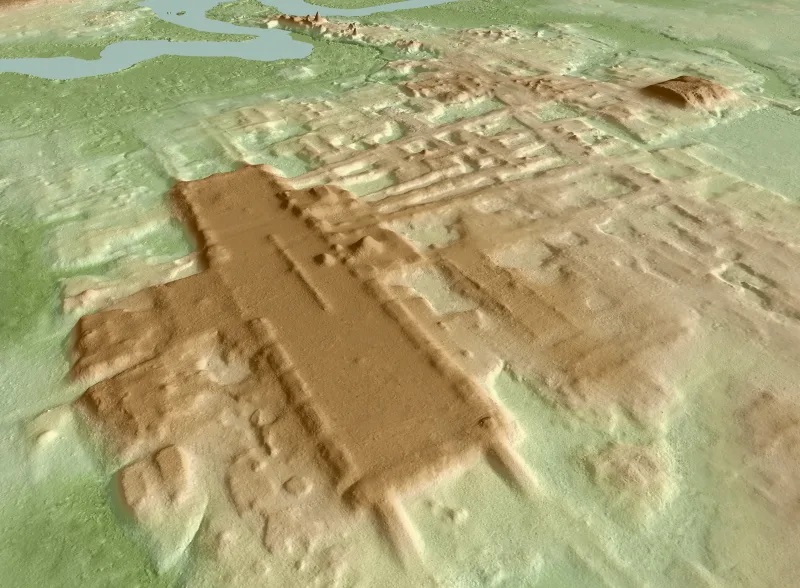
This is confirmed with the discovery of the Aguada Fénix archaeological site [above photo], the largest construction of the Mayas found so far and one that stands out for being a horizontal construction, the first of that kind that they have found.
Ceceña said that according to the discoverers, a building with those characteristics reveals community and e egalitarian organization of the place’s inhabitants, a valuable finding in the reconstruction of a history that could not be erased in the Conquest because it was buried or concealed by those who had a consciousness from a long time ago and the strength of their culture.
Aguada Fénix is in the path of the train. If it were not already discovered it could simply be destroyed to bring development to this southeast region. According to data from the INAH, there are 7,274 places within the territory that have archaeological vestiges already detected, which the Maya Train would encompass with its developments poles, the coordinator explained.
Lastly, she pointed out that destroying that richness, biodiversity and especially the geomorphology of these territories, would be an unforgivable attack and, of course, irreversible.
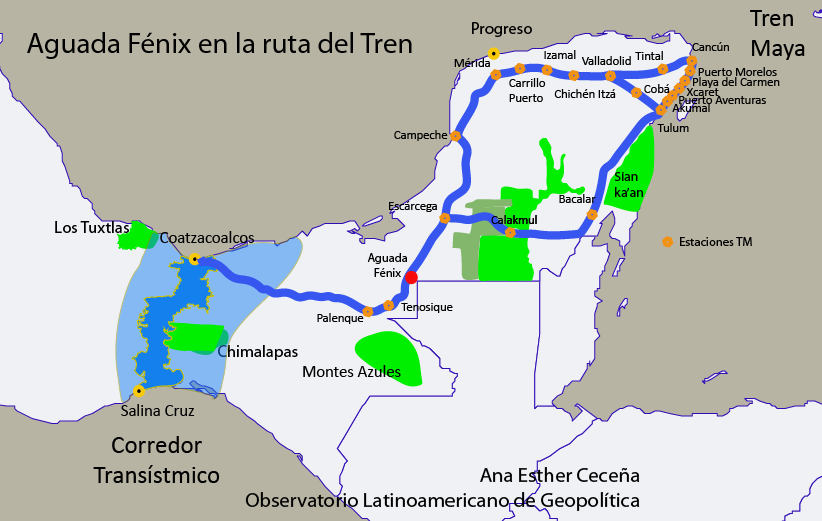
The above map shows the Aguada Fénix site as a red dot, near the border with Guatemala, Tabasco and Chiapas.
[1] Cenotes are natural sinkholes resulting from the collapse of limestone bedrock that exposes groundwater and are used as a water supply, especially on the Yucatán Peninsula of Mexico.
——————————————————————
Originally Published in Spanish by Chiapas Paralelo
Monday, August 2, 2021
Re-Published with English interpretation by the Chiapas Support Committee
Pantelhó has a new municipal council
By: Ángeles Mariscal and Andrés Domínguez
The Permanent Commission of the State Congress unanimously approved the resignation of Delia Yaneth Velasco Flores, interim municipal president and of the entire municipal council of Pantelhó, to later appoint a municipal council made up of two men and a woman.
Evelio César Morales Díaz, legal counsel for the municipality, presented Velasco Flores’ resignation to the State Congress together with those of the trustee Adelina Morales, first councilor Pedro Juárez Méndez, second councilor Aura López Martínez, third councilor Julio Cruz, fourth councilor Carmen López Zepeda, fifth councilor Martín Sánchez and of the councilor of the Green Ecologist Party of México, Cornelio Encino Núñez.
Morales Díaz specified the follow-up on the agreements made to de-escalate the problems that occurred in the municipality with the presentation of the resignations that took place in the extraordinary and urgent council session on August 6.
The session was held one month after the “El Machete” Self-defense group expelled them from the municipal headquarters. In that meeting that isn’t specific as to where it took place, the mayor and eight of the ten municipal council members agreed to resign their positions, “in order to suit my personal interests,” each one pointed out separately, in the letters that they individually sent to the Congress.
In the resignation of the municipal president she wrote: I resign voluntarily and irrevocably from the activities that I was carrying out, therefore starting from this date I suspend my activities
After reading and approving the resignations as urgent, José Octavio García Macías, president of the Executive Board of the Congress, declared the disappearance of Pantelhó’s municipal council, as established in Article 81 of the state’s Political Constitution, due to the resignation of eight of the ten council members.
Consequently, in the meeting room of the legislative power he named a municipal council and swore in Pedro Cortés López, Miguel Hernández Pérez and Sandra Luz Gutiérrez Cruz, who the population elected on August 9 as their new authorities, through the indigenous normative system.
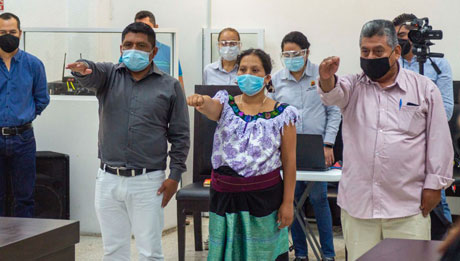
New Pantelhó municipal council members.
This municipal council has legal validity until next October 1, the date on which the three-year term of a municipal government ends. Constitutionally, from that moment on, Raquel Morales Trujillo, the former mayor’s husband, would assume as the elected mayor, because he won the elections of last June 6 through the PRD.
However, just like the former mayor, the population of Pantelhó accuses Morales Trujillo of having ties to criminal groups, and he lives in exile from the municipality.
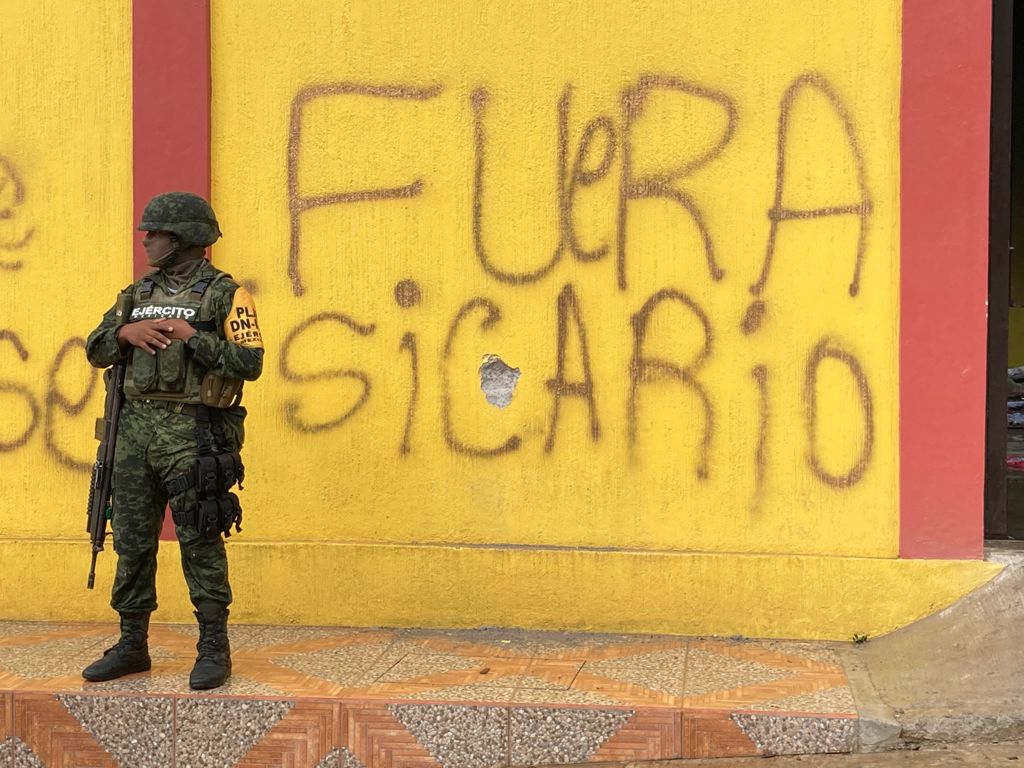
It should be remembered that since the murder of the indigenous leader and former president of Las Abejas of Acteal, Simón Pedro Pérez, which occurred on July 5, the Pantelhó population made public the El Machete Self-defense group, formed to confront the actions of organized crime.
This self-defense group expelled municipal authorities and a hundred inhabitants of the place, accusing them of different crimes and illicit activities such as the trafficking of drugs, weapons and persons.
Meanwhile, the indigenous prosecutor who was carrying out the investigation into these events, Gregorio Pérez Gómez, was murdered on August 10. The president of Mexico, Andrés Manuel López Obrador, announced that his death was related to the Pantelhó investigation.
State and federal prosecutors have not reported on the progress of investigations into this case, the case of the municipal authorities and the rest of the people accused
——-Ω——-
Originally Published in Spanish by Chiapas Paralelo
Wednesday, August 16, 2021
Re-Published with English interpretation by the Chiapas Support Committee
500 years, the uses of history

Above: A member of Zapatista Squadron 421 at the 500 Years celebration in Madrid, Spain.
By: Luis Hernández Navarro
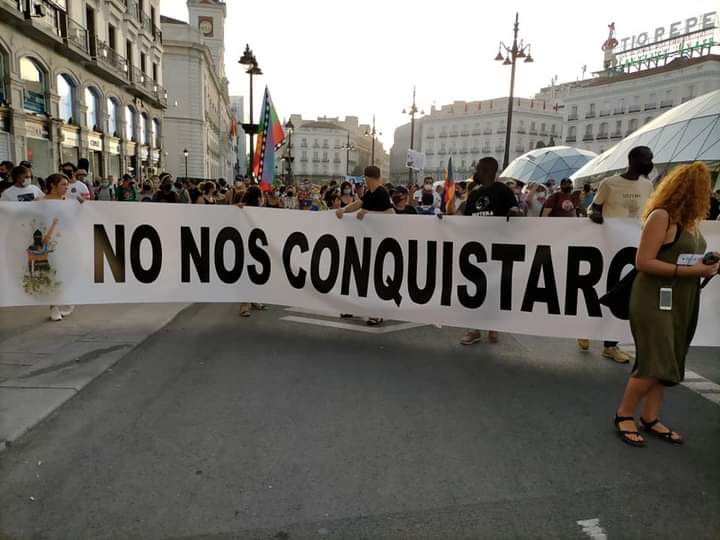
The Plaza de Colón, in Madrid, is the emblematic heart of the Spanish ultra-right and its fantasies of recovering its lost imperial grandeur. It is here that the sympathizers of Vox [1] and the Partido Popular (Popular Party) hold their mobilizations. In what was a tremendous symbolic blow, the seven members of Squadron 421 of the EZLN and some 2,500 European insubordinates arrived there last August 13
On that day, Vox attested to its incurable colonialism in a tweet. On this day 500 years ago today, a troop of Spaniards led by Hernán Cortés and native allies achieved the surrender of Tenochtitlan. Spain managed to liberate millions of people from the bloodthirsty and terrifying regime of the Aztecs. Proud of our history, he said.
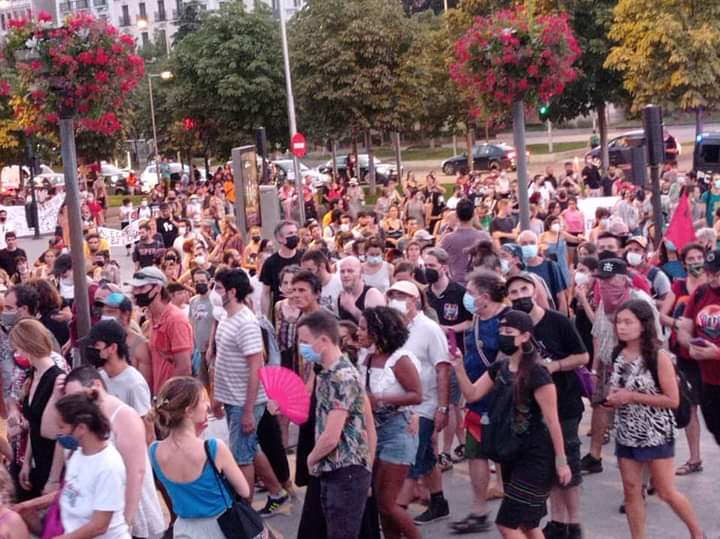
But, neither that outburst nor others, prevented the internationalist rebels from nailing, that day, the flags to the ideological heirs of Francisco Franco and the nostalgic Spaniards. Five centuries after the Castilian-Leonese, Andalusian, Extremaduran and La Mancha invasion, a ship with the Zapatista delegation on board, sheltered by a crowd coming from many latitudes, sailed the asphalt streets of the capital of the kingdom, from the Puerta de Sol to the Plaza de Colón, making the conquest in reverse. And, as if to refute Vox’s tweet (and to all those who identify with it on both sides of the Atlantic), a huge banner announced: You did not conquer us! (https://bit.ly/37O0umf).
Previously, upon disembarking in the port of Vigo last June 22, the Zapatistas had already renamed Europe as Slumil K’ajxemk’op Unsubmissive Land.
With the Plaza de Colón as a stage, the “inopportune” members of Squadron 421 took the floor. “To live,” they said, “is not only not to die, it is not to survive. To live as human beings is to live with freedom. To live is art, science, joy, dance, and struggle.”
“This is how they lead us, day and night, wanting to tame us, seeking to domesticate us. And we, well, resisting. All our lives and entire generations resisting, rebelling. Saying ‘no’ to the imposition. Shouting ‘yes to life’. It is not new, it is true. We could go back five centuries and the same story.”
In explaining the purpose of their expedition in those lands, they pointed out: “we think and we know that we are not the only ones who struggle, that we are not the only ones who see what is happening and what will happen. Our corner of the world is a small geography of struggle for life. We are looking for other corners and we want to learn from them.”
To conclude the course of their mission, after pointing to capitalism as responsible for the evils suffered by humanity and nature, they asked their counterparts: “When one day someone asks you ‘why did the Zapatistas come,’ together we can answer, without shame for you and without shame for us, ‘they came to learn.’ 500 years later, the Zapatista communities came to listen to us.”
The Zapatista mobilization in Europe marks a turning point in the struggles and discourse of the native peoples of Latin America and in the uses of the past. Beyond laments and denunciations, far from immobilizing victimhood, without refusing to call a spade a spade, in the perspective of a new internationalism, it bets on the construction of networks from below and on the left with those who fight against capitalism.
Forty-two years ago, in The New Political Presence of the Indians: A Challenge to Latin American Creativity, Guillermo Bonfil documented how the Indians of the continent have their own voice, despite the fact that the colonizing Europeans and the native bourgeoisies insist on denying it. We continue to dream of homogeneous nations, with one culture, one language, one race, despite being societies made up of diverse peoples, he wrote.
According to the anthropologist, the projects of the Indian peoples expressed through the recently created ethnic political organizations (early 1970s) have been implicit in their secular resistance. However, there is something new in them: a political ideology oriented to the change of Latin American societies and not only to the preservation of the ethnic groups themselves. These organizations, he pointed out, have in common the decision of the Indian peoples to act as distinct political units.
Bonfil described the main ideas of this emerging Indian political thought. For example, the historical continuity of the peoples and the conviction that there was no conquest, but rather an invasion. In the face of it, the Indian has resisted and fought. Thus, imperialism and colonialism are the way of Western civilization, not a moment in its historical trajectory.
Such a program claims -according to him- to retake the thread of history, not to return to the past and stay there. It is about updating a colonized history, liberating it and building on it; ending a chapter, closing the parenthesis, turning the page and moving on. From this perspective, this exercise is a powerful call to the future.
Without putting aside the legacy of this thought, Zapatismo changes the terrain of the struggle and the indigenous discourse, and places as the core of its proposal the struggle for life within the framework of an anti-capitalist project, and the weaving of a transnational community of all the “extemporaneous” based on walking by asking questions. It not only proclaims it, but puts it into action. This is the deep meaning of the mobilization of last August 13.
[1] Vox, or “voice” in Latin, is a far right political party in Spain. It can also be written as VOX.
——-Ω——-
Originally Published in Spanish by La Jornada
Tuesday, August 17, 2021
https://www.jornada.com.mx/2021/08/17/opinion/017a2pol
English interpretation by Schools for Chiapas
Re-Published by the Chiapas Support Committee
Only 500 years later
Words of the Zapatista Peoples
August 13, 2021.
Sisters, brothers, hermanoas:
Compañeros, compañeras, compañeroas:
The Zapatista communities speak through our voices.
First, we would like to express our thanks.
Thank you for having invited us.
Thank you for having welcomed us.
Thank you for having housed us.
Thank you for having fed us.
Thank you for having taken care of us.
But above all, we’d like to express our gratitude for the fact that despite differences and obstacles you have all agreed to what we’re doing today. Perhaps it seems small to you, but for us Zapatista communities it is huge.
-*-
We are Zapatistas of Mayan descent.
We are from a geography called Mexico, and we crossed the ocean to share these words with you, be with you, listen to you, and to learn from you.
We are from Mexico and in and with you we find love, care, and respect.
The Mexican state and their administrations don’t recognize us as citizens of this geography. We are strangers, foreigners, undesirable and unwelcome in the same lands that were farmed by our ancestors.
For the Mexican state we are “extemporaneous.” That’s what it says on the birth certificates that we managed to obtain after we made many trips and incurred many expenses on visits to the offices of the bad government. And we did all that to be able to come to where you are.
But we didn’t come all this way to complain or even to denounce the bad government we have to put up with.
We only share this because it is this same bad government which has demanded that the Spanish State apologize for what happened 500 years ago.
You should understand that in addition to being shameless, the bad government of Mexico is also ignorant of history, twisting and adapting it to its liking.
So let’s leave aside the bad governments that each of us have to put up with in our geographies.
They are just overseers, obedient employees of a greater criminal.
-*-
Those of us who make up the Zapatista Maritime Squadron, known as the 421st Squadron, are here in front of you today, but we are just the first wave of a much larger group. There will be up to 501 delegates. There are 501 of us just to show the bad governments that we are ahead of them: while they simulate a false celebration of 500 years, we [nosotros, nosotras, nosotroas] are already heading towards what’s next: life.
In the year 501, we will have explored the corners of this rebellious land.
But don’t worry. The 501 delegates will not arrive in one fell swoop, but in waves. Right now in the mountains of Southeastern Mexico, they are preparing the Zapatista airborne company, which we call “The Extemporaneous” and which is made up of Zapatista women, men, boys and girls.
The airborne company will be joined by a delegation from the National Indigenous Congress-Indigenous Governing Council and the People’s Front in Defense of the Land and Water.
All of us [todas, todoas, todos] have suffered to obtain our documents and vaccines. We have gotten sick and recovered. We have been hungry and far from their families, communities, lands, language and culture.
But all of us are excited and enthusiastic to meet you, not at large events but in the places where you all resist, rebel, and struggle.
Some might think that what interests us are large events and media coverage and would evaluate our successes and failures from that perspective. But we have learned that seeds are exchanged, planted, and grown in the terrain of the everyday using everyone’s own knowledge.
Tomorrow doesn’t grow in the spotlight. It is nurtured, cared for, and born in the unobserved shadows during the early morning, when the night just begins to cede ground.
The earthquakes that shake the history of humanity start with a single, almost imperceptible cry of “Enough!”; a discordant note in the midst of the noise; a crack in the wall.
-*-
For this reason we have not come to share recipes, impose visions or strategies, or promise bright and instantaneous futures, crowded squares, or immediate solutions; nor did we come to convoke you to join marvelous coalitions.
We came to listen to you.
It certainly won’t be easy: we are so different, so distinct, so distant, so opposite, and above all, so contradictory. Many things separate us.
Perhaps as we begin to talk, like it or not, we will not just share our history, but will also demonstrate our conviction that what’s ours is what counts and what is true.
Each look backwards to the past divides us, and this difference is not unfounded: each glance back brings out legitimate pain and rage about the past.
It’s true that in looking to the past we find what we seek, whether it’s rage, resentments, condemnations or acquittals. Even though there are serious and profound studies of history, we can find those that are most convenient for us, that prove us right and justify us, which we then turn into the “truth”.
We can judge and condemn in this way, but in doing so justice is forgotten.
We can find many things that divide us and pit us against each other like this.
We fight with our family, with our group, collective or organization, and in our neighborhood, region and geography.
Each person carries pain that marks them and rage that moves them.
This pain and rage, which are not small, are there.
Therefore, we Zapatista peoples say that only a larger threat, a more terrible pain and a greater rage will allow us to agree to direct our rage and pain upwards.
But it’s not that the differences among us disappear, like in the false calls for “unity” often made by those above when those below try to hold them accountable.
No, what we Zapatista communities are talking about is a cause, a motivation, a goal: life.
It’s not about abandoning convictions and struggles: on the contrary, we think that the struggle of women, otroas, workers, and native peoples should not only not stop, but should be even deeper and more radical. Each individual faces one or more heads of the Hydra.
All of those struggles, yours and ours as Zapatista peoples, are for life. But until we destroy the monster in its heart, its heads will continue sprouting and changing shape in even more cruel forms.
-*-
Today, in these times, we see and are suffering under the destruction of nature at an enormous scale, with humanity included.
Underneath the rubble, ashes, mud, contaminated waters, pandemics, exploitation, disdain, dispossession, crime, racism and intolerance, there are human beings without life. And each life is a history that gets converted into a number or a statistic and forgotten.
The future—the history to come—is, like the present, a real nightmare. And when we think that it couldn’t get any worse, reality comes and smacks us in the face.
So people look out for themselves and, in the best of cases, for those close to them: their family, friends and the people they know.
But just as in each corner of the planet and in each beating heart there is tragedy today and more to come, at the same time, there is also resistance, rebellion, and a struggle for life.
Living is not just about not dying, about surviving: living as human beings means living with freedom. Living is about art, science, joy, dance, and struggle.
And of course living is also about disagreeing, discussing, debating, and confronting.
There is someone or something that is stopping us from living, taking away our freedom, deceiving us, scamming us, cornering us and taking away the world from each one of us with bites, cuts, and wounds. We can identify the responsible party, look for a culprit, confront them and bring them to justice. We look for someone or something to pay and answer for this pain that leaves us isolated and alone [solos, solas, soloas], forcing us onto an ever-shrinking island, so small that only each person’s ego is left.
And even there, on that small island, far from everything and everyone, we’re supposed to be something else and are still not allowed to be what we are—even there in our individual history, made in part by collective history: in a room, a house, a neighborhood, a community, a geography, a cause which should be changed and betrayed to be part of something else. A woman who is to a man’s liking, unoa otroa who is accepted as hetero, a youth who is to the satisfaction of maturity, an old age tolerated by youth, a childhood disputed by youth, adults, and the elderly, an efficient and docile workforce for the overseer, an overseer to the liking of the boss.
And this pressure to transform ourselves into what we are not takes the form of violence which is structural. The whole system is made to impose the mold of normalcy.
If we are women, we should be so according to the mold made by men.
If we are otroas, we should be so according to the mold made by heterosexuality.
For example there are even clinics to “correct” sexual difference.
Really, the system itself is a gigantic and brutal clinic to “cure” our “abnormality:” a machine that attacks, isolates, and liquidates that which is other and different.
All day, every day the system tries to tame and domesticate us.
And we resist: everything that’s alive and entire generations resisting and rebelling, saying “no” to imposition and shouting “yes” to life.
It’s true that this is not new. We could go back five centuries and see the same story.
What’s ridiculous about all that is that those who oppress us today pretend to play the role of our “liberators.”
-*-
However, something is different: the pain of the Earth and nature has joined together with our pain.
And here we can either agree or disagree. We can say that it’s not true: pandemics will end, catastrophes will cease to happen, the world and our life in the world will return to how it was before, even though this “before” was and is full of pain, destruction and injustice.
We, the Zapatista peoples, don’t think so: not only will things not return to how they were before, but they will actually get worse.
We, the Zapatista communities, name what is responsible for these wrongs and call it “capitalism.”
We also say that it is only through the total destruction of this system that it will be possible for each person, according to their own ways, calendars and geographies, to be able to build something else.
It won’t be perfect, but it will be better.
What is built after that, those new relations between human beings and between humanity and nature, will be named whatever people want to call it.
We know it won’t be easy: it’s not easy now.
We know that we won’t be able to do it alone, with each person on their own plot of land fighting against the head of the hydra they happen to face, while the heart of the monster remakes itself and grows even larger.
Above all, we know that we will not live to see the day when, in the end, the beast burns and crumbles until all that remains of it is a bad memory.
But we also know that we will do our part, though it may be small and future generations may not remember it.
-*-
As the Zapatista communities that we are, we see signs. But perhaps we are wrong as the peoples that we are. You see how they call us ignorant, backwards, conservative, against progress, pre-modern, barbaric, uncivilized, unwelcome and inconvenient.
Maybe that’s true. Maybe we are backwards because here, as the women that we are and the otroas that we are, we can go out without fear that we’ll be attacked, raped, butchered and disappeared.
Maybe we are against progress because we are opposed to the megaprojects that destroy nature, destroy us as peoples, and leave death as the next generation’s inheritance.
Maybe we are against modernity because we oppose a given train, road, dam, thermoelectric plant, mall, airport, mine, or toxic waste dump, the destruction of a forest, the polluting of rivers and lakes, and the cult of fossil fuels. Maybe we are backwards because we honor the land instead of money.
Maybe we are barbaric because we grow our own food and because we work to live and not to make money.
Maybe we are inappropriate and inconvenient because we govern ourselves as the peoples that we are and because we see the work of government as one of the many responsibilities that we as community members must carry out.
Maybe we are rebellious because we do not sell out, give up, or surrender.
Maybe we are everything that they say about us.
-*-
But we see and hear something: we know something is happening and is going to happen.
That’s why we are on this journey, because we think and know that we are not the only ones who struggle and we are not the only ones who see what is happening and is going to happen.
Our corner of the world is a small geography of struggle for life.
We are looking for other corners and want to learn from them.
That’s why we came here, not to bring you insults and complaints or to collect on unpaid debts, even though this is in fashion and everyone would agree that we have a right to these complaints, or they say that we don’t know what we should do, so the bad governments will do it for us.
It’s also currently fashionable for these bad governments to hide themselves behind pseudo-nationalisms.
The flag of nationalism covers us together with those who oppress, persecute, murder, and divide us.
No. We did not come here for that.
The banner of nationalism hides not only differences but also, and above all, crimes. Under a unified nationalism, they shelter the violent man and the assaulted woman, heterosexual intolerance and persecuted otredad [otherness, other sexualities], predatory civilization and annihilated native people, exploitative capital and subjugated workers, and the rich and the poor.
National flags hide much more than they reveal.
This is why our resolve for life is global. It does not recognize borders, language, color, race, ideology, religion, sex, age, size, or flags.
This is why our journey is a Journey for Life.
-*-
This marks one of the few times where we will talk at an event in which only a few speak and many listen.
We will take this opportunity to make a respectful request.
Tell us your history, no matter how big or small.
Tell us your history of resistance and rebellion: tell us about your pain, rage, and your “no’s” and your “yes’s.”
Because we Zapatista communities have come to listen and to learn the history that exists in each room, house, neighborhood, community, language, and the ways that you do and don’t do things.
After so many years, we have learned that in each act of dissidence, rebellion or resistance, there is a clamor for life.
In our view as Zapatista peoples, that’s what this is all about: life.
Someday when someone asks you, “Why did the Zapatistas come?” together we can respond, without any shame on your or our part, “They came to learn.”
Five hundred years later, the Zapatista communities came to listen to us.
From Madrid, in the geography called Spain, in the lands and under the skies renamed SLUMIL K´AJXEMK´OP or “rebellious land”.
In the name of the Zapatista communities,
The Zapatista Maritime Squadron, known as the “Squadron 421,”
Planet Earth. August 13, only 500 years later.
Video: Rage Against The Machine – «Wake Up»
En español: http://enlacezapatista.ezln.org.mx/2021/08/13/apenas-500-anos-despues/
Zapatistas in Madrid: “500 years later, the communities come to listen to you”

Madrid, Spain
“Tell us your story, your rage, your rebellion. We come to listen and learn from your story. In each resistance there is a cry for life. 500 years later, the communities come to listen to you,” was the message from Squadron 421, in the name of the Zapatista support bases of Chiapas, Mexico, in a large rally in the Plaza de Colón, from the capital of the Spanish State, within the framework of the 500 years of the conquest of Tenochtitlán, Aztec territory.
After a march from Puerta del Sol to Plaza Colón, the Zapatistas gave thanks that they have been received, housed, fed, cared for, and especially they added: “that despite their differences were able to agree,” to carry out the march and rally.
“We are Zapatistas, from a geography called Mexico. The government doesn’t recognize de that geography, to the state we are extemporaneous,” the EZLN’s support bases recalled, alluding to the way in which the Mexican government tends to catalog people who are not registered right after being born, but rather due to economic, social, geographic and bureaucratic issues do it after some time.
“But we have not come here to complain,” the Zapatistas clarified, and indicated that Squadron 401 precedes a larger group of Zapatistas (the Zapatista Airborne Company) that will separate into smaller groups and tour the European continent, also baptized by them as Slumil K´Ajxemk´Op. Members of the National Indigenous Congress (CNI), the Indigenous Government Council (CIG) and representatives of the Peoples Front in Defense of Land and Water of Morelos, Puebla and Tlaxcala will arrive, along with indigenous peoples.

“We don’t bring any recipe, visions or strategies, we come to listen to you. As Zapatistas we have a cause, a motive, a goal: Life,” the indigenous people who rose up in arms in 1994 expressed.
The message to the struggles that the Zapatistas described as diverse was not to stop, but to be more profound and radical, faced with something that prevents us from living; in other words, capitalism, they said.
——-Ω——-
Originally Published in Spanish by Pozol Colectivo
Friday, August 13, 2021
Re-Published with English interpretation by the Chiapas Support Committee
They elect new Pantelhó council; current 3-year term will end
By: Elio Henríquez
San Cristóbal De Las Casas, Chiapas
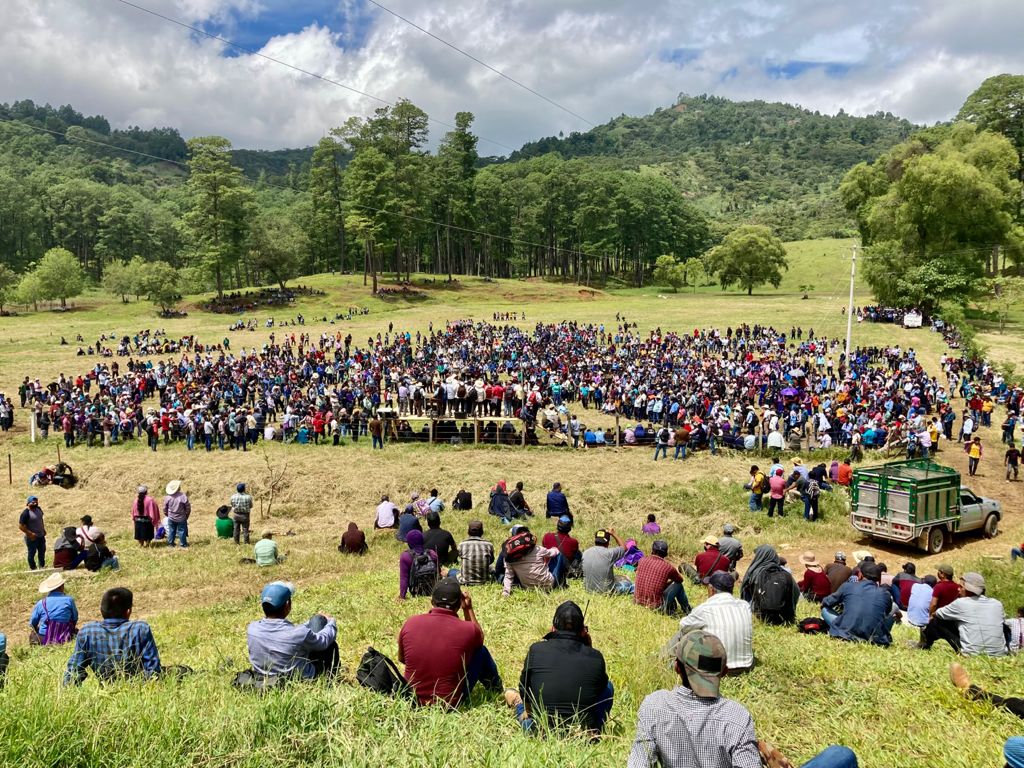
In an assembly this Monday (August 9) inhabitants of the 86 indigenous communities and 18 barrios (neighborhoods) in Pantelhó elected members of a municipal council that will relieve the municipal council that the substitute mayor, Delia Janet Velasco Flores of the PRD, heads. Last week, she presented her request to leave office to the local Congress.
The election of new authorities, which was held in a wooded area known as rancho El Progreso, is one of the agreements made last week in two months of dialogue to try to resolve the conflict that worsened on July 7 with the irruption El Machete Self-Defense group in the municipal seat (the town of Pantelhó)[1], which caused members of the municipal council to leave the municipality.
By raised hand, those who attended the assembly elected Pedro Cortez López as president of the municipal council; he was named days ago as the coordinator of the Commission of 20 representatives (municipal agents, presidents of ejido commissions and representatives of Catholic and Evangelical churches) in charge of seeking, together with federal and state authorities, a solution to the crisis in the municipality. The other two council members are Miguel Hernández Pérez and Sandra Gutiérrez Cruz.
The municipal council will be in charge until September 30, when the current 3-year term will conclude, replacing Velasco Flores, who in turn replaced the constitutional municipal president Santos López Hernández, a prisoner in El Amate, accused of sexual harassment.
Pedro Cortez said he didn’t know the date of the swearing in before the state Congress, because “I don’t even have my papers ready. Maybe they (the deputies) will tell me when. I really can’t tell you, [only] they know.”
The Tsotsil leader is confident that dialogue and understanding will prevail to reach a solution to the conflict. “I ask God to help the people and to help me, because we are really in God’s hands,” he said in an interview with reporters.
“People already knew who the municipal council members would be; I’m not lying, not am I denying, because when they spoke to me it was a surprise; I had not thought about” being president of the council, he added.
The 86 indigenous communities and 18 barrios in the municipal seat have had control of the town, including the mayor’s office, since July 26. On that day they burned houses, looted stores and retained 20 residents allegedly linked to Los Herrera, the opposing group. The whereabouts of those who were retained has not been reported.
In the two dialogue tables that were held last week with the assistance of federal and state representatives and the “Commission of 20.” A commission named by the Diocese of San Cristóbal participated as mediator, headed by the parish priest of Simojovel, Marcelo Pérez Pérez.
[1] The town of Pantelhó serves as the municipal seat (cabecera) for the municipality of Pantelhó.
——-Ω——-
Originally Published in Spanish by La Jornada
Tuesday, August 10, 2021
https://www.jornada.com.mx/2021/08/10/estados/025n1est
Re-Published with English interpretation by the Chiapas Support Committee
From the Popular Consultation to the National Campaign for Truth and Justice

By: Magdalena Gómez
August 1, 2021 will be marked by the first popular “consulta” (consultation or referendum) held on a national scale, with a constitutional and legal basis, the product of four decades of struggles to open the way to forms of direct democracy. However, due to the very low citizen participation, this exercise will also be judged as a defeat for the so-called Fourth Transformation (4T), because it emanated from their initiative to consult about the probable trial of the five former presidents of the Republic in the period between 1988 and 2018.
As we know, in the process of formalizing said proposal the Supreme Court of Justice reformulated the question to be consulted in the following terms: “Do you agree or not that the pertinent actions be carried out, in accordance with the legal and constitutional framework, to undertake a process of clarification of the political decisions made in past years by political actors, aimed at guarantying justice and the rights of possible victims?”
Faced with wording considered ambiguous, controversy arose around the very need to consult about what is in the law. However, as the entire political class was involved in the electoral process, a kind of truce was opened until last June 6, knowing that August 1 was defined as the date on which the INE vote would take place: the popular consultation. Without it being forbidden to do so, the issue did not appear in the political campaigns of the parties, including Morena.
It’s important to point this out because with a period of time less than two months, debate was reopened to an unnecessary extent, because the consulta would be carried out yes or yes, but some analysts saw it as important to delegitimize this process with an explicit dedication to its promoter, the President of the Republic.
Along with the debate, teams were formed in Morena to promote the consultation, orienting it to the initial issue; that is, the trial of former presidents even when the question no longer referred them. Neither in the debate nor in Morena’s activism were arguments placed with a view to the victims of the decisions that were supposed to be clarified, to achieve the validity of this democratic exercise. Suddenly, it seemed an exclusive matter in the arena of political parties, making the very numerous groups of the movement of relatives of the disappeared invisible. At that point, on July 16, the Zapatista National Liberation Army defined a position that no one expected. He declared in a statement entitled “Why yes to the consultation and yes to the question“, that the question to be consulted does not try to judge or condemn anyone. It deals with the rights of the victims of their right to justice to the truth and, most importantly: the EZLN member peoples would participate in the public consultation on August 1 “following the uses and customs of the native peoples, with community assemblies “Even those who have a credential who go to the polls, and those who do not, the consultation will be untimely.” (The untimely is assumed after the racist stance of some officials of the Ministry of Foreign Affairs by denying them their passports because they were not registered at birth in the appropriate times and after reflecting they realized that they are considered that way).
This news recalled the decision of supporting the National Indigenous Congress in the search for María de Jesús Patricio Martínez to appear on the electoral ballot as an independent candidate to the Presidency of the Republic in 2018. They are also surprising now because they decided to participate in the aforementioned consultation with their own forms and modes. Proof of this is that on July 31, one day before the official consultation, they published the advances in the sense that the 12 Caracols and their respective Good Government Juntas had received the minutes from 756 indigenous communities, spots and rancherías, of speakers of Maya root languages Zoque, Tojolabal, Mame, Tseltal, Tsotsil and Cho’ol on the popular consultation, which stated “Yes” in response to the question of “whether or not you are in agreement to do what is necessary to support the fulfillment of the rights of the victims and their families, to truth and justice.”
This report and subsequent ones will be delivered to collectives in the country’s victims’ movement. On the way, they realized that party members reported that the only thing ruling party officials have done is to threaten the people that, if you don’t “vote” in the consultation, they are going to “cut off” support for government programs. So, they told them to say: if you don’t want to lose your support payment, go and vote “Yes.” The old practices! While their opponents point to the 4T and the President of the Republic as defeated, the EZLN already initiated the National Campaign for Truth and Justice.
———————————————————–
Originally Published in Spanish by La Jornada
Tuesday, August 3, 2021
https://www.jornada.com.mx/2021/08/03/opinion/016a2pol
Re-Published with English interpretation by the Chiapas Support Committee
 Chiapas Support Committee