Chiapas Support Committee
Home of the Compañero Manuel blog on zapatistas & mexico
Maya leaders visit Oakland in defense of their culture
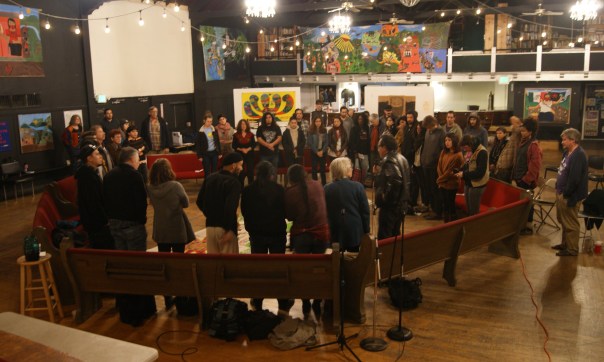
Opening ceremony at the meeting with Mexican Maya leaders held at the Omni Commons in Oakland. Photo: Fernando A. Torres / La Opinión de la Bahía
By: Fernando A. Torres / La Opinión de la Bahía
December 7, 2017
In a meeting catalogued as an “extraordinary” opportunity, residents of the city of Oakland had the opportunity to learn –in the voice of some of their own protagonists– details about the process of indigenous autonomy and self-determination through which Mexico travels.
On an information tour, the Maya leaders and representatives of the University of the Earth in Oaxaca and Chiapas, Ángel Rafael Kú Dzul and Valiana Alejandra Aguilar Hernández, stated that the so-called democratic institutions in Mexico are “falling apart,” and that it no longer matters if someone is “more to the left or the right” because “that system is dead… totally destroyed,” they said.
Marichuy: the first indigenous woman candidate to the presidency
The leaders also reported on the nomination of María de Jesús Patricio Martínez –known as Marichuy– as an indigenous candidate in the 2018 presidential elections, based on a joint initiative between the National Indigenous Congress (CNI, its initials in Spanish) and the Zapatista National Liberation Army (EZLN).
During last May and in a three-month consultation process between 543 different indigenous communities in the country, the Indigenous Government Council (Consejo Indígena de Gobierno) was created and it was agreed to seek Marichuy’s registration as a citizen presidential candidate (without a political party). Marichuy would thus become the first indigenous woman candidate to the Mexican presidency.
“Many communities said that it’s not for reaching power. We don’t want that rotten power from above. We want to recuperate the power that we peoples have of doing things: Being able to work collectively, being able to make agreements and being able to govern ourselves. We see that as a new way of doing politics. Because the candidate was elected by an assembly unlike the other candidates that assume themselves,” said Kú.
“It was and is the word of the communities that is making Mexico reverberate and is making the politicians tremble because they realize that their way of doing politics is rotten and is falling,” added Kú, a Maya from the Yucatán Peninsula and a member of the organization Ka’ Kuxtal Much Meyaj for the defense and rescue of native seeds in Campeche.
The University of the Earth: new worlds were born
They also explained the concept of the University of the Earth, a space of collective learning where the current reality is reflected on in order to create tools. “It’s more that a school, it’s an alternative to education,” said Kú.
“There are no teachers, no students, no classrooms. It’s a space for learning among each other. We must organize ourselves for that new time that is coming… We want to weave bridges and relationships with our brothers and sisters that are in the city. We know that there are people that are already organizing and that already gave birth to these new worlds and that all we need to do is to weave more, connect more,” said Aguilar, a Maya from Sinanché that has participated in different collectives, struggles and resistances related to the regeneration of the community social fabric and has worked especially with Mayan women on the Yucatan Peninsula. Currently, she lives in a small Oaxaca community and collaborates in the University of the Earth, where she coordinates the area of student exchanges and “Cultivating Dignity workshops.”
In California, the indigenous Maya leaders participated in a series of gatherings called ‘Convivial Tools,’ organized by Unitierra Califas and in Oakland by the Chiapas Support Committee (Comité de Apoyo a Chiapas) [1]. According to Aguilar, self-management and self-government are part of a new way of doing politics. “Creating a new way to govern beyond the structures of formal democracy and the institutions,” she said.
In defense of Maya culture
Kú asserted that the autonomy of the indigenous peoples is important because the non-indigenous educational institutions don’t reflect the needs of the Maya people. For example, when a young person returns from the university to the community “something changes in him or her. They return with that idea of development and want roads, Internet and more schools in the community. But for us that is not what’s most important. For us that way of seeing the developed world does not exist. We think of the world with the idea of a good life. Being able to plant our food, being able to organize, being able to make our language live and that the word of our grandparents is kept and is respected. For us, that is the good life,” said Kú.
For Aguilar, the new way of doing politics is going to achieve “creating an alternative and peacefully dismantling the regime through the exercise of power from below.”
[1] Art from the Zapatista communities was (and still is) on display at the Omni Commons during this December 2, 2017 event.
————————————————————-
Originally Published in Spanish by La Opinión
December 07, 2017
https://laopinion.com/2017/12/07/dirigentes-mayas-visitan-oakland-en-defensa-de-su-cultura/
Re-Published with English interpretation by the Chiapas Support Committee
Sub Galeano: “The PRI always needs a terrifying crime as part of its project”
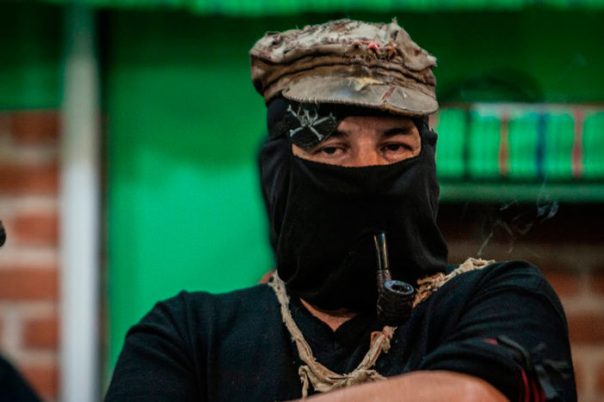
Subcomandante Insurgente Galeano in Cideci.
Chiapas, Mexico, December 27, 2017
The EZLN classified the crime this evening, especially femicide, as part of the Mexican reality, in which the dead no longer have names and pass to being numbers. The capitalist system has converted violent death into natural death, the Chiapas rebels denounced in the voice of Subcomandante Insurgente Galeano, inside the evening session of the first day of the “ConCiencias por la Humanidad” (“ConSciences for Humanity) festival with the theme “Sciences versus the wall,” in the CIDECI-UniTierra, of San Cristóbal de Las Casas.
How many murdered women do you need to ask why is this happening, the Zapatista spokesperson asked. “Capitalism is crime made system,” the Subcomandante pointed out, who also remembered the poet Juan Bañuelos, when he denounced the Acteal Massacre of 20 years ago. Before it was Acteal, now it’s Chalchihuitán and Chenalhó, “the governments put up candidates and the peoples put up the deaths,” Galeano indicated in reference to the conflict between those two neighbor municipalities that currently have thousands of displaced indigenous peoples.
With respect to the spokesperson of the Indigenous Government Council (Concejo Indígena de Gobierno, CIG-CNI) Marichuy and councilwoman Lupita of Acteal, the insurgent mentioned that organized and rebel women, mothers, daughters and grandmothers are the ones that walk and talk about “this crime called Mexico.” “Their proposal isn’t to gather signatures, it’s to join together pains and rages,” sub Galeano pointed out, with respect to the tour of the CIG and its spokesperson through Mexican territory, to make its proposal known and to be able to contend in the next presidential elections.
The Institutional Revolutionary Party (PRI) renewed its criminal persistence with its behavior. The PRI always needs a terrifying crime as part of its project, remembered the late Sub Marcos, with respect to the murder and forced disappearance of the teachers college students from Ayotzinapa, Guerrero. The families of the students don’t surrender and they persist in their demand for truth and justice, the Zapatista recognized. There is no longer the State, only a gang criminals protected in a “Homeland Security Law,” Galeano asserted.
For their part, Doctors Ramón Carrillo and Luis Suárez denounced how with capitalism patients are seen as merchandise, and diseases are just administered for their greater profit. There is negation of the sociological causality, ignored by the strictly biological vision that the health system prioritizes, they added. The biomedical model is outdated, reductionist and exclusionary, evidenced the researchers, who invited breaking with capitalist domination over medicine, returning it to its human character. “May there be doctors, so that there are no sick people,” they invited.
The physicist Nelson Ravelo questioned in front of the dehumanization in which we live: Would another science have to exist, and who would be responsible for constructing it? Doctor Alejandra Arafat, expressed from a videoconference that we dedicate ourselves or not to research, to be thinking and critical subjects, “the one who questions, bothers,” the researcher asserted and invited seeking that the benefit of the knowledge that as a species has been accumulated over time is for everyone.
Dr. Ana Luz Garza gave a detailed explanation on the evolution of geophysics from Eratosthenes to the present and about the importance of knowledge of the land for the care of natural resources. Dr. Salvatore Engel–Di Mauro, presented the theme: towards a science of soils coherent with collective struggles, from below and to the left. That is taking into account thousands of years of knowledge, as in agriculture, since there isn’t much difference between the knowledge of “formal” science and the local knowledge, which are complementary.
————————————————————-
Originally Published in Spanish by: Pozol Colectivo
Wednesday, December 27, 2017
Re-Published with English interpretation by the Chiapas Support Committee
Zapatista bases of support ask: “Do you see yourselves as rebel scientists?”
In the ConSciences for Humanity Festival Zapatista bases of support ask: “Do you see yourselves as rebel scientists?”
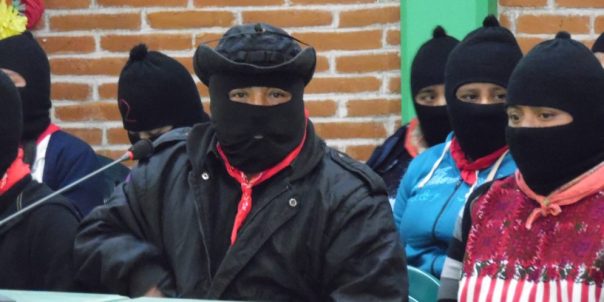
Subcomandante Insurgente Moisés opens ConSciences for Humanity Festival
December 27, 2017 – With questions about how to construct a scientific practice for confronting the storm and the walls of capital, the second edition of the “ConSciences for Humanity” festival started this Wednesday with the theme “The sciences versus the wall,” in the CIDECI-UniTierra, of San Cristóbal de Las Casas, Chiapas, México. The EZLN’s Sixth Commission, headed by Subcomandante Insurgente Moisés, was in charge of the inauguration.
The first ones to participate were the women spokespersons from the different Zapatista Caracoles of Chiapas.
From the Caracol of “Oventic”, they defined the Zapatistas as very “other” (meaning different) students, with a lot of curiosity for learning, asked the scientists: What does your heart say about organizing and struggling? What are you doing, when, where and why? What do you imagine you can do, what do you think, what makes you angry… do you see yourselves as rebel scientists?
The representative from the Caracol of “Morelia,” pointedly described how the state and federal governments operate, politically, ideologically and culturally, to ”deceive, divide and exploit” the communities by means of “social” programs and welfare-oriented political campaigns. For this reason the Zapatista communities have constructed their autonomous education, health, study of land, justice and democracy.
The spokesperson from the Caracol of “La Realidad,” emphasized that capitalism is not only out to exploit the labor force, but also the natural resources, witnessed in both the state and national context. “Don’t doubt your path, that science is for reaching that other world,” the Zapatista student exhorted in the name of her compañeros.
From the Caracol of “Garrucha,” they recalled that a year ago they were as students in the first edition del Consciences, and recognized the difficult and complicated work of science, to know how the world is formed. “Now is the time to organize collectively against the hydra,” they invited. They spoke out similarly against capitalism’s violence and death regarding women.
From the “Caracol of Roberto Barrios,” they expounded on the analogy of capitalism as a plantation (finca), where the original peoples are in resistance to said system. “May science become collective,” was their request at the same time that they remembered the late Comandanta Ramona and the 13 Zapatista demands for which they rose up almost 24 years ago.
Dr. John Vandermeer, Dr. Kristin Mercer and Dr. Ivette Perfecto, during this first day of Consciences, expounded on Agro-ecology, and how it is based on traditional knowledge, nature, political struggle and science, all to counteract the effects industrial agriculture, mono-crops and genetically modified organisms.
Agro-ecology, the researchers emphasized, is a practice, a social movement, and a science that seeks to develop new models of agriculture and forms of management that don’t contaminate the body or ways of life. For his part, Dr. Rodrigo Gómez, questioned whether medicine is sick, as well as governmental health programs, with a view to the privatization of medical service.
** You can watch and listen to the live transmission of the Consciences Festival (in Spanish) through these pages: http://conciencias.org.mx and through http://enlacezapatista.ezln.org.mx
————————————————————————————
Originally Published in Spanish by Pozol Colectivo
Wednesday, December 27, 2017
Re-Published with English interpretation by the Chiapas Support Committee
Las Abejas: The government “legalizes the war of extermination”
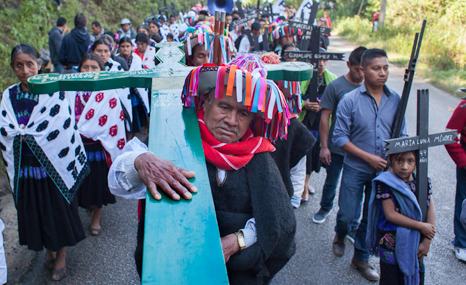
Members of the Las Abejas organization remembered victims of the paramilitary attack. Photo: Gloria Muñoz
By: Hermann Bellinghausen and Gloria Muñoz
Acteal, Chiapas
“The government wants to legalize our death,” says Guadalupe Vázquez Luna, who speaks from the back part of a farm truck facing those who walk in the procession, more than a thousand people that initiate at Majomut the commemoration of the 20th anniversary of the massacre that occurred a few kilometers ahead. Lupita, a survivor of the massacre, refers to the recently promulgated Homeland Security Law as “a law that murders.”
The political and religious march and commemoration of the massacre of defenseless civilians on that December 22, 1997 who were very precariously sheltered in the hollow of lower Acteal, has the seal of Las Abejas. It is an act of remembering, and also a statement about current events with direct complaints to the government for imposing the cited law, which they consider the continuation of the State policy that led to the massacre.
The recap is succinct: “A day like today, paramilitary PRIístas and (Frente) Cardenistas of Chenalhó created, financed, trained, armed and protected by the Executive Power and the Federal Army within the framework of the Chiapas 94 Campaign Plan, massacred with viciousness, premeditation and treachery 45 of our brothers and sisters,” and also four that had not yet been born.
Later, during the solemn event framed within the campaign Acteal: Root, Memory and Hope, the 30-year old young woman, who lost nine members of her family at age 10, is in charge of reading the official comunicado the 20 years since the massacre and 25 years “of struggle and organization” of Las Abejas. And it says: “We find ourselves with the news that the bad government of Enrique Peña Nieto has made an unconstitutional law so that its Army can continue committing, now ‘legally,’ grave human rights violations. It wasn’t enough for this criminal government to legalize the dispossession of our lands and territories with its structural reforms; with the approval of this Homeland Security Law the bad government confirms its war of extermination against the indigenous and non-indigenous peoples, as it was applied in Acteal.”
Lupita, the first woman to receive a staff of command so that she represents Las Abejas on the Indigenous Council of Government of the National Indigenous Congress, refers to one of the most sinister parts of that disgrace: “We will never forget the pregnant women whose wombs were opened, removing their babies as a message of wanting to finish off their seed.
This spot, sometimes called Los Naranjos, continues being the site of an unforgettable tragedy, of a scar that still hurts, and moreover, still bleeds. Upon bringing up “the Other Justice,” the message of the indigenous emphasizes that the treacherous attack was against a peaceful and organized Tzotzil people.
“Our experience of horror and desperation because of being literally hunted for almost seven hours, hurts us to tell all that, because it’s as if that hell had occurred yesterday,” Lupita expresses. “We want our young people to know well what happened, we have to share with them and train them so that they follow the example of our struggle and that way the memory of our people will be flourishing forever.” The system of Mexican justice “is now out of date,” the Tzotzil organization decides, “as peoples we have proposed constructing a dignified and lasting justice.”
The climactic moment of the message of Las Abejas adopts the character of a sentence by inviting the crowd “to symbolically condemn the intellectual authors of the massacre,” in order “to avoid that they continue committing more crimes against the Mexican people.” The audience stands up and utters the word “guilty,” when the communiqué names “the criminals.” It lists the nine officials that acted in the chain of command of the genocidal operation, starting with then president of the Republic, Ernesto Zedillo Ponce de León. By the way, he would be the only one of all those named that didn’t resign his position after the massacre. One after the other, all are declared “guilty” by the crowd.
The following also participated with the Indigenous in the commemoration: Raúl Vera, the Bishop of Saltillo (called Tatic in Chiapas), various former Catholic parish priests of Chenalhó, representatives of indigenous organizations and of national and international solidarity organizations, including an envoy from the United Nations Organization. Bishop Vera states that: “the stain of death that moves through Mexico” is illuminated thanks to the “fountain of hope that doesn’t turn off,” represented by the memorable struggle of Las Abejas.
Next, Pedro Faro, from the Fray Bartolomé de las Casas Human Rights Center (Frayba), an organization that has accompanied the survivors for 20 years, insists that it is demonstrated before national and international bodies “the Mexican State’s responsibility in the creation, training and support of paramilitary groups” and in the counter-insurgency strategy elaborated by the Secretariat of National Defense. Now, indicates Faro, “the armed forces have their Homeland Security Law, which means that the Mexican government affirms its language of war.”
Once again today, like two decades ago, the Frayba denounces the population exodus, on this occasion in the neighbor municipality of Chalchihuitán, and the community destruction “as a result of the government’s contempt for the original peoples, and the lacerating impunity that for decades has created roots in these lands.”
——————————————————–
Originally Published in Spanish La Jornada
Saturday, December 23, 2017
https://www.jornada.com.mx/2017/12/23/politica/002n1pol
Re-Published with English interpretation by the Chiapas Support Committee
Paramilitaries continue shooting at us, the displaced lament
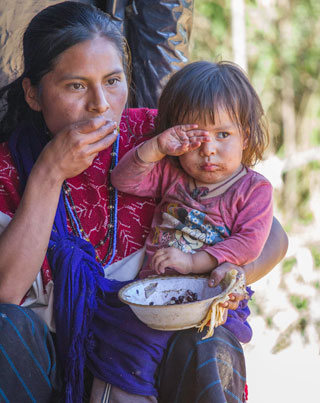
“Just yesterday they fired shots in Panacam,” a Tzotzil woman affirms in the shelter established in the municipal capital of San Pablo Chalchihuitán (image, surrounded by other women and various children. Photo: Moysés Zúñiga
In Chalchihuitán fear and dispossession live and breathe in 4,000 displaced
By: Hermann Bellinghausen
San Pablo Chalchihuitán, Chiapas
“We don’t believe that negotiation is even useful. Just yesterday they fired shots in Pacanam, the problem has not ended,” says a Tzotzil woman in the shelter established in the capital of this municipality. They surround her, expectant, other women and numerous children in a scene that is constantly repeated. Although they begin to receive food, blankets and games from the Mexican Red Cross, the lack is total.
Dispossessed of their homes and crops, they lost their belongings, stolen or burned by armed residents from the neighbor municipality of San Pedro Chenalhó that obliged them to flee shootings since October 18 to take refuge inside Chalchihuitán, far away from the territorial strip in dispute, a fight that in two months already cost at least eleven lives, nine of them because of sickness and extreme fragility.
The defenselessness of those displaced from Chalchihuitán is total. That’s why they reiterate in the different camps that La Jornada visited “we cannot return, the shooting continues.” Although representatives of the municipalities in conflict met in San Cristóbal de Las Casas on December 21 with federal and state authorities and reached certain agreements to decrease tension, the displaced are not confident.
“The government does nothing when they are killing us and now it says that there is no problem now, that they are going to distribute aid to us. Right now I’m hungry. That’s how we all are, with children and grandmothers. All our chickens were in the house, we lost it two months ago,” says Vicente Pérez Gómez, the representative of Tzomolton, who has counted 423 people from his community outside a grocery store, with some plastic canopies and bars.
The current humanitarian crisis between this municipality, officially “one of the country’s poorest municipalities,” and Chenalhó, obeys a territorial conflict that dates back to 1976 and that one month ago reached it’s most critical moment in 40 years. On October 18 an armed group coming from Chenalhó attacked Chen Mut, burned nine houses and murdered Samuel Luna Girón. Then and in the following days, some 7,000 people, one third of the municipality’s population, abandoned their homes and parcels of land. An official census estimates that now there are close to 4,000 displaced from Chenalhó.
On December 3, Raymundo Luna Pérez, age 17 and also from Chen Mut, deliberately ingested the herbicide Paraquat and died December 17.
A medical brigade that toured the shelters this week describes that the Indigenous sought refuge “in the face of shots from firearms that even during our stay we were able to hear; the population is concentrated in strategic places in their small communities, in spaces like the basketball court or some church, to later at night go up to the mountains and thus protect themselves from a possible attack. The necessity of seeking refuge in the mountains, outdoors in the region’s rains and low temperatures, made the respiratory illnesses more acute.”
According to the medical brigade from Community Health and Development (Salud y Desarrollo Comunitario) and House of the Woman (Casa de la Mujer), “there was cold, hunger, isolation, uncertainty, fear and the omission of government authorities, added to a population that lives in extreme poverty, determinant of the deaths.”
The communities displaced totally or partially because of the conflict are: Pom, Kanalumtik, Tzolmonton, Cruztón, Chen Mut, Tulantik, Bejelton, Cruz Kakanam and Bololchojón. Nine encampments exist in Chalchihuitán.
On the edges of Kanamultic one can see houses burned and shot up with heavy-caliber weapons. In a wide canvas and plastic enclosure in the center of the town, Marcela Luna Girón, sister of Samuel, the murdered indigenous man, tells in Tzotzil when the shooting began and how she “has been suffering” for two months.
Just this Friday the displaced started to receive some governmental aid, while from Majumpepentic, Chenalhó, as of today they are shooting every afternoon to prevent them from returning to their homes distributed among the coffee fields.
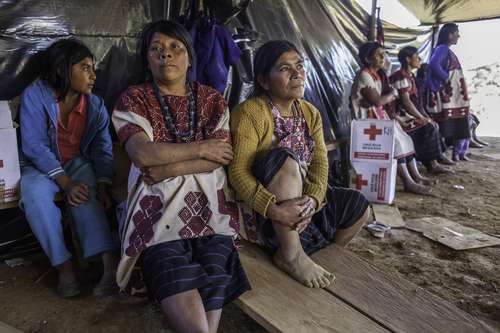
A few meters from the entrance to Chalchihuitán are found the first of many encampments where the refugees just started to receive aid from the Red Cross. Photo: Moysés Zúñiga Santiago.
They mention that shots come from the house of Miguel Silla Pérez. Other shooters are identified as Antonio Pérez and, in Fracción Polhó, Fernando Ruiz. Detonations were still heard last night from Pechiquil, a village that in 1997 was a paramilitary base. Twenty years later it still is.
“Those from Chenalhó aren’t afraid of the soldiers, they are not going to disarm them,” comments Juana Pérez, from whom they stole two pigs, 30 hens and all the rest. She left running with what she is wearing today. She doesn’t think it’s possible to go harvest the coffee, now that it’s time for that. A young woman that translates for the older women and carries a baby comments: “Their weapons are more powerful. We learned to recognize them. The new ones sound different, like an explosion.”
These refugees still don’t know that the government offers their attackers tablets in exchange for their weapons. Without being too cynical, one can ask what is more coveted here in these hollows, that apparatus or a high-powered weapon.
In the capitals of both municipalities one observes feverish activity of dozens of Civil Protection workers that bring aid, but nothing indicates that the problem will be solved. Pneumonia and diarrhea, cold, fear and dispossession reign in Chalchihuitán.
————————————————————–
Originally Published in Spanish by La Jornada
Sunday, December 24, 2017
http://www.jornada.unam.mx/2017/12/24/politica/013n1pol
Re-Published with English interpretation by the Chiapas Support Committee
Wishing you Happy Holidays and please support the Zapatistas

Dear friends & supporters of the Chiapas Support Committee:
Indigenous communities, with the Zapatistas leading the charge, hit Mexico with dramatic and powerful changes in 2017.
And we are asking you to match that Zapatista verve by making a generous donation to send to the Zapatista communities.
Your donations will be a powerful message of solidarity with their initiatives and work building Indigenous self-determination and autonomous communities. You can click here to make your donation on-line or see address below to send it in the mail!
Indigenous Council of Government & Marichuy
The National Indigenous Congress and the EZLN, the Zapatista National Liberation Army, implemented their historic decision to create the Consejo Indígena de Gobierno (CIG, Indigenous Council of Government) with the task of uniting Indigenous people everywhere in Mexico in an anti-capitalist movement and recovering indigenous power and autonomy. The CIG also selected María de Jesús Patricio Martínez, lovingly dubbed Marichuy, to be their spokesperson and candidate to run in Mexico’s 2018 presidential elections.
Marichuy began her campaign in Chiapas visiting and speaking with thousands of people in Zapatista territory and other places to unfold her campaign and to discuss and dialogue about the dreams and struggles indigenous people are undertaking to stop political violence and repression in Mexico.
According to Mara Kaufman in “Mexico’s Indigenous Governing Council: Actually Existing Anti-Capitalism for the 21st Century,” Marichuy’s candidacy is not about getting votes or winning elections. The Indigenous Council of Government is using the electoral process as a critical space to denounce Mexico’s capitalist system, which it holds responsible for the devastating violence, crumbling institutions, environmental destruction and the complicity with the drug warlords that dominate Mexico. The campaign is promoting the expansion of assembly-based community self-organization and provides the Mexican people entirely different forms of government.
Building the Art of Solidarity & Justice
In 2017, the Chiapas Support Committee organized several activities and built new initiatives to deepen awareness of the critical role and work of the Zapatistas, the crisis in Mexico and building community here in the U.S. to create the relationships and shared vision of the challenges facing us in the U.S.
In 2017, the Chiapas Support Committee:
- Started “Waffles & Zapatismo,” an educational and activist training forum held once a month on Saturday mornings. Participants learned and discussed the roots of the Zapatista rebellion, the EZLN’s history of organizing, the work their communities have done to build autonomy and the global work the EZLN has carried out since 1994 building a world movement against neoliberalism and for humanity. The last session of “Waffles & Zapatismo” ended in December with two Mayan indigenous organizers from Oaxaca who shared their insights on the Indigenous struggles for autonomy, self-determination and the impact of the CIG and Marichuy campaign on Mexico. Dozens of activists and community members participated in “Waffles & Zapatismo.”
- On August 12 at the Omni Commons in Oakland the CSC held the second annual daylong “CompArte: The Emiliano Zapata Community Festival,” a parallel event to the CompArte being held in Mexico by the Zapatistas. Calpulli Huey Papalotl opened CompArte with a danza ceremony invoking the four directions. Rounding out CompArte, the CSC brought together four bands playing son jarocho, African/African American percussion, blues/jazz and Latin American music and offered workshops on Zapatismo, Danza Azteca, Son Jarocho and the work to create a new language of solidarity organizing rooted in the tradition of the freedom underground railroad; six poets presented their work and five painters had their work displayed during the festival. Some 200 people came through the CompArte gathering to enjoy the culture and art of community in resistance against capitalism.
- Co-sponsored with the Eastside Arts Alliance the exhibition of the CompArte paintings at Oakland’s Asian Resource Center; and
- Exhibited the 2016 CompArte paintings and artwork from the Zapatista communities at the Omni Commons and sold the coffee by the pound that the Zapatista communities had explicitly sent to the U.S. to raise money to be donated to community organizations defending migrant rights and justice. The CSC raised over $1200 that will be donated to an immigrant rights organization in Oakland on behalf of the Zapatista communities.
- The Chiapas Support Committee also distributed hundreds of articles with English translation from the Zapatistas, from indigenous and anti-capitalist organizers in Mexico and Latin America on our blog and in both Spanish and English on our Facebook page, providing key perspectives and analyses on political developments. The CSC also published two print newsletters, including a special edition for the CompArte: The Emiliano Zapata Community Festival.
- To celebrate the 34th anniversary of the EZLN, the CSC premiered the feature documentary, “Zapatista Moon,” on November 18. Over 200 attended the film screening that was followed by a roundtable discussion by an all-women panel with Indigenous, African and Latina women voices that critiqued and provided fresh perspectives on the role and power of women and the fight for gender equity and justice.
- Raised funds for Mexico earthquake victims and sent 2 large donations to the Digna Ochoa Human Rights Center in Tonalá, Chiapas.
Your Donation is Solidarity with the Zapatista Struggle for Justice
Your donation will help the Chiapas Support Committee continue building relationships and activities that will be critical in the New Year to tear down the walls of capitalism and create kind and caring relationships in community.
Our activities and political struggles to break the capitalist walls in 2018 will intensify. Getting information and organizing into our communities, into the hands of activists and organizers in Oakland and throughout the U.S. will be key to mobilizing support for the Indigenous communities in Mexico and expressing solidarity with the Zapatistas.
Please visit this link to make an online donation via PayPal:
Or mail your donation to:
Chiapas Support Committee
P.O. Box 3421
Oakland, CA 94609
NOTE: Make your checks or money orders payable to Chiapas Support Committee
The Chiapas Support Committee will continue to provide education and training opportunities rooted in Zapatismo for community organizers and activists, convene educational forums and discussions and bring culture and leadership from the Zapatista communities to Oakland and beyond. Together we can make a powerful difference to push back against the capitalist war of plunder and destruction of people and communities.
Your generosity will create new bonds and relationships so that together we can imagine how to topple the walls of capitalism surrounding our communities here and in Mexico and extend our hands to each other in sisterhood, brotherhood and transhood.
Wishing you a happy, healthy and safe holiday season!
For Peace, Justice & Solidarity,
Jose Plascencia, Chair, for the
Chiapas Support Committee
Alicia Bravo
Carolina Dutton
Arnoldo Garcia
Laura Rivas-Andrade
Mary Ann Tenuto Sánchez
Marichuy in University City
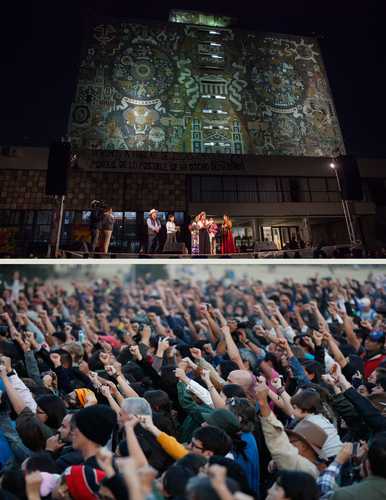
Last November 28, María de Jesús Patricio Martínez, Marichuy, visited University City. Thousands listened to her, many dialogued with her and talked about the reason for her candidacy. Photo: Carlos Mamahua
DISPOSSESSION, GRIEVANCES, PROPOSALS
By Adolfo Gilly
Last November 28, María de Jesús Patricio Martínez, Marichuy, visited our University City to dialogue and explain her candidacy and her program to a crowd of students and professors that, having as a protective backdrop the big mural of Juan O’Gorman, the one in which Copernicus and Ptolemy cross and meet, listened attentively and with applause to the words and proposals of Marichuy.
Martín Esparza, of the Mexican Electricians Union; Mario Luna, representative and leader of the Yaqui peoples of Sonora; Araceli Orozco, mother of Lesvy; two UNAM students, Amiel Moreno and Elena González; and Bettina Cruz, an indigenous organizer from Juchitán (Oaxaca) accompanied her on the platform. Botellita de Jerez and Café Tacvba added music and festivities.
A banner hung at the foot of the O’Gorman mural summed up the flower of utopia: “We come to talk about impossible things, because too much has been said about the possible.” It brought to mind the words of Marc Bloch, historian, soldier and combatant of the French resistance, shot by the Nazis: “By dint of utopias, reality finally appears.”
I found on the esplanade compañeras and compañeros of so many times and tendencies of the left and among the used books for sale there, appeared one of the greats of Latin America, the Peruvian Manuel Scorza, with his novel Redoble por Rancas, which tells us about the Peruvian times of dispossession, anger and avenger myths.
* * *
What did the candidate of the Indigenous Government Council say and propose? Here I reproduce, better than any chronicle, her very own words in some of the paragraphs of her message:
“Now more than ever, we need education to be critical, scientific and in accord with the reality of this multicultural nation in which the native cultures have always been denied. The foregoing is in order to stop that there is training to instruct operators about dispossession, about excessive production, about the justifiers of the social, political and environmental to which this capitalist system has subjected us, that education stops being the seedbed for the alienation of the peoples in our communities and in the cities; in other words, that it stops being part of sea the gears that make the capitalist system function.”
“We need education to be free and popular because rights must not be begged for or converted into merchandise, but rather vindicated and exercised without fear for the construction of new forms and horizons.” […]
* * *
“And we tell you that we are and we will be, because the pain and rage that the original peoples have is also because of seeing our dead, disappeared, incarcerated for defending what is life for us. We have pain and rage over impunity in the face of thousands of femicides, because of the systematic violence that women of the countryside and the cities experience day after day and that makes us say “enough, the time for women has come.” And have no doubt! We want it all.”
“Because our struggle our commitment is very great and we must not stop constructing, with dignity, the Mexico in which women never again falter on the path and in the work to heal our homeland.” […]
“We say that because we come seeking something much bigger and more important, we come seeking the collective conscience of below, which we have seen born and flourish in organized students and who have taught us a lot with their dignity and determination.”
“Proof of that is in the historic struggles waged by students in 1968, 1986 and 1999, which remind us that it’s also your time and that you are not only the future, but also the present, and not just of Mexico but also of the world. Today we say that along with that apprenticeship in the historical memory of university students and rebel youth, it’s time to promote and construct from the collective thought and action of the original peoples and from the dignity and strength of the struggle of the women that rebel and organize the new world that is reclaiming history.” […]
“To you, the conscious youth, the creators and multipliers of arts and sciences, we recognize you as a great light in the midst of so much death and darkness, we need you to continue dreaming, fighting and making larger all the time that which the powerful fear so much, which is called democracy, liberty and justice.”
* * *
“To all our brothers and sisters of this great city, now deeply torn, trapped I networks of violence and organized crime, torn to pieces every moment by the ambitions of big real estate capitals, to whose decisions all the public powers and all the parties of the politics of above are subjected, we want to tell you that it’s time to rebuild this city and this country from below and to the left, renewing the solidarity of everyone, which on previous occasions has distinguished you, during the earthquakes in 1985, in the recent earthquakes, on occasions when the effort and unity are demanded of the thousands and thousands that with your daily work make the city’s life possible.”
“The cities are par excellence the space in which capitalism is reproduced nonstop; the space and time of cities are organized to satisfy the reproduction of the capitalist system. Exploitation, dispossession and disrespect are permanent times in the existence of the cities.”
“What it’s about is that those below of this city, together with the native indigenous peoples and residents that inhabit it that are cornered, gradually but steadily losing their old territories, or living and working in subhuman conditions, organize joyous rebellion and anticapitalist resistance, seeking to hit the al monster in its heart at the same time that a new really just, free and democratic city is constructed.”
* * *
María de Jesús Patricio Martínez, Marichuy, in University City, spoke her words about land, work and life, against dispossession, money and death. It’s up to us to listen to them, consider them and decide.
————————————————————-
Originally Published in Spanish by La Jornada
Monday, December 4, 2017
http://www.jornada.unam.mx/2017/12/04/opinion/010a1pol
Re-Published with English interpretation by the Chiapas Support Committee
Agrarian Court rules in favor of Chenalhó in Chiapas territorial conflict
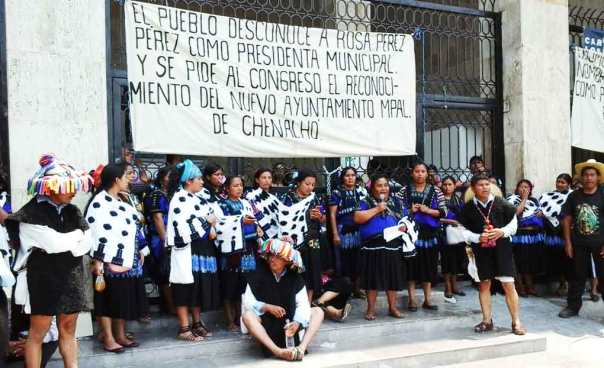
“The people don’t recognize Rosa Perez as the municipal president of Chenalhó and we ask that Congress recognize the new municipal council of Chenalhó.”
By: Isaín Mandujano
TUXTLA GUTIÉRREZ, Chiapas (apro)
After the Unitary Agrarian Tribunal (UAT) ruled in favor of the communal wealth of Chenalhó, the state and federal governments offered 300 houses and 15 million pesos to compensate the five thousand people displaced from Chalchihuitán.
This Wednesday (December 13), the parties in dispute were called to the UAT’s installations in Tuxtla Gutiérrez, where the resolution was issued that put an end to the dispute over the territorial limits between Chalchihuitán and Chenalhó.
Claudio Aníbal Vera, magistrate of the UAT #3, presided over meeting, and the mayors of both municipalities, Martín Gómez Pérez (Chalchihuitán) and Rosa Pérez Pérez (Chenalhó) were present.
Manuel de Jesús Pano Becerra, coordinator of state government advisors, Jorge Valdemar Utrilla Robles, assistant Secretary of Government and Human Rights, and Pedro Héctor Gil Ajuria, advisor to the Secretariat General of Government, were also present.
Another 20 people –between communal wealth authorities and traditional authorities from both municipalities– were also witnesses to the resolution about the land tenancy in conflict.
Magistrate Claudio Aníbal Verales read to both parties the definitive decision that returns to Chenalhó the more than 350 hectares of land that the Secretariat of Agrarian Reform (SRA) had erroneously given to Chalchihuitán in 1973.
The ruling determined that the Secretariat of Agrarian, Territorial and Urban Development (Sedatu) would be charged with re-measuring two landmarks that are found at the territorial limits of both municipalities.
Prior to the hearing, the agreement and definitive resolution of September 23, 2015 was ratified, which indicates that whatever the ruling, both groups would respect the decision of the Unitary Agrarian Tribunal.
The matter concluded, the Chiapas government issued a check to Nicolás Pérez Girón, ejido commissioner of Chalchihuitán, in the amount of 15 million pesos to compensate for the damages caused by the decision.
However, the document remained under the UAT’s guard because the municipal president of Chalchihuitán didn’t want to sign it, because in order to receive it –he said– he has to ask for the consent of the majority of the people that he governs.
For its part, the Sedatu committed to constructing 300 houses for those displaced in the municipality of Chalchihuitán. It assured that the work would start in January 2018 and the cost per house would be 120,000 pesos.
The Secretariat General of Government reported that after learning of the UAT’s ruling, Chenalhó municipal agents carried out the work of rehabilitation of the road that connects with Chalchihuitán, at the spot where the community of Las Limas is located, and as a result vehicular traffic was reestablished in the zone.
The head of that department, Juan Carlos Gómez Aranda, indicated that per instructions of Governor Manuel Velasco Coello an institutional presence was reinforced in communities in both municipalities, through the Secretariats of Civil Protection, Health and Citizen Security and Protection, as well as the state DIF.
Similarly, he specified that the state government would request the support from the United Nations Organization (UN) to make said presence more effective in Chalchihuitán and Chenalhó.
“It’s appropriate to emphasize that during the Unitary Agrarian Tribunal’s session, the municipal president of Chalchihuitán left the premises, in disagreement with the decision,” he pointed out.
And he clarified that the municipal council is not part of the lawsuit, but rather only representatives of the communal wealth, who ratified out loud its decision to respect the decision of the jurisdictional authority.
———————————————————————————
Originally Published in Spanish by Proceso.com.mx
Wednesday, December 13, 2017
Re-Published with English interpretation by the Chiapas Support Committee
Four children and 2 adults displaced from Chalchihuitán die from cold and hunger
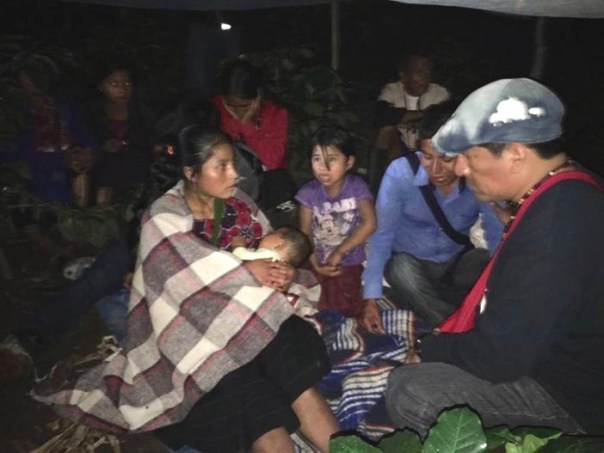
Those displaced from Chalchihuitán are living outdoors in the winter.
By: Blanche Petrich
Four displaced children died from cold and hunger last week in the icy parts of Chalchihuitán, in the Chiapas Highlands. Two adults also died, according to what the municipal president municipal of that municipality, Martín Gómez Pérez, reported. More than one thousand people remain in the mountains, spending the night in caves or under trees, away from their communities, for fear of death threats from paramilitary groups that, according to what the mayor denounced, were armed by the municipal president of Chenalhó, Rosa Pérez.
One of the little ones that died was three days old. His mother gave birth outdoors. The others were four years. Two adults also died recently. The temperatures get down to close to zero degrees during the night and at dawn in that mountainous zone.
On Saturday, former municipal presidents and agents of Chalchihuitán arrived at the parish of Simojovel to speak with the parish priest Marcelo Pérez and to make the denunciation. “We don’t have anything to care for the people. There is no medicine or food, and many are sick because they have been living away from their homes almost two months now. We don’t even have the means to move the most seriously ill, because the roads remain blocked,” the municipal president reported to this newspaper in a telephone interview.
The children that died were from the communities of Pom, Canaluntik and Telmut. To date, the residents of those sites remain displaced, the same as Bolonchojón, Cruztón and three other places. “What’s happening is very sad and unjust. I no longer know what to do. We have no help, nobody listens to us,” Gómez Pérez expressed.
Last week the Fray Bartolomé de las Casas Human Rights Center and the parish priest of Simojovel, Marcelo Pérez, denounced that because of the murder of a Tzotzil from Chalchihuitán, Samuel Pérez Luna, on October 18, thousands of people fled from their homes, and within a few days they added up to around five thousand people displaced.
The local media have recently asserted that the displaced have already returned to their homes and that the highways that connect the towns of Chalchihuitán with San Cristóbal de las Casas are now clear. “That’s a lie. We remain kidnapped in our communities. Shots from high-caliber weapons are heard from Panajó and Nichcacanam at this moment” the municipal president assured.
Last December 4, residents and authorities from the Chalchihuitán communities under siege went to Tuxtla Gutiérrez to denounce the situation and to ask for a meeting with the state’s governor, Manuel Velasco Coello. “But he didn’t receive us. Please excuse what I’m going to say, but the governor treats me like a dog. We have only been able to speak with a few lawyers and engineers that just talk, but don’t give care to the people.”
An old boundary conflict between the municipalities of Chalchihuitán and Chenalhó has generated conflicts in the zone for years. This coming December the agrarian tribunal must resolve the control of close to 900 hectares in dispute. “According to what those of Chenalhó say, if the decision doesn’t favor them they are going to go kill us. We’re living with that threat.”
Last November 16, at a negotiating table, the mayor of Chenalhó, Rosa Pérez, from the Green Party and close to the governor, committed to ordering removal of the roadblocks, which are kept under the control of about 200 armed men. The municipal president maintains: “But that wasn’t fulfilled. To the contrary, each time there are more shootings and then they tell us that there are no displaced. We are not inventing anything.”
On December 10, in the meeting held in Simojovel, the ex municipal presidents, agents and authorities of Chalchihuitán agreed to demand from the Chiapas government that: “the roads to San Cristóbal will be opened at the latest the day after tomorrow, December 12.”
———————————————————–
Originally Published in Spanish by La Jornada
Monday, December 11, 2017
http://www.jornada.unam.mx/2017/12/11/politica/014n1pol
Re-Published with English interpretation by the Chiapas Support Committee
Silent insurrections
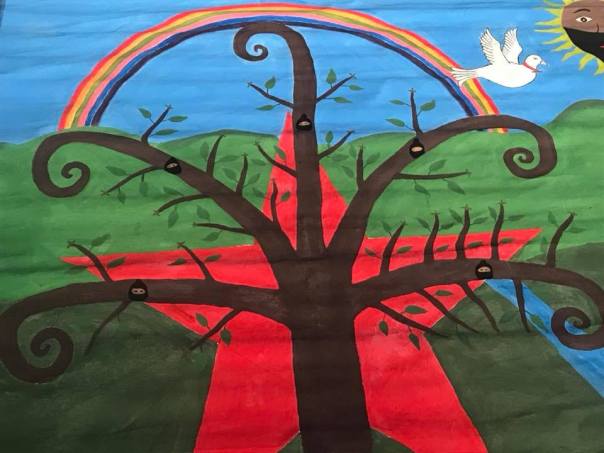
A work of art sent from the Zapatista communities and currently on display in the Ballroom of the Omni Commons in Oakland.
By: Raúl Zibechi
Big changes always begin through small movements, invisible to the analysts of above and to the big media, as one of the communiqués from Zapatismo points out. Before thousands of people occupy the big avenues, underground processes take place where the oppressed “rehearse” the uprisings that they later make visible in the mass events that academia calls social movements.
Those changes that happen in daily life are produced by groups of people who have direct relationships with each other, they are not easy to detect and we never know if they will be converted into mass actions. Nevertheless, despite the difficulties, if we sharpen our senses it’s possible to grasp intuitively that something is changing.
Something like that seems to be happening in the countries of Latin America. A Brazilian compañero considered, during a meeting of geographers with social movements (International Symposium of Agrarian Geography, SINGA), that in this country we are facing a “silent insurrection.” Intuition is based on real facts. In the bosom of social movements and in society’s poorest spaces, women and youth are leading the changes; they are displacing the place assigned to the State and the market.
Real movements are those that modify the place of people in the world when they move collectively and tear the fabric of domination. On this point, it must be understood that there is no direct or mechanical cause-effect relationship, since predictions about human relations are not possible because of the complexity that they contain and because of interaction with a multiplicity of subjects.
In recent years I was able to observe this tendency of silent changes inside several movements. Among the indigenous of southern Colombia, groups of Nasa and Misak youth re-engage in the struggle for land that had been paralyzed because of leaders that focused on the expansion of relations with the State that provides them abundant resources. Something similar seems to be happening in southern Chile, where a new Mapuche generation confronts state repression with renewed forces.
Among the consolidated campesino movements, where potent leadership structures exist, women and youth are engaging in debates and proposals of a new kind, which include the mobilization and organization of individuals who define themselves LGTB (lesbian, gay, trans-sexual and bi-sexual).
We also observe a growing activism in the bosom of traditional movements of black militants that construct Quilombos [1] and Palenques, [2] even in universities, as can be appreciated in Brazilian and Colombian academia where they open their own spaces.
During the (Zapatista) escuelita (little school) they explained to us that half of the Zapatistas are under the age of 20, something that we were able to appreciate. The participation of young women is notable. Those who participated in the art and science gatherings the Zapatistas convoked emphasize this reality. In other movements the organization of boys and girls appears with assemblies that exclude their elders.
What reflections can we make about this silent insurrection, which spreads to all of society and particularly to the anti-systemic movements. Without seeking to exhaust an incipient debate, I propose three considerations.
The first is that the insurgencies underway of women, of black and indigenous peoples and of young people in all the popular sectors, are impacting the interior of the movements. On the one hand, they are producing a necessary generational change without displacing the founders. On the other hand, that change is accompanied by ways of doing things and of self-expression that tend to modify political action in directions that the one who writes these lines is not capable of defining clearly.
The second consideration is of a qualitative character, closely related with the first. The youth/feminine irruption is a carrier of questions and cultures elaborated inside of the movements, with their own characteristics. The women of below, for example, don’t hoist the classic feminist discourse, nor that of equality of difference, but rather something new that I don’t dare conceptualize, although there are those who mention community, black, indigenous and popular feminisms.
The desire of the Zapatista youth to show their music and dance is something more than an artistic question; it’s the same as their questions about science. In some cases, like the Mapuche or the Nasa, changes can be observed that, from outside, we can evaluate as a radicalization that doesn’t focus only on forms of political action, but also on the recuperation of traditions of struggle that their elders had almost abandoned.
The third consideration, and perhaps the most important, is that the irruption of the women and youth from below is profiling another conception of revolution, which is separate from the traditional theory of Leninist style revolution. Another question appears here: how is politics done in quilombo/Palenque code? How is politics in woman code? I’m not referring to the participation of women and youth from below in already existing structures.
The peoples themselves will give the answers that are opening new paths, although the analyst from above always tends to see them with eyes and concepts of the past. It’s about constructing (new institutions), more than about occupying existing institutions. They are creating new worlds or new societies, if you want to name them with the old concepts: one’s own powers, one’s own grassroots justice, sometimes traditions and at other times the common sense of the peoples; health, education and ways of occupying space based on non-capitalist logic.
The world, our world, is changing rapidly. Rejecting those changes would be like annulling the transformative capacity that is burying capitalism and building a new world above its shambles.
[1] Quilombos are towns in Brazil formed by escaped African slaves
[2] Palenques are towns in Colombia formed by escaped African slaves
———————————————————–
Originally Published in Spanish by La Jornada
Friday, November 10, 2016
http://www.jornada.unam.mx/2017/11/10/opinion/020a1pol
Re-Published with English interpretation by the Chiapas Support Committee
 Chiapas Support Committee