
Send messages, photos, videos and art in solidarity with the Zapatista communities and to denounce the State violence and government-backed paramilitary and narco gang attacks on the Zapatistas, demanding justice and a dismantling of the paramilitary and narco gangs to: porchiapaz@gmail.com
A report by the Chiapas Support Committee
The Zapatistas have maintained autonomous self-government in their territories in Chiapas ever since the successful and unexpected uprising of 1994. Last year, for the third or fourth time since that uprising, the Zapatistas announced a major restructuring of their organization of autonomy. They explained that the system of juntas and municipal zones had resulted in an overly hierarchical structure, and they were abolishing the juntas and inverting the pyramid of power so that the communities had more decision-making power at the base. The new governing entities, called Local Autonomous Governments, (Gobierno Autónomo Local or GALS) have been created at the community level. Traveling through Chiapas these days one see signs for GALS everywhere in Zapatista territories.
The Zapatistas contend that the new structure inverts what had evolved into a pyramidal structure. Formerly, communities would send representatives to the municipalities, then from the municipalities, representatives would be sent to the juntas at the caracol/zone level. Decisions made at the junta level would then go back down to the communities. The establishment of the GALS was to provide structure by which certain decisions would be made directly in communities themselves. We do not know what areas of decision-making are being relegated to the communities, but in a recent trip to Chiapas by members of the Chiapas Support Committee (CSC), we had several conversations that led us to believe that the new structures had reactivated and remotivated compas in the communities. For example, in one Caracol, since the restructuring, many more young people have been volunteering as health promoters, perhaps because they were motivated by discussions in their community GALs.
This major restructuring is remarkable, though not atypical of the Zapatistas, who have reinvented themselves several times over their 30 years of self-government. It is the only revolutionary, anti-capitalist organization that regularly, self-consciously, takes on the task of studying and restructuring their power structures. These recent changes were the result of years of discussions at the community level.
One other important change has been the consolidation of the ethos of the commons ” lo común” and a commitment to “non-property” (la no propriedad). The changes have enabled Zapatistas in mixed communities to work together with their non-Zapatistas neighbors. The collective working of the land was singled out as an area of “the commons” to be developed. As long as they weren’t paramilitaries or working with organized crime, neighbors of Zapatistas would be invited to collaborate on working the land, with the proceeds to be shared amongst them. In the past, Zapatistas could not work together with non-Zapatistas, even though in many cases they lived next to each other in villages where the population was mixed. There are a number of places in Zapatista territory where people have left the organization for various reasons, not necessarily, and not even preponderantly because they disagreed with the principles of Zapatista community, but because they wanted more freedom to do things like attend state schools or travel. (Zapatistas can only attend their own Zapatista schools, they are not allowed to go to official state schools).
CSC believes this restructuring is a very positive change that will lead to new collaborations. The Chiapas Support Committee recently submitted a proposal to the Zapatistas to collaborate with Zapatista communities to bolster their autonomous health system. More on that when we hear back from the compas
ATTACKS AGAINST ZAPATISTA COMMUNITIES
Zapatistas have been suffering increasing attacks from criminal groups attempting to take over their lands. Earlier this year, the two remaining Zapatista families in Nuevo San Gregorio were forced to relocate after years of attempting to defend themselves against constant aggression by armed groups. More recently, in the community of 6 de Octubre, gunmen have entered Zapatista land and are threatening the families and beginning to build homes on the Zapatista’s land. These alarming developments occur with complete impunity, despite repeated denunciations and appeals for justice.
The security situation in Chiapas has been deteriorating for years now, most notably since Covid. The presence of organized crime has reached every corner of Chiapas. There have been turf wars between the infamous Sinaloa and Jalisco Nuevo Generación drug gangs and a plethora of smaller well-armed criminal groups sprouting all over the state. For a while there was confusion about the allegiances of armed groups who called themselves “autonomous,” who claimed to be protecting the local campesinos and, in some cases, even stated their support for the Zapatista “brothers.” By now it is clear that most of them are just another group fighting for power and wealth at the expense of the communities, most likely supported by local caciques with connections to organized criminal groupings. Disappearances, beatings and jailing of activists and anybody who speaks out have dramatically increased under the governance of the so-called 4th Transformation, inaugurated by former president Andrés Manuel López Obrador of the MORENA party. Despite the constant reporting of incidents, AMLO has continued to insist that Chiapas is safe, that the violence is in-fighting between different indigenous groups. There has been little or no response from the State to bring criminals to justice at any level of government.
On the national front, AMLO’s party won the recent elections by a landslide, having won over much of the so-called left. He was very clever in apportioning out economic advantages to particular sectors, like students and the elderly, winning over huge swathes of the population. Although his rhetoric claims to be critical of neoliberalism, his acts speak all to the contrary. His successor and protege, Gloria Scheinbaum, looks to be just more of the same.
In the Southeast of Mexico, in particular, it is very clear that the capitalist compulsion to transform all social relations into money relations to the benefit of the capitalist class is the main agenda of the MORENA Party. The Morena administration has perpetrated massive devastation of the natural environment, including some of the most important forests in the Americas, through his obsession to construct the cynically-named “Maya Train.” AMLO’s policies and social programs, such as the so-called Sembrando Vida, have wreaked havoc in indigenous communities and caused the disintegration of traditional forms of indigenous life that prioritized community and agriculture. The National Guard, a new military formation that AMLO created supposedly to assist in protecting people from organized crime, is now clearly just another player in the criminal gang landscape and seems to be deployed primarily in the harassment and abuse of immigrants. In San Cristóbal, they patrol downtown regularly but whenever there is a shooting event, like the time the market was held hostage by gunman for four hours, the National Guard is nowhere to be seen. (The same is true of federal and municipal policing entities). AMLO has handed over to the military powers over civilian life unprecedented in Mexico, notably handing over to them the management of the new airport and the Maya Train.
MORENA’s strategies are designed to pave the way for big capital to enter the area and exploit the “natural resources,” including the labor pools available in the area–from peasants displaced from their lands to make way to natural resource exploitation, to the waves of migrants crossing the Guatemala border. International capital has been invited to join the party. The Zapatistas and other like-minded indigenous communities such as those belonging to the Congreso Nacional Indígena, (CNI, National Indigenous Congress), are in their way. Because in order to turn these largely indigenous areas into fodder for capitalist exploitation, the communities that have inhabited these lands despite 400 years of colonization, must be torn apart.
LATE BREAKING NEWS:
CSC announces here our horror at the assassination in plain daylight of Father Marcelo Pérez Pérez as he was on his way from one mass at the Iglesia de Cuxtitali to another at the Iglesia de Guadalupe in San Cristóbal de las Casas (Sunday, October 20, 2024). Father Pérez was known for his public defense of Indigenous and labor rights and for his open criticism of organized crime. He had to move to San Cristóbal from his native Simojovel due to threats against him by organized crime in that area. This brazen assassination of a beloved priest in broad daylight on the streets of San Cristóbal is unprecedented and indicates a new level of violence on the part of organized crime.
____________________________________________
This report was written by members of the Chiapas Support Committee.
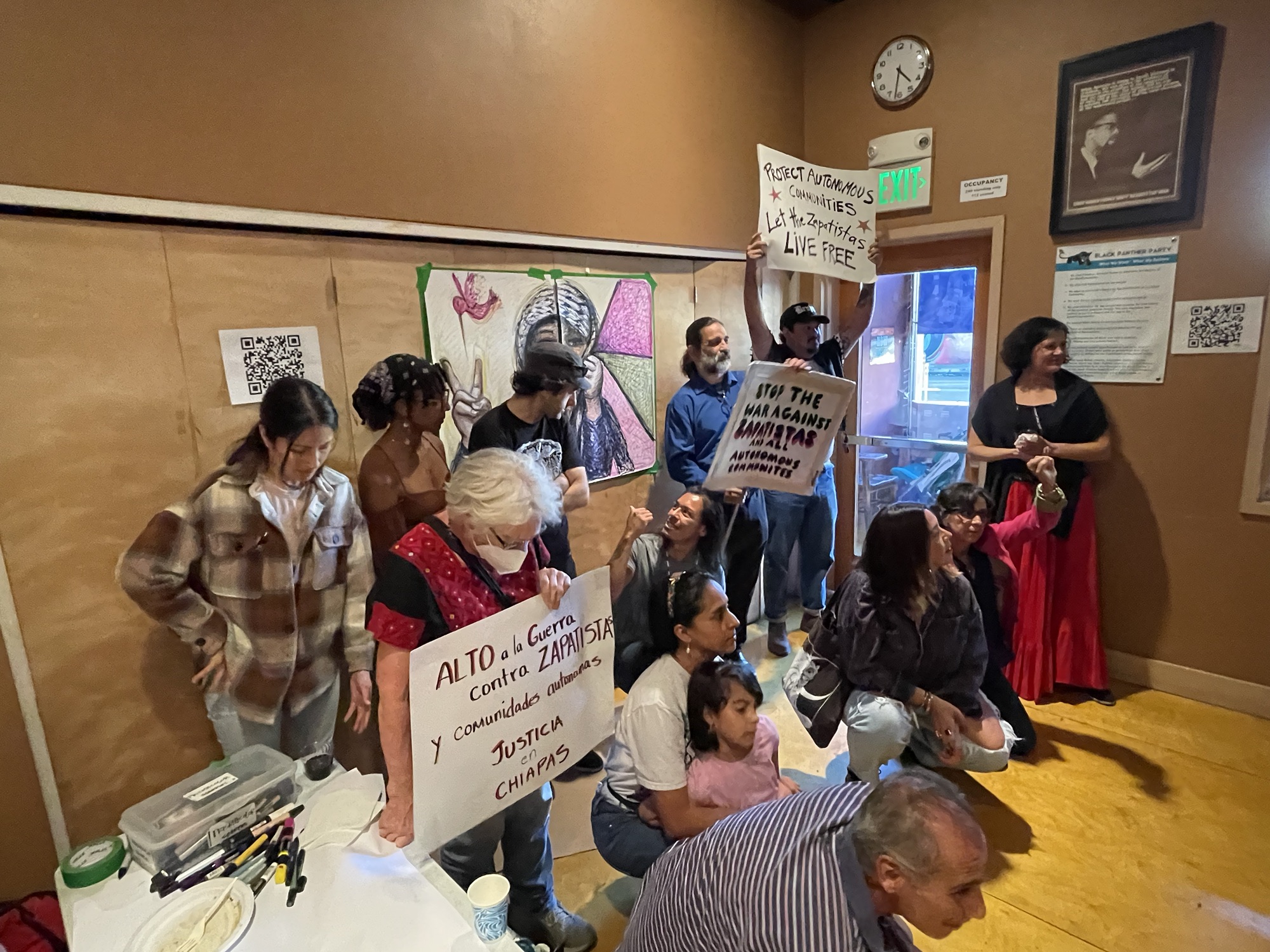
PLEASE TAKE ACTION: Send messages, photos, videos and art in solidarity with the Zapatista communities and against the State and government-backed narco and paramilitary violence against the Zapatista communities. Send them to porchiapaz@gmail.com
 Chiapas Support Committee
Hi Arnoldo, Please change the title to: Zapatista communities attacked with impunity, or somerthing tlike that. It is not really correct to say it is “governmentr-backed”
thanks for the quick posting!!!!