Chiapas Support Committee
Home of the Compañero Manuel blog on zapatistas & mexico
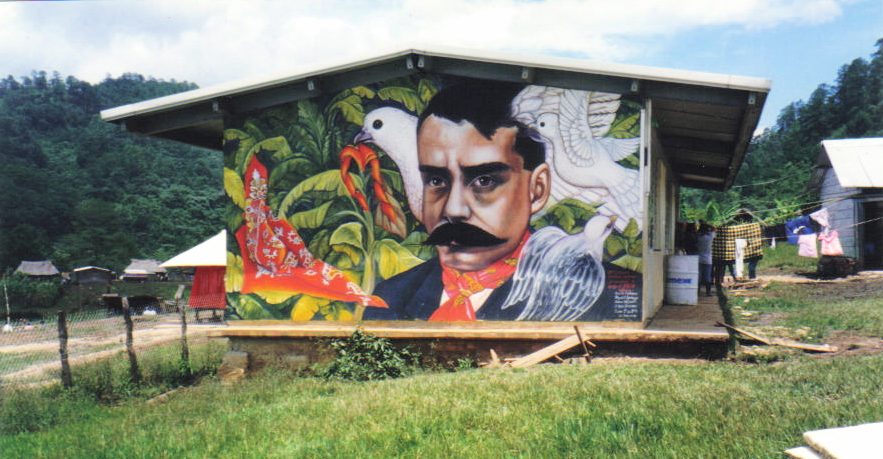
The March of the Color of the Earth
By: Luis Hernández Navarro
Twenty years have passed since The March of the Color of the Earth, the Zapatista journey through 12 states that shook deep Mexico. Between February 24 and March 28, 2001, 24 rebels traveled 3,000 kilometers of highway, filling plazas on their way and placed at the center of the political debate a radical disjunctive: to construct a country for everyone or a nation for just a few.
The mobilization began with the new moon. Its fragrance was that of Martin Luther King’s great marches for the rights of African Americans in the 1960s, as well as the indigenous uprisings of Ecuador and the Indian days of struggle in Bolivia. Born of an extreme situation in the most remote corners, these protests went up and down mountains to bring their word and their presence to the political heart of their nations.
The march was part of the cycle of mobilizations of the Zapatista National Liberation Army (Ejército Zapatista de Liberación Nacional, EZLN) outside Chiapas, initiated in October 1996 with the departure of Comandanta Ramona and the foundation of the National Indigenous Congress (CNI, its initials in Spanish), the caravan of the 1,111 towards Mexico City, in September 1997, and the Consultation in March 1999.
At its start, more than 20,000 EZLN support bases peacefully occupied the streets of San Cristóbal de las Casas, Chiapas, to say goodbye to their delegates. From that moment, city after city, town after town, the displays of popular support intensified, until ending in the glorious concentration in the Zócalo of Mexico City on March 11, 2001.
The explicit objective of the day was to meet with the Congress of the Union to dialogue about the de constitutional reform initiative on indigenous rights and culture elaborated by the Cocopa. [1]
The EZLN announced the march one day after the inauguration of Vicente Fox. Oblivious to the palace disputes, the mobilization became the principal challenge to his conservative Revolution, with hundreds of thousands of people in the streets and coverage of the mass communications media. To the dread of the business community, who went so far as to recommend shutting themselves up in their homes during those days, it achieved getting the urban and rural poor to join the indigenous cause with warm enthusiasm.
The expedition awakened an unstoppable wave of indigenous adhesion. On February 27, in Tehuacán, Puebla, Concepción Hernández Méndez, the people’s lawyer, a tireless fighter for human rights, slowly told the rebel delegates, as if she were declaiming an ancestral poetry, that she endorsed the expedition for indigenous dignity. “We experience it as ours, she said, because in it is kept the seed that we want to start germinating now. Your heart is in our Indian word. Your reason for being is in our rights. Our hope is placed in your achievements and objectives. In the march are the possibilities that we can arrive at a tomorrow full of hope. It is the hour of the Indian peoples.”
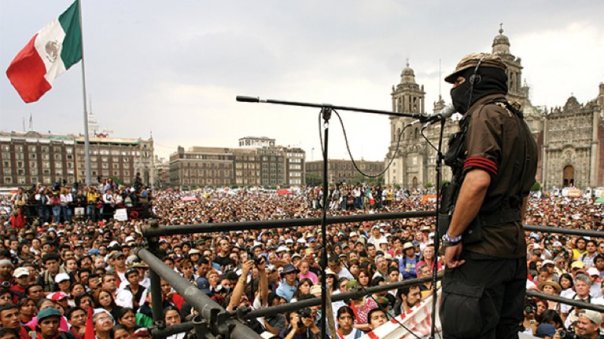
On March 11, now in Mexico City, the Zapatistas moved from Xochimilco to the Zócalo, aboard a Kenworth truck with the EZLN logo on the cabin and the platform uncovered. An enormous banner on its left side read: “Never more a Mexico without us.” During the ten-mile journey, tens of thousands of people took to the streets, balconies and rooftops to cheer them on. It was a historic march, Eduardo Galeano wrote. “Emiliano Zapata entered the DF for the second time,” he asserted.
In a memorable speech, Subcomandante Marcos summarized: “On this trip, we indigenous people have seen the map of the national tragedy, from Chiapas to the Zócalo, the center of power, and we have been gaining a flower of dark dignity.” He added: “It is the hour of the Indian peoples, of the color of the earth, of all the colors that we are below and what colors we are despite the color of money.”
Finally, in an historic event on March 28, the Zapatistas and the CNI spoke in the San Lázaro dais. “It’s also a symbol that I, a poor, indigenous and Zapatista woman, who speaks first and mine is the central message of our word as Zapatistas,” Comandanta Esther expressed there. She added that the country that the rebels want is one “where difference is recognized and respected, where being and thinking differently isn’t a reason to go to jail, being persecuted or dying.”
Despite the enormous mobilization, instead of paying the Mexican State’s historical debt to its Native peoples, the Congress of the Union increased it, by legislating a caricature of the constitutional reform on indigenous rights and culture. It bet on a country for the few. Today’s Mexico cannot be understood apart from this betrayal. A moat was opened then between the political class and the Indian peoples that remains open to this day.
The March of the Color of the Earth had long-term roots and reasons behind it. Unlike other protests, those born of demands for the recognition and dignity of Native peoples are far from being fleeting episodes. Zapatismo survived the felony of the [political] parties. Faithful to the peoples who gave it life, it remade itself on the route of autonomy without asking permission. As it did 20 years ago, it’s now preparing for another journey in the direction of hope, but with a different place for arrival: the Europe of below.
Note:
[1] Cocopa is the Spanish acronym for the Commission of Peace and Reconciliation. It is a congressional commission assigned to assist the peace process in Chiapas. The Cocopa attended and assisted the peace talks between the Zapatistas and the Mexican government that led to the San Andrés Accords.
———————————————————–
Originally Published in Spanish by La Jornada
Tuesday, March 16, 2021
https://www.jornada.com.mx/2021/03/16/opinion/012a2pol
Re-Published with English interpretation by the Chiapas Support Committee
The National Guard enters an EZLN community

National Guard in Zapatista community
By: Chiapas Paralelo
With the excuse of verifying a complaint about the existence of “pirate” radio antennas, a National Guard (NG) convoy, with 500 members, entered into a community of Zapatista National Liberation Army (Ejército Zapatista de Liberación Nacional, EZLN) supporters located in Huitepec Hill, in San Cristóbal de Las Casas. [1]
According to the residents’ denunciation, the military convoy arrived in the community aboard five armored units, went to some of the homes and detained a resident.
Residents of the community inhabited by indigenous Tsotsils, congregated in the village’s main street where they questioned the soldiers about the incursion and detention of their community member.
They cut off their exit path and demanded the surrender of the detainee. They remained there until around 5 o’clock in the afternoon, when the NG members were allowed to leave the community.
Official sources affirmed that the NG members paid a fine to the community for having entered without its authorization. Four workers from the Communications and Transportation Ministry were with the military convoy.
[1] Huitepec Hill is home to indigenous communities, including a Zapatista community, and to the beautiful Huitepec Ecological Reserve shown below.

Orchids in the Huitepec Ecological Reserve.
——————————————————————
Originally Published in Spanish by Chiapas Paralelo
Thursday, March 11, 2021
Re-Published with English interpretation by the Chiapas Support Committee
The occupation of the INPI building was the site of the 3rd meeting of CNI women
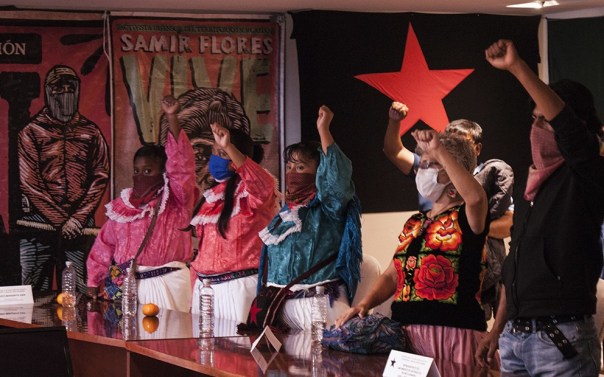
Otomí women in the INPI building
By: Sara Frabes
Last March 6 and 7, 2021 diverse indigenous women coming from different Native peoples of Mexico met in the building that previously served as the National Institute of Indigenous Pueblos (INPI), to hold the 3rd National Meeting of the Women of the National Indigenous Congress (CNI, its initials in Spanish).
The Otomí indigenous community residing in Mexico City has been occupying the space since October 12, 2020 due to the lack of response from the government to attend to their demands for housing.
In the meeting, the women worked around three months of analysis and debates that they called: Women and Territory; Women, Resistances and Autonomy; Alternatives to the Patriarchal System.
They took their measures for containing the propagation of Covid-19 and that’s how they worked for two days. Among the agreements they reached, they indicated that they joined the actions of the Otomí women who were tired of knocking on the doors of the rotating governments, “especially the current one so deceitful and lying,” they said in their statement.
In the same way, they spoke out “against the war against our brothers and sisters of the EZLN (Ejercito Zapatista de Liberación Nacional) and of those who murder the defenders of Mother Earth.”
They denounced that, in all regions of the country, the powerful ones of the patriarchal capitalist system are trampling on the rights and conquests of the Native peoples. “More and more women are experiencing worse living conditions. But we also see that, at the international level, the peoples of the world are experiencing the same situations of greater dispossession, greater destruction, greater exploitation and greater repression,” the indigenous women asserted.
They warned that what the planet is experiencing is a war of extermination on a global scale; therefore, they announced that: “together with our Zapatista compañeros and compañeras, we are seeing the importance of linking ourselves with all the peoples of the world from below and in struggle, particularly with women. To learn, to talk about the owners of the companies that come to destroy us,” said the indigenous women about the upcoming tour that the EZLN and members of the CNI will make to Europe.
“Our response is collectivity and community, from the smallest corner to the whole planet,” they said.
————————————————————————
Originally Published in Spanish by Avispa Midia
Monday, March 8, 2021
Re-Published with English interpretation by the Chiapas Support Committee
In Chiapas, Santa Martha attacks Aldama again over “agrarian conflict”
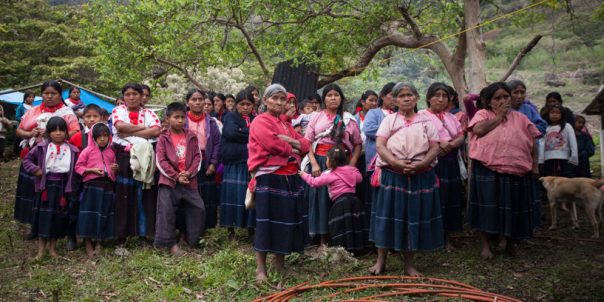
Women and children displaced from their homes in the municipality of Aldama, Chiapas.
By: Elio Henríquez
San Cristóbal De Las Casas, Chiapas
The mayor of Aldama, Adolfo López Gómez, denounced that yesterday the residents of the neighboring Santa Martha ejido, belonging to Chenalhó municipality, fired up to five high-caliber weapons against four towns in his municipality.
“At least five reports of aggressions from different points in Santa Martha (Tijera Caridad, Chuchte, K’ante and Ladrillos) have been received as of this morning,” with no information on injuries, he added.
In a telephone message he specified that the attacks were directed at the towns of Chivit, Yetón, Stzelejpotobtic and the municipal capital, which is the town of Aldama.
López Gómez added that Santa Martha residents also attacked the Juxtón community on Monday shooting firearms from the point known as Centro Santa Martha.
The mayor recalled that three months after the signing of the agreement to put an end to the agrarian conflict between Aldama and the Santa Martha ejido, little progress has been made in the administrative part to finish with the territorial demarcation.
He commented that it is expected that once the delimiting of surfaces is concluded, it will put an end to the conflict between the two Tzotzil towns in the Chiapas Highlands.
———————————————————–
Originally Published in Spanish by La Jornada
Wednesday, March 10, 2021
https://www.jornada.com.mx/2021/03/10/politica/014n2pol
Re-Published with English interpretation by the Chiapas Support Committee
From Rojava to Chiapas
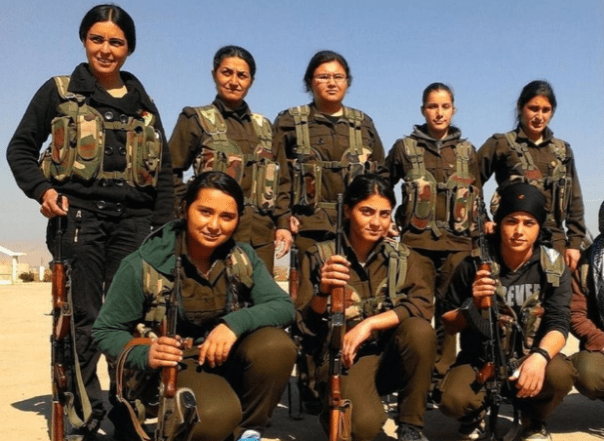
Kurdish women
By: Raúl Romero*
Kurdistan is a people with their own language and culture that live between the Tigris and Euphrates rivers. For years and in different ways, these people have struggled for their self-determination. In the past, the Kurdish territories were divided by the Ottoman and Persian Empires. After the imperial allotment that came with the first world war, the Kurdish people were divided between Iraq, Iran, Syria and Turkey.
The struggle of the Kurdish people for their liberation has also become a struggle for their survival in which they face armies of national governments, of the Isamic State, and of imperial powers. Among them, the Kurdish organizations are many and diverse, and these differences are often used by actors interested in the region’s oil to diminish the resistance.
Among the Kurdish peoples’ organizations, the Workers Party of Kurdistan (PKK), a Marxist-Leninist organization founded in 1978 that formed part of the anti colonial struggles that exploded in those years. With the passage of time, the PKK started transforming itself intellectually to find its “own path”, Democratic Confederalism, a project that according to Abdullah Öcalan — ideological figure and political prisoner— characterized as being “flexible, multicultural, anti-monopolist, oriented toward consensus and where ecology and feminism are central pillars.”
Democratic Confederalism can be stated as an anticapitalist, anti-patriarchal, and popular project built by the Kurdish people which experienced a paradigmatic moment between 2012 and 2014: the de facto declaration of autonomy by Rojava, a region in Syrian Kurdistan, a process that found international resonance. In this process, the armed resistance led by Kurdish women and their Kongra Star congress would play a decisive role.
For the sociologist Azize Aslan, “Rojava is not only the territory where the revolution is taking place, it is also a territory where the idea of a revolution is redefining itself.” Her argument is powerful: a network of assemblies is built there that make direct democracy possible and self-government possible. “The purpose of the system of popular assemblies in Rojava is to organize an anticapitalist and autonomous model for a Stateless, anti-patriarchal and ecological society.” (https://bit.ly/2MJ0NYG).
The theoretical depth and practice of critique and alternatives that are constructed in Rojava stand out for several features: it is a questioning of capitalist modernity, of Nation-states, of hegemonic science, of the patriarchy and of ecocide. The critique is accompanied by a praxis aimed at construction — not without contradictions — of a “democratic modernity” with its confederalism, its autonomy, its alternative economy, its leadership by women, and also its critical science, a science that gave way to the Jineolojï, or “science of women”, based in ethics, aesthetics with practical power and related to the economy.
Alessia Dro, of the Movement of Women of Kurdistan, has indicated that one of the biggest contradictions of our time is that between the resistance of women and the patriarchy. That contradiction, reclaimed as the backbone of the Kurdish revolution is what makes thousands of women worldwide identify with this movement. “To make the transformation we have to manage to achieve change with a perspective of women’s liberation. Women’s liberation means liberation of society as a whole. This is something that the revolutionary movements in the world still have not even elaborated as an axis of priority, and I believe that for this reason there are women from many places who join the movement.” (https://bit.ly/2PucW4H).

Zapatista Women
The theoretical and political solidity that the Kurdish revolution has achieved is reflected in the recognition of its peers in other parts of the world. It is with the EZLN and the Zapatista women with whom they have established a fraternal dialogue. In December 2019, word from the women of Rojava arrived in Zapatista territory to the Footsteps of Comandanta Ramona seedbed, where the Second International Gathering of Women who Struggle was held: “Today we would have wanted to be together with the Zapatista women in the gathering of women that was held there, but it is clear that in our situation and with the attacks on our people, this has not been possible. But we can say that our hearts are there and with all of the women in struggle for their liberty and that of their people. Because we are fighting against every type of occupation imposed on the people, on all kinds of slavery imposed on women. And we are together in the struggle.”
In Rojava and in Zapatista Chiapas, emancipatory alternatives of a new kind are being built. They are not the only ones, there are others with their own ways and times. A new history is being built and we must learn to listen to it.
* Sociologist
———————————————————–
Originally Published in Spanish by La Jornada
Saturday, March 6, 2021
https://www.jornada.com.mx/2021/03/06/opinion/014a1pol
English interpretation by Schools for Chiapas
Re-Published by the Chiapas Support Committee
The Women Who Are No Longer With Us

Another World Is Possible.
Their histories
Their joys and sorrows
Their pain and rage
Their memories and omissions
Their laughter and tears
Their presence and absence
Their hearts
Their hopes
Their dignity
Their calendars: The pages they were able to turn The ones they left unturned and the ones left to us to turn
Their screams
Their silences
Yes, above all, their silences
Whoever you are, do you hear these women? Who does not recognize him or herself in them?
Women who struggle Yes, us
But above all, them: Those women who are no longer here
But who are with us nonetheless
We do not forget them We do not forgive those who took them from us
We struggle for those women, and with them
From the Indigenous Zapatista Women
March 8, 2021
En español: http://enlacezapatista.ezln.org.mx/2021/03/08/las-que-no-estan/
Frayba: the Government continues without recognizing the Army’s human rights violations in Chiapas

In February 1995, the Mexican Army entered Zapatista communities in the Lacandón Jungle and committed an extrajudicial execution in La Grandeza.
By: Desinformémonos Editors
Mexico City
The Mexican government continues without recognizing the grave human rights violations committed by the Mexican Army in the implementation of the Chiapas 94 Campaign Plan, Fray Bartolomé de las Casas Human Rights Center (Frayba).
To the contrary, Frayba indicated, “the Mexican State maintains the logic of war with militarized structures, without respect for the human rights of the population.”
It pointed out that 26 years after the military incursion into the La Grandeza ejido, in Altamirano municipality in Chiapas, the Mexican State has not complied with the recommendations of the Inter-American Commission on Human Rights (IACHR) with respect to the extrajudicial execution of the indigenous Tseltal Gilberto Jiménez Hernández, committed by members of the 17th Infantry Battalion.
The extrajudicial execution of Jiménez Hernández occurred during the military incursion of the Rainbow Task Force of the “Yabur” grouping, a branch of the Secretariat of National Defense (Sedena, its Spanish acronym), when he and his family fled into the mountains as forcibly displaced persons. “Gilberto was carrying one of his daughters tied to his back with a shawl,” the Frayba remembers.
He added that: “faced with impunity in Mexico,” in November 2016 the IACHR recommended that the Mexican State repair the human rights violations and carry out an impartial, effective and timely investigation into the execution of Gilberto Jiménez.
However, mote than 4 years after the recommendation “the investigations don’t present any progress, breaking with a reasonable time period, without identifying the lines of investigation to follow, without knowing the corresponding administrative, disciplinary or penal measures against the actions or omissions of the state officials who contributed to the denial of justice and the impunity in which the facts are found, without adopting measures of non-repetition that include legislative, administrative and any other measures in order to ensure that the use of force on the part of State agents is compatible with international standards.”
Therefore, the Frayba urged the Mexican State to comply with the measures that the IACHR issued, as well as to suspend the militarized national security model, “as well as to prevent crimes committed by members of the Armed Forces and to stop their impunity.”
Here is the full statement:
At 26 years after the military incursion into the La Grandeza Ejido, in the municipality of Altamirano, Chiapas, the Mexican State has not complied with the recommendations of the Inter-American Commission on Human Rights1 (IACHR) relative to the extrajudicial execution of Gilberto Jiménez Hernández (Gilberto) and continues without recognizing the grave human rights violations that the Mexican Army committed in the implementation of the Chiapas 94 Campaign Plan.2
Starting in February 1995, the Mexican Army intensified the siege of the Zapatista National Liberation Army (Ejército Zapatista de Liberación Nacional,3 EZLN) with the occupation of territories of the Native Peoples and the siege of the population. The objectives of the military intervention were embodied in the “Chiapas 1994 Campaign Plan,” designed by the Secretariat of National Defense (SEDENA, its Spanish acronym) to “destroy and disorganize the EZLN’s political military structure.” The action of the Mexican Armed Forces changed from dealing directly with national security to dedicating themselves more actively to the control of internal security; as a result they perpetrated arbitrary detentions, torture, extrajudicial executions, disappearances, forced displacement, among other human rights violations.
It was in this context that members of the 17th Infantry Battalion committed the extrajudicial execution of Gilberto Jiménez Hernández, of Tseltal origin, on February 20, 1995, around 1 o’clock in the afternoon, between the Patiwitz and La Grandeza ejidos, during the military incursion of the Rainbow Task Force of the “Yabur” grouping, a branch of the Sedena. He and his family were fleeing into the mountains as forcibly displaced persons, and Gilberto was carrying one of his daughters tied to his back with a shawl.
Faced with the impunity in Mexico, the facts and their consequences were presented to the (IACHR), a body that on November 30, 2016, issued its Admissibility and Background Report No. 51/16 on Case 11.564, in which it recommended that the Mexican State: repair the human rights violations taking into consideration the community effects of the application of the Chiapas 1994 Campaign Plan; carrying out an impartial, effective investigation inside a reasonable time period for the purpose of completely clarifying the facts, identifying the intellectual and material authors and imposing the sanctions that correspond to the human rights violations, taking into account clarification of the context.
More than 4 years after the international recommendation, the investigations don’t present any progress, breaking with the reasonable period of time, without identifying the lines of investigation to follow, without knowing the corresponding administrative, disciplinary or criminal measures against the actions or omissions of the state officials who contributed to the denial of justice and the impunity in which the acts are found, without adopting non-repetition measures that include legislative, administrative and any other measures in order to ensure that the use of force on the part of State agents, is compatible with international standards.
The IACHR established as precedent that the military incursion into the La Grandeza Ejido was part of an official Plan that the Mexican Army implemented and that it generated a favorable framework for arbitrary and discriminatory behavior, as well as the excessive use of anti-subversive force.
The current Mexican government of Andrés Manuel López Obrador has the historic and progressive challenge of building a path that leads to the acceptance of the facts and of the context, which includes the recognition of the strategy implemented through the Chiapas 94 Campaign Plan and executed by the Mexican Army. Elements like those above will fully comply with the recommendations of the IACHR. Their acceptance would emerge as a measure of satisfaction for the Native Peoples who suffered a grave impact faced with the counterinsurgency war, in addition to providing non-repetition guarantees regarding the use of excessive force in military operations.
However, the Mexican State maintains the logic of war with militarized structures, without respect for the human rights of the population. Starting in 2019, with the creation of the National Guard and with the 2020 presidential agreement, public security is in the hands of the Armed Forces permanently.4 Therefore, the Frayba urges the Mexican State to suspend the militarized national security model, as well as to prevent crimes committed by members of the Armed Forces and to stop their impunity. We urge guarantying the collective rights of the Native Peoples to autonomy, territory and self-determination.
Notes:
1 CIDH, Informe No. 51/16, Caso 11.564. Fondo. Gilberto Jiménez Hernández y otros (La Grandeza). México. 30 de noviembre de 2016. Disponible en: https://www.oas.org/es/cidh/decisiones/2016/MXPU11564ES.pdf
2 Plan de Campaña Chiapas 94. Available at:https://frayba.org.mx/historico/archivo/articulos/941001_plan%20de_campana_chiapas94_sedena.pdf
3 On January 1, 1994, the Zapatista National Liberation Army (EZLN) started the armed uprising, taking the municipal seats of San Cristóbal de Las Casas, Ocosingo, Altamirano and Las Margaritas in the state of Chiapas. The Mexican Army’s presence in the region has increase since then.
4 As of July 2020, the National Guard was composed of approximately 90,000 members, of which 51,101 had been transferred from the Army and 10,149 from the Navy. Miguel Agustín Pro Juárez Human Rights Center. “Security Models.” Mexico. 2020. Page. 57.
———————————————————————-
Originally Published in Spanish by Desinformémonos
Monday, February 22, 2021
Re-Published with English interpretation by the Chiapas Support Committee
Samir Flores: The Wound of Amilcingo

By: Luís Hernández Navarrro
“In Anenecuilco, the history of the country opens like a wound,” wrote Gaston Garcia Cantú in Utopias Mexicanas. Half a decade later, in Xochicalco, repetition of the injury was reaffirmed as a policy toward the peasantry. In the Amilcingo of today, it was shown in black and white, not only that the original wound never healed, but that it has become deeper and more painful.
The shades of regional history are like windows to peek out on the tragedy of the Republic; the project of Zapata converted into a national project. Anenecuilco, Xochicalco and Amilcingo are all communities in the state of Morelos that sum up the dreams, at once modest and profound, of men of the countryside, and the betrayals they have been subjected to, far beyond Morelos.
Emiliano Zapata was born in Anenecuilco. There he was incubated, between the summer of 1914 and the summer of 1915, in the heat of the revolutionary struggle fueled by the acceptance of shared traditions, a modern utopia-made-reality: what Adolfo Gilly christened as the Morelos Commune. A practice of genuine agrarian reform from below: armed self-defense and indigenous campesino self-governance. True to their roots, the people won back land, water and forests; they reclaimed their territory and they planted the crops associated with the community that they desired, and back on track, they reinvented their society. In an exercise of memory and innovation, they kept their identity and the legitimacy of their aspirations alive.
In Xochicalco — sings José de Molina — the earth screams, wounded by a knife. What hurts her in her belly, the death of Jaramillo. In the darkness and betrayal, soldiers in formation, dressed as campesinos murdered Rubén1 and his family: his wife Epifania and his sons Ricardo, Filemón and Enrique.
The successor to the Zapatista cause, he combined the armed and electoral struggle and the taking back of land, defended campesino and indigenous struggles, but also supported projects that could give work to the population, organized in cooperatives.
The blood of their executions had not yet dried, when a Morelos campesino told Carlos Fuentes: The death of those five Jaramillos was the best fertilizer for life and the action of 500, of five thousand new Jaramillos. The commander died. Now we are all Jaramillos.
Vinh Flores Laureano was born the 18th of December of 1946, and lived there until his parents separated in 1959, returning several times. He was a tireless local hero touring the villages of the region; he defended the rights of campesinos, and in the spirit of the Zapatista motto of education for the people, with his compañeros, education institutions like the Emiliano Zapata Rural Normal School of Amilcingo (the last of its kind), the CBTA of Temoac, and the secondary school of Xalostoc. His role was key in the struggle for the recognition of the municipality of Temoac. (https://bit.ly/3qGe6I6).
Vinh participated actively in the Communist Youth and was the national youth leader of the Independent Campesino Central, linked to the hammer and sickle party. He was trained in the former U.S.S.R. and paid dearly for defying the government and encouraging the rebellious effervescence of the communities of eastern Morelos. On the 6th of September of 1976, he was tortured and murdered, together with his uncle Enrique Flores, in the mountains of Tepexco, Puebla.
Two years ago on the 20th of February, also in Amilcingo, a group of gunmen took the life of Samir Flores Soberanes, nephew of Vinh Flores, indigenous Nahua, founder of Radio Amilzinko, metalworker, organic amaranth grower, opponent of the Morelos Integral Project (PIM, its initials in Spanish) and rebel against the fatalities of submission. (https://bit.ly/3ue3nXn).
If the waters of the insurgents of Ayala became a flood of cries of “Down with the hacienda! Long-live the people!” the struggle of Samir for the community continuity and permanence, and respect for the right to decide how to live became a multitude with the demand of “Down with the PIM! Long live the people!”
The resistance, fueled by Radio Amilzinko, that began as a modest loudspeaker and became station 100.7 FM opened the way for community reconstitution. The station bears the unmistakable stamp of his work.
Gifted with a tremendous capacity for listening, Samir Flores was, like Zapata, Jaramillo or Vinh, a man of the people of Morelos. He lived the pride and pain of his people; he defended his cultural roots, threatened by the dispossession that goes hand-in-hand with big business. Like them, he was sacrificed in impunity and cowardice. And like them, he lives beyond his death in the heart of the people.
The Zapatismo of the Morelos communities is not nostalgia for by-gone times, but rather a patient wait for -as Carlos Fuentes says— the arrival of their time, the original time of their desires. It is not a buried past, but a contemporary constituent force, that refuses to live as human leftovers and claims the struggle for life protecting their lands, their waters, and their ways of coexisting and reaching agreements on that which affects them. The legacy of Samir, remembered this past February 20th in the most distinct geographies of the planet, from Zapatista caracoles to Copenhagen or Barcelona, reminds us that today in Amilcingo, —just like yesterday in Anenecuilco— opens the history of the country like a wound.
Footnote
- Ruben Jaramillo Mendez was a campesino political leader and a military leader in the Mexican revolution at the age of 17. He was a powerful leader who struggled for the rights of the ejidos and was regularly at odds with the Mexican government. Federal Police murdered him at his home, along with his wife and sons.
———————————————————–
Originally published in Spanish by La Jornada
Tuesday, February 23, 2021
https://www.jornada.com.mx/2021/02/23/opinion/016a2pol
English interpretation by Schools for Chiapas
Re-Published by the Chiapas Support Committee
Photo taken from Notisistema: https://www.notisistema.com/noticias/familiares-y-amigos-dan-el-ultimo-adios-al-activista-samir-flores/
The social commitment and ethical congruence of Pablo González Casanova
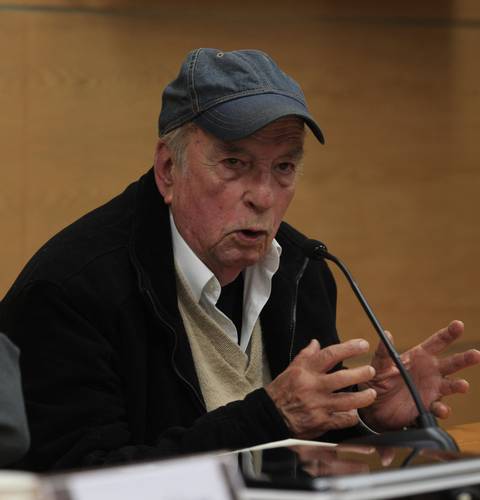
Don Pablo González Casanova (Comandante Pablo Contreras
By: Gilberto López y Rivas
On February 11, Pablo González Casanova, the most renowned and recognized intellectual in contemporary Mexico, celebrated 99 years of a life full of contributions to critical thinking about a social science committed to the oppressed and exploited, indigenous peoples and socialism.
In a few brief autobiographical strokes, González Casanova recalls the formative roots that marked the guiding lines of his action and thinking: a father who wills his son his spirit of rebellion, socialist ideas, ideological pluralism, respect for the religious beliefs of others and the intellectual option; a mother who taught order and discipline, punctuality and domestic work as also the task of men, the art of living and resolving concrete problems, a taste for languages and strengthening of the will.
The teachers and courses left “a good legacy of a jurist apprentice and bachelor with important reinforcement in national history.” The decisive influence the teachers at The College of Mexico (El Colegio de México), most who came from republican Spain, and who taught “to work, to think, to investigate what we don’t know, and to write what we were sure of, ready to discover errors, after having made efforts to eliminate them.”
There was the influence of his best friend in those years, the Cuban Martí-Communist Julio Le Riverend, from whom he learned to be tolerant of those who don’t think like him, including conservatives and the bourgeoisie. The lessons of life as a graduate student in France with Fernand Braudel: the theaters, museums, the art of conversation peppered with humor, wit, and references to the day’s readings. It was in Paris where he studied philosophy, sociology and Marxism. In Marxism, he became interested in Gramsci, whose complete works Vicente Lombardo Toledano gifted him.
“I believe –writes don Pablo– that the free and fair way of thinking that my father left me was reinforced with the magnificent philosophy of Gramsci, and the patriotic sense that my elementary school teachers, and the entire Mexican school system, combined with the encounter with communism –that I met through Le Riverend and through a streetcar friend called Suárez– and with the Marxist Leninist nationalism the official Mexican style, in which Lombardo was a teacher.”
On a scale closer to the political struggle –Casanova pointes out– “with La democracia en México (Democracy in Mexico), I initiated an exploration of freedom, participation in government and the State, the problem of national and state sovereignty, and the necessary confluence in the project of those who think or thought with empiricist or Marxist philosophies.”
From the fraternal friendship with Luis Cardoza y Aragón, which was strengthened with his defense of Guatemala faced with the State coup, González Casanova recognizes that he owes him the “curious method of criticizing revolutions without becoming counterrevolutionary and of supporting revolutions without becoming adulterous.”
In “The Zapatista Caracols: networks of resistance and autonomy (interpretation essay)”, Pablo González Casanova affirms that the Zapatista movement has given rich contributions to the construction of an alternative. The idea of creating organizations that are a tool of objectives and values to be achieved and to make autonomy and “govern obeying” not remain in the world of abstract concepts or incoherent words. This power project is not constructed under the logic of “State power” that imprisoned previous revolutionary or reformist positions, leaving the main protagonist abysmally ignorant of autonomy, be it the working class, the nation or the citizen. Nor is it constructed with the logic of creating an “acratic” society where no one holds power, the logic that prevailed in anarchist and libertarian positions (and that subsists in unhappy expressions as “anti-power,” which not even its authors know what it means), but which is renewed with the concepts of self-government of civil society “empowered” with a participatory democracy, which knows how to represent and knows how to control its representatives in whatever is necessary to respect “agreements.”
The project of the Caracoles is a project of peoples-government that they articulate among themselves and that seeks to impose paths of peace, as much as possible, without morally or materially disarming the peoples-government, less in moments and regions where the State and local oligarchy’s repressive organs, with their varied systems of cooptation and repression are following increasingly aggressive, cruel and foolish patterns of the neoliberalism of war that includes hunger, unhealthiness and the “obliged ignorance” of the immense majority of the peoples, either to weaken them, decimate them or even to destroy them if it’s necessary, when the systems of intimidation, cooptation and corruption of leaders and masses fail.
Congratulations, Comandante Pablo Contreras!
———————————————————–
Originally Published in Spanish by La Jornada
Friday, February 19, 2021
https://www.jornada.com.mx/2021/02/19/opinion/020a1pol
Re-Published with English interpretation by the Chiapas Support Committee
“For Life, Against Megaprojects, and in Honor of Our Brother Samir Flores”

The Zapatista Caracol of La Garrucha remembers Samir Flores.
Thousands of Zapatista support bases got together on February 20, 2021 in all the Zapatista Caracoles in Chiapas to render homage and remember Samir Flores Soberanes, a social fighter from the Mexican state of Morelos, murdered two years ago for opposing the imposition of megaprojects in the center of the country, as the Peoples Front in Defense of Land and Water of Morelos, Puebla and Tlaxcala, the National Indigenous Congress (CNI) and the Zapatista National Liberation Army (EZLN) have denounced.
Images of the Zapatista Mobilizations during the Day of Action “For Life, Against Mega-projects, and in Honor of Our Brother Samir Flores” – Images from all the Caracoles can be viewed here.
Published by the Chiapas Support Committee
 Chiapas Support Committee