Chiapas Support Committee
Home of the Compañero Manuel blog on zapatistas & mexico
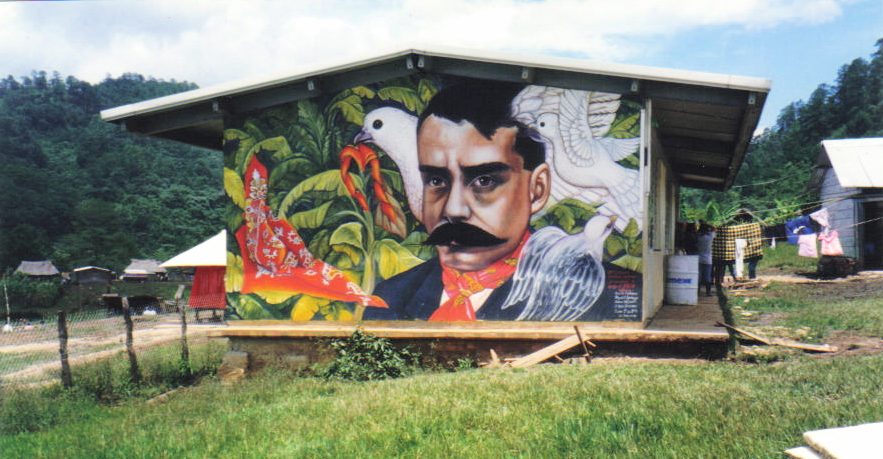
UN condemns deaths due to the attack on displaced Tsotsils in Chiapas Highlands
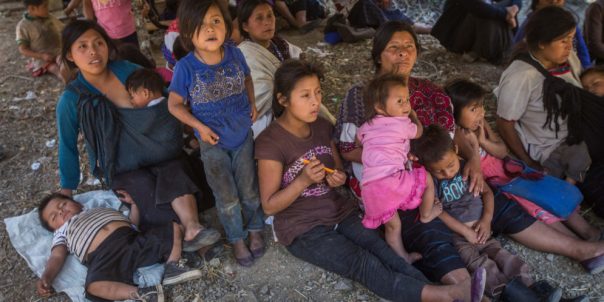
Indigenous people that are internally displaced due to paramilitary violence.
By the Editorial Staff
MEXICO CITY
The Mexico Office of the United Nations High Commissioner for Human Rights of (UN-HR) lamented the loss of human lives “as a consequence de los continuous attacks of armed groups” against the indigenous civilian population in the Highlands of Chiapas.
In a communiqué released this Friday, it condemned the attack last Monday, April 2 against displaced indigenous Tsotsils, natives of the Cotsilnam community, in the municipality of Aldama, which resulted in three people dead: one adult and two minor children.
“It is unacceptable that armed groups continue to operate outside the law. The death of these three indigenous people, derived from the attack is regrettable. The situation of insecurity that many indigenous communities experience is deplorable and requires an immediate and adequate response that ensures the disarmament of these groups, investigation of the acts of violence and that guarantees access to justice, the fight against impunity and comprehensive reparation to the victims,” declared Jan Jarab, representative of the UN-HR in Mexico.
He added: “It is equally urgent that the authorities, at all levels, provide comprehensive attention to the situation of forced displacement of which various communities in the Highlands of Chiapas are victims, in order to guarantee the security of the displaced persons, the immediate and culturally appropriate humanitarian aid, as well as the generation of all conditions necessary to guarantee a safe return to their homes, and also providing them with protection.”
The UN-HR emphasized that last February 27, the same armed group that allegedly operates out of the Manuel Utrilla ejido, in Chenalhó, would have attacked the communities of Tabak, Koko’, Cotsilnam, Stselej Potop, Xuxchen, Puente, Yoctontik, Sepelton and the municipal capital of Aldama, and would have forced the displacement of 145 families of Tsotsil origin into other communities within the state of Chiapas.
Also, he added, those attacks would be forcing communities of the Aldama municipality to displace to other parts of the state of Chiapas, where the humanitarian assistance that they would be receiving is unknown, as well as the security protection and guarantees.
Similarly, he recalled the recent forced displacement of thousands of people from the municipality of Chalchihuitán, also caused by the attacks of armed groups from Chenalhó, in November and December 2017, which resulted in the death of several people, and one part of the affected community, he said, remains displaced due to a lack of security.
The UN-HR reiterated the urgency of achieving a lasting solution that puts the structural problems that have given rise to the internal forced displacement at the center, beginning with the resolution of the conflicts that confront these communities in particular.
In that regard, it pointed out, the authorities must recognize the internal forced displacement and address it from a human rights perspective, with the support and mediation of the relevant civil society organizations and ensure the non repetition of the facts, for which the application of legislation on the internal forced displacement of Chiapas is indispensable in accordance with the Guiding Principles of Internal Displacements.
Finally, it expressed its solidarity with all forcibly displaced people, and in particular with the family members of those that were murdered.
——————————————————-
Originally Published in Spanish by Proceso
Friday, April 6, 2018
Re-Published with English interpretation by the Chiapas Support Committee
Program for the Zapatista Roundtable discussion
I.
Poster and Photography Exhibition
April 15-25, 2018, at CIDECI-UniTierra, San Cristóbal de Las Casas, Chiapas, Mexico
Images of Hope Poster art from Marichuy’s campaign Curated by Alejandro Magallanes
Absences and Presences Disappeared Women, Women of Dignified Rage Photographs by Maya Goded and Graciela Iturbid
II.
Music Concert
Sunday April 15, beginning at 4pm, at the CIDECI-UniTierra (Program to follow)
III.
Roundtable Sessions:
Monday April 16, 4pm: Marichuy Patricio Martínez, Mercedes Olivera, Márgara Millán and Sylvia Marcos
Tuesday April 17, 4pm: Carlos Aguirre Rojas, Alicia Castellanos, Gilberto López y Rivas and Alejandro Grimson
Wednesday April 18, 4pm: Films and documentaries: Tobias, Directed by Francisca Dacosta, with an introduction by the director; Somos Lengua, Directed by Kyzza Terrazas, with an introduction by the director and La libertad de Diablo, Directed by Everardo González, with an introduction by the director.
Thursday, April 19, 4pm: Fernanda Navarro, Lupita Vázquez Luna, Erika Bárcena Arévalo, Jaime Martínez Luna and Carlos López Beltrán
Friday April 20, 4pm: Jorge Alonso, Carlos Mendoza Jacobo, Dayán Mónica Meltis and Irene Tello Arista
Saturday April 21, morning session beginning at 10am: Daniela Rea , Marcela Turati, Javier Risco, Emilio Lezama and Luis Hernández Navarro
Saturday April 21, afternoon session beginning at 4pm: Marichuy Patricio Martínez , Mardonio Carvallo, Carlos González, Adolfo Gilly, Juan Carlos Rulfo, Juan Villoro and Pablo González Casanova
Sunday April 22, morning session beginning at 10am: Bertha Navarro , Ximena Antillón, Mariana Mora and Edith Escareño, Mauricio González González and John Gibler
Sunday April 22, afternoon session beginning at 4pm: Juan Carlos Rulfo, Paul Theroux, Cristina Rivera-Garza , Abraham Cruzvillegas & Gabriela Jáuregui and Enrique Serna
Monday April 23, 4pm: Sergio Rodríguez Lascano , Magda Gómez , Bárbara Zamora and Rafael Castañeda
Tuesday April 24, 4pm: Natalia Beristáin, Néstor Quiñones, Daniel Giménez Cacho and Yásnaya Aguilar Gil
Wednesday April 25, 4pm: Support team for the CIG [Indigenous Governing Council] and its spokeswoman / Chiapas Collective. Support team for the CIG and its spokeswoman / Mesa de Bellas Artes Collective , Raúl Romero, Pablo González Casanova and Roundtable Closing
From the Support Team April, 2018
Transnationals and indigenous peoples in struggle
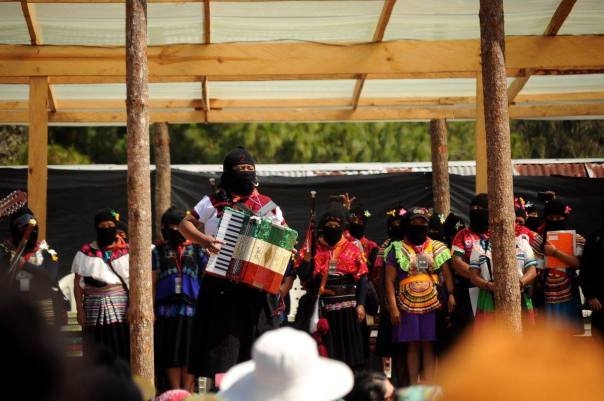
Zapatista woman playing accordion at the EZLN’s 2018 International Gathering of Women that Struggle.
By: Magdalena Gómez
Citizens in our country are living in campaign season, even without being members of any political party. The campaign that I refer to is not that of messages or promises that are expressed in speeches with few contrasts, or through social networks and the mass media, or what simulates paying attention to the governmental suspension of propaganda around social programs. In sum, it is not that which the National Electoral Institute regulates.
This campaign doesn’t display itself as such and, of course, it has rules, those of transnational capital, and it applies them blindly by means of the dominated and occupied State in which it has converted the project that emanated from the 1917 revolution; a whole history of advances and setbacks, of social struggles, which still don’t achieve dismantling that authentic meta-constitutional power.
We maintain, of course, the three powers, and each period, in the Legislative and the Executive, some are named and others change, in the logic of guarantying gatopardismo (changing everything so that nothing changes). The previous week we had the pearl of evidence, which out of respect for Zapatismo I resist calling the other campaign, because it deals with the campaign, the real one that truly affects us, whether we are conscious of it or not.
The 2018 OCDE Mexico Forum took place, which, “coincidentally,” the Organization for Economic Cooperation and Development (OCDE, its initials in Spanish) holds every six years, as a guide, they said, for the best international practices for the new administration’s development of policies. That clarity of language leaves no room for misunderstanding. They presented the third edition of the series Strategic priorities for Mexico (Getting it Right for Mexico), in which they vindicate the origin of the federal government’s initiatives validated in the agreement called the Pact for Mexico, signed in 2013 by all the political parties. In that regard they affirmed: “The investment challenge is crucial for the medium-term success of Mexico’s energy policies. Without the necessary investment, the energy sector will not unleash its potential for growth and job creation. Pemex today already faces a challenge, while struggling to increase investments just to maintain its current levels of oil production.” Today they came to reaffirm that the reforms were priorities, and should be maintained and deepened. Yes they are that, in effect, for the companies that have been favored with concessions for the exploration and exploitation of oil, open-pit mining and gas pipelines, with opening and competition in tele-communications. La OCDE recommended putting into practice the anti-corruption system, the more expeditious and transparent functioning of the judicial system, as well as the fight against the insecurity.
It gave the task to the State’s new “administrators,” even its spokespersons expressed that it’s understandable that they want to introduce nuances in the energy policy, but in now way change the direction already outlined in the Constitution. In the same line we have the federal government’s daily statements around the inevitability of continuity, while press for the granting of concessions in the field of hydrocarbons, a question not included in the electoral season. No party has set a firm position in this regard, but their candidates reassure capital and those that were expected to be more radical, offer fragile responses and leave their operators statements to the effect that the concessions were already reviewed and are in order.
But also last week the voice of the so-called civil society was heard before the United Nations Organization (UN) at the meeting held in Geneva, Switzerland, before the Committee on Economic, Social and Cultural Rights. More than a hundred organizations presented an alternative report to the one the Mexican State presented on the group of economic, social, cultural and environmental rights in Mexico. For example, they documented violations around the right to prior consultation, free and informed with indigenous peoples and communities, and the official delegation pointed out that starting with the judgment of the Supreme Court of Justice of the Nation around this right, measures have been taken and protocols constructed and they added that the problems raised around these processes, are presented because of community divisions and not because of omissions or flaws in application. Obviously they don’t recognize the government’s active role in the promotion of the same; and, finally, they resort to the very old alibi of inter-community conflicts. Also at the UN in these days another lawsuit has been opened with Peña Nieto, with the presentation of the Double injustice report from the High Commissioner for Human Rights, which questions the basis of the so-called historic truth about the Ayotzinapa case. And all of this while the indigenous peoples resist dispossession and violence from their territories.
———————————————————-
Originally Published in Spanish by La Jornada
Tuesday, March 20, 2018
http://www.jornada.unam.mx/2018/03/20/opinion/016a1pol
Re-Published with English interpretation by the Chiapas Support Committee
CompArte from Mexico: Art from Zapatista Free Territory
 CompArte from Mexico: Art from Zapatista Free Territory
Sunday, April 15, 2018 at 7:00pm
At the Eastside Arts Cultural Center | 2277 International Boulevard, Oakland, CA
Exhibition reception: art, music, poetry
FREE EVENT | accessible venue | refreshments
Sponsored by the Eastside Arts Cultural Center with the Chiapas Support Committee
On Tour from Zapatista free territory
No, artist sisters and brothers [hermanas, hermanos, hermanoas]; for us Zapatistas, the arts are the hope of humanity, not a militant cell. We think that indeed, in the most difficult moments, when disillusionment and impotence are at a peak, the Arts are the only thing capable of celebrating humanity.–EZLN
CompArte from México: Art from Zapatista Free Territory consists of over 35 pieces of paintings and wood sculptures that the Zapatistas sent north to go on tour in the U.S. The paintings, ranging from small formats to mural size canvasses, were created by Zapatista artists and culture-makers. They depict the struggle against capitalism, landscapes of the zapatista autonomous communities, the now 526 year history of indigenous people’s resistance, organizing and struggles against European invasion, settler colonialism, nationalist war of expropriation and land enclosures acts leading up to NAFTA and the ongoing struggle for Indigenous autonomy and revitalization of traditions and peoplehood.
Art from Zapatista Free Territory is a must see while it is currently in the Oakland-Berkeley Bay Area. The Zapatista art collection is from the first 2016 CompArte festival of resistance and against the walls of capitalism held in Mexico. The show will be up until May and then it will travel from Oakland to Berkeley for a stay at La Peña Cultural Center.
For more information: contact the Chiapas Support Committee at http://chiapas-support.org
Zapatista Women’s Gathering Closing Words
Words of the Zapatista women at the closing ceremony of the First International Gathering of Politics, Art, Sport, and Culture for Women in Struggle in the Zapatista Caracol of the Tzotz Choj Zone
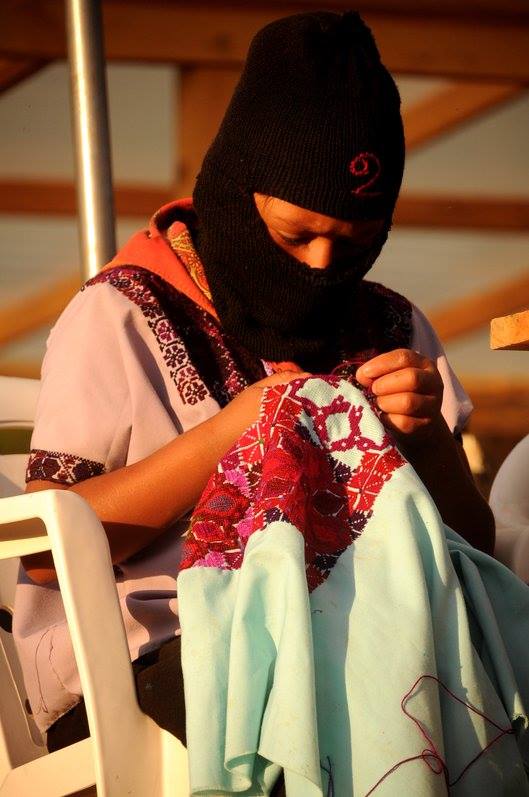 March 10, 2018
Good evening, good morning, good afternoon, compañeras and sisters in struggle, wherever you may be.
Sisters and compañeras who have accompanied us in this First International Gathering of Women in Struggle:
We are going to say a few words on behalf of all of us, the Zapatista women of the five caracoles.
We would like to thank the compañeras from the city who worked as part of the support teams: we know very well how fucking hard they worked to handle the emails, registration, organization of transportation, and the scheduling of times and locations for all the activities.
We would also like to send our regards to our Zapatista compañeras who could not come to this gathering, and who stayed behind attending to other tasks so that we could be here.
Similarly, we would like to thank our compañeros who had to stay behind to take care of our families, animals, homes, barracks, and fields, and who were on alert in case the bad governments committed any malicious acts against this gathering.
But our final words are especially for you, sisters and compañeras, women in struggle.
Women in struggle on the five continents of the world, we humbly and sincerely thank you, with all our hearts and with resistance and rebellion, for your participation. This goes for those of you who are here as well as those who are following closely what happened here.
Thank you for your ears, your eyes, your words, your workshops, your presentations, your art, your videos, your music, your poetry, your stories, your plays, your dances, your paintings, your weird things which we had no idea what they were, and all you brought to us so that we could know and understand your struggles.
We take this as a very valuable gift that we are going to care for and make grow even larger because we are going to take it to our communities and towns so that more Zapatista women can share in the gift you gave us.
We receive this gift with respect and affection because all of you made a huge effort to travel here from your places of struggle, from your times and customs, from your worlds, to be at this gathering, which we still don’t know if turned out well or not.
We’ve already looked at some of the comments that were deposited in the Criticisms Box. We still have to read everything and analyze it all among ourselves. In that box, we found a letter whose message we think applies to all of us. A compañera is going to read it.
(A compañera reads the letter: it is from the family members of the disappeared students of Ayotzinapa, asking that they not be abandoned and left alone in their struggle, because the bad government wants to close their case and let it fade into oblivion.)
We haven’t looked at all the comments, but we assure you of our commitment to fix what you’ve pointed out as wrong and to improve what you’ve said wasn’t done properly.
We can say clearly, though, that so far the great majority are criticisms of errors and mistakes that we have in our organization.
We are going to take all your critiques into account to improve next time, if there is a next time. All those criticisms, along with our word that we shared over these past few days, will be published on the Enlace Zapatista webpage so that all of you can see them.
But regardless, we want to know what you all think in general.
So we ask you, compañeras and sisters:
Did the gathering turn out mostly all right?
Or did it turn out badly?
Well, regardless of whether you respond that it turned out well or badly, we’re going to tell you something in all sincerity, something that we ask you to keep just among ourselves here, as women and women in struggle. So don’t go around talking about it, especially with men.
The truth is, sisters and compañeras, we suffered a lot because we didn’t know how we were going to pull this off.
This was our first time organizing an event like this, alone, just the women.
And we organized it from below, that is, first we had meetings and discussions in our collectives in the communities and towns, then in our regions, then in the zones, and finally among the five zones together.
And if we women take a long time to come to a small agreement, well you can imagine what it’s like when it’s a big agreement such as the decision to host this gathering.
It took us months to arrive at an agreement among all of us. Because the thing is, if we’re going to do something we have to do it among all of us, collectively.
And there’s no guidebook or manual for how to do that.
Nor could we ask the male compañeros because they don’t know how to do it either because, as we said, nothing like this had been held before.
So among ourselves, we had to figure out how to do it.
We were thinking about it the whole damned day and all the damned night. We could barely eat. And we could hardly sleep.
We were worried about whether it was going to turn out well or turn out badly.
We were worried as Zapatistas yes, but we were also worried as women.
Because we invited you, so it was on us whether it turned out well or badly.
We had to think about where you would sleep, where you would eat, where you would bathe, where you would go to the bathroom, the sound, the lights, the water, what we would do if you got sick, what we were going to say to you, how we would talk to you, and how we would listen to and see you.
So, we apologize with all our heart for the errors and mistakes we made in carrying all this out. To be sure, next time, if there is a next time, the things you critiqued won’t turn out as badly.
Because we think the most important thing, first and foremost, is that you feel at ease here, that you feel comfortable.
But it’s also important that we see and listen to each of you, because you made a long fucking trip to come all the way out here and it is only right for us to listen to and see all of you, whether or not we agree with what you say.
There was no way one collective was going to be able to organize all that. That’s why more than two thousand Zapatista women from the five caracoles were here.
And maybe that wasn’t even enough, because there are about five thousand of you, though some say eight thousand and others say nine thousand.
We can only guess exactly how many women in struggle were here over the past few days, but we think we can all agree that there were a shitload of us.
And we didn’t think so many would come, because this place is very and there are few comforts here.
If we had known there would be so many of you, perhaps more Zapatista women would have come so as to be able to embrace each and every one of you and say to you personally what we say to you now collectively.
Six Zapatista women would have come for each one of you: a “pipsqueak” (that’s what we call babies who’ve just been born), a little girl, a teenager, an adult, an elderly woman, and a deceased woman.
All women, all indigenous, all poor, all Zapatistas, all embracing you because it’s the only gift we can give you in return.
But in any case, sister and compañera, understand that what we’re telling you here is being whispered in your ear, in your language, in your way, in your time, by a Zapatista woman as she embraces you:
“Don’t give up, don’t sell out and don’t give in.”
And it is with these words that we say, “Thank you sister. Thank you compañera.”
Sisters and compañeras:
On that March 8, at the end of our contribution, each of us lit a small flame.
We lit this flame with a candle so it would last, because a match goes out too quickly and a lighter could easily break.
That small light is for you.
Take it, sister, compañera.
When you feel alone.
When you are afraid.
When you feel that the struggle is very hard; when life itself is very hard.
Light it anew in your heart, in your thoughts, in your gut.
And don’t just keep it to yourself, compañera, sister.
Take it to disappeared women.
Take it to murdered women.
Take it to incarcerated women.
Take it to women who have been raped.
Take it to women who have been beaten.
Take it to women who have been assaulted.
Take it to women who have been subjected to all kinds of violence.
Take it to women migrants.
Take it to exploited women.
Take it to deceased women.
Take it and tell each and every one of them that she is not alone and that you are going to struggle for her; that you are going to struggle for the truth and justice that her pain deserves; that you are going to struggle so that the pain she carries will not be repeated in another woman from any world.
Take it and turn it into rage, courage, and determination.
Take it and join it with other lights
Take it and, perhaps, you will come to think that there can be neither justice, truth, or freedom in the patriarchal capitalist system.
Then, perhaps, we can meet again to set fire to the system.
And perhaps you will be beside us ensuring that no one puts out that fire until only ashes are left.
And then, sister and compañera, on that day that will be night, perhaps we will be able to say together with you:
“All right, yes, now we are really going to begin building the world we need and deserve.”
And then perhaps we will understand that the really fucking hard work will have begun, and that right now we are only practicing, or training, so that we will know what is really most important and what is most needed in society.
And what is needed is for no woman ever again—whatever her world, her color, her size, her age, her language, or her culture—to be afraid.
Because here we know that when we shout “Enough!”, it’s only the beginning of a long road, and that what is missing is yet to come.
Sisters and compañeras:
Here, in front of all of us here present and those who are not here but who are present in their hearts and minds, we propose an agreement to stay alive and continue struggling, each of us according to our ways, our times and our worlds.
Do you accept our proposal?
Well, as we’re writing this document we don’t know whether you’ll respond yes or no, but I’ll continue to our second proposal:
As we have already seen, not all of you are against the patriarchal capitalist system. We respect this and so we propose that we study it and discuss it in our collectives whether it’s true that the system imposed on us from above is responsible for our suffering.
If it turns out to be true, well then, sisters and compañeras, there will be another day to agree to all struggle against the capitalist patriarchy and any patriarchy whatsoever.
And we state clearly “any patriarchy”, regardless of whatever ideas are behind it or its color or its flag, because we think that there is no good or bad patriarchy, but rather that they are the same thing against us as women.
If it turns out not to be true, well, regardless we’ll be seeing each other in the struggle for all women’s lives and for their freedom, and each one of us, according to her thoughts and her perspective, can build her world as she sees fit.
Do you agree, in your worlds and according to your ways and times, to study, analyze, discuss, and, if possible, agree to name who is or who are those responsible for our suffering?
Well, we still don’t know at the time of this writing whether the agreement has been made or not, but we’ll continue to the next proposal:
We propose an agreement to get together again in a second gathering next year, not just here in Zapatista territory, but also in each of your worlds, according to your times and means.
That is, for each person to organize gatherings for women in struggle or whatever they want to call them.
Do you agree?
We still don’t know what you will have responded, but either way you will be welcome here, sisters and compañeras.
But we must ask you to please let us know ahead of time, because it’s really rough when you tell us 500 of you are coming and you must have lost a “zero” along the way because 5,000 or more show up.
And hopefully when you come back you’ll be able to say that in your worlds you met, discussed, and agreed upon whatever agreements you came to.
That is, that your hearts, minds and struggles will have grown.
But regardless you will always be welcome here, women in struggle.
Thank you for listening.
We will now have the formal closing.
Comandanta Miriam has the floor:
Good evening compañeras and sisters.
Thank you compañeras, thank you sisters from the countries of the world and from Mexico who made the effort to arrive here to this little corner of the world.
We have arrived at the end of our First International Gathering of Politics, Art, Sport, and Culture for Women in Struggle.
The time is 8:36pm, Zapatista time, and I declare our first gathering “closed.”
Take care and safe travels.
From Caracol #4, Whirlwind of Our Words,
Morelia, Chiapas, Mexico. March 10, 2018
Frayba denounces new forced displacement of 90 families in Chiapas
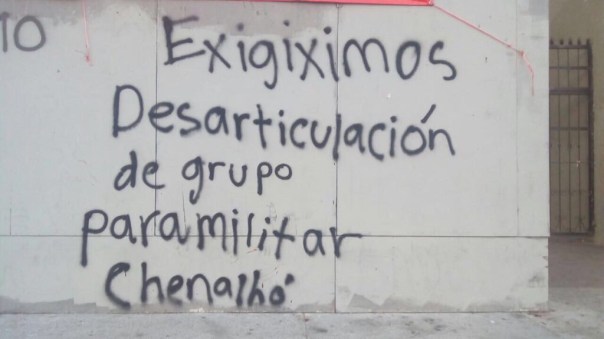
The sign reads: “We demand disarticulation of the Chenalhó paramilitary group.” Photo from Proceso.
By: Isaín Mandujano
TUXTLA GUTIÉRREZ, Chiapas
The Fray Bartolomé de Las Casas Center (Frayba) denounced that a civilian armed group of Chenalhó provoked the forced displacement of some 90 Tsotsil families from a community in the neighbor municipality of Aldama, without (as of now) the authorities having taken the measures necessary to counter this other humanitarian tragedy added to the one in Chalchihuitán.
The Frayba reported that at least 90 Tsotsil families from the community of Koko, municipality of Aldama, were victims of forced displacement since Saturday, March 24 due to the violent action of an armed group coming from Manuel Utrilla, in Chenalhó.
The families are dispersed in the mountains now, without the secure conditions or humanitarian assistance that their rights as indigenous peoples in displacement guaranty.
Additionally, civilian Zapatista families (bases of support in Zapatista terminology) from the communities of Aldama and the Manuel Utrilla ejido are also at grave risk of forced displacement, as well as of threats to their life, integrity and security because of the same armed group that provoked the displacement on Tuesday March 20 of 145 Tsotsil families from Tabak, Aldama, the Frayba accused.
These acts, it abounded, are the continuation of violence in the region after the humanitarian crisis due to the forced displacement of 5,023 people in Chalchihuitán and the forced displacement of seven families from Aldama since May 2016.
It also warned that the inefficiency of Manuel Velasco’s government has generated impunity in the zone, because of the protection it gives to Rosa Pérez Pérez, the municipal president of Chenalhó, and to the armed groups that operate in the region.
Because of that, Frayba demanded that the state and federal governments guaranty the life, integrity and personal security of the civilian Zapatista families and of the population in general in the communities of Tabak, Koko’, Cotsilnam, Stselej Potop, Xchuch Te, Puente and in the municipal capital of Aldama, as well as of the Zapatista bases of support in Manuel Utrilla, in Chenalhó (municipality).
It also asked that the governments urgently and integrally attend to the displacement situation of 145 Tsotsil families from Tabak, and 90 families from Koko’, in the municipality of Aldama, immediately applying the guiding principles on internal displacements of the United Nations, as well as carrying out preventive actions for the purpose of avoiding that other communities are forcibly displaced due to armed attacks in the region.
Then it demanded a ceasefire and implementing an effective strategy for disarticulation, disarming, arrest and punishment of the civilian armed groups in the region, as well as an in-depth investigation of the authorities responsible for their organization and operation.
And the Frayba demanded of Velasco Coello assuming his responsibility as the state’s governor and attending to the spiral of violence that exists in the region, the human rights violations and the emergency in which the residents of Aldama are found in an integral and in-depth manner.
———————————————————
Originally Published in Spanish by Proceso
Tuesday, March 27, 2018
Re-Published with English interpretation by the Chiapas Support Committee
Zapatista Women’s Gathering Opening Words
WORDS IN THE NAME OF ZAPATISTA WOMEN AT THE OPENING OF THE FIRST INTERNATIONAL GATHERING OF POLITICS, ART, SPORTS, AND CULTURE OF WOMEN THAT STRUGGLE
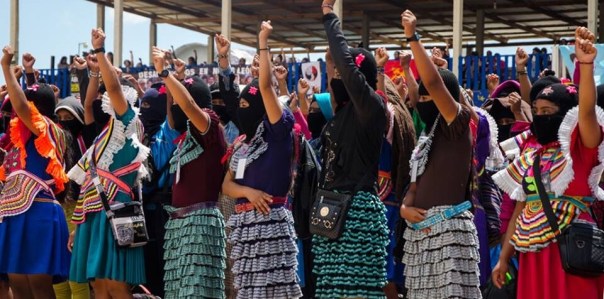
March 8, 2018. Caracol in the Tzots Choj Zone
Good morning, sisters of Mexico and the world:
Good morning, compañeras from the national and international Sixth:
Good morning, compañeras from the National Indigenous Congress:
Good morning, compañeras who are comandantas, bases of support, autonomous authorities, project coordinators, milicianas, and insurgentas:
First, we want to send a big hug to the family of the compañera Eloísa Vega Castro, from the Indigenous Governing Council support network in Baja California Sur, who died while accompanying the CIG delegation this past February 14.
We waited until today to honor the memory of Eloisa so that our embrace could be even bigger and reach even farther, all the way to the other end of Mexico.
This hug and this greeting are huge because they’re from all the Zapatista women and all the Zapatista men on this day, March 8, for that woman who struggled and whom we miss today: Eloisa Vega Castro. May our condolences reach her family.
Sisters and compañeras who are visiting us:
Thank you to all of you who are here at this First International Gathering of Women in Struggle.
Thank you for making the effort to come from your many worlds to this little corner of the world where we are.
We know well that it was not easy for you to get here and that perhaps many women who struggle were not able to come to this gathering.
My name is Insurgenta Erika—that’s how we refer to ourselves when we’re speaking about the collective rather than the individual. I am an insurgent infantry captain, accompanied here by other insurgentas and milicianas of various ranks.
Our work will be to watch over this space to make sure only women are here and to not allow any men to come in, because we know how sneaky they are.
So you’ll see us walking around in order to keep watch and make sure no men come in, and if one does then we’ll grab him and kick him out. Because it was stated clearly that men are not invited; they have to stay outside and find out later what happened here.
You can walk wherever you’d like. You can leave or enter whenever you like, all you need is your nametag. But men can’t enter until our gathering is over.
There are also compañeras who are health promoters and some who are doctors here. So if anyone gets sick or feels ill, just tell any of us and we’ll quickly let the promotoras know so that they can attend to you, and then the doctor can see you if necessary. We also have an ambulance ready to take you to a hospital if necessary.
There are also compañeras coordinating various areas, including sound technicians, those in charge of the electricity if it goes out, and those in charge of keeping things clean like the trash and the bathrooms. So that those compañeras can also participate in the gathering, we ask all of you to be mindful of the trash, hygiene, and bathrooms.
There are many of us here today, but together it’s as if we are one, welcoming and hosting you the best we can, given our conditions here.
Sisters and compañeras:
Our word is collective, that’s why my compañeras are here with me on stage.
I’m responsible for reading this text, but we agreed upon it collectively among all of the compañeras who are organizers and coordinators of this gathering.
As Zapatista women, we are very proud to be here with you and we thank you all for giving us a space in which to share with you our words of struggle as Zapatista women.
Speaking on behalf of my compañeras, my word will be mixed up because we are of different ages and different languages and have distinct histories.
Just as I worked as a servant in a house in the city before the uprising, I also grew up in the Zapatista rebellion of our grandmothers, mothers, and older sisters.
I saw what it was like in our communities before the struggle, a situation difficult to explain in words and even more difficult to live through, seeing how boys and girls, youth, adults, and elders died from curable diseases.
And all because of lack of medical attention, good nutrition, and education.
But we also died, and more of us, because we were women.
There were no clinics, and when there were, they were very far away. The bad government’s doctors didn’t take care of us because we didn’t speak Spanish and because we didn’t have any money.
In the house where I worked as a servant, I didn’t have a salary. I didn’t know how to speak Spanish and I couldn’t study, I only learned how to speak a little.
Later I learned that there was an organization in struggle and I began to participate as a base of support. I would go out at night to go study and come back as the sun was coming up, because back then nobody knew about our struggle; everything was clandestine.
During that time, I participated in collective work with other Zapatista women in areas such as traditional crafts, the production of beans and corn, and raising animals.
And we did everything clandestinely—if we had meetings or political education classes, we had to say we were off to go do something else because some people didn’t know anything about it, sometimes not even within our own families.
But I also was born and grew up after the beginning of the war.
I was born and grew up with the military patrols surrounding our communities and roads, listening to the soldiers say fucked up things to the women just because they were armed men and we were, and are, women.
But as a collective, we weren’t afraid; rather, we decided to struggle and support one another collectively as Zapatista women.
That’s how we learned that we can defend and we can lead.
And we weren’t just making speeches about all this; we were actually taking up arms and fighting against the enemy. We actually commanded troops and lead battles with mostly men under our command.
And they obeyed us, because what mattered wasn’t whether you were a man or a woman but the fact that you were willing to fight without giving up, selling out or giving in.
And even though we hadn’t studied, we were full of rage and anger over all the fucked up things they had done to us.
I experienced the disdain, the humiliation, the mockery, the violence, the beatings, the deaths for being a woman, for being indigenous, for being poor, and now for being a Zapatista.
And you should know that it wasn’t always men who exploited me, robbed me, humiliated me, beat me, scorned me, and murdered me.
Often it was women. And it still is.
And I also grew up in the resistance and saw how my compañeras built schools, clinics, collective work projects, and autonomous governments.
I saw public celebrations, where we all knew that we were Zapatistas and we knew that we were together.
I saw that rebellion, resistance and struggle are also a celebration, even though sometimes there’s no music or dancing, just the sweat and blood of the work, the preparation, and the resistance.
I saw that where before being indigenous, being poor, and being a woman only meant death, now we were collectively building another path for life: freedom, our freedom.
I saw that whereas before we women only had our houses and fields, now we have schools, clinics, and collective work projects where we women operate equipment and guide the struggle. We make mistakes of course, but we’re moving forward, with no one telling us what to do but ourselves.
And now I see that we have indeed advanced—even if only a little bit, we always manage to advance somehow.
Don’t think it was easy. It was very hard, and it continues to be very hard.
Not just because the fucking capitalist system wants to destroy us: it’s also because we have to fight against the system that makes men believe that we women are less than, and good for nothing.
And sometimes, it must be said, even as women we screw each other over and speak badly of each other, that is, we don’t respect each other.
Because it’s not just men: there are also women from the cities who look down on us because they say we don’t know about women’s struggle, because we haven’t read books where the feminists explain how it should be. They give a lot of commentary and critique without knowing what our struggle is like.
It’s one thing to be a woman, another to be poor, and another thing altogether to be indigenous. The indigenous women listening know this very well. And it is yet another and more difficult thing to be an indigenous Zapatista woman.
Of course we know there’s still much to do, but since we are Zapatista women, we don’t give up, we don’t sell out, and we don’t veer off our path of struggle—that is, we don’t give in.
You can see what we’re capable of, because we organized this gathering among Zapatista women.
It wasn’t just some idea that somebody had one day.
When the National Indigenous Congress and the Indigenous Governing Council said many months ago that as women we’re going to say that we’re not afraid, or that we are but we control our fear, we women began to think collectively that we too have to do something.
So in all the zones, among the large and small women’s collectives, we began to discuss what to do as Zapatista women.
At CompArte last year the idea was put forth that only we Zapatista women would present and honor the Indigenous Governing Council. And that’s what we did, because it was only women who received our compañeras from the Indigenous Governing Council and the spokeswoman Marichuy, who’s here today.
But that wasn’t all. In our collectives, we also considered and discussed the fact that we have to do more, because we see that something is happening.
What we see, sisters and compañeras, is that they’re killing us, and that they’re killing us because we’re women, as if that’s our crime and they’re giving us the death penalty.
So we came up with the idea of having this gathering and inviting all women in struggle.
I’m going to tell you why we thought to do this:
There are women present here from many parts of the world.
There are women who have studied a lot and have degrees, who are doctors, lawyers, engineers, scientists, teachers, students, artists and leaders.
We ourselves haven’t studied much; some of us barely speak a little Spanish.
We live in these mountains, the mountains of the Mexican southeast.
We are born here, we grow up here, we struggle here and we die here.
For example, those trees over there, which you call “forest” and we call “brush.”
Well, we know that in that forest, in that brush, there are many trees that are different.
And we know that, for example, there is pine, mahogany, cedar, and bayalté; there are many kinds of trees.
But we also know that each pine or each ocote is not the same. Each one is different.
We know this, yes, but when we see it we say that it’s a forest or brush.
Well, here we are like a forest or brush.
We are all women.
But we know that we are of different colors, sizes, languages, cultures, professions, schools of thought and forms of struggle.
But we say that we are women and what’s more, we are women in struggle.
So we are different but we are the same.
There are many women in struggle who are not here, but we are thinking of them even if we can’t see them.
We also know that there are women who are not in struggle, who resign themselves, who falter and lose heart.
So we can say that there are women all over the world, a forest of women, and what makes them the same is that they’re women.
But we Zapatista women see that something else is going on.
What also makes us the same is the violence and the death carried out against us.
That’s how we see the modern condition of this fucking capitalist system. We see that it made a forest of all the women of the world with its violence and death that have the face, body and idiot brain of patriarchy.
So we say to you that we invited you so we can speak to one another, listen to one another, see one another, and celebrate together.
We thought it should only be women so that we can speak, listen, see, and celebrate without the gaze of men, whether they’re good men or bad men.
What matters is that we’re women and that we’re women in struggle, that is, that we don’t resign ourselves to what’s happening and that each of us—according to her way, her time, and her location—struggles. She rebels. She gets pissed and does something about it.
So we say to you, sisters and compañeras, that we can choose what we’re going to do in this gathering.
That is, we can decide.
We can choose to compete to see who’s more badass, who’s the best speaker, who’s more revolutionary, who’s the best thinker, who’s more radical, who’s the best behaved, who’s the most liberated, who’s the prettiest, who’s the hottest, who dances better, who paints better, who sings best, who’s more of a woman, who wins at sports, who struggles the most.
Whatever it is, there won’t be any men saying who wins and who loses; only us women.
Or we can listen and speak with respect as women in struggle; we can give each other the gift of dance, music, film, video, painting, poetry, theater, sculpture, fun, and knowledge, and by doing so nourish the struggles that each of us has wherever we are.
So we can choose, sisters and compañeras.
Either we compete among ourselves and at the end of the gathering, when we return to our worlds, we’ll realize that nobody won.
Or we can agree to struggle together, as different as we are, against the patriarchal capitalist system that is assaulting and murdering us.
Here your age doesn’t matter; it doesn’t matter if you’re married, single, widowed or divorced, if you’re from the city or the countryside, if you’re affiliated with a political party, if you’re lesbian or asexual or transgender or however you may call yourself, if you’re educated or not, if you’re feminist or not.
All are welcome and as Zapatista women, we’re going to listen to you, we’re going to see you and we’re going to speak to you with respect.
We’ve organized ourselves so that in all the activities—all of them—there are some of us there who can carry your message to our compañeras in our villages and communities.
We’re going to set up a special table to receive your criticisms. You can turn them in there or tell us what you see that we did or are doing badly.
We’ll look at them and analyze them and, if what you say is true, we’re going to figure out how to do it better.
And if it’s not true, well then either way we’ll think about why you told us that.
What we’re not going to do is blame men or the system for errors that are our own.
Because the struggle for our freedom as Zapatista women is ours.
It’s not the job of men or the system to give us our freedom.
On the contrary, the work of the patriarchal capitalist system is to keep us in submission.
If we want to be free, we have to conquer our freedom ourselves, as women.
We’re going to look at you and listen to you with respect, compañeras and sisters.
And whatever we see and hear, we will know what to take from it to help our struggle as Zapatista women. What won’t help, we won’t take.
But we will not judge anyone.
We will not say that something is good or bad.
We did not invite you here to judge you.
Neither did we invite you to compete.
We invited you so we can encounter one another, different and the same.
We have Zapatista compañeras here from different original languages. You will hear the collective words from women from each zone.
But we are not all here.
There are many more of us, and our rage and anger is much greater.
But our rage, that is, our struggle, is not only for us; it is for all the women who are assaulted, murdered, beaten, insulted, disparaged, mocked, disappeared, and imprisoned.
So we say to you, sister and compañera, that we are not asking you to come and struggle for us, just like we are not going to struggle for you.
Each of us knows her way, her mode and her time.
The only thing we do ask of you is to keep struggling, don’t give up, don’t sell out, don’t renounce being women in struggle.
To close we’re asking you for something special during these days you’re here with us.
Some elder sisters and compañeras, “wise women” we call them, have come here from all over Mexico and the world.
They are women who are elders and who struggle.
We ask that you respect them and give them special consideration, because we want to end up like them, to grow old and know we are still in struggle.
We want to grow older and be able to say that we have been alive for many years and that each year was a year of struggle.
But in order for that to happen, we have to be alive.
That’s why this gathering is for life.
And, sisters and compañeras, nobody is going to give that to us.
Not god, not man, not a political party, not a savior, not a leader, not a female leader, and not a female boss.
We have to struggle for life.
That’s our lot, sisters and compañeras, and the lot of all women in struggle.
Perhaps when this gathering is over, when you return to your worlds, to your times, to your ways, someone will ask you if we reached some agreement because there were many different kinds of thought that came to these Zapatista lands.
Perhaps you will respond, no.
Or perhaps you will respond, yes, we did reach an agreement.
Maybe when they ask you what the agreement was, you will say, “We agreed to live, and since for us to live is to struggle, we agreed to struggle, each according to her way, her place and her time.”
And maybe you’ll also respond, “and at the end of the gathering we agreed to come back together again next year in Zapatista territory because they invited us for another round.”
That is all our words for now, thank you for listening to us.
Long live all the women of the world!
Death to the patriarchal system!
From the mountains of the Mexican Southeast,
The Zapatista Women
March 8, 2018, Chiapas, Mexico, the World
—————————————————
EZLN announces April Roundtable event
The Sixth Commission of the Zapatista National Liberation Army convokes a ROUNDTABLE DISCUSSION (or seedbed, depending): “Looks, Listens, Words: Prohibited Thinking?”
ZAPATISTA NATIONAL LIBERATION ARMY

Sixth commission of the EZLN
Mexico
March 2018
To the persons, groups, collectives and organizations throughout the world who understood and took as their own the initiative of the Indigenous Governing Council and its spokeswoman:
To the national and international Sixth:
To everyone who contributed their signature in support of the Indigenous Governing Council’s spokeswoman:
CONSIDERING:
First and only:
The Happy Family
A town, or a city, or whatever it’s called, a place in the world. A wall. Attached to the rough surface of the huge wall is a flyer, a poster, or whatever you want to call it. In the image, a man and woman smile in front of a table brimming with a wide variety of food. To the couple’s right, a smiling girl; to their left, a boy grinning to display gleaming teeth. Above them in large and intimidating letters reads “THE HAPPY FAMILY.” The poster is old by now, time’s march forward having muted the colors that, we assume, were once bright and, yes, happy. Anonymous hands have added small paper signs to the wall: “The happy family is happy only with God’s blessing;” “No to gay parenting! Death to faggots and dykes!” “Motherhood is what defines a happy woman;” “We unclog pipes: no-obligation estimates;” “Happy home available for rent to a happy family. Unhappy families need not apply.”
Along the sidewalk that runs in front of the wall, people hurry from one place to another without paying any attention to the opaque image. Occasionally, someone is crushed to death under a huge chunk that falls off the decrepit wall. In fact, these partial rockslides are becoming more and more frequent. Loose pieces of the wall break off and crush sometimes one person, sometimes a small group and sometimes entire communities. The crowd is thrown into commotion only for an instant before resuming its trajectory under the pale gaze of the happy family.
Catastrophes big or small, these should not distract us from what is most important now: every so often, the supreme maker of “happy families” announces the free and democratic election of who will preside over the poster. And precisely at this moment, you are just now noticing, a happy calendar that can be seen behind the happy family indicates that it’s election season. Around this time, a feverish activity runs through the crowd that, without stopping, discusses, offers opinions and argues about the different options presenting themselves as potential stewards of the enormous poster.
There are those who point out the danger posed to the image on the already battered poster—the symbolic identity of the city or town or whatever—by their opponents’ obvious inexperience. One person offers to renovate the poster and return to it the brightness and color it once had (in reality, nobody remembers that time, so we can’t be sure that it actually existed—if, of course, we can in fact attribute existence to time). Someone else says that previous administrations have neglected the image, and that this is what has caused its visible deterioration.
The different proposals ignite arguments among passers-by: accusations, insults, fallacies, arguments of a purely ephemeral base, condemnations and apocalyptic predictions fly back and forth. People reflect on the importance and transcendence of this moment, on the necessity of conscious participation. It wasn’t for nothing that they struggled for so many years to be able to choose who presides over the happy image of the happy family.
Factions are formed: on one side are those who insist on a sensible renovation; on the other are those who insist on the scientific postulate, “better the devil you know than the devil you don’t;” another faction consists of those calling for proper behavior, good taste and modernity. A few here and there shout: “Don’t think! Vote!” A giant placard obstructs the flow of people; it reads: “Any call to think rationally about voting is a call to abstention. This is not a time to think, it is time to take sides”.
The discussions are not always measured. The selection of the steward of the image is so important that many times the competing groups resort to violence.
Some talk of the boundless happiness that accrues to whomever ends up the victor, but, far from mundane worldly interests, the severe faces of the contenders belie the seriousness of the matter: it’s an historic task; the future is in the trembling hands of those who must choose; this most serious responsibility weighs heavily on the shoulders of the people. Happily, though, this weight will be lifted once the winner is known and sets him or herself to the task of procuring happiness for the happy image of the happy family.
The frenzy is such that everyone forgets entirely about the image portrayed. But on the lonely wall, the happy family still displays its perennial and useless smile.
At the foot of the long, high wall, a little girl raises her hand, asking to speak. The factions barely take notice, but someone finally says, “Poor little thing, she wants to talk, we should let her.” “No,” says another faction, “it’s a trick from the opposition group, an attempt to divide the vote, a distraction designed to stop us from reflecting on the gravity of the moment, a clear call to abstention.” Another faction objects: “What capacity could a little girl have to even opine about the poster? She needs to study, grow, and mature.” And from another wing: “We’re not going to waste time listening to a little girl. We should concentrate on what’s important: deciding who is best suited to take care of the poster.”
The “Commission on Transparency and Legitimacy for the Election of the Person in Charge of Stewarding the Image of the Happy Family” (abbreviated CTLEPCSIHF) released a brief and serious memo, in accordance with the gravity of the times: “The rules are clear: NO LITTLE GIRLS ALLOWED.”
Specialized analysts publish new reflections: “The only thing the little girl achieved was the legitimization of the CTLEPCSIHF. In asking for the floor, the girl entered the game and lost; the rest is consolation.”; “The failure of the girl is symptomatic of the failure of the renovation process, the institutions should let the girl talk”; “It was very moving, the little girl with her little hand raised, asking for attention, poor little thing”; “It was an adverse outcome, the product of an erroneous analysis of the conjuncture, the context and the correlation of forces. This signals the absence of a revolutionary vanguard to direct the masses, etcetera.”
But the discussions lasted only a few minutes before the coming and going of footsteps and injustices continued its course. No one listened to the girl speak as she pointed, not to the image, but to the wall upon which the happy family shone its by now deteriorated tranquility.
Standing on a pile of rubble, surrounded by the cadavers of little girls and broken stones, she stated, flatly, the obvious:
“It’s going to fall.”
But no one listened…
Just a minute… no one?
(To be continued?)
-*-
Based on the above statement, the Sixth Commission of the EZLN convokes:
A ROUNDTABLE DISCUSSION (or seedbed, depending):
“Looks, Listens and Words: Prohibited Thinking?”
In which different individuals from the National Indigenous Congress, the Indigenous Government Council, the arts, sciences, political activism, journalism and culture, will share with us what they see and hear.
The Roundtable Discussion (Conversatorio) will be held from April 15 to 25, 2018, at the CIDECI-Unitierra, San Cristóbal de Las Casas, Chiapas, México.
The following, among others, have confirmed their participation:
Marichuy (spokesperson of the Indigenous Government Council)
Lupita Vázquez Luna (council member of the Indigenous Government Council)
Luis de Tavira Noriega (Theater director)
Mardonio Carballo (writer).
Juan Carlos Rulfo (filmmaker)
Paul Leduc (filmmaker)
Cristina Rivera-Garza (writer).
Abraham Cruzvillegas (visual artist)
Néstor García Canclini (anthropologist)
Emilio Lezama (writer and political analyst)
Irene Tello Arista (columnist and activist)
Erika Bárcena Arévalo (lawyer and anthropologist)
Ximena Antillón Najlis (psychologist, specialist in victims of violence)
Jacobo Dayán (academic and Human Rights activist)
Marcela Turati (investigative journalism)
Daniela Rea Gómez (journalist)
Carlos Mendoza Álvarez (philosopher)
John Gibler (journalist)
Javier Risco (journalist)
Alejandro Grimson (anthropologist)
Enrique Serna (novelist)
Paul Theroux (writer)
Juan Villoro (writer)
Pablo González Casanova (sociologist and Zapatista, not necessarily in that order)
Gilberto López y Rivas (anthropologist)
Alicia Castellanos Guerrero (anthropologist)
Magdalena Gómez Rivera (lawyer)
Bárbara Zamora (lawyer)
Margara Millán Moncayo (feminist sociologist)
Sylvia Marcos (psychologist and feminist sociologist)
Jorge Alonso Sánchez (anthropologist)
Fernanda Navarro y Solares (philosopher)
Néstor Quiñones (graphic artist)
Raúl Romero (sociologist)
Rafael Castañeda (political militant)
Luis Hernández Navarro (journalist)
Carlos Aguirre Rojas (sociologist and economist)
Sergio Rodríguez Lascano (political militant)
Carlos González (lawyer and activist in the struggle of the original peoples)
Adolfo Gilly (political militant, historian and analyst)
Carolina Coppel (videographer)
Mercedes Olivera Bustamante (feminist anthropologist)
María Eugenia Sánchez Díaz de Rivera (sociologist)
“Lengua Alerta” (musician)
“Panteón Rococó” (musicians)
“El Mastuerzo” (guacarockero)
“Batallones femeninos” (feminist musicians)
“Los Originales de San Andrés” (male Zapatista musicians)
“La Dignidad y la Resistencia” (female Zapatista musicians)
Accordingly, we will be confirming the rest of those invited (whose names are not indicated to protect the innocent) and the complete list will be made public, as well as the days and times of each one’s participation.
The email address to register as a listener, seer, free or paid media is:
asistentesemillero@enlacezapatista.org.mx
(Please put your name, city, state or country, individual or collective)
That said, don’t miss… or do miss, the issue is that you look, listen and think.
From the mountains of the Mexican Southeast,
For the Sixth Commission of the EZLN (“Invitations and obviousness” section)
SupGaleano
Mexico, March 2018
Counter-tendencies of the US decline
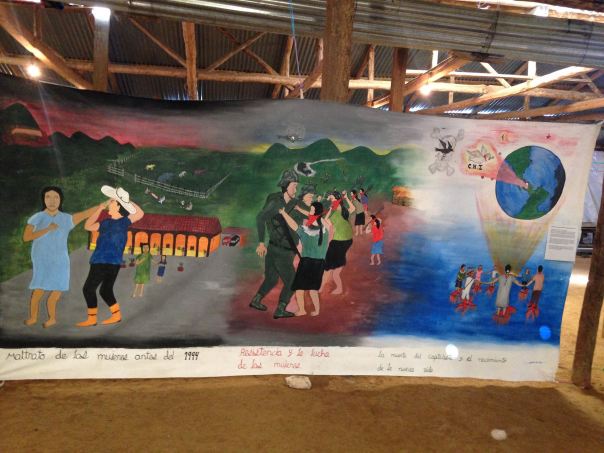
Resistance and Rebirth, Art from the Zapatista communities.
By: Raúl Zibechi
In periods of global systemic chaos it’s easy to confuse reality with desires, even more so when there are authentic facts that give rise to thinking that what we desired for a long time seems to be approaching imminently. However, problems appear here, optic deviations that lead us to erroneous conclusions. In some way, we all fall into simplifications that are ultimately shown to be incorrect.
We desire, or at least I desire, the end of this imperialist, colonial, patriarchal and capitalist system. But it would be wrong to believe that “laws” exist that lead the system to ruin. Let’s look at just a few years ago, when serious and well-documented analysts predicted peak oil, the peak of oil discoveries, which would inevitably lead to the end of a civilization based on hydrocarbons.
We thought that starting with the first decade of this century an unstoppable decline would begin and that prices would be so high that they would provoke abrupt and revolutionary changes. As we know, that is not happening. The United States has put itself at the head of extraction by hydraulic fracture (fracking), a very contaminating technique, and is breaking all records of production bringing prices to much lower levels than those of three or four years ago.
That’s just one example, among many. Those of us who were formed in Marx learned –thanks to the bad communicators and to the desire to believe them– that capitalism is condemned to disappear because of alleged laws that govern the economy and that will lead it to collapse. These debates took place a century ago and still survive. I don’t refer to those who are scanning the horizon and see clouds approaching, but rather to those who make forecasts from a desk guided by some theory.
I want to give two examples, one that endorses the thesis of the decadence of the United States and another that contradicts it.
The economist David P. Goldman maintains in a documented work in Asia Times, that the imposition of tariffs on steel and aluminum “doesn’t have any possibility of rejuvenating the industrial base of the United States. His analysis is overwhelming. He assures that starting with the decade from 2000 to 2010 there has been a decline in innovation and productivity in the US, because “venture capital stopped investing in the manufacturing industry.”
The cause is typically capitalist: aversion to the risks due to the fall in the rate of profit. China did the opposite because it’s not a savage capitalism but a State capitalism that is dedicated to protecting and subsidizing strategic industries so that the nation won’t be humiliated again, as happened with the three invasions that prostrated (the opium wars in the 19th century and the Japanese invasion in the 20th century).
Investments in cutting-edge technologies have fallen dramatically in the US, being barely one fifth of those that it had at the beginning of 2000. “The United State share of world exports of high technology have fallen from 20 percent in 1999, to a little more than 5 percent in 2014, while China increased from 3 to 26 percent in the same period,” Goldman points out (goo.gl/1yVxNy ).
He asserts that the United States never confronted a competitor like China. Washington limits itself to imposing taxes, like the one imposed on solar panels, but Beijing continues to gain sympathy by offering itself as a champion of free trade. The roles have been reversed and now the US is becoming, in the words of Goldman, “a producer and exporter of agricultural products and raw or semi-finished materials with an atrophied industrial base.”
The second analysis was published days ago in the newspaper El Economista and shows that the United States will become the first oil producer of oil starting in October, thereby displacing Saudi Arabia and Russia, and placing OPEP on the defensive. According to the International Energy Agency (IEA), thanks to fracking “the new US production will cover more than half of the world’s increase in demand for oil until 2023” (goo.gl/foDSzg).
With 10 million barrels per day, the US achieves solid energy independence and also becomes a big exporter. According to the IEA, in 2019 the countries that don’t belong to the OPEP (like Canada, the US, Mexico, Russia and Brazil, among others) will produce 60 percent of the world’s oil (goo.gl/1ywm16).
While Venezuela’s oil production falls to 1940 levels, that of the United States beats all historical records and, even more surprisingly, exports grow geometrically (89 percent in 2017), to the point that it is estimated that 40 percent of the demand of the Asian refineries will be covered with US oil (goo.gl/ecjQMp). From having been a country historically dependent on oil imports, it has become in a very few years the big global energy power.
At this point, it seems necessary to make some clarifications.
The first is that I believe that effectively the United States is a great power in decline. This is the principal aspect of the question. But the decline is not linear or rapid; it has counter-tendencies, like the one I point out above. This means that the transition towards the hegemony of China will be longer and more complex that what we could have anticipated years ago and, surely, along the way there will be agreements and crises, which will accelerate and slow down, at the same time, the la decline as well as the rise of new powers.
The second question is related to the modes of understanding and analyzing what is happening. It’s very common to fall into the temptation of eliminating data that contradict our forecasts and, above all, our desires. Up to a certain point it’s an inevitable tendency, but we must be on the alert in order to minimize this risk.
The third is that there are no “objective” laws capable of putting an end to this system of death. Only collective and organized human activity can, at the same time, restrain this barbarism and open cracks in the wall of domination.
———————————————————–
Originally Published in Spanish by La Jornada
Friday, March 16, 2018
http://www.jornada.unam.mx/2018/03/16/opinion/021a2pol
Re-Published with English interpretation by the Chiapas Support Committee
CNI & EZLN: “Call to the next step in the struggle”

BROTHERS AND SISTERS, COMPAÑERAS AND COMPAÑEROS OF THE COUNTRYSIDE AND THE CITY, OF MEXICO AND OF THE WORLD:
The National Indigenous Congress (CNI, its initials in Spanish), the Indigenous Government Council (CIG), the Civil Association “The time has come for the flourishing of the peoples” and the Zapatista National Liberation Army, address individuals, groups, collectives and organizations, peoples, barrios, tribes and nations that, in Mexico and in other countries that supported the initiative of attaining the registration of the CIG spokesperson, María de Jesús Patricio Martínez, as a candidate to the presidency of Mexico.
The hard and verifiable data that we have are:
The National Electoral Institute (INE) received 281,955 signatures; of those, 10,624 were captured on paper, not on the digital application. Of these, the vast majority corresponds to community assemblies. Under the INE’s own criteria, 94.5% of the signatures collected appear on the list of names. Helpers: Registered 14,117, active 5,704. With respect to the difference between registered and active, 8,413, in December 5,322 emails were sent to those who registered then as helpers but didn’t report any signatures, and 2, 137 answered back. Of those, 1,618 explained that they didn’t have an adequate cell phone, be it through the INE application or the cell phone camera. Average signatures per active assistant: 49.43 (data taken from the page of the sisters and brothers of Cryptopozol, who collected the information from November 3, 2017 until February 24 and 26, 2018, and can be consulted at https://criptopozol.github.io/avance_marichuy/
An approximate count (it’s not precise) of helpers by state is listed below.
Without state defined 4930
Aguascalientes 89
Baja California 251
Baja California Sur 69
Campeche 42
Chiapas 864
Chihuahua 188
Ciudad de México 3398
Coahuila 92
Colima 30
Durango 42
Estado de México 1070
Extranjero 105
Guanajuato 345
Guerrero 99
Hidalgo 179
Jalisco 1040
Michoacán 264
Morelos 274
Nayarit 63
Nuevo León 257
Oaxaca 242
Puebla 407
Querétaro 301
Quintana Roo 189
San Luis Potosí 197
Sinaloa 98
Sonora 149
Tabasco 48
Tamaulipas 69
Tlaxcala 94
Veracruz 367
Yucatán 151
Zacatecas 89
(Note: the final count does not coincide with registered helpers because, they tell us, some registered more than once, desperate because the INE did not respond to them in a timely manner and form).
-*-
Compañeras and compañeros, sisters and brothers:
As is evident, we did not achieve getting the number of signatures necessary to register Marichuy as a candidate to the presidency.
The explanations and evaluations about this fact, we think, ought to be the product of a serious analysis and a profound evaluation.
Obtaining the sufficient number of signatures would have permitted us to take advantage of that space to continue making visible the original peoples, their pains and struggles, as well as pointing out the criminal character of the system, to make us an echo of the pains and rages that team throughout national territory, and to promote organization, self-management, resistance and rebellion.
We didn’t achieve it, but we must continue on our path looking for other ways, methods and modes, with ingenuity, creativity and audacity, in order to attain what we want.
Our bet was never to take power; it always was and will be for self-managed organization, autonomy, rebellion and resistance, for solidarity and mutual aid and for the construction of a world with democracy, freedom and justice for all.
The initiative to form the Indigenous Government Council and propose its spokesperson, Marichuy, as a candidate to the Presidency of the Republic, launched by the Nacional Indigenous Congress, has completed one more stage. The first stage consisted of the decision that the Fifth National Indigenous Congress made, on its 20th Anniversary in October 2016, to consult with all its peoples and communities about the initiative before delineating it. The second stage consisted of the CNI’s internal consultation about the initiative to form the CIG and name its spokesperson between the months of October and December 2016. The third stage culminated in the CIG’s Constitutive Assembly and the naming, by consensus of said Assembly, of María de Jesús Patricio Martínez as its spokesperson, in the month of May 2017. The fourth stage consisted of the collection of signatures in favor of our spokesperson Marichuy, a process that we just concluded.
Our walking continues. And the fundamental difference with the prior stages is that now we are more original peoples walking together, and, MOST IMPORTANTLY, we are now more persons, groups, collectives and organizations oriented to seeking solutions within ourselves that, we know, will never come from above. This stage was characterized by involving more people and sectors, beyond the original peoples and the CNI, in a peaceful and civilian struggle, inclusive, with a just cause, with a horizon of the radical transformation of the reality we all suffer, with legal methods, legitimate and honest, and that is something that no member of the institutional political class can say.
Faced with the indisputable fact that we did not get the number that, by law, is needed to continue with that stage, an analysis and evaluation is imposed that, as was the entire process, will be collective, participative, inclusive, honest and truthful.
Because of all that, and because of more things for which there are no words:
First: We sincerely thank all the persons who, in Mexico and other countries, gave their signatures. For us, each one of them is an embrace and an admonition to continue and to not languish. We greet each and every one of you, and in response, we reaffirm our commitment to not be discouraged.
Second: We especially thank those who, with or without the figure of “helpers,” understood the scope of our initiative, made it theirs, and pledged time, resources and work on the way to creating, growing and consolidating collective and community, to be in the best situation to confront the storm that we already suffer.
Third: The Civil Association “The time has come for the flourishing of the peoples,” as well as the National Indigenous Congress and those who form it, the Indigenous Government Council and the Zapatista National Liberation Army, have initiated, at an internal level, a serious analysis and evaluation of this stage that ends.
Fourth: We think that this analysis and evaluation does not correspond only to us. We consider that, since it became a collective effort that far exceeded the horizon of the original peoples, we must consolidate what was achieved and maintain its longing to construct another way of doing politics.
Therefore,
WE CALL ON
Individuals, groups, collectives, organizations, nations, tribes, peoples and communities of the countryside and the city, indigenous and non-indigenous, in Mexico and in other countries, that were committed to this process and confronted it with work, dedication and honesty:
To make an analysis and an evaluation, taking into account the objectives that the CNI and the CIG made public at their opportunity, and, above all, considering the objectives that you traced, and that you send it to us at the following electronic address:
valoraciones@congresonacionalindigena.org
We also tell you that, parallel to these analyses and evaluations, the Civil Association “For the Flourishing of the Peoples,” the National Indigenous Congress, the CIG and the Zapatista brothers and sisters, will invite a series of public and open activities for those who were involved in the process, to give follow up and continuation to this struggle that, we know is just beginning. Those who convene these activities will announce them in due time.
We also invite you to, on your own initiative and according to your own criteria, modes and times, realize activities for analysis and evaluation about what is happening in Mexico and the world, because, as the CIG and the spokesperson Marichuy said again and again, our horizon doesn’t end on July 1, 2018, nor is it limited just to Mexico.
The resistance, rebellion and determination to construct a world where many worlds fit is international and is not limited by the calendars or by the geographies of those above who exploit us, despise us, rob us and destroy us.
Mexico, March 2018
NEVER MORE A MEXICO WITHOUT US!
NEVER MORE A WORLD OF DEATH AND DESTRUCTION!
NATIONAL INDIGENOUS CONGRESS
INDIGENOUS GOVERNMENT COUNCIL
“THE TIME HAS COME FOR THE FLOURISHING OF THE PEOPLES,” A. C.
ZAPATISTA NATIONAL LIBERATION ARMY
En español:
http://enlacezapatista.ezln.org.mx/2018/03/16/convocatoria-al-siguiente-paso-en-la-lucha/
 Chiapas Support Committee