Chiapas Support Committee
Home of the Compañero Manuel blog on zapatistas & mexico
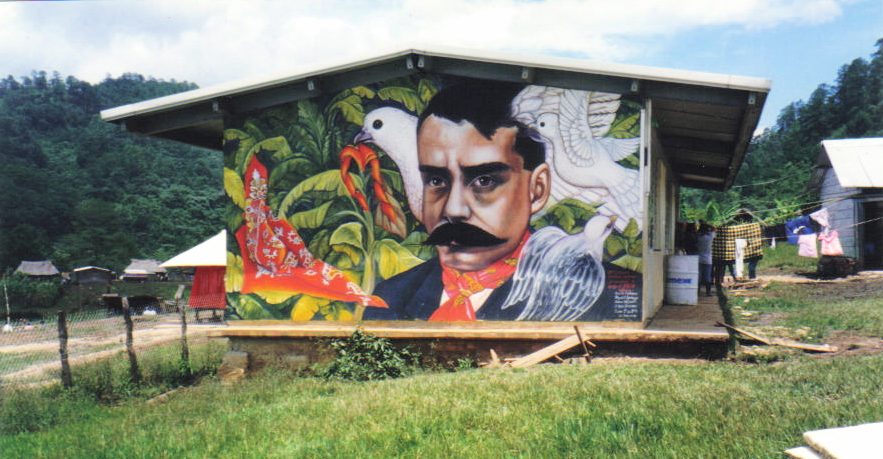
Half a century of popular education
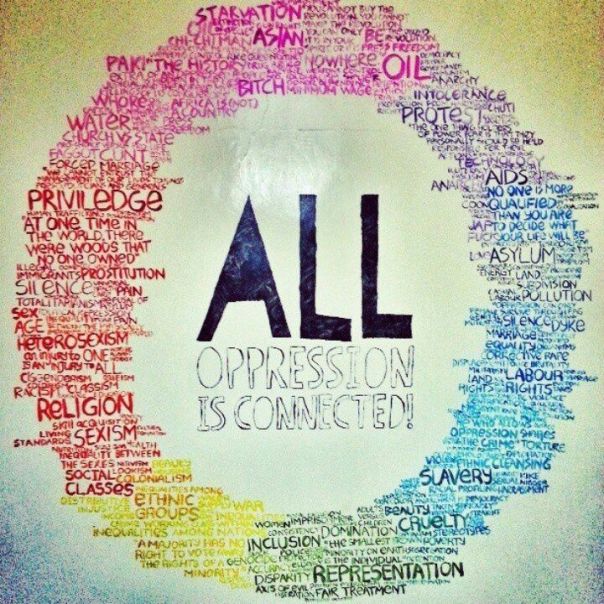
All Oppression is connected.
By: Raúl Zibechi
Among the multiple creations that illuminated the “1968 world revolution” (a concept coined by Immanuel Wallerstein), popular education is one of the most transcendental, since it has changed in depth the ways we conceive and practice the educational act, particularly in the bosom of the anti-systemic movements.
In 1967 Paulo Freire published his first book, “Education as the practice of freedom” (La educación como práctica de la libertad), and in 1968 he wrote the manuscript for “The Pedagogy of the Oppressed” (Pedagogía del oprimido), which was published in 1970. This book influenced several generations and sold the astronomic number of 750 thousand copies, something extraordinary for a theoretical text. Since the decade of the Seventies, Freire’s works were debated in the movements, which adopted his pedagogical proposals as a form of deepening the political work of the militants with oppressed peoples.
One of Freire’s principal concerns consisted in overcoming the vanguardism that reigned in those years. He defended the idea that in order to transform reality we have to work with the people and not for the people, and that it’s impossible to overcome de-humanization and the internalization of oppression just with propaganda and general and abstract discourses.
In this way it was in tune with the principal problems inherited from the experience of the Soviet Union, but it also critically addressed the work methods of the guerrillas born under the influence of the Cuban Revolution. Almost the totality of the generation of militants from the 1960s and 1970s were firmly convinced that we could represent the interests of the popular sectors (including the original peoples and descendants of slaves uprooted from Africa), but it didn’t occur to us to consult them about their interests and even less about their strategies as peoples.
I believe that popular education is one of the principal currents of emancipatory thought and action born in the atmosphere of the 1968 revolution. A good part of the movements have some relation to popular education, not only in their educational practices and the pedagogies they assume, but especially in the work methods in the bosom of the organizations.
Freire showed concern about transforming power relations among revolutionaries and between them and the peoples (the word revolution is one of the most used in the Pedagogía del oprimido), probably because he was attempting to exceed the limits of the Soviet process. His methodology proposals sought to empower the self-esteem of the oppressed, giving hierarchy to their knowledge, which didn’t consider their knowledge inferior to academic knowledge. He proposed cutting the distances and hierarchies between the educators-subjects and the students-objects, with work methods that demonstrated enormous usefulness for utilizing the organization of the popular sectors.
Thanks to popular education’s forms of work, the oppressed were able to identify the structural place of subordination that was gripping them, which contribute to the creation of more diverse grassroots organizations throughout the continent.
In the neoliberal decade of 1990, popular education was taking other paths. An excellent work from the Brazilian sociologist Maria da Gloria Gohn (goo.gl/zBZVks) emphasizes that it produced a sharp turn that led to the “professionalizing” of popular educators, weakened the horizontality and consolidated power relations between those that teach and those that learn. Popular educators were setting aside the militant relationship with their students to link themselves to the population as “groups of beneficiaries.”
The majority of the popular educators work for NGOs (before they were organized militants that, of course, did not receive pay) and spread the idea that: “governments are no longer the enemy but rather the promoters of social initiatives to include the excluded.” From then on, popular education was directed toward individuals and no longer toward collective subjects, and the methodologies occupy a central place, thereby displacing politico-ideological debates and the concept of “citizen” substitutes for the concept of “class.”
Popular educators tend to become rented helpers of state policies when, says Gohn, they stop fighting for equality and social change and work to “include, marginally and precariously, the excluded.” The postgraduates occupy the place that the educator-militants has before, while a style predominates style that set aside organization to struggle, for adopting the agenda of international funders interested in projects to “learn to insert themselves into a de-regulated economy and into a labor market without social rights.”
It’s evident that not all the popular educators take this path. Although a majority sector has been incorporated into the ministries of Social Development during the progressive governments, even with criticism and dissatisfaction, the most active and rebellious sector works together with the new movements, the recuperated factories and the landless campesinos, and they dedicate their time and effort to formation with the rural and urban popular sectors.
A considerable portion of the new generation of popular educators (without title and without name) are dedicated to learning the popular knowledge within their territories, not to codify them or use them for their own purposes, but rather to strengthen the organization of those below. The Chilean historian Gabriel Salazar maintains that the popular sectors educate themselves, in their spaces and based on their Cosmo vision. “The objective of popular self-education is to create power,” he says.
The paths are bifurcated, as often happens in all emancipatory processes. What’s important is that popular education is alive, that it has been mutating ever since the emergence of new collective subjects and that it has the ability to incorporate the knowledge of the peoples. One part of the educators decided that critical pedagogy consists in stepping down and not up.
———————————————————–
Originally Published in Spanish by La Jornada
Friday, June 8, 2018
http://www.jornada.unam.mx/2018/06/08/opinion/019a2pol
Re-Published with English interpretation by the Chiapas Support Committee
Trump: anti-immigrant terrorism
LA JORNADA EDITORIAL
 The escalation of anti-immigrant actions in the Donald Trump administration has reached unprecedented levels in US history with the mass separation of families that attempt to cross the border without the required documents: while between October 2016 and February of this year (2018) that number rose to 1800 families separated; in just 13 days, between May 6 and May 19, 658 children (some two years old and younger) were taken away from their parents in the context of border detentions. As often happens in the current US government, the measure was adopted without calculating its effects or making amends accordingly, therefore a humanitarian catastrophe is underway due to the lack of space in the children’s shelters.
It’s necessary to clarify that there is no guideline prescribing the separation of minors by border agents. It’s about a “collateral effect” of the “zero tolerance” policy put into effect in May, as a result of which crossing the border for the first time without documents was re-classified from an administrative offense to a crime, leading to the adults being arrested, criminally processed and, therefore, separated from the children with whom they were traveling. Needless to say, this indirect character of affectation in any way reduces its inhumane and brutal nature, something pointed out by human rights defense organisms, the United Nations Organization (UN), and even by federal judge Dana Sabraw, who classified the separation of families as unconstitutional and cruel.
As numbers of US agencies show, the cruelty of these measures has not fulfilled its alleged purpose of dissuading those seeking to enter their territory, which is explained because the current wave of migrants is not formed by seekers of better working conditions, but rather by people fleeing areas of El Salvador, Guatemala, Honduras and Mexico, where their lives are increasingly at risk due to the presence of criminal groups. To the extent that it’s impossible to convince a father or mother that will do anything within their power to protect the lives of their children, the Trump policy is nothing but an exercise in sadism against human beings trapped in the disjunctive between remaining in their communities and being murdered or migrating and suffering an arrest that violates their human rights.
The current crisis also reveals the moral collapse of the Republican Party, self-appointed defender of “family values” versus any advance in women’s rights or the rights of the community of sexual diversity. As Congressman Luis Gutierrez stated, by supporting the practice of separating migrant children from their families, Republicans have exhausted their time for talking about family values. If we add to this that a good part of the social decomposition that currently crosses through the referenced Central American nations is the effect of the military or authoritarian regimes imposed there by the United States during the last century, it becomes clear that the xenophobic policy in effect constitutes an ethical bankruptcy not only of the president, but also of the party that placed him in power and keeps him in power.
Given the manifest lack of will of the United States administration to reconsider its actions, it’s imperative that the international community, and especially the governments with citizens who are victims of this atrocious policy, to exercise every diplomatic and legal pressure on the White House tenant to put an end to an episode in which the physical and emotional wellbeing of minors is explicitly used as blackmail against adults that, on the other hand, do nothing but exercise their human right to escape from potentially lethal situations.
———————————————-
Originally Published in Spanish by La Jornada
Saturday, June 9, 2018
http://www.jornada.unam.mx/2018/06/09/opinion/002a1edi
Re-Published with English interpretation by the Chiapas Support Committee
First of July, change and rupture

By: Luis Hernández Navarro
What real possibilities for changing the economic model open up in the next presidential elections? None. The end of the neoliberal model in Mexico is not the order of the day in the coming elections of July 1. The option of moving towards a route different from the Washington Consensus is not at the door.
And it’s not for two different reasons. The first reason is because none of the candidates to the Presidency postulate the need to walk along a post-neoliberal path. There is not a single program of government that maintains that alternative. The second reason is because since 1994-1996 a series of legal locks have been approved that protects the neoliberal project legally. All the aspirants for the first magistrate maintain that said legal framework must be respected.
For different reasons, friends and enemies of Andrés Manuel López Obrador maintain the contrary. They see in him the candidate of rupture. Is he really that? No. His Alternative Project for the nation proposes that we must democratically recuperate the State and convert it into the promoter of the country’s political, economic and social development. He maintains that he will consult the people if the structural reforms are maintained or are cancelled. He announces that the budget will really be public and that he will give a preference to the poor. He insists on the centrality of the struggle against corruption. But he does not speak explicitly –as he did in the past– of eradicating the neoliberal economic model.
However, although there is no deep rupture with the development model followed up to now, that doesn’t mean that his project will be a mere continuation of the current one. Of course there are changes, but the core project is preserved.
Where are those changes? For now, he’s placing the review of public works contracts and governmental concessions at the center of the electoral campaign’s debate because they are, according to Lorenzo Meyer, at the heart of politics. Above all are those involving the construction of the New Mexico City International Airport and those involving concessions for the exploitation of oil fields.
Another change has to do with the education reform. The candidate of the “Together We’ll Make History” (Campaign) signed a commitment with the Progressive Social Networks, the union-electoral arm of Elba Esther Gordillo, in which it promised to reverse the education reform, sending to Congress a new draft of the Law of the Professional Teaching Service, eliminating the punitive evaluation. His proposal doesn’t touch the wording of the third constitutional article or the secondary legislation on the matter.
But, beyond the political will to modify the neoliberal model is the legal framework constructed to avoid modifying its substantive aspects. It’s not just about as lock, but about a complex locksmith’s system concocted from the reforms approved by chambers, resolutions of the Supreme Court of Justice of the Nation (SCJN), the functioning of economic regulatory organisms and the signing of free trade agreements. The legal framework approved is a real minefield that invariably favors the interests of large corporations (many of them transnational) against the State’s regulatory powers.
That new legal framework did not begin to be constructed with the Pact for Mexico or with the energy reform; it is only part of the recent cycle of neoliberal reforms.
A key moment for laying out this legal firewall was the restructuring of the SCJN in December 1994. In a sleight of hand, then President Ernesto Zedillo dismissed the 26 ministers that composed it and established a new composition of 11. As Miguel Ángel Romero documented (http://bit.ly/2pYBYs2), the neoliberal project in Mexico has counted on, starting from that moment, an enormous legal shield. Anyone who ventured to make legal changes that could put the pillars of the free market in a predicament, had to pass through the customs office that ultimately defines the constitutionality or unconstitutionality of that modification. Since then, again and again, be it the indigenous reform, the Issste law or the resolution on the constitutionality of teacher evaluations, the ministers have voted against popular interests.
 Perhaps the most striking example of this role is the discussion that the Court gave about interest on loans, derived from the 1995 financial crisis. On that occasion, Minister Olga Sánchez Cordero (now proposed by López Obrador to be Secretary of Governance) voted in favor of legalizing usury.
The bolts placed by the country’s economic regulatory agencies have also been fundamental. In fact, they have favored concentration of the market and strengthened monopolies instead of favoring competition. And, far from grantors of true autonomy, they have permitted the Executive to enjoy extraordinary powers.
The signing of numerous free trade agreements (especially in their chapters on investments) obliged modifying internal legislation and subjected the country to what the CELAG [1] has called a “new pro-business law,” dedicated to providing guarantees to foreign investments.
The cherry on the cake of this loss of national sovereignty is the recent Mexican adhesion to the Convention on the Settlement of Relative Investment Disputes between States and Nationals of Other States (the ICSID Convention) and their acceptance that it functions as like NAFTA’s dispute resolution process. With it, as the Latin American Network on Debt, Development and Rights has explained, the transnationals have an instrument of pressure on governments that, with the clothing of a court of controversies, that threaten them so that they don’t touch the interests of those companies, once, in a suicidal way, they have submitted to their authority.
If this openly pro-business legal framework is not dismantled, it’s not feasible to undertake a new development model in favor of the majorities (and I’m not talking about socialism). In these elections, no political force has made proposals for ending it.
[1] CELAG is the Latin American Strategic Center for Geopolitics (Centro Estratégico Latinoamericano de Geopolítica, CELAG)
————————————————————
Originally Published in Spanish by La Jornada
Tuesday, April 3, 2018
http://www.jornada.unam.mx/2018/04/03/opinion/017a1pol
Re-Published with English interpretation by the Chiapas Support Committee
Marichuy’s Words during the 2nd Metropolitan Gathering
 The words of María de Jesús Patricio Martínez, spokeswoman for the Indigenous Government Council, in the 2nd Metropolitan Gathering of Networks, Collectives, Organizations, Individuals and Adherents to the Sixth in support of the CIG and its spokesperson Marichuy, held May 19, in the ENAH’s [1] Piña Chan Auditorium
Good Afternoon, compañeras, compañeros, sisters and brothers:
First, thank you for having invited us into this space of the networks that called to continue listening, to continue constructing, to continue walking, and telling you that for our part, as council members, as the National Indigenous Council, we will also continue walking.
We will resume the tour through Baja California where we left off, as a showing that this doesn’t end. We said that it wasn’t the end if the signatures were not sufficient, and so our work continues.
As Carlos said, this goes far beyond the ballot boxes, well beyond July 1st. This struggle that we are thinking, this struggle that we are constructing, this new organization that we think from below, doesn’t fit in the ballot boxes, doesn’t fit in the electoral question. It was a means to make visible all the la problems that exist, and to realize everything that exists throughout national territory.
We toured 26 states of the republic and in all those states there is dispossession in its different presentations; there is repression against attempts at organizing; there are deaths; there are disappeared as a way of repressing and stopping those struggles. Then those above, those who have money and power, they have the clarity that they want, they are clear as to what they’re thinking to do about this Mexico.
At times we fight among ourselves, we wear ourselves out, we think that: “because I am better, I’m going to show you that it can be done” and it’s not true. We must unite. We must start thinking together what to do to survive, to go forward, because what’s coming is stronger, that storm about which our Zapatista brothers speak is a storm that draws near and only those who are organized are those who will succeed. That’s why this tour was that call to organization.
As indigenous peoples we also lack a lot: as indigenous brothers, they have divided our communities, the (political) parties have separated us; the government itself, with its spurious programs that arrives and gets in, confuses and then co-opts the leaders and they lose their influence all around, thinking that they can help their communities and it’s not true. They are placing traps.
Thus the call for organization that was present in our tour.
It’s simply that if we don’t organize ourselves, they are going to continue eliminating us one at a time, they’ll continue incarcerating us and they’ll continue murdering us. Why? It’s because this capitalist system is not interested in those below.
Some indigenous brothers in some communities said: “Look, we had the best lands, they were flat, and they sent us to the mountains, and now they want to take us away from the mountain. Why do they want to take us away? Well, it’s because they saw that there’s gold, that there’s iron, that there’s water, that there are forests:” everything that they can make money from is what interests the power. It is what interests this capitalist system. That’s why the governments are disposed in favor of the owner of capital. They are going to do what he tells them up there above; they make an agreement among them. And if we are separated more and more each day, we are fighting among ourselves, instead of thinking about how to work collectively, how to strengthen ourselves as women, as youth, as workers, as whatever it may be, as the best way is for us to organize ourselves because it’s urgent to do a job from below.
Let’s not run, let’s walk, but let’s not stop, because if we run we’re going to fall and then it will be more difficult. But let’s go walking, and let’s build something together, let’s go walking. That’s why we gave more time for the evaluations, because there are lots of brothers that still didn’t turn in their evaluations. And they are important for this walking.
We must go walking and we have to go asking, constructing together. So, that’s why more time was given and it’s going to be until September, because we have the assembly in October.
The construction of this new Mexico of below, this organization that must emerge, which is now being consolidated, we must not leave. We must continue constructing it, because this monster that we have to face is a big monster, and you can’t remove one part, because you can’t. It’s like the animal with seven heads that if you cut one off more and more are born.
So, that’s why the struggle demands that we are varied, that we are indigenous, workers, campesinos, doctors, lawyers, and all of us who feel identified, because a few have kidnapped this Mexico and they are the ones who are deciding what you do and are annoying us.
That’s why the indigenous communities say: “If the land dies we’re going to die with it, it’s not going to die alone.” That’s why we fight for life, because it’s everything.
We consider that there is a lot to do, there’s a lot of work.
We’re no longer thinking about the elections. Let’s think about how we’re going to organize below, because that continues and then we have to convince more and more people.
Let’s be sad when someone leaves us, not happy; and happy when they come again and again, then, because it has to do with growing, if we’re really clear that what is coming is bigger and urges that we organize with each other and to be in agreement and go forward, each one in his place, each one in his space, each one in his times, in his ways.
We with indigenous peoples, students with students, women with women, workers and so forth are then going to go unifying these struggles. We’re going to think among everyone where we’re going to give it, so that’s why our invitation is going to be for always, we must organize ourselves.
That’s the only thing that will be able to take us forward in the face of this strong destruction that’s coming. Only getting organized below is how those above are going to fall, all alone. We don’t have to knock them down, those of u below need to get organized and then you will see that there will be another world.
So, that’s why we think that this struggle continues and demands mucho more of us, especially those of us who have already walked and toured some states seeing the pain of mothers and fathers. We have seen many pains and that is what encourages us not to stop, but to continue. That’s why we have an agreement, then, to continue with the tour where we left off and from there to other places that we were not able to reach right now, but are important to reach.
So then, it’s an invitation to walk. Where do we go, we’re going to denounce what’s happening below, but we have to be strong because what’s coming, is truly bigger. It’s on a global scale; it’s not just at the level of Mexico.
That’s why it demands a lot of work on our part. Where we were going we told them: “Forgive us, we did not bring anything, we bring work,” because it’s what we offer for changing this world from below, working.
But let’s work together; let’s work in a unified way, recognizing that we have a common enemy.
As Carlos said, the enemy is not among us. He is never going to sit down with us. The enemy is above and is preparing how he’s going to continue dispossessing the people, how he’s going to continue exterminating the inhabitants, how he’s going to continue amending the laws, with reforms to ensure for them that resource.
So, we below will walk constructing collectively, constructing another Mexico. And in a little while you will see that we are going to be more. Don’t get discouraged, don’t despair, but don’t remain passive. Continue walking and, when necessary, we are together.
Then, that is our word, that is our voice, it is our work that we have to do together if we really want to construct something new from below, and in that walking, we are with you, we are ourselves and more than that are not here, but they are there.
Thank you, we invite you to walk in that construction that is not finished. Perhaps others will continue it.
Gracias.
[1] ENAH – la Escuela Nacional de Antropología e Historia (the National School of Anthropology and History).
———————————————————————————
Originally Published in Spanish by Coordinación Metropolitana
Sunday, June 3, 2018
https://coordinacion-metropolitana.blogspot.com/2018/06/palabras-de-marichuy-durante-el-ii.html
Re-Published with English interpretation by the Chiapas Support Committee
The imperial reaches of the Southern Command
THE IMPERIAL REACHES OF THE SOUTHERN COMMAND IN LATIN AMERICA, PART I

The government has the bullet. The people have the word.
By: Gilberto López y Rivas
On February 15 of this year, Admiral Kurt W. Tidd, chief of the United States Southern Command, testified before that country’s Senate Armed Services Committee, and elaborated an unclassified document at that meeting, in which he presents his position with respect to conditions, actors and current or possible variables that affect or are related to the security and defense of the United States in the area “under his responsibility,” which encompasses 31 countries in Central America, South America and the Caribbean. The document exhibits –behind the rhetoric of the supposed defense of democracy, humanitarian aid, the fight against drugs and terrorism– the familiar imperialist perspectives historically rooted in Manifest Destiny and, in the case of our continent, in the so-called Monroe Doctrine that, reconstituted and renovated, feeds the ideologies and imaginaries of the current governing groups that consider the United States as the “only indispensable nation,” and assume for themselves the right of overt or clandestine military intervention on the planetary ambit to protect its strategic interests and its national security; that is, the role of the world’s police. The chief of the Southern Command tells the Senate Committee: “Every day, our men and women work to back our approaches in the South and to build a regional security network starting with inclusive associations and based on principles. […] We depend on this network to help maintain our own security and to defend our land in depth.” However, he complains that diplomatic efforts and those in favor of “development” for maintaining that network are insufficient, and that the perception of their allies and competitors in the area [China, Russia, Iran, Korea] is that the United States is not fulfilling its commitments, renouncing its strategic position and without seriously taking into account the region’s challenges. Therefore, he argues that security risks must be considered in order to continue prevail as a hegemonic power in this hemisphere and to prevent a crisis from diminishing the ability of the United States to face other “even more important” commitments in the international ambit. He warns that it’s not desirable for his country to open “our southern flank” to a varied range of vulnerabilities. The admiral discovers that Latin America is a region of contrasting tendencies, both positive and worrisome at the same time, with democratic, modern, diverse societies, with rising middle classes and with “capable and professional militaries.” these societies still confront “governing challenges” [sic], which include political corruption, unachieved development challenges, and shocking levels of criminal violence, which create permissive spaces for illicit activities of all kinds: global extremism has established a narrow base among the Muslim population of Latin America, recruiting activists to carry out attacks. Insecurity and economic difficulties continue causing an increase in migration and, of course, he emphasizes Venezuela as a permanent risk because of its “internal instability,” which can cause significant regional upheavals. Within this context, the military man turned into a high-flying social scientist distinguishes a combination of evidence and threats that come from state and non-state actors that form networks, like those of traffickers in drugs, arms and human beings; terrorist sympathizers and militants, as well as those of money launderers, who –he points out– use common entry routes into the United States and conduct all kinds of operations in that country’s territory. Curiously, this military chief considers that organized crime cartels act like any transnational corporation that diversifies, de-centralizes and distributes franchises to perpetrate their criminal actions “without borders.” According to the admiral, these networks and their cumulative effects, play a cardinal role in the strengthening of the corruption and insecurity, and in the erosion of citizens’ faith in democracy and basic democratic values, especially in countries with the highest levels of of criminal violence. At the same time, Admiral Tidd warns that his country faces the traditional challenges from state actors, and laments that China, Russia and Iran are courting Latin American and Caribbean most strategically important associates and supporting anti-U.S. authoritarian regimes. As for China’s part, its advance and economic influence in the region is concerning, as well as its technology that can be used in the collection of intelligence. The each time more visible role of Russia in the hemisphere is also disturbing, given Russia’s cyber and intelligence abilities. It equally disturbs the imperial ways that Moscow attempts to “falsely” change the ambit of Latin American information through its Spanish information media and, of course, doesn’t grace any US military personnel with progressive access to ports and logistical spaces, “sanctuaries,” in Cuba and Venezuela and, in sum, “a projection of the visible force [of Russia] in the Western Hemisphere causes alarm.” The possible illicit activities of North Korea in “their region” disquiets military personnel, just like the expansion of diplomatic and trade relations with Iran.
But, the “threats” to the United States not only come from extra-hemispheric state actors. Tidd points out that in the field of national security: “Cuba has demonstrated a clear intention of attacking US interests, through activities of collection, vigilance and counter-intelligence in the region’s countries. This Spring’s planned political transition [he’s referring to the Díaz-Canel’s arrival to the presidency], doesn’t seem that it will change Cuba’s point of view, in the sense of diminishing the influence of military men [in the government] or altering the continuous cooperation with Russia, China and North Korea, in matters of security, politics and the economy,” Naturally, within the range of threats, we could not fail to mention the “negative influence” of Cuba on Venezuela, notably, according to the admiral, in the intelligence services and the armed forces.
The peoples remain outside of this imperial view of the world, absent their struggles and utopias; they don’t exist as important actors that forge its history, marked by countless invasions and military aggressions of the defenders of the “free world and democracy.”
———————————————————–
Originally Published in Spanish by La Jornada
Friday, June 1, 2018
http://www.jornada.unam.mx/2018/06/01/opinion/021a1pol
Re-Published with English interpretation by the Chiapas Support Committee
Ayotzinapa: possible clarification
A LA JORNADA EDITORIAL
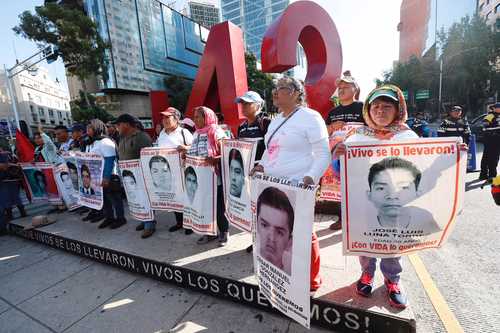
Court decides that representatives of the missing students’ parents and the National Human Rights Commission are the ones in charge of deciding the lines of investigation that must be followed and the evidence a desahogar in this case.
Yesterday, the first collegiate tribunal of the 19th Circuit in Tamaulipas, ordered the replacing of the procedure followed to date by the Attorney General of the Republic (PGR) around the atrocities perpetrated the night of September 26, 2014 in Iguala, Guerrero, that resulted in six deaths and 43 teachers’ college students disappeared. In the judgment of that judicial body, the PGR’s investigation was not prompt, effective, independent or impartial, like the Inter-American Court on Human Rights and the established protocols of the United Nations demand.
To the extent that an independent prosecutors’ office is lacking in Mexico, magistrates Mauricio Fernández de la Mora (speaker), Juan Antonio Trejo Espinoza and Héctor Gálvez, decided on the creation of an investigatory commission for truth and justice (Iguala case) that must be composed of representatives of the victims, the National Human Rights Commission and the Federation’s Public Ministry, with the condition that the first two decide the lines of investigation to follow and the evidence a present, and that will have the ability to incorporate national and international human rights organizations that they select into the investigation.
The decision is of undeniable importance, given that it opens a concrete possibility to clarifying an issue that for almost four years has been handled with an exasperating lack of grace on the part of the federal justice system, which still continues holding onto the unsustainable version the then head of the institution Jesús Murillo Karam presented at the end of 2014, according to which the young students were captured by Iguala municipal police and turned over to a criminal group that operates in that city, which would then have moved them to the neighboring Cocula to murder them and incinerate their bodies in the that locality’s municipal garbage dump. Scientists, academics and activists, as well as the Interdisciplinary Group of Independent Experts, reviewed the PGR’s conduct and disproved that version, which its author called “the historic truth,” from different technical points of view.
To make matters worse, the authority has been remiss in assuming lines of investigation of obvious interest, like the possibility that the young students had taken a bus that, without them knowing it, had been loaded with drugs destined for the United States, or the documentation of calls from some of the disappeared youths cell phones, which were made in the vicinity of the headquarters of the Center of Investigation and National Security and in the installations of Military Camp Number One, or the role played by members of the state and federal police and members of the military that were present in Iguala on the night of that episode of flagrant barbarism.
For almost four years such questions, and others, have gravitated in the conscience of the country at the side of the principal question: where are the disappeared youths and that did they do to them? The uncertainty in this regard and the carelessness of the authority responsible for seeking justice severely eroded the government’s institutional credibility, and contributed decisively to magnify the unpopularity of the current head of the federal Executive and, of course, have meant hell for the family members of the students of the Raúl Isidro Burgos Rural Teachers College of Ayotzinapa, who have maintained an admirable struggle for more than 40 months to achieve clarification of what happened, the whereabouts of their boys and the procurement and imparting of real justice.
For its own good, it’s fitting to hope that the federal government will not fail to conform with the decision and will accept, although in its final stretch, collaborating fully and decidedly in the clarification of this case and in the identification of those most responsible. Taking votes is also pertinent because the truth commission will achieve delving into the reasons for an institutional performance so defective and insufficient that incubated in society the justified suspicion that the PGR’s entire investigation was and continues being a cover-up exercise that has damaged the country almost as much as the Iguala crime itself.
———————————————————–
Originally Published in Spanish by La Jornada
Tuesday, June 5, 2018
http://www.jornada.unam.mx/2018/06/05/opinion/002a1edi
Re-Published with English interpretation by the Chiapas Support Committee

Organized peoples of Chiapas against the extractive model
THE GATHERING OF ORGANIZED PEOPLES OF CHIAPAS POINTED TO THE ADVANCES IN THEIR STRUGGLE AGAINST THE EXTRACTIVE MODEL
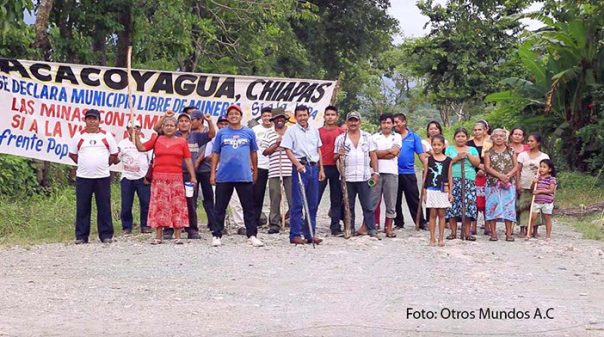
Residents of Soconusco organized to prevent their territories from being affected by the mining industry.
By: Chiapas Paralelo
More than twenty organizations and communities that make up part of the Group of Resistance to the extractive model of Chiapas met in the municipality of Acacoyagua last April 19 and 20 within the framework of the Meeting “Living Peoples! Free from Extractivism!” for the purpose of analyzing results obtained from the organized and peaceful struggle to stop dispossession and their defense against extractive model projects. [1]
Final statement of the Meeting
“Living Peoples, Free of Extractivism!”
Acacoyagua, Chiapas, Mexico
April 20, 2018
On April 19 and 20, 2018, organizations and communities that form part of the Group in resistance to the extractive model in Chiapas, met on the lands of the Popular Front in Defense of Soconusco “June 20” (Frente Popular en Defensa del Soconusco “20 de junio,” FPDS), within the framework of the Gathering called: “Living Peoples! Free from Extractivism!” that we held in the ejido house of Acacoyagua, Chiapas.
For years we have been meeting among men and women members of the Group of resistance to the extractive model in Chiapas. We seek to weave our struggles and make a common front against the advance of extractivism, that is, the current phase of capitalism that extracts a maximum of the natural commons for the accumulation of wealth and the export of raw materials.
Together and united we will stop this model that damages life, nature, the collective rights of the peoples, the social fabric, the bio-cultural patrimony and our spirituality. The FPDS is at the point of completing three years of resistance against the 21 mining concessions that exist in Acacoyagua and Escuintla. We meet in their territory because their dignified and just struggle in defense of life and Mother Earth is an example for us. Their defense is essential for the wellbeing of the population and future generations to whom we must leave clean rivers, free of contamination from mining. We admire the courage of the compañeros of the FPDS who have been installed for a year and a half in two camps in Acacoyagua in order to prevent the passage of machinery from the El Puntal Corporation S.A. de C.V. towards the “Casas Viejas” titanium mine.
Thanks to this action, the mine is not active, but we will continue supporting the FPDS until the 21 concessions are cancelled definitively. We congratulate them for having achieved that in September and October 2017, the ejido and the Communal Wealth of Acacoyagua would sign assembly agreements in which mining activity is prohibited.
Their struggle is difficult and very long-winded, like that of each of ours, but we are aware that one must continue struggling. We must hold hands because today not only must we face the mines, but also a group of megaprojects that are part of the extractive model, since today even our own native corn is threatened.
Officially, 111 mining concessions and 98 hydroelectric projects exist in the state, but in Pijijiapan, the compañeros of the Autonomous Regional Council of the Coastal Zone of Chiapas already achieved the suspension of 4 mini hydroelectric projects. In Pijijiapan, the compañeros from the communities of Lázaro Cárdenas and neighbor communities are also attempting to prohibit the Bachoco poultry farm project, whose wastes full of toxic agents flow into the Las Pilas River affecting the health of people who depend on it for water. We are in solidarity with their struggle against agro-industrial dispossession.
Wind park projects that want to produce electric energy with the wind also threaten us, like in Arriaga municipality. There are also projects of the green economy that seek to take advantage of biodiversity through Payments for Environmental Services (PSA, its initials in Spanish) and of militarization, with the implementation of the Environmental Gendarmerie, which the compañeros of the “Reddeldía de los Montes Azules” in the Lacandón Jungle are resisting. As for the exploitation of hydrocarbons, we share the dignified struggle of the indigenous Zoque people of Chiapas who seek the cancellation of blocks 10 and 11 of Round 2.2, in which exploiting 12 hydrocarbon wells in their territory was proposed, but we continue on hold for any other attack on their sovereignty.
The legalization of dispossession is accomplished through the implementation of new Special Economic Zones (SEZ) in the Mexican southeast, among them the Port Chiapas SEZ that is going to occupy 8,611 hectares of Tapachula lands. The government leads us to believe that we’re dealing with a social project that will get our communities out of poverty, but we are well aware that they only mean “progress” and “development” for the corporations, which will not pay any taxes inside of the SEZ. In return they will get a lot of energy, water and exploited labor in order to function, leaving us with more poverty, more contamination and fewer arable land. Additionally, the SEZs are an attack on the sovereignty of our municipalities since outsiders that may come from the private sector are going to administer them.
We have another more sustainable project of life for our communities, based on the rescue of our uses and customs, our native seeds and our traditional medicine.
We reject the new Homeland Security Law (Ley de Seguridad Interior) that grants the president of the Republic the right to activate the presence of the Armed Forces in any situation that represents an alleged risk to national security. The Army will be able to intervene even in peaceful protests, and that’s why we condemn this unconstitutional new law, made to protect corporations, nor campesinos. We already saw it in January 2018, when the Army entered into several ejidos in the municipality of Ocosingo in the Lacandón Jungle, as part of the implementation of the law.
We denounce the implementation of strategies of control and assistance programs within the framework of the 2018 elections, which generate division in the communities and increase the levels of violence. In the municipality of Cancúc, for example, the communities and community police are being asked to watch over the delivery of the Prospera program with weapons.
Faced with this panorama, it gives us much hope to find ourselves in FPDS territory, where organized and peaceful struggle has concrete results and has achieved stopping dispossession, in the presence of other organizations and communities that also defend and defeat death projects. By resisting the extractive model in an organized manner, we strengthen our territorial defense and our search for sovereignty, we generate union and articulation among the exploited peoples, and we recuperate the exercise of our collective rights.
Signatures: [2]
Grupo de resistencia al modelo extractivo en Chiapas
Red mexicana de Afectados por la Minería (REMA)
Movimiento mexicano de Afectados por las Presas y en Defensa de los Ríos (MAPDER)
Frente Popular en Defensa del Soconusco “20 de junio” (FPDS)
Comisariato de Bienes Comunales de Acacoyagua, Chiapas
Otros Mundos A.C./Amigos de la Tierra México
Centro de Derechos Humanos Digna Ochoa A.C.
Consejo Autónomo Regional de la Zona Costa de Chiapas
Consejo Cívico Tonalteco
Pescadores y Campesinos de la Costa y Sierra de Chiapas
Resistencia Civil contra las altas tarifas de luz
Movimiento “Reddeldía de los Montes Azules”
La Voz del Pueblo
La Sociedad Civil Las Abejas de Acteal
Parroquia de Cancúc
Parroquia Santo Niño de Atocha de Frontera Comalapa
Movimiento en Defensa de la Vida y el Territorio (MODEVITE) de Ocosingo
Kinal Antsetik A.C.
Voces Mesoamericanas, Acción con Pueblos Migrantes A.C.
Movimiento Indígena del Pueblo Creyente Zoque en Defensa de la Vida y el Territorio (ZODEVITE)
Consejo de Organizaciones de Médicos y Parteras Indígenas Tradicionales de Chiapas (COMPITCH)
Colectivo Geocomunes
They accompany us:
Movimiento Sueco por la Reconciliación – México (Swefor Mexico)
[1] Acacoyagua is a municipality in the Western part of Chiapas, near the Pacific Ocean. The region is referred to as the Soconusco.
[2] Although the EZLN is not involved directly in this movement, some of the signatory organizations are members of the CNI and the CIG, adherents to the EZLN’s 6th Declaration of the Lacandón Jungle.
——————————————————————-
Originally Published in Spanish by Chiapas Paralelo
Monday, April 23, 2018
Re-Published with English interpretation by the Chiapas Support Committee
The Catalonia below and to the left
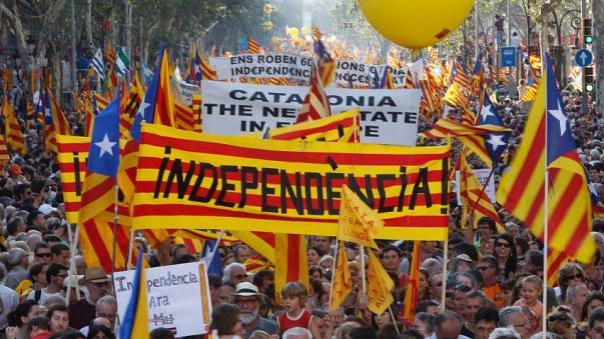
Catalonia demonstration in favor of Independence.
By: Raúl Zibechi
Things look different from a distance. Contours are barely distinguishable and large objects monopolize vision, while smaller ones are almost invisible. Not to mention what happens underground. Only in nearness, in the sharing of experiences and times, sounds and silences, can we come closer to understanding reality.
I had the immense good fortune to participate in the thirtieth anniversary of the NGO Entrepueblos (Between peoples), celebrated in Barcelona at the beginning of May, and to reunite with compañeros with whom we had worked together during exile. I spent almost all the time getting to know the realities of the grassroots independent world, which is more anticapitalist and anti-patriarchal than I suspected.
Meetings with members of the CDRs (Committees of Defense of the Republic), of the Candidacies of Popular Unity (Candidaturas de Unidad Popular, CUPs), with members of territorial collectives, the communications media, movements and social and cultural centers that, like archipelagos, people the geography of Catalonia. No organization occupies the center, in a world of galaxies and archipelagos. I wasn’t with leaders, but rather with grassroots militants, and that is more or less what I was able to see.
Sabadell is a working city of 210,000 residents a half hour from the center of Barcelona. In 1934 it was the first city of Catalonia to proclaim the republic. At the end of the 1990s, it was characterized by antifascist struggles, occupation of houses and the creation of athenaeums. Between 2012 and 2014 it championed general strikes against the (political) right that sought to unload the crisis on the workers.
There is a Popular Movement of Sabadell composed of dozens of collectives: of workers, of women, of the powerful Platform of those Affected by Mortgage, which joins some 500 people in assemblies, has four buildings occupied where they shelter the evicted and have a self-managed food bank. Besides, there are a dozen non-hierarchical consumer cooperatives and free media.
Months ago seven CDRs were born that propose, say the militants, to “territorialize the defense of the referendum” for independence. In the beginning the R was for Referendum, but later it was transmuted into Republic. In the first months up to 8,000 people participated in the assemblies, an astronomic number for a small population, which now fell to less than one thousand among the four or five CDRs that survive.
Throughout Catalonia, 300 CDRs emerged that fight for prisoners and exiles, in defense of the 150 accused because of street actions and of the 700 mayors threatened by Spanish justice. “The potentiality,” says a compañero that won’t give names or signs because the repression is real, “consists of the capacity to mobilize very different people.” He refers not only to the different political options (from anarchists to social democrats) but also age differences, where the elderly play a decisive role in the face of repression: the “yayos” and “yayas” are placed in the first row to dissuade/challenge the police.
“The limits,” he continues, “consist of the difficulty of maintaining this level of mobilization.” He assures that: “the process cycle is closed,” that the people are not afraid, that grassroots organization is very extensive and solid, but the independence process will be very long. “We have to chop rock,” he concludes between smiles.
In a meeting with four CDRs of various districts and neighborhoods, they assured that the movement “has no structures.” Each CDR is sovereign to make or take initiatives on their own, always under principles of non-violence, active resistance and rejection of hierarchies. One of the big problems is that traditional organizations of the independence movement are paralyzed by the repression; therefore the leadership corresponds to the territorial grassroots movement, whose experience goes back to the end of the 1990s in the struggle against globalization.
The CDRs carry out a very diverse set of actions: they place yellow ties on beaches and streets, cut off roads and lift up the barriers at toll booths, mobilize in support of feminists, pensioners, evictees and workers. “Each time that there is repression, more people join the assemblies,” says a young woman from Rubí, on the outskirts of Barcelona.
In the short term, they intend to maintain the resistance to show that there is no normality, that the country is intervened by the government of Mariano Rajoy. In parallel, they are taking steps to create “another economy,” based on the long experience of the Catalan libertarian co-operatives, which seeks disconnection from capitalism. They coincide in affirming that it is a struggle of a transversal character: for independence, against capitalism and patriarchy.
One of the more notable experiences is that of Coop57, the financial services cooperative that gives loans to social economy projects. Born in 1995 as a result of the struggle of the Editorial Bruguera workers, who created a solidarity fund with part of the compensation received (coop57.coop). Today they have 800 entities that support the project, with 4,000 members and almost 20 million euros in annual social loans.
I want to highlight three aspects of this movement.
One: let’s not be blinded by independence (for those that live far away and are not nationalists), because it’s most complex. The anti-capitalist and anti-patriarchal features are as powerful as the independence one.
Two: let’s not look to above (Puigdemont or Torra, for example) but rather below and to the left. That is where there is a source of very important teachings that should fill us with hope, with which we can dialogue and learn.
Three: the process will be very long and not everyone thinks like that. I have appreciated a tendency to believe that there will be independence without great conflict, something impossible in a reality framed by a centralist Spanish State that never broke ties with Francoism. But the prolongation of the process can strengthen the more anti-systemic options.
———————————————-
Originally Published in Spanish by La Jornada
Friday, May 25, 2018
http://www.jornada.unam.mx/2018/05/25/opinion/019a2pol
Re-Published with English interpretation by the Chiapas Support Committee
Waffles and Zapatismo
PLEASE JOIN US THIS SATURDAY for WAFFLES & ZAPATISMO!

 Chiapas Support Committee