Chiapas Support Committee
Home of the Compañero Manuel blog on zapatistas & mexico
Venezuela, the puppet and the puppeteer
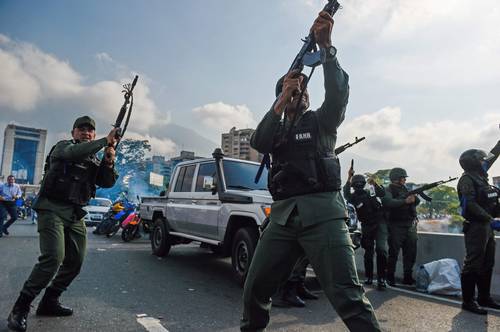
“We were deceived. They told us that we would participate in another operation,” the soldiers (in the image) denounced who initially joined in yesterday’s skirmish against the government of Venezuela. Photo: Afp
By: Luis Hernández Navarro
The scenography
One word sums up the attempted State coup against President Nicolas Maduro on this April 30: failure. Boasting, the Venezuelan opposition gambled on overthrowing the president. It lost. After some skirmishes, their call quickly deflated.
Beyond the set designed for the occasion and the deafening shouting of those who fantasize about the end of the Bolivarian Revolution, the day’s result is clear. On the one hand, commanders of the Bolivarian National Armed Force (Fuerza Armada Nacional Bolivariana, FANB) remained loyal to the Venezuelan president and tens of thousands of Chavistas guard the Miraflores Palace. On the other hand, the visible head of the operation, opposition leader Juan Guaido, is on the run, while the fugitive Leopoldo López and his wife had to take refuge in the Embassy of Chile and then in the Embassy of Spain.
The bluff began early in the morning. It was more a propaganda presentation that a military action in form. Posing for the video cameras on the Superhighway of the East, next to the Altamira traffic distributor, surrounded with a small group of military deserters, mostly low-ranking, and police, with the La Carlota military base behind them, Juan Guaido called to the Venezuelan people to take to the streets, to start the definitive phase of Operation Liberty and to make the “definitive cessation of the usurpation” a reality.
Proclaiming himself chief of the Armed Forces, the president of the National Assembly harangued his imaginary soldiers: “Today I call on the soldiers, and all the military families to accompany this feat […] There are a lot of soldiers that join in […] The time is now.”
A general without troops, Guaido issues orders, not through his high command, but on Twitter: “People of Venezuela, we need to go out in the streets together. Organized and together let’s mobilize the main military units. People of Caracas, everyone to La Carlota,” he wrote in one tweet.
“At this moment –he lied in another tweet– I’m with the principal military units of our armed forces beginning the final phase of Operation Liberty.” Now on track, he fantasized in one more: “The streets of Venezuela continue filling up with more and more people!”
With the surprise factor on their side, the rebels achieved an ephemeral early success: liberating Leopoldo López, who was serving his sentence under house arrest. And, before colliding head-on with reality, accompanied by armed protesters with pistols, they lived a few minutes of glory. It didn’t last long. With eight tanks, four 7.62 machine guns and high-power rifles, they blocked the road and attempted to advance on La Carlota. They couldn’t take it.
They were deflated more quickly than slowly. Soldiers and police that initially participated in the skirmish withdrew. “We were deceived. They told us that we were going to participate in another operation,” they denounced. The ear of corn was gradually shelled. It was not yet noon, when 80 percent of the military personnel that formed part of the attempt abandoned the leaders of the plot. One-by-one, the eight tanks were taken to their places de origin.
Dislodged from the freeway, the coup plotters tried to march towards the Miraflores Palace. They were not successful. The offices of the president were surrounded with thousands miles of Chavista sympathizers. They had to retreat towards the Altamira neighborhood.

Chavistas gather to protect the government palace.
Even less successful was Guaido’s call for citizens to take over the streets. Not even in the neighborhoods that they historically control were the anti-Chavistas able to mobilize the number of sympathizers that have traditionally supported them in all these years of opposition struggle.
US Senator Marco Rubio was also disappointed. He announced on Twitter: “On May 1, Juan Guaido headed what would potentially be the definitive moment in the struggle against the Maduro regime in Venezuela. The leaders of the FANB must defend the Constitution and protect the demonstrators from attacks of Maduro’s armed gangs.”
The interminable coup
The collapse of the anti-Chavistas is the last link in a long chain of failed coups. As recently as August 4, 2018 there was an attempt to assassinate President Maduro with a drone attack. The attempt was planned in Colombia, under the direction of the opposition politician Julio Borges and the support of the financier Osmán Alexis Delgado.
Borges is a Venezuelan politician and lawyer that in 2018 participated as a representative of the opposition in the peace talks held in Santo Domingo, and simultaneously in the organization of the attempt against Maduro. Together with the businessman Parsifal de Sola, he played a key role in the failed Operation Jericó in 2014-15, which attempted another State coup.
Shortly afterwards, at the beginning of 2019, retired Colonel Oswaldo Valentín García Palomo coordinated another failed attempted State coup against Maduro. Entrepreneurs, politicians and CIA agents participated in the action. According to the retired colonel’s testimony, he contacted a CIA official in Colombia. And in that country he also met with the Venezuelan businessman “Parsifal de Sola and a national police agent of that country, who gave me support.” According to Minister Jorge Rodríguez, the Colombian police are the coup leaders’ link with ex president Juan Manuel Santos.
García Palomo was arrested last January 31, when he entered Venezuela for the coup, thanks to the work of the local intelligence services. The retired colonel was led to believe coronel that a military uprising was underway in Caracas, and a vehicle was placed at his disposition so that he would move inside the country.
Starting last January 10, when Nicolás Maduro began another term as president, a new script was launched from Washington. The deputy Juan Guaido proclaimed himself president in charge of Venezuela. Threatening and arrogant, Donald Trump put his cards on the table: in the course of 2019 he would be able to concretize his country’s military intervention in Venezuela.
It is well known that the empire is accustomed to wrapping its colonial aggressions with oratorical games in favor of human rights, democracy and wellbeing. On this occasion, the intimidating discourse against the Bolivarian Revolution was no exception. It only added an ingredient to the interventionist script: a nonexistent humanitarian crisis.
They are not words in the wind. Trump’s discourse and that of his expeditionary friends walk hand in hand with the declarations and maneuvers of their Venezuelan puppets. Like a wooden doll that moves its lips to pretend to speak, through the mouth of Guaido is heard the barely dissimulated voice of the imperial ventriloquist. The bravado and self-proclaimed rebuffs have transported the Venezuelan opposition to times of its worst abjection and submission.
On that route, with the pretext of food aid, last February 23, the puppeteer and the puppets gambled on trying to promote, from the Colombian border, the rupture of the FANB, the desertion of high commanders, civilian overflow and the action of paramilitary groups, to attempt to occupy “liberated” territory, in which to install the government of the self-proclaimed Guaido. Unfortunately for them, la attack failed. To the opposition’s disenchantment, the Bolivarian military did not split; they contained the onslaught of anti-Chavismo and maintained control of the territory. The civic-military union was maintained. The alleged food aid to Venezuelan territory (that included material for street fighting and installation of protesters), brought to Colombia by the United States and Chile, was not able to cross the border blockade.
It has been more than 20 years ago that the Venezuela of Hugo Chávez gave the history of our continent a radical turn and put socialism once again at the center of its horizon. Neither the empire nor its creole vassals have ever forgiven him. Nor do they dispense with President Maduro, democratically elected by a majority of the people, not having abandoned that route and not having delivered them a power that they have not been able to win at the polls.
This April 30, the Bolivarian Revolution and President Maduro suffered another imperial onslaught, one more of a long chain of attacks. Puppets and puppeteers crashed head on with a people that have a sea of oil under their feet refuse to submit to the whims of the most pedestrian colonialism, which is determined to try to conquer the sky by assault.
———————————————————–
Originally Published in Spanish by La Jornada
Wednesday, May 1, 2019
https://www.jornada.com.mx/2019/05/01/politica/008a1pol
Re-Published with English interpretation by the Chiapas Support Committee
US dollars in exchange for containing migrants in Chiapas
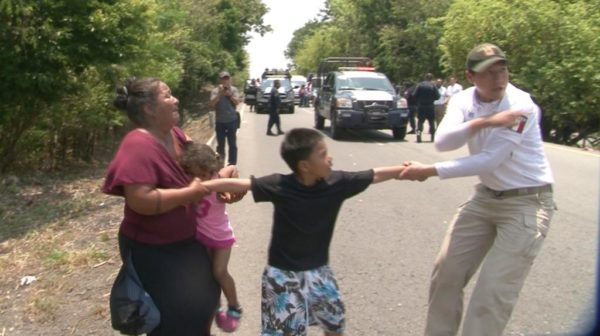
Anti-migrant raid in Pijijiapan dismantles caravan. Photo: Isaín Mandujano
By: Angeles Mariscal
A basic argument that without being new, is open and public for the first time, puts the migratory issue on the table: strengthening the economic relationship of Mexico with the United States, in exchange for containing thousands of migrants in Chiapas.
Marcelo Ebrard Casaubón, Secretary of Foreign Affairs, said it openly in the joint press conference he gave with officials from the Ministry of the Interior and the National Institute of Migration (INM), regarding migrant containment operations that since last February have sharpened in the state of Chiapas, Mexico’s southern border.
His first argument was: “to locate where we are in the relationship between Mexico and the United States. Well, first we should take into account that for the first time according to the official figures in January and February of this year, Mexico is the number one trading partner of the United States. ”
Then the numbers followed: in the first quarter of 2019 trade between both countries grew 3.4 percent. It is 97,418 billion dollars (…) new jobs and new investments and the support of American private sectors.
As another element, he referred to the meeting he held in Mérida with US businessmen, called CEO Dialogue, where according to Ebrard, the attendees said that they received “with great optimism the clear signals sent by the Government of Mexico to work decidedly to provide certainty, both legal and economic, that guarantees a healthy environment for investments,” which translates into 500 million dollars as an immediate investment.
“As you will understand, that relationship, if we are the main trading partner of the United States, far from being increasingly conflictive tends or should be or has to find a way to have a consistency as productive as possible (…) going against this relationship is very costly for Mexico and the United States,” Ebrard concluded.
And although later he wanted to clarify saying that there are “different points of view on several matters, one of them is immigration,” the fact is that the economic relationship with the United States is the decisive factor in the immigration policy of the government of Andrés Manuel López Obrador.
At the conference, Alejandro Celorio Alcántara, deputy legal consultant of the Ministry of Foreign Affairs, said that the free movement of migrants is not a condition to which Mexico must adhere.
“The Global Compact for Safe, Orderly and Regular Migration, adopted in December in Marrakech, Morocco, December 2018, is what inspires the new migration policy”, and that would be ruled by “a safe, orderly and regular migration (… ) but also the sovereign right of states to define their immigration policy in accordance with their current domestic legislation. ”
To show flexibility to the 300,000 migrants from Central America, the Caribbean, Asia and Africa, who in the first quarter of 2019 entered the country through the southern border, federal government officials announced that they will expand, at least for all of Central America, the possibility of obtaining Regional Visitor cards, previously only reserved for migrants from Belize and Guatemala.
Olga Sánchez Cordero, Secretary of the Interior, warned that: “the orderly registration of migrants that enter our territory, is a precondition for the government to protect their human rights.
She detailed the unprecedented behavior in the migratory flow, of minors especially from Honduras. She said there are about a thousand Cubans in Chiapas, and hundreds from Africa and Asia, “who have also arrived in our country in unusual numbers.” All of them, she warned, must “respect our laws and our authorities (…) maintaining control of our southern border is not an option, it is an obligation of the Mexican State. We are doing it with order and in adherence to the law.
Tonatiuh Guillén López, INM Commissioner, also acknowledged that the Mexican Foreign Ministry made a regional socio-economic development agreement with the government of the United States and the countries of Northern Central America as a tool for the mobility of people, to occur in conditions of very personal decisions and not forced by external factors.
In fact, it is to establish an immigration containment center in Chiapas, it is to extend the United States border to this state, and therefore the operations to prevent the passage of migrants and prevent them from reaching the north.
One of them happened last Monday in the Pijijiapan municipality, where among the 371 people arrested were mostly women and children. “I really regret that there were many children, a third of the migratory flow is now made up of children, that is very worrying. It is not the responsibility of the Mexican State that the migration has that composition “said Guillén López.
——————————————————————
Originally Published in Spanish by Chiapas Paralelo
Tuesday, April 23, 2019
Re-Published with English interpretation by the Chiapas Support Committee
EZLN and CNI-CIG denounce the kidnapping and murder of 2 CNI members
COMMUNIQUE FROM THE CNI-CIG AND THE EZLN ON THE COWARDLY KIDNAPPING AND MURDER OF COMPAÑEROS FROM THE EMILIANO ZAPATA POPULAR INDIGENOUS COUNCIL OF GUERRERO
The National Indigenous Congress [CNI], the Indigenous Governing Council [CIG], and the Zapatista National Liberation Army [EZLN] condemn with pain and rage the kidnapping and murders of José Lucio Bartolo Faustino, CIG council member from the Nahua indigenous community of Xicotlán, and Modesto Verales Sebastián, National Indigenous Congress delegate from the Nahua indigenous community of Buenavista. Both were part of the Emiliano Zapata Popular Indigenous Council of Guerrero [CIPOG-EZ], which is a member organization of the CNI-CIG. Narco-paramilitary groups who operate in the municipality of Chilapa de Álvarez and who are protected by the Mexican Army as well as by municipal and state police carried out this crime.
At 3pm yesterday, May 4, our compañeros were attending a meeting with other members of the CIPOG-EZ in Chilpancingo, Guerrero. On their way back to their communities they were kidnapped and murdered by these narco-paramilitary groups that operate with total complicity and protection from all three levels of the bad government, which pretend to address the indigenous communities’ demands for security and justice. The indigenous communities have repeatedly denounced to the federal government the impunity with which the criminal Celso Ortega wages violence against them. It is important to mention that our murdered compañeros and their communities have for years been organizing their own Community Police in order to resist the violence, extortion, and poppy cultivation imposed by two criminal groups in the area, Los Ardillos and Los Rojos. These two groups control municipal presidencies across the region and are protected by the Mexican army and the municipal and state police. At one point they even managed to get one of their leaders named president of the Guerrero State Congress.
We hold all three levels of bad government responsible for this cowardly crime, as they have been complicit in repressing our peoples’ organization in defense of their territories. We also hold the bad government responsible for the safety and security of our brothers and sisters of the CIPOG-EZ.
As the National Indigenous Congress-Indigenous Governing Council and the Zapatista National Liberation Army, we send our collective embrace and solidarity to the family members and compañeros of José Lucio Bartolo Faustino and Modesto Verales Sebastián, and we share with them our commitment to continue this path of autonomy and dignity for which our fallen compañeros provide a light and an example.
We denounce the intensification of neoliberal repression against the original peoples, nations, and tribes who do not consent to these death projects in Guerrero and in all of Mexico, nor to the violence which is used to impose these projects and to repress, kidnap, disappear, and murder those of us who have decided to sow a new world from the indigenous geographies that we are.
We demand justice for our compañeros.
Attentively
May 2019
For the Full Reconstitution of Our Peoples
Never Again a Mexico Without Us
National Indigenous Congress
Indigenous Governing Council
Zapatista National Liberation Army
Frayba denounces militarization in Zapatista Territory
THE MEXICAN STATE INCREASES THE MILITARIZATION IN ZAPATISTA TERRITORY
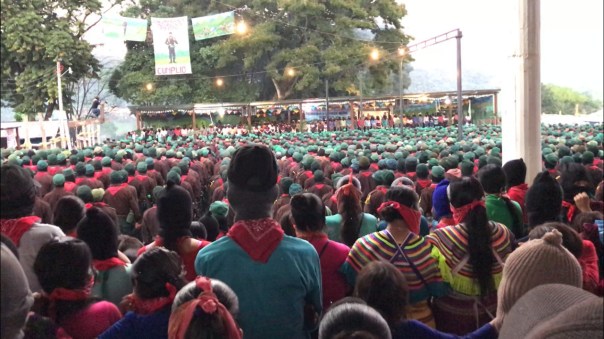
Zapatistas gather in La Realidad to celebrate the 25th anniversary of the Uprising.
Five years after the unpunished extrajudicial execution of José Luis Solís López, teacher Galeano, during an attack on the autonomous Zapatista project, in the community of La Realidad, the Mexican State reaffirms its bet for war in a region where the Original Peoples construct a Dignified Life.
Since December 2018, the Mexican State increased the militarization in territories of the Original Peoples Bases of Support of the EZLN (Bases de Apoyo del Ejército Zapatista de Liberación Nacional, BAEZLN) especially in the Lacandón Jungle region, as part of the continuation of the counterinsurgency strategy for eroding autonomous projects in Chiapas, Mexico.
The Fray Bartolomé de Las Casas Human Rights Center (Frayba), through the documentation that the Civilian Observation Brigades (BriCOs) carry out, documented that since the end of 2018, the number of Mexican Army incursions into the seat of the Good Government Junta (JBG) Towards Hope, in the Caracol of La Realidad (Official municipio of Las Margaritas) doubled. The BriCos observed 19 land patrols, (with soldiers armed with machine guns) and 5 flyovers from helicopters, from January to April 2019. The regularization of the flyovers of the communities and the increase of military movements in the last month is worrisome.
The military incursions constitute acts of intimidation and harassment against the Original Zapatista Peoples in resistance, signify an attack on their right to autonomy and represent a risk to the life, integrity and security of the entire population: “We observed that many times the military vehicles pass through the communities at high speed, without any concern for people, children or animals on the road.”
In the first four months of this year, the Frayba documented two acts of espionage against the BriCos, in the international observation camp located in La Realidad. This action harms the personal integrity and security of those who carry out the monitoring of human rights violations in the region and whose work is based on the Declaration On the Right and the Duty of Individuals, Groups and Institutions to Promote and Protect the Human Rights and the Universally Recognized Fundamental Freedoms of the United Nations Organization.
The Frayba confirms with data the BriCos collected the denunciation that the Zapatista National Liberation Army (Ejército Zapatista de Liberación Nacional, EZLN) published in its communiqué last April 10: “In our mountains and valleys the presence of military, police, paramilitary, and spies, ears and informants has increased. The flyovers of military planes and helicopters, as well as artillery vehicles have reappeared.”
The militarization that persists in the new federal government of Andrés Manuel López Obrador and state government of Rutilio Escandón Cadenas attempts against the life of the communities of Original Peoples that, in Chiapas, defend their right to autonomy, self-determination and territory.
It’s appropriate to remember that on May 2, 2014, during the same action in which José Luis Solís López was extra-judicially executed, members of the Independent Central of Agricultural Workers and Campesinos-Historical destroyed the autonomous school and clinic, as well as threaten to dismantle the Caracol “Mother of the Caracoles of the Sea of Our Dreams. The act was a pretext so that the National Defense Ministry could intensify the militarization, which the Frayba pointed to as an act of intimidation, instead of seeking justice and the means for solving the conflict in a civil and peaceful manner.
Therefore, we make a call to national and international solidarity to strengthen the path of peace and respect for human rights given the risk of a new military offensive against Zapatista territories.
————————————————————————–
Originally Published in Spanish by Frayba Communication
Thursday, May 2, 2019
https://frayba.org.mx/estado-mexicano-incrementa-militarizacion-a-territorios-zapatistas/
Re-Published with English interpretation by the Chiapas Support Committee
Social control, the 21st Century thinking

Oakland police clash with Occupy Oakland.
By: Raúl Zibechi
When the social control that states and corporations exercise becomes a mesh so fine that it traps and subjects all manifestations of daily life, is it important who governs? The concept of government (state national, federal or municipal institutions) is absolutely insufficient for understanding what’s happening day-to-day in our societies.
Last week in Bogotá, I listened in amazement to stories about the level that application of the Police Code is reaching. A young 22-year old man, a worker and university student, was punished with a fine of $280 dollars (more than $5,000 Mexican pesos) for buying an empanada on the street. The vendor also was fined.
In just two years of the code going into effect 400,000 fines were imposed, for everyday situations like running in a bus station, buying from street venders or defending someone who suffer a police fine, or for “obstructing” police work.
The Police Code was approved in 2017, while peace was being negotiated with the FARC. The objective is evident: plugging the pores through which the popular and youth culture breathes, since habits such as drinking in the plazas, juggling, circus attitudes towards the police, among many others, are punished. For those below, the new code implements the “permanent state of emergency” that Walter Benjamin talked about, which makes up part of the everyday life of oppressed peoples.
In China the State’s control of society is much stricter. The system of “social credit” grants or takes away points from people that, for example, smoke in prohibited places, and get on those that have condescending attitudes. All behaviors of people enter the point system, even some intimate ones, like the consumption of “erotic” films or books, or speaking rudely with anyone.
The control modes combine video surveillance cameras (China has almost half of the existing ones in the world) with artificial intelligence and facial recognition. In that way, the State is able to know how many trips you have made in a taxi and to where, what you buy, your medical bills and even your “generosities” with others, as highlighted in the Le Monde Diplomatique report entitled “Good Chinese and bad Chinese” (January edition).
As an example of the scores that are imposed on citizens, the monthly report emphasizes: one point for helping an elderly person get to a hospital; minus five points and a fine for throwing garbage in the river. But for placing a sticker against the government, they take away 50 points and a thousand mil yuan fine. As in good authoritarian regimes, everything comes mixed: the punishment of dissidents with the aid of others and bad habits.
But that’s where the real problems begin. Those who behave well receive gifts on Chinese New Year’s Day or have the ability to obtain credit for trips or studies. Those with few points can’t apply for certain jobs, take vacations, get on fast trains for a year, reserve a room in a hotel or enroll their child in a good school.
Black lists go hand in hand with public humiliations, since the data are published on web pages, but in some towns “the bad scores and the name of their holders are repeated through a loudspeaker on Friday night,” in a way that the system converts your neighbors into sentinels, according to Le Monde Diplomatique.
The Amnesty International researcher for China, Patrick Poon, considers that the system of giving rewards and punishments is a “large-scale social control practice that legitimizes the hierarchical classification of citizens” (https://bit.ly/2G1diaz).
When important political events take place, like the National Popular Assembly, the regime imposes “forced vacations” on the dissidents, obliging them to leave the city, accompanied by police agents, to be lodged in remote hotels and tourist complexes with all expenses paid (https://bit.ly/2Z3cRp4).
There are many more examples of social control. Reality is getting closer and closer to the concept of the “totalitarian democracy,” of the Portuguese writer João Bernardo. In his forthcoming book in Spanish, he discusses the tight relationship between entrepreneurial and governmental authoritarianism, since workers spend a good part of their life submitted to the strict discipline prevailing during work hours.
He wonders what democracy means, in our societies where the omnipotent power of the corporations prevails. “The neoliberal society reached a point in which it’s very difficult to apply the old definitions of the rule of law that until recently distinguished democracies from the regimes where political arbitrariness prevails,” Bernardo continues. The task of tracing the paths for changing the world in the face of these systemic mutations is left to us.
———————————————————–
Originally Published in Spanish by La Jornada
Friday, April 12, 2019
https://www.jornada.com.mx/2019/04/12/opinion/020a2pol
Re-Published with English interpretation by the Chiapas Support Committee
8 more municipalities reject the San Cristóbal-Palenque Highway
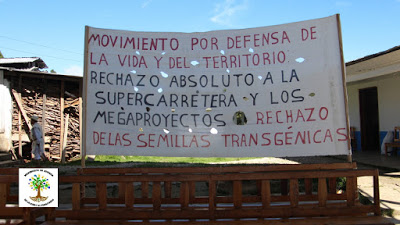
Movement for Defense of Life and Territory: Absolute rejection of the superhighway and the mega-projects, rejection of transgenic seeds.
By: Chiapas Paralelo
The Movement in Defense of Life and Territory (Modevite), which is composed of believing people in the parishes of Yajalón, Candelaria, Huixtán, Oxchuc, Ocosingo, Altamirano, Chilón, Sitalá and Chicomuselo, unite in rejection of the construction of the San Cristóbal de las Casas-Palenque Highway, because it signifies a destruction of Mother Earth.
More than 20 days after the Movement in Defense of Life and Territory (Modevite) of San Juan Cancuc stated a series of points in which they expressed their rejection to carrying out the project, 8 more municipalities and 1 locality have currently added on.
The communities that make up the Modevite questioned this project in a communiqué by asking: “who benefits from the megaproject of destruction that is the San Cristóbal-Palenque superhighway?”
Based on the fact that this project would bring about dispossession of indigenous territory and the destruction of Mother Earth, they denounced that the state and federal governments promote deception by conditioning economic resources and government programs upon rejecting [or accepting] this highway.
“We say to the state government, which Rutilio Escandón Cadenas represents, to the federal government of Andrés Manuel López Obrador and to the national and transnational corporations that THE LAND IS NOT FOR SALE, IT IS LOVED AND DEFENDED.”
They added that the path of the imposition and the fake consultations destroy the life of the communities, that’s why they don’t want the destruction of Mother Earth for the more than 185 kilometers that the construction requires.
“The plunder is disguised as the construction of a superhighway, saying it will be a benefit to the peoples, but it really has a harmful effect on our brothers and sisters who depend directly on Mother Earth,” they warned.
——————————————————————
Originally Published in Spanish by Chiapas Paralelo
Monday, April 29, 2019
Re-Published with English interpretation by the Chiapas Support Committee
:
In Chiapas, the immigrant wave experiences a Calvary

At the Frontera Hidalgo immigration station, in Chiapas, Central Americans wait to receive a permit to be able to cross Mexican territory without problems in their zeal to enter the Unites States. Photo: Alfredo Domínguez
By: Hermann Bellinghausen
Tapachula, Chiapas
The southern border is a test. It all started last October, when the avalanche of immigrants from Central America towards the north adopted new and more challenging ways of taking the trip to face the ultimate Goliath at our other border. The rapid transformation of this human flow through Mexico has exceeded the [capacity of] civilian organizations that try to support them at the national entry gates. This is the case of the Fray Matias de Cordova Human Rights Center or the Catholic Church’s different migrant houses. It has also put government institutions against the wall, like the National Immigration Institute (Instituto Nacional de Migración, INM) and the Mexican Commission for Aid to Refugees, which are, if possible, even more backlogged.
On the Mexican side of the border the bridge between Ciudad Hidalgo and the Guatemalan Tecún Umán yesterday morning, some 900 people were camped out waiting for some kind of legalization. Although they come from a hot land (most are Hondurans and Salvadorans), the sun is crushing and they all seek the cover of some shade. Entire families, including grandparents, cousins or neighbors form extended families (“travel families”). One such family, which cracks jokes and poses happy and smiling for the camera tells us that they are dedicated “to waiting.” Between anxious displacement and long waits, weeks and months pass. The procedures are so slow and so dispersed throughout Chiapas that they aggravate the Calvary especially for those who request refuge, like the family mentioned, coming from northern Honduras. The children grow, the young women mature, and the pregnant women, well they also mature.
The group’s leader insists on making it clear that they do not intend to stay in Mexico, their goal is to reach the United States. But as the wait can be long, “we would be willing to work for any pay,” he says, surrounded by all his offspring. He points to his seven-year old son: “If we continued in Honduras, he would already be selling drugs and I would be dead.”
In the center of Tapachula, the offices of Fray Matias de Cordova offer a complex panorama. In the street, one hundred people wait to be received; inside, on the wide patio of the human rights organization, it must be double that. The Center’s young director, Brenda Ochoa, comments: “Every day we’re able to attend to some one hundred cases.” The Center offers a legal guide to the asylum procedures, or possibly health care for these tired, malnourished and anguished people. “Desperate,” a woman on the Suchiate River will add later. Besides Central Americans, there is a constant and growing number of Haitians and Congolese not easily distinguishable, which allows the former to pass themselves off as Africans, because they don’t receive the same treatment, but rather worse.
The Mexican population of this border region and the cities on the route to the north along the Chiapas coast are on trial. In Huixtla, the Morena mayor ordered not to receive them or permit them to occupy any space. Between Mapastepec and Pijijiapan just last weekend the INM arrested one hundred lost sheep from the new caravan that is making its way north, and that seemed to have dispersed last night on the outskirts of Tonalá.
Historically, mestizo society in Chiapas has not been characterized by its racial tolerance, but it received the first caravans with solidarity. In just a few months, this opening has deteriorated. In Tapachula, Mapastepec, Tonalá and Acapetahua, they are now feared and rejected. Brenda Ochoa doesn’t hesitate in attribute part of the responsibility for this deterioration to the authorities, because by criminalizing migrants they incite rejection in a local population with xenophobic tendencies. The Fray Matias de Cordova Center, which participates in the Collective for Observation and Monitoring of Human Rights in the Mexican Southeast, reiterates to La Jornada its concerns given the “immigration crisis” that directly impacts this end of the country:
“The lack of comprehensive protection of their rights, the uncertainty and the absence of answers continue.” That edges the people in refugee camps to renew their march “with all the risks and no protection.”
That in these moments there are more than 5,000 immigrants in the region is an estimation that Brenda Ochoa shares with Aline Juárez Nieto, the INM spokesperson who attends to the reporters at the Ciudad Hidalgo immigration station. But there is no official data. According to the Fray Matias, “mass detentions at different points between Ciudad Hidalgo, Tapachula, Huixtla and Mapastepec increase peoples’ fear and reveal the lack of clarity in the immigration policy of the State.” In effect, the police and immigration control posts follow one another along the highway to Arriaga. The Center insists on demanding “structural reorientation of immigration and refugee policy” from the government, given the new crisis that can be expected.
———————————————————–
Originally Published in Spanish by La Jornada
Wednesday, April 24, 2019
https://www.jornada.com.mx/2019/04/24/politica/007n1pol
Re-Published with English interpretation by the Chiapas Support Committee
Oxchuc elects its municipal president through uses and customs

Residents of Oxchuc municipality elect their authorities
Without parties or ballot boxes
By: Isaín Mandujano
This Saturday, indigenous Tseltals of Oxchuc, elected their new mayor for the next three years under the regimen of a new normative system of uses and customs, by raised hand, after four years of struggle and of having expelled political parties from that municipality.
In “an unprecedented historical process,” as electoral observers present at the event classified it, some 11, 900 leaders, representatives and residents from 115 of the 120 communities and 24 neighborhoods of the municipality met on Saturday, April 13, in the central plaza of Oxchuc and elected Alfredo Santiz Gómez, 42, as the new municipal president.
The bilingual indigenous teacher is a native of Las Palmas community, but now resides in the Televisa neighborhood of the municipal capital of Oxchuc. Hugo Gómez Sántiz, del Barrio San Cristóbalito, came in second.
Of the 10 candidates proposed to occupy the position of mayor, five were men and five were women. At the last minute, one of the male candidates, Feliciano Sántiz Gómez del Barrio Cruziljá, renounced aspiring to that position.
First, the five women were called one-by-one to be voted on with a show of hands but the vote didn’t favor any of them. Most of those present in the plaza were, of course, men.
Although a crowd present in the plaza gave Hugo Gómez Sántiz an ovation, the majority raised their hand so that Alfredo Sántiz Gómez would be the next mayor, the one who substitutes for the current president of the Municipal Government Council, Oscar Gómez López.

The new mayor of Oxchuc, Alfredo Sántiz Gómez.
As soon as he was elected, he proceeded to elect his trustee and the six council members and the alternate for each one of them, and that’s where several women won positions, beginning with the trustee, Rufina Gómez López and her alternate, Carmelina Gómez López.
Each one of the candidates were presented to the crowd three times to ratify or not its support for them.
Electoral observers were present there, as well as officials from the Institute of Elections and Citizen Participation (IEPC), and the National Electoral Institute (INE), representatives of other original peoples from other states in the country that have struggled or are struggling to elect their authorities through the system of uses and customs like the original peoples did before, without the presence of any political party.
The Tzeltal town of Oxchuc began to fight for electing their municipal authorities by raising hands and without (political) parties after Mayor María Gloria Sánchez won in July 2015, who together with her husband, Norberto Sántiz, established a political boss system for more than 15 years in that municipality.
They did not allow María Gloria to take the office of municipal president for a second time. Her husband had also governed twice, and they expected that their successor in 2018 would be their son.
But since 2015, the residents of Oxchuc rebelled; they burned the homes of María Gloria Sánchez and Norberto Sántiz, as well as the homes of their closest collaborators, and expelled them and all the political parties from that municipality. [1]
They blocked the highway and marched to the state capital, and they confronted the state police in January 2018. Civilian armed groups also attacked them, which caused the deaths of Ovidio López, Víctor Sánchez and Francisco Méndez.
They pointed out that a civilian armed group that operated under the command of María Gloria Sánchez and Norberto Sántiz riddled the dead with bullets.
At the same time they initiated a long legal process before the electoral bodies and electoral tribunals, to assert their right as an original people of electing their municipal authorities through the normative system of uses and customs, by raising hands.
This struggle lasted four long years, said Juan Gabriel Méndez López, community lawyer who took the case to the judicial bodies, and who also suffered a bullet wound from an armed group in the attack when three of his compañeros died.
He said that blood had to run and pay for this struggle with their deaths so that the government authorities, the electoral authorities and the electoral tribunals would listen to the demand of the Tseltal people of Oxchuc.
The new mayor, a teacher and father of five children, resident of a neighborhood in the municipal capital, Alfredo Sántiz Gómez, said that his priority is to achieve unity of all the people, achieve peace and harmony, look for all the dissident groups and extend a hand to walk together: “because if there is no unity we will not all be able to work together. That is necessary, he urges the people of Oxchuc.”
He indicated that then he will attend one of the main problems of Oxchuc, which is the lack of water for all of its residents, and he said that his government would be a municipal presidency with open doors for attending to each and every one of his constituents.
The new mayor-elect will take the oath of office in an indigenous ritual on April 21, and it will be the State Congress that officially certifies him as the new municipal president in a solemn session on April 23. [3]
Oxchuc is the first indigenous municipality in Chiapas to elect their municipal authorities this way; the municipalities of Sitalá and Chilón are in the process.
Notes
[1] https://chiapas-support.org/2016/01/13/66-police-injured-in-oxchuc-chiapas-confrontation/
[2] https://chiapas-support.org/2018/01/30/3-dead-in-oxchuc-chiapas-violence/
[3] Both of these requirements were met and Alfredo Santiz Gómez is now officially the mayor of Oxchuc municipality (county).
——————————————————————
Originally Published in Spanish by Chiapas Paralelo
Sunday, April 14, 2019
Re-Published with English interpretation by the Chiapas Support Committee
The Peoples Front rejects the Huexca thermoelectric plant

The Peoples Front in Defensa of Land and Water Tierra of Morelos, Puebla and Tlaxcala commemorate the 100th anniversary of the assassination of Emiliano Zapata en Chinameca.
By: Hermann Bellinghausen
Chinameca, Morelos
Here, where Emiliano Zapata died 100 years ago, came the communities grouped together in The Peoples Front in Defense of Land and Water of Morelos, Puebla and Tlaxcala. Not only to remember the caudillo, but also to endorse demands and present sorrows: opposition to the Huexca thermoelectric plant and pipeline, and the demand for justice for Samir Flores, leader and spoke person of those opposed to the government project, murdered February 20 in Amilcingo on the eve of the consulta (consultation) on the matter convened by the government. The crime remains unpunished. And the megaproject “won” the consultation.
Teresa Castillo, expressive spokeswoman of the Peoples Front, in front of hundreds of people gathered in a protest act at the ex hacienda of Chinameca, says briefly: “We are against AMLO because he is against us. We wanted to talk to him. He didn’t want to.”
She denounces the persistent disappearances and, in particular, the murder of Samir: “a shame” for the government. She asks the participants to remain in the struggle, “if you love your children”.
How not to associate the deaths by ambush of two Nahua fighters in these same lands with exactly one century of difference? Zapata is the only Mexican hero at the height of the 21st century. Or as Pablo González Casanova, who is among the participants in the protest act, put it today: Emiliano Zapata is still alive in the most literal sense.
Symbols, metaphors, superb biographies and a century of historical and institutional handling, has not been enough to finish him off. The dead of the current struggle are part of what’s his.
Certainty makes the rounds that resistance to the imposition of megaprojects is inherited from the Zapatistas. Land and liberty once again: not only conquer them, but also keep them and, as the people of the regions argue, to prevent that both are destroyed by immense works of interest to capital, not for those who live here around the slopes of the Popocatépetl volcano, which has a rather restless season. That greatly disturbs those who see that the planned gas pipeline could well be deeded by the devil.
The National Indigenous Congress (Congreso Nacional Indígena, CNI) participates with the Peoples Front in the symbolic takeover of the former hacienda where Zapata fell. On the other side of the building, today a museum, the canopy and the installations for an official act that never happened languish. Not here. Instead, María de Jesús Patricio, of the Indigenous Government Council (Concejo Indígena de Gobierno, CIG), shares a message of the subcomandante Moisés, of the EZLN. “We don´t know who kill Samir. We know who pointed it him”, he wrotes. “ There was no ‘right of reply’ for Samir Flores Soberanes, neither for the peoples that today resist” the Morelos Integral Project (Proyecto Integral Morelos, PIM).
Norma Palma, member of the CNI, reads the Chinameca Declaration, fruit of the national meeting held this Tuesday in Amilcingo not far away from here. “The bad governments think that they will be able to finish us off.” She accuses the government of “shameless betrayal” for promoting the PIM. “We thought that the dispossession would stop,” she says; “that the military presence would end.” Instead, the government “promises the facilities to the Earth’s predators” and “guarantees the functioning of the Huexca thermoelectric plant” despite the volcano’s dangers.
The festivity is very big. In addition to the protest, there is a massive convention in Chinameca, surrounded by the noise of the loud roar of dozens of school bands with a swinging drum, metals, and everything that someone who is 15 years old can blow. Baton twirlers, calisthenics dances, allegorical and custom cars, Adelitas, soldaderas (women soldiers) and Juanes mustaches, children in white with cardboard cartridge belts, paper bullets and black mustaches. All this civic splendor for a Mexican whose impact is still valid for these young people who perhaps don’t know it yet. That don’t know how much.
After the ceremony in Chinameca, the Indigenous peoples moved their protest to the impressive plant of discontent, almost completed a few meters from the community of Huexca.
———————————————–
Originally Published in Spanish by La Jornada
Thursday, April 11, 2019
https://www.jornada.com.mx/2019/04/11/politica/005n1pol
Re-Published with English interpretation by the Chiapas Support Committee
CNI-CIG: The Chinameca Declaration
COMMUNIQUÉ FROM THE NATIONAL INDIGENOUS CONGRESS AND THE INDIGENOUS GOVERNMENT COUNCIL; 100 YEARS AFTER THE ASSASSINATION OF GENERAL EMILIANO ZAPATA
To the peoples of Mexico and the World
Today, April 10, 2019, Chinameca and Amilcingo, Morelos, are homes to the National Indigenous Congress, the Indigenous Government Council, together with organizations and collectives that struggle and organize against capitalism. On April 9 and 10 we met in this territory in resistance to recognize each other in the dignity, pain and hope in the face of the cowardly assassination of Compañero Samir Flores, perpetrated by neoliberalism and its overseers. For those who are no longer afraid, it was converted into rage and conviction.
We continue looking and listening to Samir. He walks among us and reminds us that the path is below, that dignity is not for sale and that life is not negotiated. Brother Samir, in our living and struggling peoples you will continue being, because your life is hope for ours.
We also met to commemorate that Compañero General Emiliano Zapata lives and walks with us, warning of the betrayal and lie that is perceived from afar in the announcements about death and war. That same war that killed him 100 years ago and that snatched Samir from us is the one that makes us call to our brother and compañero General Emiliano Zapata, alive and walking as the conscience of the peoples of Morelos, of this country and the world that is trembling.
Here we say again that the struggle for land is also for life, because the defense of what is sacred to the peoples is a principle that we will not renounce. Today, 100 years after the betrayal and the lie ended the life of General Zapata in a cowardly way, that lie and betrayal returned with an alleged face of democracy, but like then, that word when it comes from above only means war, impersonation and deception of the entire nation.
To Compañero General Emiliano Zapata we salute him raising our voice against the megaprojects that invade the land of the communities that we construct below every day while the neoliberal government is determined to convert our world into a cemetery, where the destruction and suffering of all the peoples flourish in indigenous territories.
Given the grave crisis that not only the peoples that we are suffer, but also humanity and the whole world in the war with which the Mexican and foreign companies are invading our lands, our Mother Earth becomes upset with the environmental destruction and with the dismantling of the organization of the peoples. In the meantime those above are tugging on what keeps us alive, which is the ancestral y sacred territory that we protect.
This capitalist government builds highways, canals and railroads, and reorders the country’s territory to deliver everything to them, it makes laws in their favor and in favor of the might of big capital in the world, starting with the government of the United States. With cynicism, that hydra prepares to take away what is ours, using its military or para-military forces, because with war they concentrate power and increase their profits, which are greater if they make them over the dead corpse of our mother that, as we have said 100 years ago with our compañero General Zapata and as thousands of years ago with our ancestors, it is the land, it is alive and it belongs to us.
From Chinameca, a place where the bad governments thought that they could finish with General Zapata’s word, we direct ourselves with respect to the peoples of this country and the peoples of the world to call on them to listen to us and to add the paths that have the same horizon, below and to the left.

Today the struggle of the original peoples becomes strong with the word and organization of women that show the world profound directions, weave paths of freedom with dignity and, without asking permission, open the paths that patriarchal capital denies and destroys.
We recognize the shameless betrayal of the bad federal government and we do not accept its cynical lies, which you discover ahead of those who believed it, ahead of those who thought that with the lie of the so-called “historic election” or “fourth transformation,” or whatever it’s called, the dispossession would stop, the corruption that makes the State a vulgar shoplifter of what belongs to everyone would stop, that it would keep its word to the teachers in struggle, for those who thought that the military nightmare would end, for those who thought that some national sovereignty would be defended.
On the other hand, sending and putting a gun to the head of the peoples, they want to impose on us a capitalist reordering at the service of big US power on the Isthmus, offering the minerals, the water, and the land. It promises the predators of Mother Earth to respect concessions and permits obtained with the filthiest corruption. It offers foreign owners of the tourist economy the dismantling of social property on the Yucatán Peninsula. It guarantees to big capital the operation of the thermoelectric plant in Huexca, Morelos, despite the lives of the peoples of the volcano.
One hundred years after the assassination of compañero General Emiliano Zapata we declare that we are on alert given the urgency with which the companies and the mercenaries who back them up, who are in the government as well as in the organized crime cartels, in a savage and lethal way are appropriating our territories, standing over the destruction they have left not only in our country, but also in the world.
It’s that the neoliberal government, which many thought was of the left, the one that not only declared war on our peoples, but is part of the war against humanity, the one that doesn’t give a respite to life because it wouldn’t represent profits. The war invades every corner and takes many forms in order to suck the last drop of life from Mother Earth, the capitalists are ready to take possession of life, because they know that it’s running out and if life is exhausted, like any merchandise on the market, it leaves greater profits.
Today, sisters and brothers from many countries arrive in crowds seeking refuge from the tragedy in which the power of money converted their home, their communities or their cities. They seek refuge from the wars that made their geographies uninhabitable spaces.
To Compañero General Emiliano Zapata and to Compañero Samir Flores we say to you that your seeds of liberty, democracy and justice, are born and grow in every corner where we name life, where we name them with resistance of the peoples that bet on a new world.
From Chinameca, Morelos, April 10, 2019
For the Integral Reconstitution of Our Peoples
Never More a Mexico without Us
National Indigenous Congress | Indigenous Government Council
—————————————————————
Originally Published in Spanish by the Congreso Nacional Indígena
Thursday, April 11, 2019
Re-Published with English interpretation by the Chiapas Support Committee
 Chiapas Support Committee