Chiapas Support Committee
Home of the Compañero Manuel blog on zapatistas & mexico
Words of the CCRI-CG of the EZLN on the 26th Anniversary
Words of the Indigenous Revolutionary Clandestine Committee-General Command of the EZLN, in the voice of Subcomandante Insurgente Moisés, on the 26th Anniversary of the Start of the War Against Oblivion
December 31, 2019. January 1, 2020.
Good afternoon, good morning, good evening, good day to everyone, [todas, todos y todoas]:
To the compañeras and compañeros who are Zapatista bases of support:
To the compañeras and compañeros who are Zapatista comandantas and comandantes:
To the Zapatista autonomous authorities:
To the compañeras and compañeros who are milicianos, milicianas, insurgentas and insurgentes:
To the National Indigenous Congress – Indigenous Governing Council:
To the National and International Sixth:
To the Networks of Resistance and Rebellion:
Brothers and sisters in Mexico and throughout the world:
Through me, the Zapatista Army for National Liberation speaks.
“Canek said:
I read in a book that in the old days, the rulers wanted to call together armies to defend the lands they governed. First, they called up the cruelest men because they supposed that these men were accustomed to blood. So they drew their armies from the prisons and the slaughterhouses. But it turned out that when these people stood face to face with the enemy, they turned pale and threw down their arms. Then the rulers turned to the strongest men – the stonemasons and the miners. To these men, they gave armor and heavy weapons and sent them out to do battle. But again, the mere presence of the enemy instilled weakness in their arms and dismay in their hearts. The rulers wisely then turned to men who were neither strong nor fierce nor bloodthirsty, but were simply brave and had something rightly to defend – the land they worked, the women they slept with and the children whose laughter delighted them. And when the time came, these men fought with so much fury that they drove off their enemies and were forever free of their threats and persecution.” [i]
Sisters, brothers, hermanoas:
It was 26 years ago, on an afternoon like this one that we came down from our mountains to the big cities in order to challenge those in power. At that time, we had nothing more than our own death – a double death, because we were dying a physical death and also a death of oblivion. We had to choose: whether to die like animals or die like human beings who struggle for their lives.
So it was that when dawn broke on that January 1, we had fire in our hands.
The big boss we faced then is the same one who despises us today. He had another name and another face, but he was and is the same ruler.
We rose up and a space was opened for the word. So we opened our heart to the hearts of other sisters and brothers and compañeros, and our voice was met with support and comfort from all the colors of the world from below.
The big boss engaged in tricks and deception; he lied and continued with his plan to destroy us, just like the big boss does today.
-*-
But we resisted and kept the flag of our rebellion hoisted high. With the help of all the colors of the world, we began to build a project of life in these mountains.
Doggedly pursued by the strength and lies of the big boss, then as now, we have kept firm in our work of building something new. It’s true that we have made mistakes and errors. We will surely make more on our long journey.
But we have never given up.
We have never sold out.
We have never given in.
We sought all possible means to make words, dialogue and agreement the path to constructing freedom with truth and dignity. But then as now, the big boss played deaf and hid behind lies. Now as then, under the big boss’ rule, disdain is the weapon carried by his soldiers, police, National Guard, paramilitaries and counter-insurgency programs.
All the big bosses who have come before, and those who are in power today, have done the same thing: they have tried and continue to try to destroy us. Every year the big bosses console and deceive themselves with the idea that they’ve done away with us for good—that there are no Zapatistas any more, that there are very few of us left who resist and rebel, that perhaps there is only one Zapatista left. They celebrate this triumph each year and congratulate themselves saying that they’ve gotten rid of those indigenous rebels. They say we’ve been defeated.
But every year, we (nosotras, nosotros, nosotroas) Zapatistas show up and shout: Here we are!
-*-
And each year, there are more of us.
As any person with an honest heart can see, we have a project for life. In our communities, schools and health clinics flourish. We work the land collectively. We support each other collectively. We are a community, a community of communities.
Zapatista women have their own voice and their own path. Their destiny is not one of violent death, forced disappearance, and humiliation. Zapatista children and young people have healthcare, education and many different opportunities to learn and have fun.
We maintain and defend our language, our culture, and our way of life.
We remain firm in our commitment to fulfill our duty as guardians of Mother Earth.
We have done all of this thanks to the strength, the sacrifice, and the dedication of our organized communities, and also thanks to the support of individuals, groups, collectives, and organizations around the world. Our obligation to them is to build life with their support. That is why we can say, with no shame, that our advances, our achievements, and our triumphs are due to their support and help.
The mistakes, errors, and failures are ours alone.
-*-
But just as our lives have grown and advanced, so has the strength of the beast that wants to eat and destroy everything—that machine of death and destruction called the capitalist system. That beast’s hunger is insatiable, and it is willing to do anything to make its profits. It gives no thought to the destruction of nature, entire peoples, millenarian cultures, or entire civilizations. The planet as a whole is being destroyed by the beast’s attacks.
But the capitalist hydra, the destructive beast, tries to hide behind other names in order to attack and defeat humanity. One of the names behind which it hides its project of death is “megaproject,” which means the destruction of territory—the entirety of a territory, including the air, water, land, and people.
The beast uses the megaproject to snuff out entire peoples, mountains and valleys, rivers and lagoons, men, women, others, and children. Once it finishes its destruction in one place, it’s off to another territory to do the same thing.
The beast’s trick—its deception—in hiding behind these megaprojects is to fool people into thinking that it stands for progress, that thanks to these megaprojects people are going to have wages and all of modernity’s advantages.
Now, in speaking of progress and modernity we have to remember our compañero of the National Indigenous Congress who was murdered this year: our brother and compañero Samir Flores Soberanes. We remember him now because he was always asking for whom all this progress was for. Our brother Samir always asked where the path of progress led, if “progress” was the sign worn by the beast of the megaprojects.
His own answer was that that path led to the destruction of nature and the death of the original communities. He voiced his opposition clearly and organized with his compañeras and compañeros to resist, without fear. And that’s why the current Ruler had him killed. The bad government murdered him because its job as overseer is to make sure that the beast, the overall Ruler, gets its profits. But neither the overseer nor the Ruler will admit that these megaprojects sow death wherever they are built.
-*-
A few days ago, our Zapatista compañeras held an International Gathering of Women Who Struggle. They have told us, taught us, and educated us about what they saw and heard during that gathering, and what they have described is a hell for women and children. They told us about murders, disappearances, rape, contempt, and diabolical violence, all of which occur within the “progress” of supposedly modern civilization.
A few days ago we were also with our compañeros of the National Indigenous Congress-Indigenous Governing Council, and then at the Forum in Defense of Territory and Mother Earth. During these gatherings we listened with concern to what people talked about: deserted villages with their populations expelled from their homes; illegal criminal massacres and sometimes “legal” ones as it is often the government itself which carries out such barbarities; little girls and boys abused and sold off like animals; young people, men and women, whose lives are destroyed by drugs, crime, and prostitution; the extortion of small businesses, sometimes by thieves and sometimes by politicians; contaminated springs, dried up lakes and lagoons, trash-clogged rivers, mountains destroyed by mining, forests laid to waste, animal species gone extinct; whole cultures and languages killed off; campesinas and campesinos who before worked their own land and now work as peons for a boss; and mother earth slowly dying.
-*-
As the Zapatistas that we are, we declare that only an idiot could say that the megaprojects are good things—and idiot or a cunning villain who knows he is lying and doesn’t care that his words hide death and destruction. So the government, and all of its defenders, should state clearly which they are: idiots or liars.
-*-
A year ago, in December 2018, the overseer who now rules over the plantation called “Mexico” carried out a sham in which he asked mother earth’s permission to destroy her. He had a handful of people there dressed up like indigenous peoples and they laid down chicken, liquor, and tortillas as an offering to the land. The overseer thinks that with this charade, Mother Earth has given him permission to kill her and impose a train that should really be named after his own family. [ii] This shows his contempt for original peoples and for mother earth.
But he didn’t stop with that. He then challenged the original peoples, saying he didn’t care what we thought or felt, that whether the indigenous peoples “like it or not,” he was going to do what he was told by his boss, the real Ruler, in other words: capital, just like the overseers during Porfirio Díaz’ time. That’s what he said and that’s what he’s still saying, because just a couple of weeks ago he carried out another sham—a supposed referendum [consulta]—where people were only told great things about the megaprojects but none of the tragedies they bring for people and nature. Even so, only a few people participated in the referendum to vote in favor of the megaprojects.
If that’s how he disrespects the thought and feeling of the people, he’ll be equally disrespectful of nature and our communities. And that’s because his boss doesn’t care about people or nature, but only about profits.
-*-
When the government says “like it or not,” what that really means is, “With you all dead or alive, we’re going to do this. We as Zapatista peoples take this challenge seriously, that what he is saying is that he has the force and the money on his side and who will dare to oppose his orders. He is saying that he’s going to do what he chooses, not what the peoples choose and he doesn’t care about their reasons. We as Zapatista peoples take up our part in that challenge. We know that the current overseer for the powerful is asking us a question. He’s asking us:
“Are the Zapatista peoples willing to lose everything they have gained in their autonomy? Are the Zapatista peoples willing to suffer disappearances, imprisonments, murders, slander, and lies in order to defend the land that they keep watch over and take care of, the land where they are born, raised, grow up, live, and die?”
And with these questions, the overseer and his security forces put this challenge to us: “dead or alive, you will obey.”
In other words, he is asking us if we are willing to die off as a societal alternative, as an organization, as original peoples of Maya roots, as guardians of mother earth, as Zapatista individuals.
As Zapatista peoples we do things our own way and on our own calendar. We also made an offering to mother earth here in our mountains: instead of liquor, we offered her the blood of our fallen in the struggle; instead of chicken, we gave her our flesh; instead of tortillas, we offered her our bones, because we are the people of corn. We made her this offering not to ask permission to destroy her, or sell her, or betray her, but just to let her know that we will defend her—and we will give our lives to do so, if necessary.
-*-
We did some accounting of how many people it would take to defend the land. It turns out that one Zapatista is enough. One Zapatista woman, or one Zapatista man, or one Zapatista other, whether they be old, young, or just a child is enough. One Zapatista dead set on defending the land so that Mother Earth knows that she was not abandoned or left alone. One person dead set on resistance and rebellion is enough.
We went to the collective heart that we are in search of one Zapatista person willing to do anything and everything to defend her. We didn’t find one, or two, or one hundred, or a thousand, or ten thousand, or one hundred thousand. We found an entire Zapatista National Liberation Army willing to do anything and everything to defend the earth.
So we have our answer to the question asked us by the overseer. Our answer is:
“Yes, we are willing to die as guardians of the earth. Yes, we are willing to be beaten, imprisoned, disappeared, and murdered as Zapatista individuals.”
-*-
The overseer has his answer, then. But, as is our style as Zapatistas, our answer carries with it a question for the overseers:
“Are the bad governments willing to try to destroy us, at whatever cost, to beat us, imprison us, disappear us, and murder us?”
-*-
Sisters, brothers, hermanoas:
Compañeros, compañeras, compañeroas:
We call you to this task:
As the National Indigenous Congress-Indigenous Governing Council…
As individuals, groups, collectives, and organizations of the national and international Sixth…
As Networks of Resistance and Rebellion…
As Human Beings…
Ask yourselves who of you are willing (dispuestos, dispuestas, dispuestoas), to stop this war on humanity, each of us from our own geography, on our own calendar, and by our own ways, and when you’ve thought about it and you have your answer, let the bosses and overseers know. Every day, in every corner of the earth, the beast asks humanity the same thing. Only the answer is missing.
That’s all.
From the mountains of Southeastern Mexico In the name of all of the Zapatista women, men, and otroas,
Subcomandante Insurgente Moisés.
Mexico, December 31, 2019 – January 1, 2020.
[i] Passage from Canek: History and Legend of a Maya Hero (1940) by Ermilo Abreu Gómez, a novel dramatizing part of the life of Jacinto Uc de los Santos (1730-1761), an indigenous Maya from the Yucatan Peninsula better known as Jacinto Canek who led an uprising against the Spanish in 1761. This uprising was a precursor to the Caste War that began in 1847. Translation based on that by Mario L. Dávila and Carter Wilson.
[ii] The government’s name for the railroad megaproject slated for five states of southern Mexico is the “Tren Maya,” widely criticized for the environmental destruction, displacement, and dispossession it would imply for the territories of the Mayas.
En español: http://enlacezapatista.ezln.org.mx/2019/12/31/palabras-del-ccri-cg-del-ezln-en-el-26-aniversario/
Zapatista Women close Women’s Gathering with a proposal
Words of the Zapatista Women at the Closing of the Second International Gathering of Women Who Struggle

ZAPATISTA NATIONAL LIBERATION ARMY
MEXICO
December 29, 2019
Compañeras and sisters:
We want to share a few words with you as we close this Second International Gathering of Women Who Struggle.
We have listened to the words and proposals everyone has shared in each of our work sessions as well as other proposals that have been made.
We are going to create a space for all of you to see these ideas and proposals, as well as others that emerge, and offer your own words and opinions. This is for those of you who were able to attend this gathering and have returned to your own geographies with time to think and reflect on what we saw and heard here these last few days, and above all it is for those of you who could not attend.
We think this is important because if we don’t listen to each other as the women that we are, then we aren’t really women who struggle for all women, but only for our own group, idea, or organization and that won’t do at all.
While it may be easy to say that we are going to think about and reflect on these proposals, in reality it is difficult, because even for that process we need to be organized.
With that in mind, we propose this first agreement:
- We all learn about the proposals made here and make our own proposals regarding violence against women and what we will to do stop this serious problem we have as women.
Do you all agree?
As we are preparing this message we don’t know whether you will agree or not. But if we do agree, then we have one year, sister and compañera, to move this work forward.
Let’s not return here next year amidst the same violence against women without ideas or proposals for how to stop it.
-*-
We as Zapatista women have listened attentively to the denunciations that you have made over the past few days and we want to tell you what we are thinking.
We find it unbelievable, compañera and sister, that in your worlds that talk so much about progress, modernity, and development, no one has the tiny bit of humanity necessary to be stirred by the tragedies, pain, and despair that you have expressed, as well as those you haven’t expressed out loud.
How is it possible that a woman carrying such pain, sorrow, rage, and fury has to come all the way to these mountains of Southeastern Mexico to be able to feel a comforting and supportive embrace, which is the least we can offer among ourselves as women.
Perhaps a woman who has not experienced violence thinks that such a thing is not important, but any woman with any heart at all knows that this embrace, this comfort, is a way of saying, of communicating, of shouting that we are not alone.
And you are not alone, compañera and sister. But that is not enough.
It’s not just comfort that we need and deserve; we need and deserve truth and justice. We need and deserve to live. We need and deserve freedom.
Perhaps we can achieve these things, which are so necessary, if we support each other, protect each other, and defend each other.
This is the message that the insurgentas and milicianas [of the EZLN] gave us: to respond to the woman who asks for help, to support her, protect her, and defend her with everything we have. So we’ve asked the insurgentas and milicianas to repeat their message for us now:
(The milicianas and insurgentas repeat the exercise they had previously performed)
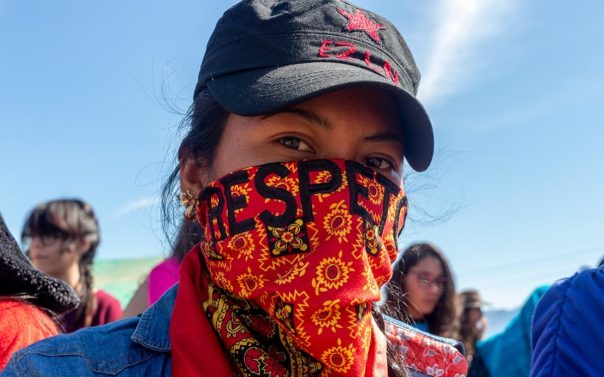
Thank you to our compañeras who are insurgentes and milicianas and who have taken care of us here, protecting and defending us during this Gathering.
The second agreement we want to propose is this:
- When any woman anywhere in the world, of any age and any color asks for help because she has been violently attacked, we respond to her call and find a way to support, protect, and defend her.
Do you all agree?
As we write this message we don’t know what your answer will be, but we’ll keep going.
For this task of defending ourselves, protecting ourselves, and supporting each other, sister and compañera, we know we have to be organized.
We know that each of us has our own form of organization. But if each organization or group or collective of women who struggles mobilizes on their own, that is a very different thing than if they mobilize in agreement and coordination with other groups, collectives, and organizations.
And in order to be in agreement and coordination, we have to be in communication, keeping each other informed, talking to each other and making agreements.
That brings us to the third agreement we want to propose:
- All of the groups, collectives, and organizations of women who struggle who want to coordinate among ourselves to carry out joint actions, should exchange our communication information, whether that communication be by telephone or internet or however.
- Do you all agree
Okay, we heard your answer.
One last thing before we finish here and close this Second International Gathering for Women Who Struggle: It’s about the calendar.
We know that whatever the day, week, month, or year, somewhere in the world a woman is scared that she will be attacked, disappeared, or murdered. We already confirmed that there is no rest for women who struggle. So we want to propose to you who are listening to us or reading us or watching us, a joint action:
It could be any day of the year, because we know that the patriarchal system doesn’t rest from abusing us, but we propose that this joint action of women who struggle all over the world take place on March 8, 2020.
We propose that on that day each organization, group, or collective choose the action it thinks best, using the color or symbol by which they identify themselves according to their own thought and way of doing things, but that all of us wear a black ribbon as a sign of our pain and sorrow for all of the disappeared and murdered women all over the world.
This will be our way of saying to them, in every language, in every geography, and on every calendar:
You are not alone.
We feel your absence.
You are missed.
We will not forget you.
We need you.
Because we are women who struggle.
And we will not give in, give up, or sell out.
-*-
These are our words for you, sister and compañera.
We ask you to be careful as you return to your geography. We hope you arrive home safely and we remind you to remember what happened at this Gathering.
Remember that here, in the mountains of the Mexican Southeast, you have us, the Zapatista women, and that like you, we are women who struggle.
In the name of all of the Zapatista women of all ages and at this hour Zapatista time on December 29, 2019, we officially close this Second International Gathering of Women Who Struggle, here in the mountains of Southeastern Mexico.
From the Semillero “Footprints of Comandanta Ramona,” Caracol Whirlwind of our Words, Zapatista Mountains in Resistance and Rebellion,
Comandanta Yesica
Mexico, December 29, 2019
Femicide: intolerable reality
A LA JORNADA EDITORIAL
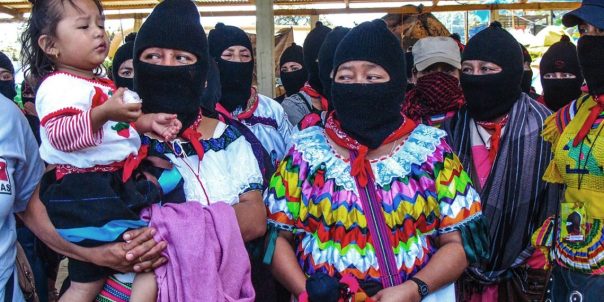
The year ends with the Second International Gathering of Women who Struggle, in which more than 3,500 of them, from 49 countries, are meeting with members of the Zapatista National Liberation Army (Ejército Zapatista de Liberación Nacional, EZLN) to talk about gender violence. At the same time, the Faculty of Philosophy and Letters of the Autonomous National University of Mexico continues taken over by students that demand that authorities of the maximum house of studies take concrete actions to put an end to all forms of gender violence that occur inside of that and other academic units. At the Chapingo Autonomous University, the community experiences shock from the murder of its student Nazaret Bautista, who disappeared on December 19 and was found lifeless on December 23. She was barely 15 years old.
These events portray what 2019 has been in terms of the struggle against the violence that women suffer. On the one hand, the uncontrolled increase in the most extreme form of gender violence: femicide; on the other hand, the bellyful given the exasperating situation of assaults and impunity and the consequent wave of protests demanding that the authorities of all levels take action on the issue, a disruptive phenomenon of disagreement in which the country’s students have played a leading role, at the same time transforming the panorama of the student movements, in which women were always central, but at the expense of making their specific demands invisible.
An achievement of this struggle has been the recognition of femicide as a particular criminal category in which the violence is done to the victim because of her gender. We’re not dealing with a question of mere terminology, because acceptance of the fact that women suffer specific forms of violence also brings with it admitting the need to address these crimes –and efforts to prevent them and punish them– with a special perspective.
The gradual acceptance of femicide as something distinct from intentional homicide against a woman has allowed measure the extent of sexist assaults; from 2015 to 2019 the number of cases classified as such went from 411 to more than 890. This number, chilling in itself, pales in comparison to the increase in the total number of women murdered, which between 2016 and 2019 went from 2,746 to more than 3,100 (the data encompass up to October 2019). In other words, in the present year 10 women have died in violent acts every day in Mexico.
In sum, what ends is the year in which Mexican women raised their voices and took to the streets to confront society with the suffocating reality they experience, as well as the turning point in which the female forms of solidarity and self-organization multiplied to make a front against the attacks they suffer. It’s imperative that the year that’s about to begin be the launch of a comprehensive strategy of struggle against all modalities of gender violence that puts an end to an intolerable situation.
———————————————————–
Originally Published in Spanish by La Jornada
Sunday, December 29, 2019
https://www.jornada.com.mx/2019/12/29/edito
Re-Published with English interpretation by the Chiapas Support Committee
Words of the Zapatista Women at the Opening of the Second International Women’s Gathering
[Save the Date: The Chiapas Support Committee is hosting a Dinner and Report Back from the Women’s Gathering on Saturday, February 8, 2020 at the Omni Commons. 5-7pm]
ZAPATISTA NATIONAL LIBERATION ARMY
MEXICO
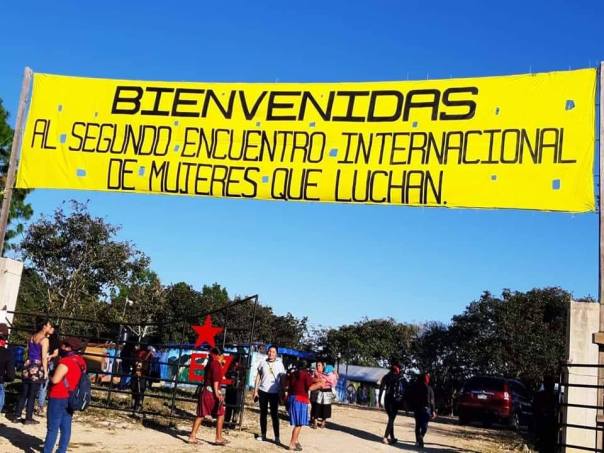
Welcome to the Second International Gathering of Women who Struggle!
December 27, 2019
Compañeras and sisters:
Welcome to these Zapatista lands.
Welcome sisters and compañeras from geographies across the five continents.
Welcome compañeras and sisters from Mexico and the world.
Welcome sisters and compañeras from the Networks of Resistance and Rebellion.
Welcome compañeras from the National Indigenous Congress-Indigenous Governing Council.
Welcome compañeras from the National and International Sixth.
Welcome compañeras from the Zapatista Bases of Support.
Welcome compañeras who are milicianas and insurgentas in the EZLN.
Sister and compañera:
We want to report that as of yesterday, December 26, 2019, registration for this second gathering came to:
3, 259 women , 95 little girls and 26 men
From the following 49 countries:
| 1. Germany
2. Algeria 3. Argentina 4. Australia 5. Austria 6. Bangladesh 7. Belgium 8. Bolivia 9. Brazil 10. Canada 11. Cataluña 12. Chile 13. Colombia 14. Costa Rica 15. Denmark 16. Ecuador 17. El Salvador 18. Spain 19. United States 20. Finland 21. France 22. Greece 23. Guatemala 24. Honduras 25. India |
26. England
27. Ireland 28. Italy 29. Japan 30. Kurdistan 31. Macedonia 32. Norway 33. New Zealand 34. Basque Country 35. Paraguay 36. Peru 37. Poland 38. Puerto Rico 39. United Kingdom 40. Dominican Republic 41. Russia 42. Siberia 43. Sri Lanka 44. Sweden 45. Switzerland 46. Turkey 47. Uruguay 48. Venezuela 49. Mexico |
Sister and compañera:
We are very happy you were able to come all the way here to our mountains.
And for those who were not able to come, we also greet you because you are watching what is happening here in the Second International Gathering of Women Who Struggle.
We know very well what you had to do to get here: we know you had to leave your family and friends; we know the effort and work you had to put in to come up with the money to travel from your geography to ours.
But we also know that your heart is a little bit happy because here you will meet other women who struggle. Maybe something you hear or learn here about other struggles will even help you in yours. Whether or not we agree with these other struggles and their forms and geographies, all of us benefit from listening and learning. This isn’t about competing over which struggle is best, but about sharing our struggles and ourselves.
So we ask you to always be respectful of different ways of thinking and doing. All of us here, and many more who aren’t here, are women who struggle. It’s true that we all have different ways of struggling, but as you can see, as Zapatistas we don’t think that it makes sense for everyone to think and act the same way. We think difference isn’t a weakness, but rather that it is a powerful force when we respect each other and agree to struggle together but not on top of each other.
So we ask you to share your pain, your rage, and your struggle with dignity, and to respect other pains, rages, and dignified struggles.
Compañera and sister:
We have done everything possible so that you can be happy and safe here. It may seem easy to say that, but we all know all too well that there are very few places in the world where we can be happy and safe. That’s why we’re here: because of our pain and our rage at the violence we suffer as women, for the crime of being women.
As you will see over the next few days, men will not be allowed in this space. It doesn’t matter if they are good men, or more or less normal men, or just whatever kind of men, they will not be allowed here for the next couple days. This place and these days are only for women who struggle—that is, not just for any woman.
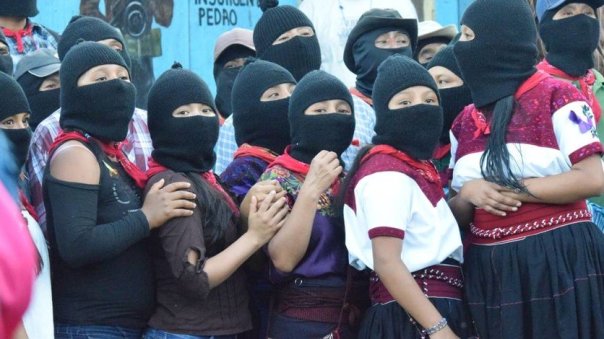
The compañeras who are insurgentas and milicianas are in charge of taking care of us and protecting us here over the next few days. We have also made sure that you will have a place to sleep, eat, and clean up. In this respect, in terms of rest, food, and bathing, we ask you to treat the “wise” women among us, that is, the older women, with respect. It’s important to respect them because they are not new to this struggle. They didn’t get their gray hair, their illnesses, or their wrinkles from selling out to the patriarchal system or by giving in to machismo. They didn’t get any of those things because they gave up their way of thinking about struggle for our rights as women. They are who they are because they haven’t given up, given in, or sold out.
To the older women—wise women as we call you—we ask that you also respect and greet the younger women, whether they are adults or children, because they have also dedicated themselves to this struggle with determination and commitment. If we haven’t let our geographies divide us, then we certainly won’t let our calendars do so. All of us, no matter the calendars we have marked or the geography in which we live, are on the same path: the struggle for our rights as the women that we are.
For example, our right to live. This point makes us sad because now, a year after our first gathering, the report is not good. All over the world women are still being murdered, disappeared, abused, and disrespected. This year the number of women raped, disappeared, and murdered keeps rising. We as Zapatistas see this situation as very serious, and that is why we organized this second gathering around one theme only: violence against women.
Sister and compañera, you who are here and you who couldn’t come:
We want to hear you and see you, because we have questions:
How did you get organized? What did you do? What happened?
Remember that at our first gathering, we all committed ourselves to get organized in our respective geographies, to organize against the murders, disappearances, humiliations, and disrespect. But we see that the situation is actually worse now.
They say there is now gender equality because within the bad governments there are an equal number of bossmen and bosswomen.
But we are still being murdered.
They say that now there is greater pay equity for women.
But we are still being murdered.
They say feminist struggles have made great steps forward.
But we are still being murdered.
They say now women have more voice.
But we are still being murdered.
They say women are now taken into account.
But we are still being murdered.
They say that now there are more laws that protect women.
But we are still being murdered.
They say that now it’s quite fashionable to speak well of women and their struggle.
But we are still being murdered.
They say there are men who understand our struggle as women, and even that those men are feminists.
But we are still being murdered.
They say that women occupy more spaces now.
But we are still being murdered.
They say there are even super-heroines in the movies now.
But we are still being murdered.
They say that now there is more awareness about respecting women.
But we are still being murdered. More and more murdered women. Murdered more and more brutally. With more and more cruelty, fury, envy, and hate. And with more and more impunity. With more and more macho men who get away with it, without punishment, as if nothing had happened, as if murdering, disappearing, exploiting, using, assaulting, or disrespecting a woman was no big deal.
We are still being murdered and they still ask us, demand of us, order us to behave ourselves.
Think of the unbelievable scandal created by a group of workers blocking a highway, or going on strike, or protesting, as if they’ve violated the rights of commodities, cars, and things, and the press is immediately filled with photos, videos, reports, analysis, and commentary criticizing their protest.
But if a woman is raped, it’s just another statistic. And if women protest, if they graffiti the monuments important to those above, break windows important to those above, shout their truths to those above, then that is scandalous.
But if we are disappeared or murdered, it’s just another statistic: one more victim, one less woman. It’s as if the powerful wanted it to be crystal clear that what matters is profit, not life. Cars matter; so do monuments, windows, and commodities. But life doesn’t, especially if it’s a woman’s life.
That’s why we as the Zapatista women that we are, anti-capitalist and anti-patriarchal, think about why the system works like that. It seems that our violent deaths, our disappearances, and our pain come out as profit for the capitalist system, because the system only allows what benefits it, what produces profit for it.
That’s why we say that the capitalist system is patriarchal. Patriarchy rules, even if the overseer is a woman. So we think that in order to fight for our rights—the right to live, for example—it’s not enough to fight against machismo or patriarchy or whatever you want to call it. We have to fight against the capitalist system. They go together as we Zapatista women say.
But we also know there are other ways of thinking and other forms of women’s struggle. Perhaps there is something we can learn and understand. That’s why we have invited all women who struggle to this gathering, no matter what their thinking or form of struggle.
What matters is that we fight for our lives, which now more than ever are at risk everywhere and all the time. Despite the fact that they declare and predict that women have made great strides, the truth is that never in human history has the fact of being a woman been so fatal.
You see, compañera and sister, they’re going to want to tell us which job or profession is the most dangerous—if it’s being a journalist, or forming part of the repressive security forces, or being a judge, or occupying a position in the bad government. But you and we know that the most dangerous thing in the world to be right now is a woman.
It doesn’t matter if she’s a little girl, or a young woman, or an adult woman, or an older woman. It doesn’t matter if she’s white, yellow, red, or the color of the earth. It doesn’t matter if she’s fat, thin, tall, short, pretty, or ugly. It doesn’t matter if she’s from the lower class, middle class, or upper class. It doesn’t matter what language she speaks, or what her culture, religion, or affiliation is. When the violence comes, the only thing that matters is that she’s a woman.
Sister and compañera:
As the Zapatistas that we are, we know that they will give us many examples of women who have advanced, triumphed, won prizes and high salaries—who have been successful, as they put it. We respond by talking about the women whom have been raped, disappeared, murdered. We point out that the rights they talk about above are won by a precious few women above. And we respond, we explain, we shout that what is lacking is the most basic and most important of rights for all women: the right to live. We’ve said it many times, compañera and sister, but we’ll repeat it again now:
Nobody is going to grant us our right to live and all the other rights we need and deserve. No man—good, bad, normal, or whatever—is going to grant these to us.
The capitalist system is not going to give them to us, regardless of the laws it passes and the promises it makes.
We will have to win our right to live, as well as all our other rights, always and everywhere. In other words, for women who struggle, there will be no rest.
Sister and compañera:
We have to defend ourselves, to take charge of our self-defense as individuals and as women. Above all, we have to be organized to defend ourselves, to support ourselves, to protect ourselves, and we have to start now.
My fellow compañera coordinators of this gathering have delegated me to communicate this to you because I’m the mother of a little girl, who is here with me. Our duty as women who struggle is to protect and defend ourselves, especially if the woman in question is just a little girl. We have to protect and defend ourselves with everything we have. And if we have nothing, then with sticks and rocks. And if we don’t have sticks or rocks, then with our bodies, with teeth and fingernails. We have to teach our little girls to protect and defend themselves when they grow up and have their own strength.
That’s how things are today, sister and compañera, we have to live on the defensive, and to teach our daughters to grow up on the defensive, and we have to maintain that practice until they girls can be born and grow and mature without fear.
We Zapatistas think that the best way to do this is to be organized. We know that there are those who think this can be done individually. We as Zapatistas do it through organization, because we are women who struggle, yes, but we are Zapatista women.
That is why, compañera and sister, our report back to all of you this year is that among us, there has not been a single murder or disappearance of any of our compañeras. We do have some cases, according to our last meeting, of violence against women, and we are in the process of deciding how to punish those responsible, all of whom are men. That punishment is partly the responsibility of the autonomous authorities, but also ours as Zapatista women.
We also want to be totally honest and say that at times we fight among ourselves, compañera and sister, and about stupid things. Maybe these dumb fights are a waste of time because we are all alive and safe. But there was a time in which we only lived death. And truthfully, looking at the way things are in your world—and please don’t be offended sister and compañera—but we hope that someday you all also fight over who is prettiest, youngest, smartest, best-dressed, who as more boyfriends or girlfriends or husbands or wives, or why you’re wearing the same thing, or whose kids are better or worse, or any of these things that happen in life.
Because when that day comes, compañera and sister, it will mean that just staying alive is no longer a problem. And maybe then we can all be equally idiotic about men and gossip and stupid stuff.
Or perhaps not, perhaps once you all are alive and free, your problems will be different, with different arguments and fights. But until that day comes, sister and compañera, we have to take care of each other, protect each other and defend each other.
As you know well, compañera and sister, this is a war. They are trying to kill us, and we are trying to stay alive, but alive without fear—alive and free, that is.
We want to shout to the world our pain and this rage at the fact that we cannot live freely. And we also want to shout our encouragement to struggle to each and every woman who is abused, either physically or however else. As Zapatista women, we want to send a special embrace to the families and friends of disappeared and murdered women—an embrace that lets them know that they are not alone, that in our own way and from our own place, we accompany their demand for truth and justice.
That’s why we’re gathered here, sister and compañera: to shout our pain and rage, to accompany and encourage each other, to embrace each other, to know that we are not alone, to look for paths of help and support.
These are our words for you today, sister and compañera. The insurgentas and milicianas have prepared a talk to present also, and in that one we will remind you of the little light that we gave you in the first gathering. Later we will begin the work of this gathering, dedicating the entire day today to denunciations—an entire day for denouncing the violence that we suffer, all of us together, with an open microphone. We’re going to take turns speaking and venting our rage and our fury about everything they do to us. And we are going to listen to each other with attention and respect. Nobody else is going to listen to what we have to say—only we as women who struggle and who are here present. So do not be ashamed, sister and compañera, express clearly your pain and your anger, scream your rage. And be assured that we, at least we the Zapatista women, will make a place in our collective heart for you, and through those of us present here, thousands of Zapatista indigenous women will accompany you.
Tomorrow we will share the ideas, experiences, and work that all of you bring in order to seek paths that we can take to end this nightmare of pain and death. The last day of the gathering will be dedicated to culture, art, and fiesta. So one day we will shout our pain and rage; the next day we will share ideas and experiences; and the third day we will shout our strength and joy.
Because we are women who suffer, but we are also women who think and who organize ourselves and above all, we are women who struggle.
That’s how the gathering will play out, and as you already know, you are welcome here, compañera and sister, you who could come and you who couldn’t but are here in your heart.
-*-
In the name of all of the Zapatista women of all ages, on December 27, 2019, at 1:57pm Zapatista time, we officially open this Second International Gathering of Women Who Struggle here in the mountains of the Mexican southeast.
From the semillero “Footprints of Comandanta Ramona,” Caracol Whirlwind of Our Word, Zapatista Mountains in Resistance and Rebellion,
Comandanta Amada
Mexico, December 2019
Zapatista women’s gathering begins
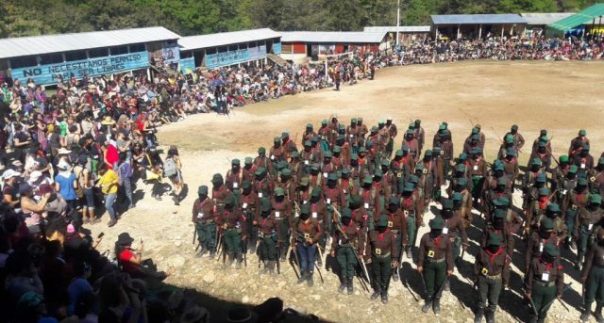
Hundreds of Zapatista milicianas paraded in the inauguration of the worldwide feminist gathering. Photo: Cuartoscuro
ZAPATISTA WOMEN CALL TO CONQUER THE RIGHT TO LIFE IN FRONT OF 5,000 FEMINISTS
From the correspondents
Ejido Morelia, Altamirano, Chiapas
“The right to life and all the rights we deserve and need, will not be given to us by anyone, nor by the capitalist system through the many laws and promises that it makes, but rather we must conquer them all the time and in all places,” the women members of the Zapatista National Liberation Army (Ejército Zapatista de Liberación Nacional, EZLN) affirmed this Friday upon inaugurating the second international gathering of women who struggle, called against gender violence, “because throughout the world they continue murdering them, disappearing them, doing violence to them and despising them.”
“To struggle for our rights, like the right to life, it’s not enough to struggle against sexism or patriarchy, we must also struggle against the capitalist system,” they stated before more than 5,000 women from Mexico and 48 other countries gathered in the Caracol called “footprints of walking with Comandanta Ramona.”
They pointed out that: “what matters is that we fight for our lives, that now more than ever they are in danger everywhere and all the time, and although they may say and may preach that there are many there are many advances for women, the truth is that never before in the history of humanity has it been so deadly to be a woman.”
“This year, the number of violated, disappeared and murdered women has not stopped, it has increased, and we as Zapatistas see this as very serious,” Comandanta Amada emphasized upon making a call to women that it doesn’t matter what your thinking or your way is.
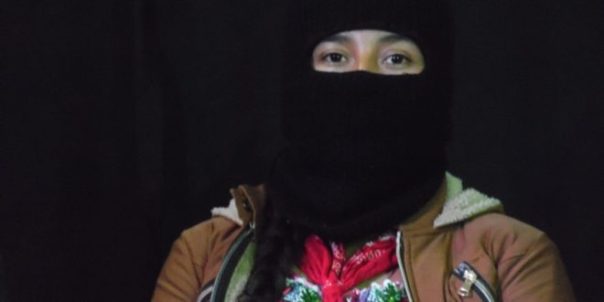
She asked the attendees to always have respect for different thoughts and ways. “Those who are here, and many more who are not present, are women who struggle. We have different ways, for sure. But now you see that our thinking, as the Zapatistas that we are, is that it isn’t useful that we are all equal. We think that difference is not weakness.”
Prior to the inauguration of the Second International Gathering of Women Who Struggle, they carried out the performance called A rapist in your path and sang feminist songs to the rhythm of the batucada. [1]
Feminine collectives arrived in Zapatista territory with diverse currents of thinking or social struggles that have made use of color to self-identify in the global context, making their ideologies public: those who wear a green scarf; promoters of the campaign for the right to abortion; those with the color violet insignia who combat gender violence, wage inequality, femicides; lesbian feminist collectives, among others.
When reading the communiqué from the EZLN women, Comandanta Amada urged attendees to “self-defend as individuals and as women, and above all we must defend ourselves organized, support and protect each other.”
There was a parade of several hundred indigenous milicianas [2] who carried clubs and bows; all of them in charge of the security of the gathering, to which not a single man was permitted entry.
“They keep killing us and they still ask us, demand from us, order us to be well-behaved, and you can’t believe it, but if a group of workers cover a road, or go on strike, or protest, there’s a big scandal; they say that the rights of the merchandise, of cars, of things are violated, and in the communications media there are photos, videos, reports, analysis and commentary against those protests,” Amada reproached from a stage.
But if they rape a woman, “they just put one more number or one less number in their statistics. And if women protest and scratch their stones up above, break their windows up above, shout their truths to those above, then yes (there is) big noise.” “But if they disappear us, if they murder us, then they just put another number: one more victim, one less woman.”
After the inauguration, the Zapatista commanders installed a table for listening to the stories of some of the participants. Testimonies were given of women violated to those to whom the government has not done justice, and who live in fear of being murdered because of denouncing sexist aggression.
Students from the School of Philosophy and Letters described the violence that is experienced inside the UNAM. The former independent presidential candidate María de Jesús Patricio, Marichuy, attended the gathering, as well as mothers of young victims of femicides like Lesvy Rivera Osorio, found dead in University City in 2017.
[1] Batucada is a sub-style of samba, performed with percussion instruments.
[2] A Zapatista miliciana is a Zapatista woman who is a member of a military body similar to the National Guard.
———————————————————–
Originally Published in Spanish by La Jornada
Saturday, December 28, 2019
https://www.jornada.com.mx/2019/12/28/politica/007n1pol
Re-Published with English interpretation by the Chiapas Support Committee
Report from EZLN-CNI Forum in Defense of Territory and Mother Earth
INDIGENOUS AGREE TO FORM AN ECONOMIC MODEL PARALLEL TO CAPITALISM
Forum in defense of territory and Mother Earth Photo: Angeles Mariscal
By: Angeles Mariscal
The global economic model based on the exploitation of nature and the accumulation of wealth, the capitalist economic model, in the last 200 years has provoked climate change and now seeks to do it to land where natural resources still remain, indigenous peoples from different regions of the country and mestizos from Mexico City and Monterrey concluded during the Forum in Defense of Territory and Mother Earth. They agreed to combine to defend their territory and to be self-sustainable.
They met for 2 days in a gathering headed by the Zapatista National Liberation Army (Ejército Zapatista de Liberación Nacional, EZLN) and the National Indigenous Congress (Congreso Nacional Indígena, CNI), to analyze the impacts that the mining, hydraulic, hydrocarbon, wind, tourism and real estate industries have on their territory. They explained in this radiography of the country, not only the histories of dispossession, but also the actions of resistance, the strategies that the communities have implemented to prevent these sectors from appropriating land that they inhabit and from extracting the natural resources. At the end of the gathering, they agreed to combine to defend their territory, to be self-sustainable and to strengthen a system of life in an economic model different from the capitalist system.
From the Yaqui tribe of Bácum pueblo in Sonora, to the Binnizá of Oaxaca, passing through inhabitants of the America colonias of Monterrey, and Coyoacán of Mexico City, indigenous and mestizos from 24 states, drew how big companies corrupt governments in order to appropriate the land and its natural resources.
On Aztecas Street marked with the number 215, in the Coyoacán District of Mexico City, every second, 60 liters of pure water coming from an underground aquifer is removed with hoses, to then be spilled into the nearest drainage.
In what until a few years ago was considered the world’s largest city, one of its main problems is the lack of water to supply 21.5 million inhabitants. The water that is spilled every day into Aztecas Street, would be enough for the consumption of 15,000 people; however, that doesn’t matter to the “I want a house” company, which seeks at all costs to dry that spring in order to build apartment buildings on it. The Coyoacán District is one of the most valuable in that city.
At the beginning of the denunciation, capital authorities argued that what was being extracted was water contaminated by the drainage, but with the help of specialists residents of the zone were able to document that it was clean underground water.
In Monterrey, the city with the country’s most thriving economy, the Barrio San Luicito, founded by migrants more than 50 years ago, “defaces the view” of the project to build plazas, shopping centers, luxury homes and tourist attractions amid “first world” roads.
“When we came to Monterrey many years ago, roped us to the hill where there was nothing more than stony terrain. Now that there is no longer room for their projects, they want to displace us because we hinder what entrepreneurs call ´economic growth´, because our houses seem ugly and poor to them, because we obstruct them.”
What happens at Aztecas 215 and in the San Luicito Barrio, are the new stories of dispossession that are reaching the cities, as those affected by these projects referred to them during the Forum in Defense of Territory and Mother Earth. Until a few years ago, those who got together at the gatherings called by the EZLN were mostly inhabitants of rural and indigenous areas, now city residents come.
Indigenous Huicholes of San Lorenzo, Jalisco, explained that they struggle so that they won’t dispossess them of 94,000 hectares of land that they have possessed since Colonial times, territory to which the mining, hydraulic and hydrocarbon industries have now been granted concessions, like the Yaquis of Sonora, the inhabitants of El Mezquital in Nayarit, and the Zoques of Chiapas.
The scope of the economic model in this logic also contemplates the emptying of land for projects like the Inter-oceanic Corridor and the Trans-Isthmus Corridor, designed to transport natural resources, merchandise and products to Asian markets.
“In order to impose [these projects] the government resorts to rigged consultations and community division to obtain the permits to open the paths of connection. They have never told us exactly what the contours are. We have not been informed of the ecological impact, much less who the big investment companies are,” denounced members of the Assembly of Peoples of Juchitán, Oaxaca.
Zapatistas shared their experience in the formation of an alternative development model to the capitalist one. Photo: Ángeles Mariscal
Informing and organizing
However, along with the denunciations, for two days those affected by the extractive projects were detailing the strategies they have used to stop the advance of these actions.
“We have gone from town to town informing, making alternative information campaigns, and articulating actions to stop the works,” several of the speakers pointed out during the Forum in Defense of Territory and Mother Earth.
“We have made agreements and we are walking little by little, strengthening ourselves as peoples, designing regulations that contemplate autonomy over our land and our resources, raising awareness about the right to decide what we have on our territory,” explained residents from the Indigenous Regional Council of Ixmujil, Campeche.
Others, like the inhabitants of the La Parota zone of Guerrero, explained how for five years they have maintained an occupation and blocked roads that lead to the area where intend to build a hydroelectric dam, or the Wixárika, who have taken their fight to the Agrarian Court and the Tzeltals and Zoques of Chiapas, who formed an alliance with different groups and organizations that seek to conserve the environment.
“We, the daughters and sons of these lands have the need to organize to defend, we have the obligation to defend it and take care of it because territory and Mother Earth cannot defend themselves. We have to think about how to defend our territory and Mother Earth,” the EZLN’s Subcomandante Moisés said when he spoke.
“The enemy of everyone is what we listen to here: capitalism. We have no doubt. Capitalism is already coming to its end because its base of sustenance, which is nature, is already ending, even its reserves. It only took them approximately 200 years to finish it off. It took millions of years for nature to accumulate, and it won’t be able to recuperate in a few years. What we are seeing is pollution of the rivers, waters, seas, soil and subsoil of Mother Earth. Climate change occurs due to this problem. The experience of our grandparents no loner works because the rain is already very irregular,” maintained a Zapatista from the Highlands zone of Chiapas.
He said that given that context, “Capitalism would seek refuge in the mountainous lands and hills where they sent us. Now those are the good lands and capitalism will come to evict us, because more natural riches accumulate there. They need coal, oil and mines.”
Each participant was outlining paths that the original peoples have followed. “We have to prepare ourselves, this situation obliges us to rescue our culture, to return to traditional medicine, to return to making our own clothes, to cultivating our food, and not to depend on capitalism and its governments to live.”
After detailing how some Zapatista communities have formed cooperatives that produce and trade their products between, the attendees at the forum agreed to increase the articulation among the peoples, and to strengthen a life and economic system parallel to the capitalist model.
——————————————————————-
Originally Published in Spanish by Chiapas Paralelo
Tuesday, December 24, 2019
Re-Published with English interpretation by the Chiapas Support Committee
An Invitation to Build Community-to-Community Solidarity & Justice
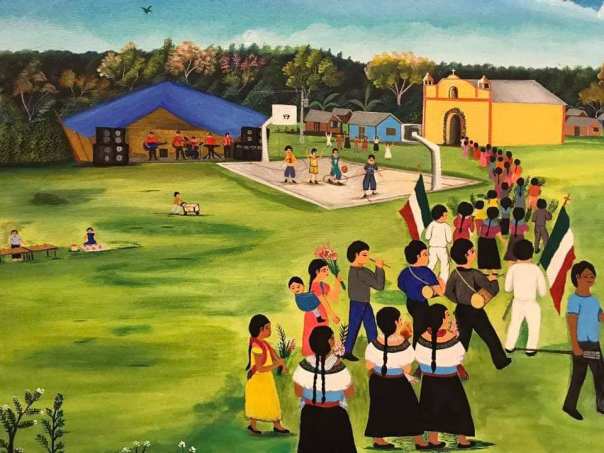
An Invitation from the Chiapas Support Committee
“We would like to take this opportunity to invite The Sixth, The Networks, the CNI, and all honest people to come and participate, together with the Zapatista peoples, in building these CRAREZ [Zapatista Centers of Resistance and Rebellion]. You might contribute to this effort by collecting the necessary construction materials, by making an economic contribution, by hammering, cutting, carrying, and guiding others, and by sharing these moments with us—whichever might be the most convenient way for you.”
Words of Subcomandante Moisés in the August 17, 2019 CCRI-CG Zapatista communiqué “And We Broke the Siege.”
Dear Friends:
The Chiapas Support Committee invites you to close 2019 by giving generously to express support and to envision a new sisterhood/brotherhood with the Zapatista communities in Mexico who are building autonomy and self-determination. We believe that this is an urgent challenge and responsibility facing all activists and organizers working for a more just and peaceful world. (You can donate safely online through PayPal, Venmo: @Enapoyo1994, or create a fundraising campaign for the CSC on your Facebook page.)
In 2019, the Zapatistas marked the 25th year of their uprising by continuing to grow the movements in Indigenous and non-indigenous communities for a new relationship based on autonomy and self-determination.
And what a year 2019 turned out to be!
Seven + Four: Zapatista Centers of Resistance and Rebellion
In August, Subcomandante Moisés issued the Zapatistas’ surprise announcement that they had organized and opened seven new Caracoles and four new autonomous municipalities in Chiapas, some of them in parts of the state not previously thought of as having Zapatista influence. The Zapatistas’ announcement represents an important growth in the practice of radical democracy, which the Zapatistas call autonomy.
And Subcomandante Moisés is inviting us to support these new Zapatista Centers of Resistance and Rebellion construct what their people need: schools, clinics, and sustainable economic production.
We are sharing Subcomandante Moisés’ invitation and extending it to you to make a generous contribution to the Chiapas Support Committee for the construction of radical Zapatista democracy. All of your contributions go to the Zapatista communities.
The creation of the new Zapatista Centers of Resistance and Rebellion (CRAREZ) were in sharp contrast to the EZLN’s ominous New Year’s message on the 25th anniversary of their 1994 Uprising saying that they were alone, fighting off paramilitaries, surrounded by thousands of soldiers and threatened with the Maya Train project and PROARBOL (commercial tree farms).
Then the Zapatistas postponed the 2nd International Gathering of Women Who Struggle. In a February 11 message, the Zapatista women said they could not hold the 2nd Women’s Gathering in March 2019 because it wasn’t safe. The women denounced the threat of paramilitary groups connected to political parties and megaprojects: the Maya Train, commercial tree farms, mining and the Isthmus of Tehuantepec project.
Both messages said the Mexican government was “coming for” them. Both messages caused great concern among Zapatista supporters and an outpouring of international solidarity in the form of letters published in various media around the world.
¡Samir vive!
Less than two weeks later, on February 20, we learned of the murder of Samir Flores Soberanes, a long-time delegate to the National Indigenous Congress (Congreso Nacional Indígena, CNI) and an outspoken opponent of the thermoelectric plant in Huexca, Morelos.
In May, four members of the CIPOG-EZ, a campesino organization belonging to the CNI, were murdered in Guerrero. These murders revealed that criminal gangs allegedly connected to organized crime had surrounded several CIPOG communities and were murdering anyone who left those communities to obtain supplies. This prompted an international solidarity campaign to donate and deliver supplies to the surrounded communities via back roads and mountain trails.
Meanwhile, paramilitary violence continued in the Chiapas Highlands (Chenalhó, Chalchihuitán, Aldama, as well as other parts of Chiapas). At least 25 were reported killed and several thousand were displaced from their homes and communities. A recent report indicates that some are fleeing violence and displacement, and are currently in an encampment near the US border waiting to be called for an asylum interview.
Yet, in the midst of military and paramilitary violence, as well as megaprojects, the Zapatistas have been able to convince and organize thousands of previously non-Zapatistas to give up Mexican government handouts and enrich the culture of indigenous resistance and rebellion to practice radical democracy (autonomy), according to the organizing principles of Zapatismo. They have done so with their dignity, patient love of neighbor and consistent example.
An invitation to grow justice & autonomy
All our communities are invited—as a small committee, as members of an emerging network and as members of diverse social and economic justice movements—by Subcomandante Moisés to build our struggles for autonomy and justice where we live, work, study, worship and play.
And the Chiapas Support Committee invites you to help us support the Zapatistas’ CRAREZ by giving a generous donation before 2019 ends to support Zapatista community autonomy projects in Chiapas.
Please join us in making a generous contribution to the anti-capitalist and autonomous development of the new Zapatista Centers of Resistance and Rebellion (CRAREZ)!
You can donate on-line, create a birthday fundraiser on your Facebook page for CSC and/or with a check or money order payable to: CHIAPAS SUPPORT COMMITTEE and mail to:
Chiapas Support Committee
P O Box 3421
Oakland, CA 94609
To donate online, you can use:
- PayPal: enapoyo1994@yahoo.com
- Venmo: @Enapoyo1994
The work of constructing autonomy in the new CRAREZ is of critical importance to the Zapatistas. Your contributions will reflect the urgent work of creating and strengthening relationships rooted in solidarity and justice across borders and movements.
Members of the Chiapas Support Committee and the folks we work with in Chiapas will thank you from the bottom of our collective heart for your contribution.
In resistance & solidarity,
Jose Plascencia, for the Chiapas Support Committee
Carolina Dutton
Arnoldo García
Roberto Martínez
Amanda Stephenson
Mary Ann Tenuto Sánchez
The Whale Dances
Sixth Commission of the EZLN
Mexico | December 2019
To the National Indigenous Congress-Indigenous Governing
To the individuals, groups, collectives and organizations of the national and international Sixth:
To the Networks of Resistance and Rebellion:
To those who enjoy dance:
CONSIDERING: First and only
A Whale Dances
The illuminated mountain. The echo of cinema, not of a movie, but of cinema itself as a community still lives on in recently lit ocotes, in the nostalgic blue of that horse–Tulan Kaw–, in a glimmer that reads «Welcome,» and finally in that defiant light that spells, «ZAPATISTAS.»
You’ve tried to leave this place but for some reason that you’re unable to explain, you can’t… or you don’t want to. Night has fallen, cold as always. You stroll through the flat open area where, hours earlier, the serpentine path between the stations reminded you of small-town fairs in distant calendars and geographies.
The smorgasbord of posters catches your eye: “Second International Encounter of Women in Struggle,” “Gathering in Defense of Territory and Mother Earth,” “26th Anniversary,” “Second ‘Puy Ta Cuxlejaltic’ Film Festival,” “First ‘Dance Another World’ Dance Festival.”
Is it possible to dance the air?
Could a dance, seemingly so distant from everything, trace the outlines of a dream through movement alone?
Yes, perhaps you’re delirious; it could be due to the cold or to that irreverent red star glittering at the top of the mountain.
You’re in the middle of analyzing this when the little girl and her gang arrive and surround you with their enthusiastic chatter: “There’s going to be a dance!” they shout, jumping up and down. Well, the girl called “Calamity” barely gets her heels off the ground, but her joy is just the same as the others’. The prospect of a dance does not excite Pedrito, the skeptic of the group, who declares: “There’s a dance every now and then anyway, I don’t see what the fuss is about.” Defensa Zapatista begins her pedagogical approach with a slap upside the head and continues, “There’s going to be a dance hanging from a cloud, not just any old dance,” as she performs an impeccable ron de jambe par terre en dehors.[1] Not to be shown up, the Cat-Dog follows with a pas de chat.[2]
“There’s going to be a dance!” repeat the girls in a jumbled chorus.
An insurgenta (you identify her by her uniform) comes running and says, “Calamity, come here, they’re going to dance the whale!” Calamity runs as fast as she can – which isn’t very fast – up the gentle slope that leads to the belly of the wooden whale still resting… or recuperating from injuries from harpoons, lies, and forgetting. Defensa Zapatista follows with the Cat-Dog in her arms.
Esperanza Zapatista is still arguing with Pedrito, who is pointing out that not only is it impossible to ‘dance a whale’, but also that it’s impossible for a cetacean (that’s what he calls it) to have ended up in the middle of the mountains of the Mexican Southeast. You don’t get to hear the end of the argument but you can guess how it played out: Esperanza Zapatista, even though she only comes up to Pedrito’s waist, usually ends every argument with: “Men can’t see past their own noses… and they’re snub-nosed!”
You decide to follow Defensa Zapatista, the Cat-Dog and Calamity. Esperanza Zapatista and Pedrito follow behind, complaining that they’re hungry.
You enter into the belly of the enormous animal, which by now is nearly empty. A group of dancers practice their movements. They (ellas, elloas, ellos) bound across the stage that, despite its name, is not higher than the bleachers, but lower.
You sit down and, instead of watching the dancers’ exercises and rehearsal, you watch the reaction of the little gang. Calamity, very excited, has climbed up onto one of the wood bleachers and attempts to execute an echappe simple,[3] and, as she falls onto the wooden bench, it breaks. “Calamity!”, Defensa Zapatista shouts – but Calamity has already climbed onto another bleacher and repeated the move… and another bench is broken. By the time the fifth bench has broken, a cluster of milicianas is trying in vain to restrain her still despite her insistence on challenging the laws of gravity… and logic.
The scene that follows – with Calamity jumping from one bleacher to another with an agility that defies the limits of her body, the milicianas trying to surround and grab her, the cat-dog biting the milicianas, Defensa Zapatista trying to stop the Cat-Dog, Esperanza Zapatista trying to get her phone out to video-record the chaos, Pedrito reminding everyone that perhaps it would be best to have something to eat – doesn’t appear to bother the dancers who seem to hang on a wind that, in the absence of music, blows only in their hearts.
Is it possible to dance an injured whale?
“Oh, the Zapatistas: as usual it’s like they’re watching a movie of their own,” you think to yourself. It’s as if when they talk about the world, they’re referring to a world besides the one we’re all suffering through; as if, traveling in a spaceship, they decided to look not at the world they’re leaving behind but the world that is hiding someplace in the universe… or in their imagination.
Can you imagine the soundtrack to a new, rebellious world rising from the ashes of the old as the latter crumbles imperceptibly?
Then you understand… or you think you do. With “Dance Another World,” Zapatismo is not issuing a challenge, but rather an invitation.
Meanwhile, cornered at the far end of the auditorium, Calamity has stopped the milicianas’ attack – they are listening attentively to the girl’s explanation of the “popcorn game” and her “history of popcorn, Calamity’s version.”
Just then you feel a rumbling under your feet. No – could it be? Yes: it seems that the whale has finally gotten desperate and is trying to restart its journey up the mountainside.
As if dance, the art of dancing another world, had healed its wounds and its heart and had encouraged it to continue its absurd effort.
But that’s impossible. Isn’t it?
-*-
Given the above, the Sixth Commission of the EZLN invites the men, women, others (otroas), children and elders of the Sixth, the CNI and the Networks of Resistance and Rebellion throughout the whole world, as well as anyone who can and wants to, to attend the First Festival of Dance…
“To Dance Another World”
The festival’s first (!) edition will take place in the Zapatista caracoles of Tulan Kaw and Jacinto Canek, in the mountains of the Mexican Southeast, December 16-20, 2019.
There will be exhibitions of contemporary, classical, and neoclassical dance; folk, aerial, and African dance; bellydancing, butoh, acrobatics, circus performance, participative dance, dark belly dance hip hop fusion, modern dance, hula hoop and fire dance.
The activities will take place in:
- The Caracol of Tulan Kaw, December 16, 17 and 18, 2019, beginning at 10:00AM.
- The Caracol of Jacinto Canek (in the facilities of CIDECI in San Cristóbal de las Casas, Chiapas), December 19 and 20, 2019.
From the mountains of the Mexican Southeast,
SupGaleano
With his beautiful and well-formed body (Ha!) injured from having tried a Temps Levé Coupe.[4] Don’t laugh, I nailed it! … Well, sort of… Okay, okay, I couldn’t do it.
Mexico, December 2019
[1] Basic ballet exercise involving circling the leg on the ground. Depicted here: https://www.youtube.com/watch?
[2] French for “a cat’s step.” In ballet, a sideways jump with both feet brought as high in the air as possible. Shown here: https://www.youtube.com/watch?v=
[3] Ballet move in which the dancer jumps from standing into a wide-footed pose, shown here: https://www.youtube.com/watch?v=
[4] Temps Levé: a small jump. Coupé: A small intermediary step done as preparation for another step. Shown here: https://www.youtube.com/watch?v=yDDioXn26HE
En español: http://enlacezapatista.ezln.org.mx/2019/12/15/baila-una-ballena/
The Maya Train: the consultation and the dispossession

Maya Train | Tren Maya
By: Carlos Fazio
Preceded with a big campaign of media propaganda and “field work” of officials from the National Fund for Tourism Promotion and the National Institute of Indigenous Peoples, yesterday, December 15, the “participatory consultation” on the Maya Train Development Project was held in municipios of Yucatán, Chiapas, Tabasco, Campeche and Quintana Roo, where Maya, Ch’ol, Tzeltal and Tzotzil communities exist. [1]
Under the premise that: “participation is inclusion, co-responsibility and democracy” and the slogan “Let’s decide together!” the formula for the manufacture of consent (Chomsky dixit) concealed that the decision was made before the consultation; President Andrés Manuel López Obrador adopted it when he became president, independently of the free determination of the Maya people. As AMLO himself has said: “rain, thunder or lightning the Maya Train will be built. Like it or not.”
Critical researchers have argued that the Maya Train is not new, nor is it just a train, nor is it Maya. And that it will not remove Mexico from the slope of neoliberalism nor return to the State its guiding role as the motor of national development: it includes two infrastructure megaprojects on the Isthmus of Tehuantepec and the Yucatan Peninsula of geopolitical and private scope, whose central objective is the territorial transformation of the south-southeast region of Mexico at the service of US corporate economic and security interests. And as such, it could lead to a new process of dispossession of lands under ejido property in the areas concerned (via induced or frankly coercive expropriation) and the consequent spatial segregation of the Maya population.
To do this, as Josué G. Veiga points out (“The Fourth Transformation travels by train”), together with the “imposition of certain development” and apart from Convention 169 of the International Labor Organization on prior and informed consultation, the Maya Train project has appropriated “meanings and imaginaries of the Maya culture to alter them and sell them as the trademark of a nationalist project.”
According to Ana Esther Ceceña, the geopolitical scope and the strategic effects of the transformation of the southeast region place the project as a nodal point of the “world market’s traffic” and, therefore, of the “war” for global control. For the US, but also for its competitors (China, Japan and other emerging economies), control of that region “can make the difference in the hierarchy of powers at the global level.”
In particular −and more after the agreements reached around the Protocol of Amendments of the Trade Agreement between Mexico, the US and Canada (T-MEC), which ratify the maquiladora vocation of the Fourth Transformation nation project−, Washington seeks to maintain the Greater Caribbean and the Gulf of Mexico (of which the Isthmus of Tehuantepec and the Yucatan Peninsula are strategic areas) a part of its jurisdictional territory (or homeland) that, among other resources, shelters an immense oil wealth that encompasses from Venezuela to Texas.
Said objective was already established in Plan Colombia and Plan Puebla Panamá of Bill Clinton (1999-2000), renamed the Mesoamerican Initiative by Felipe Calderón and Álvaro Uribe in 2008, and in which the Mexican Isthmus area (today the Maya-Tehuantepec route of AMLO) appeared as the best alternative “hinge” to the Panama Canal (given its saturation faced with the volume of merchandise and raw materials traffic), for the mobility of US capitalism in its protected ambit of North America and in inter-imperialist competition with the two other mega-blocks integrated by the Asian powers of the Pacific Basin and the European Union.
With the carrot of “development,” “progress” and “modernization” of the marginalized peoples of the Mexican south-southeast, then as now the transnational capitalist class is offered the installation of sweatshop corridors with [government] subsidies and low salaries, in an area that besides the Maya Train includes the Trans-Isthmus Corridor with its multimodal infrastructure of interoceanic connection (highway network, railroads, ports, fiber optic) for the transport of merchandise and natural goods and their “development poles” at the service of real estate and tourist corporations (hotels, housing, shopping centers, industrial ships and manufacturing); for the energy branch (new gas pipelines in Yucatan, the Dos Bocas refinery) and for the agro-industrial sector (palm oil, sorghum, sugar cane, soy, Sembrando Vida program). In its geopolitical dimension it also includes the urgency of putting up “containment curtains” given the migratory flows of Mexicans and Central Americans to the US.
With another concealed objective of the “participatory consultation” about the Maya Train: given that the financing mechanism for land availability will be through Infrastructure and Real Estate Trusts, a massive process of dispossession can be foreseen that will convert property owners into dispossessed, because although the land will not change ownership, it will be delivered as material support of the trust to partners o shareholders like BlackRock, Bank of America Merrill Lynch, Goldman Sachs, Grupo Carso, CreditSuisse, Grupo Barceló, ICA, Grupo Salinas, Bombardier, Grupo Meliá, Bachoco and Hilton Resort.
[1] The government reports that the result of the consultation was resounding approval of the Maya Train.
———————————————————–
Originally Published in Spanish by La Jornada
Monday, December 16, 2019
https://www.jornada.com.mx/2019/12/16/opinion/016a1pol
Re-Published with English interpretation by the Chiapas Support Committee
190 people flee after armed attack in Chilón, Chiapas

Residents of Chilón, Chiapas demonstrate for safe drinking water.
By: Elio Henríquez
San Cristóbal De Las Casas, Chiapas
Around 40 families (190 people) were forcibly displaced from the San Antonio Patbaxil community, municipality of Chilón, because they were “attacked by armed subjects,” the Indigenous Rights Center (Cediac) and Fray Bartolomé de Las Casas Human Rights Center (Frayba) denounced. All are scattered without food or shelter.
They detailed that those affected “are in neighboring communities, in the municipal capital and scattered in the mountains, most of them without food or shelter, surrounded by the armed group that prevents returning safely.”
They said that on December 6, around 6 o’clock in the morning, a group of 20 people, coming from the community of Pechtón Icotsilh’, attacked the population of San Antonio Patbaxil with firearms. They said that the aggressor group: “is the same one that displaced the population of Carmen San José community, between June 20 and 25, 2018.”
They pointed out that the residents of Juan Sabines Verapaz, Tzubute’el Santa Rosa, in Chilón municipality and Santa Cruz, in Sitalá municipality, are at risk.
They mentioned that the Frayba recorded the attack on nine people who returned to Carmen San José last October 9 to see their properties; the gunfire from high-caliber weapons lasted 30 minutes, and continued the following day.
Although the Frayba informed the state and federal authorities about the violence in the Chilón region, “the Mexican State has not carried out humanitarian aid or protection and prevention actions to prevent that the human rights crisis in the state continues escalating,” and because of the unpunished behavior, they said, links to state and municipal police are presumed.
Both organisms demanded: “guarantying the life, security and integrity of the 125 people displaced from Carmen San José and the 65 people displaced from San Antonio Patbaxil, as well as preventing the forced displacement of Juan Sabines Verapaz, Tzubute’el Santa Rosa, municipality of Chilon and Santa Cruz, Sitalá.
Government sources said that Jorge Daniel and Eleazar Álvaro Guillén, those allegedly responsible for the armed acts, were arrested on December 10. Two other participants, Bernabé Álvaro Álvaro and Jeremías Álvaro Álvaro, were captured on December 3. These four individuals, together with Manuel López Gómez, are accused of participating in the kidnapping of five municipal officials in October of last year.
All alleged members of an armed group from the community of Pechtón –which seeks to stay on the lands of their neighbors– are now secluded in the Ocosingo prison.
Translator’s Note
Chiapas Paralelo reports that the communities attacked are in the process of forming “community government,” meaning they are probably members of MODEVITE.
———————————————————–
Originally Published in Spanish by La Jornada
Saturday, December 14, 2019
https://www.jornada.com.mx/2019/12/14/estados/026n1est
Re-Published with English interpretation by the Chiapas Support Committee
 Chiapas Support Committee