Chiapas Support Committee
Home of the Compañero Manuel blog on zapatistas & mexico
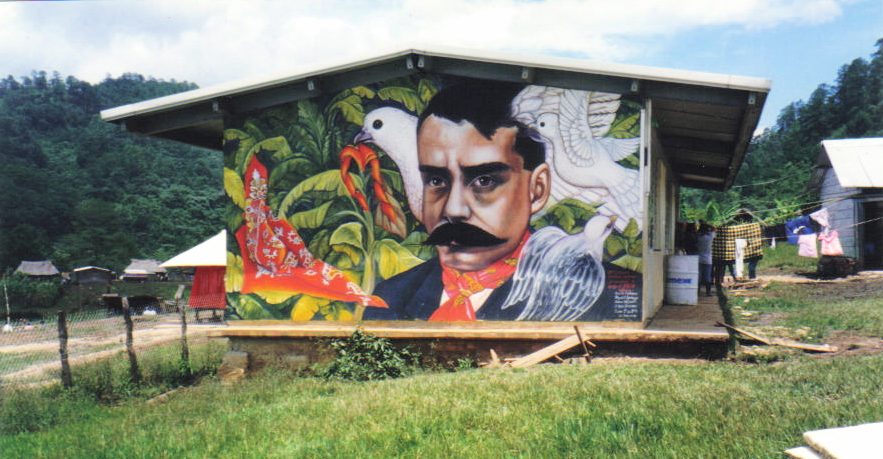
Indigenous communities stop work on the Maya Train
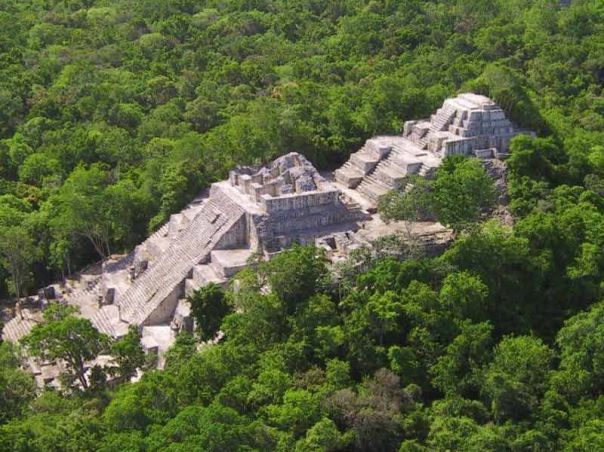
The archaeological site of Calakmul, Campeche, Mexico.
By: Luis A. Boffil, Lorenzo Chim, César Arellano and Julio Reyna
The Indigenous and Popular Regional Council of Xpujil (Cripx) reported yesterday that indigenous communities belonging to the Peninsular Maya and Chol peoples, settled in Xpujil, municipality of Calakmul, Campeche, obtained a “provisional suspension” of the execution of the Maya Train project, which would imply stopping the bidding process on stretches initiated in the first week of January, until resolving the final suspension.
In its ruling, the first district court in Campeche agreed to concede the provisional suspension “so that things are maintained in the state in which they are found, so that the responsible authorities, independently of the result of the consultation carried out in relation to the so-called Maya Train, abstain from decreeing the approval of said project, or, upon said approval having been decreed, abstain from carrying out acts extending to the execution of said project,” until the definitive suspension is resolved.
At a press conference held yesterday in Mérida, Yucatán, Cripx representatives explained that the lawsuit points out as responsible authorities the president of the Republic, Andrés Manuel López Obrador; the director of the National Fund for the Promotion of Tourism (Fonatur, its Spanish acronym), Rogelio Jiménez Pons; the Interior Minister, Olga Sánchez Cordero, and the Director General of the National Institute of Indigenous Peoples, Adelfo Regino Montes.
The resolution
In file 12/2020 VI B, the same first district court informs the aforementioned authorities that as to the indigenous consultation, the day of citizen participative voting, ordered by the federal Executive, and the approval of the development project named the Maya Train, “the provisional suspension of the act complained of is denied, based on article 107, section X, of the Political Constitution of the United Mexican States.”
In its request for a restraining order (amparo), presented January 6, 2020, the Cripx had argued that reclama “the simulated and fraudulent indigenous consultation ordered by the federal Executive and executed to the detriment of the indigenous peoples of Campeche, Yucatán, Quintana Roo, Tabasco and Chiapas,” as well as the “illegal consultation and approval of the project named the Maya Train, whose action was carried out in flagrant violation of our human right that guarantees a prior free, informed, good faith and culturally adequate consultation.
“In the amparo we denounce that the consultation process was carried out without complying with international standards that established in Convention 169 on Indigenous and Tribal Peoples in Independent Countries, of the International Labor Organization (ILO), of which the Mexican State is a part, as well as in contravention of what the Inter-American Court on Human Rights points out”.
The official response
However, the Fonatur, in charge of the construction of the Maya Train, denied the existence of a federal court order to temporarily stop the los bidding and construction processes of the railroad project.
After the announcement of the Cripx, Fonatur explained that there is a request for a restraining order promoted by Ernesto Martínez Jiménez in the first district court of Campeche under the number 12/2020, in which it points to as the “act complained of” last December’s indigenous consultation.
Martínez Jiménez is a member of the Cripx and also of the Frente Peninsular Front for Life and Jungle.
In the record, the provisional suspension Martínez Jiménez requested is denied and Fonatur has not been notified of “any suspension,” said Fonatur.
On January 10, the Fonatur issued the bases for bidding on two stretches of the train’s route that include executive projects, supply of materials and construction of platforms and tracks. Last week it convened a workshop aimed at companies interested in the bidding process and launched two new bases for both sections of the project. The workshop reached out to almost 90 construction companies.
———————————————————–
Originally Published in Spanish by La Jornada
Wednesday, January 29, 2020
https://www.jornada.com.mx/2020/01/29/politica/006n1pol
Re-Published with English interpretation by the Chiapas Support Committee
Racism and anti-Zapatista fallacies
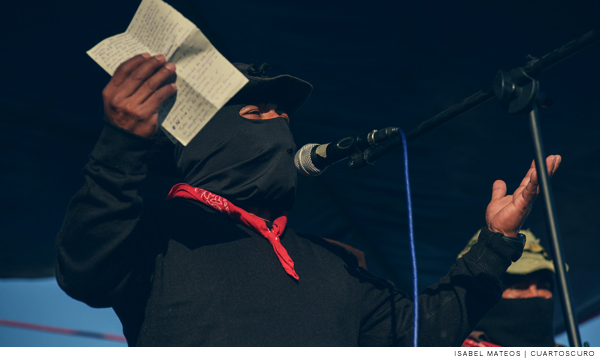
Subcomandante Moisés – Photo: Isabel-Mateos-Cuartoscuro
By: Gilberto López y Rivas
This beginning of the year has been marked by an intensification –in social networks and communications media– of the campaign of lies, fibs or fake news against the Zapatista National Liberation Army (Ejército Zapatista de Liberación Nacional, EZLN), which has been extended to the National Indigenous Congress-Indigenous Government Council, (Congreso Nacional Indígena–Concejo Indígena de Gobierno (CNI-CII), and to those who, in other areas of public life, show their support for the anti-capitalist, anti-patriarchal and anti-racist struggles of the Zapatista Mayas, in opposition to the policies of the government of Andrés Manuel López Obrador and his “Fourth Transformation.”
A good part of this campaign reveals the racism of the political elites and of some Fourth Transformation organic intellectuals, including high officials, who insist on denying all prominence to indigenous peoples, and personifying Subcomandante Marcos – Galeano as the sole author and subject of the EZLN’s political initiatives. Proof of this are recent opinion articles, videos, statements, forums, cartoons and messages on Facebook and Twitter, which demonize the one who was spokesperson of this organization, ignoring or denying that, since years ago, the role of spokesperson for the EZLN falls to Subcomandante Insurgente Moisés, of Tzeltal origin.
Specifically, it corresponded to Subcomandante Moisés to read the communiqué at the 26th anniversary of the war against oblivion, on December 31, 2019, in which he endorses the commitment of his organization to resist and defend Mother Earth, even at the cost of life. In this historic address, a succinct account of these 26 years of the EZLN is made, from the moment in which they chose between “dying like animals” or “dying like human beings who struggle for life.” In spite of contempt, deception, betrayals and the counterinsurgency policies of the rotating bosses to destroy us, the Zapatista Mayas have achieved “maintaining the flag of their rebellion,” “without surrendering, without selling out and without giving up,” answering, no doubt, to those who, from ignorance, an unconditional quality or pride, question: where were the Zapatistas when such and so event in national life occurred?
Different from the institutional Mexican left and the governments with this ideological orientation, the Zapatistas have been constructing what they call “a project of life” for these 26 years, “as any person who has an honest heart can see,” Sub Moisés points out, in which “schools and health clinics flourish in their communities and the land is worked collectively and we support each other collectively.”
For the new heralds of progress and modernity, it’s impossible to understand a characteristic of the Zapatistas and of the peoples grouped in the National Indigenous Congress-Indigenous Government Council, and that Sub Moisés describes diaphanously: “We are therefore a community.
A community of communities! The Zapatista women have their own voice, their own path. And their destiny is not one of violent death, disappearance and humiliation. Zapatista childhood and youth have health, education and different learning and fun options. We maintain and defend our language, our culture and our way. And we remain firm in fulfilling our duty as guardian peoples of Mother Earth. All this has been thanks to the effort, sacrifice and dedication of the organized peoples. And all this has also been thanks to the support of individuals, groups, collectives and organizations around the world.”
Likewise, for those who defend the 4T’s clientelism development projects, it’s difficult to understand what the capitalist system means according to Zapatista perspectives and critical thinking, which Sub Moisés describes as: “that beast that wants to eat and destroy everything,” to which: “it doesn’t matter destroying nature, entire peoples, ancient cultures and complete civilizations. The Beast’s attacks even include destroying the entire planet. The capitalist hydra, the destructive beast, looks for other names to hide and attack and defeat humanity, –says Sub Moisés–. And one of those names behind which death is hidden is ‘megaproject’. ‘Megaproject’ means destroying an entire territory. Everything: the air, the water, the land and the people! (…) And the beast that hides behind the megaprojects has its trick, its lie and its trap to convince. The beast says that it’s for progress. It says that, thanks to those megaprojects, the peoples will have pay and many advantages of modernity. And with this progress and modernity we wish to remember here a CNI compañero that was murdered this year (2019): the brother and Compañero Samir Flores Soberanes. And we remember him because he wondered and asked for whom is that progress that they talk about so much.”
The EZLN implores us to stop the war against humanity, “each one in their geography, their calendar and with their styles.”
———————————————————————-
Originally Published in Spanish by La Jornada
Friday, January 24, 2020
https://www.jornada.com.mx/2020/01/24/opinion/016a2pol
Re-Published with English interpretation by the Chiapas Support Committee
The EZLN is now a major adversary for AMLO
By: Laura Castellanos*
January 7, 2020 at 11:04 PM EST
The Zapatista National Liberation Army (EZLN, its initials in Spanish) completed 26 years since its January 1, 1994 Uprising, in the midst of an expansive process and one of radicalization against the construction of the megaprojects that the President of Mexico, Andrés Manuel López Obrador (AMLO), has announced and against the increase in violence towards indigenous strugglers and women.
Things have changed drastically for the organization: a year ago, at the start of AMLO’s government, the EZLN stated being isolated, but now has achieved extending its territorial dominion in the state o Chiapas, has emerged as the strongest voice against the State’s megaprojects and also as an inspiration for the new feminist generation that confronts the spiral of femicides in the country.
Francisco López Bárcenas, author of 14 books on indigenous rights and campesino struggles, told me that Zapatismo is now the most consolidated Mexican opposition, distinguished by its anticapitalist posture, and with a bet on long-term deep change.
The Zapatista resurgence is due, in part, to its fierce opposition to AMLO’s megaprojects, like the Maya Train on the Yucatan Peninsula, or the Trans-Isthmus Corridor that would connect industrially the Pacific and Atlantic Oceans, because it thinks that it will devastate indigenous territory for the benefit of big capital.
In its recent anniversary event, on January 1, 2020, the EZLN challenged AMLO by pointing out that its ranks are willing to give their life in the fight against his megaprojects, to which the president responded that the organization was misinformed and that it will not affect indigenous communities.
AMLO seems to ignore –or disdain– that the original peoples in Mexico are not the same as when he was the director of the National Indigenist Institute in the state of Tabasco, at the end of the 1970s: they changed with the Zapatista insurrection and now their struggles transcend their own organization.
It’s significant that, on the same day as the EZLN’s anniversary, the robust network of peaceful resistance called “The Isthmus is ours,” created at the end of the 1990s in the state of Oaxaca against a project similar to the Trans-Isthmus Corridor, was reactivated, but now against the government of AMLO.
Among the organizations allied with this network is the National Indigenous Congress (CNI, its initials in Spanish) a front of resistances against megaprojects of which the EZLN is a member, and which just denounced that last year, 11 of its members were murdered in four of the country’s states for defending their territory.
This violence led the EZLN’s leadership, in the voice of Comandante Tacho, to warn AMLO that: “we will defend our autonomy without importance to death, incarceration or disappearance. He added that they would resort to “all possible forms of struggle,” although without specifying which ones.
In 26 years, Zapatismo has struggled in all ways for indigenous rights and has also shown an amazing capacity to reinvent itself in the face of challenges, failures and betrayals, as I documented in my book Crónica de un país embozado 1994-2018 (Chronicle of a masked country 1994-2018).
In 1994, the EZLN announced itself to the world via the armed path, supported by a civilian mobilization that demanded that the government create a table for dialogue, for which the Zapatista Army had to form itself as a social movement.
The EZLN then gambled on the legislative path so that the right to indigenous autonomy would be recognized, and signed the San Andrés Accords, which were also signed by the government and the political parties, who in the end approved an alternative law in 2001. The indigenous autonomy that it demanded implied not only the defense of territory and its ecosystems, but also of their sacred places, their ancestral knowledge and their systems of self-government.
After the approval of that [alternative] law, which the EZLN considered a political betrayal, it broke all relations with the government and built its own systems of government, justice, education and health, outside official institutions. It constructed schools, clinics and productive projects, in a self-governing way, where none had existed.
In their latest gamble, in 2017, the EZLN went from an anti-electoral position to supporting the indigenous Nahua and CNI spokeswoman, María de Jesús Patricio, better known as Marichuy, for her postulation as an independent presidential pre-candidate in the recent elections.
Opting for the electoral path cost the EZLN the distancing of some of its followers and, in the end, Marichuy did not achieve gathering the signatures required for her electoral registry. Meanwhile, AMLO and his party, Morena, won a historic number of indigenous votes in his victory.
But the EZLN rapidly reversed its failure and in August 2019 announced that its administrative centers of autonomous government, called Caracoles, would go from 5 to 11. At the same time it expanded its territorial dominion, in an unprecedented way, to the communities of Motozintla, Chicomuselo and Amatitlán.
The movement is also being discovered by a new generation: in December 2019 it held its Second International Gathering of Women who Struggle and 3,259 of them met, coming from 49 countries.
Now, the EZLN has the challenge of strengthening its resurgence in the face of a national political geography that looks frayed, in which Morena, the governing party that swept electorally, does not assume to be left, according to its president, Yeidckol Polevnsky.
The future of the movement depends on how AMLO “and the state and municipal governments in which they are constructing or plan to construct the megaprojects” face the challenging question that Subcomandante Moisés made during the EZLN’s anniversary: “Are the bad governments willing to try to destroy us at any cost, to beat us, incarcerate us, disappear us and murder us?” The answer is still pending.
Laura Castellanos is an independent journalist and author
————————————————————————
Originally Published in Spanish by the Washington Post
Tuesday, January 7, 2020
Re-Published with English interpretation by the Chiapas Support Committee
They denounce the presence of US agents at Mexico’s Southern Border
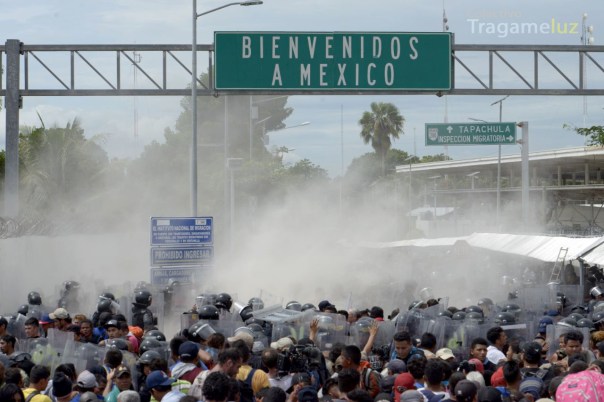
Over the weekend of January 18-19, a new Migrant Caravan of roughly 2,000 Honduran migrants arrived at the Mexico-Guatemala border and made mostly unsuccessful attempts to enter Mexico from Tecún Uman, Guatemala. On Monday, Mexico’s immigration police and National Guard stopped the large group from entering, using tear gas (depicted in the above photo). They re-grouped and tried to enter again on Jan. 22. Their current status is not clear, but apparently they are being allowed to enter one at a time to determine if they are eligible for a work permit or want to request asylum in Mexico. Mexico is no longer offering temporary visas to travel through Mexico, so migrants have to either apply for a work permit or ask for asylum in Mexico. Approximately 1,000 have been sent back to Honduras.
By: Isaín Mandujano
Peoples Without Borders (Pueblos Sin Fronteras, PSF), a migrant rights defense organization denounced the presence on the southern border of agents from the US Department of Homeland Security coordinating the persecution and hunting of migrants jointly with the National Guard (Guardia Nacional, GN)) and the National Institute of Migration (Instituto Nacional de Migración, INM).
Iirineo Mujica Morga, one of the PSF team members, said this Wednesday that within the framework of the operations to pursue and repress migration into Chiapas he has seen personnel that don’t have the uniform of the GN, nor of the INM or of any other corporation and participate actively in those operations.
These individuals are members of the Department of Homeland Security Nacional stationed in the US Embassy in Mexico, which calls into question the interference that the government of Donald Trump plays in Mexican immigration policy.
“While Ebrard [1] talks about the wonders of the rule of law, the false absence of violence and the supposed respect for human rights and López Obrador [2] talks about thousands of jobs that don’t exist for migrants who fled the place where he wants to send them to work, the one actually directing immigration policy in Mexico is: the Department of Homeland Security of the Trump administration in the United States,” said the activist.
He explained that: “United States government agents are in southern Mexico, at this moment, coordinating the deployment of Mexican police and military members to repress an collective effort of mothers, fathers, girls and boys to escape from hunger and death in Central America.”
Mujica said that he didn’t know at what moment the Mexican Senate voted for US agents to enter [Mexico] to direct its National Guard against migrant peoples and that this is a clear and evident US intervention in internal Mexican politics.
He indicated that the federal government of Mexico is closing the door to human beings that flee from death, and opens the door for US agents to do and undo with migrants, under threat to Mexico of cutting support and placing tariffs.
“The Mexican government cannot send its National Guard to protect people from drug cartels, but Donald Trump can send the National Guard of Mexico to hunt and deport migrants in Chiapas and Tabasco,” said the activist in Tapachula.
He pointed out that one of the principal causes of the dispossession of the Central American people, of the violence and poverty in Honduras, El Salvador and Guatemala, is the US intervention that for years has promoted war, dictatorship, corruption and even drug trafficking.
“While López Obrador says that it’s necessary to address the problem of violence in Central America at the root, and that root is the intervention of the United States, it is paradoxical that López Obrador permits the US to intervene in Mexican immigration policy,” he added.
[1] Marcelo Ebrard is currently Mexico’s Foreign Minister.
[2] Andrés Manuel López Obrador (AMLO), the current president of Mexico
——————————————————————-
Originally Published in Spanish by Chiapas Paralelo
Wednesday, January 22, 2020
Re-Published with English interpretation by the Chiapas Support Committee
The Snail’s walk

Snail mural on the front of the Good Government Junta’s former office in La Garrucha
By: Raúl Romero*
On August 17, 2019, the EZLN announced the end of the “Samir Flores Vive” campaign with which it went on the offensive and extended “the word and action of resistance and rebellion.” As a result of this, the Zapatista Caracols and their Good Government Juntas went from five to twelve. They also created four new autonomous municipalities, which now total 31. Likewise, they reported the creation of the Centers of Zapatista Autonomous Resistance and Rebellion, a new structure in the world they are constructing. With photographs and videos, the EZLN showed the world its most recent expansion. It was just the beginning.
During the month of December, the Zapatistas held various activities called the “Combo for Life.” The “Combo” began December 7 with the second edition of the Puy Ta Cuxlejaltic Film Festival,” in the new Caracol of Tulan Kaw (Strong Horse). More than 50 films were projected there and workshops were held with the Tercios Compas, as the communication collectives of the Zapatista bases are known.
Next it was the first primer Báilate otro mundo Dance Festival’s turn from December 16 to 20 in the Zapatista Caracols of Tulan Kaw and Jacinto Canek. More than 80 dancers answered the call, among them members of the Zapatista communities that have made the arts one of their principal ways of life.
In that context, the Fourth National Assembly of the National Indigenous Congress (Congreso Nacional Indígena) and the Indigenous Government Council (Concejo Indígena de Gobierno) took place, as well as the Forum in Defense of Territory and Mother Earth, both in Jacinto Canek Caracol.
During the assembly dozens of peoples shared their diagnosis and ratified their opposition to megaprojects like the “misnamed Maya Train,” the Trans-Isthmus Corridor and the Morelos Integral Project.
They concluded that the “neoliberal war” is deepening with the current administration, and that businesses that are part of that war – organized crime, the real estate industry, mining, agro-industry, tourist megaprojects and the energy industry– continue being deployed throughout the country. They denounced that, as a result of this war, 11 CNI members were murdered in 2019 for defending their territories and opposing the dispossession.
More than 50 organizations of Mexico, Chile, Colombia, Kurdistan and Ecuador participated in the forum. The information shared helped give dimension to the level of the capitalist system’s global destruction, but also to identify points of articulation and common resistance strategies.
In the last days of December, in the seedbed “Footprints of Comandanta Ramona’s walking,” in the Caracol of Morelia, they held the Second International Gathering of Women that Struggle. More than 5,000 women attended, coming from at least 49 countries, and for three days they shared pains, experiences and joys; they strengthened their solidarity networks and made agreements to continue struggling against patriarchy.
Finally, also in the Caracol of Morelia, the EZLN commemorated the 26th anniversary of the start of the war against oblivion. There, Subcomandante Moisés reiterated the position of the Zapatistas: they are willing “to die if necessary” to defend their autonomy. At the same time, he outlines an urgent issue: progress and development for whom and at what cost?
 No political force in Mexico, and very few in the world, are capable of guarantying the infrastructure necessary for carrying out these activities. We must not forget that the Zapatistas do not accept resources –of any kind– from governments, corporations or NGOs. Everything was sustained with resources of the Zapatistas themselves. With this “Combo for life” the EZLN not only showed its great capacity for national and international convocation, it also evidenced the large size of their organization, of their territorial expansion and of their disposition to dialogue with those who aspire to the construction of a world where many worlds fit.
In the midst of the “capitalist storm” or the “collapse of civilization” that is underway, the Zapatistas don’t take shelter and, from their “islands of resistance,” watch the world burn; to the contrary, they bet on dialogue, on weaving national and international networks with those who struggle against capitalism and patriarchy.
Together with the women who struggle and the original peoples who resist, but also together with oppressed and exploited peoples who accompany it, the EZLN bets on life… And in their gamble for life, this army of men and women give the arts a central place, that of being “the seed in which humanity will be reborn.”
The EZLN today is stronger than [it was] 26 years ago. Each step walked, each gathering, each initiative has given them a diagnosis of the current world for which they have constructed an alternative. From there they launch a new question: What are you willing to do to stop the war that exists against humanity?
They already gave their answer.
*Sociologist
———————————————————–
Originally Published in Spanish by La Jornada
Saturday, January 11, 2020
https://www.jornada.com.mx/2020/01/11/opinion/014a2pol
Re-Published with English interpretation by the Chiapas Support Committee
Train wreck in the Mexican Southeast
 By: Luis Hernández Navarro
Months ago, in May 2019, the federal and state governments inaugurated the Wind Energy Park of the South and also the Architect Ignacio Chávez and the José Eduardo Ramírez Briseño electricity substations on the Isthmus of Tehuantepec. Among protests of residents, the Energy Secretary, Rocío Nahle, offered that the federal administration would respect the voice of the original peoples and that no project will be carried out without their approval.
Some 28 wind farms have been established on the Isthmus. However, according to Isthmus residents, they pay the highest electricity rate there. Magalí Sánchez Santiago denounced: “We have been in resistance for years. Here we pay from 5,000 to 20,000 pesos, despite the fact that with the September 2017 earthquakes many families lost their home. That is not development. The inauguration of Southern Wind Energy (Energía Eólica del Sur), a subsidiary of Mitsubishi) has not generated benefits for the region’s peoples, but rather only for the investors.”
Just last weekend Juchitecos who lease their lands to the wind farm occupied the Chávez López substation. Its spokesperson, Ramón Martínez Ruiz, denounced: “Nothing that they promised us has been fulfilled. We delivered our lands thinking that the company was responsible, but now we see it’s not. They continue holding our children as peons, without permanent job status and without benefits. They have owed us payments from 2018 to date, he said. The project was suspended four years because of a protective order (amparo) filed against the consultation that the company organized.
What happened is far from being an isolated event. For large investors the original peoples’ resistance to the megaprojects is a real headache. Indigenous communities have been protected against the large works or prevent, in fact, their completion. And, where they are already in operation (like in the Energía Eólica del Sur park), there are continuous protests.
The Yaqui tribe in Loma de Bácum (Sonora), the Puebla and Hidalgo Regional Council of Original Peoples in Defense of Territory and the Nahua communities in Puebla and Morelos that reject the Morelos Integral Project (PIM) resist the gas-pipelines that cross their territories. For years, they legally protected themselves from the works. In various times they have put their body on the line to suspend them. So far, the have succeeded. According to Sener, five gas pipelines are suspended: Tuxpan-Tula, Tula-Villa de Reyes, Villa de Reyes-Guadalajara, Samalayuca-Sásabe and La Laguna-Aguascalientes.
From the hands of these megaprojects, justified in the name of progress (and now of energy sovereignty), walk dispossession, pollution and the loss of identity, territory and life itself.
According to the Commission for Dialogue with the Indigenous Peoples of Mexico of the Interior Ministry, as of January 2018, 77 cases arose in which the lack of consultation with indigenous peoples generated social conflicts and 33 lawsuits for protective orders against the large works: 25 mining projects, 13 wind farms, an equal number of hydraulic or hydroelectric dams, nine gas pipelines, four agribusinesses, three oil projects, three thermoelectric plants, two railroads, two private infrastructure, a tourist complex and a real estate development, as well as the international airport in Creel, finally canceled.
Far from solving or easing this problem, it has escalated with the megaprojects that the 4T announced. The decision of the National Indigenous Congress (Congreso Nacional Indígena, CNI) and the Zapatista National Liberation Army (Ejército Zapatista de Liberación Nacional, EZLN) to resist the Maya Train, the Interoceanic Corridor and the Morelos Integral Project anticipates new conflicts.
The 4T doesn’t have everyone with it. It has committed grave errors in its zeal to start those great works at any cost. According to the Committee for the Elimination of Racial Discrimination of the United Nations “serious gaps” exist in the consultations that the Mexican government carries out with indigenous peoples about infrastructure projects. In the majority of the cases –it pointed out–, the processes in indigenous communities are not held in advance, don’t take uses and customs into account, and neither is clear, precise and culturally adequate information provided. “In addition, they are frequently carried out in contexts of threats, criminalization and harassment, prejudicing their free character.”
The recent “consultation” on the Maya Train in which less than 3 percent of those eligible participated and the ejido authorities were sounded out (and not the indigenous communities) was severely criticized by the Office in Mexico of the United Nations High Commissioner for Human Rights (UN-HR), because it did not comply with international standards in the matter.
The indigenous rejection of the 4T’s large infrastructure works, which has a long history behind it, anticipates an inevitable train wreck in the Mexican Southeast. Private investors know what this collision implies. Some of their projects have been trapped legally for years because they underestimated the resistance of the original peoples.
———————————————————–
Originally Published in Spanish by La Jornada
Tuesday, January 14, 2020
https://www.jornada.com.mx/2020/01/14/opinion/010a1pol
Re-Published with English interpretation by the Chiapas Support Committee
United Nations-HR says: Maya Train consultation deficient

Tren Maya/Maya Train. The percentages shown represent poverty rates in the municipalities affected by the Maya Train mega-project. Note the 70.15% poverty rate in Chiapas.
By: Ana Langner
The process of indigenous consultation about the Maya Train has not complied with all the international standards in the matter, the Mexico Office of the United Nations High Commission on Human Rights (UN-HR) warned.
As an observer of different regional information assemblies, this office of the United Nations (UN) perceived that both in the convocation and the protocol, as well as in the information presented, reference was only made to the possible benefits of the project and not the negative impact that it could cause.
The UN-HR expressed concern about the low participation and representation of indigenous women in the process, despite efforts made in some places to assure their inclusion.
It detailed in a communication that the National Institute of Indigenous Peoples, the National Fund for the Promotion of Tourism and the Undersecretary of Democratic Development, Social Participation and Religious Issues of the Interior Ministry (Secretaría de Gobernación) invited it as an observer in said process.
In that context, it attended 4 of the 15 regional information assemblies in Tenabo (Campeche) and Dzitás (Yucatán), on November 29, and in Xpujil (Campeche) and Reforma (Quintana Roo) on November 30.
It was also present in eight of the 15 regional consultation assemblies in Palenque (Chiapas), Tenabo, Dzitás and Tunkás (Yucatán), on December 14, and in Xpujil, Tenosique (Tabasco), Reforma and Xul-há (Quintana Roo) on December 15.
The UN-HR reminded that international human rights standards establish that the consultation and consent of the indigenous peoples and communities must be prior, free, informed and culturally appropriate.
While it recognized the decision of the Mexican government to make efforts to respect, protect and guaranty the rights of indigenous peoples, including their right to consultation and consent to the mentioned project, it found deficiencies in the process.
In relation to the informed nature of the consultation, besides exhibiting the lack of data about the negative impacts the project could bring with it, it explained that this absence of studies or the lack of dissemination of the studies makes it difficult for people to be able to define their position regarding the project in a fully informed way.
“Despite this circumstance, the authorities advanced to the consultation stage of the process,” the office pointed out.
In the information sessions and in the consultation stage, some authorities showed that the guaranty of various economic, social and cultural rights was not conditioned on the project’s acceptance. However, as a result of the way in which it was presented, people from the communities expressed their agreement with the project as a means to receive attention to basic needs like water, health, education, jobs, housing, a healthy environment and culture, a logic that affects the free nature of the consultation, this office observed.
For the UN-HR, there is reason for concern that the cultural adequacy methodology of the process has not been constructed with the communities involved.
———————————————————–
Originally Published in Spanish by La Jornada
Friday, December 20, 2019
https://www.jornada.com.mx/2019/12/20/politica/006n1pol
Re-Published with English interpretation by the Chiapas Support Committee
EZLN warns AMLO: they will defend their territory against megaprojects
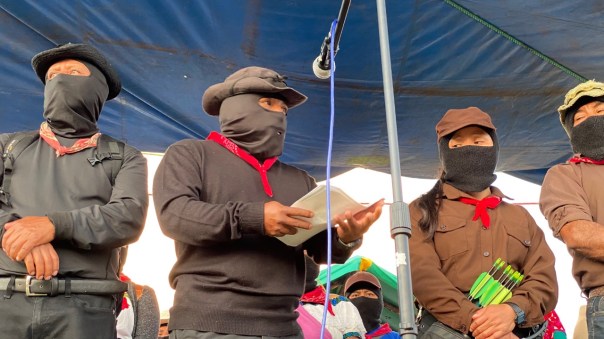
Photo: Ángeles Mariscal/Chiapas Paralelo
By: Angeles Mariscal
The EZLN reiterated its position versus government policies that imply extractive projects and warned that they will defend their territory. It called for strengthening models based on self-determination and the knowledge of the original peoples.
One year was enough for support bases, collectives and organizations that at their moment supported the political project and government of Andrés Manuel López Obrador (AMLO) to return to the Zapatista National Liberation Army (Ejército Zapatista de Liberación Nacional, EZLN).
From the bleak December 2018 speeches of “we are alone,” this December 2019 they went to the celebration of five massive events with diverse social sectors; and to the challenge: they will defend the land against government economic projects, “until death if necessary.”
Thousands of people from different regions of Mexico and the world congregated the last month of the year with the Zapatistas. They attended events with agrarian, defense of territory, women, film and art themes. The theme of the economic project of the president of Mexico, based on what are known as “megaprojects,” ran through all the discussions.
We’re talking about projects like the Maya Train, the Trans-Isthmus Corridor; and the alliance that has been made with entrepreneurs like Ricardo Salinas Pliego, Alberto Bailléres and Carlos Slim, linked to de extractive mining, energy, hydraulic and real estate projects.
One of the most significant gatherings, the “Forum in defense of territory and Mother Earth” was celebrated in San Cristóbal de las Casas on December 21 and 22. Rural and urban organizations from 24 states of the country in alliance with the National Indigenous Congress (Congreso Nacional Indígena, CNI) responded to the call.
Groups were reunited there that within the framework of the 2018 electoral process de 2018 decided to bet on the government of López Obrador, and that now, disappointed by the economic model, returned to meet again with their allies.
At that meeting they accused the federal government of supplanting their will through “deceptive consultations,” to “forcibly impose the misnamed Maya Train, which delivers indigenous territories to big industrial and tourist capital.” They agreed to articulate to defend their territory, to be self-sustainable and to strengthen a system of life in an economic model different from the capitalist model.
At the “Women who Struggle” gathering, which was held from the 26- 29 of December, almost 4,000 attendees from 49 countries questioned the impact that the economic model and the projects based on extraction of natural resources have on this sector of society.
At the EZLN’s 26th anniversary celebration, the leadership of the insurgent group vindicated the sense of their struggle to create better living conditions.
In the voice of Subcomandante Moisés, the insurgent group rejected the capitalist economic system and called for the construction of new development models, based on self-development and autonomies that recuperate the knowledge of the Native peoples.
Before an audience made up principally by Zapatista milicianos –who have military training- Moisés admitted to mistakes but emphasized the advances of the organization.
“We have remained firm in constructing something new. It’s true that we have made mistakes and errors. We will surely make more on our long path, but we have never given up, we have never sold out and we have never given up (…) and we are more each time. We have a project of life; schools and health clinics flourish in our communities, and the land is worked collectively. And we support each other collectively. We are thus a community, a community of communities. And we remain firm in the fulfillment of our duty as guardian peoples of Mother Earth.”
In this region of Chiapas, in the canyon of Altamirano, one of the entrances to the Lacandón Jungle, where one of their 11 headquarters are found, the EZLN’s spokesperson questioned the “megaprojects,” and the government decision to carry them out.
“The Zapatista peoples take it as if it is challenging, as if it is saying that it has the strength and money to see who is opposed to their mandate. It’s saying that it’s going to do what it says not what the peoples say and that the reasons don’t matter. Then we the Zapatista peoples take the position that that challenge is ours.”
Moisés questioned what they were willing to lose in order to defend the land and he reiterated the organization’s position in front of the people gathered together.
“We are willing to die as an alternative for society, as an organization, as Native peoples with Mayan roots, as guardians of Mother Earth, as individual Zapatistas. Then we Zapatista peoples continue our ways and our calendar, we made the offering only to advise Mother Earth that we will defend her, and defender her up to death if necessary.
“We looked for a person that is Zapatista and is willing to do everything, everything. And we found not one, not two, not a hundred, not a thousand, not ten thousand, not a hundred thousand. We found everyone who calls themselves EZLN willing to do everything in order to defend the land.”
——————————————————————
Originally Published in Spanish by Chiapas Paralelo
Thursday, January 2, 2020
Re-Published with English interpretation by the Chiapas Support Committee
INVITATION TO DAYS OF ACTION IN DEFENSE OF TERRITORY AND MOTHER EARTH
“WE ARE ALL SAMIR”
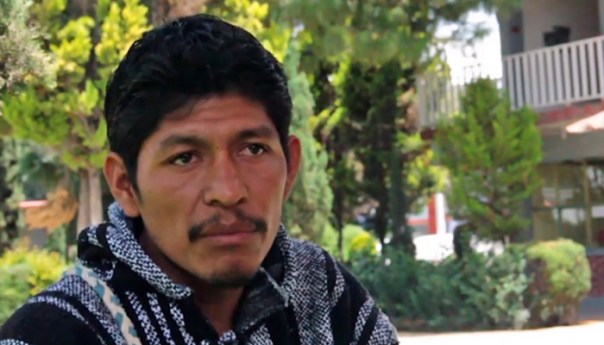
Samir Flores Soberanes
SISTERS AND BROTHERS OF MEXICO AND THE WORLD:
First: Today more than ever, capitalism grows through war and the ongoing dispossession of all forms of life. The bad governments and the big capitalist businesses, all of which can be identified by name, try to disappear our struggles in defense of territory and Mother Earth, even normalizing the murder of our brothers and sisters who defend that territory and our Mother Earth. Today our collective heart hurts for the murders of:
- Samir Flores Soberanes of the Nahua people of Amilcingo, Morelos.
- Julián Cortés Flores, of the Mephaa people of the Casa de Justicia in San Luis Acatlán, Guerrero.
- Ignacio Pérez Girón, of the Tzotzil people of the municipality of Aldama, Chiapas.
- José Lucio Bartolo Faustino, Modesto Verales Sebastián, Bartolo Hilario Morales, and Isaías Xanteco Ahuejote of the Nahua people organized as the Indigenous and Popular Council of Guerrero – Emiliano Zapata (CIPOG – EZ).
- Juan Monroy and José Luis Rosales, of the Nahua people Ayotitlán, Jalisco.
- Feliciano Corona Cirino, of the Nahua people of Santa María Ostula, Michoacán.
- Josué Bernardo Marcial Campo, also known as TíoBad, of the Populuca people of Veracruz.
Our compañeros were murdered for opposing the war the bad government is waging on our lands, hills, and waters in order to consolidate the dispossession that today threatens humanity’s existence.
We also feel the pain of the forced disappearance of our brother Sergio Rivera Hernández, Nahua of the Sierra Negra, Puebla, who also defended land and Mother Earth.
Second: The current neoliberal phase of capitalism takes on ever more monstrous forms, declaring open war on humanity and against the earth, our mother. Economic development today, based everywhere on finance capital and supported by the military and extractivist industries, dominates peoples, nations, and entire continents. It grows through real or fictitious wars and the proliferation of organized crime as well as invasions and coups d’état. Its insatiable consumptive and accumulative capitalist logic has brought us to the brink of irreversible climate change and a limit at which the very conditions for human life on the planet are at risk.
Third: In addition, the current system’s patriarchal organization, inherited from previous systems and civilizations but deepened over the past several centuries, has been exposed as a violent enemy of humanity as a whole but especially of women and our Mother Earth. In other words, the exploitation of and profound structural violence against women is an integral part of capitalism, although it was born long before. Capitalist private property, the foundation of this system, cannot be explained or understood except as part of a patriarchal system of domination over women and the earth.
Fourth: In Mexico, the acceleration of mining, extraction, and hydrocarbon pipelines, the creation of the National Guard within the logic of the Merida Initiative, and the imposition, at all costs, of major megaprojects (The Salina Cruz – Coatzacoalcos Trans-Isthmus Corridor, The Maya Train, the Morelos Integrated Project, and the New International Airport in Mexico City)—all of which are intended to reorganize territories, populations, and both the northern and Central American borders in a logic of capitalist displacement and exploitation—make a clearly anti-capitalist and anti-patriarchal defense of human life, of the territories of our peoples, and of the earth all the more urgent. For these reasons:
We invite: the peoples of Mexico and the world; organizations and collectives of workers of the countryside, city, and seas; women; students; children; elders; and those across the range of sexual diversity to:
DAYS OF ACTION IN DEFENSE OF TERRITORY AND MOTHER EARTH “WE ARE ALL SAMIR”
On the following dates:
February 20, 2020: Local actions in Mexico and around the world in Defense of Territory and Mother Earth; in demand of justice for our dead, disappeared, and imprisoned; and against the megaprojects of death.
February 21, 2020: March for Justice for Our Brother Samir Flores Soberanes and for our dead, disappeared, and imprisoned, and in Defense of Territory and Mother Earth. Meet at the offices of the Federal Electricity Commission, Avenida Reforma, Mexico City, 4pm.
February 22, 2020: Assembly in Defense of Territory and Mother Earth, to take place in downtown Amilcingo, municipality of Temoac, Morelos State, starting at 10am.
Sincerely,
January 7, 2020
For the Full Reconstitution of Our Peoples
Never Again a Mexico Without Us
AMILCINGO ASSEMBLY OF RESISTANCE
NATIONAL INDIGENOUS CONGRESS/ INDIGENOUS GOVERNING COUNCIL
ZAPATISTA NATIONAL LIBERATION ARMY
PEOPLES, COMMUNITIES, ORGANIZATIONS, COLLECTIVES, AND INDIVIDUALS PARTICPATING IN THE FORUM IN DEFENSE OF TERRITORY AND MOTHER EARTH HELD DECEMBER 21-22, 2019 IN THE CARACOL JACINTO CANEK/CIDECI-UNITIERRA, SAN CRISTÓBAL DE LAS CASAS, CHIAPAS.
Networks, organizations, and collectives of Resistance and Rebellion who are adherents of the National and International Sixth
Yaqui Tribe of the Pueblo de Bácum, Sonora
Indigenous Peoples’ Assembly of the Isthmus of Tehuantepec
Organizational Process of the Sierra de Santa Martha, Veracruz
Náyeri People, Nayarit
Neighbors’ Council in Resistance in Tanque and Américas, Monterrey, Nuevo León
Community of San Lorenzo Azqueltán, Jalisco
Community members of Cherán, Michoacán
PROFECTAR, Pueblo Rarámuri de Chihuahua
Un Salto de Vida, Jalisco
Doce Pueblos de Tecámac Organization, Mexico State
Coordinating Committee for the Peoples and Organizations of Mexico City and the Western Part of the State of Mexico
General Assembly of the Peoples, Barrios, Neighborhoods and Pedregales of Coyoacán, Mexico City
Community of Coca de Mezcala, Jalisco
Nahua Indigenous Community of Zacualpan, Colima
Council of Ejidos and Communities in Opposition to the La Parota Dam Project in Guerrero
People’s Front in Defense of Land and Water in Morelos, Puebla, and Tlaxcala
Ka Kuxtal Much Meyaj A:C:,
Maya Peninsular People, Campeche
Otomí residents of Mexico City
National Front for People’s Liberation, Guerrero
Metlapanapa River Defenders, Puebla
People’s Indigenous Council of Guerrero – Emiliano Zapata (CIPOG-EZ), Guerrero
Indigenous Regional Council of Cauca (CRIC), Colombia
Assembly of Defenders of the Mayan Territory of Maya Muuch Ximbal, Yucatán
Indigenous Community of Santa María Ostula, Michoacán
Tila Ejido, Chiapas
Indigenous Popular Regional Council of Xpujil, Campeche
Committee in Defense of Indigenous Peoples (CODEDI), Oaxaca
Raxalaj Mayab Community Center and the José María Morelos Autonomous Collective, Quintana Roo
Community members of Cuatro Venados, Oaxaca
ZODEVITE, Chiapas
Tiyat Tlali Council of the Sierra Norte of Puebla
Indigenous Zapatista Agrarian Movement (MAIZ), Puebla and Oaxaca
Union of Organizations of the Sierra Juárez (UNOSJO), Oaxaca
Chontal People’s Assembly, Oaxaca
Binnizá Community of Unión Hidalgo, Oaxaca
Community of Mapuche History
Chile Mapuche Women
Kurdish Women Geocommons
Mexicali Resiste
UCIZONI, Oaxaca
Mayo Tribe
Chiapas Coast Autonomous Council, Chiapas
LA VIDA, Veracruz
Zapatistas call to confront the “Fourth Annihilation” with the exercise of autonomies
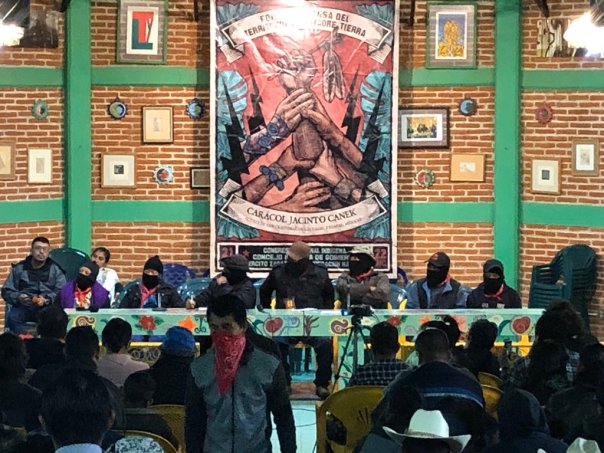
Zapatistas in the framework of the Forum in Defense of Territory and Mother Earth in the Jacinto Canek Caracol.
By: Isaín Mandujano
San Cristóbal de las Casas, Chiapas
The indigenous Zapatista bases of support of the Zapatista National liberation Army (Ejército de Liberación Nacional, EZLN) and of Mexico warned today that they will continue resisting in the new era that’s coming, the era of the “Fourth Annihilation,” but this will only be possible if the autonomies are strengthened in all the original peoples as they have been practicing in their rebel territories.
After their speech at the Forum in Defense of Territory and Mother Earth, held on Saturday, December 21 and Sunday, December 22 in this Zapatista Caracol Jacinto Canek, located in the CIDECI-Unitierra of San Cristóbal de Las Casas, one by one masked men and women members of the Good Government Juntas from all the rebel caracoles gave their word to share with those present how they have lived their autonomy for more than 15 years.
The Zapatistas pointed out that it took them 26 long years to being constructing the autonomy that they are now living and exercising in their towns and communities, in the creation of their forms of self-government, and that they didn’t have to ask the bad government’s permission for that, because with or without the law, they started their process.
A member of the Caracol of La Garrucha said in the Forum in Defense of Territory and Mother Earth that being an autonomous authority is to serve the people and not use the people: And that drug addiction, murder and rape are not permitted in their territories. All of that is punished; it’s all sanctioned.
A young masked woman said that in the capitalist system the governed are told that the key to democracy is the electoral credential. However, the Zapatistas do not use money or credentials now to elect their autonomous governments.
And, that within their autonomous systems they saw the need to create their own education systems, health systems and systems of buying and selling among people and communities.
They highlighted the education system that now educates with a view to a nature to struggle, one of rebellion and they have left behind education that required them to renounce their maternal language, an education system imposed from the Mexican government, a masked indigenous woman said.
They pointed out that now in the new autonomous Zapatista system, women have a relevant role, and no longer secondary, now the women are no longer relegated only to the kitchen or to cutting firewood, they now have an active role in making decisions about their communities and they can occupy seats on the Good Government Juntas.
“First we started participating in the villages, then on the municipalities and now we make up part of the Good Government Juntas. We are participating in the different areas of autonomy,” said a young woman from the Jacinto Canek Caracol.
The challenge now, said a rebel Zapatista, is to invest every effort to prepare the new generation of Zapatistas, “because we know that the grandchildren or great grandchildren of the finqueros (estate owners) who violated, raped, dispossessed our grandparents could return.”
“It’s a mistake what the capitalist system thinks in saying that we the peoples are behind. That’s why it’s important to work with young people,” a young Zapatista woman said.
“We saw the need to prepare our young men and women in all areas of work and government bodies. We must prepare our youth so that they are not deceived by ‘Youth building the future’ or waiting for any other program,” she said.
Andrea from the Caracol of Morelia said that the bad government has tried in many ways to finish off the organization that the Zapatistas have, “but here we continue resisting.”
Allison, also from the Caracol of Morelia said that resistance is resisting crumbs from the bad government. “That’s why we resist the economic, psychological and ideological policies, we resist criticisms and mockery from partisan brothers,” Allison said.
“Not only do we resist, but we also make resistance against political and ideological warfare. We resist internally within our families, we resist the bad government externally, a Zapatista from the Caracol of Morelia said.
And, knowing how to organize the resistance is the powerful weapon that they now have.
The Zapatistas say they are clear that the enemy is not going to like it and that it is going to persecute, harass or kill them, and that’s why all the original peoples of Chiapas and Mexico, Zapatistas or non-Zapatistas, have to “think about a real organization where they will fight for the life of our peoples.”
Alejandro said that organization is not easy, but that it IS possible when we want: “Not everything is rosy and less when it’s about organizing a lot of compañeros. We have collective work in the family, collective municipal work, both by zone and by region.”
A Zapatista from the Caracol of La Realidad said that since the breakdown of the dialogues with the bad government in February 1996, they made it clear that with or without the law they were going to exercise autonomy and so far they have achieved it. But in order to do it two things are needed: economy and organization, understanding that everything has to work collectively, something that had been lost because of the bad government that was instituted as the paternalistic State giver of everything.
“The little we have in the organization is to sustain the work of the struggle from our families, we have to work collectively as compañeras. You can’t say I don’t know how or I can’t, because everyone should be able when work is done collectively,” a masked woman said.
“We have organized collectively because we see the need, collective work is the only path that we see for living in our resistance,” said the Zapatista woman from the Caracol of La Realidad.
A Zapatista from the Caracol of Roberto Barrios recognized that in many places “the peoples are very divided, the supervisors and overseers have divided them, our political work is to go and talk to our family about the problems that we see and explain what is causing it, which is capitalism.”
“Capitalism is about to disappear, but our Mother Nature won’t be able to recuperate from the pollution of rivers, waters and seas, the pollution of land provokes that the earth doesn’t produce,” a young masked woman said.
“The Fourth Annihilation is going to destroy everyone, it’s going to see much sadness, but it gives us courage and rage to see how they continue deceiving our brothers, the situation that comes with the new government that is one of dispossession. Therefore given this, we can only resist and confront the war of the Fourth Annihilation,” a masked Zapatista said.
She reminded all those present that: “you don’t need to be Zapatista to struggle or to organize, what’s important is to struggle and confront the bad system, let’s take a big task and let’s get to work with other compañeros, that is the only way to defend what we have.”
“The problem is not whether we accelerate the struggle or not, we must start to think about what’s next, or are we prepared for what’s next? We need to reinforce our resistance and our rebellion,” they concluded.
Representatives of the Afro-Mexican, Binizaa’, Chinanteco, Chol, Chontal, Comca’ac, hñahñu, Kumiai, Mam, Maya, Mayo, Mazahua, Me’phaa, Mixe, Mixteco, Nahua, Náyeri, Purépecha, Quiché, Rarámuri, Teenek, Tepehuano, Tohono o’odham, Tojolabal, Totonaca, Tzeltal, Tzotzil, Wixárika, Yaqui, Zoque, Chixil, Cañari and Castellano peoples, coming from 24 states of the Republic, as well as invitees from Guatemala, Ecuador, El Salvador and the United States participated in this Forum.
——————————————————————-
Originally Published in Spanish by Chiapas Paralelo
Monday, December 23, 2019
Re-Published with English interpretation by the Chiapas Support Committee
 Chiapas Support Committee