Chiapas Support Committee
Home of the Compañero Manuel blog on zapatistas & mexico
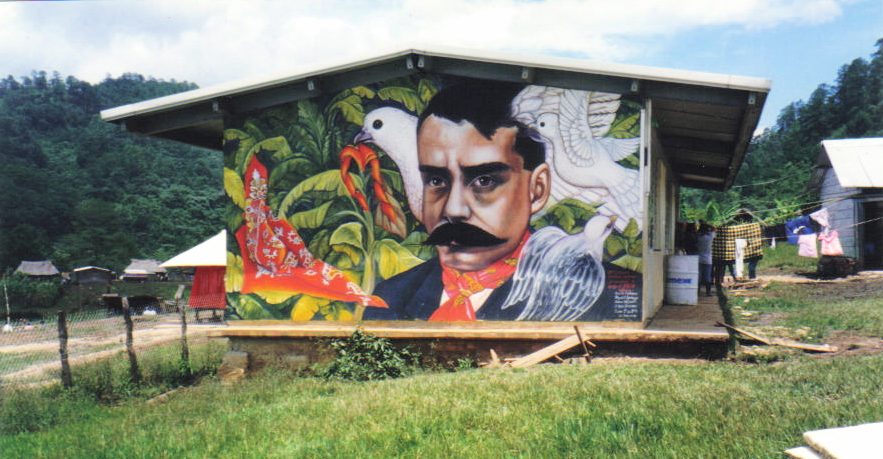
Because of Coronavirus, the EZLN Closes the Caracoles and Calls to not Abandon Current Struggles

March 16, 2020
To the people of Mexico:
To the peoples of the world:
To the National Indigenous Congress – Indigenous Governing Council
To the national and international Sixth:
To the networks of resistance and rebellion:
Sisters and brothers:
Compañeros, compañeras, compañeroas:
We inform you that:
Considering the real, scientifically proven threat to human life posed by the spread of COVID-19, also known as “coronavirus.”
Considering the frivolous irresponsibility and lack of seriousness of the bad governments and of the political class as a whole, who make use of a humanitarian problem to attack each other instead of taking the necessary measures to confront that danger that threatens life without distinction of nationality, sex, race, language, religious belief, political militancy, social condition, and history.
Considering the lack of accurate and timely information on the scope and severity of the contagion, as well as the absence of a real plan to deal with the threat.
Considering the Zapatista commitment in our fight for life.
We have decided:
First – To decree a red alert in our villages, communities, and neighborhoods, and in all the Zapatista organizational bodies;
Second – To recommend to the Good Government Juntas and Zapatista Rebel Autonomous Municipalities, the total closure of their Caracoles and Centers of Resistance and Rebellion, immediately.
Third – To recommend to the bases of support and to the entire organizational structure to follow a series of recommendations and extraordinary hygiene measures to share throughout the Zapatista communities, villages, and neighborhoods.
Fourth – Given the absence of bad governments, exhort everyone in Mexico and the world to take the necessary health measures that, with scientific basis, allow them to go forward and survive this pandemic.
Fifth – We call to not drop the struggle against femicidal violence; to continue the struggle in defense of the territory and Mother Earth; to continue the struggle for the disappeared, murdered and imprisoned; and to raise the flag for the fight for humanity up high.
Sixth – We call for human contact not to be lost, but to temporarily change the ways to know ourselves, compañeros, compañeras, compañeroas, sisters and brothers.
The word and the ear, along with the heart, have many paths, many ways, many calendars, and many geographies find each other. And this fight for life can be one of them.
That’s all.
From the mountains of the Mexican Southeast,
For the Indigenous Revolutionary Clandestine Committee-General Command of the Zapatista National Liberation Army
Subcomandante Insurgente Moisés.
México, March 2020.
The mayor of Aldama, Chiapas, asks Army and NG to intervene in agrarian fight
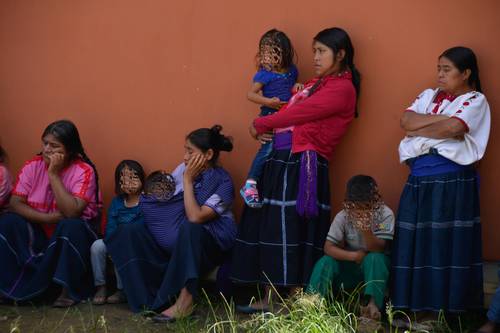
Residents of Aldama, Chiapas, displaced from their homes in November 2019 by the violence that prevails in the area for years due to a conflict with their neighbors in Santa Marta, Chenalhó over 148 acres of land. Photo: Cuartoscuro
Frayba: Federal and state authorities are accomplices.
By: Elio Henríquez
San Cristóbal de Las Casas, Chiapas
The mayor of Aldama, Adolfo López Gómez, asked federal and state authorities that the National Guard (NG) and the Mexican Army to enter his municipality, located in the Highlands region of Chiapas, in order to avoid that the conflict over 148 acres continues with its neighbors from Santa Martha community, municipality of Chenalhó.
The PRI member assured that “40 percent of the approximately one thousand people” from three villages that were displaced early Tuesday morning, due to shots from firearms, took refuge with relatives and the rest already returned to their homes. “We have intermittently displaced people; they go to camps when there are aggressions and return to their homes when they decrease,” the mayor said in telephone interview.
He said that: “apparently at this time (the territory) is calm. Just today (Wednesday) at 7:30 am there were shots coming from Santa Martha.”
The mayor stressed that Tuesday night he asked for “support from the state police, the NG and the Mexican Army in order to provide security to all the families, but they have not given us an answer; we will continue hoping because the armed groups (of Santa Martha) are not respecting the Mixed Operations Base; in fact, it was attacked at 2 am Tuesday morning.”
López Gómez said that he has asked the authorities for “urgent attention to the displaced families and for security to be reinforced along the 11 kilometers of conflict, as well as a detailed analysis for a solution to the problem. And I already asked that the order for the National Guard and the Army to enter to give security to the families.”
He added: “Since 2017 we have been in inter-institutional [dialogue] tables; I have asked that the parapets that are used to attack our communities from the mountains of Santa Martha.”
The Fray Bartolomé de Las Casas Human Rights Center (Frayba) said that inhabitants of Chuch’te, Koko, Tabak, San Pedro Cotsilman, Yetón, Xivit Tselejpobtic, Xuxton communities and the municipal capital of Aldama “are at high risk due to the increase in aggressions from Santa Martha residents.
In a communication, it indicated that the attacks from neighbors of this latter locality “have not stopped since 2019, with the complicity of the state and federal governments.” It said it had received reports that there was “a critical increase (of shooting) on March 1, at approximately 11:30 am. Inhabitants (of Aldama) denounced that shots were fired.”
The Frayba added that on March 3 at two o’clock in the morning, armed groups coming from Santa Martha attacked Xuxchen, Coco and Tabak communities, so “our people are fleeing once again. Now there are an incredible number of shots, it’s very concerning.”
Meanwhile, the Chiapas Secretary of Government, Ismael Brito Mazariegos, reported that he met separately with the traditional authorities of Aldama, as well as with municipal agents and representatives of the 134 communities in Chenalhó, to whom he made “an energetic call for the immediate stop to the aggressions that inhabitants of both municipalities carry out.”
In a bulletin announced by the state government, the official asked the parties to “assume their responsibility to set aside situations that break the route to work, which is derived from the signing of the non-aggression pact” signed last year.
———————————————————-
Originally Published in Spanish by La Jornada
Thursday, March 5, 2020
https://www.jornada.com.mx/2020/03/05/estados/028n1est
Re-Published with English interpretation by the Chiapas Support Committee
“The macho government dies”; Zapatista women demand justice for femicides

Zapatista and CNI Women – A Day Without Us. Photo from Tulan Kaú by Isaín Mandujano
By: Isaín Mandujano
With the demand of “the macho government dies,” thousands of Zapatista rebel indigenous women with candle in hand, woke up early in the 12 Caracoles to add their voices today, to the thousands of women who yesterday also demanded a stop to the femicides and to the violence against them. [1]
“Long live Comandante Ramona, Compañera Guadalupe lives, viva the compañera Olga Isabel, Viva the compañera Berta Cáceres, long live the journalist Miroslava,” were other slogans where masked Zapatista women vindicated other women who have died or have been murdered.
A little before five o’clock in the morning, some 500 Zapatista women went down from the dormitories where they spent Sunday night, to reach the plaza of this Zapatista Caracol Number 11, called “Dignified Spiral, weaving the colors of humanity in memory of the fallen” located in Tulan Kaú (Strong Horse), a rural community between Amatenango del Valle and Comitán.
In the plaza, the women, elderly women, young women and little girls, some with babies on their backs, formed a snail, where they began with slogans, “Long live the Zapatista women,” “Long live the women who struggle,” “We don’t want more femicides,” “May the bad government die that allows women to be murdered,” “May the rapists die,” “Not one more, not one more, not one more murder.”
Afterwards, the masked women left the plaza of the Zapatista Caracol and formed two fences on both sides of the la Pan American International Highway where in the darkness the candles only illuminated their eyes behind the black ski mask or the red paliacate.
For two hours, the rebel women chanted slogans, while in both lanes, private cars, private freight and passage motor transport and even military vehicles, stared at the masked women with amazement.
The same slogans were chanted in EZLN’s 12 Caracoles: the Caracol Jacinto Canek of CIDECI-Unitierra, in San Cristóbal de las Casas; in the Caracol Resistencia and Rebellion A New Horizon, Dolores Hidalgo community in Ocosingo; in the Caracol Root of the Resistances and Rebellions for Humanity in Jolj’a in the municipality of Chilón.
In the Caracol Flowering the Rebel Seed, of Patria Nueva community in the municipality of Ocosingo; in the Caracol Mother of the Caracoles of Our Dreams, of La Realidad in Las Margaritas; in the Caracol Whirlwind of Our Words of Morelia in Altamirano; in the Caracol That Speaks for Everyone of Roberto Barrios, Palenque.
The same slogans were also chanted in the Caracol Resistencia Towards A New Dawn of La Garrucha in Ocosingo; and in the Caracol Resistance and Rebellion for Humanity of Oventik in San Andrés Larráinzar.
“I’m not afraid, I’m not afraid, I’m moving forward, I am a woman, I am a woman,” “Long live the compañeras fallen in struggle,” “May patriarchy die,” were other slogans that masked Zapatista women launched on Monday, March 9 since very early, in the midst of the serene morning.
[1] The Mexican government estimated that there were 80,000 women who marched in the Zócalo of Mexico City on March 8. That number is considered “ridiculously low.” There were also marches in other Mexican states. Enlace Zapatista has photos from all the Zapatista Caracoles.
———————————————————–
Originally Published in Spanish by La Jornada
Monday, March 9, 2020
Re-Published with English interpretation by the Chiapas Support Committee
The Maya Train, development and State presence

Maya Train | Tren Maya
By: Luis Hernández Navarro
The poverty and precariousness in which the communities and inhabitants of the Yucatan Peninsula live is not the product of their supposed isolation from the global market. There has been no such thing for more than a century. Through the henequen industry, forest exploitations, pig farms, extractive projects and big tourism, the peninsular territory and its residents are tightly connected to it.
Nor are they the result of a hypothetical absence of the State. Only those who have not stopped in those 180,000 square kilometers can say such a thing. State presence extends to the last corner of the peninsula, among many other ways, by means of regulation of ejido life, agricultural credit, the public school and health system, the action of the development agencies, the policies for attention to poverty (call them what they’re called) and the network of drinking water, electricity and roads.
What explains the misery of one part of the population of the region is neither the lack of “development” nor the state presence, but rather the modalities that they have assumed. Poverty is the work of a kind of capital accumulation in which State and market have intertwined to manufacture entrepreneurs in the heat of public works and the dispossession and devastation of natural resources, while the vote of the great fortunes imposes rulers and social programs control the population.
The central cause of the extreme poverty and economic stinginess comes from a “growth” matrix of guided by the savage capitalism that dispossesses the original peoples of lands and territories, promotes real estate and tourist developments that plunder the environment, exploits native and migrant labor, favors the installation of pig “factories,” permits the production of transgenic soybeans and of abundant agro-toxic greenhouse crops, which closes its eyes in the face of clearing the jungle.
A central piece of this prototype is drug trafficking and the criminal industry, unthinkable outside the global market. They are not an “accident” or an “anomaly.” They are a substantial part of the machinery that drives the region’s economic movement. From the sanctuary cities where the families of the drug lords live to the large enterprises where they launder part of their profits, passing through the transit routes of illicit substances, the southeast is a key to the drug business in Mexico.
We’re talking about a model that is reproduced with the support of a pattern of cultural consumption that exalts the glorious Mayan past, but disrespects (or “folkloricizes”) the Peninsular Mayas of the present, that expels members of their communities to convert them into day laborers, maids, bellboys, waiters and sex servants, that doesn’t respect their right to self-determination, that stops their reconstitution as peoples, recognizing ejido authorities, but doesn’t allow them to manage their affairs as they see fit through autonomy.
As Grain recalled, the Mexico section of the Permanent Tribunal of the Peoples addressed this process in the session it held in Maní, Yucatán, in 2013. Multiple testimonies documented “a comprehensive process of monopolizing lands and the commons, of socio-environmental and territorial destruction and of annihilation of the social fabrics as part of an orchestrated plan for the displacement and emptying of the territories of the Mayas.”
Far from putting an end to this development model, the Maya Train it deepens it. It is not a matter of the correlation of forces, but rather of the nature of the project. The train is not only a railroad line, but also a territorial reordering initiative with 30 stations and 18 development poles, on ejido land, financed, as the researcher Violeta R. Núñez showed in these pages (https://www.jornada.com.mx/2020/ 02/23/opinion/012a2pol), not with public resources, but rather with hybrid financial instruments, through an Infrastructure and Real Estate Trust called the Tren Maya Fibra. Fibra is the gateway to the confiscation of ejido property in the region and the large-scale dispossession of social property.
The director of Fonatur, Rogelio Jiménez Pons, confessed that in the new cities there will be zones “for modest people” who could walk to work, but also “to ask for alms if necessary, but on foot.”
The project not only doesn’t have sufficient environmental impact studies, but it has also not been consulted with the indigenous peoples, as Convention 169 of the ILO [International Labor organization] establishes. As the UN-HR concluded, the consultation that authorities organized at the end of last year did not comply with international standards on human rights in the matter. This opinion was preceded by critical questions from the Rapporteur for Indigenous Peoples and from the Committee against Torture. Moreover: multiple testimonies realize that the authorities conditioned the delivery of supports [money] and the solution of old demands on the approval of the train.
It’s enough to look at the Maya Train project in the mirror of the Enerall-Alfonso Romo scandal or in the “development” of Cancun and the Riviera Maya to anticipate its final station. There is no worse denial that pretending that the implacable logic of capital can be regulated in favor of the popular camp just because those who until recently criticized some government institutions are now leading them.
———————————————————————–
Originally Published in Spanish by La Jornada
Tuesday, March 3, 2020
https://www.jornada.com.mx/2020/03/03/opinion/017a1pol
Re-Published with English interpretation by the Chiapas Support Committee
We Don’t Need Permission to Fight for Life, Zapatista Women Join the March 9 National Strike
 ZAPATISTA NATIONAL LIBERATION
ARMY, MEXICO
ZAPATISTA NATIONAL LIBERATION
ARMY, MEXICO
March 1, 2020
To: Women who struggle in Mexico and around the world
From: The Zapatista indigenous women of the EZLN
Compañera and sister:
We greet you in the name of all of the Zapatista indigenous women of all ages, from the youngest to the wisest—the oldest, that is. We hope you are well and are struggling along with your families, sisters, and compañeras.
Here we are having a lot of problems with the paramilitary forces who now come out of the MORENA party, just like before they came from the PRI, PAN, PRD, and Verde Ecologista (Green Ecologist) parties.
But that’s not what we wanted to talk to you about. We wanted to talk to you about something more urgent and more important: the incredible violence waged against women, which has not only not ceased but actually increased in quantity and in cruelty. The murders and disappearances of women have reached a level that we could not have imagined before, and no woman of any age, class, political affiliation, color, race, or religion is safe. We might think that rich women, women politicians or famous women are safe because they have their security guards and police to protect them, but no, not even they are safe, because the violence that kidnaps, disappears, or kills us often comes from family members, friends, and acquaintances.
We have to stop this violence, wherever it comes from, and that is why we had called for women’s demonstrations on March 8, 2020, in which everyone would organize their actions according to their own ways, times, and places. We had said that the principal demand of these demonstrations should be to stop violence against women, and to declare that we would not forget those murdered and disappeared by all governing administrations, from any party of any color (striped, blue, green, yellow, maroon, orange, brown, or anything else) because they are all the same. We also proposed that we all wear something black on our clothes as a symbol of our mourning for the mass murder of women all over the world and to remind the bad governments and our missing and disappeared compañeras that we would not forget them. The worst part is that even the littlest ones among us are not safe.
Sister and compañera:
A few days ago we learned that a group of feminist sisters from the collective “Witches of the Sea” [Brujas del Mar] in Veracruz had a good idea and called for a women’s strike on March 9, to make clear what things looked and felt like without women. The idea is that we don’t go to work, or buy anything, or move around, that we aren’t seen at all, because that is in fact what it seems like the system is trying to do: annihilate us women as its principal enemy.
Then we saw the reaction of all those patriarchal and macho men and women in the bad government, the political parties, and the big corporations. We saw that they don’t care about the tragedy in which women in Mexico live and die, but only about using that pain for their own gain, then covering it up and arguing over who among them is the biggest badass.
Those in power and their overseers act like they’re so conscientious of and sensitive to the issues at hand but they just can’t shake their patriarchal ways—they even went so far as granting women “permission” to protest the murders. How generous of them to give women permission to fight to live! They are shameless, all of them, including the women who think with the same machismo even though they’re women.
Then there’s the president, who is outraged that people aren’t talking about what he says or burps or vomits up anymore, apparently because some women—young women at that—took his microphone and shouted out exactly what the bad government tries to keep quiet. If it’s ridiculous that the president’s so-called political opposition pretend to be good people who give us “permission” to live, it’s even more ludicrous that the bad government and its fanatics call the struggle for women’s lives an “attempted coup”. In fact now it’s worse, because what the bad government is saying is that no one can live or even survive without its permission, and that no one can struggle unless they say so. That is of course how the patriarchal machistas are in any case, thinking that the whole world revolves around their you-know-what and their balls. So for them anyone who engages in struggle without their permission is against the bad government. But if women are murdered, disappeared, kidnapped, tortured, or scarred, then apparently those very women victims are part of a plan to overthrow the government. Shameless.
And still those shameless patriarchal governments and bosses try to give machista advice to women: that they shouldn’t let themselves be manipulated, that they should behave themselves, that they shouldn’t graffiti monuments and doors or break windows, that they should dress appropriately, keep their heads down, not give people a reason to talk, and be careful about what they say, write, and think. In other words, we shouldn’t do anything without permission. In effect, they are saying we’re mature enough to be killed, disappeared, or raped, but not mature enough to think, analyze, or decide. What idiots they are, and we refer to both men and women, because there are women who applaud that nonsense.
What they’re saying is that one must ask the bad government or the boss for permission for anything and everything, even to survive—because that’s how bad things are, compañera and sister: women in Mexico and around the world are just barely surviving. They’re living in fear and that’s not really living, it’s just not dying… at least not until we are murdered or disappeared, with terrorist violence.
There are also those, supposedly on the left, who are amused by how the bad government is showing so openly how either dumb or ignorant it is, as if it were necessary to witness the bad government’s temper tantrums in order to know it is both. These people are also always evaluating what works in their favor, to ally themselves with the bad governments or those who criticize the bad governments. But they don’t care if any particular initiative is good or bad for women’s struggle for life. They see the murders, the disappearances, and the rapes and they rejoice because this demonstrates that the bad government is in fact useless in addition to being bad. These people should ask themselves if their leftist values are actually what they say they are, or if they merely approach peoples’ struggles as if they were vegetables in the market—to buy or simply to manhandle and bruise.
Amidst all the political wrangling among the bad governments, the mass media, the political parties, and the pundits, they forget the most important thing about this March 8 and 9 is not that that we as women are being killed, but rather that we as women are going to struggle for our lives with everything we have, each according to our own ways, times, and places. If there are those who don’t care about life, then it’s not because they’re right-wing or left-wing or centrists. They’re just not human.
The struggle for life is essential for all humanity, and we don’t need permission from anyone for this struggle because we carry it in our blood. If someone thinks that women’s struggle for life is a coup attempt or a right-wing ploy or a leftist strategy or a government or anti-government plot, or that that struggle corresponds to one party or school of thought or religion, then what they are actually defending is death. When they hear about another murdered woman, the first thing they ask is the color of her skin, her political affiliation, and her religious association; if it doesn’t match theirs they start talking shit—not about the murderers but about the murdered woman.
We don’t understand how the world has come to such a point, especially since meanwhile they are saying that we indigenous Zapatista women are backwards and don’t understand the development and progress that megaprojects, money, and consumption will bring to us. This is their progress: to cheapen and squander women’s lives because it turns out the cost of disappearing, kidnapping, or murdering a woman is pretty low—there’s no punishment at all. In fact there’s often reward—there’s no shortage of those who applaud and comment on “one less enemy,” “one less disturbance,” “one less sinner,” “one less radical,” “one less conservative,” “one less woman.”
We don’t understand why some people are like that but we do understand that we can’t sit by and do nothing in the face of it, thinking that such pain and rage are foreign to us and don’t apply to us… until they do.
-*-
As Zapatista women, this is what we thought and felt when we analyzed the words and actions of our Witches of the Sea sisters:
First: We respect their initiative, and see it as something good, noble, valuable, honest, and legitimate, and we will support it because we think any woman—one, a few, or many—who struggles for life should know that she is not alone. If we believe that those absent from us now, the murdered, disappeared, and incarcerated women, should know that they are not alone, then certainly so should those who are alive and fighting.
We think their idea is a good one, because if on March 8 everyone will see and feel our pain and rage, then on the March 9 the patriarchal machistas can worry about what we are thinking or planning or feeling, because they’re not going to know—they’re not going to see us at all. In fact we might even organize ourselves more and better that day, because sometimes from pain and rage arises not desperation or resignation, but organization.
Second: That is why, as is our way as Zapatista indigenous women, we talked to all our other Zapatista compañeras in the communities to see if they thought the March 9 national strike was a good idea, and that if it was a good idea, what we could do to support each other as women who struggle.
We proposed that on March 9, the compañeras who have official responsibilities, whether as autonomous authorities or organizational or military authorities, or positions on education, health, media, or other commissions that we as Zapatista women hold, not show up at work. That would be our way of expressing that we support the idea of a March 9 without women, as one more initiative of women who struggle for life. And since we as indigenous women are a majority in Zapatista autonomy, that day Zapatista autonomy will come to a halt.
We thought about it and talked about it together and the conclusion was that the compañeras of all of the Zapatista zones were in agreement with joining the March 9, 2020, strike convoked by our sisters from the Witches of the Sea collective.
Third: On March 8, thousands of Zapatista women will gather in our caracoles and talk about the pain and rage that we heard in the two [international] women’s gatherings that we have held, but also about our struggles—ours as Zapatista women and yours, compañeras and sisters who are reading these words. We will also all wear something black on our clothes that day. Then on March 9, many of us will not go back to our communities but instead stay at the caracol and at dawn on the ninth, light thousands of candles so that in the caracoles and the Zapatista communities, the light of women will shine.
This act is not only so that the women who make that day a day of struggle know that we see them, admire them, respect them, salute them, and that they are not alone. It is also so that our lights signal to all those sisters who are absent from us, those murdered, disappeared, or incarcerated, those who have been abused, and those who are migrants, that here in these mountains of resistance and rebellion someone cares about them and their families, about their pain and their rage. It doesn’t matter if that sister in struggle is white or black or yellow or the color of the earth. It doesn’t matter if she believes or not in any religion. It doesn’t matter if she dresses nicely or not or has money or not or is affiliated with a political party or not. It doesn’t matter if she’s a friend or an enemy.
What matters is that she is alive and free. Because if we are alive and free we can criticize, complain, fight, debate, discuss, analyze, and maybe even come to an agreement: to fight the violence waged against women. Right now with so much killing we are stuck moving from one source of mourning to another, one pain to another, one outrage to another. Maybe this is the system’s plan—to keep on killing and disappearing us so we never have time or way to organize ourselves and fight the capitalist and patriarchal system.
But as history shows us, organizing ourselves to stop this killing is precisely what we are going to do. After that there will of course be those who say that was enough and stop there, but there will also be those of us who continue on and go beyond until we get to the root of our pain: the racist, exploitative, repressive, thieving, anti-human patriarchal capitalist system.
Once we win our right to live, there will be those who say that slavery is good, embracing it and defending it as destiny, as divine mandate, or as bad or even good luck. There will be those who say that the next fight should be for a good salary, or that men and women should be exploited equally, at the same pay. There will be those who need freedom like they need air and fight for it. There will be those who say that we can win this fight alone, as women. And there will be those who say that in order to destroy the beast that is the system, we must struggle together with everyone [todos, todas, todoas]. Then instead of so many murdered, disappeared, kidnapped, and abused, maybe we as the women that we are will have so many ideas, thoughts, and forms of struggle. Maybe then it will be understood that difference is good, but if we are to be different we must be alive.
Fourth: This is why we respectfully call on the sisters and compañeras of the National Indigenous Congress – Indigenous Governing Council, the Sixth in Mexico and abroad, and the Networks of Resistance and Rebellion to analyze and discuss if the proposal made by our witch sisters is a good one or if there are others. If you all think it’s a good idea, join us, without asking permission. If you think it’s a bad idea and that something else would be better, another initiative, then go for it and don’t ask permission for that either. Just like we aren’t asking permission from our authorities, nor from our fathers, sons, boyfriends, husbands, or lovers; rather, we are doing what we are doing because not for nothing did we rise up in arms on January 1, 1994.
See for yourselves what you think, and keep in mind that we don’t care if we are called conservatives or coup plotters or right-wingers or leftists. And if the bad governments who say that society can be divided into liberals and conservatives insist that they are against neoliberalism, then that must make them “neoconservatives.” That’s what we think and that’s what we’re going to do as indigenous Zapatista women, WITHOUT PERMISSION FROM ANY MAN, whether he’s good bad, or just whatever.
That’s all for now.
From the mountains of Southeastern Mexico,
For the indigenous Zapatista women of the EZLN,
Marisol, Yeny, Rosa Nery, Yojari, Lucia, Sol, Elizabet, another Elizabet, Yolanda, Natalia, Susana, Adela, Gabriela, Anayeli, Zenaida, Cecilia, Diana, Alejandra, Carolina, Dalia, Cristina, Gabriela, Maydeli, Jimena, Diana, Kelsy, Marisol, Luvia, Laura.
Comandantas and Coordinators of the Zapatista Women of the EZLN.
Mexico, March 1, 2020
International Women’s Day Speak Out Circle
INTERNATIONAL WOMEN’S DAY SPEAK OUT CIRCLE, SUNDAY, MARCH 8, 2020, 4-6:30pm
OMNI COMMONS, 4799 SHATTUCK AVE., OAKLAND, CA 94609

This Speak Out Circle is part of the Sexta Grietas del Norte Encuentro (Gathering) In, Against and Beyond the Capitalist Hydra Saturday and Sunday, March 7 (9am to 10:pm) and 8 (9am to 6:30pm) at the Omni Commons. It’s open to the public and we invite you to join us.
Zapatistas will join the women’s protests of March 8 and 9
By: Elio Henríquez
San Cristóbal de Las Casas, Chiapas
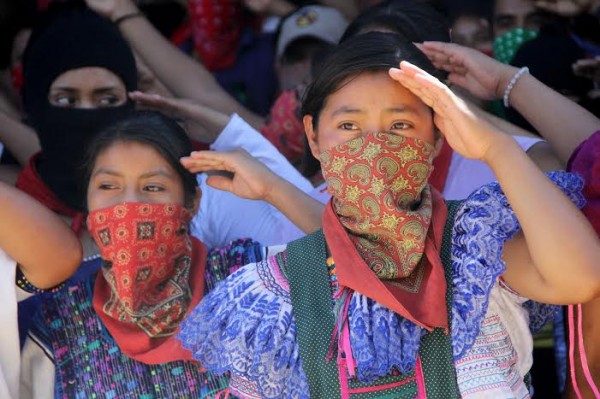
Women commanders and coordinators of the Zapatista National Liberation Army (Ejército Zapatista de Liberación Nacional, EZLN) reported that women from that grouping will join the protests and strike programmed for March 8 and 9, called by the Brujas del Mar (Witches of the Sea) collective.
“On March 9, the compañeras who have the responsibility for autonomous authority, for organizational or military command, for commissions of education, health, media and for all the work that we do as Zapatista women, won’t show up for our jobs,” they said.
They explained in a communiqué that on March 8 they would meet “in our caracoles, we’ll talk about the pain and rage that we heard in the two encuentros that we have had. We’ll also discuss the struggles, ours and yours, compañeras and sisters who read us, and we will wear a black mark on our clothes.”
The Zapatista leaders pointed out that on March 9 “many of us will not leave our villages, in the early morning we will turn on thousands of lights. The light of women will shine in the Caracoles and in the Zapatista villages.”
“That will be our way of telling you that we support that idea of a ‘March 9 without women,’ as one more initiative of women who struggle for life. And as we are the majority in Zapatista autonomy, then that day it’s going to be paralyzed,” they added.
The Zapatista women approved the initiative because “we look at it as something valuable, good, noble, honest and legitimate. And we will support it according to our ways. Because any woman, whether one or many, who struggle for life, must know that they are not alone.
“We think it’s a good idea, because on March 8, you are going to look at and feel our pains and our rages. And on March 9, the patriarchal macho men are going to worry about what we think, plan and feel, because they won’t know,” they said.
The Zapatistas commented that: “with so much killing we just go from one mourning to another, from one pain to another, from one indignation to another. Maybe that’s the damn system’s plan: to be killing and disappearing us so that we don’t have the time or way to organize and struggle against the patriarchal and capitalist model.”
“Just like we are not asking permission from commands and authorities, nor from fathers, sons, boyfriends, husbands or lovers, but rather we are going to do it [the women’s strike] because we didn’t rise up in arms in vain since January 1, 1994,” they pointed out.
———————————————————-
Originally Published in Spanish by La Jornada
Monday, March 2, 2020
https://www.jornada.com.mx/2020/03/02/politica/006n1pol
Re-Published with English interpretation by the Chiapas Support Committee
STATEMENT ON THE KIDNAPPING OF CNI MEMBERS IN CHILÓN, CHIAPAS
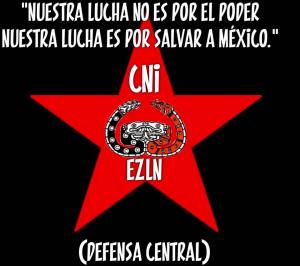
CNI-EZLN: “Our struggle is not for power. Our struggle is for saving Mexico.”
STATEMENT ON THE KIDNAPPING OF CNI MEMBERS IN CHILÓN, CHIAPAS, FOR THEIR PARTICIPATION IN THE DAYS OF ”WE ARE ALL SAMIR”
February 26 2020
To the people of México:
To the networks of resistance and rebellion:
To the National and International Sixth:
To the communications media:
To the Human Rights organisms:
To the organizations in defense of territory and Mother Earth:
By means of this communiqué we make public that compañeros and compañeras of San Antonio Bulujib and Guaquitepec communities in Chilón municipality, Chiapas, belonging to the National Indigenous Congress (CNI, its initials in Spanish), were assaulted, repressed and kidnapped at 5 o’clock in the afternoon last February 23 by the San Antonio Bulujib ejido authorities belonging to the paramilitary groups called “CHINCHULINES” and “ORCAO”, as well as by members of the MORENA political party in the region, in REPRISAL FOR HAVING PARTICIPATED IN THE “WE ARE ALL SAMIR” DAYS IN DEFENSE OR TERRITORY AND MOTHER EARTH” convoked by the Zapatista National Liberation Army and the CNI. We’re talking about María Cruz Espinoza, Juana Pérez Espinoza, Feliz López Pérez, María Cruz Gómez, Ana Gómez Hernández, Alejandra Gómez, María Luisa Pérez Gómez, just 1 year old, María del Rosario Mazariegos Gómez, 11 months old, Manuel Cruz Espinoza, Juan Gómez Núñez and Isidro Pérez Cruz, who were beaten and kidnapped for having placed a sign about the days of “We are all Samir” at the entrance to San Antonio Bulujib.
On February 24, until 8:30 at night, after more than 24 hours of having been deprived of their liberty, our compañero and compañera CNI members were released under conditions: the authorities of San Antonio Bulujib community said that if the CNI group wanted to fix the problem they would have to pay a fine of fifteen boxes of soft drinks and $2,500 pesos, being threatened that in case they don’t pay the fine that the authority imposed, their permanence in the community would be conditioned on the eleven detainees renouncing being CNI members. At the same time, the ejido authorities indicated that if our compañeros and compañeras don’t pay the fine by the afternoon of Sunday, March 1, 2020, they will be evicted from their lands and houses, which will be sold, and they will be enclosed in the town jail.
We hold the three levels of government and the paramilitary groups organized in the communities responsible for what can occur to our compañeras and compañeros, and specifically we hold responsible the head of the federal executive, ANDRÉS MANUEL LÓPEZ OBRADOR, the head of the state executive of Chiapas, RUTILIO ESCANDÓN, the San Antonio Bulujib ejido authority, MIGUEL LÓPEZ GUZMÁN, the Vigilance Council, MATEO GÓMEZ MÉNDEZ, a member of the ORCAO and CHINCHULINES organization, the Municipal Auxiliary Agent JUAN SILVANO MORENO, his alternate MANUEL GÓMEZ PÉREZ, and JOSÉ PÉREZ, the alleged leader of the ORCAO, promoter of the paramilitaries that are dedicated to provoking and invading lands, protected by the bad federal, state and municipal government, who in the name of a supposed fourth transformation are threatening the security and the life of the eleven above-named compañeros and compañeras and other CNI families.
We call for SOLIDARITY AND SUPPORT TOWARDS OUR CNI BROTHERS AND SISTERS IN CHILÓN ON THE PART OF ALL THE COMMUNITIES, ORGANIZATIONS AND COLLECTIVES THAT ARE ADHERED TO THE DAYS IN DEFENSE OF TERRITORY AND MOTHER EARTH “WE ARE ALL SAMIR,” in Chiapas, in Mexico and in the world.
Attentively,
February 26, 2020
For the Integral Reconstitution of Our Peoples
Never more a Mexico without Us
National Indigenous Congress
Indigenous Government Council
Zapatista National Liberation Army
The so-called Maya Train and conflict engineering

The Maya Train will travel at a high speed and fueled by hydrogen-fueled train
By: Magdalena Gómez
February 20 completed one year of the unjust and not investigated murder of Samir Flores. This crime will mark the current government although it seems not to realize it. Numerous peoples are carrying out actions throughout the country and some in other countries, as part of the Days in Defense of Territory and Mother Earth, “We Are All Samir,” which will culminate in Amilcingo, Morelos. This movement is a backdrop now that the government strategy of the so-called Maya Train is in progress, yes or yes, or it goes because it goes or its most recent and absurd translation, such as the statement of the head of Semarnat [1], Víctor Toledo, in the forum “Nature, Indigenous rights and national sovereignty on the Isthmus of Tehuantepec,” in the sense that the Indigenous consultation was “totally legitimate,” despite recognizing that “it was not technically adequate,” as marked by international standards. He added: “The general answer was a conditioned yes.” A lot has already been written regarding the principle of validity. Habermas, in particular, emphasizes that it is the sum of the principles of legality and legitimacy. Not one or the other, but both, and in this case both are absent, therefore the official consultation is invalid. When I talk about strategy I mean the one that is evidently in progress to defend the pseudo-consultation through voices that challenge those who have denounced its invalidity. Meanwhile, the project is progressing and the vast majority of the communities that will be affected are unaware of its environmental and cultural impact, and immediately, in the increase in the land market for the development poles that are projected from train stations of the so-called Maya train. It is not only with indispensable media debates that this dispute will be resolved, nor through them will communities that were not consulted have conditions to accept or reject the aforementioned megaproject. The damage has already been done, the simulation of a consultation has been consummated.
We have to see what the definitive position is of the first district court based in Campeche (12/2020) on March 3, regarding the amparo promoted by the Indigenous and Popular Regional Council of Xpujil (Cripx), which has provisional suspension. It will surely be followed by others, justly challenging the validity of a project that was not decided with and from the Indigenous peoples. For now, the official response has been the discrediting and threats to the promoters of the amparo, through those who are aligned with the project. That’s a task that closely resembles what’s called conflict engineering, which consists of the classic method of maintaining control of a group, increasing the visibility of their internal differences, highlighting their contradictions, in order to amplify their latent divisions and paralyze their organization. The challenge is not minor and the consequences of this will be the state’s responsibility.
However, the determining factor will be the resistance of the Indigenous communities that have been displaced in the so-called consultation and supplanted by ejido and municipal authorities in the five states through which the so-called Mayan Train will cross, which, as it has been insisted, is more than a train and even when it was stated as a territorial reorganization plan, it has already been decided not to mention this dimension. Toledo, called on opponents not to fall into “simple denial” and not to be “immature.” A day later, in a statement (016/20), the continuity of the decision-making scheme without consultation was announced: “Semarnat is organizing the formation of committees in the 84 municipalities involved in the projects, in which they will be generating participatory ecological systems to trigger processes of permanent dialogue for the purpose of not repeating ‘the Cancun model’, which is prey to enormous tourist corporations.
Will they form committees without Indigenous communities giving their voice? Will they continue with the ejido and municipal interlocution? How will they explain that these committees are a supposedly palliative mechanism of damage that originated over a decision vitiated around a project that has not been analyzed in the integrality of its impacts and that was never previously consulted?
Firmness was expected from Semarnat in the absence of environmental impact studies; it’s not enough to point out that no tree will be cut down because the damage was already done when the old railroad tracks were built. It is clear that the entire federal government has joined Fonatur [2] in defending the so-called Maya Train. Meanwhile, organizations, such as the Assembly of Defenders of the Maya Múuch ‘Xíinbal Territory, despite the threats against Pedro Uc Be, continue their work with the communities opposing it and other devastating megaprojects in their territory.
Samir Vive, is a sowing, wait for the harvest.
[1] Semarnat is the Spanish acronym for the Ministry of Environment and Natural Resources.
[2] Fonatur is the Spanish acronym for the federal agency that promotes tourism.
————————————————————
Originally Published in Spanish by La Jornada
Tuesday, February 18, 2020
https://www.jornada.com.mx/2020/02/18/opinion/013a1pol
Re-Published with English interpretation by the Chiapas Support Committee
Samir Flores and the resistances
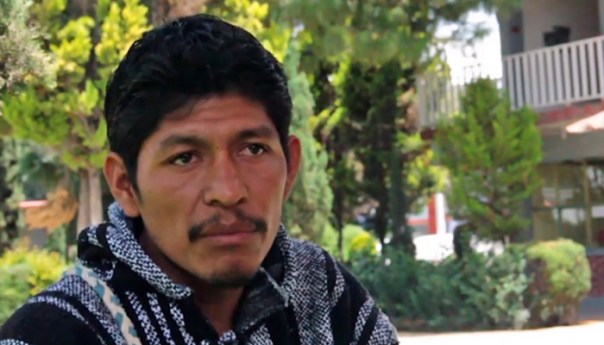
Samir Flores Soberanes
By: Raúl Romero*
On February 11, 2019, Samir Flores and a group of opponents of the Morelos Integral Project went to protest an activity where President Andrés Manuel López Obrador [AMLO] would be present. With banners, slogans and modest sound equipment, the protestors stayed for the whole event until they were able to get the president’s attention. AMLO, who was accompanied by Cuauhtémoc Blanco and Hugo Erick Flores, among others, turned towards the group Samir was in and, visibly upset, with his right hand raised and his index finger also raised, he said to them in a challenging tone: “Listen! To me, radicals of the left are nothing but conservatives.” Nine days later, on February 20, Samir Flores would be murdered outside his home.
It has not been the only time that AMLO has discredited individuals, peoples and social organizations that express the pain and discontent of a country that continues bleeding day by day. He has done so against the movements of victims, migrants, women, original peoples and journalists. In order to discredit their protests and demands, he refers to some of these sectors as “provocateurs,” “the undersigned,” “ridiculous,” or any qualifier that helps to place them as “ conservatives.”
In this discourse that focuses on people/oligarchy antagonism, with its adaptations according to the moral and ideology of the head of the executive (liberals/conservatives, good/bad), there is no room to observe other contradictions or oppressions. Exploitation does not appear in this discourse, so that exploiters and owners of capital that were previously located as part of the “mafia in power,” are now protected with the President’s popularity.
The same thing happens with the extractive projects and megaprojects, some of them previously promoted or implemented by neoliberal governments. The Trans-Isthmus Corridor, the Morelos Integral Project or the Constellation Brands are now taken up again by the current administration and presented as necessary. In other cases, it’s just enough to change the name or the location, like the Train misnamed Maya or the airport in Santa Lucía. It doesn’t matter that in the past the resistances and struggles of the peoples have stopped them, today they are the currency of promises of a better future, the same promises that others have already made.
But this speech is not exclusive to the president. In any space they can, government officials and AMLO supporters reproduce it. “The Zapatistas are an invention of Salinas,” or “Where were you when neoliberalism was imposed?” “Migrant caravans are an invention of Trump,” and “There are ‘black hands’ behind the women’s movements.” The objective is the same: to annul the resistances, disparage them, place them in the same camp as the real dominant forces, although many of the latter are in reality with the president.
This strategy is based on a premise: “the country is doing well”, “the people are happy,” if anyone differs, he is conservative or allied with the right. In the worst cases, the president and his followers can always have “other data” for confronting the reality. The strategy leads them to present themselves as the only “left” and to claim a monopoly on the truth.
The problem is that López Obrador is the President of Mexico, the head of State and, as such, his voice has an echo and consequences.
In a context of political and criminal violence like what Mexico has experienced for more than a decade, where women, journalists and defenders of territory are constantly murdered, a context in which the president discredits or minimizes the resistances and the problems that they outline, making use of the privileged media space that he has, opens the door to harassment, threats and to the worst demons.
An example of the above is the situation that residents of Calakmul, in Campeche experienced in recent days. In the face of obtaining an amparo (temporary suspension) of work on the Maya Train, they were harassed on social networks and threatened by supporters of the president. The case of the journalist Frida Guerrera also comes to light, because after questioning the president at a morning press conference about what the federal government is doing given the grave situation of femicides and gender violence, she was severely attacked in social networks.
Given this situation, the resistances face the challenge of developing more pedagogical communication strategies and strengthening all kinds of security measures. The violence of the State and of capital is finding new forms in our country; we must not stop denouncing them, but above all imagining exits from them.
*Sociologist
———————————————————————
Originally Published in Spanish by La Jornada
Saturday, February 22, 2020
https://www.jornada.com.mx/2020/02/22/opinion/016a2pol
Re-Published with English interpretation by the Chiapas Support Committee
 Chiapas Support Committee