Chiapas Support Committee
Home of the Compañero Manuel blog on zapatistas & mexico
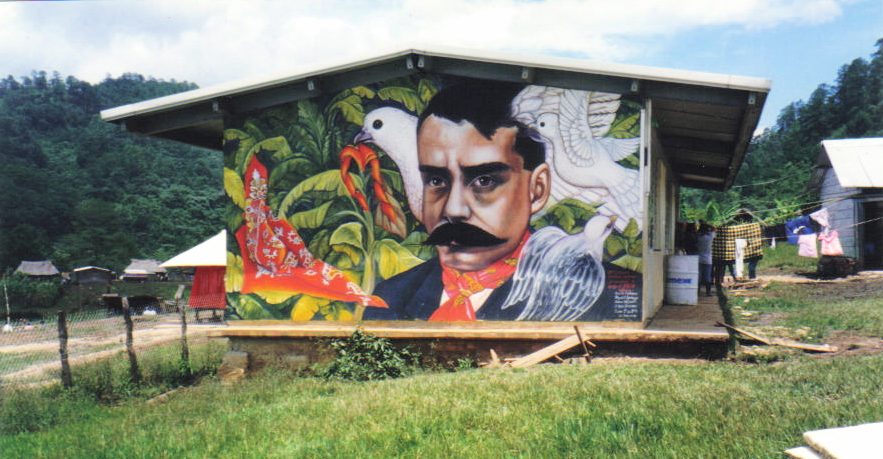
Militarization, the highest phase of extractivism

By Raúl Zibechi
The growing militarization of our societies is a clear sign of the autumnal phase of the patriarchal capitalist system. The system gave up on integrating the popular classes, and no longer even aspires to dialogue with them, but limits itself to surveilling and controlling them. Before this militaristic period, the “misguided” were locked up in order to set them straight. Now it is a matter of open-air surveillance of entire social layers making up the majority of the population.
When a system needs to militarize daily life to control the majority, we can say that its days are numbered. Although in reality those days would have to be measured in years or decades.
A good example is the legacy of the Pinochet regime in Chile, in particular the central role played by the military and the militarized police, the Carabineros, in social control.
One of the legacies is that armed forces control the surpluses of the state copper company. Copper is Chile’s main export.
The Restricted Law on Copper was approved in the 1950’s, in the midst of rampant mobilizations of workers and the poor in the city and the countryside.
During the military dictatorship, this secret law was modified seven times.
Only in 2016, thanks to a leak from the digital newspaper El Mostrador, was it revealed that 10 percent of the profits of the state copper company are transferred directly to the armed forces. (https://bit.ly/3tNDa0S).
The secret law was not repealed until 2019, (https://bit.ly/2OUAiAJ), when the streets of Chile began to burn with a string of protests and uprisings that started in 2011 with the resistance of students and the Mapuche people, and later the feminists.
The damage that the military regime inflicted on society can be seen in the fact that more than half of Chileans do not vote, when before, the vast majority voted; there is tremendous delegitimization of political parties and state institutions.
It is not the only case, of course. The Brazilian military played a prominent role in Lula’s imprisonment, the removal of Dilma Rousseff, and the election of Bolsonaro.
In all cases, militarization violates the so-called “rule of law,” the legal norms that society has adopted, often without being duly consulted.

Militarization comes hand in hand with the imposition of a model of society that we have called extractivism, a mode of capital accumulation by the 1% based on the theft and dispossession of the peoples, which entails a true military dictatorship in the areas and regions where it operates.
Militarism is subordinated to this logic of accumulation through violence, for the simple reason that people’s goods cannot be stolen without pointing weapons at them.
Militarism comes with violence, forced disappearances, femicides and rapes. Besides that, it always encourages the birth of paramilitary groups, which always accompany large extractive works. And though they are considered illegal, the paramilitaries are trained and armed by the armed forces as we see in Mexico and Colombia.
Now we know that the great beneficiary of the Mayan Train will be the armed forces. The López Obrador government has given them all the sections of the train, adding that it is “an award” to that institution (https://bit.ly/ 39aURjh).
There is more than one similarity with the case of copper in Chile.
The first is the direct delivery of benefits, which is how the government gains the loyalty of the uniformed, to whom, in reality, it is subordinate.
The second is the “national security” argument used by the governments. In Chile it was the fight against communism. In Mexico it is the southern border, with arguments about migration and trafficking.
The third is that militarization is both a project and a way of governing. It is followed by airports, internal order and the most varied aspects of life. By force, they manage to subvert legality at will, such as budgetary regulations.
We observe processes of militarization from the United States, Russia and China, to all the Latin American countries. It consists in the control of rural and urban geographies by armed men at the service of capital, in order to control the peoples who resist dispossession.
It is not about a president or a government being evil. Not that I doubt it, but that’s not the point. We are facing a system that, to stretch its agony, needs to implement figures born in the twentieth century, which are the themes of Giorgio Agamben: the state of exception as a form of government, the legal civil war against the “non-integratable” and the open air concentration camps guarded by paramilitaries.
__________________________________________________________________________________________________________________________________
The original was published by La Jornada, click here https://www.jornada.com.mx/notas/2021/03/26/politica/la-militarizacion-fase-superior-del-extractivismo/
Translation provided by the Chiapas Support Committee.
Militarizing the Maya Train

Profits and sections of the Maya Train will go to the military
- The almost 1,500 kilometers of railroad will become the patrimony of the Secretariat of National Defense (SEDENA) and the money obtained from the project will go to the Army.
The Maya Train, [supposedly] a project to improve the quality of people’s lives, care for the environment and detonate sustainable development, will run a distance of around 1,500 kilometers (km) and will pass through the states of Chiapas, Tabasco, Campeche, Yucatán and Quintana Roo.
However, the environmental impact of phase 1, which will go from Palenque, Chiapas to Izamal, Yucatán, points to the loss of vegetation cover of 800.95 hectares, “affecting the forest mass that will contribute to the emission of carbon, considered one of the causes of climate change.”
Added to that, “right of way” became the words most feared for the residents who are settled along the 232 kilometers of what is known as the First Section of the Maya Train.
Said context is added to the fact that the military will own totality of the Maya Train. The military will obtain profits for the transportation of passengers and cargo to feed the pension funds that depended on the Secretariat of Finance and Public Credit (SHCP, its initials in Spanish).
In an interview with El Financiero, Rogelio Jiménez Pons, director general of the National Fund for the Promotion of Tourism (Fonatur, its Spanish acronym) detailed that all the resources, including profits related to the railroad’s operation in the southeast, will benefit the military.
Specifically, the profits will be for the military, not for the treasury. Pensions and other things will no longer depend on the treasury. The ownership is going to remain; we are going to concede all the sections to the Army, remarked the general director of Fonatur.
Jiménez Pons said that the entry of the armed forces as owners of the megaproject would prevent the railroad from being privatized like other projects in previous governments.
It’s perfect that it’s an award to the armed forces. If we have a long-term nationalist vision of heritage, which this business is, but the State’s, we’re going to try to make this a business for the benefit of the greatest number of Mexicans, who better than the Army to be in charge of this business, to guaranty us many things and especially to guaranty us that it is not privatized, Jiménez Pons added.
He said that the Maya Train has a “national security” aspect because there are conflict zones in the country’s southeast, where there are [drug] cartels, human trafficking groups and the illegal sale of livestock.
Because of that, the military’s participation would diminish the impact that said activities would have on the project.
When you insert an institution with certain values, with certain discipline, with rigor and knowledge that it will never be privatized, because it will belong to the Army, well going forward with that, then you create a solid institution that can see the project long-term. And we already see separate merchandizing, the Fonatur already sees that, Jiménez Pons said.
The Maya Train stumbles
The Secretariat of Environment and Natural Resources (SEMARNAT) affirmed that no deforestation is authorized to make way for the construction of the Maya Train.
It’s of importance to point out that the Highest Auditor of the Federation (ASF) released a report on the Maya Train work, in which it questions the profitability, lack of feasibility studies, of consultation with residents and environmental impact, among others.
The ASF made public the federal government’s 2019 report of the Public Account, in which it points out that the project presents risks of not being profitable, was not consulted in a way owed to the indigenous population, has little interest in environmental protection and isn’t very transparent in the award of public contracts.
In the rubric of profitability, the audit numbered 1384-DE highlighted that the project’s operator, Fonatur, used assumptions that “were not reasonable,” in relation to the use of cargo and of passengers that it could operate between 2023 y 2053.
In other words, it made projections that are “a risk to the financial viability of the project, since the overestimation in demand could have repercussions in significant variations with respect to the estimated profitability of the project in the pre-investment stage.”
The ASF also reported that Fonatur paid cost overruns, awarded contracts directly in an unjustified way, did not have “an administrative structure for carrying out the project” or have completed studies; among them social feasibility, “like a diagnosis in which it foresees the possible effects and social risks its construction and operation would cause,” the audit explains.
The irregularity that the ASF most encountered refers to the environmental impact and points to: “the destruction of natural habitats; soil characteristics; damages to local wildlife; damages to species of flora, and the existence of critical ecosystems and damage to biological corridors,” according to audit 1386-DE.

Originally Published in Spanish by Chiapas Paralelo on March 16, 2021 and re-published with English interpretation by the Chiapas Support Committee.
Zapatista women’s March 8 message

Elio Henríquez, La Jornada correspondent
San Cristóbal de Las Casas, Chiapas. On International Women’s Day, Indigenous women from the Zapatista Army of National Liberation (EZLN) transmitted a text titled “Those Who Are Not Here.”
The text, transmitted by the EZLN’s official page, Enlace Zapatista, is the following:
For the Women Who Are Not Here
Those who are not here.
Their histories.
Their joy and their sadness.
Their pain and their rage.
Their oblivion and their absences.
Their hearts.
Their hopes.
Their dignity.
Their calendars.
Those who came through.
Those who were left behind and to whom we are indebted.
Their cries.
Their silence.
Especially their silences.
Whoever it is, do you hear them?
Who doesn’t see themselves in them?
Women who struggle.
Yes, us.
But most of all, those women.
Those who are not here anymore.
And despite everything, are with us.
Because we don’t forget,
because we don’t forgive,
for them and with them, we fight.
Indigenous Zapatista women,
March 8th, 2021.
_________________________________________________________
The original published by La Jornada is available here: https://www.jornada.com.mx/notas/2021/03/08/politica/mujeres-zapatistas-envian-mensaje-por-el-8m/
Translated by Clara Martinez Dutton for the Chiapas Support Committee.
Frayba makes an urgent call for solidarity
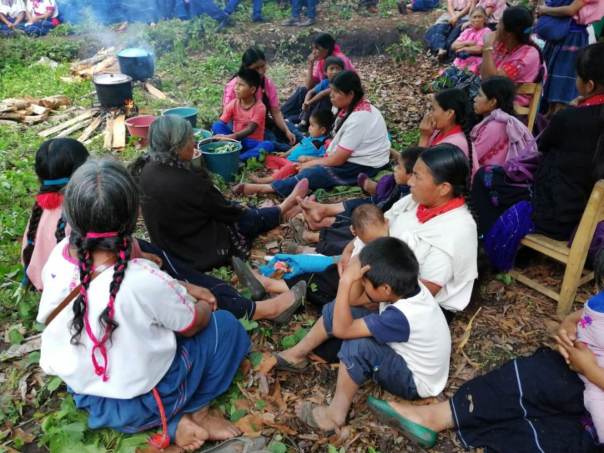
Women and children displaced from Aldama due to paramilitary attacks.
THEY DENOUNCE PRESENCE OF NATIONAL GUARD IN ARMED ATTACKS ON ALDAMA COMMUNITIES
From the Editors
Mexico City | Desinformémonos
The Fray Bartolomé de las Casas Human Rights Center (Frayba) reported more than 40 attacks with high-caliber firearms against the Tsotsil communities of Aldama, “caused by the paramilitary group in complicity with the municipal government” of Chenalhó, in Chiapas.
In regard to the March 20 and 21 attacks, the Frayba reported: “While the armed attacks were taking place, the National Guard and State Preventive Police were on the side of Santa Martha-Miguel Utrilla, Chenalhó,” which is where the shots came from.
It said that the government’s actions to address the conflict and the attacks on Aldama communities: “have been insufficient, ineffective and simulated, since they do not guarantee the safety and integrity of the population.”
Faced with the armed attacks that have kept the population “in a context of terror,” since November 2020, the Frayba demanded that the Mexican State investigate, identify and punish the paramilitary group in Santa Martha, Chenalhó, and “put an end” to the violence against the communities in Aldama.
The complete communiqué follows:
The Fray Bartolomé de Las Casas Human Rights Center, A.C. (Frayba), has received information from the Permanent Commission of the 115 comuneros and displaced persons of Aldama, Chiapas, México that during the days of March 20 and 21, 2021, the communities of Aldama have been attacked with shots from high-caliber firearms coming from different points located in Santa Martha-Miguel Utrilla, Chenalhó municipality, in Chiapas, acts provoked by the paramilitary group in complicity with the municipal government.
The armed attacks against the Tsotsil Maya population of Aldama have not stopped since November 2020, when the Frayba registered the greatest number of attacks to date. Armed attacks have continued towards the population that lives subjected to a context of terror, where children, women and the population in general survive in a torturous environment. Government actions have been insufficient, ineffective and simulated since they do not guarantee the safety and integrity of the population.
On March 20, 2021, from 2:00 pm to 11:30 pm, residents of the Stzelejpotobtic, Coco, Juxton, Yeton, San Pedro Cotzilnam and Tabac communities received 21 attacks from firearms. There were more than 9 hours of aggression! The Stzelejpotobtic community received 11 armed attacks. Shots came from the following points: K’ante’, Pajaltoj, Tok’oy-saclum, Puente Caridad, Vale’tik, Chuch te’, El Puente and T’elemax, all in Chenalhó municipality.
On March 21, 2021, from 10:00 am to 9:00 pm, residents of the Ch’ivit, Yeton, Tabak, Coco and Xuxch’en communities experienced 9 attacks with firearms. Workers from a company that were working on the Tabac-San Pedro Cotzilnam highway stretch were also under attack. While the armed attacks were taking place, the National Guardia and State Preventive Police were on the side of Santa Martha-Miguel Utrilla, Chenalhó. The attacks came from the El Ladrillo attack points, which are located inside the 60 hectares in dispute. The attacks also came from Vale’tik, T’elemax, Tojtic, Slumka and Yocventana, in Santa Martha.
The Frayba states its concern over the acts of armed aggression that the population of Aldama municipality experiences constantly. These acts are part of a persistent violence with psychological impact that the population is now experiencing and it leads to a deep fracture of the social fabric.
We urge the Mexican State to investigate, identify and punish the paramilitary group in Santa Martha, Chenalhó, and thereby put an end to the violence against Aldama communities.
We call on national and international solidarity to sign this urgent call available on the www.frayba.org.mx page and write to the Mexican authorities so that they commit to implementing more appropriate measures that guarantee the life, safety and physical and psychological integrity of the population under constant siege.
——————————————————————–
Originally Published in Spanish by Desinformemonos
Tuesday, March 23, 2021
Re-Published with English interpretation by the Chiapas Support Committee
The Maya Train: 3 new court orders stop its progress

A Yucatán judge determined that doubts exist about the real impact of the Maya Train on the environment. The decision suspends Semarnat’s authorization of the project with which, in fact, the work must be suspended for now. The Maya Train, however, is not cancelled
By: Alberto Nájar in Pie de Página
Mexico City
Construction of the Maya Train confronts a new obstacle. On Wednesday, a judge granted three orders to suspend progress on Phase 3 of the megaproject, one of the most important for President Andrés Manuel López Obrador’s government.
The resolutions have the character of definitive; in other words, they imply the suspension of the work -for now- because the judge considered that there are doubts about the real damage to the region’s environment, and above all the impact on the rights of the communities settled in the stretch of the railroad.
However, the decisions of the Fourth District judge in Yucatán do not imply that construction of the Maya Train is definitively canceled. According to law, the federal government has the possibility of filing appeals to a collegiate court to reverse the judge’s decision.
The judicial rulings refer to the Environmental Impact Statement presented by the National Fund for the Promotion of Tourism (Fonatur, its Spanish acronym), the agency responsible for the megaproject. The judge determined that there is “uncertainty” about the true impact of the railroad on the environment of the region where it is being constructed.
The document was approved by the Ministry of Environment and Natural Resources (Semarnat, its Spanish acronym). It’s a fundamental requirement for the start and conclusion of the work. But the judge established that said approval is not sufficient, as she points out in the decisions.
“The mere existence of an environmental impact statement does not grant absolute certainty that all variables have been considered, or if the interpretation of the effects of the State’s actions in a specific project will be effectively those embodied in a document of such nature.”
That is saying that it isn’t clear if effectively the impact on nature will be as Fonatur asserts. And in view of that, “a diverse principle called in dubio pro natura” must be reaffirmed. In other words, “when in doubt about the certainty or scientific accuracy of environmental risks, it must be resolved in favor of nature.”
The three definitive suspensions imply stopping the work: legally no project of this nature can be maintained if it doesn’t have an environmental impact statement.
So far, there is no reaction from Fonatur to the court decisions. But last February, the Fund’s director Rogelio Jiménez Pons warned that opposition to the megaproject does not come from the communities in the region, but from civilian organizations.
“The communities are not the ones that filed the cases,” he said to journalists. “A large majority of the communities have shown their support for the Maya Train. Those who demonstrate and have the right to do so are the non-governmental organizations”[NGOs].
Such an assertion seems to underestimate the rulings of this Wednesday. The Múuch’ Xíinbal Assembly of Defenders of Maya Territory and the Chuun T’aan Maya Collective presented the lawsuit. The fourth district judge establishes that the organizations demonstrated, “at least incidentally” their legitimate interest in the case because she notes: “that they are residents of the corresponding municipalities.”
————————————————————–
Originally Published in Spanish by Pie de Página
Thursday, March 18, 2021
https://piedepagina.mx/tren-maya-3-nuevos-amparos-frenan-su-marcha/
Re-Published with English interpretation by the Chiapas Support Committee
Teófila, armed with courage, the first Indigenous woman film-maker in Mexico
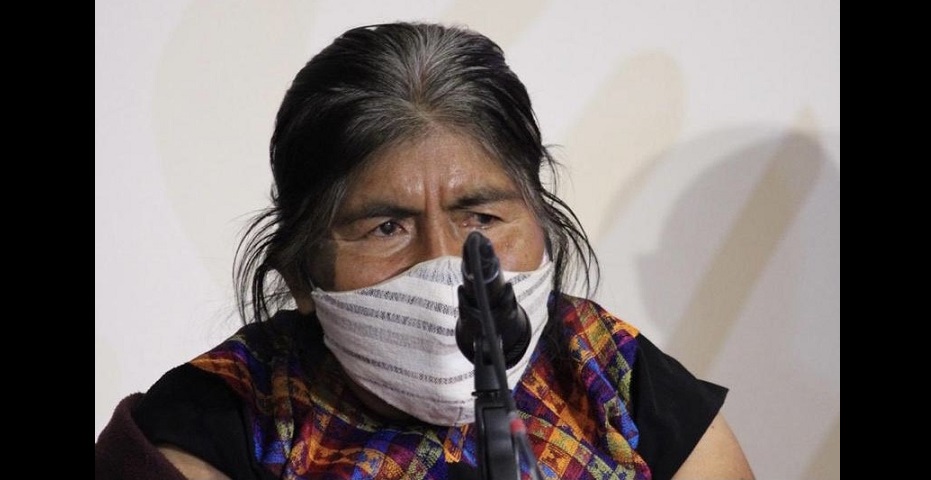
- Her documentary from 35 years ago warned that the refinery would contaminate the sea and do away with fishing.
- It hurts her that technology has changed human beings and that they don’t think about their culture.
Oaxaca, Oaxaca (pagina3.mx). Teofila, the Ikoots woman who comes from the sea, armed herself with courage to work freely, and without intending to, she became the first Indigenous woman to make a film in Mexico.
That was 35 years ago and Teofila Palafox Herranz continues breaking the mold by sowing the seeds for Mareña (Ikoots or Huave) women to fight and raise their voice and, by so doing, continue to create.
Today, at 64 years of age, she is proud to be part of the culture of the Ikoots people of San Mateo del Mar, although she recognizes that there is still resistance to accept that women have rights.
But she is also saddened that in these times technology has changed the mentality of human beings and that they aren’t valuing culture, nature and what is important for the community and gives it identity.
Seeing the documentary again after 35 years, it hurts her to confirm that the prediction that something bad was going to happen in her community with the arrival of the “Antonio Dovali Jaime” refinery, came to pass.
The water was contaminated which ended fishing, the livelihood of San Mateo del Mar.
Despite the pandemic, Teofila accepted the invitation to the event “Native Language in Indigenous Cinema and Film: Women Creators,” which took place with the celebration of International Native Language Day, put on by the National Institute of Indigenous Peoples (INPI in Spanish).
She accepted because she wants officials to turn around and see women artisans and support their community projects.
She says it is because, “As women we are fighting by bringing ideas about how to move forward. This is because San Mateo del Mar was a fishing area, but recently there isn’t any fishing there. Times have changed. Fishing is no more; everything is changing and it’s necessary to make a living.”
She remembered the adversity that she has had to endure for being a woman and living in an Indigenous community such as Ikoots.
There, in San Mateo del mar “Women aren’t recognized; we are very isolated and far from the city.”
Teófila Palafox Herranz is a filmmaker and Ikoots textile artist, recognized as the first Indigenous woman to create a film in Mexico.
She is from San Mateo del Mar, Oaxaca. She was born on the 28th of December 1956.
She started her career under the umbrella of the First Indigenous Cinema Workshop in 1985, which she helped organize as president of the Women’s Association of Artisans in San Mateo del Mar, in collaboration with a team of cinema instructors.
Teófila, her younger sister, Elvira, and another five master weavers participated in that project.
As a result of the workshop, Palafox filmed the documentary Leaw amangoch tinden nop ikoods (The Life of an Ikoots Family). It was a pioneering work for Indigenous cinema that has been celebrated by critics for the unique perspective that it gives by portraying the everyday life of the Mareño people.
In video format, her film Las Ollas de San Marcos stands out; it was filmed in 1992.
It is worth mentioning that the work of Teofila Palafox has been presented in various film festivals, among which the Festival International du Film d’Amiens, France, and the Native American Film and Video Festival of New York, stand out.
In a phone interview, Teofila mentioned that interviews still make her nervous, but she agreed to share how she became a filmmaker:
“My lineage is of artisans. My mother taught me, my sisters, my daughters, and other artisans the technique of the lap loom.”
“We started this cinema project 35 years ago. We made a movie and we did it as women”
“We learned to direct documentaries and document village life, its people, its culture, its language, its crafts, its music and everything you can see in the traditional fiestas.
“It’s the least we could do to preserve the language that we speak, and we learned to make natural dyes and today we have textiles with natural dyes,” she says.
She says, “In my time, 35 years ago, it was very hard for a woman to work freely because there were a lot of issues around women not being able to work. However, we armed ourselves with courage to work on this project and with the group of artisans we worked hard and were able to make this account that is called a documentary.”
“Now we were invited to present this movie and we are very pleased because today we are no longer in the same situation. The town has changed; there has been a lot of change. The youth aren’t the same as before and we invite the youth to keep working for our culture. It is something that we have inherited and that some people don’t have anymore.”
Back then, she said, “we tried to show the refinery of Salina Cruz. We already knew that it was going to harm us; now we are in a place where life is very expensive because of the refinery, and not everyone works there. Life is expensive. And the refinery has polluted the sea and the air with its smoke and our voice is there, in the documentary.”
With satisfaction, she now confesses with pride that she has taught her culture to her three children–two women and one man-and her eight nieces and nephews.
Her daughters not only know how to weave, one of them works in Indigenous education and teaches the Huave or Ikoots language. Teófila says “I am proud that my children carry on the culture of the people who came from the sea.”
________________________________
The original published by Página 3 in Spanish is here. Translation provided by the Chiapas Support Committee.
Interview with Teófila Palafoz Herranz (with English subtitles) as part of the On Transversality Conference 2020.
Stop Paramilitary Violence in San Antonio Bulujib, Chilon, Chiapas

MARCH 15, 2021
TO THE PEOPLE OF MEXICO
TO THE NETWORKS OF RESISTANCE AND REBELLION
TO THE NATIONAL AND INTERNATIONAL SIXTH
TO THE MEDIA.
TO THE HUMAN RIGHTS ORGANIZATIONS.
TO THE ORGANIZATIONS IN DEFENSE OF THE TERRITORY AND MOTHER EARTH.
We issue a warning against the imminent reactivation of violence in San Antonio Bulujib directed at CNI compañeros1 and compañeras who are threatened with dispossession and forced displacement due to the government’s inability to resume and renew the dialogue process that began in March of last year.
The situation of violence and harassment suffered by our compañeros and compañeras from the CNI of the San Antonio Bulujib community, Chilon, has been ongoing. Since February 23, 2020 they have been victims of a series of human rights violations that started when they participated in the activities called WE ARE ALL SAMIR, by placing a sign demanding justice for the murder of our compañero Samir Flores. They were just making use of their right to free expression and demonstration.
These repressive actions are part of a counterinsurgency strategy deployed in the region against the CNI and the EZLN, because of our opposition to the big capitalists’ megaprojects of death.
We denounce the systematic violation of the human rights by the community authorities. In addition to the excessive use of force, injuries, kidnapping, imprisonment of men, women and children, harassment and attempted rape, they threaten to evict and take away lands belonging to families that are members of the CNI if they do not pay an arbitrarily determined fine. The fine is based on a document that was signed under pressure, after one of our compañeros was beaten and imprisoned, which we therefore consider illegal and invalid, and outside the dialogue process started in March last year.
We hold the three levels of government responsible for the physical, psychological and material integrity of our CNI compañeras y compañeros. In particular we denounce the mayor of Chilon, Carlos Ildefonso Jimenez Trujillo, for instigating and protecting the ejido authorities, the governor Rutilio Escandón and the president Andrés Manuel López Obrador, for their omission in this case.
We demand the resumption of community dialogue, in search of a peaceful solution, and non-violence for our peoples.
We call for solidarity and support towards our compañeras and compañeros from the CNI of San Antonio Bulujib, and to be attentive to their situation in the face of the imminent aggression they may suffer as a result of a decision taken by the ejido assembly this coming March 20.
Sincerely,
For the Integral Reconstitution of Our Peoples
Never again a Mexico Without Us
National Indigenous Congress (Congreso Nacional Indígena)
Indigenous Governing Council (Consejo Indígena de Gobierno)
1Compañero (male) and compañera (female) and compañeroa (gender non-binary) have no exact translation in English. They lie somewhere between “comrade” and “companion.” In a political context, the term generally refers to someone who belongs to a particular organization or movement. For the CNI, CIG, and EZLN, “compa” is often used for short and refers to someone in the movement.
_________________________________________________________
English translation provided by Sexta Grietas del Norte.
Original Spanish: ALTO A LA VIOLENCIA PARAMILITAR EN SAN ANTONIO BULUJIB, CHILON, CHIAPAS
The March of the Color of the Earth

By: Luis Hernández Navarro
Twenty years have passed since The March of the Color of the Earth, the Zapatista journey through 12 states that shook deep Mexico. Between February 24 and March 28, 2001, 24 rebels traveled 3,000 kilometers of highway, filling plazas on their way and placed at the center of the political debate a radical disjunctive: to construct a country for everyone or a nation for just a few.
The mobilization began with the new moon. Its fragrance was that of Martin Luther King’s great marches for the rights of African Americans in the 1960s, as well as the indigenous uprisings of Ecuador and the Indian days of struggle in Bolivia. Born of an extreme situation in the most remote corners, these protests went up and down mountains to bring their word and their presence to the political heart of their nations.
The march was part of the cycle of mobilizations of the Zapatista National Liberation Army (Ejército Zapatista de Liberación Nacional, EZLN) outside Chiapas, initiated in October 1996 with the departure of Comandanta Ramona and the foundation of the National Indigenous Congress (CNI, its initials in Spanish), the caravan of the 1,111 towards Mexico City, in September 1997, and the Consultation in March 1999.
At its start, more than 20,000 EZLN support bases peacefully occupied the streets of San Cristóbal de las Casas, Chiapas, to say goodbye to their delegates. From that moment, city after city, town after town, the displays of popular support intensified, until ending in the glorious concentration in the Zócalo of Mexico City on March 11, 2001.
The explicit objective of the day was to meet with the Congress of the Union to dialogue about the de constitutional reform initiative on indigenous rights and culture elaborated by the Cocopa. [1]
The EZLN announced the march one day after the inauguration of Vicente Fox. Oblivious to the palace disputes, the mobilization became the principal challenge to his conservative Revolution, with hundreds of thousands of people in the streets and coverage of the mass communications media. To the dread of the business community, who went so far as to recommend shutting themselves up in their homes during those days, it achieved getting the urban and rural poor to join the indigenous cause with warm enthusiasm.
The expedition awakened an unstoppable wave of indigenous adhesion. On February 27, in Tehuacán, Puebla, Concepción Hernández Méndez, the people’s lawyer, a tireless fighter for human rights, slowly told the rebel delegates, as if she were declaiming an ancestral poetry, that she endorsed the expedition for indigenous dignity. “We experience it as ours, she said, because in it is kept the seed that we want to start germinating now. Your heart is in our Indian word. Your reason for being is in our rights. Our hope is placed in your achievements and objectives. In the march are the possibilities that we can arrive at a tomorrow full of hope. It is the hour of the Indian peoples.”
On March 11, now in Mexico City, the Zapatistas moved from Xochimilco to the Zócalo, aboard a Kenworth truck with the EZLN logo on the cabin and the platform uncovered. An enormous banner on its left side read: “Never more a Mexico without us.” During the ten-mile journey, tens of thousands of people took to the streets, balconies and rooftops to cheer them on. It was a historic march, Eduardo Galeano wrote. “Emiliano Zapata entered the DF for the second time,” he asserted.
In a memorable speech, Subcomandante Marcos summarized: “On this trip, we indigenous people have seen the map of the national tragedy, from Chiapas to the Zócalo, the center of power, and we have been gaining a flower of dark dignity.” He added: “It is the hour of the Indian peoples, of the color of the earth, of all the colors that we are below and what colors we are despite the color of money.”
Finally, in an historic event on March 28, the Zapatistas and the CNI spoke in the San Lázaro dais. “It’s also a symbol that I, a poor, indigenous and Zapatista woman, who speaks first and mine is the central message of our word as Zapatistas,” Comandanta Esther expressed there. She added that the country that the rebels want is one “where difference is recognized and respected, where being and thinking differently isn’t a reason to go to jail, being persecuted or dying.”
Despite the enormous mobilization, instead of paying the Mexican State’s historical debt to its Native peoples, the Congress of the Union increased it, by legislating a caricature of the constitutional reform on indigenous rights and culture. It bet on a country for the few. Today’s Mexico cannot be understood apart from this betrayal. A moat was opened then between the political class and the Indian peoples that remains open to this day.
The March of the Color of the Earth had long-term roots and reasons behind it. Unlike other protests, those born of demands for the recognition and dignity of Native peoples are far from being fleeting episodes. Zapatismo survived the felony of the [political] parties. Faithful to the peoples who gave it life, it remade itself on the route of autonomy without asking permission. As it did 20 years ago, it’s now preparing for another journey in the direction of hope, but with a different place for arrival: the Europe of below.
Note:
[1] Cocopa is the Spanish acronym for the Commission of Peace and Reconciliation. It is a congressional commission assigned to assist the peace process in Chiapas. The Cocopa attended and assisted the peace talks between the Zapatistas and the Mexican government that led to the San Andrés Accords.
———————————————————–
Originally Published in Spanish by La Jornada
Tuesday, March 16, 2021
https://www.jornada.com.mx/2021/03/16/opinion/012a2pol
Re-Published with English interpretation by the Chiapas Support Committee
The National Guard enters an EZLN community

National Guard in Zapatista community
By: Chiapas Paralelo
With the excuse of verifying a complaint about the existence of “pirate” radio antennas, a National Guard (NG) convoy, with 500 members, entered into a community of Zapatista National Liberation Army (Ejército Zapatista de Liberación Nacional, EZLN) supporters located in Huitepec Hill, in San Cristóbal de Las Casas. [1]
According to the residents’ denunciation, the military convoy arrived in the community aboard five armored units, went to some of the homes and detained a resident.
Residents of the community inhabited by indigenous Tsotsils, congregated in the village’s main street where they questioned the soldiers about the incursion and detention of their community member.
They cut off their exit path and demanded the surrender of the detainee. They remained there until around 5 o’clock in the afternoon, when the NG members were allowed to leave the community.
Official sources affirmed that the NG members paid a fine to the community for having entered without its authorization. Four workers from the Communications and Transportation Ministry were with the military convoy.
[1] Huitepec Hill is home to indigenous communities, including a Zapatista community, and to the beautiful Huitepec Ecological Reserve shown below.

Orchids in the Huitepec Ecological Reserve.
——————————————————————
Originally Published in Spanish by Chiapas Paralelo
Thursday, March 11, 2021
Re-Published with English interpretation by the Chiapas Support Committee
The occupation of the INPI building was the site of the 3rd meeting of CNI women
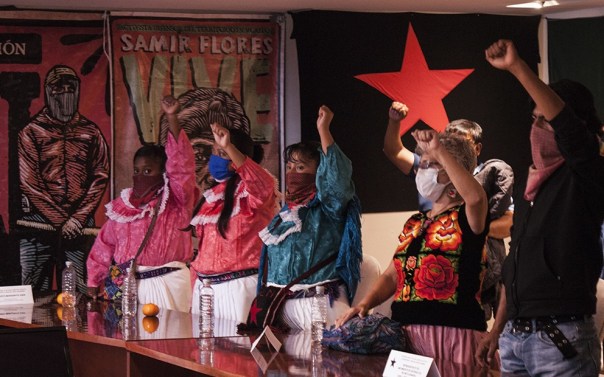
Otomí women in the INPI building
By: Sara Frabes
Last March 6 and 7, 2021 diverse indigenous women coming from different Native peoples of Mexico met in the building that previously served as the National Institute of Indigenous Pueblos (INPI), to hold the 3rd National Meeting of the Women of the National Indigenous Congress (CNI, its initials in Spanish).
The Otomí indigenous community residing in Mexico City has been occupying the space since October 12, 2020 due to the lack of response from the government to attend to their demands for housing.
In the meeting, the women worked around three months of analysis and debates that they called: Women and Territory; Women, Resistances and Autonomy; Alternatives to the Patriarchal System.
They took their measures for containing the propagation of Covid-19 and that’s how they worked for two days. Among the agreements they reached, they indicated that they joined the actions of the Otomí women who were tired of knocking on the doors of the rotating governments, “especially the current one so deceitful and lying,” they said in their statement.
In the same way, they spoke out “against the war against our brothers and sisters of the EZLN (Ejercito Zapatista de Liberación Nacional) and of those who murder the defenders of Mother Earth.”
They denounced that, in all regions of the country, the powerful ones of the patriarchal capitalist system are trampling on the rights and conquests of the Native peoples. “More and more women are experiencing worse living conditions. But we also see that, at the international level, the peoples of the world are experiencing the same situations of greater dispossession, greater destruction, greater exploitation and greater repression,” the indigenous women asserted.
They warned that what the planet is experiencing is a war of extermination on a global scale; therefore, they announced that: “together with our Zapatista compañeros and compañeras, we are seeing the importance of linking ourselves with all the peoples of the world from below and in struggle, particularly with women. To learn, to talk about the owners of the companies that come to destroy us,” said the indigenous women about the upcoming tour that the EZLN and members of the CNI will make to Europe.
“Our response is collectivity and community, from the smallest corner to the whole planet,” they said.
————————————————————————
Originally Published in Spanish by Avispa Midia
Monday, March 8, 2021
Re-Published with English interpretation by the Chiapas Support Committee
 Chiapas Support Committee