Chiapas Support Committee
Home of the Compañero Manuel blog on zapatistas & mexico
29 Soldiers “trapped” in Aldama, due to paramilitary fire

By: Elio Henríquez
San Cristóbal de Las Casas, Chiapas
Around 29 soldiers from the Base of Mixed Operations (BOM, its initials in Spanish) were trapped since 11 am this Friday in Cokó community, due to attacks from the Santa Martha paramilitary group in Chenalhó municipality, reported Adolfo López Gómez, the mayor of Aldama.
“They can’t move because the shots from firearms are going directly at them and they are fiercely attacking the trucks that travel from Xuxchén to San Pedro Cotzilnam,” he added, while clarifying that no injuries have been reported.
He explained that at 2:12 pm yesterday “paramilitary groups from the Santa Martha sector positioned at the telesecondaria, Tojtic and T’elemax are fiercely attacking the BOM that made tours in Tabak and Cokó communities.”
He explained that in addition to attacking the trucks that were traveling from Cuxchén to San Pedro Cotzilnam, they shot at a tractor that was headed to the community of Xuxchen, because of which “it’s stuck due to the bullets.”
López Gómez reported at 4 pm: “they’re shooting from Tijera Caridad, Templo and Chuchté, and are attacking the communities of Stzelejpotobtic and Juxton in Aldama.”
Just May 8, armed subjects from Santa Martha murdered Pedro Lunes Pérez, 24, a native of Cokó, Aldama, while the authorities of that municipality were holding a meeting at the City Hall.
—–Ω—–
Originally Published in Spanish by La Jornada on Saturday, May 15, 2021
https://www.jornada.com.mx/2021/05/15/estados/026n1est
Re-Published with English interpretation by the Chiapas Support Committee
Zapatismo today and the anti-capitalist struggle

By: Magdalena Gómez
The voyage across the sea of the Zapatista delegation Squadron 421 undertaken this past May 2nd from Isla Mujeres on the ship re-christened for its international tour as La Montaña, destination Port of Vigo in Galicia, Spain, obeys a clear line publicly maintained by the EZLN since January 1, 1994. It was preceded by an assessment of the global circumstance that has provoked the pandemic we are still living in, that which, together with the viral threat, has also caused isolation, despite the efforts deployed to the effect that the lock-down does not shut you up.
Without setting aside the root cause and origin of the climate change phenomenon caused by the devastating deployment of capitalism that razes both nature and life, to point out one of its catalyzing elements. The first analyses about the Zapatista initiative translate the statement of Subcomandante Galeano: a mountain sailing against the grain of history, as an inverse voyage across the Atlantic to the one made by the invaders, the so-called conquistadors, more than 500 years ago.
And here the first counterpoint is given: we don’t accept, they have pointed out, that the indigenous peoples were defeated, much less conquered; we continue living, fighting and resisting. As such, the Zapatistas reject any such plea for pardon. “For what would Spain ask our forgiveness? For having given birth to Cervantes, León Felipe, García Lorca, Picasso, the Republic and the exile from the Republic of Mexico, among many others?” … a position that contrasts with the current line of the so-called 4T. They will be in Madrid the 13 of August of 2021, Subcomandante Moisés stated in a communiqué, 500 years after “the supposed conquest,” and there they will speak to “the Spanish people” – “not to threaten, insult or reproach, nor to demand that they ask for our forgiveness. Enough of toying with the distant past to justify, with demagoguery and hypocrisy, the crimes of today. He pointed out that on this tour, they are neither seeking difference, nor superiority, not confrontation, and much less pardon and pity. We will go to find what makes us equal.”
This axis of the Zapatista struggle was expressed in the First Intercontinental Encounter for Humanity and Against Neoliberalism, known as the Intergalactic, carried out in August of 1996 in the mountains of the Mexican southeast, which 3,000 people from 45 countries attended. Since then, many of them have maintained a connection of close relationship and support with the EZLN.
Among the many dimensions of this initiative is the decision to acknowledge them in their nations. This is the meaning of their claims that they are traveling to see their old alter-globalist acquaintances, that today (as yesterday), are tireless fighters against fascism, generous organizers of migrants, vital builders of new forms of urban coexistence, brave trade unionists in a precarious labor world, and seasoned topplers of statues of slave traders and colonialists.
As the magazine Ojarasca pointed out, “they are going to the Europe of below, attentive to exiles and involuntary nomads, to the critical autonomies, to the radical rejection of environmental destruction, to the anticapitalists with their national governments, be they the dented crowns of Spain and the United Kingdom, the right-wing republics of France, Italy, Germany, Hungary, or the dictatorship of Turkey. They are going, that is, to the Europe of the migrants themselves.
The indigenous squadron that now crosses the Atlantic, is not going to meet the comfortable citizens of the old and, indeed, already decrepit world, albeit still rich, unequal and powerful. They go with the true autonomists, with those that resist, with the youth that want to learn from the news of the New World, that the new generation of Zapatista support bases brings them. It is the multiplication of the Marichuy effect in the elections of 2018, in its moment considered symbolic, but that today casts a shadow of authenticity and dignity over the electoral and partisan pantomime of 2021.” (May, No. 289)
With this gaze and understanding, it remains clear that the much-repeated arguments against any Zapatista initiative are unfounded. In 1994, they said that the rebellion impaired the triumph of Salinismo in the implementation of NAFTA, later they said he was the person that was appeasing them, and now in recent times, since 2006 all of their strategies, according to paranoia, are aimed at affecting the current occupant of the Presidency of the Republic. The Zapatista movement has placed its efforts into promoting anti-capitalist organizing and now it is doing it on a global scale. What impact will it have? That depends largely on the circumstances of the organizations and collectives in their respective nations.
—–Ω—–
Originally Published in Spanish by La Jornada on Tuesday, May 11, 2021
https://www.jornada.com.mx/2021/05/11/opinion/013a2pol
Re-Published by the Chiapas Support Committee with English interpretation by Schools for Chiapas
Capitalist Crisis and social control
By: William I. Robinson*
President Joe Biden’s decision, last April 15, to expel 10 of the Kremlin’s diplomats and impose new sanctions against Russia for its alleged interference in the 2020 US presidential elections –which Russia already answered- caused the Pentagon to carry out naval exercises off the coasts of China a few days later. The two actions represent an escalation of aggressions with Washington’s zeal to intensify the “new cold war” against Russia and China, leading the world increasingly towards international political-military conflagration.
Most observers attribute this war, instigated by the United States, to rivalry and competition over international hegemony and economic control. However, these factors only explain this war partially. There is a bigger picture –which has been overlooked– that drives this process: the crisis of global capitalism.
This crisis is economic, with chronic stagnation in the global economy. But it’s also political, a crisis of legitimacy of the State and of capitalist hegemony. In the United States, the dominant groups strive to divert the generalized insecurity produced by the crisis towards scapegoats, like immigrants or external enemies like China and Russia. The growing international tensions legitimize the increase in military and security budgets and open new lucrative opportunities through the conflicts and extension of the transnational systems of social control and repression.
The levels of global social polarization and inequality being currently recorded are unprecedented. In 2018, the richest one percent of humanity controlled more than half of the global wealth while the 80 percent of the poorest had to settle for just 5 percent. These inequalities undermine the system’s stability, while the gap grows between what the system produces or could produce and what the market can absorb.
Transnational corporations registered record profit levels between 2010 and 2019, at the same time that corporate investments diminished. The total amount of money in reserves of the 2,000 largest non-financial corporations in the world rose from 6.6 billion dollars to 14.2 billion dollars between 2010 and 2020 –an amount above the total value of all the foreign exchange reserves of the planet’s central governments– at the same time that the global economy remained stagnant.
The world economy has come to depend increasingly on the development and deployment of systems of war, transnational social control, and repression, simply as a means of profiting and continuing to accumulate capital in the face of chronic stagnation and saturation of global markets. The events of September 11, 2001 marked the beginning of an era of permanent global war in which logistics, war, intelligence, repression, monitoring and tracking, and even military personnel are more and more in transnational capital’s private domain.
The Pentagon’s budget grew 91 percent in real terms between 1998 and 2011, while globally, state military budgets as a whole grew 50 percent between 2006 and 2015, from 1.4 billion dollars, to 2.03 billion. During this period, the military-industrial complex’s profits quadrupled.
The multiple conflicts and social control campaigns in the world involve the fusion of private accumulation with state militarization. In this relationship, the State facilitates the expansion of opportunities for private capital to accumulate profits, like facilitation of the global sale of armaments by companies from the military-industrial-security complex. Global sales of armaments on the part of the 100 largest manufacturers increased 38 percent between 2002 and 2016.
In 2018, the then-US President, Donald Trump, announced the creation of a sixth service of his armed forces, the so-called “Space Force,” on the pretext that it was necessary for the United States to face growing international threats. But behind the scenes, a small group of former government officials with strong ties to the aerospace industry lobbied for its creation for the purpose of expanding military spending on satellites and other space systems.
Last February, the Federation of American Scientists denounced that behind Washington’s decision to invest no less than 100 billion dollars in a renovation of the nuclear arsenal, the companies that produce and maintain said arsenal constantly lobbied. The Biden administration announced with fanfare in early April that it was withdrawing all US troops from Afghanistan. However, its 2,500 soldiers in that country pale in comparison to the more than 18,000 private contractors deployed by the United States, among them at least 5,000 soldiers on the payroll of private military corporations.
But while the profit of transnational capital and not the external threat is the explanation for the expansion of the US state and corporate war machine, this expansion needs to be justified by official State propaganda and the new cold war serves that purpose.
The zeal of the capitalist State to externalize the political consequences of the crisis increases the danger that international tensions will lead to war. American presidents historically have the highest approval rating when they launch wars. George W. Bush’s rating reached an all-time high of 90 percent in 2001, as his administration was preparing to invade Afghanistan, while his father’s administration, that of George H. W. Bush, achieved a rating of 89 percent in 1991, following his declaration that he successfully concluded the (first) invasion of Iraq and the “liberation of Kuwait.”
* Professor of sociology and global studies at the University of California, at Santa Bárbara. Siglo XXI recently published his book (in Spanish) “El capitalismo global y la crisis de la humanidad” (Global capitalism and the crisis of humanity)
—–Ω—–
Originally Published in Spanish by La Jornada
Thursday, May 6, 2021
https://www.jornada.com.mx/2021/05/06/opinion/015a2pol
Re-Published with English interpretation by the Chiapas Support Committee
Paramilitary group deprives Pedro Lunez Perez of his life as the National Guard patrols nearby

FRAYBA ISSUES A CALL FOR SOLIDARITY!
– The Mexican State fails to comply with precautionary measures granted by the IACHR in favor of the population of Aldama.
– The federal and state governments submit to paramilitary violence in Chiapas.
The Fray Bartolomé de Las Casas Human Rights Center (Frayba) received information from the Permanent Commission of the 115 Community Members and Displaced Persons of Aldama, stating that today, around 2:00 p.m., Mr. Pedro Lunez Pérez, 24 years old, lost his life. This appalling and irreversible incident occurred in the community of Coco, municipality of Aldama, while Pedro Lunez was inside his house. It is the result of constant gunfire by the paramilitary group located in the territory of Santa Martha, municipality of Chenalho, which enjoys total impunity.
Since yesterday, the gunfire from the territory of Santa Martha, municipality of Chenalho, has been directed towards the inhabitants of the municipality of Aldama, Chiapas. The Permanent Commission of the 115 community members and displaced persons of Aldama, once again reported that today, at approximately 2:00 p.m., the armed aggressions began again. The unfortunate death occurred while the National Guard and state police were near the community of Coco.
At the close of this urgent action, the armed attacks by the Santa Martha paramilitary group continued. At approximately 16:29 hours, gunshots were fired from El Puente, Santa Martha Chenalhó, in the direction of the community of Juxton, municipality of Aldama. At 17:44 hours, high caliber gunfire came from the attack points of Tijera Caridad, Puente, Kante, Panteón, and Chuchte de Santa Martha Chenalhó.
The Maya Tsotsil population living in the communities of Coco, Tabac, Xuxchen, San Pedro Cotzilnam, Chayomte, Juxton, Tselejpotobtic, Yeton, Chivit, Sepelton, Yoctontik and the Municipal Seat of Aldama, recently benefited from the granting of Precautionary Measure no. 284-18, according to Resolution 35/2021 of April 23, 2021 of the Inter-American Commission on Human Rights (IACHR), where it considered “that the situation meets prima facie the requirements of gravity, urgency and irreparability contained in Article 25 of the Rules of Procedure of the IACHR”, requesting the Mexican State to:
- A) Adopt the necessary, and culturally relevant, security measures to protect the life and personal integrity of the beneficiary families; specifically, to guarantee security within their communities, and during their displacements, with a view to preventing threats, harassment, intimidation or acts of armed violence by third parties;
- B) Agree on the measures to be adopted with the beneficiaries and their representatives; and
- C) Report on the actions taken to investigate the facts that gave rise to the adoption of this precautionary measure and thus prevent its repetition.
Frayba expresses its deep concern for the unfortunate incidents that took place today, once again the Tsotsil people are in mourning. It also points out that it is very serious that the Mexican State is still not implementing the precautionary measures in order to prevent armed attacks, so we urgently demand the adoption of the precautionary measures granted by the IACHR in favor of the Mayan Tsotsil population of the municipality of Aldama; We also demand an exhaustive investigation to find those responsible for the armed attacks by paramilitary groups that act under the cover of impunity, terrorizing, torturing and displacing the population and that have resulted, in addition to the loss of human lives, as the Mexican government’s failure to intervene effectively bets on the extermination of the people.
SIGN THE URGENT ACTION!
We call on national and international solidarity to sign this urgent action available at www.frayba.org.mx and write to the Mexican authorities to disarm the violence in the territory.
—–Ω—–
Originally Published in Spanish by Frayba.org.mx
Saturday, May 8, 2021
Re-Published by the Chiapas Support Committee with English interpretation by Schools for Chiapas
The EZLN maritime delegation docks in Cuba
La Montaña crosses the sea to the first free territory of America
By: Elio Henríquez
San Cristóbal de Las Casas, Chiapas
Subcomandante Galeano affirmed that Ludwig, captain of the ship named La Montaña, which carries the maritime delegation of the Zapatista National Liberation Army (Ejército Zapatista de Liberación Nacional, EZLN) to Europe, recommended setting sail on May 2 and not May 3, “thinking of his passengers, as it should be.”
In a communiqué titled “On the Sea,” [1] he added that: “the heavy sea forecast for the 3rd was going to make novices [email protected] suffer [email protected] more than necessary. That’s why the captain proposed moving up the departure” for Cuba, the first free territory in America.
Alluded to the fact that: “Subcomandante Insurgente Moisés listened to him and agreed. So, now that it’s customary to use the word ‘historical’ for anything, it’s the first time that Zapatismo has dome something programmed before it was announced (we usually get hung up and start late). Ergo: it’s something historical in Zapatismo.”
He stated that the Squadron 421, made up of four women, two men and one non-binary person (“unoa otroa”), set sail at 4:11 pm on May 2, and is scheduled to dock in June “on the coasts of the port of Vigo, Spain.”
Galeano presented “two different reports on the same stretch of navigation,” from the ship that sailed from the Isle of Women (Islas Mujeres), in the state of Quintana Roo.
“Report from Squadron 421 to the Zapatista high command: itinerary of the ship La Montaña. The hours are given in the official time of Mexico City. May 2, 2021. At 4:11 pm, La Montaña began her journey at a speed of four knots. At 4:21:30 she headed south-southeast and, at 5:23:04 pm La Montaña began a gentle curve to the east. At 5:24 pm she executed maneuvers to deploy all her sails. The crew, with support from Squadron 421, was hoisting the sails; 10 minutes later she continued the turn and headed towards the east. She completed the curve and headed northeast, arriving at the island.
At dawn on May 3 it said: “At 1:42 am, La Montaña approaches the coasts of Cuba. A few miles southwest of Cabo Corrientes, the captain decides to enter the bay. On May 4, 2021, he restarted his navigating, now in a west-southwest direction. At 5:45:30 pm, off Cabo Corrientes, he heads south-southeast. The last report received is at 11:16 pm on May 5. He’s heading towards Cienfuegos, Cuba, to arrive there on May 6.”
In Cienfuegos, he affirmed, La Montaña will have to refuel and dock for a few days. It is reported that Squadron 421 is doing well and getting adjusted, “without gummies and only mild dizziness.”
[1] Photos and several music videos are attached to the communiqué “On the Sea/Sobre El Mar.” Here are the links:
—–Ω—–
Originally Published in Spanish by La Jornada on May 8, 2021
https://www.jornada.com.mx/2021/05/08/politica/011n1pol/
Re-Published with English interpretation by the Chiapas Support Committee
Journey for Life versus Military Accumulation

By: Gilberto López y Rivas
While the EZLN’s 421st Maritime Squadron prepares to launch on May 3rd in the ship called La Montaña for the port of Vigo, Spain, to meet with the Europe of those from below, in the municipality of Chilón, in northern Chiapas, the government of the Fourth Transformation attempts to impose one of the many barracks under construction in the country, despite the rejection in this case, of the Tzeltal communities, of its own community government, of the Movement in Defense of Life and Territory and of inhabitants of San Sebastian Bachajón, according to the well-founded denunciation of colleague Aldo Santiago.
For its part, the Fray Bartolomé de las Casas Human Rights Center evidenced the consolidation of the Army’s activities in public life, citing the recent report of Amnesty International, in which it reports that the government of AMLO deployed more active military personnel in its public security strategy than the two previous presidential administrations. In that report, it makes mention of the decree issued, in the midst of the pandemic, which allowed the permanent deployment of the armed forces of public security until March of 2024, clearly warning: The decree lacked the substantive regulations to guarantee that the behavior of the armed forces was in compliance with international norms. The President also announced that control of the ports and customs checkpoints would pass to the armed forces ( Ibíd., p. 305).
Amnesty International points out the continuation of the threats and harassment against people that defend human rights in México, placing the number of defenders murdered during the current government at 24. Likewise, this organization shares: “Defenders of environmental rights and the rights of indigenous peoples demonstrated their concern about the megaproject known as the Maya Train. The President reacted accusing them publicly of being ‘fake environmentalists.’ Six special United Nations rapporteurs sent a letter to the government expressing a series of reasons for their concern about the Maya Train project, some of them related to the rights of indigenous peoples to the land and to health, and also with the possible environmental consequences of the project ( Ibíd., p. 307).
For its part, the representative of the Office High Commission for Human Rights of the United Nations, Guillermo Fernández-Maldonado, declared that in light of the decision of AMLO’s government to confer control of the infrastructure megaprojects and other administrative areas (like the construction of airports, railways, and also bank branch offices, nurseries, etcetera) to the armed forces, the government should apply criteria for transparency in the utilization of resources, a taboo issue as it concerns the armed forces, as I confirmed as a federal deputy, in the failed efforts to make their budget exercise transparent.
In Morelos, the thermoelectric plant in Huexca, that the President, as a campaigning president, compared to a toxic dump in Jerusalem, continues its destructive course for its start-up, pillaging the waters of the campesina communities, poisoning the air with harmful substances that escape its chimneys, killing the fish of nearby water currents with its toxic residues and making life impossible for those who live in the community, for the infernal noise when it begins operations; A sit-in for months, in front of the main entrance to the plant, the rejection of the residents to the violence against the people was evident, while the crime of Samir Flores Soberanes remains unpunished and the company remains among those in first place for serious crimes, significantly occupying second place in femicides.
Militarized accumulation continues on the Interoceanic Corridor of the Isthmus of Tehuantepec, with the concentration of the largest number of active military personnel in the entire country and also the construction of barracks of the National Guard in Juchitán and Zanatepec, Oaxaca, not without the resistance of the peoples, most active in the Oaxaca portion, with organizations like the Assembly of the Peoples of the Isthmus in Defense of Land and Territory, while in Veracruz it’s found in the so-called Process of Articulation of the Sierra Santa Martha, a member of the National Indigenous Congress. Less than a month ago, AMLO announced that the Mexican Navy would be in charge of protecting the Interoceanic Corridor.
The delegation of the EZLN, CNI-CIG and the Peoples’ Front in Defense of Water and Land of Morelos, Puebla and Tlaxcala in its voyage to Europe goes representing the Mexico of emancipation and of rebellion, of below and to the left.
—–Ω—–
Originally Published in Spanish by La Jornada on April 30, 2021 with English interpretation by Schools for Chiapas, lightly edited and Re-Published by the Chiapas Support Committee
IACHR orders stopping the attacks in Aldama
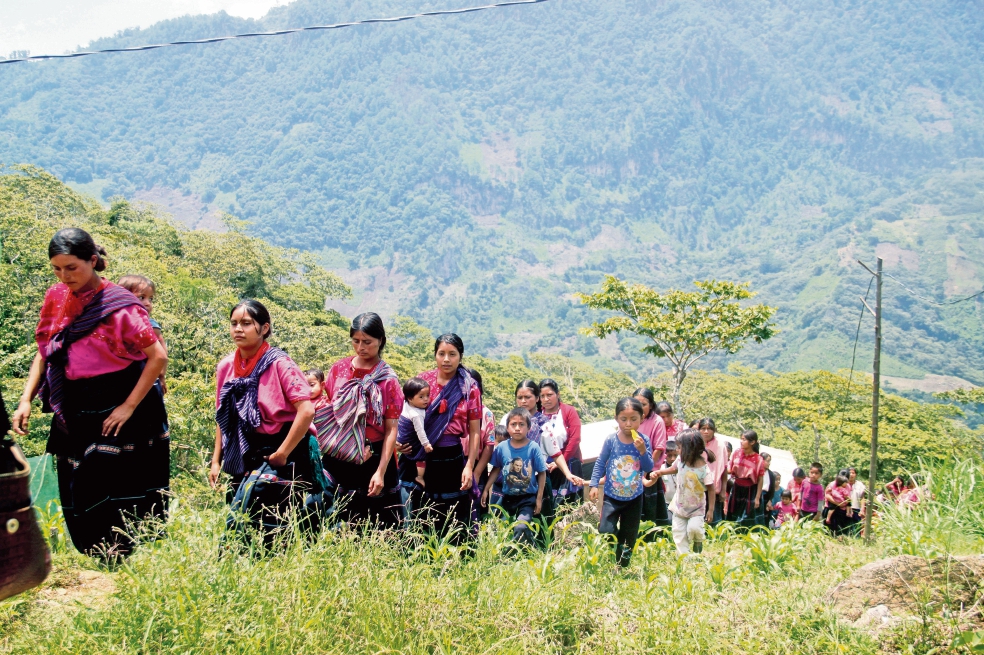
DISPLACED INDIGENOUS WOMEN of ALDAMA. PHOTO: MARÕA DE JES/S PETERS
By: Isaín Mandujano
From Washington this Tuesday the Inter-American Commission on Human Rights (IACHR) ordered the government of Mexico to implement precautionary measures in favor of the indigenous families of 12 Aldama communities, who live under fire from civilian armed groups that operate in Santa Martha, Chenalhó.
Today, the IACHR announced Resolution 35/2021 issued last Friday, April 23 in the bosom of that international body of the Organization of American States (OAS), a resolution that requires the government of Mexico to put an end to the continuous harassment and attacks that the civilian Tsotsil indigenous populations of Aldama experience.
The precautionary measures are in favor of the Tsotsil indigenous families that live in the following twelve communities: Coco´, Tabac, Xuxch´en, San Pedro Cotzilnam, Chayomte, Juxtón, Tselejpotobtic, Yetón, Chivit, Sepelton, Yoctontik and Aldama (the town and municipal capital) that are in Aldama Municipality.
Since 2018, these 12 communities have suffered various deaths and injuries to people with permanent consequences due to shots from civilian armed groups that operate from the Santa Martha Sector in Chenalhó municipality, the neighbor municipality of Aldama.
In an official letter, the Commission considered that the situation meets “prima facie” the requirements of gravity, urgency and irreparability contained in Article 25 of the IACHR Regulations.
The request filed by organizations such as the Fray Bartolomé de Las Casas Human Rights Center and the National Network of Civil Human Rights Organizations “All Rights for Everyone” (TDT Network) alleged that indigenous families in the Aldama communities are “in an situation of risk as a result of attacks, harassment and threats due to the presence of armed people in the area, which would have caused them to be displaced at different times, in the context of a territorial conflict in the area.”
Given this, the IACHR evaluated the actions adopted by the State for attending to the alleged situation; “however, after monitoring the issue, it warned that armed attacks continued to occur, despite having a Non-Aggression Agreement; as well as also the having the considerations of the National Human Rights Commission who, at different opportunities, urged the State to guarantee the rights of the area’s inhabitants.”
Consequently, in accordance with Article 25 of IACHR Regulations, the Commission asked that the Mexican government: “adopt the necessary and culturally appropriate security measures to protect the life and personal integrity of the beneficiary families; specifically, to guarantee security within their communities, and during their displacements, with a view to preventing threats, harassment, intimidation or acts of armed violence on the part of third parties.”
Likewise, it demanded that the government of Andrés Manuel López Obrador “agree on the measures to be adopted with the beneficiaries and their representatives; and report on the actions taken for the purpose of investigating the facts that led to the adoption of this precautionary measure and thus prevent their repetition.”
It explained that the granting of this precautionary measure and its adoption by the State do not constitute a prejudgment of a petition that may eventually be filed before the Inter-American System about a possible violation of protected rights in the applicable instruments.
The IACHR recalled that it’s an organ of the Organization of American States (OAS), whose mandate emerges from the OAS Charter and the American Convention on Human Rights. And that the Inter-American Commission has the mandate to promote the observance and defense of human rights in the region and act as an OAS consultative body on the matter.
—–Ω—–
Originally Published in Spanish by Chiapas Paralelo on April 27, 2021 and Re-Published with English interpretation by the Chiapas Support Committee
The Mountain and the night sky of the Lacandón

By: Luis Hernández Navarro
Since the beginning of the insurrection calendar, the image of the ship has been a central part of the metaphors of the Zapatista narrative. It is a curious irony that a political-military force territorially located in the jungles and mountains of Chiapas, hundreds of kilometers from the sea, uses it as a symbol of its emancipatory project.
It should not seem strange then that, the ship “La Montaña” (“The Mountain”) and the Zapatista delegation have weighed anchor in Isla Mujeres to cross the Atlantic towards the port of Vigo. The night sky of the Lacandón Jungle has always been a kind of sea so large that neither its beginning nor its end can be seen, and in which dreams of all kinds of utopias navigate freely, propelled by the air. What’s new now are not the fantasies of an aquatic landing on the old continent, but rather that more that 26 years after announced, they have come true.
In a postscript dated January 30, 1996 that alerts NATO, the late Subcomandante Marcos assures that Durito, that beetle that the guards later confuse with a dwarf rhinoceros, and that different witnesses claim to have seen boarding “La Montaña,” was persistent with the idea of “landing and initiating the conquest of Europe.” However, the Sup declined to be part of the undertaking because “the boat that he prepares looks too much like a can of sardines,” he fears that they want to take him as an oarsman and most of the dampness cause him dizziness.
“La Montaña,” the ship in which the EZLN’s 421st Squadron travels, is not a “can of sardines” like Durito’s, but it has years on its back. It was built at the A. Vujik & Zonene shipyards, in Holland, in 1903, as a fishing vessel. She is not a big ship. Her dimensions are 27 x 6.55 x 2.8 meters. Over the years she has been repaired and improved. Her first two-cylinder engine was made in 1931 in Finland. In 1963, they exchanged it for a 280 horsepower engine, manufactured in 1955. That is the one she continues using to this day. In 2011, the ship was rebuilt in Hamburg. Since 2005 she has been sailing the seas of Panama, Colombia and Jamaica.
Ships, as vehicles to travel to another world, are core pieces of the Chiapan rebels’ project. In the postscript of the essay “Neoliberalism: history as a comic strip,” dated April 6, 1996, presented at the American Continental Gathering for Humanity and against Neoliberalism, Subcomandante Marcos writes: “Old Antonio discovered that all those who got on the boat are the same ones who had always been excluded from all the boats.
“And that’s why they got on –Antonio told Subcomandante Marcos– because those men and women, and young people, some prisoners, the majority indigenous, ‘no longer want to obey orders, but rather want to participate, be captains and sailors and to make that ship advance towards a bigger future, with seriousness and joy, meeting men.”
The First Intercontinental Gathering for la Humanity and against Neoliberalism, also known as the “Intergaláctica,” held in August 1996 in the mountains of the Mexican southeast, was a key moment, in the forging of a network of planetary resistances against neoliberalism. Echoes of that meeting were seen starting with the protests against the World Trade Organization in 1999 in Seattle, and throughout the cycle of alter-world struggles in Quebec, Prague, Sidney and Genoa. The attack on the Twin Towers in September 2001 derailed that wave of discontent and obliged orienting the mobilizations towards demands against the invasions of Afghanistan and Iraq.
Convened by the EZLN, more than 3,000 delegates attended the Intergaláctica, half of them foreigners from 42 countries, hell-bent on constructing a new world. Representatives were present from a broad political spectrum of the left: from infrared to ultraviolet. Debates of the highest level and theoretical pertinence alternated with meetings somniferous meetings, to diagnose the nature of savage capitalism and anticipate ways of resistance and rupture.
Stimulated by the Zapatista gesture, liberating longings found social and political subjects capable of embodying them at the Intergaláctica. A broad and disperse planetary anticapitalist movement was founded there. “We dream – the event concluded among many other points – of a world where society doesn’t conform to patriarchal structures; of a world without militarism; a world without discrimination because of sex, race, creed, sexual orientation; a world where women, of any race, of any creed and of any class, enjoy pleasure at all its levels. A world without violence, a world where being a woman is a pleasure, and not an excessive workload.”
On their maritime journey to Europe, the Zapatistas are going to meet up with the history that they opened in that gathering, and that comes from far back. They are going to converse with those always excluded who have no place in other ships and don’t want to follow orders, but want to be sailors and captains, with whom they have had, since almost three decades ago, a relationship of solidarity, mutual support and learning. They are not going to meet with officials and governments. At a time of planetary urgency, beyond what happens at national borders or at electoral junctures, they are going to co-exist with their peers, with the Europe of below, to continue dreaming together of those utopias that navigate in the enormous night sky of the Lacandón Jungle.
—–Ω—–
Originally Published in Spanish by La Jornada on May 4, 2021 and Re-Published with English interpretation by the Chiapas Support Committee
The Zapatista delegation set sail for Europe on Sunday in La Montaña
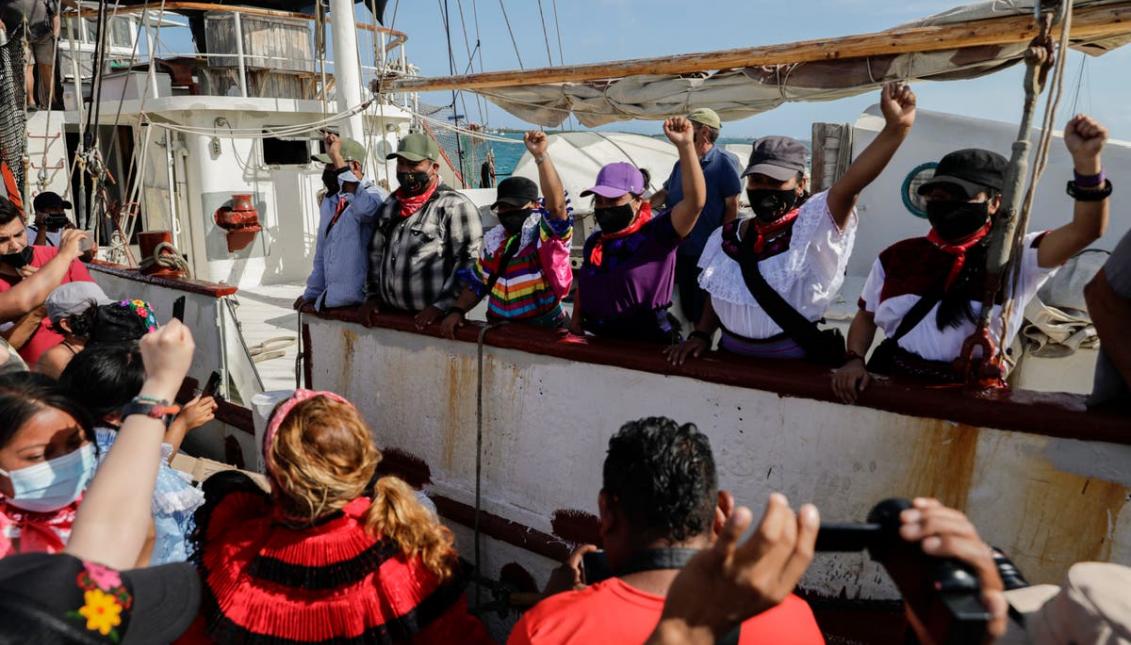
The departure of the ship with a German flag yesterday raised great expectation in Isla Mujeres. Photo: Víctor Camacho
By: Elio Henríquez
San Cristóbal De Las Casas, Chiapas
The Zapatista delegation named the 421st Squadron, made up of four women, two men and one non-binary person (unoa otroa), set sail on Sunday afternoon for Europa, a day ahead of schedule, apparently because bad weather is forecast.
The group left at 4 p.m. from the Isle of Women (Isla Mujeres), Quintana Roo, in La Montaña (The Mountain), the ship that will take them to the old continent, where they will visit at least 30 countries.
“We are following the route taken 500 years ago; in this case to sow life, not like 500 years ago, which is the opposite,” said Subcomandante Moisés, who accompanied the group from Chiapas.
In a collective interview, he added that: “you have to organize, you have to prepare, you have to defend, but together in the countryside and in the city, because what we eat comes from Mother Earth; although they are in the city, in 30 or 40 floors, we live on air, oxygen, water to drink, food for everyone and Mother Earth gives us that and whoever doesn’t fight for life is lost.”\
The Zapatista National Liberation Army (Ejército Zapatista de Liberación Nacional, EZLN) had reported in recent days that the sailboat would leave on May 3, the day of the Cross, “to cross the Atlantic on a journey that has a lot of challenges and no reproach, and in the sixth month of the calendar it will be in sight of the coasts of the port of Vigo (Ciudad Olívica), Pontevedra, in the autonomous community of Galicia, Spanish State.”
However, since April 30 there were rumors that they might move up the departure date; on Saturday, May 1st, the ship’s captain commented to some members of the group that accompanied the Zapatista delegation to Isla Mujeres that it was possible that they wouldn’t leave on the 3rd, but rather on May 2, due to the forecast of bad weather.
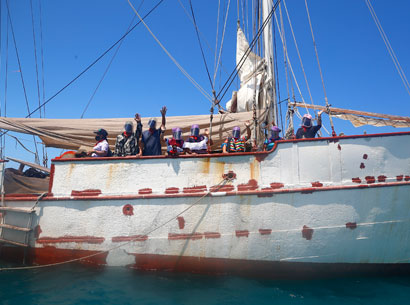
Javier Elorriaga, one of the Zapatista collaborators who were in Isla Mujeres, communicated messages by telephone on Saturday to some reporters: “We leave tomorrow. We’ll advise you.” Yesterday afternoon, reporters were notified that the boat would leave shortly thereafter.
Before departing, a commission from the National Indigenous Congress that arrived from Mexico City, as well as the rest of the people who accompanied it from Chiapas, bid farewell to the EZLN representation.
The delegation departed amid the scandal and even amazement of hundreds of tourists, many from the United States, who were getting on and off boats that arrived or left from the docks where La Montaña was anchored, while they ate or drank something in the restaurants located in the area.
Once the sailboat, which Elorriaga boarded, set sail, Moisés returned by ferry, together with the rest of his companions, presumably to return to Chiapas, where the delegation left on April 26.
According to the EZLN, “the trip is supposed to take from six to eight weeks and it’s estimated that they will be off the European Coasts in the second half of June.”
—–Ω—–
Originally Published in Spanish by La Jornada on May 3, 2021 and Re-Published with English interpretation by the Chiapas Support Committee
Frayba and Sipaz accompany the convoy

EZLN milicianos and support bases received the Zapatista delegation that will travel to Europe in the Roberto Barrios Caracol. The tour through the Mexican southeast will conclude when they set sail on May 3 from Isla Mujeres, Quintana Roo, according to their itinerary. Photo: Víctor Camacho
By: Elio Henríquez
San Cristóbal De Las Casas, Chiapas
The Zapatista delegation called the 421st Squadron, made up of four women, two men and, as described by the Zapatistas, “unoa otroa” (one non-binary person), descendants of the Native Maya peoples, left on Monday morning for Isla Mujeres, Quintana Roo, from where it will set sail for Europe in the ship named La Montaña.
The retinue departed from the Comandanta Ramona Seedbed Caracol, in the official municipality of Altamirano, where leaders and support bases of the Zapatista National Liberation Army (Ejército Zapatista de Liberación Nacional, EZLN) said goodbye to them.
Subcomandante Galeano reported, in a communiqué titled The Route of Ixchel, that “on May 3, 2021, from Isla Mujeres, Quintana Roo, Mexico, La Montaña will set sail to cross the Atlantic, on a journey that has lots of challenge and no reproach. In the sixth month of the calendar, it will have in sight the coasts of the port of Vigo (Ciudad Olívica), Pontevedra, in the autonomous community of Galicia, in the Spanish State.”
He added that: “if we can’t disembark, be it due to Covid-19, immigration, French discrimination, chauvinism, or that we ended up at the wrong port or the wrong host, we are prepared,” he said.
He continued: “We’re ready to wait there in front of the European Coasts, and will unfold a large banner that says ‘Wake Up!’. We’ll wait there to see if anyone reads the message and then, wait a little longer to see if anyone wakes up; and a little while longer to see if anyone responds.”
Expressed that: “if the Europe of below doesn’t want or isn’t able to welcome us, then, we have four canoes (Cayucos), each with their own oars and we will undertake the return. “Of course, it will take awhile until we once again glimpse the shores of the house of Ixchel,” goddess of the moon.
Meanwhile, the Fray Bartolomé de Las Casas Human Rights Center (Frayba) and the International Service for Peace (Sipaz) announced that they will physically accompany the convoy of the EZLN’s maritime delegation as observers, which left this Monday for Isla Mujeres, in the state of Quintana Roo.
—–Ω—–
Originally Published in Spanish by La Jornada on Tuesday, April 27, 2021 and Re-Published with English interpretation by the Chiapas Support Committee
 Chiapas Support Committee