Chiapas Support Committee
Home of the Compañero Manuel blog on zapatistas & mexico
They liberate the 17 students and 2 displaced indigenous people, but prohibit political activism

By: Isaín Mandujano
Today, a control judge of the El Amate Prison issued the binding to criminal proceedings of the 17 teachers college students (normalistas) and 2 displaced indigenous people, but granted them the precautionary measure of facing their proceedings at liberty and prohibited them from repeating their political activism while they continue in those proceedings.
The State Judicial Power reported this morning that giving continuity to Due Process, and at the request of the Defense before the evidence of the State’s Attorney General, a judge decided a change of the Precautionary Measure for the 17 Mactumactzá Rural Teachers College students (normalistas) and 2 people displaced from the Ejido Puebla, in Chenalhó, setting for them a periodic sign-in and the restriction of activism in public spaces.
The 17 teachers college students and two people displaced from the Ejido Puebla, in Chenalhó, will face charges for the crimes of Robbery with Violence, Damages, Mutiny (Rioting), Attacks against the Peace, Corporal and Patrimonial Integrity of the Collectivity and Gang Activity, which they will face outside the El Amate Prison, with restrictions ordered by the authorities; in other words, they will not be able to participate in acts that alter the public order.
The State Judiciary said that the 95 people that were arrested at the ticket booth on the Chiapa de Corzo-San Cristóbal de Las Casas Highway on May 18, 2021 will continue bound over for trial (from their domicile or school) and that in case of reoffending, they will be re-entered into the El Amate Prison.
Among the 95 people initially arrested, 74 women first received the precautionary measure of periodic sign-in, while two minors were released without conditions and, finally, 17 normalistas and two people displaced from the Ejido Puebla in Chenalhó, received the measure of periodic sign-in, therefore all those arrested will continue to face trial.
Along with this news, teachers of the National Coordinator of Education Workers (CNTE), teachers college students, parents and diverse groups in solidarity with Mactumactzá, mobilized to block the Chiapas Tower in the state capital, headquarters of various state government agencies and also occupied the front of the Institute of Elections and Citizen Participation, which organizes the elections this Sunday, June 6 to elect 123 mayors and 24 local deputies.
In addition, while the prisoners were coming out of El Amate, teachers, normalistas and parents, blocked the Pan-American Highway at the prison to await the time when they would be released and receive the young people.
——Ω—–
Originally Published in Spanish by Chiapas Paralelo
Wednesday, June 2, 2021
Re-Published with English interpretation by the Chiapas Support Committee
Students and teachers initiate a sit-in to demand the students’ liberation
By: Isaín Mandujano
They denounced that a smear campaign has been orchestrated against Diego Cadenas, director of the K´untik Human Rights Center.
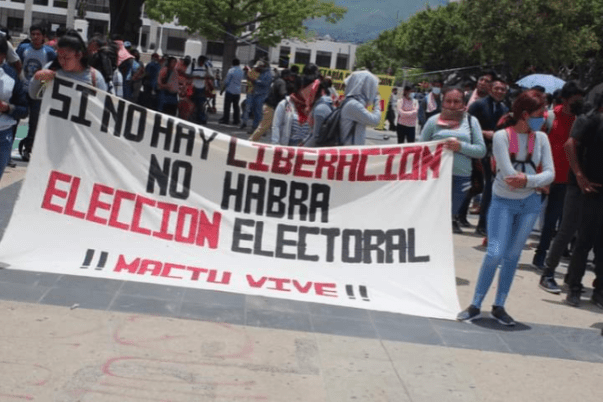
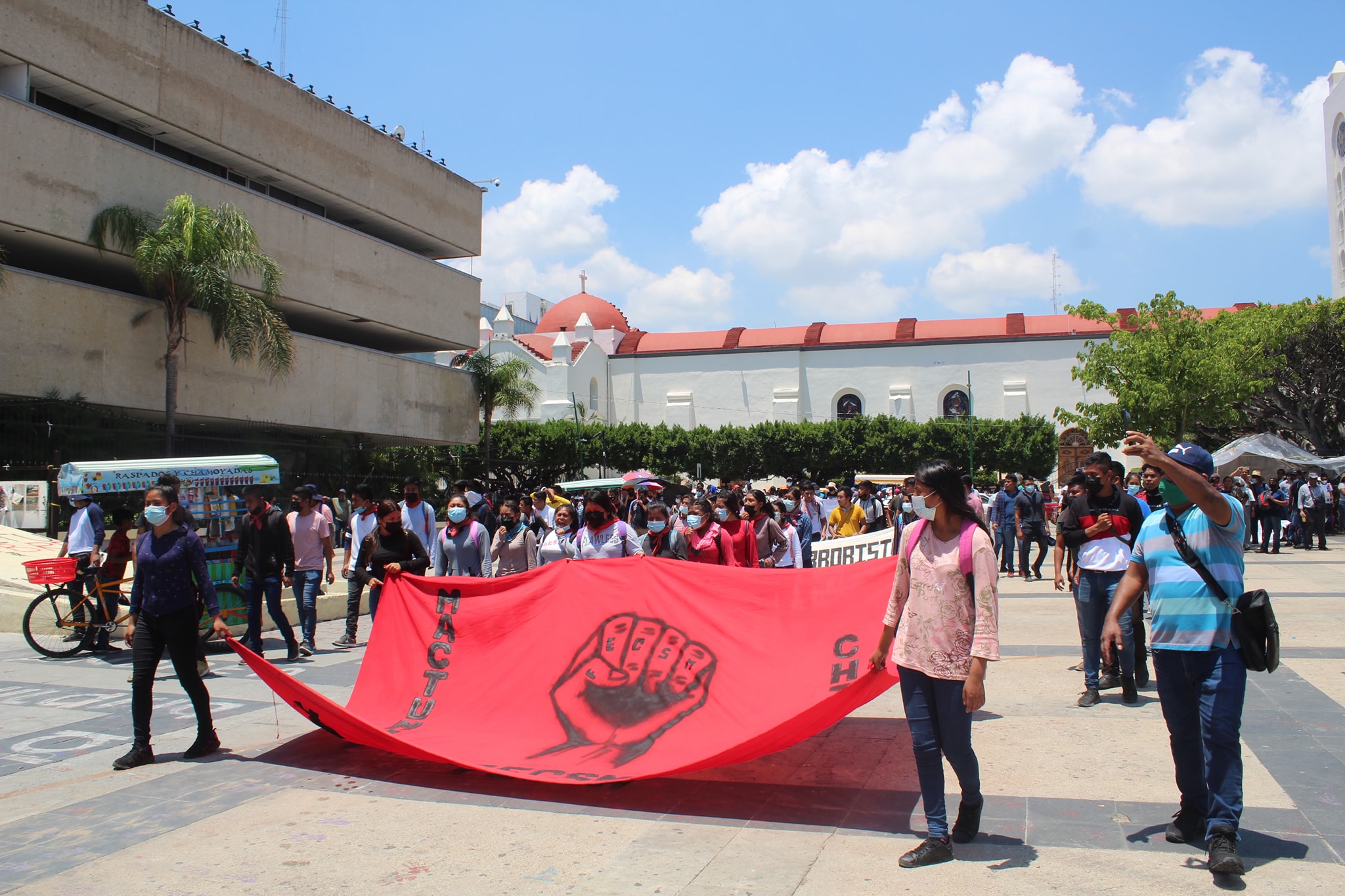
With the la slogan “if there’s no liberation, there’ll be no election,” [1] thousands of teachers from the National Coordinator of Education Workers (CNTE), teachers college students and parents of the students marched this Tuesday to demand the freedom of the 19 prisoners from the Mactumactzá Rural Normal School (a teachers college for indigenous and campesino students) and 2 from a group of displaced persons in solidarity with these young people.
They warned that the days of protest won’t stop until the 19 people arrested last May 16 in a police eviction operation when the students took the tollbooth on the Chiapa de Corzo-San Cristóbal de Las Casas highway are liberated.
From the eastern entrance of the state capital, the march advanced several kilometers to arrive at the state capital’s central plaza where they held a meeting and declared a sit-in to demand that Chiapas Governor Rutilio Escandón Cadenas release the prisoners.
The young people pointed out that they will not stop their protest actions in Chiapas or in other states where they have sister normal schools to demand that student prisoners are liberated.
Teachers from Section 7 and Section 40 of the National Education Workers Union (SNTE) adhered to the CNTE, ratified their support to the young Mactumactzá teachers college students and that they will join their protest actions as they have already done until the prisoners are released.
Pedro Gómez Bámaca, leader of Section 7, explained that the students are not alone and that they will continue in demanding that the prisoners are liberated and that a dialogue table is installed with the ability to negotiate and resolve the different problems that the Chiapas students and teachers outline. But, they said that no one should be surprised at the protest actions that will be carried out on Sunday June 6, because “if there’s no liberation there will be no election.”
In this context, they denounced that the human rights defender and founder of the Ku’untik Human Rights Center, Diego Cadenas, has been the of threats and media harassment derived from his accompaniment and solidarity with the Mactumactzá teachers college students and the youths displaced from the Ejido Puebla, in Chenalhó, who were arrested with them last May 18.
An example is the message Cadenas received on May 23, 2021 through the profile name of Rubí Espinosa in which it reads: “It would be a party to make Bámaca [líder de la CNTE en Chiapas], the teachers college students (normalistas) and you, Diego Cadenas, disappear. Chiapas would just be better (…).”
In addition, this May 31 and June 1, information published in the local media has suggested that Diego Cadenas is one of the “intellectual authors” of the mobilizations and protest actions carried out by the normalistas, their families and movements.
Rutilio Escandón Cadenas has already ordered initiating a smear campaign against me, or even better he wants to put me in prison. He supposes badly that I advise the students of the Mactumactzá Rural Normal School, nothing more naive. It ignores that in that heroic school the student base is in command. In their lampoons they ask for prison for the intellectual authors, insinuating that I and the Secretary General of Section 7 are them. Totally false, commented Cadenas.
It should be noted that due to his activism in defense of human rights in Chiapas, Diego Cadenas has Precautionary Measures of protection from the Inter-American Commission on Human Rights (IACHR), the human rights arm of the Organization of American States (OAS).
[1] The state of Chiapas holds local elections this Sunday, June 6, to elect 123 mayors and 24 local deputies.
—–Ω—–
Originally Published in Spanish by Chiapas Paralelo
Tuesday, June 1, 2021
Re-Published with English interpretation by the Chiapas Support Committee
New police eviction of Mactumactzá students
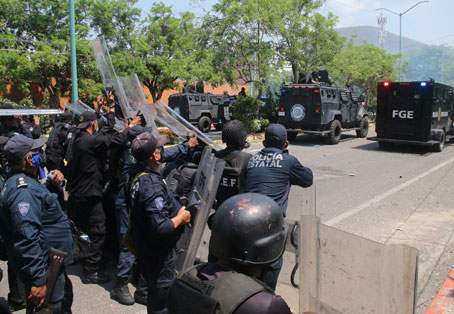
Chiapas police during the withdrawal of Mactumactzá Rural Teachers School students Photo: Juan Carlos Santiago Hernández
By: Elio Henríquez
San Cristóbal De Las Casas, Chiapas
“The police came to attack us, to repress us,” a member of the student committee said about the police eviction of which the Mactumactzá Rural Teachers School students were the object this Monday in Tuxtla Gutiérrez.
He said that with tear gases, the police evicted them and retreated towards the campus, when they were carrying out dissemination activities on the northern bypass of the capital to demand the release of their 19 compañeros, prisoners in the El Amate prison.
He said that: “we have already told them [the authorities] on repeated occasions that it’s not because we want to hold demonstrations or anything, but we want the release of our compañeros, because it’s something just, and the federal Executive must know that, because he also in his moment demonstrated and contested in elections, for what he believed was just and we also [do it] for what is just, the release of our compañeros who were practically deprived of their freedom.”
The eviction that took place this Monday morning (May 31) derived into a confrontation between police and the students that launched Molotov cocktails, stones, sticks and firecrackers.
The Secretariat of Citizen Security and Protection (SSPC, its initials in Spanish) reported that two police were injured, while the student leader, who asked for anonymity, said that several of his compañeros were hit by tear gas cartridges that the police “launched at close range,” in addition to intoxication from the substance.
The SSPC pointed out that after driving back the students, the agents recovered six units from different companies that the students had in their possession, including a Petróleos Mexicanos pipe con 20,000 liters of gasoline.
The student leader demanded that the state and federal governments: “heed our requests and release our compañeros. Enough of the harassment of students! We don’t want any more repression or violence, but rather dialogue, that they sit down to talk to us and that they listen to us and not just come, harass us, repress and even threaten us with death. We want a dialogue with the president [Andrés Manuel López Obrador] and the governor [Rutilio Escandón].”

Chiapas Police during the withdrawal of Mactumactzá students – Photo: Juan Carlos Santiago Hernández
He maintained that the area was “flooded” with tear gas because the agents threw hundreds of cartridges. “It is an injustice what the state government does to the teachers college students and displaced persons, so we’re going to continue fighting; we’re not going to permit the government and police to repress us. It didn’t matter to them that there were women and children inside the school,” said an indigenous woman displaced from Chenalhó who was in the school, where the gases reached.
The Chiapas government assured that the actions were carried out “in full compliance with the protocol for restoration of order,” while reporting that the police: “collected various explosive devices like bombs and spent grenades that the students used to attack the security forces, and which have already been made available to an agent of the Public Ministry.”
Last May 18, state police arrested 95 people –91 students and four people displaced from Chenalhó who joined their mobilizations– because they took possession of the tollbooth on the highway that connects San Cristóbal de las Casas to Tuxtla Gutiérrez. On May 23, 74 women students were conditionally released, while a judge linked 19 men, among them two displaced persons, to criminal process.
—–Ω—–
Originally Published in Spanish by La Jornada
Tuesday, June 1, 2021
https://www.jornada.com.mx/2021/06/01/politica/015n1pol
Re-Published with English interpretation by the Chiapas Support Committee
74 Mactumactzá Women Released
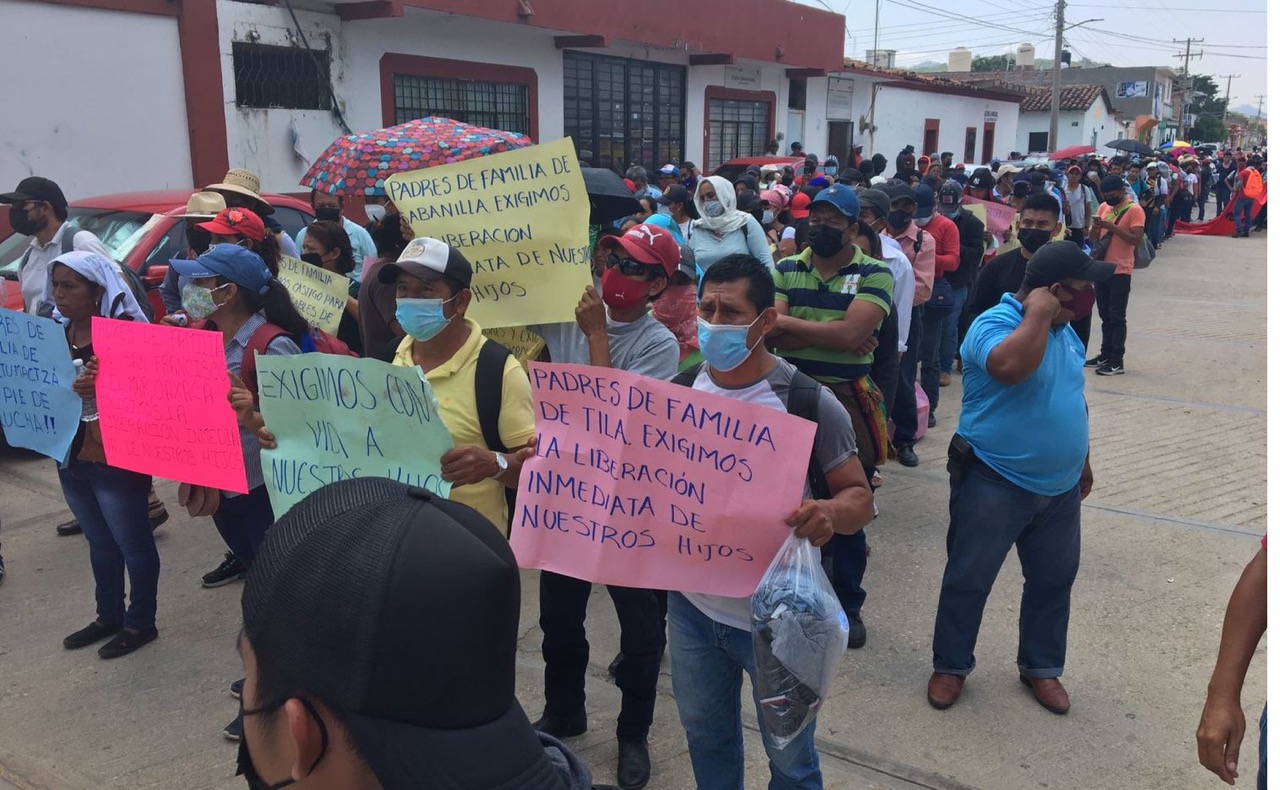
Demonstrations in support of the Mactumactzá students.
By: Elio Henríquez
San Cristóbal De Las Casas, Chiapas
The 74 students from the Mactumactzá Rural Normal School, (a teachers college for indigenous and campesino students), arrested on May 18 were released yesterday afternoon (Sunday, May 23) from the El Amate prison after a Chiapas Judicial Branch judge decided their conditional release and set them for trial, for which they will have to sign in every 15 days.
Vidulfo Rosales Sierra, who is part of the team of lawyers of Section 7 of the National Education Workers Union (SNTE), part of the National Coordination of Education Workers (CNTE), said that “there is great concern because either way the students are being subjected to criminal proceedings (trials), and a purely academic demand that has to do with the launching of a call and the realization of an in-person exam is being judicialized and criminalized.”
He said that this student demand “is resolvable through political dialogue and agreement, which is why we do not see the viability of it be taken to the criminal arena.” The 74 normalistas left the prison located in the municipality of Cintalapa at 4 pm.
He stated that the case of the 19 men, among them two indigenous men displaced from Chenalhó, will be resolved in next Tuesday’s hearing. Like their companions released this Sunday, they are accused of rioting, gang activity, violent robbery, attacks against the peace and the corporal and patrimonial integrity of the community and the state, and damages.
Rosales Sierra explained that the continuation of the hearing was scheduled for Tuesday, but “the Section 7 lawyers saw it pertinent, due to inconsistencies in the case, to waive the constitutional term and request that it be held as soon as possible; as a consequence, the judge agreed that it be held on Sunday.”
He commented that: “the debate was centered on the evidence against the students, the shortcomings that compañeros see in the file and the illicit evidence that was gathered, but the judge did not take into account the arguments that the CNTE compañeros were able to present, they were not considered and what he did was to issue an order of committal to trial.”
A source from the Judicial Branch confirmed that the judge in the case also established “restrictions for those involved, prohibiting them from activism at toll booths or on highways.”
The 91 normalistas from Mactumactzá and four displaced individuals from Chenalhó, among them two already-released minors, were detained on May 18 when they occupied the toll booth on the San Cristóbal-Tuxtla Gutiérrez highway to demand that the admission exam be taken in person and not online.
—–Ω—–
Originally Published in Spanish by La Jornada on Monday, May 24, 2021
https://www.jornada.com.mx/2021/05/24/politica/007n1pol
English interpretation by Schools for Chiapas
Re-Published by the Chiapas Support Committee
AGAINST THE REPRESSION OF THE BAD GOVERNMENTS, SUPPORT TO MACTUMACTZÁ RURAL TEACHERS SCHOOL IN CHIAPAS AND TO THE TEPEHUANO AND WIXÁRIKA PEOPLES IN JALISCO

CNI-CIG and EZLN
May 2021
To the Mactumactzá Rural Teachers School, Chiapas:
To the Tepehuano and Wixárika peoples of San Lorenzo de Azqueltán, Jalisco:
To the human rights organizations and collectives:
To the National and International Sixth:
To the communications media:
As the Native peoples that we are, organized in the National Indigenous Congress-Indigenous Government Council and the EZLN, we declare the following:
FIRST – We express our repudiation of the bad government’s repressive actions against our brothers of the Mactumactzá Rural Teachers College. Once again, with a luxury of violence, they seek to silence the just demands of the students. On May 18, the bad government arrested 91 students, including 74 women students. They have denounced that the repressive police forces saw them as spoils of war and sexually harassed them by undressing them and groping them. The students are accused of wanting the exams, which they were going to practice, to be in person and not by Internet. With this, the Chiapas educational and governmental authorities show once again that they don’t have the slightest idea of the geography and the political and social situation in the state. With this action, the bad governments summarize their plan for education of rural Mexico: repression, lies and simulation. To our brothers and sisters of the Mactumactzá Rural Teachers College we express our complete and unreserved solidarity; and we call on all our compañer@s of the National and International Sixth to show solidarity with the struggle of the Mactumactzá students. We demand the unconditional liberation of all the detainees!
SECOND – As the National Indigenous Congress-Indigenous Government Council and the EZLN, we salute the National and International Campaign for Justice and Territory in Azquetltán, Villa Guerrero municipality, in the state of Jalisco, Mexico. There the brothers and sisters of the autonomous indigenous community, Wixárika and Tepehuana, resist for their lives.
We join the demand for justice that the indigenous community makes faced with the protection that the bad governments give to the violent cacique Fabio Flores Sánchez, alias “La Polla,” who not only has stolen communal lands but has also committed numerous and grave acts of cruelty against the dignity and exemplary community organization with which they have surprised the world.
We make ours the rage in the face of the injustice and impunity that those who seek to consolidate the objective of privatizing the land that as you and as our ancestors we have collectively dreamed of. We make ours their pain due to the suffering of the grandparents who saw how the rich and powerful were going into communal lands with violence and deceit, and due to the pain of the children and grandchildren who today see the threat of ending not only collective property for the benefit of a few landholders and companies, but rather see the very existence of their Tepehuano town threatened.
We demand that Fabio Flores Sánchez, alias “La Polla,” along with the shock group that accompanies him are judged and punished for the crimes they have committed against the community, such as threats, armed attacks, attempted murder and dispossession of lands.
We reject the defamation campaigns against the communal struggle in defense of land that municipal government workers of Villa Guerrero and of La Polla have undertaken, because as on other occasions they have the objective of sowing the discord that fosters repression. Consequently, we will be attentive to what happens within their territory and we hold public officials who support him responsible for these campaigns and for any attack on the community by the cacique Fabio Flores Sánchez and the public officials that support him.
We make a call to the solidarity collectives and human rights organizations, the collectives of the national and international sixth and the networks of resistance and rebellion to be attentive and to respond to our word, our signature, our conscience and attention to the campaign that our brothers and sisters of Azqueltán make to the world, carrying the flag of hope in front.
MACTUMACTZÁ AND AZQUELTÁN RESIST!
Sincerely,
May 2021
For the Integral Reconstitution of Our Peoples
Never More a Mexico without Us
National Indigenous Congress-Indigenous Government Council
Zapatista National Liberation Army
—–Ω—–
English interpretation: Chiapas Support Committee
Mactumactzá in the crosshairs
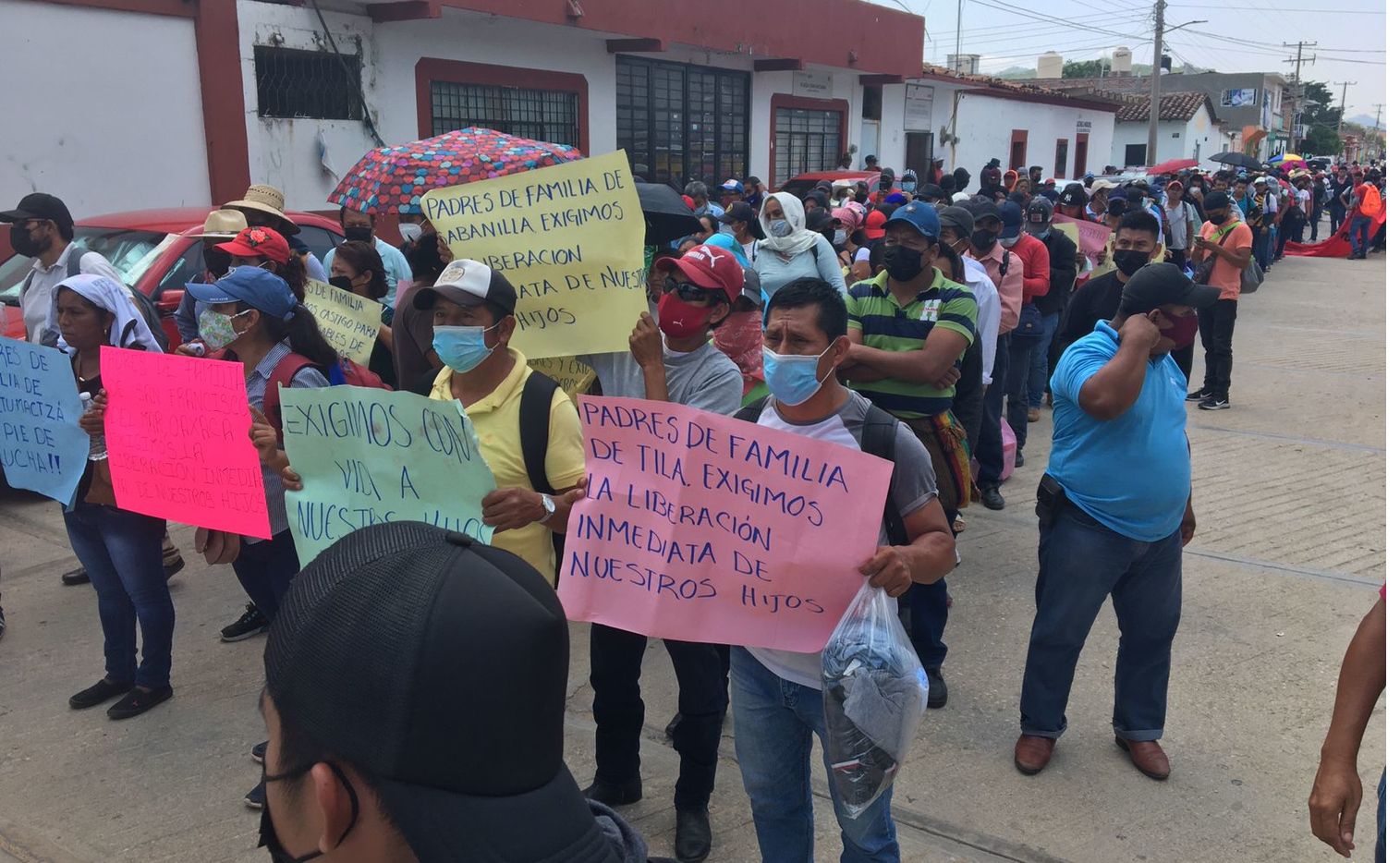
A march demanding the freedom of the students arrested and imprisoned.
By: Tanalís Padilla*
La Jornada
Sunday, May 23, 2021
The Mactumactzá students’ protest and the Chiapas government’s repression show us one more time the precariousness under which the rural teachers schools subsist. The trigger for this conflict was the insistence of the educational authorities on administering the admission exam virtually even when the socio-economic condition of the applicants presents them with immense difficulties in having access to a computer or to the Internet.
On May 18, faced with the students’ occupation of toll booths on the San Cristóbal-Tuxtla Gutiérrez highway to demand an in-person exam, the police arrested 74 women and 19 men who have been charged with the crimes of mutiny, gang activity, robbery with violence and attacks on the communication routes (highways).
The Inter-American Commission on Human Rights urged the government to investigate the excessive use of force against students who have been booked into the El Amate prison. From the beginning, the arrested students denounced sexual assaults like touching and undressing. In various parts of the Republic, including Mexico City, students from sister rural teachers schools have mobilized to demand their freedom. Members of the National Coordinator of Education Workers have also raised their voices in protest of the arrests and expressed their solidarity with the rural teachers colleges (known as “normales”). On May 21, Olga Sánchez Cordero, head of the Interior Ministry (Gobernación), reported that the Ministry and the SEP (Secretary of Public Education) were in dialogue with the Chiapas government so that those arrested and detained can carry out their criminal proceedings at liberty.
It goes without saying that the students’ protest and the State’s repression is nothing new. But this latest episode takes place in the urgent conditions that Covid-19 has exposed on a global scale. If the neoliberal model of the last four decades has decimated the social infrastructure, the health crisis has further wounded entire sectors of the population. For affluent groups technology has been a tool for continuing their work in times that require social distancing. For the rest it has accentuated the historical social inequality. Instead of acknowledging this reality, from above they insist on proposing –and imposing–technological responses to social problems. When, with their protests, the students call attention to this inequity, the response is the traditional repressive machinery.
It shouldn’t be like that, especially at times when, also from above, we talk about the 4T. The rural teachers colleges were created at the start of a transformation. The Mexican Revolution, the Constitution of 1917 and the reforms that were implemented in the 1920s, but especially during the 1930s, restructured the country’s political, economic and social system. The agrarian reform, the oil expropriation, labor rights and the massive construction of schools, represented a redistribution of the wealth that had been concentrated in a very few hands or bled towards foreign capitalists during the Porfiriato.
The transformation process was arduous and depended on the mass mobilization whose force was the channel for counteracting the power of capital. Let’s not forget that the trigger for the oil expropriation in 1938 was a strike by its workers. When British and American companies refused to recognize the workers’ rights, President Lázaro Cárdenas intervened in their favor by declaring the expropriation.
A similar process occurred with the agrarian and educational reforms. Many of the estates expropriated were thanks to the initiative of the campesinos who invaded lands and demanded their redistribution and delivery as ejidos. They not only demanded land, but also a school and teacher. Sometimes the teacher arrived early and would lead the organizational process. The communities built little rustic schools and from there demanded that the State recognition and the necessary resources.
The rural normal system, which had 35 schools in 1936, had the logic of articulating these reforms on a national scale and consolidating the project of transformation. It’s not surprising that a revolutionary ethic has been concentrated there, which is demonstrated in the repeated demands of the students for their class rights.
How to enforce those rights before a State that over the course of the years became not only indifferent, but also hostile to its demands? The form that the rural teachers college students found was collective organization and mobilization. It’s a process that begins not with the taking of tollbooths, roadblocks or hijacking busses; the actions that the communications media and the good people condemn so much, so concerned about the protection of private property.
The process begins with education, not the formal education that they receive in a classroom, but rather that of consciousness raising that since 1935 the Federation of Socialist Campesino Students of Mexico has been concerned with imparting in each generation of teachers college students. This has several components: clarifying that their place in the teachers college is a right, not a gift from the government; publicizing the accumulation of aggressions that the rural teachers colleges have suffered historically; and that only with mobilization of the student body—even with risky actions—have they managed to survive.
It’s a condition of siege that rural teachers colleges have experienced ever since the revolutionary process stopped in 1940. If we’re really talking about a Fourth Transformation, it’s a normality that must change.
* Professor-Researcher at Massachusetts Institute of Technology. Author of the book “Después de Zapata: El movimiento jaramillista y los orígenes de la guerrilla en México,” 1940-1962 (Akal/Inter Pares, 2015)
———————————————————–
Originally Published in Spanish by La Jornada
Sunday, May 23, 2021
https://www.jornada.com.mx/2021/05/23/opinion/017a2pol
Re-Published with English interpretation by the Chiapas Support Committee
Supreme Court orders construction of a pig farm in Yucatán to stop
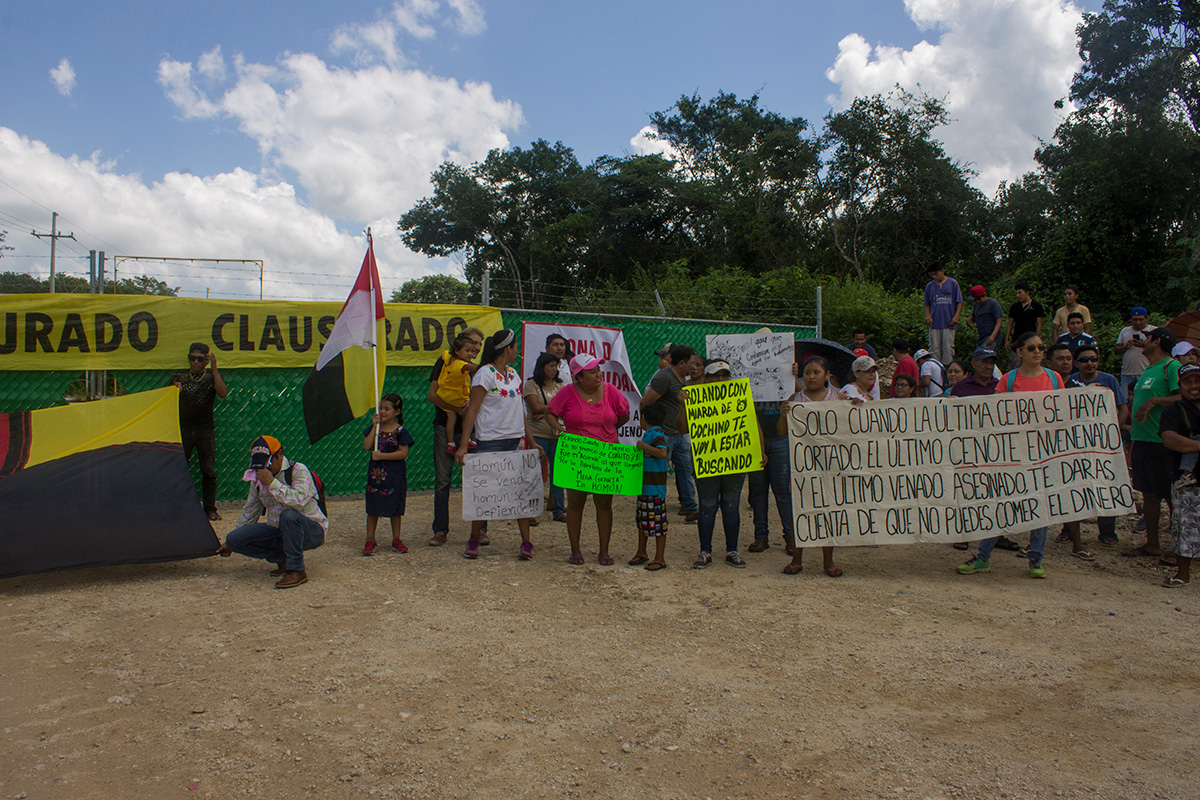
Photo: Homún residents protest against the pig farm
Text by: Eduardo Murillo
La Jornada | May 20, 2021
The construction of a mega pig farm in Homún, Yucatán, will remain stopped because the Supreme Court of Justice of the Nation (SCJN) upheld the definitive suspension of work ordered by a federal judge.
Ministers of the first hall of the highest court confirmed the suspension granted in favor of six boys and girls in the region, who filed a lawsuit against the project’s authorization.
In October 2018, upon admitting the lawsuit, Judge Miriam de Jesús Cámara Patrón, head of the fourth district court based in Merida, ordered, as a precautionary measure, suspending construction of the installations, designed to house up to 49,000 animals. [1]
The Porcine Food Production Company (PAPO, its initials in Spanish) filed an appeal for review that was unanimously dismissed yesterday by the court.
The minors who filed the lawsuit argue that the pig farm is being built with irregular permits, that the community in the municipality was not consulted and that its operation will cause grave damage to the environment.
They added that the project “threatens to pollute the water of this aquifer recharge zone, thinning the air and affecting the health of all residents of Homún,[2] whose right to free self-determination was violated, as well as the right to prior, free and informed consultation, besides the fact that it represents a threat to their way of life and the source of their income: ecotourism at the cenotes.”
The Supreme Court’s resolution implies that work on the mega pig farm will remain stopped while Judge Cámara Patrón resolves the merits of the lawsuit seeking a permanent stoppage of the project.
[1] Pig farms in the Yucatán are connected to the Maya Train mega-project. Their purpose is to produce meat for the expanded tourist industry that the Yucatán Peninsula expects the Maya Train to bring. The pig farms are also slaughterhouses, which produce toxic waste.
[2] As part of their resistance to the pig farm, residents of Homún also produced a short documentary film. The article below explains much more about their resistance to the pig farm and the making of the documentary.
—–Ω—–
THE COURT WILL DECIDE IF IT PROTECTS CHILDREN FROM THE DAMAGES OF A PIG FARM IN HOMUN, YUCATAN
Text: Pie de Pägina Editors and Daliri Oropeza in Pie de Página
Photo: Alberto Velázquez / Archive
MEXICO CITY
This Wednesday, Mexico’s Supreme Court of Justice of the Nation (SCJN) will discuss whether to maintain the suspension of the pig factory belonging to the company Porcine Food Production (PAPO, its Spanish acronym), of Mexican Porcine Group (Kekén). Judge Miriam de Jesús Cámara Patrón suspended operations on October 9, 2018 based on the amparo lawsuit for protection that six boys and girls of Homún filed. It’s about a Maya town in Yucatán located in the Ring of Cenotes [1] Geo-Hydrological Reserve.
The town of Homún has struggled against the establishment of the pig factory since 2016, when that company obtained permits without consulting the residents.
The factory threatens to contaminate the water in a recognized aquifer recharge zone and thus affect the health of the population. The Mayas of Homún lived a nightmare when a pig farm was installed that would fill a municipality with what is the water reserve for Merida with pigs. The company’s bet was to take 50,000 pigs to a territory with 7,000 inhabitants
On that occasion the inhabitants of Homún had their right to self-determination violated, including the right to a prior, free and informed consultation.
The pork company’s presence means a threat to cenote ecotourism, the residents’ source of income.
The organization Indignación, which has given accompaniment to the community, enumerated the human rights violations that the pig farm has generated. Specifically, they are the right to health, water, a safe and healthy environment and to free, prior, informed and culturally adequate consent.
They emphasize that the SCJN, when ruling on the case, may set precedents on suspensions during the amparo lawsuit, on the precautionary principle in environmental matters and about the best interest of children.
The precautionary principle maintains that when grave environmental effects can be foreseen, the authorities will have to adopt measures to prevent the damage. Thus, they give an opportunity for carrying out all the necessary tests even when total certainty is lacking.
Organizations called on the SCJN to consider the technical report that specialists and organizations presented. In it, they demonstrate that the industrial confinement of pigs using waste pits and land disposal can contaminate underground water, contaminate surface waters and emit dangerous gases.
The Court, they added, must guaranty the right of childhood to grow up in a healthy environment. And that is directly related to the right to water, health and a dignified life. They warned that the Court’s decision would also impact other Maya communities that struggle against the establishment of these kinds of pig farms.
They document the struggle of the ‘Guardians of the Cenotes’ on film

Above poster is an advertisement for the film in Spanish. There is also a poster in the local Mayan language.
The town of Homún premiered its own documentary with the story of how they beat the mega pig farm.
Ka’anan Ts’onot means Guardians of the Cenotes. That’s the name of the documentary that the community of Homún recently premiered in Yucatán; they decided to document the effort they have made to prevent the contamination and devastation of the basin and aquifer system in the southern peninsular region.
This Maya town tells its story through a documentary in order to inspire other towns to defend their territory and to invite community organization.
The community of Homún wrote the script and produced the short film. With it, the community shows what life was like before pig farms came to the area. They emphasize the importance of water in their daily life and the value to their ancestors.
In the plot, a boy goes to look for water at the cenote to cool off after having gone to harvest corn with his father. To his surprise the cenote has an important message to give him; the threat of the mega pig farms lurks and he must play an important role to protect his town.
The short film narrates the critical moments and history of struggle and resistance of the Maya community of Homún against the threat posed by the pig industry.
The guardians of the cenotes proposed the script del short film by means of assemblies. They discussed the importance of showing not only the struggle, but also their reasons.
The production of this short documentary was made through community cinema. The Non-Itinerant School of Communal and Popular Cinema First Level and the Ha de Vida Ka’anan Ts’onot project collaborated. Ha de Vida Ka’anan Ts’onot is also the name of this collective that since 2017 has fought against the imposition of the mega pig farm in their community.
In the documentary, the guardians of the cenotes warn that if the governments continue allowing these kinds of projects, all forms of life will be at risk. The community of Homún premiered it in the public plaza in front of the Ejido Commissioners on May 7. Its world premiere was Monday, May 17.
[1] Cenotes are natural sinkholes resulting from the collapse of limestone bedrock that exposes groundwater and are used as a water supply, especially on the Yucatán Peninsula of Mexico.
—–Ω—–
Originally Published in Spanish by Chiapas Paralelo on Wednesday, May 19, 2021
Re-Published with English interpretation by the Chiapas Support Committee
They demand the freedom of those arrested for demonstrating against the National Guard barracks
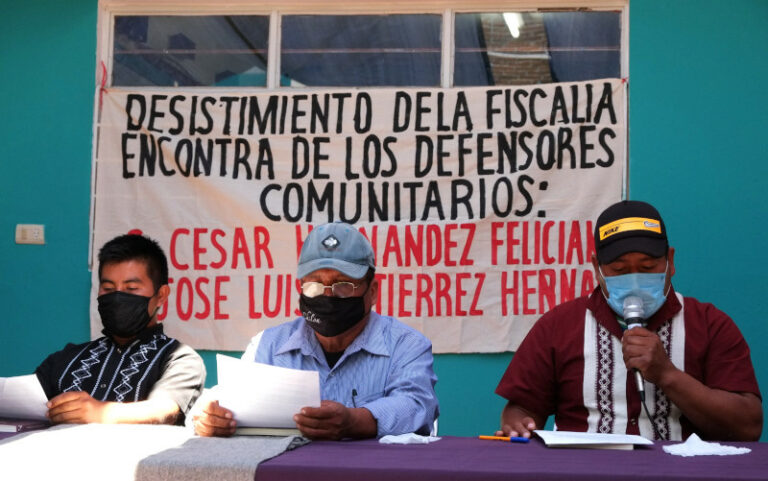
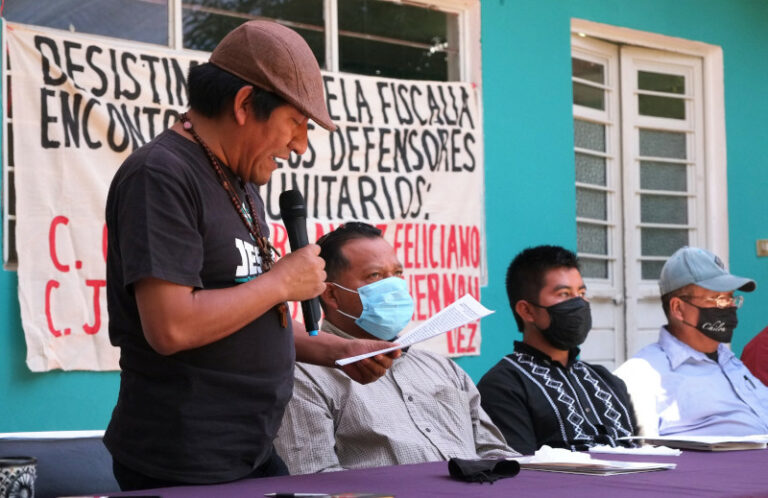
Ejido residents of San Jerónimo Bachajón and San Sebastián Bachajón make a denunciation. Photo: courtesy of Frayba
*The Tseltal people have attended seven hearings with state government authorities to demand the freedom of the ejido residents charged, but as of now there is no attention and they just “put them off so that the legal process would advance.”
By: Yessica Morales, Editor
Ejido residents of San Jerónimo Bachajón and San Sebastián Bachajón [1] in the municipality of Chilón, Chiapas, remembered that last October 15, 2020, they demonstrated on the Temó crossroads against the construction of the National Guard barracks and for the recognition of their agrarian authorities; two of their compañeros were arrested because of this act.
They pointed out that the Chilón municipal police, the State Police and the National attacked them with stones, sticks and tear gas and beat both people and vehicles, causing injuries, material damages and the arbitrary arrest of José Luis Gutiérrez Hernández and César Hernández Feliciano.
Gutiérrez Hernández and Hernández Feliciano were arrested, tortured and taken to the Ocosingo police headquarters. After that, they transferred them to the Center for Social Reinsertion for those Sentenced in the same municipality [Ocosingo] and then on October 17, they were transferred “like criminals” to the “El Amate” prison in Cintalapa without any explanation.
Given what happened, ejido residents demanded the unconditional freedom of Gutiérrez Hernández and Hernández Feliciano, as well as punishment of those responsible for the October 15 repression.
They also asked for the reparation of material damages, like recognition of the agrarian authorities elected by means of uses and customs.
We demand that there is no militarization of our territories and cancellation of the construction of the National Guard barracks in Jukulton community, Chilón municipality, because it brings the dispossession of our territory, the destruction of our culture brings more violence, alcoholism and prostitution, the ejido residents said.
They placed responsibility on municipal president Carlos Idelfonso Jiménez Trujillo and on the National Guard for any act of repression, threat, persecution and/or other attempts against ejido residents.
The National Guard warns the peoples
Father Marcelo: The Church’s mission is to be an “advocate for justice and a defender of the poor.” Photo Courtesy: Frayba
The indigenous priest Marcelo Pérez Pérez, coordinator of the Social Pastoral of the San Cristóbal de Las Casas Diocese, questioned Andrés Manuel López Obrador, President of Mexico and Rutilio Escandón Cadenas, governor of Chiapas, about whether it’s a crime to demonstrate peacefully.
Pérez Pérez explained that peaceful demonstration is a right that cannot be repressed for any reason, and therefore, he asked for a dialogue table at the government palace in Tuxtla Gutiérrez.
Of the three dialogue tables that he had, he emphasized that the repressor never appeared, nor did the Interior Ministry demand it, therefore they didn’t obtain any result.
Faced with this situation, the arrogance of Mr. Carlos Idelfonso Jiménez Trujillo is noticeable, when a municipal authority ignores the state authority it’s because someone in the state and federal government is supporting him, the priest said.
He stated that the presence of the National Guard is a red alert for the Native peoples because it goes against the indigenous cosmovision, but also because some municipal presidents use them to repress the people.
Joint pronouncement
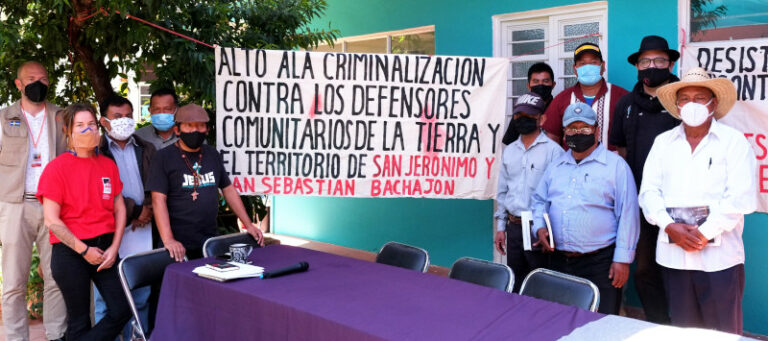
Photo courtesy of Frayba: Criminalization of the struggle against militarization of the land and territory in the Tseltal pueblo of Chilón
The Fray Bartolomé de Las Casas Human Rights Center (Frayba) and the Miguel Agustín Pro Juárez Human Rights Center (Prodh) announced that the ejido owners and their Tseltal families have historically been defenders of their land and territory against militarization and the megaprojects.
They added that with a new base in defense of territory, as with their culture, the Tseltal people began a struggle against new forms of invasion and territorial militarization, such as construction of the National Guard Headquarters,
In accordance with international standards in matters of protection of indigenous peoples’ rights, they emphasized that the implementation of any type of project, whether by the State or by individuals, is obliged to carry out a consultation in order for the peoples to give their consent in a free and informed manner.
They emphasized that the forma organizational form of the native peoples is based on their maximum authority, “The Assembly,” which is provided for in Mexican law. However, authorities of the three levels of government omitted their responsibility by not generating the mechanisms necessary for the realization of a prior, free and informed consultation.
Finally, they said that the criminalization that community defenders are subjected to for opposing the militarization shows the context of discrimination, inequality and vulnerability that the indigenous peoples in Mexico face.
Translator’s Note:
[1] The issue of building a National Guard Headquarters on land belonging to San Sebastián Bachajón and San Jerónimo Bachajón is of vital importance in the overall Chiapas political picture. The land in question is adjacent to the Agua Azul Cascades, an important and beautiful tourist attraction not far from the Palenque archaeological site, also a mega tourist attraction. The government plan is to build a super-highway from the city of San Cristóbal de Las Casas to the city of Palenque, with an exit at the Agua Azul Cascades, thus making the Cascades more accessible to mass tourism and then converting the land into an luxury tourist destination complete with a European 5-star hotel, a boutique hotel, conference center and a lodge for corporate retreats. See: https://chiapas-support.org/2019/05/23/the-san-cristobal-palenque-highway-is-back-and-so-is-the-resistance/
For many years, the Tseltal Maya people in San Sebastián Bachajón and San Jerónimo Bachajón have resisted the San Cristóbal-Palenque Super-Highway (the government has now re-named it the Highway of the Cultures) and have suffered repression because of it: several murders and a number of ejido members thrown into prison for protesting. Having a National Guard Headquarters there assures the government a military presence that is able to repress the resistance to both the super-highway and the subsequent conversion into a luxury tourist resort.
—–Ω—–
Originally Published in Spanish by Chiapas Paralelo on Tuesday, May 18, 2021
Re-Published with English interpretation by the Chiapas Support Committee
Political prisoners to the Zapatista Caravan: “We send our words from this dungeon and wish you much success”
From the Editors of Desinformémonos
Photo: Cuartoscuro
Mexico City | Desinformémonos
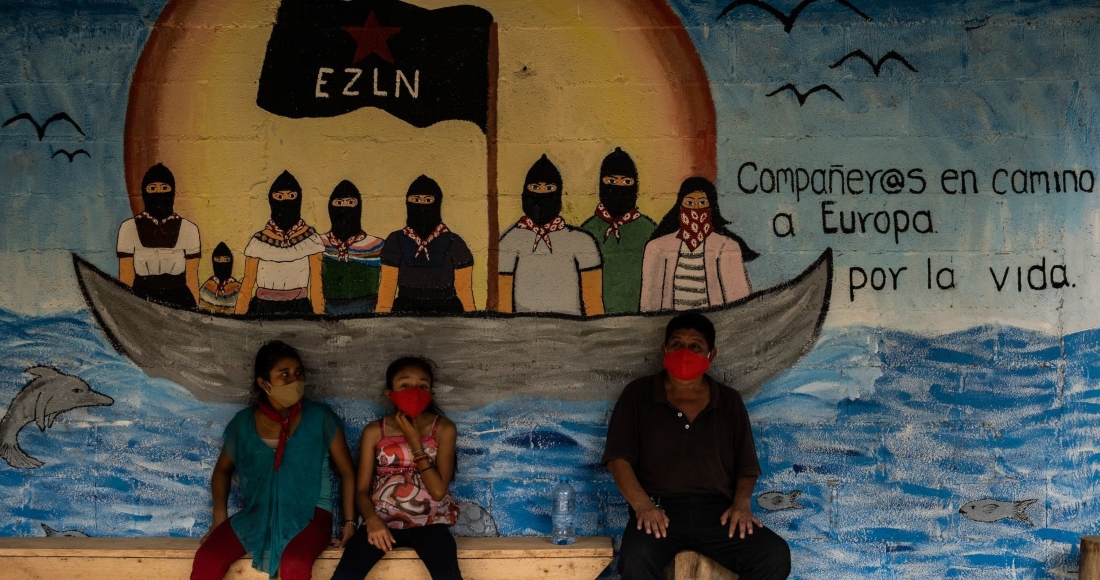
“From this dungeon we send our words and wish you much success and a happy trip crossing the heart of the sea”, the indigenous political prisoners of CERESO 5 in San Cristóbal de las Casas, Chiapas expressed to the Zapatista caravan that’s heading to Europe.
In a letter, the prisoners Adrián Gómez Jiménez, of the organization called “The Voice of Indigenous in Resistance”; Germán López Montejo and Abraham López Montejo, from The True Voice of El Amate, showed their admiration for members of the Zapatista National Liberation Army that set sail last May 3 for the European continent.
“From our trench of struggle we are admirers and [you are] a great example for us that the struggle goes on and on,” the Chiapas indigenous prisoners said, from where they reaffirmed their support for the Zapatistas who struggle “for a better life.”
On the other hand, the political prisoners in San Cristóbal de las Casas also called on human rights defenders to demand “true justice and freedom for political prisoners, prisoners of conscience and prisoners in struggle.”
Here is the complete letter:
To the Zapatista National Liberation Army
To the National Indigenous Congress
To the National and International Sixth
To the independent organizations, as well as governmental
To the Networks of Resistance and Rebellion throughout the world that fight against capitalism, racism and destruction of the environment
To the free, independent and alternative communications media
To public opinion in general
Prisoner in struggle Adrián Gómez Jiménez, a member of the organization called “The Voice of Indigenous in Resistance,” German López Montejo and Abraham López Montejo, members of the organization called The True Voice of El Amate and adherents to the Sixth Declaration of the Lacandón Jungle of the Zapatista National Liberation Army (Ejército Zapatista de Liberación Nacional, EZLN, secluded in CERESO number 5 in San Cristóbal de las Casas, Chiapas, México.
Compañeras and compañeros, first of all, receive an affectionate and combative greeting from Adrián Gómez Jiménez, German López Montejo and Abraham López Montejo. After this greeting, we turn to giving our words to you with great gratitude. We are very grateful for your struggles and the courage you have shown, because from our trench of struggle we are admirers and [you are] a great example for us that the struggle goes on and on. That’s why from this dungeon we send out our words and wish you much success and a happy voyage crossing the heart of the sea, traveling on the oceans with the heart willing to sacrifice your time, leaving your families for the purpose of supporting the Zapatista compas for a better life that we deserve without the exception of anyone. We want to tell you that you are not alone.
Brothers and sisters, once again we repeat our words: Happy journey and a lot of strength in the struggle!
Finally, we invite human rights defenders and independent state, national and international organizations to continue demanding true justice and freedom for political prisoners, prisoners of conscience and prisoners in struggle.
Uniting our voices and the strength of the Mexican peoples true justice will triumph.
Respectfully,
Adrian Gómez Jiménez
German López Montejo
Abraham López Montejo
—–Ω—–
Originally Published in Spanish by Desinformémonos on May 18, 2021
Re-Published with English interpretation by the Chiapas Support Committee
A Journey for Life
By: Raúl Romero*
Professor Douglass Rushkoff, specialist in media, technology, culture and economics published in 2018, “The Survival of the Richest: The Wealthy Are Plotting to Leave Us Behind.” (or in the Spanish translation, jump ship) (https://bit.ly/3w2krQa). In it, Rushkoff told how during 2017 he was invited to chat with five super-rich people about the future of technology. The professors interlocutors “were prepared for a digital future that had more to do with transcending the human condition and protecting themselves from the true and present danger of climate change, the rise of sea levels, large migratory shifts, global pandemics and national panic or the exhaustion of resources, than with the building of a better world. For them the future of technology in reality consists of one thing: the ability to flee.”
The planet’s super-rich have long been preparing to face the climate and civilizational crisis. They are taking measures to save themselves and their kind. Their initiatives seem to be straight out of science fiction, like those of Elon Musk, the PayPal, Tesla Motors and SpaceX magnate, who has proposed building self-sufficient communities on Mars.
While investments and research to colonize other planets grew, the ruling classes managed to watch, from their places of luxury and comfort, the tragedies of millions of people pass by. In February 2018, Mark O’Connell narrated for The Guardian (https://bit.ly/3ygYVcC) how billionaire residents of Silicon Valley were getting ready to face the apocalypse in New Zealand, a kind of reinforced geopolitical haven where survival bunkers have been built.
The bunker business, which thrived in the U.S. with the nuclear threat of the Cold War, became more sophisticated to meet the demands of billionaires. On its website, Survival Condo offers a bunker for $1.5 million to $4.5 million, while Atlas Survival Shelters offers $5 million for its platinum shelter. Some of the shelters promise pathogen detectors, radioactive particle filters, swimming pools and bowling alleys.
For the ruling classes it seems more viable to think of the end of the world as we know it, than to think of the end of the system of exploitation and domination that has brought us to this situation.
For the poor men and women of the Earth there is no alternative and the EZLN is clear: the survival of humanity depends on the destruction of capitalism. In order for humanity to survive it is necessary to “fight, everywhere and at all times -everyone in their own terrain- against this system until it is completely destroyed”.
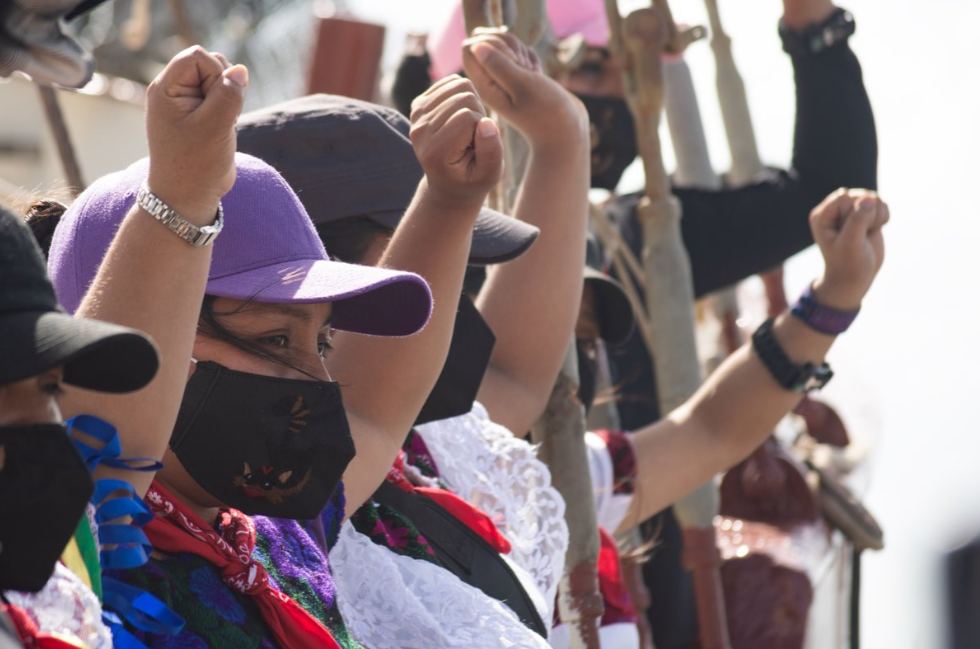
In order to meet and share experiences with others in the world who resist and are determined to defend life, the Zapatistas have begun a journey through the five continents, which they call the Journey for Life.
Their first port will be unsubmissive Europe, where Squadron 421, composed of seven indigenous Mayas (four women, two men and one other), will set sail on the ship La Montaña. They will be followed by the airborne delegation and members of the National Indigenous Congress and the Peoples Front in Defense of Land and Water of Morelos, Puebla and Tlaxcala, an organization to which Samir Flores belonged.
La Montaña will sail the European seas, which have become mass graves where thousands of migrants lie who have attempted to reach the old world in search of a better life. The crew will attempt to dock at the Port of Vigo, in Galicia, Spanish State — to later advance toward Madrid, which they will enter in August 2021, 500 years after the supposed conquest of what today is Mexico.
The unconquered, mostly women and with one non-binary person, travel in the first place to the land from which the sword and the cross came, not to threaten, reproach, insult or demand. Not to demand that they ask our forgiveness. Not to serve them or to serve us, they go to meet with those who bet on life, because as capitalism is deployed throughout the world, there are also resistances all over the planet.
In so-called primitive (or original) accumulation Karl Marx wrote: the discovery of gold and silver deposits in America, the extermination, enslavement, and burial of the aboriginal populations in the mines, the beginning of the conquest and looting of the East Indies, the conversion of the African continent into a hunt for black slaves, these are the deeds that mark the dawn of the era of capitalist production.
If in the discovery of America we find the beginnings of capitalism, this voyage, in the reverse of the one made more than 500 years ago, will help to connect the struggles for life, those that build worlds with peace, justice, dignity, freedom and democracy. In the old world the horizon is now in sight.
* Sociólogist
Twitter: @RaúlRomero_mx
—–Ω—–
Originally Published in Spanish by La Jornada on Saturday, May 15, 2021
https://www.jornada.com.mx/2021/05/15/opinion/017a2pol
Translated by Schools for Chiapas and Re-Published by the Chiapas Support Committee
 Chiapas Support Committee