Chiapas Support Committee
Home of the Compañero Manuel blog on zapatistas & mexico
Changes in US Military Strategy
Changes In US Military Strategy
By: Gilberto López y Rivas
Starting with the application of anthropology in the counterinsurgency work of the United States and with the presence of social scientists as advisors in the field of that country’s combat brigades in their neocolonial wars, a growing number of professionals in that discipline have given us the task of studying the magnitude, characteristics and consequences of this non-communal imperialist effort for maintaining its military hegemony to safeguard its economic, corporate and geo-strategic interests in the world. Thus, the anthropologist colleague David Vine, who prepares a book about the more than one thousand US military bases in 150 countries (to which one must add the 6, 000 bases inside the US), published the article “The Lily-Pad Strategy,” which Rebelión translated (18/7/12), in which he reports on the silent transformation that the Pentagon brings to a head for all the system of military bases outside US territory, which means a new and dangerous form of war.
According to Vine, US soldiers increase the creation of bases on the entire planet, which they call lily pads (those leaves or plants that float on the surface of water and that are useful to frogs for leaping towards their prey) and that consist of “small secret and inaccessible installations with a restricted quantity of soldiers, limited commodities and weapons and previously secured supplies… Similar lily-pad bases have become a critical part of a developing Washington military strategy that points to maintaining United States global domination, doing more with less in a world more competitive all the time, each time more multi-polar.”
Chalmers Johnson, another academic critical of his government and studious of these themes, maintains that: “this enormous network of military establishments on all continents, except Antarctica, constitutes a new form of empire –an empire of bases with their own geography that that doesn’t seem that it could be taught in any middle school class. Without comprehending the dimension of this world ringed with bases on the planetary ambit–, one cannot attempt to comprehend the dimensions of our imperial aspirations, or the degree by which a new type of militarism is undermining our constitutional order.” (“America’s Empire of Bases” in Tomdispatch. com)
Johnson outlines that the military branch of the United States government employs about half a million soldiers, spies, technicians and civilian contractors in other nations, and that those secret installations, besides monitoring what the people in the world, including US citizens, are talking about, or finding out the content of faxes and e-mails that they are sending, benefit the industries that design and provide arms to their armies. At the same time, “one task of those contractors is to maintain the uniformed members of the empire lodged in comfortable quarters, well fed, entertained, and supplied with vacation quality infrastructure. Whole sectors of the economy have come to depend on soldiers for their sales.” During the war for the conquest of Iraq, Johnson reports that the Defense Department, while it was ordering an extra ration of cruise missiles and tanks that made use of munitions with depleted uranium, also acquired 273, 000 bottles of a sun block that benefited companies with those products situated in Oklahoma and Florida.
Different from the big bases that appear to be cities, like those that the armed forces occupy in Japan and Germany, the lily pads are constructed with discretion, trying to avoid publicity and the eventual opposition of the local population, Vine reports. We’re dealing with small and flexible operations bases, “closer to foreseen conflict zones in the Middle East, Asia, Africa and Latin America… Pentagon officials dream about an almost unlimited flexibility, the ability to react with notable speed in the face of events in any part of the world, and therefore something that approaches a total military control of the planet.”
In what touches our America, Vine points out that: “after the expulsion of the soldiers from Panamá in 1999 and from Ecuador in 2009, the Pentagon has created or updated new bases in Aruba and Curacao, Chile, Colombia, El Salvador and Peru. At other sites, the Pentagon has financed the creation of military bases and police capable of harboring United States forces in Belize, Guatemala, Honduras, Nicaragua, Panama, Costa Rica, and even in Ecuador. In 2008, the Navy reactivated its Fourth Fleet, inactive since 1950, to patrol the region. The soldiers can wish for a base in Brazil and they tried fruitlessly to create bases, supposedly for humanitarian and emergency aid, in Paraguay and Argentina.” We don’t doubt that one of the reasons for the State coup against President Lugo was his refusal to install bases on Paraguayan territory.
Now that many social scientists have removed the use of “ideological” terms like class or imperialism from academia, due to considering them unfashionable, a key conclusion of colleague Johnson stood out in which he touches on the military expression of this latter concept: “Some time ago, one was able to trace the expansion of imperialism by counting the colonies. The United States version of the colony is the military base. Following the policy of global change of bases, one can learn a lot about our each time greater imperial position and militarism that grows in its vertex. Militarism and imperialism are Siamese twins joined at the hip.”
When will the next leapfrog be from the lily pad closer to the prey?
______________________________________________
Originally Published in Spanish by La Jornada
Friday, August 3, 2012
En español: http://www.jornada.unam.mx/2012/08/03/opinion/023a1pol
English Translation: Chiapas Support Committee
Javier Sicilia Meets With Sheriff Arpaio
Sicilia Comes Face-to-Face with the Sheriff Labeled As Racist and Demands that He “Be More Human”

Javier Sicilia confronted Sheriff Joe Arpaio Photo: Notimex
From the Editors of La Jornada
Phoenix, Arizona, August 16, 2012. In an unpublished meeting, the leader of the Caravan for Peace, Javier Sicilia, asked Maricopa County Sheriff, Joe Arpaio, who has distinguished himself by impelling actions to discriminate against Mexican and Latin American immigrants, “to be more humane” with undocumented detainees within his jurisdiction.
In the meeting that lasted one hour, Sicilia proposed, according to Caravan members that were present, that he control the sale of weapons of extermination, to which the US sheriff replied: “You control the flow of drugs.”
At the end of the meeting, Arpaio proposed to the Mexican poet that when the Caravan through the Unites States ends, he should return to dialogue, but “alone.”
The interview, which was held in the sheriff’s offices, had a complicated start when Arpaio conditioned the celebration of the meeting on the activist Carlos García, the local leader of the El Puente organization, leaving the offices. Other activists from US organizations that support the cause of the Movement for Peace, stayed in the place.
“We did not come at war but in peace, to tell you that you have 50 per cent of the responsibility for the war in Mexico.” Sicilia maintained the tone of his talk and surprised his interlocutor: “I ask you if treating immigrants like dogs is a correct policy.”
The sheriff did not become ruffled and said: “I do not administer the jails.”
Afterwards, there was an exchange of opinions between Sicilia and Arpaio. The former recognized that the Mexican government is corrupt, that they imposed a war against drugs, and added that the theme of narcotics is not a national security issue. “You want to avoid consumption, but you have a responsibility with 23 million addicts.”
The sheriff answered that the responsibility for the drug problem is with the producer countries and added that he doesn’t like to offer opinions about the governments of other countries; aside from the responsibility of complying with the law.
Sicilia insisted on questioning Arpaio about how being Catholic he could discriminate against the immigrants, to which the sheriff answered that he didn’t mix religion with policy, and that his beliefs have nothing to do with immigration or the law.
At the end, Sicilia invited him to Mexico, after urging him to have more humane and dignified conditions for the immigrants, “it would be a gesture of humanity that we would take with us;” Arpaio rejected the gesture upon asserting that drug cartels put a price on his head.
Afterwards, members of the Caravan for Peace visited the prison camp known as Tent City, “to denounce the criminalization and inhuman treatment that the undocumented and persons that consume drugs receive.”
Local police installed the camp in 1993 to “solve” overpopulation in the prisons. At the place, members of the Caravan and of local organizations locales protective of immigrant rights remembered that Arpaio is subject to investigation, among other things, for having handcuffed an undocumented Mexican woman in full labor of childbirth and of separating her from her baby.
In this place, known as “Tent City”, Arpaio dresses the prisoners with red shorts y scuffs and feeds them one sandwich a day, and it is alleged that he spends more on feeding his dogs than his detainees, they denounced.
At the Phoenix Civic Center, the pacifist movement that the Mexican poet heads gave voice to relatives of the victims of violence. More than 40 of them gave their testimony there.
This has been the occasion, ever since the Caravan started last Sunday, in which a greater possibility has been presented for the victims of the violence in Mexico due to the war against drugs to speak.
Later the Caravan headed for Tucson, where Sicilia is expected to give a speech that he prepared before starting his tour through 27 US cities, to conclude in Washington next September 12.
_________________________________________________________________________
Originally Published in Spanish by La Jornada
English Translation: Chiapas Support Committee
Friday, August 17, 2012
En español: http://www.jornada.unam.mx/2012/08/17/politica/013n1pol
Worldwide Echo In Solidarity with Zapatistas
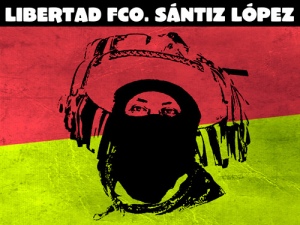 Join the Worldwide Campaign in Solidarity with Zapatistas in San Marcos Avilés and Francisco Santíz López!
[Aunque el mensaje comienza en ingles, abajo hay enlaces con videos y otros documentos en español.]
At this very moment, some 200 Zapatista civilian supporters in San Marcos Avilés, Chiapas, Mexico, are living in daily terror of another forced, and possibly violent, eviction. Those trying to evict them are affiliated with three national political parties (PRI, PVEM and PRD). Emboldened by the results of recent state, national and local elections, in which several of those parties were very successful, the party members have announced their intent to jail all the Zapatista authorities and evict the others. In addition to announcing their eviction plan, political party members openly brag about their efforts to recruit party members from other communities to help with the eviction. The Zapatistas in San Marcos have also experienced an increase in insults and threats, and the theft of their planted and harvested crops, to the extent that there will not be enough food to feed everyone this year. Non-governmental organizations in Chiapas believe there is reason to fear for the lives of the Zapatistas because of the counterinsurgency moves by these political party members.
San Marcos Avilés, an ejido (collective farm) in the highlands of Chiapas, is a divided community, meaning that some of its residents are civilian Zapatista supporters while other residents are not. All are indigenous Tzeltal-speaking Mayas who live off their land as subsistence farmers. The Zapatistas legally purchased their land in San Marcos around 12 years ago and have the paperwork to prove it.
The conflict began in August 2010 after the Zapatistas built an autonomous primary school as part of the Zapatista Autonomous Education System. Leaders of the ejido’s non-Zapatistas called several Zapatistas to a meeting with ejido officials. The officials demanded that they abandon the school and the Zapatista organization. When the Zapatistas refused, they were held in the local jail. The non-Zapatistas had now become anti-Zapatistas because of the Emiliano Zapata primary school. They perceive autonomy as a threat to the power of the political parties.
Several days later, the anti-Zapatistas took over 29 hectares of land owned by Zapatistas and destroyed all the crops; next, they took the cattle. The first eviction occurredshortly afterwards, on September 9. According to the Good Government Junta in Oventik, 170 Zapatistas fled into the mountains after the political party members “came with machetes, sticks and firearms, entered two houses and attempted to rape two women.” The September 9 eviction followed hostile criminal acts over a period of several weeks, which included stealing land and coffee fields, destroying crops, stealing cattle and firing shots into the air. The 170 displaced Zapatista supporters lived outdoors for 33 days in the wooded mountains and survived on berries and herbs. According to the Good Government Junta in Oventik, they returned to their homes in San Marcos in October 2010 accompanied by a group of Zapatistas from nearby communities. Upon returning, they found their homes ransacked and their crops destroyed.
Both the Fray Bartolomé de las Casas Human Rights Center (Frayba) and the Zapatista Good Government Junta in Oventik have denounced the threats and hostile acts that have continued since the Zapatistas’ return. In April 2011, international observers in the peace camp received death threats, a first in the history of the Chiapas peace camps. In June 2011 they denounced that the political party members made on-going death threats against the Zapatistas.
Faced with the latest threats and thefts, adherents to the EZLN’s Other Campaign have launched a two-part international campaign. The campaign’s first phase consists of spreading the word about the life-threatening situation in San Marcos Avilés during the month of August. The second phase consists of direct action and will be better defined later. The goal is to prevent a violent eviction.
Freedom for Francisco Sántiz López!
On December 4, 2011, around 50 PRI members allegedly mounted an armed attack on four families in Banavil ejido who are sympathetic to the Zapatistas. Results of the December 4 armed attack were: 1) the death of 1 PRI member; 2) one man, Alonso López, disappeared (and presumed dead); and 3) Alonso’s son, Lorenzo López, shot twice, gravely injured in the hospital and also detained, accused of causing bodily injury.
On January 19, the Fray Bartolomé de Las Casas Human Rights Center (Frayba) issued an Urgent Action in which it reported that Franciso Sántiz López, a Zapatista civilian support base, was detained by police and taken to the state prison in San Cristóbal, charged with the murder that happened during the acts of violence on December 4 in Banavil ejido, Tenejapa municipality, located in the Highlands.
Santiz Lopez received notice on March 22 that he had been cleared of the murder charges and would be released from prison. A “few meters” away from leaving prison, he was informed of a new charge, this time federal: “Carrying firearms for the exclusive use of the Army.” He was not released. The non-Zapatista (Lorenzo López) detained along with Sántiz López has been released with two bullets still in his body. His is one more example of the lack of necessary medical attention Other Campaign prisoners have been denouncing recently. On March 28, the Good Government Junta in Oventik denounced the new federal charge against Francisco Sántiz López and maintained his innocence. The Zapatistas fully support Sántiz López and all campaigns to free him. The Worldwide Campaign is demanding that Sántiz López be freed immediately. The campaign is described below.
“Worldwide Echo in Support of the Zapatistas:
Freedom and Justice for San Marcos Avilés and Sántiz López”
The Fray Bartolomé de las Casas Human Rights Center (Frayba) and the Movement for Justice in the Barrio (MJB) of New York make the call for this campaign. The first phase asks that all folks concerned about social justice issues help spread the word in whatever way they can. It suggests that people form committees to distribute this information. You can form your own committee and report that to the MJB (laotranuevayork@yahoo.com) or, in the alternative, just distribute the information widely as part of the CSC information committee. Online resources for information are listed below.
1. The entire call for a campaign in English:
http://dorsetchiapassolidarity.wordpress.com/tag/san-marcos-aviles/
2. Bilingual video from San Marcos Avilés/Video bilingüe desde San Marcos Avilés:
http://www.youtube.com/watch?v=rY-8CBt3Vkg
3. La convocatoria en español:
4. San Marcos Avilés Web Page/ Página de Internet de San Marcos Avilés
http://sanmarcosaviles.wordpress.com/
Thank you! / Gracias
_________________________________________________________
Chiapas Support Committee/Comité de Apoyo a Chiapas
P.O. Box 3421, Oakland, CA 94609
Tel: (510) 654-9587
Email: cezmat@igc.org
https://compamanuel.wordpress.com
Resumen de Noticias Sobre Los Zapatistas – Julio de 2012
JULIO del 2012 RESUMEN DE NOTICIAS SOBRE LOS ZAPATISTAS
En Chiapas
1. Alberto Patishtan regresa a la cárcel en San Cristóbal – Un tribunal federal de apelaciones confirmó la decisión de un juez federal en Chiapas que ordenó el regreso de Alberto Patishtan a la prisión estatal en San Cristóbal. Después de un largo aplazamiento, el 26 de julio el gobierno por fin cumplió la orden de la corte y trasladó a Patishtan de la prisión de alta seguridad en Sinaloa a la prisión en Chiapas. Este es un triunfo pequeño en el largo camino hacia su liberación. Otro reto que él enfrenta es obtener el tratamiento médico que necesita.
2. La campaña para liberar a Alberto Patishtan y Francisco Santiz López – En julio se realizó la tercera semana de lucha para ganar la liberación de Alberto Patishtan y Francisco Santiz López, llamada “!Derribamos los muros de la prisión!”. Patishtan es miembro de la Otra Campaña Zapatista y Santiz es un base de apoyo zapatista. La protesta nacional e internacional, apoyada por los zapatistas y los amigos y familiares de Alberto Patishtan, de nuevo recibió apoyo alrededor del mundo. El Comité en Apoyo a Chiapas hizo circular una carta exigiendo la liberación de Patishtan y Santiz durante nuestro Foro Comunitario sobre México. El Foro fue muy concurrido y obtuvimos muchas firmas para la carta. Muchas gracias a tod@s aquellos que firmaron la carta. Lo enviamos al Presidente Felipe Calderón.
3. Siguen los intentos de desalojo a los Zapatistas en San Marcos Aviles – El 25 de julio, La Jornada publicó un articulo que resume una petición de apoyo por parte de bases de apoyo zapatistas de San Marcos Aviles a la sociedad civil nacional e internacional. La comunidad teme otro desalojo. El primer ocurrió en 2010 después de que los zapatistas construyeron una escuela primaria como parte de la construcción de autonomía. La comunidad dividida esta gobernada oficialmente por miembros de los tres partidos políticos que no quieren que los zapatista y sus escuelas autónomas amenacen su poder y control político. Ese primer desalojo desplazó a los zapatistas hacia las montañas boscosas donde sobrevivieron 33 días sin techo. Estos mismos actos que ocurrieron antes, ahora están presentandose de nuevo. Toda la cosecha, los animales y los materiales de construcción de los zapatistas han sido robados por los miembros de los partidos políticos, y han amenazado a los zapatistas con ser expulsados. Hay una campaña global de solidaridad con San Marcos Aviles, en el municipio de Chilón. La primera fase de la campaña es la publicación de información sobre lo que está pasando. Se puede mirar un video bilingüe con el testimonio de unos zapatistas residentes de San Marcos Aviles, aquí:
http://www.youtube.com/watch?v=rY-8CBt3Vkg
4. Caravana para Tierra y Territorio llega al Distrito Federal – Adherentes a la Otra Campaña del EZLN anunciaron detalles sobre una marcha y caravana que se emprenderá desde la Zona Norte de Chiapas hasta la Ciudad de México, Distrito Federal. El gobierno del estado de Chiapas y las autoridades municipales les han quitado aproximádamente 130 hectáreas de territorio a los poseedores Choles del ejido. El gobierno ha rechazado cumplir lo dictado por la justicia establecida, y el caso fue llevado hasta la Suprema Corte de Justicia de la Nación (SCJN). La decisión se preveé dar el 2 de agosto. La caravana se inició en Tila el lunes 30 de julio, llegando a San Cristóbal de Las Casas ese mismo día para presentarse en una conferencia de prensa que incluyó a los compañeros del Frente para la Defensa de la Tierra (FPDT) de Atenco, antes de continuar hasta el Distrito Federal.
Por Otras Partes de México
1. Comicios mexicanos – El primero de Julio, los mexicanos votaron para elegir al nuevo presidente de la república asi como a quienes ocuparán otros puestos de representación tanto nacional, estatal y municipal. El Tribunal Federal Electoral, certificó al candidato del PRI, Enrique Peña Nieto, como el ganador de la contienda. Andrés Manuel López Obrador, candidato del PRD, y quién perdió por diferencia de tres millones de votos, reclama la invalidez de la elección. Su reclamo se basa en que el PRI excedió los límites del gasto de campaña en diferentes formas, incluyendo la compra de votos con tarjetas de regalo pre-pagadas. También aclama que la propaganda difundida por la red de televisión pro-PRI sea considerada como gasto de campaña, y que las encuestas fueron manipuladas para dar impresiones falsas.
2. Protestas contras las elecciones – Además del desafío legal formal a la elección, la cual muchos creen que no tendrá mucha oportunidad de tener éxito, la sociedad civil mexicana se está organizando contra lo que refieren como “la imposición” de Peña Nieto. El 14 y 15 de julio, representantes de algunas 300 organizaciones sociales se reunieron en San Salvador Atenco para la Primera Convención Nacional contra la Imposición. Además de la organización patrocinadora que surgió allí, el Frente de los Pueblos en Defensa de la Tierra (FPDT), estuvieron también integrantes de Yo Soy #132 (movimiento estudiantil), el SME (Sindicato de Electricistas), la CNTE (Coordinadora de Maestros) y de algunas comunidades incluyendo representantes de Cherán. Las y los representantes acordaron una agenda de acciones de protesta (que ya se están llevando a cabo) que se implementarán de aquí hasta la fecha de la toma de posesión de Peña Nieto: 1 de diciembre, 2012. Las y los representantes regresaron a sus organizaciones para que se apruebe cada acción. Por mientras, las y los mexicanos han estado manifestándose en México y alrededor del planeta (incluyendo en San Francisco) contra el regreso del PRI. Se han convocado grandes manifestaciones en la ciudad de México. El 27 de julio, #YoSoy132 pacíficamente “tomaron” (cercaron) las oficinas de Televisa en Chapultepec y emitieron un programa de seis puntos para el cambio social. Televisa, que representa la mitad del duopolio en los medios de comunicación, está acusada de transmitir información para favorecer a Peña Nieto durante las elecciones.
3. Dos asesinados en Cherán – El día 9 de julio, la Junta de Cherán, Michoacán, dió a conocer que dos campesinos se encontraban desaparecidos. Unos días después fueron encontrados muertos, asesinados. Cherán, es una comunidad autónoma en la meseta purépecha, que es parte de la Otra Campaña zapatista además de participar en numerosos movimientos sociales. La comunidad está cercada por talamontes que están destruyendo los bosques. Algunas de ellos podrían tener vínculos con el crímen organizado. Voceros de los talamontes han respondido que su única fuente de ingreso ecónomico proviene de fabricar muebles y artesanía con la madera extraída de esos bosques. El ejército tiene instaladas tres bases de operaciones mixtas en la región de la meseta purépecha.
En los Estados Unidos
1. La Campaña de Sicilia en EU comienza en San Diego el 12 de agosto – El Movimiento por la Paz con Justicia y Dignidad (MPJD), encabezado por el poeta y periodista mexicano Javier Sicilia, iniciará la caravana de la Paz por los EU en San Diego, California este 12 de agosto. Dicha caravana planea abordar cinco temas a lo largo de su ruta hacia Washington, DC: 1) financiamiento estadounidense de la guerra contra las drogas en México, a través de la Iniciativa Mérida; 2) trato humano a los inmigrantes; 3) tráfico de armas hacia México; 4) lavado de dinero proveniente de la droga por bancos estadounidenses; y 5) la militarización de la política exterior norteamericana. El itinerario de la Caravana de la Paz está publicado en nuestro blog: https://compamanuel.wordpress.com/2012/07/01/javier-sicilia-and-the-caravan-for-peace-us-schedule/ el MPJD dá como contacto para obtener información más específica sobre las visitas a San Diego y Los Angeles, o también para unirse a la caravana, a: kirsten@globalexchange.org
__________________________________________
Compilación mensual hecha por el Comité de Apoyo a Chiapas.
Nuestras principales fuentes de información son: La Jornada, Enlace Zapatista y el Centro de Derechos Humanos Fray Bartolomé de las Casas (Frayba).
_______________________________________
Chiapas Support Committee/Comité de Apoyo a Chiapas
P.O. Box 3421, Oakland, CA 94609
Tel: (510) 654-9587
Email: cezmat@igc.org
http://www.facebook.com/pages/Chiapas-Support-Committee-Oakland/86234490686
Zapatista News Summary – July 2012
JULY 2012 ZAPATISTA NEWS SUMMARY
[Many Thanks to Everyone Who Attended Our July 12 Community Forum on Mexico and Made It A Big Success!]
In Chiapas
1. Alberto Patishtan Returns to San Cristóbal Prison – A federal appeals court upheld the decision of a federal judge in Chiapas ordering that Alberto Patishtan be returned to the state prison in San Cristobal. After considerable delay, the government finally complied with the court order and removed Patishtan from the federal maximum-security prison in Sinaloa and returned him to the Chiapas prison on July 26. This is one small victory on the road to winning his freedom. Obtaining necessary medical treatment is another challenge he faces.
2. Campaign to Free Alberto Patishtan and Francisco Santiz Lopez – The 3rd week of struggle, called “Bringing Down the Walls of the Jails,” to win freedom for Alberto Patishtan and Francisco Santiz Lopez, also took place during July. Patishtan is a member of the Zapatistas’ Other Campaign and Santiz is a Zapatista support base. The national and international protest, supported by the Zapatistas and the family and friends of Alberto Patishtán, again gained support from around the world. The Chiapas Support Committee circulated the letter demanding Patishtán and Sántiz’ freedom at our Community Forum on Mexico. The Forum was well-attended, so we obtained a lot of signatures. We thank all those who signed the letter. It was mailed to Mexico’s current president, Felipe Calderón.
3. Attempts to Evict Zapatistas from San Marcos Avilés Continue – On July 25, La Jornada published an article summarizing the request from Zapatista support bases in San Marcos Avilés directed to national and international civil society, asking for support. The community fears another eviction. The first eviction occurred in 2010 after the Zapatistas built a primary school as part of their construction of autonomy. The divided community is officially governed by members of the 3 political parties who do not want Zapatistas or autonomous schools threatening their political power and control. That first eviction drove the Zapatista into the wooded mountains where they had to survive outdoors for 33 days. The same acts that occurred before are taking place once again. All the Zapatistas’ crops, animals and building supplies have been stolen by political party members, along with threats of eviction. A global campaign is underway to provide solidarity to San Marcos Avilés, in Chilón municipality. The first phase of the campaign is publishing information about what is taking place in that location. A videotaped bilingual testimony by Zapatista residents of San Marcos Aviles can be viewed at: http://www.youtube.com/watch?v=rY-8CBt3Vkg
4. Caravan for Land and Territory Travels to Mexico City – Adherents to the EZLN’s Other Campaign announced details of a march and caravan from Tila, in the Northern Zone of Chiapas, to Mexico City. The Chiapas state government and the municipal authorities took approximately 21 acres (130 hectares) of land away from Tila’s Chol ejido owners. The state refused to comply with a court order and the appeal has reached Mexico’s Supreme Court. A decision is expected on August 2. The caravan left Tila on Monday, July 30 and arrived in San Cristobal the same day for a lively press conference, which included the compañeros from the FPDT (Atenco), before heading for Mexico City.
In Other Parts of Mexico
1. Mexican Elections – On July 1, Mexicans voted in elections for national offices and some state and local offices, including the election of a new president. Mexico’s Federal Electoral Tribunal certified the PRI candidate, Enrique Peña Nieto, as winner of the presidential contest. PRD candidate Andres Manuel Lopez Obrador, who lost by 3 million votes, has challenged the election. The basis of his challenge is that the PRI exceeded spending limits in several ways:, including buying votes with pre-paid gift cards. There is also an allegation that the free advertising given by the pro-PRI television networks should be counted as a campaign expenditure and that the polling was rigged to give false impressions.
2. Election Protests – Besides the formal legal challenge to the election, which most give little chance of succeeding, Mexico’s civil society is organizing against what is referred to as the “imposition” of Peña Nieto. On July 14 and 15, representatives from some 300 social organizations met in San Salvador Atenco for the 1st National Convention Against the Imposition. In addition to Atenco’s home-grown host organization, the Peoples Front in Defense of Land (FPDT, its initials in Spanish), #YoSoy 132 (student movement), the SME (electricians union), the CNTE (teachers union) and from communities, including representatives from Cherán. Representatives agreed upon an agenda of protest actions (already underway) all the way up to the date Peña Nieto is scheduled to take office: December 1, 2012. Representatives went back to their organizations for approval of each action. Meanwhile, Mexicans have been demonstrating in Mexico and all over the world (including San Francisco) against the return of the PRI. Large demonstrations have been held in Mexico City. On July 27, #YoSoy132 peacefully “took” (surrounded) Televisa offices in Chapultepec and issued a 6-point program for change. Televisa is half of Mexico’s media duopoly that is accused of publishing biased information in favor of Peña Nieto during the election.
3. Two Killed in Cherán – On July 9, the Council in Cherán, Michoacan, reported 2 campesinos had disappeared. They were found murdered several days later. Cherán is an autonomous community in the Purépecha Meseta that is part of the Zapatistas’ Other Campaign and participates in various social movements. The community is surrounded by woodcutters who are destroying the forests. Some of them may have ties to organized crime. However, some of the woodcutters are now protesting because they maintain that their only source of income is from making furniture and artesanía out of wood from the forest. The army has placed 3 mixed operations bases in the region, known as the Purépecha Meseta.
In the United States
1. Sicilia’s US Campaign Begins in San Diego on August 12 – The Movement for Peace with Justice and Dignity (MPJD), headed by Mexican poet and journalist Javier Sicilia, begins a US Peace Caravan in San Diego, California. on August 12. The Caravan plans to address 5 issues along its route to Washington DC: 1) US funding of a Drug War in Mexico through the Merida Initiative; 2) humane treatment of immigrants; 3) arms trafficking to Mexico; 4) laundering of drug money by US banks; and 5) the militarization of US foreign policy. The Peace Caravan’s itinerary is posted on our blog: https://compamanuel.wordpress.com/2012/07/01/javier-sicilia-and-the-caravan-for-peace-us-schedule/ The MPJD’s website gives as a contact for more specific information on San Diego and Los Angeles sites, or for joining the caravan: kirsten@globalexchange.org
_________________________________________
Compiled monthly by the Chiapas Support Committee.
The primary sources for our information are: La Jornada, Enlace Zapatista and the Fray Bartolome de las Casas Human Rights Center (Frayba).
We encourage folks to distribute this information widely, but please include our name and contact information in the distribution. Gracias/Thanks.
Click on the Donate button of www.chiapas-support.org to support indigenous autonomy.
Raúl Zibechi: Paraguayan Mirror
The Paraguayan Mirror
By: Raúl Zibechi
A State coup is an action from above to interrupt a political process. It’s not important who carries it out, nor the methods that are used. Coups in the style of the one that overthrew Salvador Allende fell into disuse, because of the high international cost that they have.
The State coup that separated Fernando Lugo from the presidency of Paraguay was inscribed inside of the new modality inaugurated with the overthrow of Manuel Zelaya in Honduras, in June 2009, by the Supreme Court of Justice. It is a “new” type of coup that began to be implemented after the noisy failure of the old-style coup against Hugo Chávez on April 12, 2002. When the popular sectors learned to upset the classic coup, this new modality of “institutional coup” appears.”
In the last 20 years the only successful coups in the “old” style happened in Haiti: in 1991 General Raoul Cedrás overthrew Jean Bertrand Aristide, and something similar happened in 2004, but with the participation of troops from Canada, France and the United States. In 13 of the 15 cases in which a Latin American president was not able to finish his mandate it was not because popular pressure forced resignation.
The highlight is that the “method” of the dismissal by State organisms is identical in the cases in which it is done in favor of and against the popular sectors. In Ecuador, the Congress dismissed Abdalá Bucaram and Lucio Gutiérrez in the midst of popular uprisings. Therefore it is not useful to be focused on the forms, but rather on the processes. The new kind of coup can be repeated in any country in the region, since the dominant classes retook their offensive and placed themselves at the service of a Pentagon desirous of destabilization.
The fall of Lugo, like all political crises, bares the changes that are being produced in the region ever since Barack Obama defined the New Defense Strategy.
In the first place, the Curuguaty Massacre and the coup against Lugo were possible because of the alliance between agro-business, the property owning landholders of lands wrongly inhabited during the Stroessner dictatorship, the mafias of contraband and drug trafficking, with their ramifications in the media, the State and the churches. The regional tour by Secretary of the Pentagon (Defense), Leon Panetta, in April, seems to have been a “sign” that activated the right wing (La Jornada, 18/5/12).
The Pentagon has a long experience in the application of the “shock doctrine,” which passes for the destruction of entire nations to reconstruct them at the service of capital and the hegemonic power. US decadence makes that the only viable strategy may be domination without hegemony, which only needs military force; therefore, the “new strategy” installs coup violence at the center of the political scenario. In second place, the extractive economic model, situated in open sky mining, monocrops and infrastructure mega-projects, strengthens the dominant classes and empire, weakens the popular sectors, and puts at risk the movements and democratic freedoms.
The governments that have opted for deepening this model are alienating popular support and, at the same time, are giving life to their own gravediggers, like happened in Paraguay, where the exponential growth of soy cultivations did no more than strengthen the usurpers of lands and the murderers of campesinos.
In third place, Paraguay’s campesino movement traveled a path in half a century from which we can learn something for confronting the new scenario. The Agrarian Leagues (Ligas Agrarias) were created in the 1960s, impelled by the church communities, an impressive grass roots movement that changed the history of those from below. The Stroessner regime savagely repressed them in the middle of the 1970s. Over its ashes, the Paraguayan Campesino Movement was created in 1980. Up to here, the usual trajectory under dictatorships: organization-repression-regrouping.
In the 1990s, in democracy, the movement grows and gains visibility, but is fragmented. Even so, the struggle for land intensifies and the movement irrupts in the 1999 political crisis política over the assassination of Vice President Luis María Argaña, creating a transcendent political act like the Paraguayan March, which provoked the first defeat of the “democrat” heirs of the dictatorship. Lino Oviedo, the coup backer, flees to Argentina and Vice President Raúl Cubas gets asylum in Brazil.
In 2002 the unity of action by the campesino-popular sector in the Peoples Democratic Congress, where 60 organizations came together, impeded the privatization of state-owned businesses and stopped the approval of an anti-terrorist law. Despite divisions, the movements were capable of making “low-intensity democracy” ungovernable and defeating the neoliberal model.
That scenario created from below carpeted Lugo’s path to the presidency in 2008. The most important movements –not all– opted for creating parties; in other words, “institutes of the State financed by the budget” according to the happy assertion of Adolfo Gilly (La Jornada, 27/6/12). Division and atomization are deepened. After 2008, some of the best leaders were converted into officials and were installed in the capital, convinced that it is the path to acquiring more strength. Today, save a few exceptions, the movements suffer their greatest weakness in decades.
Half century of campesino movement, the principal anti-systemic movement of Paraguay, shows that there are no shortcuts that can substitute for class conflict; that international pressure alone cannot modify the relation of forces; that there are various kinds of defeats; that the defeat by repression is not as destructive as by institutionalization; that we can only stop the offensive of capital and of empire in the streets and plazas; and that the rest is a mirage, necessary for surviving, some say, but in the end a mirage.
____________________________________________________________
Originally Published in Spanish by La Jornada
Translated into English by Chiapas Support Committee
Friday, June 29, 2012
En español: http://www.jornada.unam.mx/2012/06/29/opinion/021a1pol
Resumen de Noticias Sobre los Zapatistas – Junio del 2012
JUNIO DEL 2012 RESUMEN DE NOTICIAS SOBRE LOS ZAPATISTAS
En Chiapas
1. Campaña por la liberación de Alberto Patishtan y Francisco Santiz López – El 8 al 15 de junio se realizó la segunda semana de lucha, llamado “!Derribamos los muros de las prisiones!” para ganar la liberación de Alberto Patishtan y Francisco Santiz López. Patishtan es miembro de la Otra Campaña y es base de apoyo zapatista. La semana nacional e internacional de protesta, apoyada por los Zapatistas y los familiares y amigos de Alberto Patishtan, de nuevo recibió apoyo de much@s alrededor del mundo. El Obispo de Saltillo, Raul Vera, es presidente de la mesa de directores del Centro de Derechos Humanos Fray Bartolomé de las Casas en Chiapas y conoce bien los dos casos. Él recientemente informó que puede haber un espacio para el dialogo con el gobierno sobre el caso de Patishtan. También indicó que el apoyo nacional e internacional es un factor en abrir ese espacio de dialogo. El Comité en Apoyo a Chiapas agradece a tod@s quienes firmaron la carta que mandamos al Presidente Calderón durante la segunda semana de protesta.
2. San Sebastian Bachajon toma la casilla – El 21 de junio a las siete de la mañana, miembros de la Otra Campaña en San Sebastian Bachajon otra vez tomaron control de la casilla en una acción en apoyo a Alberto Patishtan y Francisco Santiz y tres hombres de su ejido que están encarcelados en Chiapas. La policía llegó a las nueve de la noche, forzándolos a abandonar del edificio. Muchas personas resultaron ligeramente heridas, pero no se reportó ninguna detención o heridas graves.
3. Frayba publica informe sobre la tortura en Chiapas – El 26 de junio, el Centro de Derechos Humanos Fray Bartolomé de las Casas (Frayba) publicó su informe sobre la tortura en Chiapas. El informe concluye que se emplea la tortura con frecuencia para obtener información y extraer una confesión. Se puede leer en informe aquí: http://www.frayba.org.mx/archivo/boletines/120626_boletin_09_tortura.pdf
Por otras partes de México
1. Comicios mexicanos – El 1 de julio, los mexicanos votaron para elegir representantes a nivel nacional, incluyendo la presidencia de la república, y en algunos casos también estatales y municipales. Con más del 90 por ciento del voto total contado, el candidato presidencial príista Enrique Peña Nieto sigue siendo el líder con 37.89 por ciento de los votos. El candidato del PRD, Andres Manuel López Obrador, ocupa el segundo lugar con 31.85 por ciento. El PRI obtuvo el triunfo también de la gubernatura en el estado de Chiapas, mientras que el PRD ganó la alcaldía del Distrito Federal.
2. Caravana por la Paz de Sicilia viene a los EU – El lunes 18 de junio, Javier Sicilia y otros integrantes del Movimiento por la Paz con Justicia y Dignidad (MPJD) anunciaron en rueda de prensa una Caravana por la Paz en los Estados Unidos que durará un largo mes. En su invitación a la conferencia de prensa, el MPJD se refirió a las 71,000 muertes inocentes debido a la guerra contra el narcotráfico. Acompañando a Sicilia estuvieron representantes de organizaciones no-gubermentales tanto estadunidenses como mexicanas, que están trabajando conjuntamente en la planeación de dicha movilización. La Caravana pretende construir una base de apoyo para cambiar la política sobre las drogas en EU, con el fin de reducir las ganancias económicas de las organizaciones criminales que han evolucionado en México a partir del tráfico de drogas. También esperan lograr reducir el número de armas que cruzan la frontera de los EU hacia México, y abogarán por un mejor trato a los inmigrantes. La ruta de la Caravana se puede encontrar en nuestro blog: https://compamanuel.wordpress.com/2012/07/01/javier-sicilia-and-the-caravan-for-peace-us-schedule/a
En los Estados Unidos
1. Rápido y Furioso: ¿Cuáles son los hechos reales? – El 27 de junio, la revista Fortune publicó un profundo informe sobre la operación del gobierno de los EU conocida como Operación Rápido y Furioso. Depués de una investigación de 6 meses, el informe cuenta una historia muy diferente a la reportada originalmente por la cadena CBS News. En este, se afirma que el agente de la ATF que apareció en CBS News era en realidad un empleado descontento en busca de venganza contra un supervisor con quien estaba en desacuerdo. Según el agente descontento, el buró de Alcohol, Tabaco, Armas de Fuego y Explosivos (ATF) de los EU permitió el movimiento de algunas armas a través de la frontera Arizona/México a fin de realizar un seguimiento de su destino. El informe de Fortune afirma que en realidad era muy poco lo que los agentes de la ATF legalmente podían hacer para impedir cruzaran la frontera, debido a las limitaciones de las leyes sobre armas en Arizona y a la interpretación de esas leyes por un abogado en EU. Asegura también que la Asociación Nacional del Rifle conjuntamente con políticos conservadores tomaron la historia del agente de ATF y fueron más lejos para promover una agenda pro-armas y avergonzar a la Casa Blanca en un año electoral.
__________________________________________
Compilación mensual hecha por el Comité de Apoyo a Chiapas.
Nuestras principales fuentes de información son: La Jornada, Enlace Zapatista y el Centro de Derechos Humanos Fray Bartolomé de las Casas (Frayba).
_______________________________________
Chiapas Support Committee/Comité de Apoyo a Chiapas
http://www.facebook.com/pages/Chiapas-Support-Committee-Oakland/86234490686
Zapatista News Summary – June 2012
JUNE 2012 ZAPATISTA NEWS SUMMARY
In Chiapas
1. Campaign To Free Alberto Patishtan and Francisco Santiz Lopez – The 2nd week of struggle, called “Bringing Down the Walls of the Jails,” to win freedom for Alberto Patishtan and Francisco Santiz Lopez, took place during the week of June 8-15. Patishtan is a member of the Zapatistas’ Other Campaign and Santiz is a Zapatista support base. The national and international week of protest, supported by the Zapatistas and the family and friends of Alberto Patishtán, again gained support from around the world. The Bishop of Saltillo, Raul Vera, is president of the Board of Directors of the Fray Bartolome de las Casas Human Rights Center in Chiapas and is informed about both cases. He stated very recently that there may be a space opening for discussion with the government about Patishtan’s case. And he indicated that the national and international support is a factor in opening that space. The Chiapas Support Committee thanks everyone who signed on to the letter we sent to President Calderon during the 2nd week of protest.
2. San Sebastian Bachajon Takes Over the Ticket Booth – On June 21 at 7 am, Other Campaign members from San Sebastian Bachajon once again took control of the ticket booth as a protest action in support of Alberto Patishtan and Francisco Santiz and 3 men from their ejido who are in Chiapas prisons. Police arrived around 9 pm to force them from the building. Several people were slightly injured, but there are no reports of anyone being arrested or seriously injured.
3. Frayba Releases Report on Torture in Chiapas – On June 26, the Fray Bartolome de las Casas Human Rights Center (Frayba) issued its report on torture in Chiapas. The report concludes that torture is routinely used to gain information and extract confessions. The report can be read in Spanish at: http://www.frayba.org.mx/archivo/boletines/120626_boletin_09_tortura.pdf
In Other Parts of Mexico
1. Mexican Elections – On July 1, Mexicans voted in elections for national offices and some state and local offices, including the election of a new president. With more than 90 percent of the vote counted, PRI candidate Enrique Peña Nieto leads the other candidates with 37.89 percent of the vote and appears to be Mexico’s next president. PRD candidate Andres Manuel Lopez Obrador is in second place with 31.85 percent. The PRI also won the governorship in Chiapas, while the PRD won the election for mayor of the Federal District (Mexico City).
2. Sicilia Peace Caravan Coming to US – On Monday, June 18, Javier Sicilia and other members of the Movement for Peace with Justice and Dignity (MPJD) held a press conference to announce a month-long Caravan for Peace across the United States. In its invitation to the press conference, the MPJD referred to 71,000 innocent deaths due to the drug war! With Sicilia at the press conference were representatives from both US and Mexican NGOs working with Sicilia on the Caravan. The Caravan hopes to build support for changing drug policy in the US in order to reduce the profits of the criminal organizations that have evolved in Mexico from drug trafficking. It also hopes to reduce the number of guns crossing the US Border into Mexico and will advocate for better treatment for immigrants. The Caravan’s route is published on our blog: https://compamanuel.wordpress.com/2012/07/01/javier-sicilia-and-the-caravan-for-peace-us-schedule/
In the United States
1. Fast and Furious: What Are the True Facts? – On June 27, Fortune Magazine published an in-depth report on the US government operation known as Operation Fast and Furious. After a 6-month investigation, the report tells a very different story than the one originally reported on CBS News. It claims that the ATF agent that appeared on CBS News was actually a disgruntled employee seeking revenge against a supervisor with whom he disagreed. According to the disgruntled agent, the US Bureau of Alcohol, Tobacco, Firearms & Explosives (ATF) permitted guns to move across the Arizona/Mexico Border in order to track their destination. The Fortunereport claims that there was little the ATF agents could legally do to stop them from crossing the border due to Arizona’s loose gun laws and the interpretation of those laws by a US Attorney. It also claims that the National Rifle Association and conservative politicians took the ATF agent’s story and ran with it to further a pro-gun agenda and to embarrass the White House in an election year. See: http://features.blogs.fortune.cnn.com/2012/06/27/fast-and-furious-truth/
Compiled monthly by the Chiapas Support Committee.
The primary sources for our information are: La Jornada, Enlace Zapatista and the Fray Bartolome de las Casas Human Rights Center (Frayba).
We encourage folks to distribute this information widely, but please include our name and contact information in the distribution. Gracias/Thanks.
Click on the Donate button of www.chiapas-support.org to support indigenous autonomy.
_______________________________________________________
Javier Sicilia and the Caravan for Peace – US Schedule
Javier Sicilia to Head Peace Caravan Through United States
Mexico City, June 15, 2012 – As the number of innocent people that continue dying in Mexico, due to the failed war against drugs, rises to 71,000, the Movement for Peace with Justice and Dignity (MPJD) announces that it will lead a month-long “Caravan for Peace” through the United States to call attention to the misguided policies of the war against drugs that have provoked a crisis of violence and impunity. The MPJD and dozens of organizations of both countries are joining together to coordinate the Caravan with more than a 6, 000-mile trajectory, which will depart from San Diego, California on August 12 to arrive in Washington, D.C. on September 10. [1]
______________________________________
The above quote from an invitation by the Movement for Peace with Justice and Dignity (MPJD) to a June 18 press conference in Mexico City was shocking in that it used the number of 71,000 people dying from the Drug War. Previously announced estimates of the number of dead have been: “more than 50,000” by the Mexican government, or by the MPJD “60,000 dead.”
The MPJD announced a Caravan for Peace through the United States to create awareness and dialogue about the US role in Mexico’s current violence. Present with Javier Sicilia, the MPJD’s founder and well-known poet and journalist, were representatives of the various civil society organizations on both sides of the border working with him. Some of the representatives included: Sergio Aguayo from Alianza Cívica in Mexico; Ted Lewis from Global Exchange; Enrique Morones of Border Angels; Maureen Meyer of WOLA (Washington Office on Latin America); and Daniel Robelo of the Drug Policy Alliance. [2]
The Caravan for Peace is scheduled to begin in San Diego, California on August 12 and end in Washington D.C. a month later. Among the issues the Caravan for Peace is expected to address are: 1) US funding of the “Drug War” in Mexico through the Mérida Initiative; 2) an alternative to prohibition of drugs by criminalizing drug use; 3) the illegal sale of weapons manufactured in the US to organized crime groups in Mexico; and 4) the safety and protection of migrants. Local grass roots participation in the Caravan is encouraged. The proposed route is as follows:
Proposed Route: August 12 – September 13
San Diego, CA – Aug 12 SUN
Los Angeles, CA – Aug 13- Aug 14 MON/TUES
Phoenix, AZ – Aug 15 WED
Tucson, AZ – Aug 16 THURS
Las Cruces, NM – Aug 17 FRI
Albuquerque/Santa Fe, NM – Aug 18 SAT
Santa Fe, NM – Aug 19 SUN
(Rest Day, Santa Fe, NM Aug 20 MON)
El Paso, TX – Aug 21 TUES
Laredo, TX- Aug 22, WED
Harlingen/Brownsville, TX – Aug 23 THURS
McAllen/San Antonio, TX – Aug 24 FRI
Austin, TX – Aug 25 SAT
Houston, TX – Aug 26 SUN
New Orleans, LA – Aug 27 MON
(Rest Day – Aug 28 TUES)
Montgomery, AL – Aug 29 WED
Atlanta, GA – Aug 30 – 31 THURS/FRI
Charlotte, NC – Sept 1 SAT
(Travel Night to Chicago, IL & Rest Day – Sept 2 SUN)
Chicago, IL – Sep 3-4 MON/TUES
Cleveland, OH -Sept 5 WED
New York, NY – Sept 6-7 THURS/FRI
Baltimore, MD – Sept 8-9 SAT/ SUN
Washington, D.C. – Sept 10-12 MON-WED – FINAL CITY
__________________________________________________________________
2. Daniel Robelo is a confirmed speaker at the July 12 Community Forum on Mexico. For more information about the Community Forum, check out the flyer below at: https://compamanuel.wordpress.com/2012/06/19/community-forum-on-mexico-2/
Community Forum on Mexico
Community Forum on Mexico
Immigration * The Border Drug War * Merida Initiative
Mexico Peace Movement * Zapatistas
*
Thursday, July 12, 2012, 7:30 pm (Doors Open at 7 pm)
Berkeley Fellowship of Unitarian Universalists
1924 Cedar Street, Berkeley, CA 94709
*
Speakers: Laura Rivas, National Network for Immigrant & Refugee Rights; Francisco & María Cristina Herrera, Trabajo Cultural Caminante; Daniel Robelo, Drug Policy Alliance; Chiapas Support Committee Members
Music By Francisco Herrera
Suggested Donation $5 – $10 (Sliding Scale, No one turned away)
Sponsored by: Chiapas Support Committee (CSC)
Co-Sponsors: BFUU Social Justice Committee, Task Force on the Americas (MITF)
.*************************
For more information, please contact: Chiapas Support Committee
Tel: (510) 654-9587 * Email: cezmat@igc.org
www.chiapas-support.org * https://compamanuel.wordpress.com
 Chiapas Support Committee