Chiapas Support Committee
Home of the Compañero Manuel blog on zapatistas & mexico
EZLN: Words on its 21st anniversary
The Words of the EZLN on the 21st Anniversary of the beginning of the War Against Oblivion, Subcomandante Insurgente Moisés

Celebrating the EZLN’s 21st anniversary on New Years in Oventik
Zapatista National Liberation Army
Mexico
December 31, 2014 and January 1, 2015
Compañeras and compañeros, families of the students from Ayotzinapa who were murdered and disappeared by the bad government of this capitalist system:
Compañeras and compañeros of the National Indigenous Congress:
Compañeras, compañeros, and compañeroas[i] of the Sixth in Mexico and the world:
Compañeras and compañeros, Bases of Support of the Zapatista Army for National Liberation:
Compañeras and compañeros, comandantes and comandantas, leaders of the Indigenous Revolutionary Clandestine Committee—General Command of the EZLN:
Compañeras and compañeros, milicianas and milicianos:[ii]
Compañeras and compañeros, insurgents:
Compas:
Through my voice speaks the Zapatista Army for National Liberation.
Greetings to everyone, to all[iii] who are present and those who are not, from the Zapatista men, women, children, and elderly.
We warmly welcome the step, the voice, the ear, the gaze, and the collective heart of those below and to the left.
We have here as our guests of honor the families of those students who are missed in Ayotzinapa, in Mexico, and in the world.
We are truly grateful for the honor that that they have done us by being here with our Zapatista communities.
Their silences and words also honor us.
Their pain and rage make us brothers.
We Zapatistas have not closed our eyes or ears to the sorrow and courage that the families of Ayotzinapa show us and tell us: sorrow for the dead and disappeared; courage in the face of the bad governments who hide truth and deny justice.
What we know and are reminded of by the Ayotzinapa struggle is that it is only as organized communities that will we find the truth.
Not only the truth that has been disappeared in Ayotzinapa, but also all of the truths that have been kidnapped, imprisoned, and murdered in every corner of planet Earth.
It is upon this missing truth that we can build justice.
We Zapatistas believe that trust must no longer be placed in the bad governments that exist all over the world.
These bad governments only serve the big capitalists.
These bad governments are merely the employees of capital. They are the managers, foremen, and overseers of the great capitalist plantation.
These bad governments will never do a single good thing for the people.
Anything that they might say to the contrary is irrelevant, because these governments aren’t the ones in charge; the only Boss is neoliberal capitalism.
That is why must not believe anything that these bad governments say.
Everything that we want as peoples we have to build for ourselves.
Just like the families of the murdered and disappeared students from Ayotzinapa are building their own search for truth and justice.
Just like they are building their own struggle.
We want to tell the fathers and mothers of the disappeared compañeros not to tire in their struggle, not to stop struggling for the truth and for justice for the 43.
The struggle of the families of Ayotzinapa is an example that nourishes all of us who seek truth and justice in all lands across the planet.
We want to follow the example of the fathers and mothers who left their homes and their families to work and to meet with other families who have the same pain, rage, and resistances.
Hope is not located in an individual man or woman, as they try to make us believe when they say, “vote for me” or “join this organization because we are going to win the struggle.”
So they say.
But, what struggle are they talking about? We know that what they really want is to get into Power and that once they manage to do that, they forget about everything and everyone else.
That it is why it makes more sense for us to follow the example of the families from Ayotzinapa and organize ourselves.
We have to build and organization and make it grow in every place where we live.
We must imagine how a new society might be.
But in order to do this we have to study how things are for us in the society that we live in now.
We Zapatistas would say that we are living in a society where we have been exploited, repressed, disdained, and displaced by centuries of bosses and leaders, and that this situation continues in society even today, at the end of 2014 and the beginning of 2015.
And all that time they have tried to deceive us, telling us that they, those above, are the best and that we aren’t worth anything.
They tell us that we are fools.
They tell us that they are the ones who know how to think, imagine, and create, and that we are just peons carrying out their tasks.
“To hell with that!” “Enough is Enough!” we Zapatistas said in the year 1994. And ever since we have had to govern ourselves autonomously.
That is how we Zapatistas see things, that the work and struggle of rebellion and resistance carried out with dignity by families of the disappeared student compañeros calls us to organize ourselves so that the same thing doesn’t happen to us.
Or so that we know what to do before the same thing happens to us.
Or what to do so that what happened to them in this system can never happen to anyone else.
The families of Ayotzinapa have explained the situation very well. Like good teachers, they have explained that the system itself is responsible for this crime, working through its managers.
And this system also has schools for its managers, foremen, and overseers; these schools are the political parties that only seek office for themselves, job titles and petty posts.
That is where they train the servile managers of the bad governments, where those servants learn to rob, to deceive, to impose, and to command.
That is where they train those who make the laws, that is, the legislators.
That is where they train those who use violence to force us to follow those laws, that is, high-level, mid-level and low-level leaders, with their armies and police forces.
That is where they train those who judge and condemn anyone who doesn’t obey those laws, that is, the judges.
The way we see it, it doesn’t matter whether these managers, foremen, and overseers are men or women, or if they are white, black, yellow, red, green, blue, brown, or any other color.
The work of those above is to stop those of us below from being able to breathe.
And sometimes they have the same color skin as those they order to be killed.
Sometimes the killer and the victim have the same color and the same language.
And here neither calendar nor geography matter.
What the struggle of the families and compañeros from Ayotzinapa has made us realize is that those who kidnap, murder, and lie are all the same.
That those who preach lies will not seek the truth.
That those who impose injustice will not bring justice.
And we think that things cannot continue like this, everywhere and on every level.
That is what the families of Ayotzinapa teach us, that we must seek out and encounter others who suffer this illness called capitalism.
Hand in hand with the families of Ayotzinapa, we look for the disappeared from all of the worlds that we are.
Because what is murdered and disappeared every day, every hour, and everywhere is truth and justice.
Hand in hand with the families of the 43, we understand that Ayotzinapa is not located in the Mexican state of Guerrero, but everywhere below.
Through them we understand that the common enemy of both the countryside and the city is capitalism, not only in one country but everywhere in the world.
But this capitalist world war encounters at every turn and in every corner people who rebel and resist.
In rebellion and resistance these people organize themselves according to their own ways of thinking, their own place of struggle, their own distinctive histories, and their own ways of being.
And in their struggles of resistance and rebellion, they get to know one another and make agreements to achieve what is needed.
They get to know each other, but they do not judge each other.
They don’t compete with each other to see who is better. They don’t ask who has done more, who is ahead, who is the vanguard, or who gives the orders.
What they question among themselves is whether capitalism does anything that is good.
And the answer that they come to is NO, there isn’t a single good thing. On the contrary, capitalism has wronged us a thousand ways, and so it is logical that we have a thousand ways to respond.
So the question becomes, how do we rebel against evil? How do we resist so that this evil of capitalism doesn’t destroy more? How can we reconstruct what has been destroyed and make it even better than it was before? How do we raise those who have fallen? How do we find the disappeared? How do we free the prisoners? How do the dead live? How are democracy, justice, and freedom constructed?
There is no single answer. There is no manual. There is no dogma. There is no creed.
There are many answers, many ways and many forms.
And each of us will see what we are able to do and learn from our own struggle and from other struggles.
While those above enrich themselves with money, those below enrich themselves with the experience of struggle.
And, sisters and brothers, we want to tell you clearly what we Zapatistas have learned from looking and listening to ourselves, and from looking and listening to the world.
It has never been nor will it ever be an individual who will give us the gift of liberty, truth, and justice.
Because it turns out, friends and enemies, that liberty, truth, and justice are not gifts, but rights that we have to attain and defend.
And it is the collectives who manage to do this.
It is us, the communities, women, men and others [iv] from the countryside and the city, who have to create liberty, democracy, and justice in order to make a new society.
This is what the fathers and mothers of the disappeared are telling us.
We will have to struggle in a thousand different ways to achieve this new society. With varying levels of commitment, we will have to participate in creating this new society.
We all must accompany the families of Ayotzinapa in their struggle to find truth and justice, because this, plain and simple, is the duty of anyone below and to the left.
And we say accompany because this is not about directing them, manipulating them, managing them, using them, or degrading them.
We must struggle together with them.
Because no honest human being could celebrate this pain and this rage, this injustice.
Sisters and brothers, families of the missing students from Ayoztinapa:
The Zapatista men and women support you because your struggle is just and true. Because your struggle should be that of all of humanity.
It has been you and no one else who has put the word “Ayotzinapa” into the world’s vocabulary.
It has been you, with your simple word; you, with no boss other than your suffering and enraged heart.
And this has given much strength and encouragement to common people below and to the left.
Because out there they say, they yell, that only the big heads [highly educated] know how to do things, that things can only be done through leaders and bosses, through political parties, through elections.
And because they are yelling, they cannot even hear each other, much less the truth.
And then your pain appeared, and your rage.
And you taught us what was and is our pain, and what was and is our rage.
That is why we asked you to take our place during these days of the First World Festival of Resistance and Rebellion Against Capitalism.
We not only hope that you achieve the noble objective for the missing students to be returned alive; we also will continue to support you with our small strength.
As Zapatistas, we are sure that when your missing ones, who are also ours, are once again present, they will be impressed, but not so much by the fact that their names have been taken up in so many tongues and so many geographies. Not because their faces have been seen all over the world. Nor because the struggle for them to be returned alive was and is global. Nor because their absence has exposed the lie that is called government and denounced the terror that is the system.
Yes, they will marvel, but it will be because of the moral stature of their families, of you, who did not for a single moment allow their names to be forgotten. And who, without giving in, without giving up, without selling out, kept looking until you found them.
And so, when this day or night comes, your missing ones will give you the same embrace that we Zapatistas now give to you.
It is an embrace of caring, respect, and admiration.
And in addition, we give you 46 embraces, one for each of those who are absent from your lives.
– Abel García Hernández
– Abelardo Vázquez Peniten
– Adán Abraján de la Cruz
– Antonio Santana Maestro
– Benjamín Ascencio Bautista
– Bernardo Flores Alcaraz
– Carlos Iván Ramírez Villarreal
– Carlos Lorenzo Hernández Muñoz
– César Manuel González Hernández
– Christian Alfonso Rodríguez Telumbre
– Christian Tomás Colón Garnica
– Cutberto Ortiz Ramos
– Dorian González Parral
– Emiliano Alen Gaspar de la Cruz.
– Everardo Rodríguez Bello
– Felipe Arnulfo Rosas
– Giovanni Galindes Guerrero
– Israel Caballero Sánchez
– Israel Jacinto Lugardo
– Jesús Jovany Rodríguez Tlatempa
– Jonás Trujillo González
– Jorge Álvarez Nava
– Jorge Aníbal Cruz Mendoza
– Jorge Antonio Tizapa Legideño
– Jorge Luis González Parral
– José Ángel Campos Cantor
– José Ángel Navarrete González
-José Eduardo Bartolo Tlatempa
-José Luis Luna Torres
-Jhosivani Guerrero de la Cruz
-Julio César López Patolzin
-Leonel Castro Abarca
-Luis Ángel Abarca Carrillo
-Luis Ángel Francisco Arzola
-Magdaleno Rubén Lauro Villegas
-Marcial Pablo Baranda
-Marco Antonio Gómez Molina
-Martín Getsemany Sánchez García
-Mauricio Ortega Valerio
-Miguel Ángel Hernández Martínez
-Miguel Ángel Mendoza Zacarías
.-Saúl Bruno García
.- Julio César Mondragón Fontes
.- Daniel Solís Gallardo
.- Julio César Ramírez Nava
.- Alexander Mora Venancio
-*-
Compas, everyone:[v]
Here with us are the brothers and sisters from the native peoples who have come together in that great agreement that is called the National Indigenous Congress.
For more than 500 years, we have searched for each other as originary peoples along the paths of rebellion and resistance.
For more than 500 years, pain and rage have been present along this path, day and night.
For more than 500 years, we have sought liberty, truth, and justice.
For more than 18 years, we have come together as the National Indigenous Congress, thanks to the work of the now deceased Comandanta Ramona.
Since then we have tried to be students of her wisdom, her story, her determination.
Since then, together we have slowly unveiled the gallop of capitalism’s macabre chariot over our bones, our blood, our history.
And we named exploitation, dispossession, repression, and discrimination.
And we named the crime and the criminal: the capitalist system.
But that is not all; with our bones, our blood, and our history we also gave name to the rebellion and resistance of the originary peoples.
With the National Indigenous Congress, we raise up the dignified color of the earth that we are.
With the National Indigenous Congress, we have learned that we need to learn to respect each other and that each of us will have a place within our demands.
We understand that right now, truth and justice for Ayotzinapa is the most urgent demand.
Today, the most painful and infuriating thing is that the 43 are not with us.
We do not want the same thing to happen to us tomorrow, and so let us reach out beyond our peoples, our nations, our neighborhoods and tribes.
Let us call on our peoples to no longer allow ourselves to be fooled with miserable crumbs meant to keep us quiet while the Rulers continue to enrich themselves on our backs.
Let us unite our rage and organize and struggle for our political prisoners with dignity, without selling out, without giving up, without giving in. We must do this for those who are in prison for struggling against the injustices we face.
As originary peoples we fight for what is our collective right—a fight that we learned from our great-great-grandparents who did not allow themselves to be destroyed as the originary peoples of these lands we are from.
This is why we exist in so many languages —because our ancestors knew how not to be defeated. And now it is our turn to do the same.
All of us must say NO to the transnational corporations.
From our communities, our nations, our neighborhoods, and our tribes, we must all think about what we are going to do, how we are going to do it; we have to think about how we are going to communicate to each other everything that the bad governments do to us.
We will have to organize ourselves and take care of each other.
Because they are going to want to buy us off; they are going to offer us crumbs; they are going to offer us petty job postings.
They are going to try every possible way to divide us and get us to fight each other and kill each other off.
They are going to want to dominate and control us with other ideas.
They are going to spy on us and unleash every type of fear inside of us.
And they are going to set a thousand traps so that we falter and stop fighting for our people.
But are we really going to allow them to treat us like their trash for another 520 years?
We only want to live in peace, without the exploitation of man by man. We want equality between men and women, respect for difference, and the ability to decide our destiny, the kind of world that we want for the countryside and the city.
We are certain that we will know a better way to live than the way that they impose upon us.
We Zapatistas want to ask the original peoples of the National Indigenous Congress to embrace the families of Ayotzinapa by welcoming them in their territories.
We ask that they invite these families to visit them on their paths and with their hearts.
We ask them to extend to these families the honor of their word and their ear.
The wisdom that lives in the heart of the original peoples is great, and it will grow even more by sharing their words of pain and rage with these families.
As guardians of the mother earth, we know well that our path is long and that it needs accompaniment.
There is still so far to walk and we cannot afford to stop.
So we will continue moving forward.
As original peoples, we know mother earth well; we work the earth and live from what she gives us without exploiting her.
Let us care for her, love her, and rest in peace within her.
We are the guardians of the mother earth.
With her, we can do anything; without her, everything dies uselessly.
As original peoples, our time is now and forever.
-*-
Compañeras, compañeros, and compañeroas of the National and International Sixth:
During these days, together with those who are present and those who are not, a “sharing” [compartición] has taken place that is just one more step that we must take together as the Sixth, each in their own place of struggle, in their own way, within their own distinctive history.
There are times when, as history unfolds, it places us in front of us something that unites us, no matter the geography in which our dreams take place, no matter the calendar of our struggle.
Ayotzinapa has become a point that has united us.
That is not enough.
Let us work, organize, and struggle for our disappeared compañer@s and for our prisoners.
Let us form a whirlwind across the world so that they return our disappeared to us alive.
Let us become one, for as human beings we are indeed one, although there are some beasts among us that disappear us; they are the capitalists.
Let us form one single wave, envelop those beasts and drown the bastards who have done us so much harm all over the world.
Let us value ourselves, as the families of Ayotzinapa are teaching us.
Let us do this without ceasing, as they do, without taking advantage of the situation for other gains or interests.
Compañeros and compañeras, let us forget the negative connotations of the phrase “taking advantage.”
Let us think instead about its positive connotations, and take advantage of our common wealth. We have already suffered the evil of those who take advantage to exploit us.
And they still disappear us, torture us and imprison us.
Liberty, justice, democracy, and peace is our destiny
Now is the time for us, the world’s poor, to begin building another world that is more just, where we leave future generations prepared to prevent the return of the savage neoliberal capitalist.
Let us listen to the cry of the 43 young student compañeros who tell us, “search for us, find us, don’t allow them to stifle our cry; the 43 of us are just like you, they have taken away our freedom, we are watching to see if you will struggle for us or if you won’t; for if you don’t, it will mean that you won’t struggle for the rest who will suffer this next, that you will not struggle for your own.”
The cry of the 43 compañeros is telling us, “help, accompany, struggle, organize, work, come together with our families now that they are being abandoned as the elections approach; this is what those who forget about us are doing.”
Let us join our struggles, the struggle for the disappeared. Let us name those who are absent. Let us clearly point to the crime; let us clearly point to the criminal.
The families of Ayotzinapa have fueled our strength of rebellion and resistance; they have opened our eyes even more and they have grown our dignified rage.
They are pointing out a path and telling us that they are willing to give their lives if necessary for their disappeared loved ones.
And they also show us that all of us, whether or not we have disappeared loved ones, must be organized. Because we will all have disappeared loved ones if we do not organize ourselves, since the narco-government continues to exist.
They show us that we must struggle, that it does not matter if they talk about us in the paid media; what matters is life and that the deaths and disappearances cease.
They show us that it is time for us to organize.
That it is time for us to decide for ourselves what our destiny will be.
And it is just that; at once simple and complicated.
This requires organization, work, struggle, rebellion, and resistance.
Only with movement and organization can those of us below defend and liberate ourselves.
-*-
Compañeras and compañeros of the Zapatista Army for National Liberation:
It has been a difficult year.
The war against our desire for peace continues.
The Ruler still seeks to extinguish our freedom.
The lies that try to hide our true work persist.
Our blood and our death continue to fertilize our mountains.
And as it has been for a while now, the pain and death once reserved only for us continue extending their reach to others,[vi] both in the countryside and in the city.
Darkness becomes longer and heavier across the world, touching everyone.
We knew it would be like this.
We know it will be like this.
We spent years, decades, centuries preparing ourselves.
Our gaze is not limited to what is close by.
It does not see only today, nor only our own lands.
Our gaze extends far in calendar and geography, and that determines how we think.
Each time something happens, it unites us in pain, but also in rage.
Because now, as for some time already, we see lights being lit in many corners.
They are lights of rebellion and resistance.
Sometimes they are small, like ours.
Sometimes they are big.
Sometimes they take awhile.
Sometimes they are only a spark that quickly goes out.
Sometimes they go on and on without losing their glow in our memory.
And in all of these lights there is a wager that tomorrow will be very other.
We knew this 21 years ago, 31 years ago, 100 years ago, 500 years ago.
We know it now, that we have to struggle every day, every hour, everywhere.
We know that we will not give up, that we will not sell out, that we will not give in.
We know, and we are sure, that what is missing is yet to come.
-*-
Compas, all of you:[vii]
In the upcoming days, weeks, and months, we will share more of our word and our thought on how we see the world that is small and the world that is big.
These words and thoughts will be complicated because they are so simple.
We see clearly that the world today is not the world of 100 years ago; indeed, it is not even the world of 20 years ago.
As Zapatistas, small though we are, we think about the world.
We study it in its calendars and geographies.
Critical thinking is necessary for the struggle.
Critical thinking they refer to as theory.
We say no to lazy thinking that conforms itself to whatever exists.
No to dogmatic thinking that tries to become Rule and impose itself.
No to trickery that argues by using lies.
We say yes to the type of thinking that asks, that questions, that doubts.
Not even in the most difficult conditions should the study and analysis of reality be abandoned.
Study and analysis are also weapons of struggle.
But neither practice by itself, nor theory by itself is enough.
Thinking that does not struggle does nothing but make noise.
A struggle that does not think repeats its mistakes and does not get up after it falls.
Struggle and thinking unite in those who are warriors, in the rebellion and resistance that today shake the world, even if their sound is one of silence.
We Zapatistas think and struggle.
We struggle and think within the collective heart that we are.
-*-
Compañeras, compañeros, compañeroas:
There is not just one path.
There is not one kind of step.
Those who walk and struggle do not all do so the same way.
There is not just one who walks.
The times and the places below and to the left on painful lands are diverse, and there many colors shine.
But the destination is the same: freedom. Freedom. FREEDOM.
-*-
Compañeros, compañeras, compañeroas:
Sisters and brothers:
21 years after the start of our war against oblivion, this is our word:
TRUTH AND JUSTICE FOR AYOTZINAPA!
TRUTH AND JUSTICE FOR MEXICO AND FOR THE WORLD!
DEATH TO THE DEATH IMPOSED BY CAPITALISM!
LONG LIVE THE LIFE CREATED BY RESISTANCE!
FOR HUMANITY AND AGAINST CAPITALISM!
REBELLION AND RESISTANCE!
From the mountains of the Mexican Southeast.
For the Indigenous Revolutionary Clandestine Committee—General Command of the Zapatista National Liberation Army
Subcomandante Insurgente Moisés.
Mexico, January 2015.
[i] Compañeroas is used to give a range of possible plural gendered pronouns including male, female, transgender and others.
[ii] The EZLN’s civilian militia or reserves.
[iii] The text uses “todas, todos, todoas” to give a range of possible plural gendered pronouns including male, female, transgender and others.
[iv] The text uses “otroas” to give a range of possible plural gendered pronouns including male, female, transgender and others.
[v] See iii.
[vi] See iv.
[vii] See iii.
CNI denounces police attacks
CNI denounces harassment and attacks against buses wherein indigenous delegates were travelling indigenous to their places of origin, after finalizing the work of the First Worldwide Festival of Resistances and Rebellions against Capitalism
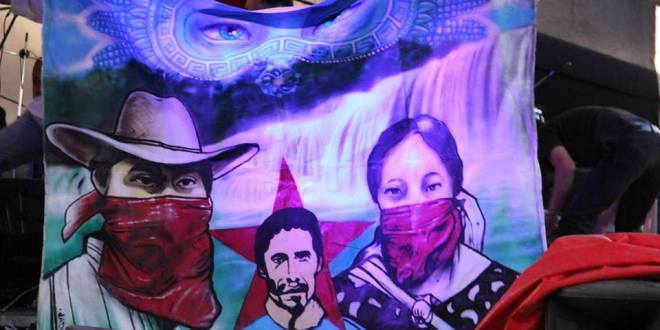
CNI banner at Festival of Resistances and Rebellions
Sisters and Brothers of the National Indigenous Congress
Compañeros and Compañeras of the National and International Sixth
We want you to know that after finalizing the work of the First Worldwide Festival of Resistances and Rebellions against Capitalism, in San Cristóbal de las Casas, Chiapas, delegates started their return to their communities and places of origin. From Puebla and in the Federal District, transit police, federal police and individuals dressed as civilians, apparently soldiers, harassed the CNI’s buses.
Afterwards, at approximately 8:00 PM, three hundred meters after the tollbooth at Salamanca, Guanajuato unidentified individuals threw stones at the bus’ windshields in which CNI compañeros were travelling towards Guadalajara. At this time no injury is reported to any compañero. Indigenous delegates of the peoples, communities and tribes from Azqueltán, Cherán, Ostula, Wirrárika, Yaqui, Guarijío, Tuxpan, Ayotitlán and Comachuén were travelling in said bus, several of them authorities and governors of their Communities and Peoples.
This cowardly aggression on the part of the bad government, shows us their fear of those of us below and to the left that from our communities and peoples, cities and countries, come together in the Festival to get together, listen to each other and share our resistances, rebellions and our pains, with many others that also resist and rebel, to thus multiply our resistances and rebellions, and to make ours the pain of those that are missing them.
We make a call to be attentive to coming aggressions and hope for the safe arrival of all the Festival delegates in their places of origin.
NEVER MORE A MEXICO WITHOUT US
January 4, 2015
National Indigenous Congress
——————————————————
Published in Spanish by Enlace Zapatista
Translation: Chiapas Support Committee
January 5, 2015
Festival of resistances and rebellions in San Cristóbal – Day 1
THE FESTIVAL OF RESISTANCES AND REBELLIONS AGAINST CAPITALISM in SAN CRISTOBAL DE LAS CASAS
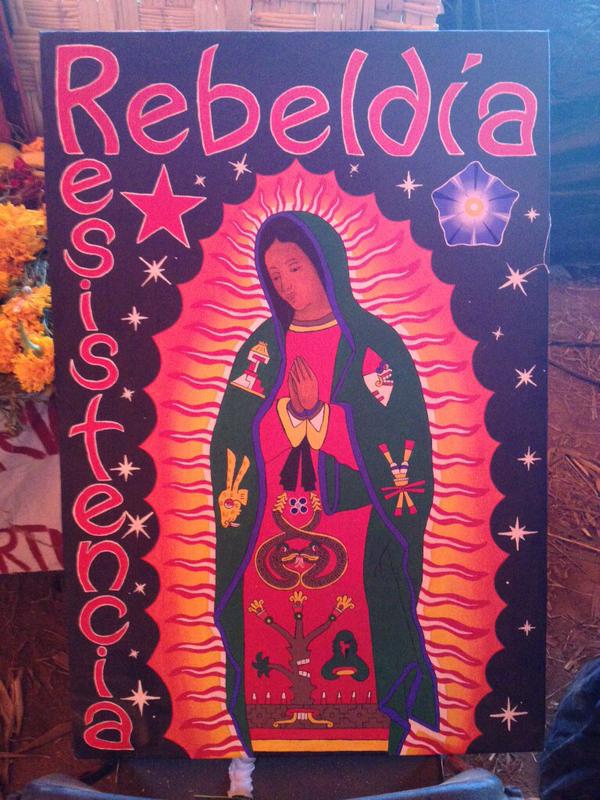
Náhua Virgin
Chiapas Mexico, January 2, 2015
José Luis Hernández, a delegate of the National Indigenous Congress (CNI, its initials in Spanish), inaugurated the sharing at the Festival of Resistances and Rebellions in the installations of CIDECI Unitierra, in San Cristóbal de las Casas, Chiapas. “We bring the word from where we come and the places where we have been,” he explained.
The CNI representative shared some of the numbers of the people registered in the Festival’s different sites: 1300 delegates of 28 native peoples from 20 states of the country and 2,914 participants of the national and international Sixth, of which 736 are international attendees from 42 countries and a total of 2,178 come from the 32 states of the Mexican Republic.
Ayotzinapa present
Continuing the tonic of the previous exchanges (sharings), the relatives and compañeros of the disappeared Ayotzinapa students spoke out. Berta Navas, mother of one of the disappeared students, spoke first and described her son with tears in her eyes as a very humble and hard-working student. “His only vice was being a teacher coming to the communities like those of the compañeros,” she remembered, and continued talking about the repression that the rural schoolteachers suffer: “This government does not want people prepared to bring a message to the communities.”
Berta Navas spoke above all to the people that have been supporting the parents of the normalistas throughout their search for these last three months. “Many thanks to all the people that have received us in their communities from the bottom of my heart, because they have reached out to me.” Referring to the talks of the Ayotzinapa families, at the New Years Festival in Oventic, she specified: “It was an honor that they told us to speak in their place, it was the best honor that I have received. I feel small before all these people, and I ask you to support us today and always. To conclude, Berta Navas exclaimed: “I hope that no one else is missing a child, that no one else is missing a family member.”
Cruz Bautista, another father of a disappeared student, continued Berta’s talk. With his words he explained how his family learned about the youth’s disappearance through the newspaper and appealed to all those in attendance to share their issues: “We hope that with your help this information will reach the country’s poorest barrios so that they realize the anomalies the government does to disappear people that demonstrate against it.”
Next, Bernabé Abraján, the father of Abraján de la Cruz, moved the whole auditorium with his words and continued bringing tears to several of those in attendance. His broken voice remembered, publicly, that today January 2 would be his disappeared son’s birthday. “We would have wanted to be sharing his birthday today with all his relatives,” he alleged. His voice, full of rage and emotion warned clearly: “Now I realize that it’s not only the state of Guerrero, all the states have problems with the government.” And he added: “Now we are going to see that justice is done, through all of us organizing together.”
Óscar García, the brother of Abel García Hernández, spoke to those in attendance explaining the difficult family situation familiar that exists. “My mother cannot speak in Spanish, only in Mixteco, therefore I am here.” The young man continues explaining how his mother asks that he return home, but he “prefers to be here fighting to see his brother again.” Abel García Hernández wanted to be a bilingual teacher, and his brother, the one that now speaks in the CIDECI, wanted to be a soldier but he explained that now he doesn’t, that he no longer wants to be part of the narco-government. Like him, Tlabertino Cruz, father of a disappeared normalista, also thanked the attendees for their presence and asked for the support of all those gathered together.
To finish, Omar García, a teachers college student remembered: “Our history has to do with resistance and rebellion for constructing a different world and for us it is an honor to be here in the CIDECI.” And he added: “We did not open our eyes on September 26, we already had them open.” Finally, he explained an anecdote about the goodbye they had with Subcomandante Moisés: “We expressed to him that we also wanted autonomy in the rural teachers colleges and he told us that seeing is believing.” The student concluded as follows: “We assume that with the courage and determination of thousands of people all over the country that will be possible.”
The inauguration ceremony ended with a present that the Emiliano Zapata Autonomous School of Huixtipec delivered to the Ayotzinapa relatives and compañeros. They read a poem in Náhuatl that talks about the disappeared normalistas and delivered a painting that has accompanied them during the whole Festival and symbolizes a virgin with various Náhuatl symbols.
Between the different talks from the relatives of the Ayotzinapa students, we had the opportunity of listening directly to Mario Luna, the activist and prisoner from the Yaqui people. The compañero expressed from Cerezo 2 of Hermosillo that: “we are where you are, we remain firm.” In reference to the bad government, he explained that: “They are hoping to let our hope fall into oblivion.” He also launched a message of hope: “We can reach a way of self-governing different from that of the politicians.”
Antonia Canuta.
————————————————————–
Originally Published in Spanish by Pozol Colectivo
Translation: Chiapas Support Committee
January 2, 2015
En español: http://www.pozol.org/?p=10177
Zapatista News Summary for December 2014
DECEMBER 2014 ZAPATISTA NEWS SUMMARY
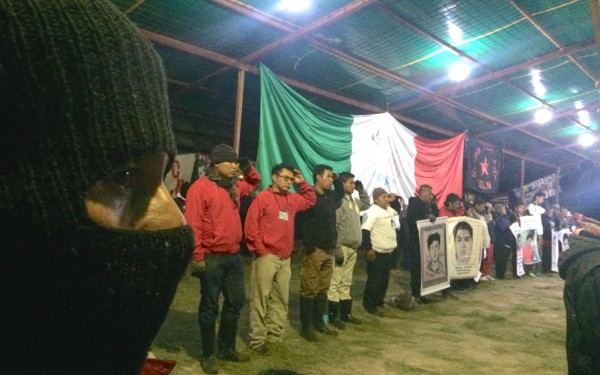
In Oventik, EZLN Celebrates 21st Anniversary with Ayotzinapa
HAPPY NEW YEAR! / ¡FELIZ AÑO!
In Chiapas
1. EZLN Issues Comunicado “On Ayotzinapa,”and much more – On December 14, the EZLN released a long statement with the title “On Ayotzinapa, the Festival and hysteria as a method for analysis and a guide for action.” It analyzed Ayotzinapa as part of the global capitalist war against humanity and offered the EZLN’s 20 spaces to relatives and compañer@s of the murdered and disappeared Ayotzinapa students, thus inviting them as honored guests to the Worldwide Festival of Resistances and Rebellions against Capitalism. The section on hysteria is a commentary on the protests that took place in Mexico around the murders and forced disappearance of the students and the reaction to them from journalists, the political class and the “well-behaved.” Lots of political commentary about those above. Although signed by SCI Moisés, it appears that SCI Galeano (formerly Marcos) had considerable input!
2. The EZLN Reports on Who will Attend the Festival – On December 19, the EZLN issued a brief comunicado titled: “On the Eve of the Festival,” in which Subcomandante Moisés lists participants in the Worldwide Festival of Resistances and Rebellions Against Capitalism and reminds folks how to sign up.
3. 1st Worldwide Festival Begins in Xochicuautla – The 1st Worldwide Festival of Resistances and Rebellions against Capitalism, co-sponsored by the EZLN and the National Indigenous Congress, began with registration on December 20 in Xochicuautla, State of Mexico, and Inauguration of the Festival on December 21 during the day. In the evening some of the left to spend the night and next day at the exchange in Amilcingo. The sharing of resistances (exchanges) took place on December 22 and 23 in both locations. Reports from Xochicuautla focused on the commonalities of the different indigenous struggles that were present and the need to defend Mother Earth. Parents and compañer@s of Ayotzinapa accepted the EZLN’s invitation and those in attendance at the Inauguration of the Festival listened as they, in turn, invited attendees to join their movement. The Report from Amilcingo lists the many struggles (mirrors) present. It included many familiar struggles, including some from Chiapas. A detailed report in Spanish includes beautiful drawings and photos. http://subversiones.org/archivos/111829
4. The Festival Moves to the Federal District – An exchange of struggles, workshops, music and other cultural offerings defined the continuation of the Festival of Resistances and Rebellions held in a facility of the Francisco Villa Independent Popular Front-UNOPII, in Itztapalapa, Federal District. The free media reported that a representative of the parents of the ABC Day Care Center in Hermosillo, Sonora, spoke and read a statement from the parents.
5. San Sebatián Bachajón Recuperates Its Land from the Government – On December 21, the ejido of San Sebastian Bachajón, in Chiapas, recuperated its lands that were stolen by the government in 2011. The reclaimed land involves the ticket booth at the entrance to the Agua Azul Cascades, a large tourist attraction between Ocosingo and Palenque. It also includes a public security office and a government clinic that is not in use. The complete story with photos can be found on the following web page: http://vivabachajon.wordpress.com/en-ingles/
6. The CIOAC-H Threatens to Displace A Community in Las Margaritas – On December 17, the Fray Bartolomé de las Casas Human Rights Center (Frayba) issued an urgent action regarding armed threats to displace Primero de Enero, a community in Las Margaritas Municipality (county). These threats have apparently been on-going since EZLN “sympathizers” settled on the land in 2013. The Urgent Action describes the folks under attack as “sympathizers,” rather than adherents to the Sixth Declaration or EZLN support bases. The CIOAC-H is the campesino organization to which the paramilitaries belong that murdered Compañero Galeano in La Realidad (also located in the official municipality of Las Margaritas) and which continues to receive protection from the official municipal government of Las Margaritas.
7. Las Abejas Commemorates 17th Anniversary of the Acteal Massacre with Ayotzinapa Parents – On December 22, 2014, Las Abejas commemorated the 17th Anniversary of the Acteal Massacre, in which paramilitaries murdered 45 women, men and children while they prayed for peace. A delegation of 14 people from Ayotzinapa, including students and parents of the disappeared, arrived in Acteal to participate in the activities commemorating the 17th anniversary of the murder of the 45 indigenous on December 22, 1997. “We came to share our situation and to report a little about what we are experiencing as family members, (…) the Acteal tragedy is similar to ours; it has no differences because it is the same Mexican State that committed that murder 17 years ago. Our demands of the State continue being that the disappeared be returned alive, that there is justice for the four murdered youths, complete reparations for the damage, that another line of investigation is opened against the 27th Battalion of the Mexican Army, that former Governor Ángel Aguirre Rivero is investigated and that he is incarcerated if he has responsibility.”
8. New Years Eve in Oventik – December 31, 2014 represented the final exchange (sharing) of the Worldwide Festival of Resistances and Rebellions Against Capitalism. After midnight, it also represented the 21st Anniversary of the Zapatista Uprising. The EZLN issued a comunicado in Spanish (not yet translated) of the EZLN’s words on its 21st Anniversary. In the ceremonies, Moisés embraced each of the parents and survivors from Ayotzinapa and said that the EZLN would join their struggle.
In other parts of Mexico
1. No Christmas or New Years Vacations for Ayotzinapa Parents and Students – Relatives and student compañer@s of the 4 murdered and 42 disappeared Ayotzinapa students spent a busy Holiday season. They said that this was a time of struggle for them, not of vacations. Apostolic (papal) nuncio Christophe Pierre, a Vatican diplomat in Mexico, officiated at a mass in Ayotzinapa with the parents and students, accompanied by the Archbishop of Acapulco. The parents are petitioning the Pope to help them find their disappeared children and Christophe Pierre said he would deliver their request to the Pope. Additionally, the parents and students appeared in marches and demonstrations in and around Mexico City and Guerrero and asked that no elections be held in 2015; if elections are held, they advocate that people not vote. They also participated in the EZLN/CNI Festival of Resistances and the commemoration of the Acteal Massacre.
————————————————
Compiled monthly by the Chiapas Support Committee.The primary sources for our information are: Enlace Zapatista, the Fray Bartolomé de las Casas Human Rights Center (Frayba) and free media.
We encourage folks to distribute this information widely, but please include our name and contact information in the distribution. Gracias/Thanks.
Click on the Donate button at www.chiapas-support.org to support indigenous autonomy.
_______________________________________________________
Chiapas Support Committee/Comité de Apoyo a Chiapas
P.O. Box 3421, Oakland, CA 94609
Email: cezmat@igc.org
http://www.chiapas-support.org
http://www.facebook.com/pages/Chiapas-Support-Committee-Oakland/
43 Hugs in Oventik for those absent
43 HUGS for THOSE ABSENT, in the FESTIVAL of RESISTANCES and REBELLIONS and the [21st] ANNIVERSARY of the EZLN IN CHIAPAS

December 31, 2014 in Oventik
Chiapas México #FestivalRyR / January 1, 2015
“The government has them, it took them away. We will only find them with your help,” expressed parents of the Ayotzinapa students, during the sharing (exchange) at the Worldwide Festival of Resistances and Rebellions against Capitalism, in the Zapatista Caracol of Oventik, in the Highlands of Chiapas.
Relatives of the disappeared students thanked the EZLN for having ceded its place in the Festival. They similarly thanked Xochicuautla, Amiltzingo, Iztapalapa and Campeche for yielding to them and for their support. “Our sons have no price, they are the most sacred, we are not going to stop,” they assured.
In his participation the spokesperson for the National Indigenous Congress listed the problems that its members suffer. “We don’t want an alliance, you and we are the same, we have the same pain and the same rage,” he asserted.
In Subcomandante Insurgente Moisés’ voice, the EZLN emphasized that one must no longer trust in the bad governments, which are the overseers and majordomos of the capitalist hacienda (plantation).
“Those above have wanted to deceive us, and if they know how to think and create, think that we are their peons. Enough of that, we said in ‘94, and we governed autonomously,” the Zapatista spokesperson said within the framework of the XXI anniversary of the armed uprising of the Indigenous Chiapanecos.
He asked the CNI to embrace and receive the relatives of the disappeared Ayotzinapa students in their territories, [so that] “the sharing of their word will grow more,” he said. Afterwards, the EZLN as well as the CNI gave a solidarity embrace to each one of the mothers and fathers of the 43 disappeared normalistas.
El Subcomandante Moisés announced that in the coming days “more of our words will come out, which are difficult because they are simple.”
————————————
En español: New EZLN Comunicado: http://enlacezapatista.ezln.org.mx/2015/01/01/palabras-del-ezln-en-el-21-aniversario-del-inicio-de-la-guerra-contra-el-olvido/
——————————————
Originally Published in Spanish by: POZOL COLECTIVO
Thursday, January 1, 2015 in Chiapas
En español: http://www.pozol.org/?p=10172
Translation: Chiapas Support Committee
EZLN weaving resistances with Ayotzinapa
EZLN, WEAVING RESISTANCES JOINTLY WITH AYOTZINAPA
By: Magdalena Gómez
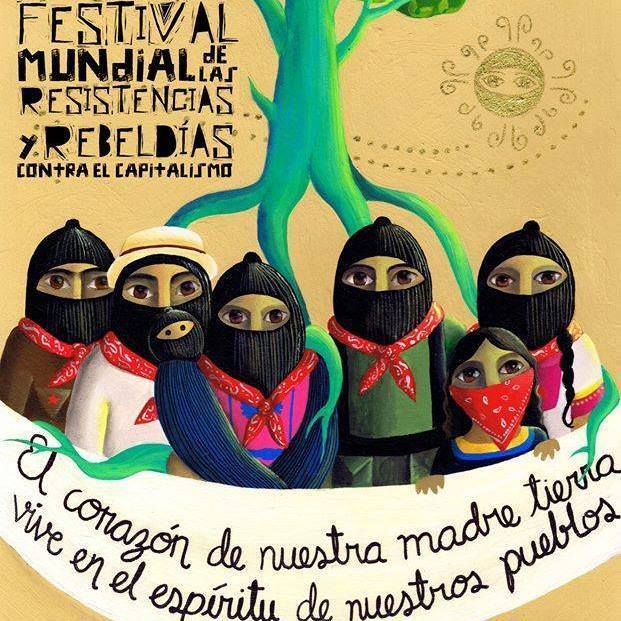
On the very next January 2 and 3, 2015 the Zapatista National Liberation Army (EZLN) and the Congreso National Indigenous Congress (CNI, its initials in Spanish) will hold the plenary of conclusions, agreements and pronouncements in Cideci, in San Cristóbal de las Casas, Chiapas, Mexico, results of the word expressed in the different exchanges (sharing) of the First Worldwide Festival of Resistances and Rebellions against Capitalism “What those above destroy those below reconstruct.”
The festival expresses the phase opened at the end of 2012. They have repeatedly announced the EZLN’s death as a project, as well as the indigenous cause, adducing that: “it already passed from fashion.” Such an absurdity was disproven on December 21, 2012, when Zapatismo held massive silent marches in various Chiapas municipios, emphasizing anew their entrance to San Cristóbal de las Casas. In them, the symbolic message was the question: “Did you hear it?” Early in 2013, the EZLN profiled two initiatives of re-articulation; the first was the Cátedra Tata Juan Chávez, convoked jointly with the National Indigenous Congress; the second: during August and December and also the first week in January 2014 the escuelita zapatista (Little Zapatista School) was held, which brought together thousands of national and foreign students in all the Caracoles to know directly from the Zapatista bases the extraordinary systemization of their autonomous organizational experience in the Good Government Juntas. The CNI held different regional meetings during the first half of this year, which culminated in the August Exchange, in which it was agreed to hold the festival that is about to conclude.
This same year, the EZLN suffered one of the most serious attacks that it has faced, just when it is promoting the re-articulation with the CNI and other movements. Last May 2, members of the Independent Central of Agricultural Workers and Campesinos Historic (Cioac-H, for its initials in Spanish) murdered José Luis Solís López, Galeano, a teacher at the escuelita zapatista. The brutality of the crime and the ambush were carried out in La Realidad, one of the emblematic bastions of Zapatismo. Within this context, Subcomandante Insurgente Marcos announced his disappearance and the birth of Subcomandante Galeano and, nevertheless indicated that the EZLN reaffirms its option for peace and not war, in favor of life and not death. With the noted process underway, last September 26 it received the blow of the disappearance of 43 normalistas from Ayotzinapa.
The caravans of the disappeared students relatives were received inside of Zapatista lands on November 15, 2014 and Subcomandante Insurgente Moisés expressed a profound message: “Your words are of utmost importance to us: your rage, your rebellion, your resistance. There, on the outside, they are talking and arguing and making allegations over violence or non-violence, ignoring the fact that there is violence on most people’s tables every day. Violence walks with them to work and to school, goes home with them, sleeps with them, and without consideration for age, race, gender, language, or culture, makes a nightmare out of their dreams and realities. We hear, see, and read that on the outside they are debating coups from the right or the left, who to take out of power and who to put in. They forget that the entire political system is rotten.
He also counseled them to avoid division, getting ready to face betrayal and abandonment when the specific cause is out of style and, above all, to look below, and from there, only from there, to weave your alliances. Seek the native peoples, he told them, who before time was time, possess the wisdom to resist and there is no one that knows more about pain and rage. And he warned: “We know that many ask things of you, that they urge you, that they demand of you, that they want to lead you toward one destiny or the other, that want to use you and that they want to tell you what to do.”
One month later: “We Zapatistas, are here. And from here we see, hear and read that the voice of the family members and the compañer@s of the murdered and disappeared of Ayotzinapa is starting to be forgotten and that now, for some folks out there, the more important things are:
-the words of others that have taken the stage;
-the discussion about what tactics and strategy to follow so that the movement will transcends its limits.
Therefore we say that what is first, most important and urgent is to listen to the family members and compañeros of the disappeared and murdered of Ayotzinapa. Those are the voices that have touched the hearts of millions of people in Mexico and in the world.” They then expressed their decision to “cede our place at the first Worldwide Festival of Resistances and Rebellions against Capitalism to the relatives and compañeros of the murdered and disappeared normalistas of Ayotzinapa.” In 1995 they also opened the table for dialogue with the government to all of the country’s indigenous peoples; those are authentic democratic lessons. This weaving of secure alliances will show hopeful strategies.
————————————————————
Originally Published in Spanish by La Jornada
Translation: Chiapas Support Committee
Tuesday, December 30, 2014
En español: http://www.jornada.unam.mx/2014/12/30/opinion/018a1pol
Festival of Resistances in the Federal District
WORLDWIDE FESTIVAL of RESISTANCES and REBELLIONS AGAINST CAPITALISM in the FEDERAL DISTRICT

Parents of Disappeared students speak in the Federal District
México, D.F. 24 de Diciembre. Today began the Worldwide Festival of Resistances and Rebellions against Capitalism in the Federal District. Despite the rain, the art, music, food and the word maintained the spirits and the interest of all those gathered together at the place for rodeos of the Charros [1] Reyes Association of Iztapalapa, of the Francisco Villa Popular Front Independent-UNOPII.
During the Festival’s inauguration, different compañeros welcomed all the attendees and shared their causes and support for the other struggles present. Nicolás Flores, from the community of Santa María de Ostula, in Aquila, Michoacán shared that the State the community has been attacked to dispossess them of their land, but their community police and the community fight to rescue it and protect it. That’s why they are part of the CNI (National Indigenous Congress) and adherents to the EZLN’s Sixth. He said: “all of us together are going to be effective,” and he added that in the case of the “Raúl Isidro Burgos Rural Teachers College of Ayotzinapa we have found a reflection of our pain, our rage and our rebellion… We are campesinos in struggle that are not going to stop fighting for our land… And therefore we are here.”
Patricia Moreno Salas of the Wixarica people also spoke about the long struggle of her people in defense of indigenous territory and she emphasized how the Cultural Festival shows us other forms of communication and resistance, “to be closer as brothers.”
Compañero José Romero, of Monclova, also took the word, gave the welcome and shared the cases of Sonora, the strategies of community division that the government employs to facilitate the dispossession of lands. But the communities are not alone: “therefore we are joining in the struggle with you to continue forward.” To this sharing is added a message sent from the parents of the ABC Day Care Center, in which they expressed their unbreakable hope of finding safe sand sound the 42 Ayotzinapa students still disappeared. In their message from parents to parents suffering injustice they expressed: “We know the pain of the uncertainty, but above all, we know what it is to find their bodies without life… It is difficult to ask the government for justice when it is the one responsible. How do you confront impunity? How do you confront a State that creates a false reality and that systematically produces criminals? How do you maintain hope? The answer is the unity of what we have suffered, the persecuted, the marginalized, those affected by the corrupt system.” The message spoke about two Mexicos, one corrupt, where the people sell their vote, founded in impunity and corruption; “that Mexico does not deserve not one drop of blood.” But there is another Mexico that late in our hearts and it asserted that this struggle is for reconquering what by law corresponds to us, justice, because “today the pain is yours, but the rage is everyone’s.”
The turn came for the Ayotzinapa compañeros, Don Mario, father of Cesar Manuel González expressed: “I am a father from an injured family that wants to recover his son. We didn’t know about this kind of event, we see the injustices and the struggles of the communities for lands and lakes.” He reiterated the demand that the government deliver the students alive because all “the times they say they have killed them, the government has fallen into the lie. We want justice for all the people that are dead in the [clandestine] graves… for the deaths in Juárez… We didn’t know that this comes from the State…. We were under the illusion that Peña would receive us, but he is a puppet that to speak he needs them to put it on paper. He is not aware of the fact that he must speak for himself.” He made an invitation to the dinner with Peña Nieto in Los Pinos at night.
Doña Hilda, the mother of Jorge Antonio Tizapa thanked everyone for the affection with which they are received in each activity, and reiterated the request to the government that it delivers the students alive.
The inauguration closed with Omar García, a student at the Raúl Isidro Burgos Rural Teachers College of Ayotzinapa. He asserted: “On September 26, nobody looked for him, the ABC Day Care Center, or the Juárez dead;” all these injustices make this a complex movement and “there isn’t even a political project. But we are convinced that the country has to change, because of the criminalization of social mobilization, because of the plunder, the impunity, the corruption… These are the problems that must unite all of us; it must be converted into a point of no return… September 26 is not October 2, now the information is about everyone; we all know that it is the government… The State has its hands very involved, because they are the only ones that don’t leave a trace when they disappear a campesino, teacher or student… They were the ones, we saw the, they were uniformed… We are going to undertake the search and we are going to construct a new country, with the municipal councils… We want to demonstrate that we are not going to remain with our arms crossed… We do not dialogue with our executioners… This justice doesn’t work for us. We believe that all of you know and understand our words [and]… we don’t want Band Aids, we want real medicines for this totally sick country.” Lastly he called for joining together, “the students and parents are very small taking on a very big problem. Don’t leave us alone! We all have to take change into our hands.”
Thus began the Festival, and in the different tents and scenarios artistic presentations and workshops were carried out about the different ways of resisting the capitalist economic model. Urban vegetable gardens for food sovereignty, ecological towels and diapers for reducing consumption and residues, belt weaving, taping, painting and processes of self-management, among others. From the diversity, the festival shows the different ways of constructing and acting collectively in the face of a system that divides and destroys.
[1] Charros are horsemen and a lienza charro is the place where a type of rodeo or show is held that involves the horsemen roping horses with lassos.
Pozol’s Source:
http://espoirchiapas.blogspot.mx/2014/12/festival-de-las-resistencias-y.html
—————————————————-
Published in Spanish by Pozol Colectivo
Translation: Chiapas Support Committee
Friday, December 26, 2014
Festival of Resistances begins in Xochicuautla
WHAT HAPPENS IN XOCHICUAUTLA IS A MIRROR OF WHAT HAPPENS IN OTHER TOWNS ALL OVER THE COUNTRY,” ORIGINAL PEOPLES SAY
“The Mexican State at its three levels, has responsibility for what is occurring in the country, because of how it acts and doesn’t act, as well as for being a guarantor of impunity, due to a politics of double discourse,” CNI.

Photo from Inauguration of the 1st Worldwide Festival of Resistances and Rebellions against Capitalism
Xochicuautla, State of Mexico, December 21, 2014
“Our mission is to care for our land. We know that it’s important to preserve it, a value more precious does not exist than life itself,” the Supreme Indigenous Council of Xochicuautla expresses, at the inauguration of the 1st Worldwide Festival of Resistances and Rebellions against Capitalism, in the municipio (county) of Lerma, State of Mexico, convoked by the Zapatista National Liberation Army and the National Indigenous Congress (CNI).
The community of Xochicuautla asserts that the authorities are sick with evils like ignorance, apathy, fear and greed, since they see money as a God. “They have the material but are poor in spirit and their children inherit that sickness. They kill, disappear and incarcerate those who oppose their interests,” they add.
Resoundingly, the indigenous Otomí community expresses a No to the passage of the Toluca-Naucalpan Super-highway, no to the La Parota Dam, no to the aqueduct in Sonora, no to the mining companies, no to the violation of rights, no to corruption, and a YES to respect, love, honesty, humility and life itself.
In his participation the spokesperson for the National Indigenous Congress and for the Indigenous Peoples Front in Defense of Mother Earth, asserts that the Mexican State at its three levels, “has responsibility for what is happening in the country, because of how it acts and doesn’t act, as well as because of being the guarantor of impunity, due to a politics of double discourse.”
Peoples and communities represented in the CNI say that they meet again one more time to share their word, and that they will carry it and plant it in the places from which they come. “Some want us to remain blind, that we are resigned to the violence and death provoked by their injustices, that we are a people resigned to the impunity, to the corruption, but the women, grandparents, men and children are going to demand justice,” the native peoples assure.
Members of the neighboring community of Huitizizilapan, also in the municipio of Lerma, State of Mexico, assure that despite repression from the three levels of government, “we are going to continue defending dignity, we are not going to give up and we are not going to take one step back.” In the same way, inhabitants of Santiago Tlanixco, in the municipio of Tenango del Valle, where six compañeros have been incarcerated for defending the water, assert that they have decided to rise up a movement together with the rest of the towns.
Mario Cesar González Contreras, the father of César Manuel González, one of the disappeared Ayotzinapa teachers college students, asserts that they are not commanded by other people, and expresses: “Why not fight for our children that were born from that same land, who will give classes to the humble people of this land? If you fight for your lands we [fight] more for our children.” Berta Nava Martínez, the mother of Julio Cesar Nava, concludes: “Thank you for waiting for us. Cesar had a great desire to be a good teacher, to go to the indigenous communities, and also to open the eyes of the parents so that they would know their rights, since the government always wants our eyes to be covered.”
“The 43 students must come to be in those 43 chairs,” the parents express about the 43 seats that remain empty in front of the stage at the festival’s inauguration del festival. “Thank you for having turned around for Ayotzinapa, for the students, for us,” they add.
At the start of the festival, indigenous from the San Sebastián Bachajón ejido of Chiapas, greeted the brother peoples and announced: “Our communities in assembly, we decided to recuperate today the lands that that the bad government has dispossessed since February 2, 2011, with the complicity of the ejido commissioner at that time Francisco Guzmán Jiménez, alias el Goyito and now by its faithful disciple Alejandro Moreno Gómez, and its vigilance council member Samuel Díaz, who serves the interests of the bad government and not those of his people.”
—————————————————————
—————————————
Originally Published in Spanish by the Pozol Colectivo
Translation: Chiapas Support Committee
December 21, 2014
En español: http://www.pozol.org/?cat=338
The Zapatistas and Hope
THE ZAPATISTAS AND HOPE
December 18, 2014
*We think that it is necessary for one of us to die so that Galeano lives.
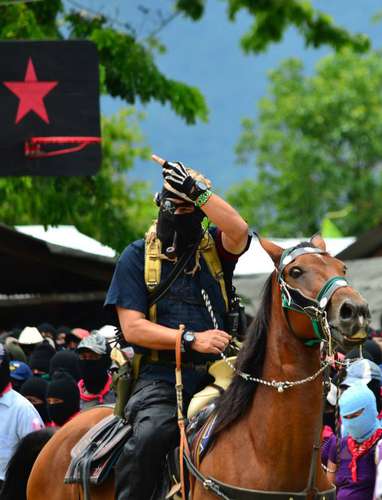
Marcos becomes Galeano
To satisfy the impertinence that is death, in place of Galeano we put another name, so that Galeano lives and death takes not a life but just a name – a few letters empty of any meaning, without their own history or life. That is why we have decided that Marcos ceases to exist today.
And death will go away, fooled by an indigenous man whose nom de guerre was Galeano, and those rocks that have been placed on his tomb will once again walk and teach whoever will listen the most basic tenet of Zapatismo: that is, don’t sell out, don’t give in and don’t give up.
Given the above, at 2:08am on May 25, 2014, from the southeast combat front of the EZLN, I hereby declare that he who is known as Subcomandante Insurgente Marcos, self-proclaimed “Subcomandante of stainless steel,” ceases to exist.
Passages from Between Light and Shadow, Subcomandante Galeano, May 2014
Dear Friends & Supporters of the Chiapas Support Committee:
2014 has been a turning point year for Mexico and the U.S.
We are asking you to join us in building grassroots support and solidarity with the Zapatista communities. Please make a generous donation to directly support the Zapatista efforts in constructing autonomy. Why?
2014 was the 20th anniversary of the EZLN-led indigenous uprising in Chiapas. The Zapatistas began marking this momentous anniversary launching “La Escuelita Zapatista,” the Little Schools of Freedom according to the Zapatistas, in 2013, where they invited community leaders, youth, elders, women, children and even world-class intellectuals to learn from them how they organized their revolution.
In 2014, the Zapatistas also shared the deep changes they have accomplished, making historic transitions consolidating the Zapatistas communities’ power from below. This includes:
- Indigenous leadership of the EZLN
- Building community-based autonomy and self-determination
- Indigenous women’s and girl’s power and direct participation; and
- At the center of these changes, “from revolutionary vanguardism to ‘rule by obeying;’ from taking Power Above to the creation of power from below; from professional politics to everyday politics, from the leaders to the people….”
To us, the Zapatistas are synonymous with hope. How do we persist and build our own resistances in the long struggle for justice across borders? The Zapatista communities have shared their own experiences and consistently organized spaces for international dialogue to build connections and movements against neoliberalism, war and racism and for humanity and a different way of being together.
Compañero Galeano Lives!
With love, pain and rage the Zapatistas laid the body of Compañero Galeano to rest while at the same time ensuring that his name and spirit would live on. The person we had known as Subcomandante Marcos for a little more than 20 years died symbolically and resurrected as Subcomandante Galeano so that the memory of the brutally murdered compañero would live on. Although it had been coming gradually, the May 2 murder of Compañero Galeano in La Realidad provided the steppingstone for a transition to Indigenous leadership of the EZLN in the person of Subcomandante Moisés, a natural and foreseen transition despite what the corporate press may have said.
The Zapatistas consider that transition and symbolism to be of such importance that they questioned two members of the Chiapas Support Committee (CSC) about our understanding of it during our visit in September and were pleased that we paid no attention to the interpretations of the corporate (“for pay”) media, but rather the direct word of the EZLN.
Originally intended to be a brief visit to clarify an education project in the region of La Garrucha, the purpose of our visit expanded when we received the news about the attacks and forced displacements in San Manuel municipio (county), with which the CSC has had a close relationship since 2002. After clarifying the education project with regional education coordinators, attention turned to the more than 70 Zapatistas displaced from their homes in 3 San Manuel communities. The Good Government Junta gave us permission to visit San Manuel.
We traveled to San Manuel and met with the autonomous municipal council, the health care promoters, warehouse workers and education promoters (teachers). We learned that the displaced families lost everything when they fled to save their lives and avoid a massacre. The autonomous council stated that the government paid the paramilitaries to attack and displace the three communities, just as the EZLN’s investigation revealed regarding the murder of Galeano. According to Subcomandante Moisés, San Manuel was attacked in retaliation for the Exchange (Sharing) between the National Indigenous Congress (CNI) and the EZLN, just like Compañero Galeano was murdered in retaliation for the very successful Little Zapatista Schools during 2013 and at the start of 2014. The government’s message: You’re going to pay a price for organizing!
Build Grassroots Solidarity! Support Zapatista Autonomy & Schools
Despite the Mexican government’s counterinsurgency and severe repression, we also have some good news to report from San Manuel. The municipio and its more than 40 communities remain together, well managed and in resistance. Autonomous authorities specifically stated that the projects the CSC constructed with them continue to thrive, thereby enabling the municipio to function and succeed.
This year we completed a three-year autonomous primary education project in the region of La Garrucha, which included the construction and or re-modeling of schools, continuing education for the teachers and teaching materials for both the education promoters and the students. We also provided emergency financial support to those displaced from the three Zapatista communities in San Manuel.
While in La Garrucha the Junta told us about an education project that is currently being developed for the region: one or more secondary (middle) schools.
In contrast to the other Caracoles, the La Garrucha region has no secondary school. The debate is whether to have one secondary school for the entire region or one in each autonomous municipio. Whatever the region’s decision may be the Chiapas Support Committee is committed to supporting the secondary school project. We need your help to do that.
Please join us and give a generous donation that will go in its entirety to help the Zapatistas build schools and autonomy!
Los 43: They were taken alive! We want them back alive!
Compañero Galeano’s murder marked the opening of a new wave of political repression and killings carried out in collusion between Mexican government forces and narco-drug cartels and paramilitaries.
Mexican youth bore the brunt of the carnage left by organized crime and drug trafficking gangs in various states of Mexico. Local police and politicians with organized crime have been responsible for the extrajudicial executions of 22 arrested and disarmed youths by Mexican Army soldiers in Tlatlaya (June) and, finally, the unspeakable crime committed against students of the Ayotzinapa Teachers College that resulted in six dead and 43 forcibly disappeared –a crime against humanity– still not clarified (since September).
The Chiapas Support Committee continues to translate and publish educational information about Mexico and the Zapatistas through our various social media outlets.
This year we met with students that attended the Little Zapatista Schools (Escuelitas Zapatistas). We worked with other collectives to organize a successful demonstration at the Mexican Consulate following Compañero Galeano’s murder.
Afterwards, we participated in forming a Zapatista urgent response network in order to have a larger and more coordinated response to any future attacks against the Zapatistas.
Our challenge in the coming year is to extend that coordination beyond emergency response.
Help Us Keep Zapatista Hope Alive
As the Chiapas Support Committee enters its 16th year and the EZLN turns 21, we are asking you to make a generous donation so that we can continue strengthening our work in support of the Zapatista communities and their construction of autonomy, as well as to support our local organizing efforts.
For your convenience, you can make your contribution online. Just go to our main website www.chiapas-support.org and click on the Donate button to make your contribution via PayPal.
Alternatively, you can send a check payable to the Chiapas Support Committee to our Post Office Box: Chiapas Support Committee, P.O. Box 3421, Oakland, CA 94609
And, we are registered with Amazon Smile and The Network for Good.
We thank you for your continued interest in and support for the peoples of Chiapas and assure you that your support makes a critical difference in the lives of many and that we and the Zapatista communities will thank you from the bottom of our hearts.
For peace & justice without borders,
Chiapas Support Committee: Arnoldo Garcia, Todd Davies, Alicia Bravo, Carolina Dutton,
Laura Rivas-Andrade, Jose Plascencia, Francisco Díaz and Mary Ann Tenuto-Sánchez
EZLN: On the eve of the festival
ZAPATISTA NATIONAL LIBERATION ARMY
MEXICO
December 19, 2014 19
To the Congreso National Indigenous Congress: To the National and International Sixth:
Compas:
Receive our greetings. We write to give you an advance about how the inscription is going of participants in the First Worldwide Festival Resistances and Rebellions against Capitalism: “Where those above destroy, those below reconstruct.”
- – Native Peoples of Mexico – Representatives of organizations, traditional authorities and individuals from the following native peoples have confirmed their participation:
Yaqui, Yoreme-Mayo, Guarijío, Tohono Odham (Pápago), Wixárika (Huichol), Náyeri (Cora), Nahua, Coca, Zoque, Purhépecha, Ñahñú (Otomí), Totonaco, Popoluca, Migrants in the city (Purhépecha, Mazahua, Mayo, Tojolabal, Nahua), Ñahtó (Otomí), Mazahia, Mephá (Tlapaneco), Na savi (Mixteco), Nancue ñomdaa (Am uzgo), Tojolabal, Tzeltal, Tzotzil, Chol, Peninsular Maya, Zoque (Ampeng), Binnizá (Zapoteco), Chinateco, Ñu savi (Mixteco), Afromestizo, Triqui, Cuicateco, Mazateco, Chatino, Mixe and Ikoot.
- – From the Sexta in Mexico: individuals, collectives, groups, and organizations from the 32 federative states.
- – From the International Sixth: individuals, collectives, groups and organizations from the following countries:
Mexico, Germany, Argentina, Australia, Belgium, Canada, Chile, South Korea, Denmark, Ecuador, Spain, United States, France, Greece, Guatemala, Honduras, England, Iran, Italy, Norway, Basque Country, Russia, Switzerland and Tunisia.
- – We remind you that the big inauguration is this Sunday, December 21, 2014 in the Ñathó community of San Francisco Xochicuautla, Lerma municipality, State of Mexico, Mexico, at 2:00 PM.
The sharing (exchanges) will be in San Francisco Xochicuautla and in Amilcingo, municipality of Temoac, Morelos, on December 22 and 23, 2014.
December 24, 25 and 26 a Great Cultural Festival will be celebrated in the Federal District in Lienzo Charro, in Cabeza de Juárez, Avenida Guelatao #50, Colonia Álvaro Obregón, Delegación Iztapalapa, México D.F.
The sharing will continue on December 28 and 29, 2014 in Monclova, municipality of Candelaria, Campeche, Mexico.
On December 31, 2014 and January 1, 2015 will be the Fiesta of Anti-capitalist Rebellion and Resistance in the Caracol of Oventik, Chiapas, where we will have the honor of receiving everyone (todoas, todas y todos).
On January 2 and 3, 2015 the plenary of conclusions, agreements and pronouncements will be held in el CIDECI, in San Cristóbal de Las Casas, Chiapas, México.
On January 3, 2015 the Closing of this Festival will be held at CIDECI, in San Cristóbal de Las Casas, Chiapas, México.
To register for an invitation, mailto:catedratatajuan@gmail.com.
To participate in the cultural festival, register at comparticioncultural@gmail.com.
- – The invited guests of honor, the relatives and compañeros of those of Ayotzinapa that are missing, communicated to us that yes they would participate. That way we will all have the opportunity of listening to them.
- – Finally, we advise you that our delegates are now ready to participate with an attentive and respectful ear. We are going with our faces uncovered so that you cannot identify us. Or, better still, so that you may identify us as one more among our compañeros, compañeras and compañeroas of the Sixth.
That’s all.
From the mountains of the Mexican Southeast,
Subcomandante Insurgente Moisés.
——————————————————————
Originally Published in Spanish by Enlace Zapatista
December 19, 2014
Translation: Chiapas Support Committee
Español: http://enlacezapatista.ezln.org.mx/2014/12/19/la-vispera-del-festival/
 Chiapas Support Committee