Chiapas Support Committee
Home of the Compañero Manuel blog on zapatistas & mexico
EZLN: Special Cases
SPECIAL CASES
If you have not received an email with a “pass” to the second grade, it could be because… …the email address you used to register for first grade has expired, or was erased, or you have forgotten your password.
…You have the same email but you haven’t received a “pass” because we got mixed up and we need your information again…or because you didn’t pass to second grade. If after following the instructions we detail below you don’t receive a “pass” email within a month, then it’s because you didn’t pass first grade.
In either case, the way to resolve the issue is simple: it is sufficient to send a new email to this address: casosespeciales@ezln.org.mx, from a new email account with the following information:
–your full name and date of birth –where you live –your registration code if you remember it or have it –the dates in which you went to first grade –the place where you went to first grade (if you went to a community, the name of the community and the Caracol it corresponds to); (if it was by videoconference, the name of the place, neighborhood, city, country, and continent where you had the videoconference) –the name of your Votán.
En español: http://enlacezapatista.ezln.org.mx/2015/07/29/casos-especiales/
EZLN: Second level of the little Zapatista school
ZAPATISTA NATIONAL LIBERATION ARMY
MEXICO

Colectivo Pintar Obedeciendo / Painting Collective Obeying.
July 27, 2015
To the National and International Sixth: To the former students of the Zapatista Little School: Compas:
The date for the second grade (only for those who passed the first) of the Zapatista Little School is approaching.
As we had previously announced, the dates are July 31 and August 1 and 2 of 2015.
No, don’t rush. This time it isn’t about coming to Zapatista territory. Rather, this time it is about not coming here, at least not for the Little School. The second grade will be everywhere, outside of Zapatista territories.
Let us explain:
As we have already said, we see that the economic situation is really difficult. Well, not just the economic situation. The government repression against the Native peoples, including the Yaquis (in Sonora) and Nahuas (in Santa María Ostula, Michoacán, and in Ayotitlán, Jalisco), and against the democratic teachers union (first in Oaxaca, later it will come in other states) reminds us all that those above do not honor their word and betrayal is part of the way they do politics.
With respect to the economic situation, we know that it is not easy to get together the money for daily things, much less for frequent travel to spend a few days here.
We Zapatistas know very well that if we say come to the Little School to continue learning how to really see us, well there will be people who can.
But the majority of those who passed the first grade are compas who do not have the money to do so or who have to comply with work responsibilities in the geographies where they struggle. That is, they can’t just be coming here every so often. This isn’t that they don’t want to come, but rather it’s because they aren’t able to come. There are those who did everything they could to get here for the seminar/seedbed this past May, and it’s really difficult for them to come again this year.
And the Little School should not be only for those who don’t have problems with the calendar or the funds for travel. What we Zapatistas want is for our compas of the Sixth to see us directly, to see us and hear us and, as it should be, take what they think will be useful to them and leave aside what isn’t useful or is bothersome.
Taking all these things into account, we have to think about how to continue talking to you and mutually learning from each other.
So we have organized the next grade levels (2 through 6) so that you don’t have to come so frequently, but rather let’s say once a year. Of course, we will give you sufficient notice when there are possibilities to receive you here.
Given that, we want to let you know that for Second Grade there are no classes in Zapatista territory. Of course, if you want to come to the festivals in the Caracoles, that’s fine. But you don’t have to come for class.
But there is going to be class, and of course, exams.
This is how it will work:
- Those who passed the first grade will receive, as of July 30-31 and August 1 of 2015, an email (if you have email that is; if not, we’ll send notice via the person who contacted you for the first grade). This email will have a link to a site with a video. In this video, a group of special Zapatista teachers will explain what is to be explained. In order to see this video you will need a password, as they call it, which will be included in the email. Now, the video doesn’t have to be viewed alone. You can get your collectives, groups, or organizations together to watch it. You can do this in the spaces that the EZLN’s Sixth Commission Support Teams have across Mexico, or in spaces belonging to the groups, collectives, and organizations of the Sixth throughout the world. There is no problem with any of that. Be it individually or collectively, you will see and hear our compañeras and compañeros explain to you a part of the genealogy of the Zapatista struggle. You all have already heard, seen, and even lived with Zapatista bases of support, with your Votans, with your families. But this is just one part of the struggle for freedom according to Zapatismo. There are other parts. It’s as if we had only given you one part of the puzzle, or as if, as they say, what is missing is yet to come.
You will also have to study Chapter 1 of the book “Critical Thought Versus the Capitalist Hydra,” the sections titled: “Some of what has changed”; “Toward a Genealogy of the Zapatista Struggle”; and “Notes on Resistance and Rebellion.” Don’t worry if you don’t have the book, because these sections are already on the Enlace Zapatista webpage, but it’s better to get the book because that’s where you get the whole picture.
- After you see, hear, and study what our compañeras and compañeros say in the video, and after studying those parts of the book, you will INDIVIDUALLY write 6 questions. You will send these 6 questions to an email address that will be included in the email that you receive. The date for sending your questions can be any day and time between August 3, 2015, and October 3, 2015.
- We will not respond to your questions individually, but rather collectively. That is, we are going to put all of the questions together here and then create texts, videos, and recordings where we respond. When you read a text from the [EZLN] Comandancia or listen to a recording from the Votans, you will know that they are answering your questions. If you don’t hear a response to your question, don’t despair! That just means that there are more words coming that will respond to you. There won’t be any individual answers, only general and collective ones.
- The questions are important. As is our way as Zapatistas, the questions are more important than the answers. And it is the questions that will be evaluated to decide whether you pass and move on to the third grade.
- The idea is that you realize that what interests the Zapatistas is not the certainties, but rather the doubts. Because we think certainties immobilize; that is, they leave you content, satisfied, sitting still and not moving, as if one had already arrived at or already knew the answers. In contrast doubts—questions—make one move or search. They don’t leave one at peace, but rather non-compliant and dissenting, as if there were neither night nor day. And the struggles below and to the left, compas, are born in disagreement, in doubts, in restlessness. If one is satisfied and in agreement it is because they are waiting to be told what to do or they have already been told what to do. If one is discontent, it is because they are searching for what to do.
- So we’re telling you right now what we are going to use in order to decide if you proceed to the third grade: the 6 questions that you put forward individually. This is what the Votans will evaluate to see whether to put you on the list for “Continues on to Third Grade.”
Well compas, that is all we wanted to tell you for now. In any case, through the Little School and everything else, we will continue supporting each other and supporting those who struggle for truth and justice, like the Nahua people of Ostula who demand justice for the attack on their community in which the child EDILBERTO REYES GARCÍA was murdered by the federal army; like the Nahua people of Ayotitlán, attacked by guardias blancas (white brigades or private paramilitaries] and police working for the transnational mining company Ternium; like the families of the 47 absent students of Ayotzinapa; like the families of the children of the ABC Daycare (just because the media doesn’t report on them doesn’t mean they no longer struggle for justice); like the families of the political prisoners and the disappeared all over the world; like the rebellious teachers’ union; like the Greece from below and to the left that never bought into the story of the referendum; like the prisoners that continue to challenge Power and the State even from behind bars; like those who challenge Power from the streets and countryside in all geographies; like the Native peoples who keep up their defense of the Mother Earth; like those who do not sell out, do not give in, and do not give up.
Because resistance and rebellion are what break the geographies and calendars above. Because when above they predict defeat, discouragement, and surrender, there is always one who says “NO.” Because, look at how things are, at the roots of freedom there is always a “NO” that clings to the earth, nourishes itself and grows from her.
Okay then. And let’s not forget today or yesterday, so that tomorrow we will remember what’s yet to come.
Subcomandante Insurgente Moisés Subcomandante Insurgente Galeano
Director of the Little School Concierge of the Little School
Mexico, July 2015
En español: http://enlacezapatista.ezln.org.mx/2015/07/27/segundo-nivel-escuela-zapatista/
Joint CNI and EZLN-CG comuniqué on Ostula
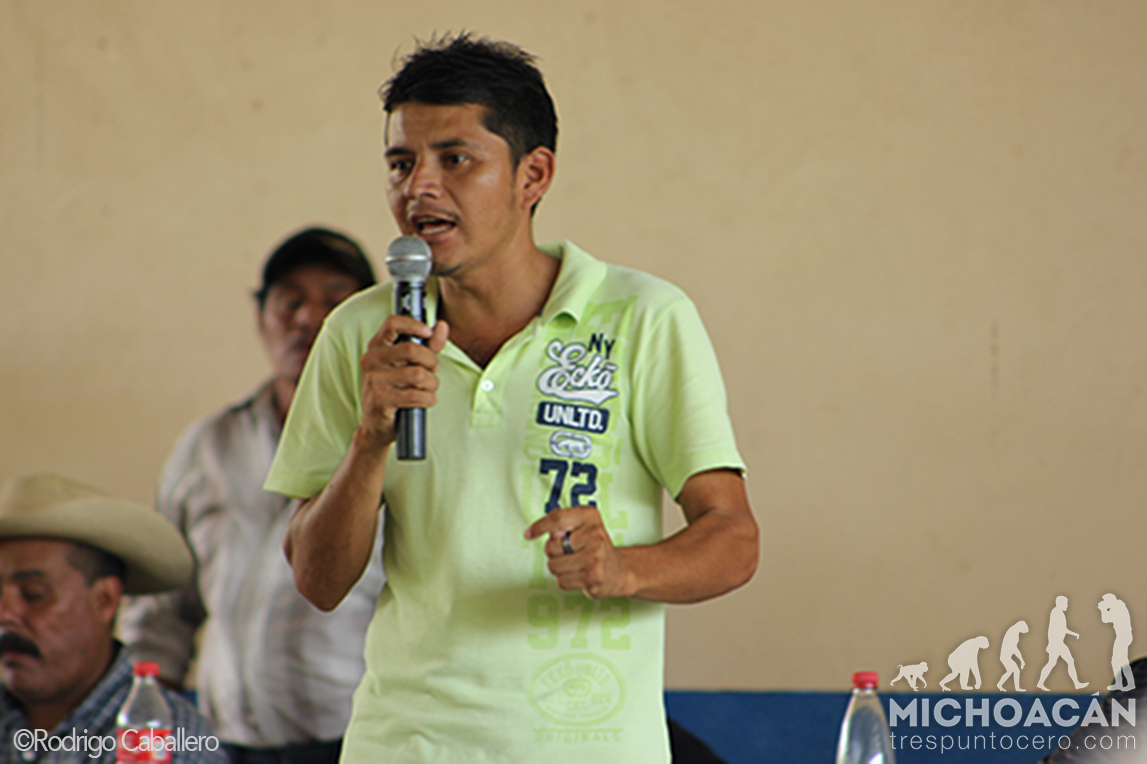
Semeí Verdía is the self-defense leader of Ostula, currently under arrest after the military attack.
Joint CNI and EZLN-CG comuniqué about the attack of federal forces on the Indigenous community of Santa María Ostula
To the Nahua Indigenous Community of Santa María Ostula, Aquila, Michoacán:
To the National and International Sixth:
To the people of Mexico and the World:
July 21, 2015
Given the violent events perpetrated against the indigenous community of Santa María Ostula on July 19, 2015, by a large commando made up of members of the Federal Preventative Police, the Secretary of National Defense, and the Secretary of the Navy in which Ostula community police commander Cemeí Verdía Zepeda was detained, in which federal soldiers murdered, WITH A BULLET TO THE FACE, THE 12-YEAR-OLD CHILD EDILBERTO REYES GARCÍA, and in which the following people were injured: the child Yeimi Nataly Pineda Reyes, 6-years-old; Edith Balbino Vera; Delfino Antonio Alejo Ramos, 17-years-old; Horacio Valladares Manuel, 32-years-old; José Nicodemos Macías Zambrano, 21-years-old; and Melesio Cristino Dirzio, 60-years-old…
WE DENOUNCE:
The criminal behavior of the above listed military and police bodies and their complicity with organized crime, in this case the Knights Templar, enacted in order to escalate the war of conquest that has been waged for years now against the Nahua indigenous community of Santa María Ostula. The goal of this war of conquest is to occupy the community’s territories in favor of mining and transnational tourist interests, and to punish this community for having dared to take back the land from which they had been displaced and for having defended themselves—by putting into practice their right to live—from organized crime, which today serves as the paramilitary branch of the Mexican State.
The motive for these criminal acts is none other than to advance of the war of capitalist conquest against Ostula and against the originary peoples and indigenous and non-indigenous communities in this country.
Given this, WE DEMAND:
- THE IMMEDIATE AND UNCONDITIONAL FREEDOM OF COMMANDER CEMEÍ VERDÍA ZEPEDA, AND THAT ALL CHARGES AGAINST HIM BE DROPPED.
- THE PUNISHMENT OF THE AUTHORITIES AND MEMBERS OF MILITARY AND POLICE BODIES WHO MURDERED THE CHILD EDILBERTO REYES GARCÍA AND BEAT AND INJURED VARIOUS OTHER COMMUNITY MEMBERS OF OSTULA.
- Respect for Santa María Ostula’s community lands which foreign mining companies like Ternium—with the support of the bad government in collusion with organized crime—intend to take over, dispossessing the community.
- The reappearance, alive and well, of the 6 disappeared community members, and the punishment of the intellectual and material authors of the murders of the 33 Ostula community members who have been killed over the last four years in their struggle to defend their land and freedoms.
- Respect for and guarantee of the continued functioning of the community police of the indigenous community of Santa María Ostula.
Finally, we call upon the international community and the brothers and sisters of the national and international Sixth to stay alert to any happenings that may occur in the territory of the Indigenous Community of Santa María Ostula, joining in solidarity with their struggle and their demands.
Attentively,
July 2015
Never Again a Mexico Without Us
National Indigenous Congress
Indigenous Revolutionary Clandestine Committee—General Command of the EZLN.
Mexican Army Kills 3 and arrests Cemeí Verdía in Ostula
Last night, we received 3 emails from the team in solidarity with Santa Maria Ostula. Two of them (Bulletins 1 and 2) described the armed attacks and deaths. This is all over the Mexican press this morning. The third contained a petition that the Network of human rights organizations in Mexico is asking people to sign. Please consider signing the petition: http://redtdt.org.mx/?p=3567
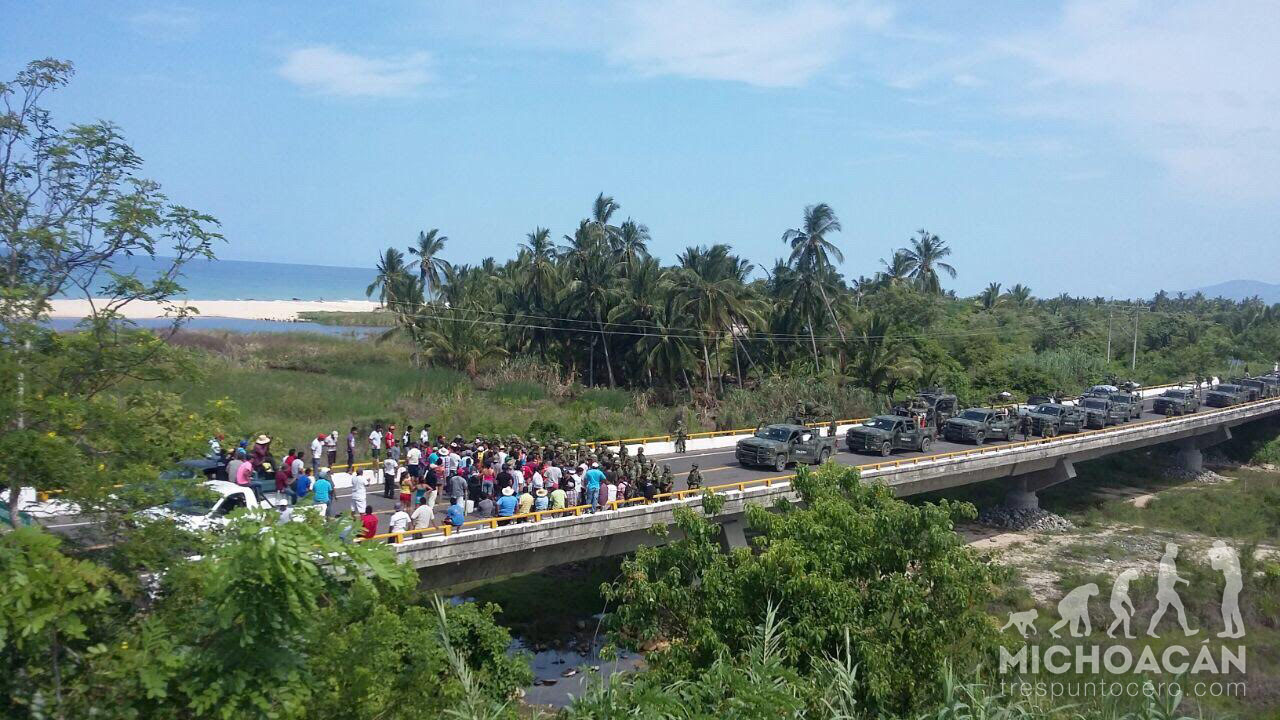
BULLETIN No 2
Attack of federal, state and municipal forces on the Indigenous Community of Santa María Ostula, Municipality of Aquila Michoacán. Two minors and one adult man were murdered, as well as several injured. (July 19, 2015, 11 PM.)
TO: CIVIL SOCIETY
TO: HUMAN RIGHTS ORGANIZATIONS
TO: THE HONEST COMMUNICATIONS MEDIA
As we denounced in Bulletin No. 1, today federal, state and municipal forces attacked the indigenous community of Santa María Ostula, Municipality of Aquila Michoacán in a joint operation that the “Michoacán Coordination Group” deployed. Two minors and one adult man were murdered as a result of the attacks and several comuneros are gravely injured.
Also, members of the Army arrested the comunero Refugio Serrano. As of this time his whereabouts are unknown.
Parallel to the arrest of Cemeí [1] Verdía Zepeda (First Commander of the Santa María Ostula Community Police and the General Coordinator of the Autodefensas of Aquila, Coahuayana and Chinicuila municipalities) members of the Michoacán Coordination Group attempted to detain the Treasurer of the Communal Wealth Commission of Santa María Ostula. In said action, for the purpose of passing through the comuneros and provoking the community into a confrontation with the Army, they stole radios for communication that the community uses to guard its communal territory. The Vigilance Council’s seal was also stolen.
After Cemeí Verdía Zepeda’s arrest, the community established different checkpoints in each Encargatura [2] for the purpose of avoiding the arrest of more community members. Nevertheless, at approximately 5:00 PM, federal and state forces attacked the checkpoints that members of the community placed in the Encargaturas of Xayacalan and El Duin which are located on Highway 200, from Lázaro Cárdenas to Manzanillo. At these points the federal forces used their vehicles to impact the Community Police checkpoints and they burned several pickup trucks and trailers that were there. They also used tear gas to attack the comuneros.
Next, the federal forces shot indiscriminately at members of the community that were in the Encargatura of Ixtapilla, also located on Highway 200, from Lázaro Cárdenas to Manzanillo. As a result, the 12-year old boy Herilberto Reyes García, the 6-year old girl Neymi Natali Pineda Reyes and Melesio Cristiano, 60, were murdered. Horacio Valladares, 32, and Antonio Alejo Ramos, 17, were injured.
Added to the above, inside of this operation the municipal capital of Aquila was surrounded by members of the federal forces impeding the exit of Aquila’s self-defense group, which is in solidarity with the Community of Santa María Ostula against attacks of which it is the object.
Cemeí Verdía Zepeda was moved in a helicopter to the city of Morelia, where he is accused of: “probable violation of the Firearms and Explosives Law and his probable participation in crimes related to the destruction of electoral material.”
The foregoing deals with a violation of the agreements that had been signed between the community and the government, federal as well as state, wherein it is established the commitment to respect the Community Police of the indigenous community of Santa María Ostula.
It’s appropriate to add that none of the local organized crime bosses, belonging to the Caballeros Templarios (Knights Templar) “Cartel” that operates in the region have been arrested.
At this time the community experiences a climate of extreme tension.
While Cemeí Verdía is detained, the community has named the comunero Germán Ramírez as First Commander of the Santa María Ostula Community Police and has asked for guaranties for his life, as well as for the rest of the community, after the attacks that federal and state forces have perpetrated against the community.
Once again, we call on you to be attentive and alert to the grave situation that the community of Ostula and the Costa-Sierra region are experiencing.
Sincerely,
Team of support and solidarity with the indigenous community of Santa María Ostula
July 19, 2015
—————–
[1] This compañero’s name is also spelled as Semeí in the media.
[2] An Encargatura would be a governmental subdivision within the municipality (county) of Santa Maria Ostula; in other words, a small village within the county.
———————————————————————-
Published in Spanish by Pozol Colectivo
Monday, July 20, 2015
Translation: Chiapas Support Committee
http://www.pozol.org/?p=10988/
For background on Santa Maria Ostula and Xayakalan, see: https://compamanuel.wordpress.com/2014/03/13/ostula-autonomy-self-defense-natural-resources-and-narcos/
Para noticias en español y fotos: http://michoacantrespuntocero.com/ejercito-abre-fuego-contra-indigenas-de-ostula-hay-varios-heridos-y-un-nino-muerto/
And please read the article we posted below this one by Gilberto López y Rivas on the reasons that the Mexican government represses the autonomous municipalities.
https://compamanuel.wordpress.com/2015/07/20/obstacles-to-indigenous-autonomy/
Obstacles to Indigenous Autonomy
OBSTACLES TO THE AUTONOMIES OF THE INDIGENOUS PEOPLES
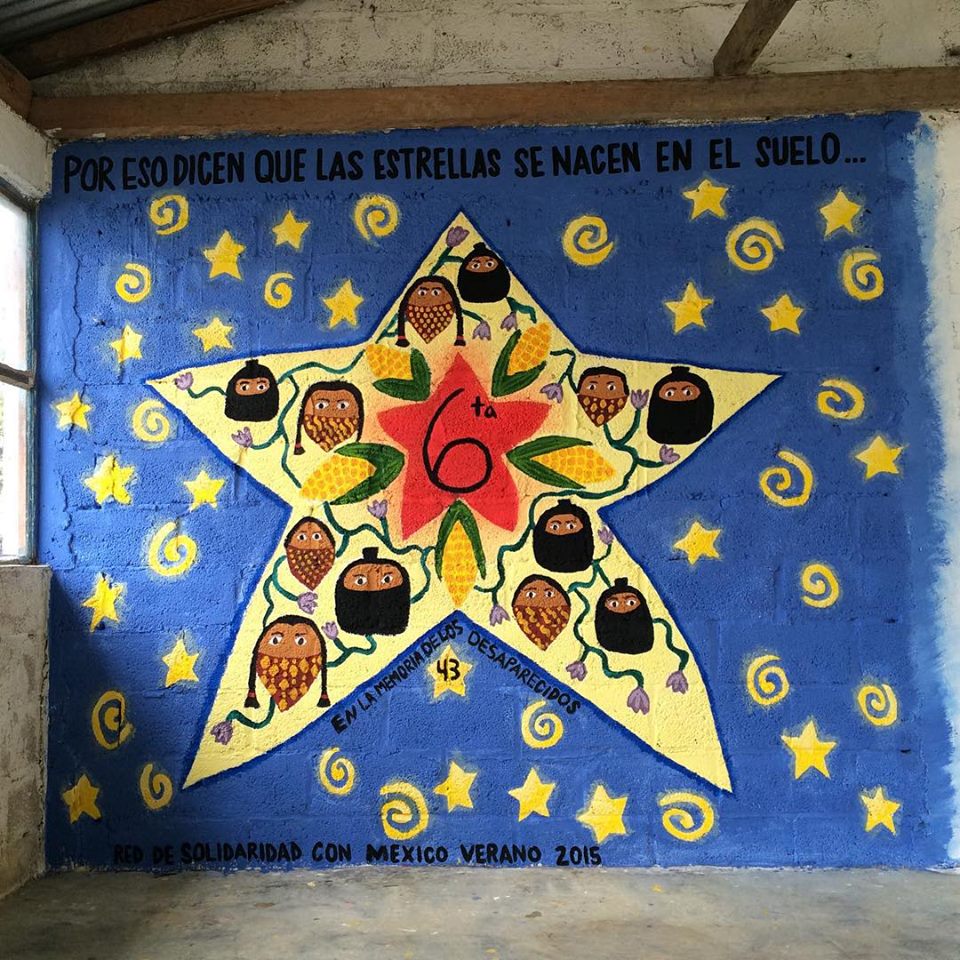
In memory of the 43 disappeared
By: Gilberto López y Rivas
The autonomic processes that the indigenous peoples champion confront arduous obstacles and challenges, essential among them, the neoliberal capitalist State’s lack of will to open spaces for effective recognition, even inside of the limited rights formally recognized in the Constitution, principally in Article 2, and of those established within international legal frameworks, like Convention 169 of the la International Labor Organization (ILO) and the Universal Declaration on Indigenous Rights of the United Nations Organization.
The constitutional reform on the matter of indigenous rights, which was enacted in 2001, was not satisfactory to anyone within the ambit of the native organizations independent of the State, so that the indigenous peoples undertook the path of constructing autonomy by means of deeds, de facto autonomy, the most consistent case being that of the indigenous Zapatistas-Mayas in Chiapas, which vindicates not having any relationship with the state and federal governments, although in the daily life of the territories, the municipal authorities of partisan origin frequently go to the Zapatista Good Government Juntas to resolve all kinds of problems.
For its part, the Regional Coordinator of Community Authorities-Community Police (CRAC-PC, its initials in Spanish), in Guerrero, the Purépecha municipality of Cherán, Michoacán, and other peoples and organizations that resist silently, maintain a relationship with the State. The CRAC-PC is permanently conflictive, and Cherán is equally confronted but legalized due to the victory obtained in their complaint before the State Electoral Institute, which recognized the ability of its residents to name their authorities and to govern themselves according to their own organizational structures. This is a notable difference with respect to the Zapatistas and the CRAC-PC, and also in relation to other experiences of municipal capitals that remain dominated by mestizos, as among the Wixáritari (Huicholes) of the state of Jalisco, where in several of them, a majority of the indigenous population is socially and geographically segregated and is also subordinated to this sort of mestizo domination on the political level.
Thus, de facto autonomies predominate in the indigenous self-governments with different gradations with respect to their relationship to the State, although always conflictive, contradictory and ambiguous, carrying the weight of a discriminatory perspective towards the indigenous world and a permanent policy of co-optation of processes underway, or if possible, of their eradication. These autonomies, for example among the Zapatista Mayas, are developed within the context of a counterinsurgency strategy or a war of exhaustion on the part of the Army (the anvil), and the para-militarization (the hammer) that characterizes it, permanent aggressions taking place from groups that come from various political organizations. They are paramilitaries and they do violence to the autonomous municipalities by means of invading the former finca (estate) lands recuperated by the indigenous Zapatistas in 1994.
So, all the autonomies, as much those protected in Constitutional Article 2 as the de facto ones, and also those that developed under more consistent local constitutional precepts, like in Oaxaca, live in a situation of permanent siege, of confrontation, whose origin is the State, the local oligarchic groups, the police and the Army, besides the corporations of capitalist extractivism in their frenetic search for resources and territorial dispossession.
Thus, the autonomies are enclosed by behind the scenes powers protected by the heavy hand of the State in different ways. In the last decade we must also add the repressive power that the State exercises through drug trafficking, and organized crime in general, which represents one more sector of the capitalist economy, and also, together with the “war against drug trafficking,” form multiple facets of the State’s strategy (and that of its United States mentors) to beat up on the indigenous and campesino world, and the group of regional and national oppositions. The Iguala Massacre and the enforced disappearance of the 43 Ayotzinapa teachers college students constitute the macabre culmination of this strategy of a criminal State.
Like the capitalist corporations of timber, mining, tourism, etcetera that seek to take possession of indigenous peoples’ resources, what is at the center of the “drug trafficking problem” is the effort to dispossess them of their territoriality, the material basis of their reproduction and the strategic space of their struggles. Their purpose is to expropriate from the indigenous peoples their lands-resources-labor, and the armed forces and police are accomplices of this subtraction beginning with their repressive and counterinsurgency actions carried out with the support of the paramilitary groups that operate like the clandestine arm of the dirty war. The militarization supposedly for “fighting crime” doesn’t bring a decrease of illegal activities, as the extensive zones of the Mexican Republic under virtual military occupation prove.
Organized crime is nothing more than the clandestine face of the neoliberal capitalist system, with its inherent unrestrained violence, psychopathic and without social and political mediation to control it. It is highly profitable economically; besides, starting with the fact that the United States is the principal provider of weapons for the drug trafficking groups. The Independent announced in 2004 that: “drug trafficking is now third globally in generating cash, after oil and arms trafficking” (February 29).
The only possibility of an effective defense in the face of this phenomenon in the indigenous world –as the Zapatista Good Government Juntas; Cherán, in Michoacán; the Community Police of Guerrero, or the Nasa in the Cauca of Colombian geography demonstrate– is the strengthening of the autonomies, starting with those that have achieved controlling –not without difficulties– the presence of organized crime in indigenous territories.
———————————————————-
Originally Published in Spanish by La Jornada
Translation: Chiapas Support Committee
Friday, July 17, 2015
En español: http://www.jornada.unam.mx/2015/07/17/opinion/021a2pol
SupGaleano: Chiapas, Mexico, the World
Chiapas, Mexico, the World. (Passage from the text “A World War,” May-June 2015, by SupGaleano, in “Our View of the Hydra,” part II of volume I of “Critical Thought Versus the Capitalist Hydra”)
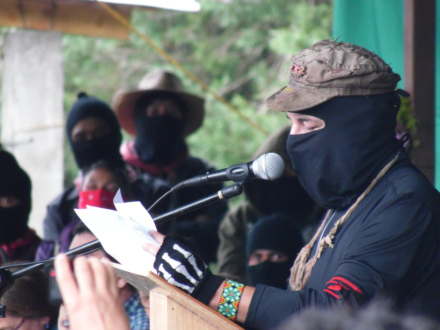
SupGaleano consulting his notes at the Seminar on Critical Thought versus the Capitalist Hydra
The first thing that got our attention was the protests and disagreement on social media. Then came the articles that managed to get a place on the pages of the paid independent media. So, a team of Tercios Compas [Zapatista Media] was sent to confirm or dismiss the reports.
If you pick up your camera and photograph a series of “onsite” images of one of the principal cities of the southeastern Mexican state of Chiapas, you will see the disorder, abandonment, and chaos that reign there.
But if, over time, you zoom out to a broader view, you will begin to notice a particular logic and order to this chaos.
Now, if you combine a panoramic view over time and space, you will have a fairly accurate image of reality. Not of the image represented there, but rather the genealogy of that image. That is, you will see the before, during, and after of that image.
Take for example the capital of Chiapas, the city of Tuxtla Gutiérrez. Originally founded by Zoques, later conquered by Mexicas, it was named by the latter “Tochtlán,” meaning “place or home of the rabbits,” or “where rabbits abound.” Later it became “Tuchtlán.” The Spanish conquest converted the word into “Tuxtla.” Then it would take on the last name of General Joaquín Miguel Gutiérrez Canales. For a time the city would fight San Cristóbal de las Casas for the dubious honor of being the state capital.
In the image you capture, you can find everything except coherence: supposed urban construction projects, carried out without official announcement, traffic signals, or alternative routes; streets that only exist in name on a street sign; large spectacles where that “famous blonde” Manuel Velasco Coello, or one of his accomplices, reiterate that they do in fact honor their word, while the principal transportation routes in the city were or are destroyed.
If you take the time to travel the city streets, you will note this irrationality and begin to think that one would indeed have to be an imbecile to carry out construction projects in this manner. You might even think that those who govern Chiapas are nothing but a bunch of immature adolescents and idiots playing—badly—Simcity on the streets of Tuxtla, San Cristóbal and Comitán. And for that you would lack neither evidence nor argument.
These “urbanization projects” have thrown dozens of small and medium-sized businesses into bankruptcy; they have thrown thousands of Chiapans out of work; they have caused fatal accidents, and they are responsible for more than one tragedy in a Chiapan home due to the delay in transport time for ambulances. The “non-quantifiable” damages with regard to vehicles and time are great.
What’s more, the only small businesses that have survived this urban war are the tire companies, muffler distributors, and mechanic shops. The road projects that have been finished are flanked by “for sale” and “for rent” signs, as well as by abandoned old buildings and shiny new ones.
It would be comical if it weren’t tragic.
If you talk to any former owner of a small or medium-sized business and that person gives you the history of how they—egged on by the municipal and state governments—opposed the mobilizations by the democratic teachers’ movement, they will tell you:
“We carried out the ridiculous. We were complaining that the teachers’ marches and blockades were lowering our sales, and it turns out that it was the government’s construction projects that bankrupted us. Look, this whole circuit here was made up of small and medium-sized businesses and all of them went out of business. Now there are foreign businesses and tons of chain stores. The city literally shut down, as if it was under siege, but it wasn’t the teachers or the Zapatistas who did it, it was the government. Sure, the teachers maintained their blockades for a few hours, a day, a week. But the government shut off transit throughout the city for almost a year and in some places you still can’t get through. Tell me, what business or company can withstand that for such a long time? Only the big ones, those that have the capital to survive the drop in sales. Or those who went so deeply into debt that now they are working to pay the bank back for the loan it gave them so that they could work. Yes, it’s absurd. Now they work to pay the bank that loaned them the money so they could work in order to pay it back. We had to close up shop, fire our workers, and sell the business. Look, that place where there is now a franchise, that belonged to my family for decades. They always told us we should fear those who rebelled, and the teachers, then the Zapatistas, then the teachers again, always the teachers. That all those people wanted to take what was ours, break things, loot our businesses, ruin us—that’s what they told us. And it turns out that the ones who ended up robbing us, breaking us (the speaker gestures to the broken-up street, worse than a dirt road), looting us, and ruining us were the governments themselves. It doesn’t even matter which party. Around here they have said they’re from the PRI, the PAN, the PRD, the Green Ecology Party, whatever they feel like being. But it’s always the same people: the Sabines, the Velascos, the Albores, the Orantes. One day they’re one color and the next day another color. And we like fools were putting up our signs saying: “We insist that the “Rule of Law” be applied so that the government could exercise repression while alleging that we had demanded it. And it was that damned “Rule of Law” that ended up screwing us over! And if we were to denounce that? Where would we do so? Where, if the local media are totally bought off and the national media also get their part of the payoff? Yes, here and there there’s a local outlet that takes a risk and publishes something on this, but they can do little to nothing against the big media, which aren’t really that big and are merely the spokespeople for the government currently in office: before they were Alboristas, later Mendeguchiistas, then Sabinistas, and now they are Velasquistas, and tomorrow whatever but they are and always will be shameless. No, no problem at all, what does it matter to me if you say that I am from the CANACO, if the real problem I have now is how to pay the debts I have to the bank. I sold everything and it still isn’t enough, and there isn’t anything left to draw from. We were so afraid of the poor and it was the rich and the government that screwed us over.
Go ahead, take a look anywhere. You’ll see I’m not lying. There are signs declaring that the government paved this or that street but they didn’t even fill the potholes. It’s a fraud, a total fraud. Here we were so afraid of those below, and those from the aboves of elsewhere came to conquer us. Employment with the new companies? A lie. Those companies come with their manager, administrator, accountant, and supervisor already assigned. At most they’ll contract somebody to attend the parking garage. They don’t even hire for cleaning services; cleaning and security companies also come in from elsewhere. This city isn’t what it was anymore, and it won’t be that again. It’s worse. Less and less Chiapan all the time.
In effect, the capital city changed its face: instead of the original businesses that were here, now wherever you look there are franchise brands and large companies. In the commercial centers, the small businesses with a small storefront close almost immediately and are replaced by others. At every intersection there is an army of windshield-washers and sidewalk vendors of everything imaginable, taking turns knocking on the passing vehicles asking for something, even just a coin. This image is repeated across other Chiapan cities… and across the rest of the urban scene of the country.
Are those who govern this chaos clumsy idiots?
Yes, they are.
But the urban and neighborhood disorder isn’t due to their collective stupidity, with its changing colors and initials.
What has happened and what is currently happening is a purposeful destruction. The plan doesn’t emerge from the very limited intellectual quotient of those who say they govern (or aspire to do so), from their unlimited ambition for stealing or their ancestral corruption. It comes from further above. Those who govern are mere administrators that get to take a piece of the loot for administering the destruction, and then the reconstruction. The large real estate companies and the usurers, where the names of the local political class also appear, wait for the urban construction projects—purposefully slow and without any rational logic—to drive the fragile local economy into despair and obligate the local “decent people” to sell. Then they wait for the construction projects to conclude at their leisure. And boom: what they bought for ten is now worth a thousand. Of course, they have to give a little something to the authority, the one who holds office and the one who aspires to it. Where else will the advertising and vote-buying money come from? What has been carried out here is a true conquest, and the resulting impoverishment no longer only corresponds to indigenous people, but also to workers and people in the neighborhood. Now a slimmed down middle class has to choose between governmental or political party bureaucracy, badly paid work, or exile.
But this isn’t only in Chiapas.
In Mexico the analysts from above are pulling out their well-groomed hair seeing that the reforms they so applauded have done nothing but create more disorder in the chaotic national economy.
They complain, for example, that energy reform hasn’t brought the immediate ‘milk and honey’ that was promised. But the objective of the reforms was precisely this: to disorder and destroy.
Energy reform, for example, is but the bugle call for the launch of a mad dash toward dispossession. And we’re not talking here only about those territories under the care of the original peoples. We are also referring to pension funds, that is, the pensions of the working class.
All in all, we see that above there are still those who believe that Mexico’s salvation lies with these reforms. Or that it is merely the selling off of the national patrimony.
But down below it should be clear that the objective of the reforms is to finish the destruction of the little that is still standing… in order to reconstruct and repopulate.
The target of the urban war that has modified the “face” of the cities is not only land plots and buildings. Services make up the main course. The provisioning of potable water is managed with calculating perversity: scarcity feeds the emergence of water pipe companies that displace the traditional companies and gradually monopolize the market. And just as with water, so it goes with transportation, communications, security, and even trash collection.
A note here: the false argument that tends to “support” the necessity for the privatization of these services is that privatization will improve service; it will be cheaper and of better quality.
There is not a single case that supports this claim. All privatized utilities are more expensive, of poorer quality, and terrible service.
Accustomed to a world where poverty and misfortune always afflict another geography or calendar, the poorly-named middle class begins to find itself more and more often among the victims and not among the spectators (and never in the position of executioner, although it longs to be so).
The process of urbanization, which would be slow if it were rational, is now madness. It is as if a war were underway, and instead of armored vehicles, it is the construction machinery that, paradoxically, destroys. If a logical reasoning would be to create adequate services and then urbanize, the reality is the contrary: urbanize and later see about services.
Here you have an option: to attribute this chaos to lack of skill, corruption, and government blunders; or attribute it to an administered chaos with the goal of later reordering.
The first option implies that the majority of the population look for changes in [the governing] colors, with the hope that having someone in government who is less stupid, less thieving, and less clumsy will lead the cities to recover their idyllic image of the past, to a yesterday where problems happened outside of one’s immediate environment and one’s home wasn’t just an extension of the nightmare.
In this option, the same names of the political class appear, claiming experience and maturity, but under different initials. And since the decisions to be made are over colors and promises, well then if red failed, let’s try blue, or green, or brown, or orange, or whatever old pattern now appears dressed as the new.
In this schema, the problem is an administrative one. And in this case, social problems are not systemic but an issue of an administration that is poor, corrupt, or clumsy, or in Mexico, all three.
For this option as survival plan, there are calendars: each calendar period you can try to change colors; maybe this time it will work. But life continues its course and one’s basic needs don’t subordinate themselves to the electoral calendar. So you follow whoever offers to resolve things most immediately, even though this means the destruction of your future.
You understand that the majority of people will react in that fashion. Or you don’t understand that and you think those people are ignorant, or lacking dignity, conscience, and shame.
So you decide to participate, or not. With passion alight, you make one color yours as if it were a sports team. You join the game, yelling and shouting your head off. The game ends with its winners and losers, and life goes on. Until the next game.
This isn’t about judging, but about understanding. And here is a problem that requires critical thought, now not only an effort at scientific thought but rather one aimed at defining a strategy of resistance, of survival, of life.
Are social problems due to a lack of administrative capacity, of political purpose, of integrity, of State vision? Or are they the unavoidable consequence of a social system?
That is, do the fundamental decisions, those that set the path of national society let’s say, still belong to the state sphere, the government, the public administration?
Even palliatives and short-term remedies, are they possible?
A good part of the world thinks this problem has been located in public administration. And the almost unanimous diagnosis is that it is an issue of corruption within the governmental apparatus.
But here the issue is that there is no politically defined flag to combat corruption. The right, the left, and the “independent” political sphere are all against administrative corruption. All are eager to offer integrity and honesty… and all end up caught up in some scandal.
And here then is a fundamental question, according to we Zapatistas: the nation-state, that is, the state as we know it, has it remained untouched in the system’s war?
Or are we faced with a hologram, an image of what it once was, a cardboard figure into which various people put their face for the photo of the season?
Or perhaps neither one thing nor the other; rather that the nation-state is no longer what it was, but it maintains some resistance against supranational powers?
When the representatives of some European state, let’s say Greece, sit down to talk to Madam Angela Merkel, are they talking to the Bundestag or to the International Monetary Fund… or with the European Central Bank… or with the European Commission… or with all four… or with none of the above?
In order to know the answer, according to our thinking, we need to reconstruct the genealogy of the nation-state and compare our conclusion to the current reality. Then we can ask: what were the foundations of the state, and which of these have been maintained, which have been disappeared, and which have mutated?
What were its functions, its place, its sphere of influence or its areas of interest?
At first glance it appears evident that some of its principle characteristics lie as victims of the ongoing war. It is more and more difficult to talk of sovereignty, territory, authority, the monopoly on violence, of juridical domination, of independence.
Of course, one has to be careful about the evidence, but clarifying what the State is, is necessary and urgent.
Oh yes, I’m sorry, but this thing of “the State” is much more complicated than the twisted lines in Game of Thrones.
_*_
(Prequels and sequels in volume I of “Critical Thought Versus the Capitalist Hydra”) [1]
————————–
*[1] The Words of the Zapatistas at the Seminar on Critical Thought versus the Capitalist Hydra has been published.
————————————————————-
Originally Published in Spanish by Enlace Zapatista
July 14, 2015
Zibechi: Latin America in the new world order

Pope Francisco in Ecuador with Indigenous children and President Rafael Correa
By: Raúl Zibechi
The nation or region that does not have a strategic project, and holds on firmly to the steering wheel in the worst geopolitical storms is destined to get dragged along by the dominant winds. Latin America is letting the opportunity to break with its subordinate role as the empire’s backyard pass by, precisely because of lacking two conditions: a project and political stability.
South America, the region that is in the best condition to break with the mold that the United States imposes, finds itself divided and the countries that could focus on new directions are paralyzed. As a group, they have lost weight in the international arena and in the principal forums.
The document 2015 United States National Military Strategy, recently published and focused on the contention of China and Russia, mentions all the regions of the planet in various passages, but barely makes side references to Latin America and the Caribbean. What it doesn’t means is that the Pentagon has no policy towards the region, but rather that it does not perceive bigger problems in its backyard, where it only worries about “the transnational criminal organizations.”
Two meetings are happening at this time in Ufa, in the southern Urals: the summits of the BRICS countries and of the Shanghai Cooperation Organization (SCO). For the Chinese newspaper Global Times, the double meeting –in reality its about the convergence of interests– reflects “a profound change in the Euro-Asiatic situation” with the ability to influence all of the world, through powerful mechanisms like the BRICS Development Bank, the Silk Road Economic Belt and the Asian Infrastructure Investment Bank (Global Times, July 8, 2015). In both summits the role of the Latin American region is also marginal.
Latin America is not present in the international conjuncture, nor do the big global powers, the traditional ones or the emerging ones, take it into account as a global actor. It is certain that the region never had a global presence, although Brazil played a certain role years ago in various scenarios and in institutions like the BRICS, but what’s noteworthy is the regression, in particular of South America, as an independent actor. There are seven reasons that explain this step backwards.
The first and most important is the paralysis of Brazil, a fruit of a combination of economic crisis and political crisis. The powerful offensive of the financial sector, the right and the middle classes against the PT and the government of Dilma Rousseff, added to the corruption in the state-owned Petrobras, placed them on the defensive and it’s not easy for them to retake the initiative.
Brazil was the country that has been able to design a national and regional strategy, which includes the development of an autonomous military-industrial complex and an independent foreign policy. The prison of some noteworthy directors of the big construction companies, like Marcelo Odebrecht, president of the key corporation in the construction of conventional and nuclear submarines, puts all of the Brazilian strategy at risk. The role that Brazil had as a regional leader with strong infrastructure investment tends to be substituted with the growing presence of China.
The second is the Venezuelan crisis, in particular the economic, followed by the crisis of leadership, which impedes continuing being a referent in the region. The December parliamentary elections can aggravate the crisis that crosses through the country.
The third is the end of the Kirchner cycle in Argentina, whose succession can be resolved favorably in the next presidential election on October 25, but even so it will be difficult to recover the vigor that it showed until now, in particular in international relations.
The strategic Brazil-Argentina-Venezuela alliance forms the critical mass capable of leading the entirety of the region in a direction more independent from Washington, transcending South America with projects like the Celac (Community of Latin American and Caribbean States).
In fourth place is the paralysis of the Mercosur, where the Brazilian crisis opens cracks in the trade agreements with Argentina and Venezuela. The change of the economic cycle with the drop in commodity prices places the Mercosur in need of moving towards another productive model, which as of now is not registering in any of them.
In fifth place is the approach of Paraguay and Uruguay to the policies promoted by Washington. The first (Paraguay) is reviving an old alliance with a strong military imprint, while the second wants to join the Pacific Alliance. A sharp negative turn is registered in both cases with respect to the Mercosur and regional integration.
The sixth question is related to the difficulties that travel across the Unasur, which impedes playing an active role in the resolution of conflicts, as well as in the development of some processes of integration that appear paralyzed. The Bank of the South, infrastructure works and projects of the South American Defense Council are stalled or advance with too much slowness in relation to the geopolitical acceleration that the world experiences.
Finally, it’s appropriate to emphasize the lack of strategic debates in the region, which affects the specialized institutes, the academies, the progressive parties and parties of the left, and also the social movements. The urgencies of the moment have relegated the essential themes, which include from the insertion of each country and the region in a world that changes, to the different national projects. A decade has been lost, in large measure because of the “ease” of following behind the high prices of raw materials, which acted like narcotics paralyzing the will for structural transformations.
The movements are part of the problem. Social forums disappeared as spaces for meeting and debate; the Vatican is filling that space. Nothing good can come from a lack of strategic projects.
———————————————————-
Originally Published in Spanish by La Jornada
Translation: Chiapas Support Committee
Friday, July 10, 2015
En español: http://www.jornada.unam.mx/2015/07/10/opinion/024a2pol
Gilly: the financial unification of the world

The seminar on Critical thought versus the capitalist hydra at Cideci.
By: Adolfo Gilly
Oventic, Chiapas, May 2, 2015
Compañeras and compañeros of the EZLN, relatives of Luis Villoro and of the Zapatista teacher Galeano, fathers and mothers of Ayotzinapa present here:
Before everything I want to thank you for the invitation to participate in the opening of this seminar “Critical thought versus the capitalist hydra,” in the midst of big spaces, houses and trees of Oventic, under this sky that changes without stopping between sun, clouds and the winters that pass and come and go while the land always remains.
I also want to thank you for the warm reception that this organized town gave those of us that arrived recently. We were only able to see the eyes of many of you, but surely you know that’s where the soul becomes visible. Then…
What I bring to say to you today comes from some very recent lines: the opening words from “The time of dispossession” (El tiempo del despojo), a small book about these adverse times that, by means of the editor, should not delay appearing in Mexico. [1]
*
In the world and in Mexico, we have entered a new epoch of capitalism or, in other words, of the domination of capital over work and nature. This domination totally encompasses the current unequal and interwoven global civilization that defines the mode of existence of human societies in this 21st Century.
We cannot address its description, its investigation and its laws of movement as if we were dealing with implantation, over pre-existing social relations, of a new economic model, as they usually say, or of a group of public policies named neoliberalism, in the same sense in which in the middle of the last century (the XX) one could talk about policies and laws on legal and contractual regulation of the relations between capital, labor and the land –then called Keynesian– inside the framework of existing relations within the States and capitalist societies.
We don’t forget either that that regulation had as an undercurrent the cruel exploitation of a colonial world now transfigured into politically independent nations, although economically and politically subordinate; a new world where the relationship of domination between human beings and between nations has been modified, although it is far from having disappeared.
*
If we take the metaphor that you propose to us for describing capitalism –the Hydra, a mythological monster with multiple heads which, if one is cut, two or more sprout up in its place–, we could say that the socialist and colonial revolutions that shook the 20th Century: Russia, China, Vietnam, Korea, India, Cuba and so many others, were cutting many of those heads of capital. But from this, over time, were born or reborn others in the same place as the old ones: the world of the new capitalists and the new rich in those nations, now owners of the money, the properties, the modes and the power.
However, let’s not go astray or deceive. It’s certain, there is no more Soviet Union, there is no more socialist China, there is no more socialist Vietnam. New rich, very rich, new capitalist and dominant classes emerged in those countries and they make up the present world. But also the old empires with their colonial dominions disappeared: in the still recent past they were swallowed and destroyed by the tide of colonial and anti-imperialist revolutions that swept the entire planet.
The peoples that made the revolution remain. The experience remains, the pride remains. The old humiliation that was overthrown remains, the history and the memory of vindicated and recuperated dignity remains. With this humanity, new in life and old in experience, you have the new rich that make their accounts and try to impose new forms of rule on thousands of millions of new salaried workers, on those dispossessed of their lands and homes, on migrants and those unprotected by all of the powers.
It is the unheard and unprecedented turbulence of the world of these times, where workers of the cities and fields are learning and inventing new forms of organizing, while capital designs and puts to the test new exhaustive forms of domination over workers and of destructive exploitation of nature.
*
We are facing a new form of the domination and subordination relationship: the universal domination of the world and rule of finances –global financial capital– over societies and economies, however diverse their cultures may be, their forms and degrees of organization and development, their different property rights and products; their relationship to nature; their political, religious and state systems; the configurations inherited and current of our societies.
All other forms of existence and reproduction of capital –the capitalist hydra, as you call it– and other existing social relations of course do not disappear. They remain subordinate to the financial form and subsumed in its planetary domination still in expansion. This modifies and subordinates nations, societies and human lives; their internal and external relations; their ways of living, of hoping and of imagining; and their relationship to nature, the planet and the universe as a given, thinkable and attainable reality.
It’s a new world, turbulent and expansive, but not a happy world. Full of conflicts and subject to unprecedented threats about its very existence and full of unhappiness because of the destruction of ancient customs, solidarities, securities and routines, this world also presents itself as a promise, today denied, of enjoyment of its fantastic discoveries, inventions and possibilities of enjoyment already present.
At the same time and moment of such a vision and temptation, reachable in appearance, it rises up before the immense majority of the seven million human beings as the denial and deprivation of that fullness of life and enjoyment, an immense humanity that sees and lives the destruction or degradation of their living worlds, their material inheritance –lands, waters, air, roads, cities, towns, barrios, forests, vegetable and animal life– and their immaterial civilizing inheritance of human relations: solidarities, cultures, beliefs and affects.
We call this new grand transformation: the financial unification of the world: a single domination (itself fragmented) over all the other immediate and existing ones and, by necessity, mediated by them; a universal and abstract (thing-like, according to the terms of Bolívar Echeverría; bestial, according to the hydra’s image; not human in either case) over all other rulers; a ruler you can’t grasp onto, despotic and material over human societies; divided by tears and violent conflicts between those who detain it, the different factions –national and territorial– of finances and their armed bodies; and exercised by reduced power and money elites, owners of weapons that for the first time make thinkable and possible the destruction of the human species and of other multiple forms of life on the planet. One single domination, but divided by contrary and irreconcilable interests; and over a single humanity, but torn by beliefs and interests, nations and ethnicities, dispossessions and migrations.
*
In the middle of the 20th Century, in 1955, the publishing house Presence Africaine published a memorable writing of Aimé Césaire, “Discourse on colonialism.” It begins like this:
A civilization that proves incapable of solving the problems that it creates is a decadent civilization.
A civilization that chooses to close its eyes to its most crucial problems is a wounded civilization.
A civilization that uses its principles for trickery and deceit is a dying civilization. […]
We must study how colonization operates to de-civilize the colonizer, to brutalize him in the true sense of the word, to degrade him, to awaken him to buried instincts, to covetousness, violence, race hatred and moral relativism.
At the end of this de-civilization, Aimé Césaire discovers its refined product: Nazism. It would reveal, he says, the very distinguished, very humanistic, very Christian bourgeois of the 20th Century that carries a Hitler inside and ignores the fact that Hitler inhabits him. Even when it censures him for his own ignorance, Césaire adds, which at bottom that man does not forgive Nazism.
What he cannot forgive Hitler for is not the crime itself, the crime against the human being; it is not the humiliation of the human being as such. It’s the crime against the white man, it is the humiliation of the white man; it’s the fact that he applied to Europe the colonialist procedures that until then had been reserved exclusively for the Arabs of Algeria, the “coolies” of India and the blacks of Africa.
Colonization: bridgehead in a civilization of savagery from where, at any moment, the pure and simple negation of civilization can flow.
Upon reaching this extreme point of the elocution that, he says, installs us squarely in the middle of howling savagery, Aimé Césaire has touched the key word of all rebellions, that last resort that when it is committed to the extreme through the inhuman mode of a domination it cracks and makes everyone jump: the humiliation imposed, the humiliation lived and the humiliation suffered.
That surprise usually begins through low voices and small gestures: for example, the voice and gestures of a man whose son was murdered in Cuernavaca in these times, one among fifty thousand deaths, killed in these Mexican lands in the last five years, at the rate of 10,000 per year, and that day he said that we are fed up and he started to go around and join grievances and pains along Mexico’s roads. Or through the voices loaded with the pain and rage of the mothers and fathers in Guerrero whose 43 sons, all teachers college students, were disappeared in Ayotzinapa by the police, a body armed with state power; and those mothers and fathers confronted this power and began to go around throughout Mexico and the world saying and demanding: Alive you took them, alive we want them. Two of them, one mother and one father, are among us today and we have heard their demand and their voices.
*
In this process of financial unification of the world we also note the slowly obliged formation of a new historic subject in fields, mines, seas, skies and cities, the global worker:
The global worker in formation is acquiring and refining in hard struggles for his affirmation and his existence a new subtlety in the creation of unpublished forms of customs in common, shared knowledge, organization, solidarity, resistance and rebellion. The rebellion of women against male domination, with different features according to [different] societies and cultures, but with a similar profile as to the state of protest and insubordination against the dominant state of things, is part of this process and in specific cases or moments it is also the dominant feature.
The global worker as unified humanity is not a utopia. It is a secular process characteristic of this civilization, in formation in the large migrations and in scientific and technological marvels, while at the same time the planet borders on catastrophic war and ecological destruction. […] In order to perceive it, it’s enough to open the window, travel the highways and sharpen the gaze and the senses.
At the end of the initial writing of this volume we list:
Nothing was easy before and nothing will be easy tomorrow. We come from the great universal disaster at the end of the 20th Century, the one that consolidated and made more ferocious the new and old wealthy of the earth, the one that also engendered the new furies of the old and modern condemned of the earth.
Don’t come to us with it’s the time of hope. Now is the time of rage and fury. Hope invites waiting; rage invites organizing. There is a time for hope and a time for rage. This is the time of rage. After rage comes hope.
And these lines close the latest writing:
In today’s world, reasoning with lucidity and working for justice leads to indignation, fervor and rage, there where the spirits of revolt are nourished. Because the present state of the world is intolerable; and if history tells us anything it’s that, in due time, it will not be tolerated anymore.
So be it, it will be our hope.
—————————————————
- Adolfo Gilly y Rhina Roux, El tiempo del despojo – Poder, trabajo y territorio, Ediciones Itaca, México, 2015.
__________________________________________________________
Originally Published in Spanish by Pozol Colectivo
Translation: Chiapas Support Committee
Friday, June 5, 2015
En español: http://www.pozol.org/?p=10800
En español: http://www.jornada.unam.mx/2015/06/05/opinion/014a1pol
Armed commando murders a member of Las Abejas
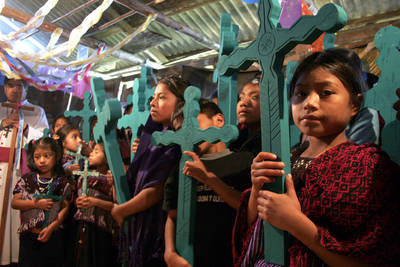
Las Abejas
Last week, the Civil Society Las Abejas organization of Acteal (hereafter, Las Abejas) issued two public denunciations. The first described the murder of their compañero Manuel López Pérez, a member of Las Abejas, as well as fear for the lives of his wife and 11-year old son. The second denunciation expressed concern for the life of Antonio López Jiménez and his family, also members of Las Abejas. [1] Both families are residents of Pantelhó municipality, which is adjacent to Ch’enalvo’ (Chenalhó) municipality where Acteal is located. Included below each denunciation was a description of the problems both men have had with the Pantelhó municipal authorities.
Several facts stand out: the families of both men were displaced from their native San Joaquin community in Pantelhó; the current municipal president and municipal judge are also from San Joaquin community; and some of the paramilitaries that participated in the Acteal Massacre and were released by Supreme Court decisions live in Pantelhó, described as a violent municipality.The denunciations are below.
June 25, 2015
Chiapas: Armed commando murders Manuel López Pérez, a member of the Las Abejas de Acteal organization
On June 23, 2015, they murdered Manuel López Pérez, a member of the Civil Society Organization Las Abejas de Acteal. The organization reports that Manuel went to the municipal capital of Pantelhó and on the way back, in the company of his son Juan López Guzmán, 11, at the Sibaluk’um Bridge, almost one kilometer from the municipal capital of Pantelhó, 7 masked individuals dressed in military type clothing and with firearms, ambushed the public transport vehicle in which he was traveling, killing him with three shots, two in the head and one through the back.
The information that the organization of Los Altos of Chiapas has collected, is that the Pantelhó judge, Pedro Girón López, who displaced and threatened Manuel on previous dates and the comandante of the la municipal police, ordered his 11-year old son to state that his father was traveling in another car ahead of the one in which he was going, and that if he told the truth, it wasn’t just the killers that were going to prison, but also him. “This act evidences the complicity of the official authorities facing this assassination,” the Acteal Organization assures.
The Las Abejas authorities communicate that for security reasons they will not be able to go to Manuel’s burial in San Joaquin community, which will take place today June 25. “Various paramilitaries that participated in acts prior to the Acteal Massacre live in that zone, as well as some of the material authors of said massacre,” the Board of Directors shares and adds: “tomorrow we will publish another denunciation, about how the life of another family of the same community as Manuel is also at risk.”
The indigenous Tsotsiles assert that: “17 years from the Acteal Massacre and the impunity that the Mexican State has perpetuated, the bad government of the president of Pantelhó, of Manuel Velasco and of Peña Nieto, kills us again, attempting to destroy us. The bad government knows that, happen what may, we will not stop struggling against the neoliberal capitalist system…”
Civil Society Organization Las Abejas
Sacred Land of the los Martyrs of Acteal
Acteal, Ch’enalvo’, Chiapas, Mexico
June 26, 2015
We denounce more death threats against members of the Civil Society Las Abejas of Acteal in Pantelhó
Today we announce other death threats, vigilance, harassment, against Antonio López Jiménez and his family (hereafter Antonio and his family), members of the Civil Society Las Abejas, natives of the San Joaquin community, municipio of Pantelhó, Chiapas. They currently live in the municipal capital of Pantelhó and have lived there since 2007 when authorities of PRD affiliation, now Green Ecologist (PVEM) displaced them from San Joaquin. Their crime was and is not accepting projects from the bad government and being in resistance and constructing autonomy.
Antonio and his family just like our compañero Manuel, assassinated on June 23, entered our organization together. They are son members of the Civil Society Las Abejas of Acteal organization. After the crime against our compañero, we fear for the lives of Antonio and his family, since the Pantelhó municipal authorities as well as the [municipal] president and the Judge instead of respecting, guarantying and protecting the physical and psychological integrity of our compañeros and compañeras, are accomplices in a series of threats against Antonio and his family, besides the fact that the mentioned judge threatened Manuel with death and according to testimonies, told his son that he should prepare his weapon for killing him.
We are worried about the physical and psychological integrity, as well as the life of Antonio and his family. Since Pantelhó is known as a very violent municipio where the authorities permit murders and let them go unpunished, if they did not respect the life of our compañero Manuel, despite the fact that he was a member of our organization, with greater reason we fear that Antonio and his family can be attacked the same way, we place responsibility on state and federal authorities, as well as on the municipal authorities of Pantelhó.
We want to place in evidence before national and international civil society, that the authorities mentioned know what’s happening against the two families. Whatever thing happens to our compañero Antonio and his family, those responsible will be the authorities of Pantelhó: Miguel Entzín Cruz, municipal president, Pedro Girón López, Municipal Judge, [Governor] Manuel Velasco Coello and [President] Enríque Peña Nieto. The latter two have the obligation to respect, protect and guaranty life and human rights. And afterwards they are not going to say that they don’t know what happened, because that is the custom of the bad governments.
[1] Las Abejas is an adherent to the EZLN’s Sixth Declaration of the Lacandón Jungle
Sources in Spanish:
http://acteal.blogspot.mx/2015/06/asesinan-miembro-de-la-sociedad-civil.html?spref=fb
http://acteal.blogspot.mx/2015/06/denunciamos-mas-amenazas-de-muerte.html
Frayba on Armed attacks in La Garrucha
FRAYBA DEMANDS INVESTIGATING ARMED ATTACK ON ZAPATISTA BASES

Francisco Madero Autonomous (Primary) School in San Manuel.
It accuses groups from Pojcol and El Rosario of attempting to kill a little girl
By: Elio Henríquez, Correspondent
San Cristóbal de Las Casas, Chiapas
The Fray Bartolomé de Las Casas Human Rights Center (Frayba) expressed its “concern for the new aggressions and threats against support bases of the Zapatista National Liberation Army (EZLN) in the communities of El Rosario and Nuevo Paraíso, situated in the autonomous Zapatista municipios (counties) of San Manuel and Francisco Villa, respectively.” [1]
At the same time, it demanded: “an urgent investigation into the acts of aggression and harassment perpetrated by armed groups from Pojcol and El Rosario, sanctioning those responsible and defining responsibilities in the attempted homicide of the 13 year old girl, which occurred on May 10.” On that occasion they shot towards where the adolescent was, but her father perceived what was happening and threw stones and injured the aggressor.
In a comunicado, the Frayba asserts that there is “an omission by the municipal and state governments in attending to the problem and defining responsibilities” in the acts that occurred in these two localities.
The organism, over which the Bishop of Saltillo, Raúl Vera López presides, reminds us that last May 10 the Good Government Junta Path of the Future, with its seat in La Garrucha, reported that: “a group of 28 individuals from the Pojcol Ejido, Chiquinival barrio (official municipality of Chilón), together with another group of 21 people from El Rosario harassed and attacked Zapatista bases of this autonomous community.”
It said that on that on that occasion, “Andrés López Vázquez fired four shots at a young 13 year old girl, the daughter of an indigenous Zapatista support base, and afterwards, three armed individuals from the same aggressor group arrived at Nuevo Paraíso village and tossed out a letter in which they blame the Zapatistas base for causing the problems.”
It point s out that faced with these facts, the Frayba “sent and official letter on May 14, in which it informs the Chiapas government about the armed aggressions that occurred. Carlos Leonel Solórzano Arcia, assistant secretary of government for the Lacandón Jungle Region XII answered the letter, recognizing the entry of armed individuals into El Rosario.” Nevertheless, “he does not mention any action for clarifying the facts and preventing repetitions that involves the punishment of those responsible; contrary to that, the DIF delivered supplies to the aggressor group,” besides the fact that: “in the writing no reference is made to investigating the attempted murder of a little girl.”
[1] Frayba Urgent Action: http://www.frayba.org.mx/archivo/acciones_urgentes/150630_au_02_baezln.pdf
—————————————————————
Originally Published in Spanish by La Jornada
Translation: Chiapas Support Committee
Thursday, July 2, 2015
En español: http://www.jornada.unam.mx/2015/07/02/politica/014n1pol
 Chiapas Support Committee