Chiapas Support Committee
Home of the Compañero Manuel blog on zapatistas & mexico
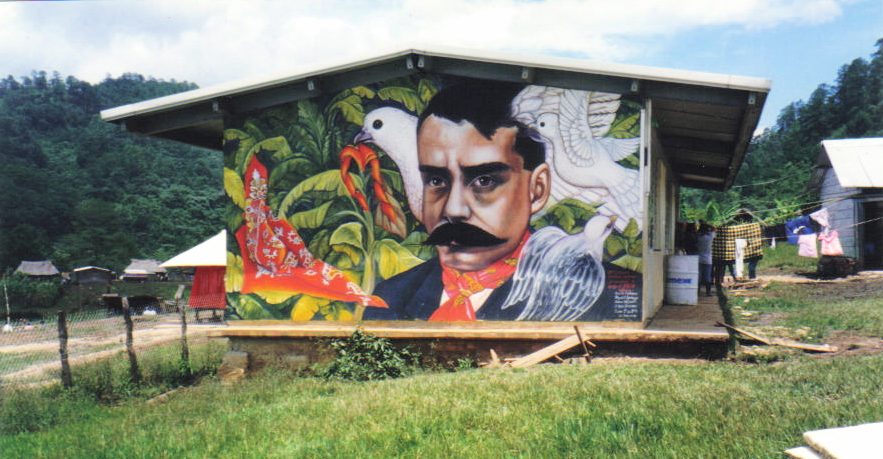
Day 8 – Felipe Carrillo Puerto, Quintana Roo: Maya Jungle leveled by Maya Train
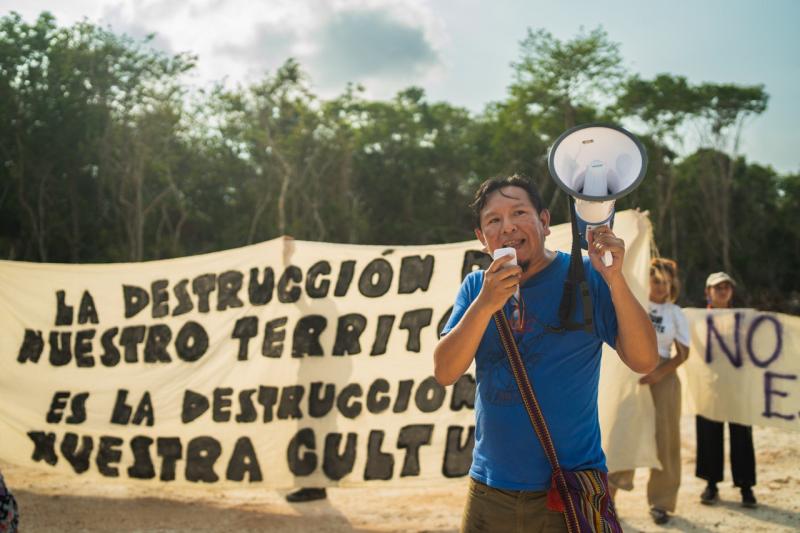
On the 8th day of the El Sur Resiste | The South Resists Caravan arrived in the city of Felipe Carillo Puerto where we marched through the streets of the city making visible the problems caused by the Maya Train project.
After the march, we depart for Xpujil, Campeche, however, we stop at the stop on the crossroad to Laguna Ocom.
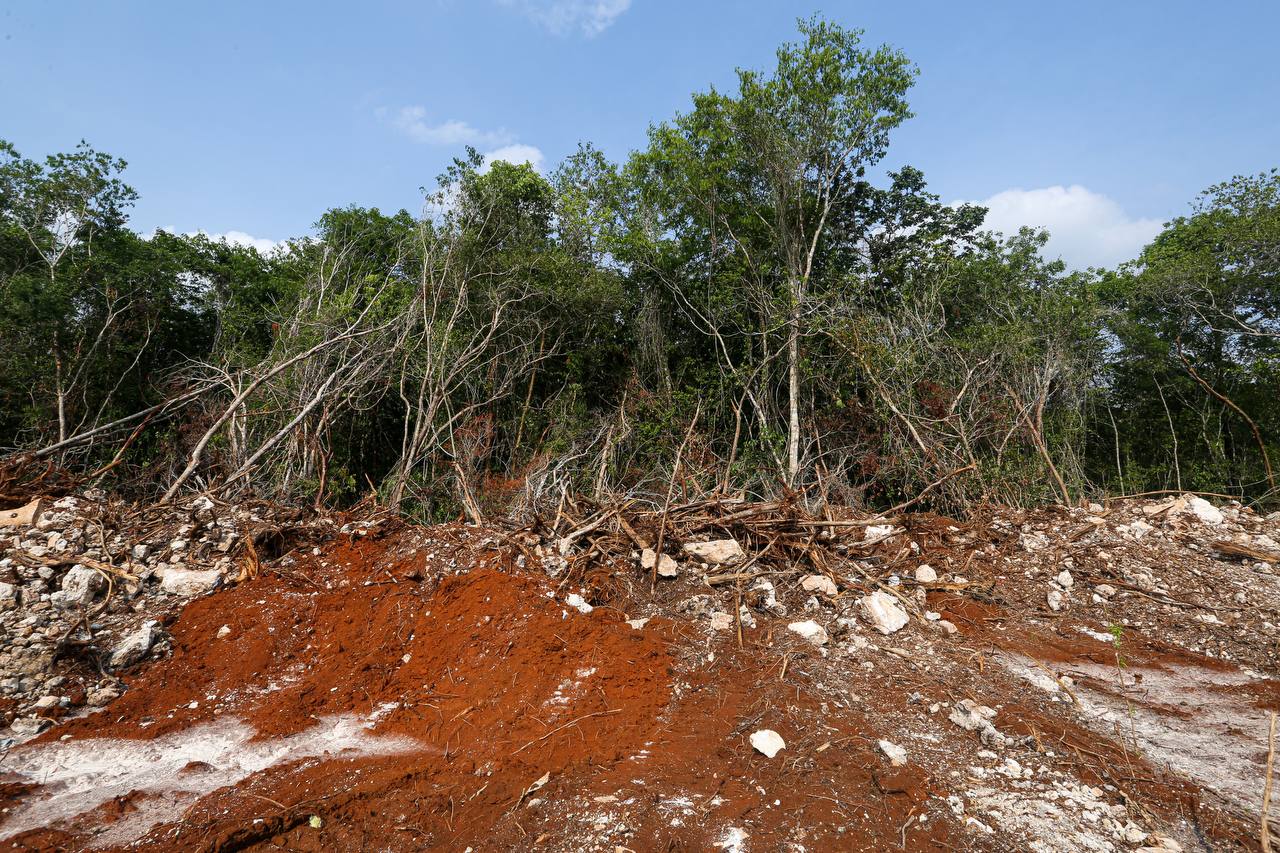
As soon as we arrive, the outlook is bleak. In this place, section 6 of the misnamed Maya Train has already taken the lives of thousands of trees; Cedars and mahogany have been cut down without any consideration for all that is lost with each tree that is felled. Home to hundreds of species, they have been uprooted from the earth in order to hand over these lands to American, Canadian, and German companies.
The Maya jungle, once full of life, flora and fauna, is now a space split in half where there are only stones and all the trees have been killed. Where life has been destroyed, the heat gives no respite, drought is felt in the environment, dust is felt floating in the air.
Although photographs of this crime have been seen on the internet, being in the midst of destruction and death is painful for everyone present. The person responsible for this ecocide has a name: Andrés Manuel López Obrador.
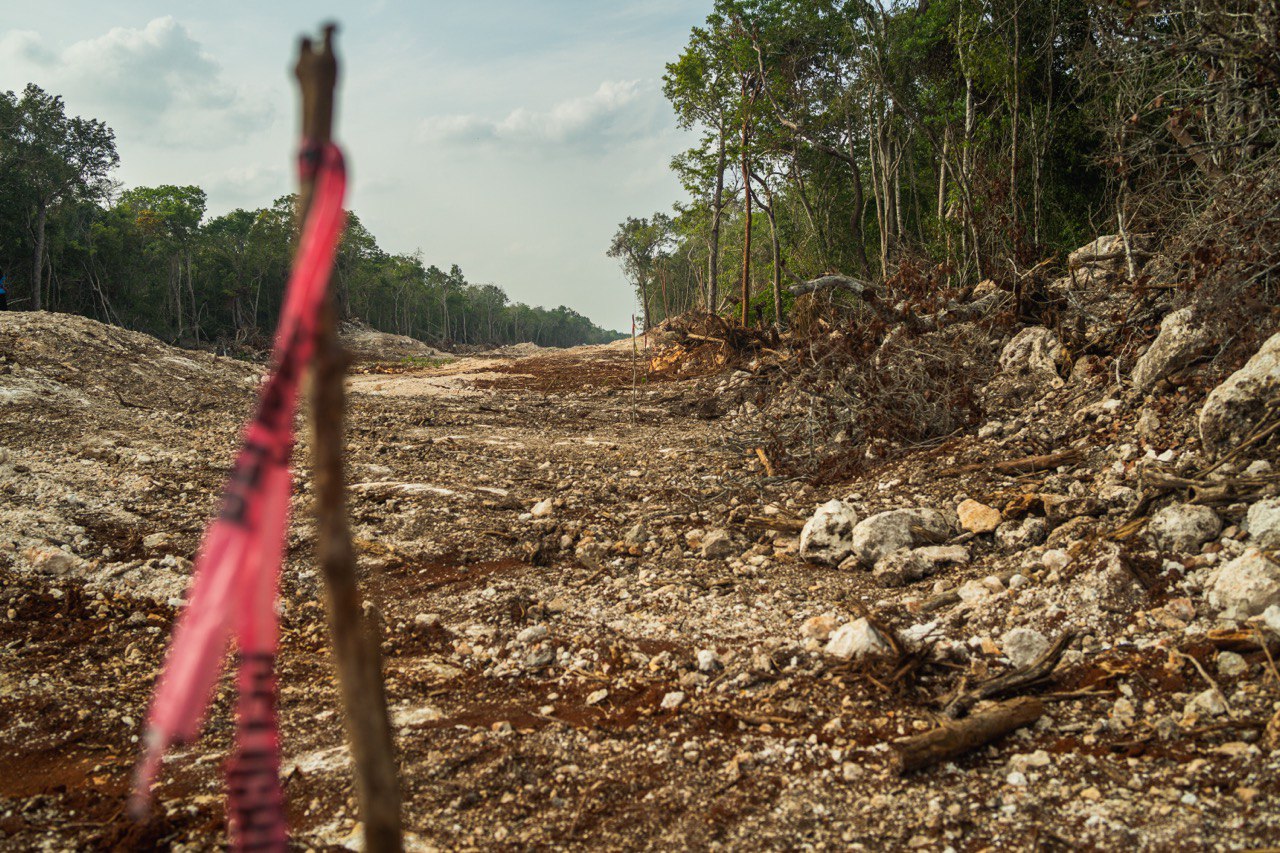
Compañero Angel Sulub, from the Maya community of Noj Kaj Santa Cruz Xáalam Naj K’ampokolche’, talks about what this disaster means for his people, the Mayas who have inhabited and defended this jungle for millennia:
“With a lot of courage, with a lot of anger in the middle of a sacred territory, the jungle that our ancestors have bequeathed to us, a territory for which our grandfathers and grandmothers fought to take care of and to guarantee that we and our granddaughters can enjoy the well-being that the territory gives us. This Maya jungle is being dispossessed; this Maya jungle is being brutally murdered. Here, where we are now, there were cedars, mahogany, chicozapotes, the deer walked here, the jaguars walked here.
Right now, we are looking at a desolate place.We are seeing the beginning of what they, those at the top, want: the looting, the most voracious extractivism of the peoples. Sacred waters that come from the state of Campeche and go to the coast travel through this territory. We are not only seeing the devastation of these ecosystems, we are seeing the destruction of the way of life of the peoples.”
Two compañeros perform a ritual in this place of destruction, they offer water and honey to the wounded earth, they tell Mother Earth to resist, that we are here, and that we feel her pain.
A Model of Destruction and Death
At the site of the devastation, we spoke with Sergio Madrid and Sara Cuervo of the Mexican Civil Forestry Council about the destruction of the Maya rainforest on the Yucatan Peninsula as a result of the progress of the Maya Train project.
Sergio Madrid and Sara Cuervo explain that this region and the Yucatan Peninsula is one of the regions with the largest forest area in the country along with Chiapas, and the second most important forest system in America recognized as the Maya Jungle. They also talk about the variety of endemic species in this region such as the jaguar, the tapir and many others.
Sergio Madrid talks about how the model of extractive tourism, the environmental and social destruction of Cancun, wants to be replicated throughout the Peninsula.
“That model has been about removing people’s access to the beach. The territory has been taken by large tourism capital, what FONATUR [1] wants is to take this scheme of large investment of entrepreneurs, and the government is the one that opens the way for these entrepreneurs to enter. The environment, the organization in defense of the territory, human rights, are a hindrance to this scheme.”
Sara Cuervo also talks about the need to not only see the terrible devastation of the train tracks, but also, all the ecocide in other areas such as the filling of cenotes and aguadas. [2] Also look at the violence that has been provoked from the implementation of this project and that has been generated with the arrival of the Army and National Guard to the places where the project is going to be built.
“Despite more than 500 years of resistance, we live in a historic moment of seeing communities crossed by a genocidal and ecocidal project. There is terror and fear of militarization and the arrival of these bodies; there is also this ignorance of everything that is being woven with this project, and how it is connected to the Interoceanic Corridor and all the geopolitical interest in the region.”
Sergio Madrid speaks specifically about the deforestation process, and about the lack of public policies of the Mexican State to address and stop deforestation in the states of Chiapas and the Yucatan Peninsula. Instead, the Government of Mexico has encouraged this massive deforestation by not implementing any type of environmental regulation to cut down thousands of hectares and plant monocultures such as sugar cane, sorghum, and soy in an agro-industrial way or under the assistance and clientelist project Sembrando Vida, which has been commented on during the Caravan as one of the main promoters of community division.
Finally, Sara Cuervo talks about the arrival of other exploitative industries in the region along with the arrival of the Maya Train, including real estate for luxury constructions and tourism projects for foreigners with high purchasing power, trafficking of women and children as has happened in the Cancun area and in other areas impacted by megaprojects of death.
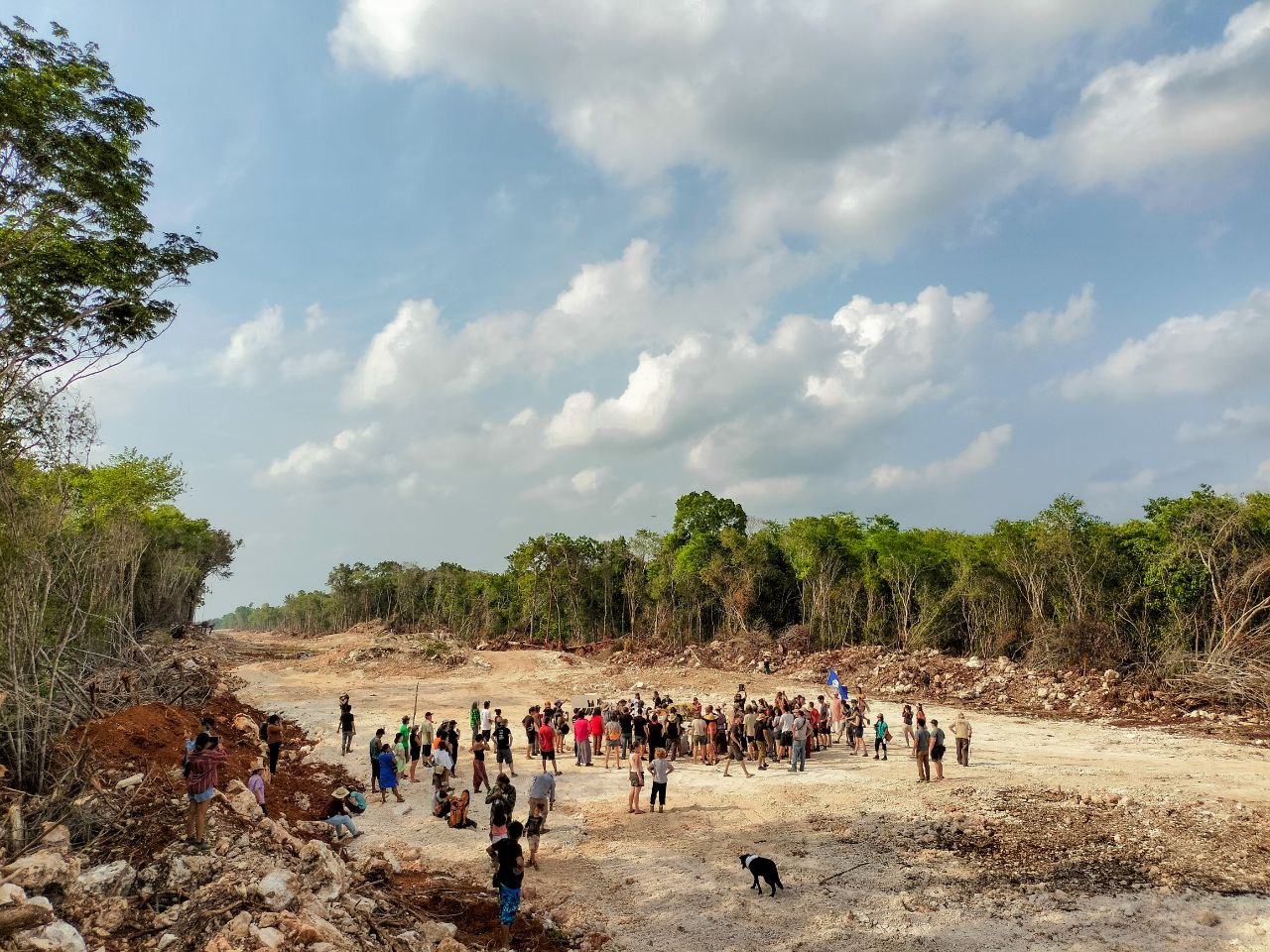
Before leaving, we took a photograph in a pile of stones and construction material, with our fists raised, the El Sur Resiste Caravan shouts: “The Jungle is not for Sale, it is loved and defended!”
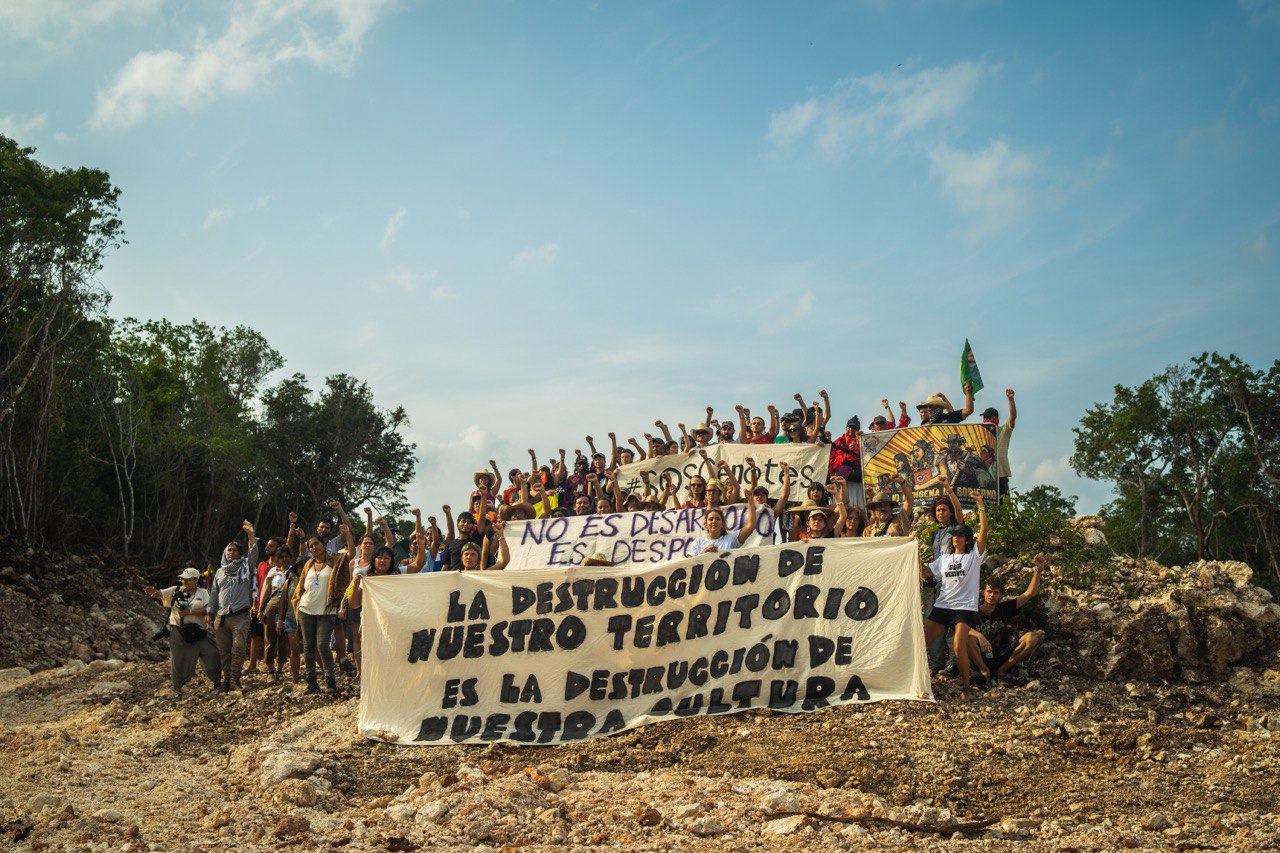
We leave with a heavy heart to see the cruelest form of murderous and voracious capitalism, but we also carry our hearts full of rage promising Mother Earth to fight to defend her, to defend us, today more than ever we need to understand that this struggle is for life.
Translator’s Notes
[1] FONATUR is the Spanish acronym for the Fondo Nacional de Fomento al Turismo (National Fund for the Promotion of Tourism).
[2] cenotes and aguadas – sink holes and water holes filled with potable water

Originally Published in Spanish by El Sur Resiste, Wednesday, May 3, 2023, https://www.elsurresiste.org/es/posts/dia-8-felipe-carrillo-puerto-quintana-roo-selva-maya-arrasada-por-el-tren-maya and Re-Published with English interpretation by the Chiapas Support Committee
Frontera Comalapa: A new armed group rises against the CJNJ and an Update
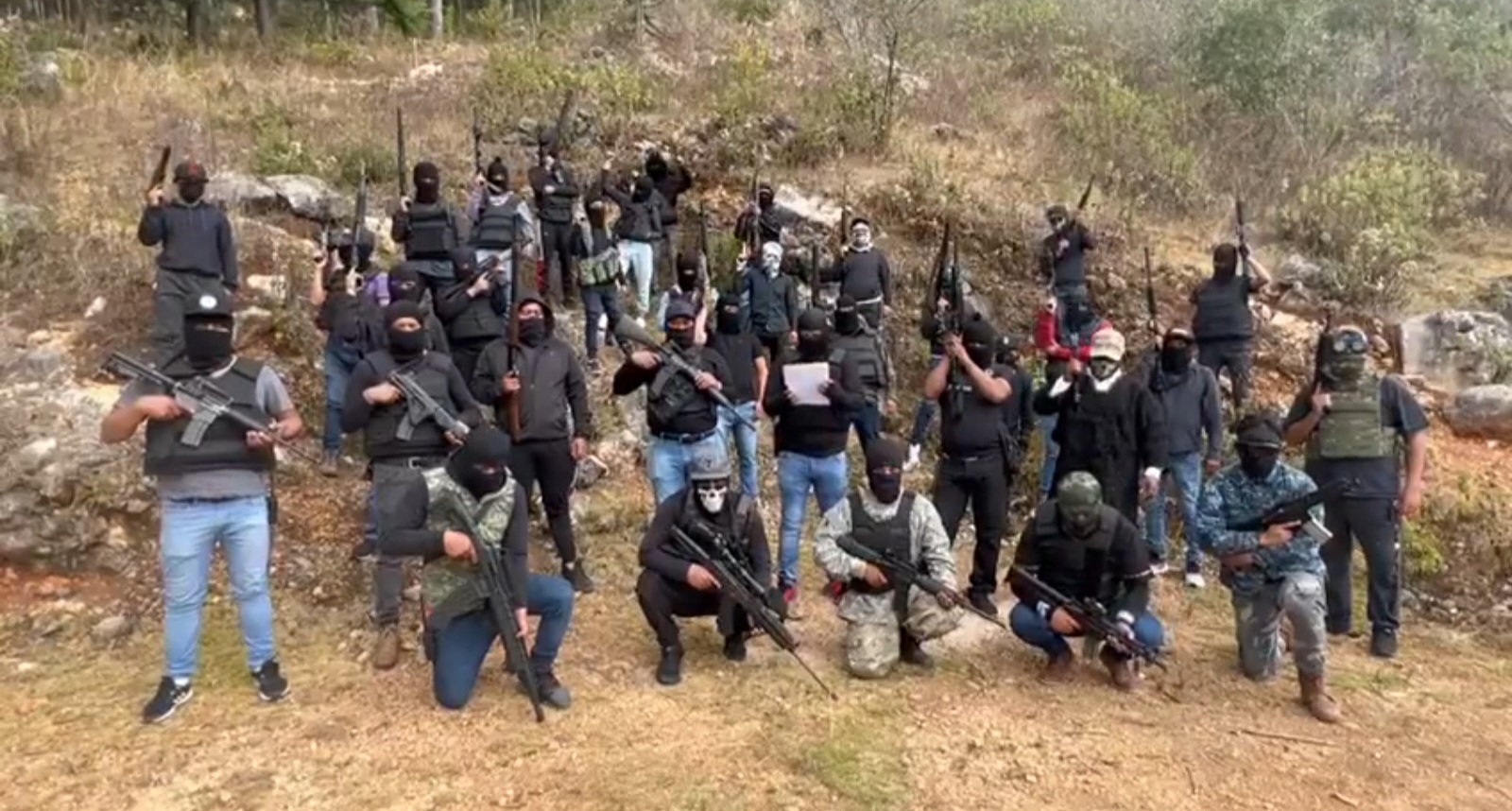
According to a video translated by Borderland Beat, “a new armed group has emerged in a video in the Chiapas municipality of Frontera Comalapa, Chiapas. Within this broadcast they claim to defend indigenous citizens from extortion by an opposing cartel. Their direct attack is against the Jalisco New Generation Cartel. The following video was recorded near Frontera Comalapa, Chiapas:” https://www.youtube.com/watch?v=IJVAQ9p-OP0
Borderland Beat translates the video as follows:
“To all authorities, communities and indigenous representatives. We’ve gathered today, Sunday, January 22, 2023. To announce the group called “Consejo Indígena” (Indigenous Council). The reason for this council is to defend our communities from extortionists, kidnappers of the so-called Jalisco New Generation Cartel. We know that they are extorting our communities under the command of Juan Valdovinos Mendoza aka “El Señor de los Caballos” (The Lord of the Horses) or Vladimir Lopez Orantes.
Let it be clear that we the indigenous brothers and sisters will not allow these rats to enter. We will defend our communities and our indigenous people. Any person who mentions these names in the communities we will bring order in our ways and customs. We also address the indigenous brothers and sisters of Chicomuselo. We will support them and not allow for them to fend for themselves because they are being harassed by the organization called El Maíz.
They are dedicated to extortion and have disappeared many of our indigenous brothers and sisters. We are publicly fighting against this organization called El Maíz. Vladimir Lopez Orantes aka El Ruso is the main boss ordering executions, disappearances, fee collections, and extortions here. He is originally from the town of Santa Teresa Llano Grande, municipality of Frontera Comalapa, Chiapas. Juan Valdovinos Mendoza aka Don Juan, is the leader of the Jalisco New Generation Cartel in Chiapas. He’s a compadre of Vladimir López …”
Source: http://www.borderlandbeat.com/2023/01/frontera-comalapa-chiapas-consejo.html
UPDATE
The whereabouts of 2 Chiapas ejido leaders, missing since March, are still unknown
By: Elio Henríquez, Correspondent
San Cristóbal de las Casas, Chiapas
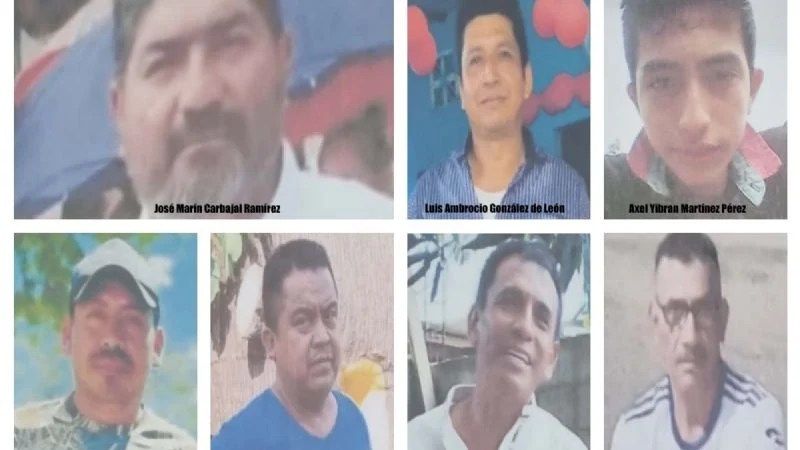
Yesterday, one month after the disappearance of Jordán Gordillo Genovez and José Marín Carvajal Méndez, president and secretary, respectively, of the Nueva Libertad ejido commission, in the municipality of Frontera Comalapa, residents claimed that “nothing is known about their whereabouts.”
“We have no indication of where they are, or who has them; We no longer know what to do or to whom we can turn to look for them,” said the locals, who requested anonymity.
“People in the community are very worried; Everyone wants to do something, but we don’t know what to do. Today (Saturday) marked a month since they disappeared and nothing is known about them,” they stressed.
They added that on Sundays and every night, the inhabitants of the town make prayer chains to ask that Gordillo Genovez and Carvajal Méndez return safely.
They recalled that the whereabouts of both have been unknown since March 22 after they crossed through the Center for Integral Attention to Border Transit (CAITF), located 10 kilometers from Comitán, which is permanently guarded by federal security forces.
They added that in total “seven members of the Nueva Libertad ejido and communal property directorate, where about 750 families live, disappeared, but five of them returned alive, little by little, safe and sound. The first of these was the secretary of the supervisory board, Axel Yibrán Martínez Pérez, 22, on March 25; four days later, treasurer Hernán Aguilar Morales, 57, and member Raymundo Sandoval Córdova, 51, arrived in the community on their own.
On April 2, the chairman of the supervisory board Luis Ambrosio González León, 53, and the treasurer Yobani Vázquez Méndez, 43, returned.
The villagers consulted explained that none of them wanted to give details of what happened “due to fear.” They also did not provide data on what happened to the managers who have not returned because, they said, they do not even know where they had them.
The seven men left Nueva Libertad on March 22, between 7:30 and 8 a.m., heading to Palenque for a tourist trip. However, once they passed through the CAITF, contact with them was lost.

Originally Published in Spanish by La Jornada, Sunday, April 23, 2023, https://www.jornada.com.mx/2023/04/23/estados/024n2est and Re-Published with English interpretation by the Chiapas Support Committee
Day 7: Valladolid, Yucatán, The people, like the jungle, always sprout
Mar, 05/02/2023
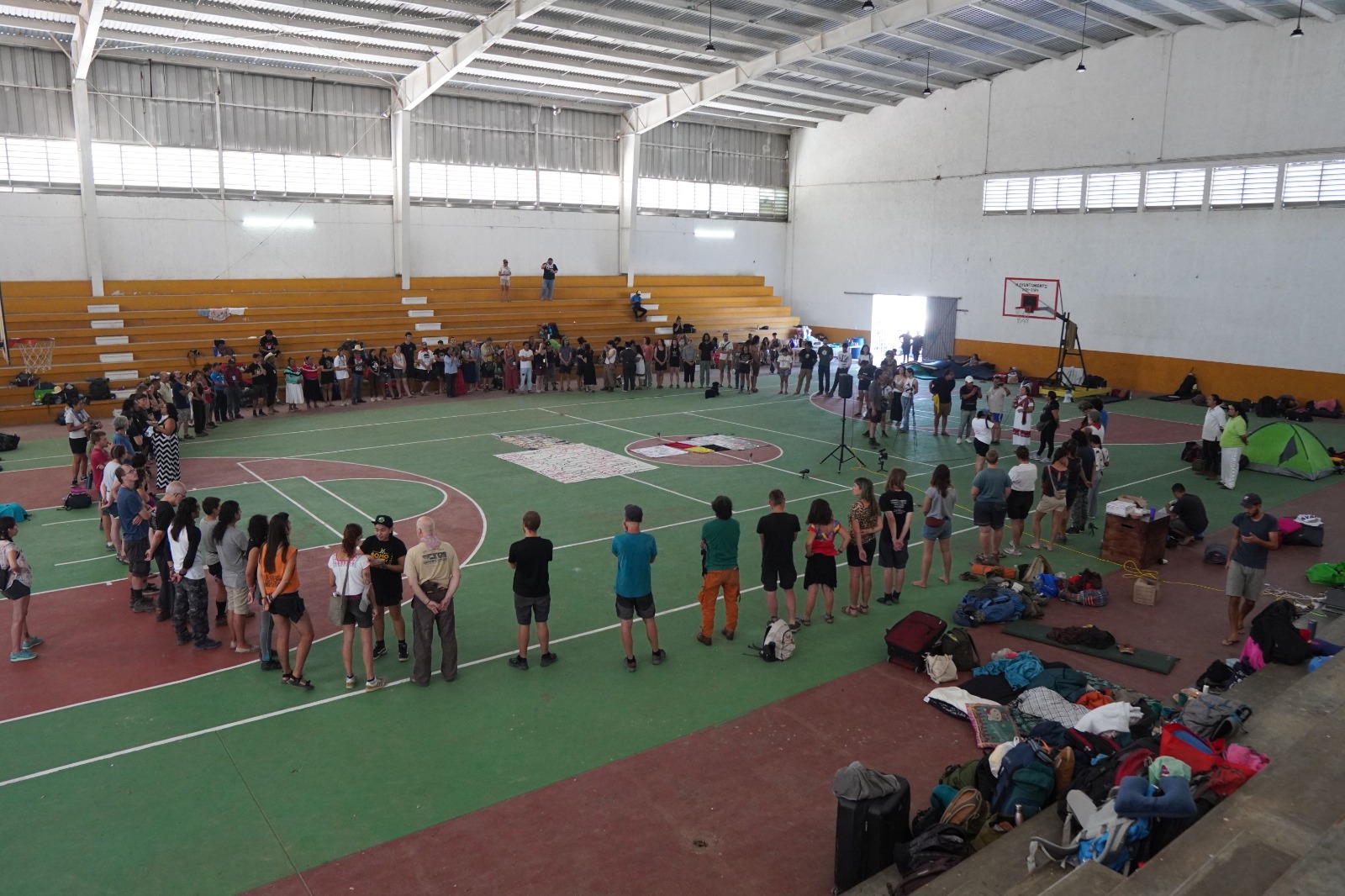
Day 7 of the El Sur Resiste |The South Resists Caravan begins with a ritual among all those who make it up: women and small children, youth and babies, as well as elderly people. Many come from other states of the Republic and also from other countries, but in this caravan we have walked together for the purpose listening to the pain of the Native Peoples and also to give voice to their resistance.
In the ritual, the compañeros of Casa Colibrí talk about remembering all the people and compañeros who have transcended this life, and the defenders of land who have been killed defending the territory. The need to remember that children and adolescents are the reason to fight to leave a better world in every way, including the right of children to a healthy environment, was also emphasized.
“Today I pledge that my actions as an adult will make a difference for children, where the value of our land and our culture is priceless, it is simply not for sale.”
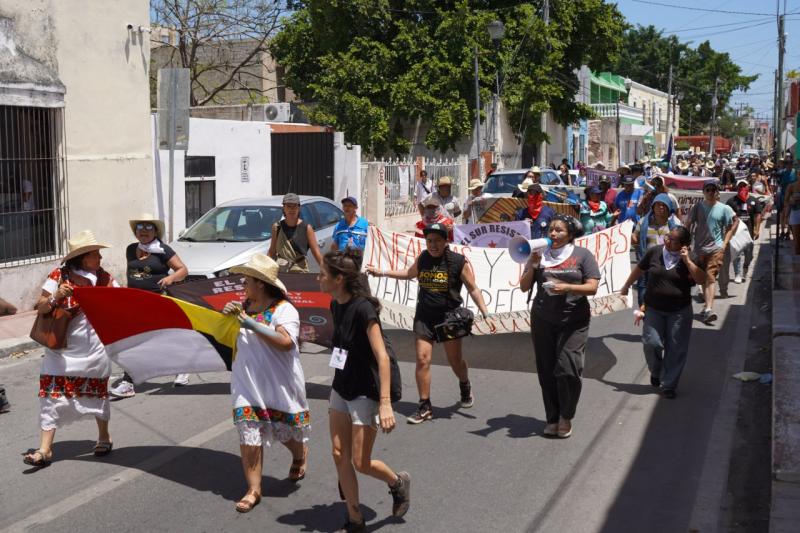
Finishing the ritual, we set off towards the center of Valladolid. During the walk the compañeros and compañeras of the native peoples and all the collectives that accompany them shout loudly, Jungle yes, train No! Water yes, train No! Cenotes are not sold, they love and defend themselves!, That train is not Maya, that train is military!
Members of the caravan hand out flyers with information about the effects of the Mayan Train to the people of Valladolid who watch the march with interest, many recording with their phones and looking through the windows of their businesses, homes, and cars.
Violence and environmental destruction in Yucatan due to the imposition of megaprojects.
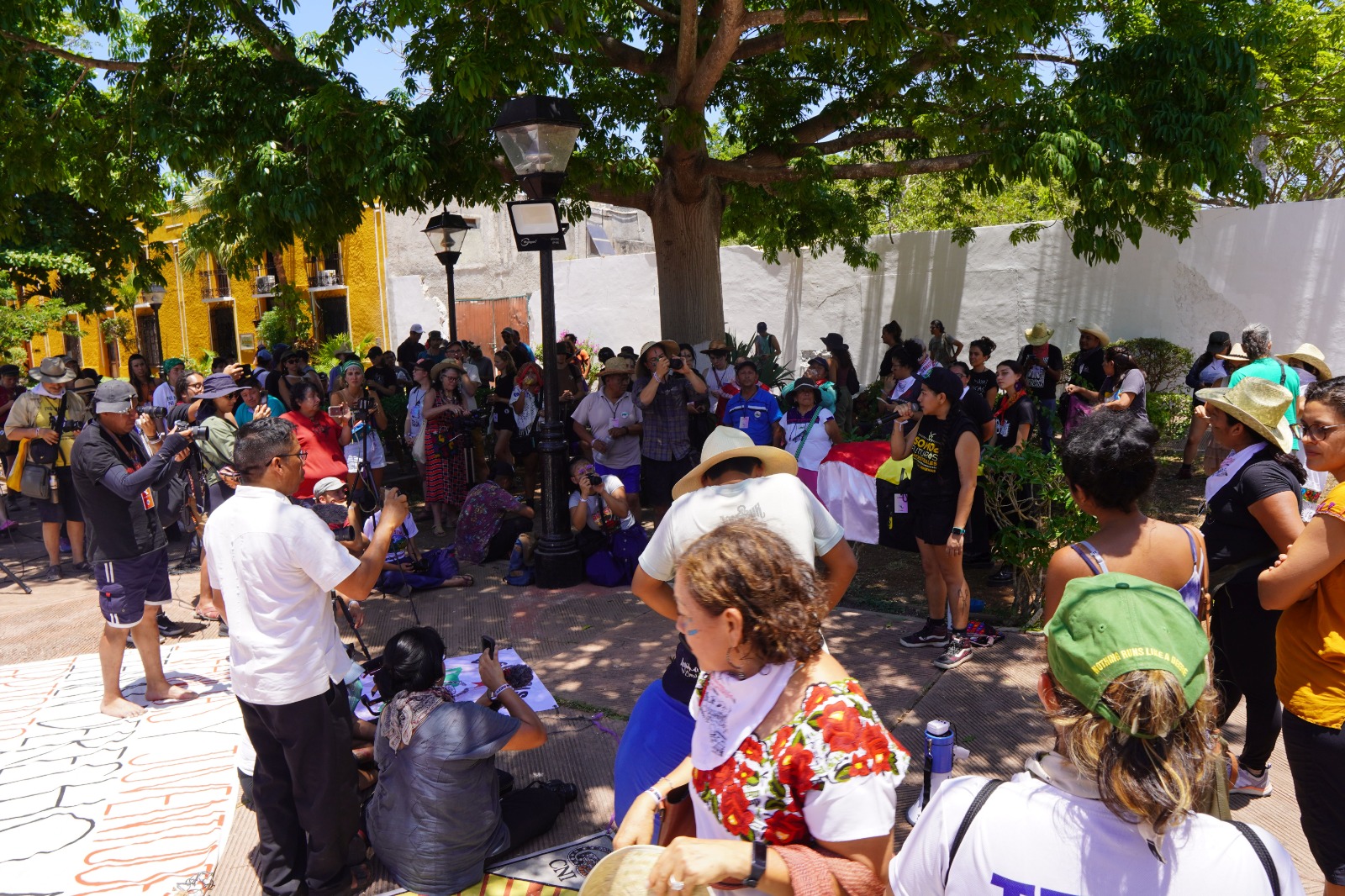
At the end of the march, a rally is held with people from different communities of Yucatan and other areas of the Peninsula. The compañeros and compañeras talk about the dispossession, environmental pollution, and violence they experience in their communities.
Valladolid: It talks about the city’s gentrification, and how for youth and new generations it is practically impossible to buy or acquire land in the city, thus violating the right to have a decent home. This has been caused by the arrival of tourism that sets aside the well-being of the people who are originally from this territory. Despite the critical situation of the state with respect to the destruction of the environment, the comrades who speak highlight the hope they have in continuing to work to change the situation and leave a better world for the next generations.
Xpujil Council, Calakmul: The council talks about the protection they have standing and with which they have tried to stop the construction of the Maya Train in their territory. The compañero talks about the use of the National Guard and the Army and especially the construction of a hotel that may have 162 rooms. This hotel is being built in the heart of the Calakmul reserve and has also been awarded to the Mexican Army like the rest of the Maya Train Project. This construction set off alarms because, if carried out, it would destroy one of the last preserved forests on the entire continent.
Cancún and Playa del Carmen: the compañero talks about all the destruction that the Maya Train Project is already causing in this area, such as the felling of 9 million trees just between Mérida and Xpujil. There is also talk of all the violence that the tourism model that has been promoted in Cancun and Playa del Carmen has generated (same model that will be applied with the construction of the Maya Train throughout the Yucatan Peninsula and in each of the territories it crosses). Forced disappearances, femicides and violence generated by drug cartels are three phenomena that have been shown to be interrelated with the arrival of megaprojects such as the Maya Train.

“We have over 9 million trees cut down after it was said that none were going to be cut down, because we have 9 million lies, lies spread out there as if they were anything.”
“We have the results of that development, we have Cancun as one of the most violent, most dangerous cities, thus hiding figures all the time, presenting beautiful figures of hotels, how many hotel rooms we have, how many jobs are generated, but they do not tell us at what cost “
Siltepech: The compañeras talk about their struggle in defense of the water in their territory that is at risk due to the increasing presence of mega pig farms, which have been shown to be highly contaminated by the waste they generate. It also mentions the criminalization of which Maya inhabitants of Siltepech have been victims, currently 8 members face criminal proceedings for defense of their territory. It also recalls the acts of police brutality and arbitrary detentions that took place against several participants after a march in support of the community of Siltepech in the city of Mérida, Yucatán.
“We want clean water; the water is ours.”
The voice of hope of young people
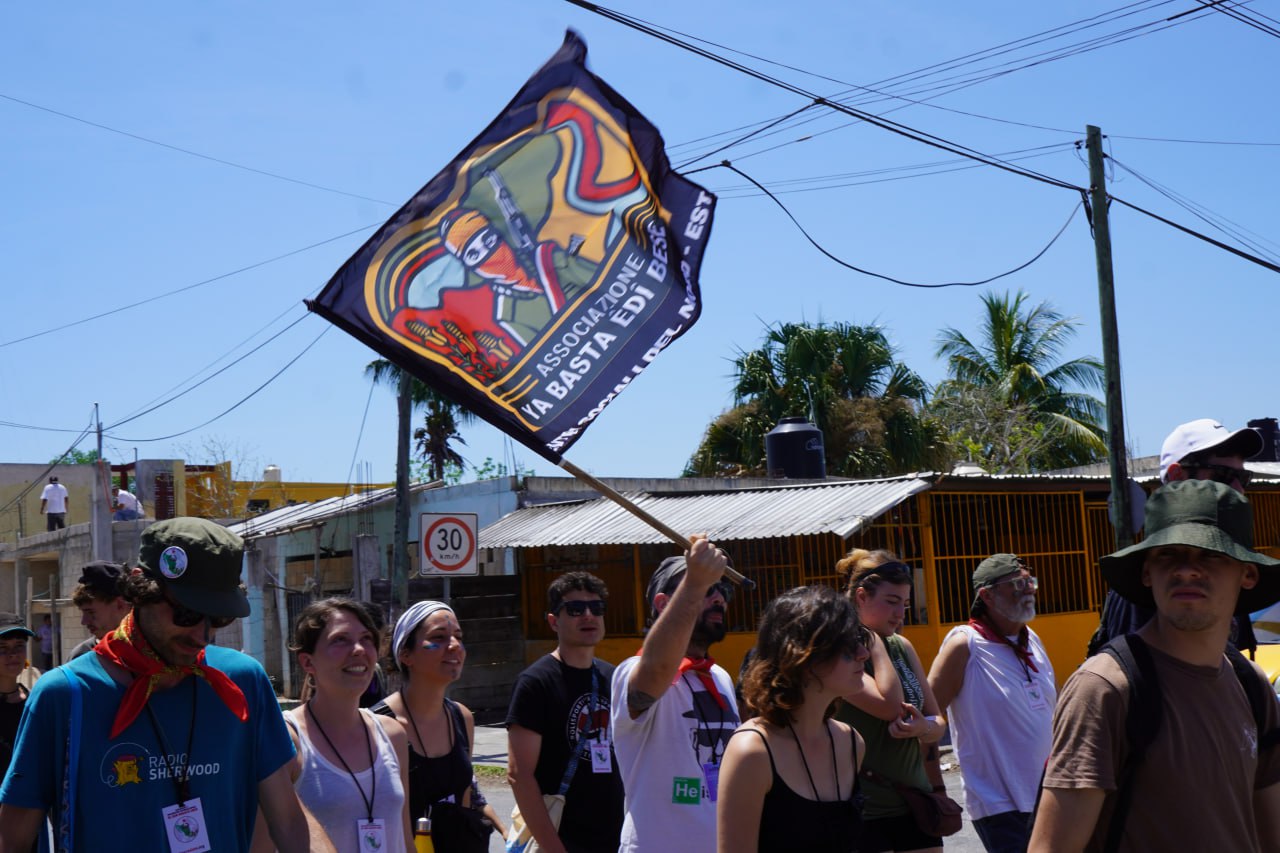
Chirro, a young man from the indigenous community of Oteapan, Veracruz – which was visited by Carava El Sur Resiste – spoke on behalf of his community with a hopeful message, full of vitality and strength.
Their participation makes it clear that young people are not the future, but the present; That in order to continue with this struggle we must listen to them, integrate them, share their vision, listen to their word, and understand that this struggle needs everyone.
Here’s part of his message:
“If we don’t have the territory, we’re not going to be able to take care of it. But I come to tell you, do not despair, as a people you have to resist because the jungle always sprouts. Because beetles and all the little animals seek their life in dry logs. They may want to fill us with concrete, but nature always defends itself and the peoples are that nature defending itself.

We are the mountain, we are the water, we are the animals. We can be the voice of bees, the jungle and everything that inhabits it.
We are focused on talking to other young people, we do it through music, video capsules, radio.
From the south of Veracruz we continue to resist, and that we must continue resisting because we are the mountain. Long live the Maya jungle”
The day in Valladolid ends by sharing “cochinita pibil” [1] that the compañeras prepare affectionately for the caravan. We leave for Felipe Carillo Puerto, Quintana Roo where they are already waiting for us with a cultural act in the center of the community. With music, theater, and poems we begin this day, because art is also resistance.
Translator’s Note
[1] A famous pork dish in Yucatan.
Originally Published in Spanish by El Sur Resiste, Tuesday, May 2, 2023, https://www.elsurresiste.org/es/posts/dia-7-valladolid-yucatan-el-pueblo-como-la-selva-siempre-retona and Re-Published with English interpretation by the Chiapas Support Committee
Day 6: Candelaria, Campeche: The Maya Train devastates the Candelaria River
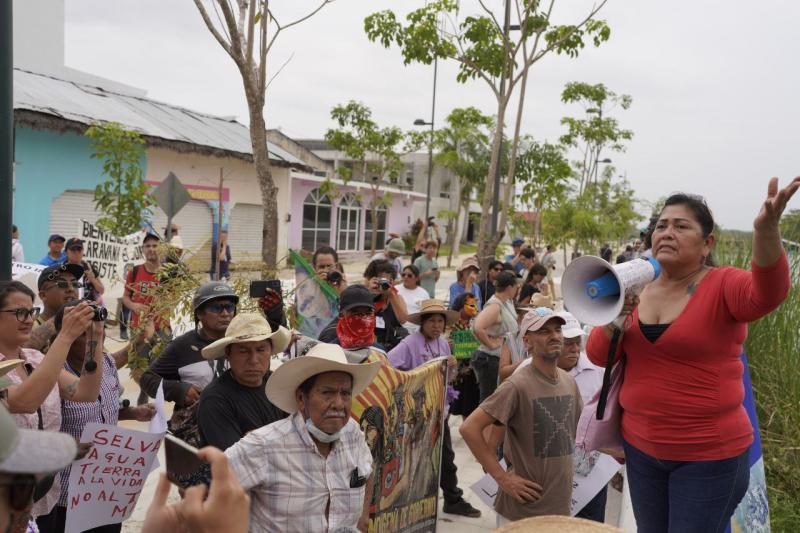
On day 6 of the El Sur Resiste Caravan, we arrived in the town of Candelaria, Campeche, one of the communities where the Maya Train project will pass and have a station; and where construction of new tracks is already underway.
This is how it is seen on the main street: red steel beams cover almost the entire street while the houses of people who inhabit this municipality, look small next to the monstrous death project.
The day begins with a welcome ritual, where Bety Cariño is remembered, and in which Mother Earth is thanked for accompanying us. At the same time, strength is asked to continue with the defense of life in a country where death caused by capitalism is imposed through the power of bad governments.
The girls and boys who are part of the caravan light the fire of the ritual, today we also celebrate their resistance, and we remember that the struggle is also for them to have a future on this planet.
The day continues listening to the testimonies of inhabitants of La Candelaria, who explain the effects that the construction of the so-called Maya Train has generated in their community among which are:
Forced evictions: at least 300 houses have been evicted since the project was announced in this community; many of the families who do not want to sell their homes were harassed and pressured to accept monetary compensation.
Stomach and respiratory diseases: member of the community talk about an increase in illnesses of this sort since the start of the train’s construction, which they attribute to a worse quality of water, and constantly breathing materials and substances used in the construction. In fact, it is easy to notice how a white layer of dust that quickly sticks to clothing and body covers the entire enclosure due to its proximity to the construction.
Community division: the project has caused more divisions in La Candelaria between people who support the project because of the false economic benefits that the government of Mexico has announced, and people who oppose its construction because of the environmental and social destruction it will bring.
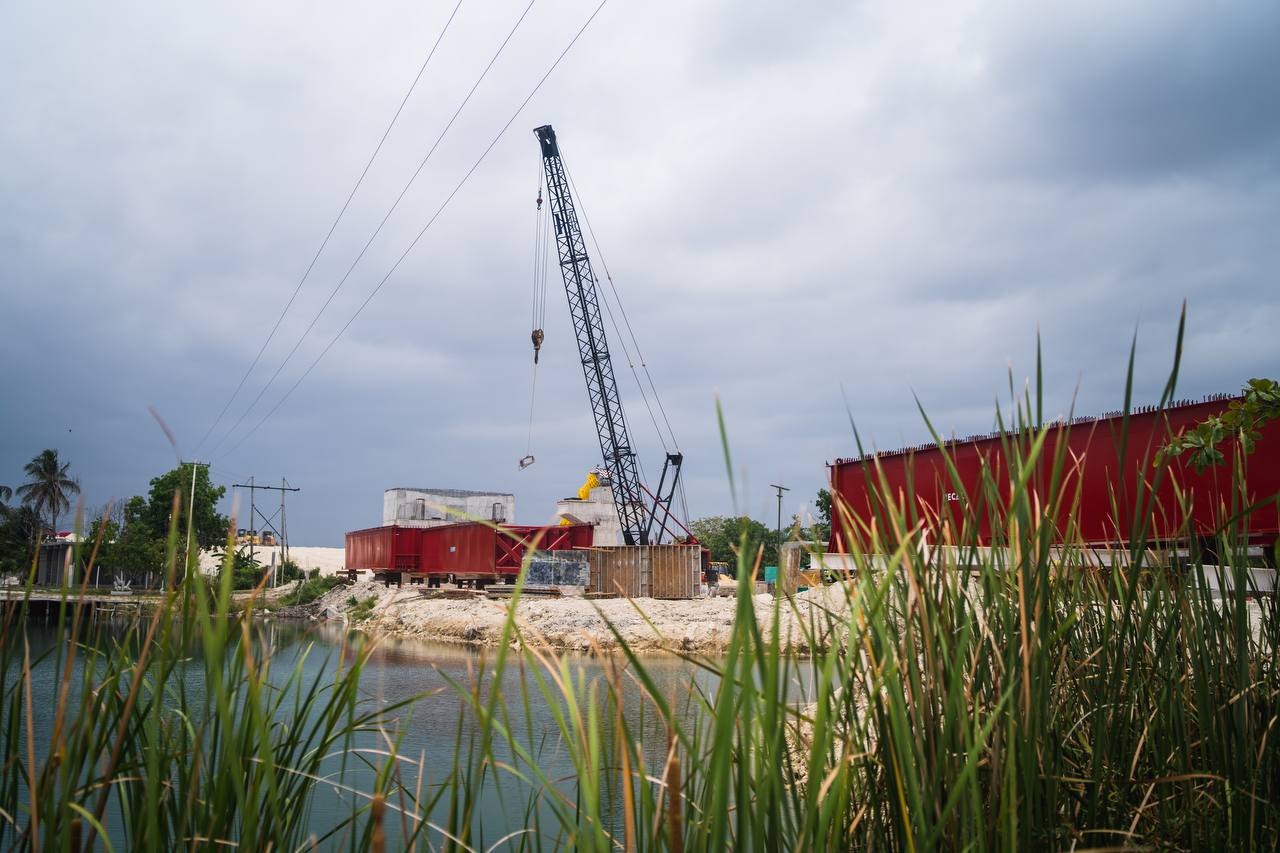
Loss of water bodies: among the most serious effects of the project is the filling of a part of the river with clean water that crosses the community. The community also mentions that wetlands within the community have also been filled in in order to continue with the construction of the death train.
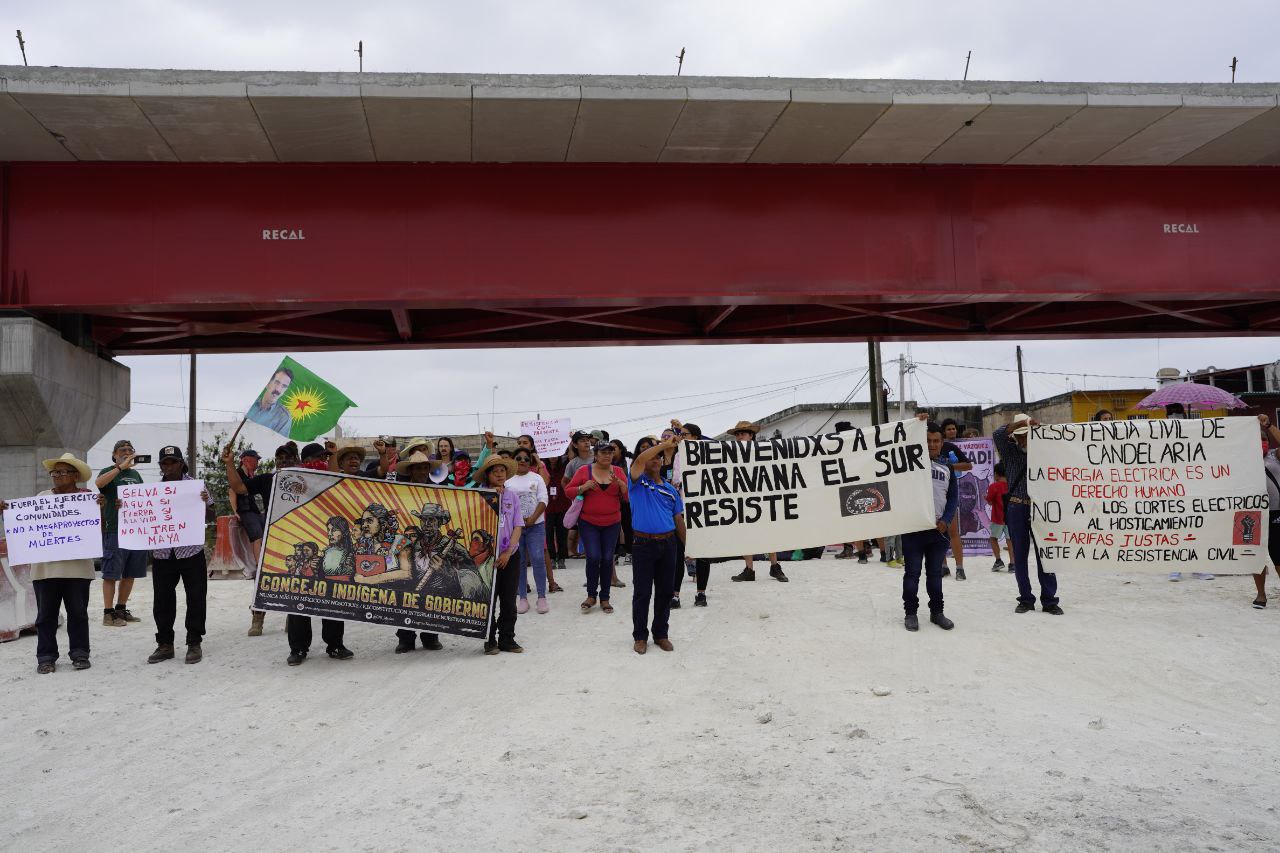
After listening to the word of the compañeras and compañeros of Candelaria, and of other compañeros/as of communities that are part of the caravan, we went out to take the streets and shout together, This Train is not Maya, this train is military!
We walk the streets, some people in the community are uncomfortable with our presence, “We want progress,” shout some, the division that the speech of the president and his institutions such as FONATUR has generated are palpable in this community.
Almost at the end of the march, we reach the river, on the left side it looks wide and imposing, it seems to have no end and is surrounded by trees and nature; on the right side it has been covered by gravel and earth, only 10 meters have been left so that the water can continue to circulate; There are no trees anymore, just piles of dirt and a yellow bulldozer pushing dirt nonstop.
A colleague from the community takes the megaphone and asks us to observe and document the destruction of the river. The death brought by the so-called Maya Train is increasingly notorious in all the places where its construction continues despite multiple protections that have been ignored, thus violating the constitution of the country and the laws that the bad government requires the people to respect, but not the companies.
The compañero also mentions that the work related to the river was never consulted with the community, and the Environmental Impact Statement simply does not exist. A violation of the right to information, consultation of indigenous peoples, and Mexican laws.
After the march, the Caravan leaves for Valladolid; we follow the death route of the Train with the clear objective of making visible the destruction it already generates, but also to give voice to the resistance of people in communities like Candelaria who refuse to be silenced, and who continue to fight to defend life.
Originally Published in Spanish by El Sur Resiste, Monday, May 1, 2023, https://www.elsurresiste.org/es/posts/dia-6-candelaria-campeche-tren-maya-arrasa-al-rio-candelaria and Re-Published with English interpretation by the Chiapas Support Committee
Day 5 of the Caravan: El Bosque community devoured by Global Warming
Text: Observatorio Memoria y Libertad
Photos: Karen Castillo – Observatorio Memoria y Libertad
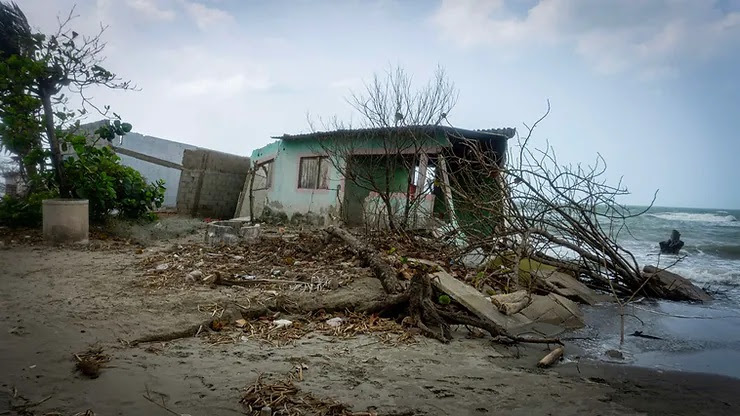
The Caravan El Sur Resiste on its fifth day of travel arrived in Colonia El Bosque, Tabasco, a community located between the Atlantic Ocean and the Grijalva River.
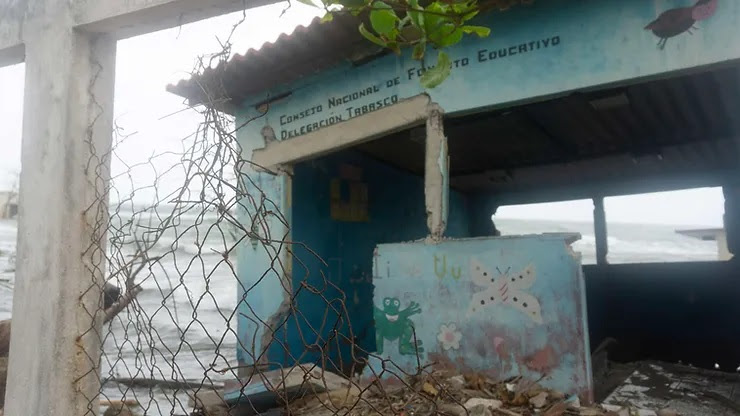
El Bosque is in danger of disappearing because, since 2019, the sea level began to rise rapidly, sweeping away the coast, the streets, the kindergarten and school, as well as dozens of homes.
El Bosque is one of many communities around the world at risk of disappearing underwater due to rising sea levels caused by climate change. In Mexico, it is one of the first communities identified as displaced by this phenomenon.
Today there are few houses and buildings that survive the catastrophe in El Bosque, many families have been displaced and those who are still resisting are demanding support from the Federal Government in the face of the destruction of their community, their homes, their roots, and their entire way of life.
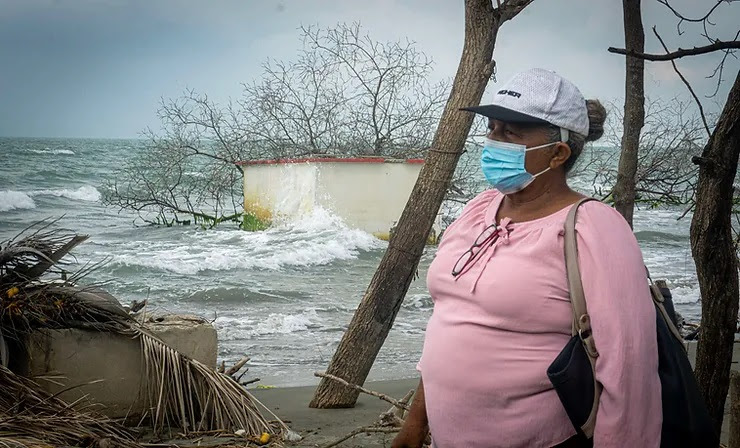
This is how Cristina Isabel Vicente and Estanilada Cardona explain it, as they give us a tour of the community to show us the buildings that are disappearing into the sea, and share their testimony and that of other community members who now wait for the Federal Government to comply with the relocation plan promised to the families of El Bosque in February of this year.
“On November 10, 2022 a press conference was held here in El Bosque to make known the terrible situation we live in, and that was when the media and the authorities began to hear us. Since that press conference, there is nothing left, everything has disappeared.
What we are asking for is relocation, we have already lost our homes, we are renting, lending, we are asking for relocation. The authorities have given us an answer, they say we are going to be relocated, but they say it takes time, we are talking about at least 60 people who are in need of relocation.”
As we mentioned, El Bosque is not the only community around the world that is in danger of being devoured by the sea.
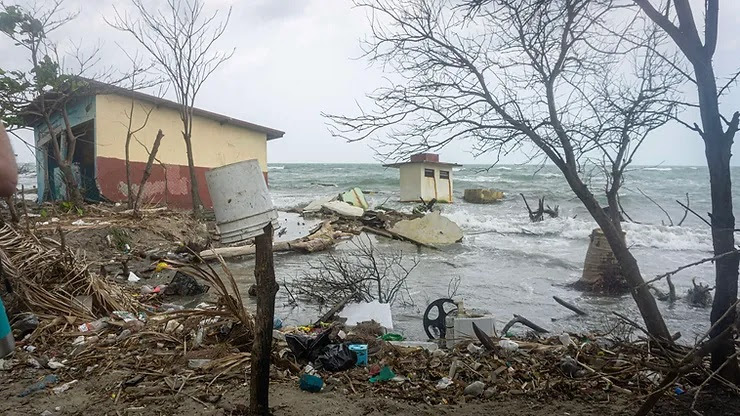
Cristina and Estanilada continue the tour of El Bosque, and we stop in front of a building that is about to collapse. Behind it, the choppy sea and the strong wind continue the process of eroding the building’s foundations. The remains of other buildings can also be seen among the waves, as well as trees and dry branches. There, Cristina explains that this building was her home.
“I want to share with you that, this one in the back, was my home… it took years of struggle to build and, unfortunately, today I no longer have a home. It is very difficult for us to be displaced, it is very difficult to be in the struggle now, but we will continue.”
Cristina joins in to relate her testimony, of what used to be home, there is nothing left; an empty space and sea waves are the only thing we can observe.
“I also lost my house, there was my house and I lost it, I was left without a house, now it’s really… without anything, you can’t see it anymore, it was left under the water.”
The Relocation Process
The few inhabitants of El Bosque who are still waiting to be relocated report that they have contact with governmental institutions, SEDATU and SEMARNAT have been in contact with the community since February 2023.
However, the families still do not have a possible date for relocation, nor do they know where they will be relocated to, much less the size of the land they will receive.
Cristina and Estanilada comment that the community hopes to be able to remain close to the sea, as they are a people who have historically been dedicated to fishing and the sea is their source of food and economic support.
“We live from fishing, that is why we want to ask if it can be in a place where we can do that, everything is worrying, very worrying, we do not know where we are going to go, nor when.
“We do talk as a community, we sit down, we talk over coffee and bread, because they say that sorrows are lighter with bread. We get very upset as a community, the nights are very worrisome, we spend our time thinking about the sea, that sea that we are already afraid is going to rise more. We have had to take things away from the people at 3am, at 4am because the sea has risen, and it really affects us as a community.”
In addition to living with the worry, day and night, that more houses and spaces will disappear under the sea, the situation of services in the community worsens day by day.
Cristina tells us that most of the families have lost the refrigerators in their homes that have broken down in the process. This not only makes it difficult for families to keep their food longer, but also makes it difficult for diabetes medicines to be kept refrigerated.
Light poles are also beginning to give way to the waves; the community could lose service to electrical access at any time.
“The whole community almost lost their refrigerators. I, who have diabetes, for example, have nowhere to keep my insulin. Yesterday I brought an ice block but I don’t know if I can bring it daily. We agree with the relocation, but we have urgent needs in the meantime.”
When talking to some people in the community, they mentioned that they understand that the relocation process can be slow and complicated; however, they hope that there can be another type of plan while they wait for it to ameliorate the crisis situation that the community is going through.
Despite the fact that the global warming process has been identified as a priority in international politics due to the impacts it will create for the security of millions of people worldwide, the Mexican Government does not have any type of plan or public policy proposal that seeks to stop this process.
According to the State Action Program for Climate Change in the State of Tabasco, “the impacts on the coastal zone of the State of Tabasco due to the accelerated rise in sea level will result in the destruction of land […] due to the action of waves. All these aspects will have notable environmental as well as social and economic repercussions.”
However, there is no plan to attend to the victims of the natural catastrophes that are already beginning to occur, as the case of the community of El Bosque suggests, and which will soon multiply throughout the national territory if the causes of the climate crisis are not addressed: the devouring capitalism that continues with a process of unlimited production at the expense of the environment and the life of all living beings on the planet.
During the tour, Cristina and Estanilada stop in front of another building in the process of collapse. This was the community’s school, the kindergarten is also gone. Now the children who are left in the community go to school only 6 hours a week in a small construction with a tin roof.
The life of the community, not only of its buildings, has also been gradually devoured by the sea.
The Loss of the Roots of a Community
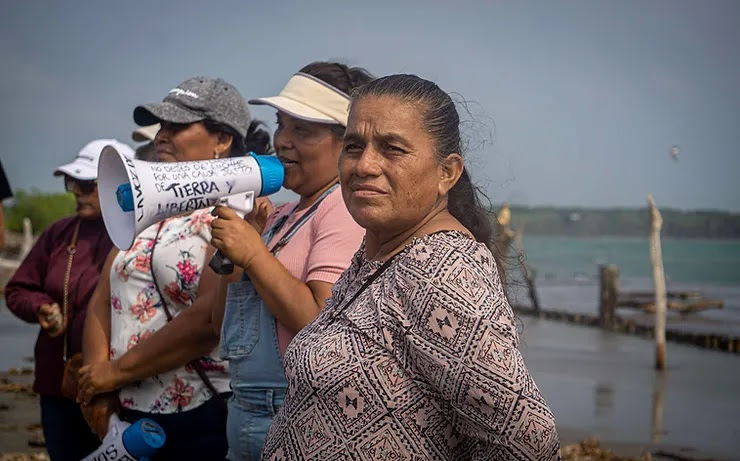
Cristina and Estanilada continue leading the tour, we walk for about a kilometer; the sea is choppy and the wind blows hard; today another North entered changing the weather conditions of the place that is usually sunny and the sea is calm.
We arrived at the point where the Grijalva River meets the Atlantic Ocean. There Cristina and Estanilada stop, as well as boys, girls, teenagers, women and men from the community. There they point us to a concrete slab that is barely visible above the water.
The slab used to be a dock, and the meeting point for the entire community; families would gather there to fish, the activity that for generations has shaped the identity of the people who live there and their source of food and economy.
Today, the dock no longer exists, fishing has almost disappeared and with it, all the activities that were carried out there, as well as the livelihood of the families. This is the testimony offered by Cristina:
“We used to come most of the people to fish, this was like a tianguis, we would all come with blankets and our children would stay here asleep and we would go fishing, we would take the product to sell and we would go fishing again in the afternoon. That no longer happens, there is no longer the production that there used to be, it has been lost. This, comrades, was our roots. I feel sad, I feel that climate change is taking away our roots. It is very sad, we know that if one day a stronger north or a hurricane comes in, we can disappear overnight.
This used to be a well-structured dock, but it has been lost, sinking. Here we used to fish, we used to party. I never imagined it would happen to us, when they said climate change, it sounded like a distant voice, when I heard that I thought of the people in the city with their cars, and not of us who live without pollution. We did not cause the change, but we are going to pay for it, today it is us, but tomorrow it will be others.”
However, it has been the global north that has been responsible for creating the climate crisis that we are experiencing and specifically it is the population of the global north that is responsible for making millions of dollars in profits at the cost of millions of human lives.
What is happening in El Bosque is not a spontaneous phenomenon. At a global level, the great need for public policies that place the indigenous, peasant and fishing communities at the center of the discussion on global warming has been placed at the center of the discussion.
They are the ones who have managed to protect the last lungs and natural areas preserved worldwide, and also the ones who will suffer the most from the effects of global warming.
The deep interrelationship that native peoples have with the environment of the territory they inhabit means that their identity, economy and community life are intimately linked to the survival of their territory.
Just as in Puente Madera, Oaxaca, the community explains that if the Pitillal is destroyed to build an Industrial Park since it is their current source of life, the same happens in El Bosque with the loss of fishing as a livelihood.
For this reason, governmental solutions at a global level -and in Mexico- need to be deep and at a system level; there is no life that can survive the devouring capitalism and its death machine.
We ended the visit and documentation in El Bosque with a meal prepared with effort and solidarity by the families of the community. Despite the uncertainty, pain, destruction and worry they have experienced in recent years, there is still hope, solidarity and resistance in their eyes and in their actions.
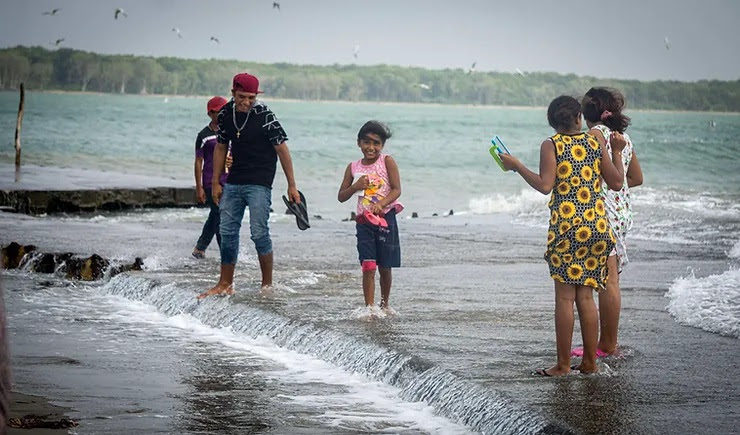
The children laugh and play in the water, the women talk and converse with each other, the community of El Bosque is resisting and fighting.
Source: Observatorio Memoria y Libertad
Translation: Schools for Chiapas
Day 4 – Oteapan, Veracruz: Resisting displacement that only benefits the rich
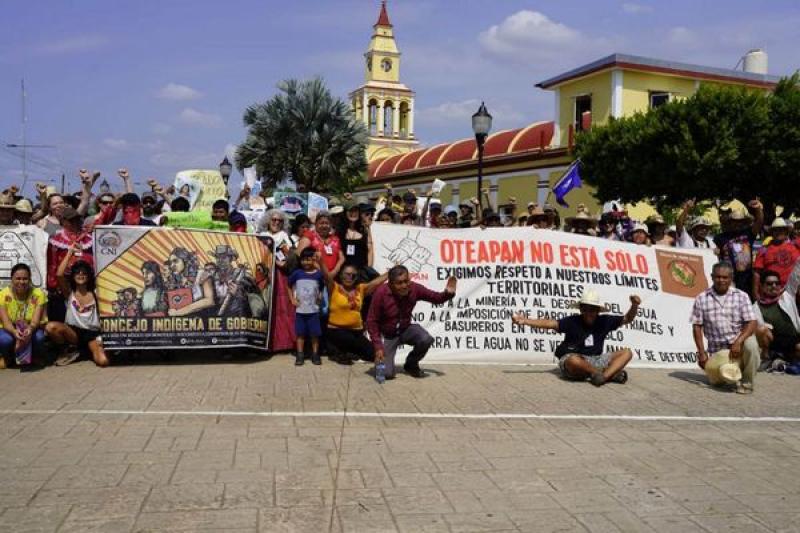
Oteapan is a community that was displaced once before. It is still present in the collective memory that 300 years ago the community had to leave their lands located on the border between the states of Tabasco and Veracruz. They denounce that that displacement was also due to “problems of the rich, they denounce that now, after so many years the rich also intend to displace them to continue destroying and making money with other lands.
On the fourth day of the El Sur Resiste caravan we go to Oteapan, Veracruz. This highway traces a similar path of the intended route of the Interoceanic Train. It has united the peoples of Veracruz and Oaxaca against one of the most destructive projects of the 4T (Fourth Transformation).
Oteopan is the waist of the region. As in all the caravan, the reception was warm in the Naranial Neighborhood, next to the Dina neighborhood, and the comrades in resistance there launched fireworks announcing our arrival. The political ceremonies were accompanied by traditional music from the south of Veracruz. Homage was paid to Bety Cariño and Jyri Jaakkola, ten years after their assassination while they were with a humanitarian caravan in San Juan Copala, Oaxaca. Members of the community of Oteapan remembered walking with Bety. Children and youth of the community read poems in her honor.
The panorama confronted by Oteapan is not much different from what we have documented since the first day of this caravan. The 4T has tried, in every possible way, to destroy the community’s social fabric in order to impose the Interoceanic Corridor, along with its associated megaprojects.
One youth denounced that two years ago the government expropriated 2000 hectares of the community. This problem is over 80 years in the making. At first the state government of Veracruz tried to take 200 hectares. Since 2022, it has tried to take seven neighborhoods: La Dina, Tierra Colorada, Tapalan, Porvenir, Rancho Alegre, Predio Viveros, and Naranial. These lands are in the territory where the railway intends to pass and they are alongside where the Trans-Isthmus highway connects with Oaxaca.
The community blockaded the highway on March 7, 2022 demanding dialogue and respect for their territorial limits. Nevertheless, also in this community the response from the state was violence and displacement by police and tear gas. On March 8 they were beaten by police who burned 50 motorbikes and 4 automobiles belonging to the community.
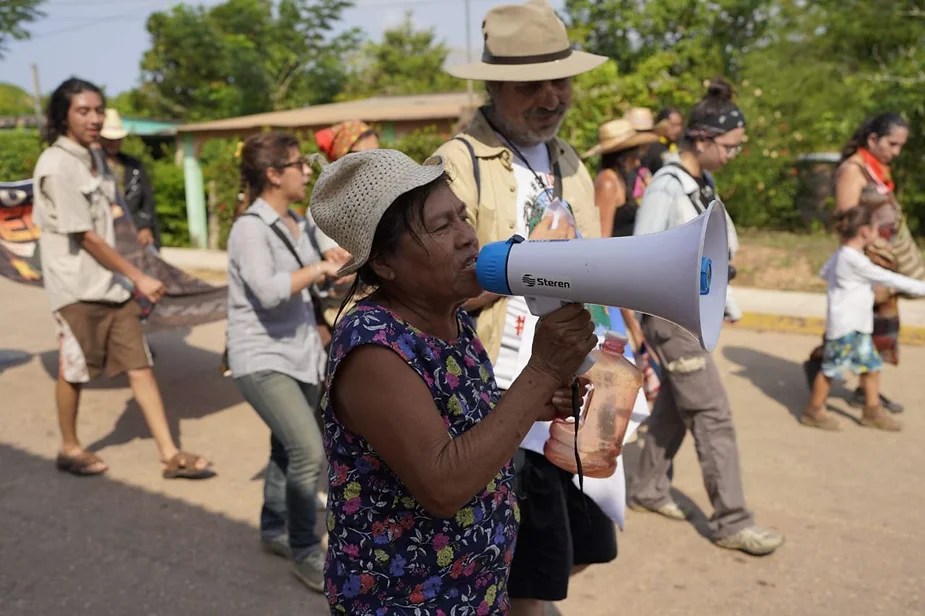
“We do not agree that the government comes for our vote and then treats us this way”
While the event was taking place in the morning, we found out that the encampment, Tierra y Libertad from Mogoñé Viejo in Oaxaca, where the caravan had just been the day before, had been brutally displaced by the Navy, the National Guard, and the municipal police.
The response of the caravan was solidarity and participation in organized action. After the announcement of the news the people of Oteapan and other communities of Veracruz decided to block the Trans-Isthmus highway.
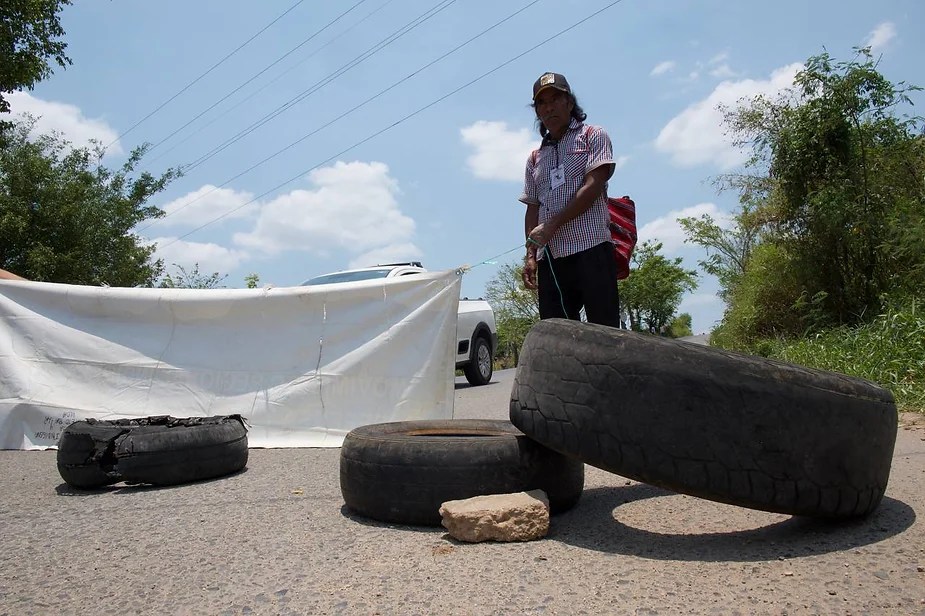
Open Air Dumping of Coke
Since 2013, an open coke dump has been installed on top of springs in Jaltipan, the municipality next to Oteapan. Toxic waste from petroleum production arrives at this plant from the Pemex Plant, General Lazaro Cárdenas in Minatitlan, Veracruz.
For years the community of Jaltipan and other nearby communities have denounced the negative impacts of this activity on the environment of the region and on the health of the inhabitants. Nonetheless, no authority has attended to these denouncements from the local people, and to this day, the plant continues to operate.
A youth from the community expressed concern that with living close to the plant, even though it is not in Oteapan, it impacts the entire region. “Coke is extremely toxic; it contaminates the layer of subterranean water. The gases evaporate and scatter all over the zone… We don’t know how far they spread, it’s very carcinogenic.”
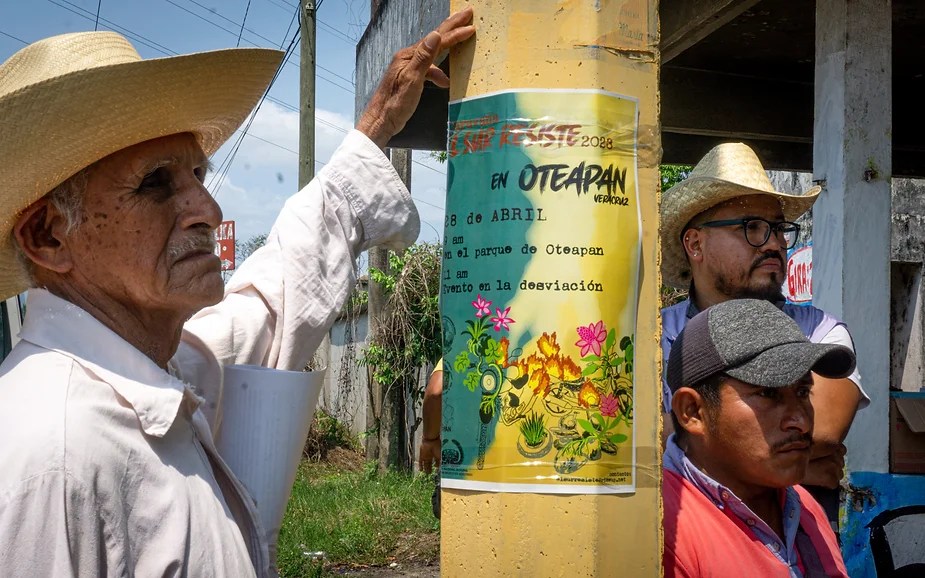
According to the inhabitants, campesinos that live near the coke plant have observed that the activities have begun to move closer to lands of Oteapan, another problem that none of the three levels of government has addressed yet.
Originally Published in Spanish by El Sur Resiste, Friday, April 28, 2023, https://www.elsurresiste.org/es/posts/dia-4-oteapan-veracruz-resistir-el-despojo-por-el-beneficio-de-los-ricos and Re-Published with English interpretation by the Chiapas Support Committee
Once again, they try to evict the Mixe protest over works on the trans-Isthmus train
By: Jorge A. Pérez Alfonso and Gustavo Castillo
Correspondent and reporter
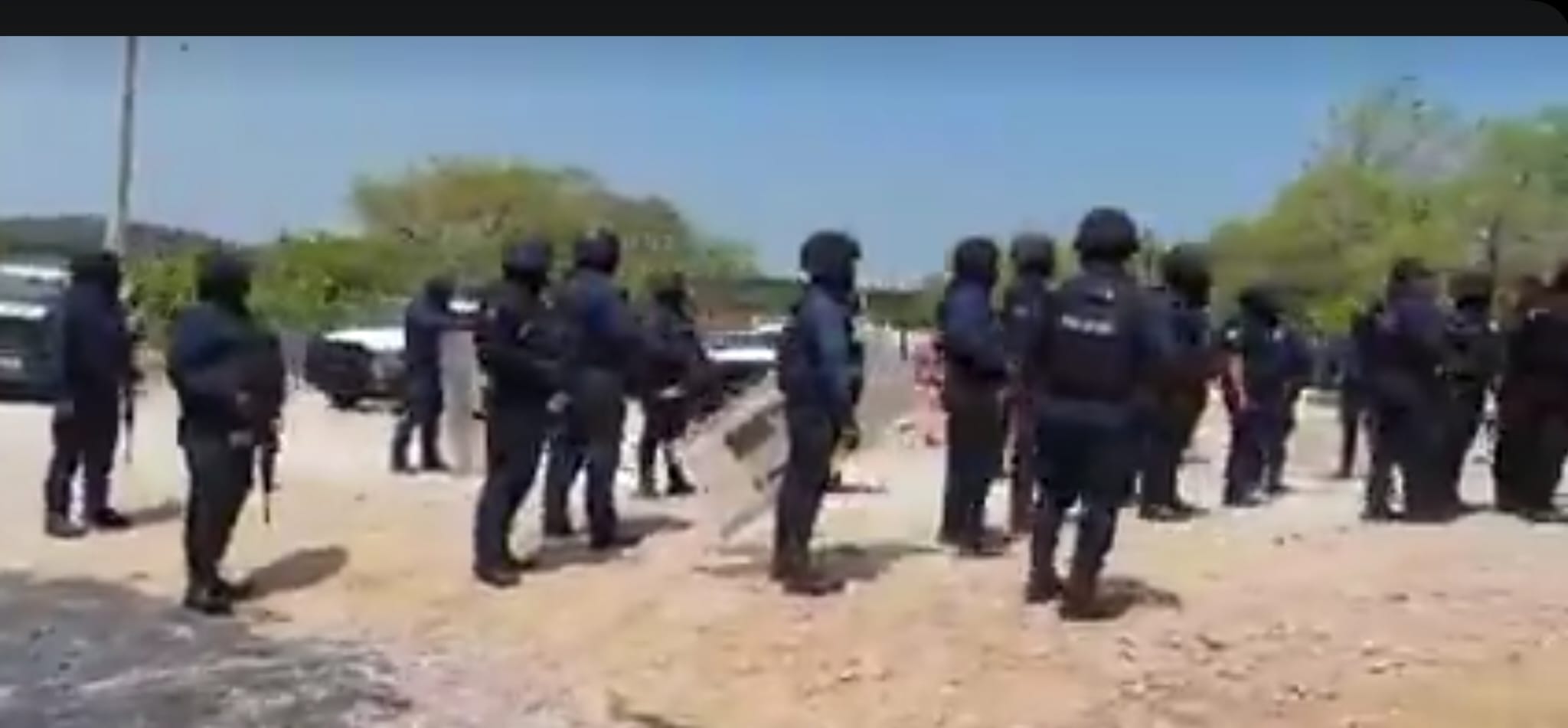
A new eviction attempt arose yesterday morning against the “Tierra y Libertad” camp, which indigenous Mixes maintain in the Mogoñe Viejo-Vixidu section, in the municipality of San Juan Guichicovi, Oaxaca.
This happened in the same place where on Friday federal and state forces removed them “with aggression,” in addition to arresting six people, members of the Union of Indigenous Communities of the Northern Zone of the Isthmus (UCIZONI) denounced.
The protest began 62 days ago as a demand for damages caused to their lands by the modernization work on the railroad that crosses the area and that is part of the Interoceanic Train project that will connect the port of Salina Cruz, in Oaxaca, with that of Coatzacoalcos, in Veracruz. The protesters were evicted from that point on Friday morning, at the request of the Federation, the state government revealed, but they reinstated their sit-in in the afternoon.
At 9 o’clock yesterday morning, police again arrived at the camp to try to remove the demonstrators; However, residents started ringing the community’s bells. More than 100 Indigenous people gathered, forcing the police to retreat.
According to the state government, the six detainees were handed over to the state prosecutor’s office; however, this institution reported that they only supported their transfer to the state capital, since they were presented to the Attorney General’s Office (FGR).
Therefore, it said, the FGR will determine their legal situation; the Morenista government of Salomón Jara has not disclosed the charges against the indigenous people arrested.
The most “serious” thing, said Ucizoni, is that until yesterday morning they had not been allowed to speak with any defender, that is, they served more than 24 hours incommunicado, “which clearly violates their human rights.”
Meanwhile, the Secretariat of the Mexican Navy (Semar) released its version of what happened during the eviction carried out on Friday against the indigenous Mixes in the town of Mogoñé Viejo.
Semar indicated that federal and local authorities acted because the workers who carry out rehabilitation work on the Interoceanic Corridor railway of the Isthmus of Tehuantepec (CIIT), “were attacked.”
Semar pointed out that the information it has on that case states that “about 15 people who blocked the railroad tracks for more than 60 days at the Mogoñé Viejo-El Zarzal crossing, came to prevent the rehabilitation work of the CIIT tracks, armed with sticks and machetes. “
Semar further explained that the demonstrators “verbally and physically assaulted the workers who were at the place. Therefore, in order to safeguard human life, personnel of the State Police and National Guard who were providing security in the area, acted immediately in the face of violent events.”
Originally Published in Spanish by La Jornada, Sunday, April 30, 2023, https://www.jornada.com.mx/2023/04/30/estados/026n1est and Re-Published with English interpretation by the Chiapas Support Committee
CNI-EZLN Pronouncement

PRONOUNCEMENT OF THE NATIONAL INDIGENOUS CONGRESS AND THE EZLN IN RESPONSE TO THE VIOLENT EVICTION OF THE “TIERRA Y LIBERTAD” CAMP IN THE MIXE COMMUNITY OF MOGOÑE VIEJO, GUICHICOVI, OAXACA, BY THE FEDERAL AND STATE GOVERNMENTS
To the peoples of Mexico and the world
To the organizations and collectives that defend human rights
To the National and International Sixth
To the national and international media
With outrage, we denounce that today, April 28, at around 10:38 a.m., a large group of members of the National Guard, the Mexican Navy and the Oaxaca state police, violently attacked those participating in the TIERRA Y LIBERTAD CAMP, causing its destruction along with the theft of the belongings of the peasants who were in the camp. IN AN ALARMING WAY, THE MIXE EJIDO MEMBERS MARÍA MAGDALENA MARTÍNEZ ISABEL, FERNANDO HERNÁNDEZ GÓMEZ, ADELA SEVERO TEODORO, ESPERANZA MARTÍNEZ ISABEL, ELIZABETH MARTÍNEZ ISABEL AND ELIODORO MARTÍNEZ ISABEL WERE DETAINED WITHOUT THEIR LOCATION BEING KNOWN, AND COMPAÑERA ADELA SEVERO TEODORO WAS BEATEN BY MEMBERS OF THESE ARMED FORCES. In this context, we denounce, as on other occasions, the intentional use of military and police forces by the state to rape women and generate terror.
Just today the TIERRA Y LIBERTAD CAMP, organized by the Union of Indigenous Communities of the Northern Zone of the Isthmus (UCIZONI), completed 61 days of blocking the railroad tracks on the Isthmus of Tehuantepec in the Mogoñe Viejo-Vixidu section, in protest against the imposition of the Isthmus of Tehuantepec Interoceanic Corridor megaproject in order to paralyze the work to modernize the railroad.
Yesterday, the NATIONAL AND INTERNATIONAL CARAVAN “EL SUR RESISTE,” in struggle against the Interoceanic Corridor, the Maya Train | Tren Maya and all the death projects of this repressive government, servile to the interests of big capital, was received at the “TIERRA Y LIBERTAD” CAMP. The purpose of that visit was to link and unite the resistance of the peoples of the south, of Mexico and of the world. We cannot omit indicating that since its beginning on April 25 in Pijijiapan, Chiapas, the CARAVAN has been permanently hampered and harassed by government espionage and an endless number of military checkpoints.
With the operation orchestrated by the military and police corporations against the “TIERRA Y LIBERTAD” CAMP, it is once again clear that the current governments are at the service of the large transnational corporations and that militarization, patriarchal violence and repression are the means they choose to counter the struggle and resistance of our Peoples against the Interoceanic Corridor and the Maya Train, and against capitalist dispossession and the war.
WE DEMAND THE IMMEDIATE RELEASE OF OUR COMPAÑERAS AND COMPAÑEROS: MARÍA MAGDALENA MARTÍNEZ ISABEL, FERNANDO HERNÁNDEZ GÓMEZ, ADELA SEVERO TEODORO, ESPERANZA MARTÍNEZ ISABEL, ELIZABETH MARTÍNEZ ISABEL AND ELIODORO MARTÍNEZ ISABEL. THE PUNISHMENT OF THOSE GUILTY OF PHYSICAL AND GENDER-BASED VIOLENCE, ROBBERIES AND REPRESSION DIRECTED AGAINST THE TIERRA Y LIBERTAD ENCAMPMENT, AS WELL AS GUARANTEES FOR ITS PERMANENCE. IN ADDITION, WE DEMAND THE GUARANTEE OF FREE TRANSIT AND ACTIVITIES OF THE NATIONAL AND INTERNATIONAL CARAVAN “EL SUR RESISTE” (THE SOUTH RESISTS).
Sincerely,
Mexico, April 28, 2023
For the Integral Reconstitution of Our Peoples
Never Again A Mexico Without Us
NATIONAL INDIGENOUS CONGRESS
INDIGENOUS GOVERNMENT COUNCIL
EZLN-Zapatista Sixth Commission.
They evict campesinos who block work on the trans-isthmus train in Oaxaca

Above Photo: Members of the “Tierra y Libertad” encampment, who have maintained a blockade for 60 days in Guichicovi, Isthmus de Tehuantepec municipality, were expelled yesterday by members of the National Guard, Navy and state police. To the right, members of the El Sur Resiste caravan and organizations of the Sierra de Santa Marta, in Veracruz, who blocked a stretch of the trans-Isthmus railway yesterday, in the municipality of Oteapan, to protest the aggressions against their compañeros of “Tierra y Libertad.” Photo La Jornada and Sayda Chiñas
By: Jorge A. Pérez Alfonso, Elio Henríquez and Sayda Chiñas, Correspondents and La Jornada Veracruz
Yesterday morning, members of the Mexican Navy, the State Police and the National Guard evicted the protest/occupation that Mixe residents have maintained for 60 days on the town of Mogoñe Viejo-Vixidu section, in San Juan Guichicovi, Isthmus of Tehuantepec municipality, Oaxaca, to protest the damage caused to their lands from the rehabilitation work on the interoceanic train.
According to testimonies and the Fray Bartolomé de Las Casas Human Rights Center (Frayba), which condemned the action and demanded respect for the peaceful demonstration, the armed forces with riot gear and armed equipment arrived around 10:30 am yesterday at the point of the blockade and attacked the demonstrators.
The indigenous Mixes have indicated damage to their properties due to the modernization work on the railroad that will connect the port of Salina Cruz, Oaxaca, with Coatzacoalcos, Veracruz, of the Trans-Isthmus Corridor.
They denounced that the armed forces intimidated them with their weapons, uttered threats against the protesters, who they warned that they will return for them if they insist on their blockade, for which they blamed the government of Salomón Jara Cruz (Morena Party,) for what may happen to them.
Frayba added that they have “a report of a compañero beaten, the destruction of the camp and theft of their belongings. The blockade completed 60 days in resistance, with more than 60 mobilizations of the communities since July 2019, which have been harassed and threatened.”
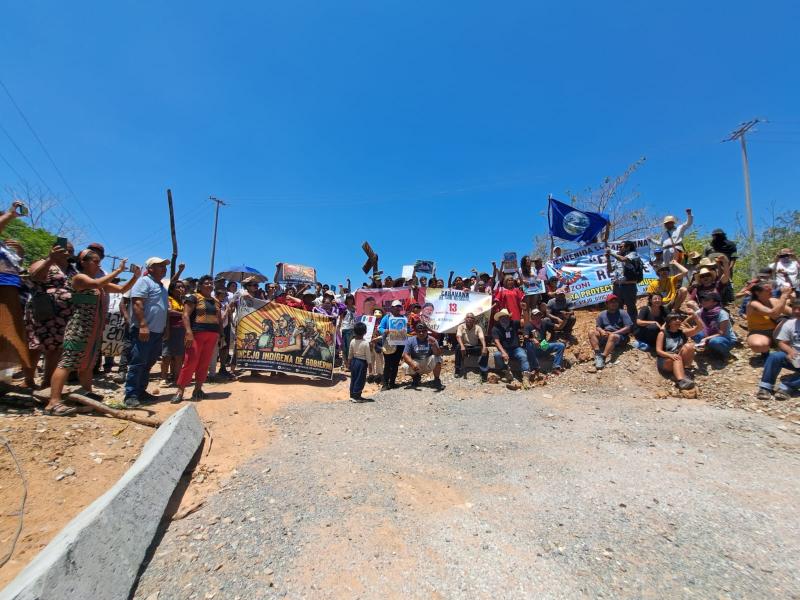
The Union of Indigenous Communities of the Northern Zone of the Isthmus (UCIZONI) said that the eviction was made a day after the members of the El Sur Resiste caravan, organized by the National Indigenous Congress and made up of civil and campesino organizations that oppose the dispossession and pollution of their communities caused by large megaprojects, visited the camp.
The UCIZONI said that in the operation six indigenous people were arrested: María Magdalena Martínez Isabel, Fernando Hernández Gómez, Adela Severo Teodoro, Esperanza Martínez Isabel, Elizabeth Martínez Isabel and Eliodoro Martínez Isabel.
The state government announced, at 20 hours this Friday, that the six arrested residents were presented at the State Attorney General’s Office, but did not report of what crime they were being accused.
The Secretary General of Government, Jesús Romero López, said that the protest is being carried out by “a small group that opposes the works, while the majority of the community has endorsed them.”
However, the same community members in the area agreed, during an urgent meeting, to reinstate the sit-in in the community of Puente Malatengo, in San Juan Guichicovi.
Sailors arrived at the place who, according to the demonstrators, intimidated them.
This is the second time that police and Navy forces have withdrawn the “Tierra y Libertad” camp. The first time occurred in the early hours of March 24, when, together with a group of armed civilians, they removed machinery held by the indigenous Mixes, leaving two villagers injured; However, the protest was restarted.
CNI and EZLN demand release of six detained Mixes

The National Indigenous Congress (CNI) and the Zapatista National Liberation Army (EZLN, Ejército Zapatista de Liberación Nacional) demanded the release of six Mixe residents detained by federal and state agents during the eviction of the “Tierra y Libertad” camp.
In a statement they denounced: “with rage, the violent attack” against those participating in the camp. They added that “it is clear to us, once again, that the current governments are at the service of large transnational corporations and militarization, patriarchal violence and repression are the path they have chosen to face the struggle and resistance of our peoples to the Interoceanic Corridor and the Maya Train, to dispossession and the capitalist war. “
Harassment in Veracruz
Meanwhile tanto, indigenous and campesino organizations of Veracruz denounced the armed forces’ constant persecution of the communities in order to protect federal megaprojects and they condemned the eviction in Oaxaca.
Members of the El Sur Resiste caravan and organizations of the Sierra de Santa Marta closed the Trans-Isthmus federal highway, in the municipality of Oteapan, in solidarity with the indigenous people of the Oaxacan Isthmus.

Originally Published in Spanish by La Jornada, Saturday, April 29, 2023, https://www.jornada.com.mx/2023/04/29/estados/024n1est and Re-Published with English interpretation by the Chiapas Support Committee
Day 3 – El Sur Resiste caravan joins protest against the Interoceanic Corridor

On the third day of the tour, the arrival was with the compañeros of UCIZONI (Union of Indigenous Communities of the Northern Zone of the Isthmus), who the night before provided a place to spend the night and take food at the Tierra Bonita agroecological center. In the morning the reception was by commissions of the more than 32 Mixe communities that maintain the “Land and Liberty” sit-in, in Mogoñe Viejo, which celebrates 60 days of resistance against the imposition of the interoceanic corridor.
The protest, or occupation, blocks the modernization work of the railroad that aims to connect with the Maya Train and with an entire railway network that would connect Canada, the United States and Mexico. For defending their territory, they have faced criminalization, repression and a strong smear campaign by the Federal Government for hindering one of the flagship projects of the AMLO government and that in 2019 presented this megaproject through a letter to Donald Trump to attract US investment and support.
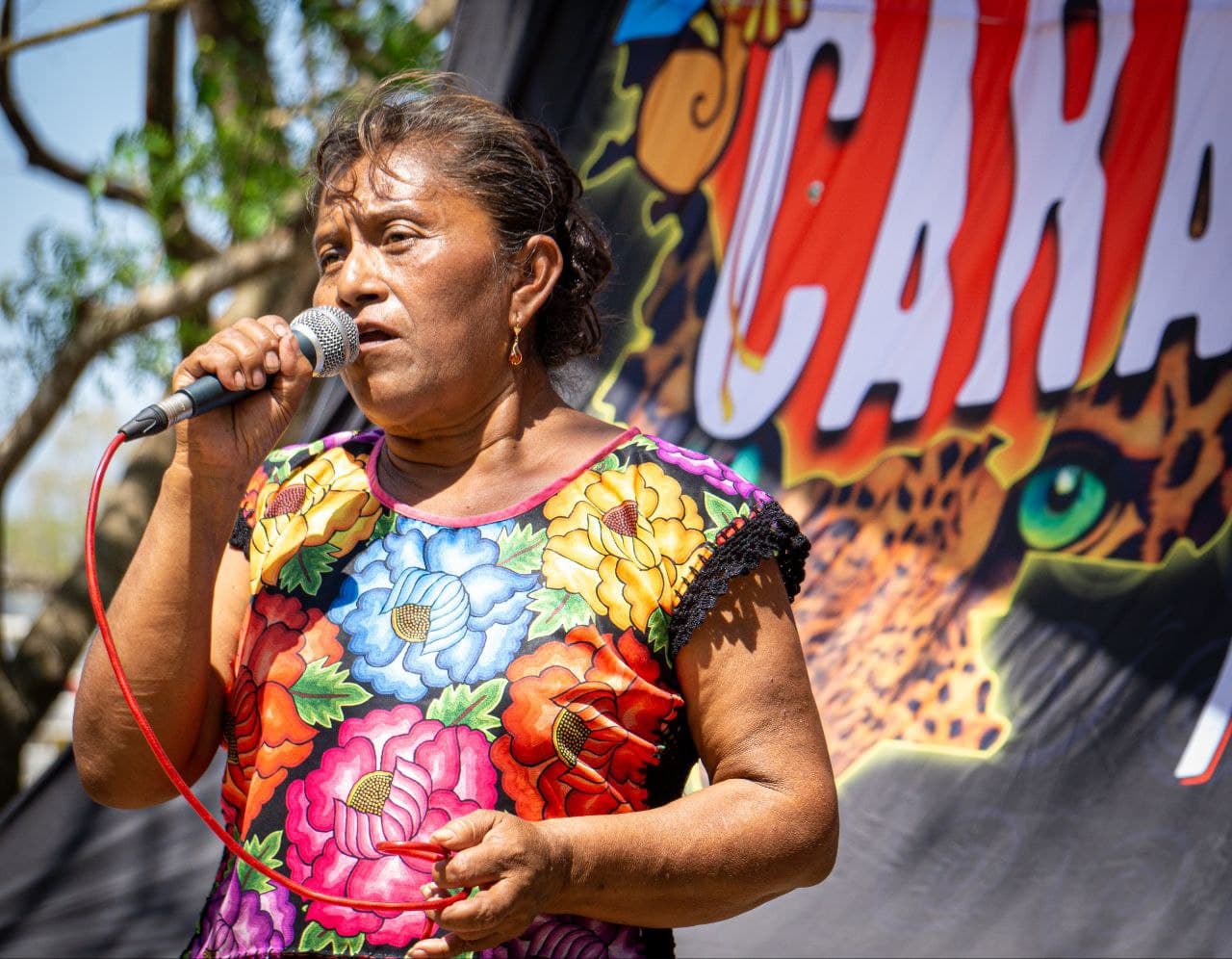
In addition to the formal attacks by the armed forces of the government, military, national guard and navy, they have also had to resist the criminal violence of drug trafficking groups. They denounced the repressive actions committed by the criminal group headed by Tacho Canasta against community members of Santa Cruz Tagolaba and the repression against activists and local authorities of Ixhuatan. This is part of a strategy that is used throughout the country to dismantle territorial defense.
Given this, they emphasize the need to weave networks of solidarity, national and international support in the defense of nature, with the communities that defend it and to confront the state discourse, position the word of the peoples claiming their self-determination.
The land belongs to those who work it, to those who defend it, to those who inhabit it, to those who step on it, to those who love it and to those who defend it. That’s why international rights recognize the right of Indigenous Peoples to self-determination, and this right implies deciding what to do in the territories they inhabit.

The compañero Carlos Beas recalled how the trans-isthmus train emerged, in 1899: the military dictatorship of Porfirio Díaz handed over the concession of the project to the English company Pearsons and Son Co. The railroad was inaugurated in 1907, but the project lost importance when the Panama Canal came into operation. However, this interventionist project and neoliberal model was again projected for its realization in different administrations such as that of Salinas and Fox. It should be noted that Carlos Beas has been the target of threats by organized crime groups, which harass ejido authorities and community members who participate in the community organization process.
López Obrador’s train project proposes a macro-regional dispossession; it is only to build the roads, there is a whole plan of dispossession for the Isthmus area: gas and oil pipelines, refineries, maquiladoras, mines and 10 industrial parks. López Obrador is managing to materialize the greatest dream of all neoliberals, and the Indigenous Peoples, like the 32 towns that make up the northern part of the Isthmus, have been his greatest nightmare.
“From June 2019 to March 2023, we have counted around 69 mobilizations of peoples to prevent the progress of the work and the damages from these projects. On February 3, 2023, 3 communities were mobilized together: Palomares, Mobilización, and Sabirera. The Navy was present in the three mobilizations, trying to intimidate. That’s the response of the 4T to our demands.”
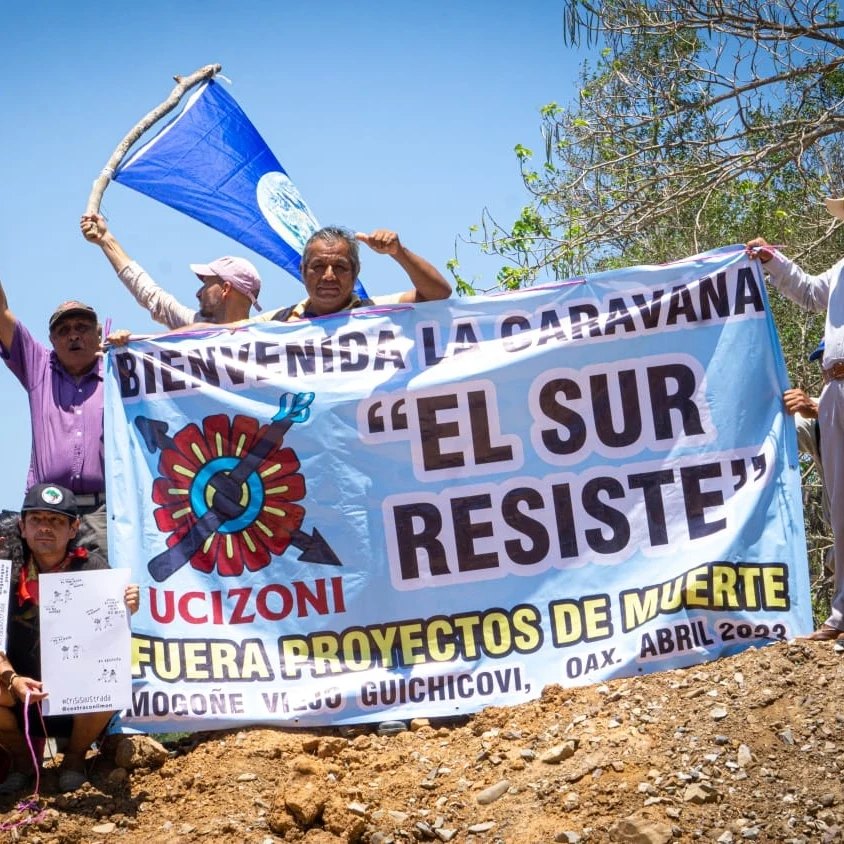
The denunciation of the UCIZONI compañeros continued mentioning the consultations and the refusal to hand over information. People detailed that federal authorities have not given enough information about the project, nor the environmental impact sample. There is no information in the Mixe or Zoque language, the languages most spoken by the inhabitants. The division of communities through selective government projects and handouts: the inhabitants of this region mentioned the Sembrando Vida project and other programs of the 4T that creates a patronage relationship between some inhabitants and the federal and state governments in other areas of the Isthmus. The situation is repeated in the eastern part of the region, where two murders of activists and community defenders are identified. The villagers also detail that people from the federal and state governments have pressured traditional authorities of the ejidos to accept large sums of money in exchange for ceding land rights; The sums have risen to one million pesos, a figure that is insignificant for companies. The investment that López Obrador announced in 2018 for the Isthmus of Tehuantepec Development Plan alone was 8 billion pesos. However, the question is: Where do those 8 billion pesos go? Where are the billions of pesos used for other projects such as wind farms and gas pipelines?
At the end of the sharing, a march was made from the sit-in to the highway to resume the march of the caravan and continue towards Veracruz.

During the day, they commemorated the life and struggle of Betty Cariño and Jyri Yaakkola, who were killed on April 27, 13 years ago, in a caravan in support of the autonomous municipality of San Juan Copala, Oaxaca. The political organization MULT ambushed the caravan and has displaced and killed in the Triqui region for many years in order to secure political control as well as the municipal budget. The four probable perpetrators were released through a pact between that organization and the Mexican government. So, justice for Betty and Jyri is demanded 13 years after this terrible date.
Originally Published in Spanish by El Sur Resiste, Friday, April 28, 2023, https://www.elsurresiste.org/es/posts/dia-3-planton-tierra-y-libertad-guichicovi-oaxaca-la-caravana-se-suma-al-apoyo-del-planton and Republished with English translation by the Chiapas Support Committee
 Chiapas Support Committee