Chiapas Support Committee
Home of the Compañero Manuel blog on zapatistas & mexico
Juan Villoro: Mexico is a gigantic necropolis after 10 years of the drug war
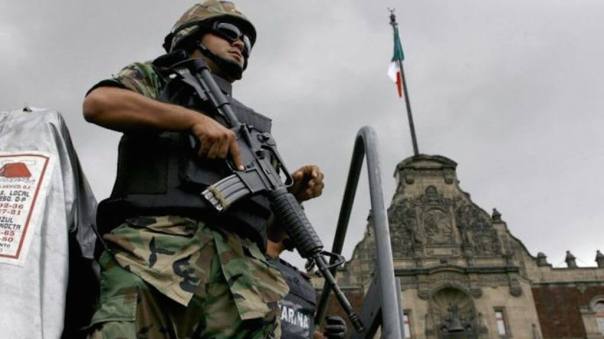
Mexican soldiers. Photo: Getty images.
By: Juan Paullier / BBC Mundo
December 19, 2016
Juan Villoro doesn’t hesitate. Witch hunts, great irresponsibility, and total failure.
Upon completing 10 years last December 11 from the start of the so-called War against Drug Trafficking in Mexico, the writer can only find dark words to define what this disastrous period has meant for the country.
There’s not even clarity about the impact in numbers. The dead as a consequence of this conflict could be around 150,000, the disappeared almost 30,000.
From religious cartels to thousands of displaced: 5 collateral effects of the War on Drugs in Mexico
“Mexico,” Villoro tells BBC Mundo in an interview, “has become a gigantic necropolis.”
The writer has no doubt about the negative result of the strategy of fighting the cartels that then president Felipe Calderón started in 2006.
“The State has lost total sovereignty, social inequality has increased, and the consumption of drugs has not gone down. It has then been a total failure because it has been understood that the only solution for fighting the problem of drug trafficking is military and the only thing that has come, it seems to me, is the proof that each bullet is a lost bullet,” he assures. Villoro, 60, admits that back then it was impossible to know what the president’s decision was going to imply for the country.
“None of us calculated the dimension that it was going to reach,” he explains, “the bloodbath in which we were going to insert ourselves because of the immense irresponsibility of President Felipe Calderón, who did not know completely the enemy that he was going to confront, and had no strategy in that regard.”
How and when did Mexico become so ferocious?
And in spite of the fact that the governmental focus has not yielded results, there is no sign from the group in power that it is looking for an alternative.
“The military strategy has been a disaster because there has not been a withdrawal of the violence, there has not been a decrease in the trafficking of drugs and it (the military strategy) has only contributed to accentuating the blood bath. There isn’t any evidence from a practical point of view that might endorse this strategy. If it hasn’t fulfilled its purpose, it’s time to change the focus, but that hasn’t been done.”
Although when Enrique Peña Nieto arrived in the presidency four years ago the discourse was different in the beginning; in practical terms and on the ground the situation has not changed.
“There were encouraging signs in the sense that he said that drug trafficking ought not be focused on as a national security problem but as one of public health,” Villoro asserts about the arrival of Peña Nieto, “(but) sufficient mechanisms were not created to be able to modify the strategy.”
Then followed a militarist inertia, he comments in the interview with the BBC, and he recognizes that the social reforms of this government stimulated illusion but were failing one by one and that the president lost credibility because of the Ayotzinapa case and the corruption scandals.
Some cry, others throw parties, others take “selfies”: it’s the harsh encounter of the families with the bone fragments of their disappeared family members.
One doesn’t have to take care of the bad ones, but rather of those that seem good
Villoro emphasizes a central moment of these ten years upon remembering Calderón’s statement about the existence of 7.5 million ninis in the country; in other words, youths that don’t work or study.
“Curiously, the very same president that gave that statistic didn’t do anything to confront the problem,” he says. “Evidently that kind of youth are the perfect culture for drug trafficking; they don’t become gunmen because they have a demoniacal calling. The best rational sensible offer that they face is that of entering drug trafficking.”
It’s the existence in the background of a more complex social problem that has not been attacked and that is not solved with soldiers in the streets attempting to capture drug cartel leaders. And it’s not just about complementing and diversifying a military strategy.
“As we could see in the Ayotzinapa case,” Villoro asserts, “the drug traffickers and the authorities are completely colluded (…) then attacking the drug traffickers means investigating the government.”
That is where one of the greatest challenges is found at the time of fighting the situation. And to introduce the theme remembers a sentence from the Mexican writer Elmer Mendoza: “One must not take care of the bad ones, but rather of those that seem good.”
By having too many interests at play, what’s lacking, he considers, is the political will to confront the problem.
Those who “seek to maintain an honorable facade and serve as a contact or as an associate with drug trafficking: those are the people that have a lot to lose if it becomes known that they have contact with organized crime, therefore they are the ones that most threaten the journalists, the ones that are in charge of protecting an apparently institutional society from organized crime.”
The zones of silence in the war on drugs in Mexico
“All societies of the world have corruption and all have a zone where the illicit becomes apparently licit (…) but the problem in Mexico is that this has reached an enormous scale, so then the range of impresarios, militaries, police and politicians colluded with organized crime is enormous, and then it’s very difficult to fight it and this is the sector that is the most dangerous for whoever tries to do it.”
And if here the magnitude of the phenomenon reached unimaginable heights in part it’s because of having the United States on the other side of the border.
“It’s important to understand that we are neighbors of the country that consumes the most drugs in the world and that sells the most arms in the world… that defines much of the Mexican situation.”
What Villoro doesn’t find much understanding of is the brutality of the violence.
“In some way the executioner feels more protected with this extreme annihilation,” he says, “but it’s a difficult phenomenon to explain and there would be nothing more grave than that this would begin to seem normal to us,” he considers.
Being an optimist belongs to the dissidence
Villoro emphasizes the need to set pessimism aside despite the fact that the atmosphere doesn’t help to see things another way.
“Optimism is a big challenge and is a radicalness. Being an optimist today belongs to the dissidence, belongs to the rebel (…) it would seem that there aren’t many possibilities to be optimistic but I believe that it’s worth it to think that things can be different,” he asserts.
He takes advantage of the issue of optimism to explain that Mexicans should not become resigned to having the country that they have today and he adds that Mexico, its reality, is schizophrenic.
]We’re talking about a rich country, despite the fact that almost half the population is poor, the tourism increases, the industries grow and there is a creative cultural atmosphere framed within a nation of “two speeds.”
And he illustrates this divergence with an example: the city of Guadalajara is the scene every year of the most important Spanish language book fair and at the same time he remembers that cadavers were found outside of that very same event.
He considers the roadmap that includes the State taking control again of the zones from which it has withdrawn and the drug traffickers acting at their own pace, as well as the legalization of some drugs.
“In a country where the State does not impart justice, it offers no labor options, guaranties no security, the drug trafficker is the one that by substitution fulfills those tasks and that is what is grave. There are of course ways of reclaiming the State’s presence, that is undeniable, it’s difficult but it can be done.”
And in that plan that he proposes he also warns of the need to integrate the society and that a part of it will be shaken by a dangerous indifference towards the horror that crosses the country.
Although the authorities have more responsibilities, he remembers a comment of the writer Cristina Rivera Garza about the people that practice a sort of “militant indifference, an apathy as a way of life so as not to assume the responsibility for doing something.”
“There is everything so that we are indignant and so that we take action, but at the same time it’s always more comfortable to do nothing. Then there is an apathy cultivated by broad sectors of the population and there are also sectors of the population dedicated to fomenting that apathy,” he points out.
“Many times the indignation stays in a tweet.(…) If we are going to change the world in that often underrated space that is reality, one must pass from criticism to transformation,” he thinks.
Villoro considers that if these ten years of the drug war have left any lesson it’s that this is the path that must be left behind.
“The only pedagogy has been that of error, we know that it should not be done, at least not in this way, and it’s the only good thing that we can get from these years”.
———————————————————————
Originally Published in Spanish by Desinformemonos
Monday, December 19, 2016
Re-Published with English interpretation by the Chiapas Support Committee
With the Zapatistas: Community, Solidarity & Love across Borders
December 2016
Dear Friends & Supporters of the Chiapas Support Committee:
We are asking you to join us in 2017 to continue supporting our work of education on Indigenous struggles in Mexico and organizing solidarity with the Zapatistas who continue building autonomous community and powerful connections for justice and rights. Click here to make your contribution!
Your support is critical to help us take on the emerging political era that promises difficult challenges to our communities.
The results of the U.S elections have had a devastating impact on many of our communities. The next four years of a Trump presidency promise greater attacks on civil rights, reproductive rights, environmental protections and cutback of social services for working people, especially our most vulnerable communities.
In 2016, which marked the 33rd year anniversary of the founding of the EZLN, members of the Chiapas Support Committee have spent time reflecting on the strengths of the Zapatista movement and how we in the U.S. can learn those lessons and their meaning for our daily lives here during this moment.
Two Zapatista practices we can strive for in our communities, both of which are grounded in principles of socially just community-making, are the commitment to standing up together to protect and support each other without being divisive, and to embody and practice loving each other to humanize each other’s experiences.
Community, solidarity and love
The Zapatista’s practice of community building has reinforced a powerful grassroots movement that has grown beyond Zapatista communities. These communities live in solidarity, resisting the extractive capitalist economic models that dehumanize and exploit us, preventing us from being more united at this critical moment.
Recognizing this need, the EZLN recently announced their decision with the Congreso Nacional Indígena (CNI, National Indigenous Congress) to carry out a consultation with all Indigenous peoples and their communities in Mexico to find out if they support forming an Indigenous government council and to run an indigenous woman as their presidential candidate in the 2018 elections.
The CNI-EZLN’s bold decision, taken at the CNI’s fifth congress held during October in Chiapas, sent shock waves throughout the Mexican political system, provoking racist anti-indigenous vitriol and raising the challenge to the wider social justice movements of how to struggle against the system itself in new ways.
The CNI-EZLN proposal is about lifting up the dire situation and oppression being imposed by the Mexican government and neoliberal capitalism on Indigenous people.
The Zapatistas stated that this decision represents their work to unite all Indigenous peoples and uplift Indigenous struggles for justice, autonomy and land, while exposing the ferocious Mexican governmental repression directed against Indigenous people and civil society.
Trumpocracy vs. Community
In the U.S, we are on the precipice of political crisis, fueled by the election of Donald Trump to the U.S. presidency.
Trump represents a sharp right turn promising to accelerate the neoliberal project of privatization and cutback of public services, drastic deregulation and re-regulation of labor, environmental and social protections, the transfer of investments, services and jobs to regions in the U.S. and abroad that will allow capitalists ever greater profits.
The election of Trump has triggered a wave of racist attacks against Muslims, Mexicans and other Latinos and police abuse of Black lives that continues to escalate.
Trump has promised draconian immigration round-ups and deportations; renegotiating NAFTA, the “free” trade pact between Canada, Mexico and the U.S., to give “American” workers and capitalists a better deal. To make good on these attacks, Trump has been nominating billionaires, racists and neoliberal ideologues to his cabinet and inner circle, a Trumpocracy based on white supremacy, an authoritarian neoliberal project and gutting the remaining social protections.
Trump’s agenda spells disaster for U.S. and Mexican workers and a deepening political and economic crisis especially in Mexico, which is still reeling from the narco-wars that have caused the deaths, disappearances and displacement of hundreds of thousands of Mexicans.
¡Show community, solidarity & love to the Zapatistas!
We must also prepare and change to take on this potentially devastating political storm. Our alternative is to build communities rooted in justice, solidarity and love that will defend and embrace its members and provide a space for dreaming a different world and resisting the onslaught that built up and created the emerging Trump regime.
In 2016, the Chiapas Support Committee:
- Sent economic support for the construction of dormitories for secondary (middle) school students in the La Garrucha zone
- Convened in July a parallel community-based cultural gathering, CompArte, bringing together poets, rappers, painters and other artists to share their work and words at the same time that the Zapatistas held CompArte in Mexico
- Celebrated the 33rd anniversary of the founding of the EZLN on November 17, hosting a key speaker sharing the struggles and vision of the water protectors at Standing Rock and showed a film to discuss the interconnections of struggles being led by Indigenous and non-indigenous movements and communities
- Hosted a speaker direct from Chiapas in December to share updates on Indigenous struggles for autonomy, land and other rights; and
- Continued publishing a print newsletter, a Facebook page and the Compañero Manuel blog, with thousands of readers, sharing information, updates and news from Mexico and the Zapatistas.
- You can make your contribution by clicking here.
In the midst of this period of political transition, turmoil and uncertainty, members of the Chiapas Support Committee believe that our movements for justice (rooted in Indigenous people’s struggles, communities of color, migrant workers and working people) remained firmly rooted in a solidarity that links struggles and communities across issues and borders.
Our commitment is to continue building solidarity with Indigenous struggles everywhere and strengthen our relations and support for the Zapatista communities while supporting and taking part in the struggles in our cities and neighborhoods for a more just and humane society.
The members of the Chiapas Support Committee are asking you to make a generous donation to continue strengthening the ties between our communities and the Zapatistas. Your contribution will go towards creating a more powerful grassroots justice and solidarity movement that is connected to key struggles and a deeply rooted movement for justice without borders.
Your donation will support the building of the Zapatista educational system, which strives to develop and include the pedagogical tools needed to deepen their vision of indigenous self-determination and liberation, anchored in their revolutionary principles.
Strengthen Community, Build Resistance in 2017!
The Chiapas Support Committee became a member of the Omni Commons (Omni) in Oakland and moved into a shared office space. The Omni is a thriving community of collectives dedicated to social justice that just purchased 22,000 square feet of space for community events and organizing.
Becoming a member of the Omni Commons has created more opportunities for the Chiapas Support Committee to bring you events like CompArte, along with films, educational workshops and guest speakers from Spain, Mexico and the United States.
In 2017 we hope to host more film nights showcasing media arts work from Mexico that has to be translated and subtitled. Your donation will help to make this possible. CSC is also planning to make CompArte an annual community justice and cultural gathering, as well as a big Dance Party on January 28th to fundraise for education projects in Zapatista communities.
The Chiapas Support Committee is asking you to make a generous donation to support the Zapatistas’ work to build autonomous communities in Chiapas, as well as to help support the education and organizing work we would like to launch in 2017. All donations are tax deductible if you itemize; we really appreciate your solidarity in supporting our all-volunteer collective.
For your convenience, you can make your contribution via PayPal by the going to our new website https://chiapas-support.org/home/donate/ or you can send a check payable to Chiapas Support Committee to P O Box 3421, Oakland, CA 94609.
We are also registered with Amazon Smile and The Network for Good.
We thank you for your continued interest in and support for the peoples of Chiapas and assure you that your support makes a critical difference in the lives of many and that we and the Zapatista communities will thank you from the bottom of our hearts.
For community, solidarity & love!
The Chiapas Support Committee Board
José Plascencia, Chair
Alicia Bravo
Francisco Díaz
Carolina Dutton
Todd Davies
Arnoldo García
Laura Rivas-Andrade
Mary Ann Tenuto-Sánchez
The Standoff at Standing Rock: Reflections from a White Ally

Tents and tepees at Oceti Sakowin (seven council fires) Camp with Flag Road in the background. Photo: Todd Davies, November 22, 2016.
By: Todd Davies
For background information, please go to OcetiSakowinCamp.org and StandingRock.org.
[NOTE: This post appears as an article in the December 2016 issue of Chiapas Update, and was written on December 6, 2016.]
As I write this, the Army Corps of Engineers (CoE) has just denied an easement for building the Dakota Access Pipeline (DAPL) under the Oahe reservoir, next to un-ceded treaty lands of the Standing Rock Sioux Tribe. CoE’s promise to do an Environmental Impact Statement came eight months after the establishment of the Camp of the Sacred Stone, where the Cannonball and Missouri Rivers meet. Sacred Stone and its extension camps (Rosebud, Oceti Sakowin, and Red Warrior) have grown from a handful of Native people last spring to thousands of inhabitants. CoE’s failure to do a proper environmental review initially, as well as the racism that led the pipeline to be routed through Native treaty lands, brought indigenous Americans and their allies together at Standing Rock. The CoE’s reversal feels like a victory, but the battle against DAPL is not over.
Energy Transfer Partners (ETP) built almost the entire pipeline in six months this year. But ETP lacked legal authority to complete the full pipeline, and now finds itself on what may be the losing end of a $3.8B gamble. Contracts with investors expire on January 1st, and solidarity campaigns are now focused on banks such as Wells Fargo, urging them to pull their investments and leave the pipeline in the ground, as a stranded asset.
Like many Bay Area activists, I have followed Standing Rock from afar, attending local events such as the November 15 Day of Action at CoE offices. And like quite a few from our community, I have also been fortunate to visit Standing Rock as a guest. My visit from Nov. 21-24 was much briefer than I wanted, but was all the time I could spare between work and personal commitments. After reading and hearing about life in the camps, I resolved to make up for the brevity of my visit by being of use while there. At the orientation meeting I attended on my first morning, in Oceti Sakowin Camp. I wrote down the other guidelines (in addition to “Be of use”) taught to new arrivals: Indigenous-centered, Building a new legacy, and Bring it home.
I flew into Bismarck, which is usually an hour’s drive from the camps, but took longer since police closed the main road to protect the drillers. I bought firewood at a local store in Bismarck, and donated the logs when I entered Oceti Sakowin Camp on the Monday of my visit. As many others who have traveled to Standing Rock have said, the spiritual feeling one gets from the water protectors is immediate and palpable. I arrived just after the violent night of November 20, when militarized police attacked water protectors in freezing temperatures with water fire, solid/lethal projectiles, and chemical weapons. Many in the camp had suffered wounds and hypothermia, including one woman whose retina was severed, and another whose arm was mutilated. I was instantly in the company of others, mostly non-Native allies, who had been involved in direct action movements in the U.S. in recent decades. But I was also aware that this was indigenous land, and that despite my many stays in Zapatista territory in Mexico, I had never been in the midst of an indigenous struggle of this magnitude in the U.S.
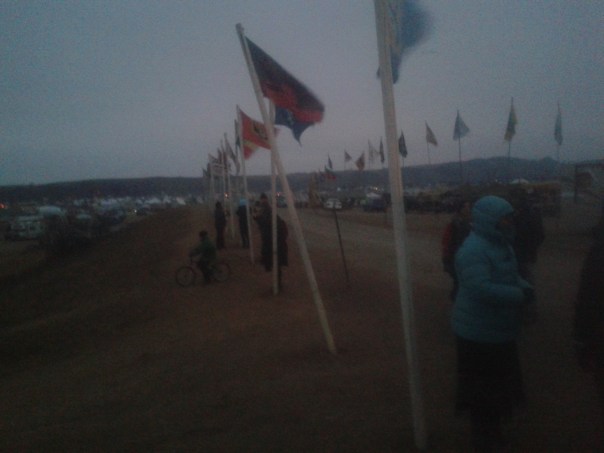
Water protectors are bundled up as the wind blows on Flag Road in the Oceti Sakowin Camp, North Dakota, November 22, 2016.
Rather than pitching my tent in the freezing air of North Dakota, I rented a room at the Standing Rock Sioux Tribe’s Prairie Knights casino. When I contacted the camp before my trip, I said I would be staying at the hotel, and that I would be happy to welcome water protectors who needed showers or shelter during my stay. Sure enough, soon after I checked in, half a dozen young activists knocked on my door. They all showered and told me what they had been through early that morning, during perhaps the most brutal police attack on water protectors since the camps had gone up. These shower seekers had been on the “front line,” where the cops had barricaded the road at the end of Backwater Bridge, just north of Oceti Sakowin Camp. They showed me large welts and bruises on their arms, legs, and torsos that came from freezing high-speed water, rubber bullets, and beanbag projectiles. These activists had been at the camp for weeks. One of them told me he was willing to die to stop the pipeline. There was a lot of reflection, and some argument, about the details of the night – what a choice to confront police means for the movement and for one’s friends, how to understand the words of the Tribal elders, and why police were acting as they did.
On Tuesday, I went through the daily Nonviolent Direct Action training next to the Indigenous People’s Power Project (IP3) camp. I joined many new arrivals in receiving instructions from the Legal Collective and from Morton County public defenders. As an indigenous trainer led exercises in peacefully holding and moving through spaces, and regrouping amidst aggressive police role-players, a surveillance helicopter circled ominously overhead. A medic gave instructions on how to deal with mace, tear gas, and other chemical weapons.
Just before twilight, I was directed to a press conference at the Backwater Bridge, just across from where the police were building a new barricade. This was the closest I got to the front lines, because after that, the elders asked everyone to go back to the camp. “We are worried the police will attack us,” they said. An apparently white male accompanied by a woman argued with a young Native camp guard, saying he did not have to follow what the elders advised. “I live here!” the white man said, although he was clearly a guest. I filmed this with the guard’s permission (and with my press pass displayed). The white activist made a run toward the bridge as Native security ran after him.
As a new arrival who had been through an allies’ orientation, I had been asked to respect the Sioux leaders, and interpreted this to mean the Tribal Council members. But I gradually learned that Standing Rock has different voices of leadership, and while they all agree on the need to stop DAPL from being built under Lake Oahe, on other issues they often disagree. This is not surprising, given the vigorous political differences that exist in most communities, including my own. But it sometimes poses a dilemma for me as a colonial settler trying to be an ally to Native people. Whatever I do, or do not do, is a choice that supports some people more than others. If I look for an indigenous activist who shares my tactical viewpoint, I am likely to find one. But if, say, white allies do this collectively, then it seems we are enacting white dominance by proxy. If we only do what elected Tribal leaders command, on the other hand, we may sometimes fail to provide needed support for Tribe members who rightfully disagree with their leaders. If we act as foot soldiers for the Tribal Council, we may amplify its power to struggle against oppressive U.S. Government policies. But if we are free to do what we believe is right, and what more radical indigenous people do and advocate, we may be able to act in ways that are productive for the struggle, but for which the Tribal government cannot safely take responsibility. Or we might screw everything up.
In the aftermath of the CoE denying a permit for DAPL, we are seeing this dilemma play out. Tribal Chair Dave Archambault II has asked non-Sioux water protectors to leave. But the founder of the camps, LaDonna Brave Bull Allard, on whose land Sacred Stone was established, is saying this would be a mistake. I don’t know enough to say who is right.
I participated in two actions on the Wednesday of my visit, using my rented car to transport water protectors to a prayer ceremony at the police blockade on the northern side of the Route 1806 closure, and also to a caravan through downtown Bismarck. The trainings had been useful, but seeing exactly how our Native action leader organized the ceremony, and interacted with police amidst ceremonial drumming, deepened my appreciation for the prayerful approach that characterizes Standing Rock. Returning to camp late in the day, I listened to speakers at the Youth camp. One Native young person thanked those of us who could only come to the camp for a few days. All of us can contribute to protecting the water, she said, and more will come to take our places when we leave.
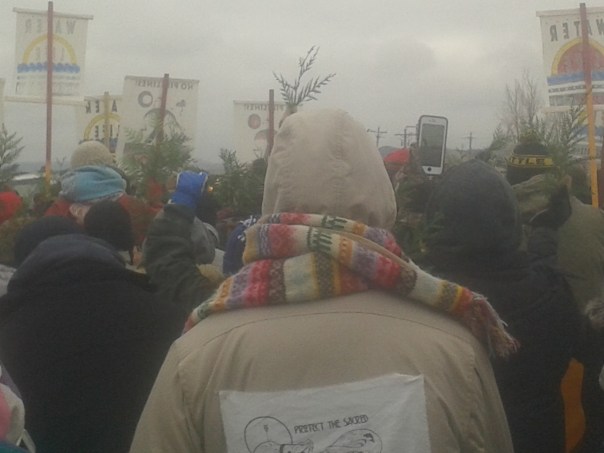
Standing Rock water protectors march peacefully toward police at the northern blockade of North Dakota Route 1806 along the Missouri River, on November 23, 2016.
I made my way to the Sacred Stone Camp across the Cannonball, where I had to go in order to make an offering from the Chiapas Support Committee to the Standing Rock Sioux Tribe. The atmosphere in this original camp was quiet but deliberate. The Sioux woman who took our gift described what is happening as a last stand. Standing Rock has lost so much, most visibly at that spot, where the joining of the rivers once created spirit rocks, but which was destroyed, and the Tribe’s lands flooded, when the dam was built. As darkness fell, I looked at the rivers and at the ugly, glaring lights that illuminate the path of the pipeline in the distance.
Snow was falling in Cannon Ball as I left on “Thanksgiving” morning. I met friends in Mandan for a holiday brunch, before heading to the airport. As we talked about the hostility directed at water protectors by many non-Native North Dakotans, and how many times I got told “Go home!” by angry white folks during my brief visit, I got a sympathetic look from one of my friends. The public hearings about the pipeline, he says, were held in Minot, Williston, and Bismarck – the mostly white centers of “oil country” in North Dakota, where the pipeline has public support. But no hearings were held where Standing Rock Sioux Tribe members live, where the Missouri was planned to be crossed, or downstream. Many non-Natives in North Dakota prefer a pipeline to the cargo trains that carry oil through cities and that often explode, he says. But, he notes, a pipeline is sure to leak in a really bad way that, especially when it is under ground, can continue for a long time.
This is exactly what the water protectors have said. A route for the pipeline that would have crossed the Missouri in mostly white areas around Bismarck was rejected, for the same reasons that the Sioux people do not want it near them. If it is too risky for white people, it is too risky for Native people. Amidst the complexities of ally-ship and leadership in this struggle, that basic point is as transparent as fresh water.
Update on “The Zapatistas and ConSciences for Humanity”
Update on the Gathering “The Zapatistas and ConSciences for Humanity.” Subcomandante Insurgente Moisés

ZAPATISTA NATIONAL LIBERATION ARMY
MEXICO
December 15, 2016
To the scientific community of Mexico and the world:
To the National and International Sixth:
We send you our greetings. We want to update you on the plans for the gathering “The Zapatistas and ConSciences for Humanity,” to be held at the CIDECI-UniTierra in San Cristóbal de las Casas, Chiapas, from December 25, 2016 through January 4, 2017.
- As of December 12, 2016, we have the confirmed participation of 82 scientists from the following countries: Germany, Canada, Chile, United States, Spain, Israel, Paraguay, United Kingdom, Uruguay, Brazil and Mexico (Baja California, Campeche, Mexico City, Mexico State, Jalisco, Morelos, Oaxaca, Puebla, Querétaro and San Luis Potosí).
- The areas in which they work are the following: Quantum Field Theory, Mathematics, Volcanology, Astrophysics, Astronomy, Cosmology, Nuclear Fusion, Genetics, Microbiology, Geophysics, Statistical Physics, Optics, Bioethics, Quantum Field Theory, Biophysics, Evolutionary Biology, Marine Biology, Molecular Biology, Biochemistry, Physiology and Biophysics of Excitable Cells, Solar Photochemistry, Genetic Mutation and Environmental Pollution, Genomics of Microorganisms, Origin and Evolution of Life, Complex Systems, Intelligent Systems Control, Energy Conservation, Food Science and Technology, Energy Science, Nutrition Science, Animal Behavior and Communication, Biodiversity Conservations, Palliative Care, Pediatrics, Behavioral and Conservation Ecology, Evolutionary Ecology of Microorganisms, Marine Ecology, Theoretical Ecology, Ecology and Agro-ecology, Renewable Energy, Energy Systems Engineering, Hydrology, Environmental Chemical Engineering, Chemical Engineering and Magnetic Separation of Minerals.
- Scientists and attendees may register on December 25, 2016. Activities will begin on December 26, at 10am, and will conclude on January 4, 2017, at 6pm. There will be an intermission on December 31, 2016 and January 1, 2017.
- The electronic address to register as a listener/observer is: conCIENCIAS@ezln.org.mx
- Two hundred Zapatista bases of support—women, men, children, and elders—of the languages Tzeltal, Tzotzil, Tojolabal, Chol, Zoque, Mame, and mestizo, will attend as students. The Zapatista students are the only ones who may direct questions to the scientists who present.
- The gathering will have general sessions, information sessions, and workshops.
That’s all for now.
From the mountains of the Mexican Southeast,
Subcomandante Insurgente Moisés
Mexico, December 2016
Trump and 21st Century fascism
By: William I. Robinson *

Piñatas of Donald Trump are popular in California.
Contrary to what is thought, Donald Trump is a member of the transnational capitalist class (TCC), since he has strong investments around the world and a very important part of his “populism” and anti-globalization discourse responded to political demagoguery and manipulation in performing the duties of the presidential election.
At the same time, this transnational capitalist class and Trump himself depend on the migrant labor for their accumulations of capital and don’t really seek to get rid of a population in labor peonage, due to their status as a migrant and not of citizen or “legal” resident. His sought-after plans for deportation, already reduced in number as president-elect, and his proposals for criminalization of immigrants on a larger scale seek, on the one hand, to convert the immigrant population into a scapegoat for the crisis and channeling the fear and action of the citizen working class (the majority white) against that scapegoat and not toward the elites and the system. On the other hand, the dominant groups have explored how to replace the current system of super- exploitation of migrant labor (based on lack of documentation) with a system of un migrant workers with visas; in other words, guest worker programs.
At the same time Trump seeks to intensify the pressures for lowering wages in the United States, for the purpose of making American labor “competitive” with foreign labor; in other words, with the cheap labor from other countries. The transnational leveling of wages downward is a general tendency of capitalist globalization that continues ongoing with Trump, this time with a discourse of “returning competitiveness” to the U.S. economy and “bringing jobs back” to the country.”
One must not overlook the dimension of Trump’s extreme racism, but rather analyze this dimension more in depth. The United States system and the dominant groups find themselves in a crisis of hegemony and legitimacy, and the racism and the search for scapegoats is a central element for challenging this crisis. At the same time, important sectors of the American white working class are experiencing a de-stabilization of their working conditions and living conditions, a downward mobility, “precariousness,” insecurity and very great uncertainty. This sector had historically certain privileges thanks to living in what’s considered the first world and because of “racial”-ethnic privileges with respect to Blacks, Latinos, etcetera. They are losing that privilege by gigantic steps versus capitalist globalization. Now the racism and the racist discourse from above channel that sector towards a racist and neofascist conscience.
Equally dangerous is Trump’s openly fascist and neofascist discourse, which has achieved “legitimizing” and unleashing the ultra-racist and fascist movements in United States civil society. In that direction I have been writing about the “fascism of the 21st Century” as a response to the grave and greater all the time crisis of global capitalism, and that it explains the turn towards the neofascist right in Europe, as much in the West as in the East; the resurgence of a neofascist right in Latin America; the turn towards neofascism in Turkey, Israel, Philippines, India and many other places. One key difference between the fascism of the 20th Century and that of the 21st Century is that now it’s about the fusion not of national capital with reactionary political power, but rather a fusion of transnational capital with that reactionary political power.
“Trumpism” represents an intensification of neoliberalism in the United States, together with a greater State role for subsidizing the transnational accumulation of capital in the face of stagnation. For example, Trump’s proposal to spend one trillion dollars on infrastructure, when we study it well, his objective in reality is to privatize that public infrastructure and transfer taxes of the workers to capital in the form of tax cuts to capital and subsidies for the construction of privatized public works. An epoch of changes is coming in the United States and in the whole world. I fear that we are on the edge of the inferno. There will surely be massive social explosions, but also a horrifying escalation of state and private repression.
The crisis in the spiral of global capitalism has arrived at a crossroads. Either there is a radical reform of the system (if not its overthrow) or there will be a brusque turn towards “21st Century fascism.” The failure of elite reformism and the lack of will of the transnational elite to challenge the depredation and rapaciousness of global capitalism have opened the way for an extreme right response to the crisis. “Trumpism” is the United States variant of the rise of a neofascist right facing crisis all over the world; Brexit, the resurgence of the European right; the vengeful return of the right in Latin America, Duterte in Philippines, etcetera. In the United States the treason of the liberal elite is as responsible for Trumpism as the extreme right forces that mobilized the white population around a program of racist, misogynist scapegoating based on the manipulation of fear and economic destabilization. Critically, the political class that has prevailed for the last three decades is more than bankrupt and has paved the way for the extreme right and eclipsed the language of the working and popular classes and of anti-capitalism. It contributes to derailing the revolts underway from below, pushes white workers to an “identity” founded on white nationalism and together with the neofascist right helps to organize them into what Fletcher names “a united white and misogynist front.”
* Professor of sociology at the University of California Santa Barbara and author of the book Latin America and global capitalism, a critical perspective of globalization (Baltimore, Johns Hopkins University Press, 2008).
———————————————————–
Originally published in Spanish by La Jornada
Sunday, December 4, 2016
http://www.jornada.unam.mx/2016/12/04/opinion/026a1mun
Re-Published with English interpretation by the Chiapas Support Committee
CNI-EZLN: Despite aggressions, the consultation continues
JOINT COMMUNIQUE BY THE NATIONAL INDIGENOUS CONGRESS AND
THE ZAPATISTA NATIONAL LIBERATION ARMY

Zapatista musicians
December 2, 2016.
TO THE PEOPLE OF MEXICO:
TO THE PEOPLES OF THE WORLD:
TO THE FREE MEDIA:
The steps taken by our peoples are great, wise steps when taken in collectivity, and the National Indigenous Congress turns with attentive ears to listen to each other, to the thoughts of we who are the word and the agreements of the 5th CNI. We continue in permanent assembly, traveling to all corners of our country, Mexico.
Our permanent assembly arises from and convenes among the peoples, nations, and tribes of all the languages spoken by the National Indigenous Congress; in large and small assemblies; in meetings of communal councils, in deep reflections by dispersed families; in regional forums and ceremonial spaces. In our collective words, we continue to conclude that it is the time of our peoples, time for the earth to tremble at its core.
The fears of the powerful, the extractive companies, the military, and the narco-paramilitaries are so great that our consultation is being attacked and harassed in the places where our peoples are meeting to discuss and decide the steps to take as the CNI. For that reason, we denounce the following:
– In the indigenous Nahua community of Santa María Ostula, Michoacán, there is intensified narco-paramilitary harassment by the Caballeros Templarios [Knights Templar] cartel, which threatened, on a paper signed on November 19, 2016—the same date that a regional assembly on the coast of Michoacán was discussing the resolutions from the first stage of the 5th CNI—to undertake a “cleansing” of those participating in mobilizations alongside the community police.
– As agreed upon in the assembly of the 5th CNI in October 2016, our compañeros have traveled to different geographies of the country where Native peoples have requested dialogue with delegates of other peoples with respect to our political proposal. These compañeros have been victims of aggressions and harassment by criminal gangs or unknown people, including the burning of homes in their communities and aggressions by vehicles trying to push them off the roads they must travel.
– While foreign companies attempt to take control of 12 oil wells in Zoque territory in Northern Chiapas, this past November 23, 2016, a group of armed men pretending to be government-sponsored teachers, and with the consent of the Assistant Secretary of Federal Education in Chiapas, Eduardo Campos Martínez and the boss, Delfino Alegría García, kidnapped a group of indigenous professors from the National Coordination of Education Workers (CNTE) in the northern zone of Chiapas. They also attacked them with high-powered weapons outside the office of the Secretary of Education in the municipality of Ixtacomitán, Chiapas. The sneak attack claimed the life of Zoque teacher Roberto Díaz Aguilar, originally from Chapultenango, Chiapas, and injured three others.
– The teacher Irineo Salmerón Dircio, Coordinator of the House of Justice in San Luis Acatlán and member of the Regional Coordination of Community Authorities (CRAC-PC), was kidnapped/disappeared by an armed group in the municipality of Tixtla, Guerrero. Two days later his lifeless body was found in the municipality of Chilapa, Guerrero, just a few days after at least 15 communities from the Emiliano Zapata Indigenous and Popular Council of Guerrero had held an assembly in the same municipality as part of the consultation we are currently carrying out.
– From the collective heart of the Native peoples of the National Indigenous Congress, we pronounce our absolute respect for the territory of the Sioux people, in Standing Rock, North Dakota, where more than 200 tribes are organizing to stop the plunder the capitalists are trying to impose through oil pipelines that destroy water sources and ceremonial sites. We condemn the brutal repression these tribes were subject to this past November 20, and the repression planned against them with the announcement of an ultimatum to vacate their lands. If we Native peoples had ever responded to the ultimatums of the powerful, we would have ceased to exist centuries ago. To the Sioux People we send a brotherly embrace and we reiterate that they are not alone, that their pain and rage are ours, also. We call on the Native peoples of the United States and Mexico, on the free media, and on civil society to strengthen their solidarity with this historic struggle.
We send a greeting of solidarity to the compañer@s of the Chanti Ollin community, adherents of the Sixth Declaration of the Lacandón Jungle, who were violently evicted—in the middle of the night on November 22, 2016—from the building where they promote culture, art, and the alternatives necessary for a new world. We repudiate the repressive, sellout policies represented by the bad government of Mexico City.
We salute the mobilizations held by the Committee in Defense of Indigenous Rights (CODEDI) from the coastal region of Oaxaca against the repressive policies of the bad governments who, for lack of any valid reason, use criminalization as their only recourse to impose 11 hydroelectric projects in the coastal region of Oaxaca, including the Multi-Use Hydraulic Exploitation Project Paso de la Reyna.
Likewise, the peoples, nations, and tribes of the CNI express our profound respect for and solidarity with the Cuban people, who have shown the world that through dignity we can reconstruct the fabric unraveled by capitalism. We know that their resistance and rebellion will continue shining and concretizing hope.
Attentively,
DECEMBER 2016
FOR THE FULL RECONSTITUTION OF OUR PEOPLES
NEVER AGAIN A MEXICO WITHOUT US
NATIONAL INDIGENOUS CONGRESS
ZAPATISTA NATIONAL LIBERATION ARMY
En español: http://enlacezapatista.ezln.org.mx/2016/12/02/a-pesar-de-las-agresiones-la-consulta-va/
Chiapas: Modevite will consult their communities about EZLN proposal
THEY DEMAND RESPECT FOR SELF-DETERMINATION OVER THEIR TERRITORY and AGREE TO CONSTRUCT COMMUNITY GOVERNMENTS

Movement for the Defense of Life and Territory Photo: Chiapas Paralelo
By: Angeles Mariscal
In this state of the Mexican Southeast, the mining industry has been granted concessions to almost 20 percent of the territory, and there are more than 30 governmental authorizations to use tributary rivers in the installation of mini-hydroelectric dams, five projects for constructing dams and an open solicitation for extracting hydrocarbons from 12 wells; the project to construct a gas pipeline is also in the works, and through the decree for creation of the las Special Economic Zones they granted eased tariffs so that corporations consolidate their businesses linked to the extractive industry.
This is the scenario that thousands of indigenous face in Chiapas; and it’s because of that that this November residents of the municipios of Salto de Agua, Tumbalá, Yajalón, Chilón, Ocosingo, Altamirano, Oxchuc, San Juan Cancúc, Tenejapa, Huixtán and San Cristóbal de las Casas left their communities to tour the region and demonstrate their rejection of these projects that threaten stability in their territory.
They are from the Tsotsil, Chol and Tseltal indigenous ethnicities, who make up part of the faithful of the Diocese of San Cristóbal de las Casas, grouped together in Pueblo Creyente (Believing People), and since four years ago have been members of the Movement for the Defense of Life and Territory (Movimiento por la Defensa de la Vida y el Territorio, Modevite).
On their 15-day tour, Modevite members met with more than 20,000 different indigenous peoples, with whom they dialogued about the common problems that cross through their territories.
“We have walked to listen to the problems of our communities and the risks that threaten our culture and our Mother Earth with mega-projects and super-highways. We walked to unite us in one single voice. We have been able to converse, reflect and dream as one people,” they explained in a joint pronouncement.
Mines, hydroelectric dams and wells on indigenous lands
“We are at a strategic place regarding the mega-projects. This territory is one of the objectives of extractivism,” they pointed out upon arriving in San Cristóbal de las Casas, in a plaza full of indigenous and mestizos.
There, in the plaza, they said that ac cording to the Secretary of Economy, in the last three six-year presidential terms 99 concessions for exploiting minerals that are found on 1.5 million hectares –almost 20 percent of Chiapas territory- have been delivered to corporate investors, the majority lands belonging to indigenous groups that would have to be displaced to make way for the mining industry.
They also said that the Federal Electricity Commission (CFE) has identified Chiapas as a state with great hydrology potential, and plans to construct 90 hydroelectric dams with different capacities. Four of those stand out that would directly affect indigenous territory: the Altamirano Dam on the Tzaconejá River; the Livingstone Dam on the Tzaconejá River; the Santo Domingo Rapids Dam (previously Huixtán I) on the Santo Domingo River; and the Santa Elena Dam (previously Huixtán II) on the Santo Domingo River, among others. They emphasized that investors have asked the Secretariat of the Environment and Natural Resources (Semarnat) for the installation of at least 32 “mini-hydroelectric” dams.
They also said that the perforation of 12 wells for the extraction of gas and oil has been projected for 2017 in the indigenous Zoque zone. This project will affect 845 square kilometers located in two areas within the municipios of Tecpatán, Francisco León, Ixtacomitán and Pichicalco.
Another risk to indigenous territories –they reminded- is the planting of genetically modified seeds (GMOs). From 2010 to the middle of 2016 the Monsanto Company planted genetically modified soy in 13 Chiapas municipios.
They call for strengthening community governments
The inhabitants of the zones where these extractive projects are located pointed out that accepting them would mean being displaced from their territory, and with that also losing their roots.
They started to organize four years ago and since then they have achieved suspending the construction of the San Cristóbal-Palenque Super-Highway. “Now we see that our fight is bigger; we have the job of defender our life, our culture and the commons that there are in our territory,” they underscored.
They said that throughout their tour through indigenous territory, there was agreement that not only must they denounce the affectation to their territory because of the extractivist projects, “but we must also care about the land.”
They said that if the federal, state and municipal governments support and promote the extractive industry, their option is to create community governments that respond to the interests of the indigenous peoples that are being affected.
Therefore, the indigenous agreed to add themselves to the proposal of the National Indigenous Congress (Congreso Nacional Indígena, CNI) and the Zapatista National Liberation Army (Ejército Zapatista de Liberación Nacional, EZLN), to consult with their communities about the decision to participate in the next national elections with an independent indigenous candidate.
“We share the same objective (as the CNI and EZLN), we believe that it’s necessary to strengthen the la voice of our indigenous peoples on the political agenda, and therefore we want to take this initiative to our communities and municipios. We can no longer work divided but rather it’s necessary to unite for our peoples, for our territories,” they said.
Modevite members announced that they would strengthen the initiative for constructing autonomous governments as a measure for conserving their territories and their culture. “It’s our right to decide the use of and destiny of our territory,” they said.
——————————————————————-
Originally Published in Spanish by Chiapas Paralelo
Thursday, December 1, 2016
Re-Published with English interpretation and edits by the Chiapas Support Committee
EZLN: a clarifying text

SCI Marcos before he died and became SCI Galeano. Photo: Vice
By: Magdalena Gómez
I dedicate this collaboration to the Cuban people and to Pablo González Casanova for the “Lessons of Fidel” and, his own. Very opportune the text “A story to try to understand,” [1] elaborated by sub Galeano and Subcomandante Insurgente Moisés, spokesperson and current head of the EZLN. Obliged reading for those who in good faith are interested in knowing and sharing the initiative underway, about which the National Indigenous Congress is consulting with indigenous peoples and communities. The detailed story about the gestation of the initiative gives an account of a political conviction of the EZLN that is certainly not the first time they put it into practice. We remember their historic decision in the dialogue with the federal government, of ceding the table to the country’s indigenous peoples so that they would be the ones that in the first instance would discuss the proposals on indigenous rights and culture in coordination with the indigenous commanders. The San Andrés Accords owe their relevance to that construction and unpublished collective debate.
The correct allegation about the more than evident fact that neither dreams nor nightmares fit into ballot boxes, for the effects of the subject initiative in consultation is a double edged sword, because, as is recognized, “there have been, there are, and there will be doubts and legitimate and rational questionings,” among them is rightly the one that proposes to go to an election when it (the election) is recognized as being meaningless.
Nevertheless, one must turn to that evaluation and the text that proposes it clearly: there is no other more convincing way of making the situation of the indigenous peoples visible than placing themself on the stage where the whole political class will see them in 2018. Very strong what they shared with the CNI upon presenting their proposal to them: “Our pain reaches fewer people all the time. Our deaths don’t echo like before. And it’s not that the people outside have become cynical or apathetic. It’s that the war we have suffer since a long time ago as Native peoples, now reaches them, it is now in their streets, in their houses, in their schools and in their workplaces. Our pains are now one more among many others. And, although the pain extends and becomes deeper, we are more alone than ever. Each time we’re going to be fewer. Soon the CNI won’t be able to meet because no one will be able to leave their territories, be it because of the cost, be it because of the bad government, be it because of the corporations, be it because of crime, be it because of a natural death or a bad death mala that it impedes you. In a while more we will only be talking among ourselves, already knowing what we’re going to say.”
Also very significant, for those who want to understand, the story about the meeting that the now-deceased Sup Marcos had 10 years ago with a northwest indigenous chief of the country’s northwest 10 years ago, when he (Marcos) was touring with the other campaign. The chief had previously received institutional governments. The chief told Marcos: “I know very well that they didn’t want you to meet with me, that they pressured you so that you would not be here. They also pressured me so that I would not receive you. I don’t know why you are here. I imagine that those who command you told you that you should see us and listen to us. I don’t know. But I’m going to tell you why I received you. I have received the governments. They have come from all the colors and sizes. They come and take their photo, they say a few words, they go away and they don’t come back. I have received them because my predecessors told me that my duty was to see that my people, my pueblo, would not die, that they would survive. I received them for that reason. I receive you because of that. I don’t believe that you b ring me ether advice or teachings, although it’s good that you don’t seek a photo and that you listen instead of talking. I received them because I think my people will survive a while longer that way and won’t die. So I receive you because I believe that something will be seen from what we are and that view, although only for a little time, will help my people survive.”
Upon the deceased Sub Marcos questioning whether he wasn’t worried that they would judge him receiving him, he answered: “Only my own people can judge me. If my people condemn me for what I have done and for what I do, that would mean that I wasn’t wrong. My people will have to have survived in order for them to condemn me. So that would mean that I have fulfilled my duty and I can show the dead that I have done so, although the living condemn me.”
Another of the document’s central messages is the clarification that it will not be the EZLN that participates in the election: “the CNI is who will decide if it participates or not with its own delegate, and, if so, it will have the support of Zapatismo.” It couldn’t be clearer. The decision of the peoples in the consultation is complex, because they rightly resist the enslavement of power, but also, like the indigenous chief of the northwest, they are supported in institutional mechanisms like survival strategy. They know that the community, individual and secret vote will be visible and they will be objects of multiple pressures. There is the task of the indigenous peoples we have accompanied and obviously we decided to assume it.
[1] Well, it turns out that the English translation of the recent EZLN communiqué entitled “A story to try to understand” is too long to post on this blog. The English translation can be found at: http://enlacezapatista.ezln.org.mx/2016/11/26/a-story-to-try-to-understand/
———————————————————–
Originally Published in Spanish by La Jornada
Tuesday, November 29, 2016
http://www.jornada.unam.mx/2016/11/29/opinion/020a1pol
Re-Published with English interpretation by the Chiapas Support Committee
Convocation of the second phase of the fifth CNI

“Our fight is not for power, our fight is for saving Mexico.”
CONVOCATION OF THE SECOND PHASE OF THE FIFTH NATIONAL INDIGENOUS CONGRESS
Given that:
- During the first phase of the Fifth National Indigenous Congress (CNI), we analyzed and discussed in depth the different faces of the capitalist war on our peoples. We agreed that it is urgent to halt the displacement, destruction, disrespect, oblivion and death to which our peoples are subjected and which seek to put an end to our individual and collective resistances and leave our homeland in the hands of the capitalists that govern this country and this world.
- It is urgent to struggle, to take serious steps and to go on the offensive alongside the peoples of the countryside and the city, indigenous and non-indigenous, to construct a new nation from below.
- We agreed to remain in permanent assembly while carrying out a consultation in all of our geographies on the resolutions reached October 9-14, 2016, with respect to the formation of an Indigenous Governing Council, to be represented by an indigenous woman who is a CNI delegate who will run for the Mexican presidency in the electoral process of 2018.
WE CONVOKE THE SECOND PHASE OF THE FIFTH NATIONAL INDIGENOUS CONGRESS:
To be held December 29, 30, and 31, 2016, and January 1, 2017, in the Zapatista Caracol of Oventik. This Congress will have decisive capacity with regard to the agreements proposed in the first phase of the Fifth National Indigenous Congress as well as with regard to any agreements reached during this second phase. The Congress will be carried out according to the following schedule:
December 29:
- a) Arrival and registration of CNI commissions.
- b) Opening ceremony.
December 30: In a closed plenary session it will discuss:
- a) The installation of the second phase of the Fifth CNI
- b) The report on the results of the internal consultation by the commission named for this purpose.
- c) Evaluation of the results of the internal consultation in work groups.
- d) Determination of the paths the CNI will take in the face of capitalist displacement, repression, disrespect, and exploitation, and the strengthening of our resistances and rebellions.
- e) The steps to be taken toward the constitution of an Indigenous Governing Council for Mexico.
December 31: The work group discussions continue.
January 1: Plenary Session in the Zapatista Caracol of Oventik.
With regard to the above, and based on the agreements, reflections, and results that come out of the work around the internal consultation that is being carried out in each of the geographies of our peoples, we ask the peoples, nations, and tribes who make up the National Indigenous Congress to name delegates who will discuss and agree upon the steps to take. These delegates should register at the official email address: catedratatajuan@gmail.com
In addition, as agreed during the general meeting of the Provisional Coordinating Commission held November 26, 2011, at the UNIOS facilities in Mexico City, we ask that the results of the consultation—as acts, minutes, pronunciations, or other forms that reflect the consensuses reached according to the methods of each people, nation, or tribe—be submitted by December 15 at the latest to the email address: consultacni@gmail.com
The points put forward in this convocation will be discussed in closed sessions December 30 and 31, 2016, in which EXCLUSIVELY CNI delegates may participate. Compañer@s of the National and International Sixth as well as accredited media may participate in the January 1, 2017 plenary, or in any moment that the assembly deems appropriate.
Members of the National and International Sixth, special invitees of the CNI, as well as media who want to participate as observers in the open sessions of the second phase of the Fifth CNI should register beforehand at the email address: cni20aniversario@ezln.org.mx
Attentively,
November 26, 2016
For the Full Reconstitution of Our Peoples
Never Again a Mexico Without Us
National Indigenous Congress | Zapatista National Liberation Army
A history that cannot be written with words

9 days of mourning for Fidel Castro in Cuba!
By: João Pedro Stédile *
São Paulo, Brazil
We lost Fidel. We gained a history of examples and wisdom.
The history of Fidel is indescribable; we cannot delineate it with words. Then, I would like to give a testimony.
He used all his wisdom, knowledge, ability as a leader and dedication to construct a united people throughout the decade of the 1960’s, which became unbeatable, confronting the 20th Century’s most powerful economic and military forces: United States capital.
During all those years, the people knew how to face the worst adversities, be they natural, with their hurricanes and strong winds. He faced an unacceptable economic blockade. And he remained standing in a permanent war, even with the Bay of Pigs military invasion in 1961.
He faced the difficulties of a society with limits on the production of material goods, a colonial heritage of extreme inequality, of slave labor, of the sugar cane mono-crop agriculture and of cultural servitude.
He combatted the worst moments of a peripheral country, dependent on global geopolitics.
He won all the battles.
He constructed a society that intensely seeks equality of rights and opportunities among all its citizens.
He defeated ignorance and it became the country with the highest scholastic index in the world.
He produced preventive, humanitarian and solidarity medicine and he sent more than 60,000 doctors to almost all the countries and joint international bodies. And he sent us 14,000 doctors so that 44 million Brazilians could know quality preventive medical attention for the first time.
He was always in solidarity with all the peoples of the world that fought against oppression and exploitation, above all in Latin America and Africa.
Our grouping, the Landless Workers Movement (MST), received the permanent solidarity and support of the Cuban people, with their technical schools, in their Latin American School of Medicine (ELAM), where hundreds of poor Brazilian youths were formed, and received the experience and method in adult literacy (Yes I can!). Together we constructed international connection of movements, Vía Campesina, ALBA, with Cuban campesinos from the ANAP and their agronomy technicians from the Actaf, with CTC, the Martin Luther King Center etcetera. But, above all, we learned a lot with his example of struggle and persistence.
We participated actively with the Cuban people in the anti-ALCA campaign and against the empire’s domination over Latin America.
And Fidel was always the organizer and inspiration of all the people.
This is not the place, now, for extolling the personal qualities of that unique figure, as statesman, sage and political strategist. He just wanted his example to reinforce our militancy, in two fundamental aspects of his life. One was the love of studying. Fidel was a propagandist of the importance of studying, of scientific knowledge, of liberating education. He always studied, from a young age to his last days. He always asserted: “only knowledge truly liberates people,” reiterating his inspirer: Martí.
He was always together with his people, at all moments, being the first in line, in all the difficult situations: in wars, in the organization of production and of knowledge. He didn’t measure efforts and set an example of the spirit of sacrifice.
Fidel was a genial man, because of his ideas and his coherence.
He left us a fantastic legacy, as an example to follow.
Long Live Fidel! Fidel will live forever!
* João Pedro Stédile is the leader of the Landless Workers Movement (MST) in Brazil.
——————————————————————————
Originally Published in Spanish by La Jornada
Sunday, November 27, 2016
http://www.jornada.unam.mx/2016/11/27/opinion/006a1pol
Re-Published with English interpretation by the Chiapas Support Committee
 Chiapas Support Committee