Chiapas Support Committee
Home of the Compañero Manuel blog on zapatistas & mexico
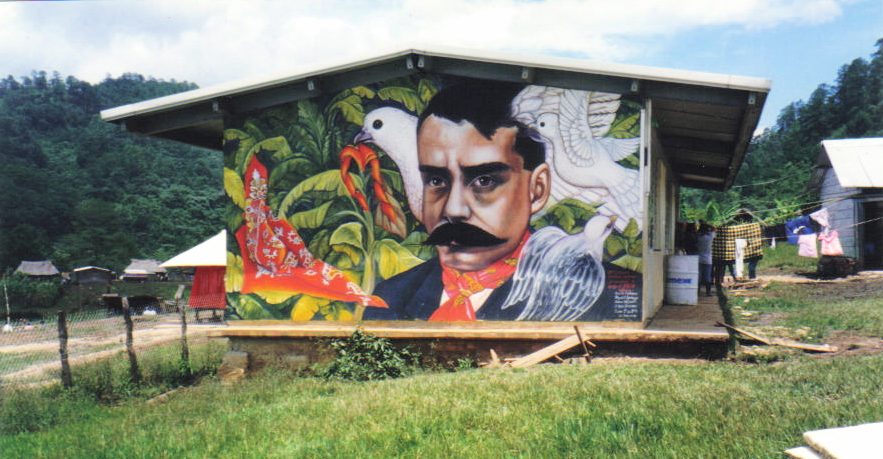
The colonial State and revolution
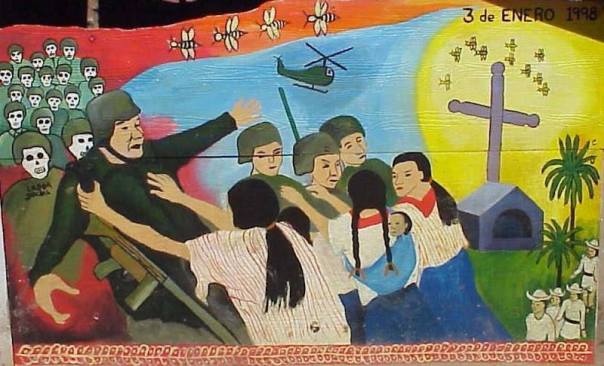
Mural depicting indigenous women pushing soldiers away to keep them out of Xoyep after the Acteal Massacre.
By: Raúl Zibechi
A century has passed since Lenin would write one of the most important pieces of critical thought: The State and Revolution. The work was written in between the two revolutions of 1917, the one in February that ended czarism, and the one in October that brought the Soviets to power. It deals with the reconstruction of the thinking of Marx and Engels about the State, which was being diminished due to the hegemonic tendencies in the lefts of that time.
The principal ideas that emerge from the text are basically two. The State is “an organ of domination of one class,” and therefore it’s not appropriate to speak of a free or popular State. The revolution must destroy the bourgeois State and replace it with a proletarian State that, strictly speaking, is no longer a true State, since it has “demolished” the bureaucratic-military apparatus (bureaucracy and the regular army) and substituted elected and revocable public officials and the armament of the people, respectively.
This not-a-true-State begins a slow process of “extinction,” a question that Lenin picks up from Marx and updates. In a polemic with the anarchists, the Marxists maintained that the State such as we know it cannot be disappeared or extinguished; it can only be destroyed. But the non-State that substitutes for it, which no longer even has a permanent army or bureaucracy, can certainly start to disappear as an organ of power-over, in the measure that classes also tend to disappear.
The Paris Commune was in those years the favorite example. According to Lenin, in the commune “the organ of repression is the majority of the population and not a minority, as was always the case under slavery, servitude and salaried slavery.”
See the emphasis of those revolutionaries on destroying the heart of the state apparatus. We remember that Marx, in his account about the commune, maintained that: “the working class cannot simply take possession of the existing state apparatus and put it in motion for its own purposes.”
So far, this has been a very brief reconstruction of critical thought about the State. Going forward, we must consider that we’re talking about reflections on the European states, in the world’s most developed countries that were, at the same time, imperial nations.
In Latin America the construction of the nation-states was very different. We are faced with states that were created against and above the Indian, Black and Mestizo majorities, as organs of class repression (just like in Europe), but also and overlapping, as organs of the domination of one race over others. In sum, they were not only created to ensure the exploitation and extraction of surplus value, but also to consolidate race as the crux of domination.
In the better part of Latin American countries, the administrators of the nation-State (the civilian bureaucracies as well as the military) are white people that violently dispossess and oppress the Indian, Black and Mestizo majorities. This double axis, both classist and racist, of the states born with independence not only modify the analysis of Marx and Lenin, but rather puts them in a distinct position: state domination can only be exercised through race and class violence.
If they considered the State as a “parasite” adhered to society’s body, in Latin America it’s not only a parasite (a figure that transmits exploitation), but also a killing machine, as five centuries of history demonstrate, machinery that has unified the interests of a class that is, at the same time, economically and racially dominant.
Having reached this point, I would like to make some current considerations.
The first one is that the world’s reality changed in the previous century, but those changes have not modified the role of the State. Moreover, we can say that we live under a regime where the states are at the service of the Fourth World War against the peoples. In other words, the states wage war on the peoples; we are not faced with a deviation but rather a reality of a structural character.
The second is that, trying to destroy the state apparatus one can argue (with reason) that the popular sectors don’t have enough strength to do it, at least in the immense majority of the countries. Therefore, a good part of revolutions are the daughters of war, the time at which the states collapse and become extremely weak, as is happening in Syria. At those times, experiences emerge like that of the Kurds in Rojava.
Not having sufficient strength does not mean to say that it would be good to occupy the state apparatus without destroying its nuclei of civilian and military power. All the progressive governments (past, current and those that will come) have no other policy towards the armies than to keep them as they are, untouchable, because they don’t even dream of entering into conflict with them.
The problem is that these bureaucracies (but especially the military) cannot be transformed from inside or in a gradual way. It’s customary to say that the armed forces are subordinate to the civilian power. It’s not true; they have their own interests and command, even in the most “democratic” countries. In Uruguay, to give an example, the military has impeded as of now that the truth be known about the disappeared and about torture. The current president, Tabaré Vázquez, as well as the former president, José Mujica, subordinated themselves to the military.
It’s not very serious to seek arriving in the government without a clear policy towards the civilian and military bureaucracies. Most of the time, the electoral lefts elude the question, and hide their heads like an ostrich. Then they make a show of unlimited pragmatism.
Then, what do we do when there isn’t any strength to overthrow them?
The Kurds and the Zapatistas, also the Mapuche and the Nasa, opted for a different path: arming themselves as peoples, sometimes with firearms and at other times with symbolic arms like the staffs of command. It’s not a question of military technique, but rather of a willingness of spirit.
————————————————————————
Originally Published in Spanish by La Jornada
Friday, June 23, 2017
http://www.jornada.unam.mx/2017/06/23/opinion/017a1pol
Re-Published with English interpretation by the Chiapas Support Committee
The Racist Contempt of the Wise

The Racist Contempt of the Wise
By Sergio Rodriguez Lascano
One of the most base characteristics in the theoretical thinking of the left locates the proposals, concepts, analysis, tendencies, and theories that come from below as folklore—produced by those who haven’t been formed in academia.
With a stroke of the pen or the keyboard, not only does this impoverish emancipatory theory but it flatly lies about the origins of such theory.
It doesn’t matter if you’re a Marxist, or anarchist, or revolutionary syndicalist or Blanquist. All of the diverse emancipatory theories were linked to a social process that made them not only possible, but inevitable. And so, for example, the League of the Banned—then the League of the Just, finally the Communist League–were composed of tailors, shoemakers, watchmakers. Those revolutionaries didn’t elaborate their theories in an academic context—more than that, often they did it under conditions of hunger or in prison–but among ordinary people with whom they worked and worked out ideas; and of course, in the midst of the great social confrontations: the revolution of 1830 in France, the revolution of 1848 in a great part of Europe, and of course the Paris Commune of 1871. That’s why Karl Marx coined a phrase that still today burns among many commentators about social struggles. “Every step of real movement is worth more than a dozen programs.” (https://www.marxists.org/archive/marx/works/1875/letters/75_05_05.htm “Letter from K. Marx to W. Bracke,” London, May 5, 1875.)
All of this is relevant because a group of commentators on reality from social media (that is where their praxis is located) have joined the chorus of attacks against Zapatismo, especially against Subcomandante Insurgente Moisés. These commentators’ practical activity amounts to crossing the Eje Central in Mexico City in fear (not without asking someone for help because contact with the people provokes disgust). Their “argument” – which would be laughable if it weren’t so dishonest—consists in pointing out that he isn’t really anti-capitalist (with a good-natured tone, it’s very chic to suggest that he could be if only he were to study and understand the profound significance of the law of value and commodity fetishism).
One could ask “where do the people who make this critique locate themselves?” Or “what are the theoretical and practical bases from which they make it?” Of course it isn’t strange that they join the anti-Zapatista chorus, or that the fundamentals of their critique come along with a big dose of racist contempt. Many have lined up behind them. Octavio Rodriguez Araujo is at the front of the line with his cool version of “my passage through Zapatismo.”
The Zapatistas’ theoretical elaboration, at least that which they have made public, begins in 1994. They laid out a series of concepts and categories that, many years later, some famous writer took up, of course, without citing the origin of the proposal.
There are also those who, at the pinnacle of retrograde racism, proposed the idea that Zapatismo was fine for the jungle but not for the city [polis]. That the city [polis] is a complex society and not a simple one like indigenous society. The idea is very simple: Zapatismo shouldn’t mess with the intricacies of theoretical proposals, they should construct their caracoles, stay in the jungle and not weigh in on burning themes like neoliberalism, the market, finance capital, the crisis of the Nation-State, accumulation by dispossession, commodity fetishism (for anyone who wants a simple but profound explanation of what this last concepts means, I recommend the discourse of the deceased Subcomandante Insurgente Marcos in Altepexi, Puebla about maquila workers) etc. [http://enlacezapatista.ezln.org.mx/2006/02/13/altepecxi-puebla-12feb06/ does not appear to have been translated into English]
But it turns out that Zapatismo not only has spoken about all those issues, but has constructed a method of approximation that, has at least two variants:
- As they have said: their theoretical reflection is a product of their practice.
- What they propose are not final judgments or closed theories, so beloved of those who fill their mouths speaking of science–those who don’t understand the important role that doubt has played historically in science. Of course, we are speaking of “scientific doubt” that calls into question revealed truths. For science, every truth, in order to be scientific, has to be refutable. An “indisputable” scientific truth is therefore an oxymoron. A characteristic of all of the theoretical elaboration of the companer@s is the “precautionary principle,” bound up with the following idea: “that’s how we see things, but who knows how you do?” They analyze economic, social, and political processes trying to locate the underlying trends that are expressed in them. And it has to be said: almost all of the trends identified by them have been demonstrated to be realities.
Why this precaution? I think there are three reasons:
- They are modest and their way of explaining things doesn’t involve the pedantry of desk theorists.
- They begin from an ethical principle that is profoundly alien not only to the theorists on social media, but also to the intellectuals in the academy who never or almost never take responsibility for what they write. One week they propose an idea, reality demonstrates the next day that their approach was completely mistaken, and they never reconsider their analysis to indicate explicitly the error or the horror, they just pass onto the next theme without the slightest embarrassment. By contrast, the Zapatistas’ word has value. When they write or say something, that something has been the product of a long process of reflection and not something that just occurred in the moment. And therefore they take responsibility for what they say. They don’t forget what they said, they have it present, they pursue the analysis of the historical trend they have identified—they see if others have other ideas, and then, via practice, they discover who was right. But, this doesn’t lead them to sing victory or to claim superiority. A new trend opens before their eyes and they begin the entire (practical-analytical) process again.
- Since their theoretical reflection is the product of their practice, they must be constantly measuring against reality those trends that they have inferred from new practices. They leave to others the confidence to disqualify a movement that said NO! Enough!–at a time when the end of history had been decreed, and a “new world order,” proclaimed; and when resignation had adorned itself with the cloak of cynicism.
Stupid things are said, like that Zapatismo is a “chic ethics” or that they aren’t completely anti-capitalist (despite the fact that this is how they define themselves) because they don’t understand the theory of value and commodity fetishism. Those who have said this last aren’t serious students of the works of Marx. They haven’t even read the fundamental works of Marxism, they only seek to be in “fashion” without knowing that, as Walter Benjamin said:
Fashion has a flair for the topical, no matter where it stirs in the thickets of long ago; it is a tiger’s leap into the past. This jump, however, takes place in an arena where the ruling class gives the commands.” (Walter Benjamin: Theses on the Philosophy of History https://www.sfu.ca/~andrewf/CONCEPT2.html)
They interpret Marx through the lenses of Robert Kurz (who died in 2012). On this occasion, I’m not interested in debating the thesis of Kurz which besides having some interesting things, reveals the terrible result of someone who spews contempt toward ordinary people, who live, grow and relate to the streets or to the land. Kurz never spoke with ordinary people nor looked to find common ground with them, he didn’t even try to understand them, or even really to see them. It strikes me that those little people who grab onto Kurz in order to critique the Zapatistas and “demonstrate” why they are not really anti-capitalists—or that they’re not yet, though maybe some day, if they listen to them (they don’t say this but it’s suggested), they will come to be anti-capitalists—overlooking something fundamental: What are the concrete expressions, the practices, of Zapatista anti-capitalism?
Let’s look in some detail at the problem.
In a series of memorable paragraphs, Subcomandante Galeano, in the name of the Zapatistas, in reference to the discourse of five different generations of Zapatista women, pointed out the following: [here is the source text in Spanish: http://radiozapatista.org/?p=13267 … there doesn’t appear to be English translation]:
“Zapatismo can’t be explained by itself, it needs concepts, theories and critical thinking to become aware of itself. You have all heard or read the marvelous genealogy of the struggle of Zapatista women, their heroism, their stubborn tenacity, but something is missing.
“Political Economy.
“This rebellion and resistance could grow, develop and extend itself to an extent that now surprises, and even frightens us, only when there existed the material base that made it concrete. It wasn’t until women began to detach themselves from economic dependence on men, that the passage from theory to reality happened. It wasn’t until their cooperatives emerged, their own projects, not until they appropriated the economy, did they take off. The tireless work of the Ramonas, the Susanas, and all the Zapatista women who dis-oriented [ok, that was a little macho slip], who inspired other women; and those, others still—all of this was possible and is possible because the women don’t depend economically on men.
“And let me tell you that this itself was possible only after at least two fundamental transformations: one, the change in ownership of the means of production; and the other, making and implementing their own decisions–that is, politics. To explain this, I’ve used the tools of political economy. Without those, you could think that all of this was a question of will, of resolve, commitment, militancy.
“The natural sciences recognize the principle of the excluded middle. (Actually, in reality it is written as the “Tercio Excluido” (the excluded third) but the “Tercios Compas” , well we’re Zapatistas and we resist. This principle is actually very simple: a thing can’t both be and not be. That is, in identical conditions, a premise will always have one and only one conclusion. [there is no third possibility] In the social sciences, the dizzying rhythm of change in the very conditions of our premises means that when the theorist arrives to reality very excited about what he has to offer [“loco de contento con su cargamento,” [Editor’s note, translates loosely as: crazy happy with his products], reality has already transformed itself.
“Unless he’s a cynic who only wants to preserve his grant or his job, the critical thinker would have to come and go continually from reality to theory, in such a way and with such speed that it’s not surprising that pretty soon he’d get nauseous and vomit. The social scientist doesn’t have to redo everything, as they would have it in social networks and the paid media. The social scientist doesn’t have to rediscover fire every time he wants to register the multiple conflagrations that are growing and spreading in social reality. He starts from a theoretical framework, some fundamental ideas, scientific concepts, a theoretical base.
“For example in the science of political economy, there is the theory of value or the theory that orients us to look for general explanations in material conditions. To begin from the ownership of the means of production, circulation and consumption of commodities (we have added “the means of dispossession,” for reasons we will explain), and the social relations of production that this mode of ownership imposes.
“Those theories, those concepts – are they only good intentions, notions, more or less structured ideologies?
“Do they serve to explain a reality? For example, can the genealogy of the capitalist system be explained without the concept of the commodity, without the theory of value? Or to put it more provocatively, can the birth and development of capitalism be explained adequately with concepts and theories that are contrary to and that contradict the theories and concepts of political economy ?” (Critical Thought confronts the Capitalist Hidra, Volume 1).
So, is there something lacking for them to qualify as anti-capitalist? Do they need to read Kurz? Ha!
In these paragraphs, from my point of view, at least four fundamental elements of the anti-capitalist practice and theory of the Zapatistas can be found. Whoever was able to hear the narratives of the five Zapatista compañeras was profoundly moved. What we heard was evidence of “the struggle to transit from sorrow to hope.” We heard of the transit from life under the domination of the landowners to the construction of new social relationships. But the narrative didn’t take form based in a closed, hard, boring discourse, but from the perspective of those who told, in a completely natural way, the story of their great and heroic creation.
And then the Sup, based on that practical experience, creates and recreates a series of key concepts:
a) This was possible, only due to a change in the ownership of the means of production.
But that change in ownership has happened many times in history; what’s different here is that we’re not dealing with a “state-ization” of the means of production, but with their socialization. And the difference is not trivial. The process of organization that has permitted the creation of new social relations has its material basis in the social appropriation of the means of production, especially the land.
Everything changes as a result. The laws of commerce are modified. The new owners of the means of production decide the form, the structure, the rhythms—everything that has to do with work, the product and the distribution of the social surplus happens based on social criteria.
Work stops being a social relationship imposed by private interests that determine the objectives and the rhythms of production and that appropriate unpaid labor time for their own personal benefit.
Equally, work ceases to be imposed by a state bureaucracy that determines the objectives and the rhythms of production, and that, even though it distributes a little less badly the products of unpaid labor time, it appropriates a fundamental part, leading to corruption and a process over the long term of the configuration of a bureaucratic bourgeoisie.
In both of these forms of control of the means of production mentioned above, the product of labor not only doesn’t belong to the direct producers, but is the basis of exploitation and domination.
But when the direct producers have control of the productive process because they are the owners of the means of production, then the key idea of the society that we are struggling for—“the free association of producers”—becomes reality.
b) But this fact isn’t only located in an economic relationship but in something equally profound: “the making and implementation of their own decisions.” For those obsessed with ontology, what is the difference here between subject and object? Can they be separated? Is it possible to construct an other social relationship if the appropriation of the means of production isn’t accompanied by “making and implementing their own decisions” on the part of the producers? Can they make and implement their own decisions without appropriating the means of production? Isn’t this the real basis of the concept of freedom? Isn’t this the material basis of the concept of dignity? Isn’t this the material basis s of the concept of democracy? Isn’t this antagonistic to the law of value and the fetishism of commodities?
c) And the law of value? And the fetishism of commodities? If the social relations of production change and if the community (not a boss, not the state, not the government, not a bureaucrat, not even a revolutionary) decides the form that the relations of production are going to take and if they are defined in terms of the collective interest and there is no private appropriation of the social surplus, then only someone who is completely obtuse who doesn’t have any point of view beyond that of a screen, whether large or small, can say “that isn’t anti-capitalism, but maybe some day it will be.”
If we understand that the fundamental basis of the law of value has to do with the appropriation and control of life via the appropriation of unpaid work, then the response is obvious. If we understand that the basis of the fetishism of commodities is the external, alien character that production has for the producer—which makes it possible that commodities take on life before stunned eyes and begin to dance–,then we understand why in the Zapatista communities, the people dance with excess, they all dance and celebrate their creation, not the reverse.
d) But neither do they have the idea that what they are constructing is a phalanstery that exists on the margin of capitalist social relations of production. Nor the caricature that Kurz makes when he says:
“In recent years this formula has been used more and more in the sense of being a cooperativist economic alternative, “to the side” of the social synthesis engineered by capital and that in some way it would gradually spread. This simply provides continuity to particularism, ‘colored’” postmodern. Certainly, the formation of a negative society (negative Vegesellschaftung) of capitalism can only be overcome in its entirety, or it will not be overcome” (“The era of capitalism has passed” http://www.sinpermiso.info/textos/la-era-del-capitalismo-pas-la-izquierda-y-la-dialectica-sujeto-objeto-del-fetichismo-moderno ).
The Zapatistas have taken as their flagship phrase “what’s missing is missing.” Their heroic constructions, carried out in the Zapatista zones are only a demonstration that society can be organized in another way.
That the objective can’t be confined to a territory, a region, a state, a country, a continent, a world… That it is indeed possible to construct other social relations. That it is a lie that the egoism of humanity will inevitably impede any common egalitarian, collective construction. That capitalism is totally overcome or it will not be overcome.
That five continents speak and that all listen. That humanity suspend a moment its silence, of shame, and anguish. That humanity speak. That humanity listen…
In their world, those who live in Power and kill for Power don’t fit within the human. There is no space for hope, no space for the future. Slavery or death is the alternative that that world offers to all other worlds. The world of money, the world of the others, governs from the stock market. Speculation is today the principle source of wealth and at the same time, the best demonstration of the atrophy of the human capacity to work. It is no longer necessary to work to produce wealth, now all that’s necessary is speculation. (Second Declaration of La Realidad For Humanity and Against Neoliberalism, August1996: http://www.afn.org/~iguana/archives/1997_02/19970209.html
No the idea isn’t to make six, seven caracoles, each operating in its own way, but what I think is at the base of the anti-capitalist thought of Zapatismo is that it is indispensable to confront the motherlodes of capitalism: private property in the means of production, and the domination that enables the society to survive or die without having control of its life. How is it to be achieved? The Zapatistas never say to others what they must know, do, and above all, discover. For that they have posed the key question on which real movement advances. Therefore, that step is indispensable to be able to generate (with a codified program or not) the bases of liberation.
That is a little more complicated that living with the pleasure of having a group of 8 whose mouths open wide with the face of “Oh, the scholar has spoken!” It’s an embarrassment. No, not everyone can do it. No, not everyone can be the subterranean drone named Subcomandante Insurgente Moisés, but at least we should temper our judgements. But, in the end, each one with their flock.
A different idea can only take off from something that is profoundly unknown by this type of person. In order to arrive at that complex vision of political economy and of life, the Zapatistas leave us a footprint through which we can advance; obviously, it isn’t simple, but it is a path:
It is necessary to re-educate desire. To teach desire to desire, to desire better, to desire more, and above all to desire in a different way. (Subcomandante Insurgente Marcos. Desde las montañas del sureste mexicano, Agosto de 1996).
There are 137 characters, three less than his universe. I don’t know, it could be, that in one of those, you will understand.
Translation by the Solidarity Committee with Chiapas, East Coast
Source: Sergio Rodriguez Lascano El desprecio racista de los “sabios” disponible en http://vientosur.info/spip.php?article12701
Letter from Kurdish Women to Marichuy
Letter from Kurdish Women’s Movement to Spokeswoman of Indigenous Governing Council

Revolutionary Kurdish Women
For María de Jesús Patricio Martínez, representative of the indigenous people of Mexico and the National Indigenous Congress #CNI.
Posted by Centro de Medios Libres Translated by El Enemigo Común
https://elenemigocomun.net/2017/06/kurdish-women-cni-letter/
First of all, we want to send our deepest respect and revolutionary greetings to our Mexican sister, from the mountains of Kurdistan to the Sierra Madre mountain range beyond the oceans. Despite the rivers, mountains, deserts, valleys, canyons and seas that separate us, we are indigenous sisters and brothers, no matter what part of the world we are in.
With you, we share our struggle, our resistance against occupation and colonialism, and our dream of a free life, and in this sense, we who belong to the Kurdish Liberation Movement declare that we consider the struggle for self-determination, self-administration and self-defense of the indigenous peoples of Mexico organized in the National Indigenous Congress (CNI) as our own struggle, and we support you on the basis of principles of revolutionary solidarity.
Indigenous peoples are the veins through which the most important social and cultural values of humanity have been transmitted, from the first moments of socialization until our times. Without a doubt, no people is superior to another, but at a time when capitalist modernity is trying to destroy every communal value, indigenous peoples are the safeguard of the social fabric of all humanity. Thousands of years of collective memory resurge in our songs, our rituals, our prayers, our tattoos, our dances and our traditions. And so the struggle for our own identity against the efforts of capitalist modernity to erase the roots and the memory of our peoples becomes the most meaningful of all forms of resistance.
In Latin America, as in Kurdistan, women are leading this resistance. In our countries, which were the cradles for thousands of years of the culture of the mother goddess, we see that women and life, women and freedom, women and land, and women and nature are inextricably related. In Kurdistan, we express this reality in our slogan “Jin Jiyan Azadî,” which means “Women Life Freedom.”
The bodies and souls of women are the reflection of the universe on the land. Thousands of years ago, during the Neolithic Revolution, it was the women, through their social organization, who led in making changes that enabled the cultivation of the land and the beginning of a sedentary life in harmony with nature. That’s why women were the first to be enslaved by the patriarchal state civilization, which arose as a counterrevolution based on domination, exploitation and occupation.
Parallel to the domination of women was the ever more rapid domination of nature. It was through the oppression of the first form of nature that the second came about, transforming both into the pincers that capitalist modernity used to forcefully exert pressure against historical society, with a greater ability to destroy it. Consequently, legitimate resistance arising in pursuit of self-government, self-determination and self-defense represents the greatest possible struggle for freedom.
We in Kurdistan, enlightened by the struggles of the indigenous peoples of Latin America, have developed our own defense against modernist capitalist forces and attacks from the colonialist states that occupy our soil. We want you to know that we continually receive special inspiration from your experiences of self-government, good government and communalism. We hope that our experiences and breakthroughs in the struggle will likewise serve as sources of inspiration for you.
One of the greatest achievements in our movement is the equal participation and representation of women. This was the result of great sacrifices made and intense struggles waged by women, and we finally won equal participation in making all decisions. Not as individuals, but as representatives of the organized, collective will of the Kurdish Women’s Liberation Movement. This is the way we are taking our place in each and every aspect of struggle. With our system of co-presidencies, established from the ground up, we represent the will of women in each and every decision and develop a democratic kind of politics that goes against all patriarchal, traditional forms of politics. But to be able to do this, it was necessary for us to become an organized force once and for all. Being organized is the most important requirement for winning victories. To the extent that we’re organized, we’re capable of resisting the dominant colonialist system and building our own governmental alternative.
For that matter, organization is our most important arm for self-defense. In the past, many peoples and movements have not been able to attain the hoped-for results because they weren’t well enough organized. It wasn’t possible to transform some historical moments into great victories precisely due to the lack of organization. We may not have reached an in-depth understanding of the meaning and importance of this fact, but we’re now in another stage of struggle. We’re obliged to multiply our efforts to heighten our levels of organization in order to take advantage of this new opportunity to triumph – at a time when the modernist capitalist system is going through yet another deep crisis in its most decisive aspects. History demands it of us. You of the National Indigenous Congress have shown that you recognize this reality by declaring the presidential elections in Mexico a key stage in a process that will result in a rise in your levels of organization.
We, of the Kurdish Women’s Liberation Movement wish to express our support for your decision, based on the conviction that this goal will be reached and taken to a much higher level, starting with these elections and the strategies developed around them. Our leader Abdullah Öcalan, who has been imprisoned under the harshest of conditions of isolation by the Turkish colonialist state since 1999, made a highly important analysis of this at the end of the twentieth century. Our leader Apo, foresaw that the twenty-first century would be the century of women’s liberation if we are able to grow and decide on our manners and mechanisms of organization. The reason for this conclusion was the evident structural crisis of the patriarchal system, which has been based on our enslavement.
The patriarchal system seeks to overcome this crisis by raising the level of attacks against women to the level of a systematic war. By concentrating its attacks against women the world over through different means and methods, the system aims to cut off the road to liberation that we’ve taken. The murders of women that have reached the level of genocide in your country, and the murders of women leaders in Latin America are the most concrete indicators of this reality. We want you to know that we consider all the women and leaders of indigenous peoples who have been killed by the operative arms of the dominant system as our own martyrs. We are also struggling to make our hopes and dreams reality. Our martyrs never die. We draw force from them, and they are reborn in every struggle we undertake.
In this context, your decision as Mexican indigenous people to name a woman comrade as representative of your will and make her your candidate in the upcoming presidential elections is very significant. As a matter of fact, comrade Marichuy is not only the voice of the indigenous peoples of Mexico, but at the same time, the voice of the women of the world. We want to say that we affirm the importance and value of her candidacy as the representative of peoples denied, women enslaved and thousands of years of ancestral wisdom threatened with disappearance by capitalist modernity.
As the Kurdish Women’s Liberation Movement, we declare our support and solidarity with the compañera and the National Indigenous Congress, not only at the moment of this electoral juncture, but in the entire struggle that your movement is pursuing. We know that the results of the elections themselves do not matter, that they are only one of the roads that the indigenous peoples of Mexico have taken in this process at this particular moment of struggle. In this light, the victory is already a fact because the modernist capitalist system feeds off of the division of forces and the disorganization of peoples and societies that it aims to dominate, but you have constructed the terrain for success by forging organized unity.
From this point on, it is important not to lose sight of this goal, which is none other than stronger organization. Your triumph will be our triumph. Our struggle is your struggle. We are the brother and sister people of the mountains that have risen from the same deep waters. Even in our different tongues, we share the same dreams, we fall in love with the same utopia, and we resist for the sake of the same love. From here, we send you all the force necessary in this new stage, we greet you with our most genuine revolutionary feelings, and we embrace you with all our solidarity and comradeship.
Long live the sisterhood of the peoples! Long live revolutionary internationalism! Women, Life, Freedom! Jin Jiyan Azadi
Coordinating group of the Kurdish Women’s Movement, Komalên Jinên Kurdistan (KJK) June 7, 2017
Construction of new military base in Chiapas advances rapidly

A view of the entrance to Rancho Nuevo Military Base from the highway. It’s located near San Cristóbal de las Casas, Chiapas.
By: Isaín Mandujano
TUXTLA GUTIÉRREZ, Chiapas. (apro)
The Mexican Army advances rapidly in the construction of what will be the new military base in the municipality of Chicomuselo, Chiapas, which according to Governor Manuel Velasco Coello will strengthen the security shield in the state’s Sierra Region and on it’s southern border.
“With the new Army barracks that is being constructed in the Sierra of Chiapas we will have a border that is more secure and a better protection of the population in natural contingencies,” said the Governor, who visited the work together with the commander of the VII Military Region, General Luis Alberto Brito Vázquez.
After supervising the construction –close to the borderline with Guatemala–, Velasco maintained that the new base would strengthen the security actions that they impel in the state to guaranty the social wellbeing, governability and integral development.
It is in the interest of both the state government and the Federation to reinforce joint actions in security matters in the 122 municipalities of Chiapas, he added.
Also accompanied by the Comandante of the 39th Military Zone, Víctor Manuel González Pérez, he pointed out that the construction of the new military complex is done under the corresponding environmental regulations.
The new installation, he said, “forms part of the national security strategy that President Enrique Peña Nieto impels, where the goal is to establish the joint labor among the different levels of government for attending to, combating and eradicating any kind of violence, as well as attaining more secure, dignified and prosperous borders for all those that live or travel through Mexican territory.”
Besides, he added, it will permit improving inter-institutional coordination, strengthening projects in security matters focused in the different regions of the state, guarantying social cohesion and offering better opportunities for social and economic development.
That –he emphasized– it will generate an economic spill of eight million pesos per month, direct and indirect jobs, as well as the opening of businesses with local providers, the arrival of service providers, and the improvement of public services in health, education, communications and transportation.
Also on tour with the governor were: Raciel López Salazar, attorney general of the state; Jorge Luis Llaven Abarca, Secretary of Security and Citizen Protection; Juan Carlos Gómez Aranda, Secretary General of Government; José Antonio Figueroa Hernández, municipal president of Chicomuselo, and federal delegates in the state, among others.
————————————————————-
Originally Published in Spanish by Proceso.com.mx
Monday, June 12, 2017
http://www.proceso.com.mx/490740/avanza-a-marchas-forzadas-construccion-base-militar-en-chicomuselo
Re-Published with English interpretation by the Chiapas Support Committee
López y Rivas: The time has come

María de Jesús Patricio, spokeswoman for the Indigenous Government Council for Mexico.
By: Gilberto López y Rivas
As always, the important comunicado of the National Indigenous Congress and the Ejército Zapatista de Liberación Nacional (CNI–EZLN), “The time has come,” dated last May 28, went unperceived in the large communications media and particularly among the political class. Immersed in the State elections, as predictable in their fraudulent results as the frustration of those who vote in good faith, confident that “now yes, there could at least be an change,” the media as well as the politicians ignore or make invisible any reference to the resistances e political initiatives of the indigenous peoples. The autism and ego-centrism of the political class goes together with the obedience to the power of the media analysts.
In their document, the CNI–EZLN announces the broad representation of indigenous peoples, communities, nations and tribes present in the constitutive assembly of the Indigenous Government Council: Apache, Amuzgo, Chatino, Chichimeca, Chinanteco, Chol, Chontal de Oaxaca, Chontal de Tabasco, Coca, Cuicateco, Mestizo, Hñähñü, Ñathö, Ñuhhü, Ikoots, Kumiai, Lakota, Mam, Matlazinca, Maya, Mayo, Mazahua, Mazateco, Me`phaa, Mixe, Mixe-Popoluca, Mixteco, Mochó, Nahua or Mexicano, Nayeri, Popoluca, Purépecha, Q´anjob´al, Rarámuri, Tének, Tepehua, Tlahuica, Tohono Odham, Tojolabal, Totonaco, Triqui, Tseltal, Tsotsil, Wixárika, Xi´iuy, Yaqui, Binniza, Zoque, Akimel O´otham and Comkaac.
The document describes in depth the capitalist full-spectrum war against the peoples throughout national territory, and the time of violence, fear, mourning and rage that is experienced, ever since: “the political class has persisted in making the State a corporation that sells the land that belongs to the original peoples, campesinos, city folk; that sells it to people as if they were merchandise that are killed and buried like raw material for the drug cartels, to sell them to the capitalist companies that exploit them until they get sick or die, for selling them in parts for the illegal organ market. The pain of the relatives of the disappeared and their decision to find their loved ones despite the fact that the governments are persistent in not finding them because by looking for them, the rot that governs this country is also appearing. That is the destiny that those above construct for us, bent on the destruction of the social fabric, of what makes us know peoples, nations, tribes, barrios, colonias, even families, it keeps us isolated and alone in our grief, while they consolidate the appropriation of entire territories, in the mountains, the valleys, the coasts and in the cities.”
Contrary to the political class that participates in electoral processes as if they were taking place in a Swiss Canton, the comunicado emphasizes: “the destruction that we have not only denounced, but also faced for 20 years and that evolve in the better part of the country into an open war waged by criminal corporations that act in brazen complicity with all the organs of the bad government, with all the political parties and institutions. All of them configure the power of above and are a cause of repugnance for millions of Mexicans of the countryside and the cities. In the midst of that repugnance they continue telling us to vote, to believe in the power of above, which continues drawing and imposing our destiny. In that direction, we only see a war that grows and on the horizon is death and the destruction of our lands, our families, our life; it is an absolute certainty that it will get worse, much worse, for everyone, for everyone.”
They reiterate that: “only in resistance and rebellion have we found the possible paths whereby we will be able to continue living, and that in them are the keys not only for surviving the war of money against humanity and against our Mother Earth, but also for being reborn together with every seed that we sow, with each dream and with each hope that is materializing in large regions in autonomous forms of security, of communication, of governments appropriate for protection and defense of territories. Therefore, there is no other path possible than the one being walked below, because above is not our path, it is theirs and we disturb them.”
The CNI–EZLN has decided “not to wait for the disaster that the capitalist killers that govern undoubtedly bring us, but rather to go on the offensive and make that hope an Indigenous Government Council for Mexico that bets on life from below and to the anticapitalist left, which will be lay and that answers to the seven principles of govern by obeying as our moral guaranty (…) we seek to snatch the destiny that they have taken away from us and, unfortunately, we seek to dismantle that rotten power that is killing our peoples and Mother Earth and the only cracks that we have encountered and that have been liberating consciences and territories, giving consolation and hope are in resistance and rebellion.”
The CNI–EZLN calls “to organize ourselves in all the corners of the country, para gather necessary elements so that the Indigenous Government Council and our spokesperson is registered as an independent candidate to the presidency of this country and yes, spoiling their party based on our death and making our own based on dignity, organization and the construction of a new country and of a new world.”
They call “to all sectors of society to be attentive to the steps the Indigenous Government Council is agreeing on and defining through our spokesperson to not surrender, not sell out, not to deviate or rest, to go carving the arrow that will carry the offensive of all the indigenous and non-indigenous peoples, organized and non-organized in order to aim it at the real enemy.”
It’s clear that the time has come for constructing power from below and to the left; a power that governs by obeying starting with the seven principles: to serve and not serve yourself, to represent and not supplant, to construct and not destroy, to obey and not order, to propose and not impose, to convince and not conquer, to step down and not up.
———————————————————–
Originally Published in Spanish by La Jornada
Friday, June 16, 2017
http://www.jornada.unam.mx/2017/06/16/opinion/018a2pol
Re-Published with English interpretation by the Chiapas Support Committee

Elections and the powers from below
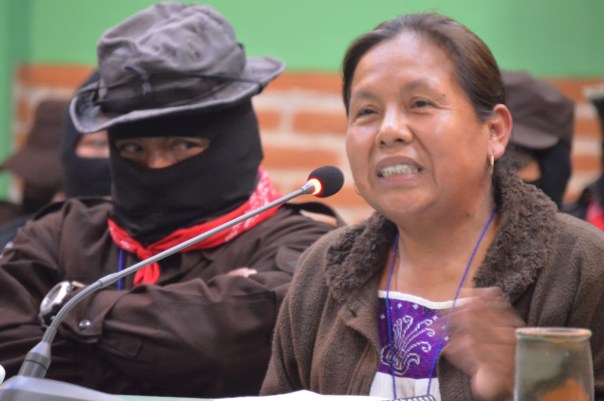
By: Raúl Zibechi
In recent decades the political culture of the left converted elections into the principal barometer of its success or failure, of advances or setbacks. In fact, the electoral conjuncture became the axis of political action of the lefts, in most of the world.
A new political reality, since not so distant times the electoral question occupied one part of the energies and was considered a complement to the main work, which revolved around organizing the popular sectors.
What’s certain is that electoral participation was articulated as the first step in the integration into the institutions of the political system (capitalist). That process destroyed popular organizing, weakening to the extreme the ability of those below to directly resist (not through their representatives) systemic oppression.
With the years, politics from below began to turn on what the leaders decided and did. A small group of deputies and senators, assisted by dozens of functionaries paid with public monies, were displacing la participation of grass roots militants.
In my country, Uruguay, the Frente Amplio (Broad Front) achieved having before the 1973 State coup more than 500 grassroots committees just in Montevideo. There, militants gathered from the different parties that made up the coalition, but also independents and neighbors. In the first elections in which it participated (1971), one of every three or four voters was organized in those committees.
Now the reality is that almost no grassroots committees exist and everything is decided at the top, made up of people that have made a career in state institutions. Only a fistful of committees reactivated during the electoral campaign, to later be submerged in a long nap until the next election.
In parallel, the institutionalization of the lefts and of the popular movements –added to the centrality of electoral participation– ended up dispersing the popular powers that those below had erected with such determination and that were the key vault of the resistances.
In the debate over elections I believe that it’s necessary to distinguish three completely different attitudes, or strategies.
Immanuel Wallerstein has defended the first one for some time: the popular sectors must protect themselves during the systemic storm in order to survive. In that sense, he proposes that reaching the government through legal means, as well as progressive social policies, can help the popular camp both to limit the damages resulting from conservative offenses and to avoid that ultra-right forces take state power.
This point of view seems reasonable, although I don’t agree, since I consider the social policies linked to “fighting poverty” as forms of counterinsurgency, based on the experience that exists in the Southern Cone of the continent. At the same time, reaching government office almost always implies administering the policies of the IMF and the World Bank. Who today remembers the experience the Greek Syriza? What consequences do we get from a government that promised the opposite?
It’s evident that being focused on that such and so leader committed “treason,” leads the debate to a dead end street, except that one thinks that things would have gone another way with different leaders. It isn’t only about errors; it’s the system.
The second attitude is hegemonic among the global lefts. The strategy would be more or less like this: there is no organized social base; the movements are very weak and almost non-existent, so that the only way to modify the so-called “correlation of forces” is to try to arrive in the government. This situation has proven to be fatal, even in case the lefts succeed in winning, as happened in Greece and Italy (if the remains of the Communist Party can be called the left).
The case is different in countries like Venezuela and Bolivia. When Evo Morales and Hugo Chávez arrived in government through electoral means, powerful movements existed, organized and mobilized, especially in the first case. However, once in government they decided to strengthen the state apparatus and, therefore, they undertook actions to weaken the movements.
They are the most “advanced” state experiences, but today no autonomous anti-systemic movements exist in either country that maintain those governments. Those who support them, with exceptions, are social organizations coopted or created from above. On this point I propose distinguishing between movements (anchored in grassroots militancy) and organizations (bureaucracies financed by the States).
A variant of this attitude are those movements that, at a certain time, decide to enter into the electoral terrain. More often than not, and I believe that Mexico has a long experience in this direction, over the years the bases of the movements weaken, while the leaders end up imbedded in the state apparatus.
The third orientation is what the Indigenous Government Council impels, which in my opinion consists of taking advantage of the electoral process to connect with the popular sectors, for the purpose of impelling self-organization. They have said: it’s not about votes, much less positions, but rather about deepening efforts to change the world.
It seems evident to me that it’s not about an electoral campaign, or that Zapatismo has taken an electoral turn. It’s a proposal –that’s how I understand it and I can be wrong– that seeks to continue to construct in a situation of internal war, of genocide against those below, like that which Mexico has lived for almost a decade.
We’re dealing with a tactic that brings back the 20th century revolutionary experience for confronting the current storm, not using the weapons that the system offers us (polls and votes), but rather with their own weapons, like the organization of those below.
———————————————————–
Originally Published in Spanish by La Jornada
Friday, June 11, 2017
http://www.jornada.unam.mx/2017/06/09/opinion/020a2pol
Re-Published with English interpretation by the Chiapas Support Committee
Emergency in the Chol town of Tila, Chiapas
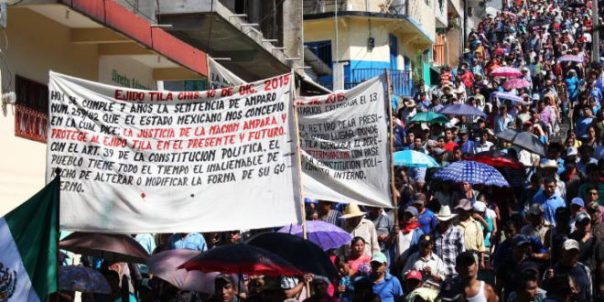
The Tila ejido marches.
By: Magdalena Gómez
Starting last June 2, paramilitary aggression and threats against the Tila ejido in Chiapas have intensified. [1] They accuse, its authorities point out, “that we are robbing them of their 130-hectare property and that they have more than 200 private deeds.” With that, the root of the injustice is again put on the table without the State, at all 3 levels taking charge of the potential for violence, or it does so, in fact, by permitting the illegal behavior of groups with a long trajectory in that zone.
Remember: the Chol people, in the Tila ejido of Chiapas, were affected by the dispossession of 130 hectares of their territory, occupied unconstitutionally by the municipal council of Tila, following the publication of Decree 72 on December 17, 1980, issued by the governor and the Congress of the state of Chiapas. In their defense, they filed a lawsuit for protection on April 14, 1982 (259/1982), with the first court, which was resolved 26 years after its presentation, on December 16, 2008, conceding the order of protection to the Tila ejido and ordering the municipal council of Tila, the governor of the state of Chiapas, the local Congress and the Public Registry of Property and Commerce to immediately restore the lands to the Tila ejido and to cancel every kind of deed that would privatize them. Nine years after the resolution, the successive governments have alleged the physical and material impossibility of complying with the judgment, and therefore they have argued that only indemnification be required for those lands.
The Chol ejido owners have insisted that upon being restored to them, as is fitting, they would head up an internal process of de negotiations with those who currently occupy the lands that were taken away from them, and would do it from a position of authority. In November 2010 a case of non-execution of judgment (1302/2010) was initiated in the Supreme Court of Justice of the Nation (SCJN). It was assigned to then Minister Olga María del Carmen Sánchez Cordero, who elaborated a project that attempted to condition the judgment’s execution, rejecting, that yes, the indemnification would include measures so that the lands would be returned to the patrimony of the ejido and from there the lands in the possession of third parties would be legalized. However, the majority of the ministers suggested the substitute fulfillment (indemnification), making use of an ability of the Court in cases in which said fulfillment would occasion a greater damage to society.
Implicitly, according to the Court’s views, on behalf of society, in this case, it would understand those who are in possession of the Chol ejido’s lands. The now former minister withdrew her project. To realize a new one, she requested diverse experts from the Autonomous National University of Mexico that is now finished. Nevertheless, the case has remained practically in limbo in the SCJN, without resolution. Facing this brief recap, the meaning of the November 8, 2015 decision of the Ejido Assembly, the maximum body of the ejido where the Chol people are settled, is clear in the sense of self-executing the 2008 court decision and initiating the construction of their autonomy as indigenous people, according to what Article 2 of the Political Constitution of the United Mexican States and Convention 169 of the International Labor Organization establish. This is how they expressed it: “One more time we demand that the municipal council of Tila, Chiapas withdraw to where it belongs, since here in the ejido not one centimeter of terrain belongs to it… Now it has been self-determined via general agreement that the municipal council will leave our territory, and that the nest of paramilitaries and partisan politicians get out of our town. Because of that the Federation sent soldiers and police… We denounce the false commissioners named by the state government… who are deceiving the settlers, saying that the ejido owners are going to burn their houses or that they are going to run them out.” For almost two years they have advanced in the construction of autonomy in different ambits, among others community justice, always in the midst of tension.
The Judicial Power at its highest level does not contribute to resolving critical cases about the violation of indigenous peoples’ rights and, as we know, when resolutions are issued they may offer only half a remedy, as in the case of the Yaqui tribe, it is not realized that in fact they lose all meaning upon not being executed. As to Tila it is paradoxical that they find it difficult to reorient a case that was undertaken via the agrarian route, when recognition of the indigenous peoples didn’t exist. Today they have all the elements and do not use them. What to say about the Executive Power, federal and state: they permit or encourage conflicts to grow without any notion that the responsibility belongs to them. Their gaze is focused elsewhere, on other interests. It’s urgent to stop the aggression towards those who achieved that justice recognized their right. There is still time.
[1] This is one of the conflicts denounced by the CNI-EZLN in the communiqué “The Offensive of above, versus the movement below.” According to the compañer@s in Tila, adherents to the EZLN’s 6th Declaration and members of the National Indigenous Congress, the paramilitaries say they have formed the “Special Forces of Tila” and are prepared to attack.
———————————————————-
Originally Published in Spanish by La Jornada
Tuesday, June 13, 2017
http://www.jornada.unam.mx/2017/06/13/opinion/014a1pol
Re-Published with English interpretation by the Chiapas Support Committee
Violence escalates against Cruztón, Chiapas, one dead
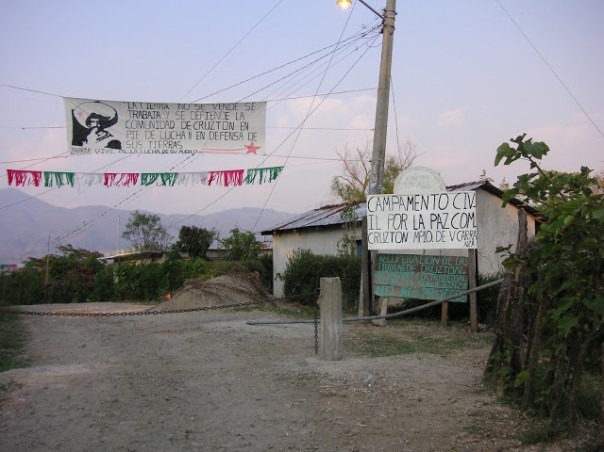
Peace camp (campamento de paz) in Cruztón.
Chiapas, México, June 12, 2017.
Despite repeated denunciations from Cruztón community, municipality of Venustiano Carranza, on this May 22 violence on the part of “invading groups” from the Nuevo Guadalupe Victoria ejido cost the life of the community defender Rodrigo Guadalupe Huet Gómez. After being ambushed together with 30 of his compañeros, Rodrigo Guadalupe left the place where he was safeguarded from the attack to verify whether the attackers had withdrawn, when he received a bullet impact in the left temple, agonized for an hour due to lack of medical attention and died at approximately 8:00 am, the Fray Bartolomé de las Casas Human Rights Center (Frayba) explained in a denunciation.
It’s appropriate to emphasize that the requested emergency medical services were not able to provide assistance, according to statements from civilian protection agents, because Eleuterio Bautista Aguilar, Municipal Agent of the Guadalupe Victoria ejido, stopped the ambulance coming from Venustiano Carranza, while the civilian protection ambulance coming from Teopisca was intercepted by men with firearms in a shooting position, the Frayba reports.
Cruztón residents have been demanding respect for their territory, especially where the holy field is found, which since 1920 “by right of our ancestors we reclaim and we know that no one can privatize and take away from us, like the group of invaders from Guadalupe Victoria are doing now,” they had denounced.
On March 5, 2013, “an invader group from Guadalupe Victoria, placed banners on 12 small properties (Tombs), in order to soon take possession of them,” the National Indigenous Congress (CNI) members warned. On April 16, 2015, upon seeing no response from the government to the Cruztón denunciations, the invading group took possession of 3 small properties.
Afterwards, on May 8, 2015 the invaders stopped up the pass that leads to Venustiano Carranza, detaining two Cruztón residents that were carrying a sick person for two hours, threatened them with high-caliber weapons and telling them: “that they were going to know who they were,” the adherents to The Sixth related.
On May 10, 2016, when Augusto de la Cruz Pérez went to Guadalupe Victoria to leave his wife at her mother’s house, “he was kidnapped upon his return without having committed any crime,” Cruztón denounced at that time. “The aggressor group from Guadalupe Victoria that kidnapped him was strongly armed with high-caliber weapons; they beat him, hung him for an hour and let him go at 5 o’clock in the morning, but at the same time they threatened him saying: “no one messes with us and if you say who it was it will; get worse for you,” the Cruztón residents reported, who are also members of the Dignified Seed collective (colectivo Semilla Digna).
In its communications, Cruztón urges Manuel Velasco and all his (government) agencies to: “respect our rights to land and territory since this aggressor group’s harassments have continued up to this moment and we hold you responsible for any aggression that may happen,” which then occurred last May 22.
The national and international condemnation response to the crime was not expected; from the CNI Mexico and the Network Against Repression (La Red Contra la Represión) to the collectives and organizations from Italy, France, Germany, Spain and Switzerland, they all agree that: “Guadalupe, the Cruztón Community not only misses him, but we also miss him. His death pushed us to raise our struggle for freedom and justice higher. We will multiply our efforts so that you don’t feel alone because your struggle is the same as our struggle for dignity and humanity,” they emphasize.
“The farewell to the body of our compañero was May 24, 2017 in our community cemetery. We said farewell to his body but his always dignified and rebellious struggle will be with us forever,” his compañer@s asserted from Cruztón.
———————————————————
Originally Published in Spanish by Pozol Colectivo
Monday, June 12, 2017
Re-Published with English interpretation by the Chiapas Support Committee
The offensive of above, versus the movement below
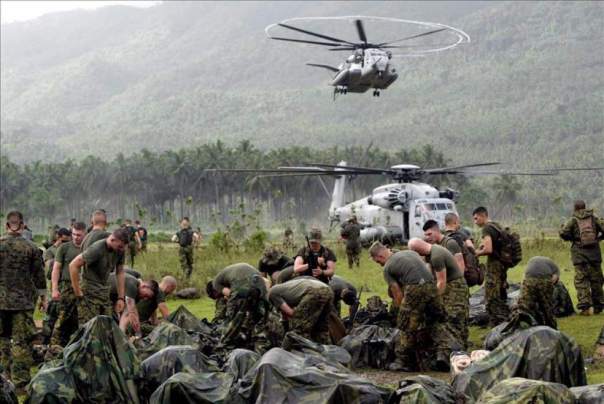
U.S. Military forces in the Guatemalan department of Petén, near the border with Campeche, Mexico.
Those of us who are the National Indigenous Congress (CNI); indigenous peoples, nations, tribes and barrios of this country, make a call to the indigenous and non-indigenous peoples of Mexico, to the honest human rights organizations, to the communications media, to the scientific and intellectual community to repudiate the repressive escalation against compañeros and compañeras of our peoples where they have been naming council members to make up the Indigenous Government Council for Mexico, which to us represents an aggression against the CNI and the proposal that we have launched to the whole nation. Therefore we denounce and point out that:
In Chiapas, the hostility and grave tension increase that the bad governments have generated in the Tila ejido, due to the political bosses tied to paramilitary groups in their attempt to bring the bad government to the community, as is the paramilitary leader of Paz y Justicia, Arturo Sánchez Sánchez, and his son Francisco Arturo Sánchez Martínez, who, firing shots and accompanied by more people belonging to their organization, closed access to the town of Tila. Recently, on June 5 of this year, they blocked the highway that goes from Tila to Salto de Agua in front of the integral hospital of Tila and another part on the highway from Tila to Yajalón, including blocking roads inside of ejido lands with masked and armed individuals. The escalation of the harassment sharpened starting with a mobilization that this group carried out last June 2 in the city of Tuxtla Gutiérrez, headed by followers and paramilitaries of Paz y Justicia.
We place responsibility on the three levels of bad government for what can occur and we call for solidarity with our brothers and sisters in the Tila ejido.
In the same state, the rich once again seek to snatch away the land recuperated in a dignified way by our brothers of the San Francisco community, municipality of Teopisca, members of the Semilla Digna (Dignified Seed) work group. The harassment is carried out b y three rich men: Juan Hernández Molina, Pedro López Girón and Pedro Hernández Espinoza. Last June 4 of this year, Mr. Pedro López Girón presented himself, accompanied by a group of approximately 50 people that violently destroyed the crossbar, barbed wire and the fence near the pasture that marks off the lands recuperated on September 19, 2016. That day, they threatened the compañeras with violating (raping) them sexually and threatened them with evicting them overnight accompanied by public forces. We condemn these cowardly attacks, and we demand complete respect for the territory recuperated by our brothers in San Francisco. We also demand the definitive cancellation of the seven existing arrest warrants against our compañeros.
Also in Chiapas, last May 28 the house of Compañera Alejandra Padilla, of the Semilla Digna work group, was broken into. They stole a laptop computer from the house, in which she was saving information about the accompaniment she has given the CNI’s indigenous communities in their struggles, as well as a part that belongs to the CIDECI- UNITIERRA work team.
On May 22 of this year at 5:20 am, a paramilitary group that identifies itself as Nuevo Guadalupe Victoria attacked a group of compañeros and compañeras of Cruztón community, participants in the CNI, with high-caliber weapons. At 7:00 am, our compañero Rodrigo Guadalupe Huet Gómez, left the place where he was protecting himself from the attack to verify if the aggressors had withdrawn, when a bullet struck him in the temple. The aggressors were identified as coming from the Guadalupe Victoria ejido.
In Querétaro we demand the immediate freedom of the Otomí compañeros Jerónimo Sánchez and Anselmo Robles, delegates of the National Indigenous Congress, who the bad government kidnapped together with Pablo González and Luis Alberto Reyes, through arrest warrants that the 9th Criminal Court of the 1st level issued against them, for the alleged crime of being the intellectual authors of aggravated rioting, which is not considered grave and, therefore, they could achieve their freedom under bond, a right that has been denied them. We are clear that said charges are to detain the struggle, the honesty and coherence that our compañeros have demonstrated.
In Morelos, we salute the dignified struggle of the Nahua people of Tepoztlán, against the expansion of the La Pera – Cuautla superhighway, and we repudiate any attempt at repression through the use of police or shock groups like the group that entered on June 7 of this year, commanded by former municipal president Gabino Ríos, to dismantle the occupation with the intention of generating violence in order to attack our compañeros, on the superhighway as well as at the municipal palace. Compañer@s, you are not alone!
In the State of Mexico, Ñuhú community of Santa Cruz Ayotuxco, municipality of Huixquilucan, they confront the destruction of their territory in the midst of the lack of any legal guaranty while the machines of the bad government and the construction companies devastate the Otomí Mexica forest in order to construct the Toluca- Naucalpan superhighway. Despite the fact that they were notified on April 26 of this year of the judicial suspension of said construction work, the authorities of the bad government and the construction companies have not respected that suspension, thereby violating the bad government’s own laws.
In Michoacán, the bad governments keep the following compañeros from the community of Calzontzin, in the municipality of Uruapan kidnapped: Ramón Ortiz Marín, Daniel Pérez Anguiano, Francisco Javier Rodríguez Amezcua, Lorenzo Aguirre Rangel, Jorge Daniel Oros Cuin, José Luis Rangel Rangel, Humberto Romero Martinez, Josué Yair Romero Ortiz, Guillermo Romero Ortiz, José Alejandro Esquivel Alvarez, José Artemio Zinzun Galván, Juan Zavala Guevara, Jose de Jesus Belmontes Arrollo, Roberto Isidro Jiménez, Juan Carlos Rangel Morales, Angrey Raúl García González and Jesus Magdalena Chávez following the bad government’s repression against the community last February 24. We demand the immediate freedom of our compañeros that are unjustly imprisoned.
In Campeche and Guatemala, we denounce the dispossession and destruction of their homes and lands that have forcibly displaced our Kekchi and Chu Maya brothers from the department of Peten, in Guatemala, by soldiers that are protected because of alleged armed conflicts; the capitalist devastation of the natural resources; and the latifundios (very large landholdings) protected by the bad governments of that country. That dispossession has brought hundreds of brothers to Candelaria, Campeche, where they set up an encampment to resist and make visible the capitalist war that they face in their lands a few meters from the Mexican border. [1] So, we denounce: the sharpening of the war against our peoples, the storm that flashes in the sky and that now seeks to kill the hopes of all the Mexicans that the Indigenous Government Council and our spokesperson represent; the use of shock groups and paramilitary groups to strike blows against the struggle of the peoples that make up the CNI, the criminalization and persecution of those who struggle for a just world, from below and to the left.
To those who think that our struggle will die because of your repression, we remind you that this path is for life and liberty, and therefore death will not stop it, but rather the opposite, and we continue calling on civil society to be aware, in solidarity and attentive to this struggle, to this offensive, which is for reconstructing democracy, liberty and justice for everyone.
Attentively,
June 2017
For the Integral Vindication of Our Peoples
Never More a Mexico Without Us
National Indigenous Congress
En español: http://enlacezapatista.ezln.org.mx/2017/06/10/la-ofensiva-de-arriba-ante-el-movimiento-de-abajo/
 Chiapas Support Committee