Chiapas Support Committee
Home of the Compañero Manuel blog on zapatistas & mexico
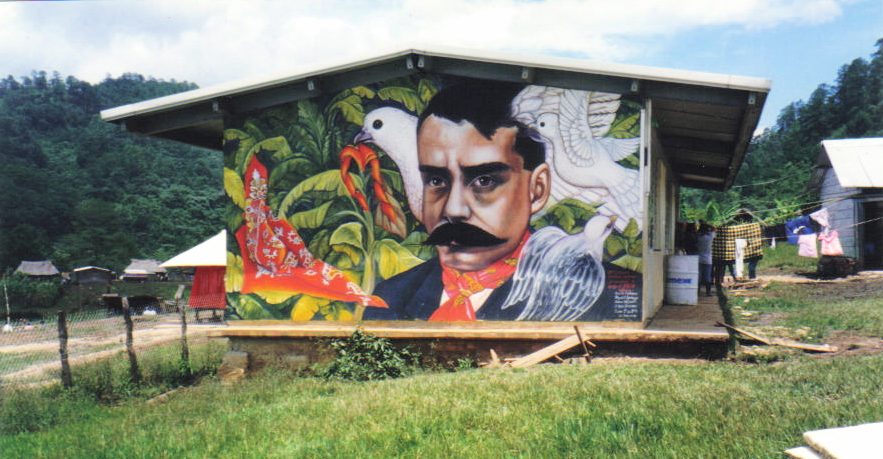
Venezuela in black and white
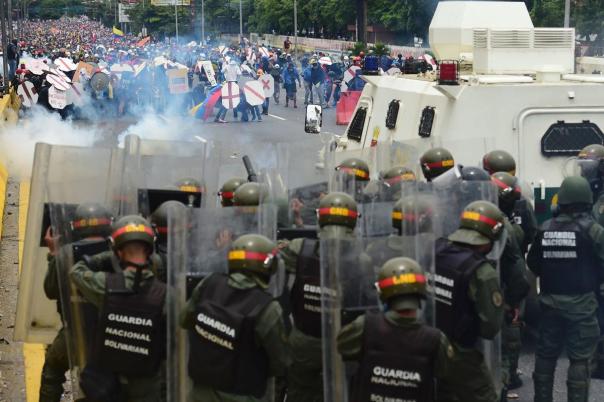
Opposition protests in Venezuela.
By: Luis Hernández Navarro
Venezuela is accused of not being a democracy. They say that its president since 2013, Nicolás Maduro, is a dictator. They assert that his predecessor, Hugo Chávez, was a tyrant. In black and white, how true are these accusations?
In a strict sense, from the perspective of social transformation, the discussion implies, contrasting the relationship (or lack thereof) existing between procedural democracy and participatory democracy and the construction of popular power. But, let’s set this issue aside for now, and review it only if Venezuelan political life complies with the principal features of a representative democracy.
After the death of Hugo Chávez, Vice President Nicolás Maduro provisionally assumed the presidency of Venezuela on March 8, 2013. Almost a month later, on April 14, he won the presidential elections for a period of six years (until 2019), with a difference of more than 200,000 votes with respect to his closest competitor, right-winger Henrique Capriles. Maduro was democratically elected as the legitimate head of the Bolivarian Republic of Venezuela.
They don’t hold elections in a dictatorship. Nevertheless, in Venezuela there are elections and public consultations regularly. There have been numerous elections since Hugo Chávez assumed the Presidency of the Republic in 1999: four presidential elections (five, if you count the one that Chávez won for the first time in 1998), four parliamentary elections, six regional, seven municipal and two elections for the National Constituent Assembly (ANC, its initials in Spanish). Six referendums have also been carried out, including the one in 2004 that ratified the son of Sabaneta (Hugo Chávez) as head of the Executive.
Chavismo has won almost all the national elections clearly. The opposition has won in only two (one, a parliamentary election in 2015); it was defeated in the rest. That has not prevented it from winning some governorships and other local government positions.
Venezuela has a multi-party political system, with great ease for making electoral coalitions. The principal opposition grouping, the Democratic Unity Table (Mesa de Unidad Democrática, MUD), is made up of 19 parties. Dozens of parties politic openly and participate in elections. The legal requirements for forming such political parties are much more flexible than in Mexico.
In the National Assembly, indigenous peoples were entitled to three electoral positions. In the current National Constituent Assembly eight indigenous representatives participate, elected for the first time according to their uses and customs, in almost 3, 500 assemblies.
The Venezuelan electoral system guarantees free and fair elections. Its results can be easily verified. Former U.S. President Jimmy Carter, who criticized Hugo Chávez, has endorsed the system on different occasions. “Of the 92 elections that we have monitored, I would say that the electoral process in Venezuela is the best in the world,” the former president declared.
It is said that there is no freedom of expression in Venezuela and that the State controls the communications media are controlled. Anyone that has set foot in that country and has turned on a television, radio or checked the kiosks or the local press knows that isn’t true. First, it’s because the majority of the media are in private hands, and second, because they freely say the worst barbarities imaginable in them, including racist insults against Hugo Chávez and Nicolás Maduro. They convoke mobilizations against the dictatorship! “What tyranny permits a newspaper to classify it as such,” asks the writer Luis Britto.
In Venezuela, the private communications media (the majority opponents) are hegemonic. In 2014, Britto explains, 2,896 media outlets were operating in Venezuela: 65.18 percent were in the hands of private parties; 30.76 percent were community media, and just 3.22 percent were public service.
There were 1,598 private stations, 654 community stations and just 80 public service stations functioning in radio broadcasting. In open signal television 55 channels were private, 25 were community and just eight were public service.
There are no limitations on freedom of association, assembly and protest in Venezuela. It’s enough to review the press to document that in the last 18 years none of those rights has been proscribed in Venezuela; to the contrary, the opposition has made use of them, even to call for deposing Presidents Chávez y Maduro! Protests have been dissolved when opponents exercise violence and call for committing a crime.
Leopoldo López is not a democrat, but rather a fascist. He is not a prisoner of conscience; he is a criminal. He is under house arrest not because of sympathizing with the dictator Francisco Franco, but rather because of participating in and impelling the crimes of setting fires and causing damages that were executed as part of the plan to overthrow President Maduro called “The exit.”
But, democracy is much more than a procedural matter. And if, as Abraham Lincoln pointed out, democracy is the government of the people, for the people and by the people, what there is in Venezuela is a much more profound democracy than what its critics admit. It’s a substantive democracy that is made reality from the power of the communes, the expression of popular self-government in a territory, with resources, competencies and their own abilities.
The communal State is, according to Venezuelan legislation, the “form of social political organization, founded on the democratic and social State of law and justice […] in which power is exercised directly by the people, within an economic model of social property and of sustainable endogenous development.
Certainly, many criticisms can be made of the Venezuelan model. But, in black and white, asserting that Venezuela is a dictatorship and its president Nicolás Maduro is a tyrant is slander. Venezuelan democracy is much deeper than what exists in the majority of the countries whose governments offend its revolution.
———————————————————–
Originally Published in Spanish by La Jornada
Tuesday, August 8, 2017
http://www.jornada.unam.mx/2017/08/08/opinion/017a2pol
Re-Published with English interpretation by the Chiapas Support Committee
The other face of the war
By: Gustavo Esteva
There is immense cynicism, ignorance or incompetence in the Mexican government and in the government of Trump. But it’s not just that. It’s also a perverse operation.
Social polarization in the United States was always there. But, it appeared as something isolated and marginal in the media; the violence continuously exercised against those below, with a very marked line of color and of gender, didn’t seem to exist. What one sees now is an open confrontation between diverse sectors of the society that becomes more radical and violent all the time. It’s not something that emerged accidentally. It’s a social climate that Mr. Trump created and that stimulates the public presence of what wasn’t accustomed to showing itself and makes evident the large extent of the racist and sexist substrata that has always defined United States society.
In Mexico, the index of polarization is vast. Citizen irritation grows continuously facing blockages of streets and highways, and the countless marches and occupations. A lynching occurs every week. Domestic violence accentuates, as does the street fighting. In many parts of the country we are already in the worst kind of civil war, when we don’t know who is fighting against whom. Forms of self-defense expand at the pace of the endless proliferation of all kinds of criminal behaviors, which often show atrocious levels of human degradation. Clandestine graves are discovered every day, in which authorities and criminals compete for numbers and horrors.
None of that is acceptable; it’s not a state of affairs with which we ought to coexist. But neither should we see it as something circumstantial or pathological. What’s happening today is that the nature of the dominant regime and how it divides and confronts us becomes more evident than ever.
Greek society, which coined the term democracy, was misogynist, sexist and excluding. It granted some participation in public decisions to a certain number of male citizens. Besides women and slaves in a position of open subordination, it excluded numerous “barbarians,” who it considered babblers because of not speaking a Greek language.
U. S. society, which modernized democracy, had those same characteristics. Its lines of color and gender were very marked. Those who shaped the Constitution and the political system were misogynist and had slaves, conceding political participation to men with certain characteristics and excluding a broad strata of society, particularly those who were not white or male.
None of this has been left behind. The fact that women, blacks and other sectors have won the right to vote and some occupy prominent positions has not eliminated the features of that political regime that continues being called democracy, but is irremediably a dispositive of oppression and subjugation for the majority of the population.
At present, to the extent that the discontent spreads and the parties as well as the dominant regime lose legitimacy and credibility, its operatives resort to a perverse mechanism: they stimulate or artificially provoke confrontations between different sectors of the population. It’s the other face of the current war. It’s about seeing the enemy among us so that we don’t occupy ourselves with the dispossession. The current war kills, disappears or incarcerates growing numbers of people and takes away ever wider layers of what they still have: lands and territories, the means of subsistence, productive capacities… or all kinds of rights, pensions, benefits, working conditions. In order to avoid confronting the perpetrators of the dispossession, it makes us confront each other, for example, in the not always peaceful confrontation between parties and candidates that divide peoples and communities in ways that can be very intense.
No experience, however, no evidence of the real character of this regime, is able to persuade everyone of the need to abandon it. A deep- rooted imaginary persists that permits expressing profound discontent with the state of things and being aware of the regime’s deficiencies that no one can save… but without going beyond that. One could say that by criticizing its natural extreme an anguishing sensation of emptiness is produced, which makes you return to the comfort zone.
Step by step, every day, we are dismantling that imaginary. We are showing that the extremes to which the governments are going are not circumstantial or temporary anomalies. We reveal that they are not just cynical, ignorant or incompetent, nor merely corrupt and irresponsible. They are all that but they are also the source of many of our confrontations and divisions. It’s increasingly clear that no candidate or party can correct that regime or put it at our service. Dismantling it becomes more and more a condition of survival. Only we can stop its destructive impetus. And that is, precisely, what begins to be profiled as a real possibility, to the extent that it spreads across the land, in towns and barrios, the organizational momentum that the proposal of the National Indigenous Congress and the Zapatistas has unleashed. We get together every day, and we organize.
————————————————————————
Originally Published in Spanish by La Jornada
Monday, August 28, 2017
http://www.jornada.unam.mx/2017/08/28/opinion/016a1pol
Re-Published with English interpretation by the Chiapas Support Committee
The subjects of revolutionary waves are the movements, not the States
[Your friendly CompaManuel blogger just bought the book described below and shares some of its ideas through this interview in Spanish that we translated into English.]
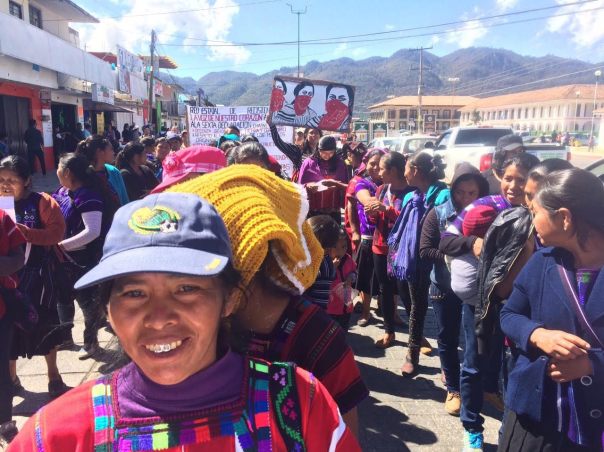
Women in social movements march in Chiapas.
By FM La Caterva
Progressivism seems to be in crisis in a good part of Latin America. To understand its debacle, “Changing the world from above” was just published (in Spanish) in Argentina. From the National Network of Alternative Media (Argentina) we interview Raúl Zibechi, author of the book together with Decio Machado. “The material and social bases on which progressivism is settled have been de-structured by reality,” he asserted.
-The subtitle of the book is “The limits of progressivism.” Without a doubt he makes reference to a debate that has not become much more profound, but that is more urgent than ever. How did the idea for this publication emerge and what do you propose in it?
-The book has various objectives. On the one hand, to put forward again some debates, which seem to me are important to maintain. For example, around the word revolution, which has a history and content, not anything is a revolution. La bourgeoisie have perverted it, they tell you that now the “revolution” is to buy a car, I don’t know as well as the publicity, the consumerism; but we have also perverted it, not just anything is a political revolution. The classics of socialism, Marx, Lenin, Mao, design what a revolution is, even the Social Sciences. A revolution supposes destroying the State’s repressive apparatuses; in other words, an electoral victory is not a revolution. I consider that it’s more of a conceptual thing, weightier, and therefore it’s necessary to clarify what we’re talking about when we talk about revolution. Secondly, we’re facing what some of us consider the end of the progressive cycle, and we also wanted to clarify what we understand by the end of this cycle. It’s not that there will no longer be more governments that declare they are progressive, it means that the material and social bases on which progressivism is supported are in crisis, they have been de-structured by the same reality. We are basically referring to two questions. A first one is the economy. Progressivism was based on an economy that exports raw materials at very high prices, oil at more than one hundred dollars, soy and minerals. Those prices fell sharply, and in the case of Venezuela it’s very clear, the oil is less than half and there is a very grave economic situation of indebtedness. The material bases of progressivism fell, and at the same time the social bases, which are very clear beginning with 2013 in Brazil, a time in which the social peace was also broken with the emergence of the popular sectors on the political stage, and later with the rights taking advantage of that popular emergence because the lefts were incapacitated or not in play to understand what was happening. For example, Lula can win the elections, if he’s not in prison, which is very probable, but can he revive Lulism? We think not; that Lulism is buried because all its project of governability is destroyed and weakened, so it won’t be able to create a government like the one it created at the start of 2003. Now under the Dilma government Lulism had entered into crisis, and let’s not forget that Dilma was the one that initiated the adjustment that today is terrible. I’m not saying that today is the continuity of that, but rather a tremendous deepening of what Dilma tepidly started. That is a second question. And third place in the book we want to place some debates, for example about social policies and consumerism. What is the objective of the social policies? What effects have they had on the principal countries of Latin America? These are some of the things that we want to put up for discussion with this work. Finally, the role of the intellectuals, whether the movements today need academic or media intellectuals, or whether the role, and to me this seems marvelous, is to create their own intellectuals.
-Is there a part of the book in which you talk about the relationship between progressivism and corruption. From where do you broach this theme, which at times is a difficult discussion to have among the lefts?
-Corruption today, different than what it was in the history of capitalism, is systemic. In the history of our countries corruption was a sharp deviation, there were corrupt people that took advantage of being in a state position to help their businesses. Today the system is unthinkable without corruption. I give you an example: Germany, a country of the center, developed, the capital there relatively “honest,” to put it one way, has gone for years without being able to inaugurate an airport in Berlin, constructed by private companies paid by the government, because of structural faults of that airport. I mean that they made a blunder when they constructed the airport. Even in Germany, being one of the most careful social-democratic capitalisms in the history of 20th Century capitalism, until this thing of corruption arrived there. Corruption today is not a deviation; it’s part of what we call accumulation by dispossession, or accumulation by theft. Just like they rob us of water and contaminate it for cultivating soy, for mining, they rob people of their house, their work, their rights, etc. The system functions in this way. Then in a country like Brazil, in which private enterprise always financed the electoral campaigns, in which gifts imply that I elect you governor, or the city’s mayor, because I pull the strings for your campaign as a private entrepreneur, and you give me back that string that I put, increased, plus value multiplied, through public works. That’s how Brazilian capitalism works, which is one of the most exacerbated in that sense, but not the only one. That the system works that way doesn’t mean that I endorse it. The PT in government, as Frei Betto, the Brazilian liberation theology priest that was in Lula’s government and se left, has set forth very clearly in a book he published, The Blue Fly (La mosca azul), in which he says that when the blue fly bites you, it corrupts you, you begin to like comfort, having a car, having a beach house, another wherever, etc. Comfort didn’t bite him, and the left should have passed by that, should not have functioned inside of the corrupt system, but rather have transformed it. What the PT did in Brazil was to play with that corruption, only that instead of doing it in favor of the old corrupt caudillos of the Brazilian political system, it did it in favor of the governability of the PT, and that already had been seen two years after the PT’s arrival in government in 2005, with the “Mensalao,” which was a monthly payment that went to opposition deputies so that they would vote for government projects, using state companies. The lesson was not understood, and it continued in the same way. So, I have no doubt that the right and Judge Moro, who is also on the right, would take advantage of the corruption to sink the PT, but you were in the game, you are also responsible for having been there and not having transformed it.
-Just as is the word revolution, as a counter-face there is one that many times the lefts forget, which is the word exploitation. The labor reform in Brazil was just voted on, and in Argentina a few days ago the State repressed and evicted the Pepsico factory, occupied by its workers. What is your reading of this regional panorama that implies an offensive of the capitalist classes?
-I think that in this epoch of the accumulation of capital by theft, the exploitation of labor is increasing exponentially in the entire world. For example, faced with all the jobs that were destroyed in the crisis, today in part it returns to having employment, because capital needs it, but in much worse conditions, with lower salaries; what they are doing is a profound restructuration of social security, increasing the retirement age, diminishing retirement conditions, we are going to much more exploitive regime than that from which we came. The Welfare State ended, the developmental State ended. Then capital can just establish a system like the maquila (sweat shop). What is the maquila? It’s a system through which the factory is converted into a prison; so you stop having rights, you are a prisoner that works not 8 hours, but the hours that capital wants or it throws you out or kills you, as happens in the maquilas of Guatemala, of Honduras, in Mexico, in the north close to the border with the United States. At one time the system aspired to integrate workers, with better working conditions, which was Peronism and development in Argentina, from the 40s forward. The dictatorship now began to break that up and neoliberalism broke it even more, and now it’s finished. Today the system of exploitation is very cruel; the extractive model generates employment for half of the population, minimally dignified employment, the other half survive as motoqueros, as precarious workers or they don’t directly survive. They have to go to completely illegal employment, in the networks of the narco, or in self- employment or whatever. But the half of the population the system rejects has no place in the current system; thus, the war in Mexico, the exponential increase of violence against women and young people. One must understand that the system functions like that. The governments that are coming, which can come to be governments that give you a little more of the air, are going to be conjunctural, as was the government of Cámpora in 1973, which was a better government than others, but how long did it last, how long did it last being a government that bet more on what’s popular? That ended, capital bet on the hardest. What the progressive governments did, among other things, beyond some positives, was to deepen the extractive model. When did soy increase the most in Argentina? It increased in the decade of Kirchner. The model today is a model of exclusion, of hyper-exploitation and impoverishment of the popular sectors, because they no longer need half of the population, not even to accumulate by theft, because there is nothing to steal from them. And the merchandise that the other half consumes is low-quality merchandise; they don’t consume I phones. This is the situation in which I believe we are.
-How do you see the role of the media at this juncture?
-The system’s media, this mega-fusion that Clarín just did, Oglobo in Brazil, are the system’s media, and are evidently not going to favor us. They are the media of oppression, of distraction for the system. So we have to have our own media, and we must make it very clear that what the media sell us is not for us. There is an old saying of the Romans that was “bread and circus,” giving a little bit of food to the poor so that they are entertained, and lots of circus. Today the circus cannot make us dizzy. The circus is not ours, and when I say circus I am thinking about consumerism. We cannot think about transforming reality, and I’m thinking about the militant activists, about the thousands of individuals that are going to the marches, about the thousands that are angry at the system. We cannot think that with an iPhone in one hand and a ballot in the other, we’re going to a socialist paradise, or wherever. It’s necessary to stop having that iPhone in one hand; perhaps it’s better to have a radio that is tuned to community radios like yours, and other things, and in that other hand a fist for fighting. We cannot let ourselves be persuaded by the system’s media, we need our own media. Since you asked me, I’ll tell you something that made me very happy, I read a census that ARECIA (the Network of community magazines) took, and the online and paper magazines reach 5,000,000 people. If you add community radios to that… we are no longer marginal. At the communication level we have some weight. I remember that during the Monsanto encampment, if I wanted to inform myself about what was happening in the camp not even Pagina/12 informed me about it; I had to go to Ecos Córdoba [an alternative media] that reported on the camp. We already have a network sufficiently wide and constructed so as not to depend on the big monopolized media. And that seems to me to be a very strong and very important learning experience, because we are now in that situation in which we have and are able to enhance what we already have. It’s good to denounce the media monopolies, but above all that we must do is support each other and support what we have already constructed, which is not a little; we are not marginal.
-In your book you argue with intellectual referents about political processes related to progressivism, among them Álvaro García Linera, who recently has asserted that we are in the presence, more than at an end of a cycle, of “revolutionary waves.” According to him, there was a first wave linked to progressivism, and like all waves it implies ebbs and possible new surges of that struggle at a future time. In the book you propose something interesting at the moment of thinking about what a civilizing change would imply, which is the idea of a collapse; in other words, no longer conceiving of the revolution in terms of the myth of what were known as the 20th Century revolutions, of the conquest of power in a traditional sense. To what are they referring with this perspective on the collapse of capitalism and what do you think about these proposals of García Linera?
-First about García Linera, I would be happy if there were new revolutionary waves, and I think there will be. What happens is that the progressive governments, and concretely that of Bolivia that Álvaro García Linera talks about, what they have done is to close off the ability of the movements to confront those waves. All the progressive governments have weakened the movements, some directly, others unintentionally, but in fact they have weakened them. I think that revolutionary waves are always born below; they don’t come from a government. The governments can encourage, can support. But, what I’m seeing is something different. When the TIPNIS march took place in defense of a territory and a national park -because the government wanted to build a highway that practically destroyed it-, the government repressed the march, condemned it and criminalized it. So, the movements are the subjects of a revolutionary wave, not the States. As for the collapse, it has a long trajectory in revolutionary thought. Marx and Engels bet on the collapse of capitalism, Lenin also. In fact, the peoples experienced World War I as a true collapse, just like WWII. The collapse is not of the stock markets; the collapse is of the life of those below. It’s in that where we affirm our action; I think that there are two things there. One: the current system for many reasons heads towards collapse, that is a key element, but the other thing is that if one stops as a revolutionary, or as a person that wants a new world, and I think about the biography of Lenin, for what moment do you prepare yourself? You prepare for the moment in which those extreme situations arrive. Lenin prepared for 1917 his whole life. One does not prepare for the next electoral campaign, beyond the fact that you can agitate and go to the elections, I’m not saying no, but your fundamental preparation is not for that, your fundamental preparation is for when life enters into a bifurcation, socialism or barbarity. We prepare ourselves for that. And I think that it’s a question that comes well before the definition of a tactic, some objectives or of a strategy. It’s thinking about why I’m here, and in what direction I am preparing myself. I think that these are debates lacking in our left, in our activism. As said before: strategic debates, we think too much about the current conjuncture, about whether such law, such repression, which are important, but that denunciation, that organization around a specific activity in response to the system, cannot make us forget that we have a long-term strategy, and that that strategy is what guides our action.
Originally Published in Spanish by Radio Caterva
July 2017
http://www.fmlacaterva.com.ar/2017/07/raul-zibechi-los-sujetos-de-las-oleadas.html
Re-Published with English interpretation by the Chiapas Support Committee
On selective structural impunity

Warehouse scene after soldiers massacre 22 in Tlatlaya
By: Magdalena Gómez
We certainly don’t have good accounts in the application of the constitutional reforms in matters of justice, as the report “From paper to practice,” elaborated by the Centro Pro, the Mexican Institute on Human Rights and Democracy and the Spanish American University documents well. Two days before the report was presented, the Tlatlaya case, which makes up part of that report parte, received new breath. We remember that on June 30, 2014 in the San Pedro Limón warehouse, soldiers shot at 22 civilians that died in the place. The National Human Rights Commission (CNDH, its initials in Spanish), in its recommendation number 51/2014, concluded that at least 15 of the 22 killed in an alleged confrontation were executed extra-judicially. Three years after a series of trials, the 14th district court of amparo in criminal matters in Mexico City considered founded the petition for amparo number 545/2017, promoted by the Centro Pro, on behalf of one of the witnesses to the events (Clara Gómez González, mother of one of the women that died in Tlatlaya), in which she pointed out to the ministerial authority the omissions to carrying out an effective and efficient investigation of the facts that happened in Tlatlaya, state of Mexico, as well as the military order that established the abatement of “delinquents in hours of darkness,” directed to the base of operations to which the soldiers involved belonged, the same as that related to the chain of command and unification of the investigation. It was resolved that: “the complainant is right, upon pointing out that the lack of action has wounded fundamental rights, in this case of the victim, as well as to the detriment of the faculties of investigation conferred by constitutional mandate.” At the same time it was determined that, in order to avoid fragmentation of the case, the PGR must integrate all the investigations that it has carried out into a single file.
Erratic justice, most evident dealing with soldiers involved, also has the background that in May 2016, the sixth unitary tribunal, with headquarters in Toluca, ordered due to “lack of elements to process” the release of three soldiers, pointed out as those allegedly responsible for crimes related to the murders and altering of the crime scene. Previously, other soldiers also remained free due to lack of elements.
There are no conditions for investigations of this kind to advance, because the repeated official posture of seeking to extend a mantle of impunity over acts that involve soldiers turns out to be very grave. We didn’t investigate the crimes of October 2, 1968, and more recently Ayotzinapa and Tlatlaya among others. What is demanded is the investigation and delineation of responsibilities in concrete acts and the State strategy consists of asserting that such a demand is an attack on the military institution. Just this year we find a succession of meetings in which Enrique Peña Nieto clothes the Army with expressions like “it has won the affection of Mexicans… Every day the recognition of soldiers and sailors is growing within me.” Finally, he aligned against: “those who disqualify the values of the armed forced out of ignorance or because of fraud,” and he added that: “those who denigrate the armed forces denigrate Mexico.” (La Jornada, 28/3/17)
The Centro Pro already stated that this resolution from the judge must be complied with and the PGR take charge of righting the structural deficiencies in its functioning, and in passing also addressed the risks of Congress approving a Homeland Security Law, without due controls on the deployment of the armed forces in security tasks. In contrast, the President of the Republic argues that said legislation is necessary and that the work of the armed forces is subsidiary and temporary. If we look at the virtual disaster of the system of procuring justice, we don’t see that conditions exist for the alleged temporariness.
Each resolution that profiles a questioning of investigations that involve the military provokes a sort of campaign of vindication or amends, so we should read the posture of the fraction of the PRI in the Chamber of Deputies to the publication of the amparo, with the announcement that the 2018 Budget of Expenditures will include an increase in Army and Navy spending: “We want to strengthen the armed forces, which are a source of national pride; we must care for them and equip them in the broadest sense of the word” (César Camacho Quiroz, PRI coordinator in San Lázaro. La Jornada 8/18/17). This whole environment constitutes strong pressure towards the Judicial Power when anyone of its members decides to fulfill its responsibility and confront in fact the institution that more than procures justice impedes it. Evidence abounds about different cases in the report “From paper to practice.”
———————————————————–
Originally Published in Spanish by La Jornada
Tuesday, August 22, 2017
http://www.jornada.unam.mx/2017/08/22/opinion/014a2pol
Re-published with English interpretation by the Chiapas Support Committee
Macri’s war against the Mapuche people

By: Raúl Zibechi
“This is the new Desert Campaign, only not with the sword but with education,” said Esteban Bullrich, then Minister of Education and Sports upon inaugurating a hospital and school in September of last year (goo.gl/JxD7Wl). Beyond the brutality of the words of the current candidate for senator, who competed with Cristina Fernández in the province of Buenos Aires, the phrase reveals what those above think about the Native peoples.
The Desert Campaign (or Conquest) was a genocide perpetrated by the Argentine State between 1878 and 1885, when it grabbed large extensions of territory from the Mapuche, Ranquel and Tehuelche peoples. The indigenous peoples defeated by the forces commanded by Julio Argentino Roca were deported by force into concentration camps, exhibited in museums or carried away for use as forced manual labor.
The underlying motive, that which cannot be expressed in public but is the dark motivating force for the actions, was the expropriation of their territories to incorporate the lands into the market and to expand the republic into zones that, before and now, are considered as “desert,” because they are little spaces fertile for the accumulation of capital.
The Bullriches (the Macri candidate and his Auntie Patricia, current Security Minister) are part of a distinguished family of the Argentine oligarchy, which played a direct role in the Campaign of the Desert.
Historian Osvaldo Bayer showed, based on documents of the Rural Society, which between 1876 and 1903 granted almost 42 million hectares (more that 100 million acres) to 1800 family members and business friends of President Roca. Some families, like that of the former Economic Minister in the last dictatorship, Martínez de Hoz, obtained 2.5 million hectares (more than 6 million acres) for free.
According to a BBC report, a good part of those lands currently belong to Benetton, which owns almost one million hectares (almost 2.47 million acres), being one of the principle owners of Patagonia, in permanent conflict with the Mapuche communities, since the multinational occupies part of their ancestral territories (goo.gl/73JZTy).
Extractivism is the continuation of the Desert Campaign. According to the journalist Darío Aranda, from the 40 mining projects in studies (in 2003), they advanced to 800 projects (in 2015); it went from 12 million hectares of transgenic soy to 22 million in the same time period. “Amnesty International counted a floor of 250 conflictive cases, among which it detected one point in common: there are always companies behind them (agricultural, oil and mining companies, among others) that act with complicity, by act or omission, with the governments” (goo.gl/71ckCG).
The media do the dirty work by linking the Mapuche to the FARC, Kurdish groups and ETA, without any proof, supported only by statements from the governor of Chubut, at the service of advancing the extractive frontier. Bullrich, the Minister of Security, took one more step by pointing out that the Mapuches are a national security problem and accusing them of being “terrorists,” at the same time that she assures that they favor a secessionist project.
“We are not going to permit an autonomous Mapuche republic in the midst of Argentina. That is the logic that they are proposing, the rejection of the Argentine State, the anarchist logic,” says one who in the seventies was active in the armed Montoneros organization (goo.gl/yp2hfU).
Behind all this cackling there is a reality that is what really disturbs: in the last 15 years, after exhausting administrative and judicial bodies, the Mapuche people recuperated 250,000 hectares (more than 600,000 acres) that were in the hands of large landowners, Aranda assures. In other words, despite the repression, criminalization and defamation, the Mapuches are winning.
The State‘s conflict with the Mapuche community Pu Lof in Resistance, in the locality of Cushamen, province of Chubut, intensified in 2015 because of the repression and criminalization of their leaders. The lonko (chief) Facundo Jones Huala, Mapuche authority of the community, was arrested on June 28 of this year, the same day on which Presidents Mauricio Macri and Michelle Bachelet met. The governments accused him of terrorism, arson, theft, threats, and even of having “declared war on Chile and Argentina” (goo.gl/1khbBy).
On August 1, members of the National Gendarmerie raided and burned the community’s installations. Within the framework of the repression the solidarity activist Santiago Maldonado disappeared when he couldn’t cross a river together with his compañeros pursued by the police. As of now, nothing is known of his whereabouts; the government refuses to respond while marches and gatherings intensify demanding his appearance alive.
There are three facts that make those above desperate and explain the repressive brutality.
One, the Mapuche people remain alive; they don’t surrender and they recuperate lands, which is the basis of their reconstruction as a nation.
Two, there is a national and international support campaign. One hundred organizations of Native peoples, Amnesty International, the Peace and Justice Service and the Permanent Assembly of Human Rights, issued a communiqué titled The indigenous struggle is not a crime, in which they say that: “the State privileges the interests of the oil companies and criminalizes the Mapuche people.”
Three is that the Mapuches have constructed the most diverse organizations, among them the Mapuche Ancestral Resistance (RAM, its initials in Spanish), dedicated to recuperating land. Daniel Loncon, a member of the Free Office of Original Peoples, said that among the Mapuches: “some prefer the diplomatic path, but we have also been witnesses to our grandparents that have died going from office to office seeking the legitimation of their lands. In that sense, the RAM is an expression of the Mapuche people that are tired of this historic injustice, but aware of where the economic power is that drives all that. Recuperation is not done to a neighbor, but rather to a multinational” (goo.gl/GEqKq9).
¡Marichiweu! (We will win a thousand times!)
———————————————————-
Originally Published in Spanish by La Jornada
Friday, August 18, 2017
http://www.jornada.unam.mx/2017/08/18/opinion/022a1pol
Re-published with English interpretation by the Chiapas Support Committee
They release the police that residents retained after Peña’s visit to Chiapas
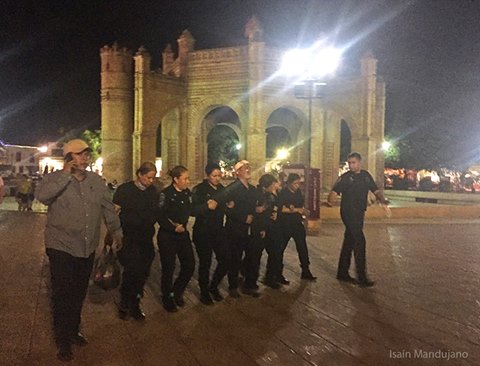
Federal Police are retained in Chiapa de Corzo.
By: Isaín Mandujano
CHIAPA DE CORZO, Chiapas (apro)
In the early morning hours of this Tuesday, residents of Chiapa de Corzo released the seven federal police that were retained after a clash between demonstrators and police agents, within the context of President Enrique Peña Nieto’s visit to this colonial city. [1]
After the celebration event for International Indigenous Peoples Day, members of the federal forces maintained several clashes with residents, who repudiated the Mexican president’s presence in this location with protests.
At first, hundreds of youth armed with sticks and stones intercepted an AVC bus that was transporting the police, the majority of them women, removed them from that vehicle and took them to the El Calvario neighborhood.
Later, in a second clash, the police exchanged tear gas for sticks and stones that the protesting youths threw. In this incident, the demonstrators retained a member of the federal police and took him away hitting him. Bloodied, the police officer was carried off to join the group of female police that they were holding. These acts occurred between 7 pm and 8:30 pm.
While the young people took control of the central plaza and City Hall, hundreds of state and federal police congregated at the town’s entrance to enter and rescue the police being held.
However, they sent a commission of functionaries headed by the Federal Police Commissioner, Jorge Armando Rodríguez Solorio, who dialogued and negotiated for several hours with the residents that participated in the protest and had hidden the police officers.
It was around one o’clock in the morning when the residents finally agreed to release the federal police officers in exchange for civilians that the police allegedly detained, but the authorities reported that they had not detained a single civilian.
After confirming that no civilians were detained, residents released the siz female police and the one male officer, all of whom came out walking for several blocks, went by the central plaza and headed for a white Suburban that was waiting to get them out of town and to take them for a medical exam.
As soon as they were set free, all the federal and state police agents withdrew from the zone. The withdrawal started around 1:30 am.
At the plaza, the young people set fire to the bus that burned for several hours in front of City Hall. Other official City Hall vehicles were also destroyed.
This is not the first time that residents of Chiapas de Corzo have confronted federal police. On May 25, 2016, they expelled hundreds of federal police from the town that were found staying in a hotel. Local residents threw them out of town because they considered them instruments of repression of the federal government against the teachers’ movement that lasted for more than three months in an occupation in Tuxtla Gutiérrez, in protest against the education reform.
[1] President Peña Nieto used this occasion to deliver a speech about the progress of the Special Economic Zones in Chiapas, Oaxaca and Guerrero and how they will alleviate the social and economic “backlog” (poverty, extreme poverty, lack of education and health care) in indigenous communities.
——————————————————————
Originally Published in Spanish by Proceso.com.mx
Tuesday, August 8, 2017
Re-Published with English interpretation by the Chiapas Support Committee
The Hour for Our Peoples to Flourish Has Arrived
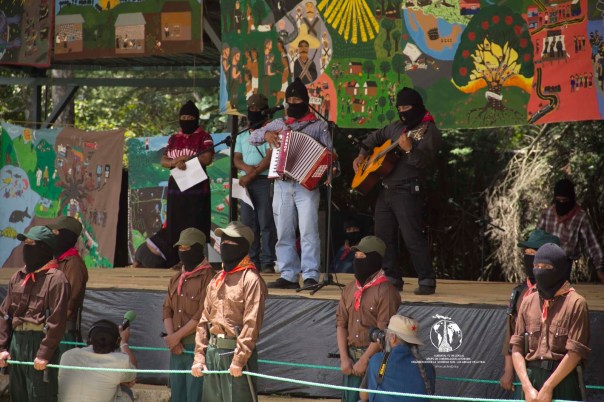
Zapatista performance at CompArte 2017 in Oventik
ANOTHER STEP FORWARD
A Joint communiqué from the National Indigenous Congress and the Sixth Commission of the EZLN greeting the first members of the civil association, “The Hour for Our Peoples to Flourish Has Arrived.” This is a required legal step in order to register the candidacy of the spokesperson of the CIG [Indigenous Governing Council], the indigenous woman María de Jesús Patricio Martínez, for the presidency of the Mexican Republic 2018-2024.
August 2017
To the People of Mexico:
To the Peoples of the World:
To the National and International Sixth:
Sisters, brothers, hermanoas,
Compañeras, compañeros, and compañeroas:
The Native barrios, tribes, nations, and peoples gathered together in the National Indigenous Congress and the indigenous Zapatista communities salute this next step forward on the long road toward putting the name of our indigenous compañera María de Jesús Patricio Martínez on the electoral ballot in 2018 as candidate for the Mexican presidency.
This legal step has been possible thanks to the generous ear, respectful gaze, and friendly word of women and men who have earned, through their own history and efforts, a special place not only in Mexico and in the world but also, and above all, in the heart that is the color of the earth that we are.
The National Indigenous Congress as well as the indigenous Zapatistas express here our approval of and appreciation to:
María de Jesús de la Fuente de O’Higgins (Visual Artist and President of the Maria and Pablo O’Higgins Cultural Foundation) Graciela Iturbide (Photographer) María Baranda (Poet) Paulina Fernández Christlieb (Ph.D. in Political Science) Fernanda Navarro (Ph.D. in Philosophy) Alicia Castellanos (Ph.D. in Anthropology) Sylvia Marcos (Ph.D. in Sociology) María Eugenia Sánchez Díaz de Rivera (Ph.D. In Sociology) Ana Lidya Flores (Masters in Ibero-American Literature) Paulette Dieterlen Struck (Ph.D. in Philosophy) Márgara Millán (Ph.D. in Latin American Studies) Domitila Domingo Manuel “Domi” (Graphic Artist) Mercedes Olivera Bustamante (Ph.D. in Anthropology) Bárbara Zamora (Attorney) Magdalena Gómez (Attorney) Rosa Albina Garavito (Masters in Sociology) Elia Stavenhagen (Doctor) Lidia Tamayo Flores (Harpist) Carolina Coppel (Cultural Producer) Pablo González Casanova (Ph.D. in Sociology) Antonio Ramírez (Graphic and Literary Artist) Eduardo Matos Moctezuma (Masters in Anthropological Sciences) Javier Garciadiego ( Ph.D. in Mexican History) Juan Carlos Rulfo (Filmmaker) Juan Pablo Rulfo (Designer, Graphic Artist) Francisco Toledo (Graphic Artist) Paul Leduc (Filmmaker) Mardonio Carballo (Writer, Journalist) Luis de Tavira (Theater Director) Juan Villoro (Writer) Óscar Chávez (Singer-Songwriter) Gilberto López y Rivas (Ph.D. in Anthropology) Carlos López Beltrán (Ph.D. in Philosophy) Néstor Quiñones (Graphic Artist) Jorge Alonso (Ph.D. in Anthropology) Raúl Delgado Wise (Ph.D. in Social Science ) Francisco Morfín Otero (Ph.D. in Philosophy) Arturo Anguiano Orozco (Ph.D. in Sociology) Carlos Aguirre Rojas (Ph.D. in Economics) Pablo Fernández Christlieb (Ph.D. in Psychology) Rodolfo Suárez Molinar (Ph.D. in Philosophy). Leonel Rosales García, Monel (Musician from Panteón Rococó) Rodrigo Joel Bonilla Pineda,Gorri (Musician from Panteón Rococó) Marco Antonio Huerta Heredia, Tanis (Musician from Panteón Rococó) Rolando Ortega, Roco Pachukote, (Musician) Francisco Arturo Barrios Martínez, el Mastuerzo (Musician) Panteón Rococó (Musicians) Carlos González García (Attorney)
These persons, along with others who are currently being contacted, form part of the Civil Association named “The Hour for Our Peoples to Flourish Has Arrived,” a necessary body formed in order to begin the path of registration for the candidate whom, with respect and affection, we call “Marichuy,” so that for the first time in this country’s history, a woman from a Native people, an indigenous woman, contends for the presidency of the Mexican Republic.
Because of their honesty and commitment, all of these people hold our absolute trust and admiration. We thus presented their names to the first General Assembly of the Indigenous Governing Council held August 5 and 6, 2017. The Indigenous Governing Council received with joy the support of these brothers and sisters who are recognized across broad sectors in Mexico and the world due to their work in the sciences, arts, and social struggle.
In the face of the current war, our wager is for a real peace, that is, with democracy, freedom, and justice. This is one further step on our path to find those who we want to hear to and who we want to call to organize themselves.
From the most forgotten corners of Native Mexico, for the Full Reconstitution of Our Peoples: Never Again a Mexico Without Us!
National Indigenous Congress
Sixth Commission of the EZLN
August 6, 2017
En español: http://enlacezapatista.ezln.org.mx/2017/08/07/llego-la-hora-del-florecimiento-de-los-pueblos-un-paso-mas/
“Chinga tu madre Peña Nieto…” Zapatistas in the five Caracoles
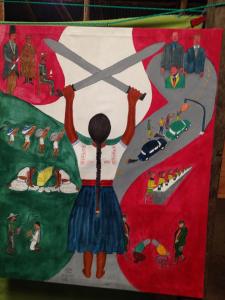
A painting in Oventik during the CompArte Festival 2017
By: Isaín Mandujano
The Zapatista CompArte Festival concluded Saturday with the slogan “Chinga tu madre Peña Nieto… and you too, Donald Trump,” indigenous of the five regions where the support bases of the Zapatista National Liberation Army (EZLN) are grouped together.
First, there were four days in which exhibitors from different states and countries came to the al Center for Integral Development for the Indigenous Communities (CIDECI) to show the indigenous Zapatistas their most diverse artistic manifestations; such as, dance, theater, painting, film, sculpture, music and other activities.
There, from last Monday to Thursday, the masked ones, young people in the majority, were present at the presentations of the Mexican and foreign artists and participated in the offered workshops.
On Friday, August 28 and Saturday 29, the Zapatistas arrived from the five Caracoles, which are divided into the regions of the EZLN support bases, which are: Roberto Barrios, La Garrucha, Morelia, La Realidad and Oventik.
In Oventik, Comandante David of the EZLN as host welcomed all the attendees to the Second CompArte Festival for Humanity 2017 “Against capital and its walls, all the arts” and thus that first Friday began with 81 non-stop presentations all day. Activities like dances, theater works, poetry, music, as well as painting and sculpture.
The Zapatistas clarified that what they would see for two days would not be a “spectacle,” but rather the word, voice, rebellion, rage and struggle from the different regions of the EZLN support bases.
The dances, theater works, songs and poetry, remembered that past of oppression that their grandparents and great grandparents experienced; in the majority of the acts they remembered the exploitation of the indigenous on the part of caciques and cattle ranchers, for whom they worked the land.
Indigenous men and women, the majority of them youths between 15 and 24 years of age, born after the 1994 armed uprising, were the protagonists of these presentations.
Songs like “The sad history of our grandparents, ” “The mistreatments on the finca” sung by masked men from the Caracol of La Garrucha, “The exploitation of before” by singers from the Caracol of Morelia or “The tempest of the housed” sung by youths of the Caracol of Oventik, sketched the suffering of the indigenous communities in this region of the country.
In the same way, poems like “Our suffering throughout history” declaimed by indigenous of the Caracol of La Realidad, “The remote slavery of the past and present” by youth of the Caracol of La Garrucha and “The exploitation and rage that were transformed into rebellion” by masked ones in the Caracol of Morelia narrated the same history of exploitation in times of submission by the landowners.
In the songs and the poems, the top hit was always the same “Fuck you Peña Nieto and you too Donald Trump,” “We’re not afraid of you.”
The Corrido of Peña Nieto sung by masked men of the Caracol of Roberto Barrios and other songs were plagued with insults to President Enrique Peña Nieto and the president of the United States, Donald Trump.
The Zapatistas exposed how they organized to rebel against the oppression of which their grandparents were victims, how they had to confront that process of rebellion and struggle for a country with justice and dignity.
In all their artistic theater statements they aligned the struggle of Zapatismo against capitalism, the enemy to conquer now and the one that threatens extinction of the indigenous peoples that oppose the dispossession of their lands and territories.
“Art and culture are a fundamental part of our resistance, rebellion and struggle against capitalism,” asserted Comandante Insurgente David, in the name of all the Zapatistas.
“With the unity and organization of the world’s poor and rebellious, we will confront and destroy this system of death,” the host said.
“Art and culture have permitted us to survive the bad government’s harassment for more than 20 years, but now art and culture have given us life, resistance and pride in what we are. With this spirit of struggle for life we formally begin this CompArte Festival,” he added.
Even with the rain, the masked indigenous didn’t stop and staged a theater work about how the Indigenous Government Council (CIG) was formed and its spokesperson María de Jesús Patricio was elected, last October in the XX anniversary of the Nacional Indigenous Congress (CNI).
During the program they also made reference to the “43 absent from Ayotzinapa,” in reference to the normalistas from the state of Guerrero, disappeared by the Mexican State, in September 2014.
For two days, the Zapatista Tzeltals, Tsotsils, Tojolabals, Chols and other ethnicities present, also praised the role of women in this struggle of the EZLN and the indigenous peoples of Mexico. The traditional and well-known group The Originals of San Andrés didn’t stop singing the “Ballad of Marichuy” on various occasions.
At the end of the event the Zapatistas, closed with the seal of the event, Chinga tu madre Peña Nieto and you too Donald Trump.”
——————————————————————
Originally Published in Spanish by Chiapas Paralelo
Sunday, July 30, 2017
Re-Published with English interpretation by the Chiapas Support Committee
Mexico and Venezuela: submission and interference
A LA JORNADA EDITORIAL
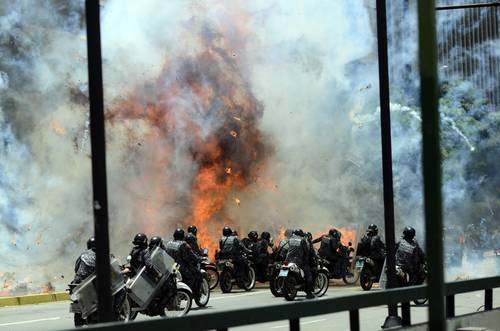
In Caracas, security forces were very busy during the protests against the National Constituent Assembly.
In a joint communiqué, the secretaries of Treasury and Public Credit (SHCP) and of Foreign Relations (SRE) reported yesterday, with respect to the sanctions announced by the Donald Trump administration against Venezuela that the Mexican government “will proceed accordingly, in conformity with applicable laws and conventions in the matter,” and undermined the ability of Nicolás Maduro “to fully re-establish democratic rule and the state of law in a peaceful manner.” In addition, Mexican dependencies (departments and agencies) credited the Washington’s accusations against “different functionaries and ex functionaries of the Venezuelan government” in the sense that they have diminished “democracy and human rights in said country” and that they have participated “in acts of violence, repression and corruption.”
This new official position of the national authorities takes two undesirable attitudes in the management of foreign policy too far: submission to the government of the United States and interference in Venezuela’s internal conflicts, whose solution ought to depend exclusively on the citizens of that South American country.
In the first of those terms, it is regrettable, as far as we can see, that the Mexican government adopts as its own United States accusations against Venezuelan functionaries that that have not even been proven and that, as different national and international voices have pointed out, are presented within the context of an open destabilization campaign that aims to overthrow the Bolivarian government. As to the second attitude, the national institutions lack the ability to issue judgments about the performance of rulers and functionaries of other countries and of “acting accordingly,” as well as to disqualify institutional actions of other nations, such as the convocation of Caracas to a Constituent Assembly.
Anyway, such decisions will not affect the Venezuelan authorities as much as Mexico’s own diplomacy, two of whose fundamental principles, the right to Self-determination and that of Non Intervention, are gravely undermined by such misadventures. Additionally, this alignment with the dictates of the White House on Venezuela constitutes a precedent that weakens Mexico’s ability to invoke such principles in its own defense.
Thus, the position announced yesterday by the SHCP and the SRE attempts, in the first place, against Mexican sovereignty and, secondly, of course, against the sovereignty of Venezuela.
A similar demolition of national foreign policy, dating back at least to Vicente Fox’s term, is particularly dangerous and harmful in a circumstance in which the country faces a racist, anti-Mexican, rude and unpredictable United States presidency, before which it’s more necessary than ever to retake the ethical, legal and diplomatic lines that made Mexico a worldwide referent during the last century.
———————————————————–
Originally Published in Spanish by La Jornada
Friday, July 28, 2017
http://www.jornada.unam.mx/2017/07/28/opinion/002a1edi
Re-Published with English interpretation by the Chiapas Support Committee
 Chiapas Support Committee