Chiapas Support Committee
Home of the Compañero Manuel blog on zapatistas & mexico
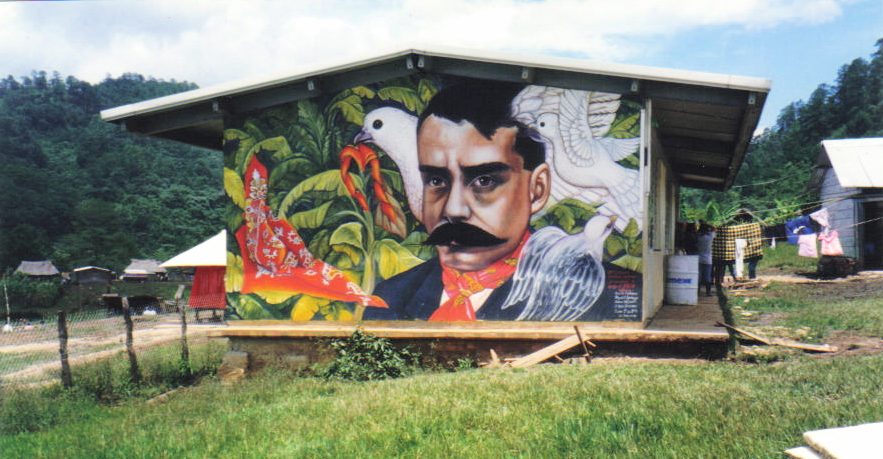
Register for ConSciences for Humanity, Second edition
 ANNOUNCING THE SECOND EDITION OF “ConSciences for Humanity,” themed: “THE SCIENCES CONFRONT THE WALL ”
To the scientific community of Mexico and the world:
To the National and International Sixth:
The second edition of “ConSciences for Humanity,” themed “The Sciences Confront the Wall,” will be held December 26-30, 2017, at CIDECI-UniTierra, San Cristóbal de las Casas, Chiapas, Mexico.
- We have so far confirmed the participation of 51 scientists from 7 countries: Germany, Austria, Canada, the United States, France, Mexico (Baja California, Quintana Roo, Mexico City, Puebla, Jalisco, Morelos, Chiapas, Querétaro, State of Mexico), and Uruguay.
- These scientists work in the areas of: Agroecology, Astrophysics, Astronomy, Biology, Biochemistry, Cosmology, Ecology, Soil Science, Ethnomycology, Physics, Genetics, Geophysics, Mathematics, Medicine, Microbiology, Neuroscience, Optics, Chemistry, and Vulcanology.
- Registration for scientists and attendees will begin December 26, 2017. Activities begin on December 27 at 10am and finish on December 30.
- To register as a listener/observer email: conCIENCIAS@ezln.org.mx
—Support Team for the Sixth Commission
Originally Published in Spanish by Enlace Zapatista

Agenda for Marichuy’s visit to Chiapas
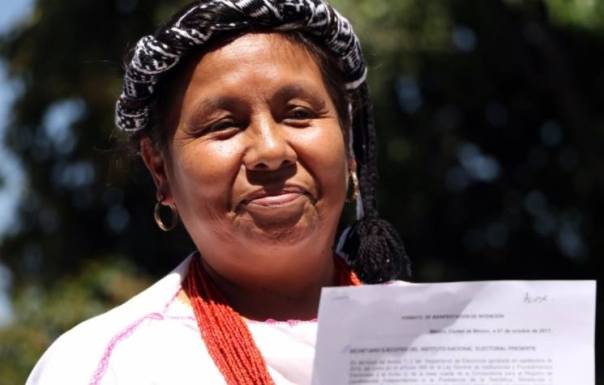
Candidate Marichuy
María de Jesús Patricio Martínez, from Tuxpán, Jalisco, Mexico, aka Marichuy, is an indigenous Nahua, traditional doctor and human rights defender, Mexican, indigenous spokesperson and representative in the 2018 federal elections.
Marichuy, an aspirant to be a candidate for the Presidency of the Republic, visited the Chiapas Coast on November 7.
Program
10: 00 am in the Joaquin Miguel Gutierrez Ejido. Pijijiapan.
6:00 pm, Offices of the Tonalá Civic Front. Calle 20 de Marzo between Av. Joaquin Miguel Gutierrez and Zaragoza. Tonalá, Chiapas.
The Tonalá Civic Front, the Autonomous Council of the Coastal Zone, and the union of campesinos and fisher folk of the coast and the Chiapas Sierra will receive the CIG’s spokesperson, to be able to listen to their voice and share their concerns, like what the residents of various municipalities are suffering after the devastating earthquake, where federal support never arrived. [1]
They will be able to present the struggle of the compañeros and compañeras, who have been in resistance against the high cost of electricity for years, and are organized in their geographies.
On November 8, there will be a meeting of the Indigenous Government Council and its spokesperson, Marichuy, with the peoples, barrios and colonias of San Cristóbal, the Highlands and the Center of Chiapas in the Plaza of the Resistance, Cathedral of San Cristóbal de Las Casas, at 5:00 p.m.
There will be cultural activities at 11 am.
All are welcome!
Our struggle is for life! May the voice of the peoples be heard!
[1] The Coastal Zone of Chiapas is where we, the Chiapas Support Committee, sent the donations we received for victims of the September 7 earthquake. Again, many thanks to everyone who contributed!
————————————————————-
Originally Published in Spanish by Pozol Colectivo
Friday, November 3, 2017
Re-Published with English interpretation by the Chiapas Support Committee
Zapatista Moon film screening
NOVEMBER 18, 2017 – 7:00-10:00 PM

AT THE OMNI COMMONS, 4799 SHATTUCK AVE., OAKLAND, CA
You are invited to a work-in-progress screening of Zapatista Moon, a feature documentary by local filmmaker Thor Anderson that narrates one man’s journey in Chiapas as he intersects with the historic Zapatista Women’s Gathering in 2007, questions men’s role and perceives the impact of Zapatismo on the on-going struggle for gender justice and equality. Requested donation is $5 to $15 (Sliding Scale) No one turned away for lack of funds.
Women’s Panel, Tamales & Aguas Frescas, Zapatista Artesanía & T-Shirts
FOR MORE INFORMATION
https://www.facebook.com/events/144265559527511/
Sponsored by the Chiapas Support Committee and Endorsed by Liberated Lens
From the end of the cycle to the consolidation of the right
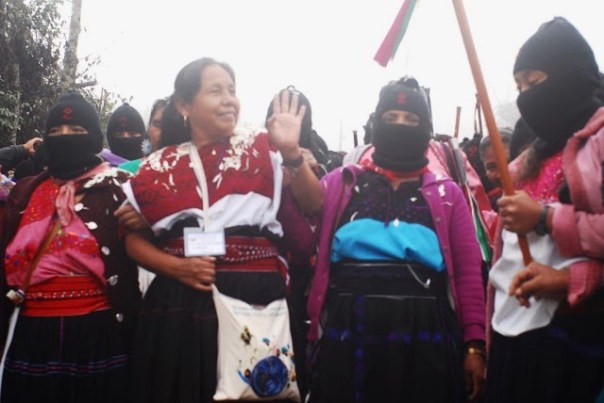
Marichuy in the Chiapas Highlands.
By: Raúl Zibechi
Political cycles are not capricious. We’re experiencing a period of the growth of the right, especially in South America. The progressive cycle ended although governments of that type continue to exist, but they will no longer be able to develop the policies that characterized their early years because a conservative inflection is imposed, although the discourses may say something different.
A good example of that irony can be found in Ecuador: an Alianza País government that carries out a conservative adjustment. Unless he opts for the extraordinary thesis of “treason,” Lenin Moreno shows that even progressives must take a turn to the right to be able to continue governing.
We say that cycles are structural and governments are conjunctural. The progressive cycle is characterized by elevated prices for the export of commodities in a general climate of economic growth, strong popular advocacy and pressure for greater social justice. Those three aspects were weakened since the 2008 crisis. Now we suffer a strong rightwing offensive on every terrain.
Despite bad economic results and an elevated social conflict in which the forced disappearance of Santiago Maldonado stands out, the Mauricio Macri government obtained a resounding victory in recent Argentine elections. The Macrismo is not a parenthesis; it won a certain hegemony that is rooted in the economic changes of the last decade, in the weariness with progressivism and the increasing weakness of the movements.
The first question to take into account is that the extractive model (soy and mining) has transformed societies. The Argentine edition of Le Monde Diplomatique for September contains two interesting analyses from José Natanson and Claudio Scaletta, which clarify the productive changes of the soy complex and its social repercussions.
The first analysis maintains that the soy map coincides “almost mathematically” with the territories where Macri wins. It emphasizes that the countryside is more and more connected with finance, industry and big media, and that the landowners and peons, who were the leading characters of the oligarchic period, now coexist with technicians, lessees, agronomists, veterinarians, agricultural machinery mechanics and fumigation pilots, among others.
Technology is even more important than ownership of the land that the “seed pools” lease, while the growers connected to the globalized world are awaiting the prices on the Chicago Stock Exchange, where cereals are quoted.
The second analysis maintains that we are facing more complexity in the rural middle classes and the emergence of new “rural-urban” middle classes. Consequently, the conflict with the countryside the Kirchner government maintained in 2008 was not the classic contradiction between the oligarchy and the people.
Starting from that moment, a more complex conglomerate of actors became visible with a much more extensive social base, which rejects social policies because they perceive urban poverty as a very distant reality. That social block is what brought Macri into government and what maintains him.
The extractive society generates conservative values and social relations, just like industrial society generated a powerful working class and values of community and solidarity. Thousands of workers were converted into a class by organizing to resist the bosses in the big factories.
To the contrary, the extractive model does not generate internal subjects; that is, inside the “productive” framework because it is a speculative financial model. Resistances are always external; those affected are generally the leading advocates.
The second question is the weariness of progressivism after a long decade of governing. Two elements appear here: One, the internal wear and tear, natural or through corruption and bad management, and combinations of both; Two, because the model itself de-politicizes and disorganizes a society that is only joined together through consumption. There is where the right bites.
Consumption is the other face of the extractive society. A society that doesn’t generate subjects or strong identities with values linked to dignified work; that is, productive work, but rather mercantile and individualistic “values,” does not have the conditions for strengthening long-term projects for social transformation.
The third question that explains the rise of the right is the weakness of the popular field, which affects the movements, the culture of work and the culture of the left. The extractive society creates the material and spiritual conditions for this anemia of organization and struggles. But there’s more.
The social policies of progressivism, above all inclusion through consumption, multiplied the predatory effects of the model as far as disorganization and de-politicization. Class contradictions disappear in the shopping centers, including ethnic and gender contradictions, because in those “non places” (Marc Augé) the atmosphere disappears the humanity of persons.
But the movements are also responsible for the options they choose. Instead of looking at long-term construction, preparing for the inevitable systemic collapse, they took the electoral shortcut that led them to construct impossible alliances with pathetic results. Some Argentine movements that opted for allying with the Justicialista right, could give an evaluation of the disastrous results they obtained, and I don’t refer to the meager harvest of votes.
Finally, we must think about the teachings that leave us with the rise of the right and the crisis of the social movements. The extractive society of the Fourth World War cannot be resisted with the same logic as the worker struggle in industrial society. A class to be directed does not exist. Collective subjects must be constructed and maintained every day. The organizations must be solid, carved for the long term and resistant to the institutional shortcuts.
————————————————–
Originally Published by La Jornada
Friday, October 27, 2017
http://www.jornada.unam.mx/2017/10/27/opinion/016a1pol
Re-Published with English interpretation by the Chiapas Support Committee
Protests demanding reconstruction of Chiapas schools escalate
PROTESTS DEMANDING the RECONSTRUCTION of CHIAPAS SCHOOLS AFFECTED by the EARTHQUAKE ESCALATE
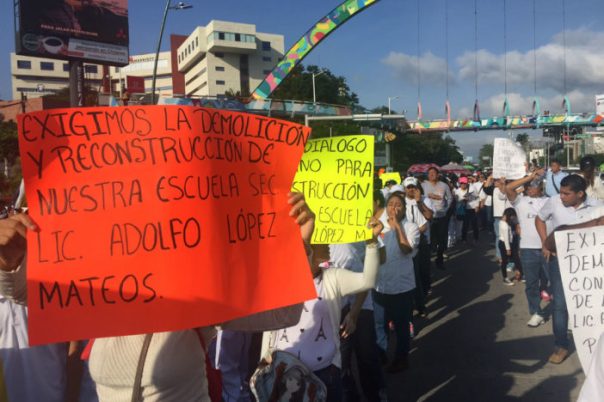
Families, teachers and students protest in Chiapas
By: Isaín Mandujano
TUXTLA GUTIÉRREZ, Chiapas (apro)
With marches, the takeover of public plazas, blockages of roads, streets, maritime ports, border bridges and other protest actions, teachers, parents and students escalated their demand that the state federal governments reconstruct and rehabilitate the thousands of schools damaged by the earthquake last September 7.
Since early in the day, hundreds of teachers, parents and their children blocked the road that leads to Puerto Chiapas, in the border city of Tapachula to demand that the state and federal governments, reconstruct classrooms affected by the 8.2-magnitude earthquake that shook this region of the country just 50 days ago.
The parents and teachers that closed that road indicated that there are around eight centers of education where the children don’t have classes due to the fact that they suffered structural damage; even worse, the children have classes outdoors or under trees or wagons.
They denounced that the situation has turned critical for them and for their children, after the conditions in which they have to hold classes have affected their health and mood, thereby reducing their school performance.
The protests affected the arrival of more than two thousand tourists that came on a cruise ship and sought to tour that region of the Soconusco, where coffee fincas (plantations) and boutique hotels abound in that mountainous region of forests and fog.
State government functionaries went to the place to negotiate with the parents; they committed to start making the damaged school habitable right away and thus achieving the unblocking of that road section.
In Tuxtla, members of the State Committee Parents announced that, 50 days after the earthquake, the demands of the parents, teachers and students to repair their schools remain unattended.
Carlos Alberto Reyes Monterrosa and Julio César Díaz Pinto, spokespersons from this state committee, pointed out that there are more than 20, 600 schools throughout the state; of them, some 2,800 have minor risks derived from the earthquake, another 1,727 present mid-level damages and some 762 present a high risk of collapsing.
They also exposed that just in Tuxtla there are more than 800 damaged schools. Last Friday, the state government committed to “lowering” the resources so that the schools are reconstructed and so that the students can return to them.
For now, said Carlos Reyes, there are thousands of children miles that are found in precarious conditions receiving classes. And desperation has obliged them a go into the streets to protest because that’s the only way the government will understand the emergency.
Just yesterday, parents, teachers and their students at the “Adolfo López Mateos” federal secondary school went out to march in the state capital’s principal avenue to demand that their school be fixed.
Javier Santiago Laguna, director of that school, said that while their requests have been heard and received in all the government agencies on whose doors they have knocked, as of now they continue waiting for machines to arrive to demolish the school buildings.
Later he detailed that there are some 18 classrooms and nine workshops and laboratories that are still not usable for the more than 1600 students that education center holds morning and evening shifts.
He also explained that there are minimally around 5 million pesos that should be invested for recovery of the lost spaces.
Gaudencio Cruz Sarmiento, a father, indicated that it is uncomfortable and disturbing for his children to have irregular classes, while bureaucracy reigns in the government for attending quickly to this emergency.
In the primary school “Restoration of the Republic,” located at 5ª North Poniente, and in the primary school “Juan Benavides,” on Central Avenue and the corner of 10 Poniente, teachers and students have come out in the street to hold classes as a protest so that their demands will be heard.
At the same time that teachers and students hold classes in the streets, parents form human walls to block vehicular transit and thus protect their children.
In Jaltenango, teachers and students have taken over the central plaza and have installed tents there for holding classes, so that state and municipal authorities can see them and attend to their demand for reconstruction of their classrooms.
In Suchiate yesterday, teachers, parents and their children blocked the international border bridge to demand that their schools be rehabilitated.
Last Friday, the director general of the National Institute of Physical Education Infrastructure (INIFED), Héctor Gutiérrez de la Garza, announced to members of the National Chamber of the Construction Industry (CMIC) and other colleagues and organizations of construction companies and providers of Chiapas that, derived from the September 7 earthquake, the federal government will invest around 1.029 billion pesos in the state for constructing and rehabilitating the affected education centers.
Gutiérrez de la Garza revealed that there are currently 2, 842 education centers with damages, the larger part of them with minor affectations: a window, a small crack, a tile or perhaps some broken lavatory.
——————————————————-
Originally Published in Spanish by Proceso
Friday, October 27, 2017
Re-Published with English interpretation by the Chiapas Support Committee
Revolt and confrontation
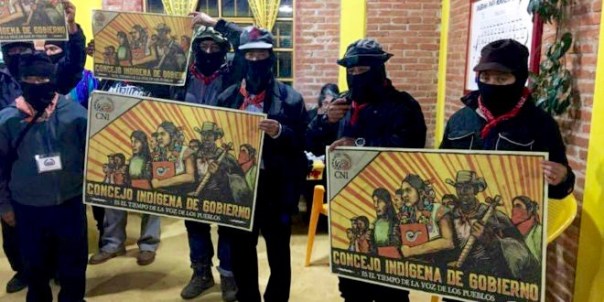
Zapatistas hold Indigenous Government Council posters.
By: Gustavo Esteva
The spirit of revolt, the natural result of the earthquakes faced with the attitudes and behaviors of the authorities, leads dangerously to confrontation with our fascists, those above as well as those below.
We celebrate in every possible way the reaction of love and solidarity that came out of the Mexican depths in the face of misfortune. Mobilizations gradually take their course in novel and sensible forms of reconstruction. They resist the obsession to demolish and control, with which the authorities seek economic and political gains. They also attempt to convert tragedy into the opportunity to sow the seed of a new society.
On the other side is the horror. We must carefully explore the attitude of thousands, of millions, who, after being paralyzed, reach out and let themselves be carried away by the winds from above, generate their own turbulence from below.
The Indigenous Government Council and the intense activities of its spokesperson, Marichuy, who begins by denouncing the technological and bureaucratic traps of the National Electoral Institute, pose an immense challenge to governors, parties and analysts. They react as was expected, with belittling indifference, disqualification or repression and desperate control efforts.
Few were expecting, however, the profoundly racist and sexist reactions that circulate through the social networks. They are a symptom of a dangerous phenomenon. Faced with the spirit of peaceful and constructive revolt that the earthquakes enlivened, passions emerge that spring from the social crack that Raúl Zibechi analyzed in these pages last October 13. His article was precisely titled “The end of democratic societies in Latin America.” He stated that: “it’s necessary to ask why a new capillary right emerged so reactionary, so incapable of dialoguing, which has torn apart the social fabric from the United States to South America.” In truth we must ask ourselves that question and act knowing that there is now an “us,” of those who try to take advantage of the limits of the system in order to transcend it, and a “them,” of those who obtain benefits from it, more like a fortune than alms, and are dedicated to openly defending it… and to confronting us. In that group are the same big political and economic figures and the modest, middle class or popular people that are happily hauled to governmental events and then seek gifts.
Fascism is one of the possible responses to a crisis like the current one, when the existing order is breaking up. It promotes unity, implicit in the word fascio, and attempts to tame the crisis, more than to annul it. It lives from tension. It appeals to the supposed equality and unity of sentiments. It can be seen as “rightwing radicalism,” but upon incarnating in nationalist and pragmatic forms adopts forms that don’t always accommodate well into the left-right spectrum.
There is no strictly fascist ideology; it would be sterile to try to characterize it. What’s important is to identify the conditions in which it emerges, how it is propitiated and what makes its triumph possible. There is a resistance to making those analyses, because they show how many of those who proclaim to be antifascists or at least distance themselves from the fascisms of yesterday and today have already fallen into their networks.
In conditions like the current ones, a survival instinct becomes generalized. To the voice of those who can save themselves, each one tries to be a survivor… That happens especially among classes on the rise that feel at risk of sinking; that’s why fascism takes root above all in the middle classes. To survive, rapidly losing dignity, one must learn to climb over the other. Everything becomes valid and legitimate, as long as it’s not among those who are sinking. That’s why it’s necessary to invent Jews, a class at the expense of which one will survive. In different countries they are called undocumented or immigrants; among us Mexicans they are called Indians, marginal, homeless, fucked…
Facing the intolerance that circulates today everywhere, it’s not enough to call for tolerance, which always supposes discrimination and is fragile in times of crisis. It is precisely to open oneself hospitably to the other, recognizing their value, their place and their rights, respecting and celebrating their difference.
The principal remedy against the fascist propensity, which appears even in friends and neighbors, is called dignity. “What do you mean by dignity,” the principal government negotiator asked impatiently in San Andrés in 1996. It bothered him that the Zapatistas and their advisors would frequently appeal to it. He wasn’t familiar with it; that’s why he had to ask. That is the problem. Although the incident started a huge guffaw throughout the Lacandón Jungle, it’s no laughing matter. We must question in depth what it implies to ignore or lose dignity.
There isn’t any dignity, for example, in those who negotiate NAFTA, forced by Trump. Since they all think in economic terms, it’s pertinent to give you a quote from Keynes: “I sympathize with those who would minimize economic entanglement between nations, more than with those who would maximize it. Ideas, knowledge, science, hospitality and travels –these are the things that should be international because of their nature. But let goods be made at home whenever it’s reasonable and convenient; and, above all, let finance be primarily national.” The quote is enough to demonstrate the contradictions that the Trump era raises… and that Mexican negotiators will never understand. It illustrates another root of their fascisms, of those that have “them.”
———————————————————–
Originally Published in Spanish by La Jornada
Monday, October 23, 2017
http://www.jornada.unam.mx/2017/10/23/opinion/020a1pol
Re-Published with English interpretation by the Chiapas Support Committee
The end of democratic societies in Latin America
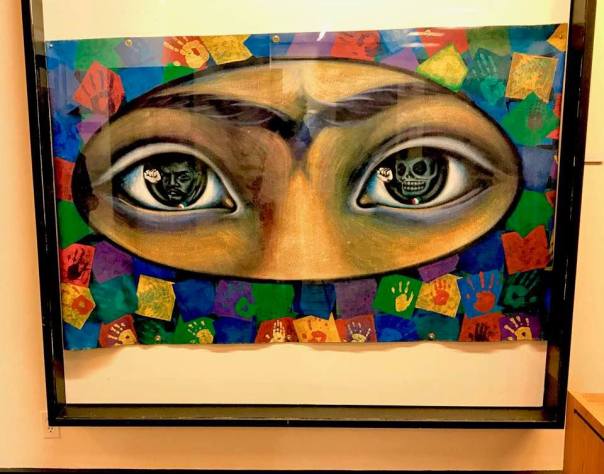
This painting by Daniel Camacho was exhibited at CompArte 2017: the Emiliano Zapata Community Festival at the Omni Commons in Oakland, CA. On display at the Asian Resource Gallery in Oakland’s Chinatown thru December 2017
By: Raúl Zibechi
Scene 1: Weeks ago, a cultural center of Munro, a place in the northern zone of Buenos Aires, presented the Orquesta Típica Fernández Fierro, one of the more potent tango bands in current Argentina. At a certain moment near the end of the recital, one of the 13 musicians took the microphone to say: “We want Santiago Maldonado to appear.”
Half of the audience of some 500 people withdrew from the place with shouts and insults against the musicians. They left suddenly, “as if there were a spring in the seats,” according to one member of the band. Among the insults they came to hear something that left them perplexed: “You broke everything and we have to pay for it.” That brutal reaction was produced because they asked for the life of a young man in solidarity with the Mapuche and disappeared by the Gendarmerie (riot police).
Scene 2: The Queermuseu-Cartographies exhibition of the Difference in Brazilian Art, which had been on display at the Santander Cultural Center in Porto Alegre for a month, was canceled by the bank that sponsored it because of the gale of reproaches that it received in the social networks. The critics accused the artistic display of “blasphemy” and of “apology for bestiality and pedophilia.”
We’re talking about 270 works from 85 artists that defend sexual diversity. The criticisms basically came from the Free Brazil Movement (Movimiento Brasil Libre, MBL), which played an outstanding role in the fall of the Dilma Rousseff government, calling together demonstrations with millions of participants. As the chronicle points out, we’re dealing with “a conservative group born in 2014 that has been gaining strength with the turn of Brazilian society to the right.”
In a statement, Santander called to reflect “on the challenges that we must confront in relation to questions of gender, diversity and violence, among other things.” But the threat of an MBL boycott had more effect than any reasoning.
One can imagine the level of aggressiveness that the popular sectors bear, if a multinational bank and a famous orchestra are attacked in that way. At this point I would like to reflect on what I consider as the erosion of the cultural and political bases of the democracies, facing the brutal social polarization that the is experienced in the region’s principal countries.
The first point consists of observing the deep social crack that exists, which is aggravated with the extractive model and the Fourth World War underway. One part of the societies opted for becoming entrenched in their privileges, of color and class, which is summarized by living in consolidated neighborhoods where there is no lack of water and houses are secure. This sector encompasses half of the population, which has access to education and health care because it can pay for them, those who have fairly well-paying but above all stable jobs, those who can travel even in airplanes, inside and/or outside of their countries. They are the citizens that have rights and are respected as human beings.
The second point is that electoral democracy has been only for that sector, although they are not the only ones that go to the polls. They can elect the candidates that represent them, who are usually of the same skin color (generally white males) that have university studies, who the communications media recognizes, esteems and to whom it generously opens its spaces.
It’s not true that democracy does not exist in Latin America. It is a democracy tailored to the “integrated” part of the population. We are facing two societies that don’t recognize each other. The Argentine media maintain that those who ask about the whereabouts of Santiago Maldonado “have declared war on us.” Or worse, the big media that say they are “respectful” of democracy, linked the Mapuche to the Islamic State.
The third point is the feedback between the political power and society. It’s often argued that this rightwing and conservative part of the society takes the offensive when the right governs. In part, it’s true. But it’s also true that the activism of that sector is what brought the right into the governments, above all in Brazil and Argentina.
I think that it’s necessary to ask why a new right emerged so reactionary, so incapable of dialoguing, which has torn the social fabric, from the United States to South America. Trump is the consequence, not the cause.
The cause is in the extractive model and the Fourth World War. When progressivism has administered the model that right emerges with even greater intransigence, because it detests the poor and those who often must share “their” spaces. We can say that we are faced with some middle classes functional to the Fourth World War, disposed to smashing those below without scruples.
The fourth point, finally, is about us, those who want to overthrow capitalism but don’t know how to do it. The first thing is being clear that the “system” is disintegrating and one of the consequences is the rupture of society.
Those above and those of the middle class are protected; those below have no place in their schools, or in their hospitals, their media or their ballot boxes. That’s not to say that we don’t complain, don’t demand, and don’t negotiate.
When we complain, we are able to do it because we really hope that they are going to give us what corresponds to us, or as political pedagogy, to show “us” the limits of the system. Because an “us” and “them” does exist, as the industrial workers always made clear until, let’s say, the last third of the last century.
If we come to the conclusion that a society of laws no longer exists, our strategies must adapt to this new reality. We must create “our” strategy, with our rules of the game in our territories, because this model of war and dispossession has eroded the social and material bases of democracies.
———————————————————–
Originally Published in Spanish by La Jornada
Friday, October 13, 2017
http://www.jornada.unam.mx/2017/10/13/opinion/021a1pol
Re-Published with English interpretation by the Chiapas Support Committee
Marichuy denounces INE’s system for collecting signatures via cell phone
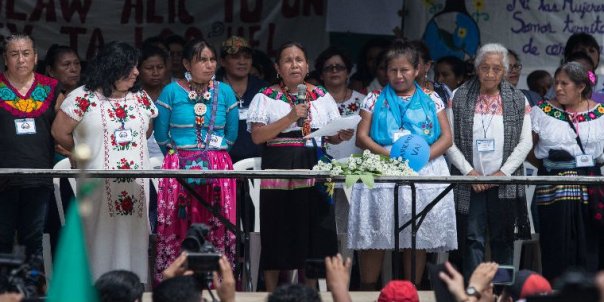
Marichuy speaks at Palenque event.
By: Isaín Mandujano
TUXTLA GUTIÉRREZ, Chiapas (apro)
The candidate nominated by the Zapatista National Liberation Army (EZLN) and the National Indigenous Congress (CNI) to the presidency of the Republic, María de Jesús Patricio Martínez (Marichuy), today denounced “the simulation” and failings of the collection of signatures through the electronic system and the slowness with which the application operates on some devices.
Within the framework of her penultimate day of touring the five EZLN caracoles, the candidate was in Palenque today, where she headed a meeting before thousands of men and women in the central plaza.
There, the candidate to an official independent candidacy exposed the farce that the mechanism created in the National Electoral Institute (INE, its initials in Spanish) has so far turned out to be.
After her registration at that organism, among the more than 40 candidates, she will have to collect 866,593 signatures in at least 17 states of the country in the next 120 days. If she achieves that, she will be able to access public financing and initiate her campaign on March 30, 2018.
Last October 15 the indigenous candidate received her proof that accredits her as a candidate to the presidency of the Republic and on Monday, October 16 she started collecting citizen support for registering Indigenous Government Council’s proposal.
After completing that step, she created jointly with the CNI a support network in the 32 Mexican states, with which in just two days they registered 1,480 volunteers and foresee that that next week 1,500 more will be added for collecting the needed signatures.
However, Marichuy denounced today that from the beginning she has seen that the digital electronic system is not made for the people of Mexico, “for the poor of this country, but rather for the rich, demanding (that we use) technologies for the collection of signatures that in many of our communities we don’t even know.”
The presidential candidate assured that: “the INE made a list of telephone makes and models so that you must have at a minimum an Android 5.0 operating system or higher and so many hours to begin with the download of the applications in the devices, we find that the list is not true; we find brands that are not included in the list and of those that are included they don’t all work. The download is tedious and can take hours.”
The Nahua woman from southern Jalisco explained that the operating system requires higher versions to really work.
Another obstacle, she explained, is that the “mid-range” telephones indicated by the INE cost more than five thousand pesos and those with “high range,” cost more than 12,000 pesos and, even worse, among those several of the brands and models selected don’t work either.
And she went further: “In order that the photograph to be accepted it must be taken at noon, because morning and afternoon light is insufficient, unless there is a special light that illuminates it sufficiently. This means that, if we reduce the days to hours, that we have one third of the 120 days provided by law.”
Then, she remembered that the INE said that a registry by this means would take them 4.30 minutes and, according to its calculations, they would reach the 120 days that electoral law sets for collecting the more than 866,500 required signatures.
However, reality revealed that one registration could last up to 16 hours because of the bad technical quality with which the application is designed.
“Many signatures that we collected were not even able to upload in many hours because of because the places through which we were passing between Altamirano, Ocosingo and Palenque, where they usually have a good Internet signal, didn’t even have a telephone signal. And those signatures that they have achieved sending don’t receive a notice of receipt until 24 hours after having been sent to the INE,” she denounced from the stage.
With these “classist, racist and excluding measures,” she said, you realize “that this electoral system is no made for those peoples below that govern ourselves and that the laws and institutions of the State are made for those above, for the capitalists and their corrupt political class, resulting in a big simulation.”
Nevertheless, she commented that “as is the custom in our peoples, surrendering, selling out or giving up is not an option and we will redouble efforts to collect the citizen support required to figure as an independent candidate to the presidency of the Republic on the 2018 electoral ballot.”
Even with that imposed obstacle, she emphasized, they will continue working to expand and strengthen the organizational structure throughout the country until making “the earth tremble at its core and it permit the survival of the Native peoples and the reconstruction of a Mexico that has been intentionally torn to pieces by those who hold power.”
After her public denunciation, she criticized the many abuses and injustices of the capitalist system in the towns and communities of Mexico not being told in the communications media “because there is someone that tells them what things have to be told and what things have to be done.”
Later, the activist repeated that the indigenous peoples would continue struggling so that their voice is heard in the countryside and the city.
More voices
Comandanta Amada spoke at the event in the name of the Indigenous Revolutionary Clandestine Committee-General Command of the EZLN from Caracol V “That speaks for everyone,” who coincided with Marichuy upon pointing out that: “it’s time that the people organize, that they fight, rebel and resist wherever we may be in our different places and geographies, because the capitalists are globalizing the exploitation and destruction of humanity all over the world.”
The leader considered that the indigenous peoples are also able to globalize their struggle “to make rebellion throughout the world, because we have a single common enemy, which is the neoliberal capitalist system.”
A masked indigenous woman identified as Alejandra, referred to the creation of the five Caracoles and their Good Government Juntas, from which began a form of self-government 14 years ago in each one of them.
“The origin of our self-government is because of the non-fulfillment of the accords signed in San Andrés Larráinzar between the federal government and the EZLN, representing the Native peoples of our country of Mexico,” she assured.
Within that system, she explained, the peoples have confidence in their self-government because their representatives -men and women- come from the same towns, where they are names by means of assemblies of agreement by uses and customs, and that don’t require money for publicity.
Comandatas Valentina, Jackeline and other indigenous women also spoke at the event.
Differently than the other Caracoles that Marichuy has visited, there were no uniformed Zapatista milicianos in the central plaza of Palenque, although there was a military discipline of men dressed as civilians and masked, who guarded the spokesperson for the Indigenous Government Council created by the EZLN and the CNI.
———————————————————————
Originally Published in Spanish by Proceso.com.mx
Wednesday, October 18, 2017
Re-Published with English interpretation by the Chiapas Support Committee
COMPaRTE: Zapatista Art in Oakland | Oct-Dec 2017
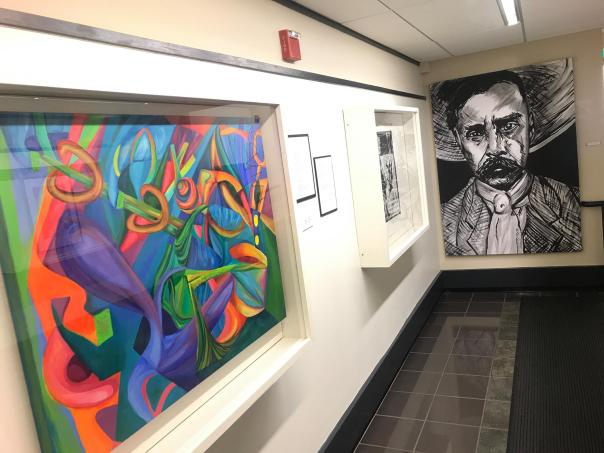
The Chiapas Support Committee with the Eastside Arts Alliance are hosting the “CompArte: Zapatista Art in Oakland” exhibition, October through December 2017, at the Asian Resource Center, in Oakland’s Chinatown.
For more info:
Eastside Arts Alliance: eastsidearts@yahoo.com
Chiapas Support Committee https://chiapas-support.org/
OPENING RECEPTION:
Wednesday, October 25th, 2017, starting at 6:00 pm with music, poetry & the artists.
At the Asian Resource Center, 317 9th Street, Oakland, CA 94607.
Featuring artists:
Daniel Camacho
Jhovany Rodríguez
Andrés Cisneros
Rafael Sanhueso
Yescka
Asaro Collective from Oaxaca
WHY?
CompArte: Zapatista Art in Oakland.
El arte muestra la posibilidad de otro mundo.—EZLN
Art demonstrates the possibility of another world.—Zapatista Army of National Liberation (EZLN)
Painters that create works of art imbued with symbols and images of justice, exposing capitalist exploitation and its inhumanity, share practical visions where our communities live free of oppression, want, poverty, pollution, racism and hierarchical suffocation on canvass. Social justice art shows us how to imagine the revolution. This is the call of CompArte.
CompArte is a play on the Spanish words compartir (to share) and arte (art), “CompArte: Zapatista Art in Oakland” is a show of sharing art to help us dream a different world where we all fit and to show solidarity with indigenous communities in Mexico and everywhere else.
The Eastside Arts Alliance Cultural Center presents the CompArte artwork, curating this diverse and political powerful work to Oakland communities.
Compartir ZapatistArte
EZLN Comandante David dijo: “Los artes y culturas son parte fundamentales de la lucha contra el capital destructor de la vida y de la humanidad. Sólo con la unidad y la organización de los pobres y de los rebeldes del mundo, podemos destruir ese sistema de muerte.”
EZLN Comandante Davíd said: “The arts and culture are fundamental elements of the struggle against capital destroyer of life and humanity. Only with the unity and organization of the poor and the rebels of the world can we destroy this system of death.”
CompArte is an international festival, first convened by Zapatista communities in 2016, to celebrate art and culture as a catalyst for social change, in rebellion against capitalism and all its walls of exploitation and oppression: racism, sexism, classism, xenophobia, transphobia, homophobia, english-only mentalities.
Zapatista supporters created CompArte Festivals all over Mexico and in other countries in 2016 and again in during the summer of 2017.
The Zapatistas in Mexico convened the second “CompArte: Against Capitalism and its Walls, All the Arts” and invited solidarity and community groups across the world to join them in bringing together art, music and poetry to celebrate the struggle against capitalism and lift up art and culture as central to organizing the fight against capitalism and building movements for deep justice, community and for humanity.
Responding to the call, the Oakland-based Chiapas Support Committee (www.chiapas-support.org) organized the second annual CompArte poetry, music & art festival in Oakland on August 12, 2017 bringing together a more than a dozen painters, poets, artists and musicians to recognize and celebrate culture and art in the movements for justice and its power to imagine a different world where there is room for everyone.
 Chiapas Support Committee