Chiapas Support Committee
Home of the Compañero Manuel blog on zapatistas & mexico
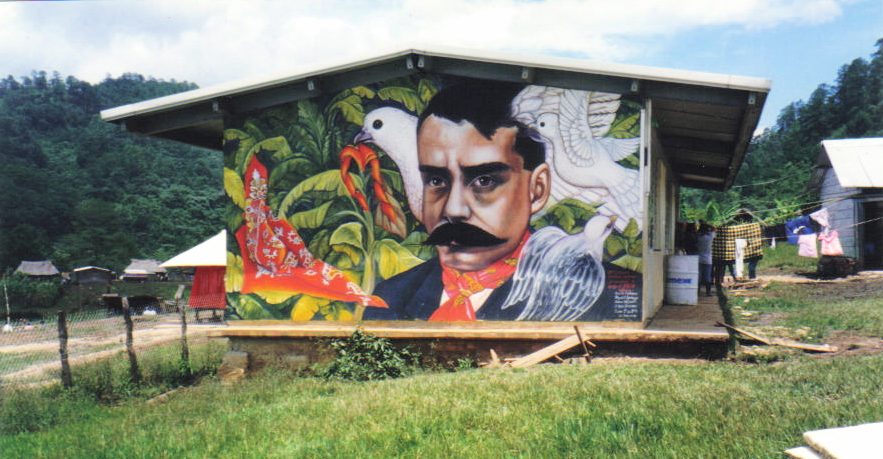
Words of Comandanta Hortencia in Oventik
Words of Comandanta Hortencia in the name of the CCRI-CG of the EZLN in Oventik, Chiapas, Mexico, on October 19, 2017 Part I

Comandanta Hortencia and her daughter Lupita preparing to tour as delegates with the “Other Campaign.” Hortencia was Delegate 5. Lupita was Delegate 5 and a quarter and made the tour with her mother, carrying her teddy bear in a plastic bag.
Compañeros and compañeras of the Indigenous Government Council
Compañeros and compañeras of the National Indigenous Congress
Compañera, sister, friend, María de Jesús Patricio Martínez
Compañeras and compañeros of the National and International Sixth
Brothers and Sisters from different social organizations
Brothers and Sisters from different towns and municipalities invited to this gathering
Brothers and Sisters of the national and international press
Brothers and Sisters of the free and alternative media, national and international
Brothers and Sisters national and international observers
Brothers and sisters, today we are gathered in this center, Caracol II of Oventic “Resistance and Rebellion for Humanity.” We are here to receive, accompany and listen to the words of the Indigenous Government Council and its spokesperson María de Jesús Patricio Martínez.
In the name of the compañeros, compañeras, women, men, youths, children and elderly support bases of the Zapatista National Liberation Army, the Indigenous Revolutionary Clandestine Committee- General Command of the EZLN greets the National Indigenous Congress, the Indigenous Government Council and its spokesperson María de Jesús Patricio Martínez, and we want to say that you have undertaken a long and difficult path, but it’s necessary to meet with the brothers and sisters in every corner of our country Mexico.
Marichuy, as we affectionately call her, is our spokesperson, who together with the council members of the Indigenous Government Council will tour all of Mexican territory to speak and listen to the voice of the most forgotten, marginalized and scorned peoples of our homeland, like the Native peoples that we are, or as they call us with scorn “Indian peoples.” She will also talk about the truly difficult situation in which all the poor Mexicans live, without distinction to organization, party, race, color, language, culture or religious belief.
Our spokesperson, from here, carries the voice of the original peoples, of the peoples that struggle, that resist and that rebel against the evils that the capitalist social system represented by the bad governments is causing.
But as the original peoples we are the most forgotten, marginalized, scorned and without any respect. For more than five centuries we have suffered cruel exploitation, looting of our riches, dispossession of our lands and territories, destruction of our languages and cultures, just for being natives of these lands, for being the color of the earth, we are not nothing, we have no value, we don’t have the right to health care or to the best education and we are only a hindrance to the big capitalists and the bad governments.
When the original peoples, tribes and nations demand our rights and ask for justice, we are repressed, incarcerated, persecuted, disappeared, tortured and murdered. It’s that way in our states and all over our country Mexico, and in all the corners of the world.
And when we organize to be seen, to make ourselves heard, so that everyone knows we exist, that we resist, that we rebel, that we live, then the insults and lies begin: that we are not able to think, that we can’t organize, that they manipulate us, that we serve the political interests of those who sell out the country, that we are a “plot” against the “good” mestizos and ladinos that want to oblige us to follow and obey them because they are the ones with know-how and, according to them, we are ignorant. And if you don’t understand anything about what’s happening and about what’s going to happen, they have a lot of studies and big heads free of charge. And, they want to dominate, scorn and humiliate us just like those who are now overseers do.
And they want to pressure us so that we change masters, lords, bosses or finqueros.
And we also know that just like our indigenous brothers and sisters live and suffer in many countries on our continent of America and in many countries of the world; just to mention some, we know how our brothers and sisters suffer in Guatemala, Nicaragua, Argentina, Brazil, Peru, Bolivia, Ecuador, Chile, Argentina and many other countries. There are no governments or laws that protect and defend our peoples.
And here we especially greet the brother Mapuche people that resist and struggle in the last corner of the world. Al pueblo Mapuche and those who accompany them in their resistance, like Santiago Maldonado, we send a big hug that fills the whole Latin American continent to find it.
But what’s most important now is that in all the Native peoples of our continent and of the world, there are consciences, there are resistances, rebellions, rages, desires to live and fight for a different world, for a new society and a new life for everyone.
Today, tomorrow and always, being Native peoples of any part of the world is no longer a shame, but rather a source of pride, it’s no longer a story, no longer is it a myth, but rather a reality, because we Native peoples are the ones that are going to care for and defend Mother Earth and all nature; we the Native peoples jointly with our brother and sister honest and rebellious artists, professionals, religious, intellectuals and scientists that are going to save the world and humanity.
Therefore we say…
Now is the time of the original peoples, the time of women, the time of the marginalized, of the scorned, of the forgotten, and it’s the time of all the poor and exploited of Mexico, of America and of the world, it’s the time of changing this criminal and murderous capitalist social system, it’s the time of uniting all the poor of the countryside and the city, it’s time to organize ourselves and struggle for real democracy, liberty and justice for all.
Today and from now on our peoples will know how to govern themselves and direct their own destiny, just like we Zapatistas are showing that for more than 20 years we have been constructing our autonomy.
Because we don’t want a change of master, boss or dominator; we don’t want any master, any boss, and we don’t want any dominator, ladino, mestizo or indigenous. No master!
What we want is freedom, our freedom, FREEDOM!
And we know very well that no one is going to give it to us, and we know very well that we have to fight every day, every hour and everywhere to win our freedom. And it doesn’t end there, because then we have to fight so that no one takes our freedom away.
That’s why we respectfully ask our spokesperson and the Indigenous Government Council to go and listen to the voices of the original peoples and of all the poor sectors of Mexico, in order to learn about the struggles, resistance and rebellion of many brothers in the whole country.
And (we ask) that they clearly tell the truth: no one is going to give us anything; we have to fight to get what we want, deserve and need!
And we have to get organized!
The Zapatista peoples are with the spokesperson, with the Indigenous Government Council and with the National Indigenous Congress, they are going to fulfill a mission of touring the country to speak and hear the truth and also to invite them to struggle, although we know that it’s not easy for them; but it’s necessary to take the risk for a just cause, in favor of life for everyone.
Our spokesperson will talk about how it is possible and necessary to construct a different Mexico, where one can govern under the 7 principles of govern obeying (mandar obedeciendo), where the people decide and the government obeys.
Brothers and sisters of the countryside and the city, we invite you then to listen to the spokesperson, so that you hear the truth, and the truth is that now there is no government that governs our country, and those who say that they are governors and president are nothing more than big corrupt overseers and majordomos that fulfill the orders of the big transnational corporations.
And the neoliberal governments that have planned to sack all our wealth and convert our country into their plantation (finca), and have those of us who inhabit these lands as their slaves and destroy us, those corrupt ones are not going to respect anyone, we will all be swept away without distinction to part y, organization of religious belief.
Because we know that the plans of the bad governments and the evil neoliberal capitalists, is the death, destruction and annihilation of those who rebel; we know that they are equipped with their armaments for ending humanity.
But we must not be afraid now, because those who govern are few and seize the wealth of our country, but it’s not important to the workers and all the poor sectors what offices they have, but they and many millions of us are suffering, that’s why if we wake up, if we unite, if we get organized and struggle together as brothers and compañeros, we will be able to change this situation and destroy the criminal monster, because truth and reason are on our side.
If we don’t do anything, our children, our grandchildren and all the generations that will come later are going to live worse than us, and our country will have no future.
Therefore we must no longer permit that our lands, our territories and our country are property of the big transnational corporations and the powerful neoliberals, who are just looting and destroying our natural riches, we must no longer permit them to manipulate us, deceive us and murder our peoples; now is the time to say BASTA (ENOUGH) of so many evils. Enough of having people incarcerated, disappeared, tortured and murdered unjustly by the bad governments!
Now is the time to begin constructing a new society and a new world un where all human beings live with liberty and justice, where we no longer have to live in misery and die from curable diseases, where we treat each other as brothers equally, with respect, and in communication and harmony with Mother Nature.
Mexico should be an inclusive country without importance to race, color, language, culture or religious belief.
That’s why we have no other path than to decide to unite and fight together, organized. We can’t wait for anyone to come and save us from this disgrace. Everyone’s participation is needed for that: organized men, women and young people.
Her entire speech is published in Spanish at: https://actividadesdelcigysuvocera.blogspot.mx/2017/10/palabras-de-la-comandanta-hortencia.html
There is a worrisome inability to govern in Chiapas
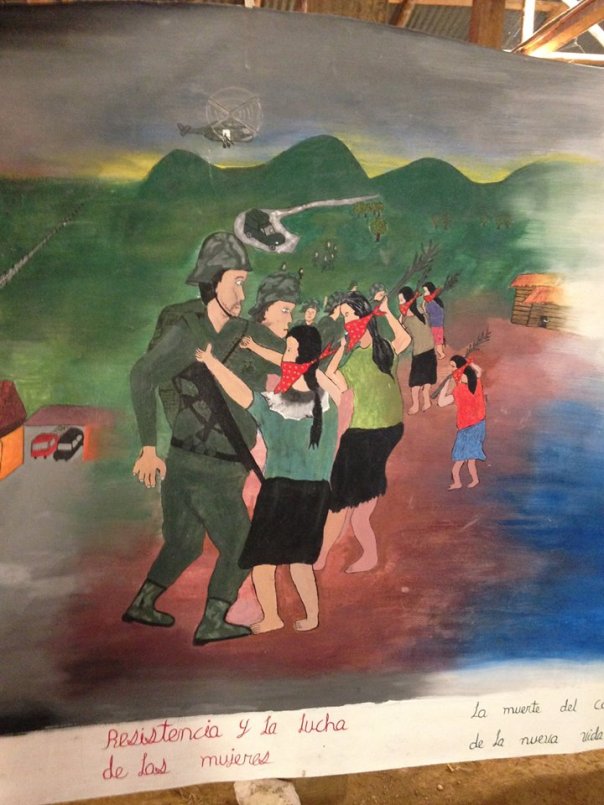
Women resisting militarization in Xoyep after the Acteal Massacre. This painting is part of the Zapatista art exhibit at the Omni Commons.
IN CHIAPAS “THERE IS A WORRISOME INABILITY TO GOVERN:” ACADEMIC
By: Hermann Bellinghausen
Being a situation latent and encouraged for years, since last October, when an age-old conflict over boundaries between the Tsotsil municipalities of Chenalhó and Chalchihuitán sharpened to an alarming level, omissions and failings of government authorities become obvious, as well as partisan interests, vices in irregular agreements and the discretionary distribution of resources that suddenly went out of control. Faced with that, the researcher Arturo Lomelí considers that: “there is a worrisome inability to govern” in Chiapas.
Some days before the twentieth anniversary of the Acteal Massacre, the same Los Altos region could be on the edge of a tragic outcome. Paramilitary groups, identified, but officially denied, have occupied the center of a conflict that is agrarian in origin. Lomelí, a specialist in the history and culture of the indigenous people of Chiapas, ventures that: “the start flag for activation of the paramilitaries, who have displaced thousands of indigenous in recent weeks, seemed to be the lavish visit of Governor Manuel Velasco Coello and the head of the Secretariat of Social Development, Luis Enrique Miranda Nava, last October 13 to Majumpepentic, a Chenalhó spot at the boundary of Chalchuihuitán. They gave tools, tools, big Rotoplás vats of water, dressed in the local style, with staffs of command and everything.”
Who knows whether it was deliberate or not, he points out, “but five days later, on October 18, a campesino with the surnames Pérez Luna, of Chalchuihuitán, was murdered during one of the violent evictions from villages by armed groups of Chenalhó, that have taken place since October.” The intricate territorial boundary between the two municipalities “was always a time bomb.” Now, it goes beyond the agrarian, “although it calls to mind that violence breaks out on the eve of a resolution from the Agrarian Tribunal at the third level that will probably favor Chalchihuitán,”
And suddenly “terror is unleashed.” The temptation of déjà vu is incomplete, but real. The counterinsurgency ingredient, key to the events of Chenalhó in 1996 and 1997 that culminated in the Acteal Massacre, seem nonexistent now. Both the aggressors and those affected are in the large majority pro-government folks identified with the Institutional Revolutionary Party (PRI), or with the Green Ecologist Party of Mexico (PVEM). [1] “Besides, it is alleged that negotiations have been held with the participation of government officials, academics, lawyers and representatives from the communities.”
They talk about between 5 and 8 thousand displaced, 80 percent from Chalchihuitán, who would be the ones attacked. “We remember that because of an internal post-electoral conflict in Chenalhó between factions of the PVEM, and others from the PRI, there are more than one thousand displaced, many of them in San Cristóbal de Las Casas; they have nothing to do with the Chalchihuitán problem, but the violence that expels them is the same. The armed civilians are encouraged or tolerated by the municipal president of Chenalhó, Rosa Pérez Pérez, of the PVEM, with her position in dispute.”
The accesses to Chalchihuitán, to its hidden and dispersed population, are blocked by the paramilitaries, Lomelí reports: “They don’t let anyone approach. They have stopped the Army, the Attorney General of the Republic, the state police and district attorneys because the paramilitaries receive them with bullets.” They just established a mixed operations base in Las Limas, a Chenalhó landmark community founded years ago to advance on the territory in dispute, and that was the seat of the failed 1997 negotiations before Acteal.
The researcher agrees with the Frayba Center in pointing out that the armed groups never disappeared after the massacre. “They didn’t take away their weapons, which must be more now; not all those responsible were prosecuted and besides all those that were in prison are now free. In Chiapas no one has ever been incarcerated for being a paramilitary; those who fall are always charged for something else,” he ended.
The state “is full of red lights (conflictive areas), with unresolved conflicts in Oxchuc, Comalapa, Chicomuselo and Venustiano Carranza. In fact, there is an inability to govern and the state authorities don’t act. What’s happening is the State’s responsibility, from the federal to the municipal level. With the experience that Chiapas already has in this kind of conflict, how is it possible that they don’t know how to behave? They continue giving gifts, distributing indemnifications and programs without the will to definitively resolve the problem.”
Faced with the violence, one thing remains clear to the interviewee, “the possible indemnification that Chenalhó would receive if the lands are recognized as belonging to Chalchihuitán raises the price.” The thousands of women, children and men that have been expelled from their villages and homes, who pay the price (they speak of more deaths due to the precarious conditions in which the displaced are found) seem like pieces of a perverse game or an omission of officials and local political bosses (caciques).
“It’s cruel to see that, despite the experience of the Acteal Massacre, just 20 yeas later exactly the same scenes, the same institutional inactions, the same warnings from observers, the same pain of hundreds of families that could lose everything are repeated.”
[1] This would seem to clarify that Zapatista bases of support are not displaced, but live in the conflictive area.
————————————————————–
Originally Published in Spanish by La Jornada
Sunday, December 3, 2017
http://www.jornada.unam.mx/2017/12/03/politica/018n1pol
Re-Published with English interpretation by the Chiapas Support Committee
Narco-politics in Chiapas, a time bomb that increases the risk of another massacre

Blocked roads, populations under siege, shootings every night, dozens of houses burned and the absence of authority, are some of the conditions that some 6,000 displaced persons from Chenalhó and Chalchihuitán suffer. Photo courtesy of the priest Marcelo Pérez
By: Blanche Petrich
Three weeks ago, the parish priest of Simojovel, Marcelo Pérez, started to tour the steep trajectory of at least four hours that goes from his parish to the border communities between Chenalhó and Chalchihuitán, in Los Altos (the Highlands) of Chiapas to verify what the inhabitants of those places were denouncing: attacks by paramilitary groups from the Institutional Revolutionary Party (PRI) and from the officialist Green Ecologist Party of Mexico (PVEM); roadblocks and populations under siege; almost 6,000 [1] people displaced in extreme conditions of vulnerability; shootings every night and dozens of houses burned by the aggressors.
He has returned several times: “And everything is true. When I saw children sleeping under trees, without anything to eat, many of them sick, I could not believe it. I never thought that I would see so much suffering again, so much sickness,” he comments in a telephone interview. He returned last Tuesday and was in several spots in Chalchihuitán collecting testimonies from the more than 5,000 displaced people. Wednesday in Chenalhó, there are almost 1,000 people who are in the woods.
This is the result of the census he took: there are 5,035 displaced in the municipality of Chalchihuitán; more than 800 from Majompepentic; there are 150 displaced from the so-called Fracción Polhó (a non-Zapatista split from what were the refugee camps of Zapatista National Liberation Army (EZLN) bases displaced by the massacres of 20 years ago that settled in Polhó), among them six pregnant women; there are 205 families (more than 900 people) from Las Limas in the mountains, far from the towns, with 15 pregnant women. Además, dejaron sus casas Four families from Campo Los Toros, 30 inhabitants from Vayem Vacax, and four families from Yabteclum also left their homes.
On the other side of the dividing line, in the municipality of Chenalhó, a census was completed just last Wednesday night of more than 960 displaced people.
“The women and children are suffering much cold, hunger and sickness. It is a repetition of what happened in these same places 20 years ago, in the days before the Acteal Massacre. History already warned us what can occur here,” he warns in the telephone interview. “The massacre can be repeated.”
A warning that doesn’t make a dent in the Government
In 1997, residents abandoned a dozen communities in Chenalhó in September because of the attacks from PRI groups that, in the context of the counterinsurgency war against Zapatismo, attacked those who they supposed were Zapatista bases. In the freezing Los Altos winter, with the crops abandoned in the field and there were already thousands of displaced that were living in the mountains, sick and destitute of everything. It was the warning of what would happen on December 22. It was ignored.
The Diocese of San Cristóbal de las Casas and the Fray Bartolomé de las Casas Human Rights Center (Frayba) have also warned: the events of Acteal can happen again. The warning has no made a dent in the authorities.
The director of the Frayba, as this non-governmental organization founded by Bishop Samuel Ruiz is known, maintains that the paramilitary groups that are acting today “are the same ones that committed the Acteal Massacre on December 22 and 23, 1997. It’s the cyclical violence that impunity generates.”
Father Marcelo coincides by pointing out: “The displaced point them out, they recognize them. Many of today’s aggressors, with high-caliber weapons just like 20 years ago, are the same ones as in Acteal. It’s true that others are not the same; there are also a new generation of paramilitaries.” But there is an aggravating factor today, he adds: “the narco-politics and arms trafficking, which is intense in Chenalhó and takes place under the complicit gaze of the authorities.”
In 1997 and 1998, after the Acteal Massacre and the wave of repression, militarization and displacements that there were, more than 30 paramilitaries were detained. A criminal process was initiated against them. Then Chiapas governor Roberto Albores contracted lawyers to defend them. Several of them confessed, and in 2007 were sentenced to 26 years in prison. But between 2009 and 2011, defended by a team of private litigators, all were released by decision Supreme Court of Justicia of the Nation (SCJN), which alleged “due process errors.” Several of the alleged killers returned to Chenalhó, to co-exist with their victims and survivors.
On that December 26, 1997, 15 children, 21 woman (four of the pregnant) and nine men were executed in Acteal. About 30 people were injured. Everyone had been fasting and praying.
They were disarmed.
Because of the terror, almost one third of the inhabitants of the municipality fled their homes and displaced themselves into organized encampments or simply to the outdoors, in the winter.
Now, the scenes of 20 years ago repeat themselves in the same places. There are communities, like Polhó and others, that are repeating the exodus that was forced upon them in 1997 and 1998, and in the same precarious conditions.
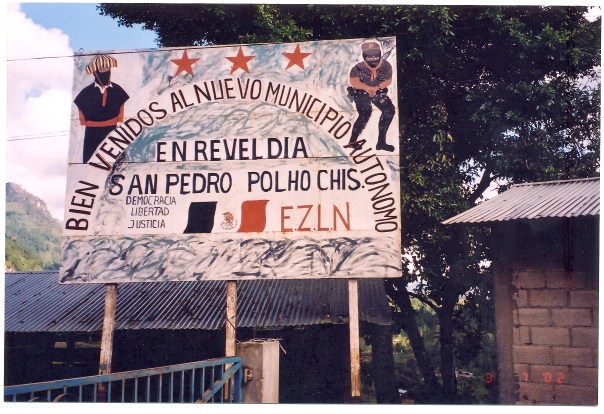
Sign at the entrance to Polhó, headquarters of San Pedro Polhó, an autonomous Zapatista municipality.
“State authorities reacted belatedly with sending humanitarian aid. For the moment only parishes in the la diocese and civil society are mobilizing food, medicine and blankets towards the camps. And it’s very complicated,” Father Marcelo explains.
Impunity, cyclical violence
Pedro Faro, director of the Frayba denounced to this media that the state government has demonstrated a total inability to resolve the conflict. “Among other things, Rosa Pérez, municipal president of Chenalhó, protected by the governor and imposed by means of fraud, committed in front of state government representatives to order the lifting of roadblocks on three highways that keep the Chalchihuitán communities under siege and to permit the Base of Mixed Operations to be reinstalled as soon as the aggressions started. She did not comply!”
The old conflict between residents of Chalchihuitán and Chenalhó was revived after the murder, still unpunished, of the Tsotsil Samuel Pérez Luna, on October 18, in a paramilitary attack. Pedro Faro explains: “It wasn’t the first case. There is omission by the authorities to resolve the border conflict that dates from 1979, in which 900 hectares are disputed because of an erroneous agrarian resolution of the then Secretariat of Agrarian Reform. Because of that the cycle of violence encourages impunity. Every once in a while violence erupts. The governor attained several agreements that have not been fulfilled at negotiating tables that have not been equal. There has been negligence and inability. In the coming days a resolution ought to be given from an agrarian tribunal that will decide if Chenalhó must accept 15 million pesos of indemnification in exchange for the allocation of lands to Chalchihuitán. I guess that’s why the paramilitaries were reactivated; as a form of pressure.”
The parish priest Marcelo Pérez adds the other ingredient of this time bomb: “Narco-politics is in this zone of Los Altos. Nobody wants to talk about it and nobody dares to denounce it, but it is known.”
[1] A previous article estimated that 7,000 people were affected by the current violence. That number apparently includes both the nearly 6,000 displaced, as well as another 1,000-plus affected (by roadblocks and nighttime shootings) but not displaced as of now.
—————————————————————
Originally Published in Spanish by La Jornada
Friday December 1, 2017
http://www.jornada.unam.mx/2017/12/01/politica/010n1pol
Re-Published with English interpretation by the Chiapas Support Committee
Speakers from Oaxaca this Saturday
Join us for a special Waffles & Zapatismo

Join us in conversation with Ángel Ku & Valiana Aguilar
Speaking on Indigenous Autonomy, the Consejo Indígena de Gobierno (CIG, Indigenous Council of Government) & Marichuy
- Saturday, December 2, 2017 | 3:00-6:00 pm
- At the Omni Commons | 4799 Shattuck Avenue, Oakland, CA
- Donation requested $5.00-$10.00 to support our guests’ work. No one will be turned away for lack of funds
Ángel Rafael Kú Dzul and Valiana Alejandra Aguilar Hernández, two compañer@s from the Center for Encounters and Intercultural Dialogues and the Universidad de la Tierra, Oaxaca, will address Indigenous autonomy in Mexico.
Ku and Aguilar will speak on the struggles for Indigenous autonomy and self-determination across Mexico focusing on Oaxaca, Chiapas, and the Yucatán peninsula. They will provide important updates about the current initiative of the Congreso Nacional Indígena (CNI, National Indigenous Congress) and the Ejército Zapatista de Liberación Nacional (EZLN, Zapatista Army of National Liberation) , especially their effort to support the Consejo Indígena de Gobierno’s (CNI, Indigenous Council of Government) spokesperson, María de Jesús Patricio Martínez, and her effort to enter the national election as an official candidate. Our guests will also speak about the current autonomous efforts to rebuild communities impacted by the hurricane and earthquake in Oaxaca’s Isthmus.
For more information, please visit: www.chiapas-support.org
Email CSC: enapoyo1994@yahoo.com
+++++
Our Guests
Ángel Rafael Kú Dzul, is an indigenous Maya from the Yucatán peninsula. Ku has been a member of different collective in the Yucatán peninsula whose work has centered principally in the rescue, defense and strengthening of the Maya culture and territory. He is a member of Ka’ Kuxtal Much Meyaj’ (Rebirth of Collective Work) formed by women and men farmworkers from the “Chenes” region in Campeche, whose main objective is the rescue and defense of native seeds. Ku has been an adherent of the Sixth Declaration of the Lacandon Jungle since 2006. Three years ago he started living in a community in Oaxaca and collaborates with the Center for Encounters and Intercultural Dialogues and the Universidad de la Tierra (University of the Earth) in Oaxaca; he coordinates research in the area of community. In 2015, he was part of the organizing committee of the International Colloquium “Weaving Voices of our Shared House” [Coloquio Internacional “Tejiendo Voces por la Casa Común”], which brought together more than 100 collectives and organizations from throughout Mexico and dozens of activist-thinkers from Mexico and 15 other countries. He participated in the project “Technologies for Good Living,” that worked in 20 communities in the Central Valleys of Oaxaca, mainly with women and men farmworkers, promoting different eco-technologies for the care of the water and the development of organic fertilizers.
Valiana Alejandra Aguilar Hernández, a Maya, a native of Sinanché, has participated in different collectives, struggles and resistances related to the regeneration of the community social fabric. She has worked especially with Mayan women in the Yucatán Peninsula. She currently lives in a small community in Oaxaca and collaborates with the Universidad de la Tierra (University of the Earth) and the Center for Encounters and Intercultural Dialogues where she coordinates student exchanges and “Cultivating Dignity” workshops that are carried out in different communities in Oaxaca, especially with indigenous women’s collectives. In 2015 she was part of the organizing committee for the International Colloquium “Weaving Voices of our Shared House” [Coloquio Internacional “Tejiendo Voces por la Casa Común”], which brought together more than 100 collectives and organizations from throughout Mexico and dozens of activists-thinkers from Mexico and 15 other countries.
***********************
El Comité de Apoyo a Chiapas
Presenta directamente de Oaxaca, México:
Ángel Ku & Valiana Aguilar en conversación sobre
La autonomía indígena, el Consejo Indígena de Gobierno y Marichuy
- El sábado 2 de Diciembre, 2017 | de 3:00 a 6:00 pm
- En el centro cultural Omni Commons | 4799 Shattuck Avenue, Oakland, CA
- Pediremos una donación de $5.00-$10.00 para apoyar al trabajo de nuestr@s huéspedes. Nadie será prohibido la entrada por falta de dinero.
Participa en esta conversación con Ángel Rafael Kú Dzul y Valiana Alejandra Aguilar Hernández, dos compañer@s del Centro de Encuentros y Diálogos Interculturales y la Universidad de la Tierra en Oaxaca, sobre autonomía indígena.
Ku and Aguilar hablarán sobre las luchas por la autonomía indígena and la autodeterminación a través de Mexico enfocándose en Oaxaca, Chiapas, y Yucatán. Darán una actualización sobre la iniciativa del Congreso Nacional Indígena (CNI) y el Ejército Zapatista de Liberación Nacional (EZLN), especialmente sobre su esfuerzo de apoyar al a la portavoz del Consejo Indígena de Gobierno’s (CNI) spokesperson, María de Jesús Patricio Martínez, y su movimiento para entrar en las elecciones nacional como una candidata. Nuestros huéspedes también hablarán sobre los esfuerzos autónomos actuales para reconstruir las comunidades impactadas por el huracán y el terremoto en el istmo de Oaxaca.
Para más información, visite: www.chiapas-support.org
Correo electrónico del comité: enapoyo1994@yahoo.com
++++++
Nuestr@s oradores
Ángel Rafael Kú Dzul es indígena maya de la península de Yucatán. Ha sido parte de diferentes colectivos en la Península de Yucatán, cuyo trabajo se ha centrado principalmente en el rescate, defensa y fortalecimiento de la cultura y el territorio maya. Es miembro de la organización Ka’ Kuxtal Much Meyaj’ (Renacer del trabajo colectivo) conformado por campesinas y campesinos de la región de los “Chenes” en Campeche cuyo objetivo es el rescate y la defensa de las semillas nativas. Es adherente a la Sexta Declaración de la Selva Lacandona desde el 2006. Desde hace tres años vive en una comunidad de Oaxaca y colabora en el Centro de Encuentros y Diálogos Interculturales y la Universidad de la Tierra en Oaxaca, como coordinador del área de investigación comunitaria. En el año 2015 fue parte del comité organizador del Coloquio Internacional “Tejiendo Voces por la Casa Común”, que reunió a más de 100 colectivos y organizaciones de diferentes partes de México y a varias docenas de pensadores-activistas de México y de 15 países. Participó en el proyecto “Tecnologías para el buen vivir”, que trabajó en más de 20 comunidades en los Valles Centrales de Oaxaca, principalmente con campesinas y campesinos, impulsando diferentes eco-tecnologías para el cuidado del agua y la elaboración de abonos orgánicos.
Valiana Alejandra Aguilar Hernández, Maya, originaria de Sinanché, ha participado en diferentes colectivos, luchas y resistencias relacionadas con la regeneración del tejido social comunitario, ha trabajo especialmente con mujeres mayas en la Península Yucatán. Actualmente vive en una pequeña comunidad de Oaxaca y colabora en la Universidad de la Tierra y el Centro de Encuentros y Diálogos Interculturales, donde coordina el área de intercambios estudiantiles y de talleres “Cultivando dignidad”, que se realiza en diferentes comunidades de Oaxaca, especialmente con colectivos de mujeres indígenas. En el año 2015 fue parte del comité organizador del Coloquio Internacional “Tejiendo Voces por la Casa Común”, que reunió a más de 100 colectivos y organizaciones de diferentes partes de México y a varias docenas de pensadores-activistas de México y de 15 países.
Chiapas Support Committee | www.chiapas-support.org
Email CSC | enapoyo1994@yahoo.com
7,000 displaced due to violence in Chiapas
VIOLENCE AND DISPLACEMENTS ESCALATE DUE TO THE CONFLICT IN CHIAPAS
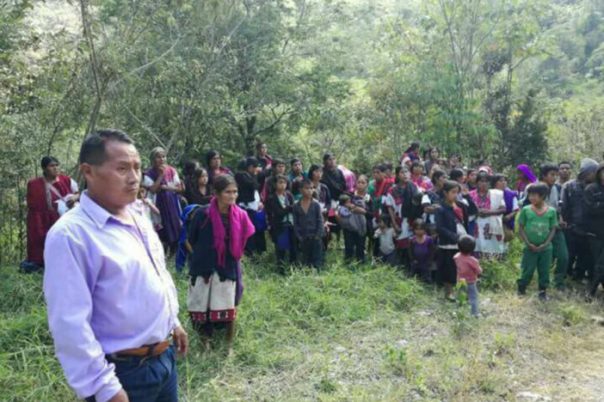
Those displaced from Chalchihuitán, Chiapas. Photo from Proceso.
A Special Report by: Isaín Mandujano
TUXTLA GUTIÉRREZ, Chiapas (apro)
The director of the Fray Bartolomé de las Casas Human Rights Center (Frayba), Pedro Faro, warned that another massacre like Acteal could occur in the Los Altos region of Chiapas if the federal government doesn’t disarm the civilian armed groups or paramilitaries that have already left hundreds displaced from Chenalhó and Chalchihuitán.
In an interview, Faro said today that this conflict between Chenalhó and Chalchihuitán, which dates from more than 40 years ago, has sharpened because of state and federal governments’ omissions to definitively resolve this agrarian and territorial dispute.
Then he exposed that both the state and federal governments propitiated this conflict through their agrarian bodies, upon emitting resolutions “from the desk.”
He also pointed out that, since the term of Pablo Salazar (2000-2006), then in the term of Juan Sabines (2006-2012) and in the current term of Manuel Velasco (2012-2018), the conflict has supposedly been resolved, but as of now there are just verbal agreements.
“The problem that we see right now, and since the July 2015 municipal elections, is that civilian armed groups have been created again. As they never investigated the paramilitary groups and as the paramilitaries in the region were never disarmed, now it is clearly seen that they can easily re-arm, or re-group for, like in this case, attacking the indigenous of Chalchihuitán”, warned Faro.
And he added that: “populations of the municipality of Chenalhó have also been affected in this dispute, who nothing to do with this conflict.”
What the Frayba has documented is that last year there was an inter-institutional group or commission that proposed a solution to this conflict to the state government, but the government has not complied with the agreements. They are: reparation of the damage, indemnify the people affected, and marking off of the territorial limits, as well as other actions.
In this conflict, he clarified, there is nothing new or obscure, “what’s dark around here is that once again the armed groups that are attacking, displacing and killing people have been reactivated.”
“It is not known what interests there are so that that zone becomes a war zone; our explanation, as far as we can see, is that a climate of impunity has been created since the Acteal Massacre, wherein actors that are tied to the government act unpunished and do whatever they want in the zone. There is not, then, the Rule of Law in this region,” he denounced.
“The information that reaches us is that they are purchasing weapons, that they are re-organizing, that they are besieging and generating terror in the communities, and that situation has now left thousands of displaced persons, not only from Chalchihuitán, but also from Chenalhó, because of this very same conflict.
The risk now, he added, is that the murders start to escalate and another massacre is perpetrated. “Because the only thing that the government has announced is the creation of a Base of Mixed Operations made up of police and military bodies from the state and federal governments, similar to what there was close to the Acteal Massacre in 1997, and it never prevented avoiding the multi-homicide.”
Faro asked that, in order to end the conflict, the community agreements that the traditional authorities of both municipalities already have be re-established, that the murders that have remained unpunished be investigated, and that the armed paramilitary groups that operate in the zone be investigated, disarmed and dismantled.
In a communiqué, the Frayba maintained that the life, security and integrity of entire communities in the region is at risk.
Later he emphasized that the death of Samuel Pérez Luna occurred in October. Pérez Luna was a resident of Chalchihuitán and a native of Kanalumtik community. The violence deepened on Monday the 13th, caused by armed groups in the region.
That’s why hundreds of families have left the region, taking refuge in the mountains. He stated that armed groups even cut off the highway and blocked all access to communities in Chalchihuitán municipality, leaving the population incommunicado.
“As of today they continue firing bullets, the population is living in terror, there are rumors that armed people are going to enter to attack the people that are in the capital of Chalchihuitán. There is nothing to eat, no beans or tortillas. The state government doesn’t listen because it hasn’t done anything; we are alone and abandoned to our fate. All the businesses are closed and there is no longer any corn, fruit or gasoline. The municipality is under siege and there is no way to get food supplies; there is a lot of fear, there is shooting in the Pom community and at least nine house have been burned down. There are also threats of cutting off the electricity,” the Frayba report emphasizes.
The Frayba report lists 32 communities that are at greatest risk and states that approximately 7,000 people are affected by the violence.
Therefore, the Frayba urged the Mexican State to take care of this situation quickly and expeditiously that because the violence has become widespread and can lead to greater human rights violations, “since we have precise information that the actions implemented by Manuel Velasco’s government officials have been inefficient and have generated a greater mayor risk to the population.”
The NGO asked that the necessary precautionary measures be implemented with urgency and pertinent to respecting, guarantying and protecting the life and integrity of the families in Chalchihuitán and Chenalhó.
Likewise, he asked that the “UN’s rector principles for internal displacements be applied,” for the purpose of protecting the hundreds of families that have fled the generalized violence and that are completely vulnerable.
He also asked that the murder of Samuel Pérez Luna be investigated, those responsible punished and that the armed groups that act with impunity and with the permissiveness of the Chiapas be disarmed.
But, above all, that free transit and social peace is guaranteed in the communities of Chalchihuitán and Chenalhó municipalities, prioritizing dialogue among the parties with essential respect for human rights.
—————————————————————–
Originally Published in Spanish by Proceso.com.mx
Monday, November 27, 2017
http://www.proceso.com.mx/512796/escalan-violencia-desplazados-conflicto-agrario-en-chiapas
Re-Published with English interpretation by the Chiapas Support Committee
The Indigenous confront an economic model based on dispossession

Victoria Tauli-Corpuz, UN special relator on indigenous peoples rights. Photo: María Luisa Severiano
By: Fernando Camacho Servín
The original peoples in Mexico and in other parts of the world confront an economic model based on the forced dispossession and occupation of their territories, with the objective that their natural resources will be used as the basis for a development that doesn’t benefit them, which is not very different from the colonial system that existed two or three centuries ago.
That’s how Victoria Tauli-Corpuz, the special relator on indigenous rights from the United Nations affirmed it; she emphasized that although the scheme is practically the same on a global scale, the native communities in Mexico face a climate of violence and impunity even greater than exists in other regions.
After concluding her visit to Mexico, from November 8 through 17, in which she toured the states of Chiapas, Guerrero and Chihuahua, the advisor and activist of Philippine origin spoke with La Jornada about her findings and concerns, as well as about the form in which she thinks that the governments can cover the historic debt they have with the native communities.
–How do the mega-projects affect the indigenous peoples?
–The communities are rich in natural resources, such as forests, minerals or biodiversity, and the governments see those resources as the basis of national development. So they go to the communities and extract what’s there, but they don’t help the people to live in the way that seems good to them. They just leave environmental destruction that mining and the extraction of oil and gas generate, but without rehabilitating their lands and waters.
“Of course, the indigenous peoples wish that they at least be consulted and that there is a negotiation. When they resist, there is where violence occurs, because the soldiers or corporate security guards treat them badly and even displace them from their lands without receiving any compensation or a decent place where they can be relocated.
“If the authorities would listen, they would know that the indigenous peoples are not against development; they just want to be assured that such development brings them benefits, that they can protect their lands and territories, and that they can continue practicing their traditional cultures.”
–How would you describe what’s happening in Mexico, in comparison to what happens in other countries?
–In many senses what’s happening here is similar to what happens in many countries that I have visited, in terms of the situation of indigenous peoples. What is very singular to Mexico are the high levels of impunity, like in the case of massacres about which I have heard and that occur frequently. That is something that I have not seen in other countries.
The government admits that there is between 98 and 99 percent impunity, that indicates to me that it disproportionately affects indigenous peoples, because they are the ones that defend their lands and go against the projects that the government considers priorities; so it’s logical to conclude that they are the ones that are being incarcerated and criminalized.
–Do the indigenous peoples continue confronting schemes of colonialism?
–Definitely! They still confront much of the colonial system because the thinking of the people that have power is only to extract, to occupy their lands and to take out everything they can from them, and that is a type of colonialism, not external, but rather internal.
–Then it’s basically equal to what occurred two or three centuries ago?
–Yes, basically I think so, because the colonizers that wanted to extract everything to enrich themselves are the same as the elites, the rich that do business in the private sector, they extract whatever they can from the communities without their consent and don’t give them anything.
–What do you think about the difference between what the laws in Mexico say and their application in reality?
–Mexico was a leader at the international level so that the United Nations Declaration on indigenous peoples rights would be approved, and that is very good, but that fact that is not reflected in the country is worrisome. It must have a ley especial law that recognizes the indigenous as subjects of public right.
–How should the historic debt with indigenous peoples be paid?
– First of all it must be accepted that there really is an historic debt, and that acceptance can come in the form of an apology, a recognition that things have been done badly, so that afterwards there is a dialogue with the indigenous peoples. It must be accepted that the current model of development is at the root of the conflicts, because the inequality of resources, power and wealth is what prevails in many countries and must be confronted, although that means less wealth and power for those who have always had them.
———————————————————–
Originally Published in Spanish by La Jornada
Sunday, November 19, 2017
http://www.jornada.unam.mx/2017/11/19/politica/010n1pol
Re-Published with English interpretation by the Chiapas Support Committee
Chomsky: impossible for campesinos of Mexico to compete with US agriculture

Noam Chomsky participated in “The city of ideas festival.” Photo: José Castañares
By: Martín Hernández Alcántara, La Jornada de Oriente
Puebla, Puebla
The philosopher, political scientist and US activist Noam Chomsky criticized the North American Free Trade Agreement (NAFTA), whose fifth round of negotiations concluded last week, and warned that Mexico is at a disadvantage versus the United States.
During his participation in the “The city of ideas,” Chomsky criticized multilateral agreements like NAFTA. He considered that in reality the residents of the participant countries don’t benefit, but only the transnational corporations, because lobbyists and investors design the clauses and only look out for the interests of their capital, side stepping the fate of the rest of the society as “externalities.”
For example, he referred to NAFTA and assured that Mexican campesinos will never be able to compete with the United States agro-industry, because it receives enormous subsidies from its government.
He added that national legislation is now manages through lobbyists and investors on behalf of the big corporations, which oppose taking advantage of solar energy and do everything in their power to make its free use difficult.
In the Metropolitan Auditorium of Puebla, Chomsky spoke about the crises that place the survival of humanity in danger. He referred to the risk of a global conflagration, because although the “cold war” ended, countries are more armed than ever and brag about their arsenals for intimidating their enemies.
About climate change, he warned that it is the responsibility of the transnationals and that the rising temperatures will lead to dangers for humanity not known as of now, like the possible liberation of prehistoric bacteria with which we don’t know how to deal, resulting from the melting of the permafrost. He affirmed that the emergencies Bangladesh and Congo now suffer are the result of the irrational exploitation of natural resources on the part of transnational corporations.
Migrations due to looting
He added that the migratory waves have an explanation in the two last centuries, as occurred in the Congo, first devastated by the Belgians and later the United States and Europe, who installed governments to loot that nation.
Today in the Congo, he added, they extract minerals for manufacturing pieces for iPhones without any controls, and the destruction is such that the people have to migrate, he underscored. He maintained that far from being cared for by the West, these humanitarian crises are repelled: Europeans prefer that those who migrate from Africa to Europe perish in the Mediterranean Sea and the same thing happens in the United States with Mexico and Central America.
During the principal event of “The city of ideas” Chomsky was asked: “what comes to mind” upon hearing the name Mexico? He answered: “Very far from God and very close to the United States.”
About Donald Trump, he said that he is a man very able to deceive and that he doesn’t give much credit to his statements and barefaced lies, which have the objective of placing him as the center of attention and strengthening his electoral base, which equals one third of US voters, who are extremely conservative and look at him “as their god.”
The physicist Lawrence Krauss and Andrés Roemer, organizer of the festival, interviewed Chomsky at “The city of ideas festival.”
The themes were the risks derived from global warming, the immigration crisis, the fallacy of the free market, the Trump government and human evolution.
———————————————————-
Originally Published in Spanish by La Jornada
Tuesday, November 21, 2017
http://www.jornada.unam.mx/2017/11/21/politica/021n1pol
Re-Published with English interpretation by the Chiapas Support Committee
Women victims of abuse in Atenco narrate police atrocities
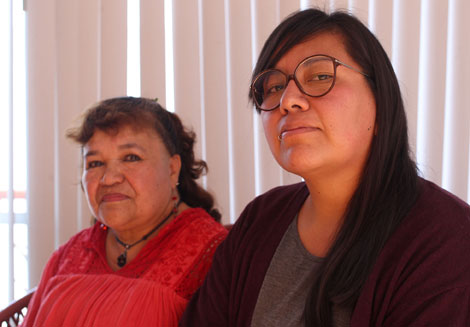
Edith Rosales Gutiérrez and Norma Jiménez Osorio. This photo by José Antonio López appeared on the front page of La Jornada.
By: Emir Olivares Alonso
The women that denounced the Mexican State before the Inter-American Court of Human Rights (Coridh) for the sexual torture of which they were victims during the police operation in San Salvador Atenco [1] the early morning of May 4, 2006 testified at that international body in search of the justice that they have not obtained in 11 years.
In the context of the 120-day ordinary period of this Court’s sessions, five of the 11 complainants narrated “the horror and the atrocities” of the police actions against them. Their testimony was not simple. At times they were silent, on the verge of tears because of the difficulty of recalling those acts.
They were beaten, subjected, humiliated and insulted. The sexual assaults included touching and the introduction of fingers into the vagina, and in one case in the anus. Medical legal experts and agents of the Public Ministry (District Attorney) also mistreated them, did not give them support and were even mocking them and rejecting their complaints; and state authorities questioned what they said.
The Court’s judges showed that they were sensitive to the stories, and didn’t limit themselves to asking exclusively about the denunciation for sexual torture, but rather went deeper into the context, into how the operation took place and the judicial processes against the complainants, about the struggle against Mexico’s new international airport, and they even wanted to know the name of the then governor of the state of Mexico. (It was none other than the current president of Mexico: Enrique Peña Nieto.)
Representatives of the Mexican government, principally, limited themselves to questioning the witnesses if they were familiar with the terms of the State’s proposals for a amicable solution, if they knew that 52 public servants had been consigned or if they were aware that one day before the acts a confrontation between residents and police had taken place. That motivated the judges to call the attention of the officials, because they considered that these kinds of questions did not deepen the objectives of the hearing.
“Come and warm this bitch up,” said various police agents upon submitting Bárbara Italia Méndez, she remembered. They abused her; they squeezed her breasts, bit and sucked various parts of her body and put their fingers in her vagina. “It was horror.” In her search for justice, she agreed to participate in an exam by experts one year later with the women’s prosecutor’s office of the Attorney General of the Republic (PGR, its initials in Spanish). She was re-victimized: while she was naked in a small room, she heard noise outside from several police agents that were making sexist jokes; additionally, the two women that applied the exams took photographs of her with their cell phones.
Several police agents assaulted Norma Jiménez in the backseat of a bus. She told the judges that when she asked for a legal medical expert to search her body because she had been raped, he answered that they had the injuries were surely self-inflicted. Her father does not speak to her. “He thinks that I am wrong for denouncing this here.” In response, Judge Elizabeth Odio told her: “Women are not wrong when we denounce.” Claudia Hernández remembered that the police took off her clothes and when they realized that she was on her menstrual period, they shouted: “We’re going to make this bitch dirtier.” And her torment started. On several occasions she thought about taking her own life.
Angélica Patricia Torres experienced the same torment. She demanded that the State clarify publically that they didn’t lie. “At that time I saw a message on television, in which the governor said that we were lying…” when she was telling this, a judge asked her for the name of the then governor. “Enrique Peña Nieto,” she answered. “Thank you,” the judge replied.
In a joint communiqué, the secretaries of Governance and of Foreign Relations, as well as the Attorney General of the Republic condemned: “the acts of sexual violence and torture against the 11 victims” and stated their “willingness and commitment to attend adequately to reparation measures that the Inter-American Court can order.”
[1] Many supporters/observers of the Zapatistas believe that the police terrorism of May 3 and 4 in San Salvador Atenco was directed at halting the EZLN’s Other Campaign, when delegates from the EZLN toured Mexico denouncing the political class during a presidential campaign. The Zapatista delegates were in Atenco for a big rally just a few days before the police riot. It did halt the Other Campaign for several months and it did curb the Other Campaign’s momentum. The government was also getting revenge on the community for its resistance to construction of a new international airport on part of its land.
Originally Published in Spanish by La Jornada
Friday, November 17, 2017
http://www.jornada.unam.mx/2017/11/17/politica/008n1pol
Re-Published with English interpretation by the Chiapas Support Committee
The State against the pre-candidacy from below and to the left
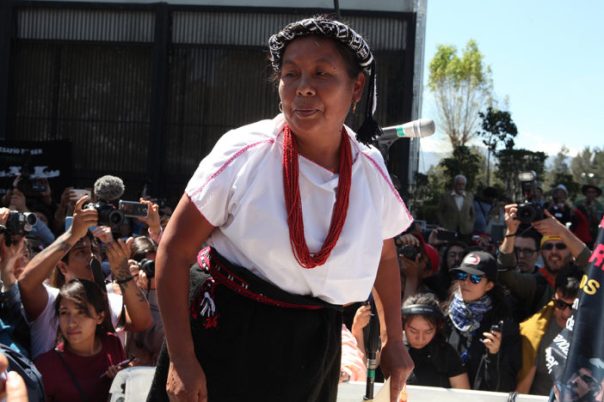
María de Jesús Patricio Martínez, aka Marichuy, the CIG’s independent candidate for president of Mexico in the 2018 elections.
By: Gilberto López y Rivas
The civil association “The Time Has Come for the Flourishing of the Peoples” (Llegó la Hora del Florecimiento de los Pueblos) was constituted for the purpose of obtaining and supporting the registration of the spokesperson of the Indigenous Government Council, María de Jesús Patricio Martínez (Marichuy) as an independent candidate to the Presidency of the Republic in next year’s electoral process. In spite of obstacles, sabotage and unequal conditions, characteristics of the structural racism that permeates institutions of the Mexican State, and without having the vast economic resources that the partyocracy and the supposedly independent candidacies have, but, in fact, at the service of the dominant groups, has been collecting citizen support for weeks in an extraordinary effort that faces a technology that is excluding and difficult to access for those who don’t have the economic resources to acquire costly telephone apparatuses. This technology, by the way, is concealed in a false modernity.
This civil association has denounced the cyber attacks in Chiapas during the mega events the EZLN organized in various of their Caracoles, to block access to the Internet and telephone network, which can only be done by State intelligence organs that have the know-how for that; the omissions and commissions of the Nacional Electoral Institute (INE) were revealed as well. Supposedly neutral and efficient, the INE functions, in fact, as a filter and barrier to hinder the entries of assistants, with proven backlogs in capture and stubbornness in achieving that deadlines, even with seven more days, act to favor the officialist (pro-government) aspirants, and, of course, impede that Marichuy appears on the 2018 electoral ballots.
Last November 7, the association denounced that the INE lies to society, violates its own regulations and fails to comply with the law: it showed that the mobile devices have not functioned appropriately, and that the average cost of a telephone is the equivalent of a little more than three minimum salaries, when 81.7 percent of the employed population earns up to three minimum salaries, and, surprise, surprise! It showed that the electoral organ is not protecting the personal data of citizens that lend their support: the registrations remain in the telephones, and to prove it it’s enough to download a program that tracks all the archives of applications, including that of the INE.
Likewise, the audit of income and expenses of the independent candidates establishes an exhaustive and exclusive system of State monitoring based on the same mono-cultural, classist and racist conception that the INE’s “modernity” its late model telephone applications exhibit. It’s about an instrument of control of the dominant system of representation, of the monopoly of power of the political parties that have overturned laws and regulations, to prevent the inscription of a candidacy that questions the order of things and proposes an anticapitalist struggle.
They don’t take into account the community organizational specificities of the indigenous peoples, nor the evident limitation on the economic resources of a pre-candidacy that doesn’t have the backing of state governments, dominant-criminal economic groups and even former presidents, who invest large quantities of money for the purchase of telephones, employ full-time personnel to work as assistants and expensive accounting firms that do the work required for the audit.
The so-called Integral Control System isn’t thinking about a campaign that positions itself against squandering the citizens’ resources and rests on mutual aid and solidarity as fundamental principles of political work. The audit prohibits public collections, for example passing the basket, la classic form the popular movements use to gather economic resources, because the INE claims that the donors are not identified.
Despite all these adversities and a countercurrent, the association has established the delivery, dedication and sacrifices of the thousands of volunteers that in these conditions have given themselves to the task of collecting citizen support. All kinds of activities have been organized in the majority of the country’s states to explain, debate and analyze the proposal of the National Indigenous Congress-Zapatista National Liberation Army that results from the election in 93 regions of the national territory of the members of the Indigenous Government Council (CIG) and the naming of Marichuy as its spokesperson.
The tours of the CIG and its spokesperson have had as their central task the reconstitution and unity of the original peoples versus the capitalist storm. Also, they have been weaving alliances throughout these months with different and numerous union and political organizations that have decided to support the proposal of the CNI-EZLN.
In the dark neoliberal night, the clarion of a struggle that goes beyond 2018 opens; that assumes the challenge of the indigenous world to organize into collectives in all the ambits of the Mexico of below to struggle against the death projects of capitalism.
The members of the civil association The Time Has Come for the Flourishing of the Peoples make the proposal of Marichuy and the CIG their own: “As is the custom in our peoples, surrendering, selling out or giving in is not an option and we redouble efforts to collect the citizen support required to figure as an independent candidate to the Presidency of the Republic on the 2018 electoral ballot, but above all to expand and strengthen the organizational structure of our rages and our pains throughout the country, so that the earth trembles at its core and permits the survival of the original peoples and the reconstruction of a Mexico that those who have the power have intentionally ripped to shreds.”
———————————————————-
Originally Published in Spanish by La Jornada
Thursday, November 9, 2017
http://www.jornada.unam.mx/2017/11/09/opinion/019a1pol
Re-Published with English interpretation by the Chiapas Support Committee
Constructing something new from below: the CNI in San Cristóbal

Marichuy speaks in San Cristóbal de las Casas, Chiapas, Mexico
By: Radio Zapatista
Chiapas Mexico, November 8, 2017
The plaza of the San Cristóbal cathedral, affectionately called Plaza de la Resistencia (Resistance Plaza), was full. A four-deep wall of women and men from communities belonging to the National Indigenous Congress guarded the stage where members of the Indigenous Government Council and its spokesperson Marichuy were.
San Cristóbal de Las Casas, so sadly known for its racism, witnessed a new uprising of the original peoples. If the declaration of war was necessary 23 years ago, the uprising now is a declaration of life. And just in this place, inheritor of the power of finqueros (plantation owners), of the racism, violence and dispossession of the original peoples, a large number of people gathered to meet and listen to the Indigenous Government Council for the first time and to receive, from the voice of the council members and its spokesperson Marichuy, an invitation to construct a new country.
Six council members shared their word in their original languages and in Spanish. The word in the original languages is an act not only of respect for the diversity of the peoples present, but it’s also symbolic: they are the original peoples, the first owners of these lands, who take care of it them, who work them, who resist despite more than five centuries of dispossession, racism and oppression. And they are the ones who now invite us to unite and get organized against the destruction that we experience.
“It’s that you are not familiar with the Indians, you can’t dialogue with them, you don’t understand them,” a mestiza woman indignantly told the author of these lines a few years ago, when he was chatting with some Tsotsil women that were trained to expect to receive hats, T-shirts and sandwiches at a PRI event. That’s why, because of that racism and that secular scorn, that this event here, in this space, was so significant.
“The political parties go after us women because they see us as weak, with their food supplies and metal roofs,” said the Wixárika council member from Jalisco. But the time has come for women’s word to be heard and that the world sees that, to the contrary, there is strength and dignity in the indigenous woman. “Women are now the flower, the fire and the word,” said the council member from Huixtán, Caracol of Morelia, Chiapas.
The divisions created by the government’s pro assistance politicians were one of the central themes in the event. “The spokesperson doesn’t come to offer caps or T-shirts,” several council members reiterated and insisted on the necessity to stop depending on “gifts” and instead, to construct autonomy by means of their own work and resources. “We are the original peoples, the owners of our lands, of our lives,” said the Tsotsil council members from Los Altos of Chiapas, “it is not possible that we would deliver our lands for some food supplies, for a few T-shirts, for some caps.”
They emphasized repeatedly the need to stop hoping for solutions from above. Only the people can save the country, said the Chol council member from the Northern Zone of Chiapas, and she clarified that, when she talks about salvation, she means life.
Marichuy said the same thing: “We must organize to construct something new from below… we must organize to overthrow this system of death, because we want life,” and she explained how the Indigenous Government Council emerged. “This proposal is because we analyzed that the problem is stronger in our communities… and because of other things that we do, there is no solution from above.” That’s why the CIG was created: “a government composed of representatives of all the indigenous peoples of Mexico, a government that listens to the people, where the people order and the government obeys.”
She announced that the CIG would tour the country to listen to the peoples and to share the word, inviting organization from below. “We have a big commitment and a big responsibility with all of you, but we also ask that you feel that, if we don’t unite these efforts, then we will regret not having made a common effort among all of us.”
The Tsotsil Council of The Highlands of Chiapas reinforced that point: “I invite everyone to organize so that tomorrow our children can say: thanks to my parents, thanks to my grandparents, today I have land, I have somewhere to live, something to eat, I am not a slave. Because if we let ourselves be conquered, if we sell our consciences to the capitalist system, tomorrow our children are going to say: my parents, my grandparents were cowards, they did not defend the land, today I am a slave, I am the exploited servant of the capitalists and the rich.”
Thus, while the crowd withdrew in the cold San Cristóbal night, those who heard the words of the CIG and made them their own, took away with them the spirit of responsibility.
——————————————————————-
Originally Published in Spanish by Desinformemonos
Thursday, November 9, 2017
https://desinformemonos.org/construir-algo-nuevo-desde-cni-san-cristobal-las-casas/
Re-published with English interpretation by the Chiapas Support Committee
 Chiapas Support Committee