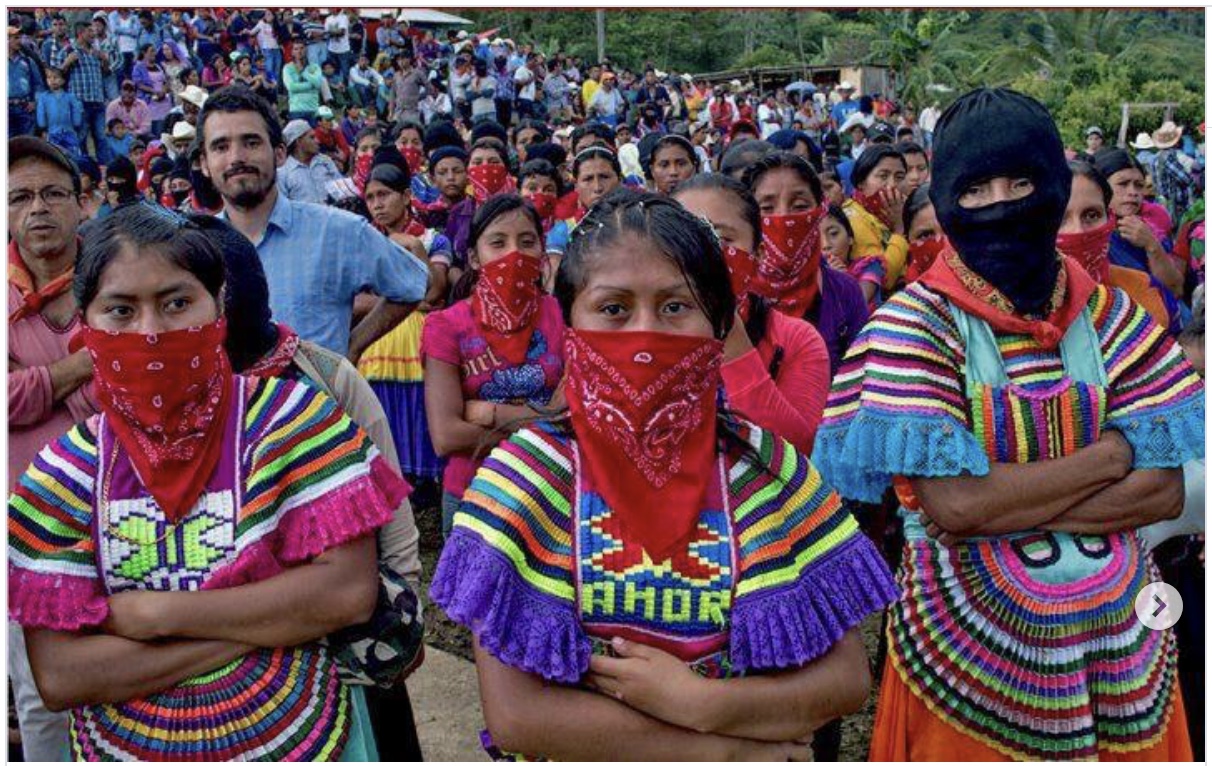
Interview: A sociologist and activist closely linked to the Zapatista movement through academia, journalism, and activism, Raúl Romero reflects on the current strength and relevance of the Zapatista National Liberation Army (EZLN), which, fueled by new practices related to the commons and non-ownership, is celebrated its 42nd anniversary in November 2025.
Written by: Sergio Arboleya at Zur
The Zapatista Army of National Liberation (EZLN) recently celebrated 42 years of existence, founded on November 17, 1983, when a group established a camp in the Lacandón rainforest to begin the first stage of organizing the movement with indigenous communities of Chiapas.
This silent network burst onto the global stage just over a decade later when it rose in arms on January 1, 1994, to demonstrate its radical opposition to the start of the North American Free Trade Agreement (NAFTA), signed by Canada, the United States, and Mexico, then governed by Carlos Salinas de Gortari, a political emblem of the Institutional Revolutionary Party (PRI).
Since then, the EZLN has shaken the global political scene by proposing an ideology that, contrary to the long tradition of Latin American guerrilla organizations, did not aim to seize control of the state apparatus but – in the words of the intellectual John Holloway, who masterfully defined it in a resounding phrase – “to change the world without taking power.”
Three decades ago, in a continent dominated by neoliberal administrations, the emergence of Zapatismo represented an innovation capable of outlining a new horizon for the collective social imagination, spreading its ideology and methods while always emphasizing that in specific territories, it was the local communities that should lead their processes, “each in their own way.”
The magnetic figure of Insurgent Subcomandante Marcos (now a Captain, in another unique demonstration that here the leaders “descend” instead of continuing to rise in the structure), with his remarkable literary skills, broadened the subjective base of the movement and facilitated its penetration, transcending physical and ideological borders.
However, Zapatismo was not merely an aesthetic movement; it involved far more daring and extreme political stances, such as generating “The Other Campaign,” capable of circumventing electoral logic and running counter to the approach adopted by the wave of self-proclaimed progressive governments that reshaped the map of Latin America 10 years after that Chiapas uprising. Although it never remained static, since that moment in the regional calendar, the EZLN and its base have gone through different phases that, broadly speaking, could be described as a certain withdrawal from the international stage and a profound retreat into the indigenous communities. During this period, they strengthened the National Indigenous Congress (CNI, which they had fostered since 1996), with which they attempted to participate in the 2018 presidential elections, supporting the candidacy of the Nahua woman Marichuy. In those elections, Manuel López Obrador ultimately prevailed, becoming the first center-left president (with all the caveats that might be added) in the country’s history.
This kind of withdrawal from international political discourse did not prevent the creation of the Zapatista Little School (2013) nor, a couple of years later, the announcement of “The Storm,” another metaphorical figure used to explain, with sharp precision and without euphemisms, the scope of the new global era. In the same vein, they called for the exercise of critical thinking in the face of the capitalist hydra and also for the formation of “seedbeds” capable of gathering autonomous experiences in different regions of the world.
The pandemic context and the siege by paramilitary groups led to greater isolation, which was reversed externally when, at the end of 2021, the Journey for Life was launched. This included a trip on the ship La Montaña as part of a larger delegation bound for Europe, with future stops planned for other continents. Since last December, this has been followed by the International Meetings of Rebellions and Resistances, where the focus was both on moving towards “the day after” and on conducting a public self-criticism of the political organizational model. This led to the creation of a new model, which Subcomandante Insurgente Moisés summarized as dismantling the pyramidal structure of the Good Government Councils and the Zapatista Rebel Autonomous Municipalities. These bodies are to be replaced by Local Autonomous Governments, the Collective of Zapatista Autonomous Governments, and the Assembly of Collectives of Zapatista Autonomous Governments in the 12 regions that make up this territory.
Sociologist Raúl Romero, who participated in one of the panels held during these meetings between the end of 2024 and January 2nd of this year, highlights these aspects of Zapatismo’s approach to “understanding the dynamic nature of the constant change taking place in the communities, structural changes that occur based on their control of the territories.”
“Zapatismo today, at a global level, is one of the hearts of the anti-capitalist movement at a time when the world has shifted significantly to the right and is experiencing what some would describe as a civilizational crisis.”
In a conversation with Zur from Mexico City, the intellectual and activist quotes Rosa Luxemburg and emphasizes that “in Zapatismo there are three main characteristics that coincide greatly with what happened in the Paris Commune: First, there is the destruction of the state apparatus to create a form of popular self-government based on assembly-based decision-making and their own governmental structures. Second, there is a destruction of the state’s repressive apparatus and, in its place, a popular army with its community authorities built by this autonomous government of the communities. And third, and perhaps most importantly, the recovery of the territories as means of production that allow for the material and cultural reproduction of life, which is what sustains everything else.”
Raúl Romero, an academic technician at the Institute for Social Research and a professor at the Faculty of Political and Social Sciences of the National Autonomous University of Mexico, is a frequent columnist for the Mexican newspaper La Jornada, co-coordinator of the book “Local Resistances, Global Utopias” (2015). He is responsible for the recently launched “Thinking Together About Alternatives,” among other professional activities; Romero emphasizes that Zapatismo, “from its consolidated territory and its armed organizational structure, engages in dialogue with the indigenous peoples of Mexico and the world.”
Drawing on his knowledge and commitment as part of several collectives of adherents and sympathizers of the autonomous ideas that have emerged from Chiapas, he believes that “Zapatismo today, at a global level, is one of the hearts of the anti-capitalist movement at a time when the world has shifted significantly to the right and is experiencing what some would describe as a civilizational crisis.”
And elaborating on this scenario, he points out: “Precisely in the face of this crisis of the liberal management of capitalism, which claimed certain ideas that were lies but were accepted as truth, such as liberal democracy, human rights, and discourses about progress and science, while particularly in Latin America, progressive movements failed to deliver for the popular sectors, the fascist approach emerges, which is completely retrograde, anti-rights, and even operates with a logic of eliminating populations and applying models of accumulation by dispossession, extractivism, the degradation of territories, and confrontation with indigenous peoples. Therefore, in this situation of wars, climate crisis, and the rise of the right wing, Zapatismo is positioning itself as an anti-capitalist left-wing reference point that allows it to offer not only a discourse, a practice, and a theory, but also a conceptualization of the world.” To elaborate on this point within the context of a conversation whose fragments were broadcast on the program Después de la deriva (After the Drift) in Buenos Aires, Raúl resorts to a powerful metaphor that seems to draw from the rich metaphorical tradition inherent in the EZLN itself, asserting: “While Zapatismo has always been committed to viewing and building its work from the autonomy of its territories, it has never stopped dreaming of a vision as vast as the world, and therefore I believe it is not a localist or nationalist movement, but an internationalist one.”
How much do you think the concept of non-ownership impacts the Zapatista movement’s international positioning?
I consider it one of the boldest and most innovative proposals because it stems from understanding the recovered territories as territories that can be shared with other non-Zapatista communities, even those who were previously opposed to them, so that they can work the land together. This idea has also led to other initiatives, such as the construction of a hospital operating room currently underway in Zapatista territory, in which both Zapatista and non-Zapatista communities are participating. This redefines the idea of radicalism, which the Zapatistas say they arrived at after consulting with their elders and ancestors, asking them how they had survived exploitation, contempt, and domination by local bosses and landowners in the past. They responded that they found common ground when they escaped the plantations and went to live in the mountains and the jungle.
Can this position be interpreted as a response to the practices of progressive governments that promoted individual land ownership?
In Mexico, we currently have a government that could be classified as progressive, a very watered-down, second-generation progressivism that lacks the same impetus and radicalism as others, such as those of (Hugo) Chávez and Evo (Morales). The Mexican government under Claudia Sheinbaum, in addition to having a framework of extractivist megaprojects and militarization, launched the “Sembrando Vida” program, which they present as the Mexican version of “good living.” This program consists of allocating resources so that farmers can plant timber and fruit trees, often from army nurseries, and in exchange, they receive a subsidy for their crops. However, one of the requirements of this social program is that farmers and Indigenous people register two hectares of private property in their name, which represents a continuation of the neoliberal agrarian reform aimed at further privatizing land, contrary to the logic of communal ownership. This leads many of these young people to sell their land to new landowners and use the money to pay the coyote, the person who smuggles them into the United States. But there, they encounter a terrible immigration policy that expels them, and they return directly to Mexico landless, indebted, and easy prey for organized crime.
Precisely, from countries like Colombia and Ecuador, among others, there are warnings about drug trafficking groups occupying territories that were part of the networks of autonomous indigenous communities. What is happening with this phenomenon in the region influenced by Zapatismo?
While drug trafficking is one of the most important sources of income for these networks in Mexico, today organized crime groups have human trafficking as their main business, as part of the new phenomenon of global exodus, something that is combined with a terrible crisis of missing persons. Currently, in the country, we have nearly 140,000 missing persons, about 500,000 murdered, around 1 million displaced people, and 13 femicides every day. In this context, since 2018, there has been a greater presence of organized crime groups in indigenous communities, and with it, the emergence of young people from these communities with problems of addiction to synthetic drugs. In this context, Zapatismo finds itself in a kind of bubble, in a kind of peace zone, since in its territories there are no forced disappearances, no drug trafficking, no human trafficking, none of these horrors that occur in the rest of the country because it has managed to protect itself through organizational and community work, just as also happens in Ostula in Michoacán and in communities in Guerrero belonging to the Emiliano Zapata Indigenous and Popular Council.
______________________________________
Raúl Romero Gallardo is a Mexico City-based sociologist, Latin Americanist, and academic technician at UNAM Social Research Institute. He teaches at the Faculty of Political Sciences, as well as at UNAM. As a Zapatista sympathizer and anti-capitalist militant, he is a Red Universitaria Anticapitalista member. He co-coordinated the book Resistencias locales, utopías globales (2015) and writes frequently for the Mexican newspaper La Jornada. His topics of interest include anti-capitalism, social movements, autonomies, socio-environmental resistance, emancipatory processes, and criminal economies.
Para leer la entrevista en español, haga clic aquí en ZUR. To read the original version in Spanish, click ZUR here.
 Chiapas Support Committee