By Danae Fonseca, originally published in El Salto
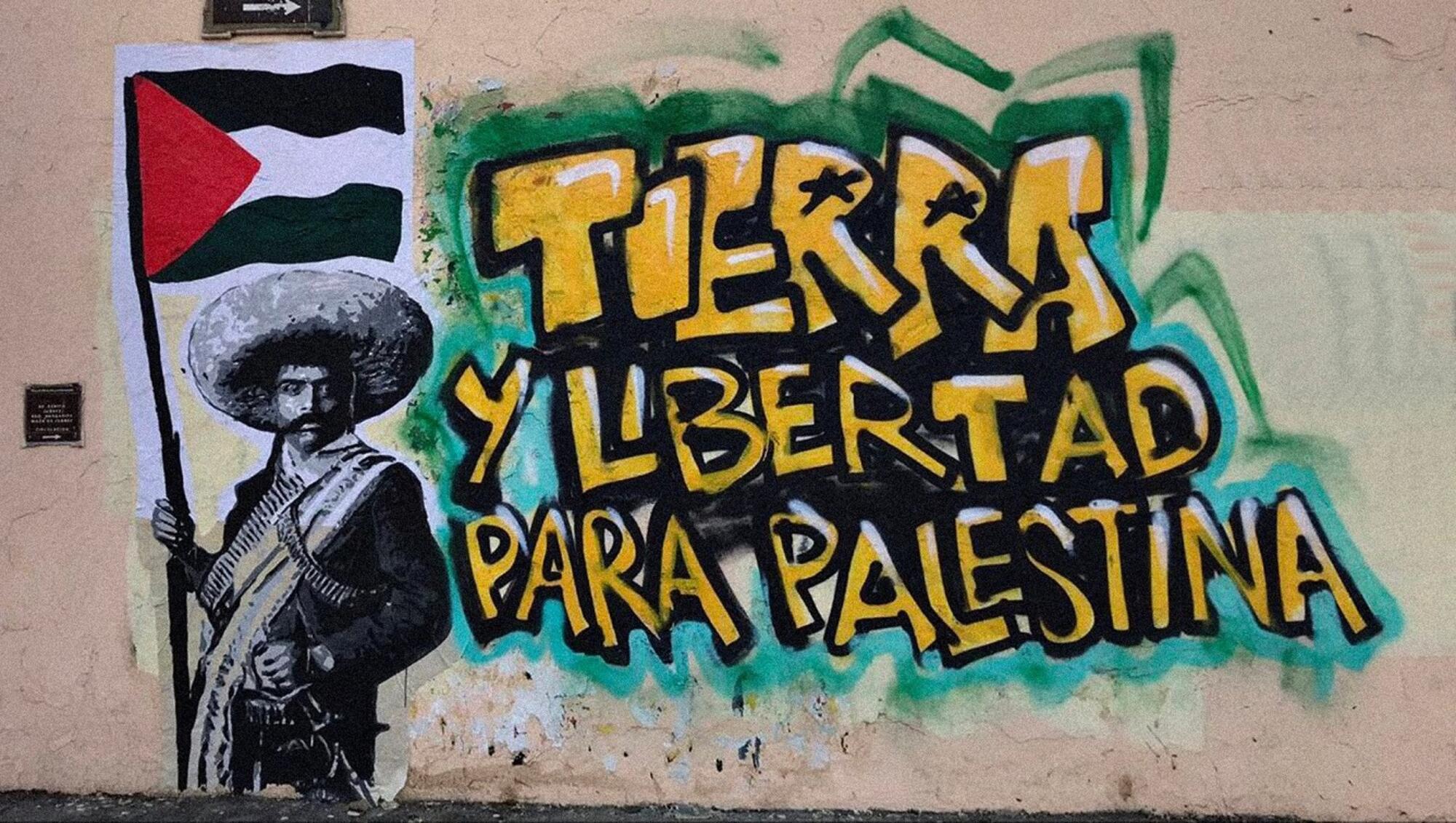
The Zapatista and Palestinian struggles share hallmarks of identity: territory, dispossession as a shared form of oppression, and the importance of memory and history to imaging other futures
I don’t know how to explain it, but it turns out that yes, words from afar may not be able to stop a bomb, but they are like a crack that opens in the black room of death which lets a little light slip through. –-Subcomandante Insurgente Marcos, Mexico, January 4, 2009.
With these words, then-insurgent Subcomandante Marcos spoke about Palestine during the first festival of Dignified Rage in 2009, in the context of the fifteenth anniversary of the EZLN uprising. He prioritized this speech over the one he was going to give at the festival, reiterating the Zapatistas’ understanding that in Gaza there was a professional army killing a defenseless population.
He added: “Who fighting for justice and equality can remain silent?” This speech, titled “Of Sowings and Reapings” –taken up in a statement by Subcomandante Moisés in 2023– linked the two struggles by showing the solidarity of the Zapatistas with Palestine and their position on the murder of the Palestinian people.
In a context in which international struggle and solidarity are more necessary than ever, Chiapas and Palestine have been beacons of continued resistance for social movements internationally. Since their uprising in 1994, the Zapatistas in the mountains of the Mexican southeast have been a symbol of the fight against the capitalist system, a hope for social movements in a world increasingly devastated by savage capitalism. One of their ideas that has permeated these movements is the call to organize — each person in their geography. Palestine, meanwhile, has been an example of dignity and resistance for social organizations around the world, for resisting the occupation for 76 years, and fighting for its liberation from the Zionist state, thereby putting on the table the legitimacy of fighting against occupation by all possible means. Both movements provides reference, resistance and a space for utopias to imagine and build other worlds.
Echoes between resistances
The Zapatista and the Palestinian struggles have very significant echoes of common resistance. The first is the importance and centrality of land for both movements; the second is dispossession as a shared form of oppression and, finally, a third echo is the importance of memory and history to imagine other futures.
Land plays a central role in the Palestinian struggle. In addition to its significance as a physical space, it has a very important symbolic power. Palestinian culture is conceived of and conveyed around the land and all the activities of those who work the land: the Palestinian traditional clothes are originally that of peasants, as is the dabke, the traditional dance. The fruits of the earth are an integral part of Palestinian culture and popular vocabulary. Olive trees, with their roots running deeply into the earth, are the quintessential symbol of Palestinian resistance. Every year, March 30 is commemorated as Land Day, remembering what happened in 1976, when the Israeli army murdered seven Palestinians during the strike that denounced the systematic theft of Palestinian land. A theft that has not stopped and that increases every year through the illegal settlements of Israeli settlers in occupied Palestine.
For the Zapatistas, their very name refers to Emiliano Zapata, the Mexican revolutionary whose main demand was the distribution of the land. Thanks to his struggle, post-revolutionary Mexico saw an improvement in the conditions of agrarian distribution: the peasant movement achieved a change. However, during the rest of the century, state capitalism – and later in its neoliberal phase at the end of the 20th century – was responsible for privatizing the ejido and education, and for removing the fundamental basic rights enshrined in the Mexican constitution, which at the time stood out in comparison to other states for the social rights it granted. Article 27 of the constitution is mentioned at various times in Zapatista history. The Sixth Declaration of the Lacandon Jungle of 2005 recounts the progress that has been made thanks to the work of the Zapatista communities. Now in 2024 a new stage is inaugurated: “the common and non-property,” a new proposal from the communities for working the land.
Regarding dispossession, both the Zapatistas and the Palestinians recognize themselves as being dispossessed from the land.
The Nakba, a word that means catastrophe in Arabic, was introduced into the Arabic vocabulary by Constantin Zurayk and has already been incorporated as part of the vocabulary used around the world to refer to the expulsion of the Palestinians in 1948. However, the word Nakba is used not only to refer to the historical event of 1948, but as a constant process of dispossession by the State of Israel, which also involves the policies of apartheid, the demolition of Palestinian homes, and the constant arrest of Palestinians, among other policies that seek the oppression and extinction of the Palestinian people. Even now, in the context of the current Zionist offensive that began in October 2023, the genocide is spoken of as a second Nakba that is having more fatalities than the first in 1948. At the beginning of July 2024, The Lancet magazine estimated that the real death toll in Gaza could be 186,000 or even higher.
“The world that began to be built on October 12, 1492 is the one that made May 15, 1948 possible, and it has been a catastrophe for humanity…” Palestinians told the Zapatistas in a 2014 statement.
A group of Palestinians who attended the first Zapatista School, “Freedom according to the Zapatistas,” held in three sessions in 2013 and 2014, with the participation of about 6,000 people, issued a statement they sent to the Zapatistas in which they spoke on the relationship between the Nakba and the catastrophe suffered by the Zapatistas. In said statement, they expressed their solidarity with the Zapatista communities after the murder of teacher Galeano in 2014:
“What Galeano taught is what the Zapatista men, women, young people and elders teach every day: that the world that began to be built on October 12, 1492 is the one that made May 15, 1948 possible, and it has been a catastrophe for humanity. This is a world that requires the annihilation of those of us who refuse to live by its designs, and the only way we can win this fight, the Zapatistas teach us, is by creating a new world together. A new world as they tell us, ‘where many worlds fit.’”
The fact that people from the Palestinian youth movement were students at the first Zapatista School reveals a lot about the connection and inspiration between both struggles. In this 2014 statement addressed to the Zapatistas, the Palestinians referred to the so-called “discovery” of 1492 as a catastrophe for humanity, describing it as a moment of extermination.
Another echo of common resistance has to do with the value of memory and history in their struggle to build new futures. For Palestinians, memory is very important; The stories, images, smells and sounds are passed down through the generations about the peoples who were ethnically obliterated in 1948. Third or second generation Palestinians, who did not experience the initial expulsion directly, know the details about their native peoples. And there are a series of dates they remember and commemorate, such as the already mentioned days of the Nakba, the day of the land, the day of the Naksa or the defeat of 1967, the massacre of Sabra and Shatila, the battle of al-Karameh, the first Intifada, the second Intifada and Independence Day, are among the most important.
Palestinian poet Rafeef Ziadah wrote a very emotional poem, Chronologies, on the topic of dates and says when she introduces this poem that Palestinians “love dates.” For Palestinians, commemoration is very important, and memory becomes a weapon against the occupation and the narratives that seek to erase them from the map. It is important to show that the martyrs are remembered, that the keys to the houses, the family stories, the songs and traditional dresses, everything that constitutes and makes up Palestine, are held on to.
For their part, the Zapatistas have never stopped acknowledging their history and situating themselves in it. They have told it through their communiqués, they share it in their schools, they enact it in their plays. As they said in that first declaration of war: they define themselves as the product of 500 years of struggles: “TODAY WE SAY ENOUGH, we are the heirs of the true forgers of our nationality, the dispossessed are millions and we call on all our brothers to join this call as the only way not to die of hunger.” In the Sixth Declaration of the Lacandon Jungle, for example, they present a very detailed review of their history, and of the steps they took.
Evaluations and diagnostic assessments are something very Zapatista. In each of their communiqués, which is how they communicate with national and international civil society, they recount their own history, what they have been through and the path to come. Similarly, during the Journey through Life – Europe chapter*, the Zapatista delegates strongly emphasized the importance of their dead in the journey towards a future, which now appears to be at least 120 years from now.
Lighting the way
One of the unmistakable shared elements of both struggles is their image as the driving force of resistance at the international level. Based on the example and tenacity of these movements, new movements have been mobilized and created. For example, if we think of the Tahrir protests in Egypt in 2011 – one of the mobilizations that led to what is known as the Arab Spring – these were promoted by collectives that came together to support Palestine, which constituted an initial organizing force that later took on a life and demands of its own. The Zapatistas, for their part, marked the beginning of the alter-globalization movements at the end of the 20th century. Just in 1994, when the world thought that all was lost, that capitalism would end up swallowing us all, the indigenous rebels of southern Mexico emerged like a ray of light, inspiring social movements around the world.
In more recent times, the Zapatista journey through Europe meant a revitalization of the movement throughout the hundreds of territories they visited. In the midst of the global COVID pandemic, different social groups mobilized to receive the Zapatistas who had traveled thousands of kilometers. This was not minor since, just at the time of the pandemic forced us all to stay at home, thousands of people in Europe chose not to remain immobile or silent and organized to receive them. An organization was deployed from below and to the left by many groups that received the “extemporaneous’ ‘ delegation made up of 177 Zapatistas and members of the CNI that accompanied the journey to share their struggles. The most important thing was that even after the departure of the Zapatista delegation, great bonds were created that united the struggles throughout Europe. The Zapatistas sowed the seed of rebellion, which has flourished in movements and has allowed Europe itself from below and to the left – which was very isolated and separated – to unite, now also to fight against the fascisms that want to subdue us.
Today Palestine is a cause that is increasingly becoming part of the agendas of social movements. In the wake of the bloodiest stage of the Israeli genocide, that began in 2023, people have mobilized and included Palestine in their initiatives. This year, the 8M, one of the largest and most important mobilizations in Spain, has made a human chain against the genocide, it has marched with the Palestinian keffiyeh. The slogan ‘Patriarchy, Genocide, Privilege #It’s over,’ has been included as part of feminist demands. The demonstration on Critical Pride Day in Madrid had a sign with keffiyehs against Israeli pink-washing. More and more social movements are becoming aware of what Palestinian resistance means and what they are fighting against. It is also worth mentioning that one of the issues that has been put on the table during the Israeli genocide is the need to reclaim armed struggle as a form of resistance. Thanks to Samidoun, the movement that emerged to support and defend Palestinian political prisoners, assemblies are increasingly questioning how certain uses of force are legitimized and others are not, and how the discourse around legitimate defense has been hijacked.
We ourselves are the hope that exists.
“We know, as indigenous people that we are, that the people of Palestine will resist and will rise again and will walk again and will know then that, although far away on the maps, the Zapatista peoples embrace them today as we did before, as we will always do, In other words, we embrace them with our collective heart.”
With these words, Comandante Tacho of the Zapatista National Liberation Army inaugurated the first sharing between the indigenous peoples of Mexico and the Zapatista peoples in 2014. Framed in a speech welcoming the indigenous peoples of Mexico, Comandante Tacho united Zapatistas and Palestinians as peoples who suffer destruction, death and dispossession. However, the most important thing is that these movements seek a solution in an alliance in which both are protagonists. Just as Tacho said: “We ourselves are the hope that exists. . . . No one is going to come to save us, no one, absolutely no one, is going to fight for us.”
These words not only resonate as a cry of resistance, but also as a call for active solidarity. The Zapatistas and Palestinians teach us that true hope lies in the union of peoples, in the joint construction of a world where many worlds fit.
_____________________
Translated by the Chiapas Support Committee. Read the original published by El Salto in Spanish here.
 Chiapas Support Committee