Chiapas Support Committee
Home of the Compañero Manuel blog on zapatistas & mexico
The Overture: Reality As Enemy

“If our epoch thinks this way,” the world says to itself, “who is (no) one to say otherwise”? Who are the politicians to do so if they should obey us? Who are the judges to do so if their decisions are obligated to reflect and please us? Who are the journalists and essayists to do so if their opinions should meld with our own? Who are the thinkers to do so…given that they aren’t even necessary to us? Who are the law makers to say otherwise if they are supposed to establish laws following our dictates?”
–Javier Marias, “When Society Is The Tyrant.” (From El País Semanal, May 13, 2018) *
(*) I don’t know if citing Javier Marías (whose novels A Heart So White and Tomorrow In The Battle Think about Me eased the sleeplessness of the now deceased Sub Marcos during the nights after the betrayal which took place in February of 1995) makes me part of the conservatives and neoliberals, “mafia of power.” I mean, I bring this up given the fact that Javier Marias has worked with the Spanish newspaper El País and that he tends to sharply question the evidence when others tend to swallow it hook, line, and sinker without so much as a whimper and that he’s intelligent and can’t (nor do I think that he wants to) hide it. In addition, let’s not forget that that he’s a monarchist because he is king, Xavier I, of the Kingdom of Redonda and a member of the Royal Academy of Spain. All of these reasons are more than enough reason to tag him as a “conservative/neoliberal/enemy of the people and its vanguard which is marching inexorably to the fulfillment of all history,” by the new thought police that we now suffer.
As I’m sure you all know by now, I care a lot about “what people say” about me because I have a reputation to protect. Given this concern I had to think carefully and in all seriousness about this citation…for all of a fraction of a second. At that moment I saw hashtags, trending topics, likes and dislikes, Facebook rants, whatsapps, instagrams, morning press conferences, and opinion columns all flash before my eyes filled with condemnations and damning tags.
In my defense, I thought I could mention the fact that along with the Javier Marías books that the now deceased Sub Marcos carried during those dark days, you could also find books by Manuel Vazquez Montalbán as well as Miguel Hernandez’s Expert in Moons. I thought I could also bring up the fact that Javier Marías is a fan of (or was a fan of—support for a football team is like love—it’s eternal, until it ends) Real Madrid, that Manuel Vázquez Montalbán is a fan of Barcelona, that Mario Benedetti is a fan of Nacional from Montevideo, Almuneda Grandes supports Atlético Madrid, Juan Villoro backs Necaxa and that I, in contrast, with my provincial chauvinism which is all the rage, support the Jaguars from Chiapas.
(N.B.! Instead of using Baseball, the sport that has become the official sport and the sport of officialdom, I prefer to use soccer as my referent. So, make sure to add these additional sins onto my sentence.)
I imagine that with a backpack packed with these “weapons”—it’s also rumored that the backpack contained a bilingual edition of Shakespeare’s Sonnets, the two volumes of The Ingenious Hidalgo, Don Quijote de La Mancha, and an absurd French-Spanish-French dictionary—the deceased Sub Marcos must have envied Guy Montag to no end for having found a library filled with texts that had been bound in the brains of the outlaws found in Ray Bradbury’s 1953 Fahrenheit 451. It must have been Sub Marcos’ wet dream to command a human library instead of troops: “Attention! This is the battle plan: First, Joyce and Beckett will sow bewilderment and confusion among the enemy ranks; next, Saramago, Neruda, and Gelman will flank the enemy to their left and Vargas Llosa, Paz, and Solzhenistyn will do the same but to their right. At the same time García Lorca, Wilde, Sor Juana, and Woolf will flip their positions, and the rest will move as a single block. Ok, you should already know this but, if there are a lot of them we’ll run, if there’s a few of them we’ll hide, but if there’s no one there then “forward! We were all born to die! Ok, any questions, doubts, anxieties, anger, middle fingers? No! Dylan, you’re on the tambourine!”
One time I ask the now deceased Sub Marcos if he actually read all that stuff that he was carrying. He told me he didn’t, that he carried it so that if they killed him his executioners would at least have something with which they could entertain themselves during the time it took him to finally die. Yes, I know, Sub Marcos’ dark humor wasn’t well received… Well, it wasn’t just his dark humor that wasn’t liked.
In sum, as I was saying, I was doubting whether I should cite Javier Marías instead of Lenin, the two Marxes (Karl and Groucho), Malatesta, Trotsky, Mao, or that Manual of Historic(al) Material(ism)—Polyester. I weighed all the pros and cons of doing so and since I found no pros and so many cons I decided I would definitely have to cite him so that in that way I could add to my already immense popularity among the intellectuals of the Fourth Transformation [IV T]. I should make clear that Javier Marías is entirely innocent in this assault against political correctness due to the simple fact I’ve never spoken to him. I hope that if he finds out about this that he’ll have the generosity to simply, as they say over there [in Spain], “look past me” with the same face that one would look at the passing of an untimely insect—an insect that might very well be a beetle.
_*_
If modernity consists of the fact that, instead of throwing stones at what people don’t understand (which is what makes that thing “different”) now they use tweets and dislikes, well then, the world must be making progress. From stoning into the bonfire, from there to the gallows. Next, up against the firing squad, followed shortly thereafter by exile and the pogroms; after that, concentration camps and strategic hamlets. Closer to home, the walls, border patrol, “votre papiers, s’il vous plait” (your papers, please).
Social Media simply isn’t enough to “purify” the newly enthroned Aryan race: ignorance. The system also requires the violence of the state institutions in order to “complete” its raids. I don’t know if the aversion to what is different was already in the DNA of the founding Big Bang of the Universe, but ignorance has always persecuted and attacked knowledge and what makes it possible: intelligence.
If the dark ages used to move at the pace of carts and galleons, today it travels in yottabytes (a yottabyte=a 1 followed by 24 zeros of bytes) and the speed of light. We might even say that social media has the government that it deserves. But even there on social media there are those who resist and rebel. There’s always someone who doesn’t follow the pied piper of the latest trending topic and who instead decides to reflect, to analyze, to doubt, to question. It’s a tiny minority that’s been cornered and swept away by “influencers” and other such cretins who have discovered that stupidity can also get you fame and social recognition. Still, the very potential of social media is also its limit: the fleeting is what leads attention by the nose and pressing pause isn’t a possibility if one is to stay up on the latest. The worst enemy of a scandal is the next scandal that follows it almost instantaneously. Traditional media is dragged back and forth by this virtual drunkenness. Almost the entirety of the printed press does nothing but try to recycle what’s already trending on social media, but no matter how much effort they make they’re always bringing up the rear. A press that can fill this vacuum by investigating, by eliciting reflection, by feeding intelligence and giving wind to the sails of knowledge has yet to be seen.
In the way it sees fit, and with an enormous technological apparatus at its disposal, the system fights off reality in the most effective way possible, by creating another reality and drawing all the attention and energy of the people-people toward this alternate reality. For example, you look upon and evaluate governments, whether positively or negatively, not by referring to their acts, their decisions, their capacity to respond to unforeseen circumstances, but rather by pointing to their virtual popularity. In this way, bad governments can triumph on these “darned” social media while real reality insists on marching us all toward the abyss. Virtual reality clothes the naked emperor in modesty; the tyrant is presented as a democrat; the reactionary as transformational; the imbecile as intelligent; and the ignorant as a sage.
But that’s not it. The system has also rediscovered that hunting down those who are different will provide you with followers and therefore the utterances and judgments of characters like Trump, Bolsonaro, Macri, Moreno, López Obrador, Ortega, Piñera, Putin, Macron, Merkel, Tsipras, Johnson and ____________ (fill in the blank) provoked howls of approval on social media. That’s how judgments and sentences are passed down today that are much more than just words and that should scandalize anyone with even a minimum of decency. The migra [in both the U.S. and Mexico], the minutemen in the U.S., and the National Guard [Mexico’s] enforce the sentence that has been passed against migrants, while the “left radicals, that in my eyes are nothing but conservatives” (dixit López Obrador) are forewarned by the “hitmen” that shot Samir Flores Soberanes. Meanwhile the washing of hands continues unabated, Trump will condemn the massacre in El Paso and López Obrador will say, while he’s in talks with big business, that he’ll investigate Samir’s assassination.
_*_
We’re not going to offend anyone by insisting that we told you so (but…we did tell you so).
The serpent, now free of its shell, stretches out and rejoices. It celebrates and applauds itself while, slowly, ever so slowly the constrictive embrace of one-dimensional thought does its work. No one should oppose the powerful! No one should defy his omnipotence over the press, social media, or the academy. No one should oppose his disdain for the arts, for science, no one should call out his corrupt financial practices, his benedictions and damnations from the pulpit—a pulpit built upon a foundation of lies, simulations, threats already delivered upon, and the attacks (virtual and real) by those maroon shirts that slowly begin to turn brown. No one should dare to recognize reality as their referent and therefore look beyond the angry and tedious sermons and diatribes of the one who appears alone, and only, on stage.
Awww, we know, so much confusion! Up there they say that everything is fine and here below we tell you everything is fucked and it’s going to get worse. But for now, all critical thought, all scientific analysis, and all art that reveals and rebels, has in front of them not reality but a tag that labels them “right wing,” “conservative,” “reactionary,” or “fifi” or whatever might come to the lips of the inquisitor-in-chief and overseer that’s charged with dishing out damnations and condemnations on this plantation we now suffer.
And by the way you’re right, the comic tantrums thrown by Felipe Calderon, by Vicente Fox, by a rancid PAN, by a PRI that survives only by bribing the coroner into setting back the time of death, by a PRD that will some way have to demonstrate that it still exists, and by those “thinkers” that accompany all of these, seem to have been created by the ruling party itself because all they are able to accomplish is:
- They provide material that can easily be refuted even by someone who seems totally lost.
- This serves to perfunctorily disqualify any criticism or observation that might actually be based in rigorous research and analysis. Which also means that any criticism, that might not even come from the left but from progressive sectors or liberal democrats, starts to sound like another brick in the wall of a plot or “soft coup” (the latest fashionable hoax) behind which the supreme leader can hide indefinitely.
Naturally, you would expect a bit of seriousness, more analysis and less sloganeering from each side. But there isn’t any seriousness nor analysis and there won’t be any either. The sectors of the right that are fighting it out, and that have reduced the left and the progressive sectors to mere spectators, are at war. Some are at war so that they can stay in Power (or at least in what they think is Power) and others so that they can return to that privileged location, to the pulpit from which they might once again reign.
But whom can I believe?
That’s right: nobody.
Not even reality?
Look, listen, feel, smell, speak, and suffer your reality because, yes, we know that it’s raining everywhere and on everyone, at least here below. Maybe some are just barely starting to feel the first cold stinging drops beating down on their body. But for others, and not only for indigenous peoples, this rain today is coming down after another rain, after another, after another; dispossession, theft, threats, persecution, jail, disappearance, rapes, poundings, death… and yes, sometimes even charity.
Can we make a list of those it’s raining on? That would be difficult but a first attempt might look like this:
-The families of prisoners, the murdered, the disappeared who are searching for truth and justice and an answer to that question for which there will never be a reply: “Why?” It’s because of the great absurdity of chaos that today distributes absences just because, because of statistical probability, like the lottery. If death can be terrible, not knowing what happened or why it happened is simply outside of all human logic and yet it’s a level of cruelty that could only be the result of the machinations of the human mind.
-Others, who have finally found equality with women of all ages, children, the elderly, men, all of them assassinated and disappeared. Death and that incredibly cruel limbo of disappearance finally creating equality across genders, races, and colors.
-Women, always women, beaten, raped, disappeared, murdered.
-Peoples under invasion by the most absurd megaprojects, humiliated by the same hand-outs as always under a different name but with the same requirements as before: Lower your head! Obey! Kneel! Humiliate yourself! Give up! Disappear! In addition to that weapon wielded by that “progressive” hitman who killed Samir Flores believing that by killing him he would die, that by killing him, they would kill his cause.
-Journalists censured by threats, blackmail, harassment (virtual and real), disappearance, jail, murder.
-Workers from the countryside and the city, weighed down with work until yesterday, today or any day, unemployed and indebted.
-Doctors and nurses who have to ask their patients to bring their own gauze, their own needle, their own bandage, their own medicine, “because there’s nothing and all I can tell you is what’s going to kill you which at this point is already a lot given the situation. But look, let me give you a list of the promises that the government has made. That’s right, in the meantime I would recommend that you wait to get sick until next year and maybe then….”
-Organizations, groups, and political and social collectives on the left that are faced with the choice: surrender or be persecuted.
-Any random person who has been assaulted, extorted, kidnapped, disappeared, murdered, or dispossessed of that which they earned through their work, or who have been robbed of freedom and of their life.
-Scientists with no funding, Artists and other creators with no place to work, Intellectuals who sin by just thinking (“Oh come on man! Thinking isn’t a sin, it’s just saying what you think that’s the sin, get it straight.”). Everything is neoliberal and “fifi” until the proper accreditation from Power has been verified in the morning press conferences that are meant to kill news columns, analysis, reports, research, knowledge, and intelligence.
-Migrants that are after the American Dream and yet only find Mexican nightmares wearing the badges of the Mexican National Guard that looks for legitimacy by proving that that cruelty against that which is different can also have citizenship in that place where the stamp depicts an eagle devouring a serpent.
If you are not on this list and you don’t have any family, friends or acquaintances who might fit into one of the categories on this list then I have no idea what you’re doing reading this. Oh! Maybe you got here because of Google! Oh, Google and YouTube, “How unsearchable are your judgments and how inscrutable are your ways” (Romans 11:33.) Yes, I googled it, I couldn’t help myself and anyway today it’s all the rage to cite the Bible willy nilly.
You’re still here? Ok, but it’s on you. I’m warning you that you’ll have to read and reading my friends is like making love—there are lots of positions, ways, calendars, geographies, techniques, and technologies. But even so we’ll always be lacking a Kama Sutra for reading.
Are you ready? Grab a coffee? A soda? A water? Some tobacco? Some legal or illegal substance? Here we go…
But first, let’s use a little imagination! Let’s take a look at one possible reality. After all, thanks to science (which today btw has been displaced by the frivolity of the pseudo-sciences, by a clean shaven esotericism, by new age and its holistic rear end summed up in a note, “Looking to trade my laboratory for a yoga studio!” and by the “like” button as a criterion of truth) we know that fiction is but another feasible reality.
Ok, tell me, the rain that’s about to fall, will it be hard? How hard? Have you ever seen the rain comin’ down on a sunny day?
(To be continued….)
From the mountains of the Mexican Southeast
The Sup Galeano
(Practicing my Ommmm so I can apply for funding from Conacyt[i])
Mexico, August of 2019
From the Notebooks of the Cat-Dog:
-The tyrant abhors intelligence. Not only because intelligence questions and defies them but also above all else because they don’t have it. Since intelligence remains unreachable for the tyrant, they prohibit it and persecute it. Fear the boss who is agile and sly but doubly fear the boss who is ignorant because ignorance dehumanizes through consensus and ends up enslaving us. And more times than not naïve hope is nothing other than a well-dressed ignorance.
-Ignorance will always have more followers than intelligence and knowledge. Not only because ignorance is just easier but also because ignorance never goes out of style and is always popular and therefore attractive.
-Ignorance is more profitable than intelligence and knowledge and also cheaper.
-Ignorance is the mother of cowardice, betrayal, and forgetfulness.
-The tyrant always sows and grows ignorance. The ignorant will always need a pastor to lead them. The tyrant will always need a flock to follow them.
-Intelligence is the fruit of growth through knowledge and its thirst can never be quenched even when it is watered by other sources.
-With knowledge, intelligence discovers that the tyrant is not only unnecessary but also has an expiration date, which is the same date as the exhaustion of the patience of the slave.
-Intelligence does not die; it does not surrender. Perhaps at times it hides and waits for the right moment to become a shield and a weapon. In the Zapatista communities of the mountains of the Mexican Southeast, intelligence transformed into knowledge is also referred to as “dignity.”
I bear witness.
The Undocumented Cat-Dog
Rrruff-meow (or is it the reverse?)
Mexico, August of 2019 – The rain begins to fall.
En español: http://enlacezapatista.ezln.org.mx/2019/08/11/obertura-la-realidad-como-enemiga/
To watch the videos that accompany this communiqué: http://enlacezapatista.ezln.org.mx/2019/08/11/obertura-la-realidad-como-enemiga/
[i] Consejo Nacional de Ciencia y Tecnologia, or National Council on Science and Technology.
Galeano: With the current government, it rains on wet for the original peoples
[A new communiqué entitled “Overture: reality as the Enemy” is available in Spanish on Enlace Zapatista (link below). When the English translation is available, we’ll post it. Meanwhile, here’s a summary from La Jornada.]
By: Elio Henríquez
San Cristóbal De Las Casas, Chiapas
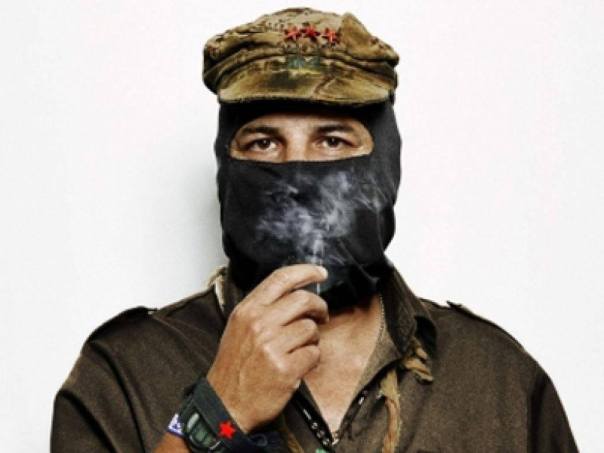
Subcomandante Galeano, formerly Marcos, affirmed that with the current government, for many Mexicans, “not only for the original peoples, it rains on wet: dispossessions, robberies, threats, persecution, prison, disappearances, rapes, blows, deaths… and, yes, sometimes alms.”
In a communiqué divulged last night on the Enlace Zapatista page, he said that: “up there above they declare that everything is going well, and here below that everything is going badly, and that it’s going to get worse. Although now all critical thinking, all scientific analysis, all art that reveals and rebels, faces not reality, but the label of ‘right’, ‘conservative,’ ‘reactionary,’ ‘fifí,’ or the occurrence that reaches the lips of the inquisitor and overseer who, on the finca that we suffer, distributes guilt and condemnation.”
He stated that: “the comic pawns of a Calderón, a Fox, a stale PAN, a PRI bringing the coroner to delay the death certificate, a PRD that somehow has to show that it exists, and the thinkers that accompany them, seem rather to be forged by the official party, because they get two things:
“One is that they give easily refutable material to someone who doesn’t even know where he stands. The other is that that annuls any criticism, singling out observation that has as its basis a rigorous and documented analysis. In addition, of course, that all criticism that we no longer say comes from the left, but rather from progressive sectors and liberal democrats, sounds like one more note in the false symphony of the plot and the ‘soft coup’ (the story of fashionable deceitful fools) behind which the supreme one takes refuge.”
He said that: “the rights that they now dispute, and that they have left as spectators of the left and of progressivism, are at war. Some for maintaining Power (or in what they believe that Power is), and others for returning to a privileged place, to the pulpit from which they reign. Who to believe? You are right: nobody. Nor the reality?”
He affirmed that: “it rains everywhere and on everyone, at least here below. Perhaps some, just barely begin to feel the cold drops stinging the body; but for [email protected], and not just for the original peoples, it rains on wet: dispossessions, robberies, threats, persecution, prison, disappearance, rape, blows, death… and, yes, sometimes alms.”
He added: “ A list? It’s difficult, but something rushed could be:
–Families of prisoners, [email protected], [email protected], in search of truth and justice. And the question that will always be unanswered is: why? The great absurdity of chaos distributing absences because yes, for statistics, for raffle. If death can be terrible, not knowing what happened and why, is out of all human logic. It is a cruelty that could only be plotted by the human mind.”
According to Galeano, “the social networks are not enough to ‘purify’ the newly enthroned Aryan race: ignorance. The system continues needing the violence of the state institutions to ‘complete’ the raids. I don’t know if the aversion to difference was in the DNA of the foundational Big Bang of the universe, but ignorance has always persecuted and attacked knowledge and its possibility: intelligence.”
He pointed out that: “if before the defense of ignorance was dragged around at the speed of carts and galleons, today it navigates in yottabytes (a yottabyte = one followed by 24 zeros of bytes), and at the speed of light. It could be said that networks have the governments that they deserve. But there is still resistance and rebellion there. There is no lack of one who doesn’t follow the flutist of the trending topic and chooses reflection, analysis, doubt or questioning. A minority cornered and overwhelmed by influencers and [email protected] [email protected] discovers that stupidity also wins fame and social recognition. But the potential of the social networks is also its limit: the transience takes the focus of attention away from the nose and stopping is not possible if you want to keep up. The worst enemy of scandal is the scandal that follows almost immediately.”
He affirmed that: “the traditional communications media are carried away by virtual drunkenness. Almost all of the written press does nothing but recycle what is fashionable in the networks, no matter how hard it’s still lagging behind. It remains pending filling the void of a press that investigates, provokes reflection, feeds intelligence and encourages knowledge.”
The complete text can be read in Spanish on Enlace Zapatista: http://enlacezapatista.ezln.org.mx/2019/08/11/obertura-la-realidad-como-enemiga/
———————————————————–
Originally Published in Spanish by La Jornada
Monday, August 12, 2019
https://www.jornada.com.mx/2019/08/12/politica/005n2pol
Re-Published with English interpretation by the Chiapas Support Committee
EZLN: The Opening Act
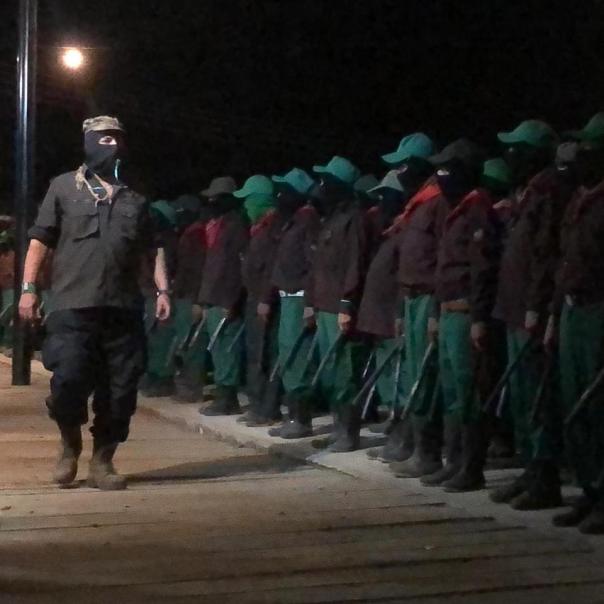
Sup Galeano reviews the troops.
ZAPATISTA NATIONAL LIBERATION ARMY
MEXICO
August 2019.
Testing, testing…
One… two… testing…
Testing one two three… testing…
“¿Hello, hello, hello, how low?”
From the… wait a minute! Did the Sup just quote the Nirvana track “Smells Like Teen Spirit”? What’s he trying to do, address a particular generation Or is he talking to those who regret having promoted what now plagues them? Or is he suggesting that this was Kurt Cobain’s version of the Joker’s “Why so serious?” Or maybe it’s self-criticism because of that “I’m worse at what I do best” thing? A subliminal message for CompArte?
Hmm…Maybe it has something to do with SKA. What? Ska wasn’t around then? Country Rock and Roll? El Piporro with images from that classic of interstellar filmography, The Ship of Monsters? [i] Hmm…an unconscious reference to Puy Ta Cuxlejaltic? [ii] Or a greeting that challenges the wall which the federal government intends to erect on the Mexican Isthmus in order to separate us from the peoples of the north? Nah, must be something else.
For sure, Alakazam the Great [iii]:
Look, ladies, gentlemen, and others
Nothing to see here, nothing to see there, but wait, all of a sudden, boom:
The Zapatista communities (re)appear…
(To be continued)
From the mountains of the Mexican Southeast
El SupGaleano,
Performing as opening act for Subcomandante Insurgente Moisés, while he drives (SupGaleano that is) fast and furious down the highway to hell, and “for this gift I feel blessed…” [iv]
Mexico, August 2019
[i] “El Piporro” was the nickname of Eulalio «Lalo» González Ramírez (1921–2003), a Mexican actor, comic, musician, songwriter, screenwriter, and film director who starred in La nave de los monstruos (The Ship of Monsters), a 1960 Mexican comic science fiction film. https://en.wikipedia.org/wiki/The_Ship_of_Monsters
[ii] The name given to the Zapatista film festival held in November 2018, meaning “Caracol of our Life.” Caracol is literally conch shell or a spiral, but also the name for the five seats of Zapatista self-government.
[iii] 1960 Japanese musical anime film, based on the Chinese novel Journey to the West. See the plot line at: https://en.wikipedia.org/wiki/Alakazam_the_Great
[iv] Lyrics from “Smells like Teen Spirit”: “I’m worse at what I do best, And for this gift I feel blessed…”
En español: http://enlacezapatista.ezln.org.mx/2019/08/10/enter-el-telonero/
- Nirvana – Smells Like Teen Spirit
2. Eulalio ‘Lalo’ González «El Piporro» – Ojos De Pancha
3. AC/DC – Highway to Hell
The Maya Train could put biosphere reserves at risk

Mama jaguar and her cub.
By: Angélica Enciso L. and Fernando Camacho
Calakmul, in Campeche, because of its continuous extension of vegetation, is the second most important rainforest reserve of tropical America, after the Amazon. The Sian Ka’an area, in Quintana Roo, shelters a system of underground rivers that interconnect cenotes and petenes. [1] We’re dealing with two biosphere reserves of high importance in the country. The Maya Train will pass through them with the threat that they will lose their ecological connectivity and fragment.
The above is pointed out in the study “The Maya Train, why are the biologists so concerned?” Casandra Reyes, Celene Espadas and other experts from the Scientific Research Center of Yucatán and the Social Sciences Unit of the Autonomous University of Yucatán authored the study.
The report exposes the importance of the jungle: it is equivalent to the planet’s lungs; it regulates the temperature and provides water. Its fauna contribute to the natural control of pests, besides services like pollination, which allows plants to produce fruits. “This kind of pollination is required by the vast majority of the vegetables that we eat, therefore the mass death of bees or bats could threaten food production.”
It adds that large mammals that inhabit the region, such as the jaguar and the puma, control populations of herbivores and help the regeneration of plants in the forests. There are other tangible environmental services, like wood, firewood, fruits, medicinal plants, dyes, spices and animals for hunting, among others. Cultural services are added to all that; local communities with “their practices and thoughts seek to establish a harmonious relationship, the least predatory possible, with nature.”
It points out that the archaeological zone of the reserve is still difficult to access; there is little tourist infrastructure and less than 40,000 visitors come per year. The report projects that with the train’s arrival, of the almost 17 million visitors that would arrive in Cancun per year, 3 million would go to Calakmul, which would multiply the current numbers.
Regarding the social impact, Giovanna Gasparello, a researcher at the National Institute of Anthropology and History, warns that this project would generate massive tourism, with the supposed objective of creating “development.” It brings with it illegal economic activities, such as human trafficking, money laundering and drug trafficking.
She points out in an interview that, according to official data, in 2017 in Playa del Carmen there was an index of 89 intentional homicides for every 100,000 inhabitants, when the national average is at 25 for every 100,000. In Bacalar, with only 90,000 inhabitants, the index is 38.1. She alerts that instead of being a tool of inclusion and social wellbeing, mass “sun and beach” tourism is based on a series of land dispossessions, in which large investors are involved.
She proposes that this project promotes territorial reordering on the Yucatan Peninsula. Its purpose is to concentrate the campesinos that live in disperse communities in 15 urban centers to be built or already existing, to have their labor available for the tourist industry. That is serious not only because of the uprooting, but also because that population would depend on an activity that can go down due to factors like the [toxic] sargassum seaweed or an increase in violence.
As if that were not enough, the geographic characteristics of the Peninsula mean that water is very scarce, she warns.
[1] Cenotes are sinkholes that expose the water underneath limestone. Petenes are islets in a salt marsh with important vegetation.
———————————————————–
Originally Published in Spanish by La Jornada
Monday, July 15, 2019
https://www.jornada.com.mx/2019/07/15/politica/005n1pol
Re-Published with English interpretation by the Chiapas Support Committee
The 85th anniversary of the march that created Tila
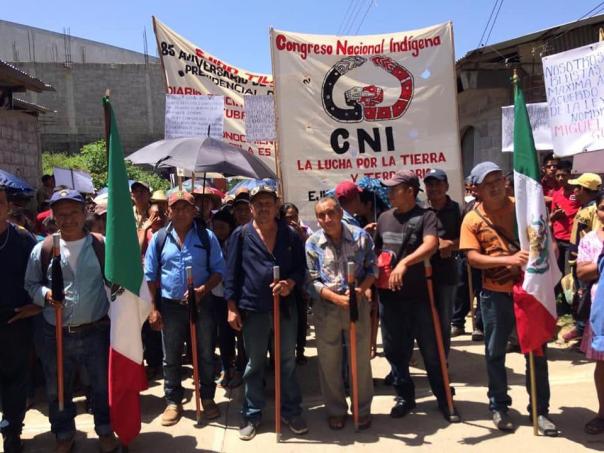
Tila celebrates anniversary.
*Almost a century after they marched from the municipality to the Chiapas capital, residents remembered the feat of their great-grandparents by bringing forward the creation of the municipality
Residents of the municipality of Tila celebrated the 85th anniversary of the presidential resolution that created the municipality with a community assembly and a march.
The National Indigenous Congress (Concejo Nacional Indígena, CNI) mentioned that they cannot overlook how the ejido’s documents were legalized, when past generations walked over the mountains of Tila to Tuxtla Gutiérrez to deliver the petition on February 3, 1922 to General José Tiburcio Hernández Ruiz, who was governor of Chiapas at the time.
After that, this request was published in the state government’s Official Daily on April 5 of the same year del and the agricultural census of 836 individuals was taken on March 21, 1929.
At the same time, on May 19, 1932, Manuel Paz was the commissioner in charge of delimiting the 5,405 hectares in the following manner: 2,938 hectares of national lands and 2,466 hectares of the Pennsylvania estate that corresponds to the sum of 5,405 hectares of ejido lands in favor of the ejido Tila. The provisional delivery was published in the state’s Official Daily on June 1, 1932 only once in accordance with Article 160 of the Agrarian law in effect at that time.
Residents remembered that on January 17, 2019 decree No. 132 was made public, which left decree No. 72 non-existent and the Official Daily of 1980 issued by the fifty-fourth legislature of the Congress of the State of Chiapas, which consisted of subdividing into urban lots that led to the dispossession of ejido lands belonging to the complaining ejido; that is, thee Ejido Tila.
In addition, in the assembly they remembered that all the injustices their parents and grandparents endured cannot go unnoticed, such as the dispossession of 130 hectares, individual dispossessions and armed conflicts, house burnings in 1970, 27 arrest warrants in 1981, four search warrants, the murder of a son of ejido owner C. Nicolas Jiménez García and his killer is a native of Tumbalá.
Also, the murders committed by the municipal and state police, the threats from the paramilitary group called “Development peace and justice in 1999 that arrived in vans and dump trucks armed with machetes and firearms in their backpacks under orders from the municipal president Professor Carlos Torres López.
They also remembered two helicopters bombing them with tear gas and the entry of 20 convoys of state police into Ejido Tila in 2005, with the arrest of more than 50 indigenous compañeros to impose municipal president Juan José Díaz Solórzano causing displacements and the death of newborn children who were not able to withstand the tear gas.
Finally, they gave thanks that secular education is free in constitutional Article 3, since it is a right, fostering the love of country, conscience, solidarity, independence and justice.
——————————————————————
Originally Published in Spanish by Chiapas Paralelo
Tuesday, August 6, 2019
Re-Published with English interpretation by the Chiapas Support Committee
CompArte: The Emiliano Zapata Community Festival
Saturday, August 17, 2019 12 Noon to 4 PM
Art * Music * Vendors * Zapatismo
Omni Commons Ballroom 4799 Shattuck Ave., Oakland
Requested donation: $5-$10 (Sliding Scale, no one turned away for lack of funds)
for more info: Facebook: https://www.facebook.com/events/893352774329382/
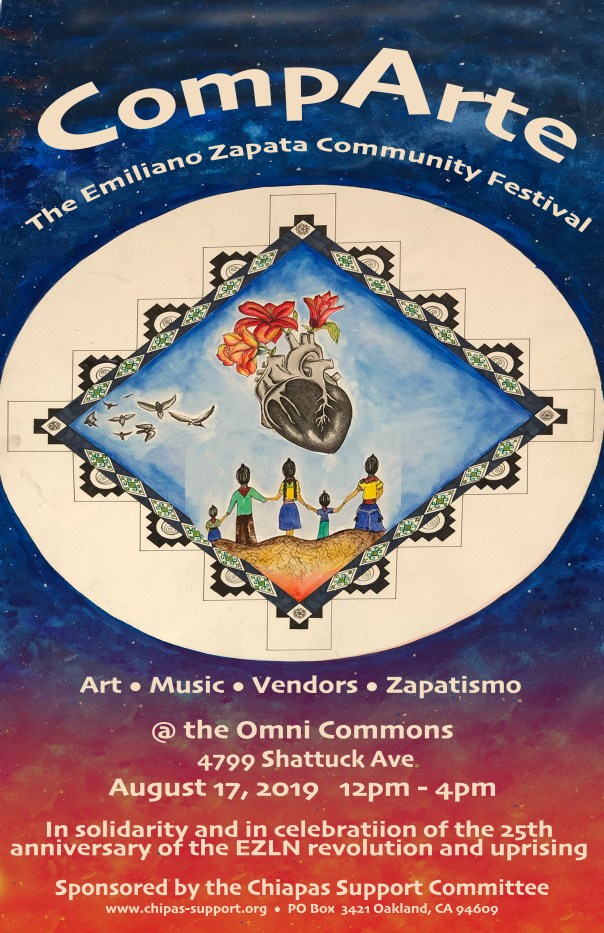
Celebrating the 25th year of the EZLN uprising & indigenous-led revolution in México.
FEATURING
Artwork by
Paintings by Zapatistas
Jesús Barraza
Daniel Camacho
FYE Collective
Alejandro García
Roberto Guerrero
Elizabeth Jiménez Montelongo
Eddie Lampkin
Maya
Xochitl Nevel Guerrero
Jhovanny Rodríguez
Stephanie Sánchez
Poets & Music
EJ (dj)
Madelina y los Carpinteros
Mo Sati
Francisco Herrera
Mogauwane Mahloele
Omi & Amanda
And others!
The Chiapas Support Committee will be selling hand-woven blouses and artesanía made by the Zapatista women’s art collective in Chiapas
There will also be local vendors will be offering arts & crafts, jewelry, weavings, coffee & dessert for purchase.
Proceeds from donations and artesanía at CompArte go to support autonomous projects in the Zapatista communities in Chiapas, Mexico.
If you can’t make it to CompArte, please consider making a generous donation on-line:
Click here: I am in solidarity!
Or through Venmo: @Enapoyo1994
¡Thank you! ¡Gracias!
Chiapas Support Committee
PO Box 3421, Oakland, CA 94609
enapoyo1994@yahoo.com
A massacre with shades of Trump
A La Jornada Editorial
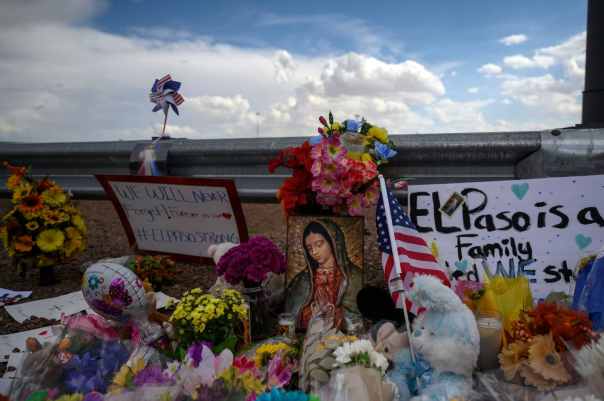
Memorial in El Paso.
The twenty dead victims that a mass shooting produced yesterday in an El Paso, Texas shopping center swells the excessive number of people that lost their lives because of attacks of this kind in the United States. Just last Monday, July 29, David Brooks, correspondent for La Jornada in that country, counted 247 armed attacks this year against civilians in different parts of United States territory carried out by one or more shooters whose common characteristic –besides their aggressiveness– is their youth. Indeed, the new massacre, which would become number 248, would have been carried out (according to still fragmentary reports) by a 21-year-old youth, apparently arrested by local police.
The statistics may eventually vary; what remains unaltered is the fact that neither the recurrence of the killings nor the scandalous number of dead and wounded they leave are sufficient for the successive occupants of the White House to decide to adopt any measure that at least allows them to exercise greater control over the large amount of armament that floods the US. The verb “flood” is not exaggerated: in that nation there are 88.9 weapons per 100 inhabitants, and the number of formally established gun stores throughout that country is around 130,000. To those businesses must be added informal vendors and transactions that originate in the so-called gun shows (weapons spectacles) that are held in the most permissive states, where collectors and hoarders take advantage to buy their deadly arsenal without control.
The results of those transactions are not unexpected: in the US 36, 383 people die each year due to the intentional use of firearms (22,000 due to suicide and the rest due to homicide). In other words, the killings such as the one that happened yesterday in El Paso monopolize the interest of the media and perhaps may partly stir the American collective conscience; but in any case they represent extreme cases of a criminal mechanics that never stops.
The mere volume of weaponry disturbs, but the ease with which citizens of our northern neighbor can access it gives the issue an explosive tone. In the gun stores of many states, to acquire for example an AR15 assault rifle, a weapon that in recent years has displaced the M16 (a less sophisticated variant of that) for the commission of mass murders, it’s only necessary to prove that you are 21 or older, present a driver’s license and fill out a form in which the buyer declares, among other things, that he doesn’t take antidepressants or suffer a mental deficiency. A few states, California among them, prohibit the free sale of high-power weapons (like the M16, AR15 or AK47) and condition a light weapons permit; but in general the sale of weapons has the endorsement of the second amendment to the United States Constitution that dates back to 1791, when the country’s historical circumstances had nothing to do with those now (“… a well-ordered militia is necessary for the security of a free State,” the text says).
If the foregoing is not enough to configure an extremely grave social panorama, it is the question of motivations, which in this case seem to be, as in previous cases, openly racist and anti-immigrant, in harmony with the speech of President Donald Trump, whose sinister resonances support (although he officially condemns the acts) all the stupidity and barbarity that massacres like the one yesterday evidence, and which also deprived at least three Mexican citizens of their lives [1].
—————–
[1] The number of Mexican citizens that were murdered in the El Paso massacre has risen to eight (8), as of this date.
———————————————————–
Originally Published in Spanish by La Jornada
Sunday, August 4, 2019
https://www.jornada.com.mx/2019/08/04/opinion/002a1edi
Re-Published with English interpretation by the Chiapas Support Committee
Saltillo police kill a Honduran man in front of his daughter
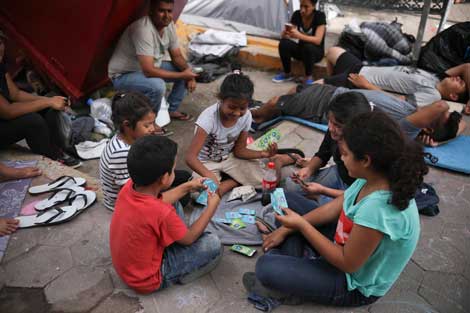
They were families that were going to board the train. The image is from a shelter in Matamoros, Mexico. Photo: AP.
By: Leopoldo Ramos, Jesús Estrada and Emir Olivares
A Honduran migrant died in front of his 8-year old daughter when police from the Coahuila Criminal Investigation Agency, belonging to the State’s Attorney General (FGE, its initials in Spanish), shot at a group of at least 10 Central Americans that left the Saltillo Casa del Migrante (Migrant House) Saltillo intending to take the railroad to reach the United States border.
“They shot to kill (…) they were migrant families, they were walking, others were already waiting for the train and they dispersed when they heard the shots; some found refuge in houses of neighbors,” assured the shelter’s director Alberto Xicoténcatl Carrasco, who detailed that the attack occurred before 9 pm on Wednesday in the streets of Colonia 5 de Mayo, in the southern part of Saltillo.
He affirmed that a woman left her three-year-old son in a store to keep him safe from the shots, but the fate of the mother is unknown; the Office for Protection of Children and the Family protected the minor.
He rejected that the foreigners were armed, because they are searched before entering the shelter to avoid carrying weapons. “The only thing they are allowed is a small knife that they use to open cans of food. Someone that has [the money] to buy a pistol doesn’t use the railroad to get to the border.”
He denounced that the persecution of migrants in Mexico has reached “an unsustainable extreme” and demanded “a stop to the institutional cruelty that is costing lives, leaving children orphaned, family separation and endless suffering provoked by the Mexican State and its institutions.”
The official version
For his part, the head of the FGE, Gerardo Márquez Guevara, gave his version of what happened and said that police from the Criminal Investigation Agency were investigating local drug dealing in the 5 de Mayo district and when people who later would have been confused among the migrants shot at them.
“It is not yet determine that it was the person who lost his life that shot at the agents; a square-type pistol was found at the place.
The investigations are underway. There are six agents Criminal Investigation agents involved; they are not detained, they are at the disposition of the general command,” he said.
A few days ago, the National Human Rights Commission Nacional asked Coahuila authorities for the issuance of precautionary measures in favor of the personnel and the Central Americans housed in the Saltillo Casa del Migrante, where on July 20, federal forces tried to break into its facilities to review the immigration status of foreigners. Likewise, the Inter-American Commission on Human Rights expressed its concern last week over police operations against that Saltillo shelter.
Meanwhile, the Guatemalan Consulate in Del Río, Texas, reported that Vilma Mendoza, a 20-year-old migrant, a native of Baja Verapaz, Guatemala, drowned in an irrigation canal adjacent to the Río Bravo (Rio Grande), in her attempt to cross the US border for the second time.
—————————————————————
Originally Published in Spanish by La Jornada
Friday, August 2, 2019
https://www.jornada.com.mx/2019/08/02/politica/013n1pol
Re-Published with English interpretation by the Chiapas Support Committee
The indigenous struggle of today can be the last: Carlos González
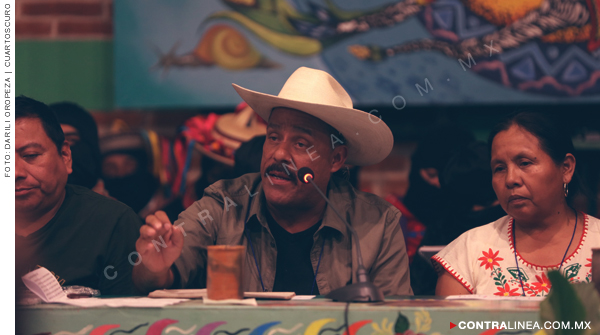
Carlos González with Marichuy. Photo: Daliri Oropeza
Extinction of the indigenous peoples would also be the end of Mexico as a nation, warns the Nahua lawyer Carlos González, a member of the CIG-CNI. The struggle that the “Fourth Transformation” imposes on them is definitive, he maintains. They will not accept referendums (consultas) for legitimizing the delivery of territories, even if they are carried out under Convention 169 of the ILO. Saying that the peoples are “conservative,” is the product of a nineteenth-century vision
Abasolo, Guanajuato, Mexico
The indigenous peoples resist a war against them; one more in 5 centuries, or the same since then. But what is clear to the Nahua councilor Carlos González is that this time it is final. The nations, tribes and original peoples will fight to continue existing. For many of them, if they don’t win, there will be no tomorrow. Their culture and their history will be buried forever.
Carlos González sports a thick, bulky mustache and short hair. He explains that the disappearance of the indigenous peoples would also imply the end of Mexico as a nation: the cultural, social and even, constitutional foundations of the country are the original peoples.
And he goes further. The struggle of the indigenous peoples is also the struggle for what they call Mother Earth –of which they consider themselves a part– and which the hegemonic culture calls “nature” or the “environment.” If the indigenous people of the world fall, the planet will collapse in the short term.
A lawyer specializing in agrarian law, Carlos González speaks convincingly, clearly and argumentatively. A man of books and documents, he brings to mind data, concepts and historical periods. He never stopped being indigenous. He is also a man of milpa and woods, in other words, of hoe, spade and machete. Today, together with María de Jesús Patricio Martínez, Marichuy, spokeswoman of the Indigenous Government Council (Concejo Indígena de Gobierno, CIG), and other council members, he tours the indigenous Mexican geography: from the coast, to the mountains; from the mountains to the valley; from the desert to the jungle; from the countryside to the city. He listens, proposes, dialogues… organizes.
He remembers the details of each conflict out of the hundreds that have developed in the indigenous peoples in Mexico: the communities involved, the culture, the type of dispossession, the megaproject, the capitalist company indicted, the characteristics of the legal fight –if there is one– and the conditions of the political struggle.
—Of all the geography of conflicts in Mexico, which ones require the most the most urgent attention –the journalist asked.
—At this time it is fundamental that Mexican society is attentive to two questions that are of utmost importance. One, the survival of the indigenous peoples in the face of projects that the new government seeks to impel; such as, the Trans-Isthmus Corridor [from the coast of Oaxaca to the coast of Veracruz]; the Maya Train [through the five states of the Yucatan Peninsula: Tabasco, Campeche, Yucatán, Quintana Roo and Chiapas]; the Special Economic Zones [Guerrero and Michoacán are added to the states previously mentioned], which they say are no longer going to continue, but ARE going to continue under a different format; the Morelos Integral Project [that affects Morelos, Tlaxcala and Puebla], and a multitude of projects in matters of mining for exploitation of hydrocarbons, gas, construction of highway and real estate infrastructure. And, on the other hand, the second theme is the impact that these projects are going to have on nature, on the environment. They are two points, two themes that must be on la agenda, on Mexican society’s priority list.
—The president of the Republic, Andrés Manuel López Obrador, has decided that all those projects will be done. There is no place for negotiation or dialogue. And he wields his 30 million votes. The reporter asks: What capacity for response do the indigenous peoples have? He thinks about the answer. He doesn’t brag or propagandize. He analyzes. More than answering the reporter, he responds to himself.
—In quantitative terms, of numbers, it may be that the resistance is not significant [compared to the 30 million supposed followers of López Obrador], but in terms of who resist, of how they have resisted and how they are going to continue resisting, I think that this resistance is to be taken into account. The indigenous peoples have resisted and have survived for centuries.
He recognizes that although the National Indigenous Congress grew during the last 2 most recent years, Lopezobradorismo [1] did generate division among various tribes, peoples and nations and, even, in the bowels of some communities. Because of that, resistance has started from within the barrios, ejidos, Encargaturas and tenancies. [2]
“Certainly in actuality many of the members of these peoples, for money, not for anything else, we must tell it like it is, for a ‘progress,’ in quotation marks, misunderstood, have accepted the projects [of Lopezobradorismo]. But in the towns, in the communities, nuclei exist, people exist, organizational structures exist and referents for resistance exist.”
But what do the indigenous communities resist? What is their struggle?
It is resisting the occupation, the dispossession of indigenous territories, the destruction of the cultures, of the languages, of the forms of governing [that comes] with these big projects, as well as the destruction of nature. I want to make that very clear, because there are those who accuse us of being “conservatives,” and that we oppose the current government. No. It’s not a question of us going back to the old nineteenth-century dichotomy of conservatives and liberals. It’s a different question. It’s a question that has to do with subsistence, the existence and future survival of the original peoples; and, therefore, of the Mexican nation, which has its sustenance and its foundation in these peoples. And I repeat that it is fundamental to the Earth. The Earth is being destroyed in an unmerciful way by all these policies of supposed progress, of supposed development. And we are eroding and we are destroying the conditions for human life in the country and on the entire planet. So, the primordial questions are the ones that we are outlining. They are not questions that have to do with the politics of worn-out nineteenth-century ideologies or with the quarrels and squabbles of the current political class and its parties. This situation is something that transcends everything, which goes way beyond and that has to do with the survival of the original peoples that have lived millennia, with the very survival of the Mexican nation and of life itself.
—Why are the indigenous peoples in a situation today that threatens their survival, if they have previously resisted? They survived the Conquest, for example –he is asked.
—Because it has been gradual. We talked about how, at least since the sixteenth century; since the arrival of the Europeans in what now is Mexico there has been a war of invasion, of occupation and of conquest. We say that that war has not stopped, that that war is permanent. And [those who make this war] have been decisively destroying the indigenous peoples. In the 19th century, there were about 200 native languages spoken in what now is Mexico; currently there are less than 70. In the 19th century it was said that 80 percent of the country’s population spoke a language other than Spanish and it was a native language. Currently, this population doesn’t even reach 10 percent, surely. There has been a systematic and perfectly planned policy to destroy and exterminate the indigenous peoples. And this policy has progressed. And despite that, the peoples have survived; but this war that has been carried out has been highly destructive.
In effect, the National Institute of Indigenous Languages (Inali, its initials in Spanish) quantifies 11 linguistic families with 68 languages (and an un undetermined number of variations of those languages). And according to the National Institute of Statistics and Geography (Inegi), those languages are spoken by at least 7,400,000 people.
—How is the resistance going to be: in the streets, in the courts? What kind of resistance will it be?
—The resistance is multiple. Resistance occurs primarily in the communities and in the regions, based on the forms of struggle, resistance, of organization that each community has. On the other hand, there is national political articulation, through the National Indigenous Congress, the Indigenous Government Council and other multiple indigenous and non-indigenous expressions that exist in the country.
He clarifies that: “the National Indigenous Congress it not the only expression of resistance. There are multiple expressions at the national level. And these forms of political struggle that are based on mobilization, on community organization, in many parts are also based on legal, judicial resources. There are expressions of the indigenous movement that no longer turn to the legal resources and that are totally alien to the Mexican State, I particularly want to refer to the autonomous Zapatista communities. But, there are many other autonomies and forms of indigenous organization that do appeal to legal resources, to legitimacy inside of the national State. And all those forms of resistance add up, they add up. We don’t think of a single form of resistance or an exclusive vision.”
—From a legal point of view, are there still possibilities for defense of the indigenous communities in the lower courts and tribunals?
—Yes it can happen as long as collective organization exists, community organization. Why? Primarily, because the Constitution and the secondary laws have suffered terrible transformations that tend in the first place primer to privatization of land, of natural resources, of the communities as well as of the nation; and in second place, because we have judicial bodies, with a federal Judicial Power and judicial powers in the states, deeply corrupted. It is recognized at the international level that, in that which has to do with the administration of justice, Mexico is one of the most corrupt countries and where the judges and the courts are contumacious with big business interests. Then, both the constitutional and legal structure and wel the deep and endemic corruption of the Judicial Power, reduce the possibility of those legal resources.
“But we believe, and I say it because I am a lawyer and I have many years defending indigenous communities, when collective organization exists, when community resistance exists, legal resources can be complementary to the struggle of the communities. In these moments it becomes a bit more difficult because of the structural reforms, which they apparently do not intend to reverse, in the matter of hydrocarbons, in the matter of electric energy, the concession regimens in the matter of mining, of water and of national goods, which tend towards privatizing, to placing in the hands of those who have the economic power both the resources of the communities and the nation.
—Since the Other Campaign, an initiative of the Zapatista National Liberation Army and the National Indigenous Congress launched in 2006 to organize an anticapitalist resistance, it was pointed out that Mexico was heading towards chaos and its disintegration. Are we really in that situation?
—We are. The chaos has been experienced since several years ago now. It is not novel. It is not something current. That has to be said. As Andrés Manuel López Obrador himself points out, everything that’s happening is not something that he has caused, generated. It was caused for years by virtue of all these policies and all these projects that they have been constructing from above, from the power. That’s why it worries us that he will continue this logic; that in this new government what continues to prevail is the decision to impose projects and policies on the peoples.
Carlos González criticizes the supposed consultations with which López Obrador intends to impose the projects already agreed upon with big capital. But he not only criticizes that kind of consultation, but even those that could be carried out under the guidelines of Convention 169 of the International Labor Organization, which guarantees the communities a free, informed and prior consultation. What it’s about, he explains, is a new relationship of the Mexican State with the indigenous peoples so that they can decide what to do with their territories and their communities.
“We say that the right to consultation is a hoot, it’s a big lie. They would not have to consult the indigenous peoples about projects that they want to impose on them. What would have to be done is to construct a new relationship where the peoples decide what their development priorities are and what projects should be developed in their territories. Coming to the peoples with the pretension of imposing projects on them from above or from outside, legitimizing them with a consultation, continues being the same: in essence the same relationship continues to exist.
“That’s why in the National Indigenous Congress we have been discussing what is known as the right to consultation for months. And we say that even así the indigenous consultation is carried out in accordance with the stipulations that the international conventions frame, in particular Convention 169 of the International Labor Organization, they continue being impositions, they continue forming part of a national and international colonial legal structure.
—We have decisions that the federal government already made for making various megaprojects. And on the other hand we have the decision of various communities to not permit what they consider a dispossession, usurpation and a war. In this clash of trains, do you unfortunately expect a blood bath? Do you have to prepare for something?
—No. We have said it systematically. We have not opted for the way of war. The way of war would definitely mean a blood bath. There IS a war from above. But the original peoples, and they have accredited it in multiple ways; want to avoid the path of violence, the way of war. I think the original peoples are going to insist on that peaceful, organized civilian resistance.
—But is there already violence from above towards below?
—That is permanent. The violence from above towards below has been permanent. It has nothing to do with a government that calls itself of the left, with one that calls itself of the right, or with a first, second, third or fourth transformation. All the transformations that we have had in this country have implied violence towards the original peoples and that has not stopped as of this day.
—But will there be a sharpening of violence?
—In the measure in which the dispossession is exacerbated, in which there is greater pressure on indigenous territories, to the extent that the capitalist economy depends more and more on wars, on the criminal cartels, on the drug cartels, on arms trafficking, because evidently the violence breaks out not only against the original peoples, but also against the whole of humanity and in all the spaces of this planet.
— He is asked: What is the contribution of the indigenous struggle to the anticapitalist struggle?
Carlos González is not condescending. He makes a self-criticism of the communities themselves and tries to offer an honest analysis. He distances himself from propaganda and self-praise.
“The indigenous peoples are immersed in the capitalist economy, in capitalism. We must not idealize them. They are immersed in this whole sea of contradictions typical of capitalism. Nevertheless, on the horizon, in the historical perspective and in the collective dream of the indigenous peoples, community organization, collective organization of the communities and their respectful relationship to Mother Earth, to nature, still have substantial weight. I believe that those two elements are fundamental and play against capitalism.”
[1] Lopezobradorismo – the politics of Andrés Manuel López Obrador, Mexico’s current president.
[2] Encargaturas and tenancies – official jurisdictions of local government in Mexico.
————————————————–
Originally Published in Spanish by Contralinea
Thursday, May 16, 2019
Re-Published with English interpretation by the Chiapas Support Committee
The lives of indigenous Chiapas prisoners at risk after 132 days
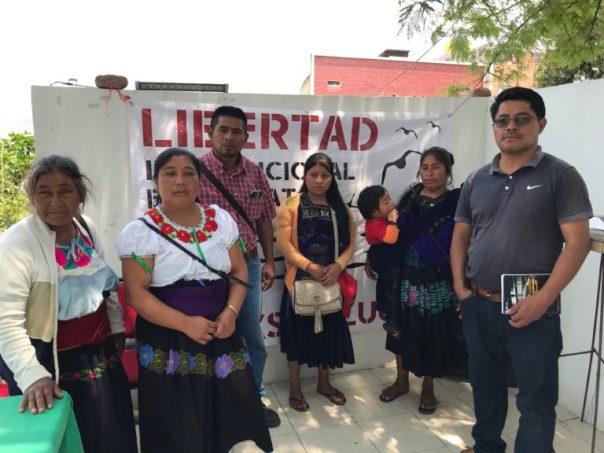
Families of indigenous Chiapas prisoners on a hunger strike. Photo: Angeles Mariscal
The Fray Bartolomé de las Casas Human Rights Center (Frayba Center) made an urgent call to the authorities of the Chiapas government to immediately provide adequate medical attention to the prisoners on a hunger strike, in the Center of Social Reinsertion for the Sentenced (CERSS) No. 5 in San Cristóbal de las Casa and on a fast in CERSS No. 10 in Comitán.
After 132 days without food intake, with a 30-day period of partial fasting, Adrián Gómez Jiménez, Juan de la Cruz Ruíz, Abraham López Montejo and Germán López Montejo, present grave medical complications and their lives are at risk due to the ineffective attention of the Executive and Judicial Powers of the Chiapas government.
According to the Report of Medical Observations for the Prisoners on a Hunger Strike that it carried out on July 18, 2019, the organization Doctors of the World Switzerland mentioned: “different government agencies have not fulfilled procedures and norms of medical attention in a prison context.”
Among the omissions are: a lack of complete and exhaustive clinical evaluations since the start of the hunger strike and of weekly clinical examinations, as well as defects in the measuring instruments (like scales).
The Frayba Center detailed that the recurring illnesses that the hunger strike prisoners have suffered are diarrhea with blood, urinary track infections, elevated triglyceride levels and liver problems, as well as tachycardia and anxiety.
Given this situation the families of the hunger strike prisoners, the Work Group “We Ate Not Everyone” and the Fray Bartolomé de Las Casas Human Rights Center, reminded the Mexican State of its responsibility to guaranty the life, security and integrity of people in their custody, according to what international treaties and conventions establish, like the United Nations Joint Principles for the protection of all people subjected to any form of detention or prison.
The families and organizations demanded immediately resolving the request for the freedom of the prisoners on a hunger strike and those fasting, who have vindicated their innocence, since while in detention their statement was obtained under torture to incriminate themselves for a crime they didn’t commit, followed by a trial with grave violations of due process.
Finally, they asked to continue the investigations of the denunciations of 13 cases of torture that appear in the Registry of Attention folder in an impartial and effective way, which were initiated by the Office of the Prosecutor Against Torture of the state of Chiapas.
—————————————————————
Originally Published in Spanish by Chiapas Paralelo
Thursday, July 25, 2019
Re-Published with English interpretation by the Chiapas Support Committee
 Chiapas Support Committee