Chiapas Support Committee
Home of the Compañero Manuel blog on zapatistas & mexico
The Mexican government apologizes to indigenous women raped by the Army in 1994
“THEY PUNISHED US TO PUNISH ZAPATISMO”
By: Angeles Mariscal
The soldiers recognized them, when on June 4, 1994, Ana, Beatriz and Cecilia González Pérez and their mother Delia Pérez attempted to cross the checkpoint that the Mexican Army put up in the ejido Jalisco, municipality of Altamirano. They even called one of them with the nickname by which she was known in her community. To the Secretary of National Defense (SEDENA, the Spanish acronym) they were members of the Zapatista National Liberation Army (Ejército Zapatista de Liberación Nacional, EZLN) and punished them for that by raping them.
They detained them and for two hours, by means of sexual torture, attempted to force them to say they were members of the armed group, and to inform on other individuals. Those were months in which the Mexican Army was occupying indigenous areas of Chiapas to disarticulate the insurgent movement.
They resisted, and upon being released, criminally denounced the acts, submitted to examinations that showed the tumultuous rape, but the case was assumed by Military Justice, and was closed denying justice. They then appealed to the Inter-American Commission on Human Rights (IACHR), a body that in 2001, after analyzing the case, presented an in-depth report, declaring the international responsibility of the Mexican State, demanding that it punish those responsible, and that it repair the damage to the aggrieved.
The IACHR concluded that rape of the González Pérez sisters, “was committed for the purpose of intimidating the three women because of their alleged links to the EZLN.” However, the Mexican State evaded its responsibility for 25 years, until this October 18, when it initiated the justice process.
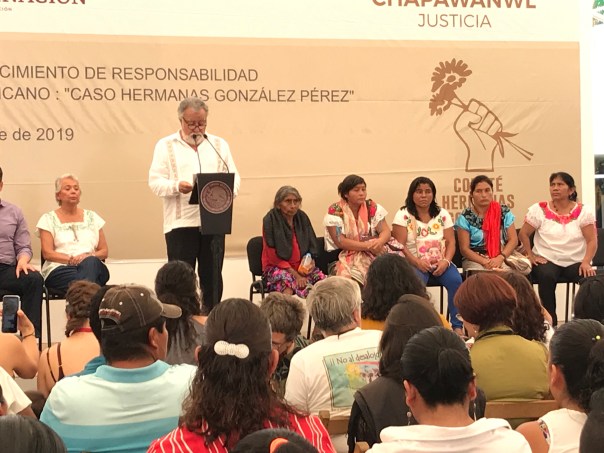
In the public square of the city of Ocosingo, in the voice of Interior Secretary Olga Sánchez Cordero, the Mexican government apologized to the Gonzalez Pérez sisters, before 500 people, among them public officials and residents of the region.
“Today, in the name of the Mexican State, I apologize for the lack of investigation and search for justice (…) it’s essential to recognize the impact of war on the bodies of women, direct offenses that cross through a triple structural violence in this case: for being women, for being indigenous and for being poor,” Sánchez Cordero said.
The Under Secretary of Human Rights, Alejandro Encinas, was also at the public apology event. He maintained: “you cannot ignore the context in which the terrible offenses of this case occur. They start with the 1994 armed conflict against the indigenous communities and peoples, who were demanding the recognition of the most basic rights: work, land, shelter, food, health care, education, independence, freedom, democracy, justice and peace. The 500 years of exploitation and marginalization were not enough: the voice of the peoples was silenced with blows (…) the sexual torture committed on the part of the State against the González sisters, had the objective of repressing, intimidating and humiliating,” he recognized.
Mexican Army, the big absence
The public apology had a big absent, representatives from the SEDENA, the institution that the sisters locate as their torturers. Ana, Beatriz, Celia and their mother Delia, demanded for all these years that military leaders were the ones who should acknowledge the acts, the ones who should apologize and be brought to justice.
“Those who in reality committed the harm didn’t come. What we want is a real justice. I want to demand justice, so that the soldiers ask us for public forgiveness. When Zapatismo happened in 1994, they punished us in order to punish Zapatismo,” Celia, who was only 16 years old when the acts occurred, pointed out.
Her sister Ana added: “this act of public in reality is not an act of public apology because we said clearly that we wanted representatives of the SEDENA to be present so that they could ask us for public forgiveness, because they were the ones who committed the offenses. This public forgiveness is not complete.”
In indigenous culture it is the one responsible for the offense who must ask for forgiveness, because it is the identification of this before the community.
Ana insisted that they reject the presence of soldiers in indigenous zones. “We don’t want the soldiers in our towns, because the government says that they are the ones who protect us, but it is the opposite; they are the ones who do us harm.”
“What happened to us, the rapes, happens in many parts of Ocosingo and Altamirano (indigenous regions of Chiapas where the EZLN has a presence), and no one ever makes it known,” Celia emphasized.
“This is happening today, it’s as if a garbage truck came, and it came to collect all the garbage. I say to you that when the government does an abuse or a rape, speak up and don’t keep quiet.”
The González Pérez sisters also spoke the name of those who died in 1994, at the hands of the Mexican Army. “The reason and the cause for which the Zapatistas died were because there is a lot of poverty, a lot of oblivion towards the indigenous peoples, and they were fighting against this.”
Among the agreements that Olga Sánchez Cordero, Alejandro Encinas and the sisters and their mother signed today, is to continue the investigation for bringing the implicated soldiers to [legal] process.
However, they insisted that this process not be individualized, and it is assumed that the rape was not an independent or autonomous act that the soldiers committed, bur rather an institutional action that obeyed a strategy of war against the EZLN.
The apology, a vindication of their dignity
For the González Pérez sisters and their mother, the act of forgiveness had a meaning beyond their person; it was the vindication of their dignity in front of their community. Therefore, they asked that this event be carried out in the municipality of Ocosingo, the most important city in the Tzeltal indigenous to which they belong.
After the rape, when the family and the community to which they belonged learned about it, they were rejected, and were forced to leave the place. “It was on the one hand because of the community’s fear of the repression on the part of the military that was occupying them, but also because of the way in which women are configured in indigenous communities, and the value they place on virginity. By losing it in the rape, they were seen as ´the soldiers’ women´ or prostitutes,” explained Gloria Flores Ruiz, the lawyer for the indigenous women.
Nevertheless, the three sisters and their mother understood that members of the EZLN and indigenous communities as a whole were also aggrieved in the rape. “Forgiveness is experienced not only towards their person, but also as a forgiveness that the aggrieved women deserve, but also the Zapatista women. Forgiveness is experienced in a feeling, individual, communitarian, political,” she explained.
Therefore, in the agreement with the Mexican government, the aggrieved also asked the Mexican government for a public apology in favor of the community as a whole, and in favor of the Zapatista population.
——————————————————————-
Originally Published in Spanish by Chiapas Paralelo
Friday, October 18, 2019
Re-Published with English interpretation by the Chiapas Support Committee
Saint Greta and the day after

Greta Thunberg
By: Hermann Bellinghausen
It is in the nature of contemporary media and social networks that we waste time among the weeds to avoid the important. The forms of self-deception, pretexts and procrastination fill our hands, disguised as likes and dislikes, ceaselessly interrupted by owners and advertisers making sure that our ideas and actions are fragmentary, effective, emotional, satisfying like a treat (in Ignacio Ramonet’s terms), fleeting, forgettable, replaced by the next and the next until nausea or numbness. Sometimes the impact is bigger. The Nordic saga of Greta Thunberg, the student who one day decided to skip school and save the world, generated a massive and ongoing wave of responses, especially from youth, to talk and demand, protest, disrupt.
These kids, from the First and Second worlds, who in effect have three meals a day, go to the dentist and may be white, although not necessarily (the Swedish factor is secondary), are provoking media impact in the guilty metropolises, even if it makes us itchy and we talk about the children of Syria and La Montaña of Guerrero, let’s see how fucking privileged kids cry, they lack the leather to tie their straps.
That said, wanting to waste time with memes, hashtags and opinions on the fly, happy to suspect that there is something fishy, nobody fools me, who is behind it, to see what prince put in the sailboat, what “green” company wants to unseat coal and oil.
Greta matters, regardless of her merit in opposing the parliament and right-wing philosophers in France, Fox News, the large extractive and warlike companies, their think tanks and last but not least, the holders of the planetary political power Putin, Trump, Bolsonaro and company. She also added the irritations, boasts, and disdain of left and radical thinking in the First, Second and Third worlds, including proud “ethnics” of any denomination. What unanimity! The Swedish girl whose clinical history is public (the new Assange?) gave a media dimension to the central claim of our time, took it to European parliaments, to the exasperating UN assembly, echoing in the streets of more than a hundred cities after infesting high schools and youth clubs.

Greta Thunberg rally in Edmonton, Alberta, Canada yesterday October 20, 2019.
The planet is dying, at least as we knew it. That is, in the conditions that made it habitable, unique in the galaxy, the habitat of all civilizations. The problem is not whether Greta is Joan of Arc (which she is), or whether we like it or not. There are alternatives of consciousness, struggles and resistances of greater depth and eloquence, but instead of turning to them and acting, we suck our finger of candy on candy, of indignation on indignation. The one that brought us is taking us and we are still wasting time.
You don’t like what children do? Hey, there are alternatives for adults. It stands out for its clarity and forcefulness Extinction Rebellion (ER), a new direct resistance movement, originated in London, which as of October 7 carries out actions in 60 cities (I fear not ours) that really challenge corporations , governments and their police. They are killing it. Their impeccable reasoning is what we should discuss now. Their logo, an hourglass, tells us: “time is running out”. Are we going to keep saying goodbye to jungles and glaciers between tears and prayers? As David Bowie recites: “I demand a better future.”
The world is going through a mass extinction event, ER argues. It is estimated that between 30 and 40 thousand species become extinct every year. The ongoing destruction process is caused by human activity. Such catastrophic loss of biodiversity is likely to generalize a collapse of ecosystems that would leave the planet uninhabitable for humans: “Something’s happening. You know it, you feel it. It calls you to be a part. ”
ER says: “We are reaching a point of no return. Governments do nothing. Neither do businesses. It is not a distant apocalypse. People suffer and die in the world right now. Whole species disappear. And it will get worse. The time to act is today. It is happening to others. Soon it will be you and the ones you love. Don’t count on us, or Greta, to do it for you. Look inside yourself and rebel. ER calls to peacefully occupy the centers of power and close them until the governments act for the climatic and ecological emergency. “Leave your desk, invite your boss, turn off the television, put the cell phone aside. Take to the streets. Respect the existence or expect resistance. ”
———————————————————–
Originally Published in Spanish by La Jornada
Monday, October 7, 2019
https://www.jornada.com.mx/2019/10/07/opinion/a10a1cul
Re-Published with English interpretation by the Chiapas Support Committee
In Spain they call October 12 the discovery of America; in Mexico we call it the bleeding of America

Photo: María de Jesús Patricio Martínez, known as Marichuy
By: Maialen Ferreira
It’s the first time that the indigenous leader María de Jesús Patricio, known as Marichuy, a leader of the National Indigenous Congress (Congreso Nacional Indígena, CNI) of Mexico, visits Euskadi [Basque Country]. Upon passing through the narrow streets of Bilbao’s Casco Viejo she cannot avoid comparing it to the famous Alley of the Kiss of Guanajuato, an alley in her country in which, according to legend, two lovers whose relationship was prohibited could communicate without being seen, thanks to the closeness of the balconies of both houses. Marichuy will visit some cities in Spain, like Bilbao, San Sebastián, Vitoria and Madrid, where she will offer talks at universities and associations in which she will treat themes like the violation of rights that indigenous communities suffer in Mexico, a struggle she has been heading for years and that last year led her to the pre-candidacy for the Presidency in Mexico’s federal elections, becoming the first indigenous woman to run for the position. Despite the fact that the Zapatista National Liberation Army (Ejército Zapatista de Liberación Nacional, EZLN) supported her pre-candidacy, she did not achieve collecting enough signatures to get on the ballot as an independent candidate for the presidency, which, after a controversial campaign, ended up in the hands of Andrés Manuel López Obrador.
How is Zapatismo currently lived in Mexico?
They continue organizing, and continue growing their organization from below, men, women and children. Even we indigenous people are surprised when they walk little by little, they don’t come out in the media, you don’t see them, but they are there, and there they continue constructing. Here you have asked me if it’s an armed group and my answer is that although they declared war on the Government in 1994, they decided that the correct path was not that way. They are part of the CNI and that to the indigenous peoples of Mexico shows us that we can achieve that organization that we sometimes consider impossible. We can really construct a government from below and to the left.
What did it mean to you and your country that an indigenous woman could achieve being a pre-candidate in the Federal Elections?
Participating in the 2018 elections was a pretext not to occupy the presidential seat, but rather to achieve making visible the problems of our indigenous peoples and also to get closer to the different towns, barrios, districts to show that the only way of really constructing this government from below is through organization. That was the idea of participating in the electoral process; we decided to insert ourselves into “the fiesta of the rich” because they consider it theirs and they pass the power from hand to hand, so that’s why we decided to use their own weapons to fulfill our objectives. That’s why this proposal was launched and it was decided to form the Indigenous Government Council (Concejo Indígena del Gobierno), which is representative of the peoples through a councilor.
Generally the positions of above are for men, but this struggle that we are constructing from below has to include women, has to be equal. If we see that something is wrong, it is the people who must, organizationally, be the one that governs and the government that obeys.
And did they achieve that objective of making the problems of the indigenous communities visible?
Although we didn’t collect all the signatures, I believe it was achieved. Many took us as an example. At the beginning they said to us: “how if you are a minority do you want to appear” [on the ballot]? And we said” “And why not?” It’s what’s missing; that the people below, the workers of the countryside and the city, don’t feel less and that we see that we have the same values and rights. Our dignity is what has to hold us with our heads held high, because it’s enough of so much rejection, so much abandonment, oblivion, humiliation that our grandparents have had. For them I believe it’s worth the pain to struggle and say that there are other ways of communicating with us, of relating to us, to construct this new organizational form.
AMLO has achieved bringing the left to power for the first time since democracy was established, in 2000. In his campaign he criticized the structural reforms of the last 25 years and declared the end of the “neoliberal period” in Mexico. How does the president evaluate his mandate so far?
For the peoples there has not been much benefit since he arrived. The change that he assured when he took the command, we see that it’s not true; it has been the opposite. The problems in the communities have worsened; there have been more deaths, more disappearances and more repression. Organizational attempts, raising your voice to say: “we disagree” with the intrusion of these megaprojects has derived, among other attacks, into the murder of our compañero Samir Flores in February. He was a member of the CNI and he said that his community disagreed with the electrical plant that the Morelos Integral Project wanted to impose and what happened? They murdered him at the door of his house. That was a declaration of war on the peoples so that they would not speak, would not organize and would peacefully leave the doors open for them to insert megaprojects. What does this mean? That one thing is said above and another below. Not only Morelos, but Puebla, Oaxaca, Yucatán and Quintana Roo is a strip where they are going to impose different megaprojects like gas pipelines, hydroelectric dams, wind farms or the Maya Train. The people have said they don’t want that, that they disagree, because it’s going to bring destruction of life, of the land, the forests, the waters, the animals and it’s also going to damage the organization of the communities, because there will be some communities that will have to be divided, passing over their forests and waters. They say that the train is going to bring a benefit, but for whom? The communities know that it’s not for them. Therefore, we believe that they are not listening to the people below, nor are they interested in listening. We believe that an agreement to transfer those lands to those who want to invest in those projects has already been made.
In Mexico the issue of colonialism is something very delicate, in Spain October 12 is a National Holiday. What does that date mean to you?
I am going to explain it from the [point of view of the indigenous peoples of Mexico. In Spain, they call that day the discovery of America; in Mexico, they call it the bleeding of America, because it was when they arrived and there were massacres, there were murders, there was a way of imposing something from outside. They brought, or at least that’s how we see it, a cross in one hand and a sword in the other and if they didn’t convince you, they forced you. But it’s not something that has ended, what began on October 12 continues being reproduced with the imposition of the megaprojects, because it’s also a way of colonizing us, because they are projects that bring death. In school they taught us that the Indians were some savages and that it not true. The communities have and have had their way of life. They came seeking gold and silver and it’s the same thing that is occurring now, what wasn’t finished then they want to finish now, it’s death, it’s repression. So what are we going to celebrate? Yes, they made us believe in school that it was good, that they brought benefit to our land, but what benefit if they killed our people? They robbed us of our gold, our silver; that is not bringing benefit.
In Mexico, despite the fact that the left governs, as you comment, there are communities in towns that do not feel represented. In Spain, the left has not been able to form a Government. Why do you believe that a real government of the lefts costs so much?
There are people that are getting organized, struggling, and to the extent that they are determined I believe they are going to achieve it. There comes a time in which the people say plainly “up to,” and it’s when the water is already coming up to their neck. The problem is that people set ideology aside when there is a comfortable life. If we feel that there are things that are bad and that we would like to change, we must start looking for those alliances, because sometimes it seems impossible that we can do everything alone. To the extent that we are walking and meeting more compañeros and compañeras that are in agreement with our ideals, with our struggle, we will be creating an organization of the left, an organization from below and to the left, but not pretending that they are the left son to then at the hour of truth show that they are the right. No, it really has to be constructed from below and that can be applied to any country.
————————————————————————-
Originally Published in Spanish by El Diario Norte
Friday, October 11, 2019
https://www.eldiario.es/norte/Espana-descubrimiento-America-Mexico-desangramiento_0_950505299.html
Re-Published with English interpretation by the Chiapas Support Committee
Indigenous peoples reject the Maya Train, the Trans-Isthmus Corridor and exploitation of water
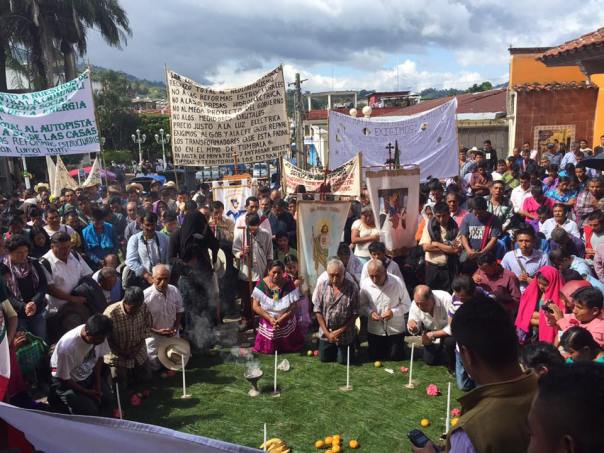
Modevite ceremony and demonstration in Chiapas.
By: Chiapas Paralelo
Different Chiapas indigenous organizations met in the “First Regional Gathering in Defense of Water Agua and Mother Earth” held in Chilón, for the purpose of expressing their indigenous resistance to the colonial invasion, and, at the same time, denouncing the strategy of the capitalist system and its logic for the dispossession of their territories.
With the slogan “Water for life, not for the transnational,” the organizations denounced that since 527 years ago they have struggled against dispossession, plunder and extermination. Now, they also struggle against the megaprojects that place in danger the conditions of existence of different life forms, as well as proposing and constructing sustainable alternatives for the care of their common house.
Given that, they mentioned that aware of the importance of the defense of land and territory, for the purpose of preserving and rescuing their knowledge, they have found different processes of struggle and resistance to converge in defense of their territory, because of which they shared their experiences in the exercise and recognition of the free determination of the original peoples.
“Others from different latitudes we weave alliances with other brother peoples to prevent the dispossession of our natural commons, since mining, geo-parks, hydroelectric dams, extraction of hydrocarbons and the privatization of water are underway as an indispensable means to carry out these megaprojects,” they explained.
One of the themes was the commercialization of water for the benefit of beer and dairy companies and, in the case of San Cristóbal de Las Casas, Chiapas, the exploitation of the vital liquid for Femsa Coca Cola company, which has generated a grave water and health crisis for the population.
Therefore, the organizations confirmed that authorities of the three levels of government are subject to the interest of the transnationals, while they generate diseases and death with the destruction of territory and community life, as well as the devastation of the planet’s ecosystems, all for their economic and political interest.
“They are the ones responsible for the planet’s climate change that puts humanity and other living beings of our common house at risk,” they said.
Therefore, they withdrew their struggle for defense of territory and self- determination of the peoples in search of community government, such as a human right to consultation with the communities and peoples of the world faced with the megaprojects imposed by the system like: the Maya Train, the San Cristóbal-Palenque superhighway, the Trans-Isthmus Corridor, the Morelos Integral Project, the new airport, the refineries and the Special Economic Zones.
Therefore what they demanded is respect for the conventions established in international agreements. Convention 169 recognizes the right to consultation in Articles (6, 15, 17, 22, 27 y 28) of the ILO and the United Nations Declaration on the Rights of Indigenous Peoples, enjoying a broad consensus at the international level with approval by 143 countries.
“The struggle of the Native peoples and their example have been fundamental in the construction of peace and the search for community reconciliation in the different regions of the state, the country and the world,” they said.
Also, the different organizations recognized the organization of the municipalities of Chilón and Bachajón, in the management of their self- government and appropriation of the human right to water forming the Movement in Defense of Water of Chilón (MODEA).
At the same time, they sympathized with the Bachajón Mission and the Movement in Defense of Life and Territory (MODEVITE).
Finally, they emphasized the organizational struggles in defense of the Quenvo Cuxtitali Reserve, Colonia 14 de Septiembre, the articulation of the Council of the Northern Zone, the defense of the María Eugenia Mountain Wetlands and La Kists and the struggle of the Zoque people against Santa Fe Mining Company (Carlos Slim), against the geo-parks, hydroelectric dams, as well as denouncing the repressive actions against the compañerxs of the Colonia Maya, San Cristóbal de las Casas.
——————————————————————
Originally Published in Spanish by Chiapas Paralelo
Sunday, October 13, 2019
Re-Published with English interpretation by the Chiapas Support Committee
Since the start of 4T, repression against indigenous peoples increased, Marichuy denounces in Spain
María de Jesús Patricio, spokeswoman for the Indigenous Government Council for Mexico.
By: Armando G. Tejeda
Madrid
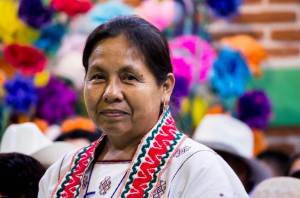
María de Jesús Patricio, Marichuy, is on tour through Basque and Spanish cities with the charge from the National Indigenous Congress (Congreso Nacional Indígena, CNI) of denouncing the “increase in repression, murders and harassment” against the original peoples ever since Andrés Manuel López Obrador arrived in the Presidency of Mexico. The denunciations of the former pre-candidate to the Presidency also include the National Guard, which she points out as mainly responsible for the repression, especially for promoting energy projects in places like the Isthmus of Tehuantepec, Morelos and the territory through which the Maya Train will pass.
In an interview with La Jornada, Marichuy ratified these accusations that she exposes at the forums she attends and warns that in the next general assembly of indigenous people, between November and December, resistance strategies will be decided to face the “very grave” situation, she affirms, in which their communities are found.
–What leads the CNI and you to make this tour outside of Mexico to denounce what happens in Mexico?
–It is to report the real situation that our indigenous peoples experience, since what is said in the media and what those above say, among them the President of Mexico, is not what happens below. We want it known that there are many dead, there are disappeared, there are aggressions toward people that organize to defend their territory. We are living in a state of war declared towards the peoples because of wanting to introduce megaprojects that will only bring territorial destruction to entire peoples and communities. It is a dispossession that the government carries out through repressive forces, such as the Army, the police, but also groups of the narco that surrender to the interests of the corporations.
–According to you, the repression has intensified since López Obrador assumed power, even worse than with the PRI?
–Yes, that is exactly what we are seeing. It is said that it is a government of the left dice and that all is well, but it isn’t. Below we are worse than before, because they have murdered our CNI compañeros and councilors and that had not happened before. To the peoples, war has been declared in order to impose those megaprojects. In fact, we believe that the National Guard was put in place to repress, not to take care of the communities, and to consummate the agreements necessary for executing the megaprojects. So, all that about change is a lie. The change for the peoples went backwards. Besides it holds consultations with the peoples, simulated and rigged, in which it offers assistance, gifts, to condition the result of the consultation.
–In case that the community votes in favor, what would happen?
–It’s that sometimes information is paid for so that it comes out in the media that the consultations were done, but in reality it’s not so. It’s not something that the communities say, but rather something for which the corporations are paying.
–You assert that the National Guard is responsible for the repression and attacks on the CNI. Could you point out for exactly what attacks and what kind of violence has been exercised against you with the National Guard?
–It’s just in the places where there is more organization to prevent what the corporations establish, like the wind farms. They have told us that the National Guard has hit the people who resist; specifically, on the Isthmus, but I don’t remember the name of the town.
–How do you know that it’s the National Guard? Are they in uniform? Do you know them?
–Because they always wear like a bracelet with an NG. And it’s happening like that on the Isthmus, in Puebla, in Chiapas.
–And those attacks, in exactly what have they consisted?
–They have told us that there have been blows; there have also been some deaths, but there is no certainty of who they were. For example, the murder of Samir Flores was a little after a government visit in the zone in which there was a demonstration against the thermoelectric plant. And it was obvious to us that it was a message for the one who raises her voice to not say anything. They also murdered four councilors in Guerrero and other CNI delegates. And that didn’t happen before.
————————————————————–
Originally Published in Spanish by La Jornada
Saturday, October 12, 2019
https://www.jornada.com.mx/2019/10/12/politica/008n2pol
Re-Published with English interpretation by the Chiapas Support Committee
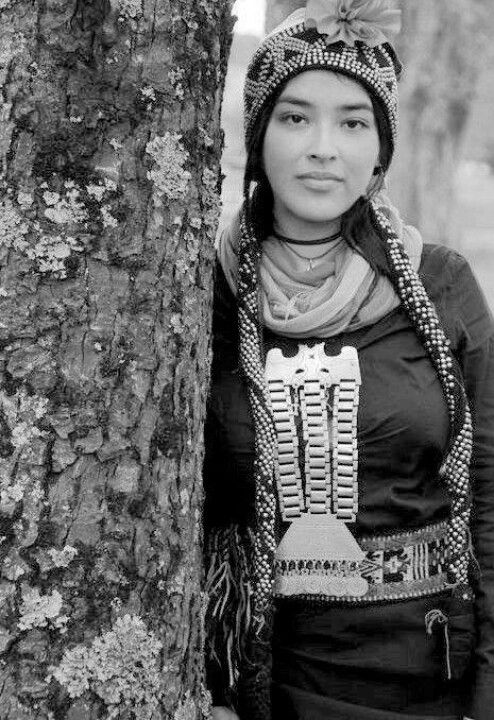
Colonialism conflicts violently with Mapuche women
 By: Raúl Zibechi
Two decades ago Silvia Rivera Cusicanqui proposed that patriarchy is a substantial part of internal colonialism and that there is a parallelism between ethnic domination and that of gender. She always lived her feminine identity “since the historic and political interior of internal colonialism,” and from that place was able to comprehend, very quickly, how the three oppressions, “Indian, women and subaltern classes,”* are interwoven sustaining the capitalist world system.
The mayor of Temuco (southern Chile), an important city in the ancestral region of the Mapuche people, is promoting a repressive escalation against women selling vegetables, which shows, without nuance, the persistence of internal colonialism and how far the coloniality of power can reach.
In the center of the city you can hear horns that warn the population: “Watch your money! If you are surprised buying from the illegal street trade inside the zone of exclusion, police officers can issue you a fine that can cost 140,000 pesos (200 dollars).” “Nazi Megaphone” is how the webpage mapuexpress.org classifies it, one of the most followed media in the region.
Mayor Miguel Becker, belonging to a family of settlers that made their fortune thanks to the genocide of the Mapuche people in the “Pacification of the Araucanía” (1860-1883), declared war on the vegetable vendors a year ago. He failed because they continued selling and the residents of Temuco continued buying from them, as I was able to appreciate last December in the environment of the Mercado Pinto, where there are hundreds of stalls of vegetables, fruits, meats, legumes and artesanía.
While the Sebastián Piñera government distributes aid to the big agricultural entrepreneurs and reduces their taxes, the campesinos are expelled from the markets in the Mapuche regions, as a document of the Mapuche History Community highlights. The Republican colonial history explains this brutal asymmetry.
“All the cities located in former Mapuche territory were built in the second half of the XIX century. As the Chilean troops that dispossessed Mapuche society of their territory advanced, they were founding military forts that later became the principal cities of the region” The foundation of Temuco was done over the dead bodies of 400 Mapuches that resisted, growing on “a river of Mapuche blood.”
The tradition of women fruit and vegetable vendors comes from the will to survive of the Mapuche people, condemned to survive on small parcels of land where they started to recuperate from the military invasion, just 140 years ago. The current cities, heirs of the Chilean “military forts,” intend to continue confining the Mapuche population outside the walls, cornering them in their own territory, accepting only white people inside the city.
The Community of Mapuche History reflects what is happening now: “But here we are, we have leaked, as greengrocers horticulturists, but also as teachers, journalists, workers, doctors, anyway, today the Mapuches are in Temuco and other cities, and we have the “right to the city,” we have the right to use them, and even the right to govern them.”
I believe that this paragraph says it all. After the military invasion and occupation of our territory, we have recuperated, we’re standing and now we look beyond, towards self-government, towards the reconstruction of our nation.
That’s why the historians say: “we bring bad news” for the powerful, “because despite colonialism and dispossession, Mapuche society continues standing, resisting in everyday life to survive and organizing to project.”
It’s that projection forward that worries the white ruling class that appeals, in its attempt to contain an entire people, to the crude methods of colonialism. In that same region, a few kilometers from Temuco, Camilo Catrillanca was murdered in November 2018, provoking a massive Mapuche reaction and unprecedented support of the Chilean population with mobilizations in 30 cities.
It seems important to emphasize that the colonial/patriarchal reaction of white power directly attacks women, perhaps because they believe that they are the weakest sector of the movement and because they are the support of the community economy. But they found that they are the point where the repressive waves crash.
Those below must understand that the Mapuche people are not asking for anything, they don’t beg, nor even do they raise demands. They are in another stage, as the “Temucuicui Manifesto” of last December teaches, and which united all currents of the movement. Their objective now consists in “strengthening the exercise of territorial recuperation y control.” Territory and self-government!
*“Mujeres y estructuras de poder en los Andes”, Controversia, La Paz, 1997.
———————————————————–
Originally Published in Spanish by La Jornada
Friday, August 16, 2019
https://www.jornada.com.mx/2019/08/16/opinion/018a2pol
Re-Published with English interpretation by the Chiapas Support Committee
Mexico, trapped between the migrant flow and US policy
African migrants protest during UN visit

Some 200 African men, women and children mobilized in Tapachula, Chiapas to demand the delivery of humanitarian visas that allow them to travel through Mexican territory. Photo: Afp.
The United Nations High Commissioner for Refugees, Filippo Grandi, visited Mexico during the latter part of September to observe the situation of migrants and asylum seekers. Interviewed prior to leaving Mexico, Grandi viewed Mexico as trapped “between double pressure:” on the one hand, an unprecedented migratory flow coming from Central America and other countries (Africans, Cubans, Venezuelans and Nicaraguans), “who are not only requesting asylum,” and on the other hand a response from the North, limiting access to U.S. territory.
Grandi was asked about Mexico’s response to these pressures, which has been to accept the US policy called the Migrant Protection Protocols (MPP). According to the US Department of Homeland Security, this policy requires that certain foreign individuals entering or seeking admission to the US from Mexico –illegally or without proper documentation– may be returned to Mexico to wait outside the US for the duration of their proceedings, where Mexico will provide them with all appropriate humanitarian protection for the duration of their stay. That policy has caused thousands of asylum seekers to have to reside in extremely dangerous cities on Mexico’s northern border.
Grandi emphasized that the UNHCR is not involved in the MPP and does not endorse the policy. However, he knows that there are many people requesting asylum and they are forced to live in very dangerous situations. There are kidnappings, human rights violations and manipulation from criminal groups in the area. Grandi recommended more resources for the COMAR at the northern border and an easing of procedures for asylum.
Grandi at Mexico’s southern border
Several days before the above interview, Grandi was in Tapachula, Chiapas, very close to Mexico’s southern border for the inauguration of the new installations of the Mexican Commission for Assistance to Refugees (COMAR). According to a report from Isaín Mandujano in Chiapas Paralelo, African migrants arrived at the COMAR’s new offices in Tapachula, where they tried to deliver a letter to Filippo Grandi. All was going well until Yadira de los Santos, federal delegate of the National Migration Institute (INM), its initials in Spanish) made an appearance at the site. This angered the African migrants and activist human rights defenders, who started to protest against the federal official. Spirits rose when federal police intervened and began struggling with the migrants.
Paul Mananga Ntoto, one of the few African migrants that speaks Spanish, demanded that the UNHCR and the COMAR intervene so that the exit letter be given to them right away so that they can continue on their way. The migrant from the Central African Congo reproached the treatment that all the migrants from his country have received up to now; they remain stranded in this southern border city of Mexico. The activist and migrant defender, Luis Rey García Villagrán, questioned the violation of the human rights of the migrants that enter our country and asked that they be taken care of immediately.
UNHCR officials came out to attend to the migrants that were protesting and then a woman migrant threw herself on the tires of Filippo Grandi’s truck in order to receive attention.

African migrants protest during UN visit.
Grandi emphasized that Chiapas is the state in Mexico that receives the highest number of requests for asylum and that Chiapas will increase its response capacity faced with the increase in asylum requests. “We must work together to respond efficiently and quickly, and also justly, respecting the rights of those who have to flee,” Grandi said during the inauguration of the new space of the Mexican Commission for Refugee Assistance in Chiapas, Mexico, supported by the UNHCR.
Africans in Tapachula throw barricades and chairs

Young African migrants march..
Apparently, officials of the COMAR and the UNHCR did not act quickly enough to satisfy the African migrants’ concerns about delay. Approximately a week later, after marching to demand delivery of the document that would permit them to move freely through Mexico, more than 200 young African migrants threw barricades, tents and chairs placed in the central park of Tapachula, Chiapas for the celebration of what’s called the Regional Security Fair.
In the morning, migrants came out of the 21st Century Migratory Station, located in the northern part of that border city, where they have maintained an occupation for more than 45 days, and they walked to the center of Tapachula. They reached the central park, where they found the city hall surrounded with metal barricades, a stage, tents and chairs, so in order to advance towards the esplanade they threw what they found in their way, while some agents observed.
One of them threatened to throw a metal barricade at the circle of police, who launched tear gas, which caused the confrontation with the young Africans. The action of the young migrants from different African countries provoked a confrontation with the police that were guarding the area. Thankfully, no injuries were reported.
In conclusion, all of the above calls into question the deliberate cruelty of the US policy named the Migrant Protections Protocols, which creates long delays for migrants seeking asylum in a country without the existing infrastructure to accommodate them.
—————————————————
The Chiapas Support Committee compiled this article from news recent reports in Chiapas Paralelo and La Jornada.
The turns of neoliberalism

1st Intercontinental Encounter against Neoliberalism and for Humanity in Zapatista Territory of Chiapas Mexico.
By: Raúl Zibechi
The crisis of critical thinking; in other words, our way of comprehending the world so we can act to transform it, has led analysts to multiply not very precise concepts that tend to be more descriptive than analytical, thus they induce confusion. Neoliberalism is one of the concepts that are being used less rigorously.
An idea has been disseminated among many professionals in politics and thought that associates neoliberalism with a type of “market fundamentalist” government, when its meaning ought to point in a structural direction: it’s capitalism in the period in which accumulation by dispossession has become hegemonic.
The Marxist geographer David Harvey, who coined the concept of accumulation by dispossession/robbery, associates this modality of capital with the neoliberal policies promoted by the Washington Consensus: privatizations, domination of financial capital, regressive distribution of income and the generation of crisis to accelerate the three previous processes.
In Latin America neoliberalism had a first privatizing period in which a good part of the state-owned companies were scrapped, transferred at very low prices to multinationals in the north. The privatizations faced a broad alliance of popular sectors and the middle classes, thereby generating a wave of mobilizations that resulted in the fall of a dozen right-wing governments, from the Caracazo of 1989 to the second Bolivian gas war in 2005.
The privatizations and the political leaders that promoted them delegitimized, neoliberalism moved the nucleus of accumulation by dispossession to other lands that we now call extractivism: agribusiness, open pit mining, infrastructure works and urban real estate speculation. We are faced with what the sociologist Maristella Svampa called “commodity consensus,” although I usually opt for a definition from below that names it the “fourth world war.”
The problem that I observe is that many analysts maintain a much more restrictive definition of neoliberalism, which they associate with the greater or lesser participation of the State in the economy and in society. In that way, it’s often maintained that when it assumes a “statist government,” real or discursive, we would already enter into a “post neoliberal period.”
I believe that defining things in this way induces confusions. Changes of government do not affect the neoliberal model, but rather hardly touch lateral aspects of the same. For example, it’s often mentioned that the compensatory social policies are part of the new post-neoliberal period. However, two central facts are ignored.
One: the progressive or post-neoliberal governments did not invent those policies, but rather the World Bank, in order to disarticulate the anti-systemic movements. Two: social policies benefit the financial sector by promoting banking from the beneficiaries. In both cases, they reinforce neoliberalism: they weaken those who can confront it and strengthen financial capital.
But what’s most important is that neoliberalism, being the current phase of capitalism, cannot be defeated by voting, electing new rulers, but rather by disarticulating the bases on which it is seated: the concentrated power of financial capital that utilizes the state apparatus as a shield and sword, beyond the rotating rulers.
I maintain that leaving neoliberalism implies a phenomenal crisis, because the power constructed by capital is so solid that it can only by defeated in a long period of self-organization of the peoples, recuperating the means of production and instituting non-capitalist ways of life, with non-state powers that defend them.
One of the most nefarious consequences of neoliberalism is that it has consolidated the power of the one percent. This power is walled in state institutions like the armed forces, which has subjected its interests to drug trafficking and other forms of accumulation by dispossession, and cannot be disarticulated without a radical change in the correlation of forces, something that was never achieved through voting, or in the short term.
Capital in the neoliberal period has been armored, learning from the lessons of triumphant revolutions. That’s why it won’t be easy to dislodge them from power, a task in which both electoral and armed options have failed. Are China and Vietnam not neoliberal?
An additional problem is the one that Darío Aranda denounces in a brilliant note. Extractivism and neoliberalism are State policies. The conservative governments reach agreements with multinational companies for the delivery of the commons. The progressives do the same thing.
The primary exporting extractive model is the continuity between them. Although the progressives assure that when they arrive in government there is no longer neoliberalism, let them ask the peoples.
———————————————————–
Originally Published in Spanish by La Jornada
Friday, September 27, 2019
https://www.jornada.com.mx/2019/09/27/opinion/020a1pol
Re-Published with English interpretation by the Chiapas Support Committee
Conflict grows in Chiapas over sociopolitical fights and insecurity

Tsotsil families displaced in Shishemantik, Chalchihuitán, Chiapas, on September 24 – Photo: Hermann Bellinghausen
By: Hermann Bellinghausen
San Cristóbal De Las Casas, Chiapas
Municipal presidencies closed or looted, municipal councils (substitutes for the elected government) in localities where some significant political assassination has occurred (Oxchuc, Amatán, Arriaga, Chalchihuitán) and there is a dispute for local power, which leaves in its wake a trail of displaced people, destruction, theft of crops, dispossession of lands, all kinds of extortions and a cluster of murders. In a brief tour of La Jornada through some localities of Los Altos (Chenalhó, Chalchihuitán, Chamula, rural and urban San Cristóbal de Las Casas), and direct testimonies from Oxchuc, El Bosque, Ocosingo and Las Margaritas, evidence was perceived of explosive situations. Social conflict, insecurity and community decomposition in Chiapas has been accentuated to a degree that should raise alarm. The sum of ingredients is overwhelming.
It’s appropriate to incorporate into this account an unusual fear of making denunciations and statements, similar to a “tendency” of governmental sources at least at the municipal and community level, aimed at inhibiting the previously habitual denunciations to the media or civilian organisms; that through promises of solution conditioned on silence or veiled threats.
On top of everything party fragmentation and the implanting of forms of organized crime in the Tzotzil region, with the insecurity and fear they bring with them. Just the current conflict in San Juan Chamula, only 12 kilometers from this city, poses a scenario of potential war between strongly armed civilian groups and the National Guard, which already registered one death in Bochil this week.
A group headed by Juan Shilón Gómez demands the destitution of the Morena mayor, Ponciano Gómez Gómez. On the 25th, two communal representatives and a constable were kidnapped by an armed group and exhibited in a photo on their knees, bloodied; four masked men in campaign uniforms point at them with tremendous rifles. If the demands are not met, they would burn them alive. A video circulated on Twitter where they were begging in Tzotzil and Spanish the government to respond to their captors, who threatened to burn the house of the current mayor. The municipal presidency was closed on Thursday afternoon, after being vandalized. A large sheet made in a hurry demanded of the governor on the facade: “Deal with the issue now!” and “Respect San Juan Chamula!”
At the entrance to the municipal headquarters, a burned patrol car in the middle of the road served as a warning. The media talked about that the National Guard was ready to intervene, but it wasn’t in the vicinity of Chamula. Of course, there were hawks, like in the movies, attentive to those who were traveling in the direction of Chamula. The air could be cut with a knife in the center of town: closed or vacant businesses, few women in the streets and groups of men spying on each other.
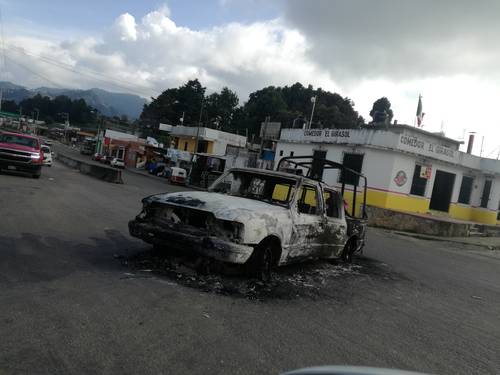
The burned municipal patrol car at the entrance to San Juan Chamula, on September 26 – Photo: Hermann Bellinghausen
But this is only one case. The community of Chavajebal, in El Bosque, is in suspense due to the hostility against Zapatista support bases and PRI members by an armed group of 40 components that calls itself the Alianza Morenista and has support in the municipal government. The entire population had to displace for two weeks at the end of 2018, after the execution of the municipal agent and the ejido commissioner; the atmosphere of danger is maintained, bullets fired into the air and harassment. The negotiation between the parties and the government is stagnant, if it’s not sabotaged. There are threats and a social network campaign against the indigenous parish priest of Simojovel, Marcelo Pérez Pérez, for intervening in favor of the victims.
Meanwhile, in Oxchuc, the interminable dispute for municipal power between parties recently caused a serious clash. In Chalchihuitán, dozens of families continue outside their lands as of today, nine groups from eight communities under fire that the paramilitaries detonate from neighboring Chenalhó, within an age-old conflict about boundaries that intensified at the end of 2017. Those displaced in Sishemtontic said they were abandoned and denied even by the municipal government. An equivalent scenario is recorded at the border between Chenalhó and Aldama, which also affects an autonomous Zapatista municipality. In Acteal last week, also in Chenalhó, the civil society Las Abejas suffered the destruction of its clinic and three homes in the displaced persons, the Catholic sanctuary and the organization’s headquarters, while several families of Río Jordán, in Los Chorros, are displaced from their community. In these two latter cases, the municipal authorities and those of Río Jordán disqualify public denunciation as a method, and they demand that not be done, “to then negotiate.”
On Friday the 27th, residents of Chalchihuitán denounced that members of the municipal council retained and deprived of their freedom the councilors Javier Nuñez Pérez and Mateo Pérez García. This Friday, Ricardo Núñez Pérez, Rafael Núñez López and Julio Girón Pérez were detained “in the same way,” and were reported “as disappeared.”
In the border jungle region, a recent crime shocked the population. On the Santo Domingo River, near Las Nubes spa, municipality of Las Margaritas, a couple of residents were found decapitated and dismembered. In Comitán, meanwhile, an organization operates that kidnaps the beneficiaries of the federal Youth Constructing the Future program (that aims to stimulate job training of those who don’t study), “charges” them half of their monthly 3,000 pesos, retains the card and the boys have to go every month to pick up “their part.” Not a few have been recruited by their captors.
There is much more to say just about Chamula, the same as San Cristóbal, a municipality with which the Chamulans maintain a paradoxical symbiotic opposition (the population of indigenous [Chamulans] formerly displaced in San Cristóbal could soon be a majority). There are many testimonies in the city about the excesses and boasts of a criminal group called Los Motonetos, something more tan urban myth, which has already carried out a nighttime “protest” with, it is said, 300 motorcyclists without license plates patrolled by vehicles also without license, challenging the San Cristóbal government. Assaults and armed violence and are attributed to them.
Originally they would have been organized, different sources maintain, by the former Coleto mayor, Marcos Cancino, a businessman of the Green Party and an Evangelical, for territorial control. Now they seem to command themselves.
In Chamula attempts at kidnapping children and disappearances are repeated. The context includes an age-old practice of trafficking persons, both migrants (polleros) and for sexual exploitation, and more recently the local production of child and adult pornography, which is sold openly in the urban markets. Reported femicides whose authors are known remain unpunished. Not to mention drugs, a business known for years. A Tzotzil friend based in San Cristóbal transmits to me the impact that it caused him seeing some young indigenous women “like this, with their traditional clothes, inhaling cocaine in the street.”
———————————————————–
Originally Published in Spanish by La Jornada
Sunday, September 29, 2019
https://www.jornada.com.mx/2019/09/29/politica/005n1pol
Re-Published with English interpretation by the Chiapas Support Committee
The History of Dolores Hidalgo, according to Marcos

Marcos enters Dolores Hidalgo in August 2005 | Photo: Mary Ann Tenuto Sánchez.
[In August 2005, the community of Dolores Hidalgo, now one of the EZLN’s new caracoles, hosted a preparatory meeting for the Other Campaign. The late figure of SCI Marcos gave an opening speech that included the words below.]
Compañeros and Compañeras,
Now to finish our speech, I’m going to tell you a story. Zapatista compañeros and compañeras told me parts of it and other parts I saw and I experienced. If there are any imprecisions, let’s leave it to the historians to clarify. With its verifiable facts, its legends, its inaccuracies and its gaps, this is part of our history, the history of the EZLN.
This place where we are was a finca (estate) called “Campo Grande.” The history of this place is a squeezed synthesis of the history of indigenous Chiapanecos; and, in some respects, of all the indigenous peoples of the Mexican Southeast, not only of the Zapatistas.
“Campo Grande” did honor to its name: more than one thousand hectares (2, 470 acres) of good land, on level ground, with abundant water, roads especially made to take out cattle and precious woods, landing strips so that the owners don’t get dusty or muddy traveling over the dirt roads so that they could reach their small planes, and thousands of indigenous who they exploit, despise, rape, deceive, incarcerate and murder. Then, the agrarian reform of the PRI, of the institutionalized revolution, was concretized in Chiapas like this: the good lands on level ground to the finqueros (estate owners), the rocky lands and hills to the indigenous.
The owner of “Campo Grande” was Segundo Ballinas, known among the older inhabitants of these parts as a murderer, rapist and exploiter of the indigenous, principally of women, boys and girls. Then the finca was divided: one part was called “Primor” and its owner was Javier Castellanos, one of the founders of the Union of Property Owners of the Second Valley of Ocosingo, one of those associations with which the finqueros disguised their “white guards” (paramilitaries); the other part was called “Tijuana” and its property owner was a Mexican Army colonel, Gustavo Castellanos, who kept the people subjugated with his personal garrison. Yet another part was the property of José Luís Solórzano, a PRI member and its candidate to different positions, known in the area for his broken promises, his barefaced lies and his arrogant and derogatory treatment toward the indigenous. Thus, in these lands the Power in Chiapas was synthesized: finqueros, the Army and the PRI-Government. To that bad trinity, Chiapas could be a cattle pasture, a hacienda for exercising the derecho de pernada (the right of rape), even with little girls, a shooting range on human targets, and one of the laboratories of the most modern of the PRI’s “democracy:” here it was not necessary to know the candidates, not even their names, or their proposals, nor even know the date of the election, nor what the options were, nor having identification. Wow, it wasn’t even necessary to go to the polls.
In each electoral process, in the municipal headquarters (cabecera) of Ocosingo, on the premises of the associations of property owners and cattle ranchers, the day filling electoral ballots was paid for with sandwiches and a soft drink. Of course that “democracy” had its excesses: in some of the elections before 1994, the PRI obtained more than 100% of the vote. Perhaps there were too many sandwiches and soft drinks.
In an August like this one that receives us here, but in 1982, the finqueros (estate owners) and their white guards violently evicted the inhabitants of the Nueva Estrella village. They shot, beat and took the indigenous men prisoners. Some were murdered. The women were set aside and were obliged to watch as they burned their homes. They took everything away from them. In time they returned. Still, when someone asks them why they returned after everything they did to them, they respond with this gesture.
In 1994, on the first of January, thousands of indigenous people from this Tseltal zone, together with thousands more from the Tojolabal, Chol and Tzotzil zones, after 10 years of preparation, covered their face, changed their names collectively as the “Ejército Zapatista de Liberación Nacional” (Zapatista National Liberation Army), rose up in arms. The finqueros fled, their white guards did the same thing, and they left abandoned the weapons with which they sustained their domination. The Zapatistas recuperated the lands. Look: they didn’t “take” them, but rather they “recuperated” them. That’s what the compañeros and compañeras called this act of justice that had to wait dozens of years to complete. These lands that were indigenous lands and that were usurped, were now indigenous lands again. They have been, then, recuperated. The lands were distributed. Hundreds of indigenous families, who before were crowded into a space of 5 acres, founded, together with other landless indigenous people from other villages in the zone, this Zapatista town that today receives us. Those who were attacked by the finqueros in 1982, among others, now inhabit this town.
This new Zapatista town is named “Dolores Hidalgo” and, according to what the founders tell me, veterans of the ’94 uprising, the significance of “Dolores” is about the pain that we have from more than 500 years of resistance, and the name of “Hidalgo” is for Don Miguel Hidalgo y Costilla that fought for the Independence of Mexico.
Notice that they said “500 years of resistance” and not “500 years of domination.” In other words, despite the domination, they have never stopped resisting it. And when we talk about domination, that is, when we tell our history, we also talk about resistance. And now I’m not talking about our history as the EZLN, but rather about our common history, the one we share with you, with your organizations and your movements. Our common history is that, where anyone says: “I command and dominate,” we, you, we say: “I resist and rebel.”
But the Zapatistas that founded “Dolores Hidalgo,” don’t refer only to resistance. They also name her pain: the pain along the way, the pain of tiredness, the pain of those who betrayed them on the trajectory, the pain of defeats, the pain of mistakes, and, above all, the pain of going forward despite all the pains.
You will tell us about your history as an organization and as a movement, about your pains, about your resistance and rebellion. Surely, we will recognize each other in more than one story. Many of the others will seem alien to us. But we will learn about you in all of them. And we will say to you what we have already said to others: that we want to continue learning.
We will learn, with you and with many more like you, to think well, to say well and to feel well when we say: “compañero, compañera.”
Welcome Compañeros, welcome compañeras!
Muchas Gracias,
Subcomandante Insurgente Marcos
August 20, 2005
http://enlacezapatista.ezln.org.mx/2005/08/20/palabras-de-inicio-reunion-dia-20-agosto/
English interpretation by the Chiapas Support Committee
 Chiapas Support Committee