Chiapas Support Committee
Home of the Compañero Manuel blog on zapatistas & mexico
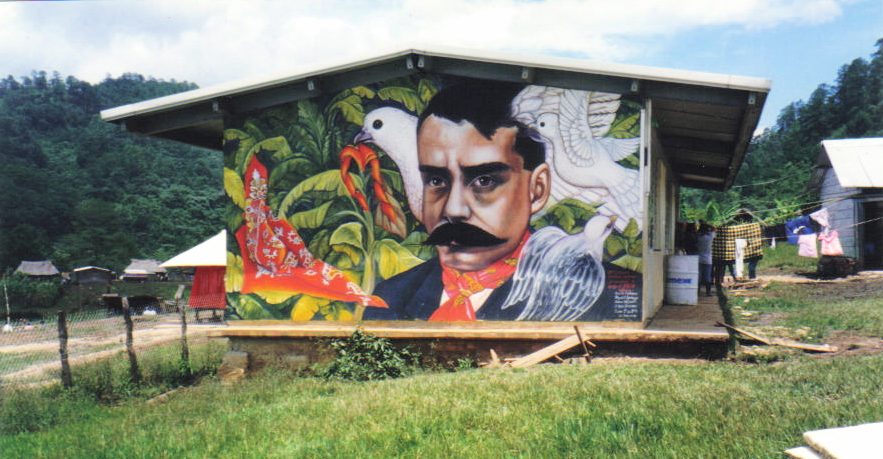
Marcos: Votan II. The Guardians
VOTÁN II.
The Guardians.
July 2013.
Now we want to explain to you how the little school will work (the list of school items you’ll need, the methodology, the teachers, the course subjects, the schedules, etc.), so the first thing is…
What you will need.
The only thing that you need, objectively, to attend the Zapatistas’ little school (in addition to being invited, of course, and your one hundred pesos for the book-DVD packet), is the willingness to listen.
So there’s no reason to heed the advice or recommendations of those people, however well intentioned, who say that you need to bring this or that equipment, based on the fact that “they have been in community.”
Those who really have been in community don’t go around bragging about it, and they also know well that what one truly needs is to know how to look and listen. Those who have come to community to talk (and to try to tell us what to do, or to offer us charity in the form of money or “wisdom”) have been and will be many, too many. And those who have come to listen are very few. But I’ll tell you about that on another occasion.
So you don’t need to buy anything special (I read that someone only had some old tennis shoes to bring, that’s cool). Bring a notebook and a pen or pencil. It is not obligatory that you bring your computer, smartphone, tablet, or whatever you use now, but you can if you like. There won’t, however, be a cellular signal where you will be. There is Internet in some caracoles but its speed is, how shall I put it, a little like “Pegaso,” Durito’s mount [a turtle]. Yes, you can bring your whatever-you-call-it that you use to listen to music. Yes, you can bring a camera and a recorder. Yes, you can record audio and take photos and video, but only according to the rules, which Subcomandante Insurgente Moisés will tell you about. Yes, you can bring your teddy bear or equivalent.
Other things that might be useful: a flashlight; your toothbrush and a towel (if you want to bathe and it is possible to do so); at least one change of clothes, in case you get covered in mud; your medicines, if they are necessary and a trained capable person has prescribed them; a plastic bag for your identification and money (always keep these things with you—we will only ask you for your identification at registration, to see if you are really you); another plastic bag for the study materials you will receive here; you should also put your (under—if you use it—and outer) wear in plastic bags.
Remember: you can bring as much stuff as you want, but everything you bring you will have to carry yourself. So none of this “I’m going to take the piano just in case I have time to practice my do-re-mi-fa-so-la.” And no, you can’t bring your Xbox, ps3 wii, or that old Atari console.
What is in fact essential to have, you cannot buy. It is what you bring already incorporated within your person and can be found, if you start at your neck, below and to the left.
Okay, having clarified that, I will here list what you do need to attend the little school in community. Without the following requirements, YOU WILL NOT BE ADMITTED:
-Disinclination to talk or to judge.
-Willingness to listen and watch.
-A well-disposed heart.
Your race, age, gender, sexual preference, place of origin, religion, scholarliness, stature, weight, physical appearance, equipment, “long experience” following Zapatismo, or what you wear or don’t wear on your feet, none of that matters.
The Scholarly Space and Schedule.
According to the Zapatistas, the place of teaching and learning—school—is the collective. That is, the community. And the teachers and students are those who make up the collective. All of them. So there is no teacher, but rather a collective that teaches, that demonstrates, that trains, and in it and with it—a person who learns and, at the same time, teaches.
So when you attend your first day of class in community (this will be different if one is taking the course another way), do not expect to find yourself in a traditional school. The classroom that we have prepared for you is not a closed space with a blackboard and a professor at the front of the room imparting knowledge to the students who he or she will then evaluate and sanction (that is, classify into good and bad students), but rather, the open space of the community. And this community is not a “sect” (here Zapatistas, non-Zapatistas, and, in some cases, anti-Zapatistas live together), nor is it hegemonic, homogeneous, closed (here people from different calendars and geographies visit all year around), or dogmatic (here we also learn from Others).
So you are not coming to a school that operates on the traditional schedule. You will be in school every hour of every day during your stay here. The most important part of your time in the little Zapatista school is your living experience with the family with whom you will stay. You will go with them to get firewood, to the cornfield, to the river/stream/spring, you will cook and eat with them (of course, you will only eat what doesn’t harm you or go against your convictions—for example, if you are vegetarian or vegan, they won’t give you meat, but please let us know beforehand because the compas, when they are happy with a visit, often cook chicken or pork, or the community or autonomous municipality or Good Government Council might take one of its collective cows and make a stew for everybody), you will rest with them, and, above all, you will get tired with them.
All in all, during these days you will be part of an indigenous Zapatista family.
And that is the reason why we can’t accept people coming with their camping tent or RV. That is why there is a limit on the number of people who can come. Because many people do indeed fit on these lands, but under the little Zapatista roofs only a few fit. If you want to camp, to live close to nature or its bucolic equivalents, fine, but not here on these dates.
So you won’t be living with your gang, group, or collective, or with other “citizens” [like city-dwellers]. If you come with your family, partner, or your not-so-much-a-partner, you can be together if you like, but no one else. None of this “all of us who came from such-and-such place are going to get together to hang out or talk or sing around the campfire or whatever.” This you can do in your geographies and calendars. You (or you and your family, or partner, or not-so-much-a-partner) are coming here to participate in the daily life and knowledge of the indigenous Zapatista people, and, of course, the daily life of non-Zapatista indigenous people.
The Zapatistas are a people that have the particularity of not only having challenged the powerful, nor only of having maintained their rebellion and resistance for 20 years. They also, and above all, have managed to build (in conditions which you will become personally acquainted with) the indigenous Zapatista definition of freedom: to govern and govern ourselves in accord with our ways, in our geography and our calendar. Yes, this part about “our geography and our calendar” defines a considerable distance between ours and other projects. We warn you that this is not just a model to follow (some things have worked for us and some things haven’t), a new evangelism, or a new fashion for export; it is also not a “construction manual for freedom.” It is not that for the other original peoples of Mexico, much less for all of the peoples who struggle in all of the corners of the world.
In addition, take careful note! We are defining a time. What you will see here works for us now. New generations will build their own paths, with their own ways and their own times. A concept of freedom does not enslave its future inheritors.
For us, this is freedom: to exercise the right to construct our own destiny, with no one that rules over us and tells us what to do or not do. In other words: it is our right to fall and pick ourselves back up. We know well that this is built with rebellion and dignity, knowing that there are other worlds and other ways, and that, just like we are building ours here, others are going about building their identity, their dignity.
During the week that you live with the Zapatista communities, you will only twice go to a meeting in the Caracol with all of the students of the zone that you are assigned to. In this meeting, where many different colors and ways from many different calendars and geographies will meet, there will be a teacher dedicated to trying to respond to any questions or doubts that have come up during your stay. This is because we think that it will be good for you to hear the doubts that arose for someone from another country or another continent, another city, another reality…
But the most fundamental part of the little school you will learn with your…
Votán.
Over the course of a few months, tens of thousands of Zapatista families have been preparing to receive those who come to the little school in community. Along with them, thousands of women and men, indigenous Zapatistas, have become a Votán, simultaneously individual and collective.
So you should know what role the Votán will play, because the Votán is, as they say, the backbone of the little school. It is the method, the study plan, the teacher, the school, the classroom, the blackboard, the notebook, the pen, the desk with an apple, the recess, the exam, the graduation, and the cap and gown.
A lot has been written and said about what Votán (or “Uotán”, or “Wotán”, or “Botán”) means. For example, that the word doesn’t exist in the Mayan language and is just a misunderstood or badly translated version of “Ool Tá aan,” which would be something like “The Heart that Speaks.” Or that it refers to an earthquake; or the growl of the jaguar, or the beating of the heart of the earth, or the heart of the sky, or the heart of the water, or the heart of the mountain, or all this and more. But, as in everything that refers to original peoples, these are versions upon versions from those who have tried to dominate (sometimes with knowledge) these lands and their inhabitants. So, unless you have interest in contemplating interpretations of interpretations (that end up ignoring their creators), here we refer to the meaning that the Zapatistas give to the Votán. And it will be something like “guardian of the heart of the people,” or “guardian and heart of the earth,” or “guardian and heart of the world.”
Each of the little school students, regardless of their age, gender, or race, will have their Votán, a guardian (or guardiana) [feminine].
That is, in addition to the family with whom you will live for those days, you will have a tutor who will help you understand what, according to the Zapatistas, freedom is.
The Guardians [masculine and feminine] are people like all common people. Only these are people that rebelled against the powerful who exploited, dispossessed, disrespected, and repressed them, and they are people who have given their life to that rebellion. Despite this, the Votán that we are does not preach the cult of death, glory, or Power, but rather walks through life in a daily struggle for freedom.
Your personal Votán, your guardian or guardiana, will tell you our history, explain who we are, where we are, why we fight, how we struggle, and alongside who we want to struggle. They will talk to you about our achievements and our errors, study the textbooks with you, resolve any doubts they are able to (and for when they are not able, we have the larger meeting). They are the ones who will speak to you in Spanish (the family with whom you live will always speak to you in their mother tongue), they will translate for you what the family says, and will translate to the family what you want to say or know. They will walk with you, go to the cornfield or to bring firewood or water with you, they will cook and eat with you, sing and dance with you, sleep near you, accompany you when you go to the bathroom, tell you which bugs to avoid, make sure you take your medicine; in sum, they will teach and take care of you.
You can ask your Votán anything: if we are really the offspring of Salinas, if SupMarcos is dead or just tanning himself on a European beach, if SubMoy is going to show up at some point, if the world is round, if he or she believes in elections, if he or she is for the Jaguares [Chiapas’ Mexican professional league soccer team], etc. etc. In contrast to other teachers, if your guardian or guardiana doesn’t know the answer, they’ll say “I don’t know.”
Your Votán will also be your simultaneous translator that doesn’t need batteries. Because here, as far as possible, you will be spoken to in our native languages. Only your guardian or guardiana will speak to you in Spanish. This way you will experience what happens when an indigenous person tries to speak in a dominant language. The fundamental difference is that here you will not be treated with disdain or mockery for not understanding what is said to you or for mispronouncing words.
There might be laughter, yes, but out of sympathy for your effort to understand and make yourself understood. And note, your Votán will not only translate words, but also colors, flavors, sounds, entire worlds, that is, a culture.
In the meeting that you will attend with your classmates in the zone, you will not be able to ask questions directly of the teacher; rather, you will ask your guardian or guardiana and they will translate the question for the teacher, who will respond in their mother tongue and your guardian will translate back to you. You will of course be left with the doubt as to whether your question was adequately translated and if the answer you got is the same as that which the teacher gave. But, isn’t that exactly what an indigenous person is subject to with a translator in the government courts of justice? This way you will understand that what they call “judicial equality” is just one more monstrosity of justice in our world. Where is judicial equality if the translation of things like “freedom,” “democracy,” and “justice” are made with the same words as those who want to enslave, dispossess, and disappear us? Where is equality if accusation, trial, and sentencing are made by a judicial system that, in addition to being corrupt, is imposed in the language of the Ruler? Where is justice in a system whose judgment is based on the premise of cultural dispossession? That is why the school will be like this. That is why the Votán will have this purpose. Because…
They are us.
Your Votán is a great collective concentrated in a person. He or she will not speak as an individual. Each Votán is all of us Zapatistas.
A few weeks ago, Subcomandantes Moisés and Marcos gave the responsibility of spokesperson to thousands of indigenous Zapatista men and women to hold for the days of the little school. During those days in August (and later next December and January), the EZLN will speak through their voice; through their ears the EZLN will listen; and in their heart will beat the great “we” that we are.
So during the days of the Little School, you will have a teacher who is nothing more and nothing less than the maximum Zapatista authority, the supreme head of the Zapatista Army of National Liberation: Votán. And the Votán will also be in charge of…
The Children.
One guardiana for each child/student who is a minor (12 years old or younger) will accompany the mother and/or father all of the time, helping to take care of the child, making sure they don’t get sick, that they take their medicine, that they play, learn, and are happy. If the child knows how to read, the guardiana will study our textbook with the child, and tell stories of how the indigenous children lived before the uprising and how they live now. They will tell terrible and marvelous stories, and jokes, and maybe even sing the children the song about “the moño colorado.” And if the children misbehave, they will tell them not to act like that, because if they do SupMarcos will come with his great big bag of cookies and won’t give them even one, even if they are animal crackers, and that the great Don Durito of the Lacandón will not tell them the story of how he fought, all by himself, against 3.141592 toothless dragons, nor the marvelous story of Lucezita and the Cat-Dog that, they tell me, leaves Ironman, Batman, The Avengers, Spiderman, X-Man, Wolverine, and anything else that comes out, in the dust.
All of the children, with the family members that accompany them, will be assigned to the zones closest to
San Cristóbal de Las Casas, under the best conditions we can offer. They will have specially prepared lodging with their mother or father so that they do not get cold or wet if it rains. There will also be compas present who know about health and first aid. And in the case of an emergency, two ambulances and two other vehicles will be available 24 hours a day to take the child to the city if a doctor is needed, or to get medicine if needed. If it is necessary for a family to return to their own particular geography before the school is over, we have a small economic fund to help them with their tickets or gasoline.
In sum, the children will have very special treatment. But neither they nor the adults will escape the…
The Exam.
It is the most difficult test you can imagine. It does not consist of a written exam, a thesis, or multiple choice questions; and there won’t be a jury or a council of judges with university titles to grade you.
Your reality will be your test, on your calendar, in your geography, and your council of judges will be… the mirror.
There you will see if you can respond to the only question on the final exam: what is freedom according to you and yours?
-*-
Vale. Cheers and believe me, I say out of my own experience, what one certainly learns best here is to ask questions. And it’s worth it.
From the mountains of the Mexican Southeast.
SupMarcos.
Mexico, July of 2013.
::::::::::::::::::::::::::::::::::::::
See and listen to the videos that accompany this text. Eduardo Galeano narrates an anecdote about a teacher and his students.
————————————————————–
Freedom is, for example, the demand for the freeing of all of the Mapuche political prisoners. The track is called “Cosas Simples” (Simple Things), by the Chilean group Weichafe (Warrior).
————————————————————–
“Luna Zapatista” (Zapatista Moon), by Orlando Rodríguez and Miguel Ogando, with “El Problema del Barrio” (The Problem of the Barrio), drawings by Juan Kalvellido. Video production: Orlando Fonseca.
——————————————————–
US Will Act On Mexico’s Southern Border
[Further militarization of Mexico’s southern border could dramatically affect the state of Chiapas, which is surrounded by Guatemala as shown on the map below. Chiapas is outlined in dark purple.]
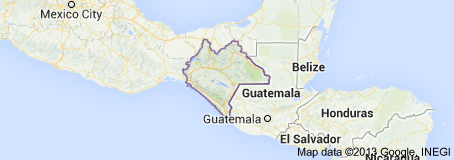
The US Will Act On Mexico’s Southern Border For “An Orderly Migratory Flow”
** Napolitano and Osorio Chong confirm mechanism without taking Central America into account
** The US Secretary congratulates her counterpart for the detention of Z-40
By: Fabiola Martínez
Members of Mexico’s security cabinet and United States Homeland Security Secretary, Janet Napolitano, defined yesterday the joint mechanism for intervention on the Mexican border (North as well as South), to intercept and fight the criminal organizations and to apply agreements on trade and immigration policies.
Without the presence of authorities from Central American countries, Mexican and US officials agreed upon “the strengthening of security on the southern border of our country (Mexico), for the purpose of achieving an orderly migratory flow with respect for human rights.”
The above is derived from the agreement signed Tuesday in Matamoros, Tamaulipas, where the US official congratulated her counterpart for the arrest of Miguel Ángel Treviño, known as El Z-40, who is identified as the leader of the Zetas gang.
“I would like to congratulate you, Secretary (of the Interior, Miguel Ángel) Osorio Chong, and the administration of President Enrique Peña Nieto, for having captured Miguel Ángel Treviño, El Z-40.
“It was a great capture of a person that has been a plague in this region for a long time. It is a very strong blow to the Zetas, but it also reflects the commitment that the government of President Peña Nieto has to neutralize the criminal organizations,” Napolitano said.
On her work visit in Mexico, first in Tamaulipas and yesterday in Mexico City, the head of the United States Department of Homeland Security–who will leave that position within the next few weeks– assured that her country will continue to support Mexico and maintained that currently the common border is more secure, “than ever.”
She urged authorities of both nations to preserve the sense of co-responsibility for improving security and achieving that the bi-national is modern, “of the 21st Century.” She emphasized the operations in which US and Mexican authorities have coordinated, the same for patrolling as in the inspection of the entry and exit of people, vehicles and merchandise.
“We cannot have the luxury –she added– of losing sight of the fact that the objective is to make a more secure border, to promote legal crossings and to combat transnational crime.”
Yesterday, high-level officials from both countries went to the Interior Ministry’s library to converse in private for more than an hour.
The Secretaries of Interior, National Defense, Navy and the Attorney General of the Republic attended for Mexico; also the Director of the Center for Information and National Security various assistant secretaries of Interior, the commissioners National Security and of Migration, as well as the chief of the System of Tributary Administration, operator of Mexicana customs.
For the US side, Alan Bersin, Assistant Secretary for International Affairs; Thomas Winkowski, Interim Director of the Office of Customs and Border Protection, Anthony Wayne, the US Ambassador in Mexico, and John Sandweg, legal advisor accompanied Napolitano.
—————————————————–
Originally Published in Spanish by La Jornada
Translation: Chiapas Support Committee
Thursday, July 25, 2013
Chiapas Cancels Carbon Deal with California
Chiapas cancels carbon deal with California
[This is REAL GOOD NEWS! What this article omits is the strong and unified opposition of both Zapatista and non-Zapatista campesinos to this attempted control over land rights in the Lacandón Jungle of Chiapas. Thanks to all the organizations that worked against it!]
The state government of Chiapas, Mexico, has cancelled a controversial forest protection plan that critics said failed to address the root causes of deforestation and could endanger the lives and livelihoods of indigenous peoples. The program is linked to California’s cap-and-trade program through a complex “carbon offset” scheme that has yet to see the light of day. Carlos Morales Vázquez, the state’s environment secretary, on July 8 told the Chiapas daily El Heraldo that the UN initiative that provided the model for the pact, Reducing Emissions from Deforestation and Degradation (REDD), “was an utter failure, and the program is cancelled.”
The program, instituted in 2011 after Chiapas signed an agreement with California as part of the US state’s Global Warming Solutions Act or AB32, has been widely criticized by civil society groups for its lack of clear objectives, and failure to engage indigenous people’s organizations or take into account historic tension over land rights in the region.
Europe’s emissions trading system, the largest carbon market in the world, does not accept REDD credits. The EU maintains that reductions in carbon emissions from forest preservation are impossible to verify accurately, that preserving one forest in one place may only drive deforestation to another area, and that industrial pollution remains in the atmosphere for centuries while forests are more vulnerable to short-term changes.
“The idea that California could reduce its climate emissions by asking the state of Chiapas to preserve its forests was absurd from the beginning,” said Jeff Conant, international forests campaigner with Friends of the Earth-US. “The suspension of the program can only be seen as recognition that there are better ways to meet our goals of preserving ecosystems, supporting indigenous peoples’ rights, and defusing the climate crisis.”
Friends of the Earth-Mexico, also known as Otros Mundos, called the REDD+ program in Chiapas “a chronicle of a disaster foreseen.”
“The failure of the REDD+ program shows why projects that attempt to commercialize nature can’t work in Chiapas,” said Claudia Ramos-Guillén of Otros Mundos. “This project has had tremendous costs for the indigenous and peasant communities of the state. Programs by which the tropical nations of the global South are paid to absorb the climate pollution of the industrial North are destined to fail as long as real solutions to the climate crisis are not put into practice.”
Morales, the Chiapas environment secretary, told El Heraldo that the program “didn’t have the results that were announced. I believe that environmental problems need to be addressed with real strategies, not just as casual occurrences.”
This spring, draft recommendations for moving the agreement between California, Chiapas and the Brazilian state of Acre generated a storm of criticism. Friends of the Earth, Greenpeace International, Global Justice Ecology Project, the Indigenous Environmental Network and dozens of other groups sent a letter to California’s Governor Jerry Brown asking him to reject the plan, saying: “[The] proposal is not only unlikely to deliver real, additional and permanent emission reductions, but it would also prevent Californians from getting the benefits of AB 32 at home.” Groups in Chiapas and Brazil also sent letters to California authorities denouncing the effort.
Despite the news that the REDD program in Chiapas is suspended, the Action Program on Climate Change in Chiapas continues to refer to REDD as a keystone of the state’s climate change strategy, indicating that the project could be moved to other areas. (Friends of the Earth, July 18).
————————————–
Originally Published by: WW4 Report on Fri, 07/19/2013 – 06:18
http://ww4report.com/node/12447
EZLN: New Dates for Little Schools & Other Details
New Little School Dates, Information about the Videoconferences and a few other things.

July 2013.
For: The compañeras and compañeros of the Sixth and the Zapatista Little School students.
From: Subcomandante Insurgente Moisés.
Compañeras and compañeros.
Here I am sending you some information about the Zapatista Little School.
First: We want to communicate with those compañer@s—men, women, children, and elders—who did not get a spot in this first round of the Zapatista Little School.
The Zapatista peoples did what they could to make more spots available, and opened space for 1700 students; these spots once again filled up quickly. In other words, they created 200 more spots, and those next in line on the waiting list have already been informed they can come. Nevertheless there are many more people who want to come. We are writing to tell them not to be sad anymore, or mad, or pissed off because there wasn’t any more space.
The compañeras and compañeros who are the Little School teachers have decided that there will be another class at the end of the year, in December of 2013, and also one in January of 2014. More specifically:
The dates for the second round of the Little School will be:
Registration: December 23-24, 2013.
Classes: December 25-29, 2013.
Return: December 30, 2013.
They also decided to remember and celebrate the January 1, 1994 Zapatista uprising, so for those who want to stay for the 20th anniversary festivities, there will be a party December 31 and January 1.
After that, there still won’t be rest, because it has also been decided that after the festivities, the work—that is, the Little School—will continue:
Dates for the third round of the Little School:
Anniversary party: December 31, 2013 – January 1, 2014.
Registration: January 1-2, 2014.
Classes: January 3-7, 2014.
Return: January 8, 2014, everyone back to their corner of the earth.
PAY CAREFUL ATTENTION TO THIS POINT: In order to request an invitation and registration code for the second and third rounds of the Little School, even if you have already asked for one via the webpage or by email, you must send your request to the following email (you can send it as of today):
escuelitazapDicEne13_14@ezln.org.mx
We are doing it this way so that we can organize things adequately and so that you receive a timely response.
Second: Remember that the parties for the 10-year anniversary of the caracoles and the Good Government Councils are open to all. These parties will begin August 8 and continue the 9th and 10th. On the 9th and 10th there will be a concert and presentations by artistic groups from various parts of Mexico and the world. There will also be a concert in CIDECI on August 11 on registration day. We will send out the program soon.
Third: We want to remind those who are coming to the first round of the Little School in August of this year that:
-Registration, to which you should bring your ID and registration code, will be August 10 and 11, 2013 in CIDECI, San Cristóbal de Las Casas, Chiapas, Mexico.
-You should bring $100.00 (one hundred Mexican pesos), which covers the cost of the study packet. It consists of 4 textbooks and 2 DVDs (20 pesos per book and 10 pesos per DVD).
-When you register, you will receive your nametag and student study packet, and you will be told which caracol you are going to. If you have a vehicle you will given directions to your caracol and informed when a caravan with a guide vehicle will be leaving. If you don’t have a vehicle, you will be told which bus or truck you can ride in as part of the caravan. If you are taking your own vehicle, you can leave it in the caracol during your class and we will take care of it.
-The departure to the caracoles is the 11th. If it gets late on the 11th and the buses are still filling up, there will be an early departure on the 12th.
-Classes start August 12 and finish the 16th; August 17 will be the return trip, and the buses will leave you in CIDECI, San Cristóbal de Las Casas, Chiapas. There you can stay for the Seminar “Tata Juan Chávez Alonso” given by various originary peoples from our country.
-Travel times:
The farthest caracoles are La Realidad and Roberto Barrios. Traveling in caravan and without stopping, getting lost, or breaking down, the trip will take 8-9 hours.
The next farthest is La Garrucha. Traveling in caravan and without stopping, the trip will take 5-6 hours.
Then follows: The caracol of Morelia, traveling in caravan and without stopping, the trip will take 4-5 hours.
And lastly: The caracol of Oventik, traveling in caravan the trip will take one and a half to two hours.
All caravans will leave from CIDECI, San Cristóbal de Las Casas, Chiapas, Mexico.
Another day I will send you the hourly schedules for the classes, but before that SupMarcos has to tell you how all of this is going to work.
Fourth: We also want to tell our compañer@s of the Sixth that if they can’t be at the Little School this August, there is still a way to participate, because we are going to transmit special classes by videoconference, with a special team of Zapatista compas who are going to explain everything and respond to your questions via “chat.”
In this process we will have the support of the compas from Koman Ilel and other independent media.
We will tell you more about this in a specific letter. But I will let you know now that the videoconference days will be August 12, 13, 14, 15, and 16. There will be at least two different schedules, one so that people in the Americas can participate in the evening, and another some hours later so that people from other continents can also participate in the evening. We did it this way thinking that in the evening you will arrive home from work and can take the class, or you can take it during the day if you work at night.
In order to take the class via videoconference, you will need to have a code or password. This password is only given to those who are invited and have asked to take the class via videoconference. If you want to take the class by videoconference and you don’t have an invitation, please ask for one at the following email address:
You will then be sent the password to enter the internet conference. Also, for any compas who are organizing videoconference sessions where they are, they should send us the names of those who they will be inviting. This is so that we have an idea of who is taking the course via videoconference.
That is what we wanted to tell you, compañer@s of the Sixth.
Subcomandante Insurgente Moisés.
Mexico, July of 2013.
:::::::::::::::::::::::::::::::::::::
Watch and listen to the videos that accompany this text:
The track “Soy el Sol en Movimiento” (I am the Sun in Movement), from the group “El Problema del Barrio” (the Problem of the Hood). Lyrics by Orlando Rodríguez, music by Miguel Ogando. Drawings by Juan Kalvellido. Video production: Orlando Fonseca.
————————————————————–
¡Rock! The Spanish group “Ilegales” (The Illegals) with the track “Tiempos Nuevos, Tiempos Salvajes” (New Times, Crazy Times). Video Production: Zenodro1000
————————————————————–
Reggae, from the Ivory Coast, Africa, with Tiken Jah Fakoli and this track called “Plus Rien Ne M’étonne” (“At this point nothing surprises me”). Video production: Ben Magec.
******************************** Traducción del Kilombo Intergaláctico. *********************************
Zapatista Summer Film: The Sixth Sun
Zapatista Summer
This summer, the Chiapas Support Committee is working with other collectives and organizations to promote the 10th Anniversary of the Zapatista Good Government Councils (Juntas), the “Little Zapatista Schools” (Escuelitas) the 20th Anniversary of the January 1, 1994 Zapatista Uprising and to build community here in the Bay. Zapatista Summer began with a beautiful Concert at Rincon in San Francisco with performances by Francisco Herrera, local musicians and Spoken Word by Arnoldo Garcia. The funds raised will be donated to the Zapatistas to help offset their expenses for the Anniversary of the Juntas and the “escuelitas” (Little Schools that teach Freedom According to the Zapatistas).
We will continue sponsoring events throughout the summer as the Zapatistas prepare to celebrate their 20th Anniversary on January 1, 2014! Please join us at these events to celebrate the EZLN’s resurgence and to learn how you can participate. Our next event is a film screening of the Sixth Sun, co-sponsored with the Eastside Arts Alliance. For more Info: cezmat@igc.org or (510) 654-9587

Raúl Zibechi: Return of the Social Movement
Return of the Social Movement
By: Raúl Zibechi
The June mobilizations in Brazil can constitute a sharp turn of long duration. They are the first large demonstrations in 20 years, since 1992 against then President Fernando Collor de Melo, who was forced to resign. Things are different now: the movement is much broader, encompassing hundreds of cities, the most organized sectors propose goals of greater reach with an anti-capitalist orientation and we are not facing a punctual explosion but rather the coming together en masse of an extensive discontent.
The above permits venturing that we are probably facing the beginning of a new cycle of struggles impelled by organizations different from those of the previous period. But, what were the prior movements?
In the 1970s, a real social earthquake was produced in Brazil, seen from below, in the middle of the military regime. The factory commissions embodied a new unionism of rejecting the vertical structure of official unionism. The strikes in São Bernardo do Campo and other cities of the São Paulo manufacturing belt broke the regime’s control, a movement that took shape in the creation of the Workers’ Only Central (Central Única de los Trabajadores, CUT) in 1983. In 1979, landless campesinos again took up occupations as tools of struggle, with the occupation of the Macali y Brilhante haciendas (plantations) that are considered the origin of the MST (Movimiento Sin Tierra). In 1980, the Workers Party (Partido de los Trabajadores, PT) was created.
The big creations of the Brazilian popular movement started through small resistance movements and struggles, and by actors, let’s say, marginal from those point of view of big politics. The PT’s creation is the junction of three currents: the defeated from the armed struggle of the 60s and 70s, the faith-based communities –that never separated ethics from politics– and the new unionism, within the context of a broad popular movement for freedom. As Chico de Oliveira, the great Brazil sociologist, points out, those junctures are very rare in history, and are not repeatable.
Two decades later, things have changed radically. The higher stratum of unionism has become, through pension funds, an ally of financial capital and the Brazilian multi-nationals. The PT is one more traditional party, which in no way differs from the parties of the right, or with any of those that co-govern. The politics of the possible led the party of Lula to dirty itself in notorious corruption cases like the monthly allowance (mensalão), which was paid to parliamentarians to vote with the government. Only the MST refused, even paying the price of greater isolation.
The same year that Lula arrived in the government more than 40,000 youths won the streets of Salvador (Bahia), against the increase of the urban transportation fares in a 10-day movement known as the Buzu Revolt (in reference to the buses). The following year, in 2004, another massive mobilization in Florianopolis struggled against high transportation costs, the Turnstile Revolt. The student apparatuses negotiated with the municipal power passing over the movement, generating a profound rejection.
In 2005, at the World Social Forum in Porto Alegre, the Free Pass Movement (MPL, its initials in Portuguese) was created, with groups in all the big cities. We’re talking about small nuclei that functioned based on the principles of horizontality, autonomy, federalism, and not supporting a political party, but not anti-political party. In that way, they rejected hierarchical and centralized organizations, dependent on the State and the government, which hegemonized the popular field. The MPL wasn’t the only movement of this kind. The Central of Independent Media (CMI, or Indymedia Brazil), the Without Roof Movement (MTST, its initials in Spanish), the unemployed (MTD), the picketers and autonomous and libertarian student groups in the universities and some high schools, formed a vast rainbow.
The MPL stood out for mobilizing tens of thousands of people in the streets, because of the poor quality of urban transportation, in general private, and for its abusive prices. Towards 2008, the Popular Committees of the Cup emerge, which analyzed the consequences that the public works for the 2014 World Cup and the 2016 Olympic Games have for the population. Just like the others, they are small groups of heterogeneous composition that started to work with the communities on the urban peripheries and residents of the favelas threatened by the mega-works.
What’s most important is that in those groups a new political and protest culture was being born. Some call it direct action. Anyway it is inspired in the four axes mentioned; it grew and expanded outside of the institutions and has no calling to become an organizational apparatus separated from the people that struggle and mobilize or from participating in elections. In a long decade of consumerist consensus, lubricated by social policies that froze inequality, that new culture was settling into the margins of social action and it began to expand from there.
In the half-year prior to June’s large mobilizations, those modes of acting won victories in a dozen cities, in the resistance to the public works for the World Cup and in the reduction of the cost of transportation. That culture went from calling on hundreds to mobilizing tens of thousands. As is known, police repression and the FIFA’s dominance did the rest. When the people started to spill over into the big avenues, all of Brazil knew that the works for the World Cup form part of a segregationist urban reform concocted by speculative capital. They struggle for the right to the city that capital denies to them.
Now we know that towards 2003, in Bahia, the slow forging of a new band of movements began. But we must not forget that it all began because of small groups of youths, at the margins of the political system and against the grain of the institutions.
____________________________________________________
Originally Published in Spanish by La Jornada
Friday, July 12, 2013
Translation: Chiapas Support Committee
En español: http://www.jornada.unam.mx/2013/07/12/opinion/020a2pol
Resumen de noticias sobre los zapatistas – Junio de 2013
JUNIO DE 2013 RESUMEN DE NOTICIAS SOBRE LOS ZAPATISTAS
En Chiapas
1. Moisés: Cupo lleno en Las Escuelitas – El 13 de junio, el Subcomandante Moisés publicó un comunicado informando que las escuelitas donde l@s estudiantes aprenderán “la libertad según los zapatistas” ya se llenaron. Ya no hay cupo. Parece que había espacio para 1500 personas pero más querían participar. Sin embargo, el Sup Moisés dice que habrá otra sesión de las escuelitas probablemente en diciembre ó enero.
2. Marcos publica comunicados sobre las escuelitas – En una serie de comunicados titulados “L@s Condiscipul@s,” el Subcomandante Marcos ha publicado 5 informes (hasta ahora) sobre quiénes sí y quiénes no asistirán a las escuelitas. L@s que no estarán presentes incluyen los desaparecidos y los presos políticos; entre ellos, Alberto Patishtán, Leonard Peltier, Mumia Abu-Jamal, Julian Assange, Bradley Manning y miembros de Pussy Riot. Edward Poindexter y Mondo we Langa también fueron incluidos. Forman parte del Black Panther Party (Partido de los Panteras Negras o BPP), objetivo del programa COINTELPRO del gobierno de los Estados Unidos que espió y luego infiltró al BPP. Otro grupo que no estará presente incluye a los que no fueron invitados; por ejemplo los ex-miembros y miembros actuales de la Cocopa, el Departamento de Estado de los EEUU, la CIA, el FBI, etcétera. En el cuarto comunicado, Marcos explica que los pueblos originarios de las Américas no estarán presentes porque los zapatistas no tienen nada que enseñarles. Mas bien, los zapatistas han aprendido de ellos y tendrán su celebración del 17 al 18 de agosto en el seminario Tata Juan Chavez Alonso. El comunicado mas reciente describe a quienes serán l@s estudiantes de la escuelita, de dónde son y cuántos serán.
3. BUENAS NOTICIAS! Tribunal Chiapaneco Libera a Miguel Vázquez Deara – El 26 de junio, un tribunal chiapaneco liberó a Miguel Vázquez Deara de la cárcel. Vázquez Deara viene de San Sebastián Bachajón, y es adherente a la Sexta Declaración del EZLN, y un participante activo en la defensa del territorio y contra los intereses del turismo lujoso. Le detuvieron en septiembre del 2011 con los cargos de haber robado con arma y asociación delictuosa, esto basado en pruebas fabricadas por militantes a favor del gobierno y quienes tienen interés por controlar las cascadas de Agua Azul. Vázquez Deara confesó haber cometido los crímenes bajo condiciones de tortura, y entonces empezó su estancia en prisión en noviembre de 2012. El tribunal de apelaciones anuló como prueba la confesión sacada bajo tortura, dado que Vázquez Deara no tuvo ni abogado ni traductor cuando dió su supuesta confesión. Este tipo de abusos del sistema de justicia es un arma más que se utiliza en contra de l@s que defienden su territorio no solo en Chiapas sino en todo México.
4. Campaña Mundial: Juan Vázquez Guzmán Vive! La Lucha de Bachajón Sigue! – Organizaciones expresando su solidaridad con la lucha zapatista llevaron a cabo una semana global de lucha que comenzó el 25 de junio y terminó el 2 de julio, para recordar a Juan Vázquez Guzmán quien fuera asesinado el pasado 24 de abril. Vázquez Guzmán fue líder del movimiento de resistencia contra los intereses turísticos que pretenden privatizar el territorio en Bachajón para construir hoteles “boutique”, con pistas de aterrizaje para helicópteros que en su mayor parte acostumbran trasladar como pasajeros a empresarios y políticos encumbrados. Si desea leer más información sobre la Campaña Global, pulse aqui.
5. Policía reprime con violencia a maestr@s en Chiapas – El sábado 29 de junio, la policía del estado de Chiapas junto con la policía especial antidisturbios, violentamente interrumpieron un Congreso Estatal de maestros sindicalizados que se llevaba a cabo en en Tuxtla Gutiérrez, desalojando a todos los presentes y resultando 28 maestros arrestados y unos 200 heridos. Según varios informes publicados en La Jornada, la Sección Local 7 del SNTE estaban eligiendo representantes y al Secretario General en el Congreso de delegados. Cuando se hizo evidente que el llamado “bloque democrático” de la sección 7 tenía la mayoría, representantes de la Unión Nacional decidieron romper la reunión acusando al Congreso de “secuestro” porque las puertas estaban cerradas para evitar la entrada de extraños a votar ilegalmente. Los representantes nacionales fueron ante el gobierno del estado y acusaron a los maestros locales de secuestro. El gobierno del estado envió su selecto cuerpo de policía. El “bloque democrático” se puede considerar como una voz disidente dentro del Sindicato de maestros. Lo interesante en este caso es la respuesta de la policía de Chiapas. Fotos de los maestros ensangrentados pueden encontrarse en La Jornada.
En los Estados Unidos
1. México, uno de los países que los EEUU espió – WikiLeaks reveló que la Agencia de Seguridad Nacional (NSA, por sus siglas en inglés) de los Estados Unidos condujo actividades de espionaje sobre la embajada mexicana, y que México fue solo uno más de los aliados de EEUU sobre los que hubo este tipo de actividades, esto de acuerdo a versiones del periódico Guardián publicadas por La Jornada.
2. El proyecto de ley migratoria de EEUU es preocupante para México – El 24 de Junio una enmienda sobre la seguridad fronteriza, considerada indispensable para la aprobación del proyecto de ley migratoria que es respaldado por el Presidente Barack Obama, sobrepasó un obstáculo de procedimiento en el Senado estadounidense, ayudando a impulsar los cambios más grandes a las leyes migratorias en los EEUU desde 1986. La enmienda duplicaría el número de agentes policiacos en la frontera sur hasta 40,000 en los próximos 10 años. Proveería más equipo de vigilancia de alta tecnología para prevenir el cruce de la frontera EEUU-México sin permiso. La enmienda también proveería inversión para concluir la construcción de 700 millas de muro fronterizo. El proyecto de ley también otorgaría condición legal (permisos de trabajo) a millones de trabajadores indocumentados, que serían puestos en una vía hacia la ciudadanía que podría tomar hasta 13 años para lograrla. El gobierno de México está preocupado de que la profundización de la militarización fronteriza conduzca a más violencia.
__________________________________
Compilación mensual hecha por el Comité de Apoyo a Chiapas.
Nuestras principales fuentes de información son: La Jornada, Enlace Zapatista y el Centro de Derechos Humanos Fray Bartolomé de las Casas (Frayba).
_________________________________
Chiapas Support Committee/Comité de Apoyo a Chiapas
P.O. Box 3421, Oakland, CA 94609
Tel: (510) 654-9587
Email: cezmat@igc.org
http://www.facebook.com/pages/Chiapas-Support-Committee-Oakland/86234490686
EZLN and CNI In Solidarity with the Yaqui Tribe
Communiqué of the CCRI-CG of the EZLN and the National Indigenous Congress in Solidarity with the Yaqui Tribe
To the Yaqui Tribe,

Rancho Peñasco Silkscreen of Traditional Dance of the Deer
To the People of Mexico,
To the National and International Sexta
To the governments of Mexico and of the World
From the mountains of the Mexican Southeast in rebel Zapatista territory we send out our joint word as Peoples, Nations and Indigenous Tribes that make up the National Indigenous Congress, through which we send a fraternal greeting of strength and solidarity to the members of the Yaqui Tribe, to their Government and Traditional Guard, hoping to find everyone well.
We greet the Yaqui Tribe’s historic mobilization in defense of their existence and of their territory, a mobilization that in the last 40 days has been demonstrated in the establishment of an encampment in resistance around the International Highway in Vicam, First Seat of the Yaqui Tribe, to the robbery of the water that the bad government seeks to concretize through the Independence Aqueduct, which affects not only the Yaqui but the whole south of Sonora; despite the fact that the Yaqui Tribe has gone through the necessary legal steps, in which it has obtained victories that the same government has not respected. Their struggle, compañeros, is also ours, because, just like you, we maintain the certainty that the land is our mother and the water that runs through our veins is not for sale, because life that is a right and that has not been given by the bad governments or by the promoters that depend on her.
We demand the immediate cancellation of the arrest warrants and the fabrication of crimes against members of the Yaqui Tribe and we condemn the criminalization of their struggle, saying to the bad governments emanating from the political parties that the Yaqui River has historically been the carrier of the ancestral continuity of the culture and territory of the Yaqui Tribe and those that make up the National Indigenous Congress, we reiterate that if you touch one of us you touch us all, therefore we will respond accordingly to any attempt at repressing this dignified struggle or any other struggle.
Finally, we call upon the international community and the brothers and sisters of the Sexta International to stay attentive to events that will be presented in the future in the territory of the Yaqui tribe, adding yourselves to the solidarity with la Tribe and its demands.
Sincerely,
From Zapatista Caracol Number 2 – Resistance and Rebellion for Humanity, of Oventic, Chiapas
Never More a Mexico without us
Indigenous Revolutionary Clandestino Committee–General Command of the EZLN
National Indigenous Congress
July 7, 2013
—————————————————————–
Originally Published in Spanish by Enlace Zapatista
Translation: Chiapas Support Committee
July 8, 2013
9 Indigenous Prisoners and Zapatista Supporters Free!
Nine Indigenous Free In Chiapas; Patishtán Will Continue A Prisoner
** The governor, Manuel Velasco Coello, went to the prison
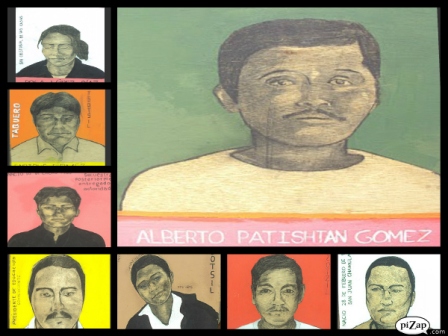
Chiapas Political Prisoners
By: Hermann Bellinghausen, Envoy
San Cristóbal de las Casas, Chiapas, July 4, 2013
It is the third time that Alberto Patishtán Gómez sees his prison companions leaving, after a long and painful struggle together for recuperating not only their freedom, but also their stolen dignity, the years lost for no reason or crime. It is the third time that he stays inside.
That occurred, because nine prisoners and adherents to the Sixth Declaration of the Lacandón Jungle were finally released this afternoon, after three days of waiting for the state government’s decision to be fulfilled. They spent several years constantly in peaceful struggle, a hunger strike, numerous afternoons of loneliness and desperation. They still had to wait for their freedom (rather a correction of the reigning justice system in Chiapas, a warning call). They had one foot in the stirrup since Tuesday, and nothing. Outside, under the rain or the sun, their mothers, wives and/or children waited two days for them, with uncontrollable incredulity.
Governor Manuel Velasco Coello arrived by land from Tuxtla Gutiérrez, at 6:15 PM, at the Los Llanos Prison, in San Cristóbal’s rural zone, to deliver the release papers to the indigenous, after entering a los booths and interviewing each one of them.
Afterwards, Professor Alberto Patishtán Gómez, who will remain in prison together with Alejandro Díaz Sántiz, went out to the prison gates and crossed over them a few meters to ‘‘deliver’’ those released to their families: ‘‘Here I deliver the compañeros; I still remain here, but one must not lose hope,’’ he said smiling and confident, before making a half turn and reentering the prison, accompanied by the governor and a swarm of officials and escorts.
The people that left state prison number five this Thursday are: Rosario Díaz Méndez, Pedro López Jiménez, Juan Collazo Jiménez, Juan Díaz López, Rosa López Díaz, Alfredo López Jiménez, Juan López González and Benjamín López Díaz. Once outside, Pedro López Jiménez said standing at the highway: ‘‘this victory is everyone’s, not just ours and not just yours,’’ directing himself to the indigenous families and solidarity sympathizers from civil society that were waiting for them. Some of them have accompanied the prisoners for many years.
‘‘We will continue struggling. We are not going to stop, much less are we going to abandon Compañero Alberto, who remains inside,’’ Pedro added at the foot of a big rock pie where banners and chants demanded: ‘‘political prisoners, freedom!’’ The people reunited, a few dozen, embraced and greeted with tears the eight men and Rosa, the only woman in the group released, who being pregnant during torture and the unjustified incarceration in 2007, lost a son, among other things.
Rosario Díaz Méndez, of the Voice of El Amate, said: ‘‘we will continue struggling until achieving the freedom of Compañero Alberto and all the compañeros that continue as prisoners.’’ He also leaves declaring his innocence. Eight years after the judicial ‘‘error’’ that sentenced him to 30 years for two grave crimes (that he did not commit), his wife did not stop hugging him; they are the oldest couple, the others are young.
The nine abandon the prison as the product of years of collective effort, in many countries, on many occasions, above all of those inside the prisons, where the Voice of El Amate and those in Solidarity with the Voice of El Amate became defenders of the rights of the prison population. In the case of Los Llanos, they transformed life inside the prison with their peaceful civil valor. If anyone is going to miss them, it’s the remaining prisoners.
A political event has resulted. A victory of the indigenous that, the majority at the mercy of official lawyers (public defenders?), demonstrated being right and displayed it (their release confirms it) to the police that arrested and also tortured them, to the District Attorney’s agents that jailed them knowing that they were innocent, to the judges that sentenced them, to the politicians that administered the sustained protest of these Tzotziles and Tzeltales from different places.
In the evening, the liberated indigenous headed for the San Cristóbal Cathedral, as they had promised, to visit the tomb of Samuel Ruiz García, their Tatic (father).
__________________________________
Originally Published in Spanish by La Jornada
Friday, July 5, 2013
En español: http://www.jornada.unam.mx/2013/07/05/politica/009n1pol
English translation by the Chiapas Support Committee for the:
International Zapatista Translation Service, a collaboration of the:
Chiapas Support Committee, California
Wellington Zapatista Support Group
UK Zapatista Solidarity Network
Join Us For A Concert with Francisco Herrera & Friends
ZAPATISTA CONCERT with FRANCISCO HERRERA y AMIGOS
POLITICAL MUSIC, plus FOOD, DRINK & ZAPATISTA CRAFTS for sale
SATURDAY, JULY 13, 2013 – 7:00 – 10:00 PM
RINCON, 3265 17th St. 2nd Floor, San Francisco (between Mission and Capp)
Requested Donation $10-$20
(All proceeds are for the Zapatistas and for scholarships for folks who are attending the EZLN’s “Little Schools.”)

Concert with Francisco Herrera & Friends
 Chiapas Support Committee