Chiapas Support Committee
Home of the Compañero Manuel blog on zapatistas & mexico
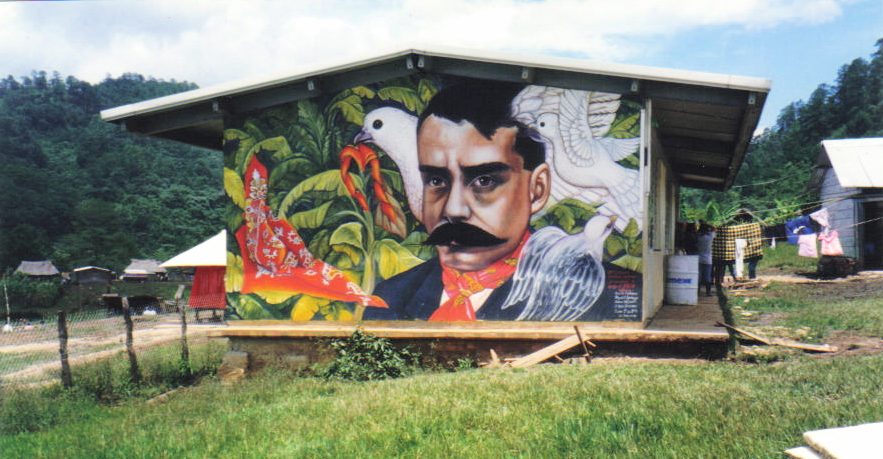
New paramilitary attack in San Manuel, La Garrucha
New paramilitary Attack in the Caracol of Resistance Toward a New Dawn, La Garrucha

Homage to Compañero Galeano the teacher and to Compañero Luis Villoro. Milicianos (Army reserves) in the forefront.
ZAPATISTA NATIONAL LIBERATION ARMY
MEXICO
June 25, 2015
To the National and International Sixth:
As we know, the bad governments are combining frauds with violence. Whether it’s one party or another isn’t important, the Ruler always seeks to keep himself above at the expense of those below. To him the denunciations aren’t worth anything, he becomes deaf, because he pays the media that sell out well so that they best talk nice about him.
Before it was Juan Sabines Guerrero, he that said he was of a very left party and even came to receive awards from progressive partisans, and the legitimate came to shout with a lot of pleasure: “Viva Juan Sabines!” That Juan Sabines Guerrero arranged everything so that it would remain a government of the “blonde category,” Manuel Velasco Coello, as both are from the same families that distributed, together with others, the [government] positions in Chiapas. Juan Sabines Guerrero stole, committed frauds and distributed violence.
Now Velasco does the same thing. Just a few days ago he made a big fraud for voting, violating the very same laws of those above, now he is preparing that the coming local elections will be with the blood of those below.
The governments of above are not content with just lying, they also want to repress, incarcerate and assassinate.
Now they are repressing the democratic teachers that are just saying that the mentioned education reform is a lie. That’s because it is the boss’ reform against the workers. It is not to improve education; it’s to make it worse. And those who make it don’t even know how the schools are, nor do they know how to teach. What the government doesn’t like is that the truth is told, because it lies. But as nothing from the government is believed, well then it represses.
Like they will be without shame that the one in charge of Education for the government is an alcoholic assassin that says one thing one day and another thing says the opposite. How is someone going to make an education reform that doesn’t even know how to talk? Emilio Chuayffet is called and is one of the assassins of Acteal; it is he that was throwing down his drinks to, already drunk, say foolishness. And he is the same now as he was before before.
Not only in Chiapas, but also in Oaxaca, Guerrero and in other states, the bad governments want put a lid on the truth with blows, gasses, shots and threats.
It is now seen clearly that if their “democratic” elections don’t have murders, beatings and incarcerations, well they don’t like it. And all the partisans fighting for their little bone, and they are not in agreement about who was killed, his name is Antonio Vivar Díaz and he was a teacher, nor about those beaten, or those incarcerated.

Antonio Vivar Díaz
The governments of above are sustained with deceit and repression.
But the blood of the teachers isn’t enough for Manuel Velasco in Chiapas. He also wants to drink indigenous blood of the communities.
Despite the fact that human rights organizations have already denounced it, Velasco continues to incite his paramilitaries so that they attack the Zapatistas support bases.
That’s what occurs in the municipio of Ocosingo, Chiapas, where three governments place themselves in agreement to provoke: Enrique Peña Nieto, Manuel Velasco and Octavio Albores. These governments are behind the paramilitaries from Pojkol.
It’s the same community where they already disavowed those paramilitaries, but they continue attacking. The same indigenous party members say that they don’t those paramilitaries, who receive their orders from the municipal president of Ocosingo and the state government in Tuxtla Gutiérrez. They receive their weapons, equipment, vehicles and the orders to attack support bases from there.
This just happened a few hours ago:
Caracol of Resistance Towards a New Dawn,
Path of the Future Good Government Junta
La Garrucha, Chiapas, México
June 24, 2015
Public Denunciation
To public opinion:
To the alternative, autonomous or whatever o you call them communications media:
To the national and international adherents to the Sixth:
To the honest human rights organisms:
Sisters and Brothers of the people of Mexico and the world:
We denounce once again what the paramilitary groups from the ejido Pojkol, Chiquinibal Barrio, Municipio de Chilón and the 21 persons from the same paramilitary group in Rosario, in the official municipio of Ocosingo, Chiapas are doing to us.
Facts:
Today, June 24, 2015 in the village of Rosario, San Manuel Autonomous Municipio [County], [1] where our EZLN support base compañeros live, 28 paramilitaries arrived from the Chiquinibal Barrio of the ejido Pojkol at 8:05 am this Wednesday. They were riding on 8 motorcycles and in a Nissan without license plates. Of the 28 paramilitaries, 8 of them were 22-caliber carrying firearms.
It’s the 21 paramilitaries that also live there in Rosario and the group of 28 paramilitaries from the ejido Pojkol in the Chiquinibal Barrio that are invading our recuperated land support them.
At 10:05 am a white RAM pickup without license plates arrives with two people aboard: an engineer and the rancher named Guadalupe Flores who lives in the city of Ocosingo Chiapas. He was owner of the land before 1994. The rancher and the engineer met with the 28 paramilitaries from Pojkol and the 21 paramilitaries [living in] Rosario. After that meeting they started to measure the land for constructing a temple and also measured sites for constructing houses, after that the rancher delivered some documents into the hands of the paramilitary group, supposedly the map of the recuperated part of the land.
At 1:26 pm they fired 10 shots behind the house of a support base [base de apoyo] compañero, intimidating the population.
At 1:27 pm, 8 paramilitaries from Pojkol entered into the house of a support base compañero but they didn’t find anyone there because the owner of the house had already withdrawn from his house to avoid clashes. 23 minutes later they arrived again at the house of another compañero. At 1:50 pm, they destroyed the house of a support base compañero, stealing all the belongings as well as the roof of the house that has 12 sheets of 3.5 metal, 2 hens, 4 pickaxe, 20 eggs, 2 hatchets, 2 solar cells, $2,000 pesos in cash, 2 hoes, a tape recorder, a 100-meter roll of water hose and 150 kilos of beans. They put all the support base compañero’s belongings into the alleged engineer’s pickup and that truck left in the direction of Pojkol, carrying all those stolen belongings to where the 28 people from Pojkol returned together.
Because of these acts we as authorities of the JBG [2] we see very clearly that those two persons pretending that one is an engineer and the other the ex owner of the ranch, are the advisors of those paramilitary groups.
We are also clear that the bad government is attacking us in many ways and forms. Various actions have happened and they are the same paramilitaries that have killed our breeding bull, where they destroyed houses, destroyed our collective store, stole our belongings, where they fumigated our pasture land with herbicides where San Manuel municipio’s cattle collective is located, where they shot off firearms and left letters on the ground that say: “Pojkol territory” and also spent shells in the month of August 2014.

A San Manuel cattle project.
They are the same paramilitaries that arrived on May 10 of this year 2015 where one of them with the name of Andrés shot at a little support base girl.
It is our third denunciation. There are also the first and the second denunciations, which detailed the facts that happened.
These groups of people, prepared and financed by the bad federal, state and municipal governments have been provoking us various times with their counterinsurgency strategy, the bad governments thinking that we are going to fall into their traps and spot our hands in blood with our indigenous brothers that are sick in the head because they are paid and have the dirty conscience that the capitalist system dirtied.
We say clearly that we will not remain with crossed arms when our support bases are attacked by any kind or means that the bad government uses against us. We have said clearly that we will defend our lands because we were born on it, we live on it and we will die on it, cost what it may.
Sisters and brothers, we will continue denouncing what happens. We hope that you are pending and to so much of what can happen with our compañero and compañera support bases [bases de apoyo].
We place responsibility directly on the federal, state and municipal governments for anything that can happen. They are also directly responsible because it’s not the first time that we have denounced what this group of people are doing.
Sincerely,
Authorities of the Good Government Junta in rotation
Jacinto Gómez Pérez Colosio Pérez Lorenzo
Nely Núñez Sánchez Alex López Álvarez
Well that’s how it is, compañeras and compañeros of the Sixth:
According to what we see, we’re not dealing with the fact that the bad government isn’t paying attention because it is busy with its lies and announcements, but that the very same government is giving those orders. If not, how do they explain that they already have the names of the criminals and they walk around with weapons in front of the authority and nobody even bothers them? It’s because they [the paramilitaries] are their employees. And the paramilitaries tell it clearly just that way: that nobody can do anything because the Velasco government protects them and pays them.
Well that’s what we have to report now, compañer@s. Everything is the same: lies, blows, scorn and exploitation come from above.
Organization must come from below, for life, not for a bloodbath. That is what the overseers, majordomos and bosses of the system in which we live want, their masters, neoliberal capitalism, have ordered them to do that.
From the mountains of the Mexican Southeast,
Subcomandante Insurgente Moisés
Mexico, June 2015
1. San Manuel Autonomous Municipio is the Zapatista munici
pio with which the Chiapas Support Committee had a partnership for a long time.
2. JBG – The initials in Spanish for Junta de Buen Gobierno (Good Government Junta).
——————————————————————
Originally Published in Spanish by Enlace Zapatista
Translation: Chiapas Support Committee
June 26, 2015
Words of Comandanta Miriam
Words of Comandanta Miriam
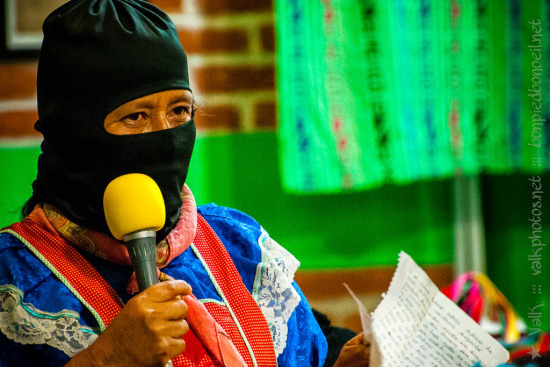
Comandanta Miriam speaks at the seminar on “Critical Thought versus the Capitalist Hydra.”
Good evening compañeros and compañeras.
I also have the chance to talk to you a bit about what the situation was for women prior to 1994.
Women suffered through a very sad situation since the arrival of the conquistadors. They stole our land and took our language, our culture. This is how the domination of caciquismo [local despotism] and landowners came into being alongside a triple exploitation, humiliation, discrimination, marginalization, mistreatment, and inequality.
The fucking bosses had us as if they were our owners; they sent us to do all the work on the haciendas, without caring if we had children, husbands, or if we were sick. They never asked if we were sick; if we didn’t make it to work, they sent their servant or slave to leave the corn in front of the kitchen so that we would make tortillas for them.
Much time passed like this, with us working in the bosses’ house. We ground the salt because the salt then was not the same as it is now, now it comes finely ground. The salt we used before came in large balls, and we women had to grind it. Women also ground the salt for the livestock, and shelled coffee when it was coffee harvest time. If we started at 6 in the morning, we finished at 5 in the evening. Women had to keep preparing the bags of coffee throughout the whole day.
This is how the women worked. Women were mistreated in their work, carrying water and all of that and paid miserably; they were only given a little handful of salt or a handful of ground coffee; that was the payment given to the women.
Years passed and women suffered like this. And when our babies cried and we nursed them, we were yelled at, made fun of, insulted physically; they said that we didn’t know anything, that we were useless, that we were a bother to them. They didn’t respect us and they used us as if we were objects.
They did whatever they wanted to a woman; they chose the pretty women or the pretty girls as their lovers, and left children all over the place; they didn’t care that the women suffered, they treated them like animals, with their children growing up without a father.
They sold us as if we were commodities during the acasillamiento [similar to serfdom]; there was never rest for us women.
Acasillamiento refers to when people would go to live on the haciendas or ranches with their families and stay there and work for the boss. The men were the ones who did the work of planting coffee, cleaning the coffee fields, harvesting the coffee, clearing the pastures, planting the grass, all this work, taking care of the corn and bean fields. The men did this work for the boss.
Apart from this, there is another thing I could tell you about the acasillamiento, which is about the mozos or slaves there, men and women who are always going to live on the hacienda. Those men or women that are slaves or mozos, who live at the hacienda, are men and women that sometimes don’t have family. For example, a family comes just to work on the hacienda, and sometimes the dad and mom get sick and die and the children are orphaned. The boss takes these children and raises them on the hacienda. And what do these children do? Its not like the bosses adopt them as an adoptive child, but rather as a slave. Those children grow and this is the work they are given: if the boss has a pet, or pets, such as a dog, a monkey, or some kind of animal, the boss has the mozo take care of it, care for the animal. Wherever the monkey goes, that’s where the child is; they have to take care of it, bathe it, clean where it sleeps. That’s how it works.
Priests would come to the large haciendas of the bosses and baptize their children, or for a birthday, or to perform a marriage ceremony for his daughters. Afterwards they would have parties and tell the mozos to guard the door. They would have the mozo watch the door while they were celebrating with their colleagues and friends. The mozo guards the door, he can’t let even a dog come into where they are partying, and he has to be there all day, for as long as the boss’s party keeps going.
And the women slaves were the ones who made the food, washed the dishes, and took care of the boss’s son, or the children of the boss’s friends.
That is how the people on the haciendas lived, and they didn’t get to eat what was eaten at the gatherings; they had to drink pozol if there was pozol, eat beans if there were beans. That was all they ate, meanwhile the boss ate the good stuff, but with his friends.
Later, when the boss wanted to go to the city, from his hacienda to a city that is, say, a 6-day walk, the mozo would go along. If the boss had children—sometimes the children are disabled—the mozo had to carry the boss’s child to the city. And if the boss’s wife came to the hacienda, the mozo goes again and carries the child back again.
And when they harvested coffee, in any harvest on the hacienda, the mozo had to be tending to the mules. I don’t know if you know about horses, but the mozo had to saddle and unsaddle the boss’s horse, herd the cattle, and take the loads to the city where the boss lives. If he lives in Comitán the mozo had to go all the way to Comitán. He had to leave the hacienda and go as the mule-driver. This is how many enslaved men and women suffered during that time.
If there are fruit tree orchards inside the hacienda and one of them climbed up to pick some fruit, the bosses wouldn’t let them. They got them down by whipping them, I don’t know if you know how the lash works; they would hit them with it. They can’t pick fruit without the boss’s permission because the entire harvest was to be taken to the city. This is how the men and women suffered.
After so much suffering by women and the exploitation during the acasillamiento, the men started realizing how their women were being mistreated. Some thought it better to leave the hacienda. One by one they started leaving and taking refuge in the mountains because the plantation owners did not claim these high lands. So they took refuge there. They thought it better to leave so that the women would not continue to suffer on the hacienda.
After awhile in the mountains—and many spent a long time there—they realized that it was better to join together and form a community, and that’s how they came to live that way. They got together, talked, and formed a community where they could live. That is how they formed the community.
But again, once they were living in the communities, those ideas that came from the boss or the acasillado were brought in. It’s as if the men drug these bad ideas along with them and applied them inside the house. They acted like the little boss of the house. It’s not true that the women were liberated then, because the men became the little bosses of the house.
And once again the women stayed at home as if it was a jail. Women didn’t go out; they were shut in their houses once again.
When girls are born, we are not welcomed into the world because we are women; when a little girl was born, it is as if we were not loved. But if a boy was born, the men celebrated and were content because they are men. They brought this bad custom from the bosses. That’s how it was for a long time. When girls were born they acted as if women were useless, and if a boy was born, as if they could do all of the work.
But one good thing they did was that they did not lose the memory of how to form a community; they began to name community representatives and hold meetings and gatherings together. It was good that this idea was not lost, it wasn’t taken away and it came to life again. The bosses and the conquest wanted to make this culture disappear, but the bosses were wrong, because the people could still form their community.
Another thing is that the man gives the orders in the house and the women obey what he says. And if he tells you that you’re going to get married, you have get married. He’s not going to ask you if you want to get married to the man who came to ask for your hand; your father already accepted the liquor they offered, he drank it already and this obligates you to go with this man that you do not love.
This is how we came to suffer once again with our husbands because they told us that women are only useful in the kitchen, or to take care of their husbands, or to take care of the children. The men didn’t hold their children; they didn’t support the women. They only gave you the child, and then who cares how the child is raised. And—I’m going to talk about how it really was for years—we women often say that a baby was born every year, every year and a half, growing up like a little staircase, every year or year and a half there is another one. But the father didn’t care if his wife was suffering because she had to carry firewood, plant the cornfield, clean the house, sweep, take care of the animals, wash the clothes, take care of the children, change the diapers, and all of that. All of that was women’s work.
This is why we say that we suffered triple exploitation as women. Women had to be awake and in the kitchen at 3 or 4 in the morning, depending on how much time the men needed to get to their fields. The women had to get up early to make pozol, coffee, and breakfast for the men. The men go to work, and when they come back in the afternoon they want the water for their bath to have been carried up to the house already and be ready for them to bathe. The men bathe and then leave the house to walk around, to play, and the women are once again stuck at home the whole day, until the night—around this time right now—the women are still awake; they don’t go to sleep until 8.
So we were really suffering. The men didn’t care if you were sick, or how you felt, they didn’t ask—that’s just how it was. That is how women really lived; we’re not lying because that is how we lived.
When you would go to church or a ceremonial center for a festival, and women did go sometimes, you had to lower your head. You couldn’t raise your head; you had to walk with your head bowed, without turning to the sides, and covering your head with the rebozo [shawl] like this, so that just your face shows.
A lot of time went by like this, during which men dragged along these bad ideas, this bad learning. That is how it happened, compañeros. As if we were nothing. As if only the men could be authorities, only the men could go into the street and participate.
There was no school. Later on in some communities there was school, but we didn’t go because we were women; they didn’t let us go to school because if we went they’d say that we only went to school to find a husband. And that it was better to learn to work in the kitchen because if we were indeed going to have a husband, we needed to learn how to take care of him.
And when our husband hit us, when he insulted us, we couldn’t complain. If we asked for help from the other institutions of the bad government they were much worse because they defended the men, and said the men are right; and so we remained silent, humiliated, and embarrassed at being women.
We didn’t have the right to come to meetings to participate, and they said that we were stupid, useless, and that we weren’t worth anything. They left us at home. We did not have freedom.
There was no health care. Even where there were clinics and hospitals that belonged to the bad government, they wouldn’t see us because we didn’t know how to speak Spanish. And sometimes we had to return to our homes, and many women and children died of curable diseases; we weren’t worth anything to them, and they discriminated against us because we were indigenous. They said that we were just dirty barefoot Indians, and we couldn’t enter the clinics or hospitals. They wouldn’t let us; they only took care of people with money.
All this we suffered in our own flesh. We never had the opportunity to say what we felt for many years because of the teachings of the conquistadores and the bad governments.
That is all, compañeros. Another compa will continue.
Ayotzinapa: key pieces of the official version fall apart

Relatives of the 43 students at the 27th Infantry Battalion in Iguala, Guerrero. Photo by: Germán Canseco.
A Special Report By: Anabel Hernández and Steve Fisher
A key piece in the version that the PGR has published after the disappearance of 43 Ayotzinapa students is that the students were detained and taken to the base of the Iguala Municipal Police before being delivered to the United Warriors cartel. But the judge that would have received them assures that was not the case. In this sixth delivery of the reporting carried out with the support of the Investigative Journalism Program of the University of California at Berkeley, documents and testimonies strengthen the version of the judge, who currently is asking for asylum in the United States and fears for his life.
MEXICO, D.F. (Proceso). – Ulises Bernabé García was a booking judge for the Iguala Municipal Police in Guerrero on the night of September 26, 2014, when the enforced disappearance of 43 students from the Ayotzinapa Rural Teachers College was perpetrated. In an exclusive interview he reveals what happened that night.
In this sixth delivery of the investigation carried out with the support of the Investigative Journalism Program of the University of California at Berkeley, García asserts in an interview –from a Mexican border city and crossing point to the United States– that the students were never taken to that base [headquarters] and that the Cocula municipal police did not arrive either, as the official version asserts.
His testimony and the documents obtained for this investigation reveal that the worst part of the attacks against the students occurred when the Attorney General of the State of Guerrero, the 27th Infantry Battalion and the Federal Police were operating in the streets of Iguala.
One of the principal parts of the official version is that, at 11:30 that night, Iguala police took the students from Juan Alvarez Street –where one of the aggressions against the students occurred– to the municipal police base. In one version, the PGR asserts that there were 43 and, in another, only 10 or 15. From there, in two patrol vehicles of the Cocula Municipal Police they were taken to the Loma de los Coyotes spot, where they handed them over to the United Warriors criminal group, who allegedly murdered them and burned them in a garbage dump at midnight of that same day.
In contrast, García asserts that, at the time that the Attorney General of the Republic (PGR) says that the students were taken to the municipal police base, a military man known as “Captain Crespo,” of the 27th Infantry Battalion of Iguala, in command of a group of 12 armed soldiers in uniform made an exact inspection in all of the (police) command for more than 15 minutes. A little later, García points out, the assistant attorney general of Guerrero, Víctor León Maldonado arrived at the same site and took control of the base for the rest of the night and until 8 o’clock in the morning of the next day.
(Fragment of the report that is published in the 2015 edition of the magazine Proceso, now in circulation.) A complete version in English can be found at: http://www.huffingtonpost.com/2015/06/14/disappeared-students mexico_n_7574652.html
Note: Representatives of the Ayotzinapa parents and students made note of this new information in their meeting with adherents to the Sixth in Northern Chiapas. And, an official of the Guerrero human rights office confirmed the above account of Ulises García to La Jornada Guerrero.
————————————————————-
Originally Published in Spanish by Proceso.com
Saturday, June 13, 2015
http://www.proceso.com.mx/?p=407453
Looking sideways at capitalism
LOOKING SIDEWAYS AT CAPITALISM
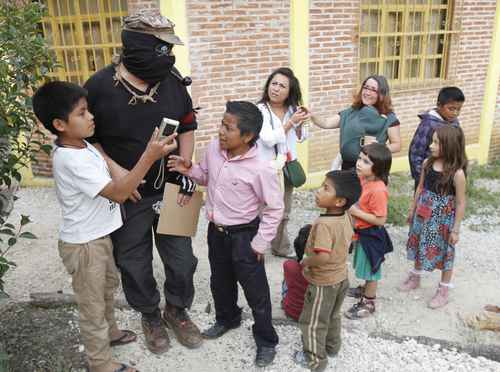
SupGaleano with children
The Zapatista National Liberation Army (EZLN) sponsored the Seminar on “Critical thought versus the capitalist hydra” from May 3 to May 9, 2015. A star-studded cast of left intellectuals participated either in person or by sending papers to be read by others. Subcomandante Insurgente Moisés and Subcomandante Insurgente Galeano (formerly Marcos) issued their words, as did Comandantas Miriam, Rosalinda and Dalia. Compañeras Lizbeth and Selena also gave their word. More than 1500 people registered to attend the Seminar. A complete list of presenters can be found here:
Before the start of the Seminar in the Caracol of Oventik, the EZLN paid homage to Compañero Galeano, the teacher, and also to Compañero Luis Villoro.
Prior to the start of this anticapitalist gathering, SupGaleano issued an important communiqué called, in English, “The Storm, the Sentinel and the Lookout Syndrome,” [1] which puts the purpose of the Seminar in perspective, or better said, it puts the purpose of the Seminar into a Zapatista perspective.
The Storm
“We, the Zapatistas, see and hear a catastrophe coming, and we mean that in every sense of the term, a perfect storm.” However, he also says that others don’t see it coming, they don’t see what the Zapatistas see. He elaborates: “We see the tendency to resort to the same tactics of struggle, to continue with marches, real or virtual, with elections, surveys and rallies.” As if nothing has changed in the last 20, 40 or 100 years! We think they have the Lookout Syndrome.
If you do the same thing over and over and it doesn’t work, maybe you should try something different!
“We Zapatistas look sideways. We pay more attention, climb to the top of the ceiba (tree) in order to try to see farther, not to see what has happened, but to see what’s coming.” And what they see is “something terrible, more destructive than ever.” But, Galeano admits, they can be mistaken. So, they want to hear what people from other geographies are thinking, what the compañeros, compañeras and compañeroas of the Sixth are thinking. That’s why they called for the Seminar, to share ideas.

Ceiba tree with house for looking sideways at capitalism
The Sentinel
Every military installation has lookout towers, guard posts, watch posts, or whatever you may call them, a place where members assigned to that military installation take turns (shifts) at guard duty. Their role is that of the Sentinel: to survey the surrounding area to know who or what is out there; and to sound the alarm in case of an attack or other event. The EZLN is no different; its military members call the guard post the “posta” and take turns carrying out the role of the Sentinel, or lookout. But the important thing is that the Sentinel must be vigilant for signs of danger. If something big and destructive is coming, then the Sentinel must alert everyone to the imminence of the coming storm.
Galeano says that, according to the Zapatistas, theoretical reflection and critical thought have the same task as the Sentinel. “Whoever works on analytic thinking takes a shift at the guard post.” The problem is that the Sentinel, or lookout, can become overwhelmed, overtaken by the task of critical observation and can develop the Lookout Syndrome.
The Lookout Syndrome
After a while the Sentinel “exhausts” his capacity for vigilance. This is what the Zapatistas refer to as the Lookout Syndrome. It consists of: “a) not keeping watch over the whole, but only one part of the whole, and b) when the lookout ‘tires,’ he does not perceive the changes that appear in the zone being watched because those changes are imperceptible to him; that is, they don’t merit his attention.” Because being on lookout duty reproduces the same images over and over again as if nothing ever changes until the lookout doesn’t want anything to change and repeats that: ‘everything is fine and nothing bad is going to happen.’
One way of counteracting the Lookout Syndrome is indirect observation or peripheral vision, also known as “looking sideways.” So, the Zapatistas are inviting people to the Seminar to look sideways with them at what is coming.
Looking sideways at voting
With mid-term elections taking place in Mexico during June 2014, let’s see what thoughts looking sideways at elections produced.
The Zapatistas have not been into voting for a long time. It makes sense for them because they have declared war against the Mexican government and have their own local and regional government. But what should everyone else do? Subcomandante Moisés says you can go ahead and vote, but don’t expect anything to change. We assume he means change for the better. And, indeed, if citizens are looking for fundamental progressive change in Mexico by means of the ballot box, they may have a very long wait! But, Moisés points out that whether you vote or not, you must definitely organize. If you want positive change you have to organize!
On the other hand, what if you live in the United States? We have a presidential election in 2016 and candidates are already announcing their candidacy, starting to raise money and taking positions on issues.
Immanuel Wallerstein, a United States sociologist and left thinker, submitted a paper that addressed, among other issues, voting in different electoral systems. He seems to agree in principle with SupMoisés about not relying on elections for any fundamental progressive change. However, in countries where people have won certain benefits from the government, like social security in the U.S. or universal health care in Canada and Europe, perhaps it’s worth voting to hold onto those benefits. Remember when George W. Bush tried to privatize (take away) social security? If one party is proposing to cut social benefits, Wallerstein suggests that it’s definitely worth voting for the party that doesn’t want to take them away (this assumes there is such a party). Hmm…
Looking sideways at the Storm
SupGaleano did not say in “The Storm, the Sentinel and the Lookout Syndrome” what kind of storm the Zapatistas see coming. Is the storm coming to Chiapas, to Mexico, or to the entire world? Will it come from war, climate change, drug-resistant diseases, one or more natural disasters or the depletion of our natural resources? We thought that perhaps the branches of the ceiba tree obstructed their vision.
And then, the “words” SupGaleano spoke on May 4 were posted on the EZLN’s website in Spanish. (As this is written, those words have not yet been translated into English.) His words give us some answers to those questions. In Spanish the comunicado is entitled “El Método, la bibliografía y un Drone en las profundidades de las montañas del Sureste Mexicano.” [2] It translates as: “Method, bibliography and a Drone in the depths of the mountains of the Mexican Southeast.”
SupGaleano says that the storm is a profound economic crisis, but not only economic. It stems from the complete domination of the world by international banking, but also from the loss of legitimacy of “traditional” institutions (parties, government, judicial system, church, army, police, communications media, family). Additional factors contributing to the crisis are the corruption of the political class and destruction of the environment. The latter is due to privatizing or “the transformation of everything, even fundamental needs -water, air, light and shade, land and sky-, into merchandise.”
SupGaleano goes on to sum up this profound crisis, this perfect storm as follows:
“We are facing a reality that is synthesized today in one word: Ayotzinapa. For we Zapatistas, Ayotzinapa is not the exception, but rather the current rule. It is the family portrait of the system on the global level.
It has been said that organized crime or drug trafficking has permeated politics. It has been the reverse: the uses and customs of a corrupt political class (like the Mexican political class), […] were transported to organized crime.”
And the antidote for this profound crisis: ORGANIZE! Prepare yourselves! The dominant message of the EZLN’s Seminar is to organize. While Galeano uses examples from Mexico, he applies the control of international banking, privatization of our shared environment, corruption of the political classes and the loss of legitimacy of traditional institutions globally.
—————————————-
Mary Ann Tenuto-Sánchez
June 18, 2015
NOTES:
Wallerstein: Elections can minimize the damage from the right
Elections can minimize the damage that the right inflicts, Immanuel Wallerstein says

People burned ballots in Tixtla, Guerrero (above) and in other states prior to Mexico’s midterm elections last Sunday, June 7. The PRI benefitted from the decline of the PRD.
By: Elio Henríquez
San Cristóbal de las Casas
The United States sociologist and historian, Immanuel Wallerstein, asserted that one must “use electoral tactics defensively” and although “it’s clear that victories” in the elections “don’t transform the world, it’s also true that they must not be underrated because they can be an essential mechanism for protecting the immediate needs of populations all over the world against the loss of benefits already acquired.”
Those “electoral battles,” he said, “must be developed within the logic of minimizing the damage that the global right is still able to inflict by means of control of the governments of the whole planet.”
In a position paper that he sent in writing to the seminar titled Critical thought versus the capitalist hydra, organized by the Zapatista National Liberation Army (EZLN), which was held in this city, he maintained that “we must not underrate this kind of battle because we all live and survive in the present and no movement can tell people that survival isn’t relevant in the short term.”
He clarified that it implies that “those electoral tactics be assumed exclusively as a pragmatic matter,” because “none of us ought to think that winning State power is a way of really transforming the world; but the decision about which is the lesser of the evils, must be analyzed case by case and moment by moment.”
In his paper titled “The anti-systemic movements and the future of capitalism,” read and translated by the social scientist Carlos Antonio Aguirre Rojas, investigator from the Autonomous National University of Mexico (UNAM), he said that: “this decision depends in large part on the electoral system with which we’re dealing. A system in which the winner takes it all must be confronted differently than a system in which two rounds (runoffs) exist or a system of proportional representation.”
Besides that, he added, “there are many different partisan or sub-partisan traditions inside the global left and although the majority of traditions are relics from a previous era, many people still continue voting according to these traditions.”
He emphasized: “Then, if state elections are only a pragmatic issue it is crucial to create alliances that respect these traditions seeking the 51 percent that, pragmatically speaking, counts a lot. But it’s very clear that we won’t ever jump for joy in the streets when we attain winning in these state elections, because the electoral victory nothing more than a simple defensive tactic.”
Considered one of the most important U.S. intellectuals on the left, Wallerstein recognized that individuals and movements exist that think that the electoral processes “are crucial,” but another part “considers that they are totally irrelevant.”
After asserting that one must “incessantly pressure towards greater democratization,” he stated that: “at least during the last two centuries, what movements on the left and the people have demanded most loudly from the States can be summed up in the word ‘more,’ in other words, more education, more health care, more income that guaranties a certain standard of living, and these demands not only are popular but also immediately useful in the everyday life of the majority of the people.”
He exposed that: “the conquest of ‘more’ also reduces the possibilities of the incessant accumulation of capital, because of which “these demands must be continuously maintained, because here the point of ‘too much’ will never be reached.”
The United States analyst asserted that: “although it’s clear that expanding all these functions of the ‘Welfare’ State will always pose questions about the efficiency in expenses, corruption or the creation of omnipotent or irresponsible bureaucracies, questions that we must resolve, that should not impede us from continuing with those basic demands for more, much more”.
In this sense, he emphasized, “it’s crucial that the popular movements facing governments of the center, center left, sometimes called progressive that they have participated in electing, not excuse them from the satisfaction of these demands for more health care, more education, more income, because the fact that they’re dealing with a friendly government and not with a government openly of the right, does not mean that we should lower our arms and stop fighting forever.”
Very much to the contrary, he continued, since by “pressuring those friendly governments we oblige opposition forces on the right to look towards a position on the center left, while if we don’t pressure them we push those governments of the center left towards positions on the center right.”
He emphasized that: “if it’s very clear that they could come to present certain special circumstances in which we would have to ignore these affirmations, the general rules with respect to democratization are clearly those of always looking for more, for much more.”
At 84 years of age, Wallerstein also said that: “the anti-systemic movements now are found in the midst of a ferocious fight around what our future can be,” because the world capitalist system is in the “structural crisis” phase.
In his opinion, “a real parting of waters exists in the programs of the left parties and social movements of the whole world in the period that encompasses from the 1960s of the last century until today.”
In the 1960s, he indicated, the programs of the movements of the old left placed their emphasis on the change of the economic structures and up to a certain point on the socialization or nationalization of the means of production, but they said very little and at times nothing in regard to the inequalities that didn’t have a class foundation.
“On the other hand today, almost all those parties and movements or their respective heirs put forth proposals that refer to gender, race and ethnic inequalities. Many of those programs are terribly inadequate, but at least those movements now feel that it’s necessary to say something with respect to these inequalities.”
He stated that on the other hand, “virtually no party or movement exists today that considers itself as being on the left and that continues defending the socialization or the nationalization of the means of production and a large number of them are proposing to move towards other horizons. And this is a healthy turn that some salute and others reject but that the majority accepts.”
He considered that: “that from 1968 until today an enormous quantity of attempts have been accumulating to create alternative strategies proposed by different movements, old and new, which has also created a healthy change in the relationships that between them guard that group of different anti-systemic movements in the sense that the mutual denunciations and the vicious struggles of the past have been considerably abated, which is a positive development that I believe we have underestimated.”
————————————————————————-
Originally Published in Spanish by La Jornada
Translation: Chiapas Support Committee
Saturday, May 9, 2015
En español: http://www.jornada.unam.mx/2015/05/09/politica/013n1pol
Zibechi: Extractivism staggers
EXTRACTIVISM STAGGERS

Conflicts over Tia Maria Mine have left 4 people dead in Peru.
By: Raúl Zibechi
Resistance to extractivism [1] is sweeping the Latin American continent, from north to south, from the Atlantic to the Pacific, involving all the countries, forcing governments to put its military in the streets and decree states of emergency to terrorize populations that no longer yield, because they are suffering the consequences of the model.
Open sky mega-mining, large public works like hydroelectric dams, mono-crops fumigated with glyphosate and real estate speculation are being responded to as never before in intensity, extension and duration. The peoples are obtaining pueblos important victories in recent years: paralyzing the planting of Monsanto seeds in Malvinas Argentina; stopping the Barrick Gold, Pascua Lama bi-national project; postponing the construction of dozens of dams, as happened with La Parota, in México.
In recent weeks it has been the population of Arequipa, in southern Peru that is forcing the government of Ollanta Humala to decree a new state of emergency, after a fourth victim died because of police repression within the framework of an indefinite strike that has now lasted more than 60 days against the Tia María copper project of the Southern Copper company.
It is probable that Peru is the epicenter of the resistances to mining, with an average of 200 socio-environmental conflicts since 2008. In Brazil not only is there resistance to mining but also to large hydroelectric projects like Belo Monte, besides multiple resistances to real estate speculation (urban extractivism), which advances feverishly in Río de Janeiro facing the 2016 Olympics.
The Argentine pampa is the epicenter of resistance to the soy model, where the Mothers of Ituzaingo, the Argentine Malvinas Assembly, Stop Fumigating Us campaign and committed doctors stand out, who from June 15 to 18 organize the Week of Teaching Training for Dignified Science and Socio-Environmental Health in Rosario.
Until now no unified or centralized resistance exists, not on a regional scale or in each of the countries, but the multiplicity of struggles is coordinated in the streets, without the need for a unified apparatus. As the latest report of the Latin American Observatory of Mining Conflicts (OCMAL) [2] points out, “all this effort for maintaining mining extractivism is more widely criticized every day and delegitimized by broad sectors of society, and mining does not achieve convincing the population of its advantages” (OCMAL, April 2015, p. 101).
A certain similarity exists between current resistance to the extractive model and worker resistance to Fordism in the 1960s. Factory workers succeeded in disarticulating production based on direct resistance in every section and every shop, and based on direct action without depending on union bureaucracies, until the discipline and division of labor were defeated. It seems necessary to insist that it was a non- institutional struggle, not even openly declared, but so effective that it bent capital within its own territories, the factories, forcing a complete restructuring of the productive apparatus.
Something that we can learn from that wave of workers struggles is that to overthrow a model of domination what is central is what happens on the ground where that model is applied, the governments and the state administrations being completely unimportant. The struggle and direct resistance cannot be substituted, as the chronicles compiled in the infinity of works and stories teach.
On this point it’s necessary to emphasize that there is not a moment of defeat or “final struggle,” as the stanza of The International (La Internacional) says, because what’s decisive is the long process of direct actions that achieve engaging the mechanism of domination. From the time Fordism [3] and Taylorism [4] were implemented until they were overthrown and neutralized, more than half a century had transpired; two or three generations of workers were necessary to find the weak points of the employers’ gear.
What is happening against extractivism must be the source of multiple lessons; with an eye placed on the history of resistances and another on the present, we are able to draw some conclusions.
The first is that the indigenous peoples, blacks and mestizos champion the resistance in the areas where the mining companies, the mono-crops and the infrastructure mega-projects are deployed. We’re talking about a broad and heterogeneous framework of campesinos, rural workers and inhabitants of towns, where the role of women and their families is emphasized. It is a face-to-face struggle against corporations and governments, almost always without support from the institutions, which only make themselves present when the larger part of the population occupies the streets.
The second is the importance of the defense of water, the principal common good affected by extractivism. In some countries, like in Uruguay, the urban population started to react against the model al verifying the deterioration of the water quality that it consumes. In that way they were able to articulate alliances in effect between rural and urban, among grass roots collectives unions, between workers and scientists.
The third is the variety of forms of struggle that, at any moment, gain in massiveness provoking social explosions that are not spontaneous but rather the fruit of a prolonged labor of distribution and organization. Something of that happens these days in Arequipa, when the better part of the population of the villages and towns, first, and of the big city, later, forms an opinion against mining.
The fourth is the importance of small local and territorial groups, made up of members and neighbors, generally young. These kinds of groups are decisive because on their part the initial information that enables debate among broader sectors of the affected population.
Extractivism is still far from being demolished. But we already see that it staggers.
__________________________________________
Notes:
- Extractivism is the English translation of extractivismo, which Zibechi uses for describing capital’s “accumulation by dispossession.” In Mexico, the word most used to describe “accumulation by dispossession” is despojo. Urban extractivism is, at least in part, what we call “gentrification” in the U.S.
- Observatorio de Conflictos Mineros de América Latina
- Fordism – A technological system that depends on mass assembly-line production.
- Taylorism – A factory management system developed in the late 19th Century to increase efficiency by evaluating every step in the manufacturing process and breaking down production into specialized repetitive tasks.
————————————————————
Originally Published in Spanish by La Jornada
Translation: Chiapas Support Committee
Friday, May 29, 2015
En español: http://www.jornada.unam.mx/2015/05/29/opinion/017a2pol
EZLN: Words from the homage and seminar
An Outline of the EZLN’s Word from the Homage and the Seminar

The EZLN’s seminar on Critical Thought versus the Capitalist Hydra and the Homage to Luis Villoro and teacher Galeano generated a high volume of comunicados and “words,” as well as articles in the print media. All are, of course, in Spanish and all have now been translated into English. The comunicados and words are published on the EZLN’s Enlace Zapatista website under the themes below. If you do not read Spanish look for the dates (3 may, 4 may, etcetera); the English option is there for most. If there is no English option on the front page, click on the words after the date and when the document opens, an English option should appear.
I. Comunicados (Issued on May 2, 2015 at the Homage)
- Words of Subcomandante Moisés
- Zapatista Teacher Galeano: Notes on a Life – SupGaleano
- Compañero Luis (words of SupMarcos prior to his “death
II. Our View of the Hydra (May 3, 2015 at the Seminar)
- The Crack in the Wall: First Note on Zapatista Method (SupGaleano)
- ON THE ELECTIONS: Organize! (Sup Moisés)
III. Our View Towards the Inside
A. Political Economy from the Communities (SupMoisés)
- Political Economy from the Zapatista Communities I (May 4, 2015)
- Political Economy from the Zapatista Communities II (May 5, 2015)
B. The Struggle as the Women that We Are
- Comandanta Miriam (May 6, 2015)
- Comandanta Rosalinda (May 6, 2015)
- Comandanta Dalia (May 6, 2015)
- Compañera support base Lizbeth (May 6, 2015)
- Compañera listen Selena (May 6, 2015)
IV. Resistance and Rebellion (All by SupMoisés)
- Resistance and Rebellion I (May 6, 2015)
- Resistance and Rebellion II (May 7, 2015)
- Resistance and Rebellion III (May 8, 2015)
Zibechi: Crisis and collapse
CRISIS AND COLLAPSE: NEW CHALLENGE
By: Raúl Zibechi
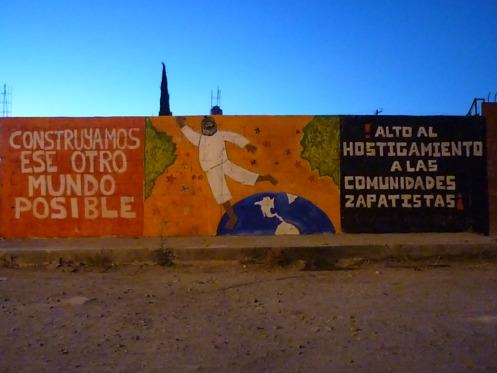
Solidarity with Zapatista Communities
One of the difficulties that the anti-systemic movements and those who continue pledged to constructing a new world confront consists of not attaining agreement on the definition of what is happening before our eyes. In broad strokes, two not necessarily opposed but very different views coexist: those who maintain that we are facing a crisis, greater even than the cyclical crises of capitalist economies, and those that tend to consider that humanity is being led to a situation of collapse by the system.
Understanding that we’re dealing with a theoretical debate with strong practical implications, since we would be facing two very different situations. It’s worth remembering that in other periods of recent history, the rise of Nazism for example, provoked deep divergences between the lefts of the epoch. Not a few failed to consider the importance of Nazism as a real systemic mutation, and thought that it was about an authoritarian regime similar to others that we had known. Nevertheless, with the passage of time we are able to agree with Giorgio Agamben that the field of concentration modified politics at the root, together with what he defined as a permanent state of emergency.
The seminar-seedbed “Critical thought versus the capitalist hydra,” organized by the EZLN from May 3 to 9 in Oventik and San Cristóbal de Las Casas, was the scene of the diverse views that cross through us, and their extraordinary wealth and fecundity. Many diverse analyses about the current world coexist within the anticapitalist field, some well founded, others more romantic, some focused on the economy and others on ethics, and many others are combinations of these and other forms of gazing and comprehending. I think that all of them have their importance, but they lead along partially different paths. Or, better, they can contribute to squandering forces.
What’s more complex is that no one can claim to have truth in his or her hands. This point seems to me extraordinarily complex, because it doesn’t permit discarding any proposal, but neither can it lead us to giving validity to any argument.
It seems to me necessary to distinguish between crisis and collapse, not because they are exclusive, but rather because they embody two distinct analyses. The concept of crisis is associated, in the anti-systemic field, with the periodic crises through which the capitalist economy crosses. On this point, the work of Karl Marx is an obligatory reference for anti-capitalists of all colors. His analysis of the crisis of over-accumulation has been converted, with complete justice, into the crucial point for comprehending how the system functions. From there derives a group of strictly present considerations.
Although some economic currents have coined the idea of the “collapse” of capitalism because of its own internal contradictions, and fail to consider the importance of collective subjects in its fall, it is evident that Marx is not responsible for this drift that he knew to have firm followers in the first part of the 20th Century.
In the same direction as Marx, Immanuel Wallerstein mentions the existence of a systemic crisis underway, which, after several decades of development, will give way to a different world than the current one (since at a certain moment it will produce a bifurcation), which can lead us to a better or worse society than the present one. We would be facing a window of temporary opportunities, during which human activity can have a large confluence in the final result. In this analysis, the crisis will be converted into chaos, from which will come a new order.
The idea of crisis is associated with periods of change, disorder, instabilities and turbulences that interrupt the normal development of things, and that after a certain time become a new but modified normality. Factors of order can emerge in the crisis that will give the new order a different physiognomy. From the movements’ point of view, it is important to discard two things: that the concept of crisis is associated too much with the economy and that it appears linked to transformation and changes.
If I understood correctly, following the words del Subcomandante Insurgente Moisés, who said at the closing of the seminar-seedbed that: “we don’t know whether we’ll have time to multiply this,” what lies in wait is not a crisis, but rather something more serious.
He insisted: “time is not waiting for us,” and said that walking is no longer sufficient, but rather it’s time to trot, to go faster. The previous night, before Subcomandante Insurgente Galeano said that up to 40 percent of humanity would be migrants and that there will be depopulation and destruction of zones in order to be restructured and reconstructed for capital. I believe that he wasn’t thinking about a crisis, but rather about something that we could call collapse, although he didn’t use that term.
Collapse is a large-scale catastrophe that implies the bankruptcy of institutions, in the form of rupture or definitive decline. There were many crises in history but few catastrophes/collapses. For example it occurs to me what happened with the Tawantinsuyu, the Inca Empire, because of the arrival of the invaders. Something similar can have happened to the Roman Empire, although I don’t have sufficient knowledge to assure it. Anyhow, the collapse is the end of something, but not the end of life, because, as happened with the Indian peoples, they rebuilt after the catastrophe, but as different subjects.
If in truth we face the perspective of a collapse, it would be the sum of wars, economic, environmental, health and natural crises. Just one fact: the World Health Organization warned that in the immediate future antibiotics will be incapable of combating the super-bacteria causing tuberculosis and pneumonia, among others. In sum, the world as we know it can disappear. If this is the immediate perspective, and those above know it and prepare for it, the Moisés’ haste is fully justified. It is time to accelerate our step.
———————————————————–
Originally Published in Spanish by La Jornada
Translation: Chiapas Support Committee
Friday, May 15, 2015
En español: http://www.jornada.unam.mx/2015/05/15/opinion/019a2pol
Gustavo Esteva: Seedbed
SEEDBED
By: Gustavo Esteva

A mural in La Realidad depicting Compañero Galeano (left) and Subcomandante Pedro (right).
The seminar on “Critical Thought versus the Capitalist Hydra” came to an end. In the closing plenary ceremony, this Saturday, we received the news: they were repressing the compañeros in San Quintín. What we had been analyzing was confirmed in the most unfortunate way. As Subcomandante Moisés emphasized, that announced that at best we no longer had the time that we thought we had; that the storm intensifies and attacks us and that sorrows join us together. We still haven’t healed from Ayotzinapa, and we continue waiting for our 43, and that arrives. And that it demands, if we learned anything at the seedbed (seminar), an immediate reaction from us for finding how to warn each other, how to take care of each other and how to weave our stories.
I believe that no one feared the pen or the word when he dealt with characterizing horror. We were charged with emotion, but also with analytical and historic rigor. We were able to show many heads of the hydra and also the form in which to cut off the ones that multiply. It was clear to us that, despite such brilliant, multiple and solid analyses, we still lack a lot: we just started. But at least it was possible to tend the theoretical and practical soil on which one can plant the seeds of knowing that we learned and to cultivate it, each in their own way, in the nurseries in each place that it may be possible.
The immediate task was clear. Upon returning home, without irresponsible haste, but with a sense of urgency, we must multiply the seedbeds. Those who have collectives, assemblies, spaces of reflection, autonomous forms of thinking and acting, we must share in them how much we learned, be it for venturing into new paths that are opened or for touring once again, with renewed eyes, what we have traveled a thousand times. Those who lack those spaces need to create them, although it may be with two friends or close friends.
One of the seedbed’s most important things was to find exact agreement on the gravity of the moment. From the most diverse positions, on a broad spectrum in which important differences became evident, recognized the immense dangers that weigh on us, an us that now is entirely general: no one escapes.
And yes, it was fascinating. But the truth is that we arrived at the gathering restless. What to do before such an overpowering circumstance, so immediately catastrophic, a condition that leaves no room for optimism and barely for hope. We asked each other the old question again, because we know that the old answers no longer function, but still weigh: imagination is paralyzed when one radically abandons them.
We did not get an answer. We heard many. That is the nature of the resistances and rebellions of today. They do not consist solely in opposing something, for resisting the aggression of any of the heads of the hydra. It was clear to many of us that participated in the seedbed that the only effective way to act is to multiply the no, the radical rejections to how much they attack and repress us, and in that same operation multiply the yeses, the different ways of constructing the new world. I believe that many of us also learned a central lesson: not to cling tightly to a position about what can be better.
Again and again, in the words repeated by Subcomandante Moisés, the Zapatistas took away from us the urge and capacity to idealize them and they also made us see that we should not imitate them. It was necessary to practice that almost surgical operation. The emotion of being in Zapatista territory, the impression that the Escuelita left in many participants, the 30 years of achievements, the vitality of an initiative that seems to be the world’s most radical and important, and even the very fact that the Zapatistas called us to this seedbed with their traditional sense of political opportunity, all that together led to losing a sense of reality. Although it would be viable and sensible to reproduce this experience as such, in the places of each one that does not now have the time that they had.
One of the most difficult challenges, of the many that we have, is how to share these reflections and even the sense of urgency with compañeros and brothers that appear distracted, who don’t perceive or feel the gravity of the current situation, who still harbor hope that things will soon return to normal and that, therefore, still cling to the usual paths. How to find the simple terms that will permit sharing without offending and to open this to wake up other minds and hearts in those with whom we need to be united?
We came with many burdens on our shoulders, but they are shoulders renewed and full of courage. We can walk around and even trot with that new weight.
———————————————————–
Originally Published in Spanish by La Jornada
Translation: Chiapas Support Committee
Monday, May 11, 2015
En español: http://www.jornada.unam.mx/2015/05/11/opinion/017a2pol
EZLN: Whatever color you vote for, it’s going to get worse
EZLN: “WHATEVER COLOR YOU VOTE FOR, IT’S GOING TO GET WORSE”
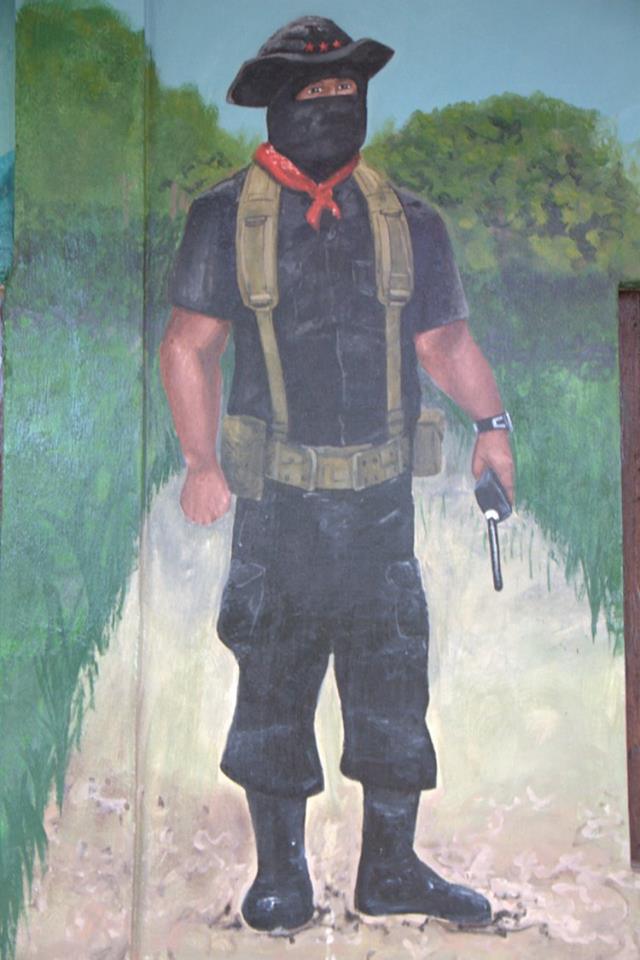
Subcomandante Moisés holding his radio in a La Realidad Mural
By: Isaín Mandujano
SAN CRISTÓBAL DE LAS CASAS, Chiapas (apro) – The Zapatista National Liberation Army (EZLN) assured that it will not promote abstaining, but neither will it call for voting next June 7, “because whatever color [party] you vote for, it’s going to get worse,” he said. What all the peoples must do, he emphasized, is “to organize.”
According to Moisés, in these days “there is this thing that they call the electoral process, we hear and we see that they’re coming out with saying that the EZLN calls for abstention (…) That and other foolishness from those who in vain have a big head, because they don ‘t even study history.”
Within the framework of the seminar named “Critical thought versus the capitalist hydra,” which is being held since yesterday at the University of the Earth and will conclude next Saturday May 9, the subcomandante set the EZLN’s official posture about the elections next June 7.
“As the Zapatistas that we are we do not call for voting or for not voting. As the Zapatistas that we are, what each of us does is tell people to organize to resist, to struggle, to have what is necessary.”
As native peoples of these lands, he added, they already know the actions of the political parties, “which have been weaving a bad history with bad people.”
According to the Zapatista subcomandante, those political parties have only been used for dividing the peoples and communities in the whole country. The political parties, he insisted, confront, use those below to obtain positions and afterwards, now above, they forget about them. They only give them crumbs in order to use them, and it’s that way until the next electoral process.
“Here below, be it whatever color, red, yellow, green, blue or discoloration, the political parties are not what they say they are: that the politicians that come are like ‘saviors;’ that they are going to take you out of poverty. They only come to use you in their petty interests of winning the political positions to which they (the politicians) aspire.”
He continued: “The politicians and their parties only use poverty for coming to give crumbs, for taking the photo of how they are helping the most fucked, the poorest, the dispossessed. Nevertheless, they only use you to come and take the photo.”
For many years, the Zapatistas have decided to organize themselves better, and he that wants to vote can vote, but the vote will not lift anyone out of poverty, what’s better is collective organization like the rebels have done, organize for going forward, not waiting for others to arrive with deceit and false promises, he said.
“We don’t tell you to vote. Nor do we say don’t vote. We don’t tell you to enter the Zapatistas, because we know well from our history that not anyone has the strength of heart to be a Zapatista.”
He added: “We’re not joking. We tell you, plain and simple, to get organized!”
When they ask us what to do, we simply tell them: “There you are going to see for yourself what to do, what comes into your heart, into your head, and no one else comes to tell you what you have to do.
“We don’t tell you lies, don’t give you big rolls or discourses. We only tell you the truth: it’s going to get worse,” he maintained.
And it’s that those above just live to deceive the people, and therefore it is necessary to organize below, because the people make the solutions, not the leaders, or the parties, he specified.
Later he let out: “If (Manuel) Velasco gives hand slaps, those party members give slaps with their poorly hidden racism.”
He explained that they know perfectly well what the elections are, but the Zapatistas, he added, have another time, another geography, another calendar of how to do elections in rebel territory, with resistance.
“While there above they spend millions of pesos on electoral propaganda, on tons of plastic waste, on canvas with photographs of rats and criminals, in Zapatista territory we have found another way of doing the elections without false promises or deceit.”
In the autonomous communities, the slogan is made effective that says: “Here the people command and the government obeys.”
That, he added, is now the Zapatista life in the peoples. It is a culture of truth. “We have certainly made many errors, many mistakes. We will surely make more, but they are our mistakes. We commit an error and we pay, while there above are the parties and their leaders that commit those mistakes, but at the end of accounts those below are the ones that pay for it.
“What comes of the elections in the month of June, doesn’t go to us or come to us. Nor do we call to vote or not to vote. It doesn’t matter to us. Moreover, it doesn’t worry us. For us Zapatistas what interests us is knowing more about how to resist and confront the many heads of the capitalist system that exploits us, represses us, scorns us and robs us.”
The elections that the capitalist system organizes only serve to perpetuate those up there above in power, he pointed out.
“If you already thought that you are not going to vote, we say that’s okay, we don’t say that it’s bad. We’re just saying that we believe that it’s not enough; we have to organize. And, clearly, get ready because they are going to blame party members of the Institutional left for the misery.”
He closed: “We, the Zapatistas, don’t get tired of saying: organize, let’s get organized, each one in your place, let’s struggle to be organized, let’s work to get organized, let’s think about organizing and let’s find each other to unite our organizations for a world where the peoples govern and the government obeys.”
—————————————————————————–
Originally Published in Spanish by Proceso.com.mx
Translation: Chiapas Support Committee
Monday, May 4, 2015
http://www.proceso.com.mx/?p=403265
 Chiapas Support Committee