Chiapas Support Committee
Home of the Compañero Manuel blog on zapatistas & mexico
Confrontation in Chiapas leaves one dead
AUTHORITIES and TEACHERS ACCUSE EACH OTHER of PROVOKING TEACHER’S DEATH
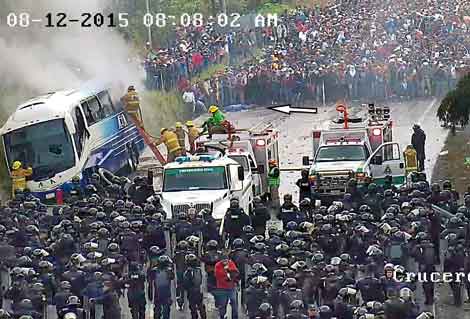
This is an image published in a video in which hundreds of members of the security forces and dissident teachers maintain positions in Ocozocoautla, adjacent to Tuxtla Gutiérrez, at a crossroad that leads to the site of the teachers evaluation examination. To the left is the bus that allegedly ran over 3 teachers and was set on fire. Towards the center (with arrow pointing) is the body of the dead teacher.
By: Elio Henríquez, Correspondent
San Cristóbal de Las Casas, Chiapas
One teacher dead, six detained and five injured (three of them police) is the result of a confrontation that occurred between security forces and teachers of Sections 7 and 40 of the National Education Workers Union (SNTE, its initials in Spanish), when they attempted to boycott the teacher evaluation, the State’s Attorney General of Justice (PGJE) reported.
Education authorities originally announced that the exam would be held on the 12th and 13th of this month, but at the last minute decided to move it up to start on Tuesday, December 8; therefore, the teachers initiated mobilizations to attempt impeding their application.
The confrontation occurred at the crossroad that leads to the School National of Civil Protection –site of the exam–, in the municipality of Ocozocoautla, which is adjacent to Tuxtla Gutiérrez.
The PGJE asserted that the demonstrators tool possession of a bus that they set in motion for the purpose of running over a group of police, but upon carrying out the maneuver rolled over three of their compañeros, among them David Gemayel Ruiz Estudillo, a teacher from Section 40, who died.
On the other hand, Hugo Alvarado Domínguez, spokesperson for Section 7, explained that the teacher was run over by a police bus when they (the police) were attacking them (the teachers) “in a brutal and inhumane manner.” At the first barrier to contain the teachers, he explained, agents of the National Gendarmerie participated, and at the second, members of the Army.
Members of the police were “between 10,000 and 15,000, we were also thousands, but they were armed,” he emphasized.
Alvarado Domínguez detailed that during the confrontation three teachers, two normalistas and one father were detained
He commented that during the early morning hours the teachers detained some buses that were allegedly transporting teachers for presenting the evaluation, but in reality they were administrative workers of the very same federalized assistant secretary of Education.
Pedro Gómez Bahamaca, Secretary of jobs and primary level conflicts and part of the leadership of the SNTE’s Section 7, said: “They gassed us and attacked us, and we didn’t realize at that time that infiltrators took possession of the bus and therefore we are not able to accept the responsibility that they are pointing at us.” He demanded the liberation of the six detained.
The PGJE stated, about the deceased teacher that: “experts performed investigative work at the scene of the incident, among which they emphasize the lifting up of the cadaver and forensic genetics that permitted corroborating that the rear tires on the right side of the bus had traces of blood that corresponds to Ruiz Estudillo.”
He asserted that: “the position of the body and the drag of the AEXA line’s vehicle with license plates 664-HU-2, which stayed on the edge of the incident, also coincide.”
———————————————————–
Originally Published in Spanish by La Jornada
Published in English by Compañero Manuel
Wednesday, December 9, 2015
Thousands march in Chiapas for New Constitution
THOUSANDS MARCH in CHIAPAS to PROCLAIM “A NEW CONSTITUTION”
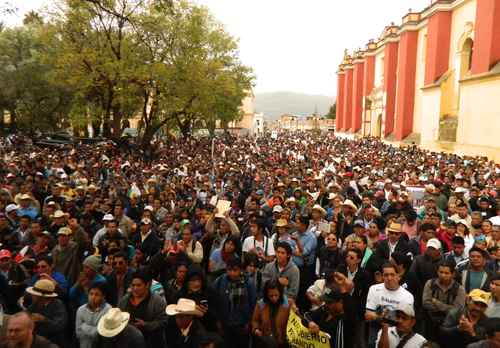
Marchers in San Cristóbal de Las Casas, Chiapas. Photo: Elio Henríquez, La Jornada.
By: Elio Henríquez, Correspondent
San Cristóbal de Las Casas, Chiapas
Thousands of persons marched yesterday in this city to later participate in the public proclamation of the Citizen and Popular Constituent, which will have to elaborate and reach consensus on a new Political Constitution for the country.
In a manifesto, the attendees expressed rejection of the structural reforms, the megaprojects, mining exploitation, the capitalist system and the political class, at the same time that the called for organizing a “big national dialogue” for setting the basis of a new social pact, because “it’s no longer time for demanding, but rather for constructing from our different cultural identities.”
“Re-founding the nation”
Upon heading the act, the Bishop of Saltillo, Coahuila, Raúl Vera López, to whom the indigenous delivered the staff of command, said that 21 years ago, with the Zapatista Uprising, the “ferment” of a new constituent emerged in Chiapas, but “now they are no longer just our brother and sister Mayas that ask for a new social pact, but rather all Mexicans.”
He asserted that in the same way in which the indigenous Zapatistas “contributed to the construction of a just indigenous law (the San Andrés Accords) that never entered the Constitution, now all Mexicans want a new Magna Carta that reflects a new social pact in which we all are included, and in which our native peoples are represented with all their cultural richness and millennial wisdom.”
He added: “We no longer want that indifference of power where the authority that we delegate to a government is perverted to put our resources and territory at the service of the multi-national corporations and of the governments and States from which they come, but rather at the service of all the Mexicans that want peace with justice and development with a dignified life.”
To the cries of: “a new constituent is urgent; re-founding the nation is our mission” and “bringing down the President is urgent,” thousands of people from diverse political, social and religious sectors of different municipios in the state started marching at 9:30 AM from the four points of San Cristóbal de las Casas.
They converged in the central park, where they made the public proclamation of the Citizen and Popular Constituent and remembered the deceased Samuel Ruiz García, Bishop of the Diocese of San Cristóbal, and Amado Avendaño Figueroa, governor in rebellion from 1994 to 2000.
“Today is a historic day that will be remembered in Chiapas and in Mexico because the presence of thousands of persons is a clear sign that the people have taken consciousness about the disastrous situation that we are experiencing, and armed with valor and dignity assumed the responsibility of transforming this reality,” affirmed the Citizen and Popular Constituent Council of Chiapas.
—————————————————————-
Posted in English by Compamanuel.com
Translated by the Chiapas Support Committee from the original Spanish
Monday, December 7, 2015
Chiapas movement denounces megaprojects
[Below is a denunciation written by people of faith opposed to the government’s “development” plans for Eastern Chiapas because they will cause displacement of indigenous communities and harm to the environment and public health.]
Movement in Defense of Life and Territory denounces Chiapas Megaprojects
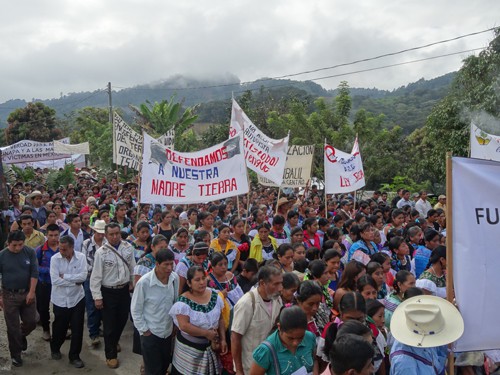
On November 25, 2015, the “International Day Against Violence and Exploitation Towards Women,” as Maya and Mestizo peoples we have come to the municipal capitals of Tumbalá, San Cristóbal de las Casas, Yajalón, Huixtán, Cancúc, Tenejapa, Oxchúc, Ocosingo, Altamirano, Salto de Agua and the towns of Bachajón-Chilón to join our voices and thus make the situation of our peoples more visible.
As the Movement in Defense of Life and Territory, which forms part of the San Cristóbal de las Casas Diocese, we are marching peacefully asking that our constitutional right to demonstrate be respected; we want to encourage the heart of our peoples to seek better paths towards living well and that our disagreements may be heard and attended to by the municipal, state and federal authorities.
On this day, we want to join together with our mothers, daughters and sisters that have been physically and psychologically beaten, excluded, exploited, mistreated, violated, discriminated; and we want to commit ourselves to respecting and defending them from those institutions or individuals that look to violate their rights; starting inside our homes.
On this pilgrimage, our principal demand is the care of Mother Earth, which is not just a place to live; she is part of us, we came from her and we owe her. And she, our mother, is being plundered, devastated and outraged without punishment by the economic interests expressed in megaprojects that threaten to destroy it. We mention some plans and projects that harm our Mother Earth below:
The Chakté Hydroelectric Dam in San Juan Cancuc municipality and the Jatzá Dam on the Jataté River, which crosses through the municipios of Ocosingo and Altamirano. This megaproject will flood 2,900 hectares of forests and ejido lands, will affect the Cañada de Las Tazas (Las Tazas Canyon), will disappear communities like La Sultana and Rómulo Calzada and will affect others. The Nancé Central Dam on the Tzaconejá River in the municipio of Altamirano, the “Salto de Agua” Dam on the Tulijá River that will flood 396 square kilometers of forests and lands. The dam in Bajatzén on the Shamulhá River inside the municipios of Yajalón, Tila and Tumbalá. This dam would flood 10,000 hectares of land.
The eco-tourist projects in the communities of Ulubil and Pocolná in the municipio of San Juan Cancuc. The eco-tourist projects in the Candelaria Ejido, in the municipality of San Cristóbal de las Casas. The Eco-tourist Project at Laguna Ocotal in the municipio of Ocosingo.
A mine in Tenejapa municipality, another mine in the community of Emiliano Zapata in Yajalón, on Ah Cabalnaj Hill and another mine in the community of Ocotal in Yajalón municipality. The mine in the Carranza and Macedonia ejidos in the municipality of Ocosingo. The mine in the Ejido de Guquitepec inside of the municipio of Chilón. Construction of the San Cristóbal-Palenque Superhighway, which will affect diverse communities in the municipios of Candelaria, Chilón, Yajalón, Salto de Agua, Tenejapa, Cancuc, Oxchuc and Ocosingo. This megaproject will also affect through its branches small communities of the Sibacá Ejido, Patria Nueva and Lucum Mil ha community, among others.
Oil wells in the municipio of Tenejapa. Oil well in Xaquilá in the municipio of Chilón. Oil wells in Ocosingo, in the Jardín zone and another in the area of San Miguel. An oil well on the border of Chilón and Ocosingo, on lands of the Carmen Ejido.
These projects and others that affect our communities are works that are destroying or are going to destroy Mother Nature and will enrich the big companies, but don’t benefit the great majority of the poor. The Structural Reforms, which protect megaprojects, are only one strategy for enriching those that have more and impoverishing the Native peoples of these lands.
It’s a joke to say that these works will improve our lives. What life are we going to improve if we don’t have land? The government doesn’t ask us if we are in agreement that these works are constructed and that is a violation of our rights as indigenous peoples.
According to the International Labor Organization, in Convention 169, we have the right to be consulted and to participate in the decisions about policies and programs that affect us, we have the right to determine our own style of development and we have the right to have our integrity respected, our culture and our land.
Meanwhile, we join the voice of Pope Francisco saying: “No to an economy of exclusion and inequality where money rules instead of serving. That economy kills. That economy excludes. That economy destroys Mother Earth” (Pope Francisco, Bolivia, July 9, 2015).
We demand that the state and municipal authorities STOP THE CORRUPTION. We hope that they don’t turn deaf ears and blind eyes, by continuing to permit, despite the hundreds if signatures and demonstrations against it, an increase in permits for the sale of alcoholic beverages and clandestine consumption; prostitution in bars or similar places; the same ones that plant and sell drugs. We have lived in our own flesh, in our homes, that drinking and drugs are the cause of family violence, murder, suicide and they make our people poorer all the time.
We also march in solidarity with more than 100,000 victims of organized crime and especially with the families of the 43 disappeared from Ayotzinapa in Iguala, Guerrero; and with the Acteal victims for whom, almost 20 years after the massacre, the government has not done justice.
Pope Francisco, in the encyclical Laudato Si’, expresses that politics reacts slowly, far from being on top of collective challenges and that it is responsible for its own discredit, for corruption and for the lack of good public policies. We confirmed that in the recent elections where the political parties only left corruption and division, damaged community harmony instead of looking for good living in our peoples. Therefore, it’s indisputable that we must look for new ways of organization. We need to join together on paths of peace and justice.
We need to and want to continue analyzing the signs of the times, caring for and defending Mother Earth, denouncing the structures of injustice and of sin that: “kill our people” (Pope Francisco), as well as constructing alternative models of economy and social organization that go to forming another possible and necessary world (Congress of Mother Earth, January 2014).
May the Heart of the Heavens and the Heart of the Earth, owner and creator of man, woman and nature, illuminate and strengthen us in all our actions in favor of the good life, because as Monsignor Oscar Romero reminds us: “every person that struggles for justice, in an unjust environment, is working for the Kingdom of God.”
Diocese of San Cristóbal de las Casas, Chiapas, November 25, 2015
MOVEMENT IN DEFENSE OF LIFE AND TERRITORY BELIEVING PEOPLE FROM THE PARISHES OF: Candelaria, Huixtán, Tumbalá, Cancúc, Tenejapa, Oxchuc, Ocosingo, Altamirano, Bachajón-Chilón, Yajalón, Salto de Agua.
Related articles:
http://upsidedownworld.org/main/mexico-archives-79/2469-chiapas-the-reconquest-of-recuperated-land
http://compamanuel.com/2014/01/25/indigenous-file-lawsuit-against-san-cristobal-palenque-toll-road/
http://compamanuel.com/2014/03/25/the-plan-puebla-panama-is-changing-chiapas/
—————————————————————–
Originally Published in Spanish by Pozol Colectivo and Koman Ilel
Translation: Chiapas Support Committee
Wednesday, November 25, 2015
En español: http://www.pozol.org/?p=11561/
Gustavo Esteva: Punctuality
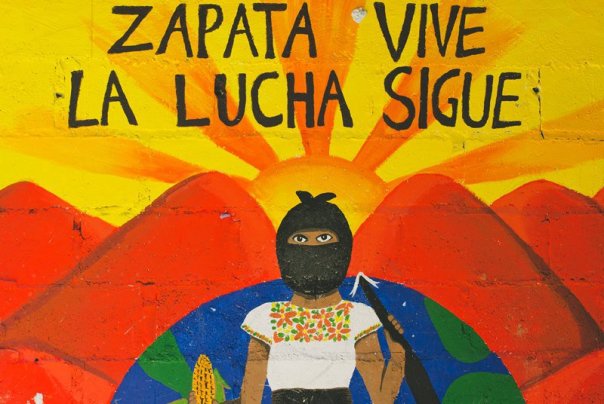
By: Gustavo Esteva
Punctuality does not have the appearance of being a very revolutionary virtue. On the contrary, it is associated with law and order, with those from above. But it also comes from below.
In modern society we learn from early on to be slaves to the clock. School prepares us for work to control our lives, to put every one of our minutes at the service of capital. And every day this domination through scheduling expands, which revolutionary winds should destroy.
But there is also another kind of punctuality. Those who completed the second level of the Zapatista “little school” would have learned what punctuality from below means, one between compañeros, the kind the Zapatistas learned about 30 years ago. They heard that at times it becomes a matter of survival and that it is indispensable within the organization.
Punctuality between compañeros and compañeras is first of all a sign of respect for others. But it is also and above all an expression of the collective will that is built collectively and is expressed in the time, in the times, along with responsibility, which is another pillar of the organization.
Current day punctuality means something more. We have to come together to confront the storm, to unite ourselves against plunder and aggression, to continually exercise solidarity and to walk hand in hand. We should be on time for the struggle and for change.
In this context, with a similar perspective, this Thursday the 12th begins a series of activities in Cuernavaca from the “Weaving together voices for the common home.” Since a small group of people, collectives and movements created this over a year ago, it has revealed itself as an effort to create harmony between our differences, to explore together the avenues to dialogue. The program is at: tejiendovoces.org.mx
In order to dialogue – according to Machado – listen first; and then, listen. It’s time to listen. It’s not just about hearing each other, but about being open to being transformed by the other. It is not the time for dogmatisms, fundamentalisms, vanguards, or sole truths. It’s time to open ourselves to all the differences and mentalities in order to identify points of convergence and learn together that we have a common home and that only together can we stop those who destroy it, those who rip us apart and separate us, and begin the work of reconstruction.
The Zapatista proposal to construct a world where many worlds fit was unanimously well received when presented 20 years ago. There are, however, significant reasons why nothing more has been done since then. If one takes the idea seriously it quickly becomes clear that we need to completely reconstruct all of our institutions, all of our day-to-day norms, the political ones as well as our own practices and behaviors. We are trapped in a society and ways of acting that have been conceived and configured from the imposition of one culture over others…and from a culture that isn’t ours, that was imported in order to impose it upon others.
That form of colonization deeply penetrated and now many Mexicans have been molded in that dominant culture. They understand it as their own. They defend all that it implies. In the current war, the one that they have submitted us to, they associate themselves with the enemy or they collaborate with him.
Recovering our own first of all means to recognize ourselves in our diversity, to know that we are different and that those differences don’t only refer to the cultural distances that exist between indigenous peoples and everyone else. There are also differences within each of the indigenous peoples and within different strata and sectors of mestizo society.
Instead of continuing to try to nullify these differences in a project that homogenizes us in exploitation and scorn, it is about celebrating them, affirming ourselves in them and finding the ways they can coexist in harmony.
The activities that will take place in Cuernavaca, Guadalajara, Oaxaca and Puebla on November 12th to 17th, and that will culminate in Mexico City from the 18th to the 20th, are created by conversations between organizations in the struggle in various parts of the country; diverse collectives and movements, and a distinguished group of intellectuals dedicated to critical thought. An anticapitalist and anti-patriarchal atmosphere will tend to prevail; some participants hold that capitalism is only the modern form of patriarchy. As experience demonstrates, there is no possibility of harmonious coexistence under that regime. In order to detain the current horror, when this regime has caused unprecedented extremes in violence against nature and the social fabric, the initiative is dedicated to weaving together different voices that are willing to unite in this struggle to build a common home.
It is an invitation to fulfill the date we have with history. The time has arrived. As León Felipe aptly put it, it is not important to arrive before or first, but all of us together and on time. And yes, it is only about that.
———————————-
Originally Published in Spanish by La Jornada
Translation: Chiapas Support Committee
Monday, November 9, 2015
En español: http://www.jornada.unam.mx/2015/11/09/opinion/030a2pol
Zibechi: The storms that are coming
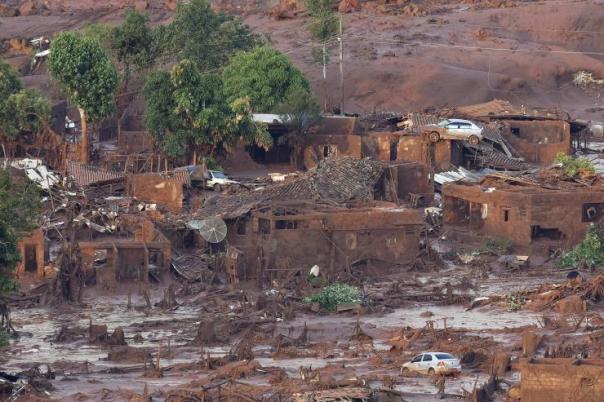
General view of where a dam burst in the Brazilian village of Bento Rodriguez in Mariana, Minas Gerais state, Nov. 6, 2015. Photo: Douglas Magno/AFP/Getty Images
By: Raúl Zibechi
The end of the progressive cycle implies the dissolution of hegemonies and the beginning of a period of dominations, of greater repression against the organized popular sectors. Until now we have been commenting on the causes of the end of the cycle; now it’s necessary to start to comprehend the consequences, tremendous, unattractive, demolishing in many cases.
The recent election of Mauricio Macri as president of Argentina is a turn to the right that calls to light the flame of social conflict. The response of the editors of the conservative daily newspaper La Nación with an editorial that openly defends State terrorism is a sample of what’s coming, but also of the resistances that will have to confront the project of the traditional right.
We are not facing a return to the 1990s, neoliberal and privatizing, because those below are in a different situation, more organized, with greater self esteem and understanding of the model that they suffer and, above all, with greater ability for confronting the powerful. Collective experiences don’t happen in vain, they leave deep impressions, wisdoms and ways of doing things that in this new stage will play a decisive role in the necessary resistance to the new rights.
The period that is opening in the whole South American region, where President Rafael Correa already announced that he does not aspire to re-election, will be one of greater economic, social and political instability; of increasing interference of the Pentagon’s militarism; of new difficulties for regional integration, which already crosses through serious difficulties; of the deterioration of the living conditions of the popular sectors, whose incomes started to erode in the last two years.
In this new climate, I find some questions central:
The first is that there will not be political forces capable of governing with a minimal consensus, like the one that the progressive governments had obtained in their first stage. There will not be consensus in governments like those of Macri; but it’s convenient to remember that the Lula hegemony broke under the second mandate of Dilma Rousseff, as well as under the governments of Tabaré Vázquez, Correa and Maduro, although the causes are different.
When hegemony vanishes, the logics of domination are imposed, which lead us directly to the exacerbation of class, gender, generation and race-ethnicity conflicts, The domination-conflicts-repression triad will affect (is already affecting) women and youth of the popular sectors, the principal victims of the systemic turn to the right.
The second question to take into account is that the political-economic model is more important and decisive than the people who conduct and administer it. In the lefts we still have a political culture very centered on caudillos and leaders, which without a doubt are important, but are not able to go beyond the structural limits that the model imposes on them. Extractivism is the one largely responsible for the crisis that runs through the region, for the erosion that the governments suffer and, in short, is the bottom line that explains the turn to the right of societies.
Unlike the model of industrialization over over substitution of imports, which generated inclusion and promoted social growth, the current extractive model generates social and economic polarization, generates conflicts over the common wealth and destroys the environment. Therefore, it is a model that generates violence, criminalization of poverty and the militarization of societies and territories in resistance.
The inability of the progressivisms to leave the extractive model and the express will of the new rights to deepen it augur times of pain for the peoples. The recent tragedy in Mariana (Minas Gerais) because of the rupture of two of the Vale mining company’s dams, [1] which provoked a gigantic tsunami of mud that is leveling cultivated fields and entire towns, is a small sample of what awaits us if a limit is not set on the mining-soybean-speculator model.
In third place, the end of the progressive cycle supposes the return of the antisystemic movements to the center of the political scenario, from which they had been separated by the centrality of the dispute between the governments and the conservative opposition. But the movements that are activating are not the same, nor do they have the same modes of organizing and of doing, as those that championed the struggles of the 90s.
The piquetero (picketer) movement no longer exists, although it left deep footprints and lessons, and an organized sector that works in the villas in the big cities, with new kinds of initiatives like the popular high schools and women’s houses. The campesino movements, like those of Sin Tierra, have been transformed by the geometric expansion of soy, but new subjects emerge, more complex and diverse, where neighbors of those affected by mining or agro-toxics participate, as well as a wide gamut of health, education and media professionals.
The impression is that we are seeing new articulations, above all in the big cities, where the demands for more democracy and inequality inundate the trenches of the parties and unions, but also of the movements of the neoliberal decade of privatizing.
Lastly, the progressive cycle must close with a serene analysis of the errors committed by the movements. It would be demoralizing that in the next cycle of struggles they repeat the same errors that have affected autonomy in these years. It’s probable that the greatest difficulty to confront consists in knowing how to accommodate the double activity of the movements: the struggle against the model (the defense of one’s own spaces, mobilization and formation) and the creation at each possible level of the new (health, production, housing, land and education).
While street action permits us to stop offensives from above, new creations are steps in autonomy. They are the modes that we learn to continue navigating in the storms.
Translator’s Notes:
———————————————————–
Originally Published in Spanish by La Jornada
Translation: Chiapas Support Committee
Friday, November 27, 2015
En español: http://www.jornada.unam.mx/2015/11/27/opinion/024a2pol/
4 Community police murdered in Guerrero
TIXTLA: DESTABILIZING VIOLENCE, A LA JORNADA EDITORIAL

The street where the murders occurred. Photo from El País (Spain)
Yesterday, an armed group murdered four community police in the El Fortín barrio, located in the municipal capital of Tixtla, Guerrero. The victims belong to the Regional Coordinator of Community Authorities (CRAC) of La Patria es Primero House of Justice. According to members of this organization, the attack was carried out when the community police were attending to a “call from the citizenry” that led them to said barrio, where they were riddled with bullets.
This act occurred threw days before the special elections for a municipal president (mayor) in that Guerrero municipality, after the electoral process of last June 7 was annulled because of the protests of normalistas and parents demanding justice for the case of the 43 Ayotzinapa students that disappeared on September 26, 2014. Significantly, the massacre in Tixtla –a municipality in which the Raúl Isidro Burgos Rural Teachers College at Ayotzinapa is located– also coincided in time with the commemoration of the 14 months that passed since the attack on the students in Iguala, which has not been convincingly and satisfactorily clarified, nor has any act of justice been seen to compensate the victims and their families.
A third contextual element is the climate of violence that exists in the Guerrero municipality, originally attributed to confrontation between the criminal gangs Los Rojos and Los Ardillos, but in recent months has acquired a clear political component: according to denunciations of the Tixtla Popular Assembly –an organization that boycotted the June 7 elections–, those mafias maintain alliances with the traditional political parties in the region, fundamentally the PRI and the PRD, the ones that, at their turn, have taken advantage of the referenced gangs to harass and attack political opponents. As examples of that intermingling among crime and the political parties, the Tixtla Popular Assembly has denounced the presence of armed individuals, allegedly related to the tricolor (PRI) and the sol azteca (PRD) at campaign events for the municipal presidency, and has reported that during the six months of the interim government headed by the PRIista Raúl Vega Astudillo –a cousin of the governor of Guerrero, Héctor Astudillo– eight murders and 18 disappearances have taken place.
The inescapable correlation of this violence is the decision of the Tixtla Popular Assembly not to boycott next Sunday’s elections and to participate in them in alliance with the National Regeneration Movement (Movimiento Regeneración Nacional, Morena). [1] Such a decision has set an unusual precedent in the country’s political history, inasmuch as it implies the articulation of a popular movement with a national political party, which permits the former to direct it socials demands through institutional means and to participate in the electoral arena.
Immediately, the homicides perpetrated last evening diminish the enthusiasm that had awakened participation in the Tixtla community and destabilize the coming electoral process; feed the climate of political contraction that municipality experiences and belie the political, social and legal normality aspired to that, according to the new government of Guerrero, has favor in the state.
Voluntarily or involuntarily, the material and intellectual authors of the crimes committed in Tixtla have attacked not just against the lives of four persons, but also against the aspirations for re-establishing democratic normality in Guerrero territory and, in particular, in that municipality, and against the battered credibility of the country’s political and electoral institutions.
Translator’s Note:
[1] Morena is the political party founded by Andrés Manuel López Obrador (AMLO).
———————————————————–
Originally Published in Spanish by La Jornada
Translation: Chiapas Support Committee
Friday, November 27, 2015
En español: http://www.jornada.unam.mx/2015/11/27/opinion/002a1edi
López y Rivas: Video for Level 2 of the Escuelitas
The SECOND LEVEL of the ZAPATISTA ESCUELITAS
By: Gilberto López y Rivas / III
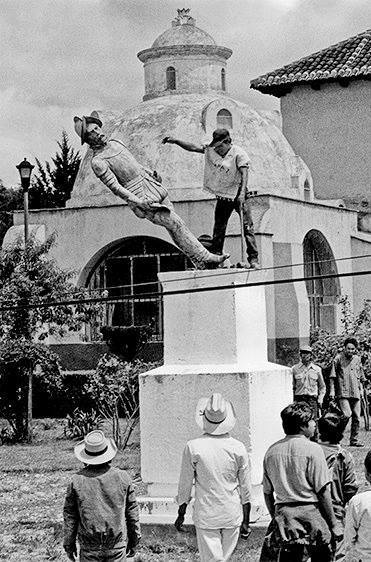
EZLN members brought dow this statue of Diego de Mazariegos on October 12, 1992, more than a year before the 1994 Uprising.
Students of the Zapatista Escuelita (Little School) that hope to pass the second level had access to a video more than three hours long, a significant part of which demonstrates the less known history of the EZLN: the history of the years prior to the 1994 Uprising. This memorable film document, which offers an extraordinary lesson of how to organize in the most adverse conditions, begins with an introduction from Subcomandante Insurgente Moisés, the current spokesperson of that political-military organization. Around 30 local responsables coming from the five Zapatista Caracols gave talks.
In these testimonies they announce, live and in the various languages of the peoples, the difficulties of clandestine work from the crucial years of 1983 and 1984; the slow and tortuous process of taking consciousness, explaining the 13 demands, the exploitation, capitalism, imperialism, the bourgeois State, criticism and self-criticism. They talk about the first recruitment of members, about the forms of secret communication and discretion, meeting with each other in the milpa or in the coffee field, in the mountains, avoiding the traveled roads, walking along the dirt paths, at night, many times in the rain, enduring hunger, mud, cold and heat, all for the struggle.
They detail the security rules for not disclosing the presence of the organization in its infancy, including sharing it with family members, neighbors and friends, “burning the notes so that the enemy would not know about us.” They remember the sacrifices and zeal of the first militants, of the initial desertions and treasons of the splits, as well as the compas that continue firm in the struggle. They describe the tasks of the local and regional responsables throughout the years, as well as the sacrifices and the conditions in which the military preparation of the insurgents and milicianos took place. They looked for secure places for the trainings and, at the same time, the militants bought their weapons, machetes, boots, hammocks, uniforms and batteries; they had “reserves,” because they didn’t know how long the war would last. There was a bakery, a tailor shop, and later a radio. They cooperated among the support bases for that and they worked collectively; the rebellion was assumed as a great task for everyone, while the insurgents gave training to the milicianos and, in the midst of all this hustle and bustle, which finally led to the 1994 Uprising, there was time to “raise spirits,” above all by realizing that more were convinced every day, that there were concentrations of thousands, with those who joined the platoons, battalions and regiments of what would be the Zapatista National Liberation Army. The Indigenous Revolutionary Committee was composed of the zonal and regional spokespersons. Compañerismo and unity, information and formation, the economy of resources destined to mobilization were followed in all these organizing efforts. When the armed and uniformed insurgents arrived in a village, they would make welcoming fiestas with marimba music and dancing.
In the expositions they identified values and qualities for eventual members of the organization; that is, they chose those who “were well-spoken,” demonstrated punctuality, discipline and completion of work, were without addictions, with irreproachable conduct and, above all, who had no contact with the government and the finqueros. [1] The best of these were selected to be local and regional responsables. In these years they were forging the organization’s basic principles: don’t surrender, don’t sell out, don’t give up and don’t deceive the (support) bases.
The reference to the work of the women in the guerrilla organization was very instructive: their first incorporation into peripheral tasks in the beginning, and their passage towards positions and duties with greater responsibility, including those directly related to the war that was being prepared; that is, as milicianas and insurgentas. In the 1993 consultation to decide the start of the war, they also signed the agreement, prepared the food for the milicianos and milicianas that marched at the front. They even made known a military action at an airplane landing strip, in which the women brought down the antenna and expropriated a radio transmitter. Now, they proudly affirm that they have learned a lot: that they are agents, commissioners, midwives and health promoters, education responsables, members of the autonomous governments, commanders and, above all, self-sufficient human beings with rights backed up by the Women’s Revolutionary Law. They maintain that the war is never going to end because “the fucking bad government is always going to betray us.”
It’s also interesting listen to the stories of how the EZLN combined the forms of struggle before the Uprising, with open organizations that answered to their commanders, one of which brought down the statue of Mazariegos [2] on October 12, 1992, in which the indigenous peoples aired their protest against the “celebration” of the invasion of our continent and, at the same time, a general rehearsal for the taking of San Cristóbal de las Casas in 1994.
What shows through is the pride and affection for the “organization,” for the history that its supporters are unraveling, each one in their fashion, from their particular experience and in their own forms of oral expression. They declare that they will never give themselves up as conquered, that the Zapatistas, 20 years after the declaration of war, have their autonomous governments, without depending on the bad government, and that this future they are constructing is forever.
They conclude by pointing out that they prepared the Second Level course for the Escuelita Zapatista with a lot of love, and starting with a commitment to the people of Mexico, to the millions of Mexicans, to whom they deliver this seed of organization and resistance.
Notes:
[1] Finqueros – Ranch owners
[2] Diego de Mazariegos was a Spanish colonizer who invaded Chiapas.
——————————————————————–
Originally Published in Spanish by La Jornada
Translation: Chiapas Support Committee
Friday, November 6, 2015
En español: http://www.jornada.unam.mx/2015/11/06/opinion/023a1pol
Escuelitas Zapatistas, an invitation for us to organize
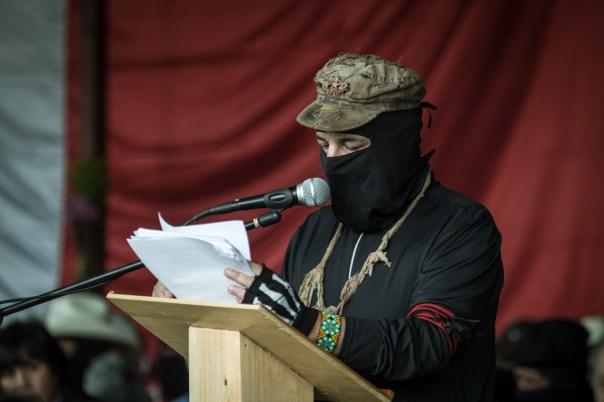
Galeano (aka Marcos) at the Seminar on Critical Thought versus the Capitalist Hydra
By Carolina Dutton
“The EZLN, through its Sixth and International Commissions, will announce a series of initiatives, of a civilian and peaceful character, to continue walking together with the other Native Peoples of Mexico and the whole continent, and together with those who, in Mexico and in the entire world, resist and struggle below and to the left.” (The EZLN announces its next steps) Subcomandante Insurgente Marcos, December 30, 2012.
From the beginning the vision of the Zapatistas has been to construct their autonomy together with the people of Mexico and the world. Massive support from the Mexican public and world opinion saved them from being wiped out by further massacres in 1994. Later that year they organized a national democratic convention in Chiapas. In 1995 they held a consultation with the people of Mexico to ask the people in all parts of the country about indigenous culture and the steps Mexico needed to take towards dialogue and democracy from below. They also presented their 13 demands for land, housing, work, food, health, education, culture, information, independence, democracy, liberty, justice and peace, which are not just for them, but rather for all people from below. More consultations were done throughout Mexico in 1999 and the March of the Color of the Earth visited 13 states of Mexico in 2001. Then came the 6th Declaration and the Other Campaign in 2005-6. The Escuelitas (Little Schools), which began in 2013, are their most recent way of reaching out to others struggling against capitalism and working to create another world. In Level 1 of the Escuelitas, the Zapatistas permitted us to participate in their resistance and thus be directly connected to them. In Level 2, they connect with us by sharing online so that many who can’t go to Chiapas but who can learn from the Zapatistas’ experience organizing and building their organization in clandestinity.
In the first level of the Escuelita we lived in Zapatista villages and the compas shared with us their everyday resistance and their construction and practice of autonomy mostly from 1994 to the present. We worked with our host families on their everyday economic activities, everything from carrying water and collecting firewood to tending the cattle, cultivating the milpa [1], coffee and sugar cane. We visited their autonomous schools and health centers and learned about autonomous government. Our host families sometimes shared their history with us around the dinner table, how things have changed for them now that they live autonomously and their participation in the uprising. We were given readings, which were testimonies of many Zapatista women and men who had served in various levels of civilian autonomous government.
The second level of the Escuelita has been conducted entirely online. The readings emphasize the need to organize our communities to resist the capitalist hydra economically and politically. We were given the link to a video where the Zapatistas shared how they formed their organization and how they organized and recruited new members, educated, encouraged, and protected each other as a clandestine organization beginning as early as 1983 up until the 1994 uprising, when they became public. The video consisted of testimonies from those who had been and some who still are both local and regional responsables [2] during clandestinity. Responsables spoke from each of the five Caracoles, or centers of Zapatista regional government: Caracol 1 La Realidad, Caracol 2 Oventic, Caracol 3 La Garrucha, Caracol 4 Morelia, and Caracol 5 Roberto Barrios.
The Zapatistas made it very clear their reasons for sharing this precious information. They hope that learning how they went about organizing will give us ideas and help us organize in other parts of Mexico or in our own communities in many parts of the world. They are very aware that they cannot do it alone, that they need us to organize too, but that we may need to do it in our own way depending on our unique situations. We are all in this together and we need not only each other’s support but also each other’s vision.
In the Escuelita 2 video the local and regional responsables during the EZLN’s 10 years of clandestine formation shared with us their tasks and sacrifices. The local responsables coordinated the organization’s work in the communities. They observed how people participated in the community and recruited new members who exhibited responsibility and understanding. They were in charge of orienting new members and raising their consciousness to understand why their lives were so hard and the necessity to struggle and to study in order to prepare the struggle.
The responsables also coordinated local security. Women were especially important for security since they usually stayed in the community and were aware when people who didn’t belong there were present. The responsables, both men and women, also convened meetings and assemblies. Sometimes meetings took place in the middle of the night on stormy nights when people would not be seen or heard as they left home and traveled to a safe meeting place.
Local responsables also organized the training and equipping of the milicianos. [3] They also organized collective work, which was necessary to free up time for those with other responsibilities in the organization as well as to earn money to buy necessities for the struggle including boots and weapons. The sewing collectives sewed uniforms. The women collectively made tostadas and women and men collectively grew the food for the milicianos and insurgents. Many women and men had responsibly for this collective work and for security but the responsables oversaw the collectives in their area and communicated information about any problems and needs to the regional responsables.
The regional responsables oversaw the work of the organization in wider regions. They oriented the local responsables, prepared and encouraged the milicianos and raised the consciousness and understanding of members of the organization. In isolated areas compas often became discouraged so the responsables organized fiestas so that the members in a region could meet each other and see how many hundreds and thousands of compas were committed to the struggle. The Zapatistas love parties, all without drinking alcohol, which was against the EZLN’s rules.
So why have the Zapatistas decided to share this information with us now? They want us to organize too in our own way. They need people all over Mexico and the world to organize and to be in touch with them. It is the only way our movements can resist the capitalist hydra whose tentacles reach all corners of the earth and all aspects of life. I think they also want to share this history with their youth. An entire generation has grown up since the uprising that did not participate in building the organization and preparing for war. Zapatista resistance now requires creativity and sacrifice but it is very different. It is important that the youth know what came before, what has changed, and the ingenuity, discipline and sacrifice that went into building the organization they have always known.
Our exam to pass Escuelita 2 consisted of 6 questions, questions which each of us had to write and ask the Zapatistas. As Subcomandantes Moisés and Galeano explain: “The questions are important, as is our Zapatista way, they are more important than the answers… What interests the Zapatistas are not certainties but the doubts because we think that certainty immobilizes, that one is still, content, sitting still and not moving, as if we had arrived or we already knew. On the other hand, doubts, questions, make one move, search, not be still, not be in conformity, like day and night don’t pass, and the struggles from below and to the left are born of inconformity, of doubts and restlessness. If one conforms it’s that one is waiting to be told what to do or has already been told. If one is not in conformity, one searches for what to do.” (Second Level of the Little School, July 27, 2015).
Notes:
[1] A milpa is much more than a field of corn. It is a diverse area of cultivation. The dominant plant is the basic grain of the people, corn. Beans grow up the corn stalk, different forms of squash creep along the ground and many medicinal and culinary herbs grow in and around the milpa.
[2] A responsable is the person responsible for a certain task or group of tasks. In the context of early EZLN organizing the responsable seems like more of a political operative or organizer.
[3] The milicianos were and still are somewhat like the National Guard. They have military training, but are not insurgents, and can be called to active duty in an emergency.
A Reflection and application from the Second Escuelita
[Last Tuesday evening, members of the Chiapas Support Committee got together and shared what they learned from the background readings and Video for Level 2 of the Escuelitas Zapatistas (Little Zapatista Schools). Several people shared their reflections on Level 2 in articles for our Chiapas Update newsletter. The first is posted below.]
“TRYING ON A SHOE, OR CLOTHES:” A Reflection and Application from the Second Escuelita
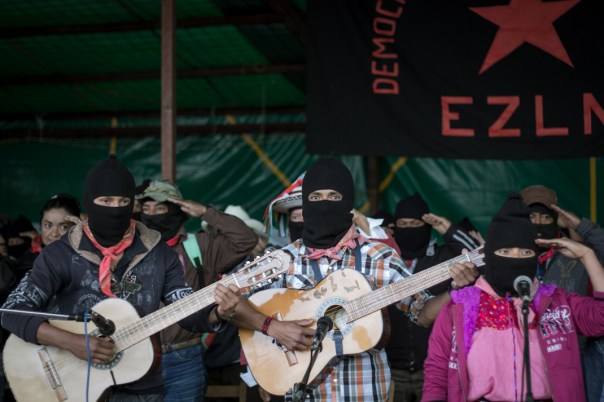
Zapatista musicians play at the Homage and Seminar in Oventik, May 2015.
By: Todd Davies
“Por eso decimos que somos muy otros, muy otras, nosotros, porque es que vamos como si fuera el zapato, la ropa, se mide uno si le queda o no le queda pues, prueba, y si no hasta que encuentra la que sí le queda pues. Así somos, compañeros, compañeras, hermanos y hermanas, de lo que es nuestra resistencia y la rebeldía.”
“That is why we say we are very other. Because we move as if trying on a shoe, or clothes – you measure and see if it fits, try it on, and if not then you keep looking for the one that fits. That’s how we are, compañeros, compañeras, brothers and sisters, that is what our resistance and rebellion is about.” — Subcomandante Insurgente Moisés, “Resistencia y Rebeldía Zapatistas II” (“Resistance and Rebellion II”), 7 May 2015
One of the themes running through the assigned readings and video recording for this year’s second level of the Zapatista’s Little School (Escuelita) was how much the compañer@s living in Zapatista Territory have learned through practice. I have long thought of the practice-driven approach of the Zapatistas as having lessons for us in movements here, but I had not seen such a clear explanation of both the philosophy underlying this approach, and some of the specific lessons it has taught, until I made my way through the curriculum of the segundo nivel.
A few years ago, after describing to fellow activists my understanding of the Zapatista phrase caminar preguntando (walking while asking questions), I was asked whether the Zapatistas’ method of learning along the way was similar to Marxist or religious concepts of “praxis”. Although I was familiar with this term, I wasn’t sure what to say at the time, so I hedged. After thinking about it a bit more, I realized that when friends of mine in movements had used the term “praxis”, they seemed to mean a form of practice that starts with an overall theory and then applies it through action. Part of the idea is that everyday practice is the means by which oppressed people actually learn how to change the world: understanding comes from doing, not just from hearing or reading. But particularly in movements of the left in this country, the use of “praxis” seems also to be infused with Gandhian and/or vanguardist thinking. Only through praxis can we bring about revolution, under this understanding of the concept, because without action, our theories are just words. Talk is cheap. “You must be the change you wish to see in the world,” as Gandhi said. And this is so because you must lead by example. Who would trust a guru who did not follow his own teachings?
So I sensed that the Zapatista approach to practice was not quite captured by the term “praxis” as I had generally seen it employed, because in caminar preguntando we begin by assuming that whatever we think now is probably wrong in crucial respects, and that we will learn what our theory should be as we go along, rather than primarily learning to appreciate what it means and demonstrating to others that we can apply it. As Subcomandante Insurgente Marcos (now Galeano) wrote in 2004: “We are trying, with our clumsiness and our wise actions, definitions or vagueness, just trying, but putting life into it, to build an alternative. Full of imperfections and always incomplete, but our alternative.” Not the words we expect from a guru or vanguard.
In the assigned readings for the second level, Moisés describes an example of how the Zapatistas have moved from “shoe to shoe” in their search for a better fit. Communities began by working collectively 100% of the time. There would be, for example, one milpa (corn field) for everyone. Over time, however, they learned that this approach worked less well than more complex arrangements that involved a mix of collective and family allotments and labor. The division of time now varies by community, and there are different levels of collective work and control: region, autonomous municipality, and zone, in addition to the community. The goal was to create a robust agreement that worked for everyone and was sensitive to problems and contexts (weather events, shortfalls, over-harvesting, different family sizes, needs, etcetera…).
Moisés says, “Here what we learned in practice is that what we were doing wasn’t working, that is, we made a mistake, and we failed when we required 100% collective work. We saw that this didn’t work because there were complaints; there were a lot of problems.” I think it is useful to contrast this with the more ideologically or theory-driven approach that we often see in movements, both capitalist and anti-capitalist: Those who complain are lazy (or are counter-revolutionaries). Problems come from those who are unproductive (or selfish).
The Zapatista approach is piecemeal: finding a shoe that fits is distinct from finding a good shirt or blouse. Theory-driven politics, by contrast, tends to push us to choose between entire wardrobes. In a widely read piece from earlier this year, L.A. Kaufman wrote about “The Theology of Consensus” in a way that portrayed consensus decision making as a religious doctrine that should be abandoned because it failed, for example, to yield effective decisions in the general assemblies of the Occupy movement. A Zapatista-like assessment would, I think, be more analytical. It would look at the many elements that vary across consensus procedures and ask which ones are sources of problems, and which should be retained depending on the context. The whole-wardrobe approach, by contrast, urges us to throw out everything and start over. That only makes sense if there is nothing in the wardrobe worth keeping.
The Zapatistas have held together as an organization for 32 years, and the rebellion that began on January 1, 1994, will soon celebrate its 22nd anniversary. What Moisés tells us in the readings for the second Little School is that the movement has survived this long because it has prioritized the organization and its radically democratic principles, has pursued what works well, and has modified what was not working. Such a simple lesson! But one that is ripe for application in our own attempts to build community and autonomy here in the bay area.
Ejido Morelia: the Army’s impunity
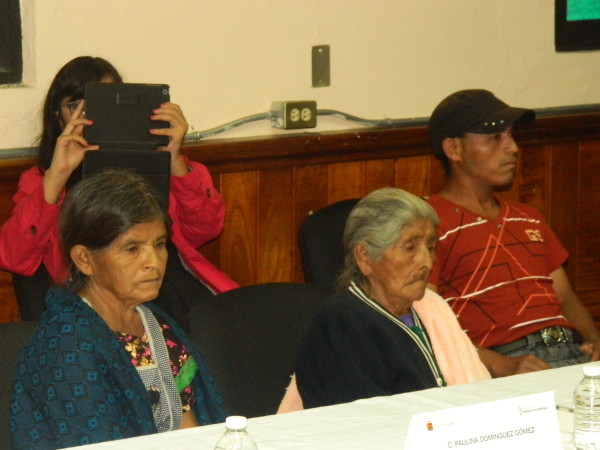
The victims’ family members attend the recognition of responsibility in San Cristóbal. Photo: Chiapas Paralelo
By: Miguel Angel de los Santos*
In January 1994 an internal armed conflict began in Chiapas, when the Zapatista National Liberation Army (EZLN, its initials in Spanish) declared war against the Mexican National Army and took various municipal capitals. Armed conflicts are governed by the rules of International Humanitarian Law, among them the Geneva Conventions and their protocols, which establish, among other things, that the parties in conflict must respect those who do not take part in the hostilities, and those who, having taken part, are injured or have been taken prisoner. Those who do not comply with these norms incur war crimes and violate human rights.
It was within the above context that a Mexican National Army brigade entered the Ejido Morelia, in the municipality of Altamirano, Chiapas, the morning of January 7, 1994. They detained 33 indigenous men, who they submitted and laid face down on the basketball court. They also detained Severiano Santiz Gómez, Sebastián Santiz López and Hermelindo Santiz Gómez, who were separated in order to take them to the sacristy of the church, where they were tortured, for allegedly belonging to the EZLN. This was the last time they were seen or heard. A few weeks later, their remains appeared near the ejido. They had been executed by their captors in violation of the norms of International Humanitarian Law.
Despite clear evidence, the Mexican National Army has denied responsibility for the acts and the Mexican State continues protecting it, refusing to investigate or simulated doing so, in order to avoid punishing the military personnel involved and responsible for the arbitrary execution.
The Inter-American Commission on Human Rights (IACHR) had already pointed out the Mexican State’s international responsibility for the violations that the soldiers incurred. Such reproach is clear in the background report number 48/97, derived from case 11.411, known as Severiano and Hermelindo Santiz Gómez “Ejido Morelia.” [1]
Almost twenty-two years later, the State has accepted its international responsibility in the human rights violations that the Mexican National Army committed, and in the terms in which the IACHR would point it out. Nevertheless, this admission has not represented punishment of those responsible.
On November 10, the signing of an Agreement for Attention to the Background Report No. 48/97 was carried out. Representatives of the Mexican State and the widows of the three victims signed the agreement.
Starting with the international principle that one who violates an international obligation, like the rights provided in the American Convention on Human Rights, is obliged to make reparations, the agreement contemplates the reparations measures agreed to by the parties, and that the State has to implement.
About the factual basis for the referenced background report, the ministerial investigation will continue until the complete clarification of the facts and the sanction of those responsible. They also agreed on diverse rehabilitation measures for family members of the victims; a public act of recognition of responsibility; the construction of a community park and corresponding compensatory indemnifications.
The path of justice is open, and the agreement represents an important gesture from the Mexican State to recognize and admit its responsibility in the deprivation of the lives of Severiano Santiz Gómez, Sebastián Santiz López and Hermelindo Santiz Gómez; nevertheless, it turns out that the human rights violations will only be resolved and compensated for when those responsible are taken to the courts and a sanction is imposed on them.
* Miguel Angel de los Santos is the lawyer for the victims’ families.
[1] http://www.cidh.oas.org/annualrep/97span/Mexico11.411.htm
——————————————————————-
Originally Published in Spanish by Chiapas Paralelo
Translation: Chiapas Support Committee
Friday, November 13, 2015
http://www.chiapasparalelo.com/opinion/2014/01/ejido-morelia-veinte-anos-esperando-por-la-justicia/
 Chiapas Support Committee