Chiapas Support Committee
Home of the Compañero Manuel blog on zapatistas & mexico
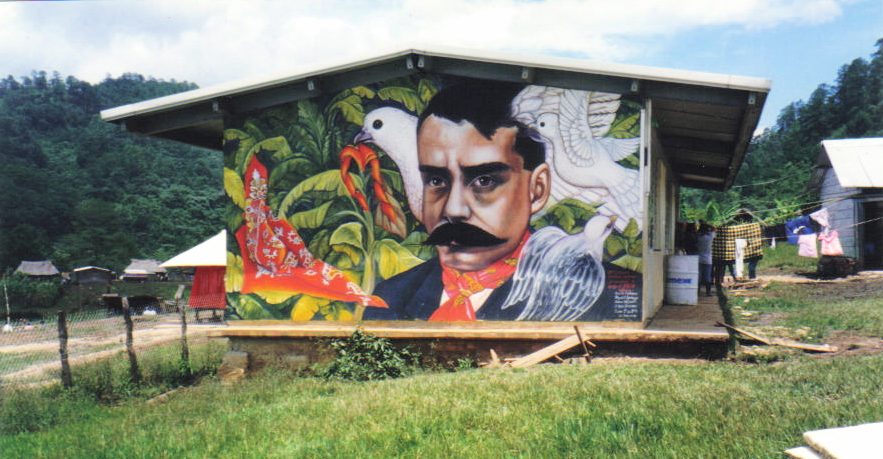
Child victims of the war in Chiapas
A PUBLIC APOLOGY WITHOUT THE AGGRESSOR PRESENT; THEY ACCUSE THE ARMED FORCED OF BEING A POWER SUPERIOR TO THE CIVILIAN
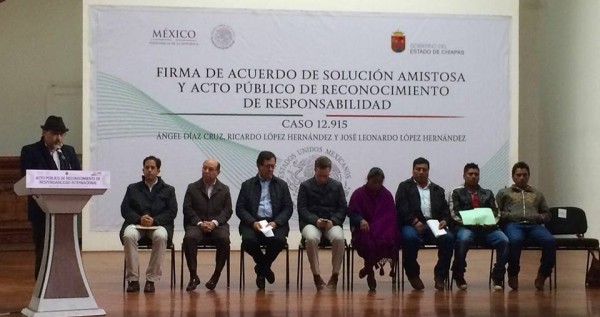
Pedro Faro, Director of Frayba (speaking), government officials and the victims (the 4 on the right) at the public apology.
By: Angeles Mariscal
Ever since military personnel arrived in Chiapas in 1994 to carry out actions against the Zapatista National Liberation Army (EZLN), the human rights violations increased: Frayba
The federal government asks the parents of Angel, Ricardo and José, victims of the explosion of a military grenade, for public forgiveness. Representatives of the Armed Forces refused to attend the event, whose realization was brought about with the intervention of the Inter-American Commission on Human Rights (IACHR).
Angel Díaz Cruz, just 9 years old, died from the impact of an anti-personnel grenade that Mexican Army personnel had “forgotten” some 500 meters away from El Aguaje community, in the municipio of San Cristóbal de las Casas. Ricardo and José López Hernández were injured.
The acts occurred in September 2000. Now, 15 years later, the Mexican government held a public act of recognition of the Mexican State’s responsibility, and asked the family members of the victims for forgiveness.
The big absence at the event, were any representatives from the Armed Forces, whose members utilized a piece of land as a training field that the El Aguaje community used to collect mushrooms and to graze their flocks of sheep.
“The only thing that these poor children did lo was to look for mushrooms to eat.” They saw the grenade and thought it was a toy, and they brought it inside of the house where it exploded, explained the father of Ricardo and José, who also spoke in the name of Cristina Reyna Cruz López, Angel’s mother.
“My family and the residents of El Aguaje are now obliged to live with all kinds of noises provoked by the explosives, the mortars and the machine guns, which provoked a lot of fear,” he remembered.
The family of the injured boys and of Angel denounced the act to judicial authorities. The Military Prosecutor’s Office demanded jurisdiction over the investigations and beginning at that moment access to the record was closed to the family and its representatives, without reparations being made for damages or medical attention being given to the two survivors.
With help from the Fray Bartolomé de las Casas Human Rights Center (Frayba), the family took the case to the IACHR, which after several years of investigations, concluded that the Mexican government was responsible for not carrying out its practices in sage zones far from the civilian population, and that it denied the victims access to justice upon bringing the case to military jurisdiction.
According to the Mexican government, Infantry Major Raúl Anguiano Zamora and Lieutenant Emilio Sariñana Marrufo were arrested for these acts. The families don’t know what the penalty given to them was because they were never notified of the process.
The IACHR asked the government and the victim to reach an agreement for an amicable solution, which includes the public apology that took place today, and that Homero Campa Cifrián, Assistant Secretary of Human Rights for the Secretariat of Governance gave, as well as the Governor of Chiapas, Manuel Velasco Coello.
Homero Campa reported that the families would be indemnified for the damages and that a school will be constructed in El Aguaje that carries the name of Angel Díaz Cruz.
Pedro Faro, current director of the Frayba, explained that the IACHR has had to intervene in three other cases where the Mexican Army has violated the human rights of Chiapas residents, in situations that include the torture and homicide of civilians where arrive to set up their camps.
He explained that ever since military members came to Chiapas in 1994 to carry out actions against the Zapatista National Liberation Army (EZLN), human rights violations have increased.
Faro emphasized that despite the fact that the Mexican government has committed to stop human rights violations, the Mexican Army has maintained contrary. “Today we lack the principal character of this story (…) The Mexican Army is not present because it is untouchable in Mexico; it’s clear to us that it is a supra power to civilian government,” he emphasized.
For his part, José López Cruz demanded that the agreements the Mexican government signed today “are totally fulfilled.”
——————————————————————-
Originally Published in Spanish by Chiapas Paralelo
Friday, January 29, 2016
Re-published with English interpretation by the Chiapas Support Committee
Oxchuc: From a postelectoral conflict to a social one

Protesters paint: “Maria Gloria Out” on Oxchuc municipal building.
By: Isaín Mandujano
The Oxchuc Rebellion…
Many weeks ago Oxchuc went from being a post-electoral conflict to being a social conflict.
The post-electoral protest that the ex-candidates for mayor of the Nueva Alianza and the Chiapas Unido started after the July 19, 2015 elections was rebuffed in the beginning by state authorities, but with the passing of months spread like foam.
Little by little more and more of the 115 communities that make up the Tzeltal Indigenous municipio (county) of Oxchuc added themselves to the protest.
The entire town rose up to put an end to the political bossism (cacicazgo) that the husband and wife Norberto Sántiz López [1] and María Gloria Sánchez Gómez have maintained for more than a decade, all with the support of the PRI and now of the PVEM.
According to the Institute of Elections and Citizen Participation Ciudadana (IEPC, its initials in Spanish), María Gloria Sánchez Gómez won at the ballot box in accordance with the local and federal tribunals. But the residents are convinced that if she won if was not cleanly and transparently. She did everything in the purest style that characterizes the PRI and the PVEM, bullying and conditioning delivery of government aid, buying votes, busing in voters, stuffing ballot boxes, cloning ballots, etcetera.
From the Secretary General of Government, all of the PRI structure incrusted in important positions moves and covers up for Norberto Sántiz López and María Gloria Sánchez Gómez, who started a political boss system in that municipio dating from the time of ex-governor Roberto Albores Guillén. [2]
They support and defend her insistently from the Government Palace. They don’t leave María Gloria and her husband alone. They defend their interests, the political interests, the economic interests and those of her party.
For the time being, those in the General Ministry of Government are looking for someone to blame in order to hide their inefficiency. They accuse the PVEM’s local deputy, Cecilia López Sánchez, of being behind it and she has firmly denied that accusation. Nevertheless, they now want to take away immunity.
State authorities believed that it was going to be easy to sway and negotiate with Oxchuc’s residents. They thought that it would be the same as with the Chamulas, that offering them municipal government posts and public works would silence them.
In Oxchuc they are decided to not let them govern more. The entire population said: “Ya basta!”
And as the days pass the movement doesn’t diminish, it gets stronger. The most recent support is from the parents of the 43 Ayotzinapa disappeared. And, many other local social groups locales now start to come and give them backing.
That’s because what was started here was a fight against political bosses [caciques) that proliferate in the majority of the 122 municipios de Chiapas just like they do in Oxchuc. Oxchuc is just the tip of the iceberg of all the conflicts that are there and haven’t yet broken out.
The State Congress del Estado resists letting her fall and installing a municipal council as residents demand.
We’ll see how much more time passes and how it continues to grow.
“It’s no longer post-electoral, but rather social as many people lead it, since the communities of this municipio have expressed their opposition in a single voice and demand the immediate dismissal of Sánchez Gómez and her town council,” says Oscar Gómez López of the Permanente Commission of Justice and Dignity of Oxchuc.
—*—
Translator’s Notes:
[1] Norberto Sántiz López was a former mayor of Oxchuc. Agents of Mexico’s Attorney General arrested him as he was trying to leave the country in 2005. The charges against him were related to misappropriating municipal funds for his personal enrichment. He was also alleged to be the leader of a paramilitary group known as the “Anti-Zapatista Revolutionary Indigenous Movement” (Movimiento Indígena Revolucionaria Antizapatista, MIRA). Before going to prison, Santiz López arranged for his wife to replace him as mayor. Her installation was widely publicized as the election of Mexico’s first Indigenous woman mayor.
[2] Roberto Albores Guillén was appointed substitute governor of Chiapas on January 7, 1998. His predecessor had been forced out following the Acteal Massacre. He remained interim governor until December 2000 when his successor took office. Albores Guillén did a lot of anti-Zapatista stuff and is the ex governor the Zapatistas call “Croquetas” (Dog Biscuits).

See also: http://compamanuel.com/2016/01/13/66-police-injured-in-oxchuc-chiapas-confrontation/
Originally Published in Spanish by Chiapas Paralelo
Monday, January 18, 2016
Re-published with English interpretation by the Chiapas Support Committee
Zibechi: A Left for Century XXI
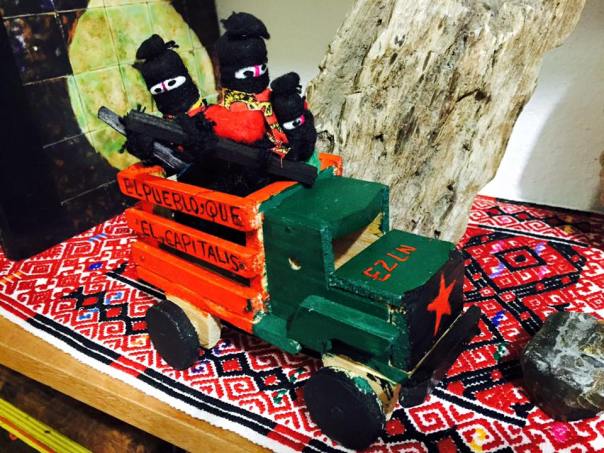
Zapatista paraphernalia on display
By: Raúl Zibechi
In the ‘60s and ‘70s, those who joined the militancy often heard a phrase: “Being like Che.” An ethic was synthesized with that, a conduct, a mode of assuming the collective action the personage inspired that –with the delivery of his life– became the compass for a generation.
“Being like Che” was a motto that didn’t expect militants to follow point-by-point the example of someone who had become an inescapable reference. It was something else; not a model to follow, but rather an ethical inspiration that implied a series of renunciations in the image and resemblance of Che’s life.
Renouncing comforts, material benefits, including the power won in the revolution, being willing to risk your life, they are central values in the heritage that we call “Guevarismo.” For a good while, those were the axes around which a good part of the leftist militancy, at least in Latin America.
That left was defeated in a brief period that we can situate between the State coups of the 1970 and the fall of real socialism, a decade later. It didn’t come out of the big defeats unscathed. Just as the fall of the Paris Commune was a parting of waters, according to Georges Haupt, which led the lefts of that epoch to introduce new themes on their agendas (the party question moved to occupying a central place), the defeats of the Latin American revolutionary movements seem to have produced a fissure in the lefts at the start of the 21st Century.
It’s still very early to make a complete evaluation of that turn since we are at the beginning of it and without sufficient critical distance and, above all, self-criticism. However, we are able to advance some hypotheses that connect those defeats closely with the current conjuncture we experience.
The first is that we’re not talking about turning back the clock to repeat the old errors, of which there were many. Vanguardism was the most evident, accompanied by a serious volunteerism that impeded comprehending that the reality we sought to transform was very different than what we thought, which led to underestimating the power of the dominant classes and, above all, to believing that a revolutionary situation existed.
But vanguardism didn’t cede easily. It is solidly rooted in the culture of the lefts and although it was defeated in its guerrilla version, it seems to have mutated and remains alive as much in the so-called social movements as in the parties that pretend to know what the population wants without the need of listening to it. A large part of the governments and progressive leaders are good examples of the perseverance of a vanguardism without a proclaimed vanguard.
The second has a relationship to the method, armed struggle. The fact that the generation of the 60s and 70s had committed gross errors in the use and abuse of violence is not saying that we have to throw everything out. We remember that at least in Uruguay it was thought that: “action generates conscience,” thus granting an almost magical ability to the armed vanguard for generating action in the masses only with its activity, as if the people could act by mechanical reflexes without the need for organizing and preparing themselves.
The armed organizations also committed indefensible atrocities, using violence not only against their enemies, but often also against their own people and also against those compañeros that presented political differences with their organization. The assassinations of Roque Dalton and Comandanta Ana María, in El Salvador, are two of the gravest deeds inside the rebel camp.
However, that doesn’t mean that we don’t have to defend ourselves. We must not go to the opposite extreme of trusting in the system’s armed forces (as the Vice President of Bolivia points out), or strip the repressive forces of their class character. The examples of the EZLN, of the Mapuche people of Chile, of the Indigenous Nasa Guard in Colombia and of the Amazonian Indigenous of Bagua in Peru demonstrate that it’s necessary and possible to organize collective community defense.
The third question is the most political and also ethical. Within the legacy of Che and within the practice of that generation, power occupies a central place, something that we cannot deny, nor should we. But the conquest of power was for the benefit of the people; never, never for one’s own benefit, not even for the group or party that took state power.
There is an open discussion about this theme, in view of the negative balance of the exercise of power by the Soviet and Chinese parties, among others. But beyond the errors and horrors committed by the revolutionary powers in the 20th Century, even beyond whether or not it’s convenient to take State power in order to change the world, it’s necessary to remember power was considered a means for transforming society, never an end in itself.
There’s a lot of cloth to cut about this issue, in view of the brutal corruption encrusted in some progressive governments and parties (particularly in Brazil and Venezuela), questions that few now dare to deny.
The left that we need for the 21st Century cannot but help to have present the history of past revolutionary struggles. It’s necessary to incorporate that motto “being like Che,” but without falling into vanguardism. A good update of that spirit can be: “everything for everyone, nothing for us.” The same thing can be said of the “to govern obeying,” which seems like an important antidote to vanguardism.
There is something fundamental that would not be good to let escape. The type of militants that the 21st Century left needs must be modeled by the “will to sacrifice” (Benjamin). It is evident that the phrase sounds fatal in the current period, but we cannot obtain anything without doing away with that tremendous fantasy that it’s possible to change the world voting every five years [or four] and consuming the rest of the time.
————————————————————
Originally Published in Spanish by La Jornada
Friday, January 22, 2016
Re-published with English interpretation by the Chiapas Support Committee
Mexico suffers an epidemic of disappearances
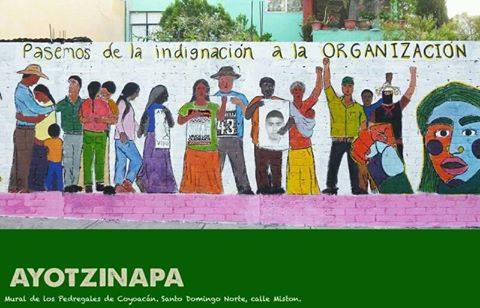
We went from indignation to ORGANIZATION.
By: José Antonio Román
An epidemic of disappearances exists in Mexico, fed by the government’s “incompetence, inertia and indolence,” which has been more worried about giving “entirely political responses” than about designing real and articulated efficient public policies for confronting that phenomenon, Amnesty International (AI).
Upon presenting the report Treated with indolence: the state’s response to disappearance in Mexico, the international human rights organization emphasized that almost half of the 27,600 people disappeared or not located, according to official numbers, have been reported during the administration of president Enrique Peña Nieto; 3,425 of them in 2015.
AI points out in the 52-page document that many cases derive from detentions by members of the Army or police, and the fact that Mexico lacks a registry of apprehensions “permit the authorities to deny all responsibility and wash their hands of it.”
It warns about the urgency with which the Mexican State recognizes the magnitude of the problem and fully assumes its duty to investigate all the cases of disappearance and enforced disappearances that occurred in the country, and of bringing those responsible before justice, adhering to due process guaranties, as well as assuring access to integral reparations for the harm to all the victims and their family members.
In the report, AI chose two emblematic cases that demonstrate various facets of the problem. One case is that reported in recent years in Ciudad Cuauhtémoc, Chihuahua, where 351 people have disappeared since 2007; 1,700 people have disappeared in the entire state.
The other case is that of the 43 students from the Raúl Isidro Burgos Rural Teachers College, of Ayotzinapa, Guerrero.
“In Mexico it doesn’t matter whether a disappearance is treated as a hidden situation or is a high profile case, the authorities seem incapable of giving a solid and institutional response that may lead to finding the truth and guarantying justice,” the report presented officially yesterday at the Memory and Tolerance Museum points out.
Amnesty International points out that the incompetence that affects the whole system and the total absence of will from state and federal authorities to investigate the disappearance of thousands of people and dutifully look for them feed a human rights crisis of epidemic proportions.
“The incessant wave of disappearances that has seized Chihuahua and the total lack of responsibility with which the investigation into the enforced disappearance of the 43 Ayotzinapa students is being managed show the Mexican authorities absolute disrespect for dignity and human rights,” asserted Erika Guevara-Rosas, director of Amnesty International’s program for the Americas.
It emphasized that in many cases of denounced disappearances the victim was last seen when members of the police or the Army detained him. Nevertheless, “the Mexican government lacks a detailed registry of detentions, which permits the authorities to deny all responsibility and wash their hands of the commission of enforced disappearances.”
As a result of an investigation, as well as interviews and testimonies from family members of the victims in the case of Ciudad Cuauhtémoc and that of Ayotzinapa, AI assures having established that in neither of them has the search for the disappeared been adequate and well planned.
In both situations, it adds, the authorities have been irresponsible in the way in which they manage the case information.
They also observed that the treatment that the authorities in charge of the investigation give the families is insufficient, hurtful and profoundly disinterested.
The report concludes with 21 recommendations for the Mexican State in the legislative ambit, the search for those disappeared and investigation of the facts, integral repair of the harm and other public policy matters.
———————————————————–
Originally Published in Spanish by La Jornada
Friday, January 15, 2016
Re-published with English interpretation by the Chiapas Support Committee
San Francisco Teopisca defends its land
AFTER 19 YEARS OF DEFENDING THEIR LAND, PROVOCATIONS CONTINUE AGAINST SAN FRANCISCO TEOPISCA, AN ADHERENT TO THE SIXTH
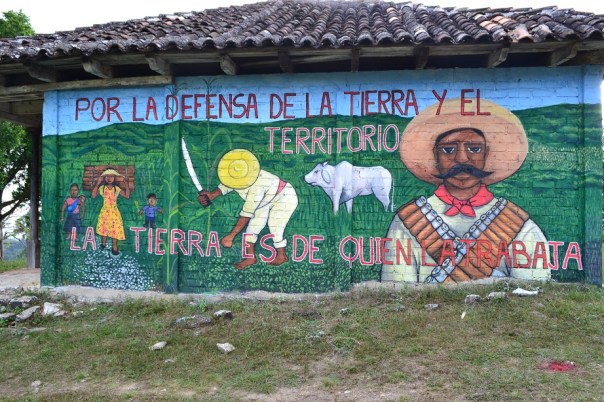
San Francisco Teopisca, Chiapas, Mexico.
“We place responsibility on the 3 levels of government for what can happen to any one of our compañeros for not giving priority to our land demands that we demand as campesinos. We also place responsibility on Señor Pedro Hernández Espinoza for any physical harm that any of our compañeros may suffer.” (Campesinos and campesinas of San Francisco, municipio of Teopisca, Chiapas México, January 10, 2016.)
To the EZLN
To the CNI (Congreso Nacional Indígena, National Indigenous Congress)
To the adherents to the Sixth Declaration of the Lacandón Jungle
To the alternative communications media
To the human rights defenders
To national and international society
We are a group of men and women adherents to the Sixth Declaration of the Lacandón Jungle since 2009, when we started in the struggle as the Other Campaign. Currently, we are part of Semilla Digna (Dignified Seed), which is a group formed by communities of the Sixth in Chiapas, belonging to the CNI. Our struggle is the defense of land and territory.
In 1995, we campesinos started to take steps with the state government of Chiapas to legalize the piece of land called “El Desengaño,” approximately 170 hectares (421 acres) owned by Pedro Hernández Espinoza. But the government never gave us a solution to our need for land. Much time passed and we saw that it was impossible that the government would attend to our request. We decided to occupy these lands because we have the legitimate right being the original peoples and the right to free determination as Convention 169 of the ILO points out.
We have been defending these lands for 19 years, organizing men and women and after several years we decided to formally work these lands. In 2012, we placed a banner on which it says that these lands are ours for the reasons mentioned on March 24, 2014. We placed various hand-painted signs (letreros) to declare and demand our legitimate right. On July 19, 2014, we declared ourselves to be in formal possession of “El Desengaño.”
On September 24, we campesinos once again pronounced that we would continue working it. We, the campesinos of this San Francisco group, have been looking for the most kind and peaceful way to dialogue with Señor Pedro Hernandez Espinoza. We have extended various invitations in various ways, but he never accepted or fulfilled any invitation we made. Now, Señor Hernández Espinoza animals are kept in a smaller space and we gave him 5 days to come and take them out, because we hold to our word that we don’t want the animals, WE WANT THE LAND.
We place responsibility on the 3 levels of government for what could happen to any of our compañeros because of not giving priority to our demands for the land that the campesinos urgently need. We also place responsibility on Señor Pedro Hernández Espinoza for any physical harm that any of our compañeros may suffer.
Sincerely,
Organized Group of Teopisca, Chiapas, Mexico
Adherents to the EZLN’s Sixth Declaration
Members of Dignified Seed, a space for struggle
Members of the National Indigenous Congress
NEVER MORE A MEXICO WITHOUT US
—————————————————–
Originally Published in Spanish by: Pozol Colectivo
Monday, January 11, 2016
Re-Published with English interpretation by the Chiapas Support Committee
Zibechi: From the Bagua Massacre to autonomous government
By: Raúl Zibechi
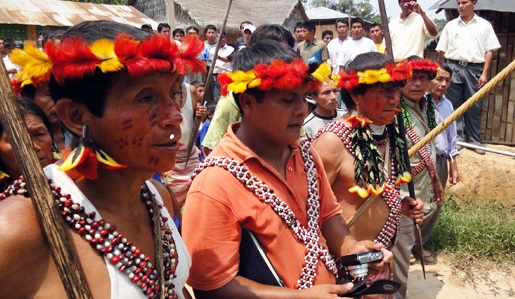
The formation of Peru’s first autonomous government, on Sunday, November 29 in Soledad community in the Río Santiago District, in the Amazon Province, is the fruit of a long history of frustrations and struggles. That day, 300 representatives from 85 Wampis communities installed their self-government as a way to defend 1.3 million hectares (3.2 million acres) of forests from the extractive multinationals.
They elected the first president of the autonomous territorial government and the 80 members of their parliament, which is to be installed in February. The newspaper Lucha Indígena (Indigenous Struggle), directed by Hugo Blanco, advanced the news in its July edition pointing out: “Appealing to autonomy as a way of solving problems is something novel in the country, but it is present in various indigenous nationalities of other countries. We hope that this will be the start of a new way of behaving from our social movements.”
The immediate background for the installation of the autonomous government was the Wampis Summit on Integral Territory and Autonomous Governance held last June 29-30 in Nueva Alegría community, where 120 representatives of the communities close to the Morona and Santiago Rivers met, in Northern Peru near the border with Ecuador. In that meeting they debated the internal situation of the Wampis people, approved the Autonomous Statute of Territorial Government of the Wampis Nation, designated a commission for the constitution of the government and presented the project of the biological corridor in their territory.
The nine-page document is the traditional text of the indigenous peoples, where below three pages of print appear another six replete with signatures, seals and even fingerprints that put the mark of approval on what was agreed, community by community, completing the ritual of big decisions. It’s a sample of the democracy of those below.
In the first part, the document titled “Act of Validation of the Autonomous Statute of Territorial Government of the Wampis Nation” analyzed the weaknesses in the communities and organizations. It emphasizes the threat that the presence of oil, mining and lumber companies represents to the people, and defends the union for “asserting our rights with the State and the private sector.” The Statute approved consists of 61 articles and three temporary articles whose contents were amplified during the debate, while others were left out.
Among the agreements figures the rejection of the entry of extractive companies without consultation, “not permitting that other indigenous organizations continue emerging since we are preparing to install our own government structure.” This exclusion is justified in the affirmation of sovereignty and self-determination in the face of State’s interference, international cooperation and the NGOs that usually promote the formation of organizations outside the control of the communities in order to weaken the indigenous nation’s project.
Finally, the meeting set the dates of November 28 and 29 for installing the autonomous government, as effectively was done.
The distant background implies going back to the decade of the 1970s when the Aguaruna-Huambisa Council, made up of Awajún and Wampis (names in the language of these warring communities), was formed around 1977. That signified a profound change in the history of the peoples. Representatives of the communities coming from the Cenepa, Nieva, Marañón and Santiago Rivers went to the first General Assembly.
It was the first occasion on which both peoples overcame their historic rivalry to confront external threats. Later would come a long period of resistances more or less open, more or less implicit, as so many native peoples of this continent have lived.
On June 5, 2009, a massacre took place against the Awajún and Wampi that had been mobilizing against decrees of the Alan García government that delivered their wealth within the framework of the FTA with the United States. The government sent the armed forces to dislodge a peaceful protest that lasted 57 days focused in the jungle regions of five departments (states): Amazonas, Cusco, Loreto, San Martín and Ucayali. Three MI-17 helicopters flew over the highway that joins the jungle with the Pacific at Devil’s Curve, which some five thousand Awajún and Wampis occupy. They launched tear gas at the crowd the (although other versions say that they also fired machine guns) while police attacked the blockade on land, firing their rifles.
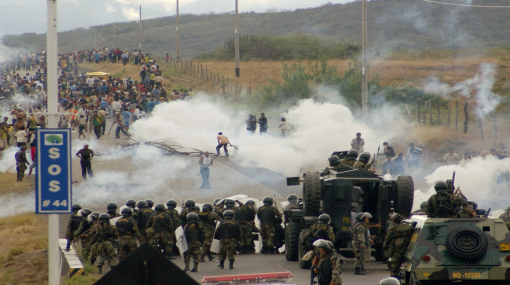
Police officers take up positions against native people in Bagua province June 5, 2009. The death toll rose on Saturday after Peruvian security forces battled native Indians in clashes that highlighted opposition to exploration in the Amazon and could threaten Peru’s investor-friendly government. Nine police officers held hostage by the protesters were killed and another 22 were freed by troops in a rescue operation, National Police Chief Miguel Hidalgo told Peru’s RPP radio broadcaster. He said seven other hostages were missing. Picture taken June 5, 2009. REUTERS.
The Bagua population went out in the streets in support of the indigenous, setting state and local institutions of the officialist (pro-government) APRA party on fire. Dozens of indigenous were dead because of the soldiers and a still undetermined number were disappeared. Several police were dead because of the indigenous. The Prime Minister Yehude Simón, a former ally of the armed group MRTA (Tupac Amaru Revolutionary Movement), classified the indigenous demands as “whims.”
The decision to form their self-government can be a decisive step for Peru’s popular struggles. In the case of the Wampis it seems the corollary of a long path on which they comprehended that you can’t expect anything from those above.
—————————————————————–
Originally Published in Spanish by Desinformemonos
Monday, December 7, 2015
Re-published with English interpretation by the Chiapas Support Committee
66 Police injured in Oxchuc, Chiapas confrontation
CONFRONTATION WITH RESIDENTS IN OXCHUC; THERE ARE 66 POLICE INJURED
By: Elio Henríquez, Correspondent

Before, during and after the confrontation with police in Oxchuc, Chiapas, dissidents burned three trucks belonging to the State Preventive Police, two small trucks of the “Trustworthy Police” and two buses belonging to commercial lines, besides damaging a tractor-trailer. Photo: La Jornada
San Cristóbal de las Casas, Chiapas
The assistant government secretary in the Los Altos zone of Chiapas, Edgar Rosales Acuña, reported that a confrontation between state and municipal security forces and residents of the municipio of Oxchuc that demand the dismissal of Mayor María Gloria Sánchez Gómez, of the Green Ecologist Party of Mexico (PVEM, its initials in Spanish), left 66 police injured, 15 houses vandalized and eight vehicles burned.
He said that the confrontation took place on Friday night when some 500 state police attempted to recover control of the municipal headquarters, situated 50 kilometers from this city (San Cristóbal de Las Casas), hours after the state police detained 38 opponents of the mayor, for the crime of rioting and for their alleged participation in the protests against Sánchez Gómez, who won the elections last July 19.
A dispute over power
The dispute for power in Oxchuc between the mayor and the local deputy, Cecilia López Sánchez, also of the PVEM, intensified with the burning of the city hall two days before the mayor would take possession of the office on last October 1, for the second time in less than 15 years.
For the last three months hundreds of Sánchez Gómez opponents have held marches and carried out roadblocks to demand her dismissal and the formation of a municipal council, with the argument that she divides the population and benefits from her position as mayor that her husband Norberto Sántiz López had.
After different proposals, state authorities called the dissidents to a meeting in this city last Friday to deal with the theme, but the 38 members of the commission were detained by the police.
Rosales Acuña explained that after the detention, which occurred after noon on Friday, hundreds of Oxchuc indigenous blocked the highway that communicates this city with Ocosingo and Palenque, at the place of the municipal headquarters. They took possession of a tractor-trailer and two buses and blocked a street to impede the passage of state police vehicles.
He added that at night more than 500 police entered the municipal capital, which derived into the confrontation with sticks, stones, machetes and other objects. “We have 66 injured, between state and municipal police that resisted the aggressors attack for more than three hours, after they found out that their leaders had been arrested,” he assured.
He reported that only eight of the agents were hospitalized, of which two are “delicate” and were moved to Tuxtla Gutiérrez. “They were injured with rockets, Molotov cocktails, sticks, stones and other objects.”
He expressed that before, during and after the confrontation, the dissidents set fire to three State Preventive Police trucks, two small trucks of the Trustworthy Police and two buses belonging to commercial lines, besides damaging a tractor-trailer.
He stated that they vandalized 15 houses, among them that of the municipal president and of the Indigenous Peace and Conciliation Judge, Rogelio Sántiz López, who together with two of his sons remained held this evening.
Tension in the municipio
“The situation remains tense in Oxchuc, although with less intensity than yesterday (Friday). Fortunately, we have no deaths and all the injuries are on our side because the police went armed only with clubs,” he specified.
He maintained that the opponents of the mayor “are a tactical group with military training that make patrols at determined times, that intimidate, deceive people, oblige them to go to the marches because if they don’t they fine them. They also threaten them with taking away (cutting off) their water, light and drainage. They are well-trained groups that are confronting the governmental apparatus.”
The opponents reported that the assistant secretary for human rights of the Chiapas Secretariat of Government, Mario Carlos Culebro Velasco, “deceived” them because upon initiating the Friday meeting he told members of the commission that: “two packets would be open for negotiation: the mayor’s dismissal and that of Deputy Cecilia López, (and) he offered to integrate some of us into the Oxchuc municipal government and into the state government.”
In a comunicado signed by Hilda Gómez and Reynaldo Sántiz, they added that: “Culebro Velasco asked if we wanted to eat some tamales, and therefore ordered his collaborators to serve them with coffee. He left the office at 12:25 PM and two minutes after the farce of showing friendliness, ministerial police agents entered and detained the commission’s 38 members.”
The dissidents insisted on the dismissal of María Gloria –who works out of her private home–, releasing the detainees and forming: “a plural and inclusive municipal council that will generate peace and will work for all of the communities in Oxchuc.”
Translator’s Note:
The day after this was published, the Altos (Highlands) teachers’ organization issued a statement about this situation, indicating the leftist teachers group may be involved, and a citizens’ group also issued a statement.
———————————————————–
Originally Published in Spanish by La Jornada
Sunday, January 10, 2016
Re-published with English interpretation by the Chiapas Support Committee
Zibechi: Movements facing the end of the democracies

By: Raúl Zibechi
In his first 2016 article, the winner of the Nobel Prize for Economics, Paul Krugman, analyzes the consequences of the domination of the oligarchy’s money in his country’s political system. Under the title “Privileges, pathology and power” (The New York Times, January 1, 2016), he maintains that: “the rich are, on the average, less likely to show empathy, with respect to the norms and laws, even more likely to be unfaithful, than those that occupy the lower rungs on the economic scale.”
It’s not just about a social and cultural condition, even less about a spiritual tendency. He centers his analysis on the answer to a key question: “What happens to a nation that grants greater political power all the time to the super rich?”
The answer is pearled from examples. Half of the contributions to all candidates in the first part of the 2016 electoral campaign come from less than 200 wealthy families. Those kinds of families have children whose behavior Krguman classifies as “spoiled egomaniacs” whose best example is the candidate that marches at the front of the Republican gang, Donald Trump. In his opinion, he could have been “a blowhard and a bully” in any place he occupies, because “his billions permit him to evade the controls that impede the majority of people from releasing their narcissistic tendencies.”
Another example: Sheldon Adelson, is a magnate of Las Vegas games of chance, accused of links to organized crime and the business of prostitution. To block his court proceedings, he bought Nevada’s largest newspaper, displaced the print version, told the reporters to start monitoring all activity of three judges of the court in charge of his case and allegedly started to “publish negative reports about the judges.” The multi-millionaire Adelson started to play an important role inside the Republican Party from his Las Vegas bastion, which he uses as an electoral platform.
Krugman talks about an oligarchy that has taken possession of politics. It can be said that this is nothing new and that there are only a few analysts that agree with that judgment. Paul Craig Roberts, former assistant secretary of the Treasury in the Ronald Reagan government, maintains that the collapse of the Soviet Union in 1991 provoked an explosion of arrogance in the United States elites that carried the neo-conservatives to control of the country’s foreign and domestic policy. The repeal of internal financial regulation and the tendency to lead the world towards nuclear war at the international level are some of the most ominous consequences of this systemic turn.
For the popular movements, the problem does not consist only in establishing that up there above they have lost direction, since they don’t have either contact with society or the least bit of interest in that society’s survival. Only money interests them, the non-stop accumulation of wealth, even at the price of the destruction of life. Our problem is what to do with an electoral system that has been converted into the political system’s only public rite that really exists. Although the majorities know that the elections are rigged, that fraud is systematic (before, during and after the emission of the vote), that although they get to elect the lesser of the evils (if one exists) nothing fundamental is going to change, there are many below that still believe their best path is to improve the current situation.
I think that the recent comunicado of the EZLN, on January 1, gives us some clues about how to get out of this involuntary situation that leads to the hegemonic political culture. The text that Subcomandante Moisés read in Oventic, emphasizes that the standard of living of the Zapatista communities is very superior to what they had 22 years ago, when the open rebellion started, and better than that of the communities related to the government. “Selling out to the bad government not only did not resolve their needs, but rather added more horrors. Where before there was hunger and poverty, now hunger and poverty continue, but there is also despair.”
While the party members have been converted “into groups of beggars that don’t work, they just wait for the next governmental program,” the Zapatistas are not only known for using the paliacate but because they know how to work the land and take care of their culture, because they study and they also respect women, for their dignity. The Zapatistas have “the clean and lofty view,” they consider the autonomous government as a service and govern collectively.
The Zapatistas don’t expect solutions to come from above; for 22 years, the comunicado says, “we have continued constructing another way of life” that includes self-government. I believe the key is here. Even the most renowned members of the system, like Krugman, recognize that everything is rotten up there above. We know that and it’s good to remember it.
But we still lack constructing that other way of living: being capable of governing ourselves. Above all, we still lack believing that we are capable of doing it and, therefore, starting to do it. The new political culture won’t come from books or from declarations: it emerges from collective work with others.
——————————————————————–
Originally Published in Spanish by Desinformemonos
January 4, 2016
Re-Published with English interpretation by the Chiapas Support Committee
Ejido Tila occupies municipal headquarters
[Intro: The Ejido Tila continues to occupy the municipal building that its members partially destroyed and then occupied on Decembers 16, 2015. Ejido members occupy the building and the ejido publishes frequent updates (comunicados) on their website: http://laotraejidotila.blogspot.mx/ The comunicado below expresses solidarity with other adherents to the EZLN’s Sixth Declaration that are facing eviction or paramilitary attacks, thus giving an overview of what’s happening in Chiapas with adherents to the 6th.]
=================

Banner hanging on the facade of the Tila municipal headquarters, now reclaimed and occupied by members of the ejido and adherents to the EZLN’s Sixth Declaration.
AGAINST the GOVERNMENT’S PARAMILITARY ACTIONS TOWARDS LAS ABEJAS, RESPECT for SAN ISIDRO LOS LAURELES and A THANK YOU TO BACHAJÓN
Ejido Tila, Chiapas, Mexico January 02, 2016
To: Public Opinion
To: The national and international Mass communications media
To: The social organizations that fight for justice and dignity
To: The Network against Repression and for Solidarity
To: The adherents to the Sixth Declaration of the Lacandón Jungle
To: The Non-Governmental Human Rights defenders
To: The National Indigenous Congress (CNI)
To: The National and International Sixth Commission
Receive a cordial greeting from adherents to the (EZLN’s) Sixth Declaration of the Lacandón Jungle of the Ejido Tila, Chiapas Mexico and an embrace to all the organizations in solidarity with our struggle, a struggle that will be tireless because we must be in solidarity with each other against that capitalist monster that converts our lands into merchandise in order to gain more money and subject the poor to being even poorer. To the compañeros and compañeras of San Sebastián Bachajón: thank you for your solidarity with our struggle.
We demand that the state government not repress our compañeros and compañeras of San Isidro Los Laureles [1] in the municipality de Venustiano Carranza, Chiapas and from the Ejido Tila and all the corners we will continue demanding because it’s time to join forces, because we will not permit that they continue committing injustices towards the indigenous communities. The lands that our indigenous brothers of San Isidro Los Laureles reclaimed must be respected, just like they respected the belongings of the alleged owner that monopolizes large extensions of land.
Our brothers and sisters fear a possible eviction on the government’s part and from here we demand respect and that decisions to reclaim their lands that were in the possession of the large estate owners for a long time and that they have decided to reclaim be respected. Also, on December 16, 2015, the Ejido Tila recuperated its land and expelled the municipal authorities that wanted to expropriate 130 hectares of our land in order to convert them into private property. We will be demonstrating forcefully over anything that may happen to our brothers because the Ejido Tila is also on maximum alert for whatever counterinsurgency attack that the three levels of government are preparing for attacking the Ejido Tila and other Chiapas organizations with the use of paramilitaries whatever you call them.
We reproach the constant aggressions that our brothers and sisters of the organization Las Abejas of Acteal, Chenalhó, Chiapas have suffered that paramilitaries ambushed near Pantelhó municipality on December 29, 2015 [2] and as always all these aggressions have been kept in complete impunity as they have the support of the three levels government, therefore they continue murdering and harming our brothers and the municipal police don’t do anything because they are well coordinated from the three levels of government. Attorney General C. Raciel López Salazar denies that paramilitary groups exist and as always he comes out and tells us that it’s an intercommunity conflict. But from here we demand a stop to the attacks and harassment; and also that those responsible for these acts are punished. There are more social fighters and political prisoners in Mexico’s prisons than criminals, because the government utilizes them for hiding and stockpiling its Armed Forces.
We ask all the social organizations and non-governmental human rights defenders to be on alert for the wave of attacks on our brother and sister fighters and we will continue reporting how often they are and we will not tire.
Sincerely,
Tierra y Libertad
EJIDO TILA
President of the Ejido Commission
President of the Vigilance Council
(SEALS)
NEVER MORE A MEXICO WITHOUT US!
STOP THE REPRESSION AND ATTACKS AGAINST THE INDIGENOUS COMMUNITIES!
WE ARE ALL ABEJAS OF ACTEAL!
Ejido Tila Adherents to the Sixth
http://laotraejidotila.blogspot.mx/2016/01/contra-las-acciones-paramilitares-del.html
—————————————————
[1] On December 20, 2015, Los Laureles community reclaimed (recuperated) approximately 407 acres of neighboring land formerly worked by their grandparents as serfs. Los Laureles community is a member of the Semilla Digna organization, which is an adherent to the Sixth Declaration of the Lacandón Jungle.
[2] On December 29, armed men wearing military clothing shot at 3 young brothers from a family belonging to Las Abejas of Acteal. No one was seriously injured, but one of the brothers sustained an injury to his foot. Las Abejas denounced that these armed men were dressed the same as those who murdered Manuel López Pérez 6 months ago in the same region of Pantelhó municipality.
——————————————————-
English interpretation, Intro and footnotes by the Chiapas Support Committee
Background article: http://compamanuel.com/2015/12/29/accuse-tila-mayor-of-reactivating-paramilitaries/
Esteva: Disputing politics
By: Gustavo Esteva
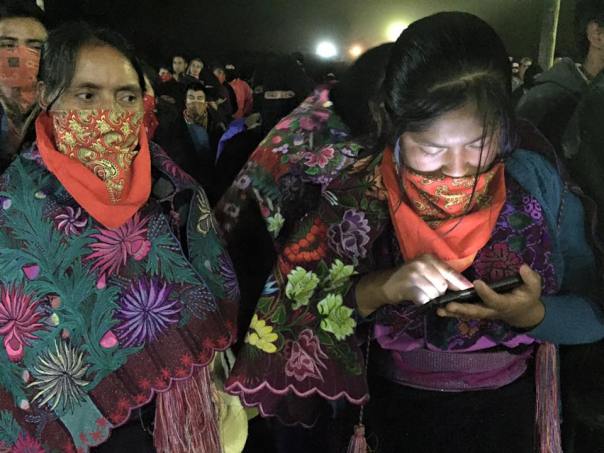
It will be a year of intense political dispute, in the midst of war. But the dispute among the politicians will be irrelevant. What will be important is disputing politics itself, reclaiming it.
On the surface, attention will be on the politicians. There will be advances of the 2018 presidential contest and elections for governors, municipal authorities and deputies in more than a third of the country. Electoral propaganda will conceal the void. The maximum distribution of the irrelevant will dissimulate the absence of a debate about what’s important, particularly about the ominous perspectives of environmental and social disaster that hover over us. All over the country it will continue becoming evident the distance between the discourse of the political and economic leaders and the real conditions of the population and the country.
In the world of politicians, nobody dares to recognize the state of things. They intensely dispute to win government positions, under the superstition that once in them they will be able to govern… and that they will do it for the common good. They are not able to recognize that they could only win soft jobs and privileges and a marginal influence on what happens, at the price of becoming accomplices of all kinds of corrupt acts and of the destruction of the natural and social life to which all governments are dedicated. It cannot be any other way. In today’s world, all the “governments” have to subordinate themselves to the logic of capitalism… and one cannot govern with capitalism, if by government we understand regular behaviors and events functioning for the common good.
There are many ways of dealing with the capitalist hydra. All the following adjectives fit: cruel, ingenuous, efficient, blind, incompetent, skillful, populist, fascist, xenophobic… But all, because of the very structure of the governments, as much the state apparatus as what continues to be called democracy, are subordinate to the logic of capitalism and therefore to its corrupting and destructive impetus. Few politicians dare to react before anticapitalist postures in the terms of the leader of Podemos, in Spain, who declared last June 25: “May you hold onto the red flag and leave us in peace. I want to win.” And that way he won what he won: the sacred right to complain. His position is not mere cynicism. It’s about a realistic attitude in the electoral game: in order to win it is indispensable to sell your soul, because once above it isn’t possible to hold on to it. It is pure demagogy to maintain that once in the government it will be possible to really be occupied with the common good and to preserve decency and an ethical sense.
Because of that the real dispute is in another place: it is the struggle to justify political activity, drawing away from the stench of the electoral fight and on the other hand occupying ourselves with resisting and constructing: resisting the dominant and destructive horror, more blind and aggressive all the time, and constructing the new world, a world that leaves behind the capitalist mode of production as well as its form of political existence, the “democratic despotism” that prevails in the nation-states and the international institutions.
Resistance and construction of the new, each time more inseparable, in practice demand being busy day after day, tirelessly, in homes, families, communities, collectives and organizations of all kinds, for dismantling capitalist social relations and the political relations that make them possible.
The dominant regime, with its two-faced politics and economics, now organizes an unprecedented devastating war against life in all its forms. It is not the will of a few politicians or capitalists that enrich themselves from it: it is an inertia in which they themselves are prisoners. Therefore it’s useless to pretend that the substitution of some (others) could stop that war. The only way to achieve that is to dismantle its basis for existence through the construction of political and economic autonomy.
The EZLN says well in its January first comunicado that: “a bloody night… extends over the world (…) It’s clear that the worst is coming (…) We must organize ourselves, prepare ourselves to fight, for changing this life, for creating another way of life, another way of governing ourselves, the peoples (…) There is nothing now to trust in capitalism (…) Now only the trust among ourselves remains… Therefore we must unite more, organize ourselves better for constructing our ship, our house, in other words, our autonomy, because it’s what is going to same us from the storm that approaches (…) It’s the time for reaffirming our conscience of struggle and for committing to continue forward, cost what it may and whatever happens (…) It is not the time to get discouraged or for getting tired, we ought to be firmer in our struggle.”
In the face of what is coming, the temptation to surrender, sell out and give up is great. It has many faces and justifications. There doesn’t seem to be any other option than to adapt to what exists… There is no other way, is said continuously. But there is! And that other plural way, difficult and uncomfortable but valiant and imaginative, that option of resistance and construction, appears each time more as the only form of surviving the general war that is currently unleashed against everything that’s alive and will be intensified this year to unprecedented levels. There is no place for optimism, but we begin the year full of hope. The voice of the EZLN is not marginal or isolated. It finds resonance in the entire world. At the end of the day, we are the most.
———————————————————–
Originally Published in Spanish by La Jornada
Monday, January 4, 2016
Re-published with English interpretation by the Chiapas Support Committee
 Chiapas Support Committee