Chiapas Support Committee
Home of the Compañero Manuel blog on zapatistas & mexico
Mining and the Oaxaca massacre
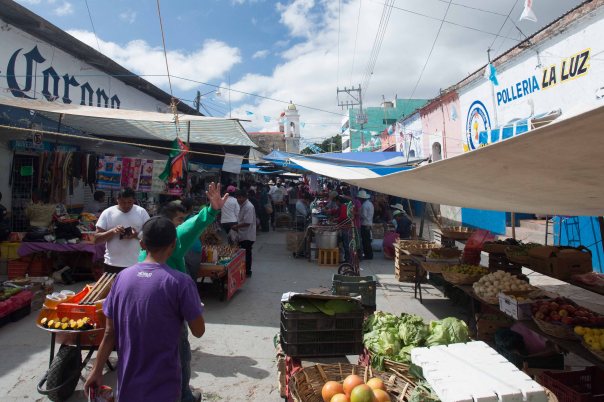
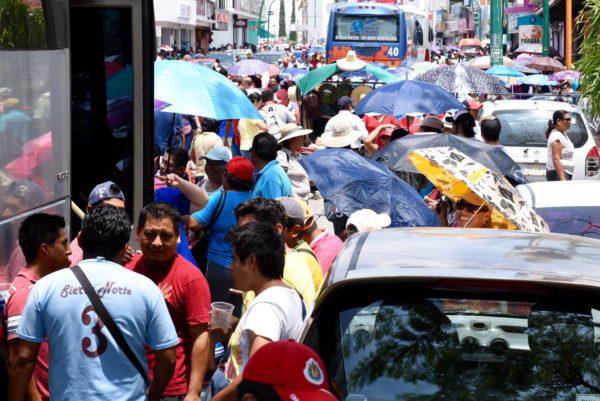
A market scene in Nochixtlán, the capital of a large indigenous district. The police attack took place on a market day, thereby maximizing the number of civilians present.
By: Agustín Ávila Romero
The massacre in Nochixtlán, Oaxaca where 11 people lost their life, more than 100 were injured and 18 were removed from a funeral so that the Federal Police could present them as detainees, not only shows that grave democratic backwardness lives in Mexico, where a civilian demonstration is answered with the use of heavy-caliber firearms despite being prohibited for dissuading social protest in international protocols; it also shows the inability of the Secretary of Education, Aurelio Nuño, to start a dialogue and carry out an education reform that fully includes the actors in the process of teaching-learning in the impetus of education in Mexico.
But beyond freeing a path of communication, what are the reasons behind why the Mexican government would act this way? What hidden and open interests are expressed behind this massacre? Why the cruel federal police attack against inhabitants of Nochixtlán, and why in this place? We’re trying to get close to an answer.
The Peña Nieto government accomplished a series of constitutional modifications with structural reforms that make possible the dispossession of lands in campesino and indigenous zones of Mexico. Different than the reform of the 90´s, foreign capital today can fully invest and through the national energy law establish serfdom schemes –they’re defined that way- where the campesinos can receive rent only for oil, gas and mineral exploitation. In that regard it defines priority use as that of energy and minerals and below that food or cattle production. Said reform has been advancing strongly in states in the country’s north and particularly in Veracruz. The dispossession and affectations to health due to mining and fracking (exploitation of gas and oil through fracture of the earth with high-pressure water) already live and beat in many regions of Mexico.
But it’s in the states in Mexico’s south-southeast -where the agrarian tradition is strongest- where capital confronts resistances and a decided opposition to its interests. Coincidentally, on June 1, some days before the repression in Oaxaca, Peña Nieto issued the decree about Special Economic Zones, through which spaces for transnational capital (STC) are constructed that would permit them to construct the enclave infrastructure necessary for the exploitation and exportation of mineral, energy (like the wind farms already installed on the Oaxacan Isthmus) and agro-combustible resources that these zones possess.
Meanwhile, what is verified in the state of Oaxaca is the process of decomposition of social and community fabrics by means of violence that would permit taking advantage and full disposition of these zones in the dynamic of accumulation by dispossession that the foreign mining companies and national and foreign capital have that were auctioned in rounds 1 and zero last year.
This is grave. If we look at a map we can think that this process of erosion and violence of the commons, initiated with force in the state of Michoacán with the full domination of drug trafficking over many territories (we remember La Familia Michoacana and the Apatzingan and Tanhuato Massacres), under force in Guerrero where the massacre of the Ayotzinapa students in Iguala, showed the alliances of political power with drug trafficking and mining in the exploitation of gold in the region. And now it arrives in Oaxaca in a noisy way with this news that goes around the world. This tendency towards the South begs the question: after Oaxaca, does a new massacre follow in Chiapas? At the bottom of this Shock logic –taking a phrase from Naomi Klein- it’s looking to deterritorialize these spaces, in other words, that the inhabitants abandon their other productive logics and that campesino reasoning to completely impose on them their condition as paid workers and agricultural subordination to the needs of transnational financial capital.
The chief of the federal police and the one finally in charge of the Oaxaca massacre, Enrique Galindo, now adds to a long list of violent evictions and extrajudicial executions. He led the eviction of teachers from the Mexico City Zócalo in 2013 with various teachers beaten and gassed. On November 20, 2014, he also led the expulsion from the Zócalo of the big demonstration that the parents of the disappeared Ayotzinapa students headed. Under his command, the elimination of the autodefensas of Michoacán in Apatzingán left 16 deaths in January 2015 and in Tanhuato 43 people accused of being drug traffickers were dead.
Meanwhile, one cannot assert that Galindo does not possess experience in the theme. It was something coldly calculated that happened in Oaxaca last Sunday, what they did not foresee was that they would film them using firearms, which they continue denying as of this date.
Nochixtlán, Oaxaca, according to studies of EPN’s Secretary of Economy, has mining potential that dates from the colonial epoch in the case of gold and silver in the El Dorado and La Soledad mines and from the middle of the last century for Manganese. It has five areas of minerals: Huaclilla-El Parian, Buenavista, Jaltepec, Jalpetongo and La Joya. It maintains one of the highest averages of attaining minerals by the ton, and a potential for gas exploitation also exists in that territory. And it is a connecting zone between the mining zones of the Oaxacan Mixteca, where private companies like Minerales del Norte of the AHMSA Group have started iron exploitation, affecting the rights of the indigenous peoples.
According to information from the federal government’s Secretariat of Energy, more than 15 percent of Oaxacan territory (more than a million hectares) is already conceded to mining companies for exploration and exploitation. Among those companies, foreign and Mexican companies stand out like: Golden Trump Resources S.A de C.V, Linear Gold Corp, Arco Resources Corp, Zalamera, S.A. de C.V. filial de Chesapeake Gold Corp, Cemento Portland Cruz Azul, SCL, Fortuna Silver-Continuum Resources, Compañía Minera del Norte, Aurea Mining Inc., Linear Metals Corp, Radius Gold, Compañía Minera Plata Real, New Coast Silver Mines LTD, Aura Silver Resources Inc. and Intrepid Mines Ltd.
In February of this year, residents of 48 communities and representatives of 30 organizations demanded the cancellation of 400 concessions and 35 mining projects in indigenous zones of Oaxaca, civilian organizations like EDUCA, Tequio Juridico, Unión de Organizaciones de la Sierra Juárez de Oaxaca and Servicio del pueblo Mixe, among others, supported said pronouncement.
Criminalizing and murdering members of organizations like the Frente Indígena de Organizaciones Binacionales (FIOB), el Consejo de Defensa de los Derechos del Pueblo (CODEP), el Frente Popular Revolucionario (FPR) or the Oaxaca Commune, among other organizations, only has the objective of sowing terror in the state and thus being able to fully carry out mining activities with their consequent effects on indigenous life and culture, on the environment, on health and on social relations.
The strategy of territorial division is something that the political parties have done, but in this fight in particular the teachers have achieved confronting, and uniting the inhabitants of the different regions of Oaxaca, Chiapas and Guerrero, where the fight is not strictly for education vindications, but rather has now moved to the defense of territory, life and ecology. Perhaps that is what the federal forces detected in Oaxaca and, therefore, wanted to give this blow that would permit breaking those social and community bonds of self-management.
———————————————————————
Originally Published in Spanish by Desinformemonos
Thursday, June 23, 2016
http://desinformemonos.org/mineria-el-fondo-de-la-masacre-de-oaxaca/
Re-Published with English interpretation by the Chiapas Support Committee
In Chiapas they protest the repression in Nochixtlán
WITH ROADBLOCKS, MARCHES, PROCESSIONS, PRAYERS AND TWO FEDERAL POLICE DETAINED, THEY PROTEST THE REPRESSION IN NOCHIXTLÁN
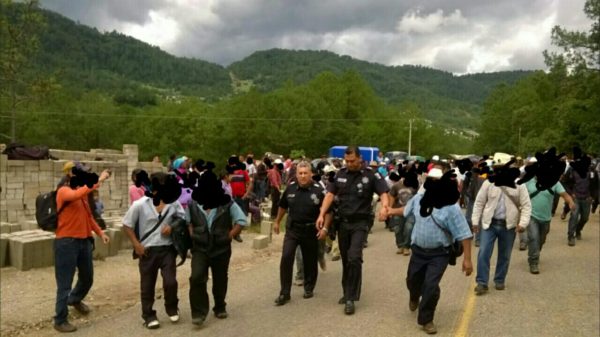
Indigenous people detain Federal Police in Huixtán, Chiapas.
Excerpt from an article in Chiapas Paralelo by Isaín Mandujano
June 21, 2016
With roadblocks, public pronouncements, processions and religious prayers, as well as the retention of two Federal Police, Indigenous peoples, campesinos, parents and teachers of Chiapas demanded a stop to the repression in Oaxaca and punishment of those responsible for the crimes committed during the eviction in Nochixtlán.
Teachers adhered to Sections 7 and 40 from the National Coordinator of Education Workers (CNTE) of the National Union of Education Workers (SNTE), blocked the two principal exits from Tuxtla: to Mexico City and to Los Altos of Chiapas.
From 9 o’clock in the morning to 6 o’clock in the evening, dissidents blocked accesses to the city. The C4 security system reported that a truck of the Bimbo Company was looted at Tuxtla’s western exit, where the teachers maintained a roadblock. Although it is not affirmed that those who looted the truck were teachers, a crowd was seen unloading boxes of bread.
At both roadblocks, the teachers distributed flyers repudiating the repression of the federal forces that left six dissidents dead and 21 Federales injured.
Federal Police detained in Huixtán
At the same time as this roadblock, two Federal Police agents that were found near the municipio of Huixtán were detained and tied up by indigenous Tsotzils that maintain a roadblock in solidarity with the teachers of Chiapas and Oaxaca. In the morning, the indigenous established the blockade on the San Cristóbal de las Casas-Palenque highway at the Huixtán location.
Meanwhile, the indigenous residents of Huixtán obliged the federal agents to speak with their superiors in Tuxtla Gutiérrez via telephone. They ordered them to tell their commanders that if they repressed the teachers in their roadblocks or in any other social movement, they would be killed and burned.
People of Faith from the jungle region march
Pueblo Creyente (Believing People) march with teachers in Tuxtla.
In the state capital, indigenous peoples from the parishes of Tila, Palenque, Salto de Agua, Tumbalá, Huixtán and other municipios marched in a procession to demonstrate their support for the teachers. They marched for several kilometers until reaching the central plaza, where the teachers’ occupation has been camped since May 15.
Marcelo Pérez Pérez, the parish priest of Simojovel, called to the police: “Señor police, you must not obey an order given by the government to kill people, because above all, must reign God’s commandment: Thou shall not kill. And if you obey such an order from the government, God asks you: Where is your brother? What have you done? Your brother’s blood cries out and his cry comes to me me from the earth.”
Later, he directed his word to president Peña Nieto: “You are the authority and your authority is for serving, not for repressing, much less for killing. Your obligation is to protect Mexicans. A law implemented with bullets is a law that is sinking.”
Two days earlier
On June 19, traditional dancers from the Chiapas city of Ocozocoautla (Coitecos) joined the teachers in another cultural march.
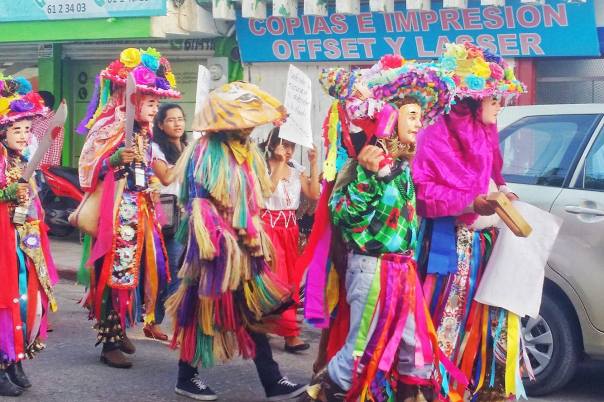
Coitecos march with Chiapas teachers
Compiled by the Chiapas Support Committee
June 26, 2016
Psychosis in Nochixtlán, Oaxaca
PSYCHOSIS IN NOCHIXTLÁN AFTER THE BRUTAL EVICTION, THE MAYOR ELECT DENOUNCES

NOCHIXTLAN, OAXACA, June 19, 2016.- CNTE teachers supported by citizens were attacked by Federal Police that sought to remove a highway blockade that the teachers had maintained for days as part of their fight against the Education Reform. 12 people are now reported dead.
PHOTO: ARTURO PEREZ ALFONSO /CUARTOSCURO.COM
By: Gabriela Romero Sánchez
Almost one week after the eviction of the Section 22 teachers belonging to the National Coordinator of Education Workers (CNTE) by the Federal Police, residents of Nochixtlán, Oaxaca, are afraid to go into the streets and afraid of being repressed again upon being considered unstable and rebel people by the federal government, narrates the municipal president elect of Nochixtlán, Rubén Alcides.
“On Thursday, a helicopter without registration letters to identify it, started to fly very low, and that motivated people going about their daily activities to run and hide,” he said.
He comments that there are still people with bullet wounds that go to private doctors offices for medical attention. “No one wants to say their name, because they think that the federal government will come to capture them for having participated in the protest.”
Alcides and a group of nine neighbors from the municipal capital resorted to federal Deputy Jesús Valencia to look for support from different bodies, among them the Government of Mexico City (now a state), for the reconstruction of their town, since, they assure, not any rapprochement exists on the part of the federal government.
“We’re talking about people that are experiencing a tremendous psychosis, who have bullet wounds,” he describes.
He describes that the eviction from the federal highway began around 6 o’clock in the morning and that a group of teachers and parents were there, “let’s say a reduced number,” but it was also market day, therefore upon initiating the operation many people came out to support a friend or parent.
They refute the version of the authorities that assert that members of the federal police were not carrying arms: “They were indeed armed. It was a totally unequal attack, underhanded and above all disproportionate,” the municipal president elect summarizes.
Alcides denies that the local priest had incited violence; to the contrary, he asserts, he gave space in his parish church for attending to the injured without importance to whether they were civilians or federal police; while at the hospital only the police were received.
A doctor in the group, who also aided in the parish that day and asked for anonymity out of fear, intervenes: “There was no surgical material for attending to the injured, around 30 people went there, of which at least 10 had bullet wounds. How can they say that they were rubber bullets when they had entry and exit orifices in their thorax and in their arms or legs!”
He indicates that around 10 o’clock in the morning they asked permission to use the two ambulances that exist in Nochixtlán, without obtaining an answer. “People started to get angry over that, they wanted to move the injured to a hospital; then, they set fire to the municipal presidency to get them out.”
The tension increased, he said, when they heard that there was one death. “People came out of their houses to support their sons, brothers, fathers. They were saying: ‘they are killing us!’”
He rejects that there were individuals unrelated to the community in the town, “we see each other every day; some of them go to my doctor’s office.”
Alcides points out that upon assuming the office he will receive a destroyed town, with the municipal palace (City Hall) and the Civilian Registry burned, without services. Above all “with intense pain in the population that feels hatred towards the federal and state governments. They arrested 19 people from the town when they were digging a tomb for a relative, their crime was carrying a pick and shovel.”
The municipal president elect urges the competent authorities to indemnify the families of the people that died: “it’s people that live in extreme poverty.” He asks for resources for the reconstruction of the damaged public buildings: “we are without legal identity, they don’t issue birth and death records.” And he asked to activate job sources.
In the afternoon the Secretary of Mobility, Héctor Serrano Cortés, attended to the group of people on behalf of the Mexico City Government. After listening to them he offered to support them with medications and food.
——————————————————–
Originally Published in Spanish by La Jornada
Saturday, June 25, 2016
http://www.jornada.unam.mx/2016/06/25/politica/007n1pol
Re-published in English by the Chiapas Support Committee
EZLN: Hour of the Police 4
FROM THE SPOILERS NOTEBOOK OF THE CAT-DOG
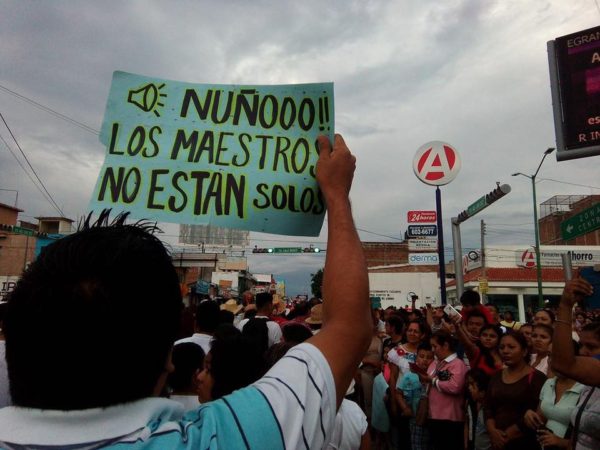
The sign reads Nuñooo!! The teachers are not alone. A phoyo from demonstrations in Tuxtla Gutiérrez,Chiapas.
June 2016
– This is the question. What would the most appropriate metaphor be for the sad and gray overseer police aspirant?
Aurelio Donald Nuño Trump? [1]
Aurelio Ramsey Nuño Bolton?
We believe, in accordance with his thirst for blood and his cowardice, he would prefer the second. And, just like in the television series “Game of Thrones,” Ramsey Bolton is devoured by the dogs that he used before for attacking others; the paid media that Nuño has used to slander, threaten and attack the teachers in resistance and the communities and solidarity organizations, will be preying on him when he falls.
Could it be said the same way tomorrow?
“Your words will disappear.
Your house will disappear.
Your name will disappear.
All memory of you will disappear.”
To you and the entire system that you serve.
Time will tell.
Wow-Meow
—————————-
[1] Aurelio Nuño is the name of Mexico’s Secretary of Public Education
Originally Published in Spanish by Enlace Zapatista
Thursday, June 23, 2016
EZLN and CNI: From the Tempest
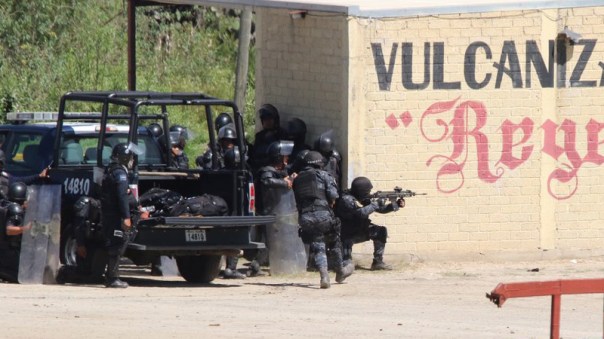
Federal Police opened fire on protesting teachers on June 19 in Nochixtlán, Oaxaca. There are at least 8 dead, around 100 injured (including both police and civilians) and many more arrested.
Joint Comunicado of the National Indigenous Congress and the EZLN about the cowardly police attack against the National Coordinator of Education Workers and the Indigenous community of Nochixtlán, Oaxaca
June 20, 2016
To the People of Mexico:
To the Peoples of the World:
Faced with the cowardly repressive attack that the teachers and the community suffered in Nochixtlán, Oaxaca, -with which the Mexican State reminds us that this is a war against everyone-; the peoples, nations and tribes that make up the National Indigenous Congress and the Zapatista Nacional Liberation Army, we say to all the dignified teachers that you are not alone; that we know that right and truth are on your side; that the collective dignity with which your resistance speaks is unbreakable and that it is the principal weapon of those of us below.
We repudiate the repressive escalation with which they seek to impose on the whole country the capitalist neoliberal reform that they call “educational,” principally in the states of Oaxaca, Chiapas, Guerrero and Michoacán. With threats, persecution, blows, unjust incarceration and now murders they want to bend the dignity of the teachers in rebellion.
We call to our peoples and to civil society in general to be with the teachers that resist at all times, to recognize them, because the violence to dispossess them of basic labor rights for the purpose of making education private, is a reflection of the violence with which they are evicting the native peoples, the campesino and urban peoples.
Those in power that are consumed with passion decided that education, health, the indigenous and campesino territories, and even peace and security, are merchandise for those who are able to pay for it; that rights are not rights but rather products and services that are snatched away, dispossessed, destroyed, are negotiated according to what big capital dictates. And they seek to impose this aberration in a bloody way; murdering and disappearing our compañeros, sending our spokespersons to high security prisons, making torture shameless governmental marketing and, with help from the paid communications media, equating the bravest of Mexican society, in other words those who fight, don’t surrender, don’t sell out and don’t give up, with the criminals.
We demand the cessation of the repression against the teachers in struggle and immediate and unconditional liberation of ALL political prisoners.
We invite all the peoples of the fields and the cities to be attentive and in solidarity with the teachers’ struggle, to organize autonomously to be informed and alert before this storm that falls upon everyone, knowing that a storm, besides tempest and chaos, also fertilizes the land from which a new world is always born.
From the mountains, fields, valleys, canyons and barrios of the native peoples, nations and tribes of Mexico
Never more a Mexico Without Us!
National Indigenous Congress – Zapatista National Liberation Army Mexico, June 20, 2016
——————————————————————
Originally Published in Spanish by Enlace Zapatista
http://enlacezapatista.ezln.org.mx/2016/06/20/desde-la-tempestad/
EZLN: the government of Chiapas is losing the media war against the CNTE

Parachicos march in support of the teachers. Photo: Eduardo Miranda.
By: Isaín Mandujano
TUXTLA GUTIÉRREZ, Chiapas
The Zapatista National Liberation Army (EZLN) said today that the mobilization y protest actions of the peoples, communities, organizations and activists in Chiapas, the government is losing the media war against the teachers’ movement that impugns the education reform.
“We don’t know about the rest of the country, but at least in Chiapas, those above are losing the media war. We have seen entire families, in rural and urban surroundings, supporting the teachers,” the EZLN asserts in a public comunicado.
And it’s not referring to support of the type “this fist is seen,” “the people united, will never be defeated,” and the slogans that despite distances in calendars and geographies, continue being the same –says the guerrilla group– “because underneath continues being the fundamental principle of solidarity.” If in previous mobilizations of the rebel teachers the “citizenry” appeared fed up and disturbed, it continued, now things have changed.
“There are more families all the time that aid the teachers, support their travels and marches, are anguished when they are son, offer them food, drinks and shelter. They are families that, according to the taxonomy of the electoral left, would be ‘stupefied’ by television, ‘eat sandwiches,’ ‘are alienated,’ ‘are driven in’ and ‘have no conscience.’ But apparently, ‘the enormous media campaign’ against the teachers that resist, has failed,” the writing points out.
It adds that now the resistance movement against the education reform has been converted into a mirror for more and more people-people all the time, in other words, not people of the social and political organizations, but rather common people.
“As if it had awakened a collective feeling of urgency before the tragedy that is coming. As if each blow with a club, each gas canister, each rubber bullet, each arrest warrant, were eloquent slogans: ‘today they attacked her or him; tomorrow I will go after you. Perhaps because of that, behind each teacher are entire families that sympathize with their cause and with their fight.
“Why? Why does a movement that has been ferociously attacked on all fronts continue growing? Why, if they are ’vandals,’ ‘loafers,’ ‘terrorists,’ ‘corrupt,’ ‘opponents-of-progress,’ do many people from below, not a few in the middle, and even some of those above, salute, though that may be at times in silence, the teachers that defend what any person would defend,” the armed group that rose up in arms on January 1, 1994 points out.
Later it lets loose against the media, in particular against the Chiapas newspaper “Cuarto Poder,” which it labels as being a media nostalgic for the epoch of fincas (estates) and Lords of the manor.
“Reality is a lie,” the EZLN points out, ought to be the title of its note when “it denounced” the popular (cultural) fiesta as false that was celebrated last June 9 in the streets of Tuxtla Gutiérrez, in support of the teachers in resistance.
“Parachicos, danzantes, folk musicians, traditional dress, persons in wheel chairs, marimbas, drums, whistles and flutes, the best of Zoque are and thousands of people greeting the resistance, the subversive group relates.
And it emphasizes that the “success” of the media war against the CNTE gave an account that day of a handmade sign that prayed: “Gracias teacher, for teaching me to fight” and another one that pointed out: “I am not a teacher, but I am Chiapan and I am against the education reform.”
More than three years after promulgating the alleged “education reform,” the EZLN lashes out, “Señor (Aurelio) Nuño still cannot present any educational argument, be it even the minimum, in favor of his ‘personnel adjustment program.’
“Its arguments have been, up to now, the same as any overseer from the Porfirio Díaz epoch: hysterical cries, blows, threats, firings, incarcerations. The same ones that would use any sad and gray aspirant to the post-modern police,” it emphasizes.
And it stirs things up
“They already beat them, gassed them, incarcerated them, threatened them, fired them unjustly, slandered them and ordered a de facto state of emergency in Mexico City. What’s next? Do they disappear them? Do they murder them? Seriously? Will the ‘education’ reform be born in the blood and dead bodies of teachers? Are they going to substitute the teachers’ occupations with police and military occupations; blockades of protest with blockades of tanks and bayonets?”
Later it refers to the Secretary of Education, as a “terrorist” for taking hostages, “that and nothing else is what the arrest is of members of the CNTE’s leadership.” In any kind of terrorism –whether that of the State or that of its fundamentalist mirrors—the EZLN points out, that (hostage taking) is a resource to force a dialogue and negotiation.
“We don’t know if up there above they have realized it or not, but it turns out that the other part (the teachers) is the one that seeks dialogue and negotiation. ¿Or is the SEP now affiliated with ISIS and takes hostages just to sow terror,” the armed group ironizes.
The Zapatistas point out in their comunicado that they don’t know much about the communications media, “but in our humble opinion, it’s bad business to place at the front of the media campaign about a shameless privatization, a sad and gray overseer that wants to be a police agent,” they say in reference to Nuño.
“Initiating the children into the first steps of science and art, that is what the teachers do,” the comunicado concludes.
——————————————————-
Originally Published in Spanish by Proceso
Friday, June 17, 2016
Re-Published with English interpretation by the Chiapas Support Committee
Capital police stop Chiapas teachers for 7 hours
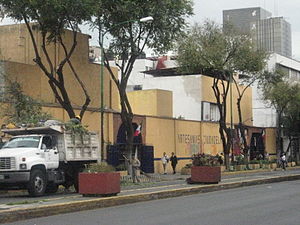
Outside of the La Ciudadela Market.
By: Laura Poy Solano
Yesterday, hundreds of dissident teachers from Sections 7 and 40 in Chiapas joined the La Ciudadela [1] occupation, after members of the Capital’s Secretariat of Public Security detained and encapsulated them for almost seven hours. Police impeded the advance of more than 30 buses coming from Tuxtla Gutiérrez, which were finally able to continue on their way, but guarded by the police.
Teachers from the Selva-Ocosingo region denounced that after their arrival in the capital at 5:30 am, “two patrols closed our passage by lowering the La Concordia Bridge, over the Ignacio Zaragoza freeway, and in minutes the police “encapsulated” us. For hours they didn’t even want to let us get out of the buses. Their only argument for detaining us was that we were going to cause harm to third parties.”
They pointed out that members of the capital police even boarded some of the buses “to inspect them,” but their access was impeded in others.
“We asked them to show the court order to search us. We are teachers, not criminals,” they asserted, after reiterating that: “at every moment we expressed that it was about a peaceful demonstration and that our destination was the La Ciudadela occupation,” because they announced that they would participate in the mass march convoked by the National Coordinator Nacional of Education Workers (CNTE) this Friday.
Beatriz Díaz Pérez, a member of the Chiapas teachers’ leadership, explained that faced with the refusal of the police to let the caravan advance towards the occupation in La Ciudadela, at a little after 11 o’clock in the morning it was determined to hold a march of the “tired feet” (at a slow pace) towards their destination in the capital’s center.
However, she indicated that: “we only advanced a few meters when they blocked our way once again. There was some pushing and shoving because they led us to the sidewalk so that we couldn’t march through the Ignacio Zaragoza freeway. There was a new negotiation, and at the end they let us pass, but guarded by the capital police.”

An artesanía booth inside the La Ciudadela Market.
Tired, loaded down with suitcases, boxes, blankets, tarps and tents, hundreds of dissident teachers, parents and teachers college students arrived at La Ciudadela Plaza a little after 1:30 pm.
Minutes later, the teachers started to organize themselves by region for the purpose of determining the location of the tents. Teachers from the Jungle, Center, Southern Border, Highlands, Sierra Madre, Maya, Valley, Costa Grande, Costa Chica, Frailesca, Cuxtepeques, Sierra Norte, Lagos, Zoque, Bachajón, Cañera and Cafetalera Zones, among others, organized themselves to occupy the sidewalk outside the artesanía market.
Meanwhile, dissident teachers from Guerrero and Michoacán made a human wall in front of the Senate, without obstructing vehicle traffic, to demand dialogue table with the federal government federal and freedom for all “political prisoners.”
With signs and banners, dozens of teachers delivered flyers and shouted slogans.
[1] La Ciudadela, or The Citadel in English, is an indoor artisans’ market in Mexico City with booths displaying traditional crafts and folk art.
————————————————————
Originally Published in Spanish by La Jornada
Friday, June 17, 2016
http://www.jornada.unam.mx/2016/06/17/politica/011n1pol
Re-Published with English interpretation by the Chiapas Support Committee
CNTE teachers leave Chiapas for Mexico City
Boarding the buses for Mexico City. Photo: Chiapas Paralelo
By: Angeles Mariscal
Aboard 32 buses and dozens of private automobiles, a first contingent of teachers from the National Coordinator Educación Workers (CNTE) departed today headed to Mexico City, where they will add themselves to the protest actions that have the objective of demanding that the federal government open a dialogue table about the education reform.
The departure of the contingent of teachers takes place upon completing one month from the start of the demonstrations of the CNTE teachers of the CNTE in Chiapas, which groups together members of Sections 7 and 40 of the National Union of Education Workers (SNTE).
In this month of protests that started with the installation of an encampment in the central plaza of the state capital, they have added the support of parents, students and university academics, social organizations, independent citizens and those who in the indigenous zone of Chiapas belong to the Diocese of San Cristóbal.
In the last two weeks, the Secretariat of Education in Chiapas has not announced the number of teachers that participate in the labor strike that started last May 15. The leaders of the CNTE, for their part, maintain that those on strike in Chiapas are 97 percent of the union members of Section 7 of the SNTE, and 90 percent of Section 40, which adds up to more than 60,000 teachers.
Sonia Rincón Chanona, state’s Secretary of Education, asserted last June 10 that upon completing one month of the strike, they run the risk of losing the 2015-2016 school cycle.
Nevertheless today the leader of the Coordinator, Pedro Gómez Bámaca, announced that in an agreement with the parents, at the time the strike started the teachers in the schools had completed 80 percent of the study program that the SEP frames.
“Before the movement erupted, we mounted the students’ qualifications on the platforms–a little more than 3 million taking courses in basic and middle school education media superior- and therefore the school cycle can be considered concluded in accordance with law and without affecting the students. If the Secretariat of Education invalidates the prior months’ work, that will be their responsibility,” he warned.
In a press conference, before thousands of teachers departed for Mexico City, the Coordinator’s leaders explained that the epicenter of the teachers’ mobilizations would be in the country’s capital. Parallel demonstrations will continue in Chiapas and the rest of the states.
“The agreement of the national assembly is that 20 percent of the mobilized teachers will concentrate in Mexico City. Chiapas will send 10,000. The first contingent leaves today and the rest in subsequent days,” Gómez Bámaca detailed.
Observers from the National Human Rights Commission (CNDH) accompany the teachers; the CNTE invited them to give an account of their events and demonstrations, in order to document the actions of the teachers and of the State forces.
“We want the national and international human rights organisms to document that we are not committing any action that violates the human rights of other people. We are exercising our right to demonstrate peacefully, and those who have committed abuses –among them the attack on teachers in the city of Comitán- are not us but rather individuals and organizations that have infiltrated with the clear intention of destabilizing,” he assured.
At the moment in which the buses of teachers were preparing to begin their journey, the demonstrators retained a person that said his name was Roberto García, and said he was assigned to the Municipal Police of the Chiapas capital.
Upon saying that to the teachers, this person, who was wearing civilian clothes was photographing and recording the demonstrators. The teachers took the retained man to the kiosk where the leadership gathered, and there the reporters asked him if he was really spying on the teachers. This person said yes he was, and that someone about whom he gave no references contracted him for that. The teachers delivered the person retained to visitors from the CNDH.
Regarding the announcement of the head of the SEP, Aurelio Nuño, about the audit that he was going to make of the list of names of teachers in the states, Gómez Bámaca said that the CNTE was disposed to any audit, including an audit of the union’s accounts.
———————————————————————
Originally Published in Spanish by Chiapas Paralelo
Wednesday, June 15, 2016
Re-Published with English interpretation by the Chiapas Support Committee
Zibechi: The New Venezuela
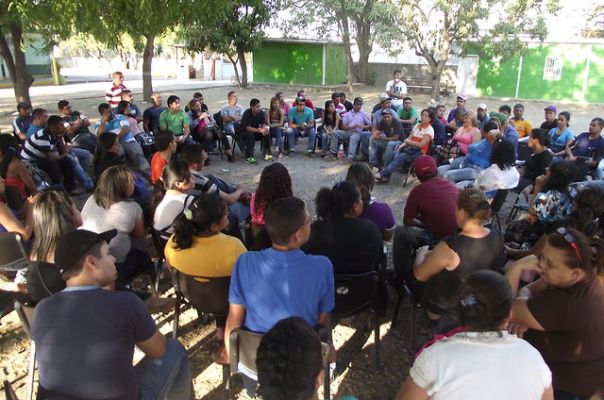
Cecosesola meeting. The cooperative functions non-hierarchically.
By: Raúl Zibechi
Systemic crises usually provoke long-term mutations that leave nothing in place. The crisis of Spanish domination over our continent converted it into a completely new reality. Societies that were established towards the second half of the 19th century had little to do with those existing in 1810, when the May Revolution in the district of Río de la Plata occurred.
Those critical periods also enable the birth of different social relations than the hegemonic ones that are one of the keystones of social change. Something new is not born during the mediocrity of stability, but rather in the midst of fierce storms when we are always capable of innovating, of working and creating.
Something similar is happening in Venezuela. Behind or beneath the political crisis, the offensive of the opposition and Washington, the government’s paralysis, the corruption that crosses the whole country from top to bottom, the scarcity and endless lines to buy food, another country exists. A productive country, in solidarity, where people don’t fight with each other in order to appropriate flour, sugar and corn for themselves, a country in which they are able to share what’s there.
An extensive and intensive tour through communities in the states of Lara and Trujillo, from the city of Barquisimeto to the Andes region permits confirming this reality. We’re talking about a broad network of 280 campesino families integrated into 15 cooperative organizations, besides 100 producers in the process of organization, who make up the Cooperative Central of Social Services of Lara (Cecosesola), which supply three urban markets with 700 tons of fruits and vegetables every week, at prices 30 percent below the market rate, since they elude the coyotes and middle men.
The direct visit to five rural cooperatives, some with more than 20 years and others in the process of formation, permits comprehending that campesino cooperation has an extraordinary strength. A simple cooperative with 14 producers in Trujillo, 2,500 meters (roughly 8,200 feet) above sea level, achieved buying three trucks, constructing a warehouse, the campesino house and a dormitory, basically producing potatoes and carrots manually, without tractors because their lands are sloping. A small miracle is called family and community work, because all the cooperatives have common lands that everyone cultivates.
Work and debate to correct errors, what we used to call self-criticism and was forgotten in some black hole of the masculine/militant ego. The 3,000 annual meetings that the 1,300 workers associated with the Cecosesola hold, open to the community, are extensive, harsh and frontal, in which personal deviations that harm the collective are not hidden. As we say in the South, they don’t go halfway; they go straight without anesthesia or diplomacy, which doesn’t damage but rather consolidates the atmosphere of partnership.
The network of 50 community organizations (15 rural and 35 urban) supplies more than 80,000 people per week in three markets for family consumption, which have 300 booths simultaneously. In these times of scarcity, they supply half of the fresh foods for a city of one million inhabitants, because of which lines of up to 8,000 people form in the central market, the most crowded of all, since the government closed some of the markets due to a lack of products.
The rural cooperatives produce fruits and vegetables; the urban community production units elaborate pastas, honey, salsas, sweets and articles for hygiene and for the home. In total, there are 20,000 associates from the popular sectors of Barquisimeto that are directly involved in the network.
The savings in production, markets and collections permitted them to construct the Integral Community Health Center, which cost 3 million dollars, has 20 bed and two operating rooms where they perform 1700 surgeries annually at half the price of the private clinics, managed by almost 200 people horizontally and in assembly. Besides, they have a cooperative fund (a sort of popular bank) for financing harvests, buying vehicles, medical needs and other family needs.
Everything, absolutely everything, they got through their own work and community support. They did not receive one single bolivar (the Venezuelan dollar) from the State throughout more than 40 years. How did they do it? Some documents elaborated by the network explain it in two concepts: ethics and community cooperation.
It’s not that there are no problems. There are many, with cases of individual profit, like everywhere. The document Ethics and revolution, distributed last March, says: “In our country a new private property modality is hastily being imposed, with each one attempting to seize the space that one fancies according to his or her convenience.” They are intransigent about that. It’s the same spirit that leads them to set prices without paying attention to market prices, but rather according to agreements between producers, making agreements by consensus, eliminating voting, perceiving all the same production needs and working to dismantle the hierarchies of internal power.
The guide it not the program, nor is it the relationship between tactics/strategy, but rather it’s the ethics. “Is there revolution without ethics,” the quoted document ends. History tells us that the popular sectors can overthrow the dominant classes, as has happened in half the world since 1917. What has not been demonstrated is that we are able to establish ways of life different from capitalism.
The Cecosesola workers can take from “their” markets the same amount of products as the rest of the community. If there is a kilo of wheat per person, it’s for everyone equally, whether they form part of the network or not. That is ethics. The scarcity is for everyone, without privileges.
That is the new Venezuela, where ethics guide. Although they are surrounded with meanness, they follow their path. Wasn’t that the revolutionary spirit?
———————————————————–
Originally Published in Spanish by La Jornada
Friday, June 10, 2016
http://www.jornada.unam.mx/2016/06/10/opinion/016a2pol
Re-Published with English interpretation by the Chiapas Support Committee
Chiapas cultural march to support the teachers
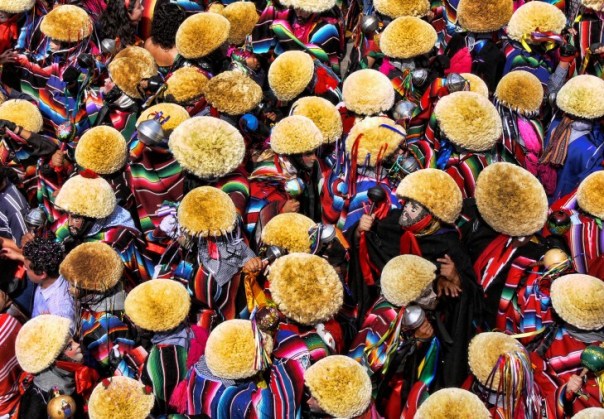
The Parachicos, traditional dancers from Chiapa de Corzo municipality.
By: Isaín Mandujano
The music of the marimba, drums and whistles, baskets full of food, thousands of traditional folkloric dancers dressed as Parachicos, Chiapanecas, Tuxtla Zoques and other traditional clothing of the state characterized the cultural march in support of the teachers’ movement against the education reform this afternoon.
To the cry of “maestro, aguanta, el pueblo se levanta” (teacher, endure, the people are rising up), men, women and children began a march that had the flavor of a fiesta but at the same time one of protest, because they were carrying signs against the government of Enrique Peña Nieto and his education reform, and also against Governor Manuel Velasco Coello.
The parents got out their traditional garb that they only wear for the feast of the patron saint and for the first time they used it to support a political and social movement in Chiapas that the teachers of the National Coordinator of Education Workers (CNTE) have headed for 26 days.
“The teacher fighting, is also learning,” some signs said that the dancers were carrying in one hand and the chinchín (a noisemaker or rattle) in the other.
Rubicel Gómez Nigenda, the sponsor of the Parachicos of Chiapa de Corzo called for a cultural march in support of the teachers. He asked everyone to wear white or get out their traditional dress to come out in support of the teachers, but above all to bring baskets with food so that the teachers can continue their movement. The Parachicos are traditional folkloric dancers (danzantes) from the Chiapas municipality of Chiapa de Corzo. They perform at the municipality’s annual fiesta in January.
In addition to the dancers from Chiapa de Corzo, there were dancers from Tuxtla, Suchiapa, Ocozocoautla, San Fernando, Cintalapa and many other municipios that came to the march in order to show their support for the striking teachers.
Upon reaching the central plaza, thousands of teachers applauded the dancers, as well as the men and women dressed in white that accompanied the cultural march. After the meeting there was a series of cultural events from poetry, dance and even singing.
The CNTE’s leaders thanked the thousands of folkloric dancers for their support and pointed out that thanks to these demonstrations of support they will continue their struggle until seeing the education reform fall.
Several Chiapas sites have amazing photos of this march. See:
And: http://www.pozol.org/?p=12485
————————————————————————-
Originally Published in Spanish by Chiapas Paralelo
Thursday, June 9, 2016
Re-Published with English interpretation and edited by the Chiapas Support Committee
 Chiapas Support Committee