Chiapas Support Committee
Home of the Compañero Manuel blog on zapatistas & mexico
Nochixtlán nurse: we attended to injuries like in a war
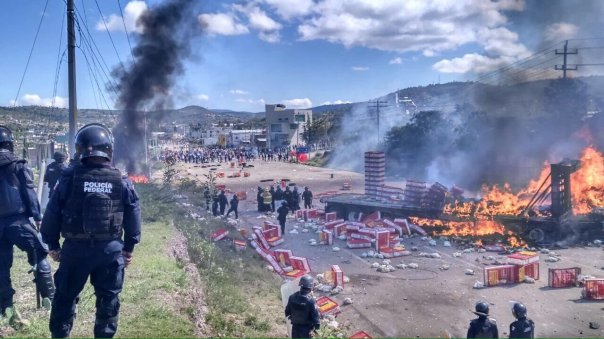
June 19, 2016: Federal Police attack teachers in Nochixtlán, Oaxaca, Mexico.
By: Blanche Petrich
Nochixtlán, Oaxaca
Last June 19, the Nochixtlán community hospital existed as if it were suddenly in the midst of a war. Almost eight hours of shooting left more than one hundred injured in the surrounding. With 12 beds available, five nurses and two doctors on rotating shifts, the hospital received 45 people with bullet wounds; four of them died within two or three hours.
The police fired tear gas from helicopters onto the roof of the building. As a consequence, three newborn babies suffered respiratory crises. Intermittently, the uniformed [police] encircled the clinic. Early in the afternoon, a group of police attempted to enter the hospital kicking on the door and threatening the guard that impeded their entry.
The nurse Juan Nicolás López, who played a double role, documented all that, aware that besides assisting in the emergency it was important to document what was happening. He shares his story with La Jornada.
He says that he checked in at the Nochixtlán de la Community Hospital, financed by the state government, a little before 8 am. Juan Nicolás has the title of general nurse, with 24 years of experience.
A few meters from the hospital the police attack on the Section 22 teachers’ checkpoint had already started. With some other compañeros the nurse attempted to approach the site of the conflict in order to lend aid in case there were injuries.
“When we realized the magnitude of the confrontation we ran back to the clinic to prepare for the worst. But we couldn’t even imagine what happened. Fateful!”
Hospital personnel quickly started hanging serum, arranging healing material and stretchers, preparing the only operating room, applying mattresses and sheets. By the end of the day nothing was enough.
Many of the injured, light or grave, had to be rejected. Two of them were taken in ambulances to the hospital in Huajuapan de León, but they didn’t arrive at the hospital alive.
The Oaxaca Human Rights Office has a list of 98 injured by firearms, more than double the hospital’s census. And it recognizes that its list can be low.
According to the census of the Oaxaca Health Services (SSO, its initials in Spanish), of which this newspaper has a copy, ten injured entered the Expanded Services Health Center (Cessa) and 14 entered the local clinic of the Mexican Social Security Institute (IMSS).
Clinics and hospitals in Huajuapan de León, Tehuacán, San Andrés Sinaxtla and Juxtlahuaca also attended to those injured in Nochixtlán and sent all their available ambulances.
Jesús Cadena Sánchez was the first injured man to die –before noon– at the community hospital; he was only 19 years old and is the

Paramedics and nurses try to revive injured man at the Nochixtlán Hospital.youngest of the victims. He approached the site of the battle attending to the call of the parish priest of his colonia (district) to go to pick up the injured.
He arrived in agony at the hospital. A bullet entered through his lower bowel and traveled to the bladder, it destroyed the iliac vein and part of the intestine. His mother, Patricia Sánchez Meza, who was present during the autopsy, says that they trained the bullet on him. “He was in pieces. I suppose that it was an expansive bullet, because it caused a lot of damage inside of my son’s body. That was evident in the written record of the autopsy.” And, it wasn’t the only case.
Anselmo Cruz Aquino died a little later. He was a plumber and electrician, a native of Tlaxiaco. According to his brother José Luis, a bullet penetrated through the point of his chin, crossed his tongue, trachea and lodged in his lung. Attempts to revive him were useless. Nicolás, the nurse interviewed, supposes that it could be another case of an expansive bullet.
At 10:30 in the morning the hospital was already overflowing. There were injured on the floor of the two waiting rooms and in the hallways. They removed the seats from the waiting rooms in order to attend to the patients there on cardboard or sheets. The noise from police helicopters overhead was heard outside.
Suddenly, two strong hits were heard, one on the roof and the other by the neighboring soccer field. “They were large tear gas bombs. We were full of smoke in an instant. In the midst of the chaos we realized that the three newborns that we had were presenting signs of asphyxia, the same as their mothers, who had given birth the previous day or night. There was nowhere to protect them. We were only able to cover the cracks of the doors and windows with wet sheets,” Juan Nicolás remembers. Of the eight that died during the police attack, four died in that little hospital. Their bodies were safeguarded in the hospital, on the floor.
Two more victims died instantly at the site where they fell, in front of the Hotel Juquila. Residents maintain that sharpshooters dressed in civilian clothes shot from the flat roof against the crowd. Juan Nicolás assures that no injured police arrived at the community hospital. Now the hotel sports an impeccable facade, renovated and recently painted. It operates normally and no one has investigated its owners.
It was not evident to Juan Nicolás that an order was received at the community from the state government hospital to not give care to the injured. “Yes we closed the doors. But that was when some 20 police arrived wanting to enter. The guard closed it. The police started to kick against the door. I saw them. They were out of it like drunks.”
Panic spread inside and as soon as the front was clear many people took their injured family members, grave or not, and took them away for fear that the police would return and would want to arrest them or kill them.
Maybe because of that fear, when Juan Nicolás returned the next weekend to cover his shift, Saturday and Sunday, only one of those injured in the confrontation remained, independent of the gravity of the rest of the injured.
———————————————————–
Originally Published in Spanish by La Jornada
Wednesday, August 31, 2016
http://www.jornada.unam.mx/2016/08/31/politica/005n1pol
Re-Published with English interpretation by the Chiapas Support Committee
CNTE: the strike isn’t over…
CNTE: THE STRIKE ISN’T OVER and THERE WILL NOT BE A RETURN TO CLASSES, PROTESTS CONTINUE
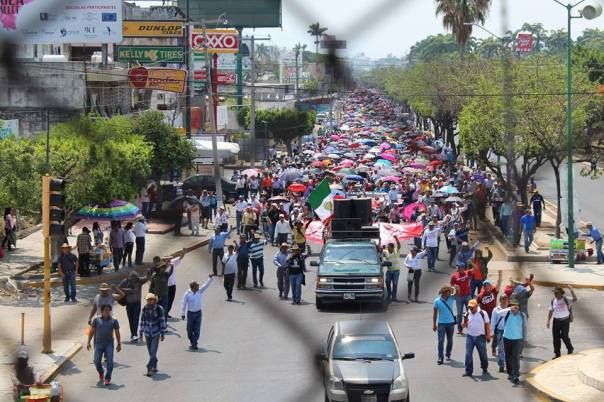
CNTE protest with parents and social organizations in Tuxtla Gutiérrez, Chiapas.
Teachers of the National Coordinator of Education Workers (CNTE) agreed this Friday night to continue with the teachers’ movement and not return to classes on Monday, September 12, because there are no guaranties that the 11 agreements the federal government offered will be respected.
After holding a State Assembly all afternoon in which representatives of the 800 union delegations in the 24 regions of the state of Chiapas participated, teachers of Section 7 of the SNTE agreed not to end the strike and that the protests will continue this Saturday with a large march and occupation of government offices in Tuxtla.
They pointed out in their resolution that the consultation process with rank and file teachers continues, but that the results that emanate from them are postponed.
They also proposed: “to immediately demand the opening of negotiations with the federal government with the presence of the state government so that it complies with the offers it outlined and with the presence of social organizations that support the teachers’ movement.”
The teachers had already obtained 11 agreements that launched the consultation with rank and file teachers that make up Section 7 of the SNTE, some 57,000 teachers. These political agreements outlined that the education reform would not be applied during the rest of this presidential term, paying back wages, 150 million pesos for school infrastructure, unblocking bank accounts of the Section’s executive committee, eliminating arrest warrants, as well as some other agreements that the federal government now publicly denies having offered to end the labor strike.
The teachers made a call to the rank and file to gather in Tuxtla and march this Saturday and take over government offices like the state Government Palace, the Federal Palace, the Municipal Palace and the state Treasury offices.
The next state assembly where all the leaders of the Chiapas teachers’ movement are together is foreseen for next Monday, September 12 starting at noon in the Che Guevara Auditorium of Section 7 of the SNTE.
——————————————————————
Originally Published in Spanish by Chiapas Paralelo
Friday, September 9, 2016
Re-Published with English interpretation by the Chiapas Support Committee
Oxchuc rejects reinstating mayor
IN OXCHUC, THEY REJECT MARÍA GLORIA and the TEPJF DECISION THAT ORDERS HER RESTORED AS MAYOR
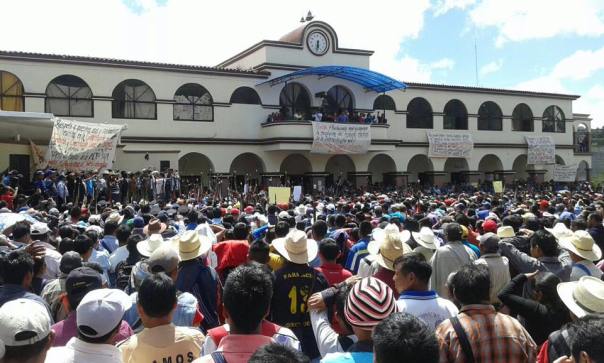
Indigenous Tseltal residents of Oxchuc Municipio in Chiapas demonstrate against reinstating María Gloria as mayor.
By: Isaín Mandujano
Oxchuc
With a multitudinous mobilization, thousands of indigenous Tseltals of Oxchuc, rejected María Gloria Sánchez Gómez’ attempt this Wednesday to be restored to her position of mayor, as the Electoral Tribunal of the Judicial Power of the Federation (TEPJF) ordered and supported the substitute mayor, Oscar Gómez López.
Coming from 115 communities, since very early, thousands of indigenous started to arrive in the municipal capital of Oxchuc. The traditional and civil authorities with the staff of command in hand concentrated at the town’s principal entrance from which they marched to the central plaza.
With banners and chants, thousands of indigenous marched headed by Oscar Gómez López, the current mayor of that municipio (country) and the president of the permanent peace and conciliation commission, Juan Encinos Gómez.
The Indigenous arrived in the plaza where they held a meeting in which they declared that they would not permit María Gloria Sánchez Gómez to be reinstated in her position as mayor, as the TEPJF ordered last August 31.
The Indigenous denounced that from their writing the magistrates are totally ignorant of the reality that the municipio experiences, because of which it concerns them not to respect said decision and that should she approach authority “María Gloria and all of them” will be thrown out.
Juan Encinos Gómez said that those that mobilized were around 25,000. The plaza was replete with indigenous Tseltal men and women that in unison stated their rejection of María Gloria Sánchez, the mayor supported by the PVEM.
Along with María Gloria Sánchez, they expressed their repudiation of her husband, the PRI member Norberto Sántiz, also twice an ex mayor, the ex federal deputy. The two maintained a political boss system for almost 15 years in that indigenous municipio.
The mayor that the people of Oxchuc support, Oscar Gómez López, said that serve in the position until the indigenous people of the 115 communities make a determination, because he took office with the principle of “mandar obedeciendo” (govern obeying). [1]
Although it had been speculated that today the indigenous would demolish the houses of María Gloria Sánchez and her closest collaborators that were expelled from the town, that didn’t happen.
But before this huge mobilization, the Network for Effective Parity (Repare, Its Spanish acronym) criticized that local authorities continue to disrespect the TEPJF’s decision and that they have not made the least attempt to restore María Gloria Sánchez Gómez in her position. To the contrary, with these marches and mobilizations they have let the hatred against women that were displaced from their positions and from that municipio to continue increasing.
——————————————————————-
Originally Published in Spanish by Chiapas Paralelo
Thursday, September 8, 2016
Re-published with English interpretation by the Chiapas Support Committee
Chiapas CNTE holds consultations on ending strike

One of the shopping plazas closed by protesting teachers in Tuxtla Gutiérrez, Chiapas
By: Angeles Mariscal
Teachers of the National Coordinator of Education Workers (CNTE) carried out consultations in their more than 800 delegations in the state to make a decision about ending the strike that started last May 15 and return to classes. The federal government proposed, extra-officially, suspending de facto the application of the education reform only in Chiapas, through an agreement that would be in effect starting from reaching agreement until the end of the presidential term (sexenio). [1]
During the assembly held last Friday, dissident teachers announced the federal government’s proposal. According to Manuel Mendoza, the CNTE’s leader in the state’s indigenous zone, the federal government’s proposal was made verbally and includes, besides considering Chiapas as a state of emergency, revising the conditions in which education is imparted within the state, in terms of infrastructure and capacity building, to attain some improvements.
The promises also include that their wages would not be docked nor any teacher fired that participated in mobilizations against the education reform, and a program would be implemented for capacity building and incentives for those who wish to participate in the evaluations, above all for those who will be contracted under the new scheme.
During the assembly, at first the teachers decided maestros to continue the strike, because the proposal to suspend the application of the reform was only to the Chiapas teachers; however the decision of the Oaxaca teachers to return to classes next Wednesday, opened the possibility of reaching their own agreements.
Therefore, according to what the CNTE’s spokesperson, José Luis Escobar, announced during this week and until September 9 when they hold the state assembly, the teachers will hold consultations in their more than 800 delegations, in which the parents and organizations that have supported the labor strike also participate.
He explained that faced with the decision of the Oaxaca teachers, the viability of continuing the strike alone must be analyzed in Chiapas. He said that if in the delegation assemblies they make the decision to end the strike and return to classes, it does not mean the end of the movement to attain the abrogation of the education reform, but rather re-proposing a new strategy for achieving it.
They agreed to maintain protest actions while they are carrying out the consultation in which it is foreseen that teachers of the indigenous zone will oppose ending the strike because there is no formal written proposal. Today they again closed shopping plazas in the capital; in one of them business owners and their workers placed themselves at the doors se in order to impede entry to the demonstrators.
They hung canvas banners with the slogan “CNTE: We’re at home, we need to work.” Nevertheless, the demonstrators did achieve closing the establishments.
[1] Sexenio means a six-year term of office. Here, the reference is to the six-year term of current President Enrique Peña Nieto that ends in December 2018.
——————————————————————-
Originally Published in Spanish by Chiapas Paralelo
Monday, September 5, 2016
Re-Published with English interpretation by the Chiapas Support Committee
The regional scenario after Dilma
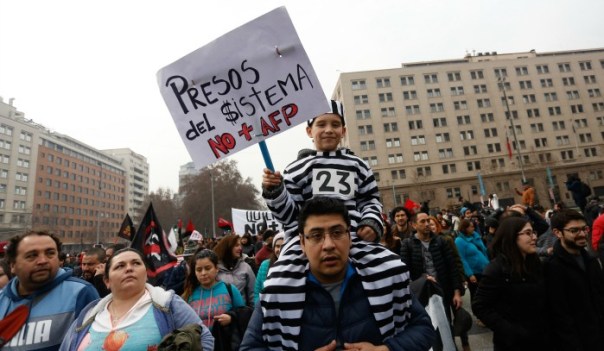
March in Chile against the private pension system.
By: Raúl Zibechi
The removal of Dilma Rousseff by the most conservative Senate since 1964 (the year of the State coup against João Goulart) closes the progressive cycle that started with the elevation of Luiz Inacio Lula da Silva on January 1, 2003. Brazil being the region’s most important country and the one that frames tendencies, we’re facing an irreversible inflection in the short term, where the conservative right-wingers impose their agenda.
The South American regional panorama appears clearly dominated by the alliance between financial capital, the United States and the local rights, which demonstrate dynamism that’s difficult to limit short term. One must go back to the beginning of the 1990s to find a similar moment, marked by the triumph of the Washington Consensus, the rise of neoliberalism and the collapse of the socialist block.
Nevertheless, it would be wrong to think that we are returning to the past, for more than a few analysts believe that “victories” are being lost. Reality indicates that the region walks forward but, immediately, what’s in front of us is not the egalitarian and just society we dream about, but rather an imminent train wreck between those above and those below, and fights between classes, races, genders and generations. Humanity goes towards that conclusion, and that is the medium-range future that is looming over the region.
Strictly speaking, this panorama has already been profiled since several years ago, when the progressives were still governing, because of the growing alliance made between the middle classes (old and new) and the wealthier, in large measure because of the triumph of the consumer culture, de-politicizing and conservative, that those very same governments impelled. But what matters, looking ahead, is the mentioned train wreck.
A new right has been imposed on the region. A right that has no legalistic scruples, that is not disposed to respect the modes of the democracies, that seeks to destroy the education and health systems as we know them. In Brazil the new right has put up the School Without Party Movement, which attacks public education, trashes the legacy of Paulo Freire and seeks to tightly control teachers.
One will have to return with more detail about this “movement,” that promotes the separation between “educating” (the responsibility of the family and the Church) and “instructing” (the transmission of knowledge, which is the task of the teachers). If the laws proposed in the parliament were approved, a portion of the teachers could be punished for “ideological indoctrination,” for talking about the country’s reality, since in the classrooms they applaud publicly, freedom of expression should not exist. Within that reality enters not only the political, but also even violence against women. That’s just a sample of what’s coming.
You don’t have to look backwards to comprehend where the new right is going, in other words, to the period of the dictatorships, but rather to personages like the British Prime Minister, Theresa May, who assures she is willing to use nuclear weapons although it may cost innocent lives (The Guardian, 18/7/16). Or like Hillary Clinton, who considers Vladimir Putin the “new Hitler.” They are not isolated or out of context statements, it’s the state of mind of the new rightists, warlike, willing to level entire nations, like they already did to half a dozen countries in Asia and the Middle East.
There have to be two antagonistic forces in dispute in order to have a train wreck. That is what is being profiled in the region. We have gone over the new student and popular struggles in Brazil (goo.gl/Bz9OBD), the movements that gain favor in Colombia (goo.gl/DfboIk) and the new black resistances (goo.gl/GTQPzQ), among others.
To those must be added the renewed strength of the campesino movement in Paraguay; resistance to the model of the soybean and mining sectors in Argentina, and, in recent months, to the Macri government’s adjustments; the important women’s mobilizations against macho violence, like that in Peru in August; and the persistence of the indigenous movements in Ecuador and Bolivia.
New and impressive resistances are opening. In August there were enormous mobilizations in Chile, two big marches of more than one million people against the private pension system (AFP), and a cacerolazo, which announces the beginning of the end of the system that was key to the accumulation of capital in the post-Pinochet regime. Nine of every 10 retirements are less than 220 dollars, in other words, less than 60 percent of the minimum wage; therefore, the population demands the end of the private system.
The conviction that corruption is systemic is slowly opening among the popular sectors, like the narco and the femicides, and that it doesn’t matter whether the left or right governs, because things will continue more or less the same. The promised education reform in Chile, which the Communist Party used as an argument for abandoning the streets and entering the government of Michelle Bachelet, was diluted in negotiations with the entrepreneurs and private education continues to be prioritized, as the new student offensive denounces.
In this stage, the system cannot realize reforms in favor of the peoples, because it has no economic or political margin. The economy functions like a machine that extracts, expropriates and concentrates the commons. Politics is reduced to fireworks and gives way, with greater evidence each day to the police to dissolve the conflicts. The principal differences between the colors that govern is of speed in the application of a model that leaves no other alternative than resistance.
The removal of Rousseff by a Senate infested with corrupt politicians could be the occasion for reflecting on the inconvenience of continuing to trust in the so-called “representatives” who are there to return favors to capital and to oppose organization with the utmost energy. No one will do anything for us.
——————————————————–
Originally Published in Spanish by La Jornada
Friday, September 2, 2016
http://www.jornada.unam.mx/2016/09/02/opinion/020a2pol
Re-Published with English interpretation by the Chiapas Support Committee
CNI and EZLN announce 5th National Indigenous Congress

THE CNI AND EZLN ANNOUNCE THE FIFTH NATIONAL INDIGENOUS CONGRESS
Given that:
- This October marks 20 years of uninterrupted work by the National Indigenous Congress [CNI], a space of unity, reflection, and organization for the indigenous peoples of Mexico. The National Indigenous Congress has worked for the full reconstitution of our peoples and the construction of a society where all cultures, all colors, and all of the peoples of Mexico fit.
- Throughout these years, and with increased strength since the release of the Sixth Declaration of the Lacandón Jungle by the Zapatista National Liberation Army, we have forged in word and action our contributions to the struggles of resistance and rebellion throughout the national geography. We not only sustain our decision to continue our existence, but we honor this decision with all our strength and with our fists in the air. We honor it by weaving together profound and collective agreements that can be seen in our care of the earth, in our languages, in our traditions, and in our collective governments in their many different names and forms. The flame of our autonomy lives inside these things, and it illuminates the collective heart of our peoples, barrios, nations, and tribes. These are deep agreements that we work on every day so that each one gives rise to the complex territories that together constitute our autonomy and self-determination.
- While we weave life, capitalism designs and lays out over us its own territories of death in every corner of our suffering Mexico. Supposed mining territories, cartel activity by organized crime, agroindustry, political party territories, urban zoning rights, and conservation programs are all imposed on our lands and in none of them—no matter what name they are given by the system or its obedient governments—do the indigenous peoples fit.
- The capitalists began and continue to expand a bloody war of conquest to take over what has always been ours. They appear behind any number of masks in this constant war of extermination: the businessman, the politician, the police, the soldier, or the hitman. And as always, the dead, the disappeared, and the imprisoned come from us, as well as the stolen and destroyed lands. Any collective, autonomous, and rebellious hope is persecuted.
- We have resisted this capitalist onslaught against our peoples. From the devastation wrought on us we have dreamed and built new worlds. From our grief and mourning for our murdered compañeros we as peoples have recreated new forms of resistance and rebellion that allow us to halt this devastation and walk the only path possible for those below and to the left: to construct and exercise the justice denied us by the powerful who purport to govern us.
- It is urgent that we bring our flames of resistance, autonomy, and rebellion together. These flames illuminate every original people who weave new worlds that are truly from below, where love and the ancestral commitment to our mother—the earth—are born.
We CONVOKE the direct authorities and representatives of the peoples, nations, tribes, barrios, communities, and indigenous organizations in order to celebrate:
THE FIFTH NATIONAL INDIGENOUS CONGRESS
To be held October 9-14, in celebration of the twentieth anniversary of the CNI, at the Indigenous Center for Holistic Training (CIDECI-UNITIERRA) in the city of San Cristóbal de las Casas, Chiapas, in Zapatista territory, according to the following schedule:
PROGRAM
October 9
Arrival at CIDECI and registration for the authorities, representatives, indigenous delegates, press, and invited guests of the CNI Coordinating Commission.
October 10-11:
Inauguration of the Fifth National Indigenous Congress Principle themes of discussion:
- Displacement and repression
- Our resistances and rebellion
- State of the CNI
- Proposals for strengthening the CNI
October 12:
Celebration of the twentieth anniversary of the National Indigenous Congress
October 13:
Plenary session, agreements, and conclusions Closing of the Fifth CNI
October 14:
Return home
Early registration for indigenous delegates can be made using the CNI email: catedratatajuan@gmail.com
Members of the National and International Sixth who want to participate as observers in the sessions of the Fifth CNI should register ahead of time at the email: cni20aniversario@ezln.org.mx.
The Fifth National Indigenous Congress will have both public sessions (the inauguration and closing) and closed ones. Media that registers with and is approved by the CNI Coordinating Commission will be allowed to cover only the CNI’s public sessions. Media registration will be held October 9 and 10 at the site of the Congress.
Sincerely,
July 2016
For the Full Reconstitution of Our Peoples
Never Again a Mexico Without Us
National Indigenous Congress
Zapatista National Liberation Army
En español: http://enlacezapatista.ezln.org.mx/2016/08/31/convocatoria-al-quinto-congreso-nacional-indigena/
Chiapas teachers thank parents after huge march
“THE CNTE CHIAPAS IS EFFECTIVE, THANKS TO THE PARENTS’ SUPPORT,” TEACHERS RECOGNIZE AFTER HUGE MARCH
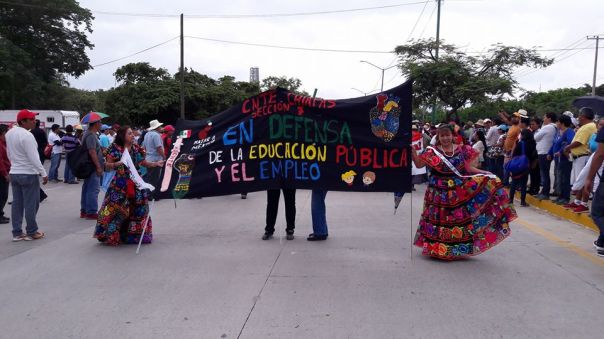
More than 100,000 Chiapas teachers and parents march on September 1. Photo: Pozol
Tuxtla Gutiérrez, Chiapas, September 1, 2016
“It’s sad that there is no start to the school year because of the government’s political stupidity,” members of the National Coordinator of Education Workers (CNTE) pointed out after a huge march of more than 100,000 teachers and parents today in the Chiapas capital. “Thanks to the support of the parents and their walking with us, the teachers’ movement is effective,” asserted the teachers, on strike since 110 days ago, in protest of the self-named “education reform.”
“But more important than the start of the school year is defending the right to public education, faced with the interests of the impresarios in power,” the CNTE teachers exposed during a meeting in the central park of Tuxtla. “Of what use would it be to start the school year if tomorrow the children of workers won’t have the right to education because it will be privatized,” the dissident teachers warned.
“The thousands of federal police that the government has sent in recent days and ever since 2013, have not been able to stop the teachers’ movement,” the educators emphasized faced with the arrival of federal police in the Chiapas capital, who threaten them with possible evictions. “We will know how to defend any aggression, but the exit has to be through the path of dialogue,” the teachers pointed out.
“What will Peña Nieto report today in the government report: who the police killed in Michoacán, who they killed in Nochixtlán Oaxaca, or about their million-dollar houses?” The Chiapas teachers asked these questions about the federal government report this September 1 and about the massacres and corruption scandals in the current Peña Nieto administration.
“The government bet that the movement would end with the end of the vacation period. Neither the sun, the water or the repression have been able to bury the movement,” the CNTE strikers. “The education reform is privatizing and punitive, and perversely the government argues and tries to manipulate that it seeks to raise the level of education,” they added during the meeting in Tuxtla.
“The illiterate president wants to throw the teachers into the streets, but the teachers aren’t going to permit it,” members of the teachers’ movement asserted. “We don’t ask for a salary increase or a holiday bonus, only to be participants in a real education project; but the government refuses because it defends the impresarios’ business,” the teachers emphasized.
———————————————————————-
Originally Published in Spanish by Pozol Colectivo
Thursday, September 1, 2016
Re-Published with English interpretation by the Chiapas Support Committee
Arrival of Federal Police in Chiapas places CNTE on alert

Federal Police arrive in Tuxtla Gutiérrez, the capital of Chiapas.
By: Isaín Mandujano
TUXTLA GUTIÉRREZ, Chiapas
Teachers of the National Coordinator Education Workers (CNTE) spent a long night on alert, after the arrival of hundreds of federal forces by land and air in Chiapas Wednesday afternoon and evening.
Dozens of buses with police and Federal Police trucks, entered the state Wednesday afternoon along the Cosoleacaque, Veracruz – Ocozocoautla, Chiapas Highway
Although in the beginning everything was a rumor, photographs and videos of the federal forces arriving in the state started to circulate later in the evening.
The federal forces were not able to enter via La Pochota, because since yesterday hundreds of CNTE teachers mounted a checkpoint where they filter the vehicles. All private motorists, local cargo and passenger transport have free access, but not the trucks or trailers of transnational companies.
The caravan of vehicles had to circulate hundreds of kilometers via the road that connects Ocozocoautla, Villaflores and Suchiapa to come out in Chiapa de Corzo and thus arrive at the installations of an old plant producing sterile flies where the police spent the night.
At the Ángel Albino Corzo International Airport, an airplane of the Federal Police was sighted letting out police that were similarly transported to that old installation constructed in the seventies by the governments of the United States and Mexico.
This mobilization of federal forces to Chiapas provoked uneasiness among the CNTE teachers, who declared a state of alert and spent the night mounting guards and filtering the vehicles that passed at the five entry points to the city where they installed their checkpoints.
At 109 days from the start of the teachers’ movement, CNTE teachers said that they would not return to classes and that they would maintain their fight against the education reform.
Yesterday, on the seventh day of the official school calendar of the 2016-2017 Cycle, the Chiapas Secretary of Education reported that seven out of every 10 schools in the state are open and operate normally.
At the same time, the head of the [government] agency, Roberto Domínguez Castellanos, pointed out that today 69.7 percent of the total student body in Chiapas are receiving classes, in other words, one million 238 thousand 611 girls, boys and youths.
It’s appropriate to point out here that since the start of the School Cycle, the number of schools that are functioning has been gradually increasing; the opening of 22 percent more school buildings has been achieved, which means that 13,961 schools are functioning.
Domínguez Castellanos pointed out that the increase in the opening of schools has been achieved thanks to conciliation and dialogue that has been maintained with the teachers, the student community and the parents, in which the right to education has been privileged.
————————————————————-
Originally Published in Spanish by Proceso.com
Wednesday, August 31, 2016
http://www.proceso.com.mx/453012/arribo-federales-a-chiapas-pone-a-la-cnte-en-alerta
Re-Published with English interpretation by the Chiapas Support Committee
Tribunal orders the return of María Gloria as mayor of Oxchuc
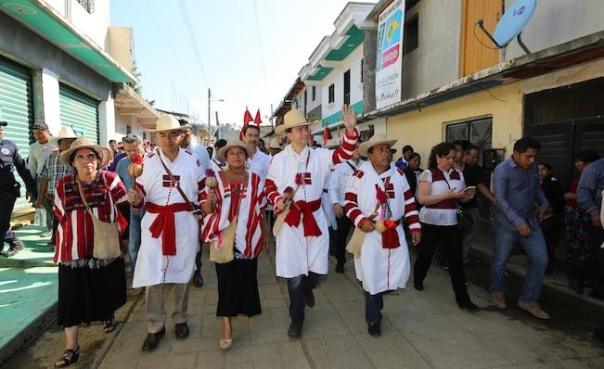
Oxchuc authorities.
By: Sandra de los Santos
On Wednesday night, August 31, the Electoral Tribunal of the Judicial Power of the Federation (TEPJF) ordered María Gloria Sánchez restored to her constitutional position as municipal president of Oxchuc.
The resolution in favor of María Gloria Sánchez was expected, since the case involving the restitution of the Chenalhó mayor was discussed, a few weeks ago, and the TEPJF magistrates announced that it would also be voting in that same way in the Oxchuc case.
The project presented by Magistrate Manuel González Oropeza suggested a plebiscite for appeal directly to an Assembly of the Population for the purpose of resolving the post-electoral conflict in Oxchuc. That point was rejected, however, and what was resolved was restoring the mayor without a plebiscite.
Six months ago, in an extraordinary session of Permanent Commission of the State Congress, the request for an indefinite leave that the Oxchuc mayor presented was approved; she was never able to take possession of the office because of the demonstrations that took place in the municipality. [1]
Three weeks ago, leaders from 105 Oxchuc communities agreed on the expulsion of the political parties from that municipio and from now on they would elect their authorities through “uses and customs” (traditional indigenous methods). Therefore, they asked Governor Manuel Velasco Coello and deputies of the State Congress for the recognition of Oscar Gómez López, the current mayor.
They warned that they won’t permit the return of María Gloria Sánchez, who would be repeating for a second time as municipal president. They accuse her of being part of the PRI-PVEM’s political boss system (cacicazgo) in the municipio.
In Chenalhó, despite the Tribunal’s resolution, the mayor remains without the power to exercise her functions in practice because conditions in the municipio don’t permit it.
[1] See: https://chiapas-support.org/2016/01/13/66-police-injured-in-oxchuc-chiapas-confrontation/
——————————————————-
Originally Published in Spanish by Chiapas Paralelo
Thursday, September 1, 2016
Re-Published with English interpretation by the Chiapas Support Committee
González Casanova proposes an emancipatory and critical reform

Among the intellectuals attending the forum were Pablo González Casanova (right) and Adolfo Gilly (standing). Photo: La Jornada.
By: Laura Poy Solano
Facing a neoliberal globalization project that seeks to make education a “culture of servitude,” the ex rector of the Autonomous National University of Mexico (UNAM), Pablo González Casanova, exhorted the teachers to construct a real education reform that will contemplate an emancipatory and critical formation, which he defines with clarity two leading principles: the values of morality and truth, understood as the construction of the defense of the collective above individual wellbeing, of solidarity and cooperation, but also of the permanent critique of what occurs and of that which generates it.
In the first Forum towards the construction of the democratic education project, convoked by the National Coordinator of Education Workers (CNTE), González Casanova reiterated his solidarity with the teachers’ struggle and pointed out that the failure of the education reform education reform and its lack of viability in different states is the result of an historic process that “happens between confrontations and negotiations.”
Because of that, the academic said, “we must think more profoundly to yield that global and stormy struggle for an emancipatory education, knowing that ours is against the neoliberal globalization that the business, military, political and media corporations push.”
They ask to suspend the evaluation
For its part, the group of academics that advises the dissident teachers showed itself to be in favor of the “immediate suspension” of the whole evaluation system as the teachers’ obligation, as well as of its labor and legal consequences, after considering that they must “eliminate the punitive, hierarchic and contrary character of the labor laws” with which it is applied.
Before dissident teachers from various parts of the country, human rights defenders, unionists, representatives of social organizations, investigators, academics, journalists, legislators and labor lawyers, Hugo Casanova Cardiel, professor-investigator at the Institute for Research on the University and Education, read the position subscribed to by more than 10 experts from the education sector, wherein they demanded that: “all the punitive actions that have been exercised and continue being exercised against the teachers ‘be suspended or be left without effect.”
They outlined the urgency of constructing alternative evaluation proposals without a punitive character founded on “educational, formative, integral, participative and democratic” knowledge, after considering that the education proposal presented by the federal government “has turned out to be unsuccessful,” because in a period of four years the policy for the sector turned into a conflict that not only has affected public education, but also changed diverse ambits of national life.
Education, a mission of the State
In the Convention Center of the 21st Century Medical Center, UNAM’s professor emeritus Adolfo Gilly emphasized that primary and secondary education for all of the population is a “mission of the State and an obligation of those who govern.” He asserted that formation is not an “industry with capital, is not a business or a banking and financial system. Therefore, education cannot be in the hands of Televisa and of those who manage it.”
After recognizing the teachers struggle and the effort of thousands of teachers that have stayed outdoors in the occupations, who have suffered prison or have lost their lives for the teachers’ struggle, he lamented that: “all that is necessary so that we may be here today.”
He reminded that education is also the emotional and social link that is created between students and teacher, because “feelings of fraternity, solidarity, liberty and equality are experienced in the classroom. We learned that in the Normal School, which is under fire.”
He asserted that there is no evaluation that can measure the many roles that teachers fulfill, who, he said, “cover absences, teach with their attitude, their life and their knowledge (…) the school must be the education place, but it also doubles as a home. What evaluation is going to measure that?”
In that regard, González Casanova, in his speech titled Towards the education that the Mexican nation needs, warned that if they want the negotiations to be successful for the general interest, for the youth, the workers and the peoples, they confront two complex elements: the rights of the teachers as workers, and who educates, about what and how it’s done.
Therefore, he considered indispensable presenting a proposal where se prepare children and youth to have a general scientific and humanist culture, in which impelling moral values and truth are determinative.
“The project would have to specify without equivocation what is understood by these values. The ethics of struggle, of cooperation, of the defense of the general interest versus individualism, consumerism and private interests is understood as the central value of education. And in truth a permanent critique of the culture of servitude is understood, as well as a constant questioning of what one believes has happened.”
He added that it’s necessary to resort to the teachers’ colleges for middle school and universities where formative themes are broached, for the purpose of generating an updating program (continuing education?) in the teaching of the sciences, humanities, arts and technology, which permits the 1.5 million teachers to continue their formation “without any kind of pressure.”
At the same time, he said, a “profound project” could be elaborated with the reform of education through work commissions in which teachers and specialists participate.
Nevertheless, he detailed that it’s also necessary to guaranty the teachers’ respect and dignity, the defense of their labor rights and to promote a humanist, scientific, artistic and technological culture, “and not only the apologetics of the world and system in which we live, but rather the critique and creator of a better world, just, free and democratic.”
————————————————————————
Originally Published in Spanish by La Jornada
Wednesday, August 10, 2016
http://www.jornada.unam.mx/2016/08/10/politica/003n1pol
Re-Published with English interpretation by the Chiapas Support Committee
 Chiapas Support Committee