Chiapas Support Committee
Home of the Compañero Manuel blog on zapatistas & mexico
The gasolinazo and the protests
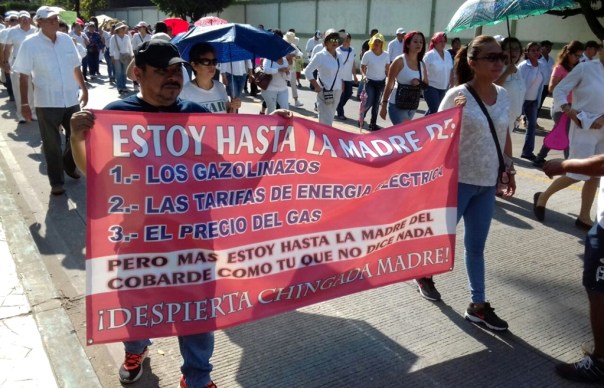
Banner in a Chiapas march: “We are fed up with: 1. the hikes in fuel prices; 2. the cost of electricity; and 3. the price of gas. But we’re more fed up with the coward who does nothing. Wake up mother fucker!
By: Luis Hernández Navarro
The image has been reproduced a thousand times as a symbol of the times. At the exit of a department store sacked by a plebeian multitude, a young man carries an enormous new screen on his back.
With that screen, he recovers from the offense of being needy in a country in which being so is not only a material tragedy but also the symbol of social defeat.
Installed in the perpetual fiesta of consumption, the lords of money exhibit their fortune without modesty. They exhibit their luxuries without any modesty, as material evidence of their success in life. And, the pariahs, without an entry pass to the spectacle of extravagance, watch the ostentation and opulence of the powerful from their humble homes through the window of television programs, until the opportunity arrives to take their revenge.
With that screen, its new owner has the illusion that he has achieved slipping into the banquet of the wealthy. The robbery’s harvest, two or three times larger that the almost 10 million television sets that the federal government gave away with the pretext of the 2015 analogue blackout, doesn’t commit either his vote or his loyalty, as happened during that year’s elections.
That television is also his personal retaliation to the politicians’ endless swindles. If the ex governors of Veracruz, Chihuahua, Quintana Roo, Coahuila and Nuevo León embezzled from state coffers without suffering any punishment, why not keep an item without having to pay for it?
He obtained that screen by breaking the law. But perhaps those above don’t do it like that? He snatched it in a strike of luck and audacity, in an act of rage and rancor accumulated for years, from which the gasolinazo took the lid off.
That is an explanation for the wave of looting that have shaken several regions of the country, like the state of Mexico, Veracruz, Hidalgo and Nuevo León. However there are those who put that explanation in doubt and offer another: that of a plot. Some say that public functionaries organized the pillage as part of a variant of the shock doctrine to justify the intervention of public force against those in disagreement with the increase in gas prices, and to discourage the popular protests.
This strategy of fear combines disinformation campaigns in the social networks, public calls to rob warehouses, the absence of public force guarding businesses, government agents and police that offer money and impunity for committing robberies and the action of provocateurs like Antorcha Campesina.
Abundant testimony and evidence have been published in the social networks that seem to corroborate this hypothesis, above all in the state of Mexico and in Puebla. In more than one video police can be seen stealing merchandise.
Has this strategy had success? Yes and no. Yes, because in different sectors of the population a climate of fear and uncertainty has been created, which has inhibited their incorporation into the protests. Yes, because groups of impresarios that were opposed from the beginning to the gasolinazo now demand a heavy hand for calming down the protests.
No, because, despite everything, far from diminishing, the social discontent continues expanding and shows no signs of weakening in the short-term. The relationship between the number of protests and looting is, according to a recap of journalistic notes, at least five to one. And no because the pillage has expanded beyond the control of its hypothetical sponsors: more than 800 businesses according to the Concanaco (Mexico’s National Chamber of Commerce).
Then, are the robberies of large warehouses actions orchestrated by government actors or are they expressions of the social rancor? They are probably both. Although in the beginning they may have been induced from some sphere of power, they are also an expression of a genuine and accumulated social discontent.
Looting is the most visible face of the popular insurrection under way, but it’s far from being the only one. Meetings, marches, liberation of toll booths on superhighways and blockages of gas stations, highways, railroads and centrals of Pemex have been carried out all over the country. Expressions of solidarity abound. The big rig drivers that in Chihuahua obstructed vehicle movement say, half in jest half seriously, that they had never eaten as well as they do now because of the popular support: meat at breakfast, lunch and dinner.
The protest against the gasolinazo is an unprecedented act, generalized, amorphous, spontaneous, lacking set direction and organizational center. In the acts, we’re dealing with multiple regional protests, each one different than the others.
In the first line of opposition are big rig drivers, transport drivers, taxi drivers, all those whose work is directly associated with the consumption of fuel. They are the ones who have organized many of the roadblocks. They have paid a high price. Many of their compañeros have been arrested.
But, irrigation farmers, campesinos, self-convoked citizens, housewives, professionals, parish priests and teachers also participate in the days of struggle. The gasolinazo hit a part of the “middle class” at the waterline and launched it into the public squares. The awesome Monterrey demonstration tells the story.
The block in power is fractured. The governors of Sonora, Chihuahua and Tamaulipas ask to reconsider the increase in gas prices. The governor of Jalisco went even further and reached an agreement with Enrique Alfaro [1] and Movimiento Ciudadano (Citizen Movement). [2] With an even more energetic tone, the Conference of Mexican Bishops (Conferencia del Episcopado Mexicano, CEM) did the same thing. And just in case something is missing, in what is the cherry on the cake on the cake of this rupture, Coparmex (Mexican Employers Association) rejected Peña Nieto’s proposed economic package.
Disconcerted, a good part of the traditional opposition leaders, social leaders as well as political leaders, have been bypassed. Their astonishment comes from the hand of the governmental inability to comprehend what it has in front of it. New popular local leaderships have emerged in the heat of the fight.
The January 7 marches, in at least 25 states, would seem to be an indicator of the advance of national protest. In them, it went from the demand to lower the price of fuels to the demand for the President’s resignation. Those demonstrations, some large and others small, could be a point of inflection in the ability to organize resistance.
[1] Enrique Alfaro is the Mayor of Guadalajara, Jalisco and a member of Movimiento Ciudadano.
[2] Movimiento Ciudadano (Citizen Movement) is a registered political party in Mexico.
———————————————————————-
Originally Published in Spanish by La Jornada
Tuesday, January 10, 2016
http://www.jornada.unam.mx/2017/01/10/opinion/015a2pol
Re-Published with English interpretation by the Chiapas Support Committee
https://chiapas-support.org/2017/02/01/the-gasolinazo-and-the-protests/
Oxchuc Celebrates the “Day of Civil Resistance”
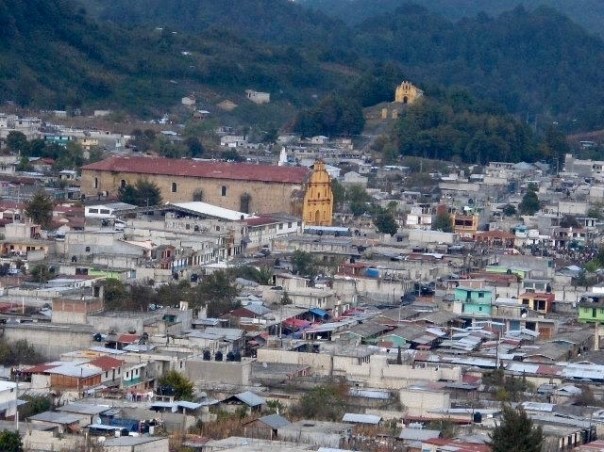
Aerial view of the town of Oxchuc, the capital of Oxchuc municipality, located in the Highlands of Chiapas, Mexico.
By: Isaín Mandujano
With marches, public assemblies, dance, food and sports activities, for two days, thousands of indigenous Oxchuc residents, celebrated the “Day of Civil Resistance” in that municipal capital, to remember that January 8, 2016 on which hundreds of state police attempted to enter the municipal capital but were repelled with a negative result for the police.
During Saturday and Sunday, residents of some 97 communities and the 22 neighborhoods in the municipal capital congregated to remember that pitched battle, which they called a “historic gesture,” that they had with some 700 police that tried to enter the town to subject them.
The town of Oxchuc maintains a civilian resistance against the mayor elected in July 2015, María Gloria Sánchez and that the Electoral Tribunal of the Judicial Power of the Federation (TEPJF) ratified; they accuse her of having won buying votes, manipulating and coercion of the vote during the elections to prolong the political boss system in that municipality that she maintains with her husband Norberto Sántiz.
In a plebiscite residents elected Oscar Gómez López, who although the local government already recognized him, the state government obliges him to install María Gloria Sánchez in his position because of a TEPJF resolution.
January 8, 2016 was marked in the history of Oxchuc, the bravery with which everyone went out in the streets to confront the state police. Minutes before, state police had detained 38 Oxchuc leaders during a negotiating session in San Cristóbal de Las Casas.
When the state police entered, residents burned a dozen buses and patrol cars and provoked more than 50 injuries. The residents also captured 27 state police, among them eight women, as well as the Oxchuc judge for Indigenous Peace and Conciliation, Rogelio Sántiz López, and four of his sons and two little boys.
The Oxchuqueros (residents of Oxchuc) used the captured state police and civilians as hostages to demand the freedom of their 38 leaders. Therefore the state government had to accede immediately to the demand.
Last Saturday and Sunday, Oxchuqueros went into the streets to march, held a huge assembly with representation from the 97 communities and the 22 barrios of the municipal capital. There, they ratified Oscar Gómez López as their mayor-elect through uses and customs.
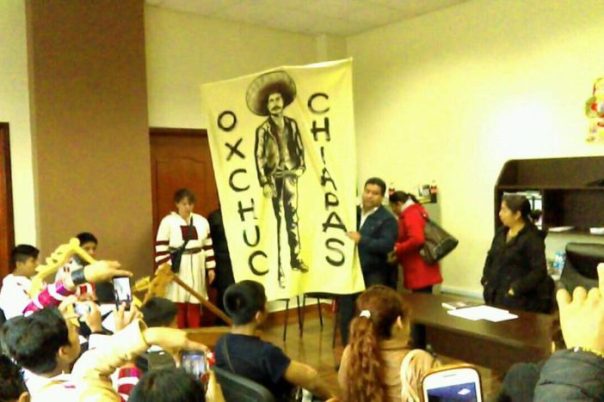
Mayor Oscar Gómez López and his Emiliano Zapata banner.
In an interview, Mayor Oscar Gómez López demanded that the state government and particularly the Treasury Secretary, release the Oxchuc municipal council’s bank accounts, because the situation has already reached a point at which it’s not possible to support some expenses they must make, like paying police, repairing patrol cars and buying gas.
Also, thousands of men, women and children are affected by the lack of ambulances, because these already are lacking or rather there is no longer any fuel for taking out the sick and injured from the more than 100 rural communities.
Gómez López said that the people have made the decision to block that stretch of highway again on January 18, to demand that the state government release the frozen bank accounts; and if they are not released they will block that highway stretch until they are heard. [1]
Blocking Oxchuc is a crisis for the state government because it paralyzes the economy, the movement of tourists and the local population that travels from the Highlands to the Jungle Region and the Northern Zone of Chiapas.
Gómez López said that the people of Oxchuc remain firm in maintaining him as mayor-elect through uses and customs and that in no way will they permit the return of the political bosses María Gloria and Norberto.
[1] Oxchuc residents maintained a roadblock on Wednesday and Thursday (January 18 and 19) to demand that the state government release the city’s bank accounts, because thousands of inhabitants are suffering the consequences of the lack of public resources like water, public services like garbage collection, security and patrolling, and health care and other matters. The state government and the members of the Permanent Commission for Peace and Conciliation, the body that heads the civil resistance movement against the region’s caciques, reached an agreement and they lifted the roadblock. In the evening, after lifting the roadblock, residents of Oxchuc heard shots fired into the air and believe they came from groups that support María Gloria. There is concern about an outbreak of violence in the town and in the municipality. http://www.chiapasparalelo.com/noticias/chiapas/2017/01/temen-enfrentamiento-en-oxchuc/
———————————————————————–
Originally Published in Spanish by Chiapas Paralelo
Sunday, January 8, 2017
http://www.chiapasparalelo.com/noticias/chiapas/2017/01/celebra-oxchuc-dia-de-la-resistencia-civil/
Re-Published with English interpretation by the Chiapas Support Committee
Learning to govern ourselves

Freedom!
By: Gustavo Esteva
The storm rages; cold and hurricane-force winds threaten from the north, which will be accentuated after next Friday, January 20, and a cyclone forms level with the land all over the country. There is nowhere to take shelter.
There are those who seek refuge in the dominant system. They think that doing so is realistic. They consider it romantic or utopian, for example, to openly challenge capitalism. Likewise, although they know that the state apparatuses are falling apart, dragged through the storm, and that the people distrust the parties and the electoral process more all the time, they hang all their hope on 2018. They think that circumstances will finally make it possible for their permanent candidate to win the elections; they are confident that, once in power, he will fix everything fixable.
They saw with disgust the decision of the National Indigenous Congress (CNI) to create a government council that will express itself in the voice of an indigenous woman, who will be an independent candidate in the presidential elections. They circulate new racist and sexist comments to disqualify the decision. They also warn that the decision will divide what is still called “the left” and will benefit the candidates who administer what remains of the government.
Debate has been scarce. Democratic dogmas are launched over rebel heads like projectiles. There is resistance to abandoning the dominant mental framework, although evidence and experiences that it’s not sensible or realistic to take refuge in the remains of the institutional shipwreck multiply.
Along with that dogmatic nonsense, probably unyielding, disagreement and confusion also spread. It’s not easy to escape from the dominant habits. For el CNI, for example, it will not be easy to constitute the government council from below cleanly. Different small groups are already mobilizing to insert their cadres into it. They perceive it as a body with power from which they will be able to impel their agendas, which embrace very diverse points on the ideological spectrum.
The challenge that we confront obviously demands a kind of imagination to which we are not accustomed. It implies, first of all, recognizing that far from escaping from the storm and seeking provisional shelters, it’s necessary to submerge oneself in it. There, from the inside, we will be able to realize that candidates, parties or even the dominant structures form part of our strategic adversary, which we still call “fascism,” and they nourish the “fascist” that we carry inside, hidden in the desire to be governed.
The patriarchal mentality, rooted in the course of millennia, makes it very difficult to conceive the world without hierarchies and structures of control. Upon warning that without them we would fall into chaos, they deny the fact that we are in current disorder because of them; the illusion of governing ourselves through representatives deepens the chaos instead of remedying it: it pushed us to the abyss of violence and decomposition in which we find ourselves.
It’s easy to talk about what we’re dealing with: governing ourselves: that we are capable of managing our own lives, nothing more nothing less. It turns out to be difficult because we are infected with the subordination virus: we allow publicists, business people, bankers, leaders, the Internet and almost anything or anybody to govern us. We believe that it’s freedom and democracy to decide between the choices that the system presents us, between brands of soap or between candidates or parties. And the “fascist” that we carry inside is constituted.
There are places and spaces in which the people have not stopped governing themselves since millenniums ago. We must not idealize them; there one also observes patriarchal impositions and habits of domination. But the practice exists. A certain number of people are still born in contexts in which many aspects of daily life are the fruit of common agreement. In questions of enormous importance to people, heteronomy, regulation by others, can be kept at bay
Although the majority isn’t accustomed to governing themselves, the impulse is profound and general. Nobody needs training to do it. It starts at home, when we create conditions so that the whole family, including small children and elders, may participate in the decisions that affect everyone. It passes from there to the condominium, the street, the district, to all the spheres of the reality in which each one moves.
Examples of how to change the pattern of behavior that makes us desire someone to govern us exist everywhere. In San Cristóbal, for example, a city that was not constructed for automobiles, traffic lights and police govern traffic… with bad results. The “one by one” device in which the drivers themselves govern the crossing of each street has demonstrated the advantages of self-governance.
On that path we are able to discover that the country still has immense reserves of autonomous wisdom. In popular sectors that collective possibility of self-government has been a condition of survival. And if we deal with the storm in that way, practicing our own forms of self-government at all levels, organizing ourselves for that, we will be prepared to do what we have to do inside of 18 months.
———————————————————————–
Originally Published in Spanish by La Jornada
Monday, January 16, 2017
http://www.jornada.unam.mx/2017/01/16/opinion/016a1pol
Re-Published with English interpretation by the Chiapas Support Committee
The Arts and the Sciences in the history of (neo) Zapatismo

Words of Subcomandante Insurgente Galeano
December 28, 2016
Last night I spoke to you about the interplanetary upheaval that had given rise to the question “Why is this flower this color? Why does it have this shape? Why does it have this scent?”
Ok, maybe I was exaggerating with the claim of “interplanetary.” I should have said the upheaval created by the question that young Rosita had put to Subcomandante Insurgente Moisés in the micro-cosmos of Zapatismo had provoked.
Although I believe it is obvious, it doesn’t hurt to mention that the response that SubMoy gave to the young Zapatista woman was the same one that, I’m not sure, but probably, I’m imagining, has fueled the advance of science since its very beginning: “I don’t know.”
Now I think that, certainly, the young woman knew what his response would be, but she also hoped that SubMoy would understand that, within the flower, there was a larger question.
We know now, because we are here in this meeting, that SubMoy knew that the response, “I don’t know” was not only insufficient, but also useless if it did not lead to other questions.
In a few minutes he is going to talk to you about what, as it were, is the context of the question…and about his response.
I am meant to speak to you briefly about the prehistory of this question and this response.
The arts and sciences prior to the Uprising, within the eezeelen, had a very small universe and a brief history. Both the sciences and the arts had a purpose, a direction, and an imposed reason: war.
First in the guerilla encampments, then in the barracks, and later in the communities, the arts were limited to music, poetry, and a little bit of drawing and painting, all with exclusively revolutionary messages. Of course, it was not unusual that soon songs of love and broken hearts, corridos, rancheras and even the occasional Juan Gabriel ballad would appear, but that was only clandestinely within our clandestinity.
Film or cinematography had its exclusive location, its VIP room, in our imagination. One of the insurgents narrated the same film to us over and over again, but he would find a way to change it a little bit each time he told it, or to combine it with the plots of other films. That was how we saw both the original and various “remakes” of “Enter the Dragon,” with Bruce Lee playing the only role, because the compa would spend hours explaining his movements and punches to us. This went on until, with a small electric source and a heavy and cumbersome 16mm projector, we saw a Vietnamese film that I think was called “Point of Contact” or something like that and which, of course, was only in its original language, and so we used our imaginations to add dialogue in Spanish, turning it into a different film than the original. I’m not sure, but I think you call this “artistic intervention.”
I call attention to this because I think that it was the first time that the sciences and the arts came together in a Zapatista encampment. And by the sciences, I’m not referring to the portable generator and the projector, but to the popcorn, which someone had kindly included when they sent the machine and the film.
Of course, we chowed down on the popcorn with the shout of “eat today or die tomorrow.” And the next day we nearly made the slogan come true: beginning in the wee hours of the morning, with collective diarrhea, the entire insurgent battalion abandoned the spot as if a herd of wild boars had taken it over. We consoled ourselves afterward, imaging that it had been a case of bacteriological warfare. Moral of the story: be careful with your slogans.
Contact with the communities broadened this limited horizon: in the celebrations, the compas would set aside time for “the cultural program,” as they called it and “for the party.” And, in a program that got shorter over the years, they recited poetry, read thoughts aloud, and sang songs, all about struggle. Gradually, the duration of “the party” got longer and better. At that time they danced and sang whatever was in fashion at the time. Eventually what we call “pop music,” started to be displaced by music that was produced locally. First, they changed the words of the songs; later they wrote the music as well.
The dances changed: from dancing in two lines facing one another, to dancing in couples. Originally, in the dances in the communities, they used to dance in two lines: one was made up of women, and, in front of them there was another line made up of men. This had its own logic: with a clear line of women, the mothers could control their daughters, and they could see whether they escaped or if they had remained in the continuous repetition of “the Red Ribbon (Moño Colorado).” Later, little by little and after some very heated assemblies, they were allowed to dance in couples, although to the same rhythm. But the existence of the line was deep. It was not uncommon to see a couple dancing, but with her looking to one side and him looking to the other side. Theater, or what we called “sign,” happened very sporadically. The drawings and paintings of the periodic murals of the mountains moved to the communities, but the themes remained the same.
-*-
If it seems like artistic activity was rather sparse, science was practically non-existent (because the book by Isaac Asimov, which the deceased carried in his backpack, doesn’t count as science). For contact with nature, we used the knowledge of the communities, which is to say, we limited ourselves to knowing facts, without knowing the explanation, or we explained those facts according to the stories and legends that circulated in the communities. For example, regarding the rainy season and the times for planting, there was empirical data that indicated whether it was going to rain or not, and this functioned statistically. In the encampments in the mountains, for example, when the mosquitos grew in number and aggressiveness, it meant that it was going to rain. Of course, we also had barometers and altimeters, but the mosquitos were more accurate. If someone had asked us at that time what the relationship was between the mosquitos and the rain, we would have responded, “I don’t know,” but we wouldn’t have gone any further, and what we did know was that it meant that it was time put up the plastic roofs or hurry to arrive at a community or at the encampment, but not time to do scientific research.
The most scientific thing that we did was calculate the force and trajectory of bullets and the resistance of different materials to those bullets (because we had to know how to protect ourselves from the gunshots of the enemy), align the scopes on the guns, fabricate explosives, and we did “terrestrial navigation” with the use of maps, altimeters and inclinometers, for which it was necessary to study the basics of trigonometry, algebra, and calculus. We wanted to learn how to use a sextant in order to orient ourselves at night, but we didn’t really get to learn how to use it. It was no longer necessary because the compas from the communities knew the land so well that we didn’t need any kind of machine to help us to get around. And they could already “predict” natural phenomena based on other phenomena, or on usos y costumbres.
The world was inhabited then by magical people, with the Sombrerón and Xpaquinté walking along the royal roads, trails, and misplaced paths, and sitting with us in the insurgent encampments in the mountains of southeast Mexico.
In medicine we applied two fundamental methods. Since we didn’t know about the existence of curing with quartz, bio-magnetism, or other things of equal scientific rigor, we resorted to the power of suggestion or autosuggestion. Given that it was more than a few times that we didn’t have medicine, if we had a fever, we would repeat over and over: “I don’t have a fever, it’s all in my head.” This might make you laugh, but the deceased Sup Marcos told us that he overcame various cases of salmonella with this method. “And did it work?” we would ask him. He responded with his customary modesty, “Well look at me, I’m alive and more beautiful than ever.” Ok, this was before we made him die.
When we did have medicine, we used the scientific method of “trial and error.” Which is to say that if someone became ill, we gave them one medicine, and if that didn’t work, we tried another, and we went on like that until we got it right or until the illness, surely tiring of our methodology, yielded.
Another scientific method for curing illness was called “the shotgun.” If someone had symptoms of an infection, we gave them a wide spectrum antibiotic. This almost always worked and, of course, chemically purified the patient, with just the bare minimum to survive until the next infection.
Years later, as the deceased would tell it, the medical treatments given were based in a simple statistic: in the mountains, x or y symptoms would be treated with x medicines in x% of cases; if in a given troop of x numbers of combatants, a certain number take ill with certain symptoms, there was x% of probability that they have the same illness.
-*-
An anecdote from the mountains, also told by the deceased Sup Marcos years ago, might serve to contrast with what we are showing you now: the deceased told us that in an exploratory trip into the depths of the Lacandón Jungle, a section of the insurgent infantry was far from the base encampment and found itself obliged to stay overnight with no blankets other than the treetops and the plant leaves; they made a fire to see if they could roast a water moccasin, which was the only thing that they had been able to hunt. At that time, Sup Marcos wasn’t a “sup” but Lieutenant Infantry Sergeant and he was in charge of this military unit.
As was customary at the time, when the night finally fell from the trees and sat among the insurgents, with the shadows descending to also sit alongside the fire, every kind of history, stories and legends which, among other things, fulfilled their role of mitigating hunger and drying clothes of the sweat and the rain that had drenched them. The then-Lieutenant Infantry Sergeant sat apart from the group and was limited himself to listening to what the troops were discussing.
One of the new recruits had rubbed up against, as happens when one walks forgotten paths, the leaves of a plant called La’aj or Ortiga, which had caused hives in one of his hands and it had swelled up. Between hurting and itching, the recruit asked another combatant why this plant, which did so much damage, even existed. The veteran, feeling obliged to educate the new recruit, responded: “Look compa, of course I must inform you that only God and the leaf know why.”
Maybe this story is the reason why the deceased Sup Marcos, when he was the Zapatista spokesperson, told and retold legends, stories, and anecdotes that referred more to explanations of reality that linked to ancestral culture, like, for example, the stories of Old Antonio.
If at that time the deceased was a window to look through onto Zapatismo, and now it is Subcomandante Insurgente Moisés who does this, it is not only that the window has changed, but also what is seen and heard through this window has changed. Zapatismo today in the communities is quantitatively and qualitatively different, not just from what it was 30 years ago, but even from 10 or 12 years ago, which is the period in which the little girl who calls herself “Defensa Zapatista” was born.
With this I want to tell you that if the children that 25-30 years ago were born during the preparation for the uprising and those that were born 15-20 years ago were born in resistance and rebellion; those born in the last 10-15 years were born in a process of consolidated autonomy, with new characteristics, among which is the need for Science. Now Subcomandante Insurgente Moisés, to whom I am ceding the word, will talk to you…
Words of Subcomandante Insurgente Moisés
Good evening brothers and sisters, compañeros, compañeras.
The science that we Zapatistas are discussing here, the kind of science that we want is science for life. I don’t need to further explain what Sub Galeano was saying, about the fact that, yes, we also studied science when we were in the mountains, during the period of preparation. And when we finally applied this science, that is when we went to war, killing and dying, our compañeros and compañeras from the communities, the bases of support, told us that there was another way to make war without losing sight of the principles that we wanted. And so from that moment on something good happened. We, as men and women combatants, recognized that something important exists within our compañeros and compañeras, within the communities. So we started to learn, to understand and to know that to be an army, any kind of army, whether an army of the rich or of the poor who struggle, is to be exclusive, because not all men, women, and children can fight in the army. And our compañeros and compañeras proposed that we fight together in order to achieve what we wanted. And they told us that in order to fight together, the weapon of struggle is resistance and rebellion.
And so then that meant that if we didn’t want the bad government, the bad system, we had to reject all of the forms through which they deceived us, and so we, the combatants, the insurgents, we learned how this was done. We learned how to do this. And so we men and women began to understand how to fight together, how the communities themselves lived and still live today in common, in collective. In the face of that the system, now the bad government, tries to divide the communities, but it hasn’t been able to do so. The communities themselves understood, for example, that even though in some communities there are various political parties, or various religions, they are still a community. And so this community has a piece of their land invaded by another community, this invaded community immediately comes together, which is to say they forget that they are divided in various political parties or religions. And that is how it works where they cannot erase what it means to be in common, to be in community.
And so then we started to understand what they were saying, what our compañero and compañera bases of support were saying to us, which was that we had to fight together. And so it ended up being so much better than what we had imagined because when we did that it meant that not only the combatants fought, everyone did. And so we, the combatants began to work together with the communities and what happened was that in this struggle, in this organization, we began creating the very forms that we were seeking. That is to say that the compañeras and compañeros, began at that time to put into practice that which they were seeking.
And so, with their autonomy, with the autonomous government of our compañeros and compañeras, something began that we had not yet known about during our time of clandestinity, during our preparation. So then we started to understand this, which was a new way of thinking about change, and this is what we have done during these 23 years that we are self-governing with our communities. The truth is that since that time we don’t have as many deaths, or bullets, or as many people injured, tortured, or disappeared as we did at first, in 1994. With these 23 years, what our compañeros and compañeras have shown us is another way to make war on the system, where you don’t die and you don’t kill. But to do this, you need organization, you need agreement, you need work, you need to struggle, and you need practice.
Now we see that with this resistance and rebellion as our weapons of struggle, the system has been unable to do anything against our compañeros and compañeras. The system has not been successful at anything that it has tried to do to us. Why? Because the compañeras and the compañeros already live in what they have for 23 years been constructing. As Sub Galeano put it, we ourselves were surprised, because we had never even dreamt this, but if we didn’t see it, it is because it is the compañeros and the compañeras that have managed to do it, through their thinking, by figuring out what they need and thinking about what to do about it. They have managed to do something to make things better and to take steps for the good of our peoples.
And so now these same compañeras and compañeros can confirm this themselves. And of course their mothers and fathers support them, because they had not seen this before. For example there are compañeras who work as, I’m not sure what you call it, the ones who help the doctors by passing them the tools that they need, like mechanics assistants who are like, here are your clamps, here is your hammer, here is your marro, as they call it. Well the compañeras are now working as assistants to doctors in order to pass them the tools that need while they are doing medical surgeries. They know how to use the ultrasound machines, and because the doctors have taught them how, then can even make diagnoses with these machines. They know how to read the images or the photos that come from the ultrasound machine, and it is the same thing with many other medical devices, which the compañeras and compañeros already know how to use – devices used by dentists, devices for pap smears, and many other things related to the area of health and medical labs.
We never imagined that this would be possible, and now we think back and say, would we have been able to build this with 23 years of bullets? And our response is that with 23 years of bullets we would not be here speaking to you now, brothers, sisters, compañeros, compañeras, scientists. If we had had 23 years of bullets, we would not have even known you. But thanks to their way of seeing, that of our compañeros and compañeras, we are here speaking with you. That is how significant the advances of our compañeros and compañeras were. Of course, we had to separate ourselves from the mode of exploitation, from capitalism, or from the bad government in order to create this freedom that they imagined, that we have achieved, and in order to begin to build our way of understanding it.
And that is how now they have their education, their Agro-ecology, their community radio, their own exchange of experiences. Our compañeras and compañeros have their own “sharing,” because what they want is life. Just like in the example that Sub Galeano gave from the stories shared by the compañeros of how to stop a baby’s death, as explained in one of the questions posed to the scientists about a baby’s placenta –they boil the placenta in water until they manage to stabilize the life of the baby. But this knowledge comes from struggle, because there is no study that shows whether this is the best way to save the baby.
And so there are many generations that have moved this learning forward. This is what Sub Galeano was saying when he was talking about how the flower is to blame, which is that Zapatista Autonomous Education has advanced to such an extent that the young women and men see that they have already learned so much. And so what happened is that the son of one of the compas, one of the Tercios Compas, started to ask questions. He told his father that he had already finished his primary school, his first level as the compañeros in the communities call it. He said to his father, “dad I already finished my school, but I’m going to continue because I want to learn more.” And so the Tercio Compa who is his father responded, son, let me see how you can, because the second level, or secondary school as they call it, is still being planned, because we want to make sure that in the education that we want we don’t learn things that aren’t useful or that we don’t need, and we are still in the process of thinking about what we should learn and what it will be useful for. And so the young man, who was only 13 or 14 years old said: “Dad, don’t think about sending me there to Cideci, because in Cideci all you learn is how to make clothes, make shoes, and other things. It is better for us to do it here in the Caracol, it’s just that we haven’t decided to do that yet.” And so the young man continued, “what I want to learn is what substance is in the estafiate and what it can cure.” And so the compa, he’s over there with his son, wanted me to tell him when and where he could learn this, and so I told him, well, let me see, I don’t know.
And so I was really surprised, which is a good thing. And even I thought, is it even possible to learn this? And so I was talking to Sub Galeano and he said, well, this has to do with the scientists, with science, with those who study science and are scientists. And so what we are seeing is that the generations now and those that are growing up are already seeing the need to know new things. And the good thing is that they are thinking, because the young man that I was telling you about is in the communities that have the “sharing” as we call it, where they talk about the three areas, or where the compañeros and compañeras go to exchange their experiences about medicinal plants, midwifery, and bone-setting, and that is where this young man heard about this estafiate and other plants that they say cure certain things and not others, right? But what they don’t know there is exactly what it is, what substances the plants have that do the curing.
And so the very practices that they have, their very knowledge that the compañeras and the compañeros in the communities have open the way to other experiences, but they simultaneously open up other needs, the desire to learn more, and so on. And so I think that in listening to what is being put forth here among us, maybe then you will come here to put it into practice with the communities, in collective, it would make the compañeros and compañeras really happy to take advantage of this knowledge because with the little bit that they know, they are doing, well…as I told you, that is what they are doing, what the compañeros and compañeras are building others can see, the brothers and sisters who aren’t Zapatistas. That is, for example, in the hospitals that the compañeros have, in the autonomous hospitals, there are more partidista (party member) brothers and sisters who are operated on than there are Zapatistas. And so that is where non-Zapatista people, partidistsas as we call them, see that what the Zapatistas are doing is better. They even say that what the Zapatistas are doing is much better. But it isn’t just that the compañeras and compañeros help them to have somewhat better health, but they also help to orient them, or to do politics, to explain to them why they are being deceived, or why they are manipulated, or why they are dominated.
And so if there had been a little bit more support from science, then there would have been more advances among the compañeros and compañeras. So we wanted to tell you that maybe we really should start this, here and now with our compañeros and compañeras in the communities. We could see if they could have classes, workshops, practical things, because the compañeros see that this stuff is so interesting and necessary in order to confront the capitalist hydra. They see that we have to improve health, and we have to improve nutrition, but for this we need to learn, we need science. The compañeros and compañeras do it, but as we have already said many times, it is through usos y costumbres, or that is to say that they have the proof that if you plant corn you will see that it grows. The same goes for the squash, or the sweet potatoes. You see how they will grow, because there is no scientific study about what is going to grow on this land, or about which plant will grow right here in this location. And living like this has caused a lot of suffering, but if you saw that there is a science, a laboratory for example, then it would be different, it wouldn’t be a question of trying stuff out because there would be a scientific study that could tell us that Mother Earth is missing this or that, or that this thing is what will grow well here, and so on.
And so you see, that is how the compañeras and compañeros do their studies as well, and where what we are here for can be born. The truth is that this thing about the estafiate that the young man was saying that he wanted to know about what the substance was, we also saw there that the other Zapatista Autonomous Schools had other needs so that they could provide what the young people want to learn.
And so, brothers, sisters, compañeros, compañeras, together with the compañeros and compañeros we invite you to join us in making a collective, because we Zapatistas move in collective, and we can later show the people of Mexico that the people themselves can create a way of life. We can show them that we don’t need anyone who manipulates our wealth, or who expropriates what belongs to the people. Rather, we as peoples need to come together – the original peoples with the science of the scientists and the science of the artists. We can show them that together we can imagine or construct, or practice and demonstrate for ourselves what we can do as compañero and compañera bases of support. We can show them that with more and more of your own strength, your own resistance, and your own thinking to see and create, imagine, that even though you may not know how to read and write, and even though you may not speak Spanish very well, but in your deeds you have, as we say here, placed the system, the bad government of Mexico, aside. We are practicing what we think and what we believe, but we feel alone because not only are we indigenous people of Mexico exploited, but the brothers and sisters in the countryside and the city are as well. But for this we need the Sciences, we need a way to build the new world.
We feel the need for this. It is just as the young man was saying, that being a young man he is thinking about what he wants to know, and he wants to know why the substance in the estafiate is so important, because it is much discussed in collective, in the “sharing” that the compañeras and compañeros have. And so this is what we want to propose to you – that perhaps we should unite in order to create another way of seeing, another way of thinking and imagining how we can create change that is more than simply a change in name or in color.
That is what we wanted to share compañeros and compañeras, brothers and sisters.
Subcomandante Insurgente Moisés | Subcomandante Insurgente Galeano
En español: http://enlacezapatista.ezln.org.mx/2016/12/28/las-artes-y-las-ciencias-en-la-historia-del-neo-zapatismo/
Ayotzinapa and the inescapable remedy
LA JORNADA EDITORIAL

Official documents of which La Jornada has a copy prove that the Attorney General of the Republic (PGR) withheld information related to organized crime’s use of passenger buses for drug trafficking, a key piece in the Ayotzinapa case. Said documents tell about the July 2014 arrest of Gonzalo Martín Souza Neves, El Uruguayo, and José Bahena Salgado, alleged members of the Guerreros Unidos criminal group, as well as about a bulletin issued the same day about the capture in which it was stated that Souza Neves was coordinating the shipment of drugs in hidden compartments on buses.
It’s important to emphasize that the “historic truth” that the PGR has maintained up to now, is based in good measure on the statements of the accused Gildardo López Astudillo, alias El Cabo Gil. According to the version the prosecution obtained and later impugned because of allegations of torture that the accused presented, it was only a rumor that the criminal organization used passenger buses for “moving” drugs, which is contradicted by the documents in the possession of this newspaper and by the statements of Monte Alejandro Rubido, head of the National Security Commission about it at the time.
With respect to the doctor and Basque psychologist Carlos Beristain, a former member of the Interdisciplinary Group of Independent Experts (GIEI, the group’s initials in Spanish), he asserted in an interview with this newspaper that the PGR’s “sum of inabilities” in conducting the Ayotzinapa case, and in particular the hiding of the referenced information, merits an profound investigation, because they could indicate the existence of deceit on the part of the authorities.
Martín Beristain was one of the members of the group formed at the request of the Inter-American Commission on Human Rights to assist in the clarification of the events that occurred the night of September 26, 2014, in Iguala, Guerrero, during which 43 teachers college students were disappeared, six people were murdered, and two students were gravely injured.
Based on his experience, he exposed that members of the GIEI never received the documents existing about the movement of heroin in passenger buses, despite the fact that they repeatedly requested them, and even summoned the PGR to request that data from the United States government.
Thus, the new evidence adds to the series of investigations that have consistently denied the version that members of organized crime murdered and incinerated 43 students from the Raúl Isidro Burgos Rural Teachers College that night in the Cocula garbage dump. The sum of the evidence also recalls the absurd and inexplicable eagerness to maintain in its essential points that story throughout the terms of three different attorney generals: that of Jesús Murillo Karam, inventor of the official version, and those of his successors Arely Gómez González and Raúl Cervantes Andrade.
Nothing remains but to concede that Doctor Beristain is right when he asserts that if the lack of resolution of the multiple irregularities in the case persists, the disappearance of the los 43 students will become “a bloody wound” for Mexico.
The authorities must remedy more than two years of erratic irresponsible and even cruel behavior that has magnified the social repudiation and institutional discredit. A self-critical explanation of such incapacity and lack of will and, of course, the location of the disappeared and the full clarification of the circumstances of their disappearance are inescapable conditions for closing the wound and restoring even a minimum credibility to the bodies prosecuting justice and to all the government agencies.
———————————————————–
Originally Published in Spanish by La Jornada
Monday, January 23, 2017
http://www.jornada.unam.mx/2017/01/23/opinion/002a1edi
Re-Published with English interpretation by the Chiapas Support Committee
A Few First Questions for the Sciences and their ConSciences

December 26, 2016
Scientists [Científicas and Científicos]:
Compas of the Sixth:
Observers and Listeners who are present here and those who are at a distance:
Good morning, afternoon, night, and, as always, the dark hours before dawn:
My name is SupGaleano. As I am only a little over two and a half years old, my version of what used to be called a “curriculum vitae” and now is called a “user profile” is quite brief. In addition to being an insurgente and a Zapatista, I have various other professions. One of them, for example, is to make those who consider themselves fine upstanding citizens uncomfortable, and to awake the basest instincts of those who do not. I do this by showing my clearly seductive and voluptuous figure, which I have achieved, through much effort, via a rigorous diet of greasy meals along with supplementary junk food at my discretion.
I am also, much to my own dismay and that of many readers, the unwilling scribe for the whims of a particular being—mythological for people over 12 years of age and of obvious existential importance for any person passionate about science and any child [niño, niña, or niñoa] who doesn’t care about calendars except to play with. I am referring, of course, to that being whose mere existence lays social and biological Darwinism to rest and marks the emergence of a new epistemic paradigm: the cat-dog. Perhaps, when this entity abandons the prison of the word, world history will be marked and its calendar redefined with “a before and after the cat-dog.”
(The Sup takes out two figurines of the Cat-Dog, carved out of wood and painted by insurgentes).
Another of my professions, at times and on the orders of my bosses, is to feed the paranoid conspiracy theories against the always “suffering,” “selfless,” and well-behaved institutional left that, for lack of real arguments and proposals, resorts to the role of eternal victim in the hopes that pity will translate into votes and for whom fanaticism substitutes for reason and even a minimum of decency.
Yet another of my professions is transgressor of laws such as those of gravity, seriousness, and good manners.
One more profession, which is most relevant in this case, is that of alchemist. Really I should be a scientist, but as I have not yet managed to transform the essence of one thing into its contradictory opposite, I have not received the level of recognition that my admirable labors deserve. But not to despair, I continue experimenting in my laboratory with test tubes and plants, under the ever-critical gaze of the cat-dog, trying to eliminate the essence of that aberration of nature called squash soup and transmute it into something likable and nutritious like pecan ice cream, which, along with popcorn and hot sauce, are some of the few things that science has produced for the benefit of humanity and which differentiate us, along with the opposable thumb and despite the specimen of Donald Trump, from non-human primates.
Thus, today it is my job to try to make you feel, not know, our happiness as Zapatistas that you have accepted our invitation and, despite the calendar, have found the way and means to participate in this gathering.
As Zapatistas we have been waiting for you for almost 23 years. As originally peoples, well, you can do the math.
Of course, many will say that it is not their first time here and that they have, in heart and body, come before. They are right. They have been here, but not as they will be here in the coming days, that is, here to teach and maybe, possibly, to learn from us.
We as Zapatistas are here as your students, your apprentices.
Although are ready to learn like anybody else, we are a very other kind of student. So that you can get to know us as Zapatistas, we will start by telling you what we don’t want and what we do want.
For example, we won’t help you to haul around your books, nor prepare a bibliography, nor bring your lab materials. Nor we will be hoping that you don’t show up so that we have an excuse to leave. We aren’t looking for good grades, credits, degrees, or, upon finishing our studies, to start our own business based on science, pseudoscience, or false science hidden behind an official letterhead.
We do not aspire to profit from knowledge, nor to achieve prestige by offering the glass beads that are the pseudo-sciences and philosophies claiming “change comes from within,” “love will redeem the world,” “this concoction/party/politician/leader-of-the-moment-will-bring-us-happiness” that come into fashion or not in times of crisis when the least common of senses, common sense, is defeated by the offer of magical solutions for everyone and everything.
We do not think of knowledge as a social status symbol or measure of intelligence. It’s clear that anybody can graduate using plagiarized material, or by pretending to have valid solutions thanks to the increasingly weak magic of the mass media.
We don’t want to go away to the university, we want to build a university in our communities, for you to teach and learn alongside our peoples.
We don’t want to go to the big laboratories and scientific research centers of the metropolis; we want them to be built here.
Instead of army and police barracks, open air mines and fancy hotels, we want—constructed here, under our leadership and collective operation—astronomical observatories, laboratories, physics and robotics workshops, sites for the observation, study, and conservation of nature, and even a Large Hadron Collider or something that allows us to free the graviton from the hypothetical prison of that particle and to thus begin to determine, once and for all, whether the physicists who subscribe to String Theory are members of a frustrated neo-cult or a group of paradigmatic scientists.
We want to erect schools to train scientists, not workshops disguised as schools that only teach vocations that serve capitalism (cheap and unskilled labor), or that only serve to pass the time or for the bad governments, or whoever aspires to become them, to say they built new schools or institutes.
We want scientific study, not just technical study.
We don’t just want to know how to drive or repair a vehicle, a sewing machine, a carpentry tool, a microscope; we also want to know the scientific principles of mechanical movement and optic physics, what combustion is; we want to know that speed is not the same as acceleration; one shouldn’t confuse value and price.
We don’t want to enter those scientific and technological competitions that so enthuse the public and private universities in order to see which machine or machinist is best. We want to learn and do science and technology to win the only competition that is worthwhile: that of life against death.
We don’t want to go to the big cities and get lost there. And that isn’t because we don’t have the knowledge to do so—the kids who have been educated in the autonomous schools have a greater level of knowledge then those who were educated in the state-run schools—nor is it for lack of intelligence or money.
It’s because we do not want to cease to be what we are. And we are original peoples, indigenous, as they say. What makes us what we are is our land, our people, our history, our culture, and as Zapatistas, our struggle.
In sum, we want to understand the world, to know it. Because only by knowing the world can we make a new one, a bigger one, a better one.
_*_
A wise man of the original peoples, Purépecha by blood, Mexican by geography and internationalist by heart, Tata Grande Juan Chávez Alonso, once said that the life of the originally peoples is, among other things, a continuous preparation. “We have to prepare ourselves for everything: to be born, to grow, to love, to hate, to learn, to build, to destroy, to struggle, to die. And in the end, this is what we leave for those who come after us. We do not leave them an inheritance of riches, surnames, and positions. We only leave them the lesson that they must prepare themselves—for everything, all of the time, everywhere.”
That is why you should know that we have been preparing ourselves for this event for months.
We didn’t just show up here in front of you to see what you say, to see how you are, what your ways and times and geographies consist of. No, we came here prepared.
The doubt that moves us, the scientific curiosity, the eagerness to learn and know, comes from long ago, so long ago that the scientific calendars can’t keep track.
For example, we prepared questions.
We know well that just as you have to prepare to teach, we who don’t know yet have to prepare to learn.
We also know that, just as one has to study to give answers, one also has to study to ask questions.
It hasn’t been easy. For example, we had to study how to say and write words like “anabolic,” “salbutamol,” “clenbuterol” “pre-eclamspia” and “eclampsia.” We had to learn to say “el mioma” [myoma] and not “la mioma.” We had to find a way to explain to you what it means: “to burst out fish” and other things that we see in our world as indigenous people.
We met multiple times. First we met as zone-level assemblies. There we chose who would participate in this event given their area of work, for example, those who are promotores [trained practitioners] in the area of health, education, agro-ecology, medicinal plants, community radio, bone-setting and midwifery, etc. It didn’t matter if the person is young or old, if they are 15 or 524 years old. They did however have to understand Spanish, in order to understand all of you. And of course, they had to be interested in science.
Later the compañeras and compañeros who were selected met multiple times to prepare our questions. The first and most important questions we created were: what are we going to ask these brother and sister scientists? Do we only ask them what they know about science? Or do we also ask them how they see the current situation, if they think things are bad or everything is calm? Do we ask they how they view their scientific work? Do we ask them how they struggle for justice and freedom?
These questions that we are going to read to you now are some of the ones that we prepared in our meetings. As you will see, many of the questions don’t correspond to the exact and natural sciences, which should give you an idea of what the next gathering will be. Here goes:
Do genetically modified organisms do harm to Mother Nature and human beings or not?
Is there a scientific explanation for why, in some regions, in gullies where in times of drought there is no water, as soon as the first rains come (in May and June), there is a sudden spike in the production of fish? This is what we call “bursting with fish.”
Let me see if I can clarify these questions. Many years ago, let’s say about 30, about the middle of 1986, we were in the mountains…
1986, when Michael Jackson was still of African American complexion…
1986, when the Green Ecology Party of Mexico, the Citizens Movement, the Workers Party, the Democratic Revolutionary Party [PRD] and the party of the Movement for National Regeneration [MORENA] were all still called the Institutional Revolutionary Party [PRI] and they had as designated successor Carlo Salinas de Gortari whose economic policies they all still back today. The New Alliance Party and the Social Encounter Party still went under the name of National Action Party.
(Decades later, the eezeeelen has recognized its defeat and has another structure; Michael Jackson, even with a different color, kept being Michael Jackson; the PRI and the PAN are still all the same people, although now with other colors)…
Around the middle of 1986, during the soccer World Cup, that intermediary between heaven and earth, the dervish named Diego Armando Maradona, took off from midfield, leaving every British player in the dust until, satisfied, he shot the ball into the net in a play that marked the 20th century and still causes old fans to say, when watching Lionel Messi play, “Pfff! I saw Maradona perform a scientific demonstration that god exists and is round.”
Okay, I guess that wasn’t a very orthodox example.
Well, in 1986, we were in an insurgent camp called “Recruits.” A group of recruits asked the commander in charge for permission to go to a nearby village to collect fish. “You mean to go fishing,” the commander said. “No,” they replied, “to collect fish, because this is the time when the stream bursts with fish.” The commander wanted to know what this was all about, and they told him: “the stream is dry, and at the first rain, it bursts with fish, but since there is no water, you just grab them.” “So are they tiny fish then?” the commander asked skeptically. “No, they’re grown, big fish, sardina or bobito,” they replied. “There’s no such thing as magic, but go ahead,” the commander said. The next day they came back with a burlap sack full of fresh fish. That afternoon we ate so much fish soup that the trees that shaded the camp took on a fluorescent light that could have been seen without difficulty from the space telescope Hubble.
In sum: there’s just a dry riverbed, a first, timid rain, and then, with the riverbed just barely moist and spotted with a few puddles, thousands of adult fish flap around disconcerted with that same distrustful look that you all have right now. What is the scientific explanation? End of the pointless clarification. Continuing with the questions:
When a patient suffers a bone fracture, a doctor amputates the affected area or installs a metal rod or screw. But if the patient is treated by a bonesetter, they’re cured. What is the explanation for this?
With all of the damage that the capitalists have done to the people through their misuse of science, scientifically can you create a science that is truly human in order to avoid falling into a science that is inhuman, and if it is possible create a truly human science, who can create it?
In our struggle for liberation we see and feel the reality produced by the capitalist hydra. We are therefore creating a new society and a new world to save nature for the sake of a humanity without injustice, inequality, exploitation, and poverty. For this we need the original peoples, all exploited people, the artists and you as scientists to be united, because your inventions and discoveries are very important for the development of humanity. What do you think and what do you have to say about this?
Brother and sister companer@ scientists, you have a different kind of knowledge, but we, and other sectors, all have something in common, because capitalism exploits us all and appropriates our knowledge for its own evil ends. Do you think that we are going to allow this exploitation to continue, or is there another way to live with justice and freedom, a way to work collectively and with unity, to defend life and humanity?
Brother and sister companer@ scientists, the exploitation and abuse of human beings and nature has caused much suffering and death. We want the exploiters and also whoever doesn’t suffer as we do to put themselves in our shoes. This has made us think that something must be done and made us ask who should do it. We have concluded that the artists, scientists, original peoples, and those below must put together our wisdom and begin to construct a new world where those of us who live will live well. Will you agree to be part of the construction of a new world together with us?
Brother and sister companer@ scientists, as Zapatistas we think that science itself is a series of wisdoms that can help us to develop a more human system, where our dreams of unity and the conservation of Mother Earth and living beings can be possible. Simultaneously they will help us to soon destroy this capitalist monster. So we ask, is there room for your dreams, your knowledge and your science in the world of oppression? Is there room for your dreams within dispossession, horror, fear and the extermination of life? Do you believe that science can humanize in conjunction with the peoples of the countryside and the city?
Brothers and sisters, companer@s, scientists, what do you think about the women who are being exploited, manipulated, marginalized, assassinated, tortured, kidnapped, racially discriminated against and used as objects to promote capitalist commodities? What do you think about the fact that they use us as publicity for their propaganda and their transport of drugs, and as objects to satisfy their sexual needs? That they prostitute us to sell articles to make money? Why must we suffer to see the violence and death faced by millions of women across the world on an everyday basis? And we do not only feel pain, but also rage and fury. For example, as Zapatista women we are exercising our right and freedom to participate in our autonomous government of lead-by-obeying, which we see is a space for us to construct a new society. What do you think as scientists can be done to free us from all of this suffering and evil that the capitalist system does to us? And what can we do about it, you and us together? And given that without us women the world cannot live, how much time to you think that we women have to wait to be free? Is it now or never? As Zapatista women we see that it is possible to organize, struggle and work, we see that you and us need one another.
-*-
And so to bring this section to a close, I put two questions to you. The first came from Subcomandante Insurgente Moisés:
What is the scientific explanation for why whenever you start to talk about politics the insurgentas and insurgents fall asleep? Some of them even claim that they have trouble sleeping, but all that you have to do is start talking about politics and they start snoring. Is there a scientific explanation for this? Or are they just acting a fool?
The second question will make more sense in the next session:
Why is this flower this color? Why does it have this shape? Why does it have this smell?
-*-
(The Sup takes out his little Einstein and Sherlock Holmes dolls and places them in the middle of the table, surrounded on either side by a pair of cat-dog figures).
Like any self-respecting alchemist, I feel a mixture of envy and admiration for the person who, without stopping to attend to the global problems of injustice and slavery, also practices the hard sciences (like Albert Einstein here) and for those who manage to go beyond the abstract universe and apply the sciences in pursuit of human justice (like detective Sherlock Holmes). Einstein and Holmes, both represent the commitment of their scientific and technical work to social transformation. Both remind us that, as Subcomandante Insurgente Moisés highlighted earlier, we cannot delegate our tasks as full human beings to others.
That is why, despite the fact that I am only a mediocre alchemist, you, who have made scientific work your motor and your destiny, share with me and with those who are huddled here with you, the idea that we must do something. And this something doesn’t have anything to do with the irresponsibility of delegating the responsibility of doing something to others.
Of course, you will say that I am setting a trap. That, in placing the figures of Albert Einstein and Sherlock Holmes in front of you, I am resorting to a crude and caricatured form of blackmail in order to oblige you to adhere to a political proposal that seeks to hegemonize and homogenize everything: the sciences, the arts, life.
Maybe, maybe not. Let’s leave aside for a moment the blackmail, perhaps more appropriate for adolescent romance and the politics of above that pays lipservice to “love” and “fraternity” while they traffic in discrimination, racism, intolerance and the “with me or against me” that all fascists resort to.
Note that alongside Einstein and Holmes I have placed the little Cat-dog figures, which are both looking at them and looking at you.
The Cat-dog is acting like Doctor Watson, ready to sum up his scientific achievements, that is, his human ones.
But the Cat-dog is also pointing to the shadows of Moriarty and the Manhattan Project, alerting you to the ominous and predatory presence of the Hydra, the system that is always inclined to operate its perverse alchemy and convert knowledge made for life and for creation into knowledge for destruction and death.
That is how – one more blackmail – I am showing you what this encounter is about, an encounter between your science and the conscience of us Zapatistas.
I am showing you that we look at you and that our gaze is also a form of listening to you and understanding you.
That our gaze has this mix of admiration and envy for what you are; for what it is that, at least according to us Zapatistas, makes you special.
And our gaze is neither hopeful, nor not hopeful,
Our gaze is simply asking:
And what about you? What are you doing?
From CIDECI_Unitierra, Chiapas, Mexico, Latin America, Planet Earth, Solar System, etcetera. SupGaleano.
Mexico, December 26 2016
En español: http://enlacezapatista.ezln.org.mx/2016/12/26/algunas-primeras-preguntas-a-las-ciencias-y-sus-conciencias/
Elections in the U.S., a society torn apart

By: Raúl Zibechi
Los most diverse analyses about the United States elections agree on one point: the current electoral campaign has been history’s most polarized and conflictive. First was the confrontation in the Democratic Party primaries between Bernie Sanders and Hillary Clinton, and later between the former Secretary of State and Donald Trump.
What the electoral campaign shows is a social body torn apart as a consequence of a politics that has concentrated the power and money in 1% of the population. Three decades of policies sponsored by the neoconservatives are at the basis of the social schism, which translates into an impoverishment of the middle classes, the deterioration of social services and the quality of life of 80% of the population. On the international level, there are thirty years of wars of medium and high intensity to maintain the superpower status that, nevertheless, have accelerated the decadence.
As history teaches, external enemies do not defeat the great empires; rather it’s the internal wear and tear that with time leads to the break and leaves them disarmed versus their external enemies. The United States not only suffers the consequences of the 2008 financial crisis, but also from a much more destructive process, which is the persistent deterioration of its institutions, the population’s health care, the quality of education and the production of goods and services, and they provoke convulsive and violent relations within the society.
Some indicators testify to that. The life expectancy rate has been increasing behind that of other developed countries and today the United States places 37th in the world, ranking behind the majority of European countries and also behind Chile, Cuba and Costa Rica. Countries that start with levels inferior to that of the proclaimed superpower, like those of Mediterranean Europe (Portugal, Greece and Spain), overcame them because they have superior health services and healthier food habits.
The consumption of hard drugs has shot up among the middle classes, with a strong incidence in the decaying industrial cities. Deaths due to a heroin overdose in the United States multiplied four times since 2002, to the point that more people die from an overdose than from traffic accidents. The most notable change has been that new consumers are, in the immense majority, whites, different from what happened previously. “It’s not like the sixties now, when, upon thinking about heroin addiction, you thought about the ghetto, about poor blacks,” say the professionals that edited the report of the Boonshoft School of Medicine, in Ohio. Now the consumption of heroin affects the country’s industrial belt, where hundreds of factories have closed and entire neighborhoods have been abandoned. According to official data, all social sectors registered decreases in incomes, up to 17% among the poorest and 10% in the middle classes, although wealth continues to concentrate in the richest 1%. One of the consequences of generalized impoverishment is that half of the 25-year old population lives with their parents because they are not able to live independently, versus 25% in 1999. The weight of the financial sector in the GDP has doubled in five decades.
But the most frightening data is related to the health of Americans. One Princeton University study, in which the Nobel Prize winner for economics Angus Deaton participated, assures that the mortality rate of middle-aged whites belonging to the disappeared middle class, has gone up in the last 20 years. A half million people of between 45 and 54 years died because of cirrhosis, suicide, alcohol and drugs, an indicting situation that had never affected demographic groups in developed countries, with the exception of the AIDS epidemic.
The mortality rate for the white population of that age group has been dropping 2% annually in the principal developed countries, but in the United States it increased a half point every year since 1998. One must look for the causes in the deterioration of the physical and mental health of that population group that is made visible in the increase of chronic pain that affects one of every three middle class whites, which makes it impossible to do daily tasks, walking, climbing stairs or having relations with friends. The breaking of the social fabric that the economic policy of the 1% has provoked is translating into a political crisis that drags on the country’s principal institutions, something never seen in periods of peace.
India’s ambassador Neelam Deo, director of the Indian Council on Global Relations, a think tank, writes: “These elections also demonstrate the absolute decline in the people’s confidence in the Government, in the democratic institutions and in the corporations, because the companies were rescued, the big banks were rescued, but the common people lost their homes, after having been deceived with mortgages.” The lack of confidence, she says, encompasses the big media. “More than ever there is a drop in the confidence in the communications media, which is becoming even more profound,” Neelam emphasizes.
According to the Global Times of China editorial on October 17, the principal U.S. media lost all objectivity, since “they have strongly promoted Trump’s insulting comments against women, while only scratching the surface of Clinton’s email scandals.” The Communist daily assures that: “of the country’s 100 principal daily newspapers, 30 give their support to Clinton and none to Trump. But in the two previous elections, in 2012 and 2008, support for the Democrat and Republican candidates was 41:35 and 65:25, respectively.”
The social crisis and the political crisis feed on each other and everything indicates that it’s going to deepen in the coming years. Beyond who wins on November 8, the damage is already done and the convulsive electoral campaign has done nothing more than to deepen it.
————————————————-
Source: Rebelión
Monday, November 7, 2016
http://www.rebelion.org/noticia.php?id=218829
Re-Published with English interpretation by the Chiapas Support Committee
CNI-EZLN: Who dares to say it’s a bad fight?

EZLN at “The Zapatistas and ConSciences For Humanity
By: Magdalena Gómez
With that question on the first of January, the Subcomandante Insurgente Moisés emphasized the support of the EZLN to the agreements reached in the second stage of the fifth National Indigenous Congress (CNI). And he reflected: “Twenty-three years ago we began our uprising, but our path was exclusive, not all could participate. Now, the CNI calls us to a struggle in which we can all participate. Regardless of age, color, size, race, religion, language, pay, knowledge, physical strength, culture, sexual preference. Those who live, fight and die in the countryside and in the city now have a path of struggle which unites them. The struggle that the National Indigenous Congress calls and invites us to is a struggle for life with freedom, justice, democracy and dignity; a whole agenda of peaceful struggle that the EZLN endorses at all times. The most recent was the meeting of Zapatistas and Consciousness for Humanity, held from December 26, 2016 to January 4, 2017 in the CIDECI of San Cristobal de las Casas, Chiapas, in which they raised questions scientists should respond to. They showed evidence that these are problems that the new Zapatista generations are facing. Science was defended and was separated from the pseudoscience and charlatans. So was the recognition that mere ancestral knowledge is no longer enough to deal with the impact on nature caused by destructive projects in the logic of capitalism. We do not need, they said, scientists who come to flatter or shout Zapata lives, the struggle continues or to expose their tribulations in the National System of Investigators (SNI) as some did, clarifying that they are not willing to lose their scholarships. From these perspectives the Zapatistas invited the scientists to share knowledge with the communities.
The second stage of the fifth congress of the CNI culminated in a public assembly held in the auditorium of the Oventic Caracol, where they explained that during the months of October, November and December they consulted on the proposal to create an indigenous council of government and to apply for a Indigenous woman as an independent candidate to run for the Presidency of the Republic in 2018, 43 indigenous peoples from 523 communities in 25 states of the country, of which 430 communities approved the proposal.
Another 80 consultations continue in process, and more will be added as other indigenous peoples, afro-descendants and migrants request it from the CNI. Delegates also explained that in some communities it was not possible to conduct the consultation because of the violence that is experienced in various parts of the country. And they announced their agreements: 1) to appoint an indigenous government council with men and women representatives of each of the peoples, tribes and nations that comprise it. This council intends to govern this country. And the council will have as its voice an indigenous woman of the CNI, that is to say, that has indigenous blood and knows its culture. That is to say that it has as spokeswoman an indigenous woman of the CNI that will be independent candidate to the Presidency of Mexico. Our point is for indignation, resistance and rebellion to appear on the ballots of 2018. They clarified that it is not their intention to compete in anything with the parties and all the political class that still owes us much for every dead, disappeared, imprisoned, every spoil, every repression. Do not become confused, we do not pretend to compete with them because we are not the same, we are not their lying and perverse words. Both the members of the council and their spokesperson will be proposed and legitimized in assembly and appointed according to customs and traditions, and their positions will be revocable by the assembly of the CNI. In addition, a series of measures were agreed to strengthen the CNI and indigenous peoples, such as eliminating all that divides, such as political parties and government projects, and focus on developing autonomy in all its axes, especially in education, justice and self-government. 2) Convene a assembly to appoint the indigenous governing council for Mexico in May 2017, in which they will decide who will be the indigenous woman presidential candidate in 2018. The next five months the CNI will seek to build bridges with the broader sectors of society where it will have to be determined if as a matter of principle racism is banned and it endorses the CNI’s decision, that still independent of the decision about the 2018 vote. Who dares to say that it is a bad fight?
—————————————————————-
Originally Published in Spanish by La Jornada
Tuesday, January 10, 2017
http://www.jornada.unam.mx/2017/01/10/opinion/014a2pol
Re-Published with English interpretation by the Chiapas Support Committee
“The flower is to blame”

Sup Galeano at the “Zapatistas and ConSciences for Humanity” encounter.
December 27, 2016
“Earlier this year, on February 30, 2016, the Swedish electronic science magazine, River’s Scientist Research Institute, published a study that may revolutionize science and its social applications.
A group of scientists, led by Swedish doctors Stod Sverderg, Kurt Wallander, and Stellan Skarsgard, presented a complex, multidisciplinary analysis that arrived at the following provocative conclusion: There exists a direct correlation between the increase in quantity and quality of feminist movements, and the decrease in birth rates.
Combining statistical methods, embryology, molecular biology, genetics, and analytical behavior, the scientists concluded that the rise in the diversity of feminism’s belligerence provokes libido inhibitors in males, thus reduces the rate of frequency of sexual reproduction.
But there’s more. Laboratory analyses established that male spermatozoa exposed to feminist activism are weaker than unexposed spermatozoa. Known as astebizisoermia, or “lazy spermatozoa” syndrome, it is more prevalent in male populations where feminism occupies a protagonist role in social organization. According to the published article, Dr. Everet Bacstrom of the Rainn Wilson Institute, headquartered in London, tested the investigation’s theory with a sample of European, WASP, and middle class males and reached the same conclusion.
In an interview with the publication, European feminist activists Chloë Sevigny and Sarah Linden said that the study was merely a dirty example of “patriarchal scientism.”
Meanwhile, the international advisory center for governments, Odenkirk Associated, declared through its spokespersons, James Gordon and Harvey Bullock, that it recommended that governments in the First World “inhibit the activism and belligerence of feminist groups” so that national birth rates may increase in developed countries. At the same time, they recommended that the governments of Third World countries, particularly in Africa and Latin America, encourage the participation of feminist groups, especially in marginalized zones so that birth rates might decline in those areas, preventing more general social disturbances.
Consulted on the matter, advisors of the European Economic Community, Stella Gibson and Gillian Anderson, refused to confirm or deny that the study is to become the basis for a new international policy between Europe and the Third World.”
Well, what I’ve just read to you is an example of the new scientific journalism. Although it is completely my own writing, it is our gift to you all for the December holidays. Take it and conduct an experiment: publish it.
Don’t appeal to the written press. With the exception of the author and a diminishing number of people, nobody reads newspapers and magazines to inform themselves. Come on, not even those who write for these places read them. They only look at whatever comments are made about their texts on social media. In fact, it is social media that dictates to them which topics they should cover. Just a couple of months ago, I read a “thought leader” and “expert analyst” ask their “followers” which topic they should cover in their column: “fav, if on the female candidate of the National Indigenistic Congress” (I’m pretty sure that’s how they put it), “rt if on the great comrade and leader, sun of our way forward, and illustrious builder of the future.” I don’t need to tell you that the rt’s won.
No, if you want to have some “media resonance,” then appeal directly as a primary source to social media.
Find one of those social media stars, for example, an adolescent “twitstar” with hundreds of thousands of followers. Someone constantly preoccupied with giving their fans the type of material that promotes critical tolerance, rational debate, and profound reflection (things that, clearly, are found in abundance in the stimulating environment that is social media). Someone like, for example, John M. Ackerman (253,000 followers). Yes, I know that I said it should be an adolescent, and yes, Mr. John Ackerman is a little long in the tooth, but I’m referring to mental age so bear with me.
After that, “follow” him and make sure he doesn’t block you. This is very easy; you don’t need to write anything that is even half intelligible. It’s enough to fill your timeline with retweets of all the grand, iron truths that emanate from the keyboard of said person.
Okay, now you only need to somehow get this “influencer” to briefly reference the scientific study, and his hundreds of millions of followers will automatically fave or retweet it.
This is how the “scientific” study will become a hit. It will become the basis for future analyses, colloquia, round tables, and it will find entry into the bloated library of conspiracy theories.
No, you won’t need to worry about anyone taking the time to critically analyze the supposedly scientific article and notice the following:
.- February does not have 30 days.
.- “River” is a British police drama where the main character, John River, is played by the Swedish actor Stellan John Skarsgård.
.- Stod Sverderg and Kurt Wallander are characters in the Swedish police TV series “Wallander.”
.- Everet Backstrom is the name of the main character on a detective TV comedy-drama called “Backstrom,” played by Rainn Wilson.
.- Chloë Sevigny is the name of the actress who plays Catherine Jensen in the Danish TV crime drama “Those Who Kill”
.- Sarah Linden is the name of the main character in the U.S. police TV series “The Killing,” played by Mireille Enos.
.- Bob Odenkirk is the name of the lead actor in the series “Better Call Saul,” which they say is the prequel to “Breaking Bad.”
.- James Gordon and Harvey Bullock are characters in the show “Gotham”
.- The European Economic Community no longer exists. It was disbanded in 2009 to make way for the European Union.
.- And Stella Gibson and Gillian Anderson are the main character and its actress, respectively, in the show “The Fall.”
Here, please forgive me if my English pronunciation is pretty off from international scientific standards, and even sounds like that of a “wet back” of the 1940s, but solidarity with Latino emigrants who currently suffer the Trump nightmare takes surprising, not always obvious paths. In any case, those who are reading rather than listening to these words have no devotion to the horror that is being lived north of the Rio Bravo.
Sure, it would have sufficed for any of you to Google these primary references to realize that the ostensibly “scientific study” described above is a complete fraud.
-*-
Does science have to worry about these frauds, which reduce scientific activity to a caricature for massive consumption?
Do you all think that only religion and creationism deserve to be challenged? Religion is religion—it doesn’t pretend to be scientific. On the other hand, pseudoscience is a major problem. If you think that you’re in the era of Enlightenment, and you’re happy with ridiculing religious paradigms and staging live-streamed popularity contests where atheists battle believers, then it might be because you haven’t noticed the gaping hole that exists below the waterline of the “ship of science.”
The pseudosciences, or false sciences, not only keep on winning, they are becoming acceptable explanations of reality.
If you don’t believe me, try undergoing some quartz-based bioenergetic balancing therapy. Or enroll in a course on “The Theory of Science” in a department of higher learning at a respectable university, and allow yourself the surprise to learn that you’ll need to engage with material under the banner of “Scientific Philosophy” (the oxymoron that lives on from even before the time of Prometheus, Sisyphus, and Theseus).
Believe it or not, the dark times on the horizon now take science from the court dock to the social gallows.
I’ll return to this point in greater depth on another occasion.
For now, this applies to this case, or thing, depending, as you all need to confront the invasion of these false sciences. We Zapatistas confront that, and several other things.
-*-
In our participation in yesterday’s first general session, I presented a few of the questions prepared by my compañeras and compañeros, who have been selected to be your students.
Those are not my questions. If they were mine, they would have sounded different. They would have been these types of questions: What relationship is there between squash soup and cognitive deficiency? What are the nutritious qualities of that wondrous food that is referred to as pecan ice cream? Are injections a pseudoscientific form of torture? Etcetera.
So the only thing I did with my compas’ questions is group them together. I removed some of them because we imagined they would be answered in the presentations, as well as for another reason which, if there’s time, I will discuss.
These 200 compañeras and compañeros, 100 women and 100 men, were selected to attend—that is to say, to respond to collectives. Their presence here is not for their personal interest or benefit. When they leave here, they will each need to return to their collective and describe what this encounter was all about, what they learned or what they didn’t, what they understood or what they didn’t. In other words, they are obligated to socialize knowledge. This is the reason why you see these compas writing and writing in their notebooks, consulting each other with a fervor I doubt you would find in your university’s student body.
What I want to say here is that, although it appears that you are all confronted by 200 masks, in reality, your words will reach tens of thousands of indigenous people who speak different native languages.
Yeah, it is a little scary. Or a lot, depending.
The interest in science inside the Zapatista communities is legitimate, it is real. But it is relatively new; it has not always been this way. It relates to one of the transformations that our struggle has undergone: our process of constructing our autonomy. That is, our liberty.
This will be elaborated on by the compañero Subcomandante Insurgente Moisés in tomorrow morning’s session. For now, let me just take a moment to provide you with some details:
1.- The indigenous Zapatista communities represented here by these 200 transgressors of the indigenous stereotype that reigns in both the institutional right and left, do not conceive of this encounter as a single event. Please understand: this is not a fleeting moment. They, the Zapatista people, hope that this encounter becomes the beginning of a stable and enduring relationship. They hope to keep in touch with you and maintain an ongoing exchange. Or as the people say, “Let this time be neither the first nor the last.”
2.- The ways of our ways: So that you don’t become frustrated and so that you understand why there aren’t any questions at the end of each presentation, allow me to explain what our method is as students.
We do not raise individual problems. As a student body, we continue to function as a collective. Everyone takes notes, then after the class or the lecture, the collective gets together and they complete their notes by taking down everybody else’s. This way, if a student had become distracted or understood things differently, the rest can help complete that student’s notes or clarify things for him or her. For example, in yesterday’s presentation, the one written by the physicist and read to us by the doctor, there’s a part where he points out that someone could say that we have no scientific advancements compared to the developed countries because in Mexico we are Indians. A Zapatista compa became really upset at that because, according to him, the physicist was criticizing us for being the indigenous people that we are, and blaming us for the lack of scientific advancement in our country. In the collective recap, they cleared up that the physicist wasn’t saying that, and that he was instead criticizing those who do say that.
With questions, the same thing happens. First the students ask their questions amongst each other. This way, a good part of the questions are answered because the problem was that they didn’t hear, or that they didn’t take down the notes well, or that they didn’t understand what was being said. Another part of their questions, they answer amongst themselves. And then what are left are the questions that truly are collective questions.
I know that, to you, this can appear to be a tedious, slow process, and that at least a few of you might become disillusioned, thinking that we don’t participate, or that you weren’t able to capture our attention. You’d be mistaken: after the collectives get together in each zone, they will write out the questions they came up with and we will send them to you through the same line of communication that we used to invite you to this encounter. At least until we come up with an agreed upon medium and way of keeping in touch.
Of course, all of this is part of our certainty that this encounter will be the first of many, and that all of you will keep in touch with your students, and through them, with tens of thousands of Zapatistas.
So, have patience. At least the same patience you provide your investigations and experiments, or the type that would otherwise drive you to despair while you wait to learn that your project proposals have been accepted.
Having said that, allow me to propose the Zapatista methodology par excellence: Answering a question with another question.
With this, you will need to begin your answers with a fundamental question: “Why do you ask that?”
So let me explain. Because of the ways of Zapatismo, our practices in the communities do not seek to hegemonize or homogenize. This means that we do not relate only among Zapatistas, and we do not try to make everyone Zapatistas. While our setbacks and mistakes are ours alone, our successes and advancements we share with non-Zapatistas even with anti-Zapatistas. To understand why this is so, it would be necessary to study our history, something that surpasses the aims of this encounter.
For now, it suffices to say that, for example, the health promoters also care for the health of partidistas [political party followers]. So then, if a health promoter is giving out vaccines, it wouldn’t be rare for them to come up against partidistas who refuse because, they argue, vaccines are not natural, or are poisonous, or make you sick, or introduce illnesses into your body, or other superstitions or whatever else, which are due to the fraud that is the government’s health system. In effect, the senior and best promoters of bad health in the partidista communities are the governmental authorities.
Because of this, in light of the partidistas’ disasters, the health promoter tries to argue for and convince people that vaccines are good. This is why it’s logical that one of the questions I read yesterday was, “Scientifically, is it necessary to vaccinate yourself and why, or are there other ways and/or forms that substitute vaccines for other things? For example, for whooping cough, measles, smallpox, tetanus, etc?” With this question, they are asking you to provide them with arguments.
It’s the same with education promoters, the community radio announcers, and the authorities and coordinators of the collectives.
Another example: when a person in a community convulses or becomes ill and exhibits strange symptoms, the partidistas begin to say that it’s because somebody cast some kind of witchcraft. Because accusations of witchcraft usually end up with lynchings, the Zapatistas take great efforts to convince the partidistas that there is no such thing, that the convulsions have a scientific explanation and not a magical one, and that it’s not witchcraft but epilepsy that provokes those attacks. That’s why they are asking about the supernatural, the occult sciences, telepathy, etcetera. Statistics on this aren’t kept, but more than one partidista is indebted to neo-Zapatismo for not having been lynched for witchcraft, the evil eye, and things like that.
There are also questions on topics that they have received contradictory views on. For example, genetically modified organisms. There are some who say that they are harmful, and others who say that they are not, and others who say that of course they’re not. So the compas request scientific proof, not the slogans for either of these positions.
Yesterday, the biologist told us about a survey she conducted, it seems to me, using social media. She told us that someone replied that they would participate when she included the option to answer something like, “science is evil.”
Well, the Zapatista communities are visited by all kinds of people. The majority come to tell us what we should or should not do. People come, for example, who tell us that it’s good to live in houses with dirt floors and mud and clay walls; that it’s good to walk barefoot; that all of this is beneficial to us because it puts us into direct contact with Mother Nature, allowing us to directly receive the beneficial auras of the universe’s harmony. Don’t laugh at me, thinking I’m exaggerating. I’m transcribing word for word the assessment of a former student of the Zapatista Little School.
“Modernity is evil,” they say, and along with that they include: shoes, manufactured flooring, wall, and roofing material, and science.
To be sure, science doesn’t have much going in its favor. Open-pit mining, machines that build hotels and subdivisions, farming techniques imposed by donors and government programs that promise “progress,” have all arrived at its hand.
It is said that religion arrived in indigenous communities by the sword; that is true. But what’s forgotten is that pseudoscience and anti-science have arrived at the hand of good vibes, naturalism as non-religion, esotericism as “ancestral knowledge,” and micro-dosing mushrooms as neo-medicine.
I understand that those things take place in the hipster establishments of San Cristóbal de las Casa or in certain Coyocan neighborhoods near and dear to your hearts, and that they sound nice while smoking a joint (puff-puff-pass), consuming smart drinks, and ingesting soft drugs. Ok, so everyone escapes from reality according to their respective budgets—we are not judging.
But understand that the challenge that we have proposed to confront as the Zapatistas that we are, requires tools that, I regret to disappoint more than one person out there when I say, ONLY “scientific science” can provide us with—which is how Subcomandante Insurgente Moisés refers to the sciences “that really are sciences,” in distinction to the sciences which are not.
-*-
Yesterday, we also heard about an experiment about something like “science and gender.” I think that it went like this: they put a man and a woman up for an academic job, each with identical CVs. The search committee was composed of the same number of men and women. They selected the man, were asked why they had selected him and not her, and their response was that the woman was submissive, conciliatory, and weak.
Sure, my biological chemical makeup includes the complete works of de José Alfredo Jiménez and Pedro Infante, so I celebrated the decision. But then, together with SubMoy, we got to thinking and started doing the figures.
We asked Insurgenta Erika (present here) what she thought about that. She, for her part, asked me what “submissive” was. I responded, “obedient.” Then she asked me what the word “conciliatory” meant. “That she doesn’t fight, that she doesn’t impose, that she tries to find an agreement,” I answered. The word “weak” she said she understood. She thought for bit and then told us: “I don’t think I know those things.”
So then, forgive me if we live in another world, but we don’t know of any compañera who is submissive, conciliatory, and weak. Maybe because if they were, they wouldn’t be Zapatistas.
However, I think that in these lands, this experiment would have the same result but for the opposite reasons. That is, they would still select the man but precisely because the woman is neither submissive nor conciliatory, and much less weak.
And I mention this for what I am about to explain:
The following anecdote was told to me by Subcomandante Insurgente Moisés and I narrate it here for you, after having confirmed the details with him.
It may have taken place in a Caracol in a meeting for the Hydra course given to the messengers and, he’s not sure.
What happened was that a compañera jóvena [female youth] ran into SubMoy and asked him something like, “Hey compañero Subcomandante, I have a question. Let’s see if you can answer it.” ([When she said it in Spanish] she kept switching the gendered nouns’ pronouns between masculine and feminine, which is now part of the “way” that Spanish is spoken in many of the communities.)
SubMoy answered something like, “Ok compañera, tell me and if I know, I’ll answer. And if I don’t, well, let’s see how we do.”
It was clear that this question had been spinning in the jóvena’s head for many days and nights because she blurted out:
“Why is the flower that color, why is it that shape, why does it have that scent?”
She didn’t stop there. Now having overcome the main obstacle (expressing the question), she added:
“And I don’t want you to tell me that Mother Earth in all her wisdom made the flower like that, or that it was God, or whatever else. I want to know the scientific answer.”
SubMoy could have responded in the way any military type, whether left or right, would have responded: that the compañera needed to cut her nonsense and go back to her post, or finish her work, or get to studying the seven principles, or that she study the Hydra lectures. Or maybe he would have referred her to the JBG or MAREZ or to the education or health commission.
He could have done all that, but he didn’t. Yes, SubMoy told me how he answered. But I got to thinking about the multitude of options that, in different calendars and geographies, would have inspired other answers.
Now looking back, it occurs to me, this unpublished anachronistic alchemist, that the compañera Zapatista was not looking for SubMoy to answer why the damn flower was the way that it was. Instead, she was looking for him to capture, how they say, all of the complexity that resides within that flower.
With just that question alone and who posed it we could have an entire seminar on the history of Zapatismo. No, I won’t overwhelm you by telling you a story that you surely won’t be interested in. All of you right now, like I was then, are more interested in learning what SubMoy’s answer was for the compañera.
SubMoy said to me, in his signature paused, teaching tone, that he had realized that, behind the question there was not only another question, but an even bigger question.
It was a question that had to with what, then and now, are referred to as the changes that have taken place in the Zapatista communities.
The jóvena, in contrast to her mother and grandmother when they were the same age, has already rejected two marriage proposals (“As if I were thinking about a husband,” was the identical response that greeted the two suitors who, only moments before, had used up half a bottle of cologne and styled with a gel that will help maintain their hair’s position for centuries); she is fluent in two languages (her mother tongue and Spanish); she can read and write with an accuracy that college students at a certain national university would envy; she has completed the primary and secondary autonomous schools; she carries out her duties as a health promoter and Tercio Compa; she can work a computer and on three different operating systems (iOS, Windows, and Linux) without difficulty; in addition to operating cameras and video editing software, she can easily navigate the internet—of course, as long as the atmospheric climate allows the JBG’s satellite link to withstand the upload and download bandwidth of 0.05 kb per second, and that the limit hasn’t already been reached with the communities’ denouncements.
With this background, it’s no surprise that she wasn’t going to be satisfied with the answer about “Mother Earth in all her infinite wisdom made the flower like that because everything is in harmony with the universe’s forces that emanate from within nature.” (Here everyone can close their eyes, take each other by the hands, and repeat after me: “ommm, ommmm.”)
It would make sense to assume that, when her mother, in response to her questions, would have instead sent her to fetch water or firewood, the jóvena would have gone for the aforementioned items without protest but would have kept pondering the question along her 4 kilometer walk to fetch the wood, and 2 kilometer trip to fetch the water.
Of course, if I were to tell you that the jóvena Zapatista in question is named Azucena [Lily], or Camelia, or Dalia, or Jazmín, or Violeta, or sure, Flor [Flower], you are all going to wonder if there aren’t already enough absurdly obvious occurrences that there’s no need to keep on raining on those things that are already wet. And I won’t tell you the truth, which is that the compañera’s name is Rosita, that her mother’s name is Rosa, and that her grandmother is Rosalia. Imagine the horror if the compañera has a baby girl. For sure her name would end up being Rositía.
Well, the point is that, when days later SubMoy told me that we had to think of how we were going to be in touch with the scientists, I gave him that same confused expression that you all had when you saw the title of this presentation. Of course SubMoy didn’t take it personally, so he forced me to ask him, “What’s that mean, where you going with that?”
SupMoy lit a cigarette and responded laconically, “The flower is to blame.”
For my part, of course, I lit a pipe and remained silent but my facial expression said, “Ah, you think?” Nah, that’s not true. I gave him an expression that said, “What?!” Nah, that’s not true either. But I did give him some kind of expression because I didn’t have my mask on and SubMoy laughed and explained his response, as I already mentioned.
The context, as they say, of the question and of the answer, is what SupMoy will talk to you about tomorrow.
So then all you scientists, when you return to your world and somebody asks you what this encounter resulted in, or why you came, or what it was about, or how it went, you can begin your long or short answer this way:
“The flower is to blame.”
Thank you very much.
From CIDECI-Unitierra, San Cristóbal de las Casas, Chiapas, México, Latin America, planet Earth, Solar System, etc.
SupGaleano.
December 27, 2016
————————
From the Notebook of the Cat-Dog: Zapatista Defense, Art, and Science
It hasn’t yet been possible to clear up the reason why. Some say that it was a bet. Others say that it was because Pedrito just took it too far. A very small number of people say that what was witnessed that day was an extraordinarily intense game whose result was decided in the final seconds, when the referee, SupMoisés, called the penalty.
Whatever the case, this places the little girl, Zapatista Defense, only a few meters away from the penalty line, where a frayed ball awaits her.
At the goal, Pedrito holds his arms up above his head like the goal keeper of what used to be the soccer team of what used to be the Soviet Union: Lev Yashin, “The Black Spider.” Pedrito smiles cunningly, for, according to him, he can already predict where the girl will aim her shot: “Zapatista Defense is perfectly predictable. Since she just came back from the discussion with the mensajeras, she will for sure aim her kick below and to the left.”
For her part, the girl, who barely stands a meter off the ground, turns her gaze toward one side of the field. (Actually, it’s a pasture which occasionally erupts with cows and their young calves, in addition to a one-eyed horse.)
On this side you can see: a strange being, half dog and half cat, happily wagging its tail. As well as two individuals who, if these weren’t Zapatista lands, one would say they totally clashed with the landscape. One of them: medium-complexioned, short grey hair, sporting a type of raincoat. The other: skinny, tall, gawky, with an elegant coat and a ridiculous sombrero on his head.
The girl heads toward the strange group. The one-eyed horse comes closer, too. They gather, and the skinny man draws strange figures on the dirt. The girl pays close attention, once in a while, nodding her head.
The girl, Zapatista Defense, returns to the middle of the field and assumes her position. She begins to trot toward the ball but she runs past it, without even touching it. She stops a few centimeters from the right side of the goal that’s being defended by Pedrito, who looks at her suspiciously. Zapatista Defense stops, squats down, and begins to scratch a bit of dirt so that she can pick a flower by its roots. She carefully takes the flower in her hands, replants it far from the goal, and returns to the field.
The audience is in suspense, sensing that they’re witnessing one of those events that will never again be repeated the world over.
Pedrito, for his part, is now more than confident. If he previously had any doubts, Zapatista Defense has committed a serious error: as she moved to pick the flower from its place, the girl signaled the direction she was going to kick to: below and to the left of Pedrito. Clearly, Pedrito told himself, because girls care about flowers, Zapatista Defense didn’t want the ball to uproot the flower.
As if that wasn’t suspenseful enough, the girl has now positioned herself no longer some distance from the ball and in front of the goal. Instead, she is standing right next to the ball with her back turned to a smiling Pedrito who is thinking about all of the ways he will make fun of Zapatista Defense when she misses the penalty kick.
Zapatista Defense turns her face over to where the strange Cat-Dog is, who starts to jump up and down and spin like a little dancing toy. The girl smiles and she initiates a movement that will divide opinions for decades to come:
Some participants from CompArte say that she first began in a ballet position, raised her left leg up, and began to whirl in that movement they call “pirouette en dehors”, and “relevés” and rotating “passes.” “It was impeccable,” they added.
The now deceased SupMarcos said that, what Zapatista Defense had just done, was none other than the Ushiro Mawashi Geri Ashi Mawatte, a martial arts technique where you turn your back to your target and spin just about 360 degrees before kicking it with the heel of your foot.
The insurgentas that were gathered in the section, “Like the Women that we Are,” for their part, said that the flower that Zapatista Defense picked up belonged to the liana known as “Chenek Caribe,” whose flowers look like little chicks or little birds, and are what the littlest of girls play with in the indigenous communities of the Lacandon Jungle. The “Chenek Caribe” tend to bloom in pastures and tall grasses, signaling that the soil is ready to sow maiz and beans.
SubGaleano who, as always, crashes these stories, says that he was certain that Pedrito would become confused by what was so obvious: that, in effect, Zapatista Defense was going to shoot below and to the left, but Pedrito assumed that it was going to be to HIS below and to the left. The kick did go below and to the left, but from the perspective of the girl.
Dr. Watson said that what Zapatista Defense had done was briefly emulate the meditative dance Sema practiced by Sufi Dervishes just as he had seen performed live during his stay in Turkey, where the dancers spin their bodies in repetitive circles, imitating the movement of the planets orbiting the sun.
The detective consultant Sherlock Holmes explained that everybody was mistaken. That what the girl did was the application of a scientific explanation he had given her on the rotational inertia of a body, and the application of centrifugal force on the sphere. “Elementary, my dear Watson,” said the detective, who found himself lost in the mountains of the Mexican Southeastern. “It was clear that, given the height and weight of Zapatista Defense, it was necessary to increase as much as possible the force that was to connect with the sphere, providing the ball the necessary velocity and acceleration to travel 11 meters. Sure, the probability of success was 50/50. That is, the goalkeeper could have moved toward the opposite side, or moved toward the side the ball was headed to, thus stopping it without difficulty.”
“And the flower?” asked Dr. Watson. “Ah,” Sherlock responded, “that, my dear Watson, is the girl’s own contribution which didn’t occur to me. Further, I was surprised as much as the goalie was. With what she did, she increased the chances that the goalie would move toward the direction where she first found the flower. It was something that, of course, had nothing to do with science or with art. If you will permit me, Dr. Watson, it was as if she had succeeded in synthesizing both. Very interesting, my dear Watson, very interesting.”
After the commotion died down, the Tercio Compas interviewed Pedrito. When they asked him how it was that the ball successfully made it into the goal, Pedrito responded laconically:
“The flower is to blame.”
I can vouch for that.
Bark-meow.
En español: http://enlacezapatista.ezln.org.mx/2016/12/27/la-culpa-es-de-la-flor/
CNI-EZLN pronouncement on Mapuche political prisoner
JOINT PRONOUNCEMENT FROM THE CNI AND THE EZLN FOR THE FREEDOM OF OUR MAPUCHE SISTER MACHI FRANCISCA LINCOLAO HUIRCAPAN
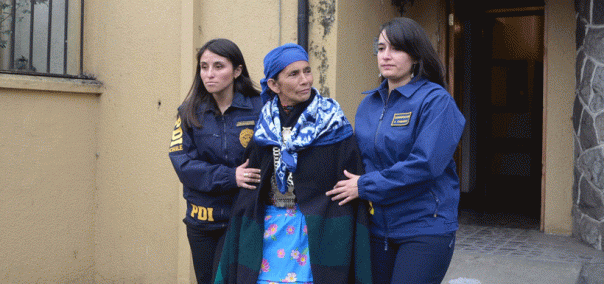
Machi Francisca Lincolao in the center.
To the Mapuche People:
To the Chilean People:
To the International Sixth:
To the Media:
We peoples, nations, and tribes of the National Indigenous Congress send a fraternal greeting of solidarity to Machi [1] Francisca Lincolao Huircapan, of the Mapuche People, in Chile, imprisoned since March 30, 2016. We know that compañera Machi Francisca is on a hunger strike to demand the justice that the bad government of Chile has denied her by keeping her imprisoned for the crime of continuing to defend the natural resources, sacred places, and cultural rights of her people. They are letting her health deteriorate to the point that it threatens the life of the compañera, whose state of health is summarily delicate.
We denounce the fact that while the Chilean government represses Machi Francisca, they blatantly protect transnational capitalists and bosses such as the landlord Alejandro Taldriz, with his illegal logging that the corrupt state works to protect.
The National Indigenous Congress and the EZLN demand:
- The immediate release of compañera Machi Francisca Lincolao Huircapan.
- An end to the repression against the dignified Mapuche people and the revocation of the racist and repressive Anti-terrorist Law that is meant to criminalize the territorial defense of the Original Chilean Peoples.
- Absolute respect for the Mapuche territory.
January 2017
For the Full Reconstitution of our Peoples | Never again a Mexico without us!
NATIONAL INDIGENOUS CONGRESS | ZAPATISTA NATIONAL LIBERATION ARMY
[1] A machi is a traditional healer and religious leader in the Mapuche culture of Chile and Argentine. Machis are more frequently women than men.
 Chiapas Support Committee