Chiapas Support Committee
Home of the Compañero Manuel blog on zapatistas & mexico
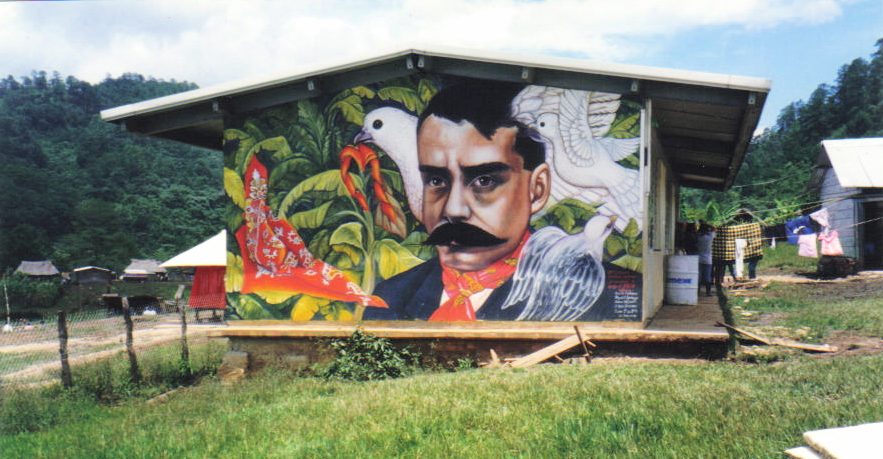
The Southern Command will support vigilance on the Mexico-Guatemala border
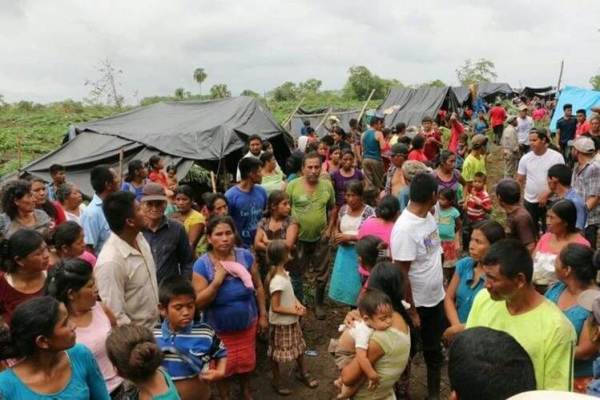
Guatemalan refugees stranded at the border with Mexico after police evicted them from their lands in the Petén.
By: Jesús Aranda
Cozumel, Quintana Roo
With support from the United States Southern Command, the armed forces of Mexico and Guatemala impel “very important” task force project on their common border for carrying out land and air patrols and recognizance for the exchange of information and intelligence to fight organized crime, General Juan Manuel Pérez Ramírez, head of Guatemala’s Joint Chiefs of Staff, revealed.
Upon participating in a meeting of the media from the seven representatives of the nations that took part in the Central American Security Conference (Centsec 2017), which was held in Mexico for the first time and was organized by the Secretariats of National Defense and of the Navy, with co-sponsorship from the United States Northern and Southern Commands, the Guatemalan military emphasized that this task force project “has been working since more than five years ago,” and one of the bases of operations will be located in the Petén, a strategic area that borders on the Usumacinta River.
“There are tangible projects” for carrying out land, air and recognizance patrols on the border of more than 1,000 kilometers, besides the exchange of information and intelligence, standardization of protocols and procedures for carrying out interdiction operations with technology and intelligence support from the Southern Command.
‘‘Inside the exchange of information process there is a route for immigrants undocumented that passes through the Northern Petén; we have periodic tactical and strategic meetings with military commanders (of the Mexican Army and Navy), Governance does its own, he indicated, and added that these kinds of “face-to-face” meetings are invaluable.
“They are strategic meetings and key to define mechanisms, the routes for migrants, contraband cattle, and for using people to carry drugs. The absence of the State is not a secret in Guatemala; with these meetings we try to be better organized to generate governability and subtract strength from organized crime,” he maintained.
Without the presence of the Secretaries of National Defense, General Salvador Cienfuegos Zepeda; of the Secretary of the Navy, Admiral Vidal Francisco Soberón Sanz, or of the chiefs of the Northern Command, General Lori J. Robinson and Admiral Kurt W. Tidd, who participated in the tasks and the closing, but not in the press conference, the Central American ministers agreed in pointing out that the biggest challenge they face in the area is the fight against organized crime.
In that regard, General David Munguía, El Salvador’s Defense Minister, emphasized that drug trafficking affects each country differently, and in this context, each nation must use “all its capacity” to confront it.
Such is the case of nations like Mexico, in which the armed forces, with respect to its legal framework in effect, participate in the fight against organized crime, he said.
The Vice Minister of Public Security of Panama, Jonathan Gabriel del Rosario Arosamena, said that drug trafficking is a transnational threat “that we must fight” with our best minds and abilities, not just in the ambit of public security, but also in the social ambit.
Initially, the conclusions of Centsec 2017 centered on the importance of information exchange based on trust as a necessity for responding effectively to threats.
A greater integration of nations was called for to make the regional security structures efficient and it was emphasized that the inequality in operational and logistical capacities would be a challenge to confront in the short term to achieve results that benefit the region.
Inside the work groups it was emphasized that it’s indispensable to establish action protocols and form strategic alliances among the area’s nations (Guatemala, Honduras, Costa Rica, Nicaragua, Belize, El Salvador and Panamá), since the common enemy, which is transnational crime, does not respect borders.
Another agreement was the urgency in coordinating the internal agencies in each nation so that they share information and with other countries and impel the exchange, thereby fomenting trust.
——————————————–
Originally Published in Spanish by La Jornada
Wednesday, April 26, 2017
http://www.jornada.unam.mx/2017/04/26/politica/003n1pol
Re-Published with English interpretation by the Chiapas Support Committee
Indigenous Government Council
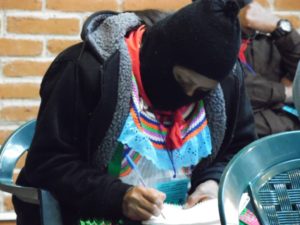
A Zapatista Comandanta at the CNI Assembly.
By: Magdalena Gómez
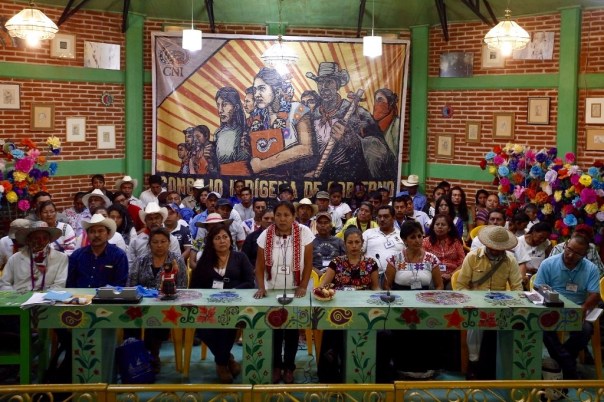
Last weekend, the constitutive assembly of the Indigenous Government Council (CIG, its initials in Spanish) of the National Indigenous Congress (CNI) was held in the Cideci in San Cristóbal de las Casas, Chiapas. 1,252 representatives from indigenous peoples and communities and 230 Zapatista delegates, a total of 1,482, participated. That completed the first phase of the process that was opened at the CNI’s fifth congress last October around the proposal, which was consulted widely and approved by the peoples, to create the Indigenous Government Council and name a spokesperson that would participate as an independent candidate to the Presidency of the Republic in 2018.
It’s important to remember that after the announcement of the aforementioned proposal, a racist attack was unleashed that quickly mutated into a strategy of omitting all reference to it. To that were added different personalities from the institutional left. The silence was recently partially broken and it showed that it’s difficult to question the electoral hegemonic view. The central note about the assembly was the naming of an indigenous “candidate,” rather than the relevance of the creation of the CIG, no reference to the resolutions that were announced in the phase open to the media about the council’s proposals, its organization and the way of linking up with the country’s social sectors. The ample and mature discussion about these themes was the heart of the assembly, their corollary was the naming as spokesperson the historic figure of the CNI belonging to the Náhuatl people of southern Jalisco, María de Jesús Patricio Martínez, who, it emphasized, will represent the voice of the original peoples of the CIG in the 2018 electoral process. They named a spokeswoman and all of the media translated it as a candidate. And it’s not merely a formal question; by omitting the CIG they seek to elude the autonomic and anti-capitalist organizational project. On the other hand, despite the fact that the inaugural session and the closing were open to the media, not one referred to the care of the Zapatista National Liberation Army (Ejército Zapatista de Liberación Nacional, EZLN) in occupying a place in the back of the auditorium, nor in Subcomandante Moisés’ punctual participation demanding truth and justice for Ayotzinapa, and demonstrating support and solidarity with the Wirrárika people, and the very symbolic and silent presence of Subcomandante Galeano accompanied by the little girl Defensa Zapatista with the message: “Don’t be afraid” and the message of Pedrito “continue forward and don’t give up.”
The EZLN’s relationship to the indigenous peoples and the CNI is solid, and is one of deep respect. It’s obvious that there is a relationship, therefore, when the CNI’s provisional council announced that its proposal for a spokesperson was Compañera Marichuy, it asked the EZLN and Comandanta Miriam for their opinion. Next a group of comandantas entered and asked permission to speak with her alone and converse about how “their heart feels” and went back to report that they accompany said proposal, which was unanimously endorsed in the assembly. There is no doubt that María de Jesús Patricio more than expresses the profile on which the CNI decided. Her words, strong and slow, reminded me of those that she spoke in San Lázaro on March 28, 2001: “Land and territory have a special meaning for our peoples, to us the land is our mother, we are born from her and she grows everything that gives us life; every stream, every rock, every hill breathes and has life in her. Because of having life and being a source of life, land has a special and sacred meaning to us. Mother Earth feeds us; we receive the air that we breathe from her, the sun that illuminates us, the light to work, the darkness to rest and dream. Upon being born we receive the first vision from her and the first breath. We return to her at the end of our steps through this world… We cannot conceive that our lands and territories are like any object that can be bought and sold like any merchandise.”
The indigenous assembly that created the CIG is an example of the potential of the indigenous peoples, of their maturity, of the breadth of their agendas, of the conscience they have about the need for unity, of breaking the chains that immobilize them like the so-called official economic “support” that no party questions because they benefit from it. Many of their proposals are not for immediate realization, but are their beacon, their emancipatory horizon. The principles are not a passing fad; thus Marichuy, the CIG’s spokesperson, recuperating the voices of the assembly, reaffirmed that this is a project for life, for organization, for the reconstitution of the peoples; it’s not for getting votes; we will call to civil society and join efforts; it’s a necessary step if we want to continue existing. Those of us who are present here are going to be at the front, the 71 council members, men and women of the CIG. I will be the spokesperson, she indicated.
No more no less.
———————————————————–
Originally Published in Spanish by La Jornada
Tuesday, May 30, 2017
http://www.jornada.unam.mx/2017/05/30/opinion/020a1pol
Re-Published with English interpretation by the Chiapas Support Committee
María de Jesús Patricio, the CIG’s spokesperson
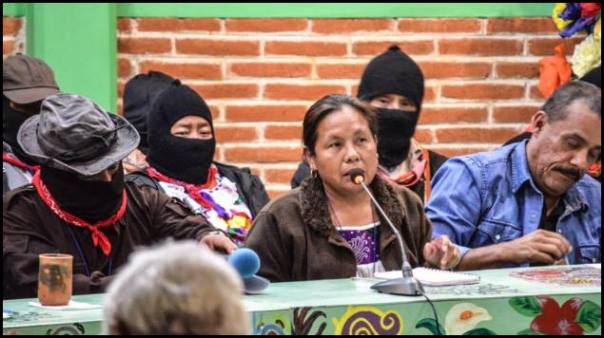
María de Jesús Patricio, spokesperson for the Indigenous Government Council
By: Luis Hernández Navarro
María de Jesús Patricio is an indigenous Nahua woman. Born in 1963 in the municipality of Tuxpan (land of the rabbit), Jalisco. She will be 54 years old next December. She is the mother of three children. She is a traditional doctor and herbalist. She has won different recognitions for her work in defense of the original peoples. Now she is also the spokesperson of the Indigenous Government Council and its candidate for the Presidency of the Republic.
Her friends and compañeros affectionately call María de Jesús “Marichuy.” Her commitment to the local and national indigenous struggle goes back many years. She attended the National Indigenous Forum, a Zapatista convocation, held in San Cristóbal in January 1996 as a representative of her community. In October 1996 she was part of the founding assembly of the National Indigenous Congress (CNI, its initials in Spanish) and read final declaration of the nascent organism. In March 2001, she responded brilliantly to the questions formulated by the legislators in the Chamber of Deputies, when the EZLN occupied the tribunal to defend the San Andrés Accords.
“We know –she said on that occasion to the deputies– that the national indigenous movement wasn’t born in 1994. The national indigenous movement has many years; it’s just that now, after 1994, is when Mexico shook and many who didn’t even know that the indigenous existed turned around to see.”
Very few individuals (men and women) have the pulse of what happens with the struggle of the original peoples that she has. Her knowledge of what’s happening in the entrails of the communities is profound and reflective. It is first hand. It comes, as much from her commitment to the reconstitution of her people, as from her participation of more than two decades in gatherings, forums, seminars, sharings and congresses all over Mexico. Additionally, she has elaborated a diagnostic statement of what is happening in the country.
It was during her participation in the National Indigenous Forum of San Cristóbal that she discovered that the inhabitants of her community were not the only poor ones and that other Native communities suffered the same problems as hers. She immediately adhered to the indigenous cause, in which she found her place and her life’s mission.
It was not exclusively an individual decision, but rather part of the feeling of all of a people. When Subcomandante Marcos visited Tuxpan, in March 2006, the representative of the municipality’s elders, Félix Vázquez Ceballos, told the Zapatistas: “Since 1994, the year in which you rose up against the government, the Nahua communities of Tuxpan have accompanied your step, because we have understood that your struggle is the struggle of all the indigenous peoples.”
María de Jesús remembers that when she was born, in Tuxpan there was only light and stone pavement in the center of the municipality, and the houses were made of adobe and roof tile. They used to carry water in jars hung on the ends of a stick (Revista Tukari, https://goo.gl/0sd0Kq).
The Nahuas of Tuxpan, dispossessed of their lands, had been neglected, impoverished and officially “disappeared” from the los census, in the face of the combined attack from cattle ranchers, the lumber industry, mining companies and government programs. And the teaching of their language was banished from the classrooms and educational programs.
Nevertheless, despite that aggressive neocolonial offensive against them, her indigenous identity resisted the pounding from the new colonialism. Against the current, from the intricacies of their culture, the Nahuas of Tuxpan undertook their reconstitution as a people. María de Jesús was fully involved in this rebirth.
Marichuy directs the Calli Tecolhuacateca Tochan Clinic, a space for the exercise and development of traditional indigenous medicine. A tool privileged in the reconstitution of the peoples, this therapy permits preserving and transmitting knowledge acquired for years by the ancestors. “It focuses –according to Doctor Patricio– not only on curing a particular evil, but also an evil of the community.”
Her calling as a traditional doctor was born in her since she was little, “when I observed how the older women, my aunts and my grandmother among them, healed the sick of fright, shock, possession by an evil spirit, bile, weakness or heat stroke. My Aunt Catarina, for example, did the cleansings with plants and she prepared ointments that she spread all over the body of the sick” (Revista Tukari, https://goo.gl/0sd0Kq). Her father and her aunt were her teachers.
The exercise of traditional medicine forms part of a project of broader resistance and emancipation. “The Clinic –asserts María de Jesús– has led us to the defense of traditional medicine, indigenous territories and Mother Earth from an anti-capitalist perspective, of the libertarian struggle of the indigenous peoples, a circumstance that has made us active promoters of the CNI, of the forums and meetings in defense of traditional medicine and of the strategic alliance between the civilian indigenous movement and the EZLN.” (https://goo.gl/d6M3eT)
Marichuy has reflected for many years on the question of the indigenous woman and her liberation. In her talk at the Seminar The Walls of Capital, the cracks of the Left, she documented the two faces of the feminine condition: on the one hand –she said– “the country is thinking without the woman,” and women are always oppressed and excluded, on the other hand –she assured– they are the ones who now head the resistances.
For her, dismantling capitalism walks hand in hand in the fight against machismo. That’s why she sees in the proposal of the CNI-EZLN that the Indigenous Government Council (CIG, its initials in Spanish) has a woman from below, indigenous and anti-capitalist, as its spokesperson and independent candidate to the Presidency of Mexico, the way to simultaneously struggle against machismo and the capitalist hydra.
On May 28, the CNI’s plenary, made up of 693 delegates, 71 council members, 230 Zapatista delegates and 492 invited guests, decided that the woman that is going to make history as the CIG’s spokesperson and candidate, who doesn’t seek votes, but seeks to defend life, is neither more nor less than her: María de Jesús Patricio.
———————————————————–
Originally Published in Spanish by La Jornada
Tuesday, May 30, 2017
http://www.jornada.unam.mx/2017/05/30/opinion/021a1pol
Re-Published with English interpretation by the Chiapas Support Committee
CNI-EZLN: The Time Has Come

Young Zapatista Woman
To the Peoples of the World,
To the Media,
To the National and International Sixth,
We send our urgent word to the world from the Constitutive Assembly for the Indigenous Governing Council, where we met as peoples, communities, nations, and tribes of the National Indigenous Congress: Apache, Amuzgo, Chatino, Chichimeca, Chinanteco, Chol, Chontal of Oaxaca, Chontal of Tabasco, Coca, Cuicateco, Mestizo, Hñähñü, Ñathö, Ñuhhü, Ikoots, Kumiai, Lakota, Mam, Matlazinca, Maya, Mayo, Mazahua, Mazateco, Me`phaa, Mixe, Mixe-Popoluca, Mixteco, Mochó, Nahua or Mexicano, Nayeri, Popoluca, Purépecha, Q´anjob´al, Rarámuri, Tének, Tepehua, Tlahuica, Tohono Odham, Tojolabal, Totonaco, Triqui, Tseltal, Tsotsil, Wixárika, Xi´iuy, Yaqui, Binniza, Zoque, Akimel O´otham, and Comkaac.
THE WAR THAT WE LIVE AND CONFRONT
We find ourselves in a very serious moment of violence, fear, mourning, and rage due to the intensification of the capitalist war against everyone, everywhere throughout the national territory. We see the murder of women for being women, of children for being children, of whole peoples for being peoples.
The political class has dedicated itself to turning the State into a corporation that sells off the land of the original peoples, campesinos, and city dwellers, that sells people as if they were just another commodity to kill and bury like raw material for the drug cartels, that sells people to capitalist businesses that exploit them until they are sick or dead, or that sells them off in parts to the illegal organ market.
Then there is the pain of the families of the disappeared and their decision to find their loved ones despite the fact that the government is determined for them not to, because there they will also find the rot that rules this country.
This is the destiny that those above have built for us, bent on the destruction of the social fabric—which allows us to recognize ourselves as peoples, nations, tribes, barrios, neighborhoods, and families—in order to keep us isolated and alone in our desolation as they consolidate the appropriation of entire territories in the mountains, valleys, coasts, and cities.
This is the destruction that we have not only denounced but confronted for the past 20 years and which in a large part of the country is evolving into open war carried out by criminal corporations which act in shameless complicity with all branches of the bad government and with all of the political parties and institutions. Together they constitute the power of above and provoke revulsion in millions of Mexicans in the countryside and the city.
In the midst of this revulsion they continue to tell us to vote for them, to believe in the power from above, to let them continue to design and impose our destiny.
On that path we see only an expanding war, a horizon of death and destruction for our lands, our families, and our lives, and the absolute certainty that this will only get worse—much worse—for everyone.
OUR WAGER
We reiterate that only through resistance and rebellion have we found possible paths by which we can continue to live and through which we find not only a way to survive the war of money against humanity and against our Mother Earth, but also the path to our rebirth along with that of every seed we sow and every dream and every hope that now materializes across large regions in autonomous forms of security, communication, and self-government for the protection and defense of our territories. In this regard there is no other path than the one walked below. Above we have no path; that path is theirs and we are mere obstacles.
These sole alternative paths, born in the struggle of our peoples, are found in the indigenous geographies throughout all of our Mexico and which together make up the National Indigenous Congress. We have decided not to wait for the inevitable disaster brought by the capitalist hit men that govern us, but to go on the offensive and convert our hope into an Indigenous Governing Council for Mexico which stakes its claim on life from below and to the anticapitalist left, which is secular, and which responds to the seven principles of Rule by Obeying as our moral pledge.
No demand of our peoples, no determination and exercise of autonomy, no hope made into reality has ever corresponded to the electoral ways and times that the powerful call “democracy”. Given that, we intend not only to wrest back from them our destiny that they have stolen and spoiled, but also to dismantle the rotten power that is killing our peoples and our mother earth. For that task, the only cracks we have found that have liberated consciences and territories, giving comfort and hope, are resistance and rebellion.
By agreement of this constitutive assembly of the Indigenous Government Council [CIG its initials in Spanish], we have decided to name as spokesperson our compañera María de Jesús Patricio Martínez of the Nahuatl people, whose name we will seek to place on the electoral ballot for the Mexican presidency in 2018 and who will be the carrier of the word of the peoples who make up the CIG, which in turn is highly representative of the indigenous geography of our country.
So then, we do not seek to administer power; we want to dismantle it from within the cracks from which we know we are able.
OUR CALL
We trust in the dignity and honesty of those who struggle: teachers, students, campesinos, workers, and day laborers, and we want to deepen the cracks that each of them has forged, dismantling power from above from the smallest level to the largest. We want to make so many cracks that they become our honest and anticapitalist government.
We call on the thousands of Mexicans who have stopped counting their dead and disappeared and who, with grief and suffering, have raised their fists and risked their own lives to charge forward without fear of the size of the enemy, and have seen that there are indeed paths but that they have been hidden by corruption, repression, disrespect, and exploitation.
We call on those who believe in themselves, who believe in the compañero at their side, who believe in their history and their future: we call on them to not be afraid to do something new, as this is the only path that gives us certainty in the steps we take.
Our call is to organize ourselves in every corner of the country, to gather the necessary elements for the Indigenous Government Council and our spokeswoman to be registered as an independent candidate for the presidency of this country and, yes, to crash the party of those above which is based on our death and make it our own, based on dignity, organization, and the construction of a new country and a new world.
We convoke all sectors of society to be attentive to the steps decided and defined by the Indigenous Government Council, through our spokeswoman, to not give in, to not sell out, and to neither stray from nor tire of the task of carving the arrow that will carry the offensive of all of the indigenous and non-indigenous peoples, organized or not, straight toward the true enemy.
From CIDECI-UNITIERRA, San Cristóbal de las Casas, Chiapas
May 28, 2017
For the Full Reconstitution of Our Peoples
Never Again a Mexico Without Us
National Indigenous Congress
Zapatista National Liberation Army
En español: http://enlacezapatista.ezln.org.mx/2017/05/28/llego-la-hora-cni-ezln/
CNI | EZLN Solidarity and support for our brothers and sisters of the Wixárika people
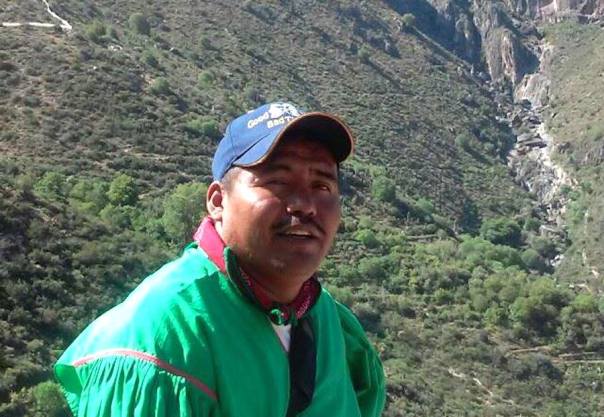
Miguel Vázquez Torres
To the Wixárika People
To the Peoples of the World
Gathered together in the Constitutive Assembly of the Indigenous Council for Mexico at CIDECI–UNITIERRA, Chiapas, the indigenous peoples, nations, and tribes who make up the National Indigenous Congress and the Zapatista National Liberation Army say to the Wixárika people that we stand together, that your pain and rage are also ours, and that the path of your historic struggle is part of the hope we have as a country and as a world.
We repudiate and condemn the cowardly murder of the compañeros Miguel Vázquez Torres and Agustín Vázquez Torres of the Wixárika community of Waut+a- San Sebastian Teponahuaxtlán in the state of Jalisco on May 20 of the present year at the hands of the mercenaries of organized crime. This crime could not have happened without the absolute complicity of the bad governments on all levels, given that the riches of the Wixárika lands are coveted by the powers of capital which know no limits and which use their narco-paramilitary groups to try to dismantle an organization as exemplary as that of the Wixaritari.
We know they will not achieve this; they have never been able to and never will because the fabric that keeps the original peoples alive also sustains the hope we are building together in order that a new world be born of resistance, rebellion, and the determination to keep existing.
We salute the exemplary defense of the territory that the compañero Miguel led, without ever turning back, as well as the paths the Saint Sebastian community is forging to recuperate nearly 10 thousand hectares invaded by ranchers, supposed small landowners from Huajimic, Nayarit. These ranchers are protected by the capitalist governments’ determination to pretend to dialogue while preparing a bloody end to this conflict, disguising it as drug cartel activity, as unclear state or municipal borders, as lying “task forces” i, as complicated judicial proceedings, or as supposed budget limitations.
Wixaritari compañeras and compañeros, we are with you and we know that the steps you collectively decide to take will be wise and dignified. We will not be indifferent nor oblivious to the support and solidarity that we have mutually shared on the CNI’s historic path.
We emphatically demand the solving of this crime against a whole people, punishment of the guilty, and the dismantling of the Jalisco New Generation Cartel and all the criminal capitalist corporations that seek to take over the territories and autonomous organization that we peoples, nations, and tribes defend.
We demand that the the ancestral territories of the Wixárika people be wholly respected, that the territory invaded on the outskirts of Huajimic, Nayarit, be urgently restored [to the people], and that the forms of security and justice decided upon and exercised by the community of Waut+a- San Sebastian Teponahuaxtlán be fully respected.
Attentively,
May 27, 2017
National Indigenous Congress
Zapatista National Liberation Army
En español: http://enlacezapatista.ezln.org.mx/2017/05/27/solidaridad-y-apoyo-con-el-pueblo-hermano-wixarika-cni-ezln/
Marichuy, the independent candidate close to the EZLN
Marichuy, the independent candidate always close to the EZLN since 1994 and one of the founders of the CNI
Marichuy, spokesperson of the CIG and elected as an independent candidate for president of the Republic in 2018
By: Isaín Mandujano
“Even with all our contradictions, this movement goes on, because to the peoples to whom we are not obliged, because while we want to be on the electoral ballots in 2018, our struggle will be for life, for organization, to continue existing,” members of the Indigenous Government Council (CIG, its initials in Spanish) said upon presenting and supporting María de Jesús Patricio Martínez as the spokesperson and independent candidate to the presidency of the republic.
A Nahua of Tuxpan, in southern Jalisco, where she was born on December 23, 1963, the indigenous woman who completed high school to dedicate herself to the preservation of traditional and herbal medicine, was the one elected as the spokesperson of the Indigenous Government Council by the National Indigenous Congress and by the General Command of the Indigenous Revolutionary Clandestine Committee (CCRI-CG) of the EZLN.
“We think that compañera Marichuy, doesn’t sell out, doesn’t give up and doesn’t surrender, as she was trained inside the CNI, we believe that,” said one of the women of the CIG al leer the pronouncement of the Constitutive Assembly.
Marichuy, as everyone in the CNI and the Zapatistas know her, received the unanimous support of everyone present in that big hall in which were more than 1,400 delegates of some 58 indigenous peoples and some 250 more EZLN representatives.
In May 2015, for preserving traditional and herbal medicine, as well as for her linkage with the country’s indigenous communities, the Tuxpan Municipal Government Council delivered the Tuxpan Award of Merit to María de Jesús Patricio Martínez (Marichuy), allotted by the Unit of Support to the Indigenous Communities of the Coordination of Linkage and Social Service of the University of Guadalajara.
The award was given to her in the area of Science and Culture, for her work in the House of Health with traditional and herbal medicine.
Today Marichuy directs the Calli Tecolhuacateca Tochan Clinic, a place for the exercise and development of the traditional indigenous medicine of the Nahua community of Tuxpan. The Indigenous Communities Support Unit (UACI) of the University of Guadalajara (UdeG) has supported this project for 22 years, for the purpose of attending to the sick with an integral community health scheme that serves as a space for the training of the region’s indigenous health promoters.
Currently, the Calli Tecolhuacateca Tochan Clinic is located on Abasolo Street, number 57-A, in the El Cóbano neighborhood. It’s open Monday through Friday from 9:00 am to 2:00 pm and from 4:00 pm to 6:00 pm. On Saturdays it’s open from 9:00 am to 2:00 pm. Until today, she has personally attended to people.
But her life has taken a radical turn by now being named spokesperson of the CIG and an independent candidate to the presidency of the republic on the part of the indigenous peoples.
Although neither she or her husband Carlos González, who is also a figure and stands out inside the CNI, have said so, their children will remain under the care of the EZLN support bases and commanders in Chiapas, who will take care of them and give them protection, but above all give them education.
Prior to her name being known, some already predicted that it she would be the one elected, because few women like Marichuy have stood out inside the CNI. Since the EZLN’s 1994 armed uprising, she was already supporting the Zapatista cause. She participated in every one of the events that the armed group has convoked.
She was chosen to take the microphone on the platform, together with the Zapatista commanders and sub-commanders, after the first departure of the Zapatistas from the Lacandón Jungle and their big march to Mexico City. It was on that occasion that Comandanta Esther of the EZLN stood out.
Recognized as one of the founders of the CNI, in her speech on March 29, 2001 before the Congress of the Union, Marichuy spoke in the name of the indigenous women of Mexico.
 That tiny little woman that was always going from one side to another in each and every one of the gatherings and forums that the EZLN celebrated in the CIDECI-Unitierra of San Cristóbal de Las Casas, in Oventik, or in any other Zapatista Territory or Caracol.
It wasn’t difficult for experts in Zapatismo to know that the EZLN and the CNI would anoint Marichuy on Sunday the 28th, when around three o’clock in the afternoon white smoke came out of that big auditorium.
Absent in that auditorium, but present in another room nearby, following every detail of the Constitutive Assembly, were Subcomandante Galeano and other commanders like Tacho, and other individuals that have always supported the civilian path, Jorge Javier Elorriaga and Sergio Rodríguez Lazcano.
Subcomandante Insurgente Moisés headed the plenary of the Constitutive Assembly together with Bettina Cruz Velazquez, of the indigenous Zapotec people and a member of the Assembly of the Indigenous Peoples of the Isthmus of Tehuantepec in Defense of Land and Territory, Santa María Xadani, Oaxaca.
The CIG members introduced Marichuy and pointed out that more than an electoral campaign it will be a campaign for la organization, for life, for defense of territory. Its mission will be the articulation of all the country’s indigenous peoples and movements.
Although they did not say it, it could be something similar to the “Other campaign” that then Subcomandante Marcos (Comandante Zero) made through the whole country, but the difference is that this time they seek to appear on the 2018 electoral ballots.
Marichuy said that she will take this “great responsibility” that the CNI and the EZLN have given her, but she is not alone in that, but rather she counts on all the support of the members of the CIG that are around 50 men and women, all from different states of the country and from different indigenous peoples.
The next meeting for everyone to get together will be October 12 in Zapatista Territory. Marichuy, as well as the new council members, made a call to all the indigenous peoples of Mexico to add themselves to this struggle before capitalism levels and disappears all the original peoples.
——————————————————————-
Originally Published in Spanish by Chiapas Parallel
Monday, May 29, 2017
Re-Published with English interpretation by the Chiapas Support Committee
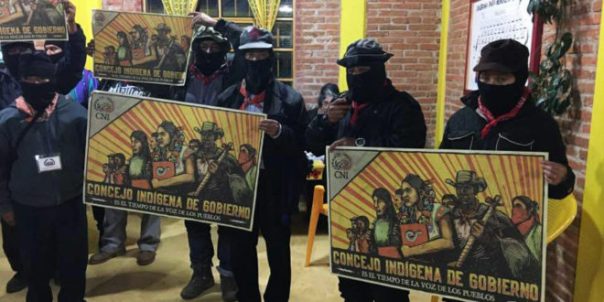
CNI Mexico: It’s time for the voice of the peoples
Published by Pozol Colectivo
San Cristóbal de las Casas, Chiapas, Mexico
Numerous buses and long lines of delegates from the national Indigenous Congress (CNI), gathered today at the Cideci-Unitierra, at the start of registration for the Constitutive Assembly for the Indigenous Government Council (CIG), whose spokesperson will be a candidate in the 2018 presidential elections in Mexico.
With the slogan “it’s time for the voice of the peoples,” members of the original peoples for the CIG’s constitutive assembly, after having consulted on the proposal in each one of their communities in Mexican geography and after having been approved by their members.
Representatives of the Cucapa and Kumiai people arrived from Baja California; Chol, Maya, Tzeltal and Castellano from Campeche; Castellano, Chol, Mam, Tojolabal, Tzeltal, Tzotzil, Lacandón and Zoque from Chiapas; Raramuri from Chihuahua, Nahua from Mexico City; Nahua from Colima; Wixarika from Durango; Chichimeca from Guanajuato; Afro-Mexican, Mephaa, Nahua, Amuzgo and Ñu Savi from Guerrero; Nahua from Hidalgo; representatives of the Coca, Nahua, Tepehuano and Wixarika peoples from Jalisco; Matlatzinca, Nahua, Otomí-Ñatho, Otomí-Ñañhú from the State of Mexico; Mazahua, Nahua, Otomi and Purépecha from Michoacan; Nahua of Morelos; delegates from the Nayéri and Wixarika peoples of Nayarit; the Chinantecos, Cuicateco, Ikoots, Mazateco, Mixe, Ñu Savi, Triqui, Binniza, Chontal and Zoque from Oaxaca; the Nahuas and Totonaco from Puebla; the Otomí-Ñañhú from Querétaro; the Mayas of Quintana Roo, the Castellanos and Nahua of San Luis Potosi, representatives of the Mayo People of Sinaloa; the Guarijio, Mayo, Seri, Tohono and Yaqui of Sonora; the Chol, Chontal and Zoque from Tabasco; the Nahuas, Otomí-Ñuhú, Popoluca, Sayulteco, Tepehua and Totonaco from Veracruz; the Mayas from Yucatan; and the resident migrant peoples in Guadalajara and in the Valley of Mexico.
For tomorrow, May 27, they foresee the inauguration and installation of the Constitutive Assembly of the Indigenous Government Council for Mexico, as well as workshops with the following axes:
1) Proposals and strategies of the Indigenous Government Council;
2) Functioning and Organization of the Indigenous Government Council;
3) Linkage of the Indigenous Government Council with other sectors of civil society; and,
4) Naming of the Spokesperson of the Indigenous Government Council.
Translators Note: Espoir Chiapas, an online publication of French solidarity folks, reported that there were thousands of people attending.
—————————————————————–
Originally Published in Spanish by Pozol Colectivo
Friday, May 26, 2017
Re-Published with English interpretation by the Chiapas Support Committee
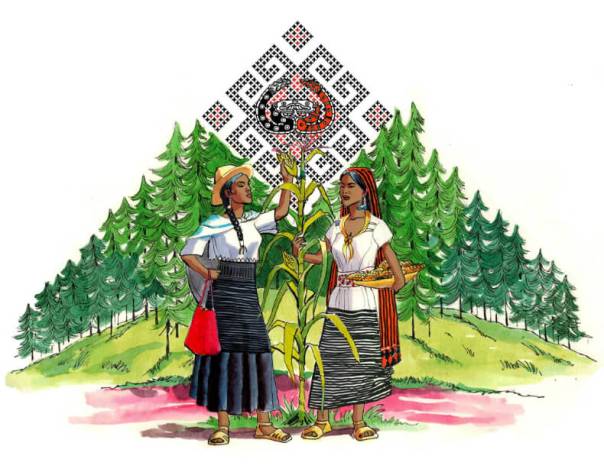
The CNI starts meeting today
Published by Pozol Colectivo
Chiapas, Mexico
“The National Indigenous Congress prepared for 20 years to reach this day and point out a good path,” Subcomandante Moisés argued last January 1, with respect to the creation of the Indigenous Government Council on the part of the National Indigenous Congress on May 26, 27 and 28, and whose spokesperson will be a presidential candidate in the 2018 elections. “Who will now question the path they have chosen and to which they are calling everyone?” If their struggle and the path that they follow is not respected, if it is not welcomed, if it is not supported, then what message does society send? What paths are left for indignation,” the Zapatista Chiapaneco asked. “This struggle is for those who have nothing more than pain, rage and desperation,” he assured from the Zapatista Caracol of Oventic Chiapas.
It was on October 14, 2016, when the National Indigenous Congress (CNI), after denouncing a panorama of “death, violence, dispossession and destruction” against the original peoples, reported its intention to consult in each one of its territories, the agreement of the Fifth National Congress to name an Indigenous Government Council (Concejo Indígena de Gobierno, CIG), whose word would be materialized by an indigenous woman, an independent candidate to contend in the name of the CNI, in the 2018 presidential elections. “We confirm that our struggle is not for power, we don’t seek it; but rather we will call upon the original peoples and to civil society to get organized in order to stop this destruction,” the indigenous Mexicans specified in the communiqué “May the earth tremble at its core!”
“If just the possibility of citizen existence (with all its rights and obligations), of an indigenous woman, makes “the earth tremble at its core,” what would happen if her ear and her word would travel through the Mexico of below,” asked Subcomandante Galeano on October 21, 2016, facing the wave of comments over the nomination of an indigenous woman in the 2018 presidential elections and the creation of the CIG. “Are they worried that the indigenous woman doesn’t know how to speak Spanish well, but not that the current head of the federal executive doesn’t know how to speak, period,” the EZLN spokesperson added. “Is it that the Mexican political system is so solid, and that the tactics and strategies of the political parties are so fundamental and consistent that it’s enough that someone says publicly that he’s thinking something, and that he’s going to ask his peers what they think about what he’s thinking, that they become hysterical,” asked the insurgent.
The CNI’s proposal provoked so many unfounded questions that on November 11, 2016, Subcomandante Moisés, in the name of the EZLN, dedicated a comunicado called ”It’s not the decision of one person,” to “the racists.” “Why do you turn against the indigenous and treat them like they have no brains and that they don’t know where they’re going,” the indigenous Chiapaneco asked. “First, learn to read, then read it well, then learn to understand what you read,” the Zapatista leader recommended. To the “PhDs and even honorary doctors or however you say it,” which turns out to be that: “you don’t know how to read or write,” and plainly “you don’t understand anything.” The insurgent specified that in the CNI proposal, “It doesn’t say that the EZLN is going to consult with its support bases as to whether they are in agreement with running an independent candidate from the Zapatista support base.” “They say they are very studious and have a lot of advanced technology and don’t even bother to read; they go to the corporate media and get their words from there,” Moisés asserted about the “intellectuals.”
On December 2, the CNI and the EZLN, felt the need to publish a joint communiqué titled: “Despite aggressions, the consultation continues,” in which they reported that: “the fear of the powerful, of the extractive industries, of the military, of the narco-paramilitaries is so great that our consultation is being attacked and harassed where our peoples are meeting to discuss and decide the steps to follow as the CNI;” and he used as an example the cases of: Santa María Ostula, Michoacán, Zoque territory of Northern Chiapas and San Luis Acatlán, Guerrero.
On January 1, 2017, the results of the CNI consultation was announced: “gathered together in this 5th Congress, 43 peoples of this country, WE AGREE to name an Indigenous Government Council with male and female representatives from each one of the peoples, tribes and nations that belong to it. This council proposes to govern this country and it will have as its spokesperson an indigenous woman from the CNI, who will be an independent candidate to the presidency of Mexico in the 2018 elections.” In the same way, the indigenous Mexicans specified with respect to the political parties that: “Don’t be confused about us, we don’t seek to compete with them because we are not the same, we are not their lying and perverse words. We are the collective word of below and to the left, that which shakes the world when the earth trembles with epicenters of autonomy, and that makes us so proudly different.”
Subcomandante Moisés, in the name of the EZLN indicated that same January 1, 2017, that: “Now, conditions of the people of Mexico in the countryside and the city are worse than 23 years ago,” when they rose up in arms. “Poverty, desperation, death and destruction, are not only for those who originally populated these lands. Now, the affliction reaches everyone,” the EZLN’s military chief explained.
“Now our brothers and sisters from the organizations, barrios, nations, tribes, and original peoples, organized in the National Indigenous Congress, have decided to shout their YA BASTA (ENOUGH!). They have decided that they are not going to permit that our country continues to be destroyed. They have decided not to let the people and their history die because of the sickness that is the capitalist system. And they have decided to do it by means of civilian and peaceful paths. Their causes are just, undeniable,” Moisés argued.
“Now, the National Indigenous Congress calls us to a struggle in which all of us can participate, without age, color, size, race, religion, language, income, knowledge, physical strength, culture or sexual preference mattering. The struggle to which the National Indigenous Congress calls us and invites us is a struggle for life with liberty, justice, democracy and dignity. It’s the hour of all working people, together with the original peoples, lodged under the flag of the National Indigenous Congress,” the EZLN spokesperson said.
—————————————————————–
Originally Published in Spanish by Pozol Colectivo
Thursday, May 25, 2017
Re-Published with English interpretation by the Chiapas Support Committee
Chiapas: Learning between modernity and marginalization
Benito Juárez Primary School
Published by: POZOL COLECTIVO mayo 15, 2017
Chiapas Mexico, May 15, CalleLuz © / Community Information Agency
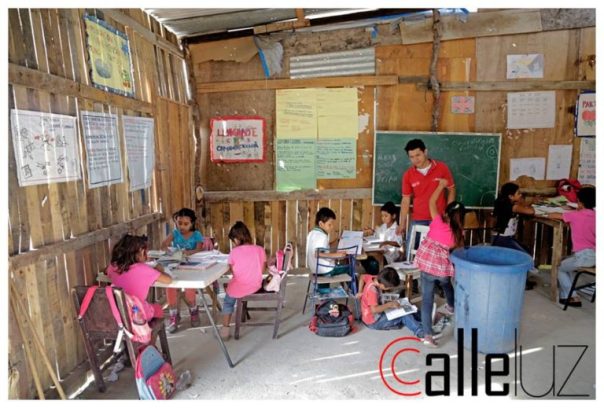
The first challenge to being a teacher has not been easy. Fortune has fallen upon César and Pablo of feeling in their own flesh the real situation that thousands of schools in Chiapas are going through. They have to give classes in the midst of dust and inside of a classroom constructed of a wood base, galvanized tin roofs and pieces of plastic, practically in marginalized conditions.
One might think that they give classes in a school located in the jungle or in the state’s Sierra (mountains), but we’re talking about a multi-grade classroom located in the Unión Antorchista District, of Chiapa de Corzo municipality, a scare three kilometers from where a modern commercial complex is built that gives a vanguard touch to the capital of Chiapas.
That reduced space that they call the “Benito Juárez” Elementary School contrasts with the modernity that is seen at a distance; from that place one can see the largest tower in Chiapas with its glittering windows; one can also see the subdivisions that have broken the visual equilibrium between the Rio Grande of Chiapas and its hills.
In that space, where seventeen boys and girls congregate daily, the color ocher and the smell of ocote wood dominate el color; the children are in search of knowledge without caring if they do it in overwhelming heat or in the middle of the dust.
The modernity of that improvised classroom is still limited to a pile of books that the father of each family brought to form a small library and to raw drawings of superheroes that simulate murals on the walls.
The children that show their friendship in each smile don’t know what a multimedia classroom is, much less an Internet connection to virtual libraries like the Education Reform proposes.
Everyone learns under the old teacher-student scheme, but now with the variant that the children have to play an almost self-taught role in order to be able to learn things better and share them with their peers.
“It’s learning based on communication and dialogue. It’s a different way since now the students learn on their own; before the teacher was standing up in front and teaching, now we interact and they can become tutors and give classes among themselves,” says Pablo, a teacher in charge of attending to a group of children.
Ironically, the classroom is located just at the side of a light post, but the classroom doesn’t have electricity; outside where the atrium is supposed to be, the almost desert-like scenario gives a dramatic atmosphere to that space.
Suddenly, a gust of wind fills the faces with earth and bothers the eyes with the tiny stones that it achieves raising, but it doesn’t matter. Nothing stops them from playing; soccer is the most fun for them.
The littlest ones hug and climb on each other to walk on the imaginary edge of the atrium; they know that the playground ends there because then comes the thicket that has been bent over by the inclement sun.
Others prefer to take advantage of the time to finish homework or to review what they learned. The best bench table for a fifth year student is a worn out chair. He places a book on the desk and leaves others that he will use later on the ground. In a cramped position he begins to review the homework and has placed a backpack as a pad so that the ground doesn’t hurt his knees.
“If we need to go to the bathroom then we ask the teacher for permission and we leave running to that little room that is there, the one that you see wrapped in nylon,” another student says, upon pointing out a small box constructed of wood and plastic.
In the Benito Juárez School with key 07KPR4157A the hero is the teacher, who given the lack of technological instruments has to draw upon his creativity and unimaginable tools to be able to comply with the study plan.
“It’s not easy, but if we have that love and vocation for teaching we have to invent so that the children learn, It’s a real test being in front of the classroom and for our students to learn the basics,” assures César, who is ready to call his students because recess is over.
César and Pablo are two student teachers from Conafe. This is their first encounter with children to give classes. Both imagined that they would send them to a marginalized community in some distant municipality, but not that they would give their service a few kilometers from the Chiapas capital; there, they also encountered a panorama similar to what hundreds of communities experience.
They are almost sure that they have to go through that experience to verify the reality about the state’s education system. They will spend a year in service to earn a fellowship and continue with their studies en some teachers college or university.
“Here we have to encounter the flavor to which we want to be dedicated. We must go through that to know if our vocation is really to be a teacher,” assures Pablo, who now only lacks a few months to finish his service.
He would like to continue in that school in order to improve the facility little by little; he is fond of his students who constantly bring fritters or other goodies to enjoy together.
César looks for a pen among his things entre to underline some corrections that he found in a sentence that he has dictated to one of his students that is in the third grade together with his other classmates.
For the child, the word exclusion still doesn’t enter his life’s dictionary, it doesn’t matter to him that he shares a group with several younger children.
There, in that humble but solid group, teachers and students spend the days cultivating and discovering new things. While the children learn the basics, the student teachers discover their true vocation, there in the midst of the dust, overwhelming heat and marginalization.
Source in Spanish: https://www.facebook.com/permalink.php?story_fbid=1998819207022613&id=1987046361533231
—————————————————-
Published in Spanish by Pozol Colectivo
Monday, May 15, 2017
Re-Published with English interpretation by the Chiapas Support Committee
 Chiapas Support Committee