
By: Mary Ann Tenuto Sánchez
July 28, 2023
At the end of August 2022 and early in October 2022, the Chiapas Support Committee published a two-part report on the dramatic increase in violence in the Mexican state of Chiapas, home to the Zapatista National Liberation Army (EZLN, Ejército Zapatista de Liberación Nacional), as well as its supporters grouped together in social organizations, some of them members of the National Indigenous Congress (CNI). That report was a first attempt to explain the disturbing news from Chiapas. A little less than a year later, a violent situation produced by a battle between two national organized crime groups for control of territory in the state, as well as the complicity of governments and ongoing counterinsurgency actions, has become even more intense.
We addressed 5 issues in the two-part report: 1) Counterinsurgency against the Zapatistas, 2) the violence generated by national organized crime groups fighting each other for territorial for control, 3) the Mesoamerica Project, 4) Municipal Elections and 5) Militarization. Since then, much, much more has been learned and, sadly, the violence is either much worse or we’re just learning about how bad it is.
This Update is published in 3 Parts. What follows below is an update on the issue of counterinsurgency against the Zapatistas.
COUNTERINSURGENCY – “Low-intensity” war against the Zapatistas
Low-intensity warfare, as practiced in Chiapas against the EZLN is, essentially, a War of Attrition; that is, exhaustion from the wear and tear of the different forms of counterinsurgency.
GUACAMAYA LEAKS – SEDENA’s surveillance of the EZLN
A group of activists calling themselves “Guacamaya” published information they hacked from Mexico’s defense agency, the Secretariat of National Defense, known by its Spanish acronym SEDENA. One such report was about SEDENA’s surveillance of the EZLN. SEDENA’s internal documents show that the Army is obsessed with the EZLN, who its support bases are, their activities, photographs of them and their events. The alleged intense surveillance includes Marichuy and the Second International Gathering of Women Who Struggle.

An interesting and possibly the most important revelation in the cited document is the map that accompanies it. The map shows the original route designed for the Maya Train. It would have cut a swath through what is considered “Zapatista Territory” and would have negatively affected one or more EZLN Caracols (Centers of Resistance). The fact that the route was changed to have zero effect on any of the EZLN Caracols may indicate that SEDENA’s obsession with the EZLN is actually a fear of Zapatista resistance and ability to organize.
SEMBRANDO VIDA (Sowing Life)
A federal government anti-poverty program called Sembrando Vida (Sowing Life) pays individual campesinos to plant trees. The government doesn’t pay the community or a campesino organization, it pays the individual. Since most rural communities are organized in a collective way, this can place individual campesinos in conflict with their community and/or their organization. The emphasis on individualism has created a strain on the community fabric in ejidos and other rural communities, including communities with Zapatistas, by creating division. Therefore, it plays a counterinsurgency role. The leaked SEDENA document on “Surveillance of the EZLN,” concludes that the EZLN is losing members due to the implementation of Sembrando Vida. Participants interact with National Guard members in the implementation of the program and intelligence information can be obtained through that interaction. AMLO says that there are 80,000 people in Chiapas enrolled in the program.
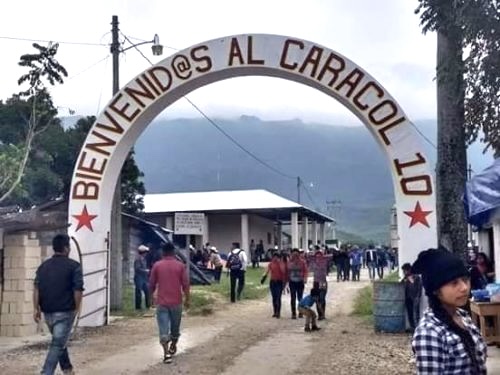
MOISÉS Y GANDHI – On May 22, 2023, narco-paramilitary members of ORCAO carried out an armed attack on this important autonomous Zapatista community. A Zapatista support base, Jorge López Sántiz, was shot in the chest and seriously wounded in the attack. It was difficult to find a hospital that had both the room and the level of care he needed. Somehow, his compañeros were able to get him admitted to the Dr. Gilberto Gomez Maza Hospital in the state capital of Tuxtla Gutiérrez, where initially there was no space in the intensive care unit, as the seriousness of his injuries required. This caused concern because he sustained injuries to his diaphragm, large intestine, stomach and spleen. Reports said his condition was so serious that he was barely clinging to life. He ended up in the intensive care unit of the hospital in Tuxtla for 10 days and in physical therapy for another 4 days.
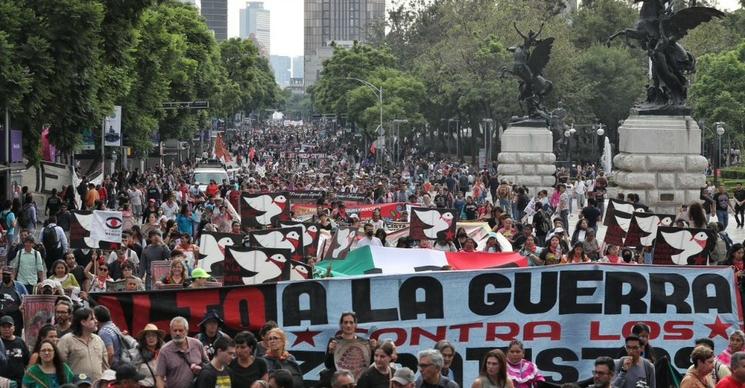
This attack and Jorge’s injury prompted the CNI to call for a Day of Global Action to Stop the Attacks against the Zapatista Peoples on June 8, and to organize a large protest march in Mexico City. Supporters around the world carried out a variety of protests.
On June 19, just 11 days after the protests, the ORCAO again launched a series of armed attacks in the Moisés y Gandhi region. The simultaneous shooting lasted three days, this time against 3 communities: Moisés y Gandhi, Emiliano Zapata and San Isidro. This led to a strong denunciation from the All Rights for All Human Rights Network (TDT Network or, in Spanish, the RedTDT). AMLO had the bad taste to respond by denying the violence that people are experiencing in the state. His denial was full of half-truths and ancient history, which raised the collective blood pressure of Zapatista supporters. In response, supporters called for more protests, more Days of Global Action.
The armed attacks mentioned are the most recent attacks on this community from this same paramilitary organization. Among its many attacks over the years, the paramilitary wing of ORCAO has repeatedly attacked the community’s coffee warehouses located at the Cuxuljá Crossroads, an important source of economic production for the Zapatistas.
ALDAMA – In Aldama, there has been a huge reduction in the amount of shooting into Aldama communities. The reduction in shooting is significant enough to knock Aldama out of the news. The shooting and the news have moved to the Moisés y Gandhi region.
The reduction in shooting is due to the expulsion from the Santa Martha Ejido of many of those who were part of the civilian armed group that was firing their weapons into Aldama day after day and night after night for several years. The sprawling Santa Martha Ejido expelled more than a hundred of its residents involved in the shooting, allegedly because they attempted to poison the spring that provided drinking water to the ejido and also killed six people within their own ejido. Those expelled are now displaced and deny those allegations. It seems that many of them fled to the town of Polhó, a Zapatista-led community that is also the municipal seat of San Pedro Polhó autonomous municipality, where a non-Zapatista allowed the people displaced from Santa Martha to stay in his warehouse.
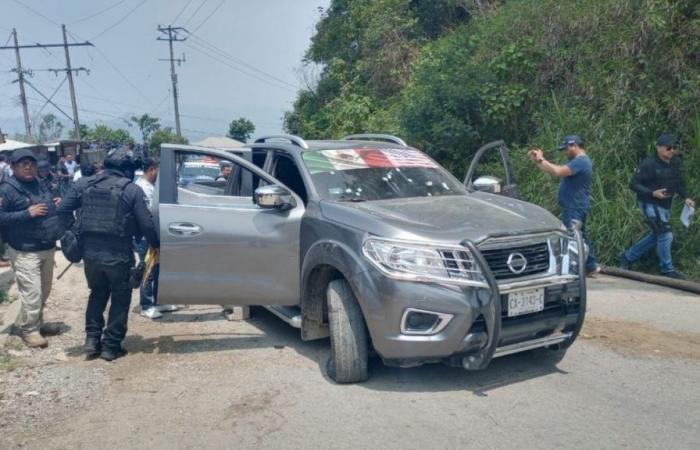
POLHÓ – Apparently, the folks displaced from Santa Martha took their guns with them when they fled to Polhó. In the late afternoon and evening of June 2, they apparently shot and killed six people (one of them a 3-year-old child) from Santa Martha who they claimed drove to Polhó to attack them. Media reports about the violent incident contradicted each other and raised many questions.
Weeks later, an opinion piece from Luis Hernández Navarro clarified key questions, such as Hernández Navarro’s description of the incident as an “ambush” of the family from Santa Martha and the driver’s relationship to Los Herrera and El Machete in Pantelhó. It turns out that the driver is the one who killed the wife of El Machete’s comandante several months ago and the displaced people living in the warehouse ambushed the vehicle he was driving.
The significance of such an incident occurring in a Zapatista-led community is hard to digest and difficult to analyze without more facts; but it appears to be an example of the narco-paramilitary violence in the Chiapas Highlands penetrating and damaging the community fabric in Polhó and elsewhere. (More on Polhó here.)
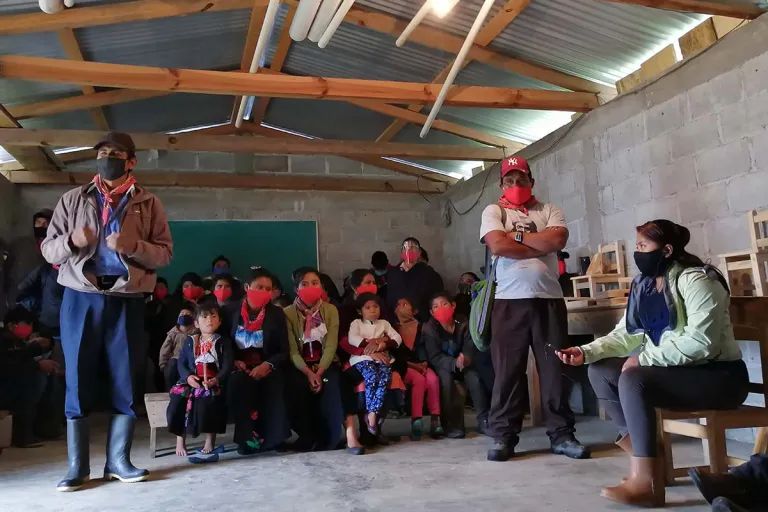
NUEVO SAN GREGORIO – The Latin American writer and analyst Raúl Zibechi visited NSG in September 2022 and reported that two Zapatista families had recently left the community, leaving just 4 families in resistance. Zibechi participated in a meeting with members of the remaining families, as did representatives from the Ajmaq Network and the Fray Bartolomé de Las Casas Human Rights Center (Frayba).
Representatives of the remaining families stated something Zibechi considered “notable.” They told him: “We’re more united now, we feel stronger than when we were a lot more.”
Nevertheless, despite their unity and strength, the four families that were holding out in Nuevo San Gregorio finally had to leave in order to save their lives, especially the lives of their children.
“JUDICIAL DISCRIMINATION” – A new or, perhaps, renamed form of counterinsurgency, which is being referred to by some as “judicial discrimination,” is the criminalization of “being Zapatista.” A recent example is the case of Manuel Gómez Vázquez, a civilian Zapatista support base from El Censo, municipality of Ocosingo, in the Tseltal Jungle Zone. A civilian armed group and the community authorities illegally arrested Manuel on December 4, 2020. He was tortured and suffered cruel, inhumane and degrading treatment. The next day, they handed him over to municipal public security and investigative police from the Indigenous Prosecutor’s Office of the State’s Attorney General (FGE). He has been in pre-trial detention (known in Mexico as preventive prison) ever since, despite the 2-year limit on such detention. [Lawyers tell me that when there is a delay for this long, the prosecutors probably don’t have a witness who is willing to give false testimony.)

Reports do not give the name of the armed civilian group that illegally arrested Gómez Vázquez. Nor do those reports indicate if that group has any connection to a national cartel. What IS known about El Censo, however, is that it has been anti-Zapatista since the early days of the EZLN. An armed civilian group, the Opddic, was born in the communities of El Censo and Taniperla (Ocosingo), on the periphery of the Montes Azules Biosphere Reserve, in the Tseltal Jungle Zone. Hermann Bellinghausen explained that history in La Jornada, on February 27, 2007.
POLITICAL PRISONERS – Judicial Discrimination seems to be another way of saying that Offices of the Chiapas State Attorney General (FGE) are arresting and holding civilian Zapatistas in prison, based on flimsy evidence, or none at all. The Fray Bartolomé de Las Casas Human Rights Center (Frayba) recently denounced a case from the municipality of Salto de Agua, in the state’s far north region near Palenque. The case involves a civilian Zapatista support base from Ranchería El Trapiche (Trapiche, on the maps). His name is José Díaz Gómez, and he has been a prisoner in the Catazajá state prison for eight months, “arbitrarily deprived of his freedom.” The Frayba is concerned about the delays in holding his intermediate hearing and demands his liberation.
José was arbitrarily detained with signs of excessive use of force, torture, cruel, inhumane and degrading treatment at the time he was forcibly disappeared and held incommunicado by members of the Specialized Police attached to the Prosecutor’s Office in the Selva District, who executed the arrest warrant. The warrant was for the crime of “robbery carried out with violence.”
And there’s more!
In addition, the Frayba added, “there is an arrest warrant for the same crime against four more indigenous EZLN civilian support bases, which places their dignity and human right to freedom at imminent risk, as a form of intimidation and harassment of Zapatista autonomy.”

INTER-AMERICAN COURT of HUMAN RIGHTS – Hermann Bellinghausen made public his affidavit to the Inter-American Court of Human Rights, which was used as evidence in the case of González Méndez v. Mexico. The family of Antonio González Méndez, a Zapatista who was forcibly disappeared from a community in Salto de Agua municipality, is pursuing a case against the Mexican government for the reparation of damages. The disappearance occurred in 1995, at the height of anti-Zapatista paramilitary activity. This is a case of first impression for the Court regarding the Mexican government’s counterinsurgency plan against the Zapatistas called the Chiapas 94 Campaign Plan, which included forming paramilitary groups. Lawyers and the widow of González Méndez are asking the Court to find a proximate cause between the government’s formation of paramilitary groups and the disappearance of González Méndez, who left the town with a member of the “Paz y Justicia” paramilitary group.
The affidavit gives a first-hand account of the history of the early days after the EZLN Uprising (1995-1999) and is not only a history lesson, but a good read.

The above is an update to “Chiapas and the Zapatistas face a dramatic increase in violence,” our initial report posted on August 31, 2022. This Update is published by the Chiapas Support Committee, a 501c.3. nonprofit organization and an adherent to the EZLN’s 6th Declaration of the Lacandón Jungle.
 Chiapas Support Committee