Chiapas Support Committee
Home of the Compañero Manuel blog on zapatistas & mexico
Collapse
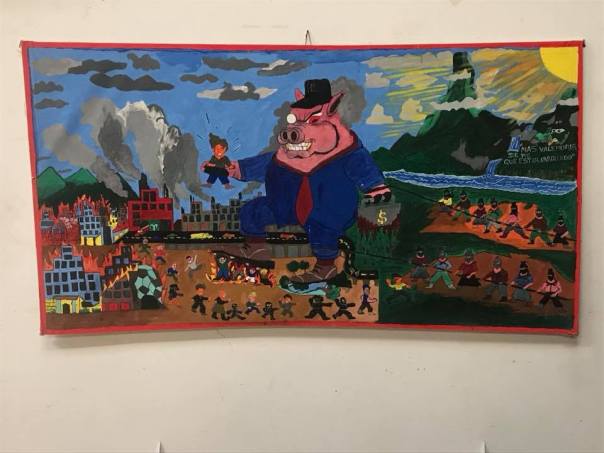
Art from the Zapatista art collection, currently circulating among the EastSide Cultural Center, the La Peña Cultural Center and the Omni Commons in Oakland and Berkeley.
By: Gilberto López y Rivas
During the recent seedbed-roundtable “Looks, listens and words: Prohibited thinking?” Subcomandante Insurgente Galeano made frequent references and reflective comments about the book by Carlos Taibo, Collapse: Terminal capitalism, eco-social transition, eco-fascism (Buenos Aires: Libros de Anarres, 2017), the book has circulated profusely in the networks that accompany the CIG-CNI-EZLN, with the recommendation to study it in depth and to discuss it collectively. We’re dealing with a shocking, disturbing and inescapable work, which makes understandable and urgent the so-called constants of the Zapatista Mayas to organize ourselves in the face of the storm that approaches. A storm that is neither metaphorical nor symbolic and that alludes not to an apocalyptic vision or prophetic millennial vocations, but rather to the real and scientifically founded possibility of a catastrophe on a worldwide scale in a not too distant future, which Taibo calls collapse; that is, the general and massive collapse of the dominant system, characterized by substantial reductions in industrial production; the simultaneous and combined collapse of a financial, commercial, political, social, cultural and ecological nature, due to its own contradictions and verifiable realities that are taking place: climate change, the depletion of raw energy materials, the irreversible attack against biodiversity, the social conditions of unemployment, poverty, hunger, mass forced displacements, the exponential increase in mortality due to curable diseases, wars over raw materials and water, genocides, ethnic cleansing, ecocides, State terrorism, proliferation of nuclear weapons, the collapse of the megalopolis and passage to the necropolis, and the extension of crime and criminal gangs.
The work has a clarifying prologue to the Argentine edition written by Juan Carlos Pujalte, a preface and seven chapters. In the first chapter the concept of collapse is expounded on and lessons are extracted from other collapses that happened in the past, which, different than the one underway, were not global. He researches different definitions of the term, to try to define it; examines various problems that surround the concept; weighs the studies that have addressed collapses in the past, and takes into consideration two contemporary collapses.
In the second chapter he explores the causes of a systemic collapse of a global character, placing emphasis on climate change and the depletion of raw materials. He explains the data by which the author considers that the global collapse is perfectly imaginable. He underscores that, differently from the past, when the main threats of catastrophes were associated with natural phenomena, human activity became decisive starting in the 20th Century. The author prefers talking about climate change and not about global warming. According to the data exposed, it will be impossible to avoid a 2 to 3 degree rise in the average planetary temperature. Its consequences, exposed summarily: a rising sea level, disappearance of ice at the North Pole, disappearance and mutation of species, desertification, an irreversible loss of forests, an increase in the number and intensity of hurricanes, increasing difficulties for food production, the emergence of new diseases, major flooding and the disappearance of lands inhabited in continental littorals and islands.
In the third chapter the possible consequences of the collapse are analyzed, which necessarily, the author warns, presents an unequivocal and unbearable speculative dimension. He attempts to explain the characteristics of the order or disorder that will probably emerge after the collapse. Taibo points out that, according to the experts, if the rules of the game are not drastically modified, the collapse could be verified in the years between 2020 and 2050. Its general features are: destruction of coastal stretches and underlying areas, mass migrations, cuts in the supply of electricity, visible effects on transportation systems that will lead to a de-globalization thanks to the scarcity of energy, and the entire universe of centralization and technology will enter into crisis in post-collapse society. There will also be a proliferation of failed states and all sorts of violence, a greater extent of crime, aggressions of the northern states on other states in search of raw materials, a notable decline in economic growth, acute social crisis, collapse of the cities, especially of the mega-cities, a substantial reduction of the number of inhabitants on the planet (it’s estimated that 67 percent of the planet’s inhabitants would perish).
In the fourth and fifth chapters two possible responses in the face of the collapse are exposed: the one that Taibo calls movements for an eco-social transition and the one he calls eco-fascism. The first has a collectivist vocation, demonstrates sufficient social cohesion, maintain forms of community property, more direct human relations, an active and participative social life, characteristics that inevitably refer to the original peoples immersed in antisystemic autonomic processes, like Zapatismo. The other imaginable response facing the collapse is eco-fascism, which leads to a rapid and overwhelming decline in the number of human beings that people the planet. Taibo refers to the antecedent of the original eco-fascism of Hitler’s Germany, and the current social Darwinism, based precisely on an open militarization of collective life and extension of terror.
The sixth chapter is about popular perceptions around the collapse, founded in ignorance and denial on the widespread idea that what we want to occur will occur, that there are no limits on the planet, that the market and the technologies will permit confronting the problems, that the only solution continues being the uncritical acceptance of the existing reality. The last chapter refers to a synthesis and general conclusions, urging attention to the collapse that approaches and acting accordingly, looking for solutions totally alien to capitalism, private property and the market, abandoning the logic of the economic growth, betting on the equality in all orders and maintaining hope in the face of savagery.
———————————————————–
Originally Published in Spanish by La Jornada
Friday, May 18, 2018
http://www.jornada.unam.mx/2018/05/18/opinion/016a2pol
Re-Published with English interpretation by the Chiapas Support Committee
Women, a key piece in capitalist exploitation
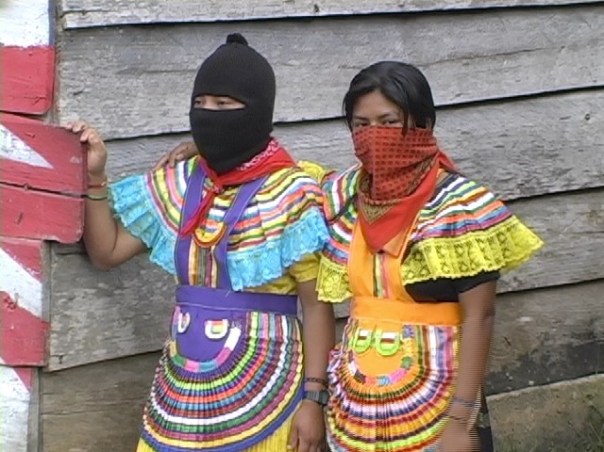
Zapatista women are constructing an anti-capitalist world.
By: Arturo Sánchez Jiménez
With the crisis of capitalism, the women of poor regions of Mexico have been forced to enter into productive dynamics and take charge of both their families and the work in their communities, which contributes to maintaining exploitation, the anthropologist Mercedes Olivera Bustamante [1] set forth yesterday in University City.
The researcher from the Center for Higher Studies of Mexico and Central America gave the keynote address Ethics and feminisms, which took place in the forum called Mexico 2018 faced with the sociopolitical processes of Latin America and the global crisis, organized by the Latin American Council of Social Sciences (Clacso).
The academic pointed out that among the elements that have impacted women in the crisis, above all the poorest ones, are: the destruction of nature, with a neo-extractivist dynamic, and brutal social polarization, which has placed them in a condition of extreme growing poverty.
“Among the communities in Chiapas we have the experience of the de-structuring of the campesino economy, which has changed the life of the feminine sector in a very important way, because there is a labor crisis to the extent that there is no industrial development or service industry that can absorb the population.”
This phenomenon, she considered, has presented itself since the 1990s, and one of its consequences is the migration of young men and women from Chiapas communities. “The women are the ones that take charge of reproduction and production; they have had to absorb it as something forced. To the extent that the men leave, the women have to take charge of the daily maintenance of their families.”
At this time, “women in Mexico are producing men for migration, with the transfer of the value of our work and of the value of the work of all of Mexican society to United States imperialism,” she emphasized.
In this regard, she said that: “women are not only subsidizing the capitalist system with our caring labor and the reproductive work, which has been something historic, but now also with the productive tasks we carry out. But we must think that it’s not just the work of women, but also this transfer of value from poor countries to the empire, which is something fundamental for sustaining the exploitation and development of capital.”
She also specified that women enter the labor market with a very large vulnerability, because of gender inequality they have not had the same opportunities as men to get training. “Then, the positions that they occupy are those least remunerated.”
[1] Mercedes Olivera Bustamonte is the founder of the Chiapas Women’s Rights Center (Centro de Derechos de la Mujer de Chiapas, CDMCH) and other civil society organizations in Chiapas.
———————————————————–
Originally Published in Spanish by La Jornada
Friday, April 27, 2018
http://www.jornada.unam.mx/2018/04/27/politica/014n2pol
Re-Published with English interpretation by the Chiapas Support Committee
The Polish cyclist was decapitated; authorities reject version
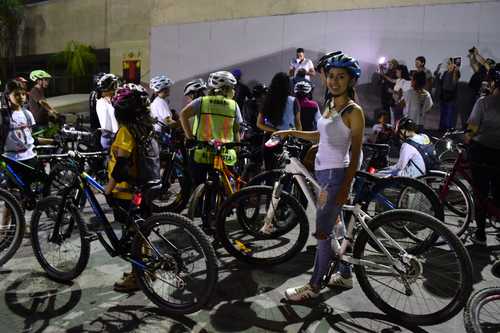
Cyclists from various parts of the world held an event in San Cristóbal de Las Casas as a homage and to protest the murder of the two tourists that were traveling on their bikes a few weeks ago. Photo: Óscar León
From the Editors
The body of one of the European cyclists found dead near kilometer 158 of the San Cristóbal – Ocosingo highway, had been chopped, a version that the state authority rejected this Saturday.
According to Juanjo Gutiérrez, who identified himself as a friend of a Mexican journalist that contacted the Polish cyclist Krzysztof Chmielewsk, affirmed that the body was indeed mutilated.
He had his first contact with the Pole in Huatulco, Oaxaca last April 8. One week later, Chmielewsk arrived in Tuxtla Gutiérrez where he offered a conference in which he talked about his travel through 51 countries, to later depart for San Cristóbal de Las Casas.
The Polish cyclist used a cell phone without a chip (SIM card) and his only form of communication was through Facebook, where he announced the details of his trips and was only connected to the Internet at points with open networks.
On April 29, the disappearance of the German cyclist Holger Franz Hagenbusch, who also was seen for the last time in San Cristóbal, was reported.
That same day it was reported in the local media that on the night of April 26 they had located the cadaver of a cyclist, referring to the Pole, a situation that awakened the curiosity of the Mexican journalist, who went to investigate if it was he.
They did not find identification or the Go Pro camera with which he recorded his journeys on the body. It was in a state of putrefaction. In the process of recognition, the prosecutor Pablo Liévano assured that the cyclist’s death was due to an accident.
Gutiérrez and his journalist friend (who he did not name) went to Ocosingo to try to recognize the cadaver and they realized, through photographs shown by forensic experts, that the body had no head; they were only able to appreciate chunks of bone from the neck.
The responsible authority told them that the skull was torn apart during the fall, despite the fact that the rest of the body was without injuries. Although the body, according to the prosecutor, “fell freely into that ravine,” the guts didn’t explode. Its internal organs were in a perfect state of preservation; but he did lack a foot, which seemed to have been cut off; the authority maintained that wildlife ate it.
The bicycle found together with the cadaver that is apparently Chmielewsk does not belong to the Pole, but rather to Holger Franz Hagenbusch. The authority said that perhaps they exchanged bicycles on the route. Both had met each other in San Cristóbal and decided to travel together to Palenque.
On Friday, May 4, Liévano announced the finding of a second cadaver, 200 meters further down from where the first one was found. He’s talking about the body of Hagenbusch. The German’s body had a hole in the skull produced by a shot.
On May 10, the German newspaper Frankfurter Allgemeine Zeitung published statements of Rainer Hagenbush, the cyclist’s brother, that the Pole had been “decapitated.” This Saturday, prosecutor Luis Alberto Sánchez, the one responsible for the investigation, rejected this version.
———————————————————–
Originally Published in Spanish by La Jornada
Sunday, May 13, 2018
http://www.jornada.unam.mx/2018/05/13/politica/012n1pol
Re-Published with English interpretation by the Chiapas Support Committee
2 European cyclists murdered in Chiapas
CHIAPAS PROSECUTORS CORRECT INVESTIGATION: FOREIGN CYCLISTS DID NOT HAVE AN ACCIDENT; THEY WERE MURDERED
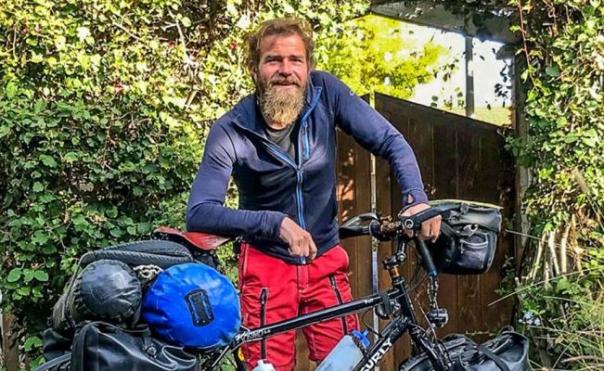
The German cyclist Holger Franz Hagenbusch
By: Isaín Mandujano
TUXTLA GUTIÉRREZ, Chiapas
The state’s Attorney General took a turn in the investigation into the death of the German cyclist, Holger Franz Hagenbusch, upon verifying that his cadaver presented a hole in the skull allegedly produced by a firearm, a fact that collapses the initial official thesis of accidental death.
That’s what the prosecutor for the Investigation of Homicide Crimes, Luis Alberto Sánchez Sánchez, said today. He recalled that the body of the Polish cyclist Krzysztof Chmielewski, which is “more complete” than that of the German, was found first.
According to the official, the first cadaver presented severe traumatic brain injury by a cause “yet to be determined,” although he said that the object with which he was hit was “very blunt” and left “the head destroyed.”
On the body of the Polish man they only found the bicycle of the German cyclist, whose whereabouts were unknown until April 26.
The finding of the Polish man’s cadaver occurred when a villager reported the fact and indicated that it was about 50 meters away in a ravine at kilometer 158 between San Cristóbal and Ocosingo, on the stretch known as La Ventana. [1]
As for the body of the German cyclist, the official explained that the skull presented an entrance hole from a bullet in the occipital region, from bottom to top, which entered the left ear and came out above the right ear.
Sánchez Sánchez recognized that, although rushed, it was first believed that the death of both cyclists could be due to a highway accident. However, upon finding the second body they found evidence of a double crime. The official said that those who killed them attempted to make it look like an accident and not a robbery, but that now it is considered as a “double murder.” Additionally, he ruled out that the double crime was an act of organized crime. In fact, he asserted that it was “an isolated act.”
However, he said that the area has been mapped to investigate who the aggressors were. He commented that they could be residents of the same region, so a team of investigators combs the area.
The prosecutor explained that last Tuesday, May 8, personnel from the German Embassy arrived in the area and were given access to the case file and then toured the place where the double crime occurred.
Additionally, they continue looking for evidence to help find those responsible; therefore, crews of investigators are out-stationed in the area to look for evidence and avoid that curiosity seekers alter the crime scene.
Holger Franz’s route
Reiner Hagenbusch, brother of the murdered German cyclist, traveled to Chiapas. The prosecutor said that he has access all the time to the investigations because of being the first and immediate one interested in seeing that the crime does not go unpunished.
Holger Franz’s brother said in an interview that Holger decided to leave a small town in the center of Germany in 2014 to tour part of Asia on a bicycle. The first country that he selected was Iran, where he expected to stay for six months.
However, he returned home because his father died. Afterwards, he sold a house and left on a trip with that money. Besides Iran, he was in Iraq, Azerbaijan, Tibet, China, Indonesia and Vietnam. He traveled from Shanghai to Alaska on a cargo ship. Then he went through Canada and traveled to the United States. In December of last year he reached Mexico’s northern border, where he began his journey towards the south.
Reiner said that his brother’s plan was to reach Patagonia and then take another cargo ship to South Africa, where he hoped to go up through the whole African continent until returning home.
“His path ended in Chiapas, but the people of Chiapas are not to blame. The crazy people that kidnapped my brother and his traveling companion are to blame,” he said.
Reiner added that on April 28 he found out about his brother’s disappearance due to a message from a friend that Holger made in Chiapas. That was why he started making calls to the German Embassy in Mexico and decided to travel to Chiapas territory to look for his brother and carry out his mother’s order: “Find my son and bring him back to Germany.”
According to Reiner, he didn’t have the faintest idea of where Mexico was or what its people were like until his brother’s disappearance. He only knew that this country was the seat of a World Cup in 1970.
Now, he added, he is surprised by the show of affection and expressions of support that he has received from all those interested in seeing his brother’s crime clarified, like the community of cyclists in Chiapas and throughout Mexico.
[1] Near the municipal capital of Oxchuc.
————————————————————-
Originally Published in Spanish by Proceso.com
Friday, May 11, 2018
Re-Published with English interpretation by the Chiapas Support Committee
Comandante Contreras
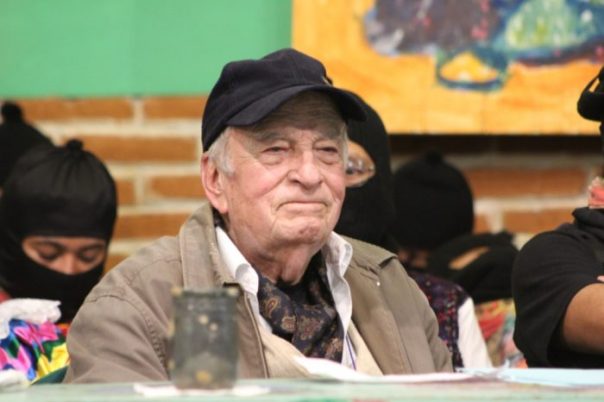
Comandante Pablo Contreras!
By: Gilberto López y Rivas
The culminating moment of the recent Zapatista roundtable, “Looks, Listens, Words: prohibited thinking?” was full of emotion and prolonged and standing applause of those who filled the auditorium of the CIDECI-University of the Earth, was when Pablo González Casanova was given the rank of comandante and thus became a member of the Indigenous Revolutionary Clandestine Committee of the Zapatista National Liberation Army. For those who have had the privilege of his friendship and camaraderie during these years in the San Andrés dialogue, the Peace with Democracy Group, the Network of Intellectuals in Defense of Humanity, in recent times, in the twinning (hermanamiento) with the struggle of the Indigenous Government Council, the National Indigenous Congress and the EZLN, the now Comandante Pablo Contreras has always represented that lookout that the Zapatista Mayas describe as the sentinel of critical reflection, who knows how to distinguish changes, look at the signs, evaluate them and interpret them, who doesn’t tire, much less surrender, and points to the dangers, storms, without slogans, acts of faith or the fashions of extractivist academia or intellectuals at the service of power. This deserved recognition from the Zapatistas to the most important social scientist of our country comes to fulfill a life full of ethical congruence and intellectual social commitment. It is for that dedication to the cause of the peoples that the EZLN’s General Command General rewards him, in Zapatista fashion, “giving him more work,” as Comandante Tacho would affirm on that memorable evening.
Against the grain of an academia and an educated right, insensitive and conformist, Pablo González Casanova is distinguished by his early and always valid contributions regarding democracy in Mexico, as well as the reformulation of the categories of exploitation, domination, internal colonialism, imperialism, community and development. Just this year, we presented his book Exploitation, colonialism and struggle for democracy in Latin America [México: Akal, 2017], essential for understanding the tragic reality of our country, in times when the electoral circus tries to trick millions of citizens with its political clowns, tamers, illusionists and trapeze artists. In this work, González Casanova maintains, precisely, that the exploitation, the foundation of the capitalist order, has been incompatible with a democratic political system that respects the sovereignty of the peoples of Latin America, a statement that makes the structural foundation of the crisis of legitimacy and credibility of this system of representation comprehensible.
Subcomandante Galeano commented that González Casanova won the surname of Contreras through his permanent and determined support, not exempt from punctual and constructive differences. With that, he shows his stripe as an organic intellectual of social processes to which he points with passion and without ambiguities. Thus, they highlight his critique of bureaucratic socialism based on the defense of scientific Marxism and humanism; his loyalty to the Cuban revolution, and, recently, his positioning around the revolutionary process that the Bolivarian Republic of Venezuela experiences, [The world’s biggest lie, La Jornada], an historic event, by the way, that has made even globally-recognized intellectuals lose their anti-imperialist and classist compass. I also remember, his categorical demarcation: “With Saramago up to here and with Cuba forever” [http://www.jornada.unam.mx/2003/ 04/26/030a1mun.php?origen=], in difficult circumstances that the government and the Cuban people experienced in 2003, and in which they received the timely solidarity of González Casanova.
Subcomandante Galeano also noted that Pablo Contreras is the only member of the General Command that is not indigenous, a distinction that is explained not only by his merits as a militant in the cause of the peoples in resistance, but also by his theoretical contributions to the understanding of what Marxism calls “the national and colonial question.” For students of ethnicity, his concept of internal colonialism signifies a light in the tunnel of dogmatic Marxism. In the “Internal colonialism” chapter of the cited book, he goes deep into this important concept to interpret the ethnic-national problem, starting with the idea that political borders have directly or indirectly influenced the formulation and use of sociological categories, marking off the relatively interchangeable character of the notion of colonialism and of colonial structure, and emphasizing colonialism as an internal phenomenon. Thus, the concept of internal colonialism could only emerge as a result of the great independence movement of the former colonies. With the direct disappearance of the domination of the natives by the foreigners, appears the notion of domination and exploitation of natives by natives. González Casanova clarifies: “Internal colonialism corresponds to a structure of social relations of domination and exploitation between cultural groups that are heterogeneous, distinct, and with civilization differences. The colonial structure and internal colonialism are distinguished from the class structure, because they are not only a relationship of domination and exploitation of the workers by the owners of the means of production and their collaborators, but rather a relationship of domination and exploitation of one population [with its different classes, property owners and workers] by another population that also has different classes [property owners and workers].”
The naming of Pablo González Casanova as a member of the General Command of the Zapatista National Liberation Army has multiple meanings from the perspective of the very same Zapatismo. In any case, it becomes an obligatory point of reference in which academia and intellectuals creaking with age and estranged from anticapitalist resistances, re-colonization and the social war that our peoples and nations experience are put to the test. And, based on the above, the idea raised by Comandante Contreras about the universal character of Zapatista thinking.
Congratulations, Comandante Contreras!
———————————————————–
Originally Published in Spanish by La Jornada
Friday, May 4, 2018
http://www.jornada.unam.mx/2018/05/04/opinion/020a2pol
Re-Published with English interpretation by the Chiapas Support Committee

What’s missing is missing

April 2018
To the CIG Support Networks and Marichuy booths:
To those who participated in the Civil Association “The time has come for the flourishing of the peoples:”
To the National and International Sixth:
To the people of Mexico:
To the free, autonomous, alternative, independent media:
To the national and international press:
Faced with the worsening of war, dispossession and repression that invade our peoples together with the advance of the electoral process and according to the steps walked through the geographies of this country by our spokeswoman Marichuy together with the council members, we respectfully direct ourselves to the people of Mexico to tell them that:
We listened to the pain of all the colors that we, the Mexico of below, are.
With the pretext of the period of collecting signatures, we toured the indigenous territories of our country where together, we made our political proposal grow from below, from where the struggle of many original peoples, their problems and their proposals were made visible.
With our participation in this electoral process, we reiterate to the indigenous and non-indigenous peoples of Mexico that we will not remain quiet while they destroy and grab the land from us that we inherited from our grandparents and that we owe our grandchildren, while they contaminate the rivers and perforate the hills to remove the minerals. We will not stay quiet while they convert the peace and the life that we have been constructing every day into war and death through the armed groups that protect their interests. Have no doubt! Our answer will be organized resistance and rebellion to heal the country.
With the large mobilization of thousands and thousands of compañeros and compañeras of the support networks throughout the country, we realized “and it became blatantly visible that in order to appear on the electoral ballot it’s necessary to guaranty that we are equal or worse than them, that if we present signatures they must be false or they are not valid, if we spend money it must be of dark origins, if we say something it must be a lie, if we agree to something serious, it must be with corrupt politicians, with the extractive industries, with the bankers, with the drug cartels, but never, ever, with the people of Mexico.”
Appearing on the electoral ballot is only for those who seek to administer the power of above oppressing those below, because the power that they seek is rotten throughout. It is a competition that can be won with cheating, money and power, like the merchandise that the elections of the political class are, in which there is no room and will not be room for the word of those below, of those who are indigenous or that without being part of an original people, scorn power and construct democracy making decisions collectively, which then become government in a street, in a barrio, in a community, an ejido, a collective, a city or a state.”
Then the electoral process is a big pig sty in which contest the one who was able to falsify thousands of signatures and the one who has billions of pesos that permit coercing and buying the vote, while most of the Mexican people struggle helplessly between poverty and misery.
That’s why our proposal is not the same, that’s why we’re not campaigning, that’s why we don’t turn in falsified signatures, nor to seek and spend monies that the people of Mexico occupy to attend to their vital needs, that’s why we don’t concern ourselves with winning any election or mix with the political class, but rather it’s the power of below that we are seeking, which is born from the pains of the peoples and that’s why we walk seeking the pain of all the colors that the people of Mexico are, because there is the hope that a good government that governs by obeying will be born and it can only emerge from organized dignity.
It’s not only the racism of the political structure that doesn’t allow our proposal to figure in the electoral ballot, because if those who oppose the capitalist destruction of the world share with other almond-shaped eyes, blue or red, public policies and supposed democracy would be made for excluding them. The original peoples and those who walk below and to the left don’t fit in their game; not because of our color, our race, our class, our age, our culture, our gender, our thought, our heart, but because we are one with Mother Earth and our struggle is so that everything is not converted into merchandise, because it would be the destruction of everything, starting with the destruction of us as peoples.
That’s why we struggle, that’s why we organize ourselves. That’s why we not only don’t fit into the structure of the capitalist state, but every day we feel more repugnance for the power of above, which makes the profound scorn against all Mexicans more notorious every day. The grave situation that our peoples are experiencing and that has been worsened gravely in recent weeks by repression and dispossession has only merited the complicit silence of all the candidates.
Consequently, by agreement of the second work session of the Indigenous Government Council, held on April 28 and 29 in Mexico City, neither the CIG nor our spokeswoman will seek nor accept any alliance with any political party or candidate, nor will they call to vote or to abstain, but rather we will continue looking for all those below to dismantle the pestilent power of above. Vote or don’t vote, get organized!
We will walk constructing the keys for healing the world.
In the original peoples of this country, where the Indigenous Government Council was in agreement, and that is where our spokesperson walked weaving, as was the mandate of the general assembly of the CNI, are the resistances and rebellions give shape to our proposal for the whole nation. That’s why, together with the councilors from each state and region, we toured their geographies, where the war and the invasion of the capitalist monster is experienced day b y day. Where the land is dispossessed so that it stops being collective and remains in the hands of the rich, so that the territories are occupied and destroyed by mining companies, the aquifers devastated for the extraction of hydrocarbons, the rivers contaminated, the water privatized in dams and aqueducts, the sea and the air privatized for wind parks and aviation, the native seeds contaminated by transgenic ones and toxic chemicals, cultures made folklore, territories configured for the functioning of transnational drug trafficking, and the organization of below subjected by the terrorist violence of narco paramilitary groups that serve the bad governments.
We also saw ourselves on the paths that are illuminated in the worlds that protect their cultures, when in them is drawn the proposal and word of the other indigenous peoples, and from their own struggle and from their own language emerge the foundations that are the reason for being of the Indigenous Government Council.
It is there where the hope that we’re seeking shines, as it also does in organized civil society in the cities with the Sexta (the Sixth), with the groups and Networks in support of the CIG that not only came out to show their solidarity and to make an agenda throughout the country, but also came out to construct from below, from the capitalist ruins, a better country and a better world. Our admiration and respect to all of them.
We call on all of us who are the people of Mexico, the compas of the Support Networks for the Indigenous Government Council in all states of the country, the compañeras and compañeros that formed the Civil Association “The Time has come for the Flowering of the Peoples” to follow us consulting and evaluating, making assessments, finding and walking the new paths that we will decide, always organizing, although you may vote or not vote for some candidate. Your words, feelings and proposals are important to us.
We will continue building respectful bridges with those who live and struggle, so that together we can grow the collective word that helps us resist against injustice, destruction, death and dispossession, to reconstruct each and every fabric of the country with the conscience of those who dream below and rebel with their own geographies, cultures and ways.
Our word that is directed to the world is protected in the collective proposal of the peoples. We will continue walking towards below, towards the indigenous peoples, nations and tribes that we are, therefore we will call in the month of October 2018 the General Assembly of the National Indigenous Congress, to learn the results of the evaluation of the original peoples grouped in the CNI, and to advance in the next step.
Sisters and brothers of the people of Mexico and the world, let’s continue together because what’s missing is missing.
For the Integral Reconstitution of Our Peoples
Never more a Mexico without Us
National Indigenous Congress
Indigenous Government Council
Sixth Commission of the EZLN
En español: http://enlacezapatista.ezln.org.mx/2018/05/02/falta-lo-que-falta/
Prohibited thinking?

Guadalupe Vázquez Luna (“Lupita”).
By: Luis Hernández Navarro
Guadalupe Vázquez Luna is a hurricane with a woman’s body. Small, with the face of a girl despite her 30 years, her voice has an immeasurable power. She is not ready to shut up and says so. Although she apologizes when speaking Spanish, which is her second language (the first is Tzotzil), her Spanish is impeccable.
“Lupita” was barely 10 years old when paramilitaries murdered her parents, five brothers, her grandmother and her uncle. On December 22, 1997 they were praying for peace in the Acteal chapel when PRIístas armed and protected by the police arrived shooting. They massacred 45 innocent people. She still hears the crying, the moaning of the men, of the women, of the babies and children that were there.
Guadalupe’s life was saved by a miracle. In the midst of the shooting, with her mother already dead, her father took her out of the hiding place where she was being sheltered and shouted at her to get out of there. She ran among the coffee fields down the mountain.
Since then, she has not stopped living in resistance, calling things by their name, and fighting against oblivion and for justice. Walking she has realized the la importance of persevering.
No one is going to listen to quiet women, she says. No one is going to read the thinking, she said at the round table discussion “Looks, listens and words: prohibited thinking?” that is being held at the Cideci-UniTierra, in San Cristóbal de las Casas, convoked by the EZLN. Therefore she does not keep quiet.
Guadalupe Vázquez Luna is a councilor on the Indigenous Government Council (CIG, its initials in Spanish) of Chiapas. In her talk at the roundtable she did not leave a head nodding. With an admirable eloquence, like a modern cantor, she narrated how she experienced the epic journey to organize the CIG and register María de Jesús Patricio on the electoral ballot as a candidate to the Presidency. Now –she said– the indigenous raised their regard. They will no longer see us as tourism.
“Prohibited thinking?” began on April 15 and will conclude on April 25. It brought together more than 50 artists, indigenous leaders, human rights defenders, filmmakers, thinkers and journalists with the Zapatista commanders, to share looks, listens and words. Old compañeros on the rebels’ route, like Gilberto López y Rivas, Alicia Castellanos and Magdalena Gómez participate, and a multitude of new voices, like Daniela Rea, Mardonio Carballo and Emilio Lezama. Together they evaluated what Subcomandante Galeano characterized as “the Marichuy effect,” took the pulse of the current conjuncture and took heart deciphering the Mexico and the world that follows the July 1 elections.
The deacon of these seedbeds, Pablo González Casanova, reflected on Zapatismo as a universal revolutionary project and was thankful for having experienced it. The EZLN then named him Comandante Pablo Contreras of the Indigenous Revolutionary Clandestine Committee and paying their respects to him.
The lawyer Carlos González also participated in the meeting, a key figure in the National Indigenous Congress (CNI) ever since its foundation in October 1996. The Congress –he said– grew in this past year, quantitatively as well as qualitatively, and is better. It is present in states like Tlaxcala and Quintana Roo, which it had never before reached. Last May, at the beginning of the CIG, 38 council members participated; today there are 160.
Prohibited thinking gives light to pain, in the words of the specialist in human rights Jacobo Dayan, a pain that, according to the psychoanalyst Mauricio González, is in the air. Fleeing from the market of victimization, the gathering transpired as a monumental flight. Stories about the “deafening noise of the blood” of Ayotzinapa, the bottomless pit of forced disappearances, dispossession and the new dirty war, alternated with stories of the formidable experience championed in Zapatista territory by 10,000 women from 48 countries during the International Gathering of Women that Struggle, held last March 8 to 10, or with the reflections –like those of the philosopher and specialist in impunity Irene Tello– about narration as a way of subverting and moving through the violence that we experience.
I come –Dayan explained– “from Syrian grandparents, from Aleppo; I come from a place that no longer exists, from nowhere.” Submerged in the circumstances of the horror of Mexico, he narrated how there are zones in the country in which tens of thousands of bone remains are buried, he related the stories of extermination operated by the Mexican State in places like Piedras Negras and remembered the death flights in Veracruz. We are outraged at the corruption –he said–, but we don’t say hardly anything in the face of a nation converted into an immense cemetery.
Faithful to the counterpoint, the event traced the cartography of grievances and their scenery, at the same time that he vindicated the challenge –according to the psychologist Ximena Antillón– of mending the words that have been emptied or denatured of their meaning by the power to allow them to understand again. He traced what the novelist and articulator of social convergences Juan Villoro characterized as an entire country transformed into a Necropolis, contrasted with the vision of the writer Cristina Rivera-Garza of writing as a political act, work process and an intrinsic part of communality.
In this polyphony, the note was the contrast. On the one hand, the journalist Marcela Turati explained how journalistic work about the truth of the victims ha been converted into a painful commission of the truth in real time, in which one must elect what’s strategic. On the other hand, the other professional of the press Javier Risco, with a fine irony, drew the horror of national politics and the politicians, starting with the interviews that he has done.
The diversity of voices that were heard at “Prohibited thinking?” were traversed by the combination of the Marichuy effect and the experience of Zapatismo as an event in some moment of their biography. We’re talking about an experience that has nothing to do with joining another candidate, organizing a new religious cult or forming another political party, but rather –as the example of Lupita Vázquez shows– with listening to the other and celebrating life.
———————————————————–
Originally Published in Spanish by La Jornada
Tuesday, April 24, 2018
http://www.jornada.unam.mx/2018/04/24/politica/017a2pol
Re-Published with English interpretation by the Chiapas Support Committee
Reconstructing hope
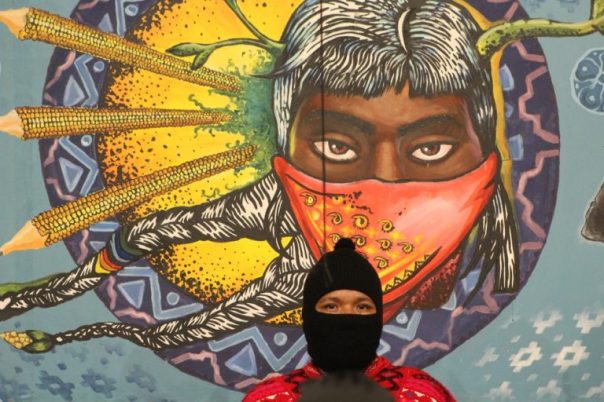
Photo from the EZLN Roundtable April 5-15.
By: Gustavo Esteva
How do we contend with the mood that is spreading, molded by the mixture of fear and false hopes instilled by the verbal incontinence and theater of the candidates and political parties?
The oppressive repetition of the horror seems to be accustoming us to it. Each day we learn of a new aggression in Myanmar, Palestine, Syria…. Daily we add data to the obscene accounting of our assassinated, kidnapped, tortured, and disappeared which makes Mexico one of the most violent countries in the world. Each day we learn of new pains of our countrymen in the face of ethnic cleansing now practiced with migrants across the world: millions of those who are on the del otro lado [U.S. side of the border] no longer dare to complete daily activities for fear of deportation; hundreds of thousands that do not know the country they were born in discover they no longer belong to the society where they have spent all of their lives.
This month horrific information was added to the daily news of climate change. A very respectable group of scientists warned, with very solid foundation, that the increase in ultraviolent radiation is seriously impacting all life on the planet, and of course, human beings. They have identified the cause: the irresponsible experiments of military geo-engineering that converts the climate and the planet into a weapon to be used in the war being waged. (Marvin Herndon, et. al., Journal of Geography, Environment and Earth Science International,14 (2): 1-11, 2018).
The country that we had has been undone before our eyes. Little is left of it. Capital, with the enthusiastic complicity of the political classes, reigns free in the social reality. The mask of the dominant regime has fallen and thanks to Mr. Trump is more and more difficult to deny its nature and characteristics, its racism and sexism.
Added to the gravity and extent of the economic crisis, that has a growing majority of Mexicans under the so-called poverty line, is the daily dispossession, almost always violent, of land, water, territories, rights, everything that we had achieved over centuries of social struggle. This barbaric and destructive process has been realized with the enthusiastic complicity of the political classes, while the deterioration of all institutions persists.
For capital, the entire population was seen as, actual or potential, labor. A few decades ago it created a disposable class: those people it has no possible use for, now or in the future. What we are experiencing now is a mechanism that disposes of those “disposable,” not just expelling them from the economic system or from their lands, but also eliminating them in physical terms.
This situation principally affects the poorest, but also, increasingly, the middle classes, whose number is continually reducing. The economic threat in general combines with the criminal violence to generate a fear each time more general and intense, which the mainstream media continually makes worse.
It’s easy to understand, in these circumstances, that many people resort to well-known defense mechanism of denial. Closing our eyes serves as the first line of defense against the anguish provoked by what occurs, that in many cases leads to desperation. Candidates are employing that moment of fragility, that psychological refuge, to insert their promises. They vaguely warn of the approaching catastrophes and then suggest that the solution is within everyone’s reach: just vote for the right person the first of July.
Not one of the threats underway, many of them completed now, will disappear after that date. They will continue to advance and deepen the processes that they produce. To fall for those immoral promises is just another form of denial, it’s not daring to see the gravity of our predicament, it’s not wanting to recognize what is evident: no change of functionaries will resolve the problems that we are facing.
What’s needed is great strength to confront with feet firmly on the ground what happens. It is what the Indigenous communities demonstrated in October 2016, when they timely recognized the danger of extinction to which they were exposed and they decided to take the offensive. It is an offensive currently underway that has achieved what they wanted in this period and in a few days will enter into a new phase.
The key to what is coming is our capacity to recuperate hope as a social force. We need to trust our own capacities to reconstruct society from below and to make unnecessary the rotten apparatuses of the market and the state. We need, above all, to fight against the patriarchal condition of all institutional apparatuses along with the attitudes and practices that form the dominant regime which are deeply internalized in all of us. All of this seems at times very small, even insignificant, and at other times seems colossal. The important thing is that it is always within our reach. For that reason, it is possible to reconstruct hope, which is the essence of popular movements.
Translated by Center for Convivial Research and Autonomy
La Jornada, April 23, 2018
<http://www.jornada.unam.mx/2018/04/23/opinion/025a2pol>
—
Manolo Callahan
Center for Convivial Research and Autonomy
Paramilitary Fire
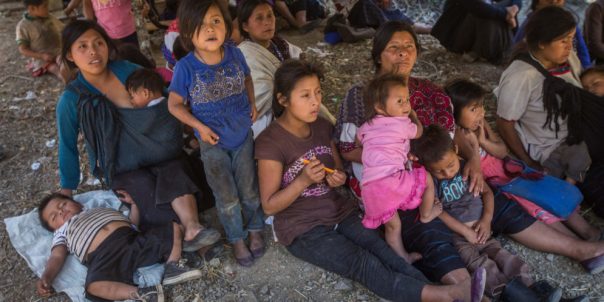
Some of those displaced by paramilitary attacks in Aldama, Chiapas, Mexico.
By: Gloria Muñoz Ramírez*
Tzotzils from different communities within the municipality of Aldama, Chiapas, have been under fire from gunshots for more than a week and the government does nothing. The lives of men, women and children are in danger. Fear lives among them from sunrise; it doesn’t go away because they hear the shots all day. Now the live in the mountain “to protect themselves from the shooting and some have had to flee to the municipal capital and other places.”
The denunciation that the Fray Bartolomé de las Casas Human Rights Center (Frayba) makes, an organism that warned since the first days of April about the intensification of the violence in Los Altos. The weapons, like more than 20 years ago, are shot from Chenalhó, a region in which the federal government armed and trained paramilitary groups to fight the Zapatistas in the first years of the insurgency. Later came the vino la Acteal Massacre and the promises of a disarming that never happened.
Just last December a new humanitarian crisis was unleashed, caused by violence induced between the peoples of Chalchihuitán and Chenalhó because of a land conflict that the government did not resolve and, in fact, it promoted. Hundreds of indigenous peoples paid the consequences and fled into the mountains in order to save their lives.
It’s about, says the Frayba, old agrarian conflicts that have been administered according to political interests, “in an electoral environment of manipulation and control to operate renewed counterinsurgency strategies” and in which they reactivate “civilian armed groups, with a paramilitary cut, linked to organized crime networks,” who attack communities with firearms with the permission and protection of Chiapas authorities.
What has to happen so that the emergency is recognized in the communities of Koko´, Xuxchen, Cotsilman, Tabak and the municipal capital of Aldama and effective measures are activated to stop the violence and displacement? What has to happen so that once and for all the armed groups in the region are disarticulated, disarmed, arrested and punished? Why doesn’t the state government conduct a thorough investigation? Is it just inefficiency or do they have an interest in the growth of violence?
For now, it is urgent to care for the hundreds of displaced and apply “preventive actions to avoid that other communities are forcibly displaced due to armed aggressions in the region.” It’s urgent to change the order of things in Chiapas. Last April 2, the bullets hit one adult and two minors that were going to plant corn. How many more do they want?
*Gloria Muñoz Ramírez publishes a weekly column in La Jornada on Saturdays called “Los de abajo” (Those below). You can email her column in Spanish at: losylasdeabajo@yahoo.com.mx
She also publishes the newspaper “Desinformémonos.”
—————————————————-
Originally Published in Spanish by La Jornada
Saturday, April 28, 2018
http://www.jornada.unam.mx/2018/04/28/opinion/013o1pol
Re-Published with English interpretation by the Chiapas Support Committee
 Chiapas Support Committee