Chiapas Support Committee
Home of the Compañero Manuel blog on zapatistas & mexico
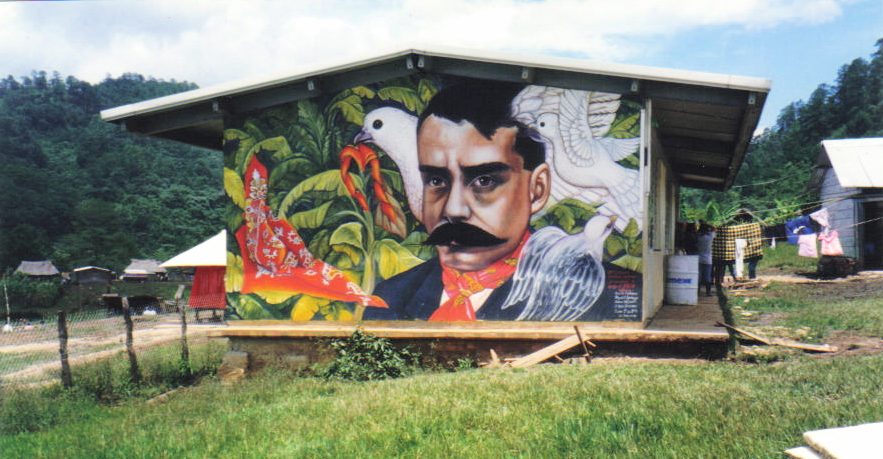
Bertolucci in the Lacandón

Subcomandante Galeano reviewing Zapatista troops at the 25th Anniversary celebration.
By: Luis Hernández Navarro
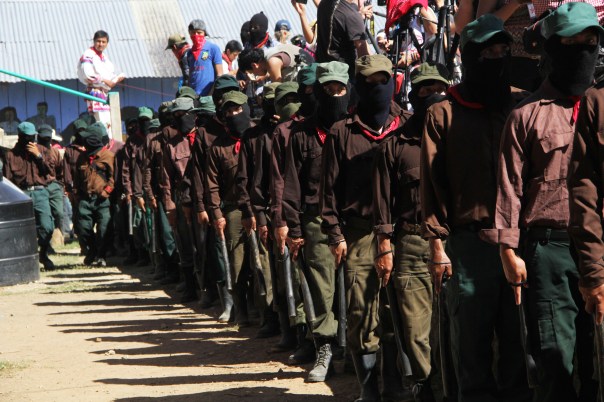
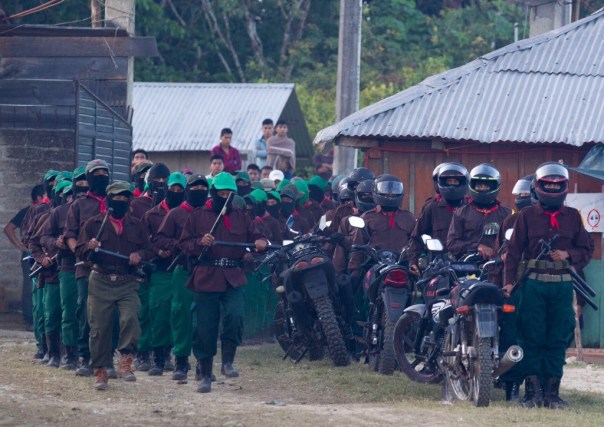
It’s close to 5.30 in the afternoon last December 31. The afternoon is bright. As if it were the climactic scene from an epic film from Bernardo Bertolucci, [1] troops of the 21st Zapatista infantry division unfold like an enormous serpent from the Cañadas that is coiling martially in the Madre de los caracoles, mar de nuestros sueños caracol (Mother of the caracoles, sea of our dreams caracol) of La Realidad, Chiapas.
In the advance of the military deployment there is a detachment of motorized Zapatista women who, upon reaching the central plaza, are open on all four sides to delimit the perimeter of operations. A group of milicianas that surround the square follows them, as if they were their guardians. The head of the gigantic jungle reptile is made up of commanders on horseback, among them Comandante Tacho and Subcomandante Moisés. A column of more than 4,000 combatants follows in a row two by two, wearing uniforms with green trousers and caps, brown shirts, black ski masks and red bandanas, each one with two wooden sticks about 75 centimeters long, which, upon colliding with each other, mark the step of the troop formation. Not all of them are able to enter.
That same division –it is explained in a video on Enlace Zapatista– is the one that 25 years ago took the municipal capitals of Altamirano, Oxchuc, Huixtán, Chanal, Ocosingo, Las Margaritas and San Cristóbal. It is reinforced with second and third generation combatants, “Zapatistas that were infants in 1994 or had not been born, and grew up in resistance and rebellion.”
The celebration of the 25th anniversary of the EZLN’s armed uprising is not the staging of a social movement. It is a show of power of a political-military force with order, discipline, cohesion, skill, logistical capability, social base, command and control of territory.
If in their public appearances during recent years the Zapatistas privileged showing their civic and popular face, through seminars and colloquiums, art festivals, escuelitas (little schools) and film exhibitions, this December 31 they put on their military face, a face that does not imply grabbing a weapon, but does imply resisting. The symbolic message of their deployment could not be more explicit.
The celebration is finished off by an energetic harangue from Subcomandante Moisés directed to the Zapatista military structures, its civilian authorities and its support bases. He tells them: we are alone, as they don’t look at us, as they don’t listen to us. They want to lie to us and they want to deceive us. It is a mockery, a humiliation. They’re coming for us, for the EZLN. We are not afraid of the government. The bad government doesn’t command here, the men and women command.
As you know (although you often forget and prefer Subcomandante Galeano to speak0, Moisés is the EZLN’s spokesperson. An indigenous Tzeltal, agricultural day laborer on the hellish fincas of Chiapas, a compañero of Subcomandante Pedro with the rank of major in the taking of Las Margaritas and of Subcomandante Marcos, today he is the one who speaks in the name of Zapatismo and its peoples. He is not a decorative figure. He is the spokesperson for the insurgency. His words are the synthesis of a life of suffering and struggle, and of the emancipatory longings of the original peoples.
The military deployment and the words must be evaluated together. Although there is a long history of disagreements between “Obradorismo” and Zapatismo, the harshness of the rebels’ accusations and their year-end mobilization would seem to respond to two central facts: the threat of an offensive against them on the part of the new government and substantive programmatic differences.
It is not paranoia. Spokespersons of the Fourth Transformation (4T) have informally proclaimed to the four winds that the EZLN was defeated, while promoters of the new National Guard threaten to undertake containment actions against the rebels.
Zapatismo (and a multitude of indigenous peoples and human rights groups) have fundamental differences with “Obradorismo.” Persecuted by the militarization of Chiapas for more than a quarter of a century, the EZLN rejects the National Guard and considers it a step forward in the militarization of the country. With a long list of militants murdered, it is opposed to the final point that leaves past crimes unpunished. Persecuted by those who seek to dispossess them of their territories, the EZLN sees in the Maya Train (Tren Maya) and the reforestation projects the spearhead for destroying them. Committed to the reconstitution of the original peoples, it finds deception in the new government’s new age ceremonies. Determined to make another world a reality, it looks upon the pretense of the 4T of governing for the exploiters and the exploited simultaneously, not only as an echo of the words of the repressor Absalón Castellanos Domínguez, but also as madness. Engaged in struggling against capitalism, it believes that the Andrés Manuel López Obrador government is the continuation of it.
One must not get confused. The appearance of Bertolucci in the Lacandón anticipates that, contrary to what some believe, nothing is written definitively in the southeast.
[1] Bernardo Bertolucci was an Italian director and screenwriter, whose epic films include Last Tango in Paris, among many other famous films. He died on November 26, 2018.
———————————————————–
Originally Published in Spanish by La Jornada
Tuesday, January 8, 2019
https://www.jornada.com.mx/2019/01/08/opinion/017a1pol?partner=rss
Re-Published with English interpretation by the Chiapas Support Committee
Words of the EZLN’s CCRI-CG to the Zapatista Peoples on the 25th Anniversary of the Beginning of the War Against Oblivion
Words of Subcomandante Insurgente Moisés
December 31, 2018
To our compañeros and compañeras who are Zapatista bases of support:
To our compañeras and compañeros who are Zapatista Autonomous Authorities:
To our compañeras and compañeros who are part of the Indigenous Revolutionary Clandestine Committee [CCRI] and those who are Regional and Local Authorities:
To our compañeras and compañeros who are milicianas and milicianos:
To our compañeras and compañeros who are insurgentas and insurgentes:
I speak in the name of the Zapatista Army for National Liberation.
I speak in your name, as it is my job to be your voice and your gaze.
Our hour as Zapatista peoples has come and we see that we are alone.
I want to tell you clearly that this is what we see, compañeras and compañeros who are support bases, milicianos, and milicianas: we are alone, just as we were 25 years ago.
Alone we rose up to awaken the people of Mexico and of the world, and today, 25 years later, we see that we are still alone. But we did try to tell them, compañeras and compañeros, you were witness to the many gatherings we held as we tried to awaken others, to speak to the poor of Mexico in the city and in the countryside.
Many people did not listen. Some did and are organizing themselves—we hope they continue to organize themselves—but the majority did not listen.
Yet we have done our work and we know the work we still have to do, and thus we can see the current situation with clarity, compañeros and compañeras. With our experience not just from the last 25 years but from over 500 years, we can tell you that we see today is what we saw 25 years ago: it’s as if they don’t see us, as if they don’t hear what we are trying to tell the poor of Mexico. Today, twenty-five years after our uprising, this is still what we see and we repeat it to you now, compañeros and compañeras: we are alone.
What we have achieved we achieved through our own work, our own effort. If we have achieved anything it has been with our own labor, and if we have erred in anything, that has also been our responsibility. But it is our work either way—nobody taught us how to do it, it is our work alone. Some people, men and women, tried to show us what we should do, they wanted to tell us what to do and what not to do, when to speak and when not to. We don’t pay any attention to them. Only those who organize can know, see, and understand. Talk is just talk; you have to actually carry out in practice what you say and what you think, and we don’t have manuals or books that show us how to struggle. No one can teach us how to build what we want to build; it can be done only through our own sacrifice and our own effort, compañeros and compañeras.
Now we are demonstrating once again, and we will honor our word on this, that what one thinks and feels is impossible is indeed possible. It’s easy to say, “we have to make the impossible possible,” people say it all the time. But you have to actually do it in practice and this is what we are trying to show people. What is it that we are showing them? What we have before us: a people who govern themselves, with their own politics, their own ideology, their own culture. They create, improve, correct, imagine, and put it all into practice. This is what we are. Here the bad government does not rule; organized women and men rule. Those who are not organized will continue to rely on despair, because what they believe in is not actually hope.
[From above] they try to lie to us, to deceive us, first of all with that stuff about the virgen Morena [i], and there are people who believe that stuff. Only a crazy person says such a thing, someone who doesn’t know how to think, and who certainly doesn’t think in terms of the people. We, on the other hand, work from our own experience, our own labor, our own efforts, and we will continue to do so; we will continue to build what we are building here and we will achieve what we are trying to create. Everything we have we have built ourselves. There are some brothers and sisters in solidarity who have helped us, but the great bulk of what we have we created ourselves.
It is not easy to stand up to the political parties, the bad governments, and the current trickster in chief. It is not easy to confront, for 25 years now, the thousands of soldiers, protectors of capitalism, who surround us. They are here even now; we’ve seen them all around here the last few days. It isn’t easy to confront the paramilitaries, or all of the small-time “leaders” who are bought off by politicians and political parties, especially the person and the political party in power today. [ii] But we aren’t afraid of them. Or are we compañeras and compañeros?
[In unison:] “No!”
I didn’t hear you…
[In unison, more loudly:] “NO!”
Other people, from outside [our communities], come and go, but we are always here and here we will stay. Those from the outside come each time as tourists, but as tourists of poverty, of inequality. But injustice isn’t something to be toured. The poor of Mexico are dying and they will continue to so. It’s a shame they listen to that guy in power who is deceiving the people of Mexico.
We aren’t lying, compañeras and compañeros, five years ago already we were telling the people of Mexico and the world that worse things were coming. We tried to tell them this in their own languages, in their own words—the collapse, the hydra, the monster, the wall—we tried to use their words so they would understand, but even so they did not listen. They think that we are lying because they are listening to that trickster in power—I don’t even want to say his name—it’s better just to refer to him as a lying trickster.
Compañeros and compañeras, that person in power is going to destroy the people of Mexico, but first he will destroy the original peoples—he is coming for us and especially for those of us who make up the Zapatista National Liberation Army. Why? Because we are here telling him that we are not afraid of him. Or are we compañeros and compañeras?
[Loudly in unison:] “No!”
We will stand up to what comes because we will not allow his project of destruction to be implemented here. We are not afraid of his “National Guard”, which is just the army under another name—he renamed it so as not to have to admit it’s the same army as always.
We will defend what we have built here, what we are able to show to the people of Mexico and the world as something we, women and men, built ourselves. We are not going to let anyone come destroy it, or are we?
[Loudly in unison:] “No!”
That trickster in power now, what is his game? That he pretends to be with the people of Mexico, trying to deceive the original peoples by kneeling upon the earth to ask permission for his projects. He thinks all the original peoples are going to believe that charade. Here we say no, on the contrary, we don’t buy it.
What do I mean by on the contrary? He is pretending to take up our customs and ways—asking permission of the mother earth to act—but he is asking permission of the mother earth to destroy the original peoples! That is what his charade is about, and some of our brothers and sisters of the original peoples have been fooled. We don’t buy it. If the mother earth spoke she’d say: “fuck off.” Mother earth doesn’t speak, but if she did, she’d say clearly, “No! Go fuck yourself.”
We know mother earth, we have lived in harmony with her for five hundred and twenty-some years. Those who have not known nor felt the sweat of living and working with the mother earth do not know her, like those idiot senators and representatives who think they know everything. They do not know poverty; they do not know what it is to sweat over the earth. We do. That is why they do not know how to make laws for our peoples, for the original peoples. We do, because we know what it is to suffer and we know what kind of law we need and want; they do not.
Take for example, compañeros and compañeras, those deceitful tricksters in all three branches of power in Mexico—the judicial, executive, and legislative powers—and look at what they do, especially the party that currently holds the majority in the national congress [MORENA] and who names indigenous people representatives so they can sit beside Ricardo Monreal [iii], for example. It’s just like before when they put a Tojolabal man in the national congress right there beside Diego Fernández de Cevallos[iv], who owns a whole bunch of ranches. They sit that Tojolabal indigenous man next to him and you think that Tojolabal man is going to say we have to redistribute the lands that belong to the ranch owners? That’s what they want to show us, that with a salary and sitting comfortably in a restaurant or hotel, that all of the senators, representatives, cabinet secretaries, council members, etc., will continue to abandon their people. That is what they want, for us as Tzeltal, Tzotzil, Chol, Tojolabal, and all the other languages spoken here in Mexico to be the ones who lie and cheat our own peoples. That is what they are showing us, that is their job, that is what their bosses have mandated. For us they are not government, they are mere overseers for the real boss.
Now we see that they are coming for us, the original peoples. We see clearly that the referendum they are carrying out is a way to manipulate the people; they are using the vote to get permission to come attack the original peoples. That’s what that referendum is about, but the people have still not awoken to the truth, and thus today we will not be able to attend fully to the 25th anniversary. We are tired. We talk and talk but for them it just goes in one ear and out the other, what we say does not truly enter into their thought.
This is what the new government is doing right now, consulting the voters as to if they can come attack us, as original peoples and especially as the Zapatista National Liberation Army with that bullshit “Maya Train,” which they have the nerve to name after our ancestors. We will not accept it. They can put any name on it, it has nothing to do with the Maya. If it were up to us we’d say they should name it after their mother.
Over these 25 years, compañeros and compañeras, bases of support, men and women, milicianas and milicianos, we have seen around the world that there are those who say they struggle, some who say they are progressive, others who say they are leftists, others who say they are revolutionaries. But they don’t have any idea what a revolutionary is, because a revolution is to turn things around. Like we say here, we have to prepare our young people, young men and women, because we ourselves will one day turn around and return [to the earth], and that is why we have to leave the next generation ready. Those on the outside have no idea what they are talking about, it’s such a pity that with all their education and degrees and diplomas they don’t know what a revolution is. And on top of that there are even some out there who say we’re “electoralists.”
They don’t have the slightest idea how to revolutionize an idea, thinking itself. They think that we lie like they lie. We told the Mexican people that we would dialogue with them and we honored that pledge, and if one day we say we are going to defend ourselves against even the most minimal provocation, then that means we are going to defend ourselves. We’re also not going to let anyone come seek cover here or cloak themselves in this territory of resistance and rebellion to start stupid shit. We won’t permit it.
Compañeros and compañeras, we have not deceived the people of Mexico, but we also have to tell them that they are still letting themselves be fooled. We don’t know why, and it causes us great sadness and anger. What good is it to study, to know history if we are not going to see our own reality for what it is? What good is study if one can’t see even that. What we have built we have built without formal study, and here it is, alive in practice. That’s what we are showing you, and will continue to show you. What they will do over there, who knows.
What we are telling you now is that the guy in power now is uttering absurdities, just look at what he says—that he’s going to govern for both rich and poor. Only a crazy person, someone sick in the head could say such a thing, because his mind is not working, his brain isn’t functioning. We’ve heard that before, from that bullshit landowner Absalón Castellanos Domínguez [v], who is finally now in hell, and who said he would govern for the rich and the poor. We’re not going to be convinced to give up fighting against exploitation because that lunatic says he’s going to govern for both rich and poor. He doesn’t even know what he’s saying; he doesn’t understand what he’s saying. And he doesn’t even have to understand because he’s just saying what his boss orders him to say. He is obeying; he is taking orders to say what he is told to say so that the citizens keep believing in those in power.
It’s very simple: you can’t support the exploiter and the exploited; you have to choose one or the other. You’re either with the exploiter or with the exploited, but not both. That’s how we see it, that’s how we understand it and that’s how we govern.
What a shame that he calls all this stuff he is doing the fourth [transformation][vi], because it’s not the fourth anything. How do these people of the “fourth” think they follow the third [transformation], which was carried out in practice, by confronting reality. This guy says he’s going to pardon all the criminals, “pardon,” he says. From where we stand, that means he’s not going to do anything to the bad government, to our compañero Galeano’s murderers for example. That’s what he’s telling us with that statement. It will be the same for all the other murders, so then what’s the point of him being in power?
There are so many things we could name that he has said that are not true. So, compañeros, compañeras, are we going to be afraid of this bad government?
[In unison:] “No!”
Of course not, because we are filled with rage due to all the lies that he’s telling the people of Mexico, and we feel pity for those who speak Spanish well and yet don’t understand that all the things he is saying are lies. It’s hard for us to understand too, not because of the Spanish but because it’s hard to believe he’s saying this amidst the poverty, inequality, and injustice around us. You don’t have to learn Spanish to understand that, you have to learn to see and feel it.
What he’s doing is mocking all of us, especially the original peoples, humiliating us, but not just us. It’s also a mockery of all those who speak Spanish perfectly well but don’t study the stinking politics of this bad government.
Compañeros y compañeras, we’re not going to give in to this, or are we?
[Loudly, in unison:] “No!”
Am I speaking loudly enough for those in the back? Compañeros, compañeras, we’re not going to give in, or are we?
[More loudly, in unison:] “NO!”
Nobody is going to come fight for us, the exploited peoples of the countryside and the city, nobody. No man, no woman, no group is going to come fight for us. What we need are women and men who organize themselves, organize themselves more and still more, a whole people who organizes itself to liberate itself. Or you think that the pope is going to come do it?
[In unison:] “NO!”
Or that Trump is going to come?
[In unison:] “NO!”
Well much less are we going to believe this guy who says he’s the fourth [transformation]. Or do we believe him?
[In unison:] “NO!”
It’s the same damn thing, compañeros and compañeras. I’m not lying to you. During his campaign he said: “In my party,” (the one that’s in power now, MORENA), “I’m not going to allow any manipulative parasites.” That’s what he said: but manipulative parasites are exactly the people that he’s let into the party since then! They are the very same as always: they’re all politicians from the PAN, from the PRI, from the Partido Verde [Green Party of Mexico] and the PT [Worker’s Party]. That’s the big lie. But it seems that there are thirty million people in this country who must not understand Spanish or else how could we explain that they believe his lies?
He says he’s going to fight corruption. Ha! Meanwhile his Cabinet Secretary [vii] is the first person he should investigate. She worked… well, you all know where she came from, I don’t have to tell you. We know where his Cabinet Secretary came from and she herself says, “I’m not getting involved in that fight against corruption,” and the same guy who says he’s going to fight corruption has nothing to say about that.
Pure lies, all of it! He’s not going to do anything for the people. The bad government thinks it’s going to come and fuck us over with its PROÁRBOL [viii] project, which is the same strategy they’ve been using for years. It’s a new name for the same programs that we already defeated with our resistance and rebellion.
Twenty-five years ago we defeated Carlos Salinas de Gortari, who was known as “the most powerful man,” but we weren’t afraid of him. And back then the Mexican people had never heard of us. Now they’ve known us for the last 25 years, and we’ve always told them the same thing. Today, we’re tired. We’ve tried so hard to make them understand. Only a few have; the majority has not.
But this is what we’ve been able to accomplish, compañeros and compañeras. We’re not asking the brothers and sisters out there to take up arms. Over the past 25 years what we have won we haven’t won with bullets or bombs, but with resistance and rebellion. That’s what has allowed us to succeed and that’s what people have come to see—but it seems they’ve only come to see, not to take this message to other brothers and sisters who haven’t been able to come because they don’t have the money, just like us.
We’re not afraid of capitalism, and we’re not afraid of the old plantation owners or the new ones. Or are we?
[In unison] NO!
In that case, whatever people say, whatever they think, we are going to defend ourselves—whatever might happen, whatever it takes. We’re going to defend ourselves and we will fight if necessary. Isn’t that so, compañeros and compañeras?
[In unison] YES!
Let’s be clear, compañeros and compañeras: here there are no saviors. The only saviors are the men and women who struggle and organize themselves, always together with their peoples.
The change we want is that one day, the people—the world, men and women—to decide how they want to live, and that there not be a group that decides about the lives of millions of human beings.
We express this in just a few words: the people command, and the government obeys. That’s what we must struggle for.
They think we’re still ignorant and backwards, compañeros and compañeras. But we’re here ready and willing to defend ourselves.
Because of that and everything I’ve already said, we are ready for whatever it takes and whatever might happen.
Because of this, we say:
Here we are!
We are the Zapatista National Liberation Army and we will continue on!
LONG LIVE ZAPATISTA AUTONOMY!
LONG LIVE THE ORIGINARY PEOPLES!
DEATH TO THE BAD GOVERNMENT!
DEATH TO ALL CAPITALISMS!
LONG LIVE THE ZAPATISTA NATIONAL LIBERATION ARMY!
Words of the Indigenous Revolutionary Clandestine Committee:
January 1, 2019
Compañeros and compañeras who are bases of support; compañeros and compañeras who are milicianos; compañeros and compañeras who are insurgents; compañeros who are commanders of the Zapatista National Liberation Army:
Brothers and sisters, compañeros and compañeras:
Today, January 1, 2019, we commemorate the 25th anniversary of our armed uprising on January 1, 1994.
Despite all the ideological, political, economic, and military and paramilitary attacks against us, we want to reiterate that we are still here building autonomy for the life of our peoples.
Here in the Zapatista communities where we are governed by the Juntas de Buen Gobierno and the Zapatista Autonomous Rebel Municipalities [MAREZ], there is no place for humiliations, manipulations, tricks, lies and fake referendums.
For this reason we will not allow the implementation of any project here that destroys the life of humanity and kills our mother earth, because behind all that lie the interests of the big Mexican and transnational capitalists.
However much they might try to humiliate us with their repressive apparatus, like the National Guard, we will not rest from defending our mother earth. We were born to this earth, we live on this earth, and on this earth we will die.
In these lands of rebel men and women, they should know that we will not give up, we will not sell out, and we will not give in, much less will we betray the blood, the life and the death of our compañeros who died in our struggle.
They can consult a billion people—we’re still not going to give in. Even if they get permission from their fucking mothers, they will not break our will.
From 1492 to 2018, there have been 525 years of resistance and rebellion against the worst humiliations by foreigners and Mexicans, but they were never able to exterminate us. Those of us with brown blood, the color of mother earth, are still here and here we will stay.
Even if one billion years go by, we Zapatistas will still be here.
Indigenous Revolutionary Clandestine Committee, General Command of the Zapatista National Liberation Army, EZLN.
From the Caracol of La Realidad, Mother of the Caracoles, Sea of our Dreams.
Mexico, January 2019.
_*_
Words of the Good Government Council “Towards Hope”
January 1, 2019.
Good morning to all of you, compañeros and compañeras.
In the name of my compañeros and compañeras of the Junta de Buen Gobierno [Good Government Council] of the border jungle (selva fronteriza) zone, from our Caracol, Mother of the Caracoles, Sea of our Dreams, seat of the Junta de Buen Gobierno:
To all the compañero and compañera bases of support of the Zapatista Army for National Liberation; to the local authorities and the municipal councils:
We welcome you to celebrate with us the 25th anniversary of our armed uprising on January 1, 1994, when we declared ourselves the Zapatista Army for National Liberation.
Today marks 25 years of our struggle, we who are the most forgotten, marginalized and exploited by the neoliberal capitalist system.
Before that time, nobody bothered to find out whether we indigenous peoples lived or died, but in 1994, we said Ya Basta! (Enough!) We declared ourselves at war with the bad government, taking over five municipal government headquarters in Las Margaritas, San Cristóbal de las Casas, Ocosingo, Altamirano and Oxchuc.
Five hundred years ago, our grandfathers and grandmothers were not taken into account by the capitalist system, because for the system we are worth nothing. They were just slaves for the plantation owners: they were worked to the bone, paid nothing and abused like animals with no humanity. Our grandparents suffered all this mistreatment and more.
They were tired of so much abuse and injustice and for this reason they decided to organize themselves to struggle against exploitation.
For this reason 25 years ago our compañeras and compañeros faced off with the Mexican army. Many brave compañeras and compañeros put their lives on the line with no expectation of anything in return.
They gave their lives in order that future generations might live better than they did. We will always remember these brave men and women because they were our teachers.
Today as the Junta de Buen Gobierno, we say that we have conquered our freedom: the freedom to govern ourselves as peoples, to make decisions and develop our own rules as peoples without asking permission from anyone.
We’ve trained health and education promoters, carried out collective work projects, and formed the Autonomous Municipalities and the Juntas de Buen Gobierno. Though it hasn’t been easy for us—we don’t have any books or manuals to guide us—we are now governing ourselves.
We’ve faced many attacks from the bad government, which wants to get rid of us and has created different projects and programs to confuse us in order to do away with our organization—but we are organized and they won’t be able to wipe us out.
Each day we’re working to further our autonomy to face the neoliberal capitalist system.
As peoples in resistance and rebellion we’ve come to understand that there is no other way except to organize ourselves. In every corner of the world and in every organization we have our own ways and customs for how we organize ourselves, but what we have in common is our shared enemy, the neoliberal capitalist system. The global crisis of the system gets worse every day, but those who created it don’t care if they destroy humanity or the universe: for them, everything is a commodity and the only thing that interests them is profit, to get richer and richer.
This system converts countries into plantations where the national governments are just overseers. For us the bad governments are no longer governments of the people, because they are at the service of an even bigger boss.
For this reason, we as the EZLN don’t believe anything they say anymore because they are the same thieving and murderous traitors always. For this reason, we say that here we will continue with our autonomy, resistance and rebellion in our Zapatista territory.
From La Realidad, Chiapas
Junta de Buen Gobierno “Towards Hope”
[i] Refers to La Virgen de Guadalupe, the figure of a dark-skinned Virgin Mary and Mexico’s patron saint. The text could be referring to news reports that many religious believers prayed to la Virgin of Guadalupe [la virgen Morena, or the “brown virgin”] that Lopez Obrador [whose party’s acronym is MORENA] would honor his promises to assist the poor: https://www.eluniversal.com.mx/metropoli/que-lopez-obrador-cumpla-promesas-piden-la-virgen.
[ii] Refers to Andres Manuel López Obrador and the MORENA party.
[iii] Former prominent PRI senator and party officer as well as long-term associate of Carlos Salinas de Gortari. It should be noted that Ricardo Monreal has also repeatedly been accused of direct involvement with drug cartels. After a long career with the PRI (1975-1998), Monreal later switched parties to the PRD (1998-2008), then to the Labor Party (2008-2012), then to the Citizens Movement Party (2012-2015) and today, at the López Obrador’s request, Monreal has been made senate leader for the MORENA party.
[iv] Former senator for the PAN, notorious for his visceral racism and his large land holdings.
[v] Former PRI governor of Chiapas, federal Mexican army general, and wealthy landowner in the state of Chiapas. He was taken as a prisoner of war by the EZLN in the 1994 uprising, convicted in a popular trial of crimes against the Chiapan indigenous population, and then released with the sentence of “living out his life with the shame of having received the pardon and mercy of the very people who he had for so long robbed, displaced, kidnapped, humiliated, and murdered” [EZLN, January 20, 1994]. He died in March of 2017.
[vi] AMLO has deemed his own governing project the “Fourth Transformation,” supposedly on a par with historic events such as Mexican Independence (1810), a period of reform in the mid-19th century, and the Mexican Revolution (1910).
[vii] Olga Sánchez Cordero
[viii] One of Lopez Obrador’s controversial development plans to plant a million hectares (two and a half million acres) of invasive and commercial trees in the Lacandón Jungle in Southern Mexico.
The Fourth Transformation?
EZLN milicianos at the 25th Anniversary celebration
By: Gilberto López y Rivas
The arrival of Andrés Manuel López Obrador (AMLO) to the Presidency of Mexico and the triumph of Morena as the first political force in the Congress of the Union, the governorships of four states, the leadership of the Mexico City Government, numerous city and municipal governments, demands reflecting, with critical thought, about the reaches and limitations of what’s called the Fourth Transformation. [1]
It’s necessary to characterize the current government, the economic and social projects it considers priorities, as well as the new correlation of political forces that it is forming, for the purpose of having tools that permit comprehending and responding adequately to the new hegemonic system of domination with which capitalism is reconfigured.
It’s necessary to analyze the bases that sustain the Fourth Transformation, which does not clearly reveal its programmatic or legislative strategy. The fight against corruption, without a rupture with the development model, doesn’t set the basis for a change in the historical dimensions of national Independence, the 1910 Reform and Revolution. Denying the validity of the class struggle in Mexico, situating itself as the supreme arbiter of social conflicts and seeking to mutate the State into a redistributive clientele apparatus, does not signify a “historical transition of the Republic,” much less a “change of epoch.”
At the same time, an enumeration of the priority economic projects: Special Economic Zones, the Maya Train, development of the Isthmus of Tehuantepec, the planting of fruit and timber trees on one million hectares, construction of 300 roads in rural territories, refineries, a system of airports in the Mexico City metropolitan area; free zones on the northern border and the Isthmus region, continuity of mining projects, the repeated affirmation of respecting contracts, the independence of the Bank of Mexico, the chief of staff’s perspective of “making Mexico an investment paradise” and the Morena initiative in Congress to abrogate the current Agrarian Law and expedite another one that reinforces the mechanisms for the privatization of ejido and communal land, and especially, the acceptance of the Free Trade Agreement with the United States and Canada, confirm the continuity of economic policies within the logic of the capitalist system, of the neoliberalism that it claims to overcome.
Politically, the creation of the National Institute of Indigenous Peoples (INPI, its initials in Spanish) is a return to the old “indigenismo” established by the PRI regime, patronizing and corporative, which was characterized as an authoritarian and manipulative State policy for the indigenous peoples, and whose funerals were celebrated in the San Andrés dialogues between the federal government and the EZLN. The fact of establishing 130 offices of the new INPI in Native peoples’ territories, with functionaries that speak the respective language, with governmental resources and projects, is a direct aggression against the autonomic processes and the movements in defense of the territories and against corporate invasion, especially in the territories where deeper autonomic processes are developed, related to armed conflicts, such as the Maya Zapatista region, or which defend indigenous campesino territoriality, the INPI runs the risk of performing counterinsurgency labors and of the “conflict engineering” that mining companies put into practice in order to overcome the resistances.
It is established in the metaphor of Subcomandante Moisés that: “the overseers and foremen change, but the owners of the finca (estate) continue being the same.” Rejection of these projects on the part of the national Indigenous Congress-Indigenous Governing Council (Congreso Nacional Indígena-Concejo Indígena de Gobierno), numerous independent indigenous and campesino organizations, specialists in different scientific disciplines, as well as criticism of the government consultas (votes) for not complying with the conditions established in the Constitution, in Convention 169 of the International Labor Organization, the United Nations Declaration on the Rights of Indigenous Peoples, which mandate that consultations be prior, free, informed and binding, have not received the attention that they deserve and, to the contrary, were the object of contemptuous treatment on the President’s part.
In this sense, the climate of intolerance to criticism of the new government from the anti-capitalist Left stands out, claiming that “it plays the game of the right,” and “is a return to primitive communism,” or “a disparagement of the 30 million voters that elected Andrés Manuel López Obrador.”
Precisely because of the respect that all Mexicans who voted for a profound change deserve, the need is vindicated for a rigorous analysis of the nature and impact of the budding projects, of the directionality of the same, starting with the resistances below and to the Left, and with an intelligentsia committed to these struggles. The disjunctive continues being: with the prince or with the people.
Note:
[1] By calling his project the Fourth Transformation, AMLO is elevating his presidential project to the importance of: 1) the War of Independence from Spain, an armed conflict that ended 300 years of Spanish colonial domination and took place from 1810 to 1821; 2) the Reform, a war between liberals and conservatives from 1858 to 1861 that resulted in the Reform Laws, among which the separation of Church and State stands out; and 3) the Mexican Revolution, a war against the regime of Porfirio Díaz from 1910 to 1917, which resulted in the promulgation of the Mexican Constitution that, as amended, rules Mexico today.
———————————————————–
Originally Published in Spanish by La Jornada
Friday, December 28, 2018
https://www.jornada.com.mx/2018/12/28/opinion/014a1pol
Re-Published with English interpretation by the Chiapas Support Committee
Communiqué from the National Indigenous Congress and the Indigenous Governing Council for the 25th anniversary of the armed uprising of the Zapatista National Liberation Army
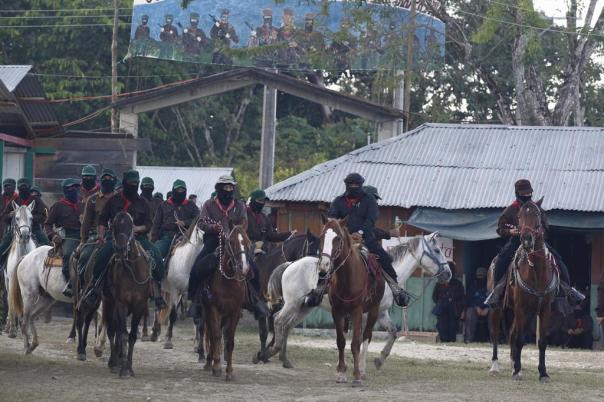
Commanders enter La Realidad for the 25th Anniversary celebration.
January 2, 2019
To the Zapatista National Liberation Army:
To the CIG Support Networks:
To the Resistance and Rebellion Networks:
To the people of Mexico:
To the peoples of the world:
To the communications media:
The peoples, nations and tribes that form the National Indigenous Congress and the Indigenous Governing Council, proudly greet the 25th anniversary of the armed uprising of the Zapatista National Liberation Army, since on January 1, 1994 our word stopped asking for alms and demanded justice, and to recognizer the rights that we started to exercise since that day, not only in Chiapas, but in all indigenous corners of our country.
That day, a new chapter in our collective life began to be written. With heads held high, we walk picking up the footsteps of our ancestors and sowing those of coming generations, with the conviction of continuing to be peoples, nations and tribes.
With the war unleashed against us, we have seen ourselves reflected in the walk of the indigenous Zapatista communities, knowing that outside there are threats against us and that everything is in the name of wealth for only some. They offer us that we migrate, leaving our territories; they offer us mourning for our deaths in the face of violence, contamination, persecution and prison; they offer us fear and resignation.
The peoples that we in the CNI are know how the bad governments act in the name of those who have more and want everything. We have faced the formation of shock groups, of paramilitaries and now of narco-paramilitaries that the bad government disguises as internal divisions, to say in that way that some want and others do not want to deliver land and natural resources to the owners of money. We know the ways in which the bad government’s “indigenist” institutions deceive our people in order to generate the kind of division that costs the lives of our compañeros and compañeras that opt for dignity, resistance and rebellion.
The INPI and its alleged new “indigenist” policy is no more than the deepening of that offensive against life, with which they want to weaken the struggle for the autonomy of the original peoples who, with their struggle, stop the devastation that they impose from above. The CNI and our compañeros of the Indigenous Governing Council do not believe al overseer of capitalism who claims to govern Mexico, and we will not accept any false consultation like those with which they want to legitimize the robbery of indigenous and campesino territories, our extermination and the sharpening of the war against us. We will not accept our death although they may bring thousands or millions of votes that, according to them, decided it.
With us walk the profound steps, real and not renounceable, that the original peoples have taken in resonance with the walking of the EZLN and the indigenous Zapatista communities. We are communications media, cooperatives, community guards; we are primary, secondary and high schools; we are languages and ancient world views (cosmovisiones); we are betting on a future that those who are in power are not even capable of imagining; we are the ones who will face in every corner the destruction that they proclaim as if it were a “democratic” benefit.
Together with the deepening of the capitalist war we will also deepen our resistance and rebellion. The mining companies with which they contracted, the megaprojects on the Isthmus of Tehuantepec, the immoral Maya Train project, the devastation and privatization of sowing industrial forest plantations in the Lacandón Jungle and the territorial alienation (for the benefit of) big capital that the Special Economic Zones are will bump heads with the real power, the power of below, the one that doesn’t surrender, doesn’t sell out and doesn’t give up, because to do it is to know we are dead as peoples.
We respectfully greet and send a collective and fraternal embrace to the Indigenous Revolutionary Clandestine Committee–General Command of the Zapatista National Liberation Army, to the thousands of milicianos and milicianas and to the support base communities. We warn the bad governments that any aggression against them is also against the CNI- CIG, therefore we make a call to the support networks throughout the country and to the networks of resistance and rebellion in Mexico and in the world to be attentive and organized to act jointly and to construct a world in which we will all be able to live.
Attentively,
January 2019
For the Integral Reconstitution of Our Peoples
Never More A Mexico Without Us
Coordination and Follow-Up Commission of the National Indigenous Congress/Indigenous Government Council
The EZLN warns that it will not permit the Maya Train project to happen

Comandante Pablo Contreras (Pablo González Casanova) in the second Gathering of Networks of Resistance in support of the National Indigenous Congress and the Indigenous Governing Council. Photo: Mariana Gutiérrez
By: Elio Henríquez
San Cristóbal de las Casas, Chiapas
The Zapatista National Liberation Army (Ejército Zapatista de Liberación Nacional, EZLN) said that it would not permit President Andrés Manuel López Obrador’s Maya Train project of death and dirty tricks to happen. It described López Obrador as “crazy” and “crafty,” and therefore, it said, it will defend what it has constructed in the past 25 years.
On Monday, López Obrador arrived in Villahermosa to attend the swearing-in of Adán Augusto López as governor of Tabasco. Upon asking him about the resistance announced by the EZLN to some of his projects, he answered: “They are within their rights, how good that they are going to do it, and many congratulations to everyone.”
In the voice of Subcomandante Moisés, during an event held in the community of La Realidad, municipality of Las Margaritas, in the Lacandón Jungle, the EZLN stated: “Think about how crazy it is that he says he is going to govern for rich and poor. Only a crazy person that is sick in the head can say that; his mind doesn’t work, he is braindead (…).
“He doesn’t know nor understand what he’s saying, and he doesn’t understand because his boss dictates to him what he has to say. It’s simple: you can’t support the exploited and the exploiter, you have to choose one of the two,” he said.
The EZLN criticized, without mentioning him by name, that Lopez Obrador “is very tricky, because (he says) that he is with the people of Mexico and continues deceiving the original peoples, demonstrating that he thrusts himself on the land asking for permission and saying that all the original peoples believe him, but we say that we don’t believe him.”
Upon referring to the ceremony held on December 1 in Mexico City’s Zócalo, where López Obrador received the staff of command from the indigenous peoples, the EZLN expressed: “Only because Mother Earth doesn’t speak, if she did she would say: fuck your mother; she would say: go to hell!”
In the context of the 25th anniversary of the January 1, 1994 Zapatista Uprising, he added: “We’re not going to allow them to come to destroy us,” and he warned: “We’re not afraid of their Nacional Guard, which changed their name in order to not say Army, but they are the same.”
He maintained that López Obrador “is going to destroy the people of Mexico, but principally the original peoples; they’re coming for us, especially for the EZLN.” He reiterated that they are not afraid of the new federal government. “We’re going to fight and we’re going to confront it.”
He remarked: “They’re coming for us, the original peoples. The consulta (vote) that they make is to manipulate the people. They are asking permission to attack us with votes. They are consulting so that they can come to confront us with that dirty trick of the Maya Train” (Tren Maya),” but “if they provoke us, we are going to defend ourselves. We’re not going to allow anyone to come to establish themselves in this territory in rebellion.”
He asserted that the so-called Fourth Transformation “is nothing of a fourth. Those of the third confronted him with facts. (López Obrador) says, for example, that he is going to forgive all the criminals. Like the one who says that he won’t do anything to the murderers of our Compañero Galeano,” murdered in the community of La Realidad in May 2014.
———————————————–
Originally Published in Spanish by La Jornada
Wednesday, January 2, 2019
https://www.jornada.com.mx/2019/01/02/politica/004n1pol
Re-Published with English interpretation by the Chiapas Support Committee
Victories of the EZLN
HAPPY NEW YEAR | ¡FELIZ AÑO!
By: Hermann Bellinghausen
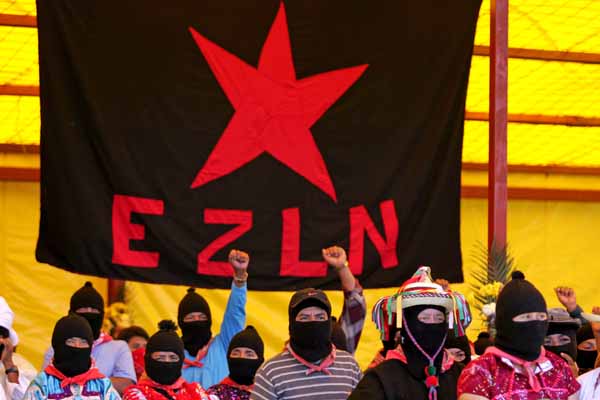
The three musketeers are not the same, the joke would say, 25 years later. Of course not! If they were, what would be the point of commemorating a quarter of a century of the armed uprising of the Zapatista National Liberation Army (Ejército Zapatista de Liberación Nacional, EZLN)? It’s pure action on New Years 1994, suicidal as it may seem, with a single shot (the formidable Declaration of the Lacandón Jungle) yielded multiple targets, more than expected. Within a few hours, a new historical cycle began on a regional and national level with global repercussions. Coming from the most forgotten corner of the country, a solitary shot seldom gave life to so many important things.
“It put Chiapas on the map,” they said. Rather, it put the world on the Chiapas map. It also placed a lot of things in doubt, from the relevance of the single Western clock to the economic folly that crowned the Free Trade Agreement with North America, which premiered that same morning. The Zapatista torpedo hit the waterline of the Mexican government, which in minutes lost the aura of invincibility and had to grapple with the revolt.
For the communities of the mountains of Chiapas it meant a step forward in their own history, the conquest of autonomy (not called so then), the dignifying of their internal democracy and the right to speak. Instead of dying, they danced. They recuperated lands in the jungle and cemented a solid future that 25 years later is a fait accompli. In spite of the fact that the reflectors keep it off the radar, the Zapatista experience, daily and real, takes place away from the spectacle and the current news. The rebel movement, clandestine in origin and internalized by the patience and experience of the peoples, materializes the rebirth intuited by Guillermo Bonfil in México profundo. It turned out to be “the Mexican alarm clock.”
If for Mexico it meant the resounding campesino rejection of the Salinas government’s agrarian betrayal formalized in 1992. For the world it embodied the first mobilization against the dictatorship of the markets, created a fresh discourse for a Left without compass and impregnated the imminent global resistances against the monopoly of globalized economic power. It was the first social movement to have at its disposal the weapons of the Internet and its networks, and to take advantage of them widely.
It imposed the “indigenous question” on the political table and the debate remains alive beyond 2018, as we observe daily. Time revealed that for the original peoples the alarm clock had sounded just in time, current and future generations would be conceived in another way, notably women; they found that with organization and a clean conscience it’s possible to achieve the deepest demands. Who wouldn’t subscribe to the 13 Zapatista demands? A quarter of a century later, despite the ideological and practical differences, there is not a single indigenous people of Mexico that isn’t in debt to the rebels.
For the original peoples it means the closest thing to their revolution that they have had on a political, mental and human level. To the Zapatista peoples, rebellion, far from killing them, guaranteed them a better life and the precious right to govern themselves. Years pass and we don’t stop seeing their youth flowing, incessant and renewed, a flow that is from an authentic river that joins waters upon descending from the mountain. Heraclitus would say that the river is never the same. But it’s always a river.
Zapatismo taught Mexicans that “president” is written with a small “p” and he can be disavowed with justice to declare war with legitimacy, denouncing his crimes with good reason. The State bared its moral smallness upon failing to recognize its signature on the San Andrés Accords, and the Zapatistas made them the law in their territories. The creation of the Good Government Juntas consolidated the only viable government alternative as of now in the country.
There are more victories but no more space. The challenges of the indigenous awakening will remain valid although the State says it is being transformed. The Nation’s historical debt to the Native peoples will not be paid by denying that indigenismo has died, that charity is an insult, that the State’s development megalomania inexorably passes for dispossession and that the peoples must be subjects of right.
———————————————————–
Originally Published in Spanish by La Jornada
Monday, December 31, 2018
https://www.jornada.com.mx/2018/12/31/opinion/a08a1cul
Re-Published with English interpretation by the Chiapas Support Committee
As the Zapatistas celebrate the 25th anniversary of their 1994 Uprising, please consider a donation to the La Garrucha Education Fund, a fund for building autonomous middle schools in the jungle region of La Garrucha. Thank you!
The expansion of the Mapuche movement

Thousands attended the funeral of Camilo Catrilanca.
By: Raúl Zibechi
Leaving Temuco, in the heart of Mapuche territory, extensive pine plantations surround villages and towns, like waves that hover over people of the earth, “natural” wire fences of a monstrous concentration camp. The highways and roads crowded with carabiñeros [1] in their green vans complement the circle of plantations with a relentless siege, tattooed in fire and shrapnel on dark bodies.
The vendors around the Temuco market are being displaced because of a municipal order, which the armed police execute with punctual arrogance. They continue coming, protected with a broad clientele that persists in buying from them despite the threat of fines. They hung a number of black balloons when they learned about the murder in the back of Camilo Catrillanca, on November 14, in the community of Temucuicui.
Whoever wants to know more details about the crime, the lies of power and about the political crisis that corners the government, can go to the page mapuexpress.org where there is no lack of information.
What follows is the result of exchanges with and listening to members of different organizations, urban and rural, with comuneros and academics, political prisoners and family members, students and feminists, collected in Santiago and Temuco during the first days of December.
The first point is to verify the territorial expansion of the Mapuche movement. In Araucanía or Wallmapu (Mapuche Territory) they don’t stop recuperating land, a question that strengthens the communities that were encircled and subjected to reductions. They remain in water up to their necks, but begin to breathe, and therefore the attacks from the power have not achieved stopping them in the last decade, let’s say between the murders of Matías Catrileo (2008) and Camilo Catrillanca (2018).
In some areas, such as the triangle between Ercilla (to the north of Temuco), the coast of Tirúa and Loncoche (to the south), the land recuperations are forming a spot of Mapuche community power. An example: on the 1200 hectares of the former Alaska farm, recuperated in 2002, two communities (Temucuicui Traditional and Temucuicui Autonomous) now live on lands that belonged to the Mininco Forestry of the Matte Group, which owns 700,000 hectares usurped from the communities.
The second thing is to verify the multiplication of organizations of all kinds, everywhere, in Wallmapu as well as in the big cities. The Coordinator of Organizations of Mapuche Students (COEM, its initials in Spanish), in Santiago, formed four years ago, unites groupings from almost all the universities and has created a school of indigenous women that defends Mapuche feminism. They define themselves as “anti-patriarchal but not feminist” because, as Angélica Valderrama of Mapuexpress points out: “we don’t want to think about our reality within the parameters of white feminism.”
The Mapuche History Community is part of this notable growth and diversification of the movement, which Simona Mayo defines as “the multi sectorial character of the Mapuche organization.” Various collectives that could be defined as human rights defenders integrate this diversity and, in some cases, consider themselves Mapuche because they have assumed that identity even having white skin.
The third, and the most surprising to this writer, is the creation of mixed spaces integrated by Mapuche and huincas (whites), as something natural and normalized, without hierarchies existing within the collectives. Both the COEM and the Mapuexpress information collective are Mapuche and white spaces, as well as various feminist, environmentalist and student groups.
They are constructing “heterogeneous subjects,” as the historian Claudio Alvarado Lincopi emphasized in a conversation, something that the Left isn’t able to do because: “in its inbreeding only its own traditions have value.” These “mixed” spaces as well as Mapuche feminism, were almost non-existent a decade ago, or they were very incipient, but now they are flourishing and multiplying exponentially.
The fourth point is the expansion of the Mapuche language, Mapudugun, in unsuspected places, like popular neighborhoods and those of the urban middle class. In the Olympic village, in the Ñuñoa commune, a middle class neighborhood of Santiago, the daughter of my host studies Mapudungun in her school, by her own choice. The same thing happens in three other schools in the district. There is consensus on the extraordinary expansion of the Mapuche language, much beyond the borders of Wallmapu.
The fifth point is the massive reaction of the Chilean population to Catrillanca’s murder. There were mobilizations in at least 30 cities throughout the country, including those in the far north. In Santiago, in the days following the murder, there were around 100 street closings, with barricades and bonfires, for hours, with hundreds of neighbors. Those who did not go out in the street beat pots and pans in entire neighborhoods, especially in the outskirts. In some zones the mobilizations lasted for 15 days.
That reveals that the Mapuche people have become a reference for an enormous portion of Chileans that harbor anti-systemic sentiments, in a country where half of the population never votes. The tenacious resistance of the Mapuche people and the mediocrity of the Lefts, located the Mapuches in that place, despite the campaigns against them.
Lastly, to emphasize the strategic importance of the Temucuicui Manifesto issued on December 1 to a crowd concentrated in the community where Camilo was murdered. It defends the “demilitarization of Wallmapu,” the right to ancestral territory with a call to the communities to “strengthen the exercise of recuperation and territorial control” and to form a “historical clarification commission” that recuperates the truth about how the Chilean State occupied their territory.
In the exercise of their free determination, all Mapuche currents finish with a call to disobedience as a way of making decolonization a reality.
[1] Carabiñeros are Chilean federal police.
———————————————–
Originally Published in Spanish by La Jornada
Friday, December 21, 2018
https://www.jornada.com.mx/2018/12/21/opinion/018a1pol/
Re-Published with English interpretation by the Chiapas Support Committee
EZLN: twenty-five years

By: Adolfo Gilly
One morning 25 years ago, January 1, 1994, we saw an unusual spectacle appear on television: an indigenous army, emerging from the shadows of that New Years night, was taking the city of San Cristóbal. They were many, looked very poor and were opening a new era in the history of this country and its peoples. Its name was and continues being Zapatista National Liberation Army (Ejército Zapatista de Liberación Nacional): EZLN.
They said then who they were and what they wanted and were proposing, and since then they have not stopped saying, from the first Declaration of the Lacandón Jungle to the presidential campaign of Marichuy and the Indigenous Government Council.
They then used a language that today, a quarter of a century later, is good to remember. On February 1, 1994, in a letter to the state of Guerrero’s 500 Years of Indigenous Resistance Council, they explained their existence in what was actually a manifesto directed to the entire country. Its singular language appeared far from conventional political discourse:
There was so much pain in our heart, era our death and sorrow was so much that it no longer fit, brothers, in this world that our grandparents gave us to continue living and struggling. So great was the pain and the grief that it no longer fit in the heart of a few, and it was overflowing, and the pain and sorrow were filling other hearts, and they filled the hearts of the oldest and wisest of our peoples, and the hearts of young men and women were filled, all of them brave, and the hearts of the children, even the smallest, were filled.
The discourse was then directed to the past:
We talked to each other, we looked inside ourselves and we looked at our history, we saw our greatest parents suffer and struggle, we saw our grandparents struggle, we saw our parents with fury in their hands, we saw that not everything had been taken away from us, that we had the most valuable thing, which made us live, […] and dignity lived in our hearts again, and we were still new, and the dead, our dead, saw that we were still new and called on us, again, to dignity and struggle.
That voice continued speaking between religion and myth, history, grievance and pride, prayer and communion:
We leave behind our lands, our houses are far away, we leave everything, we take off our skin to dress for war and death, and we die in order to live. Nothing for us, for everyone everything, what is ours is our children’s. We all leave all of us.
Now they want to leave us alone, brothers, they want our death to be useless, they want our blood to be forgotten among the stones and dung, they want our voice to be extinguished and they want our step to become far away once again. […]
Don’t abandon us, don’t let us die alone and don’t leave our struggle in the vacuum of the great lords. Brothers, may our path be the same be the same for everyone: liberty, democracy, justice!
* * *
The Zapatista National Liberation Army (Ejército Zapatista de Liberación Nacional) celebrates in these days its 25 years of life. Besides its history, it has its social organization, its language and its politics.
Nothing can be done in Chiapas, in the vast world of the indigenous peoples and in the national indigenous movement, as long it isn’t old-style state indigenismo, without taking into account the EZLN’s presence, without dialoguing with the Zapatista National Liberation Army, its politics and its history, its proposals, its resistance and its existence.
———————————————————————
Originally Published in Spanish by La Jornada
Monday, December 24, 2018
https://www.jornada.com.mx/2018/12/24/politica/010a1pol
Re-Published with English interpretation by the Chiapas Support Committee
Towards the 25th anniversary of the EZLN

EZLN Comandantes celebrate!
By: Magdalena Gómez
January 1, 2019 will be the 25 anniversary of the public emergence of the Zapatista National Liberation Army (Ejército Zapatista de Liberación Nacional, EZLN). The challenge to the Mexican State, on the day the North American Free Trade Agreement begins formal operations, permeated our roots and mobilized the indigenous peoples of our country as never before, placing their agenda on the nation’s agenda. It also gave hope and meaning to many activists and movements in the world that were looking for how to orient the compass of the Left in neoliberal times.
While it’s impossible to reconstruct the EZLN’s trajectory and contribution in a few lines, suffice it to say that a first important step was the massive social demand for a ceasefire that it achieved from Salinas de Gortari on January 12, 1994, the unilateral ceasefire and the Zapatista respect for said decision. That factor being important, however, it cannot be ignored that the State has waged war against Zapatismo by many means, and not exactly peaceful.
A key moment was the February 9, 1995 betrayal, when then President of the Republic, Ernesto Zedillo, converted into the Public Prosecutor, broadcast on national television the alleged identities of the Zapatista leadership and the issuance of arrest warrants, while the Army was advancing in Chiapas against the territory its bases occupied. The stigma of Esteban Moctezuma derives from this. As the then Secretary of the Interior (secretario de Gobernación), he was received in Chiapas days before in a supposed and discrete dialogue plan.
The crisis unleashed on February 9 derived into the passage of the Law for Dialogue, Negotiation and Dignified Peace in Chiapas, which says in its first article: “This law has as an objective establishing the legal bases that will promote dialogue and conciliation for reaching, through an agreement of concordance and pacification, the just, dignified and lasting solution to the armed conflict initiated on January 1, 1994 in the state of Chiapas. For purposes of this law, the EZLN will be understood as the group of persons that are identified as an organization of Mexican citizens, mostly indigenous, who disagreed for various reasons and became involved in the conflict referred to in the preceding paragraph.”
Starting from that context, the route was defined for the dialogue, whose first negotiating table produced the San Andrés Accords on indigenous rights and culture, signed on February 16, 1996 and after a series of crises, now into the Fox presidency and with the Zapatista expression of conditions for sitting down again with the government, the indigenous counter-reform was promulgated in 2001 with which the EZLN considered that the State kicked over the board and ruined the possibility of resuming the dialogue that had been suspended since September 1996.
From 2001 to date, Zapatismo has constructed its autonomy in Chiapas, developing different areas of work through autonomous government bodies, as well as its own health and education systems through collective work, with everyone’s participation, women, men, young people and children. We’re talking about Good Government Juntas (Boards), an experience emblematic beyond national borders that they systematized and shared in the Escuelita Zapatista. They have also organized different seminars about the capitalist hydra, as well as the CompArtes and the ConSciencias, among others.
The most recent political experience was the accompaniment of the National Indigenous Congress (Congreso Nacional Indígena, CNI) in the decision to name an Indigenous Governing Council (Consejo Indígena de Gobierno, CIG) with men and women representatives from each one of the peoples, tribes and nations that comprise it, and this council proposes to govern this country. And it will have as its spokesperson an indigenous woman from the CNI, in other words, she will have indigenous blood and know her culture, and she would be an independent candidate to the Presidency of Mexico.
We know the result of this experience, faced with the State’s rules: Marichuy did not reach the required number of signatures, however her tour achieved the articulation of networks that are maintained around the anticapitalist option. They also gave an account of the deepening deterioration in the country and of the virtual war against the peoples promoted from the State. The EZLN has reiterated the statement about the transmutation of the rulers in the historical figure of the overseers: They are good defenders of the interests of their bosses to plunder the natural riches of our country and the world such as land, forests, mountains, water, rivers, lakes, lagoons, air and the mines that are guarded in the bosom of our Mother Earth, because the boss considers everything a commodity and thus they want to destroy us completely. The bosses are not present for the official part, not in the new government or its projects, both elements to suppose a change of direction in that trajectory that threatens the life of the peoples.
We can glimpse the Zapatista message with these elements this coming January 1.
———————————————————–
Originally Published in Spanish by La Jornada
Saturday, December 22, 2018
https://www.jornada.com.mx/2018/12/22/opinion/017a1pol
Re-Published with English interpretation by the Chiapas Support Committee
El dolor de Acteal (Acteal’s Pain)
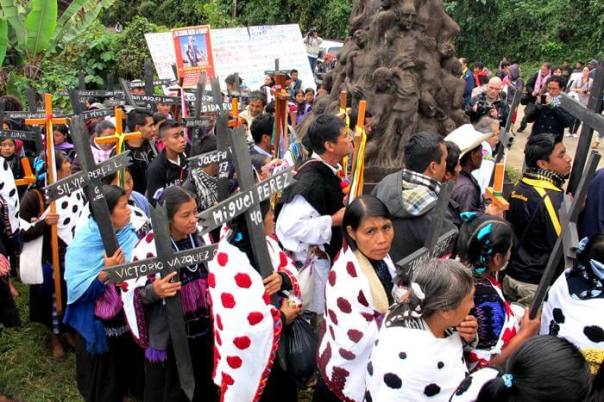
Acteal survivors carry crosses with the names of those massacred.
By: Luis Hernández Navarro
A young woman carries in her hands the photograph of a little six-year old girl framed in wood. It’s a portrait of Silvia Pérez Luna. In the lower part can be seen the date of her birth and death: 1991-1997.
Silvia was one of the 45 people savagely murdered by paramilitaries in Acteal, Chiapas, on December 22, 1997. The victims, 7 men, 21 women and 15 children (one of them less than one-year old), were praying for peace in a small chapel. The murderers finished off the wounded and opened the wombs of the pregnant women.
The image of Silvia’s portrait of her family member is part of the protest in which relatives of the Acteal martyrs (themselves also victims) and family members belonging to the civil society organization Las Abejas (The Bees) participated last December 8. That day, in Tuxtla Gutiérrez, Rutilio Escandón was sworn in as governor of Chiapas.
That day, as they have done for almost 21 years, they denounced that Acteal is a crime against humanity perpetrated by the Mexican State, in which justice has not been done, those responsible for the acts have not been punished and the truth has not been clarified.
They also remembered how, to the country’s shame, on August 12, 2009, the Supreme Court of Justice of the Nation considered it more important to point out a technicality than to defend justice and it ordered the release of 29 paramilitaries sentenced to prison.
Also coinciding with the 21st anniversary of the massacre, a timely and shocking book about it was just published: “El dolor de Acteal, Una revisión histórica,” (Acteal’s Pain, A historical review) 1997-2014, written by Mónica Uribe M, a specialist in religious issues.
Despite being a work that rigorously utilizes the tools of the sociology of religion, history, anthropology and political science, its reading provokes a strong emotional impact. The pain, indignation, rage, anguish and horror that it generates is summarized on its cover: a reproduction of the painting The Scream (El grito), from the painter Edvard Munch.
To analyze what happened in Acteal, Monica Uribe uses documentary sources that are almost unknown or only partially utilized. Among others, there is the civil complaint that a group of 11 victims filed (contrary to the opinion of Las Abejas) in United States court against former president Ernesto Zedillo. It accuses him of criminal association to execute the Acteal Massacre and for its subsequent cover-up.
The book delves into the pages of the balance sheet of the special prosecutor for crimes committed in the procurement and administration of justice in the state and for the town of Acteal. Therein is included the statement rendered by one of the tragedy’s principal actors, the then [federal] Secretary of Governance, Emilio Chuayffet. In his responses, the official makes it clear that Ernesto Zedillo knew, since one year before, about the imminent violence, through the government’s institutional channels, as well as through the national press, besides the fact that the actors in the Chiapas conflict approached him to report and warn him about the possible consequences of the situation.
In the balance sheet is included Chuayffet’s telephone conversation integrated into the case record in which, according to the document, the co-responsibility and scheming about the facts with Liébano Sáenz, President Zedillo’s private secretary is evident.
El dolor de Acteal includes an interview conducted a little more than a year ago with Alejandro Vázquez, who, at the time of the massacre, was a second archivist sergeant, belonging to the National Defense Staff, and who worked directly for the chief of the assistants to the Secretary of Defense, Enrique Cervantes Aguirre. According to his testimony, the general secretary worked on Sunday, December 21, 1997, which was unusual. That day, he was attentive to the communications from Chiapas and instructions from the Presidency, via the red telephone. He was the one responsible for picking up the phone and taking part of the call.
According to Lieutenant Vázquez, they were told that they should keep quiet and they also had to work the next day. In Acteal –he assures– “personnel from the Military Police Brigade participated, as well as logistic services personnel coming from different military zones, not from Chiapas, dressed as civilians and whose backgrounds inside the Army were negative.”
Beginning with copious documentation, El dolor de Acteal exposes the informative maneuvers of several intellectuals and of Hugo Eric Flores (the leader of Social Encounter) to elaborate an account of the facts that was convenient for the power, discards that the massacre had a religious matrix and concludes that “Ernesto Zedillo is the one ultimately responsible for the events in Acteal.”
The survivors of the massacre in Chenalhó demand that the new president listen to them, like he did to the families of the 43 that disappeared from Ayotzinapa. 21 years later, Acteal still awaits justice.
———————————————————————————
Originally Published in Spanish by La Jornada
Tuesday, December 11, 2016
https://www.jornada.com.mx/2018/12/11/opinion/016a2pol
Re-Published with English interpretation by the Chiapas Support Committee
 Chiapas Support Committee