Chiapas Support Committee
Home of the Compañero Manuel blog on zapatistas & mexico
Educational reform and the Fourth Transformation
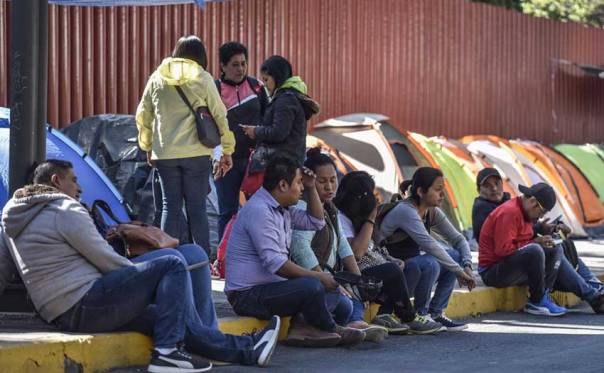
Teachers have been camped out in front of Congress in protest of the Education Reform.
By: Luis Hernández Navarro
There will be no deep social transformation in Mexico on the margins of the teaching profession. Even less against them. There will be no Fourth Transformation (4T) or a new Mexican school if it is intended to cage the teachers in an exceptional labor regime. Nor if it is intended to maintain the neoliberal educational project, even if it is made up.
With the educational reform of Enrique Peña Nieto, the State broke, unilaterally, the pact that it had for decades with education workers. The reform substantially transformed the nature of teaching. He put the teachers, overnight, into the realm of insecurity and job insecurity. Teaching ceased being a State profession to become a semi-liberal profession, whose performance is subject to the discretion of the authority. On the way, he practically decreed the extinction of normalism [1].
The new education reform is one of the essential aspects of the Pact for Mexico reform. This has been recognized by the PRI, the PAN and educational specialists from the business world. Therefore, they voted enthusiastically in favor of the ruling on the reform in the joint session of the Constitutional Points Commissions and Education in the Chamber of Deputies.
As Pablo Hiriart wrote, not suspicious of sympathizing with Obradorismo: “The educational reform approved yesterday in committees in the Chamber of Deputies is practically the same as the one promulgated in February 2013 by President Peña Nieto, after the Pact for Mexico between all the political parties.”
It is false that the rejection of the democratic teachers of the National Coordination of Education Workers (Coordinadora Nacional de Trabajadores de la Educación, CNTE) of the deputies’ opinion is for the control of hiring (jobs). The CNTE has pointed out again and again, at every forum and negotiation in which they have participated, that they do not want the union to control hiring. Despite this, politicians and educational experts linked to the business world reiterate the slander.
In fact, as researcher Aldo Muñoz recalls, “neither before nor after the federalization of 1992 was the National Committee of the SNTE given 50 percent of the lowest positions stipulated in Article 62 of the Federal Law of Workers in Service of the State.”
What the democratic teachers demand is not to be confined to any exceptional labor regimen that treats the labor rights of teachers as second-class rights. It considers unacceptable that income, promotion and recognition are administrative issues under government control, outside of any bilateral control. Not in the third article, nor in any transitory one. Nor does it admit that, although it is recognized in a transitory article that, except for admission, promotion and recognition, labor relations are regulated by section B of the constitutional article 123. For an elementary reason: for purposes of higher law, a transitory law is not above the mother law.
Formally, the education reform of the 4T declares that it seeks to strengthen normalism. It does not do that. The text says: “The state will strengthen public institutions of teacher training, especially normal schools, in the terms provided by law.” The deputies butted horns over the original presidential proposal that establishes the priority attention to these institutions.
Really strengthening normalism implies several things not contemplated in the dictum: giving positions to graduates of the public normales after finishing their studies; that graduates of these institutions have primacy to occupy a job over those coming from other educational centers; and, academic freedom and real autonomy.
Normalism is a State profession, emerged from the obligation of the latter to provide education. It is the way of training the professionals who are required to comply with the constitutional requirements in the matter. The normalistas are evaluated by the educational authorities when they enter the normal, while they are in it and while obtaining their degree and their professional license. The curricula they study are set by the State.
It is absurd that, instead of continuing the route that was followed successfully for many years, they don’t obtain their placement and immediately start working when they receive their professional ID. And that they must compete for a job with professionals who do not have the studies to teach children and young people. It is as if the cadets of the Heroic Military College, upon finishing their studies, instead of entering the service directly with a degree, had to take a new exam, competing with professionals who did not pursue a military career.
The placement of new normalistas in the public system is not administered by the union. It is not the SNTE that gives them a position. The educational authority is the one that assigns them directly as graduates because their services are needed and because they demonstrated, throughout their entire career, that they are qualified to be teachers.
With the new reform [2] it is impossible to establish any agreement between teachers and the State, or that a new Mexican school becomes a reality. To the contrary, as happened in the past six years, in which the legislators of the PRI assumed that “everything was under control” and faced intermittent waves of teacher discontent, what we will see is a permanent disagreement between education workers and the 4T.
[1] Normalism here refers to a system of teachers colleges (normales, in Spanish), such as Ayotzinapa, that educate teachers.
[2] Several days ago, AMLO issued a memorandum to the appropriate government agencies to stop implementing the application of the Education Reform. There is opposition from several sources and the final outcome of this memorandum is not clear.
———————————————————–
Originally Published in Spanish by La Jornada
Tuesday, April 2, 2019
https://www.jornada.com.mx/2019/04/02/opinion/015a1pol
Re-Published with English interpretation by the Chiapas Support Committee
Message from the Zapatista National Liberation Army
MESSAGE FROM THE ZAPATISTA NATIONAL LIBERATION ARMY 100 YEARS AFTER THE ASSASSINATION OF GENERAL EMILIANO ZAPATA

ZAPATISTA NATIONAL LIBERATION ARMY
MEXICO
To the relatives and friends of Samir Flores Soberanes:
To the Amilcingo Resistance Assembly:
To the Peoples’ Front in Defense of Land and Water Morelos-Puebla-Tlaxcala:
To the National Indigenous Congress:
To the Indigenous Government Council:
To the national and international Sixth:
To the Networks of Support for the CIG and Networks in Resistance and Rebellion:
To those who struggle against the capitalist system:
Sisters and brothers:
Compañeros and compañeras:
Subcomandante Insurgente Moisés writes you in the name of the Zapatista women, men, children and elderly. The word that we send you is collective and it falls to me, as the EZLN spokesperson, to write it.
For the same reason, from the mountains of the Mexican southeast, the embrace that is not only mine but of all the Tzotzil, Chol, Tojolabal, Zoque, Mam, Mestizo and Tzeltal Zapatista peoples arrives today in the dignified lands of Emiliano Zapata and his successors –as was and is Samir Flores Soberanes, our brother and compañero in the struggle in defense of life.
Receive it, sisters and brothers, because it’s an embrace that we, the Zapatistas of the EZLN give you because we respect and admire you.
We have not been able to be present together with you, which is what we would have wanted. The reason is very simple and has the banner of the bad government: Because in our mountains and valleys the presence of the military, police, paramilitary, and spies, ears and informants has increased. The flyovers of military planes and helicopters, as well as artillery vehicles have reappeared, like in the times of Carlos Salinas de Gortari; of Ernesto Zedillo, political tutor of the current head of the Executive Power; of Vicente Fox after the betrayal of the San Andrés Accords; of the psychopath Felipe Calderón, and the tie and cigar thief Enrique Peña Nieto. The same, but now with more frequency and greater aggressiveness.”
And the patrols and flyovers don’t follow the drug trafficking routes, or those of the overwhelmed caravans of migrant sisters and brothers who flee from a war that refuses to say its name… to enter another that hides behind a talkative and quarrelsome federal executive. No, that death threat travels through the air and land of the indigenous communities that have decided to stay in resistance and rebellion in order to defend the land, because in it is life.
Now, additionally, members of the Federal Army and Air Force go into the mountains and appear in the communities saying that war is coming and that they are just waiting for orders from the “very top.” And some pass themselves off as who they aren’t and never will be, according to them knowing the supposed “military plans” of the EZLN. Perhaps they ignore that the EZLN says what it does and does what it says… or maybe because the plan is to mount a provocation and later blame the EZLN. The same method as Ernesto Zedillo Ponce de León, and his lackey Esteban Moctezuma Barragán, now in charge of ambushing the democratic teachers.
The reality is that the current bad government is just like the previous ones, only it uses a different justification: today the persecution, harassment, and attacks on our communities are “for the good of all” and are carried out under the flag of the “Fourth Transformation.”
But that’s not really what we wanted to write you about today. After all, any denunciation is quickly discredited by the president’s insistence that it comes from “radicals of the conservative left,” which just means that anyone who hasn’t been paid off and dares to criticize the supreme government doesn’t even qualify as “bourgie.” He’ll either say that or whatever random idea he came up with that morning, later to be celebrated by his followers on social networks (supposedly “modern” only because their fanaticism is digital) who have the same arguments as all those who applaud the excesses of tyrants around the world and who exemplify the words of Emiliano Zapata Salazar: “Ignorance and obscurantism have never produced anything other than flocks of slaves for the tyranny.”
What is currently happening in these Chiapan lands is just more of the same, the same things we have been subjected to over the past 25 years, and we repeat here what we have said before: those who occupy those positions above are all the same, and today we can say this literally—they are the exact same people as always. Reality washes away the makeup they try to use to simulate change.
Sisters and brothers:
Compañeros and compañeras:
We see that your resistance is great. We say this not only because you have resisted precisely as those above celebrate a great betrayal—that which assassinated Emiliano Zapata Salazar yet failed to stop the cause that lives and persists throughout centuries and throughout the territory that we still call Mexico: Zapatismo. We also say this because your resistance, your struggle for life, is inspiring for any honest person in the world. It’s not a play for money, cushy jobs, or gifts. It is for the generations to come—if indeed the arrogance of the Ruler does not triumph and destroy all of our communities.
Thus your struggle not only merits support and admiration, but should be replicated all over the planet where nature and those who inhabit it are destroyed under the flag of “order and progress.” There are times when a cause is materialized in a person—a man, woman, or other—and thus that cause takes on a name, birthplace, family, community, and history. That was the case for Emiliano Zapata Salazar, and it is the case for Samir Flores Soberanes, who they tried to buy off, to force to surrender, and to convince to abandon his ideals. He didn’t, so they killed him. He did not give in, give up, or sell out.
Those who were relieved by his murder and who carried out a supposed “referendum” in mockery of that tragedy thought that everything ended there, that the resistance against that megaproject—criminal like all megaprojects—would be washed away by the tears of those who will miss their brother and compañero.
They were wrong, just as Carranza and Guajardo were wrong when they believed Zapata met his end in Chinameca.
In the same way, the current president is wrong when, in an ostentatious display of ignorance of the history and culture of the country it claims to “rule” (the well-worn book on his bedside table is not Who Governs, but rather Who Rules), it paints Francisco I. Madero and Emiliano Zapata Salazar as friends. Just as Madero wanted to buy Zapata off, the bad government wanted to buy off Samir and the communities in resistance using aid programs and “development” projects and other lies.
Those communities and Samir responded by continuing the work of resistance, something that would have made Emiliano Zapata proud. He used to say that he could not be bought off with gold, and that here in Morelos there are still men—we would add “and women and others”—who have integrity.
The ignorance and arrogance that characterize the current head of the bad government aren’t new, either. Nor is his court of admirers, a bunch of shameless crooks who rewrite history to suite the tyrant’s moods and present him as the culmination of history. They applaud him and repeat, in a display of unrestrained sycophantism, whatever idiocy comes out of his mouth. He issues a decree that neoliberalism has ended and his coterie quickly rearranges facts, statistics, and development projects to hide them behind the scenes of the so-called “Fourth Transformation”—really just the continuation and intensification of the most brutal and bloody epoch of the capitalist system.
What’s more, the gaggle of admirers that the tyrant has convoked is filled with lackeys of all sorts and states of indecency who live, and kill, to meet the real or assumed desires of the acting overseer.
For this reason the president does not need to issue orders to kill, disappear, denigrate, insult, imprison, fire or evict anyone who does not pay him their respects.
All he has to do is announce on stage, in the mainstream media or on social networks that he will exercise what he calls his “right to respond,” and his lackeys see to it that the desires of their lord and master are carried out.
But all tyrants become fearful when the people raise a just and humane cause such as yours (which is also ours). They think that by killing the leadership and most prominent individuals they will also snuff out the cause itself.
We do not know who murdered our compañero Samir, but we do know who singled him out, who, shrieking hysterically, put a target on his back so that mercenaries anxious to please the head of the armed forces would carry out the sentence dictated on that stage-cum-tribunal.
There was no “right to respond” for Samir Flores Soberanes, nor will there be such a right for the peoples resisting the death project that is the “Morelos Integral Project,” a megaproject whose only purpose is profit for big capitalists based in Italy and Spain, the latter of which has been asked to seek forgiveness for the conquest it began 500 years ago and which the bad government [in Mexico] continues today.
You know all of this already, sisters, brothers, compañeros, compañeras. But we repeat it here because of the rage we feel over Samir’s murder and the arrogance of those above who think they “rule” when they do not even govern.
We are enraged by the fact that those below are offered only disdain in the form of hand-outs disguised as aid programs and threats if they do not bow down, while those above, who will tomorrow betray those whom today they fawn over, receive smiles, champagne toasts and soothing declarations.
Compañeros and compañeras:
Sisters and brothers:
We know that this bad government, like previous ones, wants to co-opt the image of Emiliano Zapata Salazar in the hopes that the defense of the earth, which for the original peoples is the name of life itself, will die along with him.
But we also know what is most important, what really counts: we the original peoples will continue to resist and rebel.
It doesn’t matter if they call us “conservatives,” or, as they called the Zapatistas of the Liberation Army of the South 100 years ago, “bandits.”
Like those before it, the current bad government and its “modern” lackeys can call us whatever they want. Our word and our silence are much greater than their hysterical shrieking.
The Zapatista struggle will live on, and the original peoples will live on.
In cities and rural areas across the planet there are groups, collectives, and organizations of women, neighbors, artists, young people, scientists, workers, employees, teachers, students and others [otroas] who are rising up in struggle.
What matters is not their size, but their resolve. Together with them, and with respect and solidarity, it is necessary to build a global network of rebellion and resistance against the war which, if capitalism triumphs, will mean the destruction of the planet.
Bad governments will come and go, but the color of the Earth will live on and with it the colors of those who refuse cynicism and resignation, who do not forget or forgive, and who are keeping count of the insults, injuries, imprisonments, disappearances, deaths, and sentences to oblivion.
In that collective thought and collective heart, the world that today agonizes in death throes will be reborn.
Tyrants of all stripes will be brought down together with the system they serve.
And there will finally be life on Earth; life as it should be—that is to say, free.
Until that time arrives, we will tirelessly carry out every day the struggle embodied in the lives of Emiliano Zapata Salazar and Samir Flores Soberanes.
And in that daily struggle our rallying cry will be made real: Zapata and Samir live! And the struggle continues for…
¡TIERRA Y LIBERTAD! (LAND AND LIBERTY!)
From the mountains of the Mexican Southeast
Subcomandante Insurgente Moisés.
Mexico, April 2019
En español: http://enlacezapatista.ezln.org.mx/2019/04/10/comunicado-del-ejercito-zapatista-de-liberacion-nacional-2/
EZLN: The government wants to kidnap the image of Zapata
[Admin: New EZLN communiqué! We’ll publish the English translation as soon as we receive it.]
By: Elio Henríquez
San Cristóbal de Las Casas, Chiapas
The Zapatista National Liberation Army (EZLN) affirmed that like the previous ones, the current federal government “wants to kidnap the image of Emiliano Zapata Salazar so that, with his death, the defense of land will also die, the land that is like us, the original peoples, we call life.”
In a message directed to the peoples of Morelos on the 100th anniversary of the assassination of General Emiliano Zapata, signed by Subcomandante Moisés, the EZLN warned that: “the original peoples will continue in rebellion and resistance.
“The current bad government is like it’s a predecessors, except now it changes the justification: now the persecution, pursuit and attack on our communities is ‘for the good of all’ and is done under the flag of the supposed ‘Fourth Transformation’.”
He argued that: “the current federal Executive is wrong when, showing off his ignorance about the country’s history and culture that says ‘to govern’ (his beginning book is not Who governs, but Who commands), seeks to reconcile Francisco I. Madero with Emiliano Zapata Salazar; because just like Madero wanted to buy off Zapata, the bad government wanted to buy off Samir Flores Soberanes (a member of the Permanent Assembly of the Peoples of Morelos, assassinated in February), and the peoples that resist, with supports, projects and other lies.”
He pointed out that in Chiapas “the flyovers of military planes and helicopters have reappeared, as well as armed vehicles, like in the times of Carlos Salinas; of Ernesto Zedillo, political tutor of the current head of the Executive Power; of Vicente Fox after the betrayal of the San Andrés Accords; of the psychopath Felipe Calderón, and the tie and cigar thief Enrique Peña Nieto. The same, but now with more frequency and greater aggressiveness.”
Up there above they are the same… and they are the same. And reality removes the makeup with which they want to simulate a change.”
———————————————–
Originally Published in Spanish by La Jornada
Thursday, April 11, 2019
https://www.jornada.com.mx/2019/04/11/politica/004n3pol
Re- Published with English interpretation by the Chiapas Support Committee
Residents of San Juan Cancuc reject San Cristóbal-Palenque superhighway construction
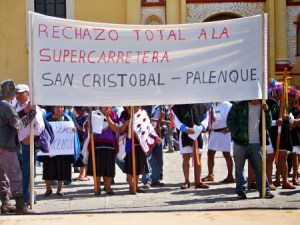
Protesting against the San Cristóbal-Palenque superhighway
By: Chiapas Paralelo
The Movement in Defense of Life and Territory (Modevite, its Spanish acronym) in San Juan Cancuc demonstrated a series of points in which they expressed their rejection of the realization of the superhighway project that goes from San Cristóbal de las Casas to Palenque.
Accompanied by the Human Rights Committee and heads of the area, the Modevite detailed in 16 points its opposition to this project, which first seeks to devastate the land, and would have an environmental impact and destruction of the ecosystems.
It would also contribute to pollution, mostly made by disposable waste, deforestation, displacement of those affected, the obstruction of roads and trails, as well as the division of the communities.
There would also be dispossession of the land, guaranty hunger and poverty due to destruction of lands and plots; it would contaminate springs, and there would be the presence and increase of violence and insecurity in communities and regions.
Finally they indicated that the construction of this project would lead to the loss of peace in the communities and violation of the fundamental rights of the peoples. Therefore, they stated that the already existing highways should be rehabilitated as a solution.
[1] Indigenous communities have demonstrated their rejection of constructing this superhighway for years! The superhighway was and still is an important part of the Plan Puebla Panamá for mega-development! After winning a lawsuit several years ago that prohibited construction of the superhighway in 2 Chiapas municipalities, we can deduce from this article that the government is proposing a new route for the superhighway. See: https://chiapas-support.org/2016/05/30/indigenous-win-lawsuit-against-the-san-cristobal-palenque-superhighway/
—————————————————-
Originally Published in Spanish by Chiapas Paralelo
Thursday, April 4, 2019
Re-Published with English interpretation by the Chiapas Support Committee
Zapata’s grandchildren reinforce the struggle against the thermoelectric plant
 By: Gloria Muñoz Ramírez
The consultation imposed by the federal Executive to start up the Huexca, Morelos thermoelectric plant, which forms part of the Morelos Integral Plan, the Nahua population responds with information caravans about the real dangers that the energy project will bring to residents of the eastern part of the state. Community by community, the Peoples Front in Defense of Water and Land of Puebla, Morelos and Tlaxcala, accompanied by experts in different areas, informs people about the direct contamination of the Cuautla River and the imminent danger from the construction of a gas pipeline in areas at risk from the Popocatepetl Volcano.
The murder of Samir Flores Soberanes, a popular communicator, social struggler and guardian of the territory, and the realization of a partial consultation (referendum) in which the ballots carry on the reverse side all the “good things” about the institutional project, further angered residents of the communities affected, who the president classified as leftist radicals and conservatives. He did not consider them that way in 2014, when the then candidate promised to throw out the thermoelectric project.
“They got involved with Zapata’s grandchildren,” they say in Morelos, while in Amilcingo they prepare to receive the National Indigenous Congress on April 9, and to take over the former Chinameca hacienda the following day, the date on which they had announced the official commemoration of the 100th anniversary of the treasonous assassination of the general of the Army of the South, Emiliano Zapata.
The organization of the peoples who are opposed to the Morelos Integral Plan, in which rejection of the thermoelectric plant won, has led them to create local fronts in defense of water, clarifying that they will struggle peacefully at all times and that they will not fall into provocations from those who, they point out, have received money from the federal delegate in Morelos, Hugo Eric Flores Cervantes, for supporting the project.
On Wednesday, Zapata will ride again through these lands, endorsing their struggle for land and for life. Definitively stopping the energy project is urgent.
—————————————————————–
Originally Published in Spanish by La Jornada
Saturday, April 6, 2019
https://www.jornada.com.mx/2019/04/06/opinion/012o1pol
Re-Published with English interpretation by the Chiapas Support Committee
What they’re saying in Mexico about Trump’s visit to the border
TRUMP: STRAW THREATS
A La Jornada Editorial

In Calexico, California, where he went to visit a stretch of wall, Trump was received with a balloon in the shape of a baby, “for his infantile attitudes” Baby Trump waves over the border wall. Photo: Xinhua.
In another turn of his speech about the border that the United States shares with Mexico, President Donald Trump announced Tuesday that “for the moment” he would not totally or partially close the border crossings as he had threatened to do last Friday, when for the first time he issued an ultimatum in that regard. According to the president, for now he can suspend the drastic measure because the government of Mexico “is detaining thousands of people at its southern border.” In what seems an effort to point the perception of alarm transmitted by Trump, the US Office of Customs and Border Protection (CBP) closed two of the eight lanes of the entry gate located at Otay Mesa due to what it called “an unprecedented humanitarian and security crisis.”
The magnate’s statements and those of the agency in charge of customs are completely inconsistent with the reality. First, because in recent days there has not been a drastic change in the policy that the Mexican government has been applying since December of last year with respect to the Central American migrants that enter the nation on their way to the United States, much less has it undertaken the mass detentions to which Trump referred. Second, because the number of people without immigration documents that arrive in the United States is very far from the historic maximums; therefore, it is totally fallacious to speak of an “unprecedented crisis.”
In this context, the fact that the Republican politician backs down on his latest series of threats suggests pressure from the American business community for conjuring up such complete nonsense, whose consequences would be catastrophic even in the short term: just one day of commercial exchanges by that means represents up to 2 billion dollars for companies on both sides of the border. For the automotive industry in the United States the scenario would be particularly disastrous, because just one week of closing the border could see everything paralyzed due to the lack inputs coming from Mexican territory.
For the rest, the decision to suspend the reckless ultimatum shows, above all, that behind this and previous episodes is not but a propagandistic strategy designed by the old television presenter to show the image of a bold, aggressive and thoughtless macho man that that so appeals to the most backward sectors of the American electorate, precisely those whose loyalty to Trump has remained unperturbed. In sum, the causes and rhythms of these outbursts should not be sought at the border or in the migratory flows but rather in the electoral calendar of the magnate and his party.
What’s serious and regrettable about this propagandistic demagogic extend and release is that the theater of the “border emergency” restricts access to refugees and asylum seekers and it reinforces the perspective that a real humanitarian crisis is developing.
———————————————————–
Originally Published in Spanish by La Jornada
Thursday, April 5, 2019
https://www.jornada.com.mx/2019/04/04/opinion/002a1edi
Re-Published with English interpretation by the Chiapas Support Committee
Marichuy: Seeking an apology from Spain, a simulation

María de Jesús Patricio (Marichuy) spokeswoman for the National Indigenous Congress Photo: Benjamin Flores
By: Patricia Mayorga
MEXICO CITY (apro)
President Andrés Manuel López Obrador’s request for an apology from Spain because of colonization, is a simulation, “what they have to do is to stop dispossessing communities of their land,” the National Indigenous Congress (CNI) spokeswoman, María de Jesús Patricio Martínez, pointed out.
On her visit through Chihuahua, the former aspirant to the presidency of the Republic insisted that the federal government deceives the citizens because it continues the dispossession and displacement of ethnicities in order to take possession of their territory.
The Purépecha Francisco Reyes, who is also a member of the CNI, warned that in the government of López Obrador the situation for indigenous peoples could get worse because he imposes measures and actions with the justification that has the support of 30 million people that voted for his national project, according to what the local Chihuahua publication Raíchali published.
Both agree that the promotion of megaprojects is accompanied by the social decomposition of the communities, con the pretext of development because it’s about a business in which “there’s no limit (…) they’re just screwing over the peoples.”
Marichuy Patricio Martínez said that they are not going to stop fighting so that the customs of the peoples prevail and achieve an organization from below against the destructive actions of the megaprojects.
The indigenous leader met with representatives of the mountain communities of Chihuahua, to listen to what has happened in the region since the start of the new federal government.
“It’s about a tour to see how they are resisting and to know what they think about the new government,” she said upon arriving in the northern state.
María de Jesús Patricio expressed her concern about the works announced, like the construction of the Maya Train (Tren Maya) in the country’s south, which they imposed “with a rigged consultation,” orchestrated by big capitalists that are the ones who dictate the direction of things, publishes the Chihuahua website.
The CNI spokeswoman said that the change of regime would not come because that doesn’t depend on only one person, but rather on everyone. And, in the case of the indigenous communities, many have maintained their customs with their governors, form of organization, fiestas, traditions and a cared-for territory that they have known how to maintain.
“We are justly fighting for that, for the respect of life on earth,” the added.
In the specific case of Chihuahua, she referred to the huge problem clandestine logging in various zones of the state, like in the municipality of Bocoyna, in which the four wheels of capitalism against the indigenous communities are show: exploitation, repression, dispossession and contempt.
She criticized that, in that case, the action of the authority had been contrary to the request of the residents, such as in the community of Bawinocachi, Bocoyna, in which the Federal Prosecutor for Environmental Protection (Profepa) placed responsibility on its residents for the clandestine logging that, since about a year ago, started killing off their forest.
In the settlement agreement dated January 15, 2019, the federal agency notified them that it had opened an administrative process against them for alleged omissions they could incur by permitting deforestation, Raíchali published.
“If they finish off the forest they are going to all of us,” María de Jesús Patricio insisted and emphasized the need to organize from below so that the people govern and also to prevent the destruction of the forest and the natural resources by the corporations or governments that want to impose businesses.
Patricio Martínez reiterated that there are many communities that maintain their customs and their form of organization.
——————————————-
Originally Published in Spanish by Proceso
Tuesday, March 26, 2019
Re-Published with English interpretation by the Chiapas Support Committee
Burial without a corpse
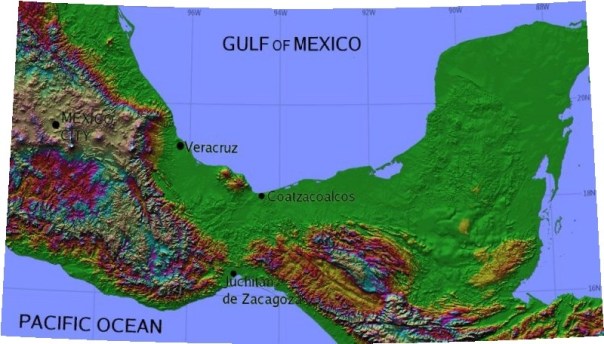
The Isthmus of Tehuantepec
By: Gustavo Esteva
The funeral of neoliberalism was decreed, but we do not know which corpse they will bury.
President López Obrador once again showed his desire to liquidate the neoliberal era, to which he rightly attributes a large amount of the troubles that overwhelm the country. His conviction is clear. But his personal definition of the enemy jeopardizes his intentions.
López Obrador seems sure that exiting the neoliberal world will be enough to retake the State leadership. It is true that renouncing the basic State functions to give them away to private corporations, in a way as corrupt as incompetent, is one of the worst mistakes of the Mexican governments since 1982. But before celebrating the recovery we need to know the meaning. It seems that everything changes… for nothing to change. This State leadership is used to giving away public programs to corporations and adopting the path that they are indicating.
One of the clearest examples is the Isthmus of Tehuantepec. It is said loud and clear that the new plan satisfies the national interest and generates wellbeing for the people of the region. Nevertheless, even the most superficial analysis of the plan´s contents, shows that it is a dispositive that inserts the country more deeply in not it´s own logic, but into the one of private interest. It constitutes a very real threat to people in the region, because it endangers their ways of life, their traditions and their hopes.
When Porfirio Díaz created the idea for the first time, it seemed viable that Mexico to strategically use the project, which awoke huge interest among the Americans. At some moment of tension with the United States, Díaz Ordaz discovered that large portions of the Isthmus were in foreign hands, so he organized a massive distribution of ejido and communal lands as a pretext for expropriation. It was too dangerous for Mexico that these lands were not our own.
When López Portillo thought that it was his turn to administer abundance, he ordered the preparation of the project in order to invest petroleum profits in it. The project was very advanced when they discovered that they had run out of money and the risks were too high. Today, under entirely different conditions, they seek to reorder activities on the Isthmus in order to connect it to an operation that only big corporations could assume and in order to cancel an autonomous path.
The protocol of the process of the free, previous and informed consultation for the peoples and indigenous communities of the Tehuantepec Isthmus in Oaxaca and Veracruz, regarding the Development Program for the Isthmus of Tehuantepec [1] is a document that deserves a careful consideration. It is an exemplary case of the forms of the state of siege (State of emergency), when the law is used to violate itself, to twist itself. It describes the pertinent legal dispositions for the case and finds solace in the legal value of good faith, to right afterwards describe the way in which people will be betrayed in spirit and in word.
The consultation that was made in a hurry and will end on March 31 is not even “previous”. The government has already made the decision to do the program. Their actions haven´t even reached the communities involved, but decisions have been made that will affect them. Every day contracts and commitments are announced. It’s urgent for the government to process the 5 billion dollars that were promised to Trump for the area.
It won´t be a “free” consultation either. It is made according to the time and conditions defined by the federal authorities, not for the peoples, which “customs and habits” are being quickly adjusted to the demands of the process. It won´t be an “informed” exercise. The presentation has a clear bureaucratic mark, with incomprehensible terms for ordinary people and formats typical of a promotional flyer. During the meetings, the expositions are accompanied with clientele suggestions, in order to incorporate some of the projects that the communities had demanded a long time ago, therefore facilitating a positive answer. [2]
The most awful thing about this consultation is that it only “informs” about the government’s program so that the people take it or leave it without presenting options. The only way of make this consultation valid is allowing the people to choose what they really want.
The operators of the mechanism of civic participation will give good news to the president by the end of the month. He would “win” another one. They will affirm with all cynicism and ignorance, that the program it is made with civic participation and in accordance with the principle of “mandar obedeciendo” [3] (to govern obeying). The result will be used as “proof” that the peoples just want to access the forms of capitalism that prevail in the north, leaving behind their “underdevelopment”, as some of the organic intellectuals of the new government affirm.
Now comes the answer of the peoples. It has already been announced in Guelatao, when the people AMLO drove-in (acarreados) surpassed the locals to honor Benito Juárez. He will not wait.
NOTES:
[1] According to reports in the press, the Development Program for the Isthmus of Tehuantepec, aka the Trans-Isthmus Corridor, is a project to revitalize the existing single-track railroad between the port of Coatzacoalcos (Veracruz) and the port of Salina Cruz (Oaxaca). The existing railroad would be upgraded to a high-speed railroad with two tracks that would carry freight between the Gulf of Mexico and the Pacific Ocean, thus providing a Panama Canal-lite and facilitating trade with China. Both ports are designated Special Economic Zones, tax-free zones for trans-oceanic commerce. The Mexican government believes that this mega-project would promote “development” in the region and provide jobs, not only for the local population, but also for migrants from Central America.
[2] See the CNI-CIG and the EZLN’s communiqué about the referendum here.
[3] Mandar obedeciendo is a set of principles for governing and leadership that are practiced by the CNI-CIG and the EZLN.
———————————————————–
Originally Published in Spanish by La Jornada
Monday, March 25, 2019
https://www.jornada.com.mx/2019/03/25/opinion/015a2pol
Re-Published with English interpretation by the Chiapas Support Committee
EZLN and CNI-CIG on the Isthmus of Tehuantepec referendum
COMMUNIQUE FROM THE CNI-CIG AND THE EZLN: Another Simulated Referendum to Justify Megaproject Development on the Isthmus of Tehuantepec

To the people of Mexico:
To the people of the world:
To the CIG Support Networks:
To the Networks of Resistance and Rebellion:
To the National and International Sixth:
To the media:
The plans for dispossession and destruction that the bad governments call the “Isthmus of Tehuantepec Development Program,” are for us as original peoples an announcement of the tragedy they now intend to extend through the territories of all of the Isthmus peoples.
As the CNI-CIG, we reject and condemn the bad governments’ so-called referendum, to be carried out throughout the Isthmus communities March 30 and 31, which simulates consultation of our peoples in order to impose these megaprojects of death.
We denounce the corrupt practices with which the bad governments, through their National Institute for Indigenous Peoples, have sought to divide, deceive, and intimidate our communities, offering programs and projects in exchange for yes votes in their so-called referendums, as if it were not precisely our territories and natural resources which are at stake.
The Binizzá, Ikoot, Chontal, Zoque, Nahua and Popoluca original peoples who inhabit the Isthmus of Tehuantepec in the states of Oaxaca and Veracruz have already made clear our “NO” to these megaprojects of death, which will lead to the destruction of our territories and the death of our mother earth.
We reject the invasion of our territories by mining companies that will destroy the mountains, springs, rivers, and air, as well as by the wind power companies that use the wind as a tool of negotiation to displace us from our lands. We do not want their trains, which only transport death, nor their repressive military or paramilitary violence, which devastate our territories.
We state once again that we will not cease in our struggle to protect mother earth and our indigenous communities and territories no matter how many simulated referendums the bad neoliberal capitalist government carries out in order to impose—via war—projects that prioritize money over the life of the original peoples and of nature. On the contrary, we will continue to organize ourselves in resistance and rebellion with all those below.
We call upon all honest organizations and collectives, on the CIG support networks and on the national and international Sixth to be alert and ready to respond in solidarity to this new attempt to impose projects of dispossession.
Attentively,
March 2019
For the Full Reconstitution of Our Peoples!
Never Again a Mexico Without Us!
National Indigenous Congress
Indigenous Governing Council
Zapatista National Liberation Army
Provocations, infamy, apologies
[Admin: The EZLN and the CNI-CIG are focusing their joint resistances on the Morelos Integral Project (PIM). This article begins to explain why: Resistances to the PIM could be repeated with the Maya Train, the Tehuantepec dry canal (aka Trans-Isthmus Corridor) and other pending megaprojects impacting indigenous peoples throughout Mexico.]

CUERNAVACA MORELOS, FEBRUARY 8, THE PERMANENT ASSEMBLY OF PEOPLES -PHOTO: TONY RIVERA
Gilberto López y Rivas
Upon completing the first 100 days of the new government, it’s concerning that its ex oficio lawyers make targeted statements about those indigenous peoples, who from their knowledge and anti-capitalism, denounce and resist the renewed development, neo-indigenist and militarization policies of the Fourth Transformation.
The EZLN and the National Indigenous Congress-Indigenous Government Council were not responsible nor were the “isolated voices” of the “Zapatista environment” for the fact that President Andrés Manuel López Obrador would ratify the PIM (Proyecto Integral Morelos, Morelos Integral Project) in his speech in Cuautla on February 10, in which he reversed his public commitments in 2014 and 2018, and in which he stigmatized “leftist radicals,” and classified them as “conservatives,” without distinguishing that, in reality, they were members of peoples and communities that for years have been waging an unequal battle against the PIM, and, now, paradoxically against the new government, that defends and represents said project.
The murder of Samir Flores Soberanes, the very incarnation of that struggle, took place ten days after the presidential harangue. Pointing out, as does Armando Bartra, that it seeks to make political use of this death to “feed blood to a cause that doesn’t need it” is trivializing that murder and an unsustainable political infamy. Samir is a symbol of the struggle of the peoples that remember with admiration and respect their teachings. Amilcingo, his birthplace, becomes the epicenter of mobilizations like the Emerging National Assembly versus State Violence and Self-determination of the Peoples, held on March 9, in which the current government was characterized, in fact, as a continuity of neoliberalism, calling for a national and international mobilization next April 10 in Chinameca, and declaring AMLO a “persona non grata” in Morelos: “We will not permit –participants in this assembly assert– that the death of our caudillo of the south is insulted with the presence of one who seeks to impel death projects on Zapatista land.” The resistances to the PIM could be repeated with the Maya Train, the Tehuantepec dry canal and other megaprojects at the doorstep.
The apologists of AMLO’s achievements in his first 100 days seem to not take into account the unavoidable reality of the profound gap between the original peoples and a government that already decreed the end of neoliberalism, in the “100 days that moved Mexico” (sic). Of course, as indigenous peoples organized in defense of their territories and their autonomic processes, it’s not a priority on the governmental agenda, except when it refers to the National Institute of Indigenous Peoples (INPI), which as of today has not made one single statement about the Morelos Integral Project and the continuity of the violence against those who struggle in defense of Mother Earth, like Samir.
The INPI is carrying out consultations in communities formally comply with Convention 169 of the ILO, although Victoria Tauili-Corpuz, the UN’s special relator on the Rights of Indigenous Peoples, already firmly expressed her concerns to the current government about the obligations contracted in this regard by the Mexican State, in accordance with the constitutional context and the international treaties in effect.
Also, from the ambits authorized, difficult of being accused of “conservative” and “ultra-leftist,” emerge critical observations that coincide with those sustained by community resistances. Greenpeace lamented the little attention of the current government, “beyond the discourse,” to the theme of the environment, and evaluated that in just 100 days of government President Andrés Manuel López Obrador’s policies –on environmental and energy matters– profile Mexico in the direction of a climate disaster. Among the five points on which such affirmation is sustained, specifically, the reactivation of the thermoelectric plants, like the one in Huexca.
Within this context of authoritarianisms from the power: To what hypothetical dialogue does Bartra refer and who is hindering it when consultations are imposed from the federal Executive that have been considered illegal, illegitimate, in violation of the collective rights of the original peoples? Is it dialogue with the delegate of the Presidency of the Republic in Morelos, Hugo Éric Flores, a systematically questioned operator that harassed the dignified people of Huexca with his presence on the night of last March 5, without being invited by a community assembly, accompanied with public force, and offering patronizing and corporative aid that seeks to buy consciences and, that yes, fraction and divide communities? Is it dialogue with the prosecutor that “investigates” Samir’s murder, insulting his memory and the ethical integrity of the atmospheres of family and struggle? Is it dialogue with one who only listens to the echo of his word made law?
———————————————–
Originally Published in Spanish by La Jornada
Friday, March 22, 2019
https://www.jornada.com.mx/2019/03/22/opinion/016a2pol
Re-Published with English interpretation by the Chiapas Support Committee
 Chiapas Support Committee