Chiapas Support Committee
Home of the Compañero Manuel blog on zapatistas & mexico
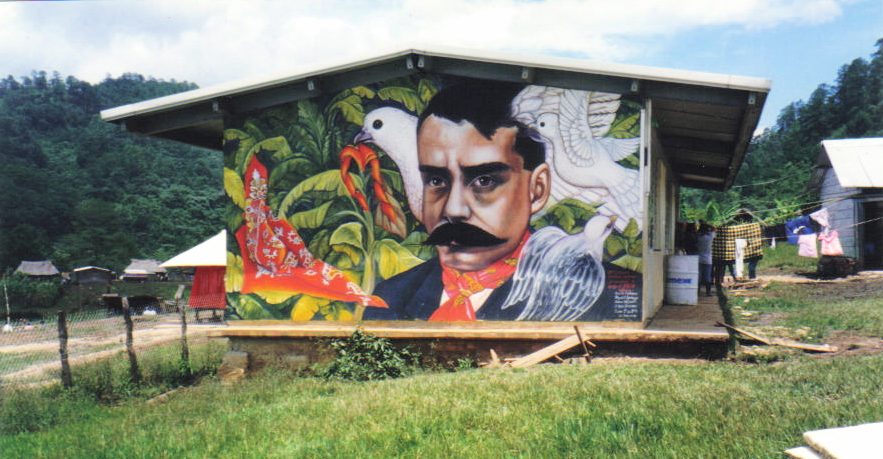
For life, peace and justice in the Mountains of Guerrero

We want a world where many worlds fit.
By: Gilberto López y Rivas
The National Indigenous Congress-Indigenous Government Council (Congreso Nacional Indígena–Concejo Indígena de Gobierno, CNI-CIG) and the Zapatista National Liberation Army (Ejército Zapatista de Liberación Nacional, EZLN) recently convoked the Campaign for life, peace and justice in the Mountains of Guerrero in order to break “the circle imposed by criminal groups that, allied with the bad governments, seek to end the power from below with terror and violence, because they know that is where they will be defeated.”
This call, of an urgent nature, urges carrying out the necessary actions, parallel and simultaneous, to dismantle the considered war of the powerful against the life of humanity and the entire planet, and what they call “the narco-paramilitary war against the peoples and communities that are members of the National Indigenous Congress.”
Last May 4, the Nahua councilor José Lucio Bartolo and the delegate Modesto Verales Sebastián, from the indigenous communities of Xicotlán and Buenavista, respectively, were kidnapped and murdered. On May 23, near Chilapa, Guerrero, two members of the community police of the Nahua communities of Tula and Xicotlán, Bartolo Hilario Morales (comandante), and Isaías Xanteco Ahujote, promoters of the Indigenous and Popular Council of Guerrero Emiliano Zapata (Concejo Indígena y Popular de Guerrero Emiliano Zapata, CIPOG-EZ) were deprived of their freedom, murdered and dismembered. In a comunicado, the CIPOG-EZ specifies: “It is important to point out that our murdered compañeros and their communities have been organizing their community police for years to resist the violence, extortion and imposition of poppy growing on the part of two criminal groups, the Ardillos and the Rojos, who control the municipal presidencies of the region, count on the Mexican Army’s complicity and that of state and municipal police…”
It’s clear to the CIPOG-EZ the relationship between the pro-development stance of the current government with its megaprojects, and the different types of armed actors that operate in indigenous territories, as well as the role of autonomy as an essential instrument of anti-capitalist resistance and rebellion: “The peoples, nations, tribes and indigenous barrios, are resisting not only the megaprojects with which the owners of power appropriate nature and land, but also against death, fear and desolation that their armed groups impose on the whole country. Although they may have the shirt of los Rojos, los Ardillos or the repressive forces of the bad government, the power of money and the ambition to make profits based on the suffering of the peoples, makes them the very same. Constructing that peace and autonomy for the peoples of Chilapa and the region is the horizon for which our murdered brothers struggle because of neoliberal capitalism.”
The CNI-CIG-EZLN is convoking a caravan that will depart from Amilcingo, Morelos, on July 12, and will spend July 13 and 14 in Acahuehuetlan, Chilapa, Guerrero. At the same time, it invites a collection of food, medications and economic resources in the places and the [bank] account of the CNI-CIG that they specify in the call. The purpose is to make visible the humanitarian crisis in entire regions, in which no food or medicines can enter, nor can they sow the land “given the risk of being killed on their plot, or keep their schools open for fear of a possible attack on our sons and daughters.”
But the war against the CNI-CIG not only takes place in the state of Guerrero. The strategy of irregular war described in the manuals of the Sedena [1] is applied throughout the national geography. In a letter against the militarization and in solidarity with the communities of Zapatistas and of the indigenous peoples of Mexico, recognized intellectuals of Mexico and global ambit, expressed their concern over the growing military activity in Zapatista territories, and they point out: “It worries us to find out about the recent homicides of members of the National Indigenous Congress and the Indigenous Government Council. The possibility worries us that this new administration, like its predecessors, liberal or conservative, once again place the indigenous peoples at the edge of extermination.”
Zósimo Camacho counts at least 117 members of the CNI murdered since its foundation in 1996, and he emphasizes: “Andrés Manuel López Obrador completes half a year of having assumed the Presidency of the Republic, a time in which 10 cases were added to the long list of murders and disappearances against indigenous activists of this organization (…) No one has been arrested for these murders and the investigations don’t advance. Death, so far in the “fourth transformation” has permission if we’re talking about indigenous peoples.”
Because of action or omission, the Mexican State should answer for these crimes.
[1] Sedena is the acronym for the Secretariat de Defensa Nacional, Mexico’s Defense Department
————————————————
Originally Published in Spanish by La Jornada
Friday, June 28, 2019
https://www.jornada.com.mx/2019/06/28/opinion/024a1pol
Re-Published with English interpretation by the Chiapas Support Committee
Surrendering to la migra, “the new normal” at the southern border of Chiapas

The Suchiate River is part of the almost 1,000 kilometers of border with Guatemala, seen yesterday from Tapachula, Chiapas. Photo: Alfredo Domínguez
By: Hermann Bellinghausen
Tapachula, Chiapas
In the shadow of the Viva México vehicular bridge, at this city’s northern exit towards Mexico City (in fact, towards the whole country), a group of seven citizens of India, young men, seated on the rails of the lower bridge over a stream that runs under the highway, wait docilely while they make room for them in a National Institute of Migration (INM) van, since the only one, for now, is completely full of migrants intercepted by the Federal Police and INM agents in plain view of three members of the National Guard (NG) wielding their weapons tranquilly. Or are they marines? These days you don’t know which one is which.
On the other side of the highway, half hidden behind acrylic shields and gray raincoats, a dozen members of the NG doze seated along the ample box of a truck belonging to the Military Police of the Navy Secretariat. They wait for their turn to monitor the immigration checkpoint, as along the entire highway towards Oaxaca, all public transportation vehicles are required to stop so that INM agents appear, scrutinize all the passengers and in case of suspicion ask for documents. The migra has been known for identifying Central American migrants (the least obvious) at a single glance.
It’s also true that many migrants travel willing to surrender and be taken to detention centers. This is usually the case for Pakistanis and Indians, generally men, traveling in groups.
A grilled INM paddy wagon arrives that is parked at the side of the full van. The agents open the front doors of the two vehicles, as a barrier, and transfer a dozen Central Americans to the paddy wagon, including a complete family from Honduras. They will be driven to the 21st Century Immigration Station. Immediately, Federal Police escort the young men from India to the interior of the recently vacated truck, to be taken at once to the detention center at the Mesoamerican Fair.
Given this endless movement of migrants lacking a visa, can we talk about normality? Routinely yes, although yesterday, perhaps due to the publicized deployment of the NG and the Mexican president’s visit on Thursday, is a rather “low” day, and even so interception of travelers is incessant.
The same thing can be said about the Chiapas border of the Suchiate River, especially in the early hours, when the night is barely ended. We’re not talking about a continuous flow, but there are always one or more inflatable boats with planks that transport citizens of Haiti (such was the case yesterday morning) or of any other origin. Most likely, these Haitians will spend the night inside the 21st Century Station (if they capture them or they surrender), or in the streets of Tapachula.
Meanwhile, outside the station, yesterday at noon a hundred Congolese and Haitians, including a significant number of pregnant women and small children, were hanging around, resting or making a line in front of the bars waiting for some document.
Such is the new every day life in the most important border region of Chiapas. But let’s not forget that the state shares around a thousand kilometers of land, river and lake border with Guatemala. According to what officials and observers predict, to the extent that the controls increase on the usual routes, migrants look for less obvious and more dangerous ways, like the Petén jungle, the Usumacinta River or the mountains to the north of the Soconusco.
———————————————————–
Originally Published in Spanish by La Jornada
Saturday, June 22, 2019
https://www.jornada.com.mx/2019/06/22/politica/004n1pol
Re-Published with English interpretation by the Chiapas Support Committee
Kana’antik k-lu’umo’ob: The Maya horizon

“Propose, don’t impose” is one of the 7 Zapatista principles of governing.
By: Francisco López Bárcenas
June 21 is a very important day for the Mayas of the Mexican [Yucatan] Peninsula. It’s the date on which the Saq’ Q’ij, known as the Summer Solstice among the mestizo population, an epoch that denotes clear, bright and resplendent days, when father sun stops his journey to announce the N’imla’j, the longest day of the year. Among the Mayas, the event is the occasion for big ceremonies and fiestas to thank the Sun God for all the wealth he has given, but above all so that the peoples are aligned with the stars and the energy they radiate and the world’s balance can continue. Perhaps that’s why, the peninsula Mayas say, three different events converged there last June 21 around an issue on which their future depends: the construction of the Maya Train.
One of those events was led by the President who, on a tour through the peninsula visited the three states that comprise it promising public works and delivering fiscal resources to beneficiaries of his social programs. It started on June 21 through the Yucatán and ended two days later in Quintana Roo, just the three days on which the Maya Saq’ Q’ij. In Yucatán he participated in a meeting called to inform the public about the benefits that construction of the Maya Train will have, only about its benefits, nothing about its negative impacts. That day 18 productive, cultural and ejido organizations and different collective made publics a manifesto, the product of two days of deliberation in the city of Merida, to analyze the Fourth Transformation government’s policy. In its conclusions, among other things, they noted:
“Waves of promises of change flow in the paths of our peoples, in our assemblies and our families; stories that talk about a bright future, about the arrival of development and the benefits to our communities with the Maya Train. The land of the Mayas on the Yucatán Peninsula is being, more than ever, offered and auctioned to the highest bidder, the one who deceives our people and ravishes and dismembers our territories with the zeal to increase their capital. Agro-industry, mass tourism, wind and solar megaprojects and the real estate developments grow enormously, repeating the dispossession and insatiably devouring life, our life. In this way, the project of ‘complete reordering’ of our Mother Earth is driven by foreign hands and seeks to change the face of the Yucatán Peninsula and its Maya inhabitants, still the legitimate and legal owners of the land that was recognized as theirs thanks to the struggle of our ancestors.”
Another group of Mayas met on June 21 in the municipality of Carrillo Puerto, Quintana Roo. Kana’antik k-lu’umo’ob, was the slogan under which they dialogued and according to one of the women participants, it means “preserving our territory.” There were axes of their discussion: the construction of indigenous autonomies and the defense of territory as a way of constructing a different future. Critiques of the governments surfaced everywhere, warning how quickly he is forgetting his campaign promises to run to the right of those who supported them because they believed his promises. Regarding the Maya Train, they regretted that the plan for its construction was not announced, that what mostly abound are rumors about the work and threats to the ejido owners to sell their lands, as happens in the areas surrounding the Bacalar Lagoon.
Given this situation, both meetings concluded that it’s necessary evaluate what they have and start from that to organize the defense of their existence that, according to their expression, passes through living with honor and dignity, something that doesn’t currently happen because everyone despises them and doesn’t take them into account for the construction of the future. Much’ Ximbal was heard around the venue where the meeting was held and everyone nodded because, they say, it means walking together. In order to achieve this they propose rescuing their culture and creating the conditions for it to flourish, so that the Maya peoples become strong again, defending what exists because they have constructed it with the wisdom of their grandparents, “with the tenacity and rebelliousness of the men and women who have permitted the maintenance of a culture around the Maya milpa, a generating and unifying space for our thought and our wisdom, food and reproduction of life; a universal referent of coexistence with the land and the source of family nutrition.”
Much’Ximbal and Kana’antik k-lu’umo’ob united and strengthened each other in the N’imla’j. United for the preservation of territory, form and essence on how the Mayas trace their horizon. A process very distant from the government actions of the Fourth Transformation proclaimed by the government, because it’s not the path of the peoples and no one has invited them to walk it. The Saq’ Q’ij, they say, sent its signals. It is up to men and women to know how to interpret them.
———————————————————–
Originally Published in Spanish by La Jornada
Thursday, June 27, 2019
https://www.jornada.com.mx/2019/06/27/opinion/024a1pol
Re-Published with English interpretation by the Chiapas Support Committee
Farewell to neoliberalism?
By: Raúl Romero*
Neoliberalism is a phase of capitalist social organization which, in a very general way, can be characterized by 1) the destruction or contraction of the social State; 2) the deregulation and expansion of the financial sector; 3) the extinction and privatization of state and para-state industries; 4) the liberation of borders to capital and the increase of immigration restrictions for people; 5) the adoption of “militarized security” models that guaranty the protection of the “strategic sectors” and regional integration; 6) the expansion of transnational corporations; 7) predominance of the extractive economies and of dispossession, and 8) the growth, on a global scale, of organized crime. Some of these phenomena are prior to neoliberalism, but they reach their predominance in this stage.
As in all social formation, in neoliberalism social relations and common senses are modified. Discourses that promote “entrepreneurship,” competition, efficiency and the effectiveness and that argue in favor of the private over the public fill neoliberal rhetoric. Rights are being replaced by “opportunities,” while asocial and ahistorical “explanations” are reinforced as responses to structural problems. These discourses are often accompanied by disqualifications against organizations of the peoples: los unions are the favorite adversaries, but also the original peoples that, in the language of the power, “refuse progress.”
Although capitalism in its neoliberal phase is a global system, it unfolds in different forms in different territories. In third world or dependent countries, the State is modified and the few social conquests are annulled to facilitate the process of accumulation of the imperial centers.
In the case of Mexico in particular, modification of the State included legal and economic reordering. In the economic it meant fiscal reforms, rationalization of public spending, commercial openings and an aggressive program of extinctions and privatizations of banks, credit societies, iron and steel, fertilizers, sugar mills, auto parts, trucks, bicycles, cinemas, airports, airlines, hotels, telephones and railroads. The data are very representative: of the 1,155 para-state companies that Mexico had in 1982, less than 200 are left today.
In legal matters, the reordering of the Mexican State translated into 86 constitutional reform decrees between 1982 and 2009 (See https://bit.ly/2UlJzhF), among which those in Article 27 stand out, which put an end to agrarian redistribution and social ownership of land, opening the way to the dispossession and privatization of ejido lands and natural resources; the reforms to Article 28, which expanded tax exemptions and allowed private investment in satellite communications and railways, and those of Article 3, which prioritized education as an individual right and not as a social right, while it opened the door for churches and entrepreneurs to intervene in plans and programs of study.
It’s also worth noting the counter-reform to Article 2 that, contrary to the agreements signed with the indigenous peoples, refused to recognize them as entities of public right with full right to the enjoyment of their territories, or the reforms to Article 123, which ended up leaving the working class totally helpless versus the ambition of employers and their new forms of exploitation.
As a result of the restructuring of the Mexican State, extractive economies and organized crime came to occupy key places, submerging our society in one of the most violent crises of contemporary Mexico. The thousands of people murdered and disappeared, as well as the dispossession and ecocide that currently characterize our country must be understood not as the result of corruption, but rather as the direct effect of neoliberal capitalism.
Is it possible that some of this will change in the short term? Sadly, no! The signals that the new administration gives point to neoliberal continuity, even though the president has decreed its end. We should no longer undertake a constituent process that, as happened in some Latin American countries, aids in discussing a new social pact. Nor is the suspension or renegotiation of the external debt or reversing the most significant counter-reforms, such as energy on the short-term public agenda. To the contrary: the dispossession projects, which also accelerate integration with the United States, have become a priority for the president.
Neoliberalism will not end by decree. Nor should we deceive ourselves with the nostalgia of a better past that didn’t exist for everyone. Limiting alternatives inside the margins of capitalism would be, besides suicidal, accepting “the end of history.” Re-discussing and proposing forms of social organization without exploitation or domination is urgent. A lot of political imagination and deep and critical study of past and present experiences would be required. Ending neoliberalism and capitalism will be the job of the peoples and their organizations.
*Sociologist
————————————————————
Originally Published in Spanish by La Jornada
Sunday, June 16, 2019
https://www.jornada.com.mx/2019/06/16/opinion/010a1pol
Re-Published with English interpretation by the Chiapas Support Committee
Individualized support: counterinsurgency or social containment?
By: Peter Rosset*
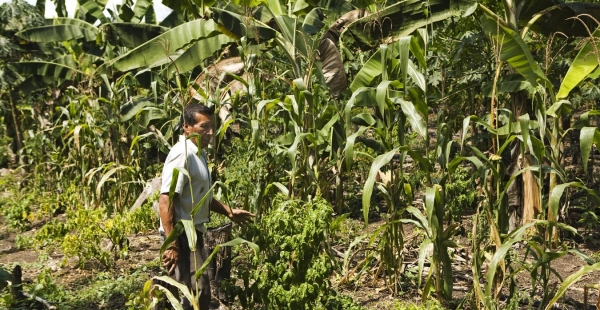
The Mexican countryside is full of struggles and alternative projects. It has a long history of agrarian struggle, territorial defense, appropriation of productive processes and commercialization through peasant cooperatives and other forms of ejidal companies and social enterprise.
There is a rich community and organizational fabric, and many collective constructions of alternatives to the dominant capitalist model. It is regrettable that for AMLO and the 4T all this is reduced to the embezzlement of peasant organizations and their corrupt leaders. It is painting everyone with the same brush.
We can divide the peasant organizations into two broad categories: on the one hand, there are the Zapatistas and a significant part of the CNI and the indigenous movement, whose strategy goes back to the construction of autonomies. The Zapatistas, for more than two decades have rejected all government programs, because they think that resources corrupt and vitiate organizations, leaders and communities, and make people move only when there are money, dispensations, projects, candidacies, and positions at stake. The result is the demobilization and permanence of poverty. They say that a “new way of doing politics” is necessary, without the intermediation of money and other resources. That’s why they do not accept programs that qualify as “alms.”
On the other hand there is a wide range of organizations in dispute over public resources that demand “a budget for the agricultural sector”. They consider that because they are citizens and taxpayers they have the right to their fair share of State resources. They seek to strengthen the organizational, territorial, productive and marketing processes with investments and credits from the public sector. The relative historical success of the peasant-indigenous coffee sector is proof of this.
Within this category there are the good, the bad and the ugly.
However, the President effectively disqualifies all as corrupt. The policy of the 4T is based on this disqualification that AMLO does. The head of the Executive has promised “no más moche” (no more bribes) for the peasant organizations; that not a penny will go through the organizations; everything will be direct to families. In other words, only individual aid deposited in Banco Azteca plastic cards (http://tiny.cc/melf7y). Considering them incapable of building their own processes, this takes away the agency of organizations and peoples.
Now they will be poor in need of alms. It is a policy promoted by the World Bank for at least two decades, with two purposes: to reduce intermediary expenses and possible sources of corruption, and achieve greater social containment in the face of structural changes in favor of capital: land grabbing, mining, plantations, hydro and thermoelectric dams, etcetera.

Social containment, because the direct transfer of money demobilizes people. Who would go to a meeting of the organization if they have money in their pocket? This is a policy of organizational breakdown. (http://tiny.cc/r9kf7y).
A breakdown directed at the two types of organizations. Against Zapatismo and the autonomies because, according to them, money is the hook to “take away bases” from the autonomic movements. It’s an old counterinsurgency tactic. And it goes against cooperatives, social enterprises, alternative projects of other types of organizations. It will be the coup de grace for many organizational spaces in the communities and territories.
Calculated as a measure of social containment, because only with good organizational fabric would they be able to defend their territories from the “megaprojects of death,” such as the Trans-Isthmus Corridor, the Maya Train, the hydroelectric and thermoelectric plants, the mining concessions and other mechanisms of dispossession.
*Doctorate from the University of Michigan. Agro-ecology specialist
———————————————————–
Originally Published in Spanish by La Jornada
Saturday, June 1, 2019
https://www.jornada.com.mx/2019/06/01/opinion/012a1pol
Re-Published with English interpretation by the Chiapas Support Committee
Zibechi: The US-China war and the movements below
As Trump heads to Japan for the G20 and prepares to meet with Xi Jinping…

Chinese labor unions protest.
By: Raúl Zibechi
We are facing a war for global geopolitical supremacy, a technological and military war that assumes (for now) the form of a trade conflict. The hypothesis that we manage is that the war is going to deepen until skirting on the dangerous abyss of nuclear conflict, and that it will be the mark of the 21st century, since it will extend in time until one of the rivals (probably China) rises up with victory.
As the conflict between the declining power and the rising one that challenges it will dominate the worldwide and regional scenario in this complex historical period, it seems necessary to draw some general ideas that can orient us to those below. I don’t intend to establish “lines,” but rather to just sketch ethical-political horizons that I believe the so-called anti-systemic movements should debate.
The first is to consider that it is a war for the domination of the planet, not for the liberation of the peoples. We see that a part of the professionals of the left maintain that we must choose between the United States and the China-Russia alliance, because it’s necessary to defeat the former and walk hand-in-hand with the latter. On the contrary, I believe that although the hegemonic power is very harmful and must be confronted and defeated by the peoples in every place on Earth, we cannot lose sight of the fact that the other two nations are also imperialists.
Therefore, I think that the situation is more similar (not identical) to that which occurred in the First World War that to what happened in WWII. In this, the national interests of the then Soviet Union led Stalin to impose an alliance with the Western powers on the movements. Meanwhile, Lenin and the Bolsheviks, in the first war, came out in favor of “defeatism” of their nation, betting on converting the imperialist war (that’s how they defined it) into class war to make the revolution.
During the Second World War, the Chinese communists dared to challenge Stalin’s directives and took their own path, separated from the Kuomintang and from the Western powers and fought against them. Thanks to that line of action, they were able to win. In short, the forces of change must take advantage of the conflict between those above to make our own project advance, with autonomy, but without discarding specific agreements providing that they don’t neutralize us.
The second question is to learn from the experience lived by our peoples during the wars of independence. The conflict between creoles and Spanish (and Portuguese), supported by England, was resolved against the peoples that suffered as much, or more, with the republics as with the monarchies that colonized them. The defeat of the revolutionaries from below (from Tupac Amaru and Tupac Katari to José Gervasio Artigas, Tiradentes and Morelos), carpeted the installation of republics that put an end to the colony and opened the way to internal colonialism.
In not a few cases, the rebels from below were used as cannon fodder by the creoles to put into effect their own nation project.
The third issue revolves around what the new global hegemony represents: an impressive technological deployment of artificial intelligence and 5-G technology, which will have disastrous consequences as to the concentration of global power and in each country. The executive and artificial intelligence expert, Kai-Fu Lee, assures that this deployment “will produce unprecedented economic inequalities and will even alter the global balance of power.” (https://nyti.ms/2HLsysU)
Different from the industrial revolution and from computers, now some jobs will not be replaced by others, but rather “will bring with it the annihilation of jobs on a grand scale.” What will happen with those millions, to which are added those that already are unnecessary to capital, the very same China teaches, with its system of large-scale video-surveillance: an enormous mass of people subjected (the 9-9-6, they work from 9 am to 9 pm six days a week), controlled 24 hours a day.
The concentration of power will increase; China and the United States will be the big beneficiaries. But it calls to attention that the professionals only mention the Yankee companies (Google, Facebook, Amazon and Microsoft) and don’t cite the Chinese (Baidu, Alibaba Group, Tencent Holdings), or the concentration camps in the Xinjiang Uigur Autonomous Region, majority Muslim (https://bit.ly/2VPSM7s). In every nation the social divide will grow between those who have access to the new technologies and those who do not have access or do it in a situation of dependency.
The Chinese hegemony can be worse for those below, as is happening since the dawns of capitalism and modernity. Believing that Yankee hegemony made us freer than that of the British, and that this was more beneficial than the Spanish, is like looking at the world from the side of the privileged. Recent history teaches us that among those who struggle, one part aspires to insert itself well above and to the right.
———————————————————–
Originally Published in Spanish by La Jornada
Friday, May 24, 2019
https://www.jornada.com.mx/2019/05/24/opinion/018a1pol#
Re-Published with English interpretation by the Chiapas Support Committee
CNI-CIG-EZLN CALL TO JOIN THE CAMPAIGN FOR LIFE, PEACE AND JUSTICE IN THE MOUNTAINS OF GUERRERO
The peoples, communities, nations, collectives, neighborhoods, and native tribes that make up the National Indigenous Congress and the Indigenous Governing Council, as well as the Zapatista National Liberation Army call for actions to dismantle the ongoing war by the powerful against the life of humanity and the entire planet. More specifically, we call for actions that will dismantle the structure and paramilitary siege that maintains the ongoing violence against our peoples who, with dignity, have decided to confront and end that structure.
For this reason and:
- Considering that the capitalist narco-paramilitary war that is conducted with the complicity of the bad government and criminal gangs against the peoples and communities that belong to the National Indigenous Congress is expanding throughout much of the country, and that today, through terror, these actors threaten to exterminate the life and peace that we defend so that they can complete their violent neoliberal projects.
- Considering that the impunity continues for the cowardly assassination of our brother Samir Flores Soberanes from the Nahua indigenous community of Amilcingo, Morelos, and that the intentions of the big moneyed interests to complete the criminal thermoelectric project in Huexca, Morelos remain unchanged.
- Considering that the Indigenous and Popular Council of Guerrero-Emiliano Zapata (CIPOG-EZ), who are members of the CNI-CIG, have made a call to break the narco-paramilitary siege that criminal organizations have imposed on the low mountains of Guerrero.
- Considering that the permanent aggression against our compañeros is creating a humanitarian crisis, it has made the introduction of food and medicine to the region difficult, it has made it nearly impossible for people to work their land due to the fear that they will face assassination in their fields, and it has made it so that these communities cannot open their schools for fear of a possible attack on our children.
WE CALL ON
Networks of support for the Indigenous Governing Council
Networks of Resistance and Rebellion
The National and International Sixth
Human rights organizations and networks and
On conscious civil society in solidarity to participate in:
THE CAMPAIGN FOR LIFE, PEACE AND JUSTICE IN THE MOUNTAINS OF GUERRERO
The campaign will be leaving from the Indigenous Nahua community of Amilcingo, Morelos on July 12, 2019 and will arrive in Acahuehuetlan, municipality of Chilapa, Guerrero where it will remain on July 13 and 14.
Along with this initiative, we call for parallel and simultaneous actions in every organizational space possible that will help put an end to the capitalist war against the peoples of Guerrero. With these actions we will break through the siege imposed by these criminal gangs who, along with the bad government, hope to put an end to the power that we have below through terror and violence. They do this, because they know that is where they will be defeated.
We call on everyone to participate in the COLLECTION OF FOOD, MEDICINE, AND ECONOMIC RESOURCES THAT WILL TAKE PLACE AT CALLE DR. CARMONA Y VALLE NO. 32, COLONIA DOCTORES, CUIDAD DE MEXICO, BETWEEN THE HOURS OF 10:00 AND 17:00 IN THE AFTERNOON.
We would also like to invite people to make donations directly to the bank account of the National Indigenous Congress. THIS ACCOUNT IS UNDER THE NAME OF ALICIA CASTELLANOS GUERRERO, AT THE BBVA BANCOMER BANK, ACCOUNT NUMBER 0471079107, CLABE BANCARIA [Standardized Bank Code] 012540004710791072, SWIFT CODE BCMRMXMM, ABA [Routing number]: 021000128. PLEASE SEND A COPY OF THE DEPOSIT SLIP WITH YOUR NAME, TELEPHONE NUMBER AND ADDRESS TO THE FOLLOWING EMAIL: aliciac.2145@gmail.com; with a note that you would like your donation directed to the communities that belong to the Indigenous and Popular Council of Guerrero-Emiliano Zapata (CIPOG-EZ).
All of the money that is raised will be managed directly by the Indigenous and Popular Council of Guerrero-Emiliano Zapata (CIPOG-EZ) and distributed according to their collective agreements.
In sum, our call is to defend our collective life and existence. We will not resist by simply waiting for death. On the contrary, we will reconstruct the ancient world, the present, and the future that will defeat this offensive against our existence, because the life of the world, of our mother earth, and of our indigenous peoples is non-negotiable.
Sincerely,
For the Full Reconstitution of Our Peoples
Never Again a Mexico Without Us
June 2019
National Indigenous Council
Indigenous Governing Council
Zapatista National Liberation Army
TO DONATE
The Chiapas Support Committee is accepting donations to add to our own donation to this campaign. If you would like to respond to the above request with a contribution, you can do so via our PayPal donate button. Contributions will be acknowledged. You can also mail a check payable to the Chiapas Support Committee to the address below. Deadline for receiving donations, which will be sent by wire transfer to the above-mentioned CNI account, is July 1, 2019.
Chiapas Support Committee
PO Box 3421
Oakland, CA 94609
Industrializing: the plan for Tehuantepec
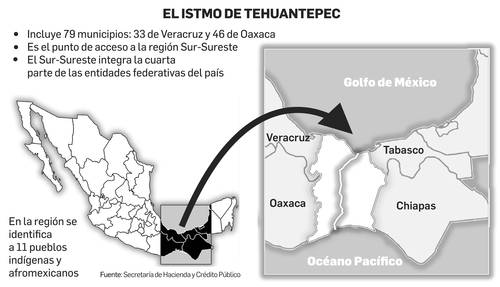
The Isthmus of Tehuantepec, showing the area affected in white in the box on the right side of the graphic. The gray streak running through the white area is for the freight train. There are 11 indigenous and Afro-Mexican peoples in that area.
By: Susana González G.
The project to create seven Special Economic Zones (SEZ) launched in the last presidential term to impel the development of Mexico’s southeast will be formally buried with a presidential decree that the legal advisors of the federal Executive now analyze. Instead, a free zone with six industrial parks will be created along the Isthmus of Tehuantepec –which connects the ports of Salina Cruz, Oaxaca, with Coatzacoalcos, Veracruz–, one of the country’s regions most lagging behind [economically].
“The future of those zones is that their disappearance is going to be decreed,” pointed out Rafael Marin Mollinedo, the one responsible for the Program for the Development of the Isthmus of Tehuantepec and for the SEZs.
Instead of the SEZs the federal government projects a free zone, along the Isthmus of Tehuantepec, with six industrial parks of 500 hectares each, with fiscal incentives similar to those granted at the northern border (where starting this year taxes were reduced and wages increased) and located on ejido lands so that their property owners will obtain permanent benefits “and won’t just be watching as progress and development happen without being included,” the official stated in an interview with La Jornada.
“It’s the same scheme of reducing the capital gains tax (income tax on corporations) and the sales tax on a 20-kilometers wide by 300-kilometers long strip around the train. That will be the free zone. We’re going to exploit the connection with the United States and Asia,” he indicated.
Since the beginning of 2019, the income tax (ISR, in Mexico) rate was reduced from 30 to 20 percent and the sales tax (IVA, in Mexico) went down from 16 to 8 percent in 43 municipalities of six states on the northern border, in addition to the fact that the minimum wage doubled from 88.36 to 176.72 pesos per day.
The Treasury Ministry is analyzing all that in the Master Plan for the Free Zone, which Marin foresees will be finished next October.
The goal is that in two years the railroad and port infrastructure on the Isthmus will be modernized, and at the same time the first industrial parks will be promoted and ready so that at the end of the six-year presidential term the bases for the six are settled, with 50 percent of the companies installed.
The bet is “to generate a whole pole of industrial, commercial and service development in a comprehensive way, but we’re going to mainly promote agribusiness to take advantage of all the zone’s raw materials,” he said, but admitted that there is no projection about investment, job creation, demand and cruise ships in the corridor and the generation of cargo that the project is expected to detonate.
The Trans-Isthmus Corridor, he said, is not new. Infrastructure has existed for the ports and the train since 1900, when Porfirio Díaz was president, but “it must be modernized and made efficient to attract the arrival of ships, so that they unload and transport their merchandise from one ocean to another.”
Rafael Marin assured that with the indigenous consulta (consultation) that the federal government held it obtained support for the Trans-Isthmus project and “a permanent dialogue was established with the indigenous communities so that they will participate, embrace it and are included. But, there will be consultations for the installation of each industrial polygon.”
Difference with the SEZs
“The fiscal incentives for the free zones will be different from the SEZs, because in the SEZs companies would not have to pay any income taxes for 10 years, but also they didn’t have such an easy scheme because they were asked for a very high investment amount of 90 million dollars for generating 500 jobs, so that only large firms would be able to access the project,” he explained.
He considered that the decrease in tax collection due to fiscal incentives in the free zone would be less than foreseen with the SEZs.
–Is all the previous work on the SEZs thrown out?
–I don’t know. We are betting on other development models, different, and we are focused on that.
He maintained that, different from the New International Airport for Mexico (NAIM, its initials in Spanish), the government of President Andrés Manuel López Obrador had not planned to eliminate the SEZs and “we explored the possibility that the zones of Salina Cruz, Oaxaca, and Coatzacoalcos, Veracruz would remain as part of the Trans-Isthmus Corridor.”
Not seven, because that’s too many and “they would pulverize” resources and efforts. He even said that representatives of the World Bank and the Inter-American Development Bank commented to him that: “that project was not going to yield results because of being so scattered and it was not advisable to open seven zones in the country at almost the same time,” besides the fact that 90 percent of the SEZs in the world have failed.
In the end, we decided to eliminate the SEZs. Marin discarded lawsuits against the federal government, maintaining that: “there is really no commitment and it wasn’t advanced enough. We have time to get out of this SEZ project. We are unraveling it. The companies made their requests and procedures, but we had not authorized any permits.”
He assured that only seven companies had advanced procedures for being installed in Coatzacoalcos, Lázaro Cárdenas, Chiapas, Yucatán and Campeche, with a joint investment of 1.5 billion dollars, but, he added, among them are included the Agro-logistical Industrial Park of the Southeast and Arcelor Mittal, which are already installed in those zones.
The land that the state governments donated will be returned to them, he added. If the states want to they can go ahead with a part of the project to attract investments, like Yucatán will do, since many of the fiscal incentives were state or municipal.
While he admitted that the disappearance of the SEZs has caused concern and criticism from business leaders and from southeast governors, Marin Mollinedo considered that: “the criticisms are few and it’s more like fussing.”
Not even in the high level meeting between entrepreneurs of the United States and Mexico, which was held two weeks ago in Merida, was the subject of the SEZs proposed, he said.
To the contrary, he said that there is not a day that he doesn’t receive in his office representatives of both national and foreign companies, like the big shipping companies, interested “in not being outside of the Trans-Isthmus project.”
Regarding the previous government’s project of forming the SEZs, three already had the creation decree (Coatzacoalcos, Lázaro Cárdenas and Puerto Chiapas), two others had been approved (Salina Cruz and Progreso) and the remaining two (Tabasco and Campeche) their decision was under review.
——————————————————–
Originally Published in Spanish by La Jornada
Wednesday, April 24, 2019
https://www.jornada.com.mx/2019/04/24/economia/018n1eco
Re-Published with English interpretation by the Chiapas Support Committee
They’ll build 3 National Guard barracks in Chiapas in areas used by migrants
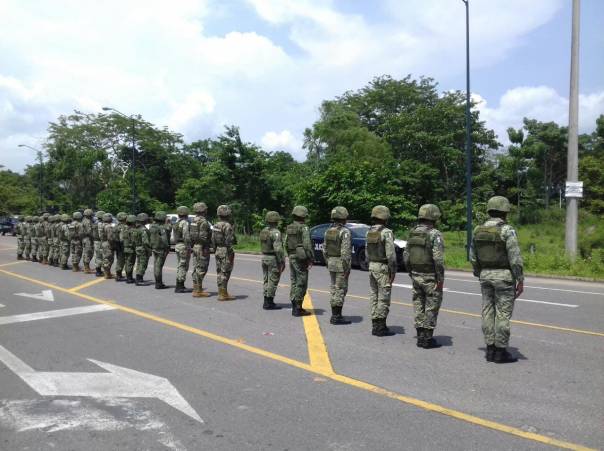
Members of the National Guard in an operation to arrest migrants at the southern border
By: Angeles Mariscal
They ask for land in the municipalities of Tonalá, Pichucalco and Palenque, located on the Coast and the Northern Zone of Chiapas.
The Chiapas government asked the local Congress for the disincorporation of 3 plots of land in order to destine them for National Guard installations, in zones where migrants pass. They will be delivered via donation, in favor of the Ministries of National Defense (SEDENA) and Navy (SEMAR), Aristegui Noticias reported.
It was last June 4 when they initiated the process for destining lands that would be used as bases for the National Guard in the municipalities of Tonalá, Pichucalco and Palenque, located on Coast and in Northern Chiapas.
Ismael Brito Mazariegos, Secretary of Government of Chiapas, made the request and it was turned over to parliamentary commissions inside the local Congress.
We’re talking about the decree initiative by which the Executive of the state of Chiapas authorizes the disincorporation of three hectares of land located in the municipality of Pichucalco, “in favor of the Federal Government destined to the Ministry of National Defense to carry out the construction of installations of the Regional Coordination of the Nacional Guard,” the note detailed.
They also asked the municipal council of Tonalá for the disincorporation of municipal land “in favor of the Ministry of the Navy for the construction of the Nacional Guard’s general barracks.” And, they asked the municipal council of Palenque for the disincorporation of municipal land and to alienate it -via a donation- “in favor of the Government of the Republic, which will destine it for construction of installations for a company of the National Guard.” Management of the lands will be resolved soon.
In the context of this act, the agreements that the governments of Mexico and the United States reached were to contain the migratory flow and to send 6,000 members of the National Guard to the state of Chiapas; this after President Donald Trump’s threats to impose tariffs on Mexican products if actions to stop thousands of migrants that attempt to reach the United States are not carried out.
The immigration policy of the Andrés Manuel López Obrador government of containing immigration on the southern border via militarization of the travel routes and the authority that was given to members of the National Guardia to do the work of immigration agents, have been questioned by civil society organizations and academics that see in it the risk of human rights violations of the migrant population, and the subordination of [Mexican] institutions to the economic agenda and interests of the United States.
—————————————————-
Originally Published in Spanish by Chiapas Paralelo
Sunday, June 9, 2019
Re-Published with English interpretation by the Chiapas Support Committee
Chiapas: they kill an ecologist and threaten his family members
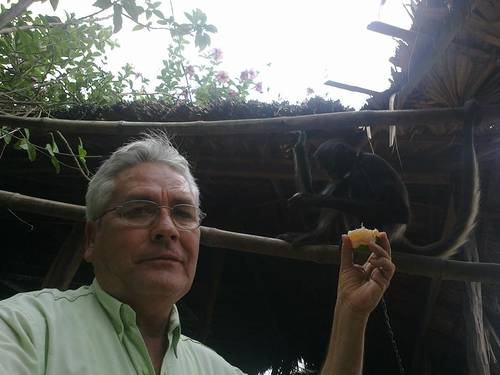
The Tabasco activist José Luis Álvarez Flores, defender of the environment and promoter of the conservation of primates, was killed and his body found Monday on a road in the municipality of Palenque, Chiapas. The photo was taken from his Facebook account.
By: René Alberto López
Villahermosa, Tabasco
Gunmen murdered with five bullets –one of them in the face– the environmentalist José Luis Álvarez Flores, 64, whose body was found Monday in the ejido Calatrava, municipality of Palenque, Chiapas, on a road that leads to Emiliano Zapata, Tabasco, Francisco Ricardez Olivares, director of public security of the first location, reported
A native of Emiliano Zapata and known as a defender of the environment and the conservation of primates, Álvarez Flores had denounced the illicit removal of sand from the Usumacinta River, which crosses through both states.
Police in Emiliano Zapata reported that the homicide was perpetrated at 12:25 pm on Monday. The murderers left a message at the side of the cadaver, in which they threaten the victim’s family members.
Personnel from the Chiapas and Tabasco prosecutors’ offices went to start the investigations, although at the close of this edition no one had given an official version of what occurred.
Locals narrated that the activist directed the Management Unit for the Use and Conservation of Wildlife (Uma, its Spanish acronym) of the howler monkey (monkey that lives in the zone and which he seeks to protect from being run over on the road).
The Ministry of Environment and Natural Resources created the Umas in 1997 as spaces for the conservation of wild life.
The Uma for howler monkeys is the first one for primates in Mexico and was created to protect one of the most studied monkeys of America. It encompasses 345 hectares of rancho Las Vegas, in the locality of Chablé, municipality of Emiliano Zapata, at kilometer 3.2 of the Chablé-La Guayaba highway.
Durante the inauguration of the space, Álvarez Flores affirmed that this Uma would be “a place where we would be able to see the majority of the animals and birds of the wildlife that exist in the southeast of Mexico.”
The promoters of this Uma point out that more than one hundred black howler monkeys and specimens of the tiger heron live in that unit. The authorized management plan includes the conservation and eventual use of the green iguana.
———————————————————–
Originally Published in Spanish by La Jornada
Wednesday, June 12, 2019
https://www.jornada.com.mx/2019/06/12/estados/028n1est#
Re-Published with English interpretation by the Chiapas Support Committee
 Chiapas Support Committee