Chiapas Support Committee
Home of the Compañero Manuel blog on zapatistas & mexico
Conservatism and the anticapitalist left

Maya Train | Tren Maya
By: Gilberto López y Rivas
Given the repeated use of the terms “conservative” or “conservatism” to identify the anticapitalist left, branded as “radical” by opinion writers that boldly defend the current government, it’s necessary specify their multiple meanings, which today refer, in the ambit of politics, to the positions and organizations of the right or the extreme right, supporters of the status quo and enemies of all revolutionary transformation, especially, of a Marxist or socialist character.
Historically, opposition to the French revolution and the Enlightenment, which fought for the restoration of the old regime, gives rise to the use of “conservative” and “conservatism” for identifying this socio-political sector, with peculiarities in different geographical-temporal contexts. In Latin America, starting with the independence movements, conservatism or conservative parties, were usually characterized by nostalgia for the colonial regime, maintenance of rigid hierarchical systems of class and cast and the extreme defense of the properties, authorities and canonry of the Church and the Army.
Thus, it is a contradiction, both historical and conceptual, to seek to pretender classify the anticapitalist left as conservative, when in reality it constitutes its antipode. We are facing the classic Manichaeism of constructing an adversary so that, in reference to the government of the Fourth Transformation (4T), without evidence or arguments, it equates the anticapitalist opposition with that of the old PRI and PAN party structure, holding that the left hides (sic) “behind its radicalism, goals similar to conservatism.”
The problem lies, jointly with these conceptual “licenses” and Manichaeism, in the absence of an in-depth analysis about the nature of the changes that are occurring in the first months of the current government that, according to the 4T legal counsel, represent a rupture with neoliberal policies. As the EZLN and the National Indigenous Congress-Indigenous Government Council (Congreso Nacional Indígena–Concejo Indígena de Gobierno) have reiterated, the megaprojects underway, the so-called Maya Train, the dry canal on the Isthmus of Tehuantepec (with its railroad lines for containers, industrial corridors, real estate and tourist development, and the certain ethnocide and ecocide damages), the Morelos Integral Project (with the opening of obsolete hydroelectric plants and gas pipelines, and marked with the death of Samir Flores Soberanes and the criminalization of opponents),the new metropolitan airport in military hands, the permanence of mining concessions that cover at least one third of the national territory, etcetera, not only do they represent a line of continuity with the neoliberal policies of past six-year term, but even go beyond what these governments imposed as managers at the service of capitalist corporations. We recall that the Tehuantepec dry canal, with its development plans for the Central American nations was the famous Plan Puebla Panamá, re-baptized the Mesoamerica [project], and that the Morelos Integral Project was also taken from the trunk of previous administrations.
Neoliberalism is characterized, precisely, for wanting the State to act as an efficient mechanism of intermediation that facilitates the process of re-colonization of territories and, in this direction, the fight against corruption and the thinning of government structures, although always positive in the terrain of the national imaginary of indignation given the impunity of the ruling class in the looting of the treasury, paradoxically constitute a factor in favor of Mexico among the national states in competition for a position in the expedited and effective implementation of the neoliberal projects, like those undertaken by the 4T.
The anticapitalist left (yes, radical, but not as a disqualifying adjective, but rather for its analysis that gets to the root of the problems caused by the systems of exploitation and domination of the current phase of necrophile militarized accumulation) does not yearn for the previous governments, which it fought and resisted for decades, at the expense of human lives and suffering that make Mexico one of the worst humanitarian catastrophes on the planet. This left does not seek the human face of capitalism nor does it aspire to be the beneficiary of client and corporate programs that individualize and fragment the communities. On the contrary, it pronounces in favor of the strengthening of its autonomous processes of defense of Mother Nature and her vital resources, in favor of critical (not conformist) thought, with the awareness that it again faces a bad government that insists on declaring war on the original peoples, while validating supposed constitutional recognition of self-determination.
———————————————————–
Originally Published in Spanish by La Jornada
Friday, August 23, 2019
https://www.jornada.com.mx/2019/08/23/opinion/018a1pol
Re-Published with English interpretation by the Chiapas Support Committee
They broke the siege and extended their autonomous territory!

Zapatista community life.
By: Gilberto López y Rivas
On August 17, 2019, the insurgent subcomandante Moisés, spokesman of the Zapatista Army of National Liberation (EZLN), published a historic communique in which this organization is accountable to the CNI-CIG, its spokeswoman, organizations, collective groups and people from Mexico and the world, “who care about the Zapatista peoples and continue with their hearts beating next to ours”.
In this document -ignored, minimized or misrepresented by the mainstream media and the political class as usual – it is recalled that three years ago, the peoples organized in the National Indigenous Congress, together with the EZLN, faced with recolonization and the humanitarian catastrophe of capitalist corporations and bad governments, pledged to go on the offensive in defense of territory and Mother Earth, and to spread the word and action of resistance and rebellion.
In fulfillment of the committed word, an ethical practice that characterizes the Zapatistas, he communicates that, like the CNI-CIG, the EZLN “went on the offensive in its fight for the word, the idea and the organization,” announcing extraordinary news for the emancipatory movements in the planetary sphere: the rupture of the counter-insurgency siege and the establishment of “new caracoles and more autonomous Zapatista rebel municipalities, in new areas of the Mexican southeast.”
These new rebel self-governments do not constitute a coup or media shows such as those frequently observed in the honorable Congress of the Union or in presidential morning press conferences, but the product of “years of silent work, despite the siege, despite the campaigns of lies, in spite of the defamations, in spite of the military patrols, in spite of the National Guard, in spite of the counterinsurgency campaigns disguised as social programs, in spite of the oblivion and contempt (…) Although slowly, as it should be according to their name, the five original caracoles were reproduced after 15 years of political and organizational work; the MAREZ (Municipios Autónomos Rebeldes Zapatistas) and their Good Government Juntas also had to raise and watch them grow. Now there will be 12 caracoles with Good Government Juntas.”
With this transcendent step, the Zapatista Mayas endorse the essential principle of the autonomous strategy: “We knew and we know that our freedom will only be the work of ourselves, the original peoples”, and, in that direction, they identify as a crucial factor in this exponential growth the political organizational work and the example of women, men, children and elderly Zapatista support bases, in an outstanding way, of the women and young Zapatistas. In the other equidistant pole of the passive subject who receives individualized and clientelist governmental help, in the Zapatista experience: The compañeras of all ages mobilized to talk with other sisters with or without organization. The young Zapatistas, without abandoning their wishes and desires, learned about science and the arts, and spread it to more and more young people. Thus, the EZLN can affirm, without sorrow and with pride, that the Zapatista women not only go forward to, like the Pujuy bird, mark the way for us and not get lost; they also go on the sides so that we do not deviate; and in the back so we don’t delay.
In their communique they ratify the critical position against the policy of the Fourth Transformation, which they describe as destructive of the community and nature, and point out that: “traditionally partisan communities have been hurt by the contempt, racism and voracity of the current government, and have gone into open or hidden rebellion. The one who thought that, with his counterinsurgency alms policy, he would divide Zapatismo and buy the loyalty of non-Zapatistas, encouraging confrontation and discouragement, actually gave the missing arguments to convince those brothers and sisters that the land and nature must be defended. The bad government thought and thinks that what people expect and need are monetary alms.
This prolonged process of reflection and search, with thousands of community assemblies, in which politicized and motivated autonomous subjects are forged in “govern by obeying” (mandar obedeciendo), is really constituted in a transformation of revolutionary scopes to which, again, without avant-garde or hegemonism, the Zapatista Mayas summon us with their example. Let Caracoles and Autonomous Resistance Centers sprout throughout the national and world geography!, with autonomous processes from below and to the left, anti-capitalist and anti-patriarchal, to make possible, in our realities, that concrete utopia built by the Zapatista brothers and sisters. It is time to break our sieges, to be another of the mallets that will tear down the walls, of the many winds that will sweep the earth, another of the many seeds from which other worlds will be born!
———————————————————–
Originally Published in Spanish by La Jornada
Friday, September 13, 2019
https://www.jornada.com.mx/2019/09/13/opinion/020a2pol
Re-Published with English interpretation by the Chiapas Support Committee
INVITATION TO THE SECOND INTERNATIONAL GATHERING OF WOMEN WHO STRUGGLE
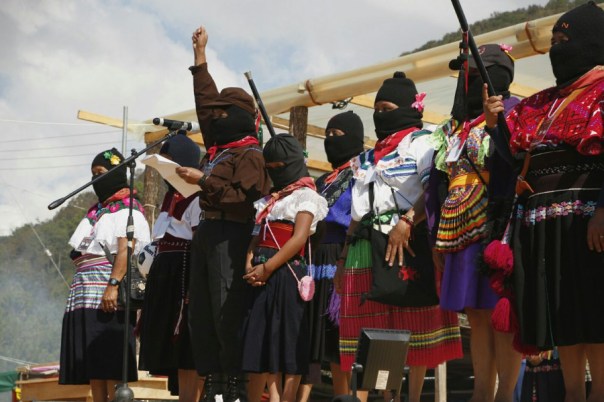
ZAPATISTA NATIONAL LIBERATION ARMY
MEXICO
September 2019
To women who struggle all over the world:
Sister, compañera, woman in struggle:
We send you greetings, from the indigenous and Zapatista women that we are.
Perhaps you remember that at our First Gathering, we made an agreement that we must live. We see of course that the killing and disappearance of women continues—of women of all ages and social positions. We are killed and disappeared because we are women, and then told it is our fault, and that these things happen because of how we were dressed, because of where we were walking, because we were out at certain hours in certain places. Both men and women in the bad government utter such stupidities to imply that we shouldn’t go out at all. According to this mindset, women should be shut up in their homes; they shouldn’t go out, shouldn’t study, shouldn’t work, shouldn’t enjoy themselves and shouldn’t be free.
We see clearly that the capitalist and patriarchal system is like a judge that has declared us guilty of being born women and sentenced us to violence, death, or disappearance.
It’s hard to put it into words, sister and compañeras, it’s like an evil so great that it can’t be named. Now they call it “femicide” or whatever but the name doesn’t change anything, the deaths and disappearances continue to accumulate. And then our families, friends, and acquaintances have to fight so that we are not effectively killed and disappeared all over again when our murderers go unpunished, or when it is said that we were merely victims of bad luck; or worse, that we were asking for it.
Sister, compañera, this is extreme stupidity. We fight against discrimination at home, in the street, at school, at work, on public transportation, against both those people we know and those who are strangers, and on top of that they want to tell us we’re asking for it, that we are at fault for dying. No, we aren’t dying, we are being raped, murdered, cut up, and disappeared. Anybody who faults us is sexist, and even women can demonstrate sexist thinking.
-*-
Compañera, sister, given that at the First Gathering we made an agreement to live, now we have to evaluate what we have done or not done to honor this agreement.
Thus we are calling for a Second International Encounter of Women Who Struggle, focused on one theme only: violence against women. We want to address this theme in two parts: to denounce the violence and to discuss what we are going to do to stop the massacre. So we invite you sister, compañera, to come meet with us so that we may together express our rage and state clearly what is happening to us all over the world.
We think this is important because we see that they try to scatter our pain: they talk about a woman raped somewhere, a woman beaten somewhere else, a woman disappeared over there, a woman murdered over here. They do that so that we think this is the problem of some woman somewhere out there, but that such a thing wouldn’t happen to us, that the problem isn’t that serious and that the bad governments will handle it.
But that’s not true—it will happen to us or to someone close to us, and it is a serious problem, very serious, and the bad governments are not going to do anything other than make declarations and insist that they are going to find the culprits. But by culprits they don’t mean the murderers, rapists, or kidnappers; they mean the women who break windows or graffiti statues out of rage.
That’s how the patriarchal capitalist system works, sister, compañera: a piece of glass or a wall with graffiti are more important than the life of a woman. This simply cannot continue.
We want to tell you about a time, years ago, before our uprising and the beginning of the war against oblivion, when here on the plantations a chicken was worth more than a woman. Hard to believe? Well that’s how it was, that’s what the plantation owners themselves used to say. Now, shocked and scandalized by a broken window and a graffitied wall, they say even worse things about us women. The truth is that not only are we raped, killed, and disappeared—that’s true—but also that we are not going to be quiet, obedient, and well-behaved as if nothing is wrong.
We are attacked so consistently that it would seem to be good business for the system: the more women murdered, raped, beaten, or disappeared, the more profit produced. Maybe that’s why they don’t stop the war on women. There is no other way to explain that every day more women are killed or disappeared all over the world and the system just calmly and happily marches on, paying attention only to its bank accounts.
Could it be that if we live, that if we are not abused and brutalized, that business goes down the drain? It seems like we need to analyze if profits for big capitalists increase with the number of brutalized women in the world, if the number of beaten, disappeared, and murdered women comes out about even to their millions of dollars or euros or whatever currency. We say this because we know very well that the system only cares about whatever affects its profit margin. We also know that the system profits off war and destruction. So we think that our deaths, the violence we suffer, are profitable for the capitalist, and that our lives, our freedom, and our serenity come out as monetary losses for the system.
So we want you to come and make your denunciation, not for a judge or a police officer or a journalist, but so that you may be heard by another woman, by other women, by many women who struggle. That is how, compañera, sister, your pain will not be yours alone but will unite with other suffering, and from that suffering comes not only a very big and deep pain, but also a rage that serves as a seed. If that seed is cultivated with organization, then pain and rage can turn into resistance and rebellion, as we say around here, with which we stop waiting to see if we’re going to be personally affected and we start to do something, first to stop the violence against us, and then to win our freedom as women.
That is our experience and our history as women, as peasant women, as indigenous women, and as Zapatistas. Nobody is going to give us peace, freedom, and justice. We have to fight, sister and compañera, fight for and wrest our freedom from the ultimate Ruler.
That is why we say this focus on violence against women is not only to denounce it, but also to say what we are doing, what we have done, and what we can do to stop these crimes.
We know that as women we have many ways and forms of struggle, because we saw and heard you in the First Gathering. We know that some think their way is best, and that other ways are useless or wrong. It’s fine to debate these things, even without coming to any agreement.
But the problem that we as Zapatista women see is that in order to discuss and debate who’s more feminist than who, well we have to be alive. And the reality is that we’re being killed and disappeared.
So the invitation to this gathering is based on one theme alone: violence against women, divided into two parts, denunciation and proposals for how to stop this war against us. It’s not that we’re going to come to an agreement to all struggle the same way; we know everyone has their own ways, calendars and geographies. But listening to different forms of struggle can give us ideas for how to shape our own struggles, according to what we see works for us and what doesn’t.
The system would prefer that we limit ourselves to screaming our pain, desperation, anxiety, and impotence. It’s time to scream together, but now out of rage and indignation. And not each of us on our own, scattered and alone which is how they rape, kill, and disappear us, but together, from our own times, places, and ways.
What if, compañera and sister, we learn not only to scream out of pain, but to find the way, place, and time to scream a new world into being? Just think, sister and compañera, things are so bad that in order to stay alive we have to create another world. That’s how bad the system actually is, that in order to live we have to kill it off—not fix it up a little, or give it a new face, or ask that it be a little more considerate and not so mean. No. We have to destroy it, disappear it, kill it until there is nothing left, not even ashes. That’s how we see the situation, compañera and sister, it’s either the system or us. And it was the system that made those rules, not us.
We invite you to arrive to this gathering on December 26, 2019, and stay December 27, 28, and 29 of 2019, with the closing on the 29th.
The gathering will be held at the Semillero that we are going to call “The Footprints of Comandanta Ramona,” in the Caracol “Whirlwind of Our Words” in the Tztoz Choj zone (community of Morelia, Autonomous Zapatista Municipality in Rebellion [MAREZ] of 17 de Noviembre). This is the same place where we held the First Gathering.
You can arrive directly to the caracol where you will receive nametags and the program schedule and where the compañeras who are drivers will take you to the actual semillero where no men are allowed, even if they are good men or normal men or whatever men. By that we mean that men will not be able to see, even from afar, our gathering, because the semillero is surrounded by mountains.
Men may wait in the Caracol during our gathering, but only if they are accompanied by a woman who answers for them and who is responsible and accountable for any foolishness they commit. We’re going to call that place «mixed.» In other words, people who call themselves men and women can all be there. It just might be the case that a commission of Zapatista women attending the gathering in the semillero go to the caracol to talk to the men about what is being denounced at the gathering, so they know what’s going on. And assuming they have any conscience at all those men will go tell other men what was said, most importantly the key thing, which is that we’re not going to wait for them to understand or to behave or to stop fucking up, but that we’re going to organize to defend ourselves first, and then we’re going to change everything. And we mean EVERYTHING.
One more thing, compañera and sister, we’re also going to be reviewing what we didn’t do well in the First Gathering. That’s why we want to hold this one in the same place, to see if we can correct our errors.
Another thing we realized from the First Gathering is that in the registration and programming process there was some favoritism toward the submissions that were most in line with the thinking of those helping out with registration and programming, and that some women and activities were left out. That happened because those working on registration and programming prioritized the activities of those who thought the same way as them and then there wasn’t time or room for the others.
So that this doesn’t happen again, that some women are valued more than others, we Zapatista indigenous women are going to do everything ourselves, including the registration and programming. We’ve never done it before, but then again, we had never been drivers either and as you can see now we’ve learned how to do that. So we might mess up and the program might not work out perfectly, but that will be because we are learning and not because we like the women who think like us more than the others.
We are now organizing and distributing tasks so that we ourselves are organizing the gathering in its entirety. So when you send your registration email (we’ll tell you later where and when to send it), you’ll know that it is we as Zapatista indigenous women who are going to open your email and write down your name and your organization, or your group or collective if you have one, or just you as an individual, and we will send you a response so that you know we have you on the list. If your email says you want to do something at the gathering, we’ll put that on the program. That’s why we want to ask you to send your registration in Spanish, because our languages are of Mayan roots and while we know some Spanish we don’t speak other languages. If we mess up and don’t get your name down, don’t worry because you can register when you get here and we’ll give you your nametag for the Second International Gathering of Women Who Struggle.
Alright now you know the date and the place, and you can go about organizing yourselves to come or to send someone or to put someone in charge of reporting back to you what happened and what we said. Then even if you are far away, you’ll know that our duty as women who struggle is to not let that little light that we gave you go out. You’ll know that that little flame isn’t just for light, but to burn down the whole damned patriarchal capitalist system.
That’s all for now, sister and compañera. Later we’ll let you know when and where to send your registration email. For now you have the most important information: December 26, 27, 28, and 29, 2019, at the same place as the First Gathering, the very same place from which we write you these words and send you our embrace. That is…
From the mountains of the Mexican Southeast,
Coordinators of the Zapatista Women for the Second International Gathering of Women Who Struggle
Selva-Fronteriza Zone:
Marisol , Yeni, Mirella, Neri, Yojari, Arlen , Erica, Mariana, Mayder, Cleyde, Evelin, Alejandra and Nayeli
Chiapas Highlands Zone:
Yessica , Zenaida, Lucía, Teresa, Fabiola, Flor, Gabriela, Lidia, Fernanda, Carla and Ofelia
Selva Tzeltal Zone:
Dalia , Rosalinda, Marina, Carolina, Alejandra, Laura, Ana, Cecilia, Julia, Estefanía, Olga and Eloisa
Tsots Choj Zone:
Gabriela, Elizabeth I, Maydelí I, Elizabeth II, Guadalupe , Leydi, Lauriana, Aliz, Ángeles, Maydelí II, Jhanilet , Fabiola, Mariela, Daniela, Yadira, Yolanda, Marbella, Elena and Elissa
Chiapas Northern Zone:
Diana , Ximena , Kelsy, Jessica, Ana María, Marina, Valentina, Yadira and Elizabeth
Mexico, September 2019
Film screening: “The Wanted 18”
FILM, SPEAKER, POPCORN
SUNDAY, SEPTEMBER 29, 2019 – 5:30 – 8:00 pm
OMNI COMMONS, 4799 SHATTUCK AVE., OAKLAND CA 94609

Through a clever mix of stop motion animation and interviews, “The Wanted 18” recreates an astonishing true story: the Israeli army’s pursuit of 18 cows, whose independent milk production on a Palestinian collective farm was declared “a threat to the national security of the state of Israel.” In response to the Israeli occupation of the West Bank, a group of people from the town of Beit Sahour decide to buy 18 cows and produce their own milk as a co-operative. Their venture is so successful that the collective farm becomes a landmark, and the cows local celebrities- until the Israeli army takes note and declares that the farm is an illegal security threat. Consequently, the dairy is forced to go underground, the cows continuing to produce their “Intifada milk” with the Israeli army in relentless pursuit. Recreating the story of the “wanted 18” from the perspectives of the Beit Sahour activists, Israeli military officials, and the cows, Palestinian artist Amer Shomali and veteran Canadian director Paul Cowan create an enchanting, inspirational tribute to the ingenuity and power of grassroots activism.
Speaker: Palestinian activist Leena Dallasheh has been active in the struggle for freedom and justice in Palestine for many years. She will share her experience in this struggle and also thoughts about her time in the Zapatista Caracol of Oventik this summer. Ms. Dallasheh will also share some thoughts about common challenges indigenous peoples experience in both places, commonalities between the Zapatista and Palestinian struggles and the potential for solidarity work between the two.
Members of the Chiapas Support Committee will present information on the recent major expansion of Zapatista autonomy.
All proceeds from this event support the Zapatista communities.
Contact information: Chiapas Support Committee – enapoyo1994@yahoo.com
The Zapatistas announce a gathering of women who struggle
THE EZLN CONVOKES A GATHERING IN DEFENSE OF WOMEN

By; Elio Henríquez
San Cristóbal De Las Casas, Chiapas
The Zapatista National Liberation Army (Ejército Zapatista de Liberación Nacional, EZLN) convoked the second International Gathering of Women who Struggle, to be held December 26 to 29 in the Caracol located in the ejido Morelia, autonomous municipality of November 17.
In a communiqué signed by the Zapatista women coordinators of the gathering, it said that only one theme will be addressed: Violence against women, in two parts: “One of denunciation and the other about what we’re going to do to stop that massacre that they are doing to us.”
It added: “the killing and disappearance of women continues, of all ages and of all social conditions. They murder and disappear us because we are women.”
It remarked: “The truth is not only that they are raping, murdering and disappearing us; that’s so, but the truth also is that we are not going to stay as if nothing is happening, well behaved and obedient. They attack us so much that it even seems like it’s a business of the system. If there are more women murdered or disappeared or raped, then there are more profits. Maybe that’s why this war against women doesn’t stop.”
Therefore, it added, “it would also be necessary to analyze if, at the same time that the number of women raped in the world goes up, the profits of the big capitalists also go up. So many beaten, so many disappeared, so many murdered, equal to so many millions of dollars or euros.”
The coordinators of the gathering recalled that: “some years ago, before our uprising and the start of the war against oblivion, here on the fincas (estates) a chicken was worth more than the life of an indigenous person. You don’t think so? Well yes, that’s what the finqueros (estate owners) said. Now they are saying worse things about women, because they whimper and are scandalized by a glass and a spot that tells the truth.”
They warned that: “nobody is going to obtain peace, freedom, or justice for us,” rather “we have to struggle. That’s why the invitation is not only to denounce, but also to say what is done or what was done or what can be done to stop those crimes.”
———————————————————–
Originally Published in Spanish by La Jornada
Friday, September 20, 2019
https://www.jornada.com.mx/2019/09/20/politica/014n1pol
Re-Published with English interpretation by the Chiapas Support Committee
From the Notebook of the Cat-Dog:
Preparations for the Puy Ta Cuxlejaltic Film Festival, a CompArte Focused on Dance, and the Second International Gathering of Women who Struggle
Twenty-six years ago, in 1993, the Zapatista women wrote the “Women’s Revolutionary Law.” In one of the articles of the law, they declared they had a right to study… “and even to be drivers,” as noted by SupMarcos in a public letter commemorating the anniversary of the law and the role of the late Comandanta Ramona and Comandanta Susana in the creation of the women’s law. Maybe someday we’ll learn why the indigenous Zapatista Women aspired to be drivers. But for now, the EZLN’s Sixth Commission presents an exclusive preview of the documentaries to be premiered by the Terci@s Compas [Zapatista media] on a still to-be-determined date. Here goes:
Title: “…And Even of being Drivers”
A documentary filmed entirely in the mountains of Southeastern Mexico in 2019. Written, directed, and produced by Zapatista women, this documentary compiles scenes of Zapatista compañeras learning to drive. Duration: undetermined. Format: unknown. Rating: Z (as it should be). It won’t come out on Netflix, nor on Amazon Prime, nor on Apple TV, nor on HBO, nor Fox, nor…what are the other options? Well, not on any of those either. Nor will it be shown in theaters. It will be shown exclusively in the Zapatista Caracoles… Oh, also at the Second International Gathering for Women in Struggle? Should I include that? Got it. But without any date or location? Okay. But people are going to complain that I’m leaving them hanging. Couldn’t we at least give them a hint, like a road sign? No, not for the actual road, I mean like an idea of potentially when and where… in December? Of this year? Hello? Helloooooo? Feeling low? Huh, well it looks like they left, but I can tell you they don’t look low at all… in fact they had a glint in their eye, in their gaze, like a goal, or a challenge—a rebellion, really. A Zapatista glint, that is.
Disclaimer: no men were hurt in the production of this documentary. Well actually there were, but only in the form of a few blows to the ego. Oh, and also a few who fell as they were running away from a compañera who got pissed because they were yelling stuff at the women learning to drive… no, it wasn’t me, I was watching from a ways away, I wasn’t going to find myself in the vicinity of that piece of lead pipe she was carrying… yee-haw…
Apocalyptic Synopsis: A virus produced in the laboratories of the Illuminati is released in the mountains of Southeastern Mexico. For some strange reason, it only affects those law-breakers who call themselves Zapatista women. The virus causes them to do strange and illogical things—they rebel, they resist, and they take over jobs and responsibilities that should be the exclusive domain of men. This documentary compiles evidence of this insubordination, and you can see exactly how the Zapatista women consider themselves not only to be free but also—you’re not going to believe this—even to be drivers. Didn’t I tell you? Nobody has any values anymore.
“No Happy Ending” Synopsis: A group of indigenous Zapatista women cry “Enough!”, rebelling and declaring their desire to be free and even to be drivers. A group of brave and daring party-affiliated men decide to challenge them, mocking and threatening them, demanding they go back to the kitchen and dedicate themselves to raising children. Those transgressors of patriarchal (and transit) law confront the men. The men lose, the women win. That’s it. Sigh. That’s why I said there’s no happy ending.
“And They Kept At It” Synopsis: (from an unpublished interview with one of the experienced men drivers teaching the driving lessons): The compañeros giving the driving lessons had said that they were only going to teach the women to drive the small Nissan pickups most common in their communities, but the compañeras said no way, that wasn’t enough, that they wanted to learn the mechanical aspects, too. So mechanics lessons it was. So far so good. The real scandal broke out when they said that they also wanted to learn to drive the “Guardián” and the “Guardiana,” which are 6-ton trucks—monster trucks the compañeras call them. And there’s where you’re really in for it, as the defunct [SupMarcos] would say, because not just anybody can drive a 6-ton truck. Even the compañero drivers have to battle with anything over a 3-ton truck, those things are no toys. But we thought, okay, fine, let them learn to start the thing up and that’ll be sufficient. But it wasn’t; the women insisted on learning not only to drive but to perform maintenance on the 6-ton trucks. They wouldn’t settle for less. Now they want to learn to drive logging trucks that can carry whole tree trunks. Where are we going to get one of those? That’s way out of our league. And what if then they decide they want to drive semi-trucks and trailers? (…) I mean it’s true those trucks would be helpful to bring supplies into the caracoles—that’s where they’re going to hold the film festival, they said, as well as the women’s gathering. They also said they’re going to hold a CompArte especially for dance and for dancing. Oh no, not me. I only know how to dance the moño colorado [a cumbia], but other than that, especially those dances where they jump around like deer or hang from big pieces of fabric, forget it. Those people can tell you a whole story, all through dance. Nah, I don’t know how to zapatear either. Only in the mud, really, and even then only when there’s a flat tire and no other choice, you gotta get out and zapatear. Yeah, the Tercias women were there too, making a film about the women drivers. The Tercias were telling the women drivers that they had to make jokes or something so that the film didn’t turn out sad, because rebellion is joyful. The Tercias were trying to get the women to pretend to crash into things and that kind of thing. What’s that? Oh, well no, the part where the compañera ran us off the road wasn’t part of the joke, I think she was tired of our jokes and that’s why she about ran over us. We all ran, not away from the car but because we saw the look in the eye of the compañera who was driving and we knew she was pissed, but strangely, also smiling. The compañeras are very “other.”
“Fucking Men” Synopsis: It turns out that during the second round of driving lessons, the compañeras said that when they practice with the community vehicles in their towns, the party-affiliated men mock them and yell stuff at them. So they told us that we men who were teaching them to drive were going to have to do the same, yell and make fun of them, with the idea that the women would also be training themselves to handle that. That is, we were acting, at least that’s how Teresa and the Cochiloco explained it to us.
(Note: the writer is referring to the actress Dolores Heredia and the actor Joaquín Cosío and their respective roles in Capadocia and El Infierno. Zapatistas refer to actors and actresses in films by their character names, not their real names. In the first film festival in November of 2018, Teresa and Cochiloco each took time to talk privately with the insurgentas and insurgentes, while stuffing themselves with tuluc tamales. They answered all the questions they were asked. What the women talked about with Teresa only the women know. What we do know is that they finished off the tamales completely, they didn’t even leave me a single one. End of note.)
Anyway, so that’s what Teresa and Cochiloco were explaining to us, how acting works—that it’s not real but you have to pretend that it is. So that’s what we did. Some of the compas even acted like they were drunk, but it was all an act. But when that compañera came out with a piece of pipe, that wasn’t acting, we ran for real, because what if the compañera forgets it’s not for real and that we’re compañeros and she let’s us have it. I had told them to just use a piece of cardboard or a rolled-up magazine but what did they do? Grabbed a lead pipe. And that thing hurts. What? Well they looked pretty happy to me, like they realized they could do it—drive that is—not just talk about it but really do it in practice. Now, the problem is going to be in their towns. Imagine when the supply truck pulls up to the community driven by a woman. Just picture it! The party-affiliated guys are going to have to eat their words and the compañeras can finally yell at them, “fucking men!” What? No, we’re compañeros, those other guys are fucking men. It’s not the same thing.
“Infiltration” Synopsis: Don’t write this down, but the men who were teaching the women to drive, well, we were feeling a little down because we had taught them to change the oil filter. And one compañera, in her traditional skirt and everything, did it really quickly. Then we teachers had to go change the filter on a truck that belonged to the Junta [Good Government Council]. Sonofa… there were 6 of us, half an hour later and we still couldn’t figure it out. We were about to go ask the compañeras for help. Thank god we didn’t have to in the end, imagine the embarrassment. I hope that part doesn’t make it into the film the Tercias are making.
-*-
-*-
A few reviews from professional critics:
“We macho men lost again, oh well. We’ll be back, even if there are fewer of us each time. If yesterday there were thousands of us, today we are a motley contingent trying to avoid the unavoidable.” SubMarcos (from 6 feet underground), from the culture section of the unpublished magazine, “Bitter Pozol.”
“All is not lost. We’re still holding out hope that the Tercias compañeras won’t finish the documentary in time for the second film festival Puy Ta Cuxlejaltic. What would Pedro Infante and José Alfredo Jiménez say?! Not to mention the deceased SupMarcos. My god, what an embarrassment.” SubGaleano in the section “Popcorn lovers of the world, unite!” from the exclusive film critic magazine, “I’ve Already Seen That One.”
I bear witness.
The Cat-Dog at the wheel… which one was the brake and which one the accelerator? Oops! Run!
A little while later…
Insurgenta Erika: “Compañero Subcomandante Insurgente Moisés, there is a report that the Guardian and the Guardiana crashed into each other; no one knows who crashed them, but it looks like the Guardiana hit the Guardián and put a hefty dent in his defenses.”
SubMoy: “Where is SubGaleano?”
Erika: “He ran off with the Cat-Dog. I think it was them because I saw in their eyes that they were guilty of something.”
Meanwhile, at the top of the Ceiba tree…
El SupGaleano to the Cat-Dog: “I told you to put it in neutral first. Man. Now all we need is for it to rain, and we’ll really be screwed.
The Cat-Dog to SupGaleano: “Woof, meow, grrrr.”
And it began to rain, hard, as if the clouds were yelling at the Earth:
Wake up!
From the mountains of the Mexican Southeast, Chiapas, Mexico, Latin America, World, in September of 2019, and yes, it’s raining.
The Isthmus is ours

The Isthmus of Tehuantepec
By: Raúl Romero*
The road from Coatzacoalcos, Veracruz, to Juchitán, Oaxaca, is a true postcard of the “capitalist war:” the imposing oil wells are the prelude to the wind parks and their gigantic mills. At different points on the road, immigration agents and the National Guard stop automobiles and buses in search of migrants. The scenario becomes more dramatic when one finds out that clandestine graves with human bodies have been discovered in the surrounding area.
Now in Juchitán, the cultural wealth of the Binnizá people (people that come from the clouds) contrasts with the dozens of homes destroyed as a result of the 2017 earthquakes that are still observed. In that region of the country where reconstruction has not been finished, there is already talk of the destruction that will sharpen with the Interoceanic Corridor on the Isthmus of Tehuantepec.
The Isthmus of Tehuantepec, which crosses from Oaxaca to Veracruz and unites by land in just 200 kilometers the Pacific Ocean with the Atlantic, is a strategic territory. Its importance reaches global dimensions: it is the gateway to what Pablo Neruda called “the waist of America.”
In the 19th Century, Great Britain and the United States attempted to take control of that part of the national territory, history that can be traced through the treaties of La Mesilla, Clayton-Bulwer and McLane-Ocampo. In the 20th Century and what goes of the 21st, as Luis Hernández Navarro has well documented in these same pages, presidents Gustavo Díaz Ordaz, Luis Echeverría, José López Portillo, Miguel de la Madrid, Ernesto Zedillo, Vicente Fox and Felipe Calderón tried to reactivate the project in different ways. Now, Andrés Manuel López Obrador takes up the initiative and promises a difference: there will be exploitation and dispossession, but without corruption from the government.
In the 2019-2024 Plan National Development Plan it defines the Maya Train, the Trans-Isthmus and the free zone on the northern border as: “regional development projects that act as ‘curtains’ for capturing the migratory flow in their transit toward the north.” In other words, the much longed for wall of Donald Trump.
Meanwhile, in the decree with which legal certainty is given to the Trans-Isthmus, only the ports of Coatzacoalcos, Veracruz, and Salina Cruz, in Oaxaca, as well as the railway connection between them are indicated. Nothing is mentioned about the businesses that the corridor will serve: agribusiness, manufacturing, real estate, mining, the expansion of wind farms and the modernization of a gas pipeline, nor about the Ixtepec airport and the Trans-Isthmus Highway. Nor is there any news about the environmental impacts of the entire project.
For the United States, the Trans-Isthmus Corridor is not only a migrant containment curtain: it is, also a trade route that reinforces the Panama Canal with South America and opens new routes with Europe and Asia. This, in full dispute with China and Russia, is also a privileged military position.
Seen alongside the other priority projects of the current government, the Trans-Isthmus Corridor is part of a network of interconnection and energy supply for the corporations that operate in the south of the country, the majority of them with private and foreign capital. These are located in special economic zones –that still have legal life– or in the routes that connect them. Thus, the current administration constructs infrastructure so that, by means of the Morelos Integral Project, the Trans-Isthmus Corridor and the Maya Train, capitalist companies are articulated in a complex network that goes from Morelos to Yucatán, passing through Puebla, Tlaxcala, Veracruz, Oaxaca, Chiapas, Tabasco and Campeche.
For the original peoples of the Isthmus and those who live in regions where these kinds of megaprojects are already being executed or will be executed, these ate also about initiatives that threaten their material and cultural reproduction. That’s why they are the main resistance: life is played out in them. That was the evaluation shared in the “national assembly between the peoples of the Nacional Indigenous Congress /Indigenous Government Council and the adherents to the Sexta, Networks of Resistance and Rebellion, organizations and collectives that organize and struggle against patriarchy, capitalism and the bad governments,” held on September 6, 7 and 8 in Juchitán.
More that 500 people, representatives of 22 free media and of 107 organizations and collectives coming from 17 native peoples, 22 states in Mexico and 18 countries attended said assembly. There they embraced the struggle of the relatives of the 43 Ayotzinapa students, the widows of the Pasta de Conchos miners, the compañeros of Samir Flores… There the resistances continued weaving a regional, national and international network that in the future proposes to stop the politics of death and destruction that comes with capitalism. They know that the path is not easy or short, but they also know that it’s the only one: changing everything that has to change, from below, to the left and collectively. For now that network has already launched its first cry in the region: the Isthmus is ours, not that of capital.
*Sociologist
———————————————————–
Originally Published in Spanish by La Jornada
Sunday, September 15, 2019
https://www.jornada.com.mx/2019/09/15/opinion/014a1pol
Re-Published with English interpretation by the Chiapas Support Committee
La Caracola and the color of the Earth

Comandanta Ramona
By: Carlos Fazio
In February, the Zapatista women announced from the mountains of the Mexican southeast the suspension of the Second International Meeting for Women in Struggle, scheduled for next March in their regional territories. One of the reasons given was that due to the “capitalist megaprojects of destruction” of “the new bad governments” (Mayan Train, plan for the Isthmus of Tehuantepec, planting trees for timber and fruit merchandise, mining, large food companies) and the reactivation of the attack by the paramilitaries, they could no longer provide “security” to women who would attend from other parts of Mexico and the world. They affirmed: “Capitalism comes for everything and wants it no matter at what cost.”
According to the communiqué, the “capitalists” want to “destroy” the Indigenous peoples and turn their lands into merchandise, completing “what Carlos Salinas de Gortari left pending that he couldn’t do because we stopped him with our uprising.” Implicitly, the expression “our uprising” refers to the peasant-indigenous insurrection of January 1, 1994 and the role of women in the political-military organization that became known as the Zapatista Army of National Liberation (EZLN).
The period that goes from the uprising to the present marks a line of continuity that links the comandantas of the clandestine era with the girls who were born in the autonomous territories under a siege of military and paramilitary annihilation, the ones who today are the protagonists of active resistance to the the renewed onslaught of big capital with its predatory extractive megaprojects and its covert war to dispossess territories and natural resources and for new markets and semi-enslaved labor.
Since then, also, the discursive construction of the inequality of the Zapatista women went from the initial triple marginalization based on social class (poor), ethnicity (indigenous) and gender (woman), derived from the use of power in society (as domination, repression, exclusion and prejudice against the Other), to an empowerment that is reflected in the living conditions of the new generation of comandantas. It should be noted that when the Zapatistas affirm that “their skin is the color of the earth”, they reflect their respect for something inseparable from the indigenous worldview: Mother Nature.
Twenty-five years after the armed uprising and the Revolutionary Laws of Women in 1994 – which questioned the foundations of the patriarchal order in Indigenous communities and vindicated a female “we” within a “collective” environment that included men – the discourse from victimization has developed towards resistance and respect. The participation of the Zapatistas as militia, insurgents and in communication tasks – for example on the radio, as a way to break the silence – has produced a new counterhegemonic discourse based on two key words: freedom and dignity.
Thus, when in their statement of February 2019 they say they want to take away their land so that tourists come and have their big hotels and restaurants; or to turn them into farms producing precious wood, fruit and water; or in mines to get gold, silver, uranium and other minerals, they add: “They want to turn us into their peons, into servants who sell our dignity for a few coins every month. Those capitalists and the new bad governments who obey them think that what we want is money. They don’t understand that what we want is freedom. […] They don’t understand that what they call “progress” is a lie, that they can’t even provide safety for all of the women who continue to be beaten, raped, and murdered in their worlds, be they progressive or reactionary worlds […] in Zapatista territory, not a single woman has been murdered for many years. Imagine, and they call us backward, ignorant, and insignificant.”
They add: “Maybe we don’t know which feminism is the best one, maybe we don’t say “cuerpa” [a feminization of “cuerpo,” or body], maybe we don’t know what “gender equity” is. In any case that concept of “gender equity” isn’t even well-formulated because it only refers to women and men, and even we, supposedly ignorant and backward, know that there are those who are neither men nor women and who we call “others” [otroas] but who call themselves whatever they feel like… What we do know is that we fought for our freedom and now we have to fight to defend it. We didn’t rise up in arms to return to the same thing. We haven’t been resisting for 25 years in order to end up serving tourists, bosses, and overseers. […] Our dignity has no price. […] We’re going to fight with all our strength and everything we’ve got against these mega-projects. If these lands are conquered, it will be upon the blood of Zapatista women. […] We are going to receive them (paramilitaries, the national guard) with our struggle and then we’ll see if they learn that Zapatista women don’t give in, give up, or sell out.”
They are also clear that the urgency, today, is not Reform or Revolution, but, literally, the struggle for life; survival. That is to say: resistance and rebellion. That is why, since last December, La Caracola, a network of Zapatista women, was born to articulate their struggles against patriarchy, capitalism and colonialism; patriarchy understood as a system of domination, depravity, devastation and death, which gave rise to the capitalist system.
———————————————————–
Originally Published in Spanish by La Jornada
Monday, September 9, 2019
https://www.jornada.com.mx/2019/09/09/opinion
Re-Published with English interpretation by the Chiapas Support Committee
Autonomous Municipalities and 40 years of resistance

Bishop Samuel Ruiz. Photo: AP
Juan Trujillo Limones
“We clearly told the government in 1994 that the people are going to rule in Chiapas,” commented the indigenous Tojolabal Aurelio on that summer morning, while he mixed the cement for repairing the wall of the secondary school in Vicente Guerrero autonomous municipality. Last August 17, the Zapatista National Liberation Army (Ejército Zapatista de Liberación Nacional, EZLN) communicated the creation of seven new Caracoles and four new autonomous municipalities. How is this process understood in the recent history of Chiapas? It’s about a reality that comes from decades of social transformations that interlace politics, religion and the indigenous campesino world. Remembering it is to understand autonomy.
Between 1968 and 1978 a catechist movement was consolidated in the Highlands (los Altos) of Chiapas with the entry of liberation theology. Social mobilization was proof of that, starting with the religious networks woven in the communities and organization of the 1974 Indigenous Congress. [1]
Campesinos of the land seekers movement autonomously won and defended their rights through peaceful struggle. The incorporation of extensions of land into the ejido system permitted the defense of communal land. Thus, communal authorities were established that, by distributing lands, not only allowed equal rights, but also assemblies for balancing the communities against internal and external conflicts.
The social organizations that formed were directed and often created by a group of catechists. On other occasions, it was not necessarily indigenous religious people, but rather highly politicized people with defined objectives and goals.
In the Tsotsil zone of los Altos, like also in the Tojolabal, Tseltal, Zoque and Chol regions of the Lacandón Jungle, the mobilization led thousands of indigenous to struggle for land in organizations like ANCIEZ, OCEZ, CIOAC or Quiptic ta Lecubtesel [2], despite repression from ranchers, landholders, finqueros (estate owners) and governments through their white guards, police and armies.
Although during the decades of the 70s and 80s the governments closed off institutional paths of struggle for land and other rights, the mobilizations of organizations sought, in the beginning, peaceful and autonomous forms for improving the prevailing undignified living conditions.
The response from the state and federal governments was to apply palliative containment measures to the campesino demands and, in most cases, counterinsurgency measures, repression and incarceration of indigenous religious and social leaders.
The “preferential option for the poor” was a radical effort by the San Cristóbal Catholic Diocese to support thousands of communities. The indigenous translated it as a struggle for life that was balanced with ideas about salvation and liberation. The political line of the indigenous religious [leaders], although some could not or would not see it or try to stop it, was drawn towards the transformation of social structures.
This required that the actions would travel beyond their borders to enter the region’s Ladino cities. In the municipal capitals and in Tuxtla [Gutiérrez] are where the procedures of legalization, distribution, purchase and sale of land were found. The diocese had to articulate a political line and it adopted more radical positions for the defense of rights and recuperation of lands. It was not a temporary statement or decision; rather, it was a struggle backed by the impulse of the suffering campesino reality. The arbitrary actions of the government and the finqueros (estate owners) were premeditated ones that resulted in incarcerations, attacks and massacres. The government sought to disqualify social organizations and the diocese so that they would abandon this path.
Between 1968 and 1988, indigenous language and culture were the channels with which the Maya worldview (cosmovisión) appealed to the diocese, activists and guerrillas. The politicization of the indigenous peoples came not only with the impulse of the 1974 Congress, but also and fundamentally with the demand for land and the hope to free themselves from the power and domination of the estate system that, although degraded, still had strength.
At the end of the decade of the 80s, the institutional paths had been closed, because they were just filters that exhausted social struggles. To strengthen the communities, Bishop Samuel Ruiz understood that it was essential to have deacons (who would carry out almost all the priestly work). By 1993, there were 7, 822 catechists and 422 candidates from 2, 608 places. A little later, there were already 311 permanent deacons, whose process consolidated the birth not only of the native church, but also currently, the autonomous one.
The 1994 armed uprising of the EZLN and the gradual installation of autonomous municipalities are only the effects of complex forms of exercising freedom and life through civilian, ejido, spiritual and military authorities that come from more than 40 years of insubordination and popular resistance. The current summer dawn, with seven new Juntas de Buen Gobierno (Good Government Juntas), supposes a new stage in the indigenous history of Mexico.
NOTES:
- The 1974 Indigenous Congress was organized by the Catholic Diocese of San Cristóbal de las Casas after the governor of Chiapas asked Bishop Ruiz to organize a celebration in honor of the anniversary of Fray Bartolomé de las Casas, the first bishop of San Cristóbal, who advocated against enslaving the indigenous peoples. Bishop Ruiz invited leftist organizers from cities in other Mexican states do outreach for the Congress in the indigenous communities and, later, to hold capacity building workshops during the Congress. Some of the organizers stayed afterwards to work with indigenous communities on establishing campesino organizations that would advocate for the needs of their constituencies.
- Quiptic ta Lecubtesel is the Tseltal name of a large and influential campesino organization in the Cañadas (Canyons) of the Lacandón Jungle east of the city of Ocosingo; its founding came shortly after the 1974 Indigenous Congress. Quiptic later became part of ARIC, ANCIEZ, and then the EZLN. In English Quiptic ta Lecubtesel means United for our Strength!
————————————————————
Originally Published in Spanish by La Jornada
Saturday, August 7, 2019
https://www.jornada.com.mx/2019/09/07/opinion/020a2pol
Re-Published with English interpretation by the Chiapas Support Committee
The third expansion of Zapatismo
 THE EZLN ANNOUNCED THE EXPANSION OF ITS ZONE OF SELF-GOVERNMENT.
By: Raúl Zibechi
August 23, 2019
Despite being surrounded by the Mexican Army, the support bases of the Zapatista National Liberation Army (EZLN) have managed to break the military, media and political siege that weighed over them. In a communiqué released August 17 and signed by Subcomandante Moisés, an indigenous man converted into the spokesperson of the Zapatista movement after the symbolic “death” of Marcos, the EZLN announced from the mountains of the Mexican southeast the creation of seven new “caracoles” and four autonomous municipalities, which are referred to as “centers of autonomous resistance and Zapatista rebellion.”
We are facing the third organizational push of the Mayan peoples that make up the EZLN. The dates are 1994, 2003 and 2019. In the first one, they announced the creation of the Zapatista rebel autonomous municipalities, in the midst of electoral fraud and the chaos installed with the government of the historic Institutional Revolutionary Party (PRI). In the second, they opened five caracoles to exercise autonomy, when the Mexican parliament, including both the parties of the right and those of the left, rejected what they had already negotiated and signed with official delegates.
The 27 autonomous municipalities (initially there were a few more) overlap the official municipalities and in them group together representatives of the communities within their zone of influence. The Caracoles, for their part, articulate their regions and are home to the Good Government Juntas, which are in charge, on a rotating basis, of governing half a dozen municipalities (on the average) and hundreds of communities.
The Zapatista zone is not homogeneous. In the communities and in the municipalities (that are self-governed through autonomous councils), Zapatista and non-Zapatista families co-exist, with the particularity that they [non-Zapatistas] also go to the clinics and health centers created and directed by the Zapatistas, and that they prefer the autonomous justice that the Good Government Juntas administer, which doesn’t charge them and are not corrupt, as is the case with the State’s justice.
The non-Zapatista families benefit from federal government assistance and also from the state government of Chiapas, with food, housing materials and social plans, which now the government of Andrés Manuel López Obrador has amplified with assistance projects, like Planting Life (Sembrando Vida) or Youth Constructing the Future. The Zapatistas not only do not receive these plans, but, because of the influence of the women, do not drink alcohol, since they consider that it promotes macho violence.
The Caracoles are “windows to see inside us and so that so that we may see outside,” while the Good Government Juntas “function through principles of rotation, revocation of mandate (recall) and accountability” and are “true networks of the power of below,” in which the municipal councils are articulated. They have become forms of power where “the rulers become servants,” as the sociologist Raúl Romero recalls (La Jornada, 8-17-19).
JUMPING AHEAD – The most important thing about the announcement of last August 17 is that several of the new centers are beyond Zapatismo’s traditional zone of control, while others border it and reinforce the presence that it has had in the region since the 1994 Uprising, when it recuperated hundreds of thousands of hectares from the large landholders. Now the Zapatista centers [autonomous municipalities] add up to 43.
As Luis Hernández Navarro, La Jornada’s director of opinion points out: “the expansion of Zapatista autonomy into new territories contradicts the rumor of the alleged desertion of its social bases as a result of the assistance programs.” They realized hundreds of assemblies, “unfolding as a social-political force, through peaceful sui generis mobilizations, which changed the field of confrontation with the State, taking it to the terrain in which the communities are the strongest: the production and reproduction of their existence.” (La Jornada, 20-08-19).
The next step is the call to society to contribute in the construction of the new spaces, besides the call to urban collectives to create an “international network of resistance and rebellion,” warning those who participate that they renounce “hegemony and homogeneity.” In addition, they summon intellectuals and artists to festivals, gatherings, seedbeds of ideas and debates.
A NEW POLITICAL CULTURE – The most interesting aspect of this expansion of Zapatismo consists of the ways in which they did it, the how of their political action. Because it reveals a culture contrary to the hegemonic, anchored as it is in state institutions or in NGOs and in the affirmation of the crack between those who rule and make decisions and those who obey and comply.
In the communiqué that Moisés signed, as well as in previous Zapatista literature, there is a clear departure from vanguardism, but also from the hierarchical culture of the parties. It was the women and the young people who left their communities to dialogue with other communities, and they soon understood “how it is only understood among those who share not only pain, but also history, indignation and rage.”
The central role was that of women: “Not only do they go in front,” explains Moisés, “to mark the path for us and (so that) we would not get lost: also on the sides so that we would not deviate; and behind so that we would not delay.” They embody community culture, which places the collective ahead of the individual, dignity and worldview ahead of material advantages. That’s why the governments that think –like AMLO’s, but also the other progressives– that with economic plans they can make entire peoples give up their identities are wrong.
It’s about a political culture that can only be understood in community terms. Those who visit Zapatista regions are often surprised when they address their main “enemies,” the PRI bases, as “PRI brothers” or, now in relation to the government party, as “partisan brothers.” A few of those brothers are the ones who now took the step of rejecting the charity from above to become Zapatistas: the way they found to remain being Native peoples.
Aug 23, 2019Raúl Zibechi
———————————————————
Originally Published in Spanish by Brecha
Friday, August 23, 2019
https://brecha.com.uy/la-tercera-expansion-del-zapatismo/
Re-Published with English interpretation by the Chiapas Support Committee, Oakland CA
 Chiapas Support Committee