Chiapas Support Committee
Home of the Compañero Manuel blog on zapatistas & mexico
The post-pandemic world
 By: Raúl Zibechi
“The period from 1990 to 2025/2050 will most likely be a period of little peace, little stability and little legitimation,” wrote Immanuel Wallerstein en 1994*. In periods of turbulence and confusion, it’s advisable to consult compasses. He was one of the most notable and, besides, he was one of us.
Strictly speaking, major global events like wars and pandemics do not create new trends, but rather deepen and accelerate existing ones.
Three fundamental trends, which were probably born as a result of the 1968 revolution, are unfolding in a formidable way at the moment: the crisis of the world-system, with the consequent hegemonic West-East transition; the militarization of societies in the face of the inability of nation-states to integrate and contain the dangerous classes; and the multiple insurgencies below, which are the central aspect of this period.
Those who think about the centrality of the conflict between states, hegemony and geopolitics, can trust that the trend towards the rise of the Asia Pacific, China in particular, and the decadence of the United States, are accelerating during the pandemic.
The Pentagon and other agencies will do everything possible to slow down that process, since they cannot reverse it, with the most diverse measures, including a possible nuclear confrontation, that they believe they can win. Not even something so sinister can modify the underlying trends.
Those of us engaged in the fight against patriarchy, colonialism, and capitalism cannot trust the states that are rapidly militarizing our societies. I want to focus on how the current situation affects us peoples / societies on the move.
First, the civilizing crisis accelerates, overlapping with the world-system crisis. We are not facing yet another crisis, but rather the beginning of a “long process” (Wallerstein) of systemic chaos, crossed by wars and pandemics, which will last several decades until a new order is stabilized.
This period, which, I insist, is not a conjuncture or a traditional crisis, but something completely different, can be defined as a “collapse,” provided we do not understand a specific event as such, but rather a more or less prolonged period.
During this collapse or chaos, strong competition occurs between states and capitals, a powerful conflict between classes and peoples with those powers, in the midst of a growing climate and health crisis.
By collapse I understand (following Ramón Fernández and Luis González),** the drastic decrease in the political, economic and social complexity of a social structure. Complex systems lose resilience as they increase in complexity to respond to the challenges they face. “Domination-based societies tend to increase in complexity in response to the challenges they face” (p. 26, t. I).
For example: they waste energy, become more hierarchical and rigid, and cannot evolve. Specifically, the big city is much more vulnerable than a rural community that is self-sufficient, uses only the energy it needs, does not pollute, is less hierarchical, and is therefore more efficient. The big city has no way out, except for collapse.
Secondly, during this long process of collapse, more like a stone rolling down a slope than falling off a cliff, there will be enormous material destruction and, sadly, of human and non-human lives. It is the condition to go from “the complex, big, fast and centralized, to the simple, slow, small and decentralized” (p. 337, t. II).
What concerns us as peoples and classes is a process of barbarism that involves the cannibalization of social relations and with nature. Survival as peoples will be as arduous as the Spanish colonial invasion was for the natives. A cataclysm that they called “pachakutik.”
The third question is how to act as anti-systemic movements. The basic thing is to understand that we live inside a concentration camp, something evident in these days of mandatory confinement. How do you resist and change the world within a camp?
Organizing ourselves comes first. Then, do it with discretion, so that the guards (right or left) do not find out because that’s a condition of survival.
What follows: work collectively (minga / tequio), community, to guarantee autonomy of food, water and health; in other words, reproduction of life. Decide collectively, in assembly.
We can do it. The original peoples on the move do it daily: Zapatistas, Mapuche, NASA / Misak, among others. Even the compas of the Acapantizingo Community in Iztapalapa (Mexico City) do it, in the belly of the monster.
We can build arks. Examples are not lacking.
* “Peace, stability and legitimation,” in “Historical capitalism and anti-systemic movements,” Akal, 2004.
** “In the spiral of energy,” Libros en Acción/Baladre, 2014.
—————————————————————
Originally Published in Spanish by La Jornada
Friday, March 27, 2020
https://www.jornada.com.mx/2020/03/27/opinion/019a2pol
Re-Published with English interpretation by Educación Colaborativo | The Education Collaborative
https://educacionymedioscolaborativos.org/news/post-pandemic-world
Indigenous peoples will suffer more damage from the virus

In Chiapas, a lack of water puts a half million homes at risk for COVID-19.
By: Gloria Muñoz Ramírez
Los de Abajo
Added to oblivion and marginalization, indigenous communities will resent even more the effects of the virus that invades the entire world. Hugo López-Gatell, undersecretary of Prevention and Promotion of Health, has been clear: “At this time, the distribution patterns of the epidemic show that it is relatively concentrated in urban areas. It still predominates in the sectors that have certain economic capacity. At any time, this (economic) barrier will be lost and it will affect the people who have the least with greater intensity.” It’s a fact.
But nothing seems to indicate, as of now, that the governmental alert is followed by urgent measures for confronting the pandemic. The Ayuujk (Mixe) population of San Pedro and San Pablo Ayutla, for example, has been without water for more that 1,000 days, they have denounced it in national and international forums, and nothing. A recent fire on parts of Cerro Pelón and La Laguna aggravates the situation, to which are added dry and high temperatures. An armed group from Tamazulapam del Espíritu Santo stripped Ayutla of its water, and took possession of its natural spring, before the silence and/or complicity of the local governments. Now there is no time to lose.
In Oaxaca, the journalist Diana Manzo has documented the lack of water in San Mateo and San Dionisio del Mar communities; in the latter, she reports, 80 percent of the 5,000 inhabitants have to buy water from pipes or extract it from wells that they have built on their own, because not a drop has fallen from the pipe for 20 years. Wash your hands 20 times a day? Not in your dreams.
As for the lack of health services –a generality in the immense majority of the indigenous communities–, the Wixárika Regional Council for the defense of Wirikuta demanded that the authorities of Jalisco, Durango and Nayarit provide attention to guarantying the right to the health of the communities, since for decades they have demanded the service, without a favorable response. And now there can be no delay.
Without a doubt the communities are organizing their prevention, as they have always done. But, when the virus reaches them, what are they going to do without water, doctors or medicines?
———————————————————–
Originally Published in Spanish by La Jornada
Saturday, March 4, 2020
https://www.jornada.com.mx/2020/04/04/opinion/009o1pol
Re-Published with English interpretation by the Chiapas Support Committee
Necropolitics, collapse and the coronavirus
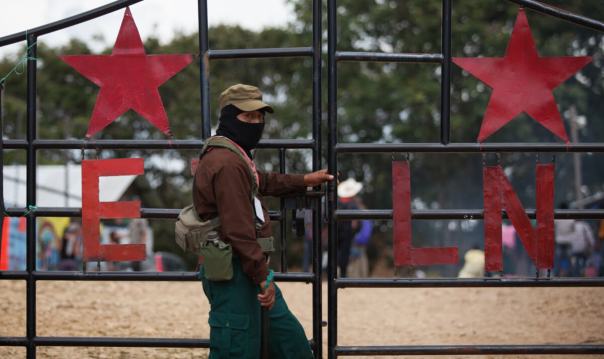
The Zapatista Caracoles remain closed due to the Corona virus.
By: Gilberto López Y Rivas
Two new events went unnoticed in the media, saturated as they are around the Covid-19, which has impacted the lives of millions of people in the world, demonstrating, even more than the effects of that viral disease itself, the profound failures of public health services, privatized and neglected by the neoliberal governments, as well as the negligence and criminal mischief of these governments, which prevent adopting responsible and effective health policies in the face of the pandemic, due to the fact that they don’t wish to affect the economic interests of the dominant groups and their own political image.
One of those acts is the threat to the Bolivarian Republic of Venezuela of a naval blockade of Venezuela (Ángel Guerra, La Jornada, 15/3/20), while the other is NATO’s realization of military exercises in Europe. In both cases it’s evident that the machinery of the imperialist military alliance headed by the United States doesn’t stop, despite the pandemic and the worsening economic crisis of the markets, above all, in the small precarious economies that barely survive, and that cannot afford to leave their jobs, get food supplies and seclude themselves in their homes or wash their hands with water they do not have. Class condition determines the probabilities of home-hospital attention and, ultimately, of the very survival of the most vulnerable groups.
The parallelism of the situation created by the health emergency in which we are immersed is surprising, with what Carlos Taibo wrote in his book Colapso: Capitalismo terminal, transición ecosocial, ecofascismo, Buenos Aires: Libros de Anarres, 2017. [1] In that book he precisely explores the causes of a global systemic collapse, emphasizing climate change and the depletion of raw materials. He underscores that unlike in the past, when the main threats from catastrophes were associated with natural phenomena, starting with the 20th century, human action turned out to be decisive and fatal. Taibo, like other authors, prefers to talk about climate change and not global warming and, according to his data, it will be impossible to avoid a rise of 2 to 3 degrees in the average temperature of the planet, because of which its consequences, briefly stated, correspond to the global reality that we are now experiencing: a rise in sea level, disappearance of ice at the poles, extinction and mutation of species, desertification, deforestation, an increase in the frequency and intensity of hurricanes, increasing difficulties for food production, and new frequent flooding of inhabited lands in coastal areas and islands, and, the emergence of new diseases, as has occurred with the Covid-19.
Returning to the reading of this shocking, disturbing and inescapable work makes understandable and urgent the constant calls of the Zapatista Mayas to organize in the face of a storm that is neither metaphorical nor symbolic and that alludes not to an apocalyptic vision or millenarian prophecies, but rather to the real and scientifically founded possibility of a worldwide catastrophe in the increasingly nearer future, which Taibo calls “collapse,” that is, the general and massive collapse of the dominant system, manifested in substantial reductions in industrial production; the simultaneous and combined collapse of a financial, commercial, political, social, cultural and ecological character, due to its own contradictions and verifiable realities, in synergy with diverse and severe foreseeable and already progressively manifest implications of the aforementioned climate change (see: Emiliano Hersch González: http://enelvolcan.com/ 84-ediciones/059-octubre-diciembre -2019/629-crisis-climatica-que-hacer).
This has an inescapable benchmark in our country. The EZLN in its communiqué of last March 16 critically denounces: “the frivolous irresponsibility and lack of seriousness of the bad governments and of the political class in its totality, who make use of a humanitarian problem to attack each other, instead of taking the measures necessary to confront that danger that threatens life without distinction of nationality, sex, race, language, religious belief, political militancy, social condition and history.” It also, calls for: “not dropping the fight against femicidal violence, continuing the struggle in defense of territory and Mother Earth, maintaining the struggle for los [email protected], [email protected] and [email protected] and raising very high the banner of the struggle for humanity.”
Despite the visibly developing collapse, necro-political capitalism will seek to use the pandemic in favor of its class interests, with the complicity of the states at its service. It’s up to the peoples to resist together and to organize themselves for life and the future of coming generations.
Note:
[1] López y Rivas wrote a previous article about this same book, saying that it was circulating in Zapatista circles, which included Sup Galeano. An English translation of the title is Collapse: terminal capitalism, eco-social transition, eco-fascism.
———————————————————–
Originally Published in Spanish by La Jornada
Friday, March 20, 2020
https://www.jornada.com.mx/2020/03/20/opinion/018a1pol
Re-Published with English interpretation by the Chiapas Support Committee
Cuba and the coronavirus
By: Luis Hernández Navarro
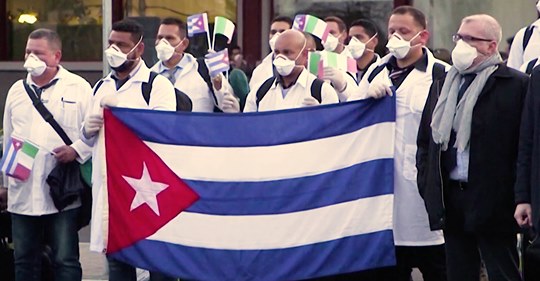
In the Lombardy region of northern Italy, Cuban doctors and nurses tirelessly combat the coronavirus epidemic under campaign conditions. They belong to the Henry Reeve International Medical Brigade, created in 2005 by Fidel Castro to offer assistance to the United States after Hurricane Katrina passed through New Orleans.
The island mission is made up of a logistics chief and 35 doctors: 23 general practitioners, pulmonologists, intensive care specialists and infectious disease specialists, in addition to 15 nurses. Several are veterans in these fights, who fought against Ebola in West Africa in 2015. Their selflessness and professionalism are widely recognized. In 2017, the World Health Organization (WHO) awarded them the Lee Jong-Wook Public Health Award.
Upon arriving in Italy, Carlos Ricardo Pérez Díaz, head of the Cuban brigade of white coats, declared: “We will be firm and take all the time that may be necessary to aid in fighting this epidemic.” And, in an interview with the SER Chain, he explained: “We have a humanist training, based on the principle of solidarity, of commitment to the profession and medicine.”
That principle –according to Doctor Pérez Díaz– is based “on that we cannot give what we have left over, but on sharing what we have. We have to share with others as much as we can. That is the challenge. That is the real principle of solidarity.”
The health solidarity of Cuba in Lombardy is not an exception, but rather the rule. In 2015, 37,000 Cuban doctors were cooperating in 77 countries. Medical support to other nations started in 1960, with the sending of doctors to Algeria. And, as many African and American (like Haiti) nations know well, despite the inhuman and illegal United States economic blockade against them for more than 60 years, island support at the time of major disasters has been crucial in defeating plagues and diseases.
Cuba is the country with the greatest demand for medical tourism on the planet. Its government has trained, in 13 schools of medical sciences and 25 faculties, highly qualified doctors and health personnel. Currently, more that 63,000 young people study medicine. But that experience in the formation of professionals is not limited to national boundaries. The Latin American School of Medicine welcomes students from 122 countries. Each year, 1500 scholarship students enroll there.
This Caribbean nation is very far from being a streetlight and the darkness of your home. To the contrary, its Cuban health model shines throughout the world. By allocating resources not where they have the highest price, nor where there is the most demand, but rather based on popular and sovereign priorities, health occupies a key place in the state budget.
Promoted from the first moment by Fidel Castro, the Caribbean health experience, oriented to guaranteeing the right to the health of its inhabitants and far away from profit and commercialization, has garnered transcendental achievements, such as the vaccination programs for newborns and small children, the maternal and child care system, with strict control over the indicators from pregnancy, which have made possible a low infant mortality rate and an increase of life expectancy.
And, beyond its pedagogical or health care experience, this nation has developed in depth biotechnology research and, in the opposite direction, established a pharmaceutical industry that has produced a surprising quantity of state-of-the-art drugs and vaccines, key to caring for different diseases.
Few countries have displayed the solidarity that Cuba has given in the face of the coronavirus crisis. From the first moment, its doctors provided health care in Wuhan, China. The Chinese authorities used interferon alpha 2B, a drug made on the island as a tool for treating the disease, together with 30 other medications.
When different nations closed their doors to the British MS Brarmar cruise ship because five passengers on board were sick with Covid-19, Havana allowed it to dock. As Abel Prieto (https://bit.ly/2QNJZP1) recalls, in less than two weeks, as support for the pandemic containment strategy, 11 Cuban medical brigades have been moved to Venezuela, Nicaragua, Surinam, Italia, Granada, Jamaica, Belize, Antigua and Barbuda, San Vicente and the Grenadines, Dominica and Santa Lucía, and soon, to Angola.
The worst and the best of humanity have emerged in the face of Covid-19. On the one hand, large corporations in the pharmaceutical industry have found in the crisis a window of opportunity to do a lot of business, while scavenger hoarders profit from the tragedy without any scruples. On the other hand, with deep humanism, governments, peoples and communities put cooperation, dignity, ethics, mutual aid and solidarity ahead to confront the evil. Without a doubt, the health colossus that is the little socialist Cuba occupies a privileged place among the second group. There is an urgent need to end the criminal punishment that it suffers.
———————————————————–
Originally Published in Spanish by La Jornada
Tuesday, March 31, 2020
https://www.jornada.com.mx/2020/03/31/opinion/018a2pol
Re-Published with English interpretation by the Chiapas Support Committee
Mexico prepares for a long epidemic
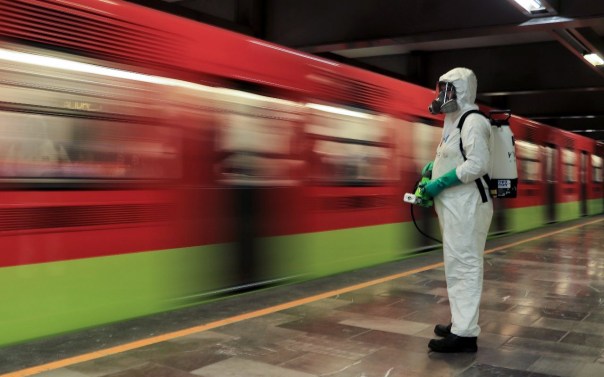
At a Metro station in Mexico City | Photo: María Fernanda Ruiz
The Mexican government seeks to extend the contagious stage of the coronavirus so that the health structure can withstand the most critical moment of the disease; the total closure of activities, the undersecretary of Health assures, would affect above all the poorest population. We enter phase 2 of the pandemic
By: Arturo Contreras Camero de Pie de Página
24 days after the first case of COVID-19 was detected in Mexico, the Government’s efforts are focused on one objective: lengthening the contagion curve. This morning they announced Mexico’s entry into phase two of the pandemic.
The strategy is that, in doing so, less people get sick at the same time, which will allow the health system to not collapse, as has already happened in other countries, like Italy, where as of yesterday deaths reached 5,476, out of a total of 59,138 cases.
“If we succeed in delaying transmission, we’re going to have a long epidemic,” Undersecretary of Health Prevention Hugo López Gatell assured Monday night.
“That’s not very pleasant, but it is compensated for by the fact that we’ll have fewer cases at the same time.”
According to the undersecretary, although there will be a time when COVID-19 cases will grow very rapidly, the government’s plan is to stop the accelerated escalation of the disease so that the health system does not collapse, as has happened in other countries.
It’s not the same for the care that is required to have thousands of urgent care cases in one day than over several weeks. That’s why the social distancing and community mitigation measures implemented throughout the past week were put into effect.
Buy it is precisely about advance action, the undersecretary explained, during the evening press conference in which he reports everyday about the progress of the disease.
“Since March 14, we preferred to anticipate the circumstances starting with phase two measures, just two weeks before the moment in which we expect to start seeing a rapid growth in the number of daily cases,” he said.
Phase Two
This Monday, in the daily report the World Health Organization issues, Mexico now appeared on its lists as a country where there is “community transmission,” which according to its criteria would imply that the country is already in phase two of the contingency.
Lopez Gatell colored those interpretations: As of one o’clock in the afternoon there were 367 confirmed cases of the disease and four deaths; 1 percent of infections correspond to cases in which the source of the disease cannot be identified.
That “is a very early sign, but characteristic of the transition to phase two.” This morning, in the presidential conference, they announced jointly with the medical corps of the Army and the Navy that the phase in Mexico changes not because of the number of infections, but to move forward in taking action.
In other words, despite the existence of these infections that took place in the country, many of them are the product of contagion from a person that “imported” the virus from another country and transmitted it to an acquaintance.
The community contagion phase is when it’s not only impossible to trace the origin of infection of the cases, but also that there will be so many that it would even be useless to do so.
“It’s a gradual process, it doesn’t occur from one moment to the next, it doesn’t occur with one more case, it’s not a situation in which from one day to the next one can now say we have already changed the phase here,” the undersecretary responded to a question about when this change would take place.
Contingency until September
This Tuesday, during the afternoon [press] conference, López-Gatell assured that the COVID-19mx pandemic could last until September and its peak would be in August.
If the federal government’s containment strategy works, infections would be delayed and would allow it “to administer the risk” and not cause the health system to collapse.
The global panorama
As of this Monday there were 332, 930 cases of people in the world infected with Coronavirus, and of these, only a proportion, 67 percent, are cases that are estimated to remain active; in other words, cases that have happened in the last 14 days and therefore can still spread the virus, while the rest are already recovered.
Of those people who have become ill, only 11 percent have required hospitalization; the rest are considered “outpatient” because they can be cared for at home.
Of the 11 percent that are hospitalized, seven percent will require intensive care. This is the panorama for which the Government of Mexico has been preparing since the middle of January, when it began to take measures regarding the pandemic.
“Disorder and fear can kill us”
In Mexico, the social distancing measures that are normally used in phase two of contagion are being applied now. That’s why, despite the fact that there are only a few Coronavirus cases with respect to the total population, many people already left the streets to seclude themselves and face the pandemic at home.
But the idea is that this kind of measure would last as little time as possible, since the socio-economic damages can be terrible, according to what the United Nations Organization has warned. López Gatell clarified that by defending the Mexican government’s decision to neither close the borders nor completely stop productive activities: “We have to think about the economic consequences of the measures on the 50 percent of the population that is the poorest. We can’t shut everything down, whether irrationally or planned, because there is social fear. Disorder and fear is what can kill us.”
[1] As of Monday, March 30, 2020, there are 12 known cases of people infected with the coronavirus: 1 in Palenque; 7 in Tuxtla Gutiérrez; 1 in Tapachula and 3 in San Cristóbal de las Casas.
——————————————————————
Originally Published in Spanish by Chiapas Paralelo
Thursday, March 27, 2020
https://www.chiapasparalelo.com/noticias/2020/03/preparemonos-para-una-epidemia-larga/
Re-Published with English interpretation by the Chiapas Support Committee
Santa María Ostula, mining and organized crime

By: Luis Hernández Navarro
On the Michoacán coast, the territory and natural resources of Santa María de Ostula community are in dispute. It’s literally a struggle for life and death in which the comuneros defend their land and their habitat from organized crime attacks.
Although they fight over the limits, the bad guys act as a clamp. Los Viagras seek to control southern Aquila municipality and the Jalisco Nueva Generación cartel (CJNG) the northern part. Its beaches are the route to the steepest parts of Tierra Caliente (Hot Land). Speedboats disembark with shipments of narcotics on its beaches. Cessna planes land on private ranches in the area to transport weapons and drugs (https://bit.ly/2Qgj1iI).
But on the regional game board they also fight over the exploitation of natural resources. The mining companies have 40,000 hectares under concession within that territory. Ternium, just one steel manufacturing company, has a concession of 5,000 hectares within Ostula. As has been documented in parts of the country, there is a marriage of convenience between mining companies and organized crime, in which the cartels are in charge of the “security” of businesses. Ostula is no exception. And, at the service of those interests, an old regional leader, previously beloved and prestigious, now acts: Cemeí Verdía Zepeda.
History repeats itself. There are community leaders with feet of clay who, when they walk on the shoulders of the communities that forge them, look like giants, but who –proud of money and power, believe that their stature is their merit alone and not of those who have supported them– just crash and burn when they touch the ground.
Such is the case with Cemeí. For years, he was a kind of popular hero in the region. Dedicated as a child to growing papaya, he was the first commander of the Ostula Community Police and general coordinator of the self-defense groups in Aquila, Coahuayana and Chinicuila. He survived three attacks perpetrated by organized crime between 2014 and 2015. He was politically persecuted and had to leave his community. He was in prison for five months in 2015, accused of using firearms for the exclusive use of the Army, until pressure from the comuneros forced the government to release him. Nevertheless, when he got a taste of the banknote and political chicanery, he succumbed.
Santa María de Ostula is an emblematic Nahua community in the indigenous movement for two reasons. The Ostula Manifesto was promulgated there on June 13 and 14, 2009, which, two and a half years before the formation of the Michoacán self-defense groups, vindicated the right to a indigenous self-defense and opened a cycle of struggle in this terrain.
Additionally, hundreds of Nahua comuneros of that locality have recuperated, at the cost of dozens of lives, hundreds of hectares of communal property illegally occupied by powerful mestizo caciques associated with organized crime (https://bit.ly/2TQ2ggn). Before going bad, Cemeí was part of those struggles.
Although he has other antecedents, the political decomposition of Verdía Zepeda accelerated in 2018, when, on the fringes of the community, he was designated the PAN candidate to a deputy position for District 21, with its seat in Coalcomán.
Simultaneously with his candidacy, Cemeí supported the nomination for the municipal presidency of Aquila (to which Ostula belongs) of César Olivares Fernández, cousin of the outgoing PRD mayor, José Luis Arteaga Olivares, his ally and one of his funders. His attitude clashed with the agreement of the assembly of comuneros to nominate their own candidate (Ebenezer Verdía) and seek his registry, first with the PRD and later with Morena.
On July 21, 2018, after the elections, Verdía Zepeda appeared at the Ostula communal assembly, with 100 heavily armed members of self-defense groups from Coalcomán and Aquila. Without being intimidated, the comuneros embarrassed him with complaints. “Go for your PAN over there,” “didn’t you know how to steal, Ceme?” “The Indian woke up,” “a year ago, Cemi, where were we for you? Say what you want, but we did it for you,” they shouted at him.
A woman shouted at him: “Don’t come back here!” Defiant, Cemeí asked: “Who said that?” And, like a modern Fuenteovejuna [1] they responded: “Everyone!” Cemeí was expelled (https://bit.ly/33ugC9H).
From that moment, Verdía escalated the conflict. First, he threatened Evaristo Domínguez Ramos, commissioner of the commons (bienes comunales). He continued resolutely, accusing the community, falsely, of having a nexus to organized crime. Then, five of his close allies headed by his lieutenant Martín Nepamuceno, entered Ostula and shot the community guard, in order to escape.
Although there is still no evidence that directly links Cemeí to other attacks, in the context of his offensive Villa Victoria, municipal capital of Chinicuila, was attacked and the radio antenna the community guard used was burned.
The indigenous community of Ostula maintains that Cemeí walks on bad paths, working for the CJNG (https://bit.ly/3d3xLv9). The district attorney of Colima arrested five of his self-defense followers with drugs, sent them to Michoacán and then released them. Cemeí falsely denounced that they were kidnapped. Curiously, they are the same ones who, headed by Martín Nepamuceno, entered the community. All the evidence points to the fact that the former commander of the community guard seeks to open the way to the interests of organized crime and mining companies.
NOTE:
[1] Fuenteovejuna is a play by Lope de Vega. The name comes from an uprising in the village of Fuenteovejuna, Spain. That word is used in Spanish as an answer to a question about who did something, meaning “all of us did it.”
———————————————————–
Originally Published in Spanish by La Jornada
Tuesday, March 17, 2020
https://www.jornada.com.mx/2020/03/17/opinion/019a1pol
Re-Published with English interpretation by the Chiapas Support Committee
Neoliberalism epidemic
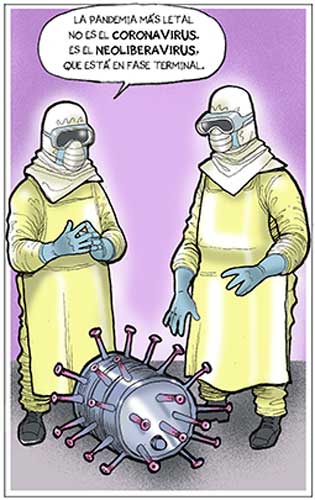
The most lethal pandemic is not the coronavirus. It’s the “neoliberavirus,” which is in its terminal phase.
By: Raúl Zibechi
Centuries ago we were able to learn the importance of the social and natural environments where viruses take root and multiply, because we live with them and they don’t always threaten us. The black plague should have taught us that pre-existing viruses multiply and disperse when the appropriate conditions are created. In our case, neoliberalism created those conditions.
In Plagues and Peoples, William McNeill highlights some current questions, when he analyzes the black plague that swept Europe from 1347. Christians unlike the pagans, cared for the sick, “helped each other in times of pestilence” and in that way contained the effects of the plague (Siglo XXI, p. 122). The “saturation of human beings,” over-population, was key in the expansion of the plague (p. 163).
Poverty, a diet with little variety and the non-observation of “superstitions,” local customs of the peoples, due to the arrival of new inhabitants, turned the plagues into disasters (p. 155).
Braudel adds that the plague, or “the hydra of a thousand heads,” constitutes a constant, a structure of the life of men (The structures of everyday life, p. 54). However, how little we have learned.
The black plague destroyed feudal society in a few years due to the acute scarcity of labor as a result of the death of half of the European population and, also, due to the loss of credibility of the institutions. This is the fear that now leads states to lock up millions.
The coronavirus epidemic underway has some peculiarities. I’ll focus on the social ones, because I ignore elementary scientific questions.
The current epidemic would not have the impact that it has, if it were not for three long decades of neoliberalism, which has caused probably irreparable environmental, health and social damage.
The United Nations through the UNEP recognizes that the epidemic “is a reflection of environmental degradation” (https://bit.ly/2TS42fL). The report points out that: “ailments transmitted from animals to human beings are growing and worsening as wild habitats are destroyed due to human activity,” because “pathogens spread more rapidly to herds and human beings.”
To prevent and limit zoonosis, it is necessary to tackle “the multiple threats to the ecosystems and wildlife, among them, the reduction and fragmentation of habitats, illegal trade, the contamination and proliferation of invasive species and, increasingly climate change.”
Temperatures in early March (winter) in some regions of Spain are up to 10 degrees above normal (https://bit.ly/3aFvynq). Furthermore, the scientific evidence links “the explosion of viral diseases and deforestation” (https://bit.ly/2IDBbGO).
The second issue that multiplies the epidemic has to do with strong cuts in the health system. In Italy, in the past 10 years 70,000 hospital beds were lost, 359 departments closed and numerous small hospitals were abandoned (https://bit.ly/39BjkMC). Between 2009 and 2018 health spending increased 10 percent, compared to 37 percent for the OECD. In Italy there are 3.2 beds for every 1,000 inhabitants. In France there are 6 and in Germany 8.
Between January and February the Spanish health sector lost 18,320 workers, in full expansion of the coronavirus (https://bit.ly/2wJIR7W). Health care sector unions denounce: “abuse of interim hiring and job insecurity,” while working conditions are increasingly hard. This neoliberal policy towards the health system is one of the causes of why Italy has placed the whole country in quarantine and Spain can follow the same path.
The third issue is the epidemic of individualism and inequality, cultivated by the mainstream media, which are dedicated to instilling fear and reporting in a biased way. For more than a century, we have suffered a powerful offensive from capital and the states against popular socialization spaces, while blessing the cathedrals of consumption, like shopping centers.
Consumerism depoliticizes, de-identifies and implies an “anthropological mutation” (as Passolini warned). Today there are more people who wish to have pets than children. This is the world that we have created and for which we are responsible.
Long-term measures can aggravate epidemics. The State suspends society upon isolating and confining the population in their houses, even prohibiting physical contact.
Inequality is equal to that in the Middle Ages (around 1500), when the rich ran to their country houses after the plague was announced, while the poor “were left alone, prisoners of the contaminated city, where the State fed them, isolated them, blockaded them and watched them” (Braudel p. 59).
The model of the digitalized prison panoptic that suspends human relations seems to be the strategic objective of capital so as to not lose control in the current systemic transition.
———————————————————–
Originally Published in Spanish by La Jornada
Friday, March 13, 2020
https://www.jornada.com.mx/2020/03/13/opinion/018a1pol
Re-Published with English interpretation by the Chiapas Support Committee
CNI-CIG Denunciation regarding the harassment of CNI Chiapas compañeros
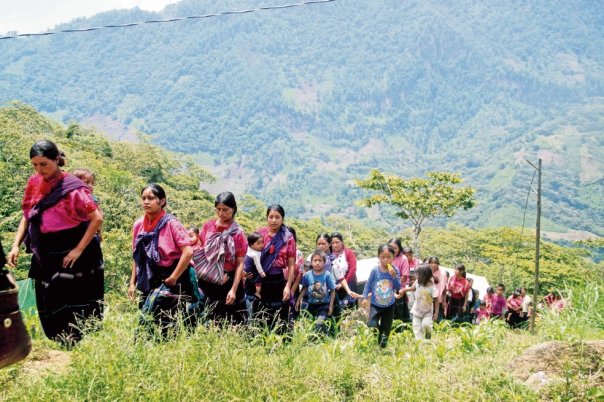
March 7, 2020
To the People of Mexico:
To the Networks of Resistance and Rebellion:
To the National and International Sexta:
To the Communications Media:
To the Human Rights Organisms:
To the Organizations in Defense of Territory and Mother Earth:
This denunciation derives from the problem stirred up against the compañeros and compañeras of the communities of San Antonio Bulujib and Guaquitepec, municipality of Chilón, Chiapas, who belong to the National Indigenous Congress (CNI, its initials in Spanish). Last February 23, our compañeros and compañeras María Cruz Espinoza, Juana Pérez Espinoza, Feliz López Pérez, María Cruz Gómez, Ana Gómez Hernández, Alejandra Gómez, María Luisa Pérez Gómez, 1 year old, María del Rosario Mazariegos Gómez, 11 months old, Manuel Cruz Espinoza, Juan Gómez Núñez and Isidro Pérez Cruz were attacked and kidnapped for having placed a sign alluding to the “We Are All Samir” days of action at the entrance to the town of San Antonio Bulujib.
Those responsible for these aggressions are the San Antonio Bulujib ejido authorities belonging to the paramilitary groups called “CHINCHULINES” and “ORCAO,” as well as by members of the MORENA party in the region.
On February 24, until 8:30 at night, after more than 24 hours of having been deprived of their freedom, our compañeros and compañeras were released under the following conditions that the ejido authorities imposed: paying a fine of fifteen boxes of soft drinks and 2,500 pesos, and if not, their freedom was conditioned on our compañeras and compañeros renouncing being members of the CNI.
At the same time, the ejido authorities indicated that if out compañeros and compañeras didn’t pay the fine by Sunday afternoon March 1, 2020, they would be evicted from their lands and their houses, which would be sold, and they would also be locked up in the town’s jail. It wasn’t possible to pay the fine by that date, so they asked for 8 more days to clarify the situation and to seek support in other agencies in conjunction with human rights; since they won’t pay the mentioned amount because it’s not a crime to demonstrate and we have the right to free expression.
Yesterday, March 6, 2020, six members of the Chilón municipal police arrived to leave an invitation from the municipal president to a supposed work meeting at the Mukulum Hotel in Bachajón, between community authorities mentioned above and the compañeros Manuel Cruz Espinosa, Celia López Pérez and María Cruz Gómez. But the police maintained an intimidating attitude by taking photos and video of our compañeras specifically and told them that they had to go with them in the van.
The reason we perceive that municipal president Carlos Ildelfonso Jiménez Trujillo has protected the authorities of San Antonio Bulujid community is because he supports that placing a sign in said community is a crime and, therefore, our compañeros have to pay a fine of $5,999 pesos. The reasons why the compañeros did not appear are because they had already agreed to a dialogue table with the state government delegate on Wednesday, March 11 of this year; but in a despotic way the municipal president, in collusion with the state government delegate, issues an invitation at his own domicile, violating the rights of the CNI compañeros, knowing that illegal deprivation of freedom is a crime.
We denounce and hold the following responsible for what may occur to our compañeras and compañeros: the municipal president of Chilón, Chiapas, CARLOS ILDElFONSO JIMÉNEZ TRUJILLO; the state government delegate and the paramilitaries organized in the communities, and we specifically hold responsible the San Antonio Bulujib ejido authority, MIGUEL LÓPEZ GUZMÁN, the Vigilance Council, MATEO GÓMEZ MÉNDEZ, a member of the ORCAO and CHINCHULINES organization, the Auxiliary Municipal agent JUAN SILVANO MORENO, his alternate MANUEL GÓMEZ PÉREZ, and JOSÉ PÉREZ, the alleged leader of the ORCAO, a paramilitary promoter who is dedicated to provoking and invading lands, protected by the bad state federal and municipal governments. Those are the ones who in the name of an alleged Fourth Transformation are attacking the security and life of the eleven above-named compañeros and compañeras and other CNI families.
On the other hand, we also denounce that Carmen las Flores community in Las Margaritas municipality is demanding that our compañeros of the CNI’s Tojolabal people work on the construction of a primary school as part of the government programs, which the CNI compañeros refuse to do, since they are outside the official education system because they have their own autonomous education project. That’s the reason why three of our CNI compañeros: Jaime Jiménez Hernández, local CNI coordinator; Ventura Hernández Gómez and Francisco Santis Hernández, who is a CNI delegate, have been incarcerated since Monday, March 2, 2020, at 9:00 pm. As of this date, they have not been set free. They have been confined for almost a week and have been denied [facilities] for relieving themselves, using said aggression against them as a form of torture.
In order to release our CNI compañeros, they are obliging them to sign a document to participate with the partisan group in the same community. That group is moved by Sebastián Jiménez Méndez, leader of the CODUC organization in Las Margaritas municipality, controlling the community through the commissioner Hilario Jiménez Méndez, the municipal agent Daniel Jiménez Pérez and as a member of the vigilance council Fidel Méndez Vázquez. They are the intellectual authors of the repression and violation of our compañeros’ rights, like the deprivation of their freedom without having committed any crime other than working for life in autonomy and not lending themselves to the demands of the partisan group of MORENA, the party of this current government.
As the National Indigenous Congress we will not allow more abuses to be committed against any compañero or compañera belonging to our organization; we call for solidarity with and support for our CNI brothers and sisters in Chiapas who have been harassed for defending their territory.
Attentively,
March 7, 2020
For the Integral Reconstitution of Our Peoples
Never More A Mexico Without Us
National Indigenous Congress
Indigenous Government Council
—————————————————————————————-
Originally Published in Spanish by the National Indigenous Congress
Saturday, March 7, 2020
Re-Published with English interpretation by the Chiapas Support Committee
Coronavirus: militarization of the crisis

Raúl Zibechi
By: Raúl Zibechi
You have to go back to the periods of Nazism and Stalinism, almost a century ago, to find examples of population control as extensive and intense as those happening these days in China with the excuse of the coronavirus. It’s a gigantic military and sanitary panoptic, which confines the population to live enclosed and under permanent vigilance.
The images that reach us about daily life in wide areas of China, not only in the city of Wuhan and Hubei province, where 60 million people live, give the impression of an enormous open pit concentration camp because of the imposition of quarantine on all its inhabitants.
Deserted cities where only health and safety personnel travel. Everyone’s temperature is taken at the entrance to supermarkets, shopping centers and residential complexes. If there are family members in quarantine, only one member has the right to go out every two days to buy food supplies.
In some cities those who don’t use masks can end up in jail. The use of disposable gloves and pencils is encouraged for pressing elevator buttons. China’s cities seem like ghost towns, to the point that in Wuhan you hardly find people in the streets.
It’s necessary to insist that fear is circulating faster than the coronavirus and that contrary to what is believed, “the main killer in the history of humanity was and is malnutrition,” as an essential interview in the Comune-info portal emphasizes.
What’s usual in history has been to place infected people in quarantine, but millions of healthy people have never been isolated in this way. Vageesh Jain, doctor and academic at the University College London Institute of Global Health, wonders: “Is such a drastic response justified? What about the rights of healthy people personas?”
According to the WHO, each person infected with coronavirus can infect two more, while the measles patient infects 12 to 18 people. That’s why Jain assures that more than 99.9 percent of the inhabitants of Hubei province are not contagious and that: “the vast majority of the population trapped in the region are not feeling ill and are unlikely to become infected.”
Bulletin 142 of the European Laboratory of Political Anticipation (LEAP, its initials in Spanish) reflects: “China triggered an emergency action plan of unprecedented magnitude after only 40 deaths in a population of 1.2 billion people, knowing that the flu kills 3,000 people in France every year.” In 2019, the flu killed 40,000 people in the United States. The measles kills 100,000 people each year and the flu kills half a million worldwide.
The LEAP maintains that we are faced with a new social model of crisis management, which has the approval of the West. Italy followed that path by isolating 10 towns with 50,000 inhabitants, when there were only 16 people with the coronavirus.
China exercises a sophisticated control of the population, from video-vigilance with 400 million cameras in the streets to the “social credit” point system that regulates citizens’ behavior. Now control is multiplied, including territorial surveillance with “volunteer” brigades of neighbors in each neighborhood.
I would like to enter into several considerations, not from the point of view of health, but rather from one that leaves the management of this epidemic to the antisystemic movements.
The first is that China being the future global hegemon, the practices of that State towards its population reveal the type of society that the elites want to build and propose to the world. The forms of control that China exercises are extremely useful to the ruling classes of the entire planet for keeping those below within bounds, in periods like the deep economic, social and political convulsions, of the terminal crisis of capitalism.
The second is that the elites are using the epidemic as a social engineering laboratory, for the purpose of tightening the siege on the population with a double mesh, on a macro and micro scale, combining a minute control at the local level with another general and extensive control like Internet censorship and video surveillance.
I consider that we are facing a test that will be applied in critical situations, such as natural disasters, tsunamis and earthquakes; but especially before the great social convulsions capable of provoking devastating political crises for those above. In sum, they are preparing for eventual challenges to their domination.
The third is that the peoples still don’t know how we are going to face the powerful mechanisms for control of large populations, which are combined with the militarization of societies in the face of revolts and uprisings, as is happening in Ecuador.
——————————————————————
Originally Published in Spanish by La Jornada
Friday, February 28, 2020
https://www.jornada.com.mx/2020/02/28/opinion/020a1pol
Re-Published with English interpretation by the Chiapas Support Committee
Panic Buying in San Cristóbal de Las Casas shopping areas

By: Félix Camas
San Cristóbal de Las Casas, Chiapas
Given the evident presence of Coronavirus infections in the state of Chiapas, self-service stores, supermarkets and commercial chains, as well as in the public plazas of this city, are taking all kinds of preventive measures as health authorities have indicated.
On a tour through various shopping areas, it was found that in some they are measuring the temperature of their workers, and if they detect fever or that someone comes down with a cold, they are sent home, the same applies if they have a dry cough, in addition to providing antibacterial gel to everyone and providing preventive information.
It may also interest you
In other places they don’t measure fever, but if any worker presents a cold they are sent home. The self-service check-out areas are disinfected every 25 minutes, as well as the ATM areas and all the places where there is contact with the hands, such as in the shelf and warehouse area, in addition to the presence of antibacterial gel at strategic points. Without considering that we’re dealing with “panic” purchases, one can notice in some stores that the shelves are empty of products, “what people have bought the most are toilet paper, antibacterial gel, mouth covers, beans, rice, canned products and water,” says the manager of an important commercial chain.
While another area of the city, in another important supermarket, the report of sales is calm, “there has not been any news, they have not made panic purchases and everything is going normally.”
Some stores are practically empty, in others the flow is normal, but in all of them it’s noted that they have activated a plan with preventive protocols, given the increase in the spread of the Coronavirus at the national level, which according to experts, is expected to increase in the next hours.
————————————————————-
Originally Published in Spanish by NVI Noticias
Tuesday, March 17, 2020
https://www.nvinoticias.com/nota/140438/compras-de-panico-en-en-centros-comerciales-de-sclc
Re-Published with English interpretation by the Chiapas Support Committee
 Chiapas Support Committee