Chiapas Support Committee
Home of the Compañero Manuel blog on zapatistas & mexico
Chiapas, the return of Paz y Justicia
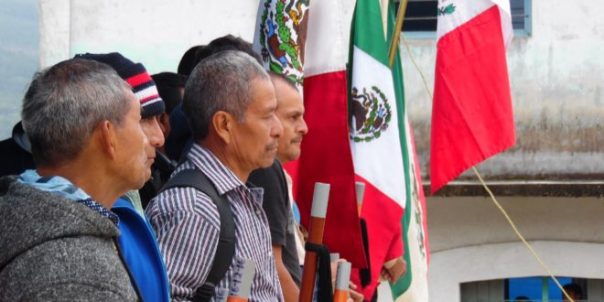
Tila-Chiapas
By: Luis Hernández Navarro
Terror returned to Tila, Chiapas, hand in hand with the resurgence of the paramilitary group named Desarrollo, Paz y Justicia (Development, Peace and Justice). One after another, armed attacks, assassinations, sieges and all kinds of aggressions take place against the 836 ejido owners who reclaimed their territorial rights.
In the Northern Zone of Chiapas, between 1995 and 2000, Paz y Justicia assassinated more than 100 indigenous Chols, expelled at least 2,000 campesinos and their families from their communities, closed 45 Catholic churches, attacked Bishops Samuel Ruiz and Raúl Vera, stole more than 3,000 heads of cattle and raped 30 women. Equipped with high-power weapons, the paramilitaries controlled roads, administered public resources and occupied seats.
The civilian armed group counted on the support of General Mario Renán Castillo, head of the Seventh Military Region. The military spokesperson confessed –according to what Jesús Ramírez Cuevas wrote: “that organization is a pride of the general” (https://bit.ly/3mik0gy). Days before the military man left his position, the leaders of Paz y Justicia said goodbye to him with words of complicit thanks. “We will never forget you, sir. Everything that you did for us requires gratitude,” they told him.
Paz y Justicia was a central actor in the low-intensity war that the government of Ernesto Zedillo orchestrated against the Zapatista National Liberation Army (Ejército Zapatista de Liberación Nacional, EZLN). It sought to territorially control the strategic corridor that connects the Chiapas Cañadas with Tabasco and to derail, by means of violence, the autonomic Chol process.
On July 2, 1997, the Chiapas government agreed to give $4,600,000.00 pesos to Desarrollo, Paz y Justicia, “to promote agro-ecology and productive projects.” Paramilitary leaders, then Governor Julio César Ruiz Ferro and Uriel Jarquín, the state’s undersecretary of Government signed the document. General Mario Renán Castillo signed it as an honorary witness (Masiosare, 21/12/1997).
Beyond its military ties, the initiative to form Paz y Justicia came from the Salto de Agua cattle ranchers associations. It was founded in March 1995. Its political operators were the PRI leaders of Tila. According to a report from the Fray Bartolomé de Las Casas Human Rights Center (Frayba) (https://bit.ly/3mhvTn9), Salto de Agua, Palenque and Playas de Catazajá are, in the Northern Zone of Chiapas, the municipalities in which there are more private properties and in which ejidos and agrarian communities represent the smallest percentage of land ownership.
Its principal leader, now a prisoner but before a PRI deputy, Samuel Sánchez Sánchez, explained that the creation of Paz y Justicia was due to the “radicalization in orientation of those who sympathized with the Zapatistas and the PRD in the ejidos and communities (of Tila, Sabanilla, Salto de Agua and Tumbalá).”
Its members were part of Solidaridad Campesino-Magisterial (Socama), an organization originally formed by parte of the leadership team of Section 7 of the SNTE coming from the Pueblo group, headed by Manuel Hernández, Jacobo Nasar and Pedro Fuentes, and a dissident CNC group led by Germán Jiménez. The group, which took its name from the Polish union Solidarity, was closely linked to campesino struggles in the state. However, it started its pro-government drift as a result of the arrest of its main leaders in 1986. With the arrival of Carlos Salinas to the Presidency it was converted into the replacement for the officialist campesino organizations and, starting with the 1994 Zapatista Uprising, into an incubator of the paramilitary groups (https://bit.ly/3hvViWq).
The reconstitution of the Chols as a people and the construction of their autonomy have a long history behind it. It’s a history that, in its “modern” phase, encompasses the struggle for the end of the mosojüntel (“the time in which we were mozos”), [1] against Kaxlan oppression and that of the large coffee producing companies, the Cardenista agrarian reform that permitted the recuperation of land, the return to campesino production of basics, the formation of an indigenous church, the organization of coffee cooperatives to appropriate the productive process, the Zapatista Uprising, the electoral struggle (1994 and 1995), the re-conquest of the ejidos and the formation of autonomous governments.
At the beginning of the new century, Paz y Justicia temporarily fell out of favor. First, they fought each other over economic resources. Then, some of its leaders were arrested. Nevertheless, they were able to rebuild in the region with the cover of the Green Ecologist Party of Mexico (PVEM).
In fact, those who have attacked the Tila ejido are the former municipal president Arturo Sánchez Sánchez and his son Francisco Arturo Sánchez Martínez, brother and nephew respectively of Samuel Sánchez Sánchez, who remains in prison. Also, the current mayor, Limbert Gutiérrez Gómez, of the PVEM, as well as the regional delegate of Paz y Justicia, and the technical secretary of the Chiapas Institute of Education for Youths and Adults, Óscar Sánchez Alpuche, associated with Ismael Brito Mazariegos, the state’s Secretary of Government (https://bit.ly/3mjT93S).
The reactivation of Paz y Justicia in northern Chiapas and its politics of terror are not an isolated act. Other paramilitary groups have re-emerged in Chenalhó, Chilón, Oxchuc and Ocosingo immediately after the Zapatista announcement of the expansion of their autonomous governments and their rejection of the Maya Train’s construction. The counterinsurgency war continues.
[1] Mozos – Serfs on the large estates of land in Chiapas
———————————————————-
Originally Published in Spanish by La Jornada
Tuesday, September 15, 2020
https://www.jornada.com.mx/2020/09/15/opinion/017a2pol
Re-Published with English interpretation by the Chiapas Support Committee
The paramilitary group Paz y Justicia perpetrated the attack, the autonomous ejido says
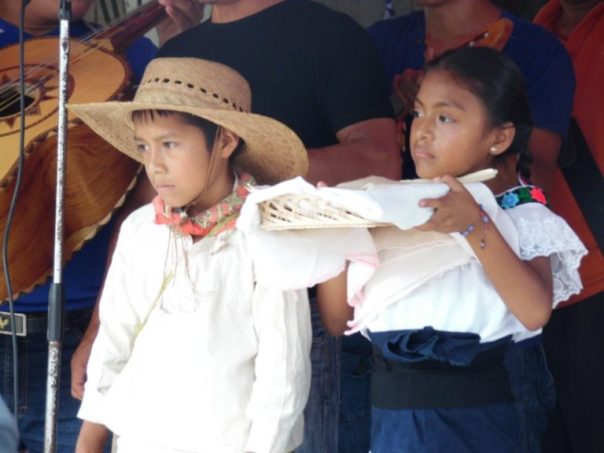
TILA-CHIAPAS Photo from Pozol.org
By: Hermann Bellinghausen and Elio Henríquez, Reporter and Correspondent
The violence in Tila, Chiapas, continues to grow, and cross reports are alarming. On the one hand the ejido, declared autonomous, maintains that the march that they carried out on September 11th to remove the blockades that besieged the town was attacked by followers of the group headed by Francisco Arturo Sánchez Martínez, linked to the Paz y Justicia paramilitary group. Pedro Alejandro Jiménez Pérez lost his life due to a bullet wound in the abdomen in the clash that occurred this Friday, and Ángel Darinel Vázquez Ramírez, Medardo Pérez Jiménez and Jaime Lugo Pérez were injured.
In the group that follows Sánchez Martínez, Elmar Martínez Pérez and Juan Pablo Pérez Vázquez died as a result of bullet wounds, and Carlos Daniel Parcero Gutiérrez, Fredy Pérez Ramírez, Mateo Pérez Álvarez and Isaías López Gómez were injured.
For its part, the Digna Ochoa Human Rights Committee made a serious denunciation today, after the appearance of two dead bodies with signs of torture, for which they blame the “autonomous,” incorrectly characterized as members of the EZLN who, as is well known, are not members of the EZLN. [They are affiliated with the CNI].
The Committee condemned “the acts of armed violence,” for which it blamed “the self-proclaimed autonomous group,” who, according to its version, had initiated the attack, and not the followers of the City Council. However, the Digna Ochoa Committee admits that this second group “is responsible for breaking down the gate at the entrance to Tila on August 25, maintaining a blockade to control access to the town,” and carrying out “previous acts of provocation with firearms, as we denounced on August 30.”
The Committee records that: “two people who the autonomous group considered as disappeared from the Sañoja annex of the Tila ejido, lamentably appeared dead today with signs of being brutally tortured alive, with signs of burns and cuts on his skin; their names were Luis Aparicio Parcero Martínez, whose face was skinned, and Elidio Zenteno Trujillo who they say was a native of Moyos in the municipality of Sabanilla, had nothing to do with the conflict and was just returning from working with his motorcycle.”
The general assembly of ejido owners also reports disappeared after the attack, which Eliasin Bárcenas would have led, “firing with high-caliber weapons as well as with small arms” because of which “they retreated into the mountains while they continued shooting at them and as of this moment there are many disappeared ejido owners.” Unofficially, the ejido owners distanced themselves from the new deaths.
The Digna Ochoa Committee also blamed the government of Rutilio Escandón Cárdenas for being “remiss and negligent” and also talks about “six people executed” (sic) in the confrontation. It also censures the position of the Catholic Diocese of San Cristóbal de Las Casas, arguing that the la Tila parish would favor the autonomous, who are the guilty ones in the eyes of the Digna Ochoa Committee. It also records that: “the tense climate continued during the early morning with threats that the electricity would be cut off and the houses of the avecindados, [1] and at 1:30 am the lifeless body of Pablo Vásquez Álvarez continued lying in the streets of the town, and that the access road to Tila is totally closed.”
[1] “Avecindados” are people who are not from the Tila ejido but have moved into the urban part of the ejido, in other words, the town of Tila. They do not have rights of ownership or participation in the ejido general assembly.
———————————————————–
Originally Published in Spanish by La Jornada
Sunday, September 13, 2020
https://www.jornada.com.mx/2020/09/13/politica/011n1pol
Re-Published with English interpretation by the Chiapas Support Committee
Paramilitaries ambush march in Tila, Chiapas; at least two dead
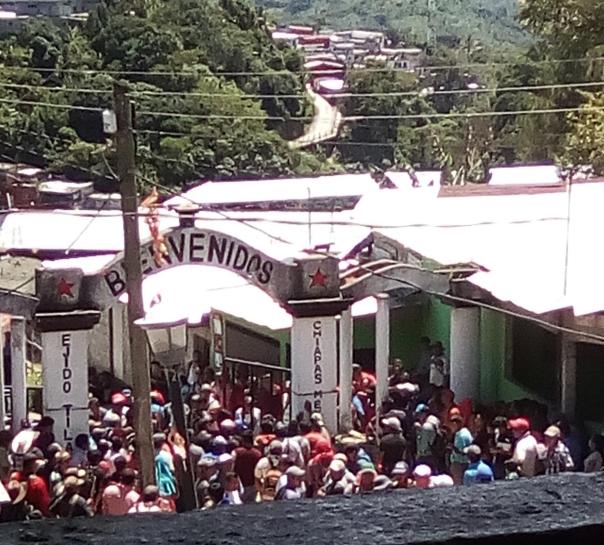
Arch at the entrance to the Tila ejido in Chiapas, Mexico.
By: Hermann Bellinghausen and Elio Henríquez
Violence broke out this Friday in the Chol municipality of Tila, in the northern zone of Chiapas, with at least two dead (other sources talk about three) and an undetermined number of injured. The events were unleashed when an apparently large march was ambushed. In the march were ejido owners from the municipal seat of Tila and sympathizers of neighboring populations that sought to open the fence that followers of the City Council, opposed to the autonomy of the urban and rural Tila ejido, established in mid-August.
Through several blockades on the access road, workers and sympathizers of the City Council and of the Paz y Justicia [1] group prevented the ejido owners from leaving. The first, located at the exit to El Limar, and the last at the first entrance to the urban area. They also requested the presence of the National Guard to evict the ejido owners and re-establish the City Council in the old seat, which has been in El Limar since 2015. In the last two weeks, shootings from these blockades were recurrent to intimidate the ejido owners.
The ejido owners’ march was attacked this morning after liberating the blockade at the site of the hospital on the exit for El Limar and a second blockade at the Tila entrance. According to sources from the general assembly of ejido owners, before the third entrance the march was attacked with shots from a curve by what turned out to be a small group of City Council supporters. The march unexpectedly responded to the shots, a point on which the assembly has not commented. According to the version of those who sympathize with the City Council, the march was what initiated the aggression.
However, the first to fall was one of the marchers. It was his death that inflamed the ejido owners’ march and sparked a confrontation in which the initial aggressors got the worst of it. At the close, the situation is tense.
The events are the new outcome of a legitimacy problem in the Tila ejido, which also served as the seat of the constitutional city hall until the ejido assembly won recognition from the Supreme Court of Justice of the Nation (SCJN) about ownership of the lands in 2015, including the political seat. That has caused various differences among ejido owners of the vast ejido and those who have moved into the urban area but don’t own lands or plots.
Problems of legitimacy in the ejido
The city council, headed for the third time by Limberg Gregorio Gutiérrez, of the PVEM (and his wife held the mayor’s office for another period), is historically supported through the strength of the group formerly known as Paz y Justicia. Francisco Arturo Sánchez, nephew and son of the founders of Paz y Justicia, heads the opposition to the ejido.
Another factor that made the problem tenser was the attempt, on the municipal government’s part, to carry out public works inside the ejido without its authorization.
In a prudent communiqué, the official City Council of Tila reproached “confrontation as a way to resolve differences or demand a solution to social problems,” and called to the groups involved for “prudence in the events that occurred in recent hours.” It referred to the “longstanding agrarian dispute whose solution depends solely on the SCJN,” and committed to respecting indigenous rights and realizing “a policy of conciliation and zero provocation.”
Today, residents of Tila told the La Jornada correspondent: “A group of ejido owners went to remove the blockade and were received with bullets. We have one compañero dead and several injured. The compañero ejido owners defended themselves. That’s what the city council and that damn family of paramilitaries provoke.”
State government sources reported three deaths, although they did not provide names, as well as six injured from bullets who are being cared for in Yajalón and Palenque hospitals and several beaten.
The State’s Attorney General reported that according to the investigation folder, “the events were recorded at approximately 12 noon this Friday at the Tila entrance arch, where residents and autonomous ejido owners attacked each other.” He added that: “a special group from this Prosecutor’s office, made up of police, experts and specialized employees from the Ministerio Pública (district attorney), was sent to the place for the purpose of initiating the investigative work, whose results will be announced in the next few hours.”
The Vicarage for Justice and Peace of the Diocese of San Cristóbal said that: “we are aware that almost three weeks ago a group of Tila ejido residents carried out blockades at the main entrance and at other stretches near the town. We know that there was the intention of a dialogue and negotiation process to seek a solution to the conflict, but apparently the situation got out of control and therefore it is suggested investigating the true causes of the events.”
[1] For more about the Paz y Justicia paramilitary group see: https://chiapas-support.org/2020/09/12/vandalism-and-the-return-of-paz-y-justicia-in-the-tila-ejido-in-chiapas/
——————————————————————–
Originally Published in Spanish by La Jornada
Saturday, September 12, 2020
https://www.jornada.com.mx/2020/09/12/politica/010n1pol
Re-Published with English interpretation by the Chiapas Support Committee
Vandalism and the return of Paz y Justicia in the Tila ejido, Chiapas

Members of the National Indigenous Congress (Congreso Nacional Indígena, CNI) in Tila.
By: Hermann Bellinghausen
The Tila ejido, in the northern zone of Chiapas, denounced acts that have altered the fragile stability of its urban core and mark the return of the Paz y Justicia [1] organization (that never really went away), for “acts of vandalism of disgruntled neighbors, not in their entirety,” this Tuesday, August 25. “Between six and seven am they started to tear down the security gates that the general assembly of ejido owners agreed to construct for the population’s security and as a Covid-19 health filter.”
The ejido representation argues being in compliance with the agrarian legislation in effect, and points out as the ones responsible the former municipal president Arturo Sánchez Sánchez and his son Francisco Arturo Sánchez Martínez, “paramilitary intellectual leaders in northern Chiapas,” linked to “the killings in the low zone between 1997 and 1998.” They are the brother and nephew respectively of Samuel Sánchez Sánchez, currently a prisoner in el Amate.
The fight, which isn’t new, between two groups of residents in the municipal seat, is intertwined with conflicting political positions dating back Ernesto Zedillo’s counterinsurgency war in the Chol region, when the Army and the PRI paramilitary group Development, Peace and Justice (Desarrollo Paz y Justicia) generated an armed violence against the resistance of the Zapatista peoples and their allies that cost hundreds of deaths and displaced families, rapes and disappearances stil unresolved today.
By legal means, in recent years the original ejido owners of Tila recuperated their territorial rights, which had been eroded and even alienated by the “avecindados,” in other words residents who are not from the ejido or do not belong to the ejido assembly, but that given the urban condition of the ejido installed themselves over time, coming to control the municipal government and an important part of central Tila, a town with a lot of commerce. This has occurred without legal possession, because the town’s village is settled on ejido lands, the patrimony of 836 ejido owners.
At the end of the last century, Paz y Justicia took over the entire northern zone and with the government’s support controlled Tumbalá, Sabanilla, Salto de Agua and Tila municipalities. When their principal ringleaders fell out of favor and paid with prison for various crimes (but not for the murders that they committed directly or indirectly) the region was pacified to a certain point. Then the ejido legally recuperated its ejido rights and installed a certain autonomy inspired in Zapatismo.
The ejido owners have denounced aggressions and falsifications of the ejido register in order to impose authorities, and blame Miguel Vázquez Gutiérrez and Luciano Pérez López, members of an “alleged legal commission,” who “violate the agreements of the highest authority” and participate in “the groups that destroyed the gate.”
The ejido authority maintains that the aggressors rely on “gang members and drug addicts previously hired.” We would be talking about “young people brought in cars who are unaware of the ejido’s legalization.” They warn about “threats of kidnappings by these armed rioters.”
Civil organizations in the Tzeltal-Chol region have documented that those who “carry out damage and harm” against the ejido are advised and financed by the current municipal president Limbert Gutiérrez Gómez, of the Green Ecologist Party of Mexico, and the “regional delegate” of Paz y Justicia, and civil servant, Óscar Sánchez Alpuche.
[1] Paz y Justicia is the name of a notorious paramilitary group in the northern part of Chiapas. In an effort to cleanse its bloody reputation, it later took the name of Desarrollo Paz y Justicia (Development Peace and Justice).
———————————————————————–
Originally Published in Spanish by La Jornada
Thursday, August 27, 2020
https://www.jornada.com.mx/2020/08/27/politica/015n1pol
Re-Published with English interpretation by the Chiapas Support Committee
Stop the war against the EZLN

Corn comes in all colors, like everyone.
By Gilberto López y Rivas
One of the characteristics of the current government of the 4T is to neither listen to, much less attend to the serious allegations related to the reactivation of paramilitary groups in Chiapas, like those that belong to the Regional Organization of Ocosingo Coffee Growers (Orcao), who, on August 22nd looted and burned the facilities of the New Dawn of the Rainbow Commercial Center in the autonomous municipality of Lucio Cabañas (Ocosingo). In addition to this provocation, several groups, also identified as paramilitary since the 90’s, like Paz y Justicia [Peace and Justice] and Chinchulines, that once again have carried out all kinds of aggression in various regions of Chiapas, and in particular, in the municipalities of Tila and Aldama. In recent weeks, through networks and various local and national media, statements of support for the EZLN have been circulated, one of which, Stop the War against the Zapatistas, has been signed by hundreds of organizations, academics, artists, and solidarity networks from 22 countries. (https://alto-a-la-guerra-contra -lxs-zapatistas.webnode.mx/). [1]
The attack of August 22nd against the Zapatista support bases forms part of a continuous strategy of counterinsurgency carried out by previous governments against the Zapatista Mayas, one that the Miguel Augustín Pro Juárez Community Action Group and Human Rights Center, two decades ago qualified as a “wholesale war of attrition,” conceived in the U.S. counterinsurgency manuals as a succession of small operations that suffocate the enemy in political, economic and military spheres, avoiding to the extent possible, spectacular actions that would draw the attention of the press and international public opinion. (Now they bet on exhaustion. Chiapas: Psychological foundations of a contemporary war, 2002.) In this type of war, the role of paramilitary groups is fundamental.
According to one of the Sedena manuals of irregular warfare, this not only has to do with taking water from the fish (support bases of the insurgency), but also to introduce more aggressive fish to the water, that is, those paramilitary groups with military organization, equipment and training, to which the State delegates the fulfillment of missions that the armed forces cannot openly carry out without implying a recognition of their existence as part of the monopoly of state violence. Paramilitary groups are illegal and unpunishable because it is convenient for the interests of the State. That which is paramilitary consists, then, of the illegal and unpunishable exercise of State violence, and the covering up of the origins of this violence. As in previous governments, which were openly neoliberal and counter-insurgent, the Fourth Transformation continues saturating the so-called “theater of war.” Zósimo Camacho maintains that today the greatest number of active military personnel can be found in Chiapas, which are, to use a metaphor, the anvil that maintains the security fence around the zone of conflict, with its barracks, garrisons, convoys, intelligence agents, aerial and terrestrial surveillance, etc. while the paramilitary groups, continuing the metaphor, are the hammer that strikes the people with actions like those of August 22nd, trying to introduce terror, creating conditions of expulsion and displacement of indigenous communities, joining up with civil authorities, both military and police, to pinpoint the internal enemy that refuses to follow the logic of capital, with its little mirrors of progress, development and precarious employment.
Jointly with the actions of the paramilitary groups, the campaign on social networks and communication media has intensified against the Zapatista Mayas, with grotesque infusions, like that the territory of the EZLN is controlled by a drug trafficking cartel, that supplies high-powered weapons to the insurgent group, the same that are rigorously analyzed with information and refuted in depth by Luis Hernández Navarro in an interview that Ernesto Ledesma Arronte carried out on his program RompeVientoTv (https://wwwyoutube.com/ watch?v=gdDNI9m_8).
Unfortunately, and in unison with this campaign, a very worrisome statement from the head of the federal executive branch, took place in his morning conference on August 28th, in which he tried to stigmatize and criminalize the work of advocates and defenders of human rights, journalists, academics and representatives of the indigenous communities in opposition to the so-called Maya Train, one of the signature megaprojects of the developmentalist territorial reorganization, which the Zapatista Mayas also confront. With this declaration, the government of the Fourth Transformation jumped aboard the old counterinsurgency train of its predecessors.
This piece was originally published in Spanish in La Jornada on September 4, 2020. https://www.jornada.com.mx/2020/09/04/opinion/017a2pol This English interpretation has been re-published by Schools for Chiapas. Re-Published with permission by the Chiapas Support Committee.
[1] The Chiapas Support Committee is collecting signatures on a letter to the Mexican Consulate in San Francisco, as well as the Mexican Embassy in Washington DC, the presidency of Mexico and the governor of Chiapas, demanding a stop to the paramilitary violence. We urge our readers to sign the letter, which can be read here. You can send your approval to sign the letter to enapoyo1994@yahoo.com.
Two campesinos with bullet wounds in the town of Aldama, Chiapas

Paramilitary-style group shoots at Aldama communities from Chenalhó
The shooting continues and the National Guard doesn’t intervene [1]
By: Hermann Bellinghausen
After several days of incessant shooting with high-caliber weapons from different points located in the municipality of Chenalhó, Chiapas, according to reports received by La Jornada, two indigenous men in San Pedro Cotzilnam, Aldama municipality, were wounded in the back yesterday (Friday) morning while working in their parcels. The two men are Mario and Juan Pérez Gutiérrez, 22 and 27 respectively. The shooting came from T’elemax in Santa Martha, while groups of armed men “went down to the river.”
Hostilities of the civilian armed groups in Santa Martha started early against Tabak, Cotzilnam and Coco’ communities. A group of the attackers was sighted when it was crossing the river that separates Chenalhó from the lands in dispute between the two Tzotzil municipalities in the Highlands (Los Altos).
Just a day earlier, those displaced from Aldama detected “a lot of armed men dressed in black, shouting” at the Tontik Curve. Meanwhile, more armed people arrived and fired countless shots at the aforementioned communities.
The shooting coming from Chenalhó territory has been almost continuous for weeks. Just from Tuesday to yesterday armed attacks had been registered from Tijera Caridad, Vale’tik and Tontik Saclum (all near Santa Marta, Chenalhó) against the towns of Stzelejpotobtik, Yeton, Tabak, Coco’ and Cotzilnam, in Aldama, where dozens of families have been victims of forced displacement for months.
Meanwhile, in Mexico City, a dissident group of Las Abejas and an Undersecretary of the Interior, Alejandro Encinas, signed a “friendly agreement” to allegedly pay off the Mexican State’s material and moral debt for the Acteal Massacre perpetrated by Chenalhó paramilitaries in 1997. Simultaneously, since reality doesn’t know about speeches, “many armed men dressed in black” gathered on Thursday at Tontik Curve to immediately shoot at the aforementioned towns in Aldama.
As has been denounced for years, as of this date the civilian groups in Chenalhó have not been disarmed, and their aggressiveness increased when they acted against the state police in the communities of Tabak and in Santa Martha itself. The inaction of the National Guard deployed in the area stands out. The federal and state governments insist on talking about hostility between both municipalities, although the fact is that the shooting comes from only one side. Besides, the only story that the authorities seem to hear is that of the Chenalhó municipal government and the armed groups that, unsustainably, present themselves as “victims.”
Finally, after noon yesterday, the unilateral fire from Chenalhó, coming from Tijera Caridad was aimed at Ch’ayomte’ community (Aldama).
Aldama municipal authorities indicated that despite agreements signed with the three levels of government, the armed groups in Chenalhó continue attacking their communities. According to the Fray Bartolomé de las Casas Human Rights Center (Frayba): “the government continues giving contradictory messages and messages of impunity that encourage violence in the Highlands (Los Altos).”
[1] The Chiapas Support Committee is collecting signatures on a letter to the Mexican Consulate in San Francisco, demanding a stop to the paramilitary violence. The letter will also be sent to the Mexican Embassy in Washington DC, the presidency of Mexico and the governor of Chiapas. We urge our readers to sign the letter, which can be read here. You can send your approval to sign the letter to enapoyo1994@yahoo.com.
————————————————————–
Originally Published in Spanish by La Jornada
Saturday, September 5, 2020
https://www.jornada.com.mx/2020/09/05/politica/012n1pol
Re-Published with English interpretation by the Chiapas Support Committee
Stop the paramilitary violence in Chiapas!
Recent events in Chiapas require an international solidarity response. Armed attacks are being directed at unarmed forcibly displaced persons in the Highlands (los Altos) of Chiapas. Those doing the shooting are a group of paramilitaries in Chenalhó municipality that also patrol and block access to crops and fields. The “targets” of the shooting and roadblocks are a mix of Civil Society Las Abejas members, civilian Zapatistas and non-Zapatistas that are members of various political parties. The attacks against Aldama municipality are especially frequent and dangerous. The paramilitaries use a dispute over a piece of land that was officially granted to Aldama as their excuse for the armed attacks. These attacks and patrols have resulted in deaths, injuries and hunger in Aldama.
The Chiapas Support Committee is urging our friends and supporters to join us in signing the letter below, which will be delivered to the Mexican consulate in San Francisco and mailed to the Mexican Embassy in Washington DC. We will also email it to the president of Mexico and the governor of Chiapas.
Please read the letter below and send an email to the Chiapas Support Committee’s email: enapoyo1994@yahoo.com saying that you agree to sign on by close of business (5pm) on Friday, September 11, 2020. Thank you!
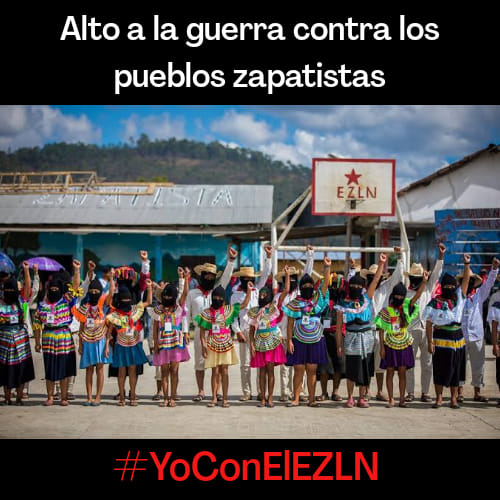
Stop the war against the Zapatista peoples!
Dear Consul General Gómez Arnau,
We write to express our alarm over the growing violence in the Highlands of Chiapas, Mexico; specifically, in the municipalities of Aldama, Chenalhó and Chalchihuitán, where paramilitaries have violently attacked and forcibly displaced thousands of indigenous people from their homes, fields and communities. We are demanding that the Mexican government stop the paramilitary violence, stop any support being given to the paramilitaries and dismantle them.
According to the internationally respected Fray Bartolomé de Las Casas Human Rights Center (Frayba), paramilitary-style civilian armed groups in Chenalhó municipality perpetrate the violence, shooting indiscriminately into the civilian communities where displaced persons are sheltered, often causing them to flee for safety in the mountains, thus leaving them outdoors without shelter and food. In Aldama, for example, bullets fired from Chenalhó injured13-year-old María Luciana Lunes Pérez in the face and shoulder while she was working on her loom inside her home in Koko’, Aldama.
These paramilitary groups also patrol roads and block access to fields so that those displaced cannot grow or harvest their food, creating hunger and the threat of famine in the midst of the novel coronavirus pandemic, as well as preventing the harvesting and sale of cash crops that provide the only income these subsistence farmers have. Meanwhile, deaths and injuries are claimed on both sides.
A troubling photo apparently taken from a video in the local press shows heavily armed men in Chenalhó, dressed in camouflage uniforms, wearing ski masks and sporting high-powered rifles. The video’s release, in which the paramilitaries introduce themselves to society, would seem to assert: “We have impunity!” Further evidence of impunity appeared on social media with the news that 80 residents of Santa Martha (Chenalhó) took weapons and munitions away from a detachment of police in that town and continued to retain the weapons.
Another report from those displaced in Aldama indicated that there have been 30 armed attacks in three days against the people of Aldama, with the gunfire coming from Chenalhó. This shocked readers in Mexico and abroad. These egregious human rights violations must be stopped now to avoid further loss of life and serious bodily injury. Human rights defenders and those displaced are seeking such intervention.
This is a crisis situation that requires the Mexican government’s immediate intervention to dismantle these paramilitaries and repair the damage done to all victims. Mexico’s federal and state governments failed to do this before and after the December 22, 1997 Acteal Massacre in which paramilitaries attacked and murdered 45 women, men and children. Paramilitary violence forcibly displaced thousands in the months before that massacre, as is happening now. Additionally, there is evidence that the current paramilitary group is related to the one involved in that massacre.
The growing paramilitary attacks on Aldama feel eerily reminiscent of the conditions that preceded the Acteal Massacre. And the present reminds us all too painfully of the past. The Mexican government can prevent a greater calamity from taking place by stopping and dismantling the paramilitary violence now.
We, therefore, urge Mexico’s federal and state governments to stop the paramilitary attacks, dismantle the paramilitary group(s) in Chenalhó and begin repairing the damage done to all the victims.
Sincerely,
[We’ll add the signatures as they come in and then send to the Consulate]
CNI-CIG Condemns aggression against Zapatista community and calls for solidarity

To the people of Mexico and the world.
The Indigenous Government Council-National Indigenous Congress condemns the cowardly attack by members of the paramilitary group called the Regional Organization of Ocosingo Coffee Growers (ORCAO), who last Saturday, August 22, around 11:00 a.m., robbed and burned facilities of the New Dawn of the Rainbow Commercial Center, which is located at the site known as the Cuxuljá crossroads, in Lucio Cabañas Autonomous Municipality, within the official municipality of Ocosingo, Chiapas.
The paramilitary organization ORCAO has maintained constant pressure and violence on Zapatista communities for years, as is the case with the Autonomous Municipality of Moisés Gandhi, to prevent autonomous organization, to privatize the lands that have required the struggle and organization of the original Zapatista support bases, to intimidate and threaten the comrades who from below continue betting on hope, such as the various aggressions against comrades of the National Indigenous Congress, who were raped and kidnapped by ORCAO paramilitaries, the Chinchulines and people from the MORENA party.
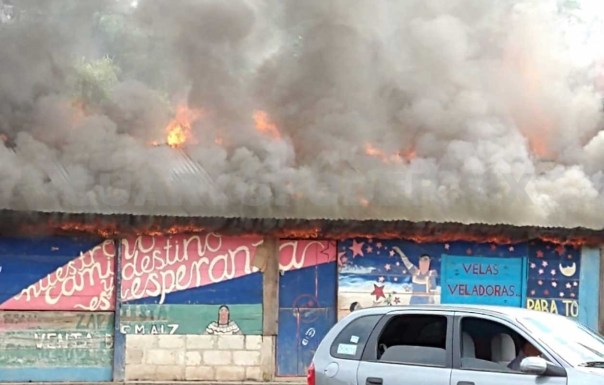
We denounce the war that, from above, is being deployed against the organization of the Zapatista communities, at the same time that the bad governments seek to impose from above, throughout the country, megaprojects of death which we oppose and will oppose, because we are not willing to give up our territories and allow the destruction promised by the powerful.
We hold responsible for these events the paramilitary organization ORCAO, the MORENA party and the state and federal governments, as they have not stopped sowing violence in the region with the aim of striking not only at our sister and brother EZLN support bases in the communities, but at all the peoples who dream of the struggle for life, of healing our Mother Earth and not letting it be privatized, that the capitalist bosses and bad governments never return to the Zapatista autonomous territories, and that this light continues to flourish in the territories of the original peoples of the CNI-CIG and all of humanity.
We call on our comrades in support networks and networks of resistance and rebellion to speak out and mobilize against the war of extermination, which is dangerously intensifying against our sisters and brothers of the Zapatista communities, who teach us to never stop sowing rebellion and hope.
Sincerely,
For the complete restoration of our communities,
Never Again A Mexico Without Us
National Indigenous Congress – Indigenous Council of Government
—————————————————————————————
Originally Published in Spanish by the Congreso Nacional Indígena
Monday, August 24, 2020
Re-Published with English interpretation by the Chiapas Support Committee
High-powered weapons and explosives in the attacks on Tzotziles in Aldama

This photo was taken from a video released to the public in which the Chenalhó paramilitaries introduced themselves.
By: Hermann Bellinghausen
Armed attacks continue against various Tzotzil communities in Aldama municipality, in the Highlands of Chiapas, the same attacks that, being chronic, have sharpened since Friday. Civilian armed groups in Santa Martha, Chenalhó perpetrate the attacks. La Jornada receives constant reports from Aldama about the attacks, both about the origin of the shots and about the “target” populations.
An old boundary conflict over 60-hectares (roughly 148 acres) between Aldama and Chenalhó has derived into a situation where high-powered weapons are fired and explosives are thrown only from one side. However, the official versions suggest that there is a “confrontation between two gangs,” and like the local media, they only give credit to information the Chenalhó municipal government and the Santa Martha groups give, who present themselves as victims of Aldama. This Wednesday, the paramilitary group circulated an unusual video, introducing itself to society.
Nevertheless, according to all the on-site reports, there is a vast operation of harassment, siege and attack against Aldama communities, from which there is no evidence of shooting.
On Tuesday, they reported a death in the center of Santa Martha, whose residents blamed Aldama residents. Allegedly, the federal government intervened to “calm spirits,” according to what Misael Rojas expressed on social networks. Rojas is the spokesperson of the undersecretary for Human Rights, Migration and Population in the Secretariat of Governance, Alejandro Encinas, and accepted the version about a “confrontation.”
Given the real circumstances, considers Pedro Faro, director of the Frayba and an attentive observer of the conflict, it’s very improbable that the indigenous people in Aldama would be able to attack and allegedly kill a person in the center of Santa Martha, where other very disturbing things happen.
This morning, it was distributed in social networks that a group of civilians disarmed the detachment of state police in said community: “a group of 80 residents took away their weapons and munitions. There were a total of 20 weapons, between 5.56 mm long and 9 mm short arms. As of now, the comuneros of the Santa Martha sector maintain the weapons in their possession.”
Meanwhile, at 9 pm on the 18th, the state preventive police withdrew from the community of Tabac (Aldama) due to the constant attacks that the community receives, and the shooting continued at the community, according to what the displaced reported at midnight on the 19th, as well as about the concentration of armed civilians in Santa Martha, once the state police and National Guard withdrew.
According to the local media El Imparcial, confrontation would have been unleashed: “the attacks between both gangs began at midnight this Tuesday, when groups from Aldama attacked residents of Chenalhó, which generated a reaction.” That version of the facts would be from the mayor of Chenalhó, Abraham Cruz Gómez, who demands: “the disarming of Aldama.” Everything indicates that we are faced with a new case where “the ducks shoot at the shotguns.” In another video, the mayor of Aldama, Adolfo Victorio Gómez, desperately demands the presence “of the three levels of Government.”
————————————————————
Originally Published in Spanish by La Jornada
Thursday, August 20, 2020
https://www.jornada.com.mx/2020/08/20/politica/015n3pol
Re-Published with English interpretation by the Chiapas Support Committee
Chiapas burns

Bodegas on fire at the Cuxuljá crossroads.
By: Luis Hernández Navarro
Chiapas burns. The masters of the paramilitaries let go of the reins and, emboldened, they do their thing. They attack indigenous rebel communities with firearms, are given the luxury, as in Santa Martha, of showing themselves with arms and uniforms and disarming state preventive police agents.
Just this August 22, a group of transporters belonging to the a la Regional Organization of Ocosingo Coffee Growers [1] (Orcao, its Spanish acronym) living in the municipality of Oxchuc, headed by Tomás Santiz Gómez, shot, looted and burned two coffee warehouses belonging to Zapatista National Liberation Army (EZLN) [2] support bases, in Cuxuljá community, Moisés Gandhi autonomous rebel municipality (Ocosingo, in official nomenclature).
Cuxuljá is a village at the foot of the highway that that connects San Cristóbal and Ocosingo. Eight autonomous Zapatista municipalities surround it and it’s the crossroads for different communities. The Army occupied it until 2001. The soldiers withdrew from that position in order to comply with the three signals that the EZLN demanded from the government of Vicente Fox to re-establish the dialogue.
The withdrawal of the troops did not “pacify” the zone. As soon as the dialogue failed, due to the approval of the constitutional reform on indigenous rights and culture that did not fulfill the San Andrés Accords, aggressions of the Orcao paramilitary group began against the rebel bases in that community. Its objective was to occupy the territory the troops vacated left.
The Orcao wasn’t always like that. For some years it had a close relationship with Zapatismo. However, it broke this tie between 1997 and 1999, and its leadership began to dispute the rebel social base, with economic support and positions in the government for its leaders. With the arrival of the state government of Pablo Salazar (2000-06), the conflict escalated. In 2002, the coffee growers aggressions against as Zapatista bases intensified dramatically, to the point of destroying an insurgent mural. It became a paramilitary force.
The Orcao formed in 1988, with 12 communities in Sibacjá, in the municipality of Ocosingo. Soon after, other towns joined until adding up to almost 90. It’s original demands consisted of both the search for better prices for coffee (in 1989 they fell drastically) and a solution to the agrarian backlog. Influenced by progressive pastoral work, in 1992, in the context of the commemoration of 500 years of indigenous, black and popular resistance, it vindicated indigenous self-determination, opposed the reform to Constitutional Article 27 and demanded liberty, justice and democracy (https://bit.ly/3goUvWS).
However, it suffered an unstoppable decomposition. It was practically expelled from Unorca in 2015. Internally divided, two groups fought over its leadership, the José Pérez group, linked to the Greens and to the control of control of passenger transport, and the Juan Vázquez group, the commissioner for reconciliation in the Juan Sabines government, more oriented to the productive. Allied with the rotating governments, its leaders have enjoyed, for their personal benefit, positions in public administration. Many of them were part of the PRD, the PVEM and now of Morena.
There is a long history of Orcao attacks against Cuxuljá. As a result of the armed uprising, the EZLN support bases (a collective group of 539 campesinos) were benefitted with 1,433 hectares expropriated from finqueros (estate owners). They have a “delivery-receipt of land certificate” from the Agrarian Reform Ministry.
The Zapatistas work the land collectively and refuse to parcel it out individually. They say that doing so would be like returning to 1994. However, a small group from the Orcao who abandoned the community and sold their houses, originally supported by the Army and police, has insisted for 19 years on subdividing the property, obtaining certificates and selling individually what is the product of a common struggle.
Orcao’s attacks against the EZLN’s support bases have been a constant. They are not limited to Cuxuljá, but rather encompass several municipalities. The last one took place last February 23 in Chilón, when Orcao, los Chinchulines and members of Morena violated and kidnapped community representatives, in retaliation for participating in the Days in Defense of Territory and Mother Earth We Are All Samir (https://bit.ly/3leg3cs).
These aggressions have been carried out regularly, within the framework of government offensives to try to weaken Zapatismo and contain its advance. They are not the product of inter-community fights, but rather the result of a strategy of the State fabricating internal conflicts. The governments in turn (even the current one) support the Orcao with economic resources, productive projects (many of them cattle projects), political cover and police impunity, to try to erode and wear down the EZLN.
Just a year ago, the rebels announced the creation of seven new Caracoles in addition to the five existing ones, giving them a total of 43 self-government bodies, unrelated to official government bodies. Additionally, they have announced their rejection of the Tren Maya and the Interoceanic Corridor. The new battle of Cuxuljá and the non-stop war of the Chenalhó paramilitaries are part of a containment strategy against that advance of Zapatismo; a strategy that doesn’t seem to worry about setting the state on fire.
[1] Organización Regional de Cafeticultores de Ocosingo (Orcao)
[2] Ejército Zapatista de Liberación Nacional
———————————————————–
Originally Published in Spanish by La Jornada
Tuesday, August 25, 2020
https://www.jornada.com.mx/2020/08/25/opinion/017a1pol
Re-Published with English interpretation by the Chiapas Support Committee
 Chiapas Support Committee