Chiapas Support Committee
Home of the Compañero Manuel blog on zapatistas & mexico
Frayba suspends observation in Nuevo San Gregorio
Death threats against national and international observers and obstruction of Frayba human rights defense work
Bulletin No. 22
San Cristóbal de Las Casas, Chiapas, Mexico, June 29 2022
The absence of the Mexican State puts at risk the life and integrity of people who are defenders and autonomous communities who defend land and territory
Since November 2019, the Nuevo Poblado San Gregorio (Nuevo San Gregorio) community, territory recuperated in 1994 by the Zapatista National Liberation Army (EZLN, Ejército Zapatista de Liberación Nacional), has been constantly attacked by part of a group of people coming from communities surrounding the San Gregorio ejido, Ranchería San Andrés Puerto Rico, Ranchería Duraznal and Ranchería Rancho Alegre, who have dispossessed about 155 hectares that are part of the collective territory of the Lucio Cabañas Zapatista Rebel Autonomous Municipality, of Caracol 10 “Flowering the Rebel Seed,” of the Good Government Junta “New Dawn in Resistance and Rebellion for Life and Humanity” in Chiapas, Mexico. The Fray Bartolomé de Las Casas Human Rights Center (Frayba) has documented and denounced the aggressions, attempted forced displacement and territorial dispossession of the Zapatista autonomy process to the three levels of government.
On March 3, 2021, a Civilian Observation Brigades (BriCO, Brigadas Civiles de Observación) camp was installed in the community. So far this year, the brigades documented 21 attacks against 5 families (27 people) who live in Nuevo San Gregorio, which range from intimidations to death threats, sexual violence and torture, as well as physical attacks, stealing cattle and destruction of property; cutting off water, surveillance and obstruction, control of and charging for free transportation, as well as kidnapping people. The territory has been fenced off with barbed wire, denying the right to a dignified life, food, health and education.
The threats, harassment and intimidation by the group of people are added to the Mexican State’s failure to address this situation despite having been informed of the events from the Frayba. This fact aggravates the risk to life, security and integrity of the population, as well as of the BriCO observers, who have been the target of threats in recent weeks.
For two weeks, the aggressor group has increased its dispossession actions and articulated serious threats against the BriCOs. On June 10, 15 and 19, 2022, the brigades again registered attacks that put at risk the life, security and personal integrity of the BAEZLN [1], as well as the risk of forced displacement of the entire community and grave violations against the right to free travel in the region. Like the kidnapping, mistreatment and extortion that occurred last June 19, of a crane and its personnel contracted by the El Puente organization for a period of 7 hours. The UN Special Rapporteur on the rights of indigenous peoples and the Special Rapporteur on the human rights of internally displaced persons have been informed of this situation, as well as the embassies whose citizens are in the community. Even so, the three levels of government keep a deathly silence in the face of the events.

Faced with this situation in the Frayba, we made the decision to suspend the observation camp in Nuevo San Gregorio, seeking to protect the life and integrity of national and international observers.
In 28 years of the BriCOs work, we have rarely had to suspend observation camps due to threats and the serious life-threatening situation of the observers. The Mexican State does not protect the right to defend human rights, despite having signed and ratified the United Nations Declaration on the right and duty of individuals, groups and institutions to promote and protect human rights and universally recognized fundamental freedoms.
This context puts the Autonomy and Self-Determination of the Peoples at risk, as well as the work of the defense and promotion of human rights that we carry out from the Frayba. However, we will continue pointing out these criminal acts that link to human rights violations, and also persist in meeting with the corresponding mechanisms for the defense the fundamental rights, so that the federal and state governments wake up and act effectively against aggressor groups that proceed with criminal acts in the face of what is now a permanent impunity and is deepening.
From the Frayba we will continue documenting and denouncing the situation of the BAEZLN in Nuevo San Gregorio and demanding that autonomous territories be respected, which is why we call on national and international civil society to a speak out for life, for the defense of territory, for the security and personal integrity of the community’s inhabitants and strongly demand that the Mexican State fulfill its obligation to guarantee and protect the work of defending human rights.
[1] BAEZLN – the letters in Spanish for EZLN support bases (bases de apoyo del EZLN).
==Ω==
Originally Published in Spanish by Frayba, Wednesday, June 29, 2022, https://frayba.org.mx/amenazas-de-muerte-contra-observadores-nacionales-e-internacionales/ and Re-Published with English interpretation by the Chiapas Support Committee
The military operation: kill and disappear
As Mexico begins to open its archives on the “dirty war,” Abel Barrera Hernández describes some of the Mexican Army’s counterinsurgency operations
By: Abel Barrera Hernández*
During the “dirty war” (1965-1990), repression in Guerrero was systematic and generalized. The report Truth Commission of the State of Guerrero (Comverdad, its Spanish acronym), which was presented recently in Acapulco, reports with great detail that the Army’s atrocities were not casual or isolated repression. It responded to the State’s policy that had as its express objective exterminating the guerrilla, destroying the rural and urban communities where the groups settled and found shelter for their supplies. The search they carried out in the most rugged regions was to arrest, torture and disappear the men, women and children they found on the roads and in the villages. It was about clearing the lands sown with rebellion. They slashed the precarious productivity of the fields so that the scarce food the families consumed would not be enough for the guerrilla. Starvation was part of the extermination. No one could move food out of the community. Whoever dared would no longer wake up in the town.
Federal and state authorities, instead of addressing the causes of the rebellion, submitted to military power. They left public security in the hands of bloodthirsty generals and allowed the military zones to become centers of torture, executions and disappearance of people. The president of the Republic left the strategy for suffocating the social and armed uprising in the hands of the Secretary of National Defense. They used all the economic resources, occupied the best military equipment to transfer it to the Sierra de Guerrero. They Commissioned special forces trained to kill and concentrated a large number of soldiers from other states, to enter the territories where the population lives in extremely precarious conditions.
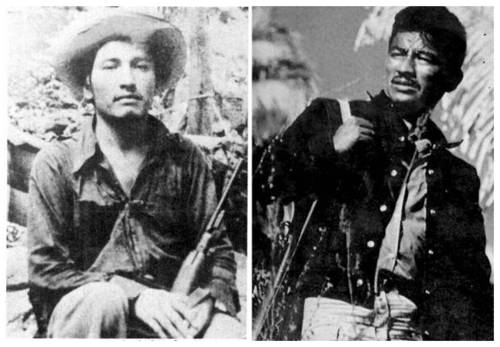
The anti-guerrilla military operations were rigorous: to kill and disappear the armed groups and their support networks. Because of living in places where the guerrilla operated, people were victims of illegal detentions; they suffered torture so that they would confess where to find the armed men. Due to mere suspicion, some were disappeared and executed. “Guachos” was the nickname that the soldiers earned for their quarrelsome and cowardly attitude. For the damage they caused. For their rapacity. For arresting and killing innocent people. The first and last names of the guerrilla leaders were compelling reasons for the guachos to arrest entire families. In addition to torturing them, they looted homes, displaced them and in some cases, disappeared the heads of family. They sought to uproot the guerrilla; however, the families that carry in their veins the ideal for which their husbands and sons fought, maintain the indelible mark of their lineage. Today, they resist and remain in their homelands in search of individual and community reparations. 50 years after this abominable repression, they maintain the demand for justice.
The anti-guerrilla military operations were rigorous: to kill and disappear the armed groups and their support networks. Because of living in places where the guerrilla operated, people were victims of illegal detentions; they suffered torture so that they would confess where to find the armed men. Due to mere suspicion, some were disappeared and executed. “Guachos” was the nickname that the soldiers earned for their quarrelsome and cowardly attitude. For the damage they caused. For their rapacity. For arresting and killing innocent people. The first and last names of the guerrilla leaders were compelling reasons for the guachos to arrest entire families. In addition to torturing them, they looted homes, displaced them and in some cases, disappeared the heads of family. They sought to uproot the guerrilla; however, the families that carry in their veins the ideal for which their husbands and sons fought, maintain the indelible mark of their lineage. Today, they resist and remain in their homelands in search of individual and community reparations. 50 years after this abominable repression, they maintain the demand for justice.
The Comverdad report and its three annexes show the radiography of the horror, the cartography of the violence that the Army perpetrated, the testimonies of survivors and family members who overcame the ravages of war. They are an example of honor and toughness in the face of infamy and insolence of the authorities for the crimes of the Army.
The Plan Telaraña (Spiderweb Plan), applied in March 1971, is part of a counterinsurgency scheme used in Guerrero for the purpose of gaining the will of the civilian population to later attack contra insurgent groups. General Hermenegildo Cuenca Díaz, the Secretary of National Defense, announced it among yjr troops, but asked for secrecy in its application. The central component was to reactivate the economy through infrastructure works; provide medical care and promote literacy campaigns. With the Army as a benefactor agent, it sought to take the flags away from the guerrilla movement, classifying it as criminal. This work would be accompanied with espionage to provide information on the guerrilla presence and combat it.
The military forces in charge of operating this strategy were the 27 and 35 military zones, in co-ordination with the commands of the adjacent territorial jurisdictions. Social work with the civilian population that involved public agencies of the State providing direct benefits to poor families was key. They cast the hook so that military action would enter; however, it was a failed attempt. The Army didn’t know that the population maintains a code of ethics that will always defend the rights of collectivity. It will not betray its people for a kilo of sugar. Faced with this failure, the Army acted against the same population because it never imagined that justice is a widespread demand.
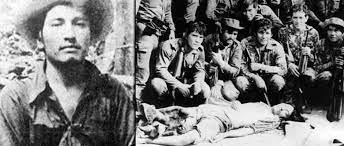
The Spiderweb Plan mobilized against the guerrilla at least 2, 236 soldiers; 2, 115 troop members, grouped together in 77 military parties (partidas), as well as 105 officers and 16 chiefs and an undetermined number of rural defenses. It had the support of three helicopters from the Attorney General Office. The action started on April 29 and 30, 1971, to comply with the express orders of the Secretary of Defense and the supreme chief of the armed forces, Luis Echeverría Álvarez. In this first stage of the Spiderweb Plan, the president declared: “they must be sure that we will defend our democracy from any interior or exterior aggression.” For his part the Secretary of Defense declared: “guerrillas don’t exist in Mexico… military intelligence investigates to prevent subversive elements from carrying out agitation anywhere in the country.” In addition to applying the Spiderweb Plan in six stages combined with a tracking plan, the Army applied the Fan Operation (Operación Abanico), to carry out encircling movements to corner enclose, and eliminate the guerrilla group headed by Genaro Vázquez Rojas. Despite Operation Rabbit Hunt, the Army was very far from achieving its objective of winning the population’s trust and cornering the guerrilla.
The Army was founded on supreme power that had no limits or controls for exterminating the guerrilla movement. The president of the Republic gave it all the economic and logistical support for turning the state of Guerrero into a counterinsurgency laboratory. After the passage of 50 years, impunity reigns with the militaristic strategy of killing and disappearing, as has happened with El Charco, Tlatlaya and the 43.
* The author is the Director of the Human Rights Center of the Mountain-Tlachinollan
==Ω==
Originally Published in Spanish by La Jornada, Tuesday, June 7, 2022, https://www.jornada.com.mx/2022/06/07/opinion/020a1pol and Re-Published with English interpretation by the Chiapas Support Committee
Oxchuc: Faced with a complicit state that fosters impunity
[*An update from La Jornada on the situation in Oxchuc follows this opinion piece]
By: Magdalena Gómez
An ominous week closed for Chiapas and the entire country with the deployment and confrontation of criminal groups with high-powered weapons in the northern zone of San Cristóbal de las Casas on June 14, in a violent dispute over control of the Supply Center (Central de Abastos) and a public market. All of this occurred in the several hours that it took for National Guard and police forces to arrive. The specific gangs and cartels are public and known to the citizens, with a range of official alliances that act with the overt impunity and complicity, in fact, of the three orders of government. All the while, they sow social fear, at present paralyzing, except in isolated and clearly limited groups, which undoubtedly favors the State. These facts were widely denounced and censored in networks and some media inside and outside the country.
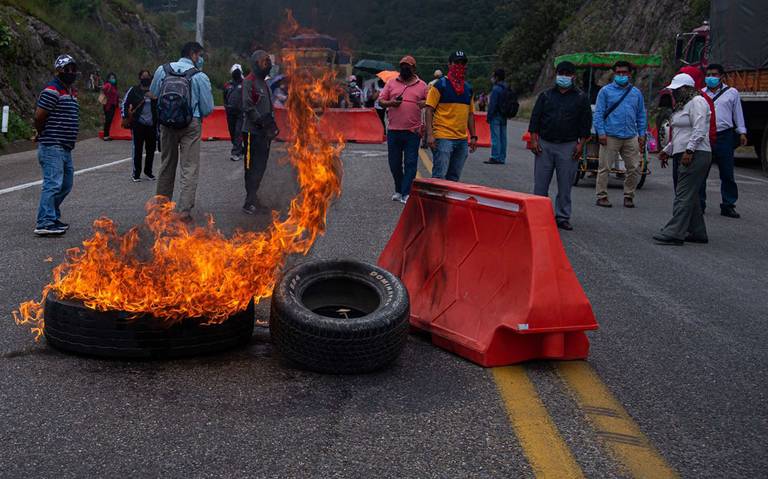
The same did not happen with the June 18 attempt in Oxchuc to carry out special elections in their municipality, under the system of usos y costumbres (uses and customs), whose very predictable results will be those of a new suspension, annulment and postponement of the process, motivated by the violence, also armed, which did not stop in many of the communities that would participate.
Why is it important to focus on Oxchuc? The municipality suffered under the political bosses (caciques), among others, of María Gloria Sánchez Gómez and her family, with a history of conflicts and aggressions. Even when she was removed from office, the Electoral Tribunal ruled in her favor. For all these reasons, it is worth remembering that today it is the only municipality in the state of Chiapas that achieved recognition of elections under its normative systems outside of political parties. A struggle of almost three years before the electoral courts were deployed through the Permanent Commission for Peace and Justice of Oxchuc which initially rejected their proposal for self-determination and in which they finally achieved approval. After INAH’s elaboration of a cultural survey that accounted for the historical existence of an internal normative system, and, following that, a consultation was organized, from November 27 to December 28, 2018, and on January 5, 2019, its results were reported: the community assemblies of indigenous consultation, out of the 116 communities, 59.18 percent, were in favor of the usos y costumbres system; while 38.40 percent were in favor of the continuation of the political party system. The decision arising from the free, prior and informed consultation process was formalized by the General Council of the Institute of Elections and Citizen Participation of Chiapas (IEPC). Based on this, authorities were elected for a three-year term.
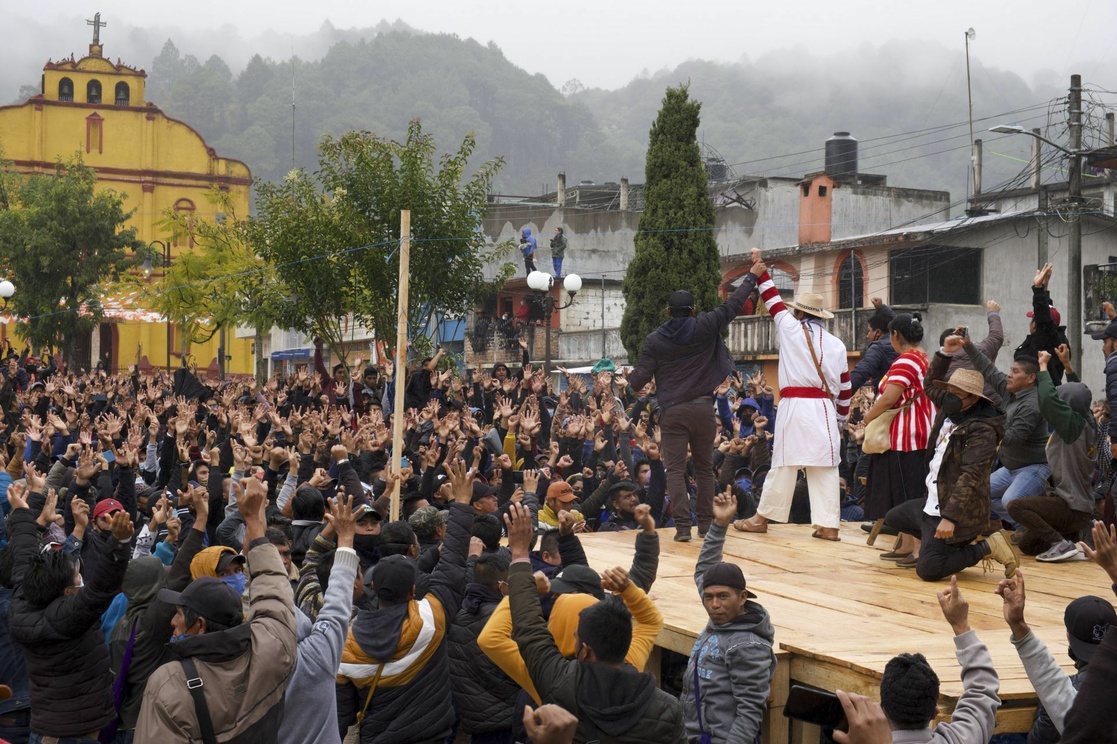
It’s worth remembering that last December 15, 2021 in the municipality of Oxchuc, the election process for its municipal authorities was initiated under the internal normative system (2022-2024), but that election was suspended due to unfortunate violent acts, such as roadblocks, house burnings, detention of vehicles and people, injuries and one death. Subsequently, the IEPC of Chiapas determined that the process had not concluded. Therefore, the exercise could not be validated. Meanwhile, the state Congress appointed provisional authorities who showed no interest in promoting the pending election. Once again, the protest had to be organized before the IEPC, which determined that it was up to the community authority to carry it out. This exercise of June 18 once again experienced violent actions to sabotage its conclusion and recognition.
We ask ourselves: what is the common thread that unites the events of June 14 and 18? In the first case, the actions of organized crime groups, in the second, local cacique power groups allied with a political party that have made abuse and dispossession their modus operandi. In these and other serious cases happening in other regions of Chiapas, these two factors connect and are unified in networks of governmental complicity that by default fail to comply with the obligation to guarantee the rights of citizens, indigenous or not. With respect to the rights of indigenous peoples, there is no known intention to take them seriously and to consider their fulfillment, because that would require reversing the axes of the so-called Fourth Transformation.
At the moment of Oxchuc’s triumph, the federal government, through the National Institute of Indigenous Peoples (INPI) was present, in all its Tseltal costume, to recognize a result that did not cost them any effort or struggle. Now, in the face of this violent siege and disregard for their rights, no statement has been issued since December 15 and subsequent months.
It is hard to accept the profound truth full of wisdom from a young Tseltal who told me: “Every law is only written on paper and is never carried out as it should be.”
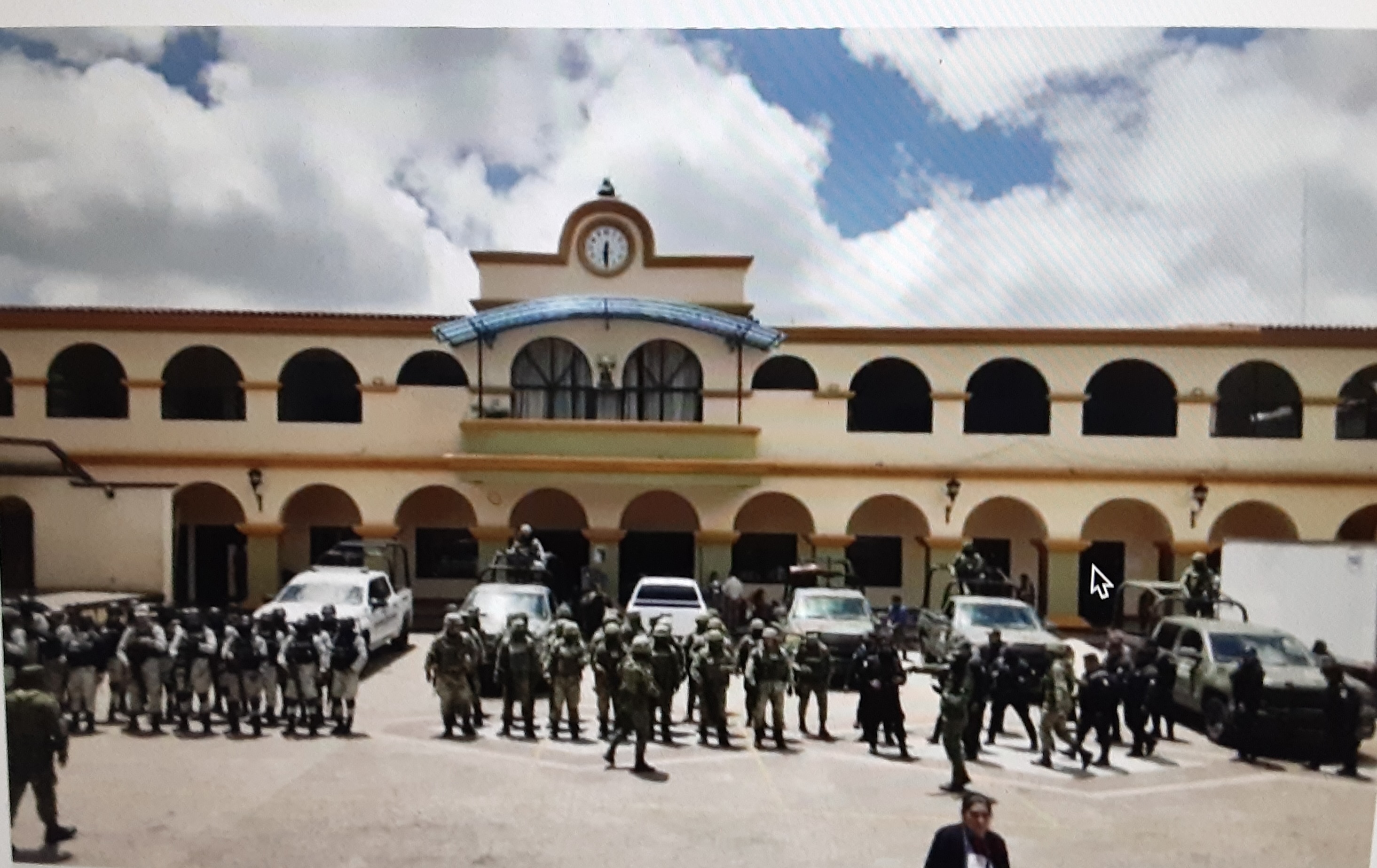
*Update: As of June 24, some 300 members of the Mexican Army, National Guard and state police are patrolling the city of Oxchuc, the municipal seat, as well as the surrounding roadways. https://www.jornada.com.mx/2022/06/25/estados/027n4est
==Ω==
Originally Published in Spanish by La Jornada, Tuesday, June 21, 2022, https://www.jornada.com.mx/2022/06/21/opinion/017a1pol with English translation by Schools for Chiapas and Re-Published by the Chiapas Support Committee
Mexico’s criminal industry

By: Raul Romero*
The official narrative imposed on Mexico around drug trafficking and the war on drugs has generated a series of confusions in Mexican society that must be cleared up in order to understand the problem we are facing. A first phenomenon to be clarified is the fact that drug trafficking is only one of the businesses of a criminal industry that, in addition, is transnational. According to the United Nations Office on Drugs and Crime, transnational organized crime is characterized by operating in more than one State and includes more than 20 businesses, including extortion, kidnapping, illegal trafficking in arms, people and natural resources, and drug trafficking, among others.
One key business, as it is one of the contact points between the legal and the illegal, is money laundering: it is here where the resources generated in the criminal industry businesses, and others such as corruption and tax evasion, are laundered to be inserted into the financial systems. For this to happen, a complex web develops between criminal corporations, bankers, politicians, law enforcement, government and financial institutions.
As in other businesses, the criminal industry is made up of corporations, known as cartels. Criminal corporations compete with each other for territory, for branches of their industry, for markets, for communication channels and media, and to expand their influence in other businesses. An example of the latter is the participation of these groups in huachicol (Santa Rosa de Lima), in mining (Caballeros Templarios), in avocado (Jalisco Nueva Generación cartel) or as paramilitaries as a form of surrogate repression (Zetas). In this competition for the control of markets and territories, criminal corporations not only confront each other with their private armies, but also have their allies in the municipal, state and federal security forces, who make or allow them to wage war. The populations that inhabit these territories directly experience the terror of war: assassinations, forced disappearances, forced recruitment… On occasion, they also form alliances with other national or transnational corporations to confront common enemies or to increase their profits.

It was the process of neoliberalization that facilitated the expansion and diversification of these industries’ businesses. Organized crime was also globalized. Weapons produced in Germany reached Mexico, the money of Mexican criminal corporations reached Panama, Switzerland and other tax havens. Poppy harvested by Mexican peasants arrived in the United States in the form of heroin, and chemicals from China are used in Mexican laboratories to produce fentanyl, which is consumed in the neighboring country to the north and increasingly in Mexico.
There are also social classes in the criminal industry. At the top of the pyramid are those who are referred to as white-collar criminals, those who apparently have nothing to do with it, but who are the main beneficiaries. Likewise, the nouveau riche emerged, such as the one who offered to pay the country’s foreign debt if he was freed. [1]
The impoverished sectors are those who perform the jobs of production and distribution, and those who fill out the private armies. Many of the jobs performed by these sectors are carried out through violence, pressure or extortion: indigenous and peasant communities are forced to change their traditional crops for marijuana or poppy. Women are kidnapped and forced into prostitution and production of pornography. Children and adolescents are recruited to do surveillance or scouting work. There have even been cases of kidnapping groups of masons or engineers for the construction of infrastructure and communication systems. The renting of children for illegal human trafficking, or the use of bodies -mainly women- for international drug trafficking, are part of these contemporary forms of slavery.
Criminal corporations also have influence and control over sectors of the administrative apparatus of the Mexican state. Whether financing campaigns, imposing their own members as governors or assassinating candidates or governors, criminal corporations intermingle with political power to guarantee protection, impunity and also the allocation of portfolios. For a better example, the Genaro García Luna case, [2] but it’s not the only one.
Much more could be written about it, such as the patriarchal nature of the criminal industry or the cultural market that has been formed in this regard. Contrary to what many claim, criminal corporations are not a market failure or anomaly, but a consequence of a system that commodifies everything. The problem is neither new nor local, it has been developing for decades and it would be worthwhile to observe with this perspective the place of the criminal industry in the national and global economy. The solution is neither near nor simple, but there are alternatives. Of that there is no doubt.
* Sociologist. @RaulRomero_mx
Notes
[1] Rafael Caro Quintero, of the Guadalajara Cartel, after his arrest in 1985, was rumored to have offered to pay Mexico’s foreign debt (at the time 8- billion dollars) for his freedom.
[2] Genaro García Luna, the former Mexican Secretary of Public Security from 2006-2012, was arrested in 2019 for taking millions of dollars in bribes from the Sinaloa Cartel during his term in office.
==Ω==
Originally Published in Spanish by La Jornada, Saturday, June 18, 2022, https://www.jornada.com.mx/2022/06/18/opinion/015a1pol English Translation by Schools for Chiapas and Re-Published by the Chiapas Support Committee
Aldama and Chenalhó sign second conciliatory agreement

The conflict now has two conciliatory agreements between the parties. Nevertheless, the situation in the region has not been noticeably different.
By: Yessica Morales
On June 14, 2022, the three levels of government and authorities from the municipalities of Chenalhó and Aldama signed a conciliatory convention to reach a definitive solution to the agrarian conflict that originated more than 40 years ago and thereby achieve pacification among both localities.
The relationship between Aldama and Santa Marta was not conflictive in the past. Because they share a neighborhood and for several years, there were marriages between members of both towns. In addition, the patron saint fiestas were a reason for mutual visits.
It’s important to remember that the town of Santa María Magdalena, which changed from the name Aldama after its re-municipalization in 1999, together with Santa Marta, Santiago El Pinar and San Andrés Larrainzar, share a micro coffee growing region.
These towns have been united in history, since times before the Colonial Era. During the 18th century, their communal territories were privatized by Ladino ranching families, leaving their population subjected to peonage relationships.
In 1974, they decided to carry out joint actions and massively recuperate their territories, thus expelling the Ladino ranchers. In those years, topographers in the Agrarian Reform Secretariat (SRA) who made up the “Chiapas Brigade,” carried out technical work to resolve agrarian problems in the region.
After the expulsion, the strategy the SRA used for the confirmation and titling of the commons was the recognition of acts of dominion, without a forceful value to the documents. Where the Secretariat recognized the Communal Assets of the peoples, but the strategy to which it resorted left agrarian conflicts.
Santa Marta obtained recognition and titling of communal assets in August 1975, with the official name of “Manuel Utrilla.” However, the limits that the SRA marked off were challenged by Santa María Magdalena, which alleged that a part of their ancestral territories had been granted to Santa Marta, sowing a conflict that has cost more than a dozen lives.
The SRA attempted to resolve the error with acts of conformity agreements, but with the passage of years these were ignored. In 2000, through the Program of Certification of Ejido Rights and Titling of Urban Plots (PROCEDE), Santa Marta achieved obtaining its definitive plan, keeping the disputed lands inside its territory, of which twenty hectares are planted with coffee.
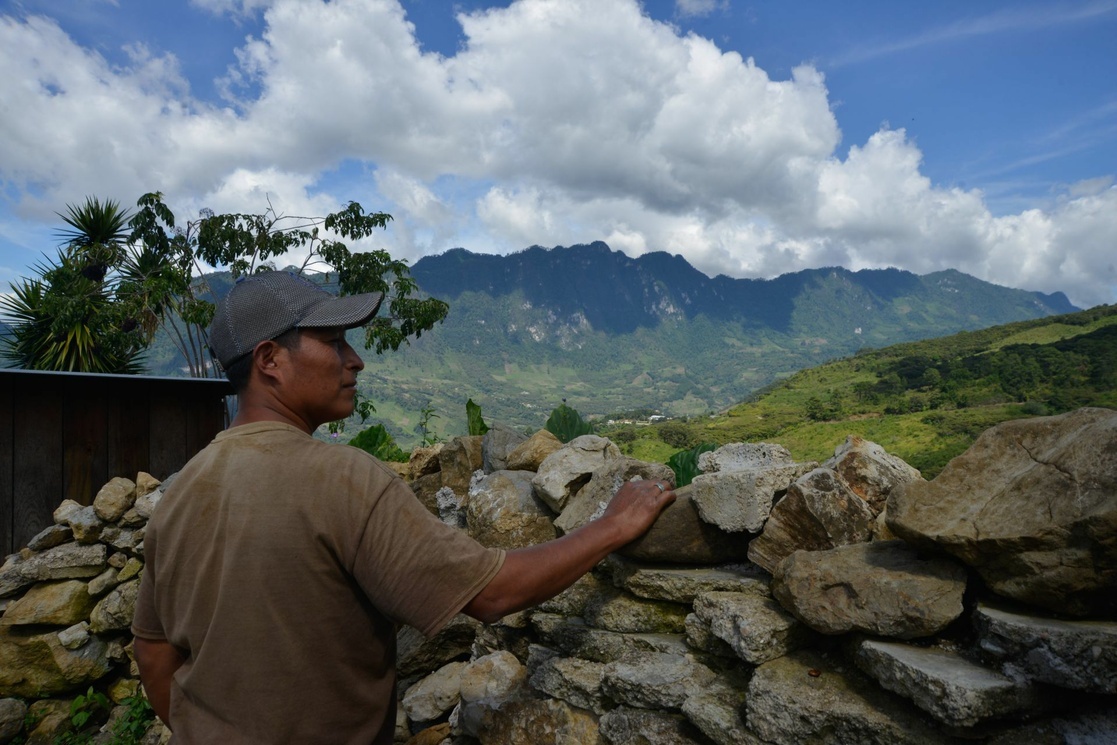
Federal and state officials witnessed the agreement event, in which Victoria Cecilia Flores Pérez, Secretary General of Government, recognized the work of institutions that have labored for peace and reconciliation, and a dignified life in the indigenous towns of Chiapas.
It’s time to celebrate and to re-commit ourselves, because this work is forever and those of us who are authorities have the obligation to be pending day by day, so that peace continues to be built and seeing these results, said Flores Pérez, after the signing of the document with which legal certainty will be given to possession of the land and will allow resolving the controversy generated by the dispute of 59.5 hectares.
Likewise, Angelina Díaz Méndez, municipal president of Aldama; Alonso Pérez Sántiz, uses and customs president of Aldama; and Abraham Cruz Gómez, mayor of Chenalhó, thanked the General Government Secretariat for support to advance in resolving this controversy.
==Ω==
Originally Published in Spanish by Chiapas Paralelo, Wednesday, June 15, 2022, https://www.chiapasparalelo.com/noticias/chiapas/2022/06/firman-segundo-convenio-conciliatorio-para-la-solucion-definitiva-entre-aldama-y-chenalho/ and Re-Published with English interpretation by the Chiapas Support Committee
Chiapas, endless violence

By: Luis Hernández Navarro
Panic and anxiety. Those words sum up what thousands of residents of San Cristóbal de las Casas experienced for hours last June 12, when dozens of armed civilians, masked and wearing bulletproof vests, fired Kalashnikov and AR-15 rifles, blocked avenues and streets with double-wheeled trucks and painted walls, disputing control of the city’s North Market. They sought to remove remover its eternal administrator, Domingo Pishol, representative of Hugo Pérez, self-proclaimed mayor of Oxchuc.
With the sound of the first volleys, the people had to take cover or throw themselves on the floor in stores, schools, clinics and businesses, fearful that some projectile would hit them. Gunshots are a frequent thing in that part of the city but this time they had an unusual intensity.
The existence of criminal groups in Chiapas isn’t new. It began to grow during the governorship of Juan Sabines (2006-12). But in recent years, in large areas of the state zonas their presence and their disputes over territories, routes and markets have intensified. Guatemala is an immense warehouse at the service of the criminal industry. Drugs, weapons, piracy, human beings, and stolen vehicles come from there, through the porous Chiapas border, towards the United States and different regions of Mexico.
Controlling the border and the roads is essential to moving merchandise. The Frontera Comalapa, Comitán, San Cristóbal, Tuxtla Gutiérrez corridor has acquired great importance in the shipment of drugs.

A couple of examples, among many. In July 2021, the Cartel Jalisco Nueva Generación (CJNG), now in dizzying expansion in the state, executed “El Junior,” son of a Sinaloa Cartel leader, in Tuxtla Gutiérrez, Chiapas. The dizzying expansion of the Chamula Cartel, evidenced by the permanent accidents of vehicles loaded with Central American migrants and the broadcasting of their narcocorridos.
San Cristóbal is no stranger to this war. Like other tourist spots, such as Cancun or Acapulco, it’s an enclave desired by organized crime. In that city, with impunity, at least five known groups (some say there are eight), such as the “motonetos” or “motopandilleros,” linked to narcomenudeo (local drug dealing), charge a fee for protection, steal, murder and fire gunshots into the air, sowing terror and uncertainty. They emerged as a shock group during the administration of Marco Antonio Cancino González (2015-18), of the PVEM. His brother Sergio Natarén controlled them. The battle for control of the North Market last June 12 is part of this scheme in the state and in the coleto [1] city.
A key figure in this scheme is Martín Pale Santiz, alias El Gemelo, leader of the Coordinator of Organizations for the Environment for a Better Chiapas (Comach), with tight relations with the state government, one time arrested for extortion and then released. His agents are capable of strangling San Cristóbal, blocking highway accesses, while confronting other groups with firearms and sticks. They’re also capable of evicting and beating up families of Santa Catarina (a district of San Cristóbal), members of the Popular Campesino Front of Chiapas, in order to dispossess them of five hectares (https://bit.ly/3n3Fmjm). With the support of Gerónimo Ruiz Sántiz, el Moshán, they charge around 800 thousand pesos a week to some 1,200 street vendors (whom they control) on the Plaza de la Paz (Peace Plaza), the Andadores, [2] Santo Domingo and the Historical Center.
One person was murdered in the operation: Xalik. It was reported that he had been “reached” by a stray bullet. Civilian defenders in San Cristóbal point out that the deceased was a young Tsotsil who was openly opposed to the recruitment of boys to make up armed groups in Chamula. “This man was very young and had separated from his lineage clan, distancing himself from those dynamics that now impregnate many Chamula families. But not just that. He dedicated himself precisely to organizing the street children and especially those who walk around in that area’s market.” A very convenient death for some people.
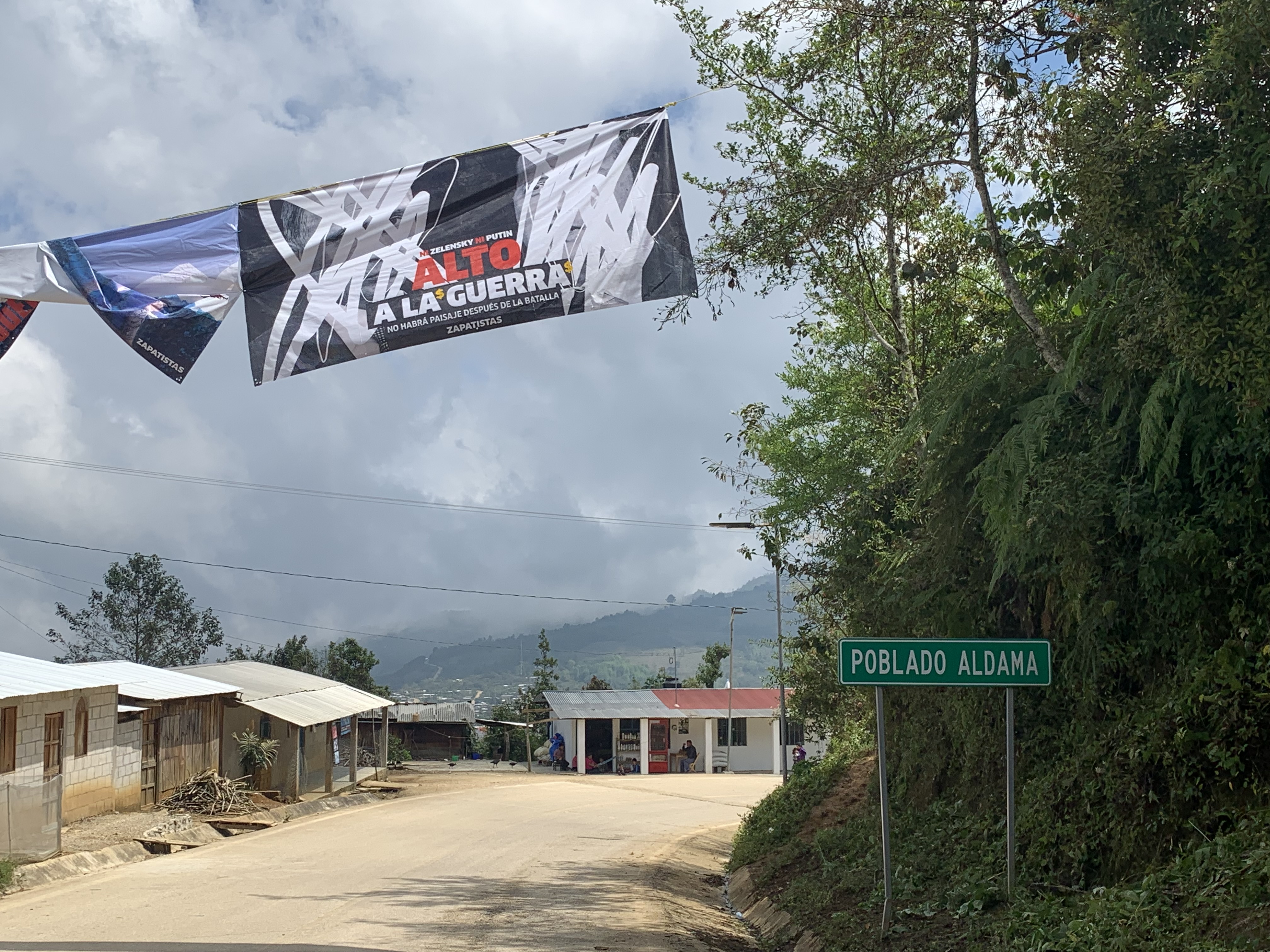
The partial “taking” of the city is just one more incident in an interminable chain of violence that shakes the state. Last June 8, just 30 kilometers from San Cristóbal, the mayor of Teopisca, Rubén de Jesús Valdez Díaz, was murdered in a truck outside his home.
The list of aggressions is endless. According to the Fray Bartolomé de las Casas Human Rights Centro (Frayba), during March of this year alone, 437 attacks with firearms were recorded against the Aldama community by the narco-paramilitaries from Santa Martha, Chenalhó.
Likewise, attacks have intensified against Zapatista support base families in Nuevo San Gregorio autonomous community that puts their lives, security and integrity at risk.
Within this context, the San Cristóbal de las Casas Diocese and other organisms made a joint statement in the face of unstoppable increase of violence in Chiapas, in which they express their “concern about the presence of strongly armed groups in the territory.”
They also state their “concern about the constant attacks, persecutions and vigilance of human rights defenders in our country and in Chiapas, principally those who defend land and territory.”
They denounce that last May 29, Manuel Santiz Cruz, an indigenous Tseltal, president of the Human Rights Committee of San Juan Evangelista parish, in San Juan Cancuc municipality, along with another four individuals were arbitrarily deprived of their freedom. (https://bit.ly/39D6G53)
Fear and uncertainty. In Chiapas, the violence, far from stopping, grows and intensifies. Let no one call it a “surprise when what’s going to happen happens.”
Notes
[1] Coleto is a local term in Chiapas that refers to San Cristóbal de Las Casas residents who claim to be of Spanish ancestry; in other words, not mestizo. They are also referred to as “authentic coletos.”
[2] Andadores are passageways for walking between buildings. In San Cristóbal, specific streets are dedicated for walking only. No vehicles. Street vendors walk these streets in shopping areas selling their merchandise.
==Ω==
Originally Published in Spanish by La Jornada, Tuesday, June 21, 2022, https://www.jornada.com.mx/2022/06/21/opinion/018a1pol and Re-Published with English interpretation by the Chiapas Support Committee
Thinking and acting from heterogeneities
By: Raúl Zibechi
La homogeneity of collective subjects was nothing more than an impossible dream of critical thought, which today is questioned by reality. The effort to standardize the popular field led to the politics of unity that ran through unions, diverse social organizations and the party, because was thought to be key to the conquest of the State.
From his earliest works, such as the Communist Manifesto (1848), Marx worked on the idea that society would divide more and more into two opposing camps and that each one would be homogenous, because they would defend common interests that prevailed over “secondary contradictions,” as Mao baptized them.
Marx considered that “the conditions of existence of the proletarians are becoming more and more equal,” due to the industrial development that plunges them into poverty, but he also believed that “only the proletariat is a truly revolutionary class.” The rest tend to disappear or are reactionary, as he thought the peasantry was.
But if these ideas were unjust, less so would be the application of certain “principles” derived from them in political action.

They thus appeared “unique” centrals, as the CUT of Brazil and Chile, among others, and even the “unique” campesino central of Bolivia, the CSUTCB. There are hundreds of “unique unions” per branch, each of which embodies “unity.”
These concepts of unity and unique embody an express will to exclude and flatten the diverse, everything that is not subordinate to a strategy that needs homogeneous collective subjects. Because it is assumed that the unity carved out of homogeneity permits powerful subjects to exist, who are capable of taking power and imposing the hegemony of the revolutionary camp.
Then happens what happens: it hides a leadership that represents unity and ends up usurping the role of the popular sectors that it claims to represent. Until that bud from above becomes a new dominant class, or however you want to call the likes of Putin, Ortega and Xi, who govern commanding.
In the 1970s, and until recently, the defenders of unity accused feminists of dividing the left and the unions, and that their demands would materialize when they (the male leaders) came to power. The same thing was said to the native peoples and blacks. Aimé Césaire’s letter to a Maurice Thorez resigning from the French Communist Party (1956) is one of the most brilliant pieces of denunciation of that policy (https://bit.ly/3HD4JCp).

What’s certain, and what’s hopeful, is that ever since other collective subjects such as indigenous peoples and women have started to emerge, things have started to change and there is no longer so much talk of homogeneity and unity. But new problems have emerged.
Resisting and struggling in heterogeneity has led collectives and individuals to defend limited and narrow issues, ignoring common problems. Anchoring oneself in the defense of oppressions that are suffered, but also struggling against capitalism, patriarchy and colonialism, is not usual in these times.
In that way, power has learned to co-opt adopting a sustainable green veneer, claiming to support women, sexual dissidences, indigenous peoples and Afro-descendants. Iy has been the way to enlarge its social base by incorporating the elites of the movements, but laying a political siege against the anti-capitalists, accusing them of being radicals.
In reality power plays their game. The problem, as almost always, is in our camp. We can only come out ahead if we feel that all the oppressions question us, that we must support all the resistances, beyond the geography of each one, of the attractiveness of this or that speech or leader.
As León Felipe said: “Let us never sing the life of the same town / nor the flower of a single orchard / May all the towns and all the orchards be ours.”

A central theme is how to relate among different people and collectives, among the heterogeneities that resist. Here, the words unique and unity get in the way. The native peoples of Brazil created an “articulation,” the APIB. The Nasa of the Colombian Cauca created a “regional council,” the CRIC. There is the Indigenous Governing Council as an example of a similar proposal.
Others have created coordinating bodies, plenaries and the most diverse forms with the intention of including differences, encouraging their expression in a rainbow in which all the colors coexist without one being imposed on the rest. To embrace all peoples, all oppressions and resistances, neither vanguards nor principal and secondary contradictions have value.
Constructing in heterogeneity, respecting the times and ways of walking of each one who, as the Zapatistas propose, is an unfinished learning process, always incomplete, which requires us to be willing to continue learning and to continue letting go of individual and collective egos.
==Ω==
Originally Published in Spanish by La Jornada, Friday, June 17, 2022, https://www.jornada.com.mx/2022/06/17/opinion/015a1pol and Re-Published with English interpretation by the Chiapas Support Committee
Narco violence and indigenous youth
By: R. Aída Hernández Castillo*
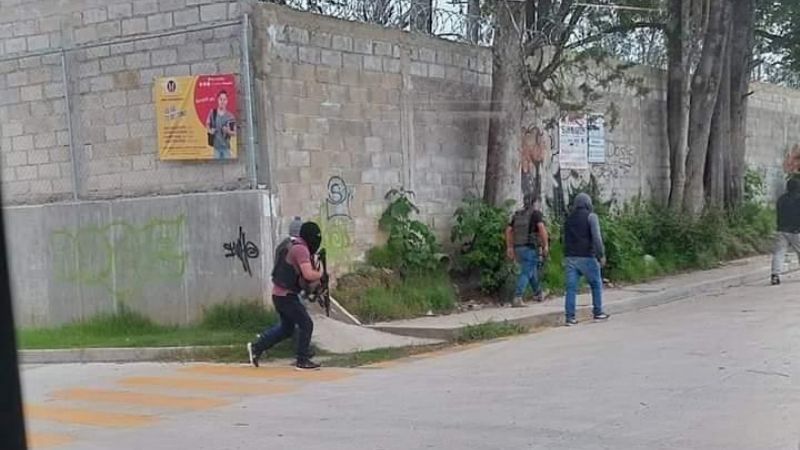
Last June 14, strongly armed indigenous youth took over the popular market of San Cristóbal de las Casas, Chiapas, and maintained control of the northern zone of this city for more than three hours, stealing, burning vehicles and terrorizing the population, without the different security forces doing anything to stop them. The press and the social networks explain these actions as the confrontation between different criminal groups over control of the market, mentioning the Motonetos, the Vans and the San Juan Chamula cartel as some of the groups that confronted each other in these fights over territorial control. The images that circulate in the social networks are those of young men with high-power weapons circulating freely through the streets. The “Coletos” fears of the indigenous occupation of their city and racist imaginaries are expressed by emphasizing the indigenous identity of the aggressors and their capacity for violence.
A taboo theme among anthropologists is revealed in these images: organized crime has infiltrated the indigenous communities, physically or culturally kidnapping their youth. Tsotsil, Tseltal, Mayo-Yoreme, Yaqui, Me’phaas, Mixteco, Rarámuri and Purépecha men, forced or seduced by narco-cultures, are being recruited by the cartels. The tourism, political and cultural importance of San Cristóbal that influenced these acts had a wide media coverage. However, similar incidents are happening in different indigenous territories of the country, without then press or academia denouncing the profound impacts that these processes are having on community fabrics.
The risks involved in doing research in territories controlled by organized crime, coupled with the fear of contributing from our academic work to the criminalization of the native peoples, has influenced the fact that few researchers take on the task of documenting and analyzing the cultural and political transformations that drug trafficking networks have brought to the indigenous communities. An elderly Mayo-Yoreme man, whose grandson was disappeared and murdered in a community taken over by drug traffickers, described to me these transformations this way: “About 10 years ago, things began to break down, when coca entered [the community] and then crack. Then they started to insert drugs into the schools, miasmas that leave the boys blind, deaf, crazy. They started to work with the government and to kidnap the boys, many never returned and some returned crazy. They return addicts so that that they will work for them and when they are no longer useful to them, they kill them.”
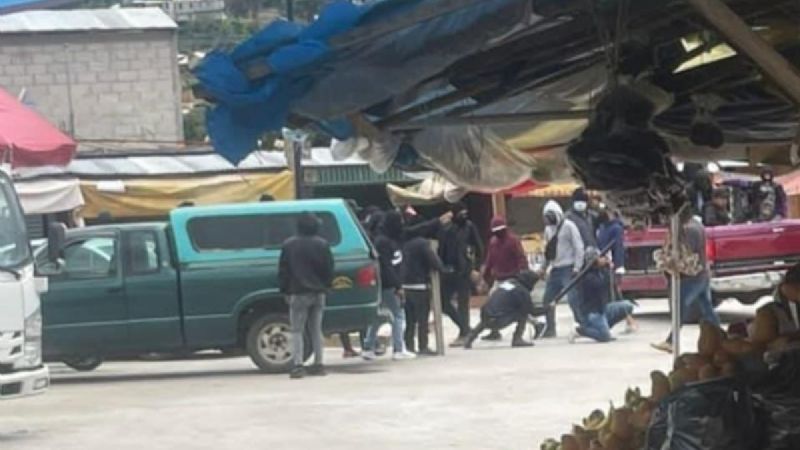
We are facing a new manifestation of colonial violence that dispossesses them of their lands, desecrates their sacred spaces, forces them to move and kidnaps their sons and daughters. Now the “enemy” is inside their own homes, speaks their own language and has the knowledge to dismantle community power structures, making resistance increasingly difficult.
In many regions, such as Chiapas, the cacique political powers have armed these groups and used them to control and terrorize their opponents; in others they are hired by business groups to impose megaprojects, intimidating and, if necessary, murdering those who oppose the dispossession and plundering. The most worrisome thing is that they are creating new indigenous masculinities willing to kill or be killed for a nickname, an automobile or a cell phone. Behind many of these young assassins there are terrorized indigenous women, with little possibility of denouncing or breaking away from violent relationships. Femicide, trafficking and disappearances of indigenous women have increased exponentially, without gender alerts that recognize the specificity as to the contexts of their vulnerability.
It is urgent to document and denounce this ethnocidal violence, to accompany the efforts of indigenous organizations to protect and recover their young people. Silencing these processes not only doesn’t contribute to finding solutions, but it also makes us complicit in the impunity and indifference that has allowed the kidnapping of indigenous youth.
* Doctor in anthropology, researcher at Ciesas
==Ω==
Originally Published in Spanish by La Jornada, Sunday, June 19, 2022, https://www.jornada.com.mx/2022/06/19/opinion/012a2pol and Re-Published with English interpretation by the Chiapas Support Committee
“Calm” returns to San Cristóbal de Las Casas

By: Angeles Mariscal
The booths in the Northern Market opened, children attended school, a market with typical sweets was installed on the central plaza and dozens of soldiers and police maintain searches and patrols. 24 hours after armed men hombres took control of the northern zone of San Cristóbal de Las Casas for several hours, the population tries to recuperate its daily life.
Señoras María Eugenia and Morelia spent Wednesday morning setting up a stall selling typical sweets in the corridor of what used to be the Municipal Presidency of San Cristóbal de Las Casas, next to the Cathedral of Peace.
The Corpus Christi celebrations will begin in the evening, and for more than sixty years, this has been an important festivity in the principal tourist city of Chiapas.
The lady vendors say that the violent events of the previous day did indeed rob the tranquility, but -they assure- the need to work is greater than fear, “they (the criminal groups) in their world and we in our world,” María Eugenia explains.
In the city’s central streets, and especially in the tourist corridors, people stroll through non-stop, Mayor Mariano Díaz Ochoa, took time to tour this zone.
In an interview, the mayor assured that what happened on Tuesday was a “focused” event in a single region of the city, with actors related to the dispute of a single place, the Northern Market; and that the hundred armed men who showed their power, are “paid assassins” (“sicarios pagados”) who for 500 pesos work for the highest bidder, in this case, a group that wants control of the sales center.

He denies that what happened in San Cristóbal de Las Casas is part of the increase in the presence and actions of organized crime groups, which have caused deaths, disappearances and regions controlled by them in other municipalities of the state of Chiapas, as civil society organizations and religious groups have documented.
Mariano Díaz says that in the city that he governs the Attorney General of the Republic must intervene, learn who is guilty and be careful that San Cristóbal de Las Casas continues to be “the tourist jewel of the state.”
In the streets of the northern zone, identified as the center of action of the criminal groups that demonstrated, schools opened on Tuesday morning and the stalls were set up at the market in dispute.
At 8 o’clock in the morning, children in uniform were walking through the streets to the education centers, the only difference in the zone are the municipal police patrols on some corners.
On the avenue that connects to San Juan Chamula municipality, yesterday the center of action of armed people, today soldiers and members of the National Guard set up a checkpoint to search every auto that passes.
One of the officials in charge said that in today’s searches they have not found weapons, drugs, or any illicit merchandise, and that everything was “tranquil.”
A tense “calm” exists in the city of San Cristóbal de Las Casas, a restauranteur explains, who prays that tourism doesn’t stop because, he says, that would cause more poverty “and that pulls young people into crime.”
Today, the State Attorney General’s Office announced that it initiated an investigation for the crimes of Attacks Against the Peace, Damages and those that may result; and a second investigation for the crime of Homicide against young Salvador “N,” who died in the Northern Market as a result of a shot.
The agency maintained that the young man’s body “was removed from the hospital by members of his family who, with the argument of being governed by uses and customs, prevented the corresponding procedures from being carried out.”
==Ω==
Originally Published in Spanish by Chiapas Paralelo, June 16, 2022, https://www.chiapasparalelo.com/noticias/chiapas/2022/06/la-calma-vuelve-a-san-cristobal-de-las-casas/ and Re-Published with English interpretation by the Chiapas Support Committee
The city taken, hours of terror in San Cristóbal de Las Casas, Chiapas

By: Chiapas Paralelo
For almost five hours they fired shots, burned vehicles, blocked streets, took control of part of San Cristóbal de Las Casas and, until the rain began, or they got fed up, they left without any authority showing up in the affected area. One hundred armed men sowed terror in the city.
The population of the place took refuge in hotels, shops, businesses, schools, in their homes; They desperately called the emergency numbers for help, because students were trapped inside schools.
“A group of people, girls, adults and men are sheltering in the Villa Vanesa hotel, whom I thank enormously for letting us in. We have been here since approximately 1:40 pm, and at no time have we seen the National Guard, the militia, and the municipal police have stood out for their absence. This is the place that the municipal president boasts so much about. It is now 3:23 p.m. and the detonations continue, some already very close, please do not leave home,” a resident of San Cristóbal explained on Facebook; showing a photograph of people covering themselves on the ground floor.
They were joined by young people on motorcycles [known locally as “motonetos” or “scooters ”], with their faces uncovered, known for their youth and the impunity with which, on a daily basis, they walk the streets shooting, as if playing a game.

They parked some of their vehicles — white pickup trucks, tinted windows — in the parking lot of a Walmart store. Inside the place, the people at that time of day were shopping, they threw themselves on the floor, covered themselves with the shelves, and stayed there for hours.
This place was their second stop, the first being the North Market, where they also shot, more to persuade than to kill. At the moment there are no official reports that anyone has died, but on Facebook the image of a young man was shared who, they say, died from a stray bullet when he was inside the market.
They made a sign: “CORUTO, OUT administrator CHABEZ PIXOL”, along with a phallic symbol. “Pixol”, is penis in Tsotsil, was the offense for whoever now has the administration of that sales center, which has five large warehouses for the food and flower trade.
The dispute over the markets in San Cristóbal de Las Casas is not new. What is new, residents say, is the variety of illegal products that are now being sold. In the streets near the North Market there are also plenty of places to sell stolen cars that are offered without any shame; also drugs, weapons, clandestinely cut wood. Migrant smuggling is another business that has proliferated in the region.
It is an area of streets with impoverished neighborhoods and people in the same circumstances, founded by indigenous people who came to the city decades ago, looking for opportunities and work. Now bulletproof vans circulate, brothels abound almost on a par with churches and schools.
More than four hours of terror were experienced in that area of San Cristóbal de Las Casas. “Go arrest them, go arrest them, I need to go get my son,” a father shouted at policemen who were standing before the shooting zone, trying to divert traffic.
“It started to rain, we are seeing if we can go out now,” a young woman messaged her boyfriend, later telling him that the shots were heard again, now almost at the door of the university study center where they were.
The armed men left as they arrived, amid impunity. At almost five in the afternoon, soldiers and police began to arrive at the scene, covered in raincoats to protect themselves from the rain. They fanned out through the streets and found nothing.

In a statement, the Chiapas Secretary of Public Security reported: members of the inter-institutional group made up of Sedena, National Guard, Secretary of Security and Citizen Protection and Municipal Police carry out surveillance patrols and presence in the area, as well as in the streets and avenues of the city, with the aim of safeguarding the integrity and heritage of citizens and visitors.
It adds that “after the events that occurred this Tuesday, allegedly derived from a social conflict in the Popular Market in the North of this city (…) experts and agents from the Public Ministry also arrived at the scene for the purpose of initiating the corresponding investigations and defining responsibilities, under the premise that no criminal conduct goes unpunished.”
And it ends with the phrase: the Government of Chiapas endorses its firm commitment to Chiapas to strengthen the rule of law and guarantee security throughout state territory, urging social organizations to conduct themselves legally and peacefully to find solutions to your demands.

Municipal police surpassed, the mayor recognizes
The municipal president of San Cristóbal de Las Casas, Mariano Díaz Ochoa, acknowledged today that their [police] bodies are overtaken by these armed civilian groups that broke into the northern part of the city today, so he asked the state and federal authorities to intervene, to investigate and arrest those responsible: “they surpass us in number and weapons.”
In an official letter, the mayor said that from the first moment the violent events began on Tuesday morning, he notified the state authorities, both the General Ministry of Government, Victoria Cecilia Flores, former mayor of San Cristóbal de Las Casas, and the Ministry of Security and Citizen Protection, to intervene and safeguard the integrity of the population trapped in the conflict zone.
He said that the municipal police under his command are preventive in nature, so their members do not have the fire power or the sufficient number to face the criminals who came out with AK-47s and other types of long and short weapons to dispute control of the popular market in the north of that city.
The mayor added that these groups “are heavily armed” and that they “surpass” the municipal police forces, so he asked for the intervention of the National Guard and the Mexican Army.
==Ω==
Originally Published in Spanish by Chiapas Paralelo, Tuesday, June 14, 2022, https://www.chiapasparalelo.com/noticias/chiapas/2022/06/la-ciudad-tomada-horas-de-terror-en-san-cristobal-de-las-casas/ Re-Published with English interpretation by the Chiapas Support Committee
 Chiapas Support Committee