Chiapas Support Committee
Home of the Compañero Manuel blog on zapatistas & mexico
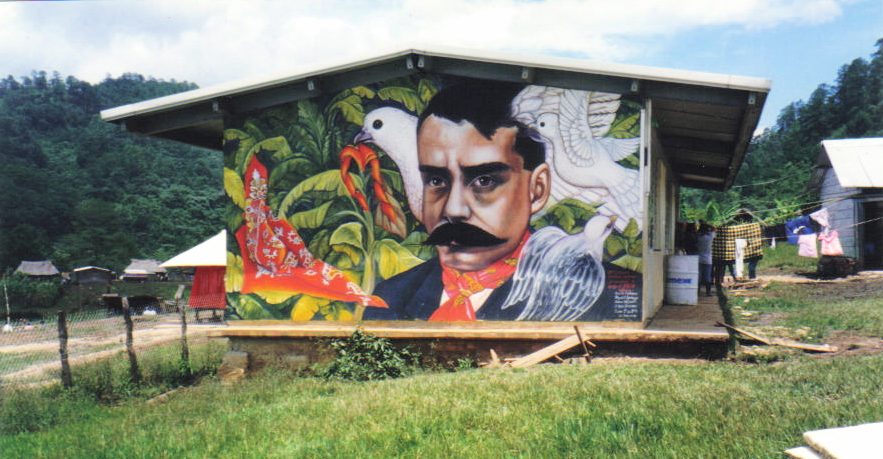
Marcos: The Bad and Not-So-Bad News
THE BAD AND NOT-SO-BAD NEWS

November 2013.
To the students who took or want to take the first grade course of the Zapatista Little School:
To whom it may concern:
Compañeros, compañeras and compañeroas
As is now custom, I have been designated to give you the bad news. So here goes.
FIRST – The accounts (and here I advise you to double check the additions, subtractions, and divisions because math isn’t one of my strengths. That is, it also isn’t one of my strengths):
A) Expenses from the first grade course in August of 2013 for 1281 students:
– Support materials (4 textbooks and 2 DVDs) for 1281 students: $100,000.00 (one hundred thousand Mexican pesos).
– Food and transport for 1281 students to go from CIDECI to the communities where their course was held and back: $339,778.27 (three hundred thirty-nine thousand seven hundred and eight pesos and 27 cents), which breaks down as the following:
Expenses for each zone to take students in vehicles from CIDECI to their host communities and back to CIDECI, in addition to food for the children of the students.
Realidad ————- $ 64,126.00
Oventik—————- $ 46,794.00
Garrucha————– $ 122,184.77
Morelia—————- $ 36,227.50
Roberto Barrios—- $ 70,446.00
Total overall —– $ 339,778.27
Note: Yeah that “77 cents” also caught my eye, but that’s how it appeared in the report. Meaning, we don’t do any rounding up around here.
-Transportation for 200 guardians to CIDECI, where they gave a course, and home again: $40,000.00 (forty thousand pesos). Their food was covered by the compañer@s of CIDECI-Unitierra. Thank you to Dr. Raymundo and all of the compas of CIDECI, especially those in the kitchen (note: you still owe me some tamales).
Total expenses for the Zapatista communities for the first grade course in August of 2013 for 1281 students: $479,778.27 (four hundred seventy-nine thousand seven hundred and eight pesos and 26 cents). Average expense per student: $374.53 (three hundred seventy-four Mexican pesos and 53 cents).
B) Income for the Zapatista Little School: Registration payments (from the donation container that was in CIDECI): $409,955.00 (four hundred nine thousand nine hundred and fifty-five Mexican pesos).
National pesos: $391,721.00
Dollars: $1,160.00
Euros: $175.00
Average per student payment at registration: $320.02 (three hundred twenty pesos and 20 cents).
SECOND— Summary and consequences:
On average, the remaining $54.51 (fifty-four Mexican pesos and 51 cents) per student was covered through solidarity donations. That is, some students covered others. But that means that the numbers don’t work out, compas. It was thanks to some students who gave more than the 100 required pesos (and some didn’t give anything), as well as to generous donations from others that we could more or less break even.
For those who gave more and those who made extra large donations, we thank you from the bottom of our hearts. And we should also thank those who didn’t pay the full 100 pesos or didn’t give anything at all.
But we know very well that we can’t expect this to work out again this way, where some students pay the course for others, which leaves us with the following options:
a) – We close the Little School.
b) – We reduce the number of students to what we Zapatistas can pay for ourselves. Subcomandante Insurgente Moisés tells me this would be about 100 per caracol, or 500 total.
c) – We raise the cost and make it obligatory.
We think that we shouldn’t close the Little School because it has permitted us to meet more people and for other people to meet us, people that we didn’t know before and who didn’t know us.
We think that if we reduce the number who can come, many people will be sad or mad because they already have everything ready to attend and it could be that they wouldn’t make the list. And above all, as you now know, the essence of the course is found in the communities and the guardians and guardianas, and if we reduced the number of students I would have to give them the bad news, and I would get the backlash.
So the only solution is to ask that you pay for your own transport and food. We know that this, in addition to bothering some people, might leave others out. That is why we are letting you know ahead of time so that you can find a way to pay your fee and/or the fee for other compas who want to come but can’t pay.
The cost now will be $380.00 (three hundred eighty Mexican pesos) per student, and should be paid at registration in CIDECI on the designated registration days. If on top of that you want to bring a pound of rice and a pound of beans, we would appreciate that too.
And please, we beg you, we plead with you, we implore you to clarify who is coming with you, how many of you there are, and each person’s age. The thing is that we get emails that say “I’m coming with my kids” and then they arrive and well, it’s like the cast for the “The Walking Dead.” All those who are going to attend must register ahead of time, this includes kids, adults, elders, and the walking dead.
Also please clarify the dates on which you will come. There are two dates now, one at the end of December and another at the beginning of January. It is important for us to know which one you are signing up for because, as you know, there is an indigenous family that is preparing to host and attend to you, a guardian or guardiana that is preparing to orient you, a driver who is getting his or her vehicle ready to transport you, and a whole village preparing to receive you. And clarify if you want to take the course in a community or in CIDECI in San Cristóbal de Las Casas, Chiapas.
Oh also, come to listen and learn, because there are some who came to give seminars on feminism, vegetarianism, Marxism, and other “isms.” And now they’re upset because we Zapatistas don’t obey them, these people who came to tell us that we should change the revolutionary law for women to their liking and not as determined by the Zapatista women, that we don’t understand the advantages of marijuana, that we shouldn’t make our houses out of cement because it’s better to make them out of adobe and palm, or that we shouldn’t wear shoes because by going barefoot we would be better in touch with mother earth. In sum, that we should obey those who come to give us orders… that is, that we should not be Zapatistas.
SPECIAL CASES: the Anarchists
Given the anti-anarchist campaign launched by those of “good conscience” and the well-behaved left united in a holy crusade with the old right to accuse the anarchists, young and old, of challenging the system (as if anarchism had another option), including the dismantling of their shows (this thing about turning the lights off, was that so we wouldn’t see the anarchists?), and the repetition ad nauseum of epithets such as “anarcho-hardliners,” “anarcho-provocateur,” “anarcho-thugs,” “anarcho-etcetera” (somewhere I read the epithet “anarcho-anarchist,” isn’t that sublime?), the Zapatista men and women cannot ignore the climate of hysteria that so firmly demands respect for windowpanes (which don’t reveal but rather hide what happens just behind the counter: slave-like work conditions, a total lack of hygiene, poor quality, low nutritional value, money laundering, tax evasion, and capital flight).
Because now, apparently, the robbery poorly disguised as “structural reform,” the assault on the teachers union, the national patrimony “outlet” sale, the theft imposed by the government on the governed through taxation, and the fiscal asphyxiation – which only favors the large monopolies – is the anarchists’ fault.
This includes blame for the fact that now “decent people” don’t go out into the street to protest anymore (“hey but what about the marches, sit-ins, roadblocks, graffiti, flyers…” “Yes, but those are teachers-bus drivers-vendors-students, that is, country bumpkins, and I’m talking people really-truly-from-the Federal District.” “Ah, the mythical middle class, so courted and yet so despised and cheated by the entire political spectrum and all of the media…”), the fact that the institutional left also evicts the protest rallies, the fact that the “only opposition to the regime”[i] has been overshadowed by the nameless again and again, the fact that the arbitrary imposition is now called “dialogue and negotiation,”[ii] the fact that the murder of migrants, women, youth, workers, children – all of this is the anarchists’ fault.
For those who fight as and claim the “A,” a flag without a nation or frontiers, and who are part of the SIXTH—but who really are in the struggle, not just as a fashion or a fad—we have, in addition to an embrace of solidarity, a special request.
Anarchist Compas: We Zapatista men and women aren’t going to blame you for our shortcomings (or lack of imagination), nor are we going to hold you responsible for our mistakes, much less persecute you for being who you are. Actually, I should tell you that various invitees to the August course cancelled because, they said, they couldn’t share the classroom with “young people who are anarchist, ragged, punk, pierced, and tattoo-covered,” and that they (those who are not young, nor anarchist, nor ragged, nor punk, nor pierced, nor tattoo-covered) expected an apology and a purging of the registry. They continue to wait in vain.
What we would like to request is that when you register, you submit a text, maximum one-page in length, where you respond to the criticism and accusations that they have leveled against you in the for-profit media. That text will be published in a special section of our website (enlacezapatista.ezln.org.mx) and in a magazine-fanzine-or-whatever-it’s-called soon to appear in the globally global world, written and run by indigenous Zapatistas. It will be an honor for us to have your word together with ours in our first issue.
Huh?
Yes, even a page with a single word taking up the whole space counts: something like “LIARS!!” Or something longer, such as “We would explain to you what Anarchism is if we thought you would understand;” or, “Anarchism is incomprehensible to those with little brains;” or, “Real change first appears in the police blotter;” or, “I shit on the thought police;” or the following citation from the book “Golpe y contragolpe” by Miguel Amorós: “Everyone should know that the Black Bloc is not an organization but a tactic of street struggle similar to “Street Fighting [Kale Baroka] that a constellation of libertarian, “autonomous” or alternative groups have been using since the struggles for the squats (“okupations”) in the 1980s in various German cities,” and add something like, “if you are going to criticize something, first do your research. Well-written ignorance is like well-pronounced idiocy: equally useless.”
In any case, I’m sure that you won’t be lacking in ideas.
THIRD – Some not-so-bad-news: a reminder of the dates and how to request your invitation and registration code.
Dates for the second round of the Little School:
Registration: December 23rd and 24th, 2013.
Classes: from December 25th until December 29th of this year. Return on the 30th.
For those who want to stay for the 20th anniversary of the Zapatista uprising, to celebrate and commemorate the dawn of January 1st, 1994, the party will be on December 31st and January 1st.
Dates for the third round of the Little School:
Registration: January 1st and 2nd, 2014.
Classes: from January 3rd through 7th, 2014. Return on January 8th, 2013, everybody back to their corners of the world.
To request your invitation and registration, send an email to: escuelitazapDicEne13_14@ezln.org.mx
FOURTH – More not-so-bad-news is that I was going to begin this phase with a very different text, saluting our dead, SubPedro, Tata Juan Chávez, Chapis, the children of the ABC daycare, the teachers in resistance, and also with a story by Durito and the Cat-dog. But they told me that this business about the accounts and the finalization of the dates was urgent, so it will have to wait for another time. As you can see, the urgent leaves no time for the important. And so you have escaped reading about things that are not “significant-for-the-present-conjuncture”…for now.
Vale. Cheers and, believe it or not, the world is bigger than the most scandalous media conglomerate. It is a question of broadening the step, the gaze, the sound…and the embrace.
From the mountains of the Mexican Southeast,
SupMarcos
Little School Concierge, in charge of giving bad news.
Mexico, November 2013
:::::::::::::::::::::::::::::
Listen to and watch the videos that accompany this text:
http://enlacezapatista.ezln.org.mx/2013/11/05/the-bad-and-not-so-bad-news/
Keny Arkana with this rap titled “V pour Verités.” In one part he says, “Blessed are those who stand up for something, those who construct something else.”
———————————————————————————-
A clip from the movie “V for Vendetta” about the relationship between the media and obedience, and another way of understanding the words “justice” and “liberty.”
———————————————————————————-
Pedro Infante with the song “I am who I am” by Manuel Esperón and Felibe Bermejo, in the movie “The Third Word” with Marga López, Sara García, and Prudencia Grifell, 1955, directed by Julián Soler. I’m including this one just to piss off those who want to make us do things their way.
———————————————
[i] Translators’ note: The reference here is to Andrés Manuel Lopez Obrador, ex PRD politician (former Mexico City mayor and PRD presidential candidate) and now leader of MORENA, the “National Regeneration Movement.”
[ii] Translators’ note: The “arbitrary imposition” refers to the installation of PRI candidate Enrique Peña Nieto as president in 2012 in what was widely denounced as a fraudulent election. The “dialogue and negotiation” refers to Peña Nieto’s initiative for an agreement or “pact” between the three major political parties in Mexico, the PRI, PAN, and PRD, regarding how best to roll out the latest round of privatizations.
Hiding Mexico’s Dead: drug war deaths go underreported in the U.S. media
Hiding Mexico’s Dead: drug war deaths go underreported in the US media
By: Mary Ann Tenuto Sánchez*
 It is essential that we understand the United States Drug War policy for exactly what it is: a tool for social control and repression. In the United States, the Drug War has been used against people of color, migrants, legal immigrants and activists. It is now a large contributor to the overcrowding of criminal courts, local jails and the flourishing prison-industrial complex, at a cost to the taxpayer of billions of dollars. It has also been used to pressure Latin American governments and support deadly “Drug Wars” in Colombia and, currently, in Mexico, the latter of which is spilling over into Central America. Consequently, many of us have reason for wanting to end this repressive policy. This is written with the hope that we can get together and find ways to end it.
As a member of a Zapatista solidarity group, my focus is on Mexico. I am alarmed at what’s happening in Mexico as a result of the US-backed “Drug War.” Each day I read the Mexican online media closely for news about the Zapatistas, Sexta adherents and social movements (those from below). While doing so, I am hit over the head with the daily horror that is called a Drug War and its underreporting in the United States.
Perhaps the most frustrating thing about following news about the so-called “Drug War” in Mexico is obtaining accurate information on the approximate number of deaths that have resulted from it. The Mexican president and his cabinet officials want to hide or minimize the violence, so they do not publicize accurate numbers of dead. In the United States, the Obama administration, like the Bush administration, seems to be head over heels in love with the Drug War (they say it’s a “security” issue), but they also want to hide its horrors. Consequently, misinformation abounds! Journalists, especially in the US, tend to simply repeat what someone else has written without any explanation of how the numbers were calculated.
Molly Molloy shares this frustration. Molloy is a research librarian and Border and Latin American specialist at the New Mexico State University Library in Las Cruces, NM. She is the creator and editor of the Frontera List, a forum for news and discussion of border issues. Since 2008 she has provided detailed documentation of homicides in Mexico, with an emphasis on Ciudad Juarez. She translated and co-edited El Sicario: The Autobiography of a Mexican Assassin (Nation Books, 2011) and has written for The Nation, Phoenix New Times, Narco News and other publications.
One of the many examples of media misinformation about Mexico’s “Drug War” comes from none other than the Council on Foreign Relations, which published a February 13, 2013 video using the number of 50, 000 deaths without saying how it arrived at that number. [1] Just a few months prior to that, Molloy was reporting 110, 000 deaths! [2] Underreporting Mexico’s drug war death toll minimizes the urgency of the situation and does a disservice to the unreported victims!
While acknowledging that a precise number is impossible to calculate, there are official statistics and news reports available that provide guidance. Molloy spells out her sources and methodology in a recent article published in the online Small Wars Journal. Entitled The Mexican Undead: Toward a New History of the “Drug War” Killing Fields, [3] the article begins, in part, with the following words:
“Power in Mexico works as a system of arrangements between government, business and narco-trafficking. The drug business has functioned pretty well for decades, generating huge sums of money and funneling it into government and legitimate businesses. Violence was always part of its corporate culture as there is no way to enforce contracts in the drug business without murder. For years this level of violence seemed acceptable to those in power. Starting in December 2006, President Calderón deployed the army, and lethal violence in Mexico exploded. He said he was fighting drug trafficking, but the flow of drugs and money continues unimpeded. In 2010, Calderón said it was not exactly a war on drugs, but rather a crusade for public safety. There is evidence of social cleansing aimed at those deemed worthless to society: los malandros. At least 130, 000 Mexicans have been killed and kidnapping, extortion and murder plague civil society at all socio-economic levels.” [Emphasis added.]
Molloy explains her methodology in that article. It includes using figures on intentional homicides from INEGI, Mexico’s National Institute of Statistics and Geography. She also looks at statistics reported by the National System of Public Security. In order to separate out intentional homicides due to domestic violence, armed robberies or land disputes from those committed as a result of the Drug War, statistics from the years prior to the Drug War are compared to those after the Drug War began. Molloy cites a result similar to hers from the Trans-Border Institute (TBI), University of San Diego. [4] The TBI report states: “ … our estimate is that the total number of homicides during the Calderón administration was likely around 120,000 to 125,000 people killed, depending on whether the INEGI data or the National System of Public Security data are used.”
Forced disappearances
Molloy’s article also addresses other Drug War-related issues; such as, forced disappearances, death squads, torture, the collusion between government and organized crime, and the impunity with which these crimes take place. She publishes the government’s official number of those forcibly disappeared, which is placed at approximately 27,000, and also gives examples of death squads, torture, the government’s collusion with organized crime and the near total impunity of the perpetrators. And, she wonders why none of this is accurately reported in the US media, citing many examples of under-reporting. Although Molloy does not address the issue of the tens of thousands of Mexicans displaced from their homes and communities by the violence, she does introduce the issue of what she calls “social cleansing” through several examples from the Juárez area. Those being “cleansed” are often the folks she terms “los malandros,” which very loosely could be translated into “the riffraff,” or in Zapatista-speak: those from below (los de abajo).
How the Zapatistas see the war
In a March 2011 letter exchange between Subcomandante Marcos of the EZLN and the Mexican philosopher Luis Villoro, [5] Marcos discusses war in general. He says the bottom line of any war is control of territory! Marcos reviews a history of wars and says that nuclear weapons have changed the nature of wars from the World Wars in the first half of the 20th Century to regional or smaller wars, whereby a stronger force dominates a weaker one and the communications media legitimize the rational for the domination.
In reference to the current war in Mexico (“The war from above”), domination is the imposition of capitalism’s will. “In the current era, the will that capitalism attempts to impose is to destroy/depopulate and reconstruct/reorder the conquered territory.”
“Yes, war today is not content to conquer a territory and demand tribute from the defeated force. In the current era of capitalism it is necessary to destroy the conquered territory and depopulate it, that is, destroy its social fabric. I am speaking here of the annihilation of everything that gives cohesion to a society.” Marcos believes that the United States is the one that will benefit from the Drug War because Mexico’s social fabric will be destroyed.
What we are witnessing is not really a war on drugs; it is the militarization of Mexico in order to clear the way for transnational capital to accumulate wealth via mining, mono-crop agriculture and real estate development, all of which involve the displacement of people. Thus, it is a war against people. As Marcos points out: “We have said before that war is inherent to capitalism and that the struggle for peace is anticapitalist.”
Let’s End the Drug War in the US and in Latin America
The thought of the US government supporting a war that is killing approximately 130,000 people in a neighboring country with which we share a 2,000-mile border, forcibly disappearing at least 27,000 (they are all presumed dead), and displacing tens of thousands, perhaps hundreds of thousands, offends my sense of social justice, as does the mass incarceration of people of color in the United States. Underreporting hides the human tragedy caused by this deadly war. Ya basta! (Enough!) It is my hope that the groups, collectives and organizations that represent people affected by this repressive policy can work together to end it both at home and abroad and that we can all use numbers that truly represent the tragedy both here at home and in Latin America, where Mexico is the largest current victim.
__________________________________________________________
* Mary Ann Tenuto Sánchez compiles the monthly Zapatista News Summary for the Chiapas Support Committee. The News Summary is distributed to the group’s information list, Facebook page and Compañero Manuel blog. She is also a member of the Latin America Solidarity Coalition (LASC) Drug War Working Group.
Author’s Notes
2.http://www.miaminewtimes.com/2012-07-26/news/mexico-s-magical-homicides/
4. The Justice in Mexico Project Releases its Report “Drug Violence in Mexico: Data and Analysis Through 2012,” February 5, 2013. http://justiceinmexico.org/2013/02/05/the-justice-in-mexico-project-releases-its-report-drug-violence-in-mexico-data-and-analysis-through-2012/
5. http://www.elkilombo.org/letter-from-subcomandante-insurgente-marcos-to-luis-villoro-on-war/
Contact information
________________________________________________
Chiapas Support Committee/Comité de Apoyo a Chiapas
P.O. Box 3421, Oakland, CA 94609
Email: cezmat@igc.org
http://www.facebook.com/pages/Chiapas-Support-Committee-Oakland/
https://compamanuel.wordpress.com
Zapatista News Summary for October 2013
OCTOBER 2013 ZAPATISTA NEWS SUMMARY

In Chiapas
1. Alberto Patishtán To Be Free Soon! – The big news this month regarding Alberto Patishtán is that both chambers of the Mexican Congress wrote and moved through the legislative process legislation to expand the criminal law concerning presidential pardons. After Mexico’s Supreme Court denied Alberto Patishtán’s appeal for a recognition of innocence and sent it to a federal appeals court in Chiapas, which also denied his appeal, legislators went to work on an amendment to the current penal code. The amendment permits the president, upon a request from the legislature, to grant pardon to a person who has been sentenced to prison and whose human rights have been seriously violated by the criminal proceedings. Several days ago Mexican President Enrique Peña Nieto said that he would grant the pardon and that Patishtán would be released from prison on October 31. Alberto Patishtán is an adherent to the EZLN’s Sixth Declaration of the Lacandón Jungle. There are three other Sexta adherents, also unjustly imprisoned: Antonio Estrada Estrada, Miguel Demeza Jiménez and Alejandro Diaz Sántiz. You can read the recent La Jornada interview with Patishtán here.
2. Mitzitón Announces Community Ecology Police – The Mitzitón Ejido, an adherent to the EZLN’s Sixth Declaration of the Lacandón Jungle, announced that the ejido has created Community Ecology Police to protect their forests from illegal logging. The ejido assembly agreed to create the ecology police because “the government has done nothing to avoid the illegal logging that the group led by Carmen Díaz López, Gregorio Gómez Jiménez and Francisco Gómez Díaz has been carrying out since 2009, despite denunciations presented to the a government agent.” The announcement also reported that the ejido rights of those same illegal loggers and the 23 families that follow them were terminated. Moreover, the ejido assembly agreed to re-admit 40 Evangelical families that left the ejido 14 years ago. It appears that the government was involved in brokering these agreements as a means to end the on-going violence in Mitzitón. The state government provided money for the construction of new homes to the 23 families whose rights were terminated. Part of the agreement made with the 40 returning Evangelical families involved each family paying one thousand pesos to the assembly for the time that they were absent and agreeing to follow the rules set by the assembly. The Protestants, members of the Wings of the Eagle Church that Pastor Esdras Alonso González heads. He is the leader of the so-called Army of God. Mitzitón is an ejido located in the municipality (county) of San Cristóbal de las Casas. (For those familiar with the area, Mitzitón is situated on land near the junction of the road to Comitán and the road to Ocosingo/Palenque, near the big Army base.) Mitzitón consists of 300 families and 4,479.9 acres (1,813 hectares). The ecology reserve is composed of 3,953.6 acres(1,600 hectares) of pine forest.
3. The New Community of Che Guevara Faces Eviction Attempts – Che Guevara is a Zapatista community on recuperated land in the official municipality of Motozintla, located in the Sierras of Western Chiapas, bordering on Guatemala. It is part of the autonomous Zapatista municipality of Tierra y Libertad, which runs along the border with Guatemala. The Good Government Junta in La Realidad denounced the fact that various local government officials have been trying to drive away the Zapatistas that live in Che Guevara with numerous provocations, and that on October 26 these same provocateurs started to construct a house on Che Guevara’s recuperated land. Building a house on land recuperated by the Zapatistas has often been the start of dividing a community and the eventual eviction of the Zapatistas. It is one of the government’s counterinsurgency tools.
_________________________________________
Compiled monthly by the Chiapas Support Committee.The primary sources for our information are: La Jornada, Enlace Zapatista and the Fray Bartolome de las Casas Human Rights Center (Frayba).
We encourage folks to distribute this information widely, but please include our name and contact information in the distribution. Gracias/Thanks.
Click on the Donate button of www.chiapas-support.org to support indigenous autonomy.
_______________________________________________________
Chiapas Support Committee/Comité de Apoyo a Chiapas
P.O. Box 3421, Oakland, CA 94609
Email: cezmat@igc.org
http://www.facebook.com/pages/Chiapas-Support-Committee-Oakland/
Interview with Alberto Patishtán
“I Have Been Free From Day One:” Patishtán
By: Hermann Bellinghausen
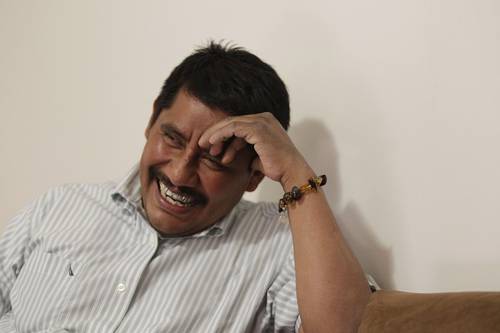
Albert Patishtán Photo: Yazmín Ortega Cortés
**A prisoner since 2000, he demands that his innocence is admitted
“Inside myself I have been free from day one. They tortured me psychologically, threatened me, but I never fell for the game of accepting blame.” It is his security that always makes professor Alberto Patishtán seem happy. “It is very sad that the judges did not admit my innocence, like that’s not important to them. They let themselves govern by obscurity,” he says. He radiates the clarity and interior peace of the good warrior.
“I am aware that the deputies and senators are looking for some solution to my case. Independently of what they want or are able to do, what interests me is that it be made clear that I am innocent. They have to give me freedom and honor,” he maintains on the patio of a house in Mexico City, where he stays since some weeks ago while he receives radiation treatments for the (benign) pituitary tumor he suffers, for which he was operated on last year, and which has grown again. He does not seem alarmed by that or by anything.
“I don’t know if there is a countersign for holding me prisoner,” he expresses in and extensive interview with La Jornada. “There is a time that it seems so. They do everything in reverse. It seems that they do not reflect, nor are they flexible. At times I think that the authorities are the ones that ought to be in prison, and we should be outside, because they don’t judge like they should.”
After 13 years behind bars, Patishtán is no longer an unknown. Is he a political prisoner, a prisoner of conscience, emblematic? He is that and more. Unjustly condemned to 60 years, he has learned a lot about the justice system and the human condition. He has become a defender of the rights of the prison population, starting with the simple fact of not letting themselves be conquered: “I keep the consciousness that I have.”
“Perhaps the authority thinks that it’s going to have an enemy upon releasing me. If it were convenient for the Judicial Power of the Federation, they would have set me free, but there is money to be made. When there is money, they will set anyone free. They know that I am innocent, but without money there is no justice,” he insists. “I have seen many cases where the prisoners talk and admit that they are guilty, but they have influence, thus they talk to you as an equal. The person that has done the crime tells you. And they have gone free. I realize that we are within that system.”
The release of the Acteal paramilitaries
Take the case of the paramilitaries that were prisoners because of the Acteal massacre. “I knew them all in El Amate, and some would tell you: ‘yes I participated,’ and others that denied it admitted that they were from the same group, that they cooperated in all that, that they acted. It surprised me that they would leave and not me. To what is that due?” And he adds: “I am not the only one, I know other cases of evident injustice.” He has seen some of them leave. Others remain there.
He has his conclusions: “Justice must be on top of everything else; truth on top of any lie. And as my conscience is clean, I stay calm, secure about what I’m going to do. That gives me the energy to go on, and I can help those that have been in the same situation,” adds the Tzotzil teacher, who was rewarded in 2010 by Bishop Samuel Ruiz García, for his labor in defense of the human rights of indigenous prisoners in Chiapas with the distinction JTatic Samuel JCanan Lum.
The government’s commissioner for Dialogue with Indigenous Peoples, Jaime Martínez Veloz, visited him months ago. “He told me that he was worried because he knows that I am innocent,” he says. “I understood it as a yes, as a no from the government. I told him not to worry, to better occupy himself.”
He remembers the early days of his incarceration. He recognizes that “when they grabbed me, the most painful thing to think about is the injustice; you are left with tantrums from that, until you are full of rancor, of hate. For me that was another prison. It doesn’t let you advance. When I got close to the things of God, I began to forgive. Before, I wasn’t into religion as much, but thanks to spirituality I left that prison. It took me a few years. The manual work of artesanía also helped, it took away those thoughts. Now I have dedicated myself to transmitting it to other prisoners.”
He does not attribute his transformation to anything particularly religious. “In prison, people from the Church always attend, and they approach you, and you talk to them, but I was to realize things. I studied the social sciences and I reached the sixth semester at the University of Grijalva Valley, in Tuxtla Gutiérrez. Afterwards I was a teacher in my hometown of El Bosque. My studies have also helped me to approach the compañeros and free them from that prison that is the worst. I have helped those that approach. Or I approach them, to center them, to take the tantrum away from them. There are people that don’t eat; they have bitter saliva, as we say. It has fallen to me to free them from that. When that liberation arrives, you become more active.”
The Tzotzil professor says that he has never stopped struggling for his freedom, and that while doing it he participates in the struggles of the other prisoners that are there unjustly. As adherents to the Sixth Declaration of the Lacandón Jungle, dozens of Chiapas prisoners have maintained their innocence and achieved their freedom. Some were support bases of the Zapatista National Liberation Army.
Spirituality, more than religion (Catholic in his case), has been a weapon for resisting. “Some of the compañeros in solidarity with The Voice of El Amate (La Voz del Amate) were Evangelicals. They told me about their experiences; that their pastors see the situation another way. They ask that you conform inside the prison. These compañeros did not see the Scriptures as concrete help for confronting authority. The pastors do not want to have authority as their enemy. They gain from it, my compañeros used to say. ‘Those religious men are not saved nor are they free because they don’t do anything for us. They want us to be resigned, which they told me is the will of God.”
In his case there was no special priest that would counsel him. “Prison teaches you to orient yourself; the same authorities with their abuses give you the tools for resisting. An injustice gives you strength; nothing else remains. The injustices impede you from being at peace with yourself; they don’t let you be free. You have to find that peace to continue forward.”
Always a critic of the penal system that he has suffered, he relates: “We are fighting for more public defenders. In the Cereso where I am there is only one. We speak four languages in there and there are more than 500 prisoners, almost all indigenous, and the public defender is not familiar with their languages. There is a little Tzeltal woman, the director himself commented to me, who has been in process for 10 years. Another has 12, without a lawyer. Imagine that they turn out to be innocent, or that their sentence is six years. Who is going to make reparations for the years that they lost?”
He comments about his “effect” on other prisoners. Now, relatives of indigenous Chiapas prisoners seek him out, “people that I don’t know if I met, who are suffering bad treatment” in Islas Marías (where the former Chiapas Secretary of Government, Noé Castañón León, wanted to send him although he had to accept having him in a federal prison in Guaymas, Sinaloa, for several months, until Patishtán achieved his return to San Cristóbal de las Casas).
About his state of health he expresses: “The news that tumor remains there isn’t going to scare me either. It seems that I am stable with treatment. The tumor grows but it doesn’t shake me. There are moments that it worries me, but of little importance.” His joys? “Having one more day to laugh. My children Héctor (present during the conversation) and Gabriela (in Chiapas, taking care of her baby Genesis, who made the professor a grandfather) have helped me, and they have learned with the struggle.”
“Prison is going to get worse”
He remembers the not so distant days in which The Voice of El Amate and Those in Solidarity with The Voice of El Amate were resisting in the San Cristóbal and Cintalapa prisons. Only Alejandro Díaz Sántiz and he remain prisoners. “They used to worry when their names didn’t appear in the newspaper, or theirs appeared and not mine. Don’t be afraid, he would tell them. Don’t you know that where I am you are, and where you are I am, and that it falls to all of us to give a hand to the others? Alejandro (with 15 years in prison) was the most quiet, but he has learned. He felt betrayed. We all do. When the other nine left he said: ‘watch out! Patishtán needs a secretary.’ And right now he is representing the complaints of the prisoners that approach him.”
The protests of the prisoners of the Sixth Declaration provided improvements at prison number five in San Cristóbal: “They respect the visits more. In April we got an agreement with a private clinic so that consultations would be held with doctors and dentists every 15 days. They give medical attention and patent medicines. The women, some 50 of them, are examined with a gynecologist. On May 10, the prison workers wanted to celebrate Mothers Day, and we got a mariachi to come. We got firewood for the women’s kitchen from the wooden vegetable crates. There goes Alejandro to start it and deliver it to the compañeras. Recently, a beautiful mural was painted on the patio. Some solidarity visitors were permitted to introduce paint and paint brushes.”
The other prisoners get worried every time that he leaves for the doctor. “Are you going away now? No, I’m just going to a consultation. What about that suitcase? Well, it’s just a little clothes. It’s that if you go away, Patishtán, and it is no longer seen that we are struggling, the prison is going to get worse.”
_________________________________________________________
Originally Published in Spanish by La Jornada
Translation: Chiapas Support Committee
Thursday, October 24, 2013
En español: http://www.jornada.unam.mx/2013/10/24/politica/002n1pol
Raúl Zibechi: Is it possible to defeat Monsanto?
IS IT POSSIBLE TO DEFEAT MONSANTO?
By: Raúl Zibechi
Diverse movements and multiple actions, both programmed and spontaneous, through denunciations, and all types of mobilizations that converge against a corporation that represents a serious danger to the health of humanity are besieging one of the world’s largest multinationals. Establishing the variety of existing initiatives and learning about them can be a way of comprehending a new kind of cross-border movement, capable of articulating activists all over the world in concrete activities.
The encampment at the gates of the seed plant that Monsanto is building in Malvinas Argentinas, 14 kilometers from Córdoba, is one of the best examples of the mobilization underway. The multinational plans to install 240 silos of genetically modified corn seeds for the purpose of arriving at 3.5 million hectares planted. The plant will use millions of liters of agro-chemicals for the care of the seeds and a part of the effluents “will be released into the water and soil, provoking grave harm,” as Medardo Ávila Vázquez of the Network of Doctors of Fumigated Peoples maintains.
The movement against Monsanto won victories in Ituzaingó, a Córdoba barrio near the place where they intend to install the corn seed plant. The Mothers of Ituzaingó (movement) was born there ten years ago. The movement discovered that 80 percent of the children in the barrio have agro-chemicals in their blood and that it is one of the causes of the deaths and deformities in their families. In 2012, for the first time they won a lawsuit against a producer and a fumigator, (who were) condemned to three years of conditional incarceration without going to prison.
The encampment at Malvinas Argentinas is now one month old, maintained by the Struggle for Life Malvinas Neighbors Assembly. They achieved winning the support of a good part of the population: according to official polls, 87 percent of population want a popular consultation and 58 percent reject the multinational’s installation, but 73 percent are afraid to express an opinion against Monsanto for fear of being harmed (Página 12, 09/19/13).
The campers resisted an attempt to evict them from the construction union (UOCRA) that is adhered to the CGT, harassment from police and provincial authorities, although they have the support of the mayor, the unions and the social organizations. They received support from Adolfo Pérez Esquivel, a recipient of the 1980 Nobel Peace Prize, and from Nora Cortiñas, of the Mothers of the Plaza de Mayo. They were able to paralyze the plant’s construction by impeding the entry of trucks.
The siege of Monsanto also arrived in the small tourist town of Pucón in southern Chile, on Villarrica Lake, where 90 of the transnational’s executives coming from the United States, Argentina, Brazil and Chile arrived at a luxury hotel to hold a convention. Environmental groups, cooperatives and Mapuche collectives from Villarrica and Pucón dedicated these days to “exposing” the presence of Monsanto in the country (El Clarín, 10/13/13).
Those are just two of the many actions that are happening in the whole Latin American region. To my way of looking at it, the varied mobilizations in more than 40 countries permit us to draw some conclusions, from the point of view of anti-systemic activism:
In the first place, the mass actions in which tens of thousands participate are important, because they permit demonstrating to the general population that the opposition to corporations like Monsanto, and therefore to genetically modified foods, is not a question of minority criticism. In this sense, worldwide days, like that of October 12, are indispensible.

Raging Grannies March Against Monsanto in San Jose
The mobilizations of small groups, dozens or hundreds of people, like the ones that happen in Pucón and in Malvinas Argentinas, as well as in various mining undertakings in the Andean Cordillera, are as necessary as the big demonstrations. On the one hand, it is a way to be permanently present in the media. Above all, it is the best path for forging militants, besieging the multinationals and publicizing criticisms of all their business initiatives.
It is in the small groups where ingenuity usually flourishes and within their breasts the new forms of being able to innovate with political culture and protest methods are born. There is where community ties and strong ties between people can be born, which are so necessary for deepening the struggle. After one month of camping in Malvinas Argentinas, the demonstrators “began to put up adobe walls; they constructed a clay oven and started an organic vegetable garden by the side of the route” (Día a Día de Córdoba, Octubre 13, 2013).
In the third place, it is fundamental to support the denunciations with scientific arguments and, if possible, to involve authorities in the matter. The case of the Argentine biologist Raúl Montenegro, Alternative Nobel Prize in 2004 (Right Livelihood Award), who committed himself to the cause against Monsanto and to the Mothers of Ituzaingó, shows that the commitment of scientists is as necessary as it is possible.
The fourth question is the importance of the opinions of the common people, distributing their beliefs and feelings about genetically modified foods (or any initiative of the extractive model). The subjectivity of the people is accustomed to showing traits that do not contemplate the most rigorous academic studies, but their opinions are just as important.
Finally, I believe that it’s necessary to place within view not only one multinational like Monsanto, one of the worst of the many that operate in the world. In reality, this is just the most visible part of a model of accumulation and development that we call extractivism, which turns around the expropriation of the commons and the conversion of nature into merchandise. In this sense, it is important to emphasize what there is in common between the transgenic monocrops, mining and real estate speculation. The latter (real estate speculation) is the mode that extractivism assumes in the cities. If we defeat Monsanto, we can conquer the other multinationals.
———————————————————
Originally Published in Spanish by La Jornada
Translation: Chiapas Support Committee
Friday, October 18, 2013
En español: http://www.jornada.unam.mx/2013/10/18/opinion/024a1pol
Art Is A Revolutionary Weapon: Emory Douglas
ART IS A REVOLUTIONARY WEAPON, SAYS ILLUSTRATOR EMORY DOUGLAS
By: Juan José Olivares
** “Obama is a puppet at the service of the corporations… he is not very different from George W. Bush,” he expresses in an interview
** Minister of Culture of that group’s political party, he asserts that: “they only demanded social programs from the government for the unprotected”
** Today, civil rights in the US is set aside, he says
** The creator of the front pages for the Black Panther newspaper exhibits at Vértigo Galería

One of Douglas’ recent works
Emory Douglas is the revolutionary artist. That’s how Eldridge Cleaver, member and publisher of the Black Panther Party (BPP) baptized him. Huey P. Newton and Bobby Seale founded the BPP in the United States in the 1960’s, after the death of Malcolm X. The premise of this political entity was the inflexible defense of the Afro American community’s civil rights. The movement was known in many parts of the world for its left posture.
Emory Douglas was the creator of the art and designs on the front and back pages of the Black Panther Newspaper, which, he says, achieved publishing up to 400,000 copies per week. He was also the Minister of Culture for that party, from 1967 to the beginning of the ‘80s, when a hostile tirade from the government finished it off. The Federal Bureau of Investigation (FBI) came to consider it a public enemy, among other reasons, because some members carried guns, “under the legal framework of the United States Constitution,” says Emory Douglas, who used the attractive publicity methods of that time to change them in to information weapons.
“Art is a revolutionary weapon,” he comments in an interview with La Jornada, held at Vértigo Galería, where his works, the front pages of the mentioned newspaper, are exhibited in a show that will close next November.
Genius of the cartoon, the collage and recycling
His images illustrate the words of his community, persecuted by racism, which detonated “self-defense in the face of civil rights violations carried out by the government. We only demanded that they carry out social programs for our community and unprotected people. For example, we wanted free breakfasts for all the children in the country… That was a big problem for the government,” ironizes Douglas, whose ingenuity as a cartoonist, in collage and recycling, gave the newspaper an explosive message.
Today, those low-cost printed illustrations (like in photo static copies), have been mounted in different museums of contemporary art, and have even been the motive for a book, but initially they wanted “to educate the people about what the government wasn’t doing for the most unprotected classes.”
In 2012, Douglas participated in the Zapanteras Project, a meeting between the Zapatista Movement and the Black Panthers, represented with the assembly of seven of his works, which were embroidered by indigenous hands, and which incorporated in textiles, Zapatista and Maya symbols.
It is a response by nature. He asserts that United States President “Barack Obama is a puppet at the service of the corporations. He does not talk much about the Black community’s progress. He does not mention anything about political prisoners… We know that his term is not very different from that of George W. Bush, or from that of many other presidents in the United States. Before he arrived in office, the people had hope, but, in the end, he was not very different from Bush.”
The art of Emory Douglas is inflexible, confrontational and even violent, but it is also festive and inspiring. He was looking for a premise: returning power to the people.
He added: “The connection of art and politics was a natural way to inform. The images played an important role. I observed, I understood and I communicated. I knew that artistic expression is fundamental for inspiring change, for spreading ideas, the demand for social programs. It is possible to change consciences through it. The media manipulated information. And culture had to be used for disseminating ideas.”
–How are civil rights in the United States today?
–They are set aside. Things have progressed, but are forgotten. September 11, 2001 created a psychosis in the government, which started to be more rigid as to that theme. The least protected are those that suffer the consequences.
He joins the Movement
Emory came to the party after connecting with the black arts movement. He went to a meeting in which he sought to make a poster for an event planned by Malcolm X’s widow, at which he met the Black Panther leaders.
“The first time that I met Eldridge Cleaver there were texts, pencils, erasers… colors on a table and he asked me: What can you do with that? Later he recommended that I should be careful, because if the police caught me with those sketches, they could arrest me,” he comments.
“Those illustrations were, in a way, catharsis for me. The colors –primaries– were essential, because they were those used in publicity at that time,” he said.
The exhibit of Emory’s work will stay open until the end of this coming November in Vértigo Galería, located in Colima 23 local A, in Colonia Roma. More information by telephone 5207-3590 and at info@vertigogaleria.com. Visiting hours are on Monday to Friday from 12 to 8 PM, and on Saturdays from 12 to 7 and Sundays from 12 to 6 PM.
————————————————-
Originally Published in Spanish by La Jornada
Translation: Chiapas Support Committee
Thursday, October 10, 2013
Source in Spanish (En español): http://www.jornada.unam.mx/2013/10/10/espectaculos
Resumen de noticias sobre los zapatistas – Septiembre de 2013
SEPTIEMBRE DE 2013 – RESUMEN DE NOTICIAS SOBRE LOS ZAPATISTAS
En Chiapas
1. Corte Niega la Libertad a Alberto Patishtán – La resolución sobre el reconocimiento de inocencia de Alberto Patishtán salió el 12 de septiembre, pero no era lo que él había esperado. El Primer Tribunal Colegiado de Tuxtla Gutiérrez le negó su amparo de inocencia, y así le condenó a permanecer encarcelado otros 47 años. Ya no le queda otro remedio de apelación en el sistema de justicia mexicano. La única corte a la que puede acceder en este momento es la Corte Interamericana de Derechos Humanos, y ya ha iniciado ese proceso. Puede leerse aqui un artículo más amplio sobre esta decisión adversa.
2. Magisterio chiapaneco “ocupa” instalaciones de PEMEX – Como much@s maestr@s por todas partes de México, el magisterio chiapaneco se está movilizando en contra de las “reformas” educativas presentadas por el Presidente Peña Nieto como parte de su “Pacto por Mexico,” un conjunto de cambios estructurales neoliberales que se les llama “reformas.” Además de ocupar las plazas de la capital de Chiapas, el magisterio también ocupó las instalaciones de PEMEX en este mes, impidiendo así la distribución de gasolina en las estaciones gasolineras. El magisterio también tomó control de algunas casetas de cobro en las carreteras federales y colectaron las cuotas para financiar el envío de maestros a reforzar la lucha que estos sostienen en la ciudad de México.
3. La situación se complica en la frontera sur mexicana – Circulan informes de que la administración de Obama está considerando un plan para instalar puestos de seguridad y control de tres líneas en la frontera sur de México con Guatemala y Belice. Al parecer, la administración está preocupada por la posible oposición de los republicanos, entonces ha procurado mantener estos planes en secreto desde que la ex-Secretaria de Seguridad Nacional, Janet Napolitano, visitó México y dijo que los Estados Unidos está preparado para “actuar” en la frontera sur de México. Sin embargo se han filtrado algunos detalles. Según un informe, el plan para la frontera requiere del financiamiento y apoyo técnico de los EEUU para crear tres líneas de seguridad, alcanzando hasta unas 100 millas al norte de la frontera de México con Guatemala y Belice. Este sistema de seguridad fronterizo usará sensores de movimiento y la recopilación de inteligencia para combatir la trata de personas y el narcotráfico en la región, una de las principales fuentes de la inmigración ilegal hacia los Estados Unidos. Seria financiado a través de la Iniciativa Mérida.
En Otras Partes de México
1. Tormentas tropicales golpean ambas costas de México – El 14 de septiembre, Ingrid, un huracán de categoría 1 golpeó la costa del golfo de México. Cinco estado sufrieron el desplazamiento de la población de sus casas y masivos daños a bienes: Veracruz, Tamaulipas, San Luis Potosí, Puebla e Hidalgo. En tan solo Veracruz, 30,000 personas fueron desplazadas de sus casas. El día siguiente, la tormenta tropical Manuel golpeó la costa pacífica de México. Mientras varios estados de la costa fueron duramente golpeados, al parecer el estado de Guerrero sufrió la peor parte de los daños y muertes causados por la tormenta. Miles se quedaron sin hogar y muchos todavía no han sido contados entre los muertos. Montañas se derrumbaron sobre aldeas y los ríos se desbordaron. Los turistas quedaron atrapados en Acapulco y en otras ciudades el suministro de agua quedó destruido. Al publicar este resúmen de noticias, la situación en Guerrero es desesperada; las carreteras están destruidas, inundadas o bloqueadas con lodo, y como consecuencia los vehículos no pueden entrar para repartir alimentos y otras provisiones. El Centro de Derechos Humanos Tlachinollan, en la región de La Montaña en Guerrero, está preocupado ante la posibilidad de una hambruna. 26 de los 31 estados mexicanos fueron afectados por los fuertes vientos y lluvias de las dos tormentas. Hace varios días se informó que el total de muertos era de 144, con 53 desaparecidos. El CRAC-PC (policía comunitaria) en Guerrero informa que 15 personas murieron por falta de atención médica, por lo que el número de decesos sigue creciendo.
2. Oposición a “Reformas” del Pacto por México surge con Resistencia – Los maestros protestando contra las “reformas” educativas anti-obreras; los políticos y los movimientos sociales oponiéndose a la privatización de la compañía estatal de petróleos, Pemex; y la oposición a las “reformas” sobre el pago de impuestos continúa, y se comienza a consolidar un movimiento de resistencia. A pesar de la represión, los maestros continúan ocupando el espacio en la Ciudad de México. Cuauhtémoc Cárdenas y Andrés Manuel López Obrador (AMLO), dos políticos que no han estado cercanos por un tiempo, están dirigiendo grandes protestas contra la privatización de Pemex. Y las “reformas” a los impuestos que causarán más daño a la clase media están contribuyendo al crecimiento de las filas de las protestas. Estas protestas también se están dando en muchos estados, no sólo en la Ciudad de México.
En los Estados Unidos
1. La breve visita del vicepresidente de los EU Joe Biden a México – El vicepresidente de los Estados Unidos, Joe Biden, hizo una visita muy breve a México el 19 de septiembre. Aparentemente su visita fue acortada debido a los desastres naturales ocurridos en ambas costas de México. Sin embargo, su estancia en México tuvo el tiempo suficiente para ofrecer el apoyo de la administración a las “reformas” neoliberales contra las cuales muchos mexicanos se están manifestando!
_________________________________________
Recopilación mensual hecha por el Comité de Apoyo a Chiapas. Las fuentes primarias de nuestra información son: La Jornada, Enlace Zapatista y el Centro de Derechos Humanos Fray Bartolomé de las Casas (Frayba).
We encourage folks to distribute this information widely, but please include our name and contact information in the distribution. Gracias/Thanks.
Click on the Donate button of www.chiapas-support.org to support indigenous autonomy.
_______________________________________________________
90 Dead Bodies Still Buried Under Mud in La Pintada, Guerrero
Some 90 Dead Bodies Remain Under Muddy Ground in La Pintada
** Slow advance of the rescue that soldiers and moles carry out
** Inhabitants of Guerrero support volunteers with water and food

[Members of the Army, moles from the states of Mexico, Nayarit, Oaxaca and Guanajuato, and even from Peru, work to rescue the dead bodies of some 90 people buried by the collapse of a hill in La Pintada. Photo: Javier Verdín]
By: Héctor Briseño, Correspondent
Atoyac de Álvarez, Guerrero, October 3, 2013
The mudslide that buried dozens of residents of La Pintada, in the municipality of Atoyac de Álvarez, in the Costa Grande, continues imposing, almost intact, a giant of red earth that covers dozens of houses and lanes of the coffee-growing community, where desolation reigns, interrupted only by the sound of the river that descends with force from the high part of the Sierra, almost in the heart of Guerrero
By land or by air, the avalanche dominates from anyplace that one looks at it, and on top of it protrude the tire of a small truck, a vehicle leveled, a stove, the roof of a house, a shoe’s heel, a garage, rocks, sand and branches.
“It’s very difficult”
The 20 topos (moles) that have carried out recue work since September 22 seem insufficient for removing the “treacherous” mud that descended with force, as if spit from the hill, last September 16, which they have not been able to remove, except at a few sites counted on the fingers of one hand. The survivors calculate that there are some 90 cadavers under the mud, because it was a holiday when they were buried.
At one side of the little La Pintada Zócalo, in a kiosk that is painted in the country’s colors, the chief of the group of Topos Azteca (Aztec Moles), veterans of the 1985 Mexico City earthquake, Héctor Méndez Rosales, describes with two words the operation that they have undertaken as volunteers: “it’s very difficult.”
He calculated that in the two Independence Day mudslides, when the majority of the town got together to eat pozole, the community was buried with a hundred thousand cubic meters of mire in an area of 400 by 400 meters and some six meters of depth.
The rescuers have placed boards, doors and rocks over the muddy ground so as not to drown when walking, because “it absorbs you, you get in up to your waist and you can’t get out.” There for the excavations are suspended while it rains, which is every day, besides at night, because the risk of another mudslide exists.
With the passing of the days, the mud has hardened and is more difficult to remove. “The work is artisan,” details the chief of the moles. He points out that there are still mountain villages incommunicado, like Nueva Delhi, Puerto Gallo, El Molote, Las Delicias, Arrayán, Toro Muerto, Piloncillo, El Tambor and El Iris, whose inhabitants carry food supplies and water by helicopter.
Méndez Rosales detailed that the moles, men and women decked out with orange suits, have helped to rescue 10 bodies from the mud. He explained that: “the people come and tell us where they think that their relatives could be at the moment of the mudslide. You make their grief yours.”
“We came to help because we had friends here”
A group of 10 soldiers make excavations at the other side of the town, some 50 meters from the rock engraved with hieroglyphics that give the community, founded almost 50 years ago, its name, in which some 600 people were living at the moment of the mudslide.
A detachment of almost 40 members of the Army and 10 more of the Ministry of the Navy accompany the 16 inhabitants of La Pintada that have decided to stay to look for family members and to form nighttime guards, divided in two groups, to avoid the solitary homes that survived being looted, because the mud divided the village in two.
All the people that arrive in La Pintada walking must be noted on a list, “for their security, there’s not going to be another mudslide and we don’t know what their name is,” explained an Army official.
Landslides and washouts invade the road that joins La Pintada with El Paraíso, the community with which communication by road from Atoyac is now re-established.
Groups of people that go from Atoyac and El Paraíso, with picks, shovels and pots of food, walk along the 10 kilometers of constantly ascending road.
“We came to help in any way we can, we came because we had friends here,” express Francisco and Israel Bautista, volunteers from the Santa María de Guadalupe parish, in El Paraíso, who offer water to the reporter and the photographer from La Jornada, while they lead them through a shortcut on a wooded hill.
“Here is the burial ground. Yesterday we buried a mother and her two daughters. The day before yesterday, a three-year old girl,” Francisco says while he points to a group of crosses on a path next to the road. He adds: “we come every day, we bring tortillas to the topos, we are going to help in whatever, we must help.”
The young man walks without stopping to La Pintada pulling wheelbarrows with dirt and whatever he can offer to the soldiers and rescuers dressed in orange.
———————————————————-
Originally Published in Spanish by La Jornada
Translation: Chiapas Support Committee
Friday, October 4, 2013
En español: http://www.jornada.unam.mx/2013/10/04/politica/011n1pol
Mexicans Seek Asylum from Drug Violence
MEXICANS SEEK ASYLUM AS DRUG VIOLENCE PERSISTS
SAN DIEGO October 3, 2013 (AP)
By ELLIOT SPAGAT and MARK STEVENSON Associated Press
Elizabeth Silva was walking her younger sister to school when two hooded men burst into her house and pumped three bullets into her father. When her 14-year-old brother rushed out of his bedroom to see what was happening, he was also shot dead.
The killings in a sun-seared farming region of western Mexico prompted her to board a bus to the U.S. border to seek asylum, a hugely popular escape route in a remote area that has seen some of the country’s worst drug-fueled violence. As gunfire rang in the distance, her family hurried out of the cemetery after burying the bodies and fled the same day.
Asylum requests from Mexico have surged in recent years and, while the U.S. government doesn’t say from where within Mexico, The Associated Press has found that many are now arriving at the border from the “Tierra Caliente,” or Hot Country, about 250 miles west of Mexico City. Word has spread there that U.S. authorities are releasing women and children while they await hearings before immigration judges, emboldening others to follow.
The AP counted 44 women and children from the Tierra Caliente released in San Diego in just one month, from Aug. 26 to Sept. 27, including the 25-year-old Silva, her 2-year-old daughter, mother, grandmother and sister.
Many from the town of Buenavista carry a formal letter from town official Ramon Contreras stating they are victims of persecution.
“The residents of this town are under death threat from a drug cartel … please provide them the protection they request,” the letter reads.
The Tierra Caliente is so completely ruled by one vicious drug cartel that residents in a half-dozen towns formed self-defense groups earlier this year to try to drive out the gang. Now, they are fleeing in droves, saying their rebellion has made them targets for cartel killings.
“There have been many, many families going to the United States to seek asylum,” said Hipolito Mora, a leader of the patrols in the La Ruana neighborhood of Buenavista, a municipality of 42,000.
The Knights Templar cartel, a pseudo-religious gang that takes its name from an ancient monastic order, has set fire to lumber yards, packing plants and passenger buses in a medieval-like reign of terror. The cartel extorts protection payments from cattlemen, growers and businesses, prompting the vigilante patrols in February. That drew more attacks from the cartel, which sought to cut off the area’s main economic activity, growing limes.
A Buenavista politician was hacked to death and a Navy vice admiral killed in an ambush. In April, 10 people were killed in a cartel ambush as they returned from a meeting with state officials to ask for help.
The flight from Tierra Caliente comes as asylum requests from throughout Mexico more than quadrupled to 9,206 in 2012 from six years earlier, when the Mexican government launched an offensive against drug cartels. The Department of Homeland Security says an average of 11 Mexicans sought asylum daily at San Diego border crossings from Aug. 9 to late September.
More than 90 percent of asylum requests from Mexico are eventually denied. To be granted asylum, an immigration judge must find an applicant suffered persecution or has a well-grounded fear of persecution on grounds of race, religion, nationality, membership in a social group or political opinion. Immigration lawyers said most asylum seekers are held in detention centers, but Silva and many others have been freed while awaiting a decision.
House Judiciary Committee Chairman Bob Goodlatte, R-Virginia, criticized DHS for the releases, saying the asylum seekers may never return to court. “I am concerned that credible fear claims are being exploited by illegal immigrants in order to enter and remain in the United States,” he wrote Janet Napolitano in August, before she stepped down as DHS secretary.
DHS said in a statement that custody decisions are made on factors including ties to the community, flight risk and criminal record. They wouldn’t comment on releases.
Some asylum seekers have said they were turned back at the border, including Isamar Gonzalez, 20, of Buenavista, and her mother. “We told them we wanted asylum and they laughed at us,” Gonzalez said.
But many others make it across after an initial screening. Candelaria Aguilar feared the cartel would kidnap her 14- and 10-year-old sons and turn them into hit men. She made the trip to San Diego after her sister-in-law called from Los Angeles to say she had been freed pending a court hearing on her asylum request.
“It got me fired up,” said the 30-year-old single mother, who also was released by U.S. immigration officials with her children last week after one night in custody. “This is the only way out.”
Ynez Valencia Valladares, 23, said she boarded a bus to Tijuana with her children, ages 7, 5 and 3, unsure what to do after her brothers were killed on the family ranch. A Tijuana taxi driver told her to claim asylum, and she and her children were released after one night in custody.
Elizabeth Silva’s path toward asylum began when the hooded men kicked open the door to the family’s home in Apatzingan around 8 a.m. on Sept. 2, killing her father, Jorge Silva, 47, and brother, Jose Manuel Silva, 14, according to the Michoacan state attorney general’s office. Police made no arrests and haven’t disclosed a possible motive. Silva suggested it had something to do with extortion payments.
“Everyone in town pays up,” she said. “Everyone.”
———
Stevenson reported from Mexico City.
Zapatista News Summary – September 2013
SEPTEMBER 2013 ZAPATISTA NEWS SUMMARY
In Chiapas
1. Court Denies Freedom to Alberto Patishtán – The long-awaited decision regarding Alberto Patishtán’s appeal for a recognition of his innocence came on September 12, but it wasn’t what he hoped for. A federal appeals court in Chiapas denied Alberto Patishtán’s request for a recognition of his innocence, thus denying him freedom. He has no remaining avenues for appeal in Mexican courts. The only Court to which he can appeal is the Inter-American Court on Human Rights and that appeal has been filed. Click here for an article about this adverse decision.
2. Chiapas Teachers “Take” Pemex Installations – Like teachers in many parts of Mexico, Chiapas teachers are protesting the education “reforms” proposed by President Peña Nieto as part of his “Pact for Mexico,” a group of neoliberal structural changes termed “reforms.” In addition to the occupation of a plazas in the state capital, the teachers took over Pemex installations this month, thus blocking the distribution of gasoline to local gas stations. They also took over the toll booths on the super-highways and collected the fees to finance sending teachers from Chiapas to reinforce the occupation in Mexico City.
3. The Plot Thickens on Mexico’s Southern Border – Reports are circulating that the Obama administration is considering a plan for three-tiered security checks around Mexico’s southern border with Guatemala and Belize. Apparently worried about Republican opposition, the administration has attempted to keep these plans secret ever since former Homeland Security Secretary, Janet Napolitano, visited Mexico and said that the United States was prepared to “act” on Mexico’s southern border. Nevertheless, some details are leaking out. According to one report, the border control plan calls for U.S. funding and technical support for three security lines extending more than 100 miles north of Mexico’s border with Guatemala and Belize. The border security system would use sensors and intelligence gathering to counter human trafficking and drug running from the region, a major source of illegal immigration into the United States. It would be financed through the Merida Initiative.
In Other Parts of Mexico

Victim of Tropical Storm Manuel in Guerrero
1. Tropical Storms Batter Both Coasts of Mexico – On September 14, Ingrid, a category 1 hurricane, hit the Gulf Coast of Mexico. Five states suffered massive displacement of people from their homes and massive property damage: Veracruz, Tamaulipas, San Luis Potosi, Puebla and Hidalgo. In Veracruz alone, 30,000 people were displaced from their homes. The next day, tropical storm Manuel hit Mexico’s Pacific Coast. While several coastal states were hard hit and experienced flooding, mudslides and power outages, the state of Guerrero apparently suffered the brunt of the storm damage and deaths. Thousands are homeless and there are many yet-to-be counted dead. Mountains crumbled on top of villages and rivers flooded. Tourists were stranded in Acapulco and another city’s water supply was destroyed. As this News Summary is published, the situation in Guerrero is desperate; roads are destroyed, flooded or blocked with mud, and consequently vehicles cannot get through to deliver food and other supplies. The Tlachinollan Human Rights Center in La Montaña region of Guerrero is worried about impending starvation. 26 of 31 states in Mexico were affected by the high winds and heavy rains from the 2 storms. The death toll was reported at 144 several days ago with 53 reported missing or disappeared. The CRAC-PC (community police) in Guerrero reports that 15 more people died due to a lack of medical attention, so the death toll continues to rise.
2. Opposition to Pact for Mexico “Reforms” Grows into Resistance – Teachers protesting anti-worker education “reforms,” politicians and social movements opposing privatizing the state-owned oil company, Pemex, and opposition to tax “reforms” continue and begin to coalesce into a resistance movement. Despite repression, teachers are still occupying space in Mexico City. Cuauhtemoc Cardenas and Andres Manuel Lopez Obrador (AMLO), two politicians that have not been friendly for some time, are leading huge protests against privatizing Pemex. And tax “reforms” that will hurt Mexico’s middle class are swelling the ranks of the protests. These protests are also taking place in many states, not just in Mexico City. For an article with more details, click here.
And In the United States
1. US Vice President Joe Biden’s Brief Visit to Mexico – United States Vice President Joe Biden made a very short visit to Mexico on September 19. His visit was apparently cut short by the natural disasters on both coasts. However, he was in Mexico long enough to offer the administration’s support for the neoliberal “reforms” against which many Mexicans are protesting!
_________________________________________
Compiled monthly by the Chiapas Support Committee.The primary sources for our information are: La Jornada, Enlace Zapatista and the Fray Bartolome de las Casas Human Rights Center (Frayba).
We encourage folks to distribute this information widely, but please include our name and contact information in the distribution. Gracias/Thanks.
Click on the Donate button of www.chiapas-support.org to support indigenous autonomy.
_______________________________________________________
Chiapas Support Committee/Comité de Apoyo a Chiapas
P.O. Box 3421, Oakland, CA 94609
Email: cezmat@igc.org
http://www.facebook.com/pages/Chiapas-Support-Committee-Oakland/86234490686
 Chiapas Support Committee