Chiapas Support Committee
Home of the Compañero Manuel blog on zapatistas & mexico
United States is Ready to Help Mexico in Michoacan: John Kerry
US, “Ready” to Offer Help to Mexico in Michoacán: John Kerry

Federal Police take control of Apatzingán
** “Yes, we are concerned,” the Secretary of State ratifies in a meeting with Meade
** The cabinet official referred to the conflict between self-defense groups and drug gangs
Dpa
Washington, January 17, 2014
The US Secretary of State, John Kerry, reiterated today Washington’s “concern” about the situation in the state of Michoacán, where federal forces intervened this week after the action of self-defense groups increased against local cartels.
“Yes, we are concerned,” recognized Kerry after meeting this Friday in Washington with his Mexican counterpart, José Antonio Meade, within the context of a meeting of the North American chancellors, in which Canada also participated.
“We are not afraid, but yes we are concerned and we are going to work with the government; we are ready to try to be useful if we can,” he added in response to a question from a journalist.
Their words are similar to those expressed two days ago by an important official from the State Department to a group of media in Washington, including the Dpa, who assured that the United States government gobierno was “extremely concerned” over the situation in Michoacán after the resurgence of the activities of the self-defense groups.
“We’re talking about communities that are already under pressure from the drug trafficking and criminal organizations, and now they find themselves in the midst of a battle between those that assert that they protect those communities and those that use them in their own interest,” the official said on condition of anonymity. He pointed out that the problem is that: “it is not clear if any of those actors are truly interested in what is best for their towns.”
Just like Kerry today, the source assured that the United States “is ready” to offer any kind of help to Mexico, always and when it is requested, something that, he specified, has not happened as of now.
———————————————————
Originally Published in Spanish by La Jornada
Saturday, January 18, 2014
En español: http://www.jornada.unam.mx/2014/01/18/politica/003n1pol
U. S. in Michoacán: words of interference
La Jornada Editorial
US in Michoacán: words of interference
Lea en español: http://www.jornada.unam.mx/2014/01/16/opinion/002a1edi
According to information published yesterday by the Dpa news agency, a high official in the US State Department affirmed that the violence and loss of governability that Michoacán is living through is “extremely concerning.” She characterized the circumstances that cross that state as a scenario “of communities that are already un der pressure because of the drug traffickers and criminal organizations, and now they find themselves in the middle of a battle between those who assert that they protect those communities and those that use them in their own interest.” She also said that the affected citizens “do not receive the support that they need from the central or local government.” Additionally, the official assured that the United States is “ready to provide assistance” to the Mexican government in the security work undertaken a few days ago by federal forces in the state.
Without ignoring the gravity of the acts that occur in Michoacán territory and the worrisome character that they present for the governability of the region and the country, the official’s signals are inopportune and inappropriate in that the situation she describes is an internal Mexican issue, whose solution is the exclusive concern of Mexicans. There is no reason for a foreign authority to bring up the theme or to issue opinions in any sense around the issue.
Furthermore, the proposal of eventual “assistance” from the United States government in the Michoacán conflict is worrisome, in light of the immediate precedent of “collaboration” between the governments of the United States and Mexico that resulted in a subordination of the second to the first and in the adoption, by authorities of the neighbor country, of security functions that correspond exclusively to the national authorities.
That’s what happened, in effect, during the term of Felipe Calderón, within the context of the Merida Initiative: the unacceptable ceding of sovereignty championed by the last administration with the pretext of the “war against drug trafficking” derived into an almost total dependency with respect to Washington in security matters, intelligence and foreign policy, without it having translated into the reduction of the level of criminal violence in our country, as the confrontations between alleged drug traffickers and self-defense groups in Michoacán demonstrate. To the contrary, the US involvement in the ambits mentioned left as a result the multiplication of the violence and the increasing loss of social peace and governability, and on the way showed Washington as a not very trustworthy and unscrupulous ally, capable of providing war resources to the criminal organizations it was allegedly helping to fight, as happened with Operations Fast & Furious and Open Receptor.
The emergency of insecurity and ungovernability that exists in Michoacán is a problem that requires the recovery territorial control by the State and the re-establishment of legality at the points where it has been rendered powerless. A first step is that the federal authorities avoid repeating the errors that their predecessors committed, beginning with tolerating and encouraging the interventionism of Washington, normally disguised as military and police assistance, which regularly begins in the form of statements like that emitted yesterday by an anonymous source from the State Department.
———————————————————-
Originally Published in Spanish by La Jornada
Monday, January 20, 2014
http://www.jornada.unam.mx/2014/01/16/opinion/002a1edi
Translation: Chiapas Support Committee
Resumen de Noticias Sobre Los Zapatistas – Diciembre del 2013
DICIEMBRE DEL 2013 RESUMEN DE NOTICIAS SOBRE LOS ZAPATISTAS
 En Chiapas
1. El EZLN emite tres comunicados – Los Zapatistas emitieron tres comunicados: Dos Avisos Importantes; Rebobinar 2; y Rebobinar 1. En el primer comunicado, Moisés da información para quiénes participarán en la Escuelita de diciembre y enero y para quienes no recibieron invitación. ¡Recuerden! El EZLN dijo que habrá una cuarta Escuelita en abril o agosto del 2014. En Rebobinar 2, Marcos ofrece comentarios sobre las privatizaciones recientes (el gobierno las llama “reformas”) de la energía eléctrica, la educación y la justicia y los compara con la “reforma” del articulo 27 constitucional. En Rebobinar 1, Marcos analiza a los medios de comunicación de paga en la posdata. Puede que sea la manera en que el EZLN responde al articulo reciente publicado en El País por Maite Rico, y tal vez a otros, que erróneamente afirman que las comunidades zapatistas no están en mejores condiciones de las que estaban en 1994. En Rebobinar 1 y 2, Marcos también recuerda a l@s que dieron sus vidas por el movimiento.
2. ¡Buenas noticias! Liberan a presos de San Sebastián Bachajón – Justo a tiempo para las fiestas navideñas, Miguel Demeza y Antonio Estrada, ambos habitantes de San Sebastián Bachajón y ambos injustamente encarcelados por delitos que no cometieron, fueron liberados de prisión en Chiapas. Eran presos políticos cuyo encarcelamiento fue considerado parte de la represión contra quienes se resisten al despojo para los megaproyectos turísticos que se planean para la zona alrededor de las cascadas de Agua Azul.
3. El TPP realiza audiencia en Chiapas – El 6 y 7 de diciembre, el Tribunal Permanente de los Pueblos (TPP) realizó audiencias importantes en Susuchumil, una comunidad Chol en el municipio de Tila, Chiapas. El objetivo del Tribunal era oír el testimonio de testigos, sobrevivientes y familiares de las victimas de la “guerra sucia” (la contrainsurgencia o guerra de baja intensidad) en Chiapas contra el Ejercito Zapatista de Liberación Nacional (EZLN). Los afectados por los abusos en los derechos humanos dieron testimonio de desapariciones forzadas, asesinatos, desplazamientos forzados, violencia sexual y dos masacres perpetrados por grupos paramilitares; todos los cuales permanecen impunes.
En otros lugares de México
1. Emerge un nuevo grupo guerrillero en Guerrero – Alrededor del primero de diciembre, las Fuerzas Armadas Revolucionarias-Liberación del Pueblo (FAR-LP) emergieron públicamente en el estado de Guerrero. Comandantes de las FAR-LP se reunieron con miembros de la prensa en algún lugar en las montañas de Guerrero, donde leyeron su comunicado. Entre las demandas del grupo armado está la liberación de uno de los dirigentes de CRAC, Nestora Salgado García y Gonzalo Molina González, así como también del coordinador de la casa de justicia de El Paraíso, Bernardino García Francisco y 12 miembros de la policía comunitaria. Las FAR-LP declararon tener presencia en las áreas de Acapulco, La Montaña y Costa Chica.
En los EEUU
1. Operación clandestina asesina a dirigentes de las FARC – El periódico estadounidense Washington Post (WP), publicó un extenso reportaje sobre cómo bombas “inteligentes” [dirigidas por computadora), hechas en los EEUU, fueron usadas para asesinar a varios dirigentes de las FARC (Fuerzas Armadas Revolucionarias de Colombia) como parte de un operativo clandestino de la CIA enfocado en liquidar a la dirigencia de las FARC. El ejército colombiano y la CIA fueron asistidos por los servicios de inteligencia de la Agencia de Seguridad Nacional estadounidense (NSA, US National Security Agency), que opera en México. El tema escalofriante que surge en este reportaje concierne a las justificaciones “éticas” que fueron usadas para usar bombas “inteligentes” contra un blanco humano. Vea: http://www.jornada.unam.mx/2013/12/23/mundo/033n1mun
Chiapas Support Committee/Comité de Apoyo a Chiapas
P.O. Box 3421, Oakland, CA 94609
Email: cezmat@igc.org
http://www.facebook.com/pages/Chiapas-Support-Committee-Oakland/86234490686
Zapatistas: twenty years after
ZAPATISTAS: TWENTY YEARS AFTER
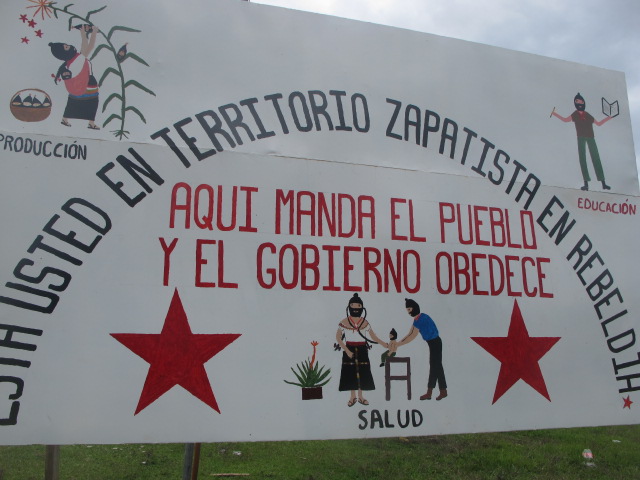
You are in Zapatista Territory. Here the people command and the government obeys!
By: Luis Hernández Navarro
Winds are blowing today, similar to those that blew 20 years ago in the Mexican elites. At that time Carlos Salinas de Gortari felt invincible, much like Enrique Peña Nieto does today. His project to reform Mexico in an authoritarian and vertical manner was advancing without major obstacles, and was being advertised as overcoming myths and historical atavism. He had already laid the foundations of a trans-sexennial power. His approval ratings in public opinion were skyrocketing.
The reforms to Article 27 of the Constitution, which privatized the ejido and opened the way for land concentration in the countryside, were approved without major mishaps. The same thing happened with the amendment to Article 130, which granted political rights to the clergy. At the signing of the North American Free Trade Agreement (NAFTA) an age of abundance, progress and prosperity was announced.
Salinismo believed itself to be eternal. There could be no other reforms than theirs. They were faced with no opposition able to withstand their onslaught. The Party of the Democratic Revolution (PRD) had overwhelmingly lost in the midterm elections of 1991, and more than 300 of its militants had been assassinated. In the political rubbish dumps they discussed matters such as renaming the country, arguing that the international financial institutions identified it as Mexico, and NAFTA was signed with this name.
The emergence of the Zapatista Army of National Liberation (EZLN) in January 1994 overturned that picture dramatically. It derailed the trans-sexennial project of Salinas, dynamited the authoritarian presidency, put the indigenous question in the center of the public agenda, unmasked the government project to combat poverty as a sham, opened spaces for the expansion of a wide variety of political and civic forces which had been blocked politically, forced the citizenization of the Federal Electoral Institute (IFE), laid the foundations for the political reform of 1996, ended the reign of the two hegemonic political-cultural blocs and oxygenated public debate on the country’s fate.
The Zapatista Uprising won, in a very short time, a huge social legitimacy, which was politically and legally recognized, first in the Dialogues of the Cathedral, and then in the Law for Dialogue, Reconciliation and a dignified Peace in Chiapas. That commitment to their cause was not unrelated to the devastating effects of the “modernizing” reforms of Salinismo among broad sectors of the population. Many victims saw the insurgents as their avengers. The rebels justified the armed uprising, in part, by the counterreform to article 27 of the constitution and the signing of NAFTA.
The emergence of the Zapatistas did not stop the cycle of neoliberal reforms, but its promoters were forced to delay them. While it made evident a crisis of political representation in which society does not fit into the regime, and it was a real factor in pushing political change, it did not have sufficient strength to limit the ‘partyocracy’. Nor could it occupy a permanent place at the national political table.
This was palpable on at least three separate occasions. First, in 1996, with the government’s failure to fulfill the San Andrés Accords, and the signing of the Barcelona Accords, by which they agreed to a new political reform that led to a real sharing of power between the three main parties. This negotiation reinforced the party monopoly of political representation; left many of the political and social forces not identified with these parties outside the institutional spaces; and preserved almost intact the power of the leaders of corporate mass organizations.
Secondly, in 2001, in what is the forerunner of the current Pact for Mexico, the PRI, PAN and PRD united in the Senate to vote for a caricature of indigenous reform that made the San Andres Accords a dead letter, putting an end to the possibility that the EZLN and its allies could be inserted into national political life in another way.
And thirdly, from mid-2005 and throughout 2006 the Zapatistas promoted, through the Other Campaign, a nonpartisan, non-electoral political initiative, which put popular participation at its heart by promoting, from below and to the left, a process of anti-capitalist political change. The project was blocked by the governmental repression of the people of San Salvador Atenco and the incomprehension of the institutional left.
In spite of these blocks, the EZLN continues to be a strong force for transformation and an indisputable reference for a wide archipelago of social organizations in the country. Without asking permission, the rebels govern themselves, exercise justice, are responsible for the health and education of their people, and exercise the right to self-defense. Only a year ago, on December 21, 2012, they showed their strength by mobilizing, in silence, 40,000 support bases in an orderly and disciplined manner. In August 2013 supporters from almost every part of the Republic attended the Little Zapatista School (escuelita zapatista), a tremendous learning experience. At the end of the event, hundreds of representatives of indigenous peoples from throughout the country made, together with the rebel commanders, the Juan Chavez seminar into a central moment in the reconstruction of the Indigenous National Congress.
20 years after its public eruption, the Zapatista movement continues to be a new form of politics endowed with an enormous strength. What is profoundly original about this strength, wrote the essayist Thomas Segovia, is that, even though it is an armed rebellion, it continues to faithfully bear the features of a social protest and not a political revolution. This protest has challenged the legitimacy of power. It has avoided becoming a political party and getting caught in the networks of institutional politics.
The Zapatista rebellion vindicated itself from popular sovereignty, and does not recognize intermediaries for its exercise. It is a genuine expression of a society that reflects on itself and on its destiny, which makes its own rules and, by doing so, institutes itself.
____________________________________________________
Originally Published in Spanish by La Jornada
Translation: UK Solidarity Network
Tuesday, December 24, 2013
Zapatista Event at Modern Times Bookstore, SF
20 YEARS OF FREEDOM ACCORDING TO THE ZAPATISTAS
FRIDAY, JANUARY 17, 2014 @ 7:00 pm – 9:00 pm
MODERN TIMES BOOKSTORE
2919 24th STREET SAN FRANCISCO, CA 94110
For 20 years the Zapatistas have been constructing their autonomy. Some of us that attended the Escuelitas Zapatistas, members of the Chiapas Support Committee and YoSoy 132 Bay Area will share their experiences and perspectives, followed by a discussion of what we can learn from Zapatista autonomy and how it informs our work here. Welcome anyone interested in building a world in which many worlds fit.
20 AÑOS DE DE LIBERTAD SEGÚN LOS ZAPATISTAS
Vengan a celebrar 20 años desde el levantamiento Zapatista y 20 años de la construcción de autonomía. Personas que estudiaron en las primeras Escuelitas Zapatistas en 2013, miembros del Comité de Apoyo a Chiapas y de Yo Soy 132 presentarán sus perspectivas. Después habrá una discusión acerca de que significa la autonomía Zapatista para nosotros aquí y en Mexico. Están bienvenidos todos que quieran trabajar para un mundo en que quepan muchos mundos.
Co-sponsors: Chiapas Support Committee and YoSoy 132 Bay Area. For more information, please call: (415) 647-8126
Zapatistas: the Wealth of Dignity
ZAPATISTAS: the wealth of dignity

By: Luis Hernández Navarro
In the community of Emiliano Zapata in the Whirlwind of Our Words Caracol, 30 Zapatista families work collectively. They have in common a coffee plantation, vegetable gardens and about 350 head of cattle. Its inhabitants do not receive government support of any kind, but their standard of living is much better than that of the surrounding PRI-governed settlements. There is a small cooperative shop in the community, whose proceeds go to works that people need. There, as in all the other rebel regions, the cooperative’s resources are used to finance public works such as schools, hospitals, clinics, libraries or water pipes. Throughout all the rebel territory, an autonomous system of well-being flourishes, based on a de facto land reform which prioritizes the communal use of the land and natural resources in collective work, as well as in the production of items for use, and fair trade practices in the international market. In areas of Zapatista influence, they have been overthrowing the law of San Garabato [greed], which dictates that farmers must buy the goods they need at high prices and sell their products cheaply. It happens frequently that coyotes (abusive commercial intermediaries) find themselves forced to pay the rebel support bases higher prices for their crops, livestock and crafts than those offered to the residents who are not organized. The Zapatista cooperatives have acquired a veritable swarm of motor vehicles for moving and transporting their products. In the rebel communities, an environmental awareness has also been developed. There, agroecology is practiced and the use of chemical fertilizers has been banished. Work is done to protect the soil. There is a genuine and widespread concern for conserving forests and jungles. As the authors of the book “Very Other Struggles (Luchas muy Otras): Zapatismo and Autonomy in the Indigenous Communities of Chiapas,” say: “the challenges of sustainability in community production highlight the tension between the need to survive within the existing socioeconomic scheme and the project to transform that scheme.” What emerges here is, rather than a Zapatista economic model, “an endogenous and diverse process of prioritizing the communities as an alternative to submitting to the steamroller logic of transnational capital.”
In the 27 Zapatista municipalities, alcohol is not consumed and drugs are not grown. Justice is exercised without government intervention. Rather than punishment, the focus is put on the rehabilitation of the offender. Women have taken positions and responsibilities that they undertake infrequently in rural communities. The network of common infrastructure in education, health, agro-ecology, justice and self-government, which the insurgents have built outside State institutions, functions according to its own logic, which is plural and diverse. The Zapatista communities have trained hundreds of education and health promoters and agricultural technicians, in accordance with their own culture and identity. All this has been achieved because the Zapatistas govern themselves and defend themselves. They have constructed their autonomy without asking permission, in the midst of an ongoing counterinsurgency campaign. They resist continual harassment from 51 military bases and from welfare programs that seek to divide the communities in resistance by offering them crumbs. However, towards the end of this year a smear campaign was unleashed which asserts that none of this is true. Falsely, it claims that the Zapatistas are worse off today than they were 20 years ago, that they are destroying the environment and dividing communities. This is the latest episode in a dirty war as old as the uprising itself. The slanders do not hold up. Hundreds of public testimonies demonstrate that the accusations against the rebels have nothing to do with the reality that the slanderers spread. For example, the painter Antonio Ortiz, Gritón, was in the community of Emiliano Zapata between August 11th and 16th this year, as part of the Zapatista escuelita, and documented his experience in a moving account that he put on Facebook. He was surprised to find that 30 indigenous families owned 350 head of cattle. He was part of a group of 1,700 people who attended the first Zapatista escuelita that month. Also present were Gilberto López y Rivas and Raúl Zibechi, who shared their reflections in the pages of La Jornada. So did the journalist Adriana Malvido in Milenio, and the dancer Algeria Guerrero in alternative publications. All stated directly how the Zapatista communities live, work, educate, heal and think. For nearly a week, 1,700 guests were transported, housed and fed by their hosts in the communities in which they lived. A Zapatista cadre accompanied each one and answered their questions and concerns about their history, struggle and organizational experience, and translated indigenous languages into Spanish for them. This experience is currently being repeated, at the end of this year, and will be repeated again at the beginning of 2014. An educational initiative of this magnitude, different from the traditional pedagogy, can only be sustained through the existence of communities with a material base capable of accommodating guests, an organization with the skill and discipline to operate such an ambitious project, and thousands of political cadres with training to explain their daily lives and their proposal for social transformation. From below, the Zapatistas are changing the world. Their life today is very different from what it was 20 years ago. It is much better. Over the past two decades, they have given themselves a dignified life, liberated, full of meaning, outside government institutions. They are not just doing it in a few isolated communities; they are doing it in hundreds of them established over a wide area. There is, in this laboratory of political transformation and liberation, much to learn and much to be thankful for.
———————————————————–
Originally Published in Spanish by La Jornada
Tuesday, December 31, 2013
Para leer el Artículo en español: http://www.jornada.unam.mx/2013/12/31/index.php?section=politica&article=017a1pol
EZLN: The Fighting lasted 12 Days; the struggle continues
A little Zapatista history…
The Fighting Lasted 12 Days; the struggle continues

Subcomandante Marcos
** 20 years after their Chiapas Uprising, the Zapatistas resist and reinvent themselves
By: Hermann Bellinghausen
San Cristóbal de Las Casas, Chiapas, December 30, 2013
Against the versions renewed today, and hardly consistent with reality, the autonomous Zapatista communities, without governmental aid (to the contrary, the Mexican government responds to the original demands of said peoples with a sustained war of low-intensity and exhaustion), have achieved promoting a process of self-government, within which dozens of new villages on lands recuperated after the 1994 Uprising were founded. These, added to the more than one thousand towns that make up the autonomous rebel municipalities (municipios), produce as a result no more poverty and marginalization, as the Diviners of the Power would like, but rather organized regions with their own efficient systems of education, collective health (essentially for prevention), agricultural production for self-sufficiency, independent commercialization of coffee, honey and artesanía. All of that, outside of the induced consumerism, economic dependency and political control that the governmental plans imply in Chiapas.
After 1994, the state experienced a virtual agrarian reform, with the appropriation of thousands of hectares of what were ranches and fincas that now are in the hands of the state’s Mayas. We’re talking about up to 700,000 hectares (1.729 million acres) occupied by the Indigenous; the large part, in fact, benefitted those that were not even rebels. The Zapatista rebellion’s influence also reached and benefitted those who stayed on the officialist (pro-government) margins and on occasion have been used to harass, attack and displace the rebels and their indigenous sympathizers. Although systematically denied by the authorities, paramilitarization is a constant fact, with criminal implications and guarantied impunity.
The Life of the original peoples changed in Chiapas
The month of December concludes. At this time, 20 years ago, hundreds of Mayan communities in the Mexican Southeast were getting ready to finally rise up in arms against what they have always called the bad government, after years of preparation for the war of national liberation. The Chol, Tzeltal, Tojolabal and Tzotzil families, said goodbye to miliciano fathers, sons or brothers. The insurgents, many of them women, would head up the route from the Lacandón Jungle, the Highlands and the Northern Zone to simultaneously occupy various cities in the early morning of the year’s end. And so at dawn in Altamirano (they were) demolishing the clock on city hall; in San Cristóbal de Las Casas, at the first light of day, locals, tourists and the first journalists (Amado Avendaño Figueroa, director of Tiempo, the first of them) went to find out who took over the municipal palace and emptied it out. From its balcony, in the voice of Comandante Felipe (famously without ski mask) read the Declaration of the Lacandón Jungle of the Zapatista National Liberation Army (Ejército Zapatista de Liberación Nacional, EZLN), and announced its demands. Subcomandante Marcos, the only mestizo in the group, immediately attracted the media’s attention. From darkness to light, still a little bit like deer in the headlights, it looked like they were who they were and they were prepared for what would come. With faces covered, they demanded: “everything for everyone, nothing for us.”
In Ocosingo a bloody battle awaited them on the second day, and the largest number of rebels would fall there, among them Comandante Hugo, a respected Tzeltal leader. The federal Army (that attacked coming from Palenque) executed several placed face down, with hands tied in back, but the majority died in combat. The road from the Cañadas was seeded with cadavers of indigenous with the uniform of a campesino army that would redefine the idea of modernity, according to the dominant classes. In the early hours the belief ran around that they were not Mexicans and that they were talking like foreigners. They must be from Guatemala, said the Caxlanes closing up their houses inside. The taking of Las Margaritas seemed almost too easy, where the insurgents confronted the police. Subcomandante Pedro fell in that action. The world didn’t know him. The peoples of the Tojolabal Canyon carried him back and mourned him with full honors.
Except in Ocosingo, the rebels’ withdrawal was unobstructed, almost mysterious. Upon leaving Las Margaritas, the rebels passed through the ranch of the general, ex governor and large landowner Absalón Castellanos Domínguez and took him prisoner. He took many indigenous lives and he would be judged for his crimes. And as in La vorágine, from José Eustasio Rivera, the jungle swallowed him up, or the mountains of the Tzotzil Highlands did.
The elites believed that upon 1994 dawning Mexico would be entering the first world as an associate of the northern powers supposed luxury. With the bell tolling of indigenous water festivals in a distant corner of the homeland, the country found itself instead faced with an almost improbable war, of an unpublished eloquence to which no one could be indifferent. Their “¡Ya basta!” changed the rules of the game. The media went en masse from all countries. There was a new player: the indigenous peoples of Mexico. The rest, as they say, is history.
Twenty years later
With that evaluative style so dear to the neoliberals, now “they ask the Zapatistas for an accounting:” let’s see, what have you done these 20 years? And they cast indicators at them, wrong inferences and ill-intentioned lies. After twenty years, five presidents and eight official governors, the peace has not been signed and therefore the declaration of war remains in effect. The talks between the rebels and the authorities have been few (and the last one occurred 18 years ago). The agreements achieved in San Andrés in 1996 were disavowed the following day by the federal government that had signed them, and since then the Zapatistas are ignored in the census, turned into a thing in the polls, are fought with hidden violence and “shot at” with money under the name of programs, which the comunidades that after their insurrection declared themselves in resistance never accepted.
The January fighting lasted 12 días. Hundreds of thousands of people (they talked about a million) went out in the streets to ask for a ceasefire. Since then, a truce exists between the parties, although the government repeatedly violates it (February 9, 1995, with Zedillo’s treacherous military offensive on the communities, and June 10, 1998, with the military attack on San Juan de la Libertad autonomous municipality stand out). The government’s war has not stopped for a single instant. Its fronts are many and not necessarily armed. And nevertheless, in August 1994 the Zapatistas would make an unpublished pronouncement saying that they were an army that aspired to stop being one. In fact, different from what’s common in Latin American rebel movements, they have embarked upon the construction of an autonomous regime, self-sustainable although modest. They vindicate women and don’t owe anyone. They have continued the war without firing a shot; won peace and territory, constructed towns, municipalities and five government centers, called Caracoles, where the very original Good Government Juntas have functioned since 2003.
Arriving at 2014, the Zapatista peoples continue reinventing themselves, because they can do it. Their resistance was arduous, they have suffered without bending, and they continue waking up in the morning to celebrate life. A war like no other, is it not?
_____________________________________________________
Originally Published in Spanish by La Jornada
Translation: Chiapas Support Committee
Tuesday, December 31, 2013
En español: http://www.jornada.unam.mx/2013/12/31/politica/036n1pol
Zapatista News Summary – December 2013
HAPPY 20th ANNIVERSARY!
As the Zapatistas and their supporters around the world celebrate the 20th anniversary of the EZLN Uprising, the Chiapas Support Committee wishes all our friends and compañer@s a HAPPY NEW YEAR! 2013 was a great year for both meeting new people and working with long-time friends. We thank everyone for your interest and participation and look forward to working even harder in 2014. There are a lot of articles commemorating the 20th Anniversary. You can find them on our Compañero Manuel blog. CSC.
DECEMBER 2013 ZAPATISTA NEWS SUMMARY
In Chiapas
1. EZLN Issues 3 Comunicados – The Zapatistas released 3 comunicados: Two Important Notices; Rewind 2; and Rewind 1. In the first comunicado, Moisés provides some information for those attending the Escuelitas in December and January and for those who did not receive an invitation. Remember! The EZLN said that there will be a fourth Escuelita in either April or August 2014. In Rewind 2, Marcos offers comments about the recent privatizations (the government calls them “reforms”) of energy, education and justice and compares them to the Article 27 land “reform.” In Rewind 1 Marcos discusses “for profit” media in a postscript. It may be the EZLN’s way of answering the recent article in El País by Maite Rico, and perhaps others, who incorrectly claim that the Zapatista communities are no better off now than they were in 1994. In both Rewind 1 and 2, Marcos is also remembering those who gave their lives for the movement.
2. Good News! San Sebastián Bachajón Prisoners Released – Just in time for the Holidays, Miguel Demeza and Antonio Estrada, both residents of San Sebastián Bachajón and both unjustly incarcerated for crimes they did not commit, were released from prison in Chiapas. They were political prisoners whose unjust imprisonment was considered to be part of the repression against those resisting dispossession because of the massive tourist project proposed for the area surrounding the Agua Azul Cascades.
3. The TPP Holds Hearings in Chiapas – On December 6 and 7, the Permanent Tribunal of the Peoples (TPP, its initials in Spanish) held important hearings in Susuchumil, a Chol community in Tila municipality, Chiapas. The Tribunal’s purpose was to take testimony from witnesses, survivors and relatives, all victims of the “dirty war” (counterinsurgency or “low-intensity” war) in Chiapas against the Zapatista National Liberation Army (EZLN). Those affected by the human rights abuses gave testimony about forced disappearances, murder, forced displacement, sexual violence and 2 massacres perpetrated by paramilitary groups; all of which remain unpunished.
In other parts of Mexico
1. New Guerrilla Group Emerges in Guerrero – Around December 1, the Revolutionary Armed Forces-Liberation of the People (Fuerzas Armadas Revolucionarias Liberación del Pueblo, FAR-LP) emerged publicly in the Mexican state of Guerrero. Commanders of the FAR-LP met with members of the press somewhere in the mountains of Guerrero, where they read from a comunicado. Among the armed group’s demands are the liberation of CRAC leaders Nestora Salgado García and Gonzalo Molina González, as well as the coordinator of the house of justice of El Paraíso, Bernardino García Francisco and 12 Community Police members. The FAR-LP claims to have a presence in the areas of Acapulco, La Montaña and Costa Chica.
In the United States
1. Covert CIA Operation Killed FARC Leaders – The Washington Post (WP) ran an extensive article about how “smart” bombs, made in the USA, were used to kill various FARC (Revolutionary Armed Forces of Colombia) leaders as part of a covert CIA operation to kill FARC leadership. The Colombian military and the CIA were aided by intelligence from the US National Security Agency (NSA), which also operates in Mexico. The scary issue raised in this article concerns the “ethical” justifications used for directing smart bombs at a human target. See: http://www.washingtonpost.com/sf/investigative/2013/12/21/covert-action-in-colombia/ OR en español: http://www.jornada.unam.mx/2013/12/23/mundo/033n1mun
_________________________________________
Compiled monthly by the Chiapas Support Committee.The primary sources for our information are: La Jornada, Enlace Zapatista and the Fray Bartolome de las Casas Human Rights Center (Frayba).
We encourage folks to distribute this information widely, but please include our name and contact information in the distribution. Gracias/Thanks.
Click on the Donate button at www.chiapas-support.org to support indigenous autonomy.
_______________________________________________________
Chiapas Support Committee/Comité de Apoyo a Chiapas
P.O. Box 3421, Oakland, CA 94609
Tel: (510) 654-9587
Email: cezmat@igc.org
http://www.facebook.com/pages/Chiapas-Support-Committee-Oakland/
https://compamanuel.wordpress.com
EZLN: Rewind 1- When the dead silently speak out
WHEN THE DEAD SILENTLY SPEAK OUT
(Rewind 1)
(In which he reflects on those who are absent, biographies, narrates the first meeting of Durito with the Cat-Dog, and talks about other issues that are not on point; accordingly he will be dictating the impertinent postscript.)

November-December 2013
Methinks we have hugely mistaken this matter of Life and Death. Methinks that what they call my shadow here on earth is my true substance. Methinks that in looking at things spiritual, we are too much like oysters observing the sun through the water, and thinking that thick water the thinnest of air. Me thinks my body is but the lees of my better being. In fact take my body who will, take it I say, it is not me. Herman Melville “Moby Dick.”
For a while now I have maintained that most biographies are no more than a documented lie, and at times, not always, well edited. The typical biography is based on a pre-existing belief and the margin of tolerance for anything that strays from that conviction is very narrow, if not nonexistent. The author, starting from that previously held belief, begins the search through the jigsaw puzzle of a life unfamiliar to him or her (which is why the bibliography interests them to begin with), and goes about collecting the false or ill-fitting pieces that allow him or her to document their own belief, not the life reviewed.
The truth is that we can barely be certain of the date and place of a person’s birth, and in some cases, the date and place of death. Other than that, the majority of biographies should be categorized under “historical novels” or “science fiction.”
So what is left of a life? A little or a lot, we say.
A little or a lot, depending on your memory.
That is, depending on the fragments that life left on the collective memory.
And if that aspect doesn’t matter to biographers and editors, it won’t be important for everyone else. What tends to happen is that what really matters doesn’t appear in the media and can’t be measured in polls.
Ergo, all we have of someone who has passed are the arbitrary pieces of a complex jigsaw puzzle made from the shreds and tendencies that we call “life.”
So with that confusing beginning, allow me to pick up some of those loose pieces in order to embrace and envelop ourselves in that step that today we so need and lack…
-*-
There is a concert in the Mexican silence. Don Juan Chávez Alonso, Zapatista and Mexican, gestures as if shooing away a bothersome insect. It is his response to my apology for one of my clumsy outbursts. We are in Cucapá territory, a sandy land. The coordinates for this geography and calendar show the Sixth in 2006 in the Northeast of Mexico. In the big camping tent that serves as lodging, Don Juan takes his guitar and asks if we want to hear something he composed. After tuning the guitar he begins a concert that, without words, narrates the Zapatista uprising from January 1,1994 through the presence of Comandanta Ramona in the formation of the National Indigenous Congress.
Then a silence, as if it were another note.
A silence in which our dead were quiet out loud.
-*-
Also in the Mexican Northeast, Power, in its bloody mania, paints absurdly and with impunity on the calendar of those below. June 5, 2009. Governmental despotism and greed have set fire to a children’s daycare. The victims, 49 little girls and boys, are merely collateral damage once the compromising documents have been destroyed. The absurdity of parents burying their children is followed by a weak and corrupt justice: those responsible not only are not arrested, but are given jobs in the cabinet of the criminal who will try to hide the bloodbath which he wrought on the entire country under the blue of the National Action Party.
Where biographers stop their notes “because a few years of life aren’t profitable,” history below opens its notebook of other absurdities: with their unjust absence, these small children have given birth to other men and women. Their fathers and mothers have ever since held up the demand for the greatest possible justice: that such injustice is not repeated.
-*-
“The problem with life is that in the end it kills you,” Durito once said. Chapis always enjoyed his fantasy stories of knighthood, although she would have asked, with that impertinent mix of naïveté and sincerity disconcerting to those who didn’t know her, “and why is that a problem?” Don Durito of the Lacandón, beetle by origin and errant knight by profession, would have avoided arguing with her, given that in the supposed code of conduct of an errant knight, one should not contradict a lady. (This is especially true if the lady in question has influence “high up,” Durito adds, knowing that Chapis was religious, a nun, and sister, or whatever name you give to those women who make their faith their life and profession.
Chapis did not know us. That is, not as those who look at us from the outside and write and talk about us… or talk trash about us (fashions are fleeting you know). Chapis was with us. And she was with us some time before an impertinent beetle would appear in person in the mountains of the southeast of Mexico to declare himself an errant knight.
And perhaps because she was among us, all of this about life and death didn’t seem to worry her much. It was that attitude, so neo-Zapatista, in which one invests everything and it’s not death that concerns or occupies us, but life.
But Chapis was not just with us. It is clear that we were one part of her path. And if now I tell you something about her it’s not to provide notes for her biography, but to tell you how we feel here. Because the history of this believer—her history with us—is one that makes even the fanatic atheists doubt themselves.
“Religion is the opiate of the masses”? I don’t know. What I do know is that she gave the most brilliant explanation that I have heard of the destruction and the depopulation that neoliberal globalization causes in a given territory, not a Marxist-Leninist-atheist-and-a-few-more-ists theorist, but… a member of the Christian, Catholic, Apostolic and Roman parish, adherent to the Sixth, and exiled by the high clergy (“for thinking a lot,” she told me as if asking forgiveness) to one of the geographic deserts of the Mexican plateau.
-*-
I believe (maybe I’m wrong, it wouldn’t be the first time and, to be sure, it won’t be the last), that many people, if not all people, who approached what is known as neo-Zapatismo, did so searching for answers to questions formed in their own personal histories, according to their calendar and geography. And they stayed just long enough to find the answer. When they realized that the answer was the most problematic monosyllable in history, they turned in another direction and began to walk there instead. It doesn’t matter how much they tell others and themselves that they are still here: they left. Some people more quickly than others. And the majority of them do not look at us, or they do it with the same distance and intellectual disdain as those who brandished calendars before the dawn of January 1994.
I think I’ve said it before, in some other missive, I’m not sure. But anyway I’ll say, or repeat here, that this dangerous monosyllable is “you;” like that, in lowercase letters, because that answer was and is intimate to everyone. And each one takes it with his or her own respective terror.
Because the struggle is collective, but the decision to struggle is individual, personal, intimate, as is the decision to go on or to give up.
Am I saying that the ones who stayed (and I’m not referring to the geography but to the heart) did not encounter that response? No. What I am trying to say is that Chapis did not come looking for an answer to her personal question. She already knew the answer and had made of that “you” her path and goal: her self as a believer accountable to her own beliefs.
Many others, many like her, but different, had already answered, in other calendars and geographies. Atheists and believers. Men, women, and Others of all calendars. It is those men, women, and others who always, alive or dead, place themselves before Power, not as victims, but to challenge it with the multiple flag of below and to the left. They are our compañeras, compañeros y compañeroas… although in the majority of cases neither they nor we know it… yet.
Because rebellion, friends and enemies, does not belong exclusively to the neo-Zapatistas. It belongs to humanity. And that is something that must be celebrated. Everywhere, everyday and all the time. Because rebellion is also a celebration.
-*-
The bridges that have been built from all corners of the planet Earth to these lands and skies are neither few nor weak. Sometimes with gazes, sometimes with words, always with our struggle, we have crossed them to embrace that other who resists and struggles.
Maybe that’s what it means, not anything else, to be “compañeros”: to cross bridges. Just like in this embrace-made-word that we send to the sisters of Chapis who, like us, miss her and, like us, need her.
-*-
Impunity, dear Matías, is something that only Justice can grant; it is the system of Justice exercising injustice”
Tomás Segovia, in “Cartas Cabales”
I have already said that, in my humble opinion, each person is the hero or heroine of his or her own individual story. And in the soothing complacency of narration, “this is my personal story,” actions and mistakes are revised, the most incredible fantasies are invented, and narrating anecdotes resembles a bit too much the accounting practices of the miser who steals what is not his.
The ancestral desire to transcend one’s own death finds a substitute for the elixir of eternal youth in biographies. Of course, this substitute may also be found in one’s descendants, but the biography is in a certain sense, “more perfect.” It is not just someone who resembles you, rather it is the “I” extended in time thanks to the “magic” of the biography.
The biographer from above uses the documents of the time, perhaps testimonials by family, friends, or compañer@s, of the person whose death is being appropriated. These “documents” have the same accuracy as meteorological forecasts and the testimonials obviate the delicate separation between the “I think that…” and the “I know that…” And so the “veracity” of the biography is measured by the number of footnotes on each page, as these footnotes have the same value for the biography as do the expense sheets of money spent on governmental “image”—the longer they are, the truer they are.
Today, with the Internet, Twitter, Facebook, and their equivalents, biographical myths and fallacies circulate and take shape, and voilà, these fallacies reconstruct the story of a life, or fragments of it, so that soon the biography has nothing to do with what actually took place. But that doesn’t matter, because the biography is published, printed, circulated, it is read, cited, and recited…. just like the lie.
Check the modern sources of documentation for future biographies. That is, check Wikipedia, blogs, Facebook and the relevant “profiles.” Now compare these sources with reality:
Doesn’t it give you chills to realize that, maybe, in the future:
Carlos Salinas de Gortari will be considered “the visionary who understood that selling a nation was more than a family business (taking family to mean blood and politics of course), it was an act of modern patriotism,” and not as the leader of a band of traitors (don’t act the fool, we all know that a number of those that supported the reforms made to Article 27 of the constitution—that watershed moment in the destruction of the Mexican National State—are today members of the “mature and responsible” opposition);
Ernesto Zedillo Ponce de León won’t be remembered as the “Statesmen” who dragged the entire nation from one crisis to an even more severe crisis (in addition to being one of the intellectual authors, with Emilio Chuayffet and Mario Renán Castillo, of the Acteal massacre), but rather as the one who took “the reigns of the country,” with a singular sense of humor…and ended up being what he had always been: a second-rate employee in a multinational corporation.
Vicente Fox will be the proof that the posts of President of a Republic and President of a soft-drink subsidiary are interchangeable…and that useless people can occupy both posts.
Felipe Calderón Hinojosa will be known as a “courageous President” (with others doing the dying) and not as a psychopath who stole a weapon (the Presidency) for his war games…and who ended up being what he always had been: a second-rate employee in a multinational corporation.
Enrique Peña Nieto will be thought of as a cultured and intelligent President (“ok, he is ignorant and foolish, but crafty”; this is the new profile that they are developing in the corridors of political analysis), and not as a functional illiterate (either way, as the popular saying goes: “that which nature doesn’t give, Monex can’t buy”)…?
Ah, the biographies. Often they are autobiographies, even if it’s their descendants (or their buddies) who promote them and, in doing so, are able to adorn their own genealogical tree.
The criminals of the Mexican political class who have misgoverned these lands will, according to those who suffered their abuses, always be mere unpunished criminals. It doesn’t matter how many lines they buy in the press; or how much they spend on spectacular events that will fill the streets, the written press, the radio, and the television. From the Díaz (Porfirio and Gustavo) to the Calderóns and Peñas, from the Castellanos and Sabines to the Albores and Velascos, the general rule is that of exposing the ridiculous frivolity of the “juniors” (but only on social networks since the paid press still considers them “mature and responsible people”).
But the world turns and in the continuous rise and fall of the politicians up above, one can pass quickly from a picture on the cover of “Hola,” to one that says, “WANTED: DANGEROUS CRIMINAL,” from the revelry of the December of NAFTA, to the hangover of the Zapatista uprising; from “man of the year” to the “hunger strike,” undertaken with a “chic” brand of bottled water (what can I say, even in protests there are social classes), from applause for bad jokes to the upcoming murder of a supposed family member; from nepotism and corruption dressed in witty remarks to an investigation for links to drug trafficking, from extra large military uniforms to fearful and bloody exile, from the binge of the December of the sell out to…
-*-
With all of this and what follows, am I saying not to read/write biographies? No, but what makes the old wheel of history move are collectives and not individuals. Historiography thrives on individualities but history learns from a people.
Am I saying that we don’t have to write/study history? No, but what I am saying is that it is best done in the only way that it can be done, that is to say, organized with others.
Because, friends and enemies, when rebellion is individual it is pretty. But when it is collective and organized it is terrible and marvelous. The former is the material of biographies; the latter is what makes history.
-*-
It is not with words that we embrace our Zapatista compañeros and compañeras, atheists and believers.
To those who carried a backpack and history on their backs in the night.
To those who took lightening and thunder in their hands.
To those who put on their boots without having a future.
To those who covered their face and their name.
To those who died without expecting anything in return.
So that others, everyone, in a morning that is yet to come, would be able to see the day as we must, in other words, head-on, on our feet, and with the gaze and the heart upright.
For them, there are neither biographies nor museums,
For them our memory and rebellion,
For them, our cry:
liberty! Liberty! LIBERTY!
Vale. Be well and may our steps be as great as our dead.
SupMarcos
PS. WITH OBVIOUS INSTRUCTIONS: Now it would be nice to read, in reverse order, Rewind 1 through 3, and maybe in doing so you will find the cat-dog and resolve some of your doubts. And yes, you can be sure that more questions will arise.
P.S. WHICH RESPONDS TO, AND DEMANDS FROM, THE FOR-PROFIT MEDIA. Ah! What a moving effort by those counter-revolutionaries in the for-profit media who try to build arguments for the few counter-revolutionary readers/listeners/viewers that they have left. But, as I’m feeling generous for the holidays here are a few tips that you might use as material for your stories: [1]
– If the conditions of the Zapatista indigenous communities are the same as they were 20 years ago and there haven’t been any advances in their quality of life, why would the EZLN “open” itself through our Little School in which people from below can see and know for themselves, WITHOUT INTERMEDIARIES, what exists here, just as we did with the press in 1994?
And now that we’re asking questions, why during that same twenty years was there an exponential decrease in the number of readers/listeners/ viewers of the paid media? Psst, psst, you might want to respond that you don’t have fewer readers/listeners/ viewers – cause that might reduce your advertising and the bribes, what you can say is that now readers/listeners/viewers are simply more “selective.”
-You ask, “What has the EZLN done for the indigenous communities?” We respond with the direct testimony of tens of thousands of our compañeros and compañeras.
And now you, the owners, shareholders, directors, and bosses should respond to this:
What have you done, in these past 20 years, for those who work in the media, one of the sectors hardest hit by the crime enacted and encouraged by the regime that you so adore? What have you done for the journalists that have been threatened, kidnapped, and assassinated? And for their families? What have you done to improve the life of your workers? Have you increased their salary so that they could have a dignified life and don’t have to sell their word or their silence in the face of what is actually taking place? Have you created the conditions for them to have a dignified retirement after years of working for you? Have you given them job security? That is to say, so that the job of a reporter no longer has to depend on the mood of their editors or on the “favors,” sexual and otherwise, that are demanded of them regardless of gender?
What have you done so that a job in the media is something to be proud of and which does not result in the loss of freedom or of life when done honestly.
Can you say that your work is more respected by governments and governors than it was 20 years ago?
What have you done against imposed or tolerated censorship? Can you say that your readers/listeners/television viewers are better informed than they were 20 years ago? Can you say that you survive thanks to your readers/listeners/viewers and not from advertising, the majority of which is government sponsored?
You should provide your answers to your workers and your readers/listeners/viewers, just as we are accountable to our compañeros and compañeras.
Oh, come on! Don’t be so glum! We’re not the only ones that have escaped your role as judge and executioner, begging your forgiveness and always receiving your condemnation. There is also, for example, reality.
Vale, for the 9th time. Or even better, for the 69th time. El Sup saying that a thumbs-down is better than a raised middle finger above.
It is Zapatista territory, it is Chiapas, it is Mexico, it is Latin America, it is Earth. And it is December 2013; it’s cold, as it was 20 years ago, and, just like then, today a flag covers us, the flag of rebellion.
————————————————————————
Watch and Listen to the videos that accompany this text:
In one of the autonomous Zapatista schools, boys and girls dancing at a school party.
From and for León Gieco: “The landing.” Pay attention to the words, because if “there are those who resist and never complain/…./we don’t claim to see the change/only to have left something/on the road taken.”
____________________________________________
Joan Manuel Serrat with his “It Would be Fantastic”, which could really be a program of struggle: “It would be fantastic/…/if the same ones didn’t always lose/and if the disinherited inherited./ It would be fantastic/ if the best won/ and if force didn’t make one right/…/If everything was as it should be/ and if no one ruled/…”
________________________________________________________________
Hugh Laurie (who you might recognize as Doctor Gregory House), with a very special interpretation of the blues “Saint James Infirmary”. For those who die on their feet.
__________________________________________________________
Originally Published in Spanish by Enlace Zapatista at:
http://enlacezapatista.ezln.org.mx/2013/12/28/cuando-los-muertos-callan-en-voz-alta-rebobinar-1/
English Translation: El Kilombo
Re-posted from: http://dorsetchiapassolidarity.wordpress.com/2013/12/31/ezln-rewind-1-when-the-dead-silently-speak-out/
Editors Note:
[1] We believe that this postscript is a response to the El País article by Maite Rico (as well as others), in which she claimed that the current living conditions in Zapatista communities are no better than they were in 1994. (Has she ever been in a Zapatista community?) She co-authored Marcos: the genial imposter, a very critical account of the EZLN in the early years of the Uprising.
______________________________________
Raúl Zibechi: The Ya Basta! In Latin America

Happy New Year!
The Ya Basta! In Latin America
By: Raúl Zibechi
In the 20 years that have transpired since the January 1, 1994 Zapatista Uprising, Latin American movements have championed one of the most intense and extensive cycles of struggle in a long time. Since the 1989 Caracazo (Caracas Massacre), uprisings, insurrections and mobilizations occurred that encompassed the whole region, delegitimized the neoliberal model and installed those from below, organized into movements, as central actors of changes.
Zapatismo formed part of this wave of the 90s and very soon became one of the inescapable referents, even for those who do not share their proposals and forms of action. It is almost impossible to enumerate everything the movements realized in these two decades. We can only review a handful of significant acts: the picketer cycle in Argentina (1997-2002), the indigenous and popular uprisings in Ecuador, the Peruvian mobilizations that forced the resignation of Fujimori, and the Paraguayan March, in 1999, that led to the exile of Lino Oviedo, who led a military coup.
In the next decade we had the formidable response of the Venezuelan people to the 2002 rightwing coup, the three Bolivian “wars” between 2000 and 2005 (one del about water and two about gas) that erased the neoliberal right from the political map, the impressive struggle of the Amazon Indians in Bagua (Peru) in 2009, the resistance of the Guatemalan communities to mining, the Oaxaca commune in 2006 and the mobilization of the Paraguayan peasantry in 2002 against the privatizations.
In the last three years a new layer of movements were felt that insinuate a new cycle of protests, like the mobilization of Chilean secondary students, the community resistance to the Conga mining enterprise in northern Peru, the growing resistance to mining, to fumigations and to Monsanto in Argentina, the defense of the TIPNIS (Territorio Indígena y Parque Nacional Isiboro Sécure) in Bolivia and the resistance to the Belo Monte Dam in Brazil.
In 2013 alone we had the Colombian agrarian strike that was capable of uniting all the rural sectors (campesinos, indigenous and cane cutters) against the free trade agreement with the United States and one of the urban movements, and also the June mobilizations in Brazil against the ferocious urban extractivism of labor for the 2014 World Cup and the 2016 Olympic Games in Rio de Janeiro.
This group of actions throughout the two decades permits assuring that the movements of those below are alive in the whole region. Many of them are carriers of a new political culture and organization that is demonstrated in very diverse ways in the different organizations, but make up different ways of doing than what we knew in the decades of the 60s and 70s.
Some of the movements, from the Chilean secondary school students to the Zapatista communities, passing through the Guardians of the Conga Lakes, the Venezuela Settlers Movement and the Free Pass Movement (Movimiento Passe Livre, MPL) of Brazil, among the most prominent, demonstrate some common characteristics that would be worth noting.
The first is the massive and exceptional participation of youth and women. This presence revitalizes the anti-capitalist struggles, because the people most affected by capitalism are participating directly, those who don’t have a place in the still hegemonic world. It is the majority presence of those who don’t have anything to lose because they are, basically, women and youth from below that give the movements an intransigent radical character.
In second place, a political culture is gaining ground that the Zapatistas have synthesized in the expression “govern by obeying” (mandar obedeciendo), which is still expressed diffusely. Those that care for the lakes in Perú, the heirs of campesino patrols, obey the communities. Youths of the MPL make decisions by consensus so that majorities are not consolidated, and they explicitly reject the “sound cars” that union bureaucracies imposed in the previous period to control the marches.
The third question in common is related to autonomy and horizontalness, words that just started to be used 20 years ago and were fully incorporated into the political culture of those who continue struggling. They claim autonomy from the State and the political parties, meanwhile horizontalness is collective leadership of the movement and not individual. Members of the Coordinator Assembly of Secondary Students (ACES, its initials in Spanish) of Chile function horizontally, with a collective leadership and assembly.
The fourth characteristic that I see in common is the predominance of flows over structures. The organization adapts and is subordinate to the movement, not frozen in a structure capable of conditioning the collective, with its own interests separate from the movement. The collectives that fight are something like communities in resistance, in which all run similar risks and where the division of labor adapts to the objectives that the group outlines at every moment.
In this new layer of organizations it is not easy to distinguish who the leaders are, not because referents and spokespersons don’t exist, but rather because the difference between directors and directed has been diminishing as the leadership of those below increases. This is perhaps one of the most important aspects of the new political culture in expansion in the last two decades.
Finally, I would like to say that Zapatismo is a political and ethical referent, but not as the direction of these movements, which it does not seek or could be. It can be an inspiration, a reference and an example if one chooses. I feel that there are multiple dialogues among all these experiences, not in the style of formal and structured gatherings, but direct exchanges between militants, capillaries, not controlled, but the kind of exchange of knowledge and experience that we need to strengthen the fight against the system.
———————————————————————-
Originally Published in Spanish by La Jornada
Translation: Chiapas Support Committee
Friday, December 27, 2013
En español: http://www.jornada.unam.mx/2013/12/27/opinion/018a1pol
 Chiapas Support Committee