Chiapas Support Committee
Home of the Compañero Manuel blog on zapatistas & mexico
1 Dead and 15 Injured: La Realidad Junta
THE “TOWARDS HOPE” GOOD GOVERNMENT JUNTA VEHEMENTLY DENOUNCES THE CIOAC PARAMILITARIES ORGANIZED BY THE THREE LEVELS OF BAD GOVERNMENT AGAINST OUR BASES OF SUPPORT OF THE ZAPATISTA NATIONAL LIBERATION ARMY
THE GOOD GOVERNMENT JUNTA “HACIA LA ESPERANZA”
CARACOL I
MOTHER OF THE CARACOLES
SEA OF OUR DREAMS
LA REALIDAD, CHIAPAS, MEXICO
MAY 5, 2014
PUBLIC DENUNCIATION
TO NATIONAL AND INTERNATIONAL CIVIL SOCIETY
TO THE STUDENTS OF THE LITTLE SCHOOL
TO THE COMPAÑERAS AND COMPAÑEROS OF THE SIXTH IN MEXICO AND IN THE WORLD
TO THE INDEPENDENT HUMAN RIGHTS ORGANIZATIONS
TO THE ALTERNATIVE MEDIA
TO THE NATIONAL AND INTERNATIONAL PRESS
TO ALL HONEST PEOPLE IN MEXICO AND THE WORLD
Compañeros and compañeras, brothers and sisters, we vehemently denounce the CIOAC paramilitaries organized by the three levels of the bad government against our bases of support of the Zapatista National Liberation Army – EZLN.
On March 16 of this year, as we were carrying out an autonomous health drive with our Zapatista communities in the autonomous municipality of General Emiliano Zapata, headquartered in Amador Hernández, the CIOAC paramilitaries from La Realidad detained the Junta de Buen Gobierno’s [Good Government Junta] truck which was transporting medications for our campaign. They used the pretext of objecting to the two loads of gravel that our compañero bases of support in la Realidad were supplying for the construction of a dormitory for the health promoters working in the autonomous municipal health clinic in the municipality of San Pedro de Michoacán, headquartered in La Realidad.
1. The pretext: before, there had been an agreement about how the gravel could be used. But the paramilitaries of La Realidad have been using it to construct the chicken coops and pigpens that the bad government gives them as part of the dignified housing program, so now the paramilitaries do not allow our compañeros to use this gravel; this was their pretext.
The paramilitaries, organized by the three levels of bad government in preparation for a counterinsurgency campaign, tried to provoke our Zapatista compañeros by acting against the Junta de Buen Gobierno, because instead of detaining the truck that transported the gravel, they detained the vehicle that was working in the service of the health of thousands of Zapatistas. They never intended to understand or resolve the situation. The leaders of the CIOAC paramilitaries are the ejido commissioner (comisariado ejidal) Javier López Rodríguez, paramilitary agente Carmelino Rodriguez Jiménez, Jaime Rodríguez Gómez, Eduardo Santiz Santiz, Álvaro Santiz Rodríguez, and Oscar Rodríguez Gómez.
This was just a pretext for provocation, because there is a community agreement that the gravel is communal. The CIOAC paramilitaries of La Realidad are using that gravel to build the pigpens that the bad government calls dignified housing.
And so the compañeros thought that they also had the right to use it.
The paramilitaries of La Realidad are paid, organized, led, and trained by the three levels of bad government to divide and provoke the Zapatista people and the Zapatista autonomous government; this time they distorted the issue at hand and went after the Junta de Buen Gobierno.
As the Junta, we wanted to resolve the situation, but they never wanted to come to an understanding, because it was the leaders of the CIOAC paramilitaries of la Realidad that brought their people against the Junta de Buen Gobierno, and as such the situation could not be resolved. They dragged the Junta de Buen Gobierno’s truck to their ejidal house and it is still in their hands today.
2. As the Junta de Buen Gobierno, we believed that we had an understanding with the other paramilitary leaders from the CIOAC-Histórico, which is to say the paramilitary leaders Luis Hernández, José Antonio Vázquez Hernández, Roberto Alfaro Velasco, Alfredo Cruz Calvo, Juan Carlos López Calvo, Romeo Jiménez Rodríguez, Víctor García López, Conrado Hernández Pérez, Gustavo Morales López, and Roberto Méndez Vázquez, and accompanied by some of their militants such as Adrián López Velásquez, Cesar Hernández Santiz from the community Victoria la paz; Bernardo Román Méndez, Enrique Méndez Méndez, who are from the Ejido Miguel Hidalgo; Misael Jiménez Pérez, Vidal Jiménez Pérez, Marconi Jiménez Pérez from Guadalupe Tepeyac; and Ismael Garcia Perez from San José la esperanza. And there are other accomplices who work from another site, including Gilberto Jiménez Hernández, Delmar Jiménez Jiménez, and Gerardo Hernandez Perez, the three paramilitary bosses who operate in Guadalupe Tepeyac.
There are others from Guadalupe los Altos including Julio Rodriguez Aguilar, Carmellino Rodriguez Aguilar, Ranulfo Hernandez Aguilar and Alejandro Vazquez; from San Carlos Veracruz including Gaudencio Jimenez jimenez who works in the municipal presidency of Las Margaritas; and Gabriel Grene Hernandez, Isauro Mendez Santiz, Ivan Mendez Dominguez, Fidel Mendez Zantiz, and Alfredo Mendez Rodriguez, from Veracruz annexed to San Carlos.
3. Knowing the attitudes of the CIOAC paramilitary leaders, which is to say the Los Luises gang, we first went to the Human Rights Organization Fray Bartolomé de las Casas. We explained the acts of provocation against us, and “Frayba” explained it to Los Luises and gave them a summons with the date of March 31. There was a first summons, and then a second, and a third. The response was that if the summons was for the problems with the CIOAC from Guadalupe los Altos, Santa Rosa el Copan, Diez de Abril, San Francisco or San Jose el Puente, then that isn’t their problem. Frayba explained the situation around the summons and, moreover, the summons itself specifies the problem with the CIOAC paramilitaries in la Realidad, but they didn’t present themselves.
4. We again sent a second summons through Frayba and the response was that they were going to come, but they never did.
Seeing this with concern, we had to go to the Frayba offices to explain more fully the reason for the call and that they should go directly to tell the Luises, the paramilitary leaders. Not until the third citation was sent did they come. We asked for Frayba’s presence as a witness for a peaceful solution and they set the date of the meeting for May 1 of this year.
5. The first to arrive were Roberto Alfaro Velasco, secretary of the CIOAC, and Alfredo Cruz Calvo, their secretary of transportation. One of them, Alfredo Cruz Calvo, went to talk to his CIOAC paramilitary compañeros in La Realidad, and he returned to tell us, the members of the Junta de Buen Gobierno, that they hadn’t understood – exactly as they have been taught to act. They proposed to us that they would go and talk to some of the other paramilitary leaders in La Realidad, but that was backbiting trickery because they didn’t go talk to the paramilitaries in La Realidad – they went to speak with the paramilitary boss of the Luises. When Alfredo returned, after supposedly having gone to talk to the paramilitaries in La Realidad, he brought 15 people with him telling us that we had to free Roberto Alfaro. In other words, he didn’t come to address the problem but to tell us that one of them was going to stay to talk to the leaders in La Realidad.
Once the discussion began, it was made clear to them that Roberto Alfaro had neither been kidnapped nor detained. The 15 people they brought were the ones forcing Roberto Alfaro to say that he had been kidnapped and detained, and Frayba was a witness to all of this; they were there the whole time. Roberto Alfaro asked those 15 people to go talk to the paramilitaries in La Realidad but they refused. On May 2 we were about to reach an agreement at about five or six in the evening to establish another dialogue the following day. But those 15 and the paramilitary head of the Luises were already organizing something else outside. On the evening of May 2 the Zapatista compañeros bases of support were arriving to our Caracol to work on other zone projects, and these paramilitaries were planning an ambush at the entrance to the community in order to attack our compañeros.
The paramilitaries in La Realidad already had a plan organized. They had split into two groups – one at the entrance to the community and the other in the middle of the community. They had both long and short weapons – machetes, clubs, and rocks. Before they carried out the murder, they began their provocations by destroying ourcompañeros autonomous school and cut the water piping that supplied water to our Zapatista bases of support and to the center of the caracol. We saw and heard it happen. As this was happening, the compañeros were arriving to work on other zone projects, and immediately the La Realidad paramilitaries ambushed the entrance road to the community and began attacking our compañeros with rocks and clubs, destroying the trucks’ windshields. Our compañeros managed to get out of the trucks however they could and defended themselves. We as Junta de Buen Gobierno were informed immediately that our compañeros were being attacked, and other compañeros who were working in the caracol came out to help, but they were unable to reach them. They were attacked with firearms in the middle of the community, and that is where our compañero José Luís Solís López fell; he was a zone level teacher in our Little School “Freedom According to the Zapatistas.” He was shot in the right leg and the right side of the chest with a .22 caliber bullet, cut across the mouth with a machete, and received a coup de grace to the back of the head with a weapon of the same caliber. He had also been clubbed many times on the back.
Many other compañeros sustained injuries from bullets, machetes, clubs, and rocks:
– Romeo Jimenez López, shot twice: once in the right leg and another in the left leg with a .22 caliber bullet.
– Andulio Gómez López, grazed in the chest with a .22 caliber bullet.
– The compañero Abacuc Jimenez López, struck by a machete blow to the right arm.
– The compañero Yadiel Jimenez López, struck by a machete blow, also to the right arm.
– The compañero Efraín, struck by a rock blow to the head.
– The compañero Gerardo, struck by a rock blow to the mouth.
– The compañero Ignacio, struck by a rock blow to his right hand and to his brow.
– The compañero Esau, struck by a rock blow to his brow.
– The compañero Noe, struck by a rock blow to his head.
– The compañero Saul, struck by a rock blow to his right arm.
– The compañero Elder Darinel, various blows to his neck.
– The compañero Hector, struck by a rock blow to his eye.
– The compañero Marin, struck by a rock blow to his mouth, destroying his teeth.
– The compañero Nacho, struck by a machete blow to his hand and eye.
– The compañero Jairo, struck with blows to his back.
Our compañeros were transported to our hospital-school “La Primera Esperanza Compañero Pedro” for medical attention.
6. We adamantly refute that we were armed. If that had been the case, the outcome would have been different. This took place at 8:30pm on May 2.
That little mob of paramilitary leaders – those 15 who were with us – were told to go outside and control their people, but none of them would go.
7. Today, May 5, we see that the bad government in Chiapas had detained five people. One of them is a CIOAC paramilitary leader, Conrado Hernández Pérez; we don’t know the others. But they know exactly who they are, especially their paramilitary head, Manuel Velasco Cuello, and their supreme paramilitary-in-chief, Peña Nieto. However, those murderous paramilitary criminals who took the life of our compañero José Luís Solís López, and shot him coup de grace style have not been detained. They are still in La Realidad, keeping up their provocations, and they will continue to do so because this is the plan of the supreme paramilitary-in-chief, the top paramilitary in Chiapas, and the paramilitary bosses of CIOAC.
8. As you can see from what we’ve recounted, the Fray Bartolomé de Las Casas Human Rights Center was present at every moment. This is why we did not put out our own statement on what took place quickly. Out of respect for their mediation role and impartial perspective, we waited for Frayba to issue its neutral account, the way it does with all the issues it handles. In Frayba’s statement you can see directly who is lying and what the truth is, according to those who were present but did not belong to any of the groups involved.
9. Now it can be clearly seen that everything that the paid press reported is a lie. There was never a confrontation. There was an attack against us.
10. In light of this problem and the cowardly murder of our compañero Galeano, the Junta de Buen Gobierno has decided to withdraw its participation and hand the entire issue over to the General Command of the Zapatista Army for National Liberation so that it can take charge of the investigation and help bring about justice. Now we have to wait for what our EZLN compañeros have to say.
SINCERELY
JUNTA DE BUEN GOBIERNO
HACIA LA ESPERANZA
ZONA SELVA FRONTERIZA
Translated by El Kilombo Intergaláctico
EZLN: Marcos: Pain and Rage – activities cancelled
EZLN: PAIN and RAGE
Zapatista National Liberation Army
May 8, 2014

Subcomandante Marcos
To the Compañeras and Compañeros of the Sixth:
Compas:
To tell you the truth, the communiqué was all ready. It was succinct, clear, precise, how communiqués should be. But… well… maybe later.
For now the meeting with the compañeros and compañeras bases of support of the community of La Realidad is about to begin.
We listen.
We have known the tone and the emotion with which they speak for a long time: pain and rage.
So it occurs to me that a communiqué will not adequately reflect this.
Or at least not fully.
True, maybe a letter won’t do so either, but at least the words that follow are an attempt, even if they are only a pale reflection.
Because…
It was pain and rage that made us challenge everything and everyone 20 years ago.
And it is pain and rage that now again makes us lace up our boots, put on our uniforms, strap on our guns, and cover our faces.
And that leads me to don the old and tattered hat, the one with three red five-pointed stars.
It is pain and rage that has brought us to Reality (La Realidad).
A few moments ago, after we explained that we had arrived here in response to the petition of support made by the Good Government Council, a base of support and a teacher in the course “Freedom According to the Zapatista,” told us more or less the following:
“Compañero Subcomandante, we want to be clear, if we were not Zapatistas we would already have taken revenge and it would have led to a massacre, because we are filled with rage about what they did to our compañero Galeano. But we are Zapatistas and we don’t seek revenge, but rather justice. So we have waited to see what you all will say and that is what we will do.”
As I listened to him, I felt both envy and sorrow.
I felt envy toward those who have had the privilege of having women and men like Galeano and like this compa who was speaking as teachers. Thousands of men and women from across the world have had this good fortune.
And I felt sorry for those who no longer have the possibility of having Galeano as their teacher.
The compañero Subcomandante Moisés has had to make a very difficult decision. His decision cannot be appealed, and if someone were to ask my opinion (which no one has done), his decision is unobjectionable. He has decided to indefinitely suspend the meeting and exchange with the indigenous peoples and organizations of the National Indigenous Congress. And he has also decided to suspend the homage that we had prepared for our absent compañero Don Luis Villoro Toranzo, as well as to suspend our participation in the Seminar “Ethics in the face of Dispossession,” that was being organized by artists and intellectuals in Mexico and the world.
What led him to this decision? Well, the preliminary results of our investigation, as well as information that we have received, leave no doubts regarding the following:
1. This was a planned, premeditated attack, militarily organized, and put into action with premeditated malice and advantage. And it is an act of aggression inscribed in a climate created and cultivated from above.
2. The leaderships of the paramilitary group called CIOAC-Historica, the Green Ecological Party (the name under which the PRI governs in Chiapas), the National Action Party [PAN] and the Revolutionary Institutional Party [PRI], are all implicated in directing this attack.
3. We know that at least the government of the State of Chiapas is implicated. We have not yet determined to what extent the federal government was also involved.
One woman from these anti-Zapatista organizations has come to tell us that this attack was planned and that in fact the goal was to specifically “fuck over” Galeano.
In sum: this was not some intra-community problem, where two groups confront each other in the heated emotions of the moment. This attack was planned: first they tried to provoke us by destroying our school and health clinic, knowing that our compañeros were not armed and that they would humbly defend what they had created through their own efforts; next the attackers took up positions on the path that they knew our compañeros would take from the Caracol to the school; and finally they fired on our compañeros.
Our compañeros were injured by gunfire in this ambush, but what happened to our compañero Galeano is even more extreme. He did not fall in the ambush. He was surrounded by 15 or 20 paramilitaries (yes, they are paramilitaries; their tactics are those of paramilitaries); our compa Galeano challenged the aggressors to hand-to-hand combat, without guns; they would swing at him and he would jump from one place to another avoiding their blows and disarming his opponents.
When these aggressors saw that they could not beat him like that, they shot him in the leg and he fell. Then came the barbarism: they descended upon him, beat him and cut him with a machete. Another shot to the chest brought him to the edge of death, and they kept beating him. When they saw that he was still breathing, one of those cowards shot him in the head.
They shot him three times at point blank range. And all three shots came while he was surrounded and unarmed, but had not given up. His body was then dragged by his assassins for some 80 meters and then tossed aside.
Our compañero Galeano was left there alone, his body thrown in the middle of what had been the territory of the campamentistas, men and women from all over the world who had answered the call to build a “peace camp” in La Realidad. And it was our compañeras, the Zapatista women of La Realidad who defied fear and went to pick up Galeano’s body.
Yes, there is a photo of our compa Galeano in this state. The image shows all of his wounds and it feeds our pain and rage, despite these needing no reinforcement after listening to the stories of what happened. Of course I understand that this photo could offend the sensibilities of the Spanish royalists; reason enough to publish a photo of a scene unashamedly manufactured, with a few injured people, and with reporters, mobilized by the government of Chiapas, selling the lie that there had been a confrontation. Well, “he who pays, rules.” Because classes do exist my friend. The Spanish monarchy is one thing, and these “fucking” rebellious Indians who tell you off—telling you to beat it to Lopez Obrador’s ranch because a few feet away, they are mourning the body of the still bloody compa Galeano—are quite another.
The CIOAC-Histórica, and their rival CIOAC-Independiente, and other “peasant” organizations such as ORCAO, ORUGA, URPA, and the rest, make their living from provoking confrontations. They know that creating problems in the communities where we have a presence pleases the various levels of government and that they will be rewarded with social programs and thick wads of cash for their leaders for the problems that they cause us.
In the words of a government official in the administration of Manuel Velasco: “it is more convenient for us that the Zapatistas be kept busy with artificially created problems than for them to be holding activities that “güeros” from all over the world come take part in. That’s what he said,” güeros.” Yes, it is comical that he should say that, given that he is the servant of a certain “güero.”[1]
Each time the leaders of these “peasant” organizations see their budgets thinning due to their bingeing, they create a problem and then run to the government of Chiapas who pays them in order to “calm down.”
This “modus vivendi” of these leaders who can’t even tell the difference between “sand” and “gravel”, began with the Priista and nearly forgotten “croquetas,”[2] Albores, and was taken up once again with Juan Sabines, follower of Lopez Obrador, and continues today with self-proclaimed Green Ecologist Manuel “el güero” Velasco.
Wait just a minute…
Now a compa is speaking. Crying. But we all know that these are tears of rage. With a faltering voice he says what we all feel: we don’t want revenge, we want justice.
Another compa interrupts: “Compañero Subcomandante Insurgente, don’t misunderstand our tears, they are not tears of sadness, they are tears of rebellion.”
And now there is a report about a meeting of the leaders of CIOAC-Histórica. The leaders say, word for word: “with the EZLN we cannot negotiate with money. But once all of those who appear in the newspaper are detained, locked up for 4 or 5 years, and the problem has abated, then their release can be negotiated with the government.” And another one adds, “or, we can say that we had a death on our side and that now things are even because there was a death on both sides, and the Zapatistas should settle down. We will stage a death or we’ll kill one of our own and then the problem will be solved.”
In the end, this letter has got long and I don’t know if you have managed to feel what we feel. In any case, Subcomandante Insurgente Moisés has charged me with letting you know that…
Wait…
Now they are speaking in the Zapatista assembly in La Realidad.
We had left so that they could come to an agreement regarding their response to a question that we had asked them: “The government pursues the comandancia of the EZLN. You know this well because you were there during the betrayal of 1995. So, do you want us to be here to see about this problem and to see that justice is done, or is it better for us to go elsewhere? Because all of you may now also suffer direct persecution by the governments and their police and military.”
Now I hear a young person, about 15 years of age. They tell me that he is the son of Galeano. I look and yes, it is a young man, it is a Galeano in the making. He says that we should stay, that they trust us to find justice and to find the people who assassinated his father. And that they are open to anything. The voices in this vein multiply. The compañeros speak, the compañeras speak, and even the children stop crying; these women were the ones who reconnected the water, despite the threats by the paramilitaries. “They are brave,” says a man, a war veteran.
We will stay, this is the agreement.
Subcomandante Insurgente Moisés gives some monetary support to the widow.
The assembly disperses. Although we can see that their step is firm again, that now there is another light in their gaze.
What was I telling you? Ah yes.
Subcomandante Insurgente Moisés has charged me with letting you know that the public activities of May and June have been suspended indefinitely, as have the courses “Freedom According to the Zapatistas.” And so you should see about your cancellations and all of that.
Wait…
Now they are saying that up above they are re-invoking the model that they called “the Acteal model”: “it was an intra-community conflict over a sand bank.” Hmm… and then the militarization follows, the hysterical voices of the domesticated press, the simulations, the lies, and the persecution. It’s no coincidence that the old Chuayffett is in office, now with disciplined students in the government of Chiapas and in the “peasant” organizations.
And we already know what comes next.
But what I want to do is take advantage of these lines to ask you:
For us, pain and rage have brought us here. If you have managed to feel these as well, where has it brought you?
For us, we are here, in reality (La Realidad), where we have always been.
And you?
Vale. Health and indignation.
From the mountains of Southeastern Mexico.
Subcomandante Insurgente Marcos.
Mexico, May 2014. In the 20th year of the war against oblivion.
P.S. The investigations are being conducted by Subcomandante Insurgente Moisés. He will be reporting on the results, or, he will do so through me.
Another P.S. If you asked me to summarize our laborious journey in a few words, they would be: our efforts are for peace, their efforts are for war.
[1] “güero” is a term that in Mexico is often used to refer, often affectionately, to people with light skin. Manuel Velasco, governor of Chiapas, has made his entire political career with the self-appointed nickname of “el Güero,” continuing the long tradition in Chiapas of the despotic rule of a white political class over a majority mestizo and indigenous population. The irony here then is an official that serves under this governor (el Güero) is complaining about the EZLN bringing “güeros” to the state of Chiapas.
[2] “Croquetas,” or doggy biscuits, was the nickname assigned by the EZLN to Roberto Albores Guillén, whose bloody tenure as governor of Chiapas lasted from 1998-2000.
Translated by El Kilombo Intergaláctico
Peter Rosset: To better understand anti-Zapatista violence in Chiapas. A brief guide.

Are Indians just violent people, or what? Are the Zapatistas violent? There is a heck of a lot of confusion surrounding violence in Chiapas. To help clear up misunderstandings about what is going on, I offer this brief guide to better understanding.
The counterinsurgency strategy in Chiapas is based, in part, on the implementation of policies designed to fragment peasant, community and indigenous organizations, creating ever smaller, more polarized, more aggressive, more opportunistic and easier to manipulate factions. Local and regional leaders are bought off with handouts and money for productive projects, with candidacies, cushy government jobs, etc., responding both to the objective needs of their followers, as well as to their opportunism, envy and grudges.
These offers either explicitly or implicitly hinge on distancing their organizations from Zapatismo. The first goal is to politically isolate the rebels. These resources and jobs are then also used to provoke open conflict, with or without violence, against Zapatista supporters (called ” support bases”) and communities. Local problems and disputes, many times preexisting, are used to stimulate violence, even though the issues at hand may be completely unrelated to Zapatismo itself. These are the kind of conflicts that are commonplace, even “normal”, in all rural societies, both in and outside of Chiapas.
Among these common problems are disputes over property lines between adjacent landholdings, especially in contexts where one group wants to title the land and the other doesn’t; access or control over local resources, such as water, timber trees, land suitable for development, and sandbanks and gravel quarries; family and religious differences; political party affiliations; competition for government projects and handouts; disputes over representation viz a viz the State; as well as greed, resentment, grudges and jealousies going back in time. Manipulation by the State can take almost any latent, preexisting difference, and transform it into an open conflict.
Still, it would be a mistake to see the State as monolithic. There are factions in the State that look to encourage violence by any means possible, but there are also forces trying to temper the violence, so as to not scare away investors and tourists. This means that on one side, anti-Zapatista violence is promoted through “rewards” (projects, government posts, candidacies), and on the other side, a “resolution” is sought, to calm each conflict. A given peasant group may be rewarded with resources by one arm of the State for the attack, and then given another reward for stopping the attack, by the other arm. Then they must wait a decent interval before they can attack again, to get more rewards. As result it seems that these local factions rotate, taking turns doing their job of attacking the Zapatistas.
It should be no surprise that violence directed at the Zapatistas gets misleading coverage in the mainstream media, tainted as it is by racism and classism. Instead of being presented as attacks and aggression, it is portrayed as “local conflicts,” or “dust-ups between peasants,” that come about because “Indians are inherently violent,” and “poor people just go around killing each other”. This messaging is used as a justification so the “forces of order” can act against the Zapatista support bases.
Often national farmer organizations deny ties to what apparently are their local affiliates, when these commit violent acts. This can happen precisely because, as a result of the overall strategy, these local groups who belong to the national organizations, are constantly forming, dividing, re-combining and merging in new combinations, all with astonishing quickness. Many times national leaders aren’t even aware of the day-to-day reconfiguration of their bases. But the decision to draw a dividing line between themselves and their old members doesn’t mean that those people didn’t once belong to the national organization, and couldn’t once again in the future. Sometimes the explanation given by national leaders is but a pretext; while other times they may quite simply be ignorant of what is going on with their bases.
Counterinsurgency in Chiapas takes advantage of local conflicts as a central part of its strategy. These preexisting local problems are like trees, while the counterinsurgency policy is the forest. Both must be seen simultaneously. It is important to understand, and not forget, that the forest is built, precisely, from all the trees.
Finally, there is one additional element that should be taken into account. In the disputed territories of Chiapas, there are two predominant visions. One, the Zapatista vision, is centered on the gradual construction of territorial, indigenous, and peasant autonomy, on autonomous education, health and justice, on agroecology, and on self-government. It is a vision that, little by little, is becoming reality. The other is more petty, short-term, always trying to cozy up to power, and seeks immediate and individual benefits. Those who identify themselves as from the left and from below prefer the Zapatista vision, and want it to be allowed to consolidate itself, more and more, as an alternative and an example. For this to happen, the total repudiation of all aggression against Zapatismo is an urgent necessity.
Peter Rosset is a specialist in rural issues, PhD from the University of Michigan. Among his books is Promised Land: Competing Visions of Agrarian Reform.
To learn more about the most recent incident:
http://enlacezapatista.ezln.org.mx/2014/05/10/pain-and-rage/
Peter Rosset: Para entender la violencia antizapatista

¿Son violentos los indios? ¿Son violentos los zapatistas? Existe mucha confusión sobre la violencia en Chiapas. Aquí intento ofrecer una guía breve para su interpretación.
La contrainsurgencia en Chiapas se basa, en parte, en la implementación de políticas diseñadas para fragmentar las organizaciones campesinas, indígenas y comunitarias, creando facciones cada vez mas pequeñas, tendenciosas, oportunistas y manipulables. Esto se logra ofreciendo a líderes locales y regionales recursos para proyectos productivos y asistenciales, candidaturas, puestos en la administración pública, etc., con base en las necesidades objetivas de sus bases y a sus oportunismos, celos y rencores.
Estos ofrecimientos están condicionados explícita o implícitamente a su distanciamiento del zapatismo. Su objetivo es aislar políticamente a los rebeldes. Estos recursos y posiciones también son usados para provocar el conflicto abierto, sea con violencia o sin ella, contra las bases y comunidades zapatistas. Para estimular la violencia se utilizan problemas y disputas locales, muchas veces preexistentes, que con frecuencia ni siquiera están relacionados con el zapatismo como tal. Se trata de conflictos que son comunes, y hasta normales, en la sociedad rural, dentro y fuera de Chiapas.
Entre este tipo de problemas se encuentran las disputas sobre colindancias de terrenos, sobre todo en contextos en donde unos quieren regularizar la posesión de la tierra y otros no; el acceso o control sobre los recursos locales, tales como agua, árboles maderables, predios aptos para urbanización y bancos de arena y grava; diferencias familiares y religiosas; representaciones de partidos políticos; la rebatinga por proyectos productivos o asistenciales; disputas por protagonismo e interlocución con el Estado, así como avaricia, rencores, resentimientos y celos históricos, etc. La acción del Estado manipulador puede transformar cualquier problema latente preexistente en una fractura abierta.
Sin embargo, sería un error ver al Estado como monolítico. Dentro de él existen tanto facciones que buscan alentar al máximo la violencia, como fuerzas que buscan atemperarla, para no espantar a inversionistas y turistas. Eso provoca que, por un lado se promueva la violencia antizapatista por medio de premios (proyectos, puestos, candidaturas), y por el otro se quiera resolver y calmar el conflicto. Esto provoca que grupo campesino pueda recibir recursos para, primero golpear, y luego dejar de hacerlo hasta que pase un cierto tiempo. Estos grupos que agreden a las comunidades en resistencia se alternan en su labor de agresión.
Las hostilidades contra zapatistas son a menudo divulgadas en los medios de comunicación convencionales, con un sesgo racista y clasista. Se les presenta como meros conflictos locales o enfrentamientos o grescas entre campesinos, surgidos del hecho de que los indios son de por sí violentos y los pobres se la pasan matándose entre ellos. Esta violencia sirve como justificación para que las fuerzas del orden actúen en contra de las bases de apoyo zapatistas.
Con frecuencia, las organizaciones campesinas nacionales se deslindan de sus afiliados locales cuando éstos cometen actos violentos. Los grupos locales pertenecientes a centrales nacionales se forman, dividen, recombinan y fusionan con gran rapidez. Muchas veces los dirigentes nacionales ni siquiera están al día de lo que sucede entre sus bases. Pero su decisión de trazar una línea divisoria entre ellos y sus antiguos miembros no significa que éstos no hayan pertenecido en el pasado a esa organización nacional que, en el futuro, pueden serlo. En ocasiones esta explicación de los dirigentes nacionales es un pretexto; sin embargo, sucede también en ocasiones que simple y sencillamente ignoran lo que está pasando con sus bases.
La contrainsurgencia en Chiapas utiliza los conflictos locales como parte central de su estrategia. Los problemas locales preexistentes son los árboles, la política contrainsurgente es el bosque. Hay que ver ambos de manera simultánea. Lo importante es entender y no olvidar que el bosque se conforma precisamente por el conjunto de los árboles.
Finalmente, hay un elemento adicional que no se debe perder de vista. En los territorios en disputa en Chiapas predominan dos visiones. Una, la zapatista, es de la construcción paulatina de la autonomía territorial, indígena y campesina, de la educación, salud y justicia autónomas, de la agroecología, y del autogobierno. Se trata de una visión que se está haciendo realidad, poco a poco. La otra es más mezquina, cortoplacista, de acercamiento al poder, que busca beneficios individuales e inmediatos. Quienes se identifican como abajo y a la izquierda prefieren la visión zapatista, y quieren que tenga la posibilidad de consolidarse cada vez más como alternativa y ejemplo. Para ello, es necesario el repudio total a toda agresión contra el zapatismo.
Peter Rosset es un especialista en cuestiones rurales, doctor por la Universidad de Michigan. Entre sus libros se encuentra Promised Land: Competing Visions of Agrarian Reform. Este trabajo apareció en Rebelión.
Conversations On Autonomy II
PLEASE JOIN US FOR:
CONVERSATIONS ON AUTONOMY II

La Realidad Caracol Graphic
TUESDAY, MAY 20, 2014 – 7:00 PM to 9:00 PM
CENTER for POLITICAL EDUCATION
518 VALENCIA ST., SAN FRANCISCO, CA
Requested donation: $5-$10 (No one turned away for lack of funds)
The Chiapas Support Committee, the Center for Political Education and YoSoy 132, Bay Area, are convening the second in a series of four community gatherings to discuss, dialogue and learn together about autonomy and the struggles for autonomy. Initiated by the Chiapas Support Committee (CSC), these gatherings are based on participatory discussion on what we can learn from the Zapatista Escuelitas and how that learning can be applied to our work here in the Bay Area. The CSC will also address the significance of the recent murder of a Zapatista in La Realidad.
———————————————————-
Chiapas Support Committee/Comité de Apoyo a Chiapas
P.O. Box 3421, Oakland, CA 94609
Tel: (510) 654-9587
Email: cezmat@igc.org
http://www.chiapas-support.org
http://www.facebook.com/pages/Chiapas-Support-Committee-Oakland/
Zapatistas clarify: it was not a confrontation, but an attack
THERE WAS NO CONFRONTATION; IT WAS AN ATTACK ON US, ZAPATISTAS CLARIFY
La Realidad Caracol Graphic
** The Good Government Junta will send the case to the EZLN’s General Command
** They denounce behavior of the CIOAC-H paramilitaries, headed by the Los Luises gang
By: Hermann Bellinghausen
“Faced with the murder of the Zapatista compañero Galeano (a teacher from the Escuelita for Freedom Zone) and the problem” in the community of La Realidad, Chiapas, the Towards Hope Good Government Junta announced its decision to “withdraw its participation and pass the whole matter to the hands of the General Command of the Zapatista National Liberation Army (EZLN), so that it is well investigated and so that justice is done.”
It also contradicted that the Zapatistas may have been armed. “If we were, the result would be different.”
The Junta identifies a good number of the “paramilitaries” from the Independent Central of Agricultural Workers and Campesinos-Historic (CIOAC-H), headed by what is known in the region as “the Los Luises gang,” among many others Luis Hernández Cruz, José Antonio Vázquez Hernández, Roberto Alfaro Velasco, Alfredo Cruz Calvo and Conrado Hernández Pérez. Among the five that the government announced it had detained, the Junta only identifies Hernández Pérez as “paramilitary.”
The rebel Junta recapitulates the facts. On March 16, when a health campaign was being carried out in General Emiliano Zapata autonomous municipality, with its seat in Amador Hernández, the Cioaquistas from La Realidad detained the Junta’s truck that was transporting the medications, with the pretext of the extraction of gravel in two trucks of the bases of support of La Realidad.
Although it’s the “La Realidad paramilitaries” who monopolize and use the collective gravel pit badly, with such a “pretext” they took away the vehicle and the medications from the Zapatistas, despite the agreement that the gravel is communal. “Organized and prepared” by the “three levels of bad government” for “the counterinsurgency campaign,” they went against the Junta, “because instead of detaining the truck that was transporting the gravel, they detained the vehicle that is at the service of the health of thousands of Zapatistas.”
The Junta sought a solution, but the Cioaquistas refused and the alienated truck remained at the ejidal house. Facing these “attitudes,” the Junta went to the Frayba (Fray Bartolomé de las Casas Human Rights Center) and asked the Center “to go to explain it to Los Luises and deliver to them the summons to appear for the date of March 31” in reference to the “Cioaquista problem” in La Realidad.”
The CIOAC-H did not show up then, nor a second summons to dialogue, although they had accepted both times. The third date was May 1. Roberto Alfaro Velasco and Alfredo Cruz Calvo came from the officialist (pro-government) central. The latter left saying that he would speak with his fellow members in La Realidad, but “he was with the paramilitary chief of Los Luises” and returned to the Caracol with another 15 people “to tell us that we would have to free Roberto Alfaro.”
Alfaro clarified to the Junta: “that he is not kidnapped or detained.” Those that arrived (with Cruz Calvo) sought to obligate him “to accept” that he was.
With everything, the meeting continued on May 2 and “were arriving at agreements” on continuing the dialogue the following day, but “the chief of Los Luises and the 15 were organizing something else outside.” That afternoon dozens of Zapatista bases were heading to the Caracol “for other work, and the paramilitaries ambushed them” at the entrance and in the center of the community. “Armed with both long and short arms, machetes, cudgels and stones, and before carrying out the murder, they began destroying the autonomous school” and cut the water tubes for the Caracol and the Zapatista families.
The ambushers attacked the EZLN bases with stones and cudgels. Other Zapatistas left the Caracol to help them, “but they couldn’t reach them, they were attacked in the middle of the village with firearms, and that is where our compañero José Luis, a teacher from the Escuelita por la Libertad Zone,” fell. He received three shots, one of which was “the fatal shot in the back of the head.” It was 8:30 PM on May 2. As for the 15 officialists that were in the “he told them to go out and control their people,” which no one wanted to do.
On May 5, the Junta adds, the Chiapas government said it had detained five persons; one “is indeed the paramilitary leader of the CIOAC;” the others “we don’t know them, but these are known, above all the maximum paramilitary chief Manuel Velasco and also the supreme paramilitary leader (Enrique) Peña Nieto.” Thus, those who took the life and shot the compañero to death “continue in La Realidad, provoking, and they will continue because it is the supreme paramilitary’s plan.”
The Junta emphasizes the presence of the Fray Bartolomé de las Casas Human Rights Center at the scene, in whose word “one can see directly who is telling lies and where the truth is.” And he points out: “Everything that came out in the press for pay (prensa de paga) is a lie. There was never a confrontation. What happened was an attack.
——————————————————————–
Originally Published in Spanish by La Jornada
Translation: Chiapas Support Committee
Wednesday, May 7, 2014
En español: http://www.jornada.unam.mx/2014/05/07/politica/011n1pol
Zapatistas Were Ambushed at Entrance to La Realidad
MEMBERS of CIOAC-H, PVEM and PAN MURDERED a Zapatista: FRAYBA
La Realidad Mural
[Note: The Zapatistas have now issued an account of the events that took place surrounding the murder of their compañero. It will take time to translate. This article, as it says, is based on the Frayba Human Rights Center’s account of events.]
** It asks for punishment of those responsible and an impartial investigation
By: Hermann Bellinghausen
Members of the Green Ecologist Party of Mexico (PVEM) and National Action Party (PAN), as well as of the Independent Central of Agricultural Workers and Campesinos Historic (CIOAC-H) were the ones that murdered the Zapatista José Luis Solís López in La Realidad last Friday, with three bullets and a machete blow to the face, the Fray Bartolomé de las Casas Human Rights Center (Frayba) maintained.
The officialist groups, it added, ambushed, attacked and shot at three vehicles in which Zapatista bases were travelling, and also at those who went to rescue them.
The Center said that last May 2 a “dialogue commission” of 15 CIOAC-H members arrived at the Towards Hope Good Government Junta, in the Caracol of La Realidad, asking for the alleged liberation of Professor Roberto Alfaro Velasco, private secretary of the CIOAC-H.
Nevertheless, that same professor clarified: “At no time have I been retained, I have been free and decided to stay to resolve this problem, because of which we have been meeting and exchanging information continuously.” In light of that, the commission decided to continue the meeting “until agreements are signed.”
The Frayba pointed out that on May 4, at 10:00 PM, the CIOAC-H commission withdrew from the Caracol in the Tojolabal community, part of the San Pedro de Michoacán autonomous municipality.
The meeting has been developing since May 1 in the offices of the Junta, “with the consent and presence of CIOAC-H representatives, members of the Junta” and two people from Frayba “in the role of observers.” Until the afternoon of May 2, “they were reaching agreements for resolving the problem derived from the retention of the Junta’s vehicle.”
Nonetheless, pointed out the Frayba’s eyewitness testimony, “at 6:30 PM, members of CIOAC-H, PVEM and PAN that were outside of the Junta’s offices began to hit” the next door installations of the autonomous school and clinic. “They also heard the retained vehicle being damaged.” The Zapatista bases remained in the Caracol “to avoid confrontation.”
Moreover, the CIOAC-H’s dialogue commission “asked for safekeeping in the Caracol” to guaranty their personal safety. Minutes later they heard “a warning that at the entrance to the ejido, approximately 140 La Realidad residents belonging to the CIOAC-H and members of the PVEM and PAN ambushed and attacked approximately 68 BAEZLN that were headed for the offices of Caracol 1 aboard three vehicles, using firearms, machetes, sticks and stones. The result was BAEZLN injuries, as well as damage to the vehicles in which they were travelling, which consisted of broken windows and lights and dented doors on two small trucks and a 3-ton truck damaged with cudgels.
That resulted in several Zapatistas injured and their vehicles were also vandalized. The Frayba testifies that the EZLN bases that went to the aid of their compañeros were attacked with shots and rocks. Solís López received three bullet impacts: in the right leg, the thorax and in the rear part of the skull, besides blows from a cudgel to his back and head, and a machete blow in the mouth.
The deceased was participating in the referenced dialogue, and a little before had denounced “harassment and threats from the ejido commissioner Javier López Rodríguez, the municipal agent Carmelino Rodríguez Jiménez, the commission’s secretary Edmundo López Moreno, also from Jaime Rodríguez Gómez, Eduardo Sántiz Sántiz and Álvaro Sántiz Rodríguez, all CIOAC-H members.” This Monday, the aggressors cut off the water supply to the Caracol.
The Frayba condemned the aggressions, the interruption of the dialogue and the escalation of violence “that puts the lives of everyone in the Caracol at risk.”
The organism calls on the Chiapas government to: “realize a prompt and impartial investigation, and to sanction the material and intellectual authors of the murder,” and also those responsible for the aggressions that left several “gravely” injured. The clinic was “totally destroyed,” as well as two classrooms, the mesh for the school’s vegetable garden and three damaged vehicles.
On May 1, at 11 AM, in the Caracol of La Realidad, a dialogue was initiated between two CIOAC-H members, Alfredo Cruz and Roberto Alfaro, with the Junta. The purpose, the Frayba says, was to resolve the retention of a truck belonging to the Junta that the Cioaquistas (CIOAC-H members) had kept in the ejidal house since March 16.
In said meeting, the Junta members proposed to their counterparts seeking “peaceful solutions,” and agreed that Alfredo Cruz would go to speak with the official authorities and with his organization, in a fruitless attempt to free the vehicle.
“Assuming responsibility for the CIOAC-H,” the Frayba points out, Professor Alfaro asked Cruz to communicate to Luis Hernández, historic leader of the “históricos,” the situation that prevails in La Realidad, “urging him to reach agreements with the members of his organization.” The civilian organism relates that the parties had declared themselves in a “permanent meeting,” and that “at all times” two of its members had communication with the CIOAC-H leadership.
———————————————————————–
Originally Published in Spanish by La Jornada
Translation: Chiapas Support Committee
Tuesday, May 6, 2014
En español: http://www.jornada.unam.mx/2014/05/06/politica/011n1pol
Update on Murdered Zapatista
FIVE CIOAC-H MEMBERS GIVE STATEMENTS
By: Elio Henríquez, Correspondent
San Cristóbal de Las Casas, Chiapas, May 4, 2014
On Sunday afternoon, state police presented five members of the Independent Central of Agricultural Workers and Campesinos-Historic (CIOAC-H) to the District Attorney (Ministerio Público), so that they could give their statements about the homicide of a Zapatista, which was perpetrated last Thursday in the community of La Realidad, Las Margaritas (official) municipality, government sources reported.
They clarified that the five Tojolabales, located in the city of Comitán, more than 100 kilometers from La Realidad, are not under arrest and are only giving statements as witnesses.
Those presented are: Adán Vázquez Jiménez, Trinidad Álvarez Jiménez, Eduardo Méndez, Francisco Sántiz Hernández and Conrado Hernández Pérez, who was released yesterday after the Zapatistas held him for several hours in the Caracol of La Realidad.
The sources pointed out that the three killers of José Luis López, the Zapatista leader murdered during a confrontation between both groups, could probably be among those presented.
It will be acted on “energetically”
The Chiapas government advanced that it will proceed “energetically and in conformance with law to assign responsibilities for the murder.” In a communication, it lamented and condemned the homicide, as well as “the aggression” of the CIOAC-H against the Zapatistas.
“Unilateral actions that attack against the will and achievements in matters of détente contribute nothing,” it added.
Support bases of the Zapatista National Liberation Army (EZLN) confronted Thursday night in La Realidad, a community situated in the Lacandón Jungle belonging to the (official) municipality of Las Margaritas, with militants of the CIOAC-H, linked to the Party of the Democratic Revolution.
The Zapatista José Luis López died during the squabble. He was a native of La Realidad and, according to unofficial reports, was a member of the Good Government Junta. There were also 16 people injured.
The president of the ejido commission, Javier López Rodríguez, and the municipal agent of La Realidad, Carmelino Rodríguez Jiménez, belonging to the CIOAC-H, said that the divisions between both groups have become more acute sharp because they decided to accept social programs from the federal government.
————————————————————
Originally Published in Spanish by La Jornada
Translation: Chiapas Support Committee
Monday, May 5, 2014
En español: http://www.jornada.unam.mx/2014/05/05/estados/028n3est
SEE ARTICLE BELOW!
Zapatista Killed in La Realidad Confrontation
ZAPATISTA KILLED in CONFRONTATION with the CIOAC-H in LA REALIDAD
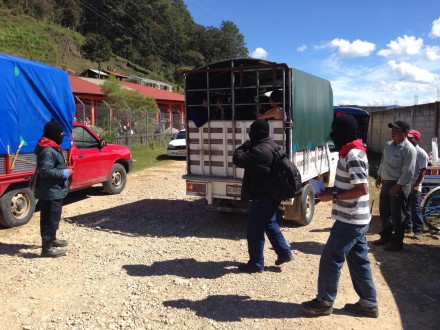
Photo taken in La Realidad by Isaín Mandujano for Proceso
[The Chiapas Support Committee compiled this information from a number of online articles. We emphasize that the Zapatistas have not issued a report and, therefore, we do not have their word. We have not been able to find a report from the Frayba Center either.]
A confrontation between bases of support of the Zapatista National Liberation Army (EZLN, its initials in Spanish) and of the Independent Central of Agricultural Workers and Campesinos-Historic (Cioac-H), in La Realidad, left one Zapatista dead and 13 injured from the Cioac-H. These facts do not seem to be in dispute. However, we do not know how many Zapatistas were injured. The confrontation allegedly occurred last Friday, May 2.
It also seems undisputed that the conflict originated when members of the Cioac-H retained a farm truck belonging to the Zapatistas that was used to transport their members. It is, however, not clear exactly when that may have happened. Apparently, the Zapatistas retained some Cioac-H members in retaliation for taking the truck and the confrontation occurred when other Cioac-H members went to La Realidad to negotiate their release. The Zapatistas retained the leader of the Cioac-H group and, in retaliation, the Cioac-H members cut off the water supply to the Zapatistas.
It would seem important here to remember that anti-Zapatistas calling themselves the Cioac-Democratic were the ones that assaulted Catholic nuns and medical personnel in February. The national Cioac organization stated that the assailants were not part of the national organization and were just using that name. We have no information about the group calling itself the Cioac-H.
Stay tuned for more details.
Zapatista News Summary for April 2014
APRIL 2014 ZAPATISTA NEWS SUMMARY
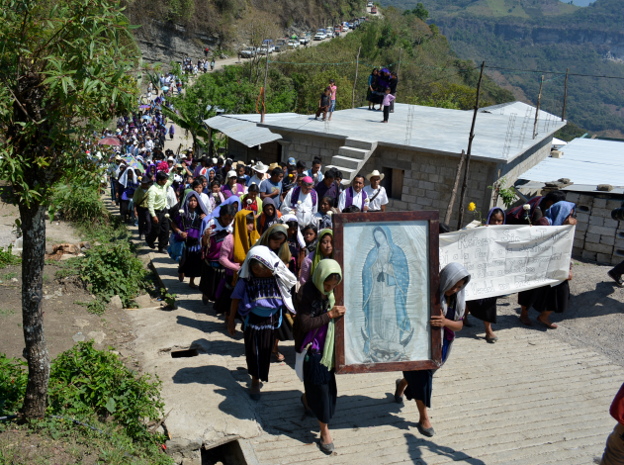
Displaced families return to the Puebla ejido
In Chiapas
1. Zapatistas Release 2nd Issue of Rebeldía Zapatista – The Zapatistas have released another edition of the Rebeldía Zapatista magazine. The Zapatista bases that participated in the Escuelitas give their impressions of the students. An editorial by Subcomandante Moisés is the only part of the magazine published online. You can read his editorial comments here.
2. Homage to 2 Zapatista Supporters Murdered Near Agua Azul – On Saturday, April 26, residents of San Sebastián Bachajón ejido (SSB), adherents to the EZLN’s Sixth Declaration of the Lacandón Jungle, gave homage to Juan Vázquez Guzmán, murdered April 24, 2013, and Juan Carlos Gómez Silvano, murdered on March 21, 2014. Both men were leaders in SSB’s struggle to defend their lands from government efforts to take that land away; in other words, against dispossession. SSB has been resisting the government’s efforts to take its lands in order to benefit powerful interests. Tourism interests are those that have dominated previous reports and analyses from Chiapas. However, at the homage to the two fallen leaders, the SSB folks raised the specter of another powerful interest – Walmart!
3. International Campaign in Support of San Sebastián Bachajón – Between April 24 to May 6, Zapatista Solidarity groups are sponsoring an international campaign in support of San Sebastián’s struggle to defend its land and in honor of its 2 murdered leaders. It involves watching a 13-minute video about the struggle. The video is posted on YouTube. It is in Spanish with some English subtitles (click the cc box at the bottom of the screen for English subtitles).
4. Displaced Return to Puebla Ejido – On April 14, the 17 Catholic families displaced last August from this ejido in Chenalhó municipality by the dispute over a piece of land with the Evangelical majority, returned to the Puebla ejido accompanied by Felipe Arizmendi Esquivel, the Bishop of San Cristóbal de Las Casas, and Eduardo Ramírez Aguilar, the Secretary of Government, as well as by representatives of non-governmental organisms and civilian observers. The Bishop stated that it was a return “without justice,” and asked: “to continue supporting the “returnees,” because it’s not over, not only as to material issues, but above all in security, stability, harmony and reconciliation.” The Fray Bartolomé de las Casas Human Rights Center was one of the organisms accompanying the Catholic families.
In other parts of Mexico
1. Self-Defense Groups and Government Sign Agreement – Early this month, leaders of the various self-defense groups from 20 Michoacán municipalities signed an agreement with the federal commissioner for Michoacán, Alfredo Castillo, and other government officials to “demobilize” and register their weapons. The deadline set for the demobilization is May 10. Castillo said: Those who want to continue patrolling the towns of Michoacán will have to become part of a new statewide rural police force. All current self-defense group members, however, will be allowed to keep their weapons, regardless of whether they join the police force, as long as they register them with the Army and keep them at home. Castillo said: “Beginning May 11, any [armed] person not registered, not uniformed, will be arrested.” He said the deadline date would allow authorities time to vet and train those who want to join the rural force and to re-train and purge municipal police forces of officers with known or suspected criminal ties. Meanwhile, the self-defense groups had some demands of their own and some provisions are included in the agreement regarding the release of self defense members who are in prison simply for carrying weapons. There are also provisions for financial support for widows and children of victims of the struggle against organized crime in Michoacán. The United States government has poured untold billions into the “drug war” and little, if any, progress was made to protect ordinary citizens from the criminal groups until the self-defense groups formed and ran the criminals out of the communities. We’ll see what happens after May 10! For an analysis, here’s an article by Luis Hernández Navarro.
2. United Nations Special Relator on Torture Visits Mexico – The United Nations (UN) special relator on torture, Juan E. Méndez, began a visit to Mexico in the last week of April. The not-really-shocking, but very sad, headline is that complaints about torture increased by 500% during the Calderón administration. This is attributed to the use of the Armed Forces in public security and the legal figure of arraigo (lengthy detention without charges). He has not yet visited Chiapas.
3. North American Defense Heads Meet in Mexico – Robert D. Nicholson, Canada’s Minister of Defense; Charles Timothy Hagel, US Secretary of Defense, as well as General Salvador Cienfuegos Zepeda, Mexico’s Secretary of Defense, and Admiral Vidal Francisco Soberón Sanz, Mexico’s Secretary of Navy met together in Mexico. They discussed their mutual concerns about threats from transnational organized crime and ways to improve mutual efforts… at least that’s what the press reports said.
_________________________________________
Compiled monthly by the Chiapas Support Committee.The primary sources for our information are: La Jornada, Enlace Zapatista and the Fray Bartolomé de las Casas Human Rights Center (Frayba).
We encourage folks to distribute this information widely, but please include our name and contact information in the distribution. Gracias/Thanks.
Click on the Donate button at http://www.chiapas-support.org to support indigenous autonomy.
_______________________________________________________
Chiapas Support Committee/Comité de Apoyo a Chiapas
P.O. Box 3421, Oakland, CA 94609
Tel: (510) 654-9587
Email: cezmat@igc.org
http://www.chiapas-support.org
http://www.facebook.com/pages/Chiapas-Support-Committee-Oakland/
https://compamanuel.wordpress.com
 Chiapas Support Committee