Chiapas Support Committee
Home of the Compañero Manuel blog on zapatistas & mexico
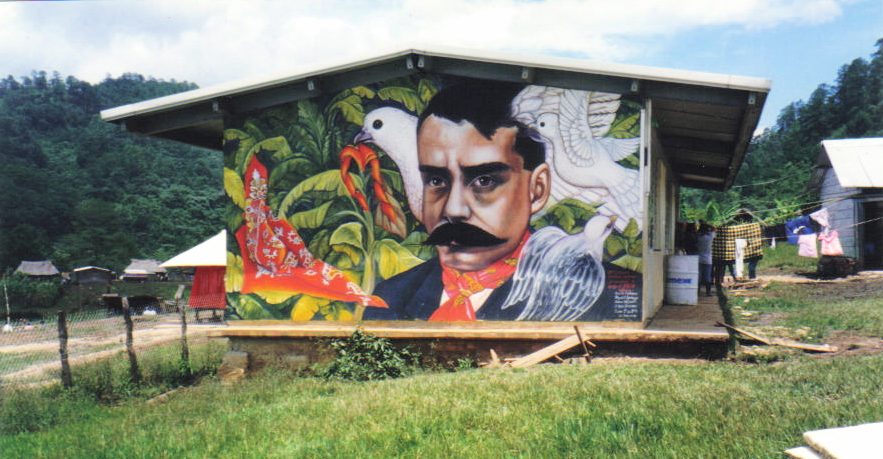
EZLN: On Ayotzinapa, the festival and hysteria…
ON AYOTZINAPA, THE FESTIVAL, AND HYSTERIA AS A METHOD OF ANALYSIS AND A GUIDE FOR ACTION
Subcomandante Insurgente Moisés
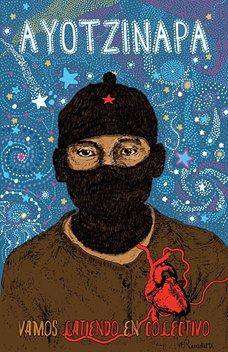
Zapatista National Liberation Army
December 2014
To the compas of the National and International Sixth:
To the National Indigenous Congress:
To the family members and compañeros of those killed and disappeared in Ayotzinapa:
Sisters and brothers:
Compañeros and compañeras:
There are many things we want to tell you. We won’t tell you all of them because we know right now there are more urgent and important issues for all of us. [i] Thus we ask for your patience and your attentive ear.
We Zapatistas are here. And it is from here that we see, hear, and read that the voice of the family members and compañeros of the murdered and disappeared of Ayotzinapa is beginning to be forgotten and that now, for some people out there, the more important things are:
-the words coming from other people that have taken stage;
-the discussions over whether the marches and protests belong to the well-behaved or the badly behaved;
-the discussion about whatever it is that appears most frequently and rapidly in social media;
-the discussion over what tactic and strategy will “move beyond” the movement.
And we think that the 43 from Ayotzinapa are still missing, as are the 49 from the ABC Daycare, the tens of thousands of murdered and disappeared citizens and migrants, the political prisoners and disappeared prisoners.
We think that the truth is still kidnapped, and justice is still disappeared.
And we think that the legitimacy and autonomy of this movement [of the family members and compañeros of Ayotzinapa] must be respected.
We Zapatistas heard their voices in person. Thousands of Zapatista bases of support heard them and their voices were then carried to tens of thousands of indigenous people. Their voice thus also spoke in Tzeltal, Chol, Tojolabal, Tzotzil, Zoque, and Spanish to our collective heart.
Those voices are wise, they know what they are talking about, and their heart is like ours when it becomes pain and rage. They know their path and they are walking it.
They know themselves. We know ourselves in rage and pain. We have nothing to teach them. We have everything to learn from them.
That is why now, as their voice is stifled, silenced, twisted or forgotten, we send them our word as an embrace.
That is why we say that the first, most important and urgent thing is to listen to the family members and compañeros of the disappeared and murdered of Ayotzinapa. These are the voices that have touched the hearts of millions of people in Mexico and around the world.
These are the voices that have marked the pain and rage and have denounced the crime and pointed to the criminal.
The importance of these voices is also recognized as much by the government, which tries to delegitimize them, as by the vultures that try to twist them.
We want to help these voices retake their place and their path.
These voices resisted the slander, the blackmail, and the buy-off.
These voices did not sell out, did not surrender, and did not give up.
These voices are in solidarity.
We found out, for example, that when young people were piling up in the jails, and the “well-behaved” advised these voices not to pause for the prisoners, that their freedom wasn’t that important given that the government was of course “infiltrating” the protests, those dignified and firm voices of the family members and compañeros of the 43 said, more or less, that for them the freedom of those detained was part of the struggle for the return of the disappeared. That is, as they say, these voices did not let themselves be blackmailed nor did they buy that cheap bit about the “infiltrators.”
Of course, these voices have had the fortune of encountering a population receptive at the fundamental level to being both fed up and empathetic—fed up with the “classic” forms of Power and empathy among those who suffer its habits and abuses.
But this already existed in diverse calendars and geographies. What puts Ayotzinapa on the world map is the dignity of the family members and compañeros of the murdered and disappeared young people, and their stubborn and uncompromising insistence on the search for justice and truth.
In their voice, many people all over the planet recognized themselves. Their words spoke to other pain and other rage.
And their words made us remember many things. For example:
-that the police do not investigate theft; the police kidnap, torture, disappear, and murder people, whether or not they have political affiliation.
-that the current institutions are not the place to take our rage for indictment; they are the places that provoke our rage.
-that the system has no solutions for the problem because it is the problem.
And that for a long time now, and in many places:
-the governments don’t govern, they pretend;
-the representatives don’t represent, they supplant;
-the judges don’t impart justice, they sell it;
-the politicians don’t do politics, they do business;
-the public security forces are not public and don’t impose order other than that of the terror they carry out at the service of whoever pays best;
-that legality is a disguise for illegitimacy;
-that analysts don’t analyze, they make their phobias and affinities into reality;
-that critics don’t critique, they accept and distribute dogmas;
-that those responsible for informing don’t inform, but produce and distribute slogans;
-that thinkers don’t think, they swallow whatever is in fashion;
-that crime isn’t punished, but rewarded;
-that ignorance is not fought, but extolled;
-that poverty is the wage for those who produce wealth.
Because it turns out, friends and enemies, that capitalism nourishes itself from war and destruction.
The era in which capital needed peace and social stability is over.
And in the new hierarchy within capital, speculation reigns and commands, and its world is made of corruption, impunity, and crime.
As it turns out, the nightmare in Ayotzinapa is not a local, state, or national problem. It’s a global one.
And it turns out that it is not only against young people, nor only against men. It is a war of many wars: a war against the other, a war against indigenous peoples, a war against youth, a war against those who with their labor make the world go round, a war against women.
Because it seems that femicide is such old news, so everyday and ubiquitous in all ideologies that it now goes down as “natural death” in the records.
Because it is a war that every few minutes takes on a name in whatever calendar and geography: Erika Kassandra Bravo Caro: young woman, worker, Mexican, 19 years old, tortured, killed, and flayed in the “pacified” (according to civil, military, and media authorities) Mexican state of Michoacán. “A crime of passion,” they will say, just like those who say “collateral victims,” or “a local problem in the municipality of the provincial Mexican state of… (enter the name of any state in the federation),” or “it’s an isolated event, we must move on.”
It turns out that Aytozinapa and Erika are not the exception, but rather the reaffirmation of the rule of capitalist war: destroy the enemy.
Because in this war the enemy is all of us.
And this is a war against everything, every thing everywhere.
Because as it turns out, this is what it’s about, what it has always been about: a war, which is now a war against humanity.
In this war, those below found in the family members and compañeros of those taken from Ayotzinapa an amplified echo of their own history.
And now not only in their pain and rage, but also and above all in their stubborn effort to find justice.
And with their voices the lies of conformity, of “we can put up with it,” of “nothing is wrong,” of “changes is made within oneself.”
But, in the midst of pain and rage, there above, once again, the vultures circle over the great stain of death and disappearances that carry names.
Because where some count unjust absences, others count votes, windows, job opportunities, memberships, leaderships, marches, signatures, likes, and follows.
But that doesn’t mean that the count that counts and means something is forgotten.
We, Zapatistas of the EZLN, believe that it is so important that the voices of the family members and compañeros of the murdered and disappeared of Ayotzinapa retake their place that we have decided the following:
- To cede our place at the First World Festival of Resistance and Rebellion against Capitalism to the family members and compañerosof the Ayotzinapa students who were murdered and disappeared. We think that in their voices and ears there will be generous echoes for all of those who, present or not, participate in the festival.
- That is why we are asking the compañerasand compañerosof the National Indigenous Congress in the distinct locales, the Joint Commission of the CNI-Sixth for the Cultural Festival, and those who would have been offering transportation, lodging, food, security, and health support to our delegation, to dedicate and orient their efforts toward the families and compañeros of the Ayotzinapa students who we all miss today. We ask that you attend to them, listen to them, and talk to them as if they were whichever of the 20 Zapatistas, 10 women and 10 men, who would have formed our delegation.
- This is why we respectfully ask the family members and compañerosof those absent from Ayotzinapa to accept our invitation and name, from among yourselves, a delegation of 20 people, 10 women and 10 men, and participate as honored invitees in the World Festival of Resistance and Rebellion against Capitalism to be celebrated from December 21, 2014, through January 3, 2015. It was very important for us, as Zapatistas, to listen to you directly. We think it will be very good for all of those who attend the festival to have this same honor. And we also believe that all of you will gain much from meeting other sister resistances and rebellions from Mexico and around the world. You will see then how great and extensive this “you are not alone” really is.
- The EZLN will participate in the Festival. Our attentive and respectful ear will be there as one more among all of our compasof the Sixth. Not on stage or in special places. We will be like shadows, alongside everyone else, among everyone else and behind everyone else.
- Our word for the exchange is already on video. We have indicated to “The Odd Ones Out Compas” [Los Tercios Compas] that they should get it to the various Festival locales and to the free, alternative, and independent, autonomous, or whatever you call them media who belong to the Sixth so that they can air it, if they see fit, according to their own times and methods.
- On December 31, 2014 and the first day of the year 2015, it will be an honor for us to receive as honored guests, in the Oventic caracol, the women and men who, with their pain and rage, have raised across the planet the flag of dignity that we below and to the left are.
- And not only that, we also want to use this space to invite everyone from the National and International Sixth, masked or not, to participate in this great exchange, to share their stories and listen to Others. [ii]
_*_
On hysteria as a method of analysis and guide to action
We, as Zapatistas, are here. And from here we see, listen, and read.
In the recent mobilizations for truth and justice for the Ayotzinapa students, the dispute over who sets the tone of such mobilizations has been repeated, to the extent now of criminalizing those who coincide with a particular overplayed stereotype: young people, with their faces covered, dressed in black, that are or appear to be anarchists; in sum, those who are badly behaved. And as such, as the debate goes, they should be pointed out, expelled, detained, tied up, and handed over to the police or just to the ire of the progressive sectors.
This issue has been met with reactions close to hysteria in some cases, and schizophrenia in others, impeding a reasoned argument and necessary debate.
Although we have witnessed this before (in the UNAM strike of 1999-2000, in 2005-2006, and in 2010-2012), the re-launch of this method of analysis and guide for action by the well-behaved left requires some reflection:
The family members and compañeros of the murdered and disappeared of Ayotzinapa, like the tens of thousands of murdered and disappeared, do not ask for charity or pity; they demand truth and justice.
Who is anyone to say that these demands, that could be those of whatever human in whatever part of the world, should be expressed in this or that particular manner? Who gets to write the “manual of good and bad methods” that expresses pain, rage, and nonconformity?
In any case, one can and should debate how compañerismo is best expressed: whether from a haughty voice onstage or with a broken window; whether with a “trending topic” or a police car in flames; whether on a blog or with graffiti. Or maybe through all or none of those, and each person creates and constructs their form of support with whatever they have.
But not even those with the moral authority and human stature to say “yes, that way” or “no, not like that,” that is, the family members and compañeros of those absent from Ayotzinapa, have done so.
So, in that case, who assigned the jobs of commissioners of good behavior for support and solidarity? Where does this joyous pointing out of “government agents,” “infiltrators,” and, horror of horrors, “anarchists” come from?
The argument “those aren’t students, they are anarchists,” is ridiculous. Any anarchist has more cultural baggage and scientific and technical knowledge than the average person who, working as the thought police, points them out wanting them burned at the stake. And that’s not even mentioning those who are filled with praise and pride over the stupidity and illegality used as a form of policing (please who it may) by the government of Mexico City.
But of course, they can create a straw man that represents current trends (some version of region IV [iii] insurrectional anarchist) and can build a caricatured theoretical body around it that makes it look ridiculous, so that it can then be dispatched without delay to the nearest government department, whether juridical or media-based (of course, if their arrest is caught on video; if not, well, who is going to miss them?). After all, “journalistic” information comes from reliable sources: betrayal and political policing.
It isn’t the same thing to single someone out (one who points out, accuses, judges, condemns, and demands that the police execute the sentence) as it is to debate. Because in order to single someone out, it is only necessary to be caught up with the latest trends (what is comfortable, easy, and well, increases “likes” and “follows”). Singling someone out does not require investigation or argumentation; it is enough to “post” a few photos. And that is where the great romances between the “leaders of opinion” and the masses of “followers” are born: blind faith synthesized in 140 characters.
From the “I follow you and you follow me” to the “and they lived happily ever after,” to the “You don’t love me because you don’t re-tweet me or make me a favorite or give me a “like.” “I’m going to go with a different hero.” [iv]
In order to debate one has to investigate (yeah that’s right, turns out there are different anarchisms: right on again: turns out that “direct action” isn’t necessarily violent), think, argue, and argghh, the most dangerous and difficult: reason.
Debating is difficult and uncomfortable. And there are consequences for those who debate (I mean, more than thumbs down, middle finger up, and “a cascade of “unsubscribes”).
But oh well, there are in fact people who don’t walk through life trying to please people, conform, fit, and attract.
Behind every critical being there is a long list of “followers” deserting them, moving somewhere one doesn’t have to think and re-tweeting doesn’t involve self-critique.
And when progressive journalism replaces the functions of the government office and accuses, interrogates, concludes, and condemns, is that singling out or debating?
Or is that a form of debate? With the anarchists in the jails or pursued or exiled, and the “well-behaved” in the presses, the microphones, and the little blue bird?
Okay, okay, okay! But we are in agreement that we must support the family members and compañeros of the murdered and disappeared from Ayotzinapa, or is that no longer important?
Not the children of the ABC Daycare either? The disappeared of Coahuila, the ignored migrants, and the women assaulted and murdered every day at every hour everywhere in all ideologies? Or is the only thing that’s important is changing the name of the person that sits in the chair or promotes employment in glass, window, and shelving companies?
No one has accused those who insist on the electoral path as the only and exclusive option of being “infiltrators,” “police,” “provocateurs,” or “soldiers dressed in street clothes.” They may be accused of being fools, naïve, dumb, stupid, opportunists, careerists, intolerant, ambitious, vultures, tyrants, and despots; and, well, of being fascists. But not “infiltrators,” even though certainly more than a few fit quite well the profile of government agent and political police.
We know that some are great strategists (its enough to look at their achievements); they think, propose, and impose the idea that “we must move beyond the mobilization.” So there are some with their well dressed and well behaved marches trying to contain and control, and others with the direct action of an exclusive and violent rage.
Some with a vanguardist enthusiasm for being an exclusive elite ready to direct, create hegemony and homogenize the diversity of manners, times, and places.
From “if you break a window you’re an infiltrator” to “and if you don’t break it… still an infiltrator.”
For some, what is important is the geographic center and what converges there: political, economic, and media power.
If it doesn’t happen in Mexico City, it doesn’t happen, it is not valid; it doesn’t count. Being “historic” is their exclusive patrimony.
For them, the mobilizations in Guerrero, Oaxaca, Jalisco, Veracruz, Sonora, and in other corners of Mexico and the world do not exist.
But because analytical laziness reigns among them, they do not realize that the center of Power is not located there.
There above, things have changed, and they have changed a lot.
As long as they continue to abandon serious and profound analysis of the new character of Power, following their noses to the calendars above (electoral and institutional) and being led from one date to another, or with the urgent claim that “we must do something, anything,” even if its useless and sterile, they will continue repeating the same methods of struggle, the same regurgitations, the same defeats.
Toward a serious debate:
Regarding the direct actions in Mexico City that took place with the marches of November 8 and 20 and December 1, 2014, it is worth remembering the words of Miguel Amorós:
“In such events, the mere presence of citizenists and their allies is enough to create confusion and transform the best radical intentions into pure activism, seamlessly integrated into the spectacle and thus easily manipulated, either by those who govern to justify the excesses of public force, or by the citizenists to justify the failure of the action to live up to their own expectations. Activism—whether violent or simply ideological—is the greatest testament to the obsolescence of revolt; it reflects the theoretical poverty and strategic weakness of the enemies of capital and the State. Activists, spurred by the need to do “something,” sign up for everything and thus fall into the trap of a media that seeks to depict them as hooligans and provocateurs. The result is only useful for the governments, the parties, or the pseudo-movements—that garbage that if it exists it is only in order to prevent even the most remote possibility of any autonomous struggle or revolutionary thought.” Amorós, Miguel. “The Decline of Revolt,” October 2001, in Punches and Counter-Punches, Pepitas de calabaza, ed. & Oxígeno dis. Spain, 2005.
What comes next: The requirements for protest
Ellos [men]: A credential from the National Electoral Institute or an identity card, proof of residence (if you don’t own a house, a copy of your lease; if you have a mortgage, what exactly are you doing here?), a pants suit and tie (no, not a tuxedo, there’s no need to overdo it—that’s for when we cross triumphant, on the shoulders of the crowd, through that sacred door that those thoughtless people had sought to destroy), clean face and hands, no visible tattoos, no piercings, and no outlandish hairstyles (outlandish: anything that does not appear in the fashion magazines), dress shoes (no sneakers or boots), your signature on a memo of understanding where you promise to respect all signs of authority and/or power in all of its forms and to call attention to any attitude or intention that deviates from said rules.
Ellas [women]: All of the above except with a skirt suit rather than a pants suit. Oh, and sorry, yes, you have to do your hair.
Elloas[v]: Not eligible to participate. Please proceed to the nearest closet.
On the vanguard of the proletariat, the well behaved, and the badly behaved:
We would like to let you know, in case you haven’t heard, that the Mexican Electrical Union (SME) refused to let us, the CNI and the EZLN, borrow one of their facilities for the celebration of cultural events in Mexico City during the First World Festival of Resistance and Rebellion against Capitalism: “Where Those Above Destroy, We Below Rebuild.”
Before the campaign “Behave Yourself and Just Say NO to the Masks,” the SME had granted, generously, one of its facilities for the cultural festival. As the campaign progressed into “Don’t Fear the State; Fear what is Different,” the excuses began to roll in: “Well, since it’s the holiday season; we don’t have anyone to take care of the space; we’re not going to spend Christmas like that.”
Later they were more clear and told us, “there is a sector within the SME that is against supporting other struggles, and in the assembly they proposed that we needed to put a stop to this issue of involvement with the people from Ayotzinapa, because it is not possible to negotiate with the government on the one hand, and on the other be involved with a movement of masked, pissed-off youth responsible for actions like the one at the Palace. They had to stop these youth from coming to the deportivo (that’s what the SME calls the facility that they were going to let us borrow), where the caravans were going to come and where later you (the Sixth and the CNI) and your mask-wearers (in the role of the mask wearers: the EZLN) wanted to put on your festival. It will no longer be possible to have the festival there; that you will need to find another location. We hope you understand.”
They said other things, but those things have more to do with internal goings-on in the SME and it’s not our place to repeat or spread them.
So how about that? The compas from the National Indigenous Congress had proposed an SME facility as a show of recognition and as a salute to the SME’s struggle and resistance, and we supported their proposal. Yet there are still some people out there who think that the expulsions will be necessary until the improbable moment when the proletariat vanguard takes Power.
And well, the Zapatistas, we get it. But we don’t understand. We don’t understand how a movement that has suffered a campaign against them of every possible type of slander, lies, and harassment (even more than what today’s youth, anarchists/non-anarchists, mask wearers/non-mask wearers, students/studied go through) has given into the trend of criminalizing that which is different. We don’t understand how they can subscribe to this current fad and decide to enter the “circle” of the well-behaved and separate themselves from those who not only respect(ed) them but also admire(d) them. Is that separation part of the principles upheld by the new political party that they’re building? Is it part of its 100-year celebration?
It would have been much easier for them to do like they do nowadays in Mexico City and put up a sign at the door that says, “No masks allowed,” and that would have been it. It is true that we wouldn’t have come in, but your struggle would have been seen, enlivened by all the colors that make up the color of the earth in the National Indigenous Congress, as well as the diversity of resistances and rebellions that, although they don’t have facilities to hold cultural festivals, bloom in various corners of Mexico and the world.
In any case, in accordance with our limited means, we will continue supporting their just struggle. And, of course, we sent them an invitation to the Festival.
Select the correct response:
“Vile mask wearers” (or their equivalents in the new synonyms: “anarchists,” “infiltrators,” “provocateurs,” “students,” “youth”), was said, tweeted, declared, signed, sung, painted, drawn, or thought by…
a). – a columnist, intellectual, caricaturist, journalist, commentator from a conservative paid media outlet.
b). – a columnist, intellectual, caricaturist, journalist, commentator from a progressive paid media outlet.
c). – a conservative artist.
d). – a progressive artist.
e). – a military general.
f). – a person from the managerial class.
g). – a union leader from the vanguard of the revolutionary proletariat.
h). – a leader from a political party aligned with the right-wing.
i). – a leader from a political party aligned with the far right-wing.
j). – a leader from a political party aligned… Ok, in short: a leader of any political party.
k). – epi[vi]
l). – Enrique Krauze.
m). – All of the above.
Answer: Any letter selected is correct. If you selected the last option, you are not only right, you have also conducted an exhaustive monitoring of social media, paid media, and free media. We don’t know whether to congratulate you or send you condolences. Read: in today’s times, if you’re not really confused, then you’re not really informed.
On the stage of social media:
A typical tweet from the well-behaved after the November 20, 2014 march in Mexico City: “Why did the police arbitrarily detain civilians instead of detaining the anarchists?” Take note: Not only is it okay to arbitrarily detain the anarchists, they are also not considered “civilians.”
A commentary from the well-behaved in seeing a photo of Mexico City police beating up, in the “whetheryoulikeitnot” kind of way, a family on the outskirts of the city’s main square on November 20, 2014: “I know them and they are not anarchists.” Take note: If nobody knows you or if you are an anarchist, you deserve to get beaten up.
An argument from the well-behaved at the beginning of the movement, or maybe after, it doesn’t really matter: “For sure those aytozinacos [vii] were asking for it. Who told them to go around looking like anarchists? Note: no comment.
The impossible dialogue:
“What do you mean you don’t understand this whole thing about how mask-wearers = anarchists = infiltrators? Look, those people are not interested in politics, they only want to create disorder. That’s what “anarchism” means: disorder. This whole covering your face thing is just cowardice. And the thing about the infiltrators is that they’re working for the government. What? Yes, the Zapatistas are also masked, and so are the ones who confronted Ulises Ruiz in Oaxaca, and so are some of the people who are now mobilizing in Guerrero and Oaxaca. Yeah, but they aren’t here in our city (stress on the “our” with a look of alarm). The Zapatistas, the Oaxaquistas, and the people from Guerrero, well, they’re good-hearted little Indians; of course, without clear political leadership. Plus, they’re far away. We can send them humanitarian assistance—by which we mean getting rid of those things that we no longer want, that are no longer useful, or worse yet, that have gone out of style. But these fucking anarchists are here and they have taken our streets (look of alarm once again on that “our”) and well, how can I say it? They ruin the scenery. We’re here trying our best to make this place cool, like real retro, like the sixties. You get me? Very peace and love, Age of Aquarius, flowers, songs, soft drugs, smart drinks, good vibes, you know? Check it out! I have an app on my phone that makes the lights blink to the tune of whatever ringtone I choose. Huh? No, I don’t march with a group, I walk along the sides and I climb on top of a… No, it’s not to get a better view of the march, it’s so that the masses can get a better look at me. Look dude, dudette, whatever you are: protesting should be like going to a club, you get me? It’s not about protesting but about seeing everyone, saying what’s up, and the next day confirming that we are what we are, and not in the media’s social section but in the national section. Besides, this thing in Ayotzi… No, nobody says Ayotzinapa, its way cooler to say “Ayotzi.” Well, as I was saying, Ayotzi has international repercussions, I mean, like it gives us a certain cosmopolitan air. Whatever, with all the attention given to the socialites; that’s for the right. We modern leftists let ourselves be known through these types of events. Next time, if those nacos [viii] don’t step back, we’re thinking about inviting Mijares. That’s right, so that he can sing “Soldier of Love” to us. And to keep with the vibe, Arjona should also come so we can have him belt out “Private Soldier.” Yes, everyone will look amazing marching to the beat, holding hands with the presidential guards and the police. Maybe it would be better at night and we’ll break out our lighters while we sway our arms to the rhythm of “soldier of love / in this war between you and me…” and with Arjona, “I am marking the passage / while I survive / I don’t have anger / oblivion has won out.” Yes, we can see it already, next time Eugenio Derbez will be the keynote speaker. It will be brilliant! We will infiltrate Televisa and get them to switch over to our side! Huh? No, we’re not going to demand the resignation of Peña… Well, because the deadline has passed and now we have to prepare for 2018. Huh? Who cares about those people’s original demands. Sure, poor things, but that’s exactly why they have to accept the direction given by those who know, and by those who know I mean us. Look, what this country needs is not a revolution but a massive “feat,” with us in the lead and only role and the common people in the chorus or backstage. Yes, the story that matters is a “selfie” of us in the front and the masses in the background and below, enchanted by us, hailing us, and… yes, I already know what I’ll say when they beg me to go up on stage… “Hey! Wait! Why do you refuse to engage in dialogue? Fucking anarchist! Yeah, you better put on a mask because you can see the naco on you from a mile away! Ugh, this is exactly why this country doesn’t advance. No worries, I already took his picture and I’ll put it on my Facebook so you all can get a good look at another guy who’s an infiltrator. Or was it a girl? Well, I didn’t get a good look; they dressed real sloppy, very typical. Oh Mexico, you pain me…”
Other lines of investigation:
- – The few words that most helped Abarca, under protection in the Altiplano penitentiary, and the house arrest on his Region VI [ix] iron lady—both of them out of the media’s reach—were the words: “it was the feds.” After that, they asked them nothing else. Not because they didn’t want to know, but because they already knew.
- – Now that those above are seriously considering the possibility of a replacement in Los Pinos (which explains the sudden eloquence from national defense officials and the dizzying strategy of the media to distant itself [from Peña Nieto] are those who before December 1 demanded Peña Nieto’s resignation going to now produce a document called “The Defense of the Institutions and the Rejection of a Presidential Resignation, version June 1996, updated for 2014-2015″?
What singling out and denouncing really looks like
- – Any analysis that blames repression on the violent direct actions of “anarchist” groups should be consistent and, in the case of Mexico, also hold responsible the one who broke the so-called “white house” scandal that provoked the ire of the presidential couple (although that person later made up for this by playing the prosecutor [of protestors]). But no, distributing blame is also a classed activity, and it is up to the well behaved to foist the criminalization campaign onto the poor youth (according to the chain of equivalence: infiltrator = masked = anarchist = young = poor), which is exactly what set off the long nightmare that we know today as “Ayotzinapa.”
- – According to the latest that we’ve seen, read, and heard, actual infiltrators do not hide their faces. Infiltrators working on behalf of the Mexico City government (“the institutional left as an alternative”) and their employees have been filmed attacking protesters, arbitrarily detaining them, and “planting” masks on their victims.
Now then, following a method of analysis guided by hysteria and the impeccable logic of the thought and fashion police, we understand that all the protesters who do not wear masks are potential “infiltrators” and need to be pointed out, detained, and handed over to the authorities “in order to allow the masked protesters to march for their demands.” So now, whenever anyone without a mask is spotted at a march, they should be pointed out and expelled to the sound of the refrain: “No to violence; No to violence.”
- – Let’s do a bit of remembering: Aren’t the ones who today critique “violent” actions against the “historic,” commercial, and financial patrimony that take place in demonstrations for Ayotzinapa in Mexico City the same people who blocked banks, shopping centers, had that “historic” sit-in on Reforma in 2006, and harassed the employees in the orange uniforms for being “accomplices” of the 2012 electoral fraud? Oh yes, it’s because electoral fraud is more serious than 43 disappeared indigenous people and tens of thousands of persons in the same situation.
- – The clamor of this hysterical campaign has resonated and now achieved its first victories: a few smooth operators are detained in a toll booth, far from the march, while they collected money for their own benefit; they are tied up and triumphantly displayed in the “taking of Mexico City” on December 6, 2014. Later, through the magic of the media, they become “infiltrators” of the march, and it is claimed that at least one of them was police and one of them military. About the supposed police, nothing more was said. About the supposed military type: he’s 17 years old and “confessed” that he was joining the army in a month. Nobody bothered to recall that all Mexican youth, the moment they turn 18, are obligated to fulfill their National Military Service. Nevertheless, the action was applauded. One hopes that hysteria as a method of analysis and a handbook for action will reach its pinnacle when a lynching takes place. At that point, everyone will look the other way.
The dreaded outcome of a resignation, in six acts (Complete the following names):
- – A party in terminal crisis. Card_ resigns from the party, declaring: “I will live out my life as an ordinary citizen.”
- – In the face of the crisis of the political party system, the “citizen option” begins to be put forward. The press and progressivecircles begin talking about the rise of “Social Card_ísmo.”
- – The movement grows and calls for unconditional unity in support of “citizen” Card_.
- – Lop_ refuses.
- – Another electoral fraud. A massive gathering in the capital’s town square. Among the protesters one notices cardboard signs reproducing the latest cartoons by the progressive cartoonists: “The students from Ayotzinapa were an invention of Salinas” being the common denominator. On stage, Ele_ mentions Lop_. The masses hiss and boo on cue. The next day, Ele_ clarifies that the mention of Lop_ was not intended maliciously and that he personally has a lot of appreciation for him.
- – After the sit-in de rigueur, Card_ announces that the struggle must go on… creating a new party in order to run in the upcoming elections. No, if victorious, Epi will not be assigned to director of social communications and that idiot from desfiladero [x]will not serve as the presidential spokesperson. Or maybe they will? Gulp.
The story that doesn’t count for the world of progressive happenings:
Yes, there are some who remember that December 6 of this year marked the entry of Villa and Zapata’s armies into Mexico City 100 years ago. We, on the other hand, remember the Zapatistas’ negative gesture and rejection of the presidential throne. It is said that the leader of the Liberation Army of the South had this to say about it: “When a good person sits there, they become evil; when an evil person sits there, they become worse.” And if he didn’t say it, without a doubt he was thinking it.
Unsolicited advice which, of course, nobody will follow:
- – Enough searching for the mockingjay. Abandon that train of disillusion. Its next stop is “Apathy and Cynicism,” and its final destination: “Defeat.”
- – Don’t get caught up in the trending topicor whatever it’s called. Same thing with the tweets coming from the “famous” people, the “opinion shapers,” or the allegedly “intelligent” people. Look for the common people’s tweets. There you will find real literary gems in miniature, the thoughts of those who really matter—that is, those who force us to think. There is no small tweet there.
The trending topics (the “latest happenings”) only function as a deformed mirror and are as ridiculous as an enormous masturbation salon: everyone comes out beaten and unsatisfied. Soon we will be seeing tweets that look like a porn script: “Oh! Yes, yes, just like that, don’t stop!” Or maybe it’s a real victory to beat out the hashtags #WeLoveYourNewHairJustin or #Sammy?
- – Valuing somebody for the number of followers they have and not for their thoughts and their actions is pointless and useless.
If shit had a Facebook account, it would have “likes” (and “licks“) from hundreds of thousands of flies.
- – In defense of social media, or rather, in defense of using social media, we think that it also counts as a sharing if one chooses where to shift their gaze and their ear.
There are great writers, thinkers, analysts, critics, and social justice fighters who do not appear and will not appear in the paid mass media. And for many of them, it’s not because they haven’t been “discovered,” but because they have chosen a different mode of expressing themselves. This should not only be saluted but also nurtured.
- – But if the possibilities of social media are great, so are its limits. Besides the obvious, that silences and gazes cannot be tweeted, as gigantic as the social media universe is, a far greater universe remains excluded.
Social media cannot replace basic communication (seeing, speaking, listening, touching, smelling, enjoying); it can only augment it.
“If you aren’t on twitter you don’t exist,” mimics that expired old maxim, “if you aren’t in the media you don’t exist.”
Whether you believe it or not, there exist many worlds outside of cyberspace. And it’s worth lifting one’s head up to take a look.
We’ll be (and have been) seeing you
Yes, we already know that we make some people uncomfortable. For some, we are radicals; for others, we are reformists.
Everyone, above and below, is going to need to accept this:
Here below, there are more of us each day who insist on engaging in struggle without asking forgiveness for being who we are or asking permission to be it.
From the mountains of the Mexican Southeast.
Subcomandante Insurgente Moisés.
Mexico, December 12, 2014. In the twentieth year of the war against oblivion.
Note: The monitoring of the paid media, the free, autonomous, independent, alternative or whatever they’re called media, the social media, as well as all the selfless contributions of sarcasm, free psychoanalytic therapy, investigative tips, useless advice, the 140-character long straight jacket in some places and other special effects are courtesy of the “Los Tercios Compas” [Odd Ones Out Compas] who, as their name indicates, are neither media, nor free, nor autonomous, nor alternative, but they are compas. Copyright annulled for using a mask. This text may be cited, recited, and recycled by pointing to the source as an “infiltrator.” Reproduction is authorized in full or in part in front of the police, uniformed or not, whether behind a gun, a shield, a camera, a microphone, a smartphone, a tablet, or in cyberspace.
We have faith: ”Winter is coming, so don’t forget your blankets” (that’s something one of the Starks say in the upcoming season of Game of Thrones. Spoiler courtesy of the “Tercios Compas.” Nah, don’t mention it.)
———————————–
[i] The text uses “todas, todos, todoas” to give a range of possible plural gendered pronouns including male, female, transgender and others.
[ii] The text uses “otra, otro, otroa” to give a range of possible gendered “others” including male, female, transgender and others.
[iii] Region IV refers to Latin America on DVD coding. Referring to someone as “región IV” is a putdown, something like saying “oh, you’re so third world.”
[iv] The text uses “sinsajo,” which is the Spanish translation for mockingjay in the context of The Hunger Games. Could be read to mean switching to a different favorite or hero to root for.
[v] The text uses “ellos, ellas, elloas” again to give a range of possible gendered “others” including male, female, transgender and others.
[vi] Likely refers to Epigmenio Ibarra, producer and journalist, twitter activist, and frequent contributor to Mexico’s “progressive” press. Ibarra carried out the first videotaped interview with then EZLN spokesperson Subcomandante Insurgente Marcos in 1994.
[vii] A play on Ayotzinapa and “naco” which is a derogatory term like “hick,” implying poorly educated, ill-mannered, and with poor taste.
[viii] See footnote iv.
[ix] See footnote iii.
[x] Desfiladero is a column in the Mexican daily newspaper La Jornada.
Ayotzinapa and the voice in the street
AYOTZINAPA AND THE VOICE OF THE STREET
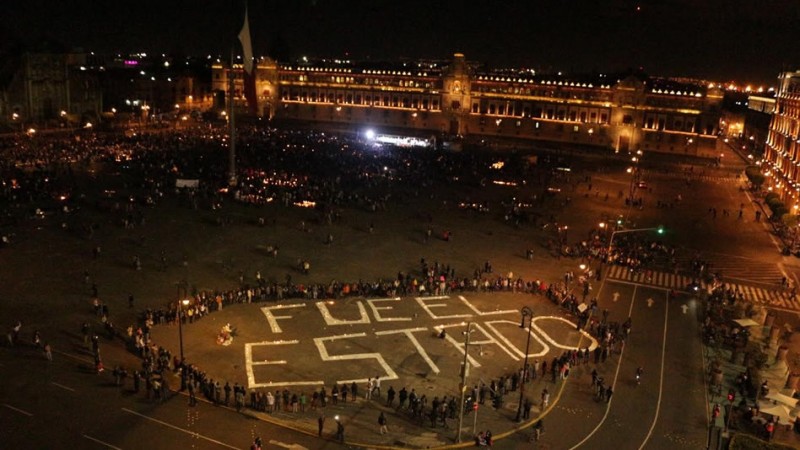
Demo for Ayotzinapa in Mexico City’s Zócalo: “It was the State!”
By Luis Hernández Navarro
Roberto Zavala Trujillo is the father of Santiago Jesús, one of the 49 children that died in the fire at the ABC day care center, in Hermosillo, Sonora. Just this November 20, in the plenary session of the state Congress, together with a thousand demonstrators that occupied the building in solidarity with Ayotzinapa, declared: “From Sonora, after more that 104 years, we re-initiate the Revolution that has not walked.”
Last November 20, some 5,000 students, miners from Cananea, fathers of the ABC day care center, those affected by the contamination of the Sonora River, railroad workers, feminists, ecologists and braceros marched through the streets of Hermosillo, took over the seat of the local Legislative Power and warned: “The people are in session today, there is a quorum.” Before entering the enclosure, they left a message for the deputies in the suggestion box: “Listen to your people, before it’s too late for you.”
La Jornada correspondent Ulises Gutiérrez narrated what, there himself, J. Márquez, another of the ABC day care center parents, said to the family members of the disappeared students: “We share your courage, your frustration because of what happens in Mexico.” To close the session, “the dissidents demanded that Peña get out,” and voted to fire the President, in the midst of cries for: “justice, justice!”
What happened in Sonora with the takeover of the Sonora Congress is not an isolated act. In varied regions of the country, the citizen mobilizations demand the resignation of Enrique Peña Nieto and, at the same time, vindicate a growing will to become an alternative constituent power.
As the protests on November 20 and December 1 show, despite their unequal development on a national scale, the movement continues in the rise and radicalization phase. Today, it’s not only students that participate in the marches. The days of struggle incorporate other sectors more every time: unions, campesino organizations, urban-popular forces, relatives of the disappeared, members of the clergy, artists and even children. In states like Chiapas, the teachers’ mobilizations have been very intense, and in Oaxaca they even achieved taking over the airport.
Nevertheless, social indignation and governmental discredit go far beyond what is seen in the streets. The substratum of popular disagreement is more widespread, vigorous and complex than what they express in the marches. In fact, the malaise of those below has fractured the federal government’s unity of command and reached some of its traditional allies. The deterioration of the presidential figure seems unstoppable. The political crisis deepens more each day.
The governmental strategy for confronting the debacle has failed. The pretention of Los Pinos to make the Iguala Massacre a local issue, a mere responsibility of organized crime, without recognizing the State’s responsibility in the crime and the national character of the protest, have fed the discontent. The Peña Nieto decalogue for dodging the problems of insecurity and corruption shipwrecked as soon as it was launched on the waters of public opinion. Even the The Economist magazine warned that the President could have lost the opportunity to change the tide (from turning) against him. The official decision of inventing interlocutors, disentangled from the real social movement, like he did to “negotiate” the problem of the prisoners because of the November 20 march, the only thing it provokes is that his discredit grows.
The crisis of the economy makes things even more difficult for Enrique Peña Nieto. The news on this terrain is not good. The peso is devalued, oil production falls at the hand of the price of crude, the expectations for growth of the GNP have been reduced a little more than 2 percent, el possible increase of interest rates in the United States announces an imminent flight of capital and the censors warn about the flight of investment provoked by the political instability.
Meanwhile, beyond the imminence of the school calendar and the Christmas vacations, the calendar of protests continues its course. Next December 6, thousands of teachers, students and campesinos, including horses, will symbolically take Mexico City to commemorate 100 years from the entry of the revolutionary armies of Francisco Villa and Emiliano Zapata. The initiative goes beyond a mere political reply. It imagines –as was announced in the taking of the Sonora Congress– re-initiating the revolution that has not walked.
Between December 21 and January 3 of next year, the Zapatista National Liberation Army (EZLN), the National Indigenous Congress (CNI) and adherents to the Sixth Declaration of the Lacandón Jungle will hold the First Worldwide Festival of Resistances and Rebellion against Capitalism. Its slogan will be: “Where those above destroy, those below rebuild.” The inauguration of the gathering will be held in the community of San Francisco Xochicuautla, in the state of Mexico, on December 21. “We know –assert the convokers– that savage capitalism and death are not invincible” and that “the seed of the world that we want is in our resistances.”
A new cycle of mobilizations begins with the arrival of 2015. An important campesino convergence, systematically ignored by the federal government, agreed to take the streets of Xalapa on January 6, the anniversary of the Carranza Law. And, on January 31, it plans to carry out a large national occupation in front of the offices of the Secretaries of Governance and Agriculture. For its part, also in January, the National Coordinator of Education Workers (CNTE) has the organization of a national strike against the education reform.
There is no evidence that the deployment of social mobilization has already reached its maximum point. And, although the street protests eventually diminish the tendency towards wear and tear on the regime is maintained. We are living in an unprecedented situation, in which, as the angered Sonorans that occupied their legislature warned, those above have not wanted to listen to the voice of the street.
———————————————————–
Originally Published in Spanish by La Jornada
Translation: Chiapas Support Committee
Tuesday, December 2, 2014
En español: http://www.jornada.unam.mx/2014/12/02/opinion/018a2pol
Movement for change coming from the Iguala case
A MOVEMENT FOR CHANGE IS BEING ARTICULATED FROM THE EVENTS IN IGUALA
By: Blanche Petrich
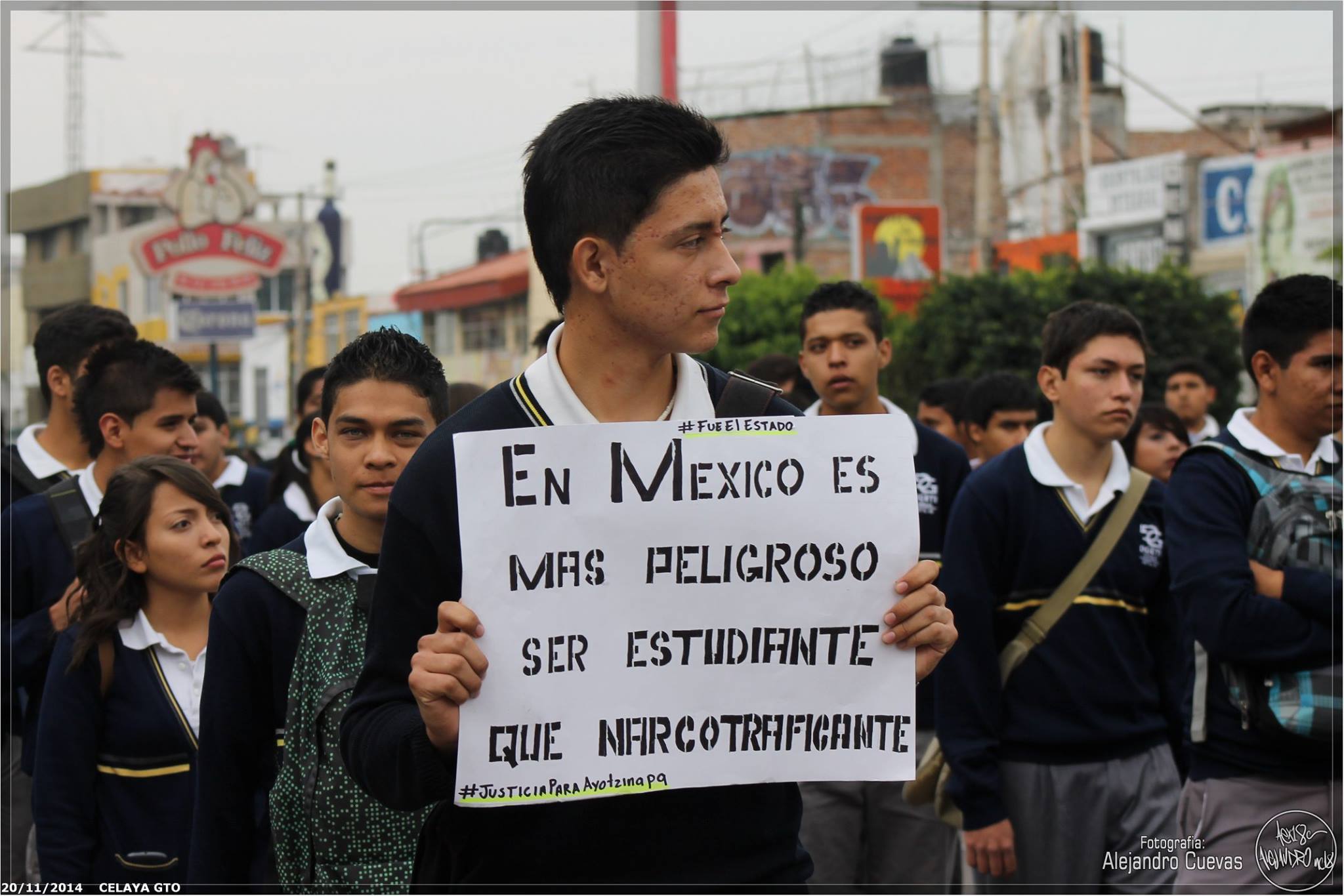
The sign the student is holding reads: In Mexico it’s more dangerous to be a student than a drug trafficker.
The five popular municipal committees that were installed yesterday in different Guerrero municipios, and another 20 more that are being prepared, are part of the people’s organized response, who beginning with the Iguala attack, were at a “point of no return, articulating a movement for changing things in this country, once and for all,” asserted Omar García, leader of the Student Committee of the Ayotzinapa Rural teachers college.
He described these new organizational experiences in Ayutla de los Libres, Tlapa, Acapulco, San Luis Acatlán and Tecoanapa as initiatives “that seek to exercise self-government and direct democracy through popular assemblies,” which seek to change the forms of government where an official municipal (county) structure dominates that administers public and private issues. “We want it to be the population that attends to those issues with a concept of population, of people, with all its difficulties and complexities, with their creativity.”
He points out that facing a reality recognized by researchers as that 70 percent of the country is under the influence of organized crime, these new forms of municipal government are “a necessity, and not only for Guerrero.”
It’s difficult to explain the structure, the functions established and the attributions of these councils: “They are an incipient experience. Their organization is complex, but the purpose is that it’s the people that organize them and participate in them.”
García, a survivor of the attack on Iguala, last September 26, insists on describing the country’s conjuncture as a “point of no return.” But in the definition of what can happen, “we as Ayotzinapa students or parents can’t do it alone, it must be an effort of everyone to articulate a national movement.”
Yesterday, organizations with years of work in different regions, appeared in Guerrero heading some of these Popular Council projects, like the Regional Coordinator of Community Authorities-Community Police, the Union of People and Organizations, the Guerreran Network of Human Rights Organisms, the Guerrero Popular Movement and the Front of Democratic Organizations of the State.
Questioned about whether these initiatives follow the model of the Zapatista Zones in Chiapas, the Good Government Juntas, he explains that these “are not a model, but definitely a referent. “And yes, we are also starting to talk about autonomy, because it is a necessity, besides being a right. Constitutional Article 39 established that sovereignty is in the people, not in the government.”
Somehow, the councils appear as a response to the announcement of a new package of initiatives of President Peña Nieto, which he presents to the Legislative Power today. The leader comments that what he calls “Peña Nieto’s 10 little points” are only “for strengthening the State, not for strengthening society, because the only thing that they love is money and it’s structures. The people have the right to change the government model that applies to them, if what there is doesn’t function. There are no eternal models.”
He is asked: “How is it possible that a 1917 Constitution continues governing us? We are now in another century, in another millennium. We need new forms of government more horizontal, less patriarchal, less macho, more plural and with direct participation, not just representative.”
The rupture with that traditional way is important, he considers, because “politics it not a question of a few. We are saying a resounding no to state politics, there is another type of politics that we can apply, the politics of below, that of the common and current people.”
–Is it the moment for a new constituent?
–What I can say is that it is a moment of no return. Just like there are ruptures between generations, in ways of thinking, there must be ruptures in social and power relations. It is an opportunity for reinventing forms of social organization. Any parent, any student can sum it up for you in a very simple way.
We want changes. No one wants what happened the 26th to happen again, what happened yesterday and the day before yesterday, with those decapitated. We don’t want the government to continue repressing. How to achieve it? We are into that. We have to attempt it, we have the right to attempt it.”
———————————————————–
Originally Published in Spanish by La Jornada
Translation: Chiapas Support Committee
Monday, December 1, 2014
En español: http://www.jornada.unam.mx/2014/12/01/politica/004n2pol
First World Festival of Resistance and Rebellion against Capitalism
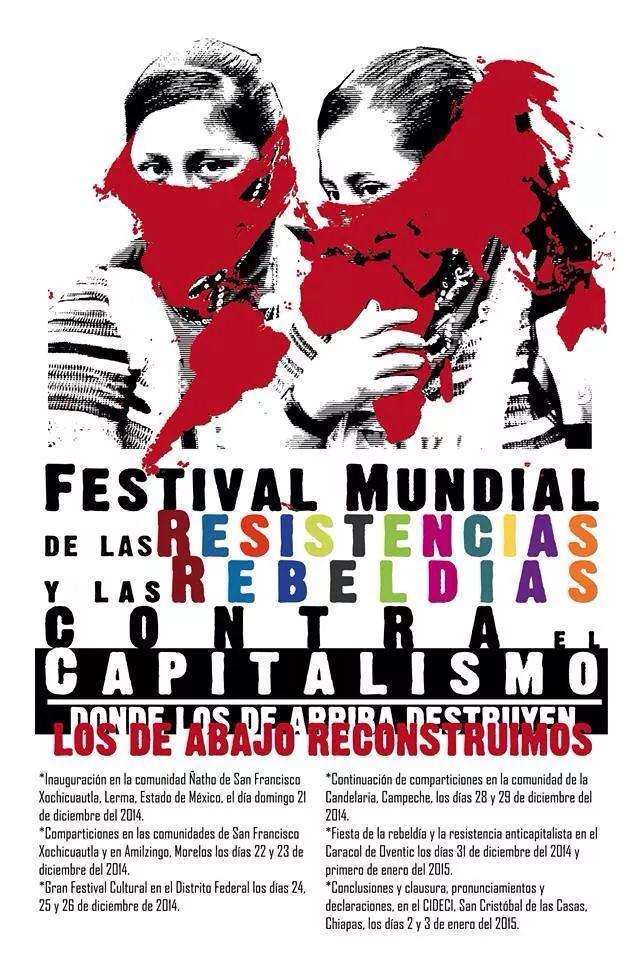
GENERAL PROGRAM
Inauguration: San Francisco Xochicuautla, Municipality of Lerma, Mexico State
Saturday December 20, 2014:
- 4pm: Registration beings; arrival of delegates
Sunday December 21, 2014:
- 8am: Breakfast, registration continues
- 1-2pm: Lunch
- 2-4pm: Inaugural Event for the First World Festival of Resistance and Rebellion Against Capitalism
- 4-9pm: Cultural Event.
Note:
- 6pm: Delegates depart for Amilcingo
- 9pm: Arrival to Amilcingo and delegate registration begins at this Sharing site.
FIRST SHARINGS IN SAN FRANCISCO XOCHICUAUTLA AND AMILCINGO.
San Francisco Xochicuautla, Municipality of Lerma, Mexico State.
Monday December 22, 2014:
- 8am: Breakfast.
- 9pm: the Sharing work begins.
- 2-3pm: Lunch.
- 3pm: the Sharing work continues.
- 7pm: Dinner.
Tuesday December 23, 2014:
- 8am: Breakfast.
- 9am: the Sharing work begins.
- 2-3pm: Lunch.
- 3pm: the Sharing work continues.
- 7pm: the Sharing work ends.
- 7:30pm: Dinner.
Amilcingo, Muncipality of Temoac, Morelos
Monday December 22, 2014
- 8am: Breakfast.
- 9am: Welcome by compañerosfrom Amilcingo.
- 9:30am: the Sharing work begins.
- 2-3pm: Lunch.
- 3pm: the Sharing work continues.
- 7pm: Dinner.
Tuesday December 23, 2014
- 8am: Breakfast.
- 9am: the Sharing work begins
- 2-3pm: Lunch.
- 3pm: the Sharing work continues.
- 7pm: the Sharing work ends.
- 7:30pm: Dinner
Great Cultural Festival in the Federal District – December 24, 25, 26, 2014. Lienzo Charro, Cabeza de Juárez. Av. Guelatao, No. 50, Colonia Álvaro Obregón. Delegación Iztapalapa.
Note:
- December 27, 2014. Delegates of the CNI and the Sixth depart for the next Sharing in Candelaria, Campeche.
Third Sharing. Monclova, Municipality of Candelaria, Campeche.
Saturday December 27, 2014
- 4pm: Registration begins for all of the delegates in Monclova.
Sunday December 28, 2014
- 7am: Breakfast.
- 9am: Welcome by the compañeros from the Peninsula.
- 9:30 am: The Sharing work begins.
- 12 pm: Recess and
- 12:30 pm: the Sharing work continues.
- 4-5 pm: Lunch.
- 5 pm: the Sharing work continues.
- 8 pm: Closing
Monday, December 29, 2014
- 7 am: Breakfast.
- 9 am: the Sharing work begins.
- 12 pm: Recess and
- 12:30 pm: The Sharing work continues.
- 4-5 pm: Lunch.
- 5 pm: the Sharing work continues.
- 8 pm: Closing
Note:
- Tuesday December 30, 2014. Delegates of the CNI and the Sixth depart for the celebration in Oventic
Celebration of Anti-capitalist Rebellion and Resistance in the Caracol of Oventic, Chiapas
December 31, 2014 and January 1, 2015.
PLENARY SESSION FOR CONCLUSIONS, AGREEMENTS, AND DECLARATIONS CIDECI, SAN CRISTÓBAL DE LAS CASAS, CHIAPAS
January 2, 2015:
- Summary reports from each Sharing.
- Proposals arising from reports.
January 3, 2015:
- Agreements and tasks to be carried out.
CLOSING CEREMONY
________________________________________________________________________________
DELEGATE REGISTRATION
The following people can register to participate as delegates:
- The peoples, communities, and organizations that belong to the CNI.
- Adherents to the National and International Sixth.
- Local and regional indigenous peoples, communities, and organizations invited by the Sharing sites in agreement with the Provisional Coordination of the CNI.
- Social organizations in resistance invited by the National Indigenous Congress and the Zapatista Army for National Liberation.
The following people can register as press:
- The free and alternative media that are adherents to the Sixth.
A SINGLE REGISTRATION COMMISSION composed of the Provisional Coordination of the CNI, delegates from each of the Sharing sites, and a commission from the National Sixth will handle delegate registration.
- Delegates from the National Indigenous Congress can register by sending an email to catedratatajuan@gmail.comprior to December 15, 2014. Registration information should include the names of the delegates, the people they belong to (their language), their community or organization, and their municipality and state. ALSO INDICATE WHICH PARTS OF THE FESTIVAL YOU WILL PARTICIPATE IN OR IF YOU WILL PARTICIPATE IN THE ENTIRE EVENT.
- Delegates from the National and International Sixth and the alternative and free media can register by sending an email to: comparticionsexta@gmail.com prior to December 15, 2014. Registration information should include the names of the delegates, their organization and/or collective or status as an individual participant, and their state and country. ALSO INDICATE WHICH PARTS OF THE FESTIVAL YOU WILL PARTICIPATE IN OR IF YOU WILL PARTICIPATE IN THE ENTIRE EVENT.
- Invited delegates can register by sending an email to catedratatajuan@gmail.com, or directly at the Sharing sites during the times stipulated in the Festival Program.
The people, communities, and organizations that are members of the CNI and the Sixth and who wish to hold a cultural event or sell products in the Great Cultural Festival in the Federal District should send all necessary information to comparticioncultural@gmail.com.
Mexico, November 2014
SINCERELY,
TOWARD THE HOLISTIC RECONSTITUTION OF OUR PEOPLE
NEVER AGAIN A MEXICO WITHOUT US
NATIONAL INDIGENOUS CONGRESS
Zibechi: The downpour begins with a single drop
THE DOWNPOUR BEGINS WITH A SINGLE DROP
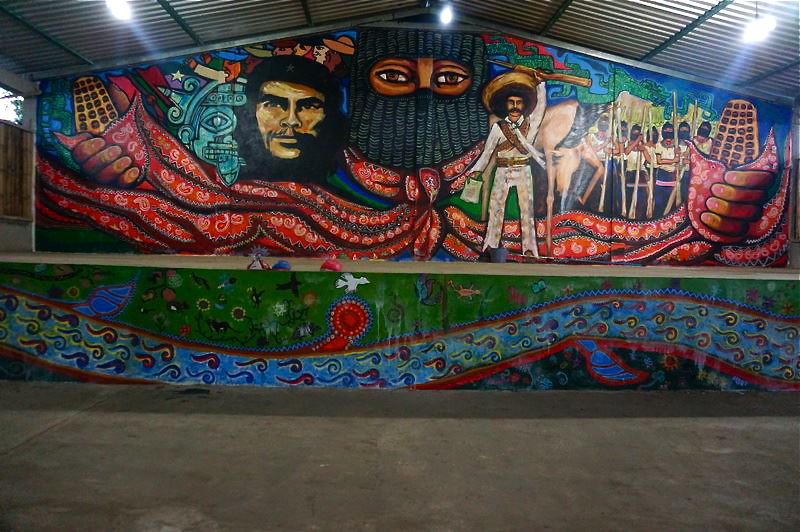
Mural in the Zapatista Caracol of Roberto Barrios
By: Raúl Zibechi
The large and profound crises, those that happen from time to time but are a parting of waters, can create long-term anti-systemic movements, in other words, movements that are not exhausted in mobilizations that, as numerous as they may be, are necessarily ephemeral. Movements, to the contrary, endure, they don’t vanish with the passage of time, are capable of transcending junctures and they adopt their own push, which takes them much farther than what the inertias of the moment can.
Profound crises break barriers and the partitions constructed by those above to separate the different belows into watertight compartments, as a way of impeding the convergence of rebellions. Only during crises are those overflows produced that put in contact movements born in different periods, among diverse sectors of society, in varied geographies and in heterogeneous pains that, at those precise moments, recognize and embrace each other.
On November 15, relatives and compañeros of the 43 disappeared in Ayotzinapa went to the Oventik Caracol to meet with the EZLN, as part of the caravans that toured the country. In the moments of greatest pain, they were in search of their equals, where they found listening and respect. “We sought them out because we know their political position and their forms of work,” they said.
I feel that the words of the general command in the voice of Subcomandante Insurgente Moisés deserve to be read carefully, because they are born from the heart of one of the most transcendent contemporary movements. They sum up collective wisdom accumulated during three decades by the Chiapas rebels that, in turn, incarnate five centuries of resistances against colonial domination and the most consistent determination for creating a new world.
Collectives in many places in the world are now debating the words of the general command. Three questions seem to me necessary to emphasize, although it is certain that the thousands that discuss them will encounter more and better arguments in the Zapatista text.
Pain and rage, converted into active dignity, create movements. They are the nucleus “that start moving everything,” Moisés said. Rage, rebellion and resistance that contrast with debates about tactics and strategies, programs, methods of struggle and, of course, who will lead. That is what’s first. Without that, there is nothing, in place of more theoretical musings that they practice, in place of more discussions and rational analysis that they manufacture. The rebellions, the revolutions, large movements are born of rage, the motor of all struggles and collective dignities.
It is organized rage, made dignity, which impedes that rebels end up selling out or giving in, in a world where the rational calculation says that it’s best to adapt to the reality, to accommodate to the most above as you can, because conquering the powerful is almost impossible. It’s rage (bronca, we say in the south) that can make us step over the threshold of the impossible; not the program or the lucid academic analysis that, however, are useful to rage, but never substitute for it.
The second question to emphasize is from those marvelous words and wise paragraphs where they shelled their own history: the abandonment of 99 out of every 100 of those that approached them in moments of euphoria, until remaining only one, indispensable precondition so that “something terrible and wonderful” happens: discovering that there are millions like that one. That is rebel wisdom, which one can only learn by experiencing it. One who has not been alone, cannot discover themselves in others, cannot continue forward against wind and sea. It is the story of Zapatismo.
It is the story of Olga Arédez, Mother of the Plaza de Mayo, who for years walked around and around the plaza, alone, demanding the appearance of her husband alive, and faced the indifference of her neighbors of Ledesma, a people intimidated by the family that owned the sugar mill. She had all that dignity in her fragile body to continue, in solitude, walking around and around the plaza, until piercing the fear of her neighbors. Thanks to her stubborn persistence the owners of the Ledesma sugar mill were judged. They had provoked blackouts during which the army disappeared 400 social and political militants. The oligarch Carlos Pedro Blaquier, owner of the mill, was indicted.
The third is time. “It will not be easy,” Moisés says. “It will not be quick.” What’s easy and quick is to create an electoral party, as some de-colonial academics colonially recommend. It is the way for “the masses to open the path to power,” as the comunicado read in Oventik says. There is no magic capable of converting rage into votes without turning it into merchandise, an object exchangeable for other objects in the marketplace of institutional politics; demonstrations in exchange for big arm chairs; entire organizations that negotiate for positions, and so on.
Only time has the ability to settle things, of making the survivors of a cycle of struggles connect with those that are starting new fights. The history of those below is plagued with rebellions and revolutions. Individuals and collectives appear in them that persist beyond the moment, the militants. Among them, and that also teaches us history, they often recruit the members of the new elites or dominant classes.
The challenge is that those militants won’t sell out or put down their arms for a position, but also that they obey the people, and that they don’t govern alone. After a fistful of “triumphant revolutions” throughout almost a century, this is a larger challenge that we continue confronting. That is what the general command’s text deals with. Zapatismo challenges Robert Michels’ “iron law of the oligarchy,” which asserts that a minority will always govern, that all organization becomes oligarchic.
That explains why the politicians of above hate them and why those below that resist take them as a reference.
——————————————————————-
Originally Published in Spanish by La Jornada
Translation: Chiapas Support Committee
Friday, November 28, 2014
En español: http://www.jornada.unam.mx/2014/11/28/opinion/029a1pol
Zapatista News Summary for November 2014
NOVEMBER 2014 ZAPATISTA NEWS SUMMARY

In Chiapas
1. Ayotzinapa Caravan Meets with EZLN in Oventik – On November 15, the Caravan of relatives and compañer@s of the murdered and disappeared Ayotzinapa students that traveled south met with Zapatista bases and commanders of the EZLN commanders in the Caracol of Oventik. Comandantes Javier and Tacho welcomed and opened the meeting and Subcomandante Moisés issued a major statement on behalf of the EZLN’s General Command. The 3 comunicados can be read here!
2. EZLN and CNI Denounce Xochicuautla Arrests – On November 3, the National Indigenous Congress (CNI) and the EZLN issued a joint statement regarding the use of riot police and helicopters in an action to break up a protest in Xochicuautla over the construction of a super-highway. 8 indigenous members of the community were arrested. This is the same community where the Worldwide Festival of Resistances and Rebellion Against Capitalism will be inaugurated on December 21.
3. CNI Announces Schedule and Registration for Worldwide Festival of Resistance and Rebellion Against Capitalism – On November 26, the National Indigenous Congress (CNI) announced the schedule and registration process for the Worldwide Festival of Resistance and Rebellion Against Capitalism to be held in several locations over the holiday season and ending at Cideci in Chiapas.
4. More than 20,000 March Against Chiapas Super-Highway – On November 25, more than 20,000 thousand members of Pueblo Creyente (Believing People) and the Movement in Defense of Life and Territory marched in 12 municipalities (counties) of Chiapas against the construction of the super-highway between San Cristóbal and Palenque. Pueblo Creyente is a religious-political organization in the local parishes of the San Cristóbal de Las Casas Catholic Diocese, which includes much of the eastern half of Chiapas. The marchers were also protesting the proliferation of bars and the sale of alcoholic beverages, and the cultivation and sale of drugs. It was the international day against violence toward women and the marchers issued a statement that included a commitment to end violence against women in all its forms. Among the reasons given for opposing the super-highway’s construction was that it would destroy Mother Nature, bring with it new kinds of customs and only benefit the rich. Marchers also demanded that the 43 forcibly disappeared Ayotzinapa students be returned alive!
5. 3 Men Convicted for the Acteal Massacre Released from Prison – On November 13, three more of the paramilitaries convicted of participating in the December 22, 1997 Acteal Massacre of 45 indigenous members of Las Abejas were released from prison. The Supreme Court overturned their cases finding a lack of due process. Their release means that 73 of the 75 paramilitaries convicted of the crime against humanity are now free. Las Abejas and the Frayba Human Rights Center denounced the release. Las Abejas was one of the organizations that participated in the march against the super-highway.
In other parts of Mexico
1. Mass Support for Ayotzinapa on November 20 – Relatives and student compañer@s of the 3 murdered and 43 disappeared Ayotzinapa students formed 3 caravans; one caravan headed north, another went south and the third toured communities in Guerrero, organizing support. The 3 caravans then culminated in a huge march to Mexico City’s Zocalo for one of the largest marches and rallies in recent history (meaning that there were so many hundreds of thousands that they couldn’t be conuted). Solidarity protests continue to take place in various parts of Mexico and in the United States. Mexico’s attorney general gave a press conference in which he presented photographic evidence and confessions from gunmen for the United Warriors criminal gang. The government’s position is that the gang members shot and killed the students, and incinerated their bodies in a Cocula municipal garbage dump, ultimately scooping their ashes into plastic bags and tossing the bags into the river. The parents and many others refuse to accept the government’s version of the facts for reasons that Luis Hernández Navarro explains here. Although forensics experts have examined the clandestine graves found around Iguala, Guerrero, no bodies have been identified as those of the missing students. Mexico has now agreed to permit experts from the Inter-American Commission on Human Rights to participate in the investigation regarding the 43 disappeared students.
2. Reports On Mexico’s Drug War – This month we learned that the US Bureau of Alcohol, Tobacco, Firearms and Explosives (ATF) not only gave guns to Mexican drug traffickers, it also gave them explosive devices! Another news report indicates that US marshals are participating in military exercises with Mexican Marines, although the US government denies it. Eleven headless and partially-burned bodies were just found in Guerrero and rumors are circulating about the disappearance of 30 students a year ago. This has not been confirmed. As of one year ago, a reliable source reports that the total number of dead in Mexico’s “Drug War” reached 150,000. That number represents an educated guess because both governments (US and Mexico) hide the numbers and not all murders are reported to government authorities. However, several news sources have started to compare the number of deaths in Mexico’s Drug War to the number of deaths in Iraq’s war and to question why so much attention is paid to the numbers in Iraq and not to those in Mexico.
In the United States
1. Solidarity in U.S. with Relatives and Students of Ayotzinapa – There have been different forms of solidarity with the 43 disappeared students expressed throughout the United States: marches, vigils, protests, etc. Many communities around the country and the world participated in the Nov. 20 Day of Action. Actions are planned throughout the United States on Wednesday, December 3. This time the actions question the billions of dollars in military aid the US sends to Mexico through the Merida Initiative (“Plan Mexico”) and the role that money plays in the country’s terrifying violence. The Ayotzinapa Massacre and 43 forced disappearances have started to shine some light on drug war violence in Mexico, as well as on the political corruption and impunity.
———————————-
Compiled monthly by the Chiapas Support Committee.The primary sources for our information are: La Jornada, Enlace Zapatista and the Fray Bartolomé de las Casas Human Rights Center (Frayba).
We encourage folks to distribute this information widely, but please include our name and contact information in the distribution. Gracias/Thanks.
Click on the Donate button at http://www.chiapas-support.org to support indigenous autonomy.
_______________________________________________________
Chiapas Support Committee/Comité de Apoyo a Chiapas
P.O. Box 3421, Oakland, CA 94609
Email: cezmat@igc.org
http://www.chiapas-support.org
http://www.facebook.com/pages/Chiapas-Support-Committee-Oakland/
National Day of Action for Peace in Mexico
STOP U.S. FUNDING of MEXICO’S DRUG WAR!
Website: http://ustired2.com/
Facebook:https://www.facebook.com/pages/USTired2/767562843324746?fref=photo
Twitter: https://twitter.com/UStired2

ACTIONS in SF BAY AREA
Berkeley: Sproul Plaza: December 3 – 12 Noon
https://www.facebook.com/events/287022214842119/
*********************
SF: Federal Bldg., Civic Center 4 PM
https://www.facebook.com/USTired2SanFranciscoCA
Ayotzinapa and the voice of the parents
AYOTZINAPA AND THE VOICE OF THE PARENTS
By: Luis Hernández Navarro

Huge crowd received parents of 43 missing students in Mexico City’s Zócalo on Nov. 20. Photo from La Jornada.
The days pass and their sons don’t appear. One day the authorities tell them one thing and the next day another. And the versions that they give them don’t agree with the available evidence. Why are the parents of the 43 disappeared Ayotzinapa students going to believe the government?
The first time, functionaries asserted that the young men were hidden away as political pressure. They asserted that were safe in some place in the mountains or in a corner of their school. Valuable days for finding them alive passed like that, without seriously looking for them. It was clear very quickly that that was not true. But not any authority apologized to the parents for that lie. Nobody had the humility to confess that he was wrong.
The official story changed on the night of October 5. Iñaki Blanco, attorney general of Guerrero, reported that two detainees had confessed to the murder of 17 of the 43 normalistas. According to Blanco, Martín Alejandro Macedo Barreda, a drug dealer, and Marco Antonio Ríos Berver, a hired gun for Guerreros unidos (United Warriors), revealed that they executed them on orders of a personage nicknamed El Choky.
Days later, the killers’ statements were leaked to the press. El Gaby, one of the executioners, stated to the Public Ministry (district attorney): “I participated by killing two of the Ayotzinapos, giving them a bullet in the head, and they are not the ones that we burned, they are whole… the way of killing them was chivalrous and we shot them through one side of the head.” That –said another– “for going around rabble rousing.”
One of the killers, Martín Alejandro Macedo, revealed: “I received the instruction to shoot them (the normalistas) from el Choky; the shots we fired were in the center of Iguala… El Choky asked the municipal police for help, and because of that I knew that El Choky did indeed fuck over several Ayotzinapos, since they were becoming very crazy; once they started got out the students began to run and we achieved securing 17, who we put in our trucks and we took them to the security house where we immediately killed them since they did not want to submit and as they out-numbered us, El Choky gave the instruction that we should kill them…”
But almost one month later, while cadavers and more cadavers were appearing without a name in a multitude of clandestine graves around Iguala and the authorities “sought” that the numbers of the dead normalistas would fit, the government’s version of the facts was again modified. Authorities never clarified why those killers that confessed lied. They simply blotted it out and made up a new story.
On November 7, in a press conference, Attorney General Jesús Murillo Karam reported that, according to three new statements, the 43 youths were driven to the Cocula municipal garbage dump, killed, incinerated and their ashes thrown in plastic bags into the river.
The new government story about the massacre presents the provisional results of an investigation underway as if they were almost definitive. But it is also full of holes, explanations of little credibility and evident contradictions. In La Jornada, Telesur and Proceso the opinions of various specialists have been documented. They place in doubt the third official version of the facts, the last (as of the moment).
We review some of the criticisms that have been made of the official report. To begin with, it would not be an easy thing for the gunmen to submit a group of 43 combat-hardened and rebellious youths, and move them docilely, without leaving any trace, several dozen kilometers from where the police took them prisoner. He assures in the explanation that some suffocated on the road. Nevertheless, the vehicles in which they were transported (a 3.5-ton truck and a small cargo truck) did not have a closed cabin that would impede the entry of air. Why then were they asphyxiated?
The garbage dump where the students were allegedly incinerated is an open-air place, in which it is very difficult to attain the temperatures necessary for burning their bodies, much less on a rainy day, like it was that day. Avoiding the fact that the fire spreads to other corners of the dump is a task full of risks. Nevertheless, the gunmen managed the fire superbly. A fire of that magnitude and a stench like that which the bodies emit upon wasting away devoured by the flames would have gone unperceived in the region. But nobody realized what happened.
Curiously, the steel strips that reinforce the tires that they used to feed the fire were not found on the burned land. Nor did they find metal buckles from belts and huaraches, zippers from pants and jackets, watches, medals or amalgams from the students’ dental pieces. On the other hand, they did find remains of vegetation that miraculously survived the fire’s infernal heat.
It’s also surprising that, according to the detainees’ statements, they had been able to destroy the bones with expertise and picked up the residue a scarce two and a half hours after the funeral pyre was extinguished. The ashes are a very efficient thermal insulation, which can conserve the heat for many hours after the fire is out. It is impossible to put them in plastic bags without them melting.
Finally, it calls la attention to the reason for which the gunmen hurled the ashes into the river in plastic bags, when what we were dealing with was not leaving any trace of the crime. And, even more surprising, is that one of those packages had not broken upon crashing on the stony bottom of a river with a vigorous current.
The refusal of the parents of the disappeared to recognize the government version as valid comes from not just the natural refusal to admit such a painful fact but also, fundamentally, what they consider an obscene script for shelving the tragedy, and excusing the Mexican State for its responsibility in the crime.
Too much time already passed for these parents without their children appearing. They are fed up with the deceit, maneuvers and the government’s attempt to buy time.
———————————————————-
Originally Published in Spanish by La Jornada
Translation: Chiapas Support Committee
Tuesday, November 25, 2014
En español: http://www.jornada.unam.mx/2014/11/25/opinion/025a2pol
The Drug War on Our Southern Border
PEÑA NIETO’S FIRST YEAR: Iraq on Our Southern Border

Warehouse scene after soldiers massacre 22 in Tlatlaya
BY: MOLLY MOLLOY
JANUARY 2014
Enrique Peña Nieto promised to bring peace to Mexico, but casualty figures during his first year indicate that the country is as violent as ever—at least 50 and possibly as many as 100 people per day are murdered. Many more people (in raw numbers) die violently in Mexico than in Iraq. And when population is taken into account, Mexico’s homicide death toll still exceeds that of Iraq—a country barely emerging from foreign invasions and civil war.
Iraq has about 35 million people, while Mexico’s population approaches 118 million [[1]]. Recent reports from the United Nations and other international organizations indicate that violent deaths in Iraq this year have surpassed 8,000 [[2]].
A comparable rate of violence in Mexico would produce about 27,000 murders. As it turns out, according to statistics from the Executive Secretariat of the National Public Security System (SESNSP), there have been 31,532 homicides in Mexico between January and November 2013—16,736 of these are categorized as intentional homicides, the remainder as murders without intent (accidental or negligent homicides).
Can we justify comparing violent deaths in Mexico with those in Iraq? While there are difficulties with such an association, I use it to point out how differently U.S. observers portray human security disasters in these two countries that are both highly significant to American economic and political interests. Murders in Iraq are attributed to terrorism, sectarian strife and other leftovers from our war with the majority of victims seen as innocent civilians slaughtered by a few suicide bombers. In contrast, 90 percent of Mexico’s murderers and murder victims are said to be criminals killing each other. That’s how President Calderon described them during the height of the violence in 2010 [[3]] and Enrique Peña Nieto has not changed this characterization.
The numbers reported each month by the SESNSP are actually a count of “averiguaciones previas”/preliminary investigations opened by police and prosecutors in hundreds of jurisdictions around the country and reported by the states to the federal agency. In other words, the numbers refer to crimes under police investigation, not actual numbers of victims. Many crimes have multiple victims and officials admit they don’t know how the numbers of crimes reported translate into a number of murder victims. “’I don’t have the number of how many victims there are,’ said Monte Alejandro Rubido Garcia, Head of the Executive Secretariat of the National Public Security System, in a recent interview with the weekly magazine, Zeta” [[4]].
Peña Nieto’s security officials don’t agree on what the official numbers are, nor what they mean, but they regularly issue statements saying that their president is decreasing homicides and other crimes by percentages that vary from one statement to another. Mexican journalists have attempted to produce more realistic counts of homicide deaths using local media and human rights reports. A recent investigation carried out by Zeta Magazine and published in many national news outlets, found that there were 19,016 intentional homicides during the first 11 months of the EPN administration, a number that surpassed (by 855) the 18,161 homicides in the last 11 months of Felipe Calderon’s presidency [[5]].
The Zeta report made another discovery: many murders aren’t counted at all because family members never report the killings or disappearances, so regardless of the number of victims in these incidents, there are no preliminary investigation files at all to be counted and reported to the SESNSP. An unnamed investigator in the prosecutor’s office in the state of Veracruz told Zeta: “In Veracruz there are deaths not reported to the authorities. These are deaths and disappearances no one talks about and that never come to light, but deaths and disappearances that keep on happening. Nothing comes out in the press, everything is covered up” [[6]].
Logic would indicate that Veracruz is not the only place in Mexico where murders and disappearances never get counted.
Since multiple homicide events have become commonplace in Mexico in recent years, it is certain that the actual number of victims is higher than the number of investigations counted by the SESNSP. For example, as I write on December 18, 2013,* a shootout in the luxury beach resort of Puerto Peñasco/Rocky Point, Sonora—a short drive from the Arizona border and popular getaway for Americans—left at least 5 people dead [[7]]. A few days earlier on December 14, at the opposite corner of the country in the southeastern state of Oaxaca, 11 people, including three children aged 4, 6, and 7, were shot and burned to death in a vehicle with U.S. license plates [[8]].
What Peña Nieto has accomplished during his first year is to employ American public relations experts to improve the image of his government and Mexico in the international press [[9]]. The campaign seems to get mixed results—Mexico is presented in the U.S. press as both a “new land of opportunity” [[10]] and a mess [[11]].
Like Calderon before him, Peña Nieto (with the endorsement and support of the U.S. government) continues to wage a “war on drugs” that kills an average of 1,500 people each month in Mexico. Despite a cumulative death toll since 2006 of at least 150,000, neither the Mexicans nor the Americans provide any evidence that the drug supply has been diminished [[12]].
*Note that the number of 150,000 was the cumulative total as of one year ago!
————————————————————
Published by Small Wars Journal
January 2014
http://smallwarsjournal.com/jrnl/art/peña-nieto’s-first-year-iraq-on-our-southern-border
Notes
[[1]] http://countrymeters.info/en/Iraq/; http://countrymeters.info/en/Mexico/
[[2]] http://data.huffingtonpost.com/2013/12/a-wave-of-violence-sweeps-iraq
http://www.cnn.com/2013/12/16/world/meast/iraq-violence/.
[[3]] “Most of that—90 percent of those casualties are of—are casualties of criminals themselves that are fighting each other.” CNN Transcripts, The Situation Room: Interview with Mexican President Felipe Calderón …Aired May 19, 2010, http://transcripts.cnn.com/TRANSCRIPTS/1005/19/sitroom.01.html.
[[4]] El conteo (irregular) de los muertos. Seminario Zeta, November 4, 2013, http://www.zetatijuana.com/ZETA/reportajez/el-conteo-irregular-de-los-muertos/
[[5]] “Registran 19 mil ejecuciones en primeros 11 meses de Peña; Cifra supera la regitrada en lapso similar durante el sexenio de Calderon.” revela investigacion. December 8, 2013. Investigaciones Zeta, published online in El Diario de Juarez, http://diario.mx/Nacional/2013-12-07_86f85bd0/registran-19-mil-ejecuciones-en-primeros-11-meses-de-Peña/.
[[6]] ibid. “En Veracruz hay muertos no reportados a las autoridades; de muertos no se habla y de desaparecidos tampoco, y no los dan a conocer pero siguen desapareciendo. Todo se esconde, en la prensa no sale”.
[[7]] Perla Trevizo, “Gunbattle leaves at least 5 dead in Rocky Point.” Arizona Daily Star, December 18, 2013, http://azstarnet.com/news/local/border/gunbattle-leaves-at-least-dead-in-rocky-point/article_9a405b87-f983-558f-ae9d-6eb6e884e7a2.html
[[8]] Jorge A. Perez Alfonso, “Encuentran 10 cuerpos calcinados dentro de camioneta en Oaxaca.” La Jornada, Dec. 15, 2013, http://www.jornada.unam.mx/2013/12/15/estados/028n1est.
[[9]] Bill Conroy, “Mexican President Peña Nieto Enlists US-based PR Firm.” Narco News Bulletin, November 23, 2013,
[[10]] Damien Cave, “For migrants, new land of opportunity is Mexico.” New York Times, September 21, 2013, http://www.nytimes.com/2013/09/22/world/americas/for-migrants-new-land-of-opportunity-is-mexico.html.
[[11]] Richard Fausset, “After president’s first year, Mexico still a mess by many measures.” Los Angeles Times, December 1, 2013, http://www.latimes.com/world/la-fg-mexico-presidency-20131202,0,4431161.story#axzz2nwy671L6.
[[12]] “International ‘War’ On Illegal Drugs Failing to Curb Supply.” Science News. September 30, 2013, http://www.sciencedaily.com/releases/2013/09/130930200708.htm.
3 EZLN Comunicados read to Ayotzinapa Caravan
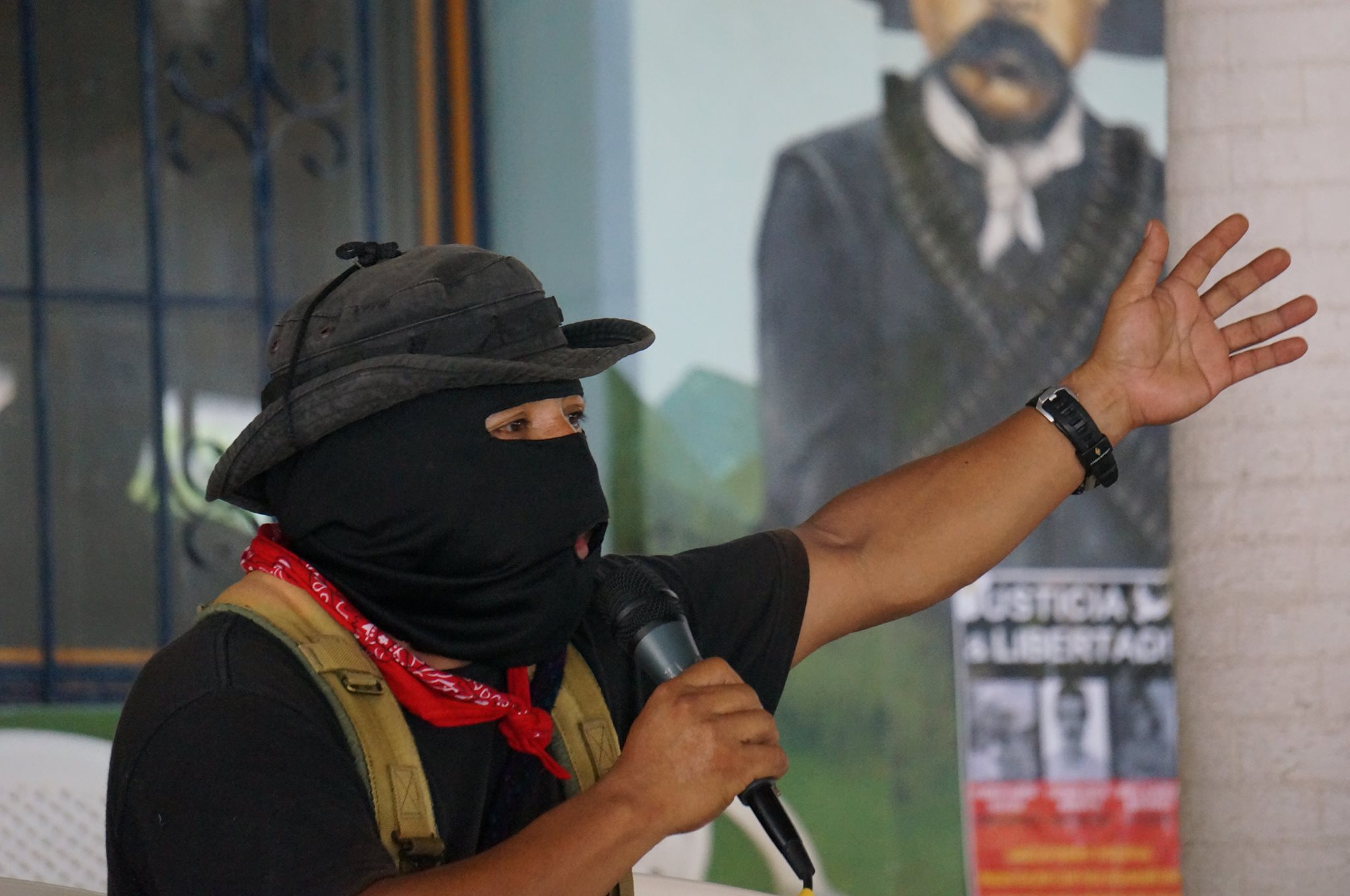
Subcomandante Moisés
The Words of Comandante Javier, welcoming the Ayotzinapa Caravan to the Caracol of Oventik, November 15, 2014
Brothers and sisters, parents of the 43 disappeared students, and Students and Teachers from the “Raúl Isidro Burgos” Rural Teachers College of Ayotzinapa, state of Guerrero:
A very good afternoon to everyone!
In the name of our thousands of compañero and compañera bases of support of the Zapatista National Liberation Army, we warmly welcome you to this humble center, the Caracol II of Oventik, Resistance and Rebellion for Humanity, in the Highlands Zone of Chiapas, Mexico.
Those of us present here are representatives of our Zapatista communities, and we receive you with open arms in order to listen to your words.
Know that you are not alone! That your pain is our pain! That your rage is our dignified rage! And that with our actions we support the demand that the 43 students, disappeared by the bad governments’ criminal acts, be returned alive. May you feel at home here, because this place is home to all who struggle.
Thank you
——————————
**************************
The Words of Comandante Tacho, at the opening of the EZLN Encounter with the Ayotzinapa Caravan, November 15, 2014
Compañeras and compañeros:
Fathers and mothers of the disappeared students from the “Raúl Isidro Burgos” Rural Teachers College in Ayotzinapa, state of Guerrero, Mexico.
To the students and to all of those accompanying this caravan, and everyone gathered here.
In the name of the boys, girls, young people, men, women, and elderly of the Zapatista Army for National Liberation, we welcome you to this Caracol of Oventik, Caracol II, Resistance and Rebellion for Humanity.
Compañeras and Compañeros:
We the Zapatista Army for National Liberation want to hear your words of pain and rage, which we share.
We are not concerned with whether municipal presidencies are burning, nor with how many cars, doors, or palaces have been burnt.
What we want to hear is your pain, your rage, and the angst that comes from not knowing where your young students might be.
We also want to tell you that we Zapatistas have been accompanying you in the protests and mobilizations that have been held in Mexico and in the world. Though our acts of pain and rage do not appear in the paid media, we want you know that we have joined you with real and true actions.
This is why we want you to speak to us, and why we want to listen to you.
If we had known a few days earlier that you were coming, there would have been many of us here to greet and listen to you, many more than are here now. You can’t imagine the number of people who would have come.
Those of us who serve as representatives here today receive you with all of our hearts to listen to your pain and your rage.
That’s all.
—————————————————
***************
The Words of the General Command of the EZLN, presented by Subcomandante Insurgente Moisés upon concluding the event with the caravan of the families of the disappeared and students of Ayotzinapa, in the caracol of Oventik, November 15, 2014.
Mothers, Fathers, and Family members of our murdered and disappeared brothers in Iguala, Guerrero:
Students of the “Raúl Isidro Burgos” Rural Teachers College in Ayotzinapa, Guerrero:
Brothers and Sisters:
We thank you with all our heart for sharing your word with us.
We know that in order to bring us your word directly, without intermediaries or outside interpretations, you had to travel many hours and endure fatigue, hunger, and exhaustion.
We also know that for you this sacrifice is part of the duty that you feel.
It is the duty to not abandon the compañeros disappeared by the bad governments, to not sell them out, to not forget them.
It is because of this duty that you began your struggle, even when no one was paying any attention and the disappeared brothers were being called “amateurs”, “rabble rousers” “future delinquents who deserved what they got,” “agent provocateurs,” radicals,” “hicks,” and “agitators.”
They were called those names by many of the same people who now crowd around your dignified rage for reasons of fashion or self-benefit, the same people who before tried to blame the Raúl Isidro Burgos Teachers College for what happened.
There are still some people above who try to blame the teachers college, attempting to create a distraction in order to conceal the real culprit.
It is because of this duty that you began to speak, to shout, to explain, to tell, to use your word with courage and with dignified rage.
Today, in the heap of empty words with which others clothe your dignified cause, there are already squabbles over who can take credit for getting you recognized, heard, understood, and embraced.
Perhaps no one has told you this, but it has been you, the families and compañeros of the dead and disappeared students, who, with the strength of your pain and its conversion into dignified and noble rage, have caused many people in Mexico and the world to awaken and begin to ask questions.
For this, we thank you.
We thank you not only for honoring us by bringing your word to our ears, humble as we are—we who have no media impact and no contacts in the bad government; we who are without the capacity or knowledge to accompany you, shoulder to shoulder, in the incessant coming and going of the search for your loved ones, who are now also loved by millions who don’t even know them; we who are without sufficient words to give you advice, relief, or hope.
Also, and above all, we thank you for your heroic determination, your wise insistence on naming the disappeared in the face of those responsible for this disgrace, for demanding justice in the face of the arrogance of the powerful, and teaching rebellion and resistance in the face of conformity and cynicism.
We want to thank you for the lessons that you have and continue to give us.
It is terrible and marvelous that the poor and humble families and students who aspire to be teachers have become the best teachers this country has seen in recent years.
Brothers and sisters:
Your word was and is for us a source of strength.
It is as if you have given us a source of nourishment, even though we were far away, even though we did not know each other, even though we are separated by calendars and geographies—that is, by time and distance.
We also thank you for sharing your word because we see now that others have tried to contain this firm and strong voice, this nucleus of pain and rage that set everything in motion.
And we see, hear, and read that now they speak of doors that before didn’t matter to anyone.
They forget that for a while now these doors have been meant to signal to those outside them that they had nothing to do with the decisions made inside.
They forget that these doors are now merely part of a useless shell within which sovereignty is simulated but servility and submission reign.
They forget that behind these doors there is just a huge mall which the people outside can’t enter, and where the broken pieces of what used to be the Mexican Nation are sold off.
We don’t care about those doors.
We don’t care if they are burned or adored, nor if they are seen with rage, nostalgia, or desire.
We care about your word, your word, your rebellion, your resistance.
There, on the outside, they are talking and arguing and making allegations over violence or non-violence, ignoring the fact that there is violence on most people’s tables every day. Violence walks with them to work and to school, goes home with them, sleeps with them, and without consideration for age, race, gender, language, or culture, makes a nightmare out of their dreams and realities.
We hear, see, and read that on the outside they are debating coups from the right or the left, who to take out of power and who to put in.
They forget that the entire political system is rotten.
It is not that this system has links to organized crime, to narco-trafficking, to the attacks, aggressions, rapes, beatings, imprisonments, disappearances, and murders, but that all of that is now part of its essence.
And we can’t talk about the political class as something separate from the nightmares that millions of people on this land suffer.
Corruption, impunity, authoritarianism, organized and unorganized crime: these are now the emblems, statues, declarations of principals, and practices of the entire Mexican political class.
We don’t care about the bickering, the agreements and disagreements, among those above over who will be in charge of the machine of destruction and death that the Mexican State has become.
We care about your words, your rage, your rebellion, your resistance.
We see, read, and hear the discussions being had out there about calendars, always the calendars of above, with their deceptive dates that hide the oppressions that we live today. They forget that hidden behind Zapata and Villa are the ones who actually remained in power: Carranza, Obregón, Calles, and a long list of names that, upon the blood of those who were like us, extended their reign of terror to our present day.
We care about your words, your rage, rebellion, and resistance.
And we read, hear, and see the discussions being had out there about tactics and strategies, methods, programs, what to do, who will be in charge of whom, who gives the orders, and where to look for direction.
They forget that the demands are simple and clear: they must be returned alive, all of them, not just those from Ayotzinapa; there must be punishment for those responsible at all levels and across the entire political spectrum; and they must do whatever is necessary so that this horror is never repeated, not against anyone in this world, even if they are not a famous or prestigious figure.
We care about your words, your rage, rebellion and resistance.
Because in your words we hear ours.
In those words we hear and say that no one takes us, the poor from below, into consideration.
No one, absolutely no one thinks about us.
They only appear to be concerned in order to see what they can take, how much they can grow, what they can win, how much they can make, what they can do and undo, what they can say and what they can keep quiet.
A few days ago, during the first days of October, when the horror of what had happened was just being discovered, we sent you some words.
They were small, as our words have been for some time now.
They were few because there are never sufficient words to speak of pain, to explain it, relieve it, or cure it.
So we just told you that you were not alone.
But with these words we meant not only that we support you, that although we are far away, your pain is ours, your dignified rage is ours.
Yes, we said this but not only this.
We also told you that in your pain and your rage you were not alone, because thousands of men, women, children, and elderly know firsthand that nightmare.
You are not alone, sisters and brothers.
Seek your word among the families of the little boys and girls murdered in the ABC daycare in Sonora; among the organizations for the disappeared in Coahuila; among the families of the innocent victims of the drug war, a war that has been lost since it began; among the families of the thousands of migrants killed and disappeared across Mexican territory.
Seek it among the daily victims in every corner of our country who know that it is the legal authority that beats, annihilates, robs, kidnaps, extorts, rapes, imprisons, and murders them, and that this authority is dressed sometimes as organized crime and sometimes as the legally constituted government.
Seek it among the indigenous peoples who, since before time was time, possessed the wisdom to resist, and there is no one who knows more about pain and rage than they do.
Seek out the Yaqui and you will find yourselves.
Seek out the Nahua and you will see that your word is embraced.
Seek out the Ñahtó and the mirror you find will be mutual.
Seek out the people who rose up in these lands and whose blood gave birth to this Nation before it was called “Mexico,” and you will know that below, the word is a bridge that can be crossed without fear.
This is why your word has strength.
Because millions have seen their reflection in your word.
Many will say this, and although the majority will keep quiet, they too make your demand theirs, and inside themselves they repeat your words.
They identify with you, with your pain and rage.
We know that there are many who are asking things of you, demanding things; they want to take you in one direction or another, to use you or tell you what to do.
We know that there is a lot of noise coming your way.
We don’t want to be one more noise.
We only want to tell you not to let your word fall.
Do not let it grow faint.
Make it grow so that it can be heard above all of the noise and lies.
Do not abandon your word, because in it walks not just the memory of your dead and disappeared, but also the rage of those who today are below so that those above can be there.
Sisters and brothers:
We think that perhaps you already know that you may be abandoned, and that you are prepared for this.
It may be that those who crowd around you right now in order to use you for their own benefit will abandon you and scuttle off in another direction seeking another trend, another movement or another mobilization.
We are telling you this because it is already part of our own history.
Estimate that there 100 people who accompany you in your demands.
Of those 100, 50 will switch to a new fad when the calendar turns.
Of the 50 who remain, 30 will buy the forgetting that is already being offered on a payment plan, and they will say that you no longer exist, that you didn’t do anything, that you were a farce to distract from other issues, that you were an invention of the government so that such and such party or such and such politician could not advance.
Of the 20 left, 19 will run away terrified at the first broken window. Because the victims of Ayotzinapa, of Sonora, of Coahuila, of whatever geography only occupy the media spotlight for a moment and observers can choose not to see, not to listen, not to read, or to turn the page, or change the channel or the station. A broken window, in contrast, is a prophecy.
And so, of the original 100, you will see that there is only one left. [i]
But that one will have discovered themselves in your words; their heart will have opened, as we say, and in their heart, pain and rage will have taken root.
Not just for your dead and disappeared, but for this one who, out of the 100, must keep going.
Because this one, just like all of you, will not give in, will not give up and will not sell out.
Part of this one percent, perhaps the smallest part, is we Zapatistas.
But not just us.
There are many, many more. [ii]
Because as it turns out, the few are only few until they find others.
And then something terrible and wonderful happens.
Those who thought they were few and alone discover that we are the majority, in every sense.
And so the world must be turned over, because it isn’t fair that the few dominate the many.
And because it isn’t fair that there are dominators and dominated.
Sisters and brothers:
We tell you this according to our ways of thinking, which are our histories.
You, in your own histories, will listen to many more ways of thinking, just as you have honored us by listening to ours.
And you have the wisdom to take up the thoughts you see to be of value and discard those you don’t.
We Zapatistas think that the changes that really matter, profound changes, the kinds that create other histories, are those that begin with the few, not with the many.
But we know that you know that although Ayotzinapa may go out of style, although the grand plans, strategies, and tactics fail, that although moments of conjuncture go by and other interests and forces come into fashion, that although all those who today hover around you like vultures that thrive on the pain of others, although all of this happens, you know and we know that everywhere there is a pain like ours, a rage like ours, and a determination like ours.
We Zapatistas invite you to seek out that pain and rage.
Seek it, find it, respect it, speak and listen to it; share your suffering.
Because we know when different sufferings encounter each other, they do not seed resignation, pity, and abandon, but organized rebellion.
We know that in your hearts, regardless of your creeds, ideologies, and political organizations, the demand for justice enlivens you.
Do not let yourselves break apart.
Do not become divided, unless it is in order to advance further.
And above all, do not forget that you are not alone.
Sisters and brothers:
With our small strength but with all of our heart, we have and will continue to do everything we can to support your just struggle.
We have not said much so far because we see that there are many interests—with those of the politicians above first in line—that want to use you to their liking and at their convenience, and we do not and will not join the predatory convergence of those shameless opportunists who do not care in the least if the missing are returned alive, but want only to grease the wheel of their own ambitions.
Our silence has signaled and continues to signal respect, because the size of your struggle is gigantic.
That is why our steps have been in silence, in order to let you know that you are not alone, that your pain is our pain, as is your dignified rage.
That is why our tiny lights were lit where nobody noticed except us.
Those who view this effort as no big deal or who don’t know about it at all, who scold and demand that we speak and that we declare our position and add ourselves to the noise, are racists who look down on anything that does not appear above.
It is important that you know that we support you, but it is also important that we know that we support a just, noble, and dignified cause, like the one that animates your caravan throughout the country.
Because for us, knowing that we are supporting an honest movement is a source of nourishment and hope.
How terrible it would be if there were no honest movements, and in all of the vast below that we compose there was merely a replication of that grotesque farce above.
We think that those who look to and count on the calendar from above or a particular deadline or date will abandon you as soon as a new event appears on their horizon.
Running after a situation and opportunity which they did nothing to create and which they at first looked down upon, they now wait for “the masses” to clear the path to Power and for one name to replace another up above so that nothing changes below.
We think that the moments that transform the world are not born on the calendars above, but are created by the daily, stubborn, and continuous work of those who choose to organize themselves instead of following the current trend.
This much is true: there will be a profound change, a real transformation in this and other suffering lands around the world.
Not one but many revolutions will shake the planet.
But the result of these will not be a change of name and logo in which those above continue to be above at the cost of those below.
Real transformation will not be a change of government, but a change of relation, where the people command and the government obeys.
It will be one where the government is not a business.
Where the fact of being woman, man, other, [iii] child, elderly, young person, a worker in the countryside or city, does not mean living a nightmare or falling prey to the enjoyment and enrichment of those who govern.
Where women are not humiliated, the indigenous are not looked upon with disdain, where the young person is not disappeared and those who are different are not satanized, where childhood is not turned into a commodity, where the elderly are not discarded.
It will be one where terror and death do not reign.
One where there are neither kings nor subjects, neither masters nor slaves, neither exploiters nor exploited, neither saviors nor saved, neither bosses nor followers, neither commanders nor commanded, neither shepherds nor flocks.
Yes, we know it won’t be easy.
Yes, we know it won’t be fast.
We know this, but we also know that it won’t be a change in names and letters on the criminal building of the system.
And we know it will happen.
We know that you and everyone else will find your disappeared, that there will be justice, that for all those who have suffered and continue to suffer this sorrow will come the relief of having answers to the what, why, who, and how. And upon these answers not only will punishment be brought to those responsible, but the necessary measures constructed so that this can not happen again and that to be a young person or a student, a woman, a child, a migrant, an indigenous person, or whoever, will not mean being a target for the executioner in turn to identify his next victim.
We know that this will be so because we have heard something, among many things, that we have in common.
We know that you, like us, will not sell out, will not give in, and will not give up.
Brothers and sisters:
On our behalf, we want only for you to take with you this thought that we express from the bottom of our collective heart:
Thank you for your words, sisters and brothers.
But above all, thank you for your struggle.
Thank you, because upon knowing you, we now see the horizon…
Democracy!
Liberty!
Justice!
From the mountains of the Mexican Southeast,
For the Revolutionary Indigenous Clandestine Committee–General Command of the Zapatista National Liberation Army
Subcomandante Insurgente Moisés.
Mexico, on the 15th day of November of 2014, in the twentieth year of the war against oblivion
[i] The text uses “uno, una, unoa” for to give a range of possible gendered pronouns including male, female, transgender and others.
[ii] The text uses “muchos, muchas, muchoas” to give a range of possible gendered pronouns including male, female, transgender and others.
[iii] The text uses “otroa,” meaning “other,” to give a range of possible gendered pronouns including male, female, transgender and others.
——————————————————————
Originally Published in Spanish by Enlace Zapatista
November 15, 2014
 Chiapas Support Committee