Chiapas Support Committee
Home of the Compañero Manuel blog on zapatistas & mexico
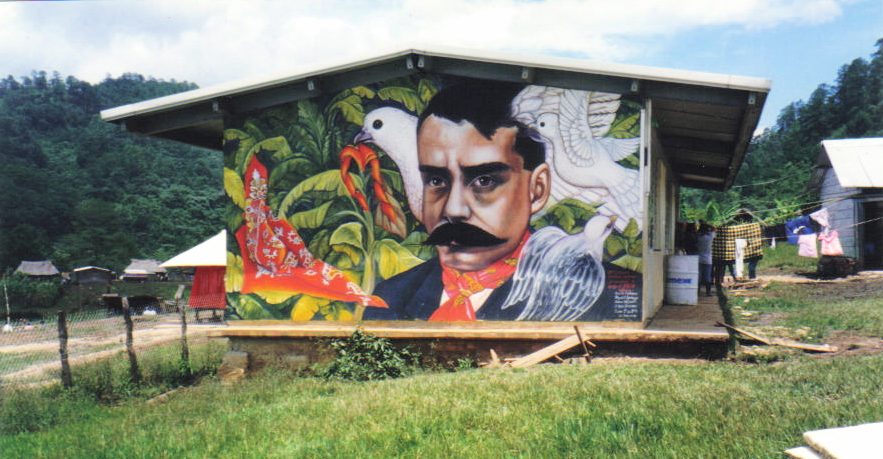
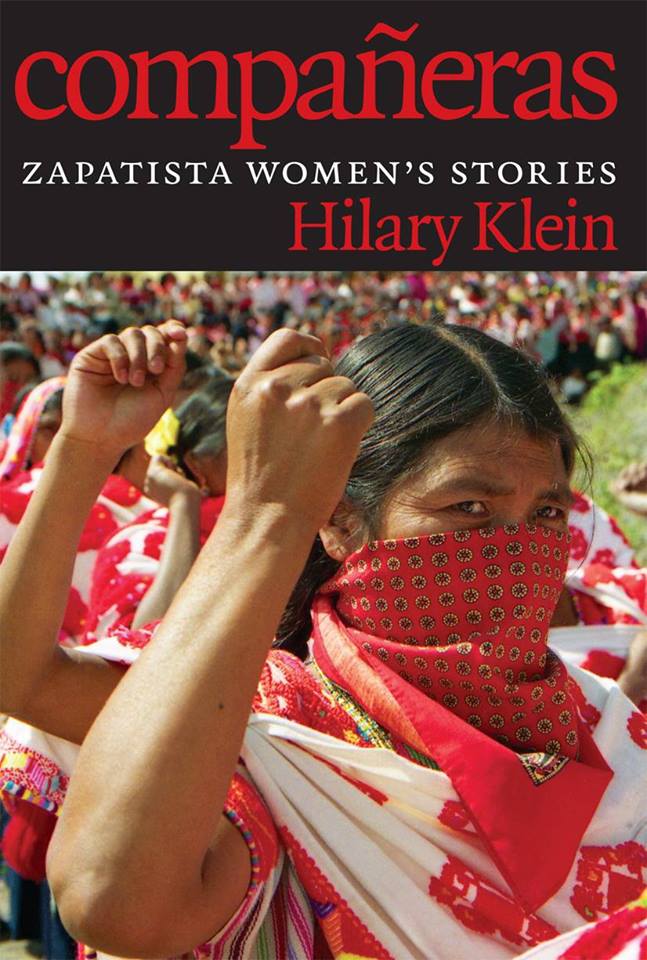
Compañeras: Zapatista Women’s Stories
PRESENTATION OF THIS IMPORTANT NEW BOOK IN OAKLAND
Tuesday, April 28, 7pm at The Omni Commons – https://www.facebook.com/events/1430606940567768/
Zibechi on Eduardo Galeano
THE DESPISED LOST THEIR BEST NARRATOR

Eduardo Galeano
By: Raúl Zibechi
Those who listen to the beat from below harbor their sorrows and share their laughs and weeping. Those who make an effort to understand them without interpreting them, by accepting them without judging them, can win a place in the hearts of those below. Eduardo Galeano toured the most diverse Latin American geographies on trains, on the back of a mule and on foot, traveling in the same ways as those below. He wasn’t seeking to imitate, but something better: feeling in his skin the feelings of others to make them come alive in his texts, to help them leave anonymity.
Eduardo was a simple man, committed to the common people, to the nobodies, to the oppressed. His was a commitment to the people of flesh and bone, to men and women living and suffering; much deeper than the adhesion to ideologies that always can be corrupted according to the interests of the moment. The pains of those below, he taught us, cannot be negotiated or represented, not even explained by the best writer. That’s equal to stopping their hopes.
Among his many teachings, it’s necessary to rescue his punctilious attachment to the truth. But he finds those truths far from the mundane noise of the media, in the hungry eyes of the Indian child, in the cut feet of the campesinos, in the candid smile of the sellers, there where the scorned tell their truths every day, without witnesses.
He never had the slightest hesitation in pointing towards those responsible for the poverty and hunger, like these chronicles about the crisis of Uruguayan industry, when at the age of 20 he was the editorial chief of the weekly Marcha, one of the first and best exponents of the critical and committed the press. In them he denounced the powerful with first names, last names and properties, without deviations. Because, as he liked to say: “the media prostitute the words.”
But it was his reports about the struggles and resistances of those below that left an early and indelible impression. Like the one he titled: “From rebellion henceforth,” in March 1964, relating the second “cañera” march (sugar cane workers’ march). His gaze stopped on the more than 90 boys that participated, on Doña Marculina Piñeiro, so old that they had forgotten their age and for whom he seemed to feel a special admiration. “They wanted to conquer us with hunger. But because of hunger what were we going to lose? We are accustomed,” the woman told him, a mother and granddaughter of cañeros.
His pen gave form to the everyday life of the disinherited, but it wasn’t made up of portraying their pain. He toiled at painting –with live colors– the dignity of their steps, their rage capable of overcoming the repression and torture. In first place would appear, always and in each one of his notes, the people that embodied sufferings and resistances. Perhaps because he was obsessed by the indifference of others, which he considered “a lifestyle” whose protective covering we should destroy, that’s why he wrote his articles.
Among the much homage that he received in life, he had the privilege of the teacher at the Little Zapatista School, José Luis Solís López, adopting Galeano as his pseudonym. It is very probable that the teacher was not referencing the writer. Anyhow, Eduardo and Zapatismo knew and recognized each other at once. As if they had been waiting all their lives. Neither a program nor a list of demands called him, but rather the ethics of being below and to the left.
Eduardo Galeano was in La Realidad in August 1996. He participated in one of the tables at the Intercontinental Meeting for Humanity and against Neoliberalism. He talked a little, was clear and said a lot. In those days, and in many more, he planted Galeanos, he infected Galeanos; Galeanos that now walk hoisting their dignity and their Galeano rage. The forever despised carry him in their hearts.
——————————————————————
Originally Published in Spanish by La Jornada
Translation: Chiapas Support Committee
Tuesday, April 14, 2015
En español: http://www.jornada.unam.mx/2015/04/14/opinion/013a1pol
Ayotzinapa, emblem of 21st century social order
Mexico: Ayotzinapa, Emblem of the Twenty-First Century Social Order
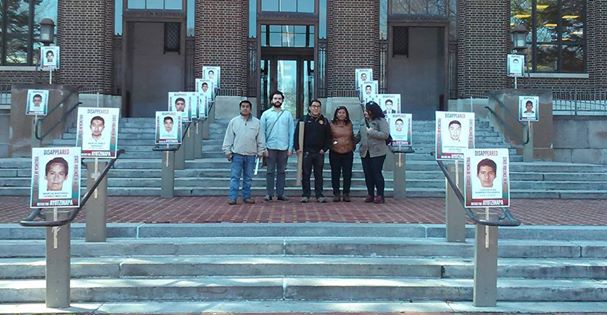
Caravana 43 in a recent visit to Ann Arbor, Michigan
By: Ana Esther Ceceña
For Julio César Mondragón, in memoriam
Ayotzinapa is an ominous emblem of the atrocities generated by contemporary capitalism. Ayotzinapa is anywhere in our world where a dissident voice has been raised, a demand, a sign of rebellion in the face of the devastating dispossession and plunder on which the accumulation of capital is based, as well as the networks of power that sustain it.
Ayotzinapa is the end result of a bundle of interconnected events. These, with greater or lesser density and visibility, are part of the essence of Twenty-First Century capitalism, not limited to Mexico but spreading, whether surreptitiously or scandalously, throughout the whole world.
Twenty-First Century capitalism
It is increasingly clear that today’s capitalism runs on two tracks. On the one hand, we have the formally recognized society, with its economy, its organization and confrontation, its morality; and on the other the accelerating growth of a parallel society, whose economy is generically qualified as illegal, that works with a morality, organization and disciplinary methods that are quite different.
There are places in this world, such as Mexico, where the crises of neoliberalism, in addition to provoking substantial changes in their position in the international division of labor, in the definition of their productive activities and in the usage of their territory, have generated a social fracture that grows deeper over time. One of the central issues is that young people have lost their perspectives and a space to occupy. A society has been created with few possibilities for absorbing them, a society in which the chances of work or incorporation have disappeared, in which the horizons have faded out. It no longer had room for many existing workers, and much less so for those arriving on the scene. Some have called this Generation X, a generation that does not know where it is going because it has nowhere to go. The current phase of capitalist concentration has eliminated spaces even as it extends its power. Land, domestic activities, even entertainment were taken over, but growing sectors of the population were eliminated from the benefits, being left on the edge or becoming pariahs.
Given the depth and characteristics of this process, it is no longer possible to speak of a social order. The existing conditions are rather those of disorder, rupture, decomposition and break ups. That is to say, this new order appeals to authoritarianism, as the only visible way to sustain it.
The militarization of the planet, especially in everyday affairs, has begun to impose itself as the general pattern of the whole process. Stability for this system not only demanded the “open and free market” of the neo-liberals, but the force that can guarantee its functioning. This is a militarized market, whose hands are not only visible, but also armed. This was the path taken by formal capitalism, that which is recognized and, paradoxically, “legal”.
However, the fractures this society has opened up, as if it had been subjected to fracking, have found cover in the development of a parallel society. This society occupied the small niches of the old one, but ended up invading it. It is a society that adopted the hidden trash the old one had -hypocritically- rejected, and made it into a business, an opportunity for accumulation and power.
All forms of illicit trade moved there: the illegal arms trade, drug production and traffic, human traffic, trafficking in valuable and rare species and a great number of variations on these that are the most profitable dealings – in part because they are not taxed – but that established morality is obliged to deny.
Here, the game of mutual confrontation took off, fueling the arms trade, and above all, the practice of extortion, blackmail, kidnapping or any variants on these.
Yet capital accumulation feeds on both sectors. The losers are the marginalized sectors: those economically, socially, politically or culturally excluded – excluded from business at different levels, or from power.
This is where a generous opening for young people came into play: their incorporation into the police or the armed forces provided them with conditions that no productive sector could offer them, and also gave some small recognition and a little power to those who had been categorized as socially useless. At the same time, there were openings in the supposedly contrary ranks. Drug dealers or businessmen engaged in illegal activities also needed their armies of servants or thugs. And these have provided employment over the last two or three decades, creating a new culture: the culture of the mercenary, of arbitrary power, of plunder by extortion.
As the “legal” economy entered a state of crisis, the dark side of the economy grew, operating in some of the same sectors as the “legal” economy, but in ways that are more profitable.
One example is that of undeclared mining operations, that even involve several forms of slavery in their work force. Whether in Africa or Mexico, there are mines operating with forced labor of children or adolescents, who are often kidnapped for this work and guarded by armed bodies, that might be either the army or mercenaries. The mining products are extracted almost without cost because the workers are not paid, without taxes because the products are undeclared and are exported with the complicity of mining consortia and their home States, as well as that of local authorities that take part of the profits for looking the other way or actively protecting the industry.
This kind of two-edged capitalism is thus able not only to survive the crisis, but also to engage in a double exploitation of the population through slave or semi-slave labor, different kinds of extortion, expulsion from land, outright robbery of their property and similar tactics. The key to all this is the exercise of ruthless violence.
Under these circumstances, the State becomes part of the process and society is subjected to warlike conditions in daily life. Violence is installed as social discipline and becomes generalized. In a public-private game those in charge of social control come together around the real sources of gain, be these legal or illegal, and around the configuration of local powers invested through their ability to impose a social order corresponding to these modalities of accumulation.
Diffuse and asymmetric wars
The conditions of concentration of wealth and power in today’s capitalism, associated with growing instability in a broad range of social groups, have driven the system into a state of risk, manifest in permanent conflicts and confrontations that are asymmetric in character, to use the terminology of the Pentagon. Contemporary wars increasingly adopt the notion of a diffuse enemy and take on the character of preventive wars that for the most part are undeclared.
Operations of destabilization and imposition of discipline, episodes of violence unleashed in specific places or of violence metered out over broad areas, are the preferred mechanisms of unspecified wars against diffuse enemies. At the same time, they are ideal mechanisms to open the way for the looting of resources in many regions of the planet, creating confusion that makes social organization very difficult. The controlled supply of weapons and the provocation of violent situations are allies sought by contemporary capitalism.
There are no declared wars. There are no wars between equals. There is corrosion. A spreading stain of violence accompanies the capitalism of the beginnings of the Twenty-First Century. The institutions responsible for discipline and security of States have been inadequate in the face of the high level of appropriation and dispossession that marks today’s capitalism. These institutions are reproduced on a local and private level as often as they are needed. “Islamic states”, “private guards”, “cartels” or “gangs” of so-called organized crime, appear as needed, to protect and broaden or deepen the sources of gain, of accumulation, and as such, complement the institutions that are officially recognized for these purposes. Just as markets required military support, the institutional forces of social disciplining, given the level of appropriation and dispossession, require de-institutionalized support capable of exercising a level and a kind of violence that changes the patterns of social contention. These are “irregular” forces that, like the state of exception, come into existence to remain in place. They have become part of the regular forces that make the system function.
Ayotzinapa as the limit
Colombia was in a state of internal war when Plan Colombia was introduced and, in spite of the changed intensity in the violence and the direct and obvious intromission of the United States in the conduct of the conflict, the change in other areas was maybe less visible. On the contrary, Mexico was celebrated as an emblem of discipline in democracy before the Merida Initiative began.
In less than ten years, the axis of discipline passed from the Institutional Revolutionary Party – the PRI – to the perpetrators of violence, in both State and private hands. The key was in the factors of corrosion that marked the way and in the disproportion of the corrective means employed. Violence exists in all societies, but the scope and methods introduced here imposed a new social logic. In this period, Mexican society had to get used to beheadings, mutilations, burned bodies, repeated disappearances, common graves and the ostentatious complicity of elements responsible for the security and justice of the State.
Estimates already surpass some one hundred thousand disappeared people and news reports start at twenty deaths daily. Mexico has become a cemetery for the poor and for migrants who are extorted, kidnapped for slave labor, savagely murdered in order to terrify and discipline others, or killed en masse. The relation of these actions with the control of migration to the United States is a matter of speculation, but there is no doubt as to the results. What is evident is the takeover of land, of business, of resources and of power that take place because of this. Every day there are more displaced people, more dispossessed people who dare not even complain for fear of reprisal and because there are no institutions of justice that will protect them.
In less than ten years and after much pain, society has been transformed. It is corroded, with clear signs of Balkanization, with growth of local power centers that make their own laws and negotiate with the federal authorities. Fear has taken root through repeated and explicit savagery, although, through its much repetition, it is beginning to generate the opposite.
Ayotzinapa is the mountain peak. In Ayotzinapa the limits were over-reached. With complete impunity, ostentatious force and total complicity between the State and organized crime, they went against the most vulnerable members of society: poor young people from devastated rural areas, students in teacher training, children of the people known for their joy of living, desiring to change the world, that world that no one wants to accept. In addition, Ayotzinapa is the peak of a mountain of insult, defenselessness and anger. It is the accumulated conscience of ignominy and indignity. It is the limit, the situation that brought back the energy, vitality, courage and dignity of the people of Mexico and drove them into the streets. “They have taken so much from us that they have even taken away our fear” was one of the first posters raised by young people everywhere. Julio César Mondragón, a young man who had just entered the Teacher Training School of Ayotzinapa, already a father of a few months, and victim of the most savage tortures that we have seen, because of his pain has become the involuntary detonator of the recovery of strength, hope and decision on the part of the people of Mexico, mobilized today as they have not been for a long time.
Ayotzinapa is a symbol. It is the tip of the iceberg or a cleavage.
Ayotzinapa is the symbol of the wars of the Twenty-First Century and of the new patterns of social discipline that accompany the processes of looting and dispossession in the whole planet. In just ten years, Mexico, which had not experienced the dark night of the Latin American dictatorships, even though it had known dirty wars and massacres, has become a land of pain and common graves. The problem is not “the narco”; the problem is capitalism.
Ayotzinapa is a two-way mirror: that of the path of power is obvious, visible and overwhelming; that of the call to defend life is pallid and discreet, but it will certainly leave footprints.
———————————
(Translated for ALAI by Jordan Bishop)
– Ana Ceceña is Coordinator of the Observatorio Latinoamericano de Geopolítica, Instituto de Investigaciones Económicas, Universidad Nacional Autónoma de México (UNAM). She is a member of the Council of ALAI.
– The original text is part of ALAI’s Spanish language magazine América Latina en Movimiento, No.500, November-December 2014, titled “América Latina: Cuestiones de fondo” (Latin America: basic issues).
————————————————————————————
Published by: América Latina en Movimiento in both Spanish and English
In English: http://www.alainet.org/en/active/79434
En español: http://www.alainet.org/es/active/79387
Why so serious? SupGaleano
WHY SO SERIOUS?

SupGaleano (aka Marcos) wearing eye patch with skull.
(01001101 01110101 01100011 01101000 01100001 01110011 00100000 01000111 01110010 01100001 01100011 01101001 01100001 01110011 00100000 01000011 01101111 01101101 01110000 01100001 01110011 (note: translate binary code)
April 2015.
We didn’t know anything about this kind of thing. We learned. They explained it to us. We understood even less. But later on, “we grasped the concept holistically,” as they say. That is, not at all. But they were saying something about how we had been victims of a “high level” cyber attack. We of course put on our “no problem” face, the one that says: “the proper measures will be taken” and “we will pursue this case to its logical conclusion.” But really, we were asking ourselves if it happened because of all the times we ourselves go to the page in order to increase the number of visitors. “Some over-enthusiastic clicker” we thought. But that part is confidential, so we’d appreciate it if you didn’t make it public.
Later on they told us that calculations show that in the United States alone, the average annual cost of cyber attacks was 12.7 million dollars in 2014. We didn’t understand, I mean about the quantity. When they explained it to us, we panicked and ran to see if our pozol reserves had diminished. Nope. “Stable levels,” the guard said (this means there is enough for the homages and the seminar). At that point, all was still well. The problem was that in order to celebrate the fact that the cyber attack had not penetrated the solid vaults where we store the “gold of the LXIX century,” we had a party and a dance with the community DJs’ electronic music. The result? The strategic reserves were substantially reduced and now we have to replace them.
But, as they say, now it is official: neo-Zapatismo has entered the 21st century. Okay, okay, okay, we’re late, but keep in mind that it’s only 2015.
Did you think the image of modern Mexico lay in Beverly Hills shopping, helicopter travel, or an electoral ad? Wrong! Error 404! ¡Erreur! ¡Fehler! ¡Oшибка!
The webpage of the eezeeelen was cyber-attacked!
Okay, okay, okay, we don’t really know what that means (being so pre-modern, we’re only accustomed to attacks by soldiers, police, paramilitaries, and various ink-shitters), but it sounds so fancy, so classy, so first world.
Oh, I thought this day would never come! Let Sony, Microsoft, and Apple die of jealousy! Let Obama, Putin, and Merkel turn green with envy! Let Walmart, Carrefour, Tesco, and Metro swell with rage! Let Samsung, LG, and Motorola buy their antacids! Prostrate yourselves cola drinks, junk food and fast food! Don’t hide your humiliation International Monetary Fund, World Bank, and World Trade Organization!
We will take it for what it is: a small homage to our humble and quiet work of clicking on the webpage to raise our “web traffic” and soon, we will be collecting payments for advertising self-help courses, language classes in Elf, Dothraki, High Valerian, Klingon, and Na’vi, and of course, online offers from “The Speedy Huarache.”
Well in reality and in La Realidad, all this is nothing but a pretext to send you all an embrace and say:
Thanks to the gang, the plebes, the crew, the barrio, the homies, the brothers, the compas or whatever you call them, who lent a hand, some support, backup, and, as they say these days, “replicated” the content of the pages, the tweets, the Facebook, and the chats closest to their respective hearts. As this is sure to happen again, we want to reiterate once and for all: Thank you (please use the scientific method of “copy and paste” for this note of appreciation because it won’t be the last time you need it).
From the cyber-concierge, protecting himself with the hyper-modern firewall Pozolware 6.9.
SupGaleano, fighting with the cat-dog over the copyleft rights.
(Nah, really we’re fighting over the popcorn…but I got here first!)
Mexico, April 2015.

Cat-Dog administering the web wearing a paliacate (bandana) and a ski mask.
From the diary of the Cat-Dog:
Looking for who to blame:
-The trendy hypothesis of “Moderate Hysteria“:
It was without doubt the reptile-millennial-illuminati-narco-globalist-party follower-electoralists.
-The trendy hypothesis of “Misogynist High Politics“: It was Frank Underwood, but with bad advice from Claire… Okay, okay, okay, Petrov then?
-Report from Big Brother, received by the Pentagon: (Summary of observations from “The Situation Room” of the “East Wing” of the Zapatista Hexagon. Reporting: Echelon System. April 7, 2015. 2330 hours, Zulu time): Opinions were split: someone said it was us (the Pentagon), someone else said it was the Kremlin. Somebody else said Buckingham Palace, el Palacio de Hierro, [i] Liverpool, or Sears. Nobody said the Eifel Tower (this calmed them down because they were worried about their buddies from Tameratong)?
Some embittered soul said that they already knew that the new season of Game of Thrones was no good at all. Some indescribable character, something like a dog…or a cat…or vice versa, put up a sign that read: “Spoiler Alert.”
It sounded like they were about to come to agreement on something when the sound of a marimba being tuned was heard. The voices in the audio become chaotic, confused, and the only thing that can be made out is a kind of shout: “Pozol Agrio!” It must be some kind of alarm signal because the “Situation Room” and the whole east wing of the complex was quickly deserted.
(End of the report that demonstrates that the budget dedicated to spying is money thrown into cyberspace garbage).
-Section “There is a Trending Topic in your future.” Suggestions for solidarity hashtags:
#wewanttheezeeelenwebpagebackeventhougwealreadyregistered
#theenlacezapatistawebpageisbackonlineandifitgetstakendownthehomieswillhelpus
#don’tlettheenlacezapatistawebpagethatistheblogoftheezlncommissionsextabecyberattackedbytheconspiracyinfashion.
I testify:
(Grunts and snorts).
—————————————————————-
[i] “The Iron Palace,” an upscale chain of department stores in Mexico.
————————————————————
Originally Published in Spanish by Enlace Zapatista
http://enlacezapatista.ezln.org.mx/2015/04/09/por-que-tan-serios-el-supgaleano/
Info about cyber-attack on Enlace Zapatista webpage
Information about the cyber attack on the Enlace Zapatista webpage
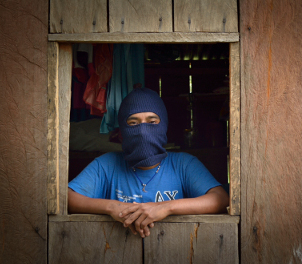
Zapatista Compañero
TO: Adherents to the Sixth
TO: The free media
Information about the cyber-attack on the Enlace Zapatista webpage: http://enlacezapatista.ezln.org.mx/
This morning, around 10:30 AM, a ddos attack (denial of service) occurred.
These types of attacks are generated by automatized programs that launch thousands of simultaneous requests at the same domain (the page’s address, in this case), provoking that the server is saturated and is incapable of responding.
The company that houses the server informed us that the attack was being carried out from a large number of IP addresses. Some of the addresses identified are:
- Range 80.78.20.24, from Cameroon
- Range 80.78.20.32 from the United States
- Range 93.170.11.125, from Russia.
Before these kinds of attacks, the only solution is to disconnect the equipment.
While the technical team achieves resolving the problem of the attack on the server and given that our interest is that those who want to attend the Critical Thought facing the Capitalist Hydra Seminar do not lose the opportunity, we solicit adherents to the Sixth and the free media to help us by replicating the text of The Storm, The Sentinel and the Lookout’s Syndrome (In English) OR La Tormenta, el Centinela y el Síndrome del Vigía (En español) and also to share the pre-registration formats for the seminar.
On the other hand, if anyone of you has a proposal that might help us fight this kind of problem, we would appreciate it if you would send your ideas to the following email address: notienlacezap@gmail.com
The page’s administration team
SOURCE: https://www.facebook.com/enlacezapatista?ref=ts&fref=ts
Pre-registration forms for the Seminar: http://espoirchiapas.blogspot.mx
(Admin’s Note: the pre-registration forms are in very simple Spanish)
———————————————————————–
Originally Published in Spanish by: POZOL COLECTIVO
Tuesday, April 7, 2015
Galeano: The storm, the sentinel and the lookout’s syndrome
Dear friends and enemies: so… err… umm… the thing is… well… remember that at the end of our March 19, 2015 text entitled “About the Homage and the Seminar,” we said that the organization of the seminar was a mess? Well, we have honored that claim: the email address to which we asked you to send your registration information is wrong, erroneous, in other words, that’s not the one. The correct email is: seminario.pensamientocritico15@gmail.com. Okay, okay, okay. It’s on me. Sincerely, yo merengues.
The Storm, the Sentinel, and Lookout’s Syndrome
April 2015.
To the compañeroas of the Sixth:
To all those interested:
Although it may not look like it, the following is an invitation… or is it a challenge?
If you are an adherent to the Sixth, if you are from the free, autonomous, alternative, independent media or whatever it’s called, if you are interested in critical thought, then accept this invitation to the seminar, “Critical Thought versus the Capitalist Hydra.” If in addition to accepting this invitation you would also like to attend the seminar, please follow this link: http://enlacezapatista.ezln.org.mx/registro-al-seminario-de-reflexion-y-analisis-el-pensamiento-critico-frente-a-la-hidra-capitalista/
If you are an invited speaker, [i] a similar letter will be sent to you via the same channels through which you have already been contacted. The difference will be that the invitation letter sent to the speakers will contain a “secret clause.”
Ok then, the invitation is really something like the wrapping paper.
Inside, further down below and to the left, you will find…
The Challenge
Oh, I know. The classic beginnings to a Zapatista reflection: disconcerting, anachronistic, silly, absurd. As if not really putting in any effort, as if just sort of putting it out there, a kind of “we’ll leave you to it,” or “see what you can do with it,” or something like “it’s on you.” It’s almost like they toss out a piece of a jigsaw puzzle and expect that people would understand that they are not just describing one part of reality, but have the entire image in mind. As if they saw the completed jigsaw puzzle, with its precise figures and colors in place, but with the border of each piece still visible, as if to point out that the whole exists because of all the parts, and of course, that each part acquires its meaning in relation to all the others.
As if Zapatista thinking demands that we see that what is missing is that which is not, that there is more than what is, that there is more than what is immediately perceptible.
This is something like what Walter Benjamin did with Paul Klee’s “Angelus Novus.” Reflecting on the painting, Benjamin “completes” it: he sees the angel, but he also sees what the angel sees, he sees how it has been thrown back by what it sees, he sees the force that assaults it, the brutal footprint of that force. He sees the jigsaw puzzle as complete:

“There is a painting by Klee named ‘Angelus Novus.’ It shows an angel looking as though he is about to move away from something that has him paralyzed. His eyes stare, his mouth is open, his wings are spread. This is how one imagines the Angel of History. His face is turned toward the past. Where we perceive a chain of events, he sees a single catastrophe that piles ruins upon ruins and hurls it at his feet. The angel would like to stay, awaken the dead, and mend that which has been shattered, but a hurricane blows in from Paradise that entangles itself in his wings and is so strong that the angel can no longer close them. The hurricane overpoweringly propels him into the future, to which his back is turned, while the pile of debris before him grows skyward. This hurricane is what we call progress.” (X, “Theses on the Philosophy of History”)
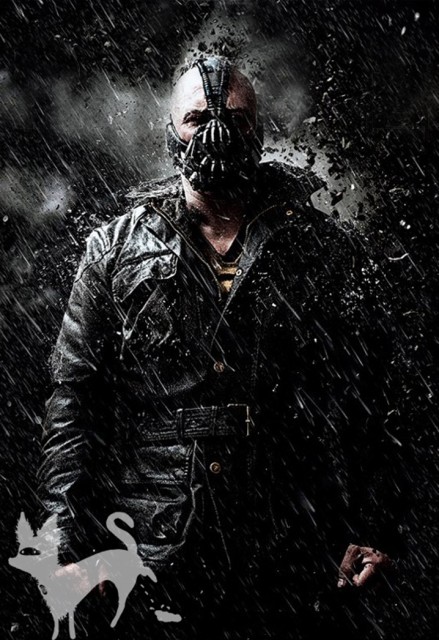
And so, it is as if our reflections were a dare, one of the Riddler’s enigmas, one of Mr. Bane’s challenges, one of the wildcards the Joker pulls while asking, “Why so serious?”
It is as if the cat-dog—at once superhero and super villain, Sherlock and Moriarty—bursts onto the scene harassing everyone with questions: “What do we see? Why? Where to? Where from? For what?”


It is as if we were thinking the world, questioning its clumsy rotation, debating its course, challenging its history, disputing the rationality of its evidence.
It is as if, for even just one moment, we were…
The Sentinel
You can observe that a military installation will usually have posts set up along its periphery. They’re called “Observation Towers,” “Guard Posts,” or “Watchtowers.” These posts are there for surveillance of the surroundings and access points to the installation in order to know who or what approaches or moves or stays in the surrounding area. Well, these surveillance posts (in the Zapatista camps we call it “la posta” (the post). I’m not sure why; for example, we say, “You take the posta at 0000 hrs,” or “the posta’s shift changes at 1200,” etc.) serve to inform or alert the rest of the installation, and to contain or detain anyone who tries to enter without authorization. Whoever is currently occupying the observation post is the guard, the lookout or the sentinel. In addition to keeping watch and staying alert to whatever happens, the sentinel is the one who sounds the alarm in case of an attack or any other event.
According to us Zapatistas, theoretical reflection and critical thought have the same task as the sentinel. Whoever works on analytic thinking takes a shift as guard at the guard post. I could go into detail about the location of the guard post within the whole, but for now it’s enough simply to say that it is also part of the whole, nothing more, but nothing less. I say it for all those [ii] who would claim to:
– Be either above or outside of everything, as if they were something separate, and hide behind “impartiality,” “objectivity,” “neutrality.” They claim to analyze and reflect from a standpoint of indifference in their impossible laboratory that manifests as science, seminar, research study, book, blog, creed, dogma or slogan.
– Or those who confuse their role as lookouts and instead designate themselves as the new doctrinaire priests. Although they are only sentinels, they behave as if they were the leading brain which mutates into criminal tribunal whenever convenient. From there, they order everyone around, judging, absolving, or condemning. While we recognize the fact that nobody pays any attention to them —reality always being so markedly rebellious— it does nothing to restrain them from their (not infrequently intoxicated) delirium.
The sentinel is related to the observation post in question. But we will return to this in one of the interventions we make in the seminar.
For now, it’s enough to say that, overwhelmed, overtaken by the task of critical observation in a world that is so deceivingly instantaneous, during his shift as guard, the lookout can fall into…
The Lookout’s Syndrome
Well, it turns out that after some time, the sentinel “exhausts” his capacity for vigilance. This “exhaustion” (which we Zapatistas refer to as “Lookout’s Syndrome”) consists of, broadly speaking, the development, after some time spent on watch, of a type of “looped perception” or “recorded perception.” That is, the lookout reproduces the same image over and over in their conscious perception, as if nothing ever changed, as if any changes were part of the image’s normal state of being. It has to do partly, I suppose, with visual perception but it also has to do with the desire to not have anything change up the routine. So, for example, the lookout does not want any danger to appear, and that desire actually affects what he sees. “Everything is fine, nothing bad is going to happen,” he repeats to himself over and over, and this translates into his actual evaluation of reality. His objective is to be able to hand in a brief report about his watch: “nothing new.” All of this that I’m explaining comes from empirical observation, not from a scientific study. Over years and years of keeping watch, it is what we concluded from our own (limited) experience. Having the persistent doubt about whether we should rely on science or on traditions and customs, we asked someone who would know about neuroscience. They told us that the phenomenon does exist, although they don’t know exactly why (before you all pelt me with the different strains and positions within psychology, I’d like to clarify that the only thing that I confirmed is that the phenomenon is real, verifiable). So then, well, why does it happen? Well, you all can figure that out—it would be good if while you’re at it, you come to an agreement on what the object of study is in the “science” of psychology.
So then, that person told us that about something called “selective attention” and sent us a book that was written a long time ago (that is, one that is written clearly and easily understood). In so many words, it is about how we only pay attention to a small part of what we see in a given moment and we ignore the rest. So then, this ignoring the rest is our “blindness to change” or “blindness by inattention.” It is as if, by filtering the parts of the image that we see, we become blind to that which we have not selected as important.
For now we won’t develop this idea further, but, in sum, the “lookout’s syndrome” consists of:
- a) Not keeping watch over the whole, but only one part of the whole.
- b) When the guard “tires,” the guard does not perceive the changes that appear in the zone under watch because those changes are imperceptible to him (that is, they don’t merit attention).
In order to counteract this, we use various tactics: One of them is indirect observation, “peripheral vision,” or, in colloquial terms, “looking sideways.” The indirect gaze allows the person to detect changes in the routine. There should be explanations for this in neuroscience also, but I think that we lack study in that area.
Other forms of resolving the sentinel’s fatigue are: assign two or more guards to cover the same post; or reduce the time at the post and increase the frequency of shift changes.
Perhaps there are other ways to ensure that the sentinel does his job.
But the important thing is that one must be vigilant for any sign of danger. This does not mean sounding the alarm once the danger is present, but rather to watch for the signs, evaluate them, interpret them—in sum; think about them critically!
For example, those storm clouds on the horizon; do they signal a passing rain shower? How intense will it be? Is it coming closer or moving away? Or, is it something bigger, more terrible and more destructive? If that is the case, one must alert everyone to the imminence of….
The Storm
Okay, so the thing is that we, the Zapatistas, see and hear a catastrophe coming, and we mean that in every sense of the term, a perfect storm.
But… it’s also true that we Zapatistas see and hear that people with great knowledge say, sometimes with their words and sometimes with their attitude, that everything continues on more or less the same.
They say that the reality that we are confronted with presents only small variations that do not significantly alter its path.
In other words, we see one thing and they see another.
We see the tendency to resort to the same tactics of struggle, to continue with marches, real or virtual, with elections, surveys, and rallies. And at the same time and in related manner, we see the development of new parameters for “success,” a kind of applause-o-meter that functions, in the case of protest marches, inversely: the better behaved the march (that is, less protest), the more successful. New partisan organizations are created; plans are laid out, strategies and tactics developed, creating a veritable juggling act out of actual concepts.
As if the State, the Government, and the Administration were all the same thing.
As if the State were the same, and had the same functions, as it did 20, 40, 100 years ago.
As if the system were also the same, and the forms of subordination and destruction the same. Or, to put it the terms used by the Sixth: the same forms of exploitation, repression, discrimination, and dispossession.
As if up above, Power had continued on without varying its mode of operation.
As if the hydra had not regenerated its multiple heads.
So we think that either they or we have “sentinel’s syndrome.”
We Zapatistas look sideways at these shifts in reality. We pay more attention, climb to the top of the ceiba [tree] to try to see further, not to see what has happened but to see what is coming.
And well, what we see is not good at all. We see that what is coming is something terrible, even more destructive than before, if that’s possible.
But we also see that those who think and analyze aren’t saying anything about this. They keep repeating what they were saying 20 years ago, 40 years ago, a century ago.
We see that organizations, groups, collectives and individuals continue doing the same old thing, presenting false and exclusionary options, judging and condemning the other—that which is different.
And what’s more: expressing disdain toward us for what we see.
So, as you know, we are Zapatistas. And that means a lot of things, so many that in the dictionaries in your languages there aren’t even words for it.
But it also means that we always think that we could be mistaken. That perhaps everything continues on pretty much the same, without major changes. That perhaps the Ruler continues to rule the same as decades ago, centuries ago, millennia ago. That what is coming is perhaps not so serious, but just a minor adjustment, a resettling of the sort that isn’t even worth talking about.
So the options presented are: no thinking, no analysis, no theory, or the same as always.
So we Zapatistas think that we have to ask others, [iii] from other calendars, different geographies, what it is that they see.
I think it’s like when a sick person is told that what they have is very serious, or like we say here, “está cabrón,” and so they have to look for a second opinion.
So we say in this case that there is a failing in the thinking, or theory. That could be our failing or that of others, or maybe both.
So despite being generally distrustful, which is indeed our tendency, we do have some faith in the compañeras, compañeros and compañeroas of the Sixth. But we know that the world is very big, and that there are others who also engage in this task of thinking, analyzing, watching.
So we think that we need to think about the world, and also about each of our calendars and geographies.
We think that, even better, we should have an exchange of thought. Not like an exchange of commodities, like in capitalism, but rather as if we make a deal that I’ll tell you what I’m thinking and you tell me what you’re thinking, like a meeting of our thoughts.
But we don’t think that this is any old meeting, but rather a big one, very big, worldwide even.
We Zapatistas, well, we don’t know a lot. Just a little, and even that with struggle, about our compañeroas, compañeras, and compañeros of the Sixth.
And we’ve seen that in some places, these meetings of thought are called “seminarios” [seminar or seedbed], and we think this is because seminario (seminar) means seedbed, that is, where seeds are started that sometimes grow quickly and sometimes take awhile.
So we think we should make a seedbed of ideas, of analysis, of critical thinking about how the capitalist system currently works.
And that seminar or seedbed is not just one place or time. Rather, it takes awhile and happens in many places.
That’s why we say that it’s a “dislocated” event and that it doesn’t happen in just one place but in many places, all over the place. And we say that it is worldwide because there is critical thinking in all of the worlds that there are, that everywhere people are asking what is going on, why, what to do, how, and all of these things that are thought through theory.
But, we think, this has to start in some place and at a time.
So, this collective seedbed will start in a particular place, and that place is a Zapatista Caracol. Why? Because here the Zapatista communities use the Caracol to call and convoke the collective.
So for example, if there is a community problem, an issue that has to be resolved, the Caracol is sounded and all of the community knows that there is a collective meeting so that thought can be spoken.
Or to see what we will do to resist. So we could say that the Caracol is also one of the instruments of the sentinel; it alerts the community to danger.
So the place is, then, a Zapatista Caracol: the Caracol of Oventik, in the mountains of the Mexican southeast, Chiapas, Mexico.
And the starting date is May 3. Why May 3?
Well, in our communities this is the day of planting, of fertility, of harvest, of seeds. It is the day of Santa Cruz.
Custom in the communities is to plant a cross in the earth at the beginning of the river, or the stream or spring that gives life to the village. This signals that the place is sacred, and it’s sacred because water is what gives life. So May 3 is the day that the communities ask for water for the planting and for a good harvest. The villagers go to the source of the water to make offerings, that is, they talk to the water, give it flowers, a cup of atole, incense, some chicken soup without salt. In other villages they give it a shot of alcohol, but since alcohol is prohibited in the Zapatista communities they give it soda pop. The chicken soup they offer the water doesn’t have salt so that the water doesn’t dry up. While they are carrying out the offering ceremony, they play music and everyone begins to dance, children, young people and old people. When the offering is over the community gathering begins. The food they have brought is distributed: atole agrio, chicken, beans, squash. They eat there together next to the water source, collectively. After that, they go home. And out of pure joy they continue dancing in the village and eat together and share coffee and bread. There are Zapatista compas who are carpenters, and they celebrate this idea too; they say they make a cross out of whatever wood they can find and put it in the ground when they begin construction. They say this is because of the responsibility of the worker—with this act the worker expresses responsibility for the construction and puts effort into it so that it turns out well, because it is on him that it turn out well. So now you know. See what you can do with it. If you accept the challenge or not, it’s on you.
Note: the following is only for those who are going to present. That is, it will only go out in the formal invitations that we send to those who are going to speak. Don’t go around publishing it because it is a….
Secret Clause:
All of this is so that you understand the context, as they say, of the seminar.
What do we expect of you?
We want you to understand that people are coming from very far away, and will have sacrificed pay and time to come listen to what you are going to present. They do not come out of idleness, or because they are going to learn something. They don’t come because it is trendy or because they are ignorant. They come because perhaps they see those storm clouds on the horizon, because the rains and winds are already battering them, because their hunger to understand what is happening is not satisfied, because they sense the storm that is coming.
So just like we Zapatistas respect you, we ask that you respect these people. There will be a gate crasher here and there, but the majority are our compas. They are people that live and die struggling, without anyone, other than us Zapatistas, noticing. For them there will be no museums, no statues, no songs, no poems, and their names will never appear on subway cars, as street names or neighborhood names. They are no one, of course. And not despite that but precisely because of it, for us Zapatistas they are everything.
So don’t be offended, but do not bring with you slogans, dogmas, condemnations, or fads; don’t repeat what others have said before or elsewhere; don’t nourish lazy thinking; don’t try to impose dogmatic thinking; don’t spread deceptive thinking.
We ask that you bring your word and use it to provoke thought, reflection and critique. We ask you to prepare your message, sharpen it and polish it. We ask that you use your message to honor those who will receive it, and not academia or its equivalents, even if that might come in the form of a shaking, a slap, or a scream.
The seed that we ask of you for this seminar or seedbed is one that questions, provokes, feeds, and compels us to keep thinking and analyzing. It is a seed that allows other seeds to hear that they must grow and they must do it their way, on their calendar and in their geography. Oh yes, we know: your prestige will not swell, nor will your bank account, nor your share of fame. Neither will you find new followers, disciples, or flocks.
What’s more, you won’t even see the only sign of success that will come as a result, which is that in other places, on other calendars and in different geographies, others [iv] will challenge it all and discuss, debate, question, critique, imagine, believe.
This is what we ask of you. This and only this.
From the concierge of the Little School, now outfitted as the “Office of Protocol, Design, and Printing for weddings, quinceñeras, divorces, baptisms, frustrated graduations, seminars, and other events.” I am currently hanging signs that say “No credit available today, or tomorrow either,” and “Life vests available upon order,” “Get your pirated telescope very-cheap-everything-legal-my-dear-of-course,” “This establishment does not discriminate on the basis of myopia.”
SupGaleano
Mexico, April 2015.
————————————————————-
[i] The text uses “invitadoas,” or invited speakers, to give a range of possible gendered pronouns including male, female, transgender and others.
[ii] The text uses “aquelloas” to give a range of possible gendered pronouns including male, female, transgender and others.
[iii] The text uses “otroas” meaning “other,” to give a range of possible gendered pronouns including male, female, transgender and others.
[iv] See iii.
———————
Originally Published in Spanish by Enlace Zapatista
http://enlacezapatista.ezln.org.mx/2015/04/01/la-tormenta-el-centinela-y-el-sindrome-del-vigia/
Zibechi: Systemic chaos in South America
SYSTEMIC CHAOS IS INSTALLED IN SOUTH AMERICA

The nearly exhausted Yanacocha gold and copper mine, Peru, is an example of extractivism. The Conga Mine has been proposed nearby to replace it and has generated protests.
By: Raúl Zibechi
I propose understanding the coyuntura (juncture) through which South America passes as the region’s entry into the situation of systemic chaos that the world travels through. I postulate that last weekend’s demonstrations in some of Brazil’s large cities and the internal and external attacks that the Venezuelan government suffers embody a qualitative leap in that direction, in which four large forces are deployed, whose frictions and crashes make for a situation of growing chaos.
The first sentence of the Global trends 2030 report, issued by the United States National Intelligence Council in 2012, emphasizes that in 2030 the world will have suffered “radical changes” and that no country will boast of global hegemony. The agency’s fifth report concludes that power has shifted towards the east and the south and that the Asian economic and strategic space will have exceeded that of Europe and the United States together. We are in full transition towards that world.
Based on that forecast, US elites grapple with the analysis of its principal geo-strategist, Nicholas Spykman. More than half of his work America’s strategy in world politics, published in 1942, is dedicated to the role that the power should play in Latin America, and particularly, in South America. The Brazilian political scientist José Luis Fiori remembers it as well; the key is the separation of a “Mediterranean” Latin America from the rest, which includes Mexico, Central America, the Caribbean, Colombia and Venezuela, as a zone where US supremacy cannot be questioned, “a locked sea” whose keys belong to Washington.
The rest of South America, the countries outside the zone of “immediate hegemony,” is treated only partially different. Spykman proposes that if the big states of the south (Argentina, Brazil and Chile) unite to counterbalance US hegemony, it ought to respond to them by means of war. Fiori laments that the region’s countries, particularly Brazil, may not be as clear about this as the superpower (Valor, 29/1/14).
Three forces are undermining United States hegemony in both zones: 1) China, 2) the progressive governments and 3) the popular movements. Together, we have four forces in dispute, whose collision will define the Latin American scenario for a long time. In some ways, they represent the roles that the Spanish (and Portuguese), English, Creoles and popular sectors played during the wars for independence.
The first of those forces, the United States, counts on military, economic and diplomatic power, besides powerful allies, so as to destabilize those that oppose it. Certainly, it no longer has an almost absolute power like the power that permitted it to unleash State coups to discipline the region at its whim, like in the 1960s and 70s.
The second force, China, is basically deploying economic and financial power. It has made strong investments in Venezuela, Argentina and Ecuador, it maintains important relations with Brazil and Cuba, and risky projects (for the United States) go forward like the Nicaragua Canal, which will compete with the Panama Canal. The first China-CELAC Forum, held in January in Peking, is a sample of the advance of Chinese relations with Latin America and it announces that this process is not going to stop.
The third force, the progressive governments, is the most vacillating and contradictory. On the one hand, they are supported in the emerging countries, above all China, and in a lesser measure Russia. On the other hand, they support the extractive model, which implies an alliance with China (and others), but, above all, it is a mode of accumulation that strengthens the right and the bourgeoisies, just as the industrial model strengthened workers, unions and left parties.
Venezuelan oil revenue requires intermediaries separate from the workers, be they managers, administrators or military men. Brazil is a good example. The mining/soy/real estate extractivism [1] weakens the movements, gives more power and force to the multinationals and to urban speculators, to such a degree that their most conspicuous representatives are in Dilma Rousseff’s cabinet. Continuing with the extractive model is political suicide. It polarizes society and alienates the popular sectors of the lefts. It does not generate corruption: it is corruption, because it is based on the dispossession of campesinos and the urban poor.
To the fourth force, the organized popular sectors that are the axis of this analysis, extractivism/accumulation by dispossession/fourth world war is a permanent attack on their ways of life and survival. The big news of the two last years is that they are progressively becoming autonomous from the progressive governments, in large measure as a consequence of the reigning model, which condemns them to being dependent on social policies affecting their dignity.
These policies are losing their capacity for discipline, as was demonstrated in Brazil in June 2013 and more all the time in the region. The new-new movements that are emerging, added to the old movements that have been capable of reinventing themselves to continue fighting, are reconfiguring the map of social struggles.
If the progressive governments persist in their alliance with the emerging countries and with fringes of the bourgeoisies of each country, they will continue bloodying the breach that separates them from the organized popular sectors. The movements of those below are the only force capable of defeating the current rise of the right and interference of the United States.
Just like the cycle of struggles at the end of the 1990s and the beginning of 2000 delegitimized the neoliberal model, only a new cycle of struggles can again modify the relation of forces in the region. As the case of Brazil after June 2013 demonstrates, the progressive governments are shown to be fearful of the autonomous movements and prefer to weave alliances with conservative powers.
Translator’s Note:
1. Zibechi uses the term “extractivism” to describe what is referred to as “despojo” in Spanish or “dispossession” in English. It is a process that describes how capitalist accumulation results in displacement of campesinos and the urban poor, as well as destruction of the environment (Mother Earth).
————————————————————————
Originally Published in Spanish by La Jornada
Translation: Chiapas Support Committee
Friday, March 20, 2015
Chiapas mobilization against organized crime
PILGRIMAGE AGAINST ORGANIZED CRIME IN CHIAPAS
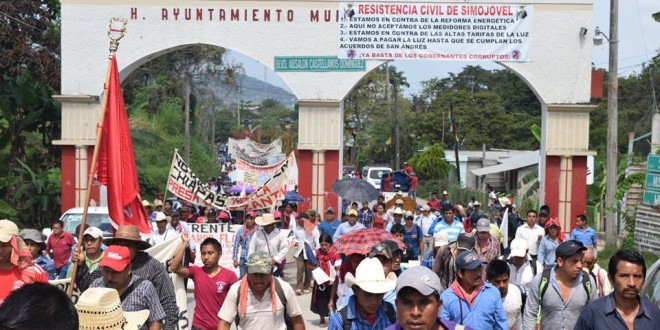
The banner hung on the entrance to the town says: Civilian Resistance of Simojovel.
Thousands of people wound their way on foot down and around the mountain roads of the Chiapas Highlands during the first two days of the Pueblo Creyente pilgrimage. On March 23, at least 15 thousand pilgrims (according to a local online media source [1]) left the town of Simojovel, Chiapas, on a pilgrimage to the state capital of Tuxtla Gutiérrez. The parish priest of San Antonio de Padua Parish in Simojovel and members of Pueblo Creyente (Believing People), both lay and religious, along with members of parishes in neighboring municipalities, went on a Lenten Way of the Cross, a walking pilgrimage to denounce the advance of organized crime in their municipalities, and also to denounce that the threats and attacks from local politicians against the priest, the parish council and members of Pueblo Creyente have increased. Complaints from this region, in the north central part of the state, include: Alcoholism, drug addiction, prostitution, armed robbery, murder, large groups of bad guys, arms trafficking, drug trafficking, cattle rustling, extortion, anonymous threats, kidnappings, corruption of authorities, insecurity and impunity. As the marchers walked down the winding mountain roads, people in the villages came out and joined the march because they are also experiencing the advance of organized crime.
Pueblo Creyente is a political-religious organization in the Catholic Diocese of San Cristóbal de las Casas, Chiapas, Mexico. Its members have participated in demonstrations and marches, which they call pilgrimages, for years. For the past several months, however, members of Pueblo Creyente in Simojovel have been denouncing the increase of cantinas, drugs, prostitution and organized crime, as well as political corruption. They state that this has led to threats of violence against the parish priest, Marcelo Pérez, and the parish council. The local politicians they name as responsible for the threats, attacks and corruption are Ramiro Gómez Domínguez, a pre-candidate to the municipal presidency, and Juan Gómez Domínguez, a candidate for (local) deputy. Both are members of the Revolutionary Institutional Party (PRI).
On November 4, the politician Ramiro Gómez Domingo filed a complaint with the Attorney General of the Republic (PGR) against Father Marcelo Pérez, accusing the priest of destabilizing the region. Pueblo Creyente sees the charge as a reprisal for an October 8 pilgrimage. More than 12,000 people participated in that pilgrimage to denounce the proliferation of cantinas, the sale of drugs, prostitution and arms trafficking, motivated by the participation of local authorities. During the November 25 hearing on the charges filed against him, Father Marcelo Pérez denounced the advance of organized crime in the municipality and the corruption of the authorities.
The advance of organized crime, “a reflection of what is happening throughout the country”
The entry of organized crime into the northern part of the state is no secret. The cultivation, distribution and sale of drugs in the region are public knowledge, as is arms trafficking. In a February call for the pilgrimage, Pueblo Creyente stated: “Simojovel is a reflection of what is happening throughout the country. Institutionalized corruption is governing the country, therefore all peoples must rise up and organize to defend life; what is in danger is human life, the future of our children.”
On February 3, 2015, Pueblo Creyente issued a call for the pilgrimage with the following words:
“The town of Simojovel has no safe drinking water; the health center is in pitiful condition, but the cantinas, prostitution centers, drug trafficking, arms trafficking, sex trade, corruption etc. are increasing. The worst thing is that some PRI political leaders are the ones that are promoting these acts that keep the people kidnapped. Therefore, they want to kill or incarcerate the priest and members of the parish council and representatives of Pueblo Creyente of this town of Simojovel.
Therefore, the Pueblo Creyente of Simojovel make a call for a huge Lenten Way of the Cross CROSS Pilgrimage from Simojovel to Tuxtla to all the towns that suffer violence: like Acteal, Ayotzinapa, Banavil, Chicomuselo, the towns that suffer high electricity rates, foreign mega-projects, etc.; the consequence of the corruption, complicity, impunity and ambition of the system of government and of the legal reforms that are generating more poverty.” [2]
Part of the civilian resistance
Pueblo Creyente participates in marches/pilgrimages with other social organizations to protest the megaprojects, high electricity rates, land grabs, displacements and political prisoners. Pueblo Creyente also sends representatives to gatherings of other social organizations and they made the call to those all those social organizations to join them in the pilgrimage. Pueblo Creyente is part of the civilian resistance to the advance of capitalist accumulation, as well as the advance of organized crime.
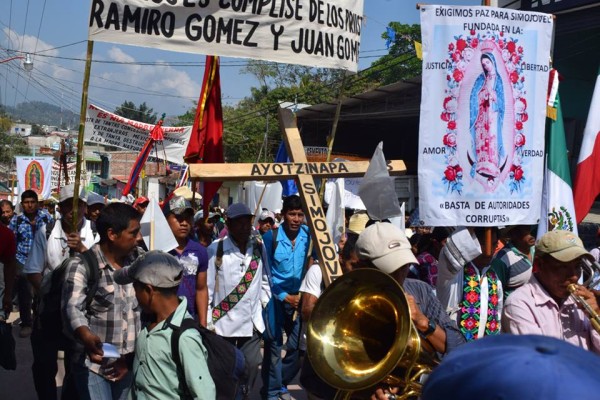
Members of Catholic parishes from Simojovel, Bochil, Amatán, Pueblo Nuevo and El Bosque are accompanied on their pilgrimage by social and human rights organizations, including the Fray Bartolomé de las Casas Human Rights Center (Frayba), which issued a press bulletin asking that the government guaranty the personal safety of the marchers. [3]
Frayba’s press bulletin went on to say that during the four days of the tour other Chiapas parishes, Ecclesiastic Base Communities and churches of other religious denominations were expected to join the pilgrimage, and that did, in fact occur. Members of the Frayba, representatives of civil society organizations, international observation organizations, members of the clergy from the Archdiocese of Tuxtla and from the San Cristóbal Diocese, as well as members of the free media accompanied the marchers.
The mobilization arrived in the state capital of Tuxtla Gutiérrez on Thursday, March 26. The Virgin of Guadalupe parish in Tuxtla received the marchers and they held a religious ceremony there. They read their demands in Tuxtla’s central plaza, in front of the government palace. Their demands reflected the broad spectrum of organizations supporting and accompanying the pilgrimage and their rejection of the advance of capitalist privatizations and megaprojects.
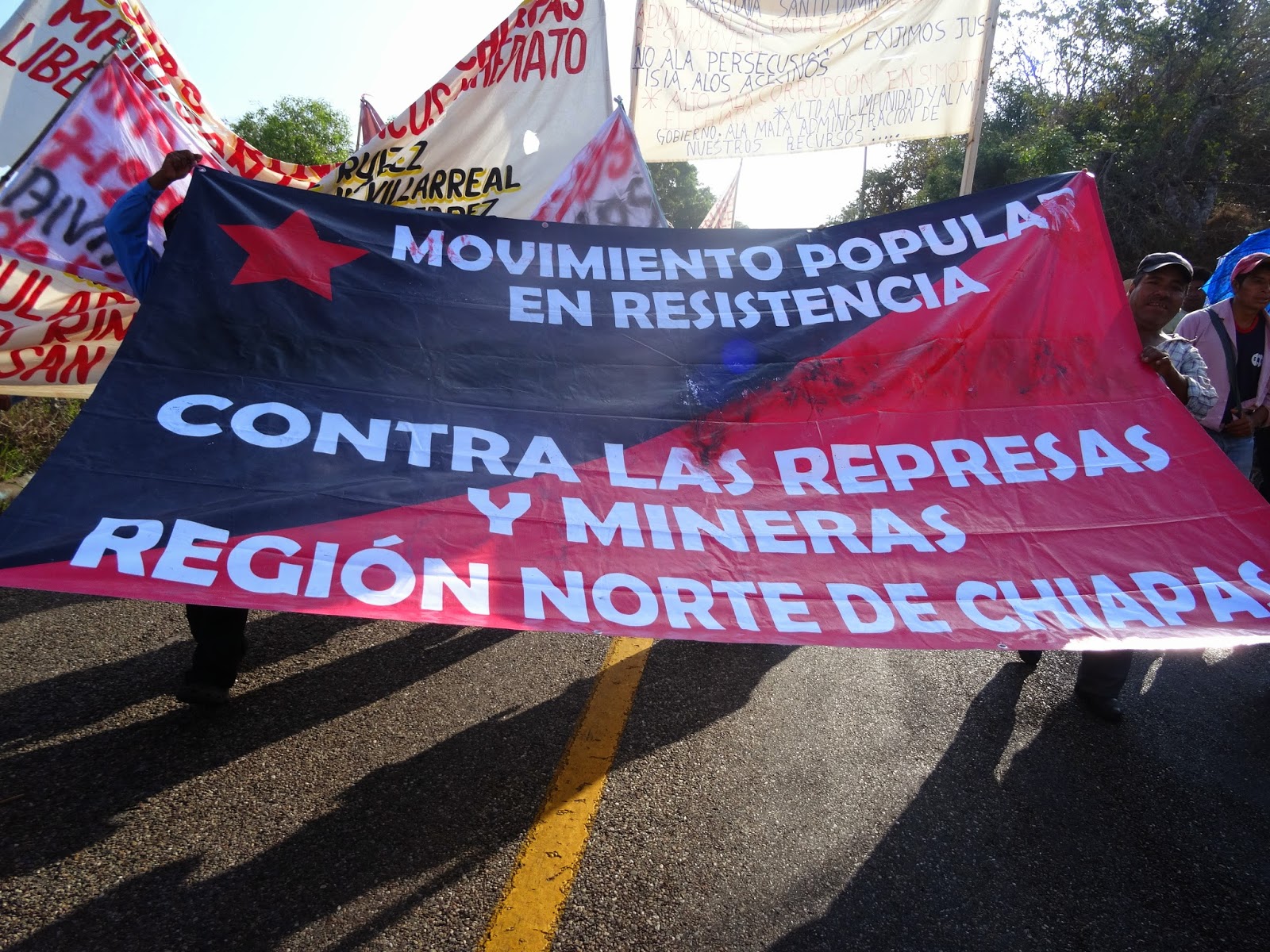
Popular Movement in Resistance against the dams and mining companies in the north region of Chiapas.
The indigenous and campesino participants in the pilgrimage summed up their demands in six categories: Stop the impunity and corruption of all the state’s authorities; no to the mega-projects, no to the Palenque-San Cristóbal Superhighway, no to hydro-electric dams, no to mining projects and to the dispossession of lands; no to the structural reforms, abolition of the neoliberal reforms, the property reforms, no to the high cost of electric energy, no to the privatization of water; adequate use of public resources for better services; no to forced displacement, true justice and return for Banavil in Tenejapa and Primero de Agosto in Las Margaritas; and a stop to the violence, drug trafficking, prostitution, murder and kidnapping, as well as the cancellation of arrest warrants and freedom for political prisoners. [4]
This was an important mobilization. Rather than shrinking in fear of the threats made, Pueblo Creyente of Simojovel and their neighbors in the north central part of Chiapas mobilized thousands to stand up and resist the corruption and impunity that accompanies the advance of organized crime.
By: Mary Ann Tenuto Sánchez
Sources:
[1] http://www.pozol.org/?p=10440
[2] http://chiapasdenuncia.blogspot.com/2015/02/pueblo-creyente-de-simojovel.html
[3]http://www.frayba.org.mx/archivo/boletines/150323_boletin_09_peregrina_simojovel
[4]http://chiapasdenuncia.blogspot.com/2015/03/pronunciamiento-de organizaciones.html
Ayotzinapa Caravan Schedule in Bay Area

The Berkeley/SF Schedule is posted below. At the bottom of the page there is a link to a blog with whom to contact for the Caravan’s schedule in Fresno, San Jose, Sacramento and Santa Rosa.
BERKELEY SCHEDULE
Thursday, April 2nd/Jueves 2 de abril
1. Rally (Welcoming) 2:00 PM – 4:00 PM Sproul Plaza Rally/Bienvenida
2. Discusión/ Discussion with Jim Cavallaro, Commisioner at Inter-American Commission of Human Rights/Berkeley Law School: 6:00 PM – 8:00 PM 110 Boalt Hall
Friday, April 3rd /Viernes 3 de Abril
3. Forum/QA with parents and normalistas: “Ayotzinapa: Mexico at the Crossroads” Forum/Sesión de preguntas y respuestas con los padres y los normalistas 1:00 PM – 3:00 PM Maude Fife Room, 315 Wheeler Hall
4. Vigilia/ Vigil at Campanile 5:00 PM ———————————
SAN FRANCISCO SCHEDULE
Saturday, April 4/Sábado 4 de Abril
1. Community March: Mission and 16th Sts. 1:00 pm- Start of the rally 3pm- March starts towards 24th St.
2. Community Forum: 4 – 6pm Buena Vista Horace Mann Elementary 3351 23rd St., between Bartlett and Valencia Sts.
Sunday, April 5/Domingo 5 de Abril
1. 10:00 AM – Sunday morning (Easter) mass at St. John the Evangelist Episcopal Church, 1661 15th St., San Francisco
Monday, April 6/Lunes 6 de Abril
1. 10 am to 12 Noon Event at City College, Mission Campus
2. 12:30 PM Press Conference at City Hall (sups have passed a resolution in solidarity with Ayotzinapa)
3. 2pm protest at Mexican Consulate
—————————–
The entire schedule for the Pacific Coast tour of the Ayotzinapa Caravan is posted at the Internet site below with contact information for Fresno, San Jose, Sacramento and Santa Rosa: http://www.globalexchange.org/blogs/peopletopeople/2015/03/17/ayotzinapa-43-caravan-information/ ——————————————– Chiapas Support Committee/Comité de Apoyo a Chiapas Email: cezmat@igc.org
SupGaleano: About the Homage and the Seminar
ABOUT THE HOMAGE AND THE SEMINAR
By: Sup Galeano

Mexican Army patrolling La Realidad
ZAPATISTA NATIONAL LIBERATION ARMY
March 2015
To the compas of the Sixth in Mexico and in the World:
Compas:
I have been asked to let you know that…
Despite the significant increase in military activity in the vicinity of the Zapatista Caracoles (aggressive patrols, intimidating checkpoints, threatening flyovers)—particularly in the caracoles of La Realidad and Oventik (the first has just opened a school-clinic, and the second will host the tribute to Don Luis Villoro Toranzo)…
Despite the growing belligerence of the paramilitary groups sponsored by the Chiapas government…
Despite the tired “new” lies in the paid media /no, there is not and there has not been any proposal for dialogue; no, not since 2001, that is to say that no federal official has approached the EZLN in the last 14 years for any reason other than in an attempt to assassinate the Zapatista leadership; no, the federal and state governments are not looking to improve the living conditions of indigenous people in Chiapas, rather, they are trying to divide communities; no, the only governmental approaches that Jaime Martinez Veloz claims for himself were not to Zapatistas but to the paramilitaries backed (before he took over) by Luis H. Alvarez, Juan Sabines Guerrero, Felipe Calderon Hinojosa, and now Manuel Velasco Coello, Rosario Robles Berlanga and Enrique Peña Nieto, one of whose groups (the CIOAC-H) is responsible for the murder of the compañero teacher Galeano; no, and so forth and so on/…
Despite the fact that truth and justice are still missing in Ayotzinapa…
Despite the fact that out there they’re busy with other things (more important things, right?) and that quickly changing trends in “mobilization” only prove that frivolousness is the overall strategy…
In spite of the fact that dignity reveals, time and again, reality / in the far north of Mexico it is discovered that there are still methods of exploitation from the time of President Porfirio Diaz. “In the North we work and have to support the lazy ones in South,” say the powerful; and while men, women, children and elderly indigenous Triqui and Maya cultivate the fields, the powerful say nothing and kneel before foreign power. In the Valle de San Quintín, Baja California, in what is known as Oaxacalifornia, the day laborers ask for fair wages and labor rights. They boil it down to few words: “we only want justice.” The government represses them “for going around like rowdy troublemakers”: 200 are detained. The governor, a PANista, meets with the commanders of the 67 infantry battalion of the federal army “to maintain social peace.” The top headline in the paid media is “007 in the Zócalo”. The hashtag #SanQuintinEnLucha isn’t trending / …
In spite of it all…
Or precisely because of it all…
the EZLN confirms the celebration of:
– The homage to the compañero Luis Villoro Toranzo and Zapatista teacher Galeano, on May 2, 2015, in the Caracol of Oventic, Chiapas, Mexico. In this homage, in addition to the Zapatista compañeras and compañeros bases of support, the following people have confirmed their participation: Juan Villoro Ruiz, Fernanda Navarro, Adolfo Gilly, Pablo Gonzalez Casanova, Don Mario Gonzalez Contreras, father of César Manuel Gonzalez Hernandez, one of the 46 missing from Ayotzinapa, and Doña Bertha Nava, mother of Julio Cesar Ramirez Nava, one of the 46 missing from Ayotzinapa; as well as family members of compañero teacher Galeano and Zapatista autonomous authorities of the 5 zones.
– The kick-off of the seminar “Critical Thought Versus the Capitalist Hydra,” convoked by CIDECI-Unitierra and the EZLN’s Sixth Commission on May 3-9, 2015, in the mountains of the Mexican southeast. I have been told that the following people have confirmed their participation in the Seminar:
Doña Bertha Nava, Don Mario González Contreras and Doña Hilda Hernández Rivera, (family members of Ayotzinapa’s missing 46). Pablo González Casanova. Adolfo Gilly. Juan Villoro Ruiz. Elena Álvarez-Buylla. Catherine Marielle. Álvaro Salgado. Alicia Castellanos. Óscar Olivera (Bolivia). Margarita Millán. Sylvia Marcos. Mariana Favela. Karla Quiñonez (USA). Xuno López. Jean Robert. Carlos González. María Eugenia Sánchez Díaz de Rivera. Eduardo Almeida Acosta. Vilma Almendra (Colombia). Philippe Corcuff (France). Luis Lozano Arredondo. Juan Wahrem (Argentina). Rosa Albina Garabito. Jerónimo Díaz. Rubén Trejo. Manuel Rosenthal (Colombia). Hugo Blanco (Perú). Juan Carlos Mijangos Noh. Greg Ruggeiro (USA). Ana Lydia Flores Marín. Javier Hernández Alpízar. Pablo Reyna. Christine Pellicane (France). Efraín Herrera. Domi. Antonio Ramírez. John Berger (Great Britain). Donovan Hernández. Sergio Rodríguez. Raúl Zibechi (Uruguay). Sergio Tischler Visquerra (Guatemala). Jorge Alonso. Jerome Baschet (France). Paulina Fernández C. Carlos Aguirre Rojas. Gilberto López y Rivas. Daniel Inclán. Enzo Traverso (Italy). Silvia Federici (Italy). Immanuel Wallerstein (USA). John Holloway (Ireland). Michael Lowy (Brazil-France). Marcos Roitman (Chile-Spanish State).
From the concierge of the Little School, stacking boxes and more boxes marked “FLUNKEES.”
El SupGaleano
Mexico, March 2015
Section entitled “From the Diaries of the Cat-Dog”
On options:
Imagine you are having a nightmare. You find yourself in the midst of a desolated landscape. Not like after a war, but rather as if in the midst of its horror. On the right side of the road dividing the landscape is a modern building complex. At the entrance, a sign gives notice or warning: “Visions of Reality Mall.” Two modern imposing buildings stand out. The marquee for one of them reads, “Course in Ethical Journalism and Objective Reporting. Taught by: Ciro Gómez Leyva, Ricardo Alemán, Joaquín López Dóriga, Javier Alatorre and Laura Bozzo.” The building by its side announces: “Course in Ethical Journalism and Objective Reporting. Taught by: Jacobo Zabludovski and 4 others from the only remaining free and independent spaces.”
You, a discerning person, of course, tolerant, of course, inclusive, of course, civilized, of course, reasonable, of course, with reasoned arguments, of course, educated, of course, with an actual e-d-u-c-a-t-i-o-n, of course. Even in your nightmares you maintain your composure, obviously.
That’s why you understand why there are long lines to get into one place or the other.
You are feeling self-congratulatory due to the fact that there are informational options for every preference when you hear, in a corner to the left, a little girl trying to play the tune of “the long and winding road” by the Beatles on her school flute.
You, unable to hide your irritation at the child’s off-key notes, realize that on the left side of this long and torturous road there is a group of beings (incomprehensible, of course), constructing little huts (miserable little things, of course), and their signs do not offer courses or discounts, of course, but rather manage only to stammer “free, autonomous, alternative, or whatever you call them media.”
You are faced then with a dilemma: either you—generously of course—widen your criteria, your tolerance, your inclusiveness, your civility toward this side of the road; or you feel grateful that there are things that never go out of style (like the bulldozer, the nightstick, the police, the antiriot squads). You are paralyzed in the face of this complex dilemma. Since you don’t know what to do, your smartphone—thanks to a modern application that gives you a zap whenever the hard drive is reconfigured (yours, of course)—activates in order to awaken you. You come to attention, but everything looks the same: the war landscape, the fancy buildings on the right side, poor ones on the left. Ah, but instead of the out-of-tune flute playing “the long and winding road” you hear a disconcerting rhythm, a mix of ballad-cumbia-corrido-ranchera-tropical-hiphop-ska-heavy-metal that, played on the marimba, launches into “Ya se mira el horizonte…” [the Zapatista anthem].
In that terrible situation you know that you have to take drastic measures. But you can’t decide, should I get a new cell phone, or just update the operating system? That, my friend, is a real dilemma. But to vote or not to vote, what is that??
On the paid media:
– They say that those wise men and women, of grand studies and knowledge, realized that what the ignorant, illiterate, and pre-modern indigenous said was true: “in capitalism, the one who pays rules.”
– On the “five free and independent spaces” and Molotov: uh oh, it seems that Jacobo did make someone stupid. [1]
On postmodernity:
– Note to divers: the pool doesn’t have water, just shit. Proceed with caut…. Splash!
– Break-up conversation of a postmodern couple: It’s not you, it’s the context.”
On the seminar:
– The following message came from Italy: “So-and-so said he would only attend (the seminar) if he could personally talk to subcomandante insurgente marcos.” When the deceased heard that, thinking the message was from Monica Bellucci, he began to stir in his grave. Later they told him who the message was from and, disappointed, the deceased settled back down. SupMoy said to just send a message back that “il supmarcos e morto, se volete, potete cercare in inferno” [Italian in original] along with a calendar. Questioned on the subject by Los Tercios Compas S.A. (without) C. (nor) V. of (i)R. (i) L.[2] (note: use of this brand prohibited without the express written consent of those who (can’t) pay for it), SupMoy declared “the thing is that there are people who don’t realize that we are in 2015.”
– Pst. Pst. The organization of the seminar is a mess. But pretend you didn’t hear that. Place yourself in harmony with the universe. Now repeat with me “ommmm, the seminar is already organized, ommmm.”
I testify: meow-woof (and vice versa).

Cat-Dog
Notes:
[1]”Que no te haga bobo Jacobo” (Don’t Let Jacobo make you stupid) is a song by Molotov referring to media giant Televisa’s ex-anchor Jacobo Zabludovsky.
[2] S.A. de C.V. de R.L. in Spanish stands for Sociedad Anonima de Capital Variable de Responsibilidad Limitada, or Anonymous Society of Variable Capital, Limited Liability. The formulation here, S.A. (sin) C (ni) V de (i) R (i) L, would mean Anonymous Society (without) Capital (nor) variable capital of (un)limited (ir)responsibility.
—————
En español: http://enlacezapatista.ezln.org.mx/2015/03/19/sobre-homenaje-y-seminario-el-supgaleano/
 Chiapas Support Committee