Chiapas Support Committee
Home of the Compañero Manuel blog on zapatistas & mexico
Holloway: Critical thinking against the capitalist hydra
CRITICAL THINKING AGAINST THE CAPITALIST HYDRA
By: John Holloway*
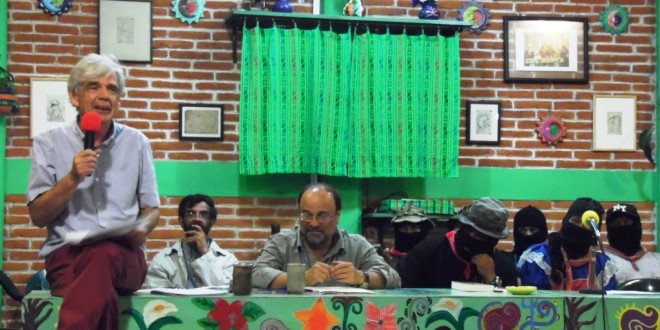
Critical thinking: thinking that looks for hope in a world where it doesn’t appear to exist anymore; that opens what is closed, that rattles what is fixed. Critical thinking is the attempt to understand the storm and more. It is to understand that at the center of the storm there is something that gives us hope.
The storm is coming; or better yet it is already here. It is here and it is probably going to intensify. We have a name: Ayotzinapa; Ayotzinapa as horror and also as a symbol of many other horrors, Ayotzinapa as a concentrated expression of the fourth world war.
Where is the storm coming from? Not from the politicians; they are merely the executors of the storm. Not from imperialism, it is not a product of the governments, nor from the most powerful governments. The storm surges from the form in which society is organized. It is an expression of the desperation, the fragility, the weakness of a form of social organization that is already past it’s expiration date, an expression of the crisis of capital.
Capital as such is a constant aggression. It tells us every day “you have to mold what you do in a certain way, the only activity that is valid in this society is the one that contributes to the expansion of capital’s profits.”
The aggression that capital is has a certain dynamic. To survive it has to subordinate our activity every day more intensely to the logic of profit: “today you have to work faster than yesterday, bend over more than yesterday.”
With that we can see capital’s weakness. It depends on us, what we want and accept what it imposes on us. If we say “excuse me, but today I am going to cultivate my plot of land.” or “today I am going to play with my children,” or “today I am going to dedicate time to do something that makes sense for me,” or simply “We are not going to bow down,” then capital cannot extract the profits it needs, the rate of profit falls, capital is in crisis. In other words, we are the crisis of capital, our lack of subordination, our dignity, and our humanity. We are the crisis of capital and proud of being so, we are proud of being the crisis of the system that’s killing us.
Capital despairs of this situation. It looks for all the possible ways to impose the subordination it needs: authoritarianism, violence, labor reforms, educational reforms. It also introduces a game, a fiction; if we cannot extract the profits that we require, we are going to feign that there exists, to create a monetary representation for a value that has not been produced, expand the debt to survive and try to use it at the same time to impose the discipline that is needed. But this fiction increases the instability of capital and additionally it fails to impose the necessary discipline. The dangers for capital that this fictitious expansion represents becomes clear with the collapse of 2008, and with that it becomes more evident that only way out for capital is through authoritarianism: all the negotiation around the Greek debt tells us that there is no possibility for a softer capitalism, that the only path for capital is the path of austerity, of violence; the storm that is already here, the storm that approaches.
We are the crisis of capital, we who say no, we who say: Enough of capitalism!, we who say that it is time to stop creating capital, that there is another way of living.
Capital depends on us, because if we do not create profits (surplus value) directly or indirectly, then capital cannot exist. We create capital, and if capital is in crisis it’s because we are not creating the necessary profits for the existence of capital, that’s why they’re attacking us with so much violence.
In this situation, we really only have two options of struggle. We can say “Yes, we are in agreement that we are going to continue producing capital, promoting the accumulation of capital, but we want better living conditions.” This is the option of the governments and parties of the left: of Syriza, of Podemos, of the governments in Venezuela and Bolivia. The problem is that, even though we can improve our living conditions in some regards, through the desperation of capital itself there is very little possibility of a more humane capitalism.
The other possibility is to say “Good by, capital, leave, we are going to create other ways of living, other ways of being in relationship, among ourselves and also with the non-human forms of life, ways of living that are not determined by money and the search for profits, but through our own collective decisions.”
Here at this seminar we are at the very center of the second option. This is the point of encounter between Zapatistas and Kurds and thousands of more movements that reject capitalism, attempting to construct something different. Everyone of us, women and men are saying “Capital, your time has passed, leave now, we already building something else.” We express in many different ways: We are making cracks in the wall of capital and attempting to promote its confluences, we are building the commons, we are communing, we are the movement of doing against work, we are the movement of use value against value, we are the movement of dignity against a world based on humiliation. We are creating here and now a world made of many worlds.
But, do we have sufficient strength? Do we have enough strength to say that we are not interested in capitalist investment, that we are not interested in capitalist employment? Do we have the strength and force to totally reject our actual dependency on capital to survive? Do we have the strength to say a final “good-bye” to capital?
Possibly, we do not have it, yet. Many of us who are here today have a salary or our grants that come from the accumulation of capital or, if not, we are going to return next week to look for work from a capitalist. Our rejection of capital is a schizophrenic rejection: we want to say a definitive goodbye, and we cannot or it costs us a lot of work. Purity does not exist is this struggle. The struggle to stop creating capital is also a struggle against our dependency on capital. Which is to say, it is a struggle to emancipate our creative capacities, our strength to produce, our productive forces.
We are in it, that’s why we came over here. It is a question of organizing ourselves, clearly, not about creating an organization, but of organizing ourselves in multiple ways to live from now on from the world we want to create.
How do we advance, how do we walk? By asking questions, of course, asking and holding each other and organizing ourselves.
* Post-graduate professor of sociology at the Instituto de Ciencias Sociales y Humanidades de la Benemérita Universidad Autónoma de Puebla. This is the text of a document presented to the Seminar on critical thinking against the capitalist hydra [Seminario sobre el pensamiento crítico frente a la hidra capitalista].
————————————————————
Originally Published in Spanish by La Jornada
Translation: Chiapas Support Committee
Friday, May 15, 2015
En español: http://www.jornada.unam.mx/2015/05/15/opinion/018a1pol
La Garrucha denounces paramilitary acts in San Manuel
CARACOL OF RESISTANCE TOWARDS A NEW DAWN
Path of the Future Good Government Junta,* La Garrucha, Chiapas, Mexico
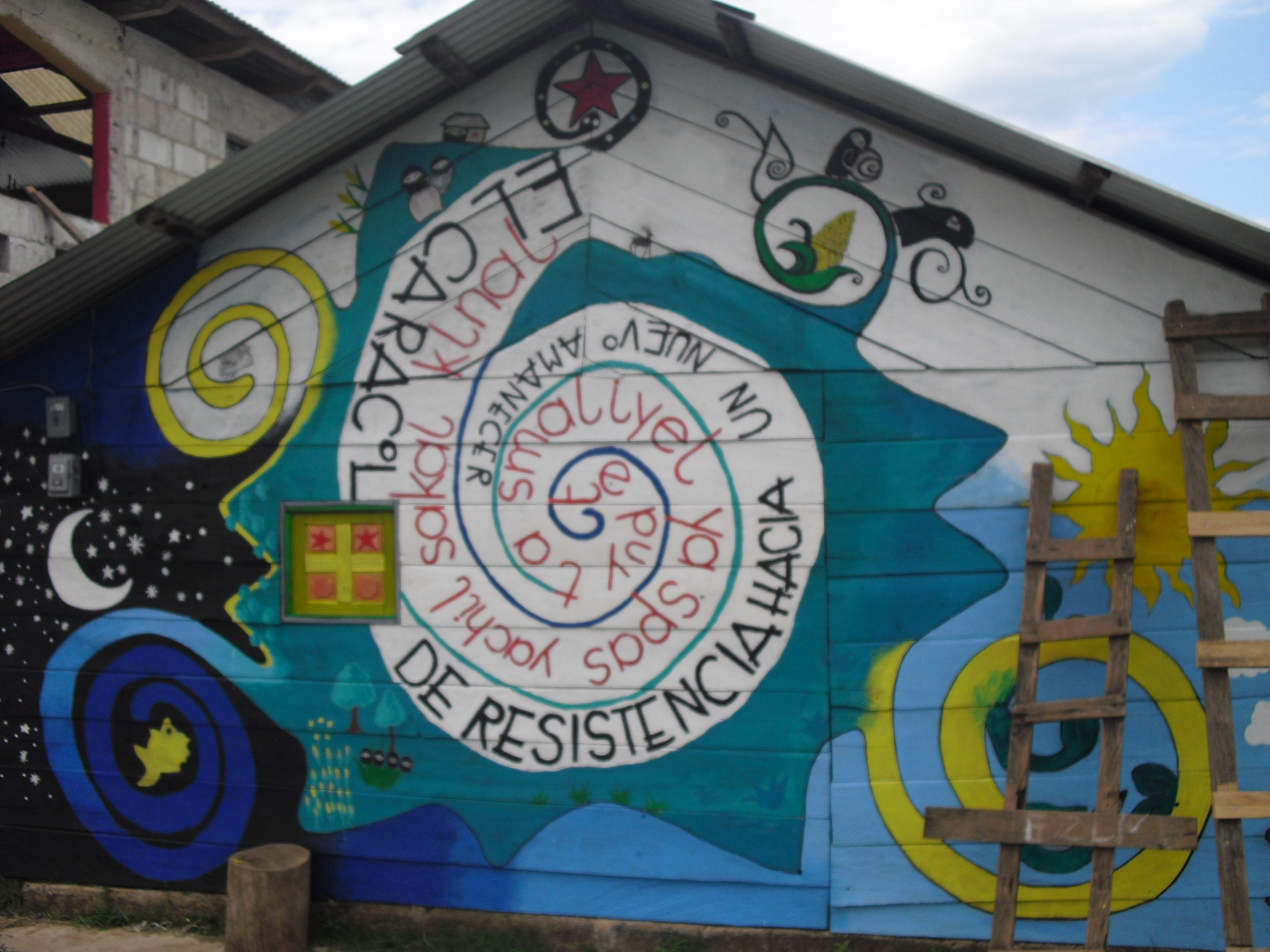
Mural on front of former offices of Good Government Junta in La Garrucha carries the name of the Caracol in both Spanish and Tseltal.
May 11, 2015
WE DENOUNCE PUBLICLY
To public opinion:
To the communications media, alternative, autonomous or whatever you call them:
To the national and international adherents of the Sixth:
To the honest human rights organisms:
Sisters and brothers of the people of Mexico and of the world:
We energetically denounce what the paramilitary groups of Rosario are doing to us. There are 21 paramilitaries in Rosario and 28 paramilitaries from the Chikinival barrio of the Pojkol ejido in the municipio of Chilón, Chiapas.
Our compañero support bases live there in Rosario, because it is recuperated land, belonging to San Manuel autonomous municipio of Caracol III La Garrucha.
There are 21 paramilitaries living in Rosario and they are supported by the 28 paramilitaries from barrio Chikinival that are invading our recuperated land.
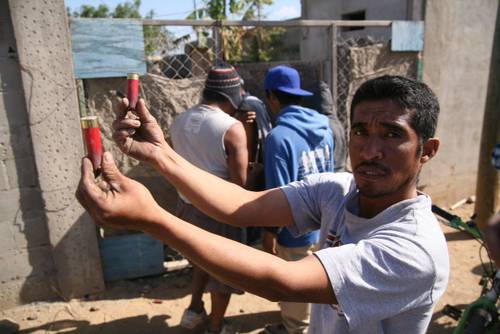
It has been the same problem since August 2014, when they killed a stud bull of ours, when they destroyed homes and destroyed our collective cooperative, stole our belongings, when they fumigated a hectare of pasture land with herbicide, when they were shooting and leaving letters in the ground with spent shells that said: “Pojkol territory.” [1]
WHAT HAPPENED
On May 10, 2015, at 9:35 in the morning, 28 arrived people that belong to the Chikinival barrio of the Pojkol ejido in the official municipio of Chilón, some 40 minutes away by car from the town of Rosario. They arrived aboard eight motorcycles, in the recuperated town of ROSARIO where the compañero support bases live, because they want to take our land away by force.
These paramilitaries of Rosario, accompanied by the paramilitaries from the Chikinival barrio of the Pojkol ejido, started to measure the sites where the compañero support bases are already living, during the day they were working there.
At 15:15 pm, a group of them withdrew from working, another group stayed in the same place, but 5 minutes later three of them headed to the home of a support base compañero, and the majority of them stayed on the highway 30 meters from the compañero’s house. They only found the 13-year old daughter of the support base compañero at home sweeping her room, not the father. The mother was outside on one side of the house.
Two of these paramilitary aggressors belong to the Chikinival barrio of the Pojkol ejido and one belongs to Rosario. His name is ANDRES LOPEZ VAZQUEZ. The 2 from Chikinival entered inside of the house, while Andrés, the Rosario paramilitary, stood guard at the door of the house. Upon seeing that the compa’s young daughter went out running for the door, ANDRES shot at her 4 times with a 22-caliber pistol. Her father arrived at the moment of the shots and the compañero defended his daughter, throwing a stone at the attacker that hit him in the head. None of the bullets hit the young woman. His compañeros that were at 30 meters carried the injured man away.
Yesterday afternoon, May 11, the injured man returned the family members of the aggressor went to the compañero’s house, in other words, the wife and 3 sons to say that they have to pay him 7,000 pesos for his care.
It’s clear that the compañero will not pay, because he is not the one who sought and provoked what happened.
On May 10 at 6:50 pm, 16 people arrived in village of Nuevo Paraíso in Francisco Villa the autonomous municipio. Three of them were armed with two 22-caliber pistols in hand and one 22-caliber long arm. They were aboard 8 motorcycles. These people belong to the Chikinival barrio of the Pojkol ejido. They came to throw a letter in the street, wherein they blame the support base compañeros for provoking these problems first.
But in reality we are not the ones provoking any problem, because we have been seeking peaceful alternatives for trying to resolve this matter, but they have never understood us. We have even delivered one hectare to each one of the 21 persons that are provoking, even so they have been threatening us. From February until today, May 11, those from Chikinival in the Pojkol ejido are threatening us daily because they ask those of Rosario to patrol armed. Those from Pojkol are always armed every day.
Therefore, we contradict what they are doing and blaming. It’s clear who provokes first.
We have cited (sent a notice to appear) the Pojkol ejido’s authorities and they came and said that they cannot do anything, because that group is not recognized now in the ejido, because they are totally some hoodlums, they do not respect or obey in the ejido. He also advised that the State of Manuel Velasco Coello also does nothing because it is his paramilitary.
Compañeros and compañeras, brothers and sisters of the world, these are the strategies with which the three levels of bad federal, state and municipal government are provoking us, when they use people that don’t understand our just cause so that that way we fall into their traps; but we are clear about what this bad government is doing: organizing, preparing and financing organizations and people that let themselves be bought off or that sell out.
We say to those without brains up there above: we are never going to stop resisting, not are we going to fall into their traps; we will continue resisting here, working our lands and constructing our autonomy.
Whatever may come to pass, we place responsibility directly on the federal, state and municipal governments and on the paramilitaries from Chikinival barrio of the Pojkol ejido and from Rosario.
Sisters and brothers, we will continue reporting what may happen with our peoples and we want you to remain attentive to what may happen.
SINCERELY,
Good Government Junta
Jacobo Silvano Hernández Lucio Ruiz Pérez
—————————————————————–
* We have translated the name of the Good Government Junta as “Path of the Future” because in that region of the Jungle the word camino is used to refer to one’s current path in life.
[1] For background on what happened last August 2014, see: https://compamanuel.wordpress.com/2014/10/04/anatomy-of-a-paramilitary-attack-on-the-zapatistas/
——————————————————————
Originally Published in Spanish by Enlace Zapatista
Translation: Chiapas Support Committee
Monday, May 11, 2015
Baja’s day laborers suffer police repression
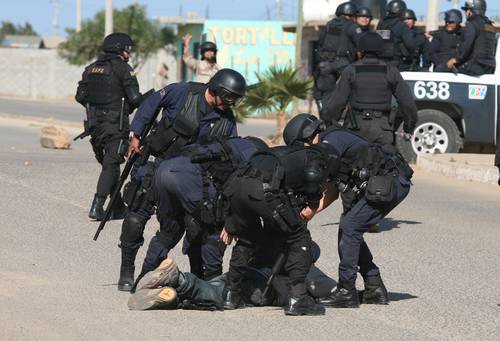
Police repression in Baja
EZLN is in solidarity
Baja California state police attacked farmworkers on strike in that state for better wages and working conditions. On May 9, twenty (20) patrol cars full of police agents entered the Triqui community of Nuevo San Juan Copala in the San Quintín Valley under the mistaken impression that members of the Alliance of Organizations for Social Justice were there to incite some of the community’s residents to set a farm on fire. The police started to detain one person; community members came out to defend him and a few threw stones and used sticks to repel the police. The police, in turn, used rubber bullets. Police originally detained 17 people, but 12 were released. Five remain in police custody. 70 people were injured, 7 of them in gravely injured. At the close of the Seminar on “Critical Thought versus the Capitalist Hydra,” the EZLN expressed solidarity with the day laborers. Below is a La Jornada article regarding the federal government’s handling of the strike.

A small tank is set on fire in the San Quintín Valley of Baja California
SAN QUINTÍN: IRRESPONSIBLE INDOLENCE
By: Luis Hernández Navarro
From the exhaustion to the repression, from the indolence to the joke, that’s how the strategy that the federal government has traced for “resolving” the conflict of the San Quintín jornaleros [1] can be summarized.
Almost two months have passed since, last March 17, when thousands of farmworkers from this agro-exporting enclave broke out in a general strike to denounce the savage labor exploitation that they suffer and to demand a salary dignified increase. In place of resolving the movement’s demands, the government of Enrique Peña Nieto first gambled on its weakening and discouragement and, later, on violent contention.
Nevertheless, neither of those maneuvers has been effective for disarticulating the day laborer protest. Despite the eight weeks of struggle transpired, it maintains itself fed with the combination of moral indignation in the face of a savage model of exploitation and a cohesive and vigorous associative base community fabric.
The May 9 repression shows it. That day, using the pretext that they wanted to set fire to an agricultural, the state preventive police beat residents of the Triqui settlement Nuevo San Juan Copala when some of its residents were exhorting the farmworkers to maintain the strike. Residents responded by confronting the police with rage.
Nuevo San Juan Copala is a colonia of San Quintín, which in 2010 had a little more than 1,600 inhabitants, the majority Triquis. It took the name of the community of origin of its founders in Oaxaca. It was formally established in 1997 on lands occupied by jornaleros that were seeking dignified housing and that were fleeing from the oppressive agricultural camps. Since then, the collective action of its residents achieved obtaining services and basic infrastructure: orderly subdivision of land, public lighting, safe drinking water, schools and improvement of the streets. Simultaneously, it installed a figure of the Triquis’ political representation.
Its residents have developed –according to what Abbdel Camargo explains in Asentamiento y organización comunitaria– [2] a form of political and community organization that combines traditional organs of authority based on its places of origin with newly created institutions. This re-invention of tradition has permitted them to appropriate new spaces of residence, to develop collective practices that generate a strong cultural identity and to strengthen their management capacity.
The standard life of the settlement, explains Camargo, is organized around three traditional figures, natives of their communities of origin. These are: the traditional authority, the community’s political representative and mediator; the council of elders, which orients and gives its opinion on the settlement’s relevant issues, and the system of majordomos, in charge of the organization and realization of the fiestas in honor of the patron saint.
Thus, when last May 9 the state police repressed the residents of Nuevo San Juan Copala to discourage their struggle and send a signal to the striking San Quintín jornaleros about what awaited them, they butted heads with a vigorous community organization, constructed and forged from the heat of the struggle for almost two decades. The result of this maneuver was counter-productive.
The violence against residents of Nuevo San Juan Copala was the last link of a failed strategy. At first, the federal government gambled on confining the struggle to the state ambit, hoping that it would die out. When the conflict was nationalized and internationalized, it had to accede to installing a negotiating commission, headed by the assistant secretary of Governance, Luis Miranda.
Police fired rubber bullets on striking day laborers
Far from seeking solutions, the negotiating (dialogue) table between the jornaleros and the authorities last March 24 was a maneuver to gain time. The official retinue, which consisted of the governor of Baja California, Francisco Vega de la Madrid, and the heads of the IMSS, the STPS, senators and deputies, came without any proposal. First it impeded the press’ passage to the meeting. Then it behaved as if it knew nothing about the origin of the conflict. Mockingly, the governor –according to what Arturo Alcalde wrote– said to the jornaleros: “You have the word; we are here now. Tell us what your requests are.”
The public functionaries dedicated themselves to confusing the work. Finally, assistant secretary Miranda put into effect operation surprise attack: without having convened a meeting between the parties, he announced a future meeting on May 8, in which he would give an integral solution to the demands; he invented that an agreement had been reached, unilaterally closed the meeting and brought the journalists into the meeting. The jornaleros rejected that anything was agreed upon in that negotiation.
The official retinue abandoned San Quintín hurriedly. Even the representatives of the Legislative Power, who supposedly attended the session invited by the strikers, acted like employees of the government and shamefully added themselves to the Executive’s entourage.
Assistant Secretary Luis Miranda arrived on May 8 and left the agricultural workers in the lurch. More than 4,000 of them were waiting for him in order to hear his answer to their demands. When Fidel Sánchez Gabriel, the leader of the Alliance for Social Justice, warned him that they would stay in front of the state government offices, the functionary replied: “You don’t know me.” The next day they felt the clubs and rubber bullets of the police.
Despite the nearly two months that have transpired and the repression against them, the movement of the San Quintín day laborers doesn’t show signs of physical or spiritual tiredness. It resists, fed by the conviction that one must put an end to a barbaric model of exploitation and by decades of community struggles. For the time being, it is willing to confront official indolence by organizing the international boycott of the Valley’s vegetable and fruit production Valle.
———————————————————–
Notes
- Day laborers
- Settlement and community organization
———————————————————–
Originally Published in Spanish by La Jornada
Translation: Chiapas Support Committee
Tuesday, May 12, 2015
http://www.jornada.unam.mx/2015/05/12/opinion/015a2pol
The Crack in the Wall: First Note on Zapatista Method

Subcomandante Galeano
May 3, 2015
Good afternoon, good day, good night to all listening and reading, no matter your calendars and geographies.
My name is Galeano, Subcomandante Insurgente Galeano. I was born in the wee hours of the morning on May 25, 2014, collectively and quite in spite of myself, and well, in spite of others also. [i] Like the rest of my Zapatista compañeras and compañeros, I cover my face whenever it is necessary that I show myself, and I take the cover off whenever I need to hide. Although I am not yet one year old, the authorities have assigned me the task of posta, of watchman or sentinel, at one of the observation posts in this rebel territory.
Since I am not used to speaking in public, much less in front of so many fine – (ha—excuse me, it must be hiccups from stage fright), I say, fine people, I thank you for your patience with my babble and repeated stumbling in the difficult and complicated art of the word, of expression.
I took the name Galeano from a Zapatista compañero, an indigenous teacher and organizer who was attacked, kidnapped, tortured, and murdered by paramilitaries protected by a supposedly social organization: the CIOAC-Historic. The nightmare that ended the life of the compañero teacher Galeano began before dawn on May 2, 2014. From that moment on, we Zapatistas began the reconstruction of his life.
During those days, the collective direction of the EZLN decided to put to death the person who called himself SupMarcos, who was at the time the spokesperson for the Zapatista men, women, children, and elderly. Since then, the cargo [assigned duty or responsibility] of Zapatista National Liberation Army spokesperson corresponds to Subcomandate Insurgente Moises. Through his voice we speak; through his eyes we see; in his steps we walk. We are he.
Months after that May 2, the long night of Mexico “below” became longer and added a new name to its already long experience of terror: “Ayotzinapa.” As has happened time and again in the world, the geography from below was marked and named by a tragedy that had been planned and executed—that is, by a crime.
We have already said, through the voice of Subcomandante Insurgente Moises, what Ayotzinapa means to us Zapatistas. With his permission, and with the permission of the Zapatista compañeros and compañeras who are my bosses, I pick up where he left off.
Ayotzinapa is pain and rage, yes, but it is more than that. It is also, and above all, the stubborn determination of the families and compañeros of the missing.
Some of these family members who have kept memory alive gave us the honor of sharing their time with us, and they are here with us in Zapatista territory.
We heard the words of Doña Hilda and Don Mario, mother and father of César Manuel González Hernández, and we heard from and have here with us Doña Bertha and Don Tomás, mother and father of Julio César Ramírez Nava. With them we make the demand for [the return of] the 46 missing.
We asked Doña Bertha and Don Tomás to make sure these words reach the other family members of the missing of Ayotzinapa. Because it is their struggle that we have kept present in order to launch this semillero [seminar or seedbed].
I think that more than one [ii] person from the Sixth and the EZLN will agree with me that we would have preferred it if they hadn’t had to come here in this way. That is, that they had come here but not as pain and rage, and rather as a compañero embrace. That nothing had happened that September 26; that the calendar, in a friendly gesture, would have skipped that day and that the geography would have taken a wrong turn and not landed on Iguala, Guerrero, Mexico.
But no, after that night of terror, the geography extended and deepened itself, reaching the most isolated corners of the planet. And if the calendar continues to surrender to that date, it is because of your [the families] determination, the greatness of your simplicity, your unconditional dedication.
We don’t know your children. But we know you. And we have no other intention but to make sure you are certain how much we admire and respect you, even during the loneliest and most painful moments you encounter.
It’s true, we cannot fill the streets and plazas of big cities. Any mobilization, small as it may be, represents for our communities a significant economic loss. And this is an economy already in difficult conditions, as it is for millions of others, and barely sustained by over two decades of rebellion and resistance. I say our communities, because the support we offer is not the sum of the work of individuals, but of collective, reflective, and organized action. It is part of our struggle.
We can’t shine in the social networks, or make your words reach farther than into our own hearts. We also can’t support you economically, although we well know that these months of struggle have taken a toll on your health and living conditions.
It is also the case that we, in rebellion and resistance, are more often than not seen with resentment and suspicion. Movements and mobilizations that rise up in different corners prefer that we not state our sympathy explicitly. Sensitive to what “they might say” in the media, they don’t want their cause associated in any way with “the masked ones in Chiapas.” We understand; we don’t challenge this. Our respect for the rebellions swarming the world over includes respect for their assessments, their steps, their decisions. We respect them, yes, but we don’t ignore them. We have our eye on each and every one of the mobilizations that confront the System. We try to understand them, that is, to get to know them. We know very well that respect grows from knowledge, and that fear and hate, those two faces of contempt, are often born out of ignorance.
Although our struggle is small, we have learned something over the years, decades, centuries. And this is what we want to tell you:
Don’t believe those who say that sensitivity, sympathy and support are measured by crowded streets, overflowing plazas, big stages, or in the number of cameras, microphones, leading journalists, and social media trends you attract.
The great majority of the world, not just in our country, is like you, brothers and sisters, family members of the Ayotzinapa missing. People who have to fight day and night for a little piece of life. People who have to struggle in order to wrench from reality something with which to sustain themselves.
Anyone from below, man, woman, otroa, who lives this painful history sympathizes with your struggle for truth and justice. They share your demand because in your words they see their own history, because they recognize themselves in your pain, because they identify with your rage.
The majority of them have not marched in the streets, they have not gone out to protest, they have not posted on social networks, they have not broken windows, they have not set cars on fire, they have not chanted slogans, they haven’t appeared on stage, they haven’t told you that you are not alone.
They haven’t done it simply because they haven’t been able to do it.
But they have listened to and respected your movement. Do not be discouraged.
Do not think that because those who were once by your side and have now gone, after getting paid whatever they could get for it or because they discovered they wouldn’t get paid at all, your cause is any less painful, any less noble, any less just.
The path you have taken up to now has been intense, to be sure. But you know that there still remains much more to walk.
You know something? One of the deceptions from above is how they convince those from below that if you can’t get something quickly and easily, then you can never get it. They convince us that long and difficult struggles do nothing but wear you out and in the end you achieve nothing. They trick the calendar from below by superimposing over it the calendar from above: elections, appearances, meetings, dates with history, commemorations that only hide pain and rage.
The System does not fear social explosions, as massive and illuminating as they may be. If a government were to fall, there’s always another one waiting in the cupboard as a replacement and another imposition. What terrifies the system is the perseverance of rebellion and resistance from below.
Because the calendar is different below. It has another way of doing things. It has another story. It has another pain and another rage.
And now, as the days pass, the below that we are, so dispersed and multiple, is no longer simply attuned to your pain and rage. We are also paying attention to your persistence, how you continue on, how you don’t give up.
Believe us. Your struggle does not depend on the number of protestors, the number of news articles, the number of posts about you on social media, the number of speaking tours you are invited to make.
Your struggle, our struggle, the struggle of those below in general, depends on resistance; on not giving up, not selling out, not giving in.
Well, of course, that’s according to us Zapatistas. There will be people who will tell you differently. They’ll tell you that the most important thing is to be with them. For example, that it’s more important to vote for such-and-such political party because that’s how you’ll find the missing. That if you don’t vote for such-and-such party you will not only lose out on THE opportunity to recover the missing, but you will also be accomplices to the continuation of terror in our country.
You know how there are political parties that take advantage of the people? You know how they offer handouts, school supplies, phone cards, movie passes, buckets, hats, sandwiches, and Tetra Pak bottled water? Well, there are also those who take advantage of the people’s emotional needs. Hope, friends and enemies, is the necessity most successfully commercialized up there above. Hope that everything will change, that finally there will be wellbeing, democracy, justice and freedom. Hope is what the enlightened from above snatch from the down-and-out below and then sell back to them. Hope that a resolution to their demands comes in one of the colors found in one of the products in the system’s cupboards.
Maybe these people know something that we Zapatistas don’t. They’re wise, and after all, they charge for their expertise. Knowledge is their profession; it’s how they make their living… or how they cheat everyone. You see that they know more and, referring to us, they say that we are “lost out there, in the mountains, who knows where,” and they say that we call for abstention and that we are sectarian (maybe because, unlike them, we do respect our dead).
Ah! It’s so easy to say and repeat sound bites and lies! It’s so inexpensive to defame and slander, and then later preach unity and give lessons on the real enemy, the infallibility of the shepherd and the incapacity of the herd.
Many years ago, we Zapatistas did not march, or chant slogans, or raise banners or even our fists. Until one day, we did march. The date: October 12, 1992, when those above celebrated 500 years of “the meeting of the two worlds.” The place: San Cristóbal de Las Casas, Chiapas, Mexico. Instead of banners we carried bows and arrows, and a deafening silence was our slogan.
Without a lot of noise, the statue of the conquistador fell. If they put it up again it didn’t matter. Because they will never again be able to put back up the fear of what it represented.
Some months later, we returned to the cities. We again didn’t use slogans or banners, and we didn’t take bows and arrows. That dawn smelled like fire and gunpowder. And that time, it was our heads that were raised.
Months later, some people came from the city. They told us about the great marches, the slogans, the banners and the raised fists. Of course, they always added that if we Indian men and women (they’re always so careful to preserve gender equity) had survived, it was thanks to them, those from the city who had prevented genocide in those first days of 1994. We Zapatistas didn’t ask them if there hadn’t been genocide before 1994, or if it hadn’t already been prevented, or if these folks from the city were there to discuss something that actually took place or to read us their invoice. We Zapatistas understood that there were other ways of struggling.
After that we had our marches, our slogans, our banners and our raised fists. From then on our marches have been only a pale reflection of that march that lit the dawn of the year 1994. Our slogans have the disorganized rhyme of songs from guerilla encampments in the mountains. Our banners are tirelessly elaborate, trying to find equivalents to what we in our languages describe in just one word, and what in other languages requires three volumes of Capital. Our raised fists signal less of a challenge than a greeting. As if they were oriented more for the future than for the present.
But something hasn’t changed: our heads are still raised.
Years later, our self-proclaimed creditors from the city demanded that we participate in the elections. We didn’t understand because we never demanded that they rise up in arms, or that they resist, not even that they rebel against the bad government, or that they honor their dead in struggle. We didn’t demand that they cover their faces, that they deny their names, that they abandon their families, profession, friendships, nothing. But these modern conquistadors, dressed up in progressive leftist garb, threatened us: If we did not follow them, they would abandon us and we would be to blame if the reactionary right were to take over the government. We owed them, they said, and they were leaving us the bill, printed on an election ballot.
We Zapatistas did not understand. We rose up in order to govern ourselves, not so that they could govern us. They became angry.
Sometime afterward, those from the city continue marching, chanting slogans, raising their fists and banners, and now they also have tweets, hashtags, likes, trending topics, followers. Their political parties are made up of the same people who only yesterday were part of that reactionary right. They sit at the same table and converse with the murderers, and the families of the murdered. They laugh and toast together when they get paid, and they grieve and cry together when they lose an election.
Meanwhile, we Zapatistas also march sometimes, we chant impossible slogans, or we remain quiet, raising banners and fists instead, but always raising our gaze. We say that we don’t protest in order to defy the tyrant but to salute those who confront him in other geographies and calendars. To defy him, we construct. To defy him, we create. To defy him, we imagine. To defy him, we grow and multiply. To defy him, we live. To defy him, we die. Instead of tweets, we make schools and clinics; instead of trending topics, we have fiestas to celebrate the life that defeats death.
In the land of the creditors from the city, the master continues to rule with another face, another name and another color.
In the land of the Zapatistas, the people govern and the government obeys.
Maybe that is why we Zapatistas didn’t understand that we had to be the followers, and the leaders from the city had to be the ones to be followed.
And we still don’t understand.
But it could be true, that the truth and justice that you and we and everyone are seeking can be found thanks to the generosity of a leader surrounded by people as intelligent as he is, a savior, a master, a chief, a boss, a shepherd, a governor, and all this with the minimal effort of a ballot and a ballot box, with a tweet, by attending a march, a rally, signing a petition… or by remaining silent in the face of the farce that feigns patriotic interest while what it really longs for is Power.
Yes or No? Maybe that’s what other thoughts will answer for us in this seminar/seedbed.
What we Zapatistas have learned is that the answer is No. That the only thing offered from above is exploitation, theft, repression, disdain. That is to say, all we can expect from above is pain.
And from above, they are demanding, calling on you to follow them. They say that you owe it to them that your pain is now known all over the world and that you owe them for all the occupied plazas, the streets filled with colorful protest and creativity. That you owe them for the hard work of the civilian police that pointed out, followed, and demonized all those “smelly-nasty-anarchist-infiltrators.” They say you owe them for all the well-behaved protests, the colorful photographs, the favorable reporting, and the interviews.
We Zapatistas have only this to say:
Don’t be afraid to be abandoned by those who have never really been by your side. They are the ones who do not deserve you. They are the ones who are attracted to your pain as they would be to a spectacle, either because it pleases them or disgusts them, but which they will never be a real part of.
Don’t be afraid of being abandoned by those who don’t want to accompany and support you, but instead to administrate you, tame you, subordinate you, use you, and finally, discard you.
Be afraid yes, but only of forgetting your cause, of allowing your struggle to fall by the wayside.
But while you keep with it, while you resist, you will have the respect and admiration of many people in Mexico and the world.
People like those who are here with us today.
Like Adolfo Gilly.
What I am about to say wasn’t going to be said. The reason? Because initially, Adolfo Gilly, like Pablo González Casanova, had said that maybe he also wouldn’t be able to attend, both of them because of health problems. But Adolfo is here, and we ask of him to let Don Pablo know about this next part.
The late SubMarcos used to tell the story that somebody once asked him why the EZLN paid so much attention to Don Luis Villoro, Don Pablo González Casanova, and Don Adolfo Gilly. The challenger based his argument on the differences that these three persons had with Zapatismo, and said that intellectuals who were 100% Zapatistas weren’t treated with the same deference. I imagine that the Sup lit his pipe and then explained. “First,” he said, “their differences are not with Zapatismo but with the assessments, analyses, or positions that Zapatismo assumes on various issues. Second,” he continued, “I have personally seen these three persons face to face with the compañeras and compañeros who are my bosses. Quite prestigious intellectuals have come here as have some not so prestigious ones. They have come to speak their word. Few, very few, have spoken with the comandantas and comandantes. And only with these three persons have I seen my bosses, the comandantes and comandantas, speak and listen as equals, with trust and mutual camaraderie. How did they do it? Well, you’d have to ask them. What I do know is that it’s difficult to gain the ear and the word of these compañeras and compañeros, my bosses, with respect and love—very difficult. And the third thing,” the Sup added, “is that you are mistaken to think that we Zapatistas are looking for mirrors, praise, and applause. We appreciate and value differences in thought, sure, if they are critical and articulate thoughts and not that sloppy nonsense that abounds in today’s enlightened progressivism. We Zapatistas do not value thinking on the basis of how much it coincides with ours or not, but upon whether it makes us think or not, on whether it provokes our thought or not, and above all, whether it provides a true account of reality. These three persons have held, it is true, different positions and even contrary ones to ours across diverse situations.
Never, ever have they been against us. And in spite the moving trends, they have been by our side.
When their arguments have not coincided with ours, and not just a few times, directly contradicted ours, they haven’t convinced us, it’s true. But they have helped us understand that there are various positions and different thoughts, and that it is reality that gets to judge, not any self-established court within academia or from within militant struggle. Provoking thought, discussion, debate is something that we Zapatistas value very much.
That’s why we admire anarchist thought. It’s clear that we are not anarchists, but their approaches are the kind that provoke and nourish; the kind that make you think. And believe me that orthodox critical thought, for lack of a better phrase, has a lot to learn in this respect from anarchist thought, and not only in that regard. To give you an example, the current critique of the State is something that anarchist thought has been developing for some time.”
“But returning to the three accursed, when anyone of you,” the Sup replied to the one demanding a Zapatista rectification, “can sit in front of any of my compañeras and compañeros without them fearing your mockery, your judgment, your condemnation; when you succeed in having them speak to you as equals and with respect; that they see you as a compañero and compañera and not as an unfamiliar judge; when they develop affection for you, as we say around here; or when your thought, whether it agrees with ours or not, helps us discover how the Hydra operates, helps us ask new questions, invites us on new paths, makes us think; or when it can help explain or provoke an analysis of a concrete aspect of reality, then and only then you will see that we hold the same bit of deference for you that we hold for them. In the meantime,” Supmarcos added with that acidic humor that so characterized him, “abandon that hetero-patriarchal, worldly, reptilian, illuminati envy of yours.”
I’m recounting this anecdote that SupMarcos once said to me because a few months ago, when a delegation from the families fighting for truth and justice for Ayotzinapa came to visit us, one of the fathers told us about a meeting they had with the bad government. I can’t remember now if it was the first one. Don Mario told us that the officials arrived with their paperwork and bureaucracy, as if they thought they’d be tending to a change in license plates and not a case of forced disappearance. The family members were afraid and enraged, and they wanted to speak, but the head bureaucrat claimed that only those already on the list could speak, and he intimated them. Don Mario said that they had been accompanied by a man already of age—“a wise one,” as the Zapatistas might say. That man, to everyone’s surprise, slammed his hand down on the table and raised his voice, demanding that family members who wanted to speak be given the floor. The way Don Mario put it, give or take a word or two, was: “That man had no fear, and this took our fear away too, and we spoke. And ever since then, we haven’t stopped.” That man who, fired up by rage, planted himself in front of that government official could have been a woman or a man or otroa. And I’m sure that anyone one of you would have done the same thing or something similar in those circumstances. But it happened that the one who did it was named Adolfo Gilly.
Family member compas:
That’s what we mean when we tell you that there are people who are with you, who don’t see you as a commodity to buy, sell, exchange, or steal.
And like him, there are others who do not bang on the table because they don’t have it in front of them. If that were not the case, you’d see what would happen.
As Zapatistas, we have also learned that nothing that we deserve and need is achieved easily or quickly.
Because hope is a commodity up above. But below, it is a struggle for a certain truth: We will get what we need and deserve because we are organizing and we are struggling for it.
Happiness is not our destiny. Our destiny is to struggle, to always struggle at all hours, at every moment, in every place. It doesn’t matter if the winds are not favorable. It doesn’t matter if the wind and everything else is against us. It doesn’t matter if a storm comes.
Because, believe it or not, the original peoples are specialists in storms. And they’re still there and we’re still here. We call ourselves Zapatistas. And for over 30 years we have paid the price of that name, in life and in death.
All that we have, that is to say, our survival in spite of everything and in spite of everyone above who has come and gone in the calendars and geographies, we do not owe to individuals. We owe it to our collective and organized struggle.
If somebody asks to whom the Zapatistas owe their existence, their resistance, their rebellion, their freedom, whoever responds “TO NOBODY” will be speaking the truth.
Because this is how the collective cancels out that individuality that supplants and imposes, pretending to represent and lead.
This is why we have said to you, families in search for truth and justice, that when everyone leaves your side, we who are NOBODY will remain.
One part of that NOBODY, in fact the smallest of them all, are we Zapatistas. But there are more, many more.
NOBODY is who makes the wheels of history turn. It is NOBODY who works the land, who operates the machinery, who constructs, who works, who struggles.
NOBODY is who survives catastrophe.
But maybe we’re mistaken, and the path that has been offered to you is the one that really matters. If that’s what you believe and if that’s what you decide, don’t expect any judgment from here condemning you, rejecting you, or belittling you. You will continue to have our affection, our respect, our admiration.
-*-
Families of the Absent from Ayotzinapa:
There is so much that we cannot do, that we cannot give you.
Instead, what we have is a memory forged in centuries of silence and abandonment, in solitude, in a place assaulted by distinct colors, different flags and various languages. Always by the system, the fucking system that is above us, the system that exists at our expense.
And maybe stubborn memories don’t fill plazas, or win or buy government posts, or take palaces, or burn vehicles, or break windows, or raise monuments in social media’s ephemeral museums.
All stubborn memories do is not forget, and that is how they struggle.
The plazas and streets empty out, government posts and administrations end, palaces are demolished, cars and windows are replaced, museums get moldy, and social media runs from one place to the other, demonstrating that frivolity, like capitalism, can be massive and simultaneous.
But moments arrive, compas family members of the absent, when memory is the only thing left.
In those moments, know that you all also have us, Zapatistas of the EZLN.
Because we should tell you that the persistent memory of the Zapatistas is quite other. It carries with it a record of pain and rage of days past, sketching in its notebook maps of the calendars and geographies that have been forgotten above, but not only this.
THE WALL AND THE CRACK
As Zapatistas, our memory also looks for what is to come. It signals times and places.
If there exists no geographic location for that tomorrow, we start gathering twigs, stones, strips of clothing and meat, bones and clay, and we begin constructing and islet, or better yet, a rowboat planted in the middle of tomorrow, the place where one can still just barely see the storm looming ahead.
And if there is no hour, day, week, month, or year on the calendar that we recognize, well we begin to gather the fractions of seconds, barely minutes, and filter them through the cracks that we open in the wall of history.
And if there’s no crack, well, we’ll make it by scratching, biting, kicking, hitting with our hands and head, with our entire body until we manage to create in history the wound that we are.
And then it turns out that someone walks by and sees us, sees the Zapatistas, hitting ourselves hard against that wall.
Sometimes that passerby is someone who thinks that they know everything. They pause and shake their head in disapproval, judging and declaring that, “You will never bring down the wall that way.” But sometimes, every so often, someone else will walk by, an other.[iii] They pause, look, understand, stare down at their feet, at their hands, their fists, their shoulders, their body. And they decide. “This is a good place right here.” We’d be able to hear if their silence were audible, as they make a mark on the immobile wall. And then they hit it.
That someone, who thinks that they know everything, comes back, since their journey is one of always coming and going, as if checking in on their subjects. They now see that another one has joined in the same stubborn task. They’re happy to see that there are now enough to constitute an audience, to listen, applaud, cheer, vote, to serve as followers. They speak a lot and say very little: “You will never bring down the wall that way. It is indestructible, eternal, endless.” When they decide to finally conclude they say, “What you should do is see how you can administer the wall, change the guard, try to make it more just, friendlier. I promise you that I can soften it up. In any case, we will always be on this side of it. If you continue this way, you’ll only be playing into the hands of the current administration, the government, the State, the whatever-you-wanna-call-it. The difference doesn’t matter because the wall will always be the wall. You hear? It will always be there.”
Perhaps someone else walks by. They observe in silence and conclude, “Instead of confronting the wall, you should understand that change comes from within. All you need to do is think positively. Look, what a coincidence, I happen to have on me this religion, trend, philosophy, alibi that can help you. It doesn’t matter if it’s old or new. Come, follow me.”
For cases like this, those who are out there giving that wall hell are already better organized—they become collectives, teams, they hand off the baton, take shifts. There are fat teams, skinny teams, tall and short teams; there you’ll find dirty ones, ugly ones, mean and ill-mannered ones; some who are stubborn and clumsy footed; some with hands calloused from work. You will find there the ones—women, men, or others—who hit with their shoulders, their bodies, their lives.
Giving ‘em hell however they can.
There are ones with a book, a paintbrush, a guitar, a turntable, a verse, a hoe, a hammer, a magic wand, a pen. Man, there are even ones who can hit that wall with a pas de chat [a ballet step]. And well, things might start to happen then because it turns out that dancing is contagious. And someone has a marimba, a keyboard and a ball, and then the shifts… well, you can imagine.
Naturally, the wall doesn’t even notice. It continues undaunted, powerful, unchanging, deaf, blind.
And the paid media begins to appear: they take pictures, videos, they interview each other, consult specialists. The such-and-such specialist, whose virtue is that they’re from another country, declares with a transcendent gaze that the wall’s molecular composition is such that not even with an atomic bomb… and therefore, what Zapatismo is doing is totally unproductive and only ends up only serving as an accomplice of the wall itself (once the microphone is off, the specialist asks the interviewer to give a mention to their only book, maybe that will finally make it sell).
The parade of specialists goes on. The conclusion is unanimous: it’s a useless effort; they will never take the wall down that way. Suddenly, the media run over to interview the one who promises to “more humanely” administer the wall. The tumult of cameras and microphones produce a curious effect: the one without arguments or followers will appear to have many of each. A great and moving speech. They will run an article about it. The paid media leave because nobody was paying attention to what was being said by the candidate, or the leader, or the wise one because they were paying attention to their phones which are, obviously, smarter at least than the interviewee, and there was just an earthquake near here, and some official was just found to be corrupt, and James Bond has arrived at the Zocalo, and the fight of the century has attracted millions, maybe it’s because they thought it was supposed to be between the exploited and the exploiters.
No one asks the Zapatistas anything. If they did, perhaps they wouldn’t respond. Or maybe they’d say about their absurd effort: “You think we’re trying to take down the whole wall? It’s enough to make a crack.”
It doesn’t appear in any written books, but rather in the ones that haven’t yet been written and yet have been read for generations, that the Zapatistas have learned that if you stop scratching at the crack it closes. The wall heals itself. That’s why you have to keep at it without rest. Not only to expand the gap, but above all, so that it doesn’t close.
The Zapatista also knows that the wall’s appearance can be deceiving. Sometimes it’s like a great mirror that reproduces the image of destruction and death, as if no other way were possible. Sometimes the wall dresses itself up nicely, and on its surface a pleasant landscape appears. Other times it is hard and grey, as if trying to convince everyone of its solid impenetrability. Most of the time the wall is a big marquee where “P-R-O-G-R-E-S-S” repeats over and over.
But the Zapatista knows it’s a lie, that the wall was not always there. They know how it was erected, what its function is. They know its deception. And they also know how to destroy it.
They are not fazed by the wall’s supposed omnipotence and eternity. They know that both are false. But right now, the important thing is the crack, that it not close, that it expand.
Because the Zapatista also knows what exists on the other side of the wall.
If you were to ask them, they would respond, “nothing,” but smiling as if to say, “everything.”
During one of the handoffs, the Tercios Compas, who are neither media nor free nor autonomous nor alternative nor whatever-you-call-it, but who are compas, harshly interrogated those who were doing the hitting.
“If you say that there’s nothing on the other side, then why do you want to make a crack on the wall?”
“To look,” the Zapatista responds without taking a break from scratching.
“And why do you want to look?” insist the Tercios Compas who from then on are the only ones left, since all the other media have gone. And as a way to ratify this, they have the inscription on their jerseys, “When the media leave, the Tercios remain.” And sure, they’re a little bit uncomfortable because they’re the only ones who are asking instead of joining in and hitting the wall with their camera or recorder or with their I-finally-know-what-the-hell-this-is-good-for-fucking-tripod.
The Tercios repeat the question because, well, it couldn’t be otherwise. Even though it will have to be memorized because the recorder is done, the camera is better not described, and the tripod metamorphosed into a centipede right then and there. So, again, “And why do you want to look?
“In order to imagine everything that could be done tomorrow,” the Zapatista responds.
And when the Zapatista said “tomorrow” they could have well been referring to a lost calendar or to a future that is to come. It could be millennia, centuries, decades, half a decade, years, months, weeks, days… or already tomorrow? Tomorrow? Tomorrow-tomorrow? Are you sure? Don’t fuck with me, I haven’t even combed my hair!
But not everyone walked past.
Not everyone walked by and judged, absolved, or condemned.
There were, there are a few, so few that they don’t even take up all the fingers on your hand.
They were there, silent, watching.
They’re still there.
Sometimes, once in a while, they utter an “hmm” that is very similar to the utterances made by the most elderly in our communities.
On the contrary to what is commonly understood, the “hmm” does not mean disinterest or detachment. It also does not mean disapproval or agreement. It’s better understood as an, “I’m here, I hear you, I see you, keep going.”
Those men and women are already of age, “de juicio” [wise] the compas say when referring to the elderly, signaling that the pageless calendars in the struggle provide reason, wisdom, and discretion.
Among those few there was one, there is one. Sometimes that one joins the soccer league that the anti-wall commando organizes in order to continue hitting, even if sometimes what he hits is a soccer ball and later what he plays is the marimba keyboard.
As is the custom in those leagues, nobody asks anybody’s name. Nobody is named Juan or Juana or Krishna, no. Your name is the position that you’re playing. “Hey listen, goalie! Pass it, midfielder! Hit ‘em, defense! Shoot it, striker! Over here, forward!” you hear in the ruckus on the pasture with the cows infuriated because the back and forth of all those teams destroys their dinner.
In a corner, a restless little girl starts to put on some rubber boots that, you can tell, are too big for her.
“And you? What’s your name?” that one, a man, asks the little girl.
“I’m Zapatista defense,” the little girl says and puts on her best “get out of my way if you don’t want to die” face.
The man smiles. He doesn’t laugh out loud. Just smiles.
The little girl, it is clear, is recruiting players to challenge the losing team.
Yes, because over here, the team that wins gets to go hit on the wall. And the team that loses keeps on playing, “until they finally learn,” they say.
The little girl already has a good part of her team, which she shows off to the man.
“This is the forward,” she points to a little mutt whose color is uncertain for the crusty mud covering its coat. It wags its tail with enthusiasm. “It runs, barely even stops, and just keeps going and going all the way over there,” the little girl points to the horizon blocked by the wall. “All it needs to do is just remember the ball,” she says seemingly apologetic, “because it’s always taking off in one direction; but the ball’s over here and the puppy forward is over there.”
“This is the goalie, who they also call the concierge, I think,” she now says, introducing him to an old horse.
“My job,” the little girl explains, “is to not allow him to pass the ball because, well look at him, he’s half blind, you see, he’s missing an eye, the right one, so he can only see below and to the left and if the ball comes from the right then forget about it.”
“And well, right now the entire team isn’t here. We’re missing the cat… well, he’s more like a dog. He’s very different, this whatever-you-call-it, like a dog but he meows, or like a cat that barks. I looked in the book on herbalism to find what a little animal like that is called. I didn’t find him. Pedrito told me that the Sup used to say that he was called a cat-dog.
“But you can’t always believe Pedrito because…” the little girl, glancing over her shoulders to make sure nobody else is close enough to hear, reveals a secret to the man, “Pedrito’s team is America.” And then she whispers, “His dad roots for Chivas and so he gets pissed. If they fight, his mom knocks them both on the head and they calm down, but Pedrito argues a lot about freedom according to the zapatillas [house slippers] and who knows that else.”
“Don’t you mean, Zapatistas?” the man corrects her. The little girl doesn’t notice. Pedrito owes her and he has it coming.
“Well, this whatever-you-call-it, this cat-dog—don’t you wonder if he knows how to play?”
“Oh, he knows,” she answers her own question.
“It’s because the enemy can’t really tell if he’s a dog or a cat, so he can go from one side to the other real fast and then POW!—there’s the goal. The other day we almost won, but the ball went into the bushes and then it was time to drink our pozol and the game was suspended. But anyway, I tell you, that cat-dog whatever-you-call-it, one of his eyes is yellow like this.”
The man has been left stunned. The little girl has just described a color using her little hands. The man had seen many worlds and many hardships, but he had never met anyone who could describe a color with a mere gesture. But the little girl didn’t come to give lessons on the phenomenology of color, and so she continues.
“But that cat-dog isn’t here right now,” she says with worry. “I think that he’s gone off to become a priest because they say that he went to a seminary against that stubborn-ass capitalism. You know how that stubborn-ass capitalism works? Well look, lemme give you a political lecture. It turns out that the fucking system doesn’t take a bite out of you from just one place, no. It messes with you all over the place. It bites everything, the fucking system. It scarfs everything down and if it sees that it has gotten all big and fat, then it vomits it up so it has room again to keep going some more. I mean, just so you understand me, that damned capitalism is never satisfied. That’s why I told that cat-dog why would he go become a priest over at that seminary. But he rarely follows orders. You think that a cat-dog is really going to become a priest? No, right? Not even with all the goals he’s made, not even for the yellow in his eye. You’d let a cat-dog with a yellow eye perform a wedding ceremony? You wouldn’t, right? That’s why for me, when I marry my husband, I don’t want no priest. Only the autonomous municipality. And then only if there’s dancing, if not, then not even that. Just with permission, so nobody can go around talking bad about us. Just me and my what-do-you-call-him, and if he turns out to be no good, well, let the buzzards take out his eyes. That’s what my grandma says, she’s already really old but she fought in combat on the first of January of 1994. What—you don’t know what happened on the first of January of 1994? Well, later I’ll sing a song for you that will explain everything. Not right now because we have to play in a bit and we have to be ready. But just so you’re not kept in suspense, I’ll tell you that what happened that day was that we told those damned bad governments that we’d had enough, that we’d had it up to here, that we weren’t going to take any more of their shit. And my grandma says that it was all thanks to the women because if it would have been left to their husbands, well, forget about it, we’d be here feeling sorry for ourselves, just like the political party followers. Well, I’m not really sure who I want to get married to just yet because husbands you know because men can be such knuckleheads you see. And right now I’m still a little girl. But I know that soon these damned guys are going to be checking me out but I’m not going to be all like “yes”, “no,” “I don’t know.” That is, I’m going to take my pick and if that damned husband tries to push me around well then, he’ll see why I’m a Zapatista defense when I kick him to the curb. He’s going to need to respect me for the Zapatista woman that I am. Of course, he won’t get it right away so it’s going to take a few smackdowns before he can understand the struggle we women have.”
The man has listened to every word of the little girl’s long-winded speech. Not so much the little dog with the crusty mud, who knows where he ended up, or the one-eyed horse slowly chewing a piece of plastic left by the Little School student body. The man never laughed in any moment of it—he has barely managed to blink to the same rhythm of his surprise.
“There’s going to be more of us soon,” the little girl says with encouragement. “It might take awhile, but there will be more of us.”
It takes a while for the man to understand that the little girl is referring to her soccer team. Or not?
But now the little girl is studying the man with the eyes of a talent scout. After a few “hmms” she finally asks, “And you, what’s your name?”
“Me?” He answered knowing that the little girl wasn’t asking for his family tree or his family crest, but for a position.
After running the options through his head, he responds, “My name is ball boy.”
The little girl keeps quiet while she assesses the usefulness of that position.
After thinking it through for a while, she tells the man, not seeking to console him, but to have him know how important he will be:
“Hey, not just anybody could be a ball boy. The way it goes is, if the ball goes even just over there, over to the tall grass, well forget it, nobody will want to go because it’s too wild out there. Lots of thorns, vines, spiders and even snakes. Or maybe the ball goes over to the stream and it’s not easy to grab it because the water carries it away, so you have to run in order to catch the ball. So yeah, retrieving balls is important. Without a ball boy there is no game. If there’s no game, well then there’s no party, and if there’s no party then there’s no dancing and if there’s no dancing then what’s the point of combing my hair and putting in my colorful barrettes for nothing. Look,” the little girl says, digging in her bag. She takes out a handful of hair clips of various colors, so many colors that some don’t even exist yet.
“Not just anybody would be a ball boy,” the little girl repeats to the man and gives him a hug, not to console him but to have him know that everything that is worth doing has to be done in a team, in a collective, each with their task.
“I would do it, but no. I’m too scared of spiders and snakes. The other day I even dreamt something fierce because of a damned snake that I ran into in the pasture. Just like that,” and she extends her arms out as much as she can.
The man keeps smiling.
The game is over. The little girl hasn’t completed making the team that will challenge the loser, and has fallen asleep on the ground.
The man gets up and puts on his jacket because the afternoon is getting dim and the breeze soothes the earth. It might even rain.
A miliciano [iv] is now returning with the identification documents that the Good Government Council had requested. The man awaits his turn.
They finally call his name and he walks up to retrieve his passport, which has “Eastern Republic of Uruguay” emblazoned on it. Inside there’s a photograph of a male with a face that says, “What the hell am I doing here?” and next to it, it reads: “Hughes Galeano, Eduardo Germán María”.
“Hey,” the miliciano asks him. “Did you take Galeano as your nom de guerre in honor of the compa sergeant Galeano?”
“Yes, I think I might have,” the man responds, holding onto his passport, unsure.
“Ah,” the miliciano says, “I thought so.”
“Hey, and your land, where exactly is it?”
The man looks at the Zapatista miliciano, he looks over at the wall, he looks at the people giving it hell right at the crack, he looks at the children playing and dancing, he looks at the little girl trying to talk to the puppy, to the half-blind horse, and with a little animal that may well be a cat or a dog, and he says, resigned, “also here.”
“Ah,” the miliciano says, “And what do you do?”
“Me?” he tries to respond while picking up his backpack.
And suddenly, as if he finally understood it all, he responds with a smile, “I am the ball boy.”
And the man is by now too far to hear the Zapatista miliciano murmuring in admiration: “Ah, ball boy. Not just anybody.”
Now in formation, the miliciano turns to say, “Hey Galeano, today I met a man from the city who named himself after you.”
Sergeant Galeano grins and retorts, “Yeah right, man.”
“For real,” the miliciano says, “Where else is he going to get a name like that?”
“Ah,” Galeano, militia sergeant and Little School teacher says, “And what does he do?” he asks.
“He’s a ball boy,” the miliciano replies, running over to serve himself some pozol.
Galeano, the militia sergeant, picks up his notebook and puts it in his bag, muttering through his teeth, “Ball boy, as if it were easy to do. Not just anybody can be a ball boy. In order to be a ball boy you would have to have a lot of heart, like being a Zapatista, and not just anybody can be a Zapatista, although it is true, sometimes there’s someone who doesn’t know that they’re a Zapatista… until they know.”
-*-
Maybe you all won’t believe me, but this story I just told you actually happened just a few days ago, a few months, a few years, a few centuries, when the April sun slapped the earth, not to offend it, but to wake it up.
-*-
Sisters and brothers, family members of the Ayotzinapa missing:
Your struggle is a crack in the wall of the system. Don’t allow Ayotzinapa to close up. Your children breathe through that crack, but so do the thousands of others who have disappeared across the world.
So that the crack does not close up, so that the crack can deepen and expand, you will have in us Zapatistas a common struggle: one that transforms pain into rage, rage into rebellion, and rebellion into tomorrow.
SupGaleano.
Mexico, May 3, 2015.
[i] This could also be translated as: “I was born in the small hours of the morning on May 25, 2014, collectively and to my own sorrow, as well as that of many others.”
[ii] The text uses “uno, una, unoa” to give a range of possible gendered pronouns including male, female, transgender and others.
[iii] The text uses “otroas” meaning “other,” to give a range of possible gendered pronouns including male, female, transgender and others.
[iv] Member of the EZLN’s civilian militia or reserves.
EZLN Corroborates support for Ayotzinapa parents
[The Seminar on “Critical thought versus the Capitalist Hydra” began May 3. Subcomandantes Moisés and Galeano each gave the EZLN’s word on various topics. At the Homage on May 2, SCIs Moisés and Galeano remembered Compañero Galeano the teacher. Their words will be posted soon.]
EZLN corroborates support for parents of the 43 normalistas
By: Isaín Mandujano
OVENTIK, Chiapas. (proceso.com.mx) – Subcomandante Galeano, spokesperson and military chief of the Zapatista National Liberation Army (Ejército Zapatista de Liberación, EZLN), ratified today its backing and support for the parents of the 43 Ayotzinapa disappeared: “Don’t fear being left alone by those who have never been with you. Don’t fear being abandoned because those who only seek to use you and then forget you.”
At today’s beginning of the Seminar “Critical Thought Versus the Capitalist Hydra,” Galeano he elaborated on the support and affection of the Zapatistas for the parents of the disappeared, after listening to Bertha Nava Ramírez, mother of Julio César Ramírez Nava, who came from the state of Guerrero together with her husband Tomás Ramírez, to bring the representation of those who seek their 43 disappeared.
Bertha Nava, mother of one of the youths that died that night of September 26, said that although she had in front of her the body of her son to whom she could give a burial, her pain doesn’t stop because she still hopes for the return of her son that went away to study at the Rural Raúl Isidro Burgos Teachers College.
On the stage, together with the writers Adolfo Gilly, Juan Villoro and the Zapatista commanders, Subcomandante Insurgente Moisés and Subcomandante Insurgente Galeano, Nava exclaimed: “I ask you to help us, that you don’t leave us alone to demand the appearance with life of our young men, because it was the State, there is no doubt about that.”
“The government didn’t have a reason to do that barbarity. If what they wanted was the Teachers College we would have given it to them with pleasure, but there was no need to do what they did, disappear our young men. We are missing 43; 43 empty chairs are in the school. Their compañeros also look for them and wait for them,” she said with tears before an equally moved crowd.
“We are dying every day of our lives. While I am alive I will continue looking for them until I die. I ask you from the bottom of my heart to be with us, and that you say you are supporting us, because we don’t have anywhere else to take shelter, because the day that you leave the government will do what it wants with us,” she said looking at those with masks.
“The government has already attempted it, they have sent their federal forces, their soldiers and their riot police at us to attack us but we are not afraid, because there are 43 lives at stake. If the government says that they already killed them, they owe us proof of that, she pointed out.
“If in reality they already killed them then show us their bodies, because you are not going to deceive us with a few little bones. They say that they burned them, but how were they able to get so much firewood an d from where did they get the tires for burning the bodies? In that Cocula place Cocula where they say that they burned them weeds and plants are being born, if they had burned so many bodies there the grass would still impede the growth of weeds. That place is growing green again,” she indicated.
“They don’t fool us. To us, the PGR is a liar because it has only delivered lies to us, pure lies,” Nava said.
She said that in her life she never thought that she could come to love another person’s son, but no, now the pain has united her to all the mothers and all the fathers and they ask that they return their sons snatched.
In the same way, Hilda Hernandez and Mario González, parents of César Manuel González Hernández, one of the 43 disappeared youths, spoke via a video that they sent and that was shown to the crown. Both asked for the total support of the Zapatistas to be able to continue in this struggle to see their children once again.
“I didn’t understand the Zapatistas’ struggle against the bad government until this happened to us,” Hilda Hernández said, who was holding the photo of his son on her legs.
The father indicated that now more than ever they require the support of all the social and political movements, like the Zapatistas in order to con front this tragedy that has now gone on for more than seven months.
Because of that, Subcomandante Galeano dedicated his first words to ratify the EZLN’s support for all the Ayotzinapa parents and all those that look for their children in the whole country.
“It is our struggle although small, something we have learned in all this time, to be and to accompany many other struggles,” Galeano affirmed.
“And your struggle is also ours,” he told them.
He explained that although there are those who remain foreign and distant from the struggle that they have undertaken, “the majority of the world and in our country, like you, brothers and sisters of Ayotzinapa, are like you.”
“Anyone that sympathizes with your struggle and/or identifies with your rage is like you. The majority has not gone out to march, has not shouted slogans, they have not said that you are not alone, have not done it plain and simple because they have not been able to do it. But they are surely with you.”
“Don’t pine away because those who were at your side left after having completed their part or because they realized that they would not able to complete it,” he added.
He said that one of the hoaxes from above is convincing those below that long struggles only wear you out and they don’t gain anything; because what terrorizes those above are the rage and anger of those below.
Galeano indicated that the Zapatistas are attentive now not only to their rage, but also to the pain of the Ayotzinapa parents.
And don’t worry! Your struggle doesn’t depend on the number of people in your demonstration nor that you become the theme of the moment in the social networks.
“There will be people that tell you other things, they will tell you that it’s more important to be with them and that it’s more important for such and so political party or you are going to find your disappeared. You now see that there are parties that offer everything: sandwiches, buckets, backpacks, or passes to the movies,” Galeano said.
He indicated that hope is the necessity with which more is gained and is trafficked up there above.
He narrated that many years ago the Zapatistas were not marching or chanting slogans, until the indigenous came out of their communities on that October 12, 1992.
“The statue of the conquistador fell. A few months later, in January 1994, we went out into the cities, this time we weren’t carrying bows and arrows; we were carrying guns and bullets. We rose up in order to govern ourselves, not so that others would govern,” he added.
And so, 20 years later in Zapatista land, the people govern and the government obeys.
Don’t be afraid to be alone because of those who have never been with you. Don’t fear being abandoned because they only seek to use you and later forget about you,” Galeano told them.
——————————————————————
Originally Published in Spanish by Proceso.com.mx
Translation: Chiapas Support Committee
Monday, May 4, 2015
http://www.proceso.com.mx/?p=403198
EZLN renders homage to Luis Villoro and teacher Galeano
The EZLN renders homage to Luis Villoro and to teacher Galeano
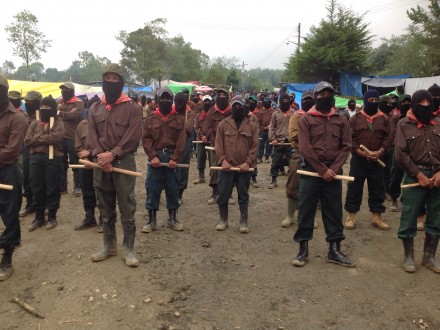
EZLN milicianos at the Homage to Luis Villoro and to teacher Galeano
By: Isaín Mandujano
OVENTIK, Chiapas (proceso.com.mx) – This Saturday, the Zapatista National Liberation Army (EZLN, its initials in Spanish) rendered homage to the Mexican philosopher Luis Villoro Toranzo and to the Indigenous Zapatista teacher Galeano, assassinated precisely one year ago in La Realidad, by an anti-Zapatista shock group.
More than five thousand people, between indigenous EZLN support bases and adherents and sympathizers of the movement, gathered in the esplanade to see on the stage the families of Don Luis Villoro, teacher Galeano, the parents of a youth disappeared from Ayotzinapa seven months ago, the General Command of the armed group and the surprising public appearance of Subcomandante Galeano.
Before the event, six columns of Zapatista milicianos with green pants and brown shirts guarded the family members of those being paid homage to from the principal entrance to Oventik for a kilometer until arriving at the enclosure where the ceremony would take place.
Among the fog that covered the development of the entire event, the words of Don Pablo González Casanova were read first. He remembered many of the political differences that he always maintained with Luis Villoro.
On one occasion he dared to say to him: “Do you agree, Luis? We have always had theoretical differences and discussions, but we always find ourselves in the same battle as now with the Zapatistas,” to which Villoro responded: “The solution is not logical, but rather ethical.”
González Casanova eulogized Villoro’s contribution to critical thought in his text sent for the homage, as Adolfo Gilly would do, upon a reading after an extensive speech in which he rescued extracts from his books and essays in which he brought up the domination and liberation of the peoples.
It was Silvia Fernanda Navarro Solares, Villoro’s life-long compañera, who talked about the love and commitment the philosopher had for the Zapatista struggle and cause, for whom he dedicated much of his analysis of social and political theory.
Navarro said that she, as much as Villoro, were always assiduous visitors of the Zapatistas and their communities, so much so that he contributed resources for the construction of the Zapatista School in Oventik.
And that throughout these 21 years they have accompanied the indigenous Zapatista communities in their advances and achievements that since August 2003 made theirs full autonomy to work in matters of education and the development of all of the rebel autonomous peoples.
She eulogized the level of organization and discipline of the Zapatistas that have walked these two decades accompanied above all with other peoples of Mexico and the world that have been in solidarity with the Zapatista cause.
Juan Villoro at his turn pointed out that it was the Zapatistas that put into the national public arena the fraternal struggle of the masked ones that is not annihilating, but rather transforming.
In the name of his three absent siblings, Miguel, Carmen and Renata, he thanked the Zapatistas for the homage to his father that they organized in this Caracol, one of the seats of the five Good Government Juntas.
He said that his father hated homages and with all certainty would have been opposed to this event that the rebels organized, but in his absence he can’t do anything now, he said, to the complicit laugh from the crowd.
After Juan Villoro’s speech, Subcomandante Galeano suddenly appeared from among the masked indigenous peoples, where he had remained camouflaged the whole time, to read an extensive discourse that the “dead Marcos” wrote after his death in March 2014, a homage that he would have made in the middle of last year, but that had to be suspended because of the attack and the death of Galeano.
Galeano, who “buried” Marcos on May 25, 2014 after taking the name of the fallen Zapatista teacher, he revealed today to the family members present, that the philosopher Luis Villoro Toranzo was “a Zapatista compañero” that after a night and early morning in May many years ago he came out as a member of the EZLN with the condition that no one, not even his own family, would know about it.

Juan Villoro and Sup Galeano at the Homage
He indicated that UNAM’s professor of philosophy, Don Luis Villoro was a Zapatista not only until his death but also as of now that he is remembered for his commitment as a sentinel that fulfilled the mission with which he was charged.
When they asked him then what his clandestine name would be, Don Luis Villoro elected his real name, which surprised the Zapatistas, but he assured what that would precisely do: it would hide the Zapatista with the role of a philosopher that the whole world already knew. Well then, nobody would know that Villoro would have really been an EZLN member.
He says that instead of a mask, Don Luis Villoro would always wear a black beret, to camouflage his identity. The first mission to which he was assigned was like that of everyone when they started in the ranks of the EZLN; he did the “post,” standing guard, because of which he was always a “Zapatista Sentinel,” which mission he knew how to fulfill until his last days.
Galeano reviewed that meeting with the Zapatista philosopher that even left his chestnut brown jacket hanging in the EZLN Barracks at which he presented himself to leave as one more in the ranks of the armed group.
After thanking the presence of the family members of Don Luis Villoro, he reviewed the life and trajectory of teacher Galeano in the ranks of the EZLN, who got to know the Zapatista guerillas in 1989. Little by little he was enrolled to be a miliciano that participated in the January 1, 1994 feat under the command of Insurgent Captain Zeta, in the taking of Las Margaritas, where the most affectionate Subcomandante Pedro would be killed with bullets.
Galeano said that the Zapatista teacher from whom he took his new name was a rebel, and that he also fulfilled all the missions to which he was assigned. Because of that and nothing less than that they have presented this deserved homage.
His daughter Lizbeth was there, as well as his son Mariano, his wife Selena and his father Manolo, who talked about Galeano, the teacher at the Escuelitas Zapatistas that the EZLN had organized months before to the thousands of adherents that came from diverse communities of the five autonomous regions where they have a presence.
Upon the event ending, those with ski masks sung the Zapatista Hymn and the milicianos broke ranks in order to protect the exit of the EZLN’s general command and SupGaleano.
Fernanda Navarro was moved; she thanked the homage with tears. Juan Villoro also said that his father would not have imagined this multitude of masked indigenous rebels that today rendered homage to him today for his support to critical thinking and for his unconditional support to the EZLN’s cause.
This Sunday, the family of Villoro Toranzo will deliver the philosopher’s ashes to the Zapatistas so that he may be buried in the shade of a luxuriant tree as was his wish, to finally rest in the territory to which he dedicated his last 20 years of life.
——————————————————————
Originally Published in Spanish by Proceso.com.mx
Translation: Chiapas Support Committee
Sunday, May 3, 2015
En español: http://www.proceso.com.mx/?p=403142
EZLN: Program and other information about the homage and seminar
PROGRAM AND OTHER INFORMATION ABOUT THE HOMAGE AND THE SEMINAR
ZAPATISTA NATIONAL LIBERATION ARMY
MEXICO

April 29, 2015
Compas:
Here is the latest information about the May 2, 2015 celebration in Homage to compañeros Luis Villoro Toranzo and Zapatista Teacher Galeano, and the seminar that will be held from May 3-9, 2015.
First.- A group of graphic artists will also participate in the Seminar: “Critical Thought Versus the Capitalist Hydra,” with an exposition called “Signs and Signals” of their own works of art made especially for this exposition. The following people will participate:
| Antonio GritónAntonio Ramírez
Beatriz Canfield Carolina Kerlow César Martínez Cisco Jiménez Demián Flores Domi Eduardo Abaroa Efraín Herrera Emiliano Ortega Rousset Felipe Eherenberg Gabriel Macotela |
Gabriela Gutiérrez OvalleGustavo Monroy
Héctor Quiñones Jacobo Ramírez Johannes Lara Joselyn Nieto Julián Madero Marisa Cornejo Mauricio Gómez Morín Néstor Quiñones Oscar Ratto Vicente Rojo Vicente Rojo Cama |
The opening of the exposition will take place Monday morning, May 4, 2015, in CIDECI.
SECOND. Here is the program of activities and participants for the seminar. There may be some changes (note: all hours listed are “national time”).
HOMAGE:
Saturday, May 2. Caracol of Oventik. 12:30.
Homage to compañeros Luis Villoro Toranzo and Zapatista Teacher Galeano.
Participants:
Pablo González Casanova (written statement).
Adolfo Gilly.
Fernanda Navarro.
Juan Villoro.
Mother, father, wife and children of the compañero teacher Galeano.
Compañero teacher Galeano’s compañeros and compañeras in struggle
General Command – Sixth commission of the EZLN.
Note: On May 2, the caracol will be open for entry before 12:30. At 12:30, you will be asked to gather outside the caracol in order to begin the welcome ceremony for the families of those to whom we are paying homage and for the guests of honor, and you can then follow them to the specific place where the homage will be held. After the event, you will need to leave the caracol because it will be completely filled by the compañeras and compañeros who are bases of support. You will not be able to spend the night at the caracol. We estimate that the homage will end between 4 and 5 in the afternoon at the latest, so you will be able to return safely and comfortably to San Cristóbal de las Casas.
SEMINAR “CRITICAL THOUGHT VERSUS THE CAPITALIST HYDRA”
Sunday, May 3. Caracol of Oventik. 1000-1400 hrs. We ask that you arrive a little bit before the start time.
Inauguration by the General Command of the EZLN.
Don Mario González and Doña Hilda Hernández (video participation).
Doña Bertha Nava and Don Tomás Ramírez.
Participation by the Sixth Commission of the EZLN.
Juan Villoro.
Adolfo Gilly.
Participation by the Sixth Commission of the EZLN.
Relocate to the grounds of CIDECI in San Cristóbal de Las Casas, Chiapas, beginning at 1400 hours.
Sunday, May 3 CIDECI. 1800 – 2100 hrs.
Sergio Rodríguez Lazcano.
Luis Lozano Arredondo.
Rosa Albina Garavito.
Participation by the Sixth Commission of the EZLN.
Monday, May 4, CIDECI. 1000 – 1400 hrs.
María O’Higgins.
Oscar Chávez (recorded message).
Guillermo Velázquez (recorded message).
Antonio Gritón. Opening of the Graphic Exposition “The Capitalist Hydra”
Efraín Herrera.
Participation by the Sixth Commission of the EZLN.
Monday, May 4, CIDECI. 1700 – 2100 hrs.
Eduardo Almeida.
Vilma Almendra.
María Eugenia Sánchez.
Alicia Castellanos.
Greg Ruggiero (written message).
Participation by the Sixth Commission of the EZLN.
Tuesday, May 5, CIDECI. 1000 – 1400.
Jerónimo Díaz.
Rubén Trejo.
Cati Marielle.
Álvaro Salgado.
Elena Álvarez-Buylla.
Participation by the Sixth Commission of the EZLN.
Tuesday, May 5, CIDECI. 1700 – 2100.
Pablo Reyna.
Malú Huacuja del Toro (written message).
Javier Hernández Alpízar.
Tamerantong (video participation).
Ana Lidya Flores.
Participation by the Sixth Commission of the EZLN.
Wednesday, May 6, CIDECI. 1000 – 1400.
Gilberto López y Rivas.
Immanuel Wallerstein (written message).
Michael Lowy (written message).
Salvador Castañeda O´Connor.
Pablo González Casanova (written message).
Participation by the Sixth Commission of the EZLN.
Wednesday, May 6, CIDECI. 1700 – 2100.
Karla Quiñonez (written message).
Mariana Favela.
Silvia Federici (written message).
Márgara Millán.
Sylvia Marcos.
Havin Güneser, from the Kurdish Freedom Movement.
Participation by the Sixth Commission of the EZLN.
Thursday, May 7, CIDECI. 1000 – 1400.
Juan Wahren.
Arturo Anguiano.
Paulina Fernández.
Marcos Roitman (written message).
Participation by the Sixth Commission of the EZLN.
Thursday, May 7, CIDECI. 1700 – 2100.
Daniel Inclán.
Manuel Rozental.
Abdullah Öcalan, of the Kurdish Freedom Movement (written message).
John Holloway.
Gustavo Esteva.
Sergio Tischler.
Participation by the Sixth Commission of the EZLN.
Friday, May 8. CIDECI. 1000 – 1400.
Philippe Corcuff (video participation).
Donovan Hernández.
Jorge Alonso.
Raúl Zibechi.
Carlos Aguirre Rojas.
Participation by the Sixth Commission of the EZLN.
Friday, May 8. CIDECI. 1700 – 2100.
Carlos González.
Hugo Blanco (video participation).
Xuno López.
Juan Carlos Mijangos.
Óscar Olivera (video participation).
Participation by the Sixth Commission of the EZLN.
Saturday, May 9. CIDECI. 1000 – 1400.
Jean Robert
Jérôme Baschet
John Berger (written message)
Fernanda Navarro
Participation by the Sixth Commission of the EZLN
Closing Ceremony
Third.- As of April 29, 2015, 1,528 people have confirmed their participation. Of them, 764 state they are adherents to the Sixth, 639 state that they are not adherents, 117 state that they are from the free, autonomous, alternative, or whatever you call it press, and 8 work for the Paid Press.
Fourth.- Those people who are not able to register prior to May 2, 2015, can do so directly at CIDECI , in San Cristóbal de Las Casas, Chiapas.
That’s all for now.
Have a good trip.
From the office of the concierge,
SupGaleano
April 2015
STAND UP! Comedy: A Benefit for autonomous Zapatista education
Just added: Zapantera Negra Art Exhibit…
FRIDAY, MAY 15, 2015 – 8:00 – 10:30 PM
The Chiapas Support Comittee is excited that Caleb Duarte will be collaborating to exhibit the Zapantera Negra art project at this event. Caleb is an artist and curator of the Zapantera Negra project, a collaboration between Emory Douglas, former Minister of Culture of the Black Panther Party, and local and international Zapatista artists.
PLEASE JOIN US on FRIDAY, MAY 15, 2015 – 8:00 – 10:30 PM at:
THE OMNI COMMONS
4799 Shattuck Ave., Oakland, CA 94609
Admission: $12.00. Tickets at the Door and in advance through Brown Paper Tickets:
http://www.brownpapertickets.com/event/1475108

And on Facebook
https://www.facebook.com/events/375091909366280/
We’d really like to have you join us this Friday; but if you can’t, you can still buy a ticket through Brown Paper Tickets to support autonomous Zapatista education.
http://www.brownpapertickets.com/event/1475108
For more Information: Chiapas Support Committee/Tel: (510) 654-9587
Email: cezmat@igc.org
7 months after: investigative journalists talk about Ayotzinapa
7 Months After: investigative journalists talk about the Ayotzinapa Case

Graphic for Caravana43 in New York City by JR
Seven months after the attack on Ayotzinapa students, I remembered that unspeakable crime by attending a talk at my local branch library (Temescal) in Oakland. For several hours last Saturday, Anabel Hernández and Steve Fisher talked about their work as investigative journalists. Both are postgraduate fellows at the University of California Berkeley’s School of Journalism in the Investigative Reporting Program. [1] They are currently investigating the Ayotzinapa Case and have written several articles for the Mexican weekly Proceso.
Hernández and Fisher have debunked the federal government’s official version of the Ayotzinapa Case piece by piece. For example, the federal government denied that the Federal Police were involved. Hernández and Fisher obtained a key piece of evidence that told a different story: the September 26, 2014 monitoring record from the Center for Control, Command, Communications and Computation (C4), a computer-monitoring center connected to both state and federal police. That C4 monitoring record showed that the students were monitored from the minute they left Ayotzinapa for Iguala and that their location was reported to the Federal Police.
Perhaps the most interesting part of the government’s official version concerned the alleged “motive” for such a heinous crime: José Luis Abarca, Iguala’s mayor at the time in question, supposedly ordered the attack because he was afraid that the students would disrupt his wife’s presentation of her DIF [2] activities. The official version goes on to say: following the mayor’s orders, municipal police from Iguala and from the neighboring municipality of Cocula attacked and captured the students while the United Warriors (Guerreros Unidos) criminal gang murdered and then incinerated them, without the knowledge of the federal agents and soldiers stationed in the zone.
Hernández made a big point of saying that there is no way the mayor of Iguala and his small municipal police force, even with the aid of Cocula’s municipal police and “Guerreros Unidos,” had the ability to pull off an operation like the disappearance of 43 college students and the attack that preceded it. She stressed that the mayor was a “nobody” and Guerreros Unidos were never even heard of before this tragedy. She emphasized that Iguala was a place where large federal institutions dominated: the federal police, the Army and offices of federal agencies like Governance (SG) and the Attorney General (PGR).
It has been reported in the Mexican press that no murder or kidnapping charges have been brought against Abarca because there is no evidence to support either charge. A member of Caravana43 stated the same thing in a talk at Boalt Hall, the UC Berkeley Law School, and Hernández emphasized it. She added that Abarca’s wife, María de los Ángeles Pineda Villa, had finished her presentation and left the area by the time the student’s reached Iguala. The presentation of Abarca’s wife was not the motive for the attack!
As for the “confessions” from alleged members of Guerreros Unidos, Hernández said that photos of their appearances before a judge showed obvious signs of torture. The significance of this is that their confessions were obtained under torture and, therefore, should not be upheld up in court of law.
So what actually did happen? Who ordered and/or planned the attack and the disappearances and why? That is what Hernández and Fisher continue investigating. They want answers. So far, they have obtained information from the reconstruction of the crime, pieced together by the parents’ lawyers with survivors of the attack, as well as from cell-phone videos taken by survivors. They have obtained government documents and interviewed both survivors and detainees. They stated that they are planning to investigate why the EPR (Ejército Popular Revolucionario, EPR) issued a statement shortly after the attack pointing fingers at the Mexican Army as responsible for the murders and enforced disappearances. A baseless accusation or does the EPR know something? The parents certainly seem to believe that the Army was responsible. At the talk I attended in Berkeley a member of Caravana43 specifically said the parents and survivors believe the Army is responsible.
There was a hint in the first Proceso article by Hernández and Fisher that the leftist politics of the school may have been a motive:
“Moreover, according to the information obtained by Proceso at the Ayotzinapa Teachers College, the attack and disappearance of the students was directed specifically at the institution’s ideological structure and government, because of the 43 disappeared one was part of the Committee of Student Struggle, the maximum organ of the school’s government and 10 (others) were “political activists in formation” with the Political and Ideological Orientation Committee (Comité de Orientación Política e Ideológica, COPI).” [3]
And there was also an implication in the Saturday talk that the government suspected a connection between the students and the EPR or the ERPI [4] and that could have been the government’s motive.
The question and answer session was interesting. One of the questions that is always asked at public discussions involving the Drug War in Mexico is whether legalizing drugs here in the United States would solve the problem of violence in Mexico. What seemed to be of greater concern than legalizing drugs, at least from the journalists’ perspective, was ending the military aid that trains soldiers and police how to kill more effectively and provides them with the weapons needed to do so. Hernández believes those weapons and training are not used against drug traffickers or organized crime, but rather against the (innocent) civilian population.
Why has the Ayotzinapa case won so much support in Mexico and the world? Anabel Hernández answered that question by saying that since the beginning of Mexico’s Drug War, the federal government has generally blamed the victims; in other words, when government security forces (Army, Navy or federal police) cause civilian deaths, the federal government alleges that those civilians were working for drug trafficking gangs or had a family member involved in drug trafficking. She went on to say that the government likewise tried accusing the Ayotzinapa students, but it was so ridiculous that it wasn’t believed. Because the government could not connect these students to organized crime, the students represent the hundreds of thousands of innocent victims of the government’s Drug War and all those citizens that live in fear of the next massacre or disappearance. Thus, the parents of the dead and disappeared students and the survivors of the attack speak with an unprecedented moral authority.
The passion with which Anabel Hernández spoke was contagious and many of those asking questions were also passionate. A final thought I came away with was that Mexico’s Drug War affects everyone, regardless of skin color, economic status or social class.
I also came away with a question I have had for several years and one that was asked by another member of Saturday’s audience: Why isn’t there more of an effort in the U.S. to end the Merida Initiative and stop the supply of weapons to Mexico?
Submitted by Mary Ann Tenuto-Sánchez
——————————————–
[1] For more information about Hernández and Fisher and the program see: http://journalism.berkeley.edu/news/2014/dec/19/irp-fellows-investigate-governments-role-disappear/
[2] DIF – These are initials for the National System for Integral Family Development, a welfare program for families administered through the President, Governor and Mayor’s offices. The wives of the president, governor or mayor are usually the ones responsible for carrying out these responsibilities.
[3] http://www.proceso.com.mx/?p=390560
[4] Ejército Revolucionario del Pueblo Insurgente, an armed group in Guerrero
SupGaleano: Report on registration for the seminar
REPORT ON REGISTRATION FOR THE SEMINAR “CRITICAL THOUGHT VERSUS THE CAPITALIST HYDRA”
 Zapatista National Liberation Army
Mexico
April 21, 2015
To the Compas of the Sixth:
To the presumed attendees of the Seminar “Critical Thought Versus the Capitalist Hydra”:
We want to let you know that:
As of April 21, 2015, the number of people who have registered for the seminar “Critical Thought Versus the Capitalist Hydra” is approximately 1,074 men, women, others, i children, and elderly from Mexico and the world. Of this number:
558 people are adherents of the Sixth.
430 people are not adherents of the Sixth
82 people say they are from the free, autonomous, independent, alternative, or whatever-you-call-it media.
4 people are from the paid media (only one person from the paid media has been rejected, it was one of the three who were sponsored by the Chiapas state government to sully the name of the Zapatista Compa Professor Galeano and present his murderers as victims.)
Now then, we don’t know if among those 1,074 who have registered so far there might be a portion who have gotten confused and think that they have registered for Señorita Anahí’s wedding ii (apparently she’s marrying somebody from Chiapas, I’m not sure, but pay me no mind because here the world of politics and entertainment are easily confused… ah! There too? Didn’t I tell you?)
Anyway, I’m sharing the number of attendees because it’s many more than we had expected would attend the seminar/seedbed. Of course now that’s CIDECI’s problem, so… good luck!
What? Can people still register? I think so. I’m not sure. When questioned by Los Tercios Compas, Doctor Raymundo responded: “no problem at all, in any case the number of people who will actually pay attention are far fewer.” Okay, okay, okay, he didn’t say that, but given the context he could have. What’s more, not even the Doc knows how many people are going to come to CIDECI.
In any case, if you are engrossed by the high quality of the electoral campaigns and are reflecting profoundly on the crystal clear proposals of the various candidates, you should not waste your time on this critical thinking stuff.
Okay then, don’t forget your toothbrush, soap, and something to comb your hair.
From the concierge of the seminar/seedbed, In search of the cat-dog,
SupGaleano. Mexico, April 2015.
The Cat-Dog in the chat “Zapatista attention to the anti-Zapatista client”: (You are currently on hold, one of our advisors will be with you in a moment. If it takes awhile, it’s because we’re on pozol break. iii We thank you for your patience.)

“
Hello? Can you hear me?”
“Ah yes hello, I would like to register.”
“Listen, are there still seats available?
“Ah okay, but listen, the thing is that I want a seat really close to the front, you understand?
“Hey listen, will there be a chance for a selfie, and autographs, and all that?
“Yes, listen, another question, in the registration process are you giving out some kind bonus, as they say?”
“What! This isn’t the registration for the Juan Gabriel concert?
“Damn! I knew it. I told the gang that if we didn’t hurry up we weren’t going to get a seat.”
“Alright listen, if there aren’t any seats left for Juan Gabriel, then give me one for Jaime Maussan.”
“What, no seats for Maussan either! Alright then, tell me where there are seats.”
“Oh really? So you guys are trying to be really postmodern huh? Very metaFukuyama and all that, right?
“Listen, let me recommend for the subject of postmodernism, José Alfredo Jiménez and his classic aphorism of “life isn’t worth a thing.” That is the real thing, not that nonsense of a nihilism of multi-colored condoms and feminine pads.
Well listen, let me tell you that what is really important is a cultured pragmatism. I mean, appropriately and pleasantly presented. For example, the Araña weaving inconfessable alliances, Meñique [Littlefinger] investing in various “scenarios,” the institutional left doubting whether it should be left or institutional, the Laura Bozzo of the vanguard of the proletariat pontificating, a lot of svelte nudes to remind you of cellulitis and stretch marks, Kirkman proposing fascism as the best option in times of crisis, Rick and Carol exactly like they are, Tyron exchanging Cercei for Khaleesi, the “investigative journalism” searching out who will do their work for them with the slogan “go ahead and denounce, we’ll see if we can get paid for printing it.” Yes, what Alejandría needs are less Latinos and African Americans, and more figures along the line of Justin Bieber and Miley Cyrus. There, you see, even the fucking dragons changed political parties and the Starks are having trouble getting their party registered. And later Mance Rayder wanted to be all freedom loving and all, and they killed him for not wanting to vote. Ah, but in the game of thrones that matters, what’s really worth something is on the island of Braavos. Seven Reigns be damned! Winter is coming and “The Iron Bank will get what belongs to it.”
“Anyway, I’d give more spoilers, but better not to. I’ll leave you in doubt, suffering…”
Hey listen, are you sure there aren’t any seats left? Not for Neil Diamond either? Sonora Santanera? Not even Arjona?
Hey listen I’m confused. Isn’t this where you register for shows and performances? You know, like the movies, theater, concerts, comic routines, electoral campaigns, Don Francisco, circuses with animals on the ticket [ballot], candidacies, reality shows, green advertising spots on Imax screens, “Stop suffering” propaganda charged to the public treasury, lose weight by jogging to the ballot box?
“I knew it!” Fucking Peñabots! They have to be promoting abstention. Don’t they understand they’re just playing to the right? Don’t they see the great advances of the progressive governments in the world? I’m sure that you are a renter or have a mortgage to pay, right. And here I am, with my own house, trying to orient and guide you, and you all over there stuck in sadomasochism. I hope you get sick from that sandwich with salmonella! There you have your unlaic [unlike], your mute, your block, and your unfolou [unfollow]! So let’s see how you survive now eh!
(The user has gone offline. The chat session is over. End of transmission). (…) (sound of liquid being poured). (…) (voice stage left): Who spilled pozol agrio on the keyboard?! I told you not to let the cat-dog use the computer! Oh just wait until I find him, then he’ll see!
I testify.
SupGaleano
Woof! Meow! (And vice versa).
Translator’s Notes:
[i] The text uses “otroas,” to give a range of possible gendered pronouns including male, female, transgender and others.
[ii] Anahi is the singer/actress engaged to the Governor of Chiapas. Their elaborate (expensive) wedding will soon take place in Chiapas, one of the country’s poorest states.
[iii] pozol agrio is a drink made from corn
 Chiapas Support Committee