Chiapas Support Committee
Home of the Compañero Manuel blog on zapatistas & mexico
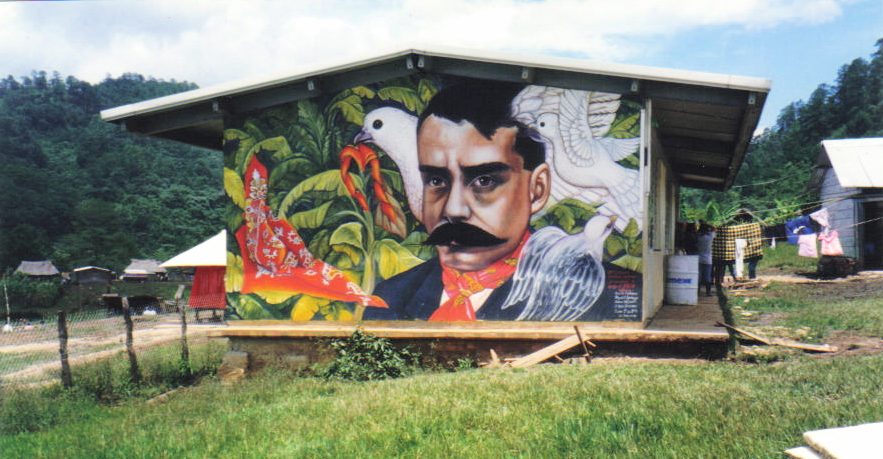
EZLN: And meanwhile in the partisan communities

ZAPATISTA NATIONAL LIBERATION ARMY
Mexico
February 2016
To the compañer@s of the Sixth
To whom it may concern
Compas and non-compas:
What we tell you comes from the very own voice of indigenous partisans that live in the different zones of the southeastern Mexican state of Chiapas. Although these partisans belong to, sympathize with or collaborate in the different institutional political parties (PRI, PAN, PRD, PVEM, PMRN, PANAL, PT, PES, PFH… and others that will be added from here to 2018), they have in common having received aid programs from the bad government and being human material for votes and earthly and celestial acarreos (carries) [1], besides, clearly, being indigenous and Mexican.
What you will now read not only has not appeared, does not appear, nor will appear in the local, national and international paid press; it also contradicts point by point government propaganda and the praises that its media sing (very bad, of course).
In synthesis, they are demonstrations of a crime: the “legal” dispossession of lands, history and culture of indigenous communities that believe that the bad governments and the partisan organizations are to help them. We have omitted the real names of communities and persons at the express request of the speakers, who, in some cases, fear reprisals; and in other cases because of the shame and mocking that they suffer because of the offense suffered.
The protagonists are only a small part of the victims of a war, the most brutal, terrible, bloody and destructive in world history: a war against Humanity.
We only give some examples because there are many, although the lie and the suffering are equal partners in all of them. Here goes then:
What is written is what is happening in the partisan communities.
It’s apparently not believed but now what we tell you is a fact, as the support base compañer@s tell us and say to us, and as the non-Zapatistas say in the communities, what is now being suffered in their towns. This is apart from what they are suffering in the other towns of the compañeros and compañeras of the National Indigenous Congress in our country, which is not well known because there are no communications media that get the information out, because the majority of the media are paid-off.
This that we write about is a thing of less than a year ago.
We see as if we were in an underground Drone to see how the partisans of below are, far from the governmental statistics and paid insertions in the media.
On the one side of La Realidad, in a community -good, it will continue being a community if they are going to defend themselves, because you will see what happened there-. They are not Zapatistas, but partisans.
A cattle project arrived there from the bad government. It gave cattle to all those that are ejido owners, not in common, but rather individually; individually their cows, their horse, it mounting, its corral, wire for enclosing it, salt and in common it gave them a veterinary medicine chest.
And then the people are very happy. They even have their posters and T-shirts that the government supplies. And the rulers had their photo taken and paid the media-for-pay so that they put it in big headlines: “Yes, the partisan communities advance, the Zapatista (communities) are the same or worse than in 1994.” The functionaries noted in their story that they spent a lot to hide what they stole: so much for them, so much for the governments, and another so much for the media-for-pay.
But it turns out that news travels around like a blind “Chicken Little” that doesn’t know where to go: that El Chapo already escaped for the second time, that they already grabbed him for a third time, that the Pope already came, that the Pope already left, and meanwhile in any corner of Mexico or of the world, they beat up-raped-incarcerated-murdered-disappeared-someone-unimportant. And so the news is part of the system, in other words it’s also merchandise. And it sells out if it tells, and it sells out if it’s quiet. And so the media receive more money for telling… and much more money for keeping quiet.
But not much time passed: as for one of those ejido owners in the town that receives government support, need took hold of him and he sold a cow. When we say “need or necessity” we mean that he had an emergency, like a grave illness. Then the project inspector came and started to count the cows, one-by-one, which he had given them, and well one of the cows he had given them was missing, in other words one of the ejido owner’s cows was missing. Then the inspector asked where the other cow is and the man answered: “I sold it out of necessity.” And the inspector told him: “you cannot sell it, why didn’t you ask permission? You have to buy one of the same value and the same size and breed.” And the ejido owner told the inspector: “but how, Señor, if I already exhausted the money due to necessity, where do I find the money to buy the similar one?” And the inspector responds: “that’s not my problem, it’s your problem, buy a similar one, that’s all, and if you don’t then we’re going to take away all the others.”
Not even a month passed and the bad little inspector came back and meets with the ejido owners and there is where he says to everyone dice, takes out the bunch of papers and shows the people and says, in other words the inspector says to the people: “all these papers are ready, the receipts, invoices for everything that you have received from the government, therefore the land is no longer yours, you must leave and better be good, because if not it’s going to be bad for you. If you leave in a good way it’s now ready where you are going to live: in Escárcega, on other words in the state of Campeche, or you leave for the Chimalapas.”
In other words, in all that time in which they were happy for the bad government’s support, in reality they were taking care of cattle that were not even theirs, like peons. And all the papers that they signed, with their ejido acts and their voting credentials, were in reality that they were wrongly selling their lands without knowing it.
That’s where the smiles ended, and then came pain, sadness, grief and rage.
Because in that place is a tourist zone. It’s where the Jataté River leaves a few islands that are very beautiful. That’s what the rich men that live off of other people’s money want. That is happening in the X community, official municipio of Maravilla Tenejapa, by the border with Guatemala.
Do you know where Los Chimalapas are? Yes, on the border with the state of Oaxaca. Do you know that there are frequently conflicts there, because of land problems, between Oaxacan and Chiapan campesinos? Good, because they are going to increase. The federal and state governments are using that place to relocate those who are displaced from their lands. That is what government populism does: it doesn’t resolve problems, it is making them bigger and moving them to other geographies so that they break out again in other calendars.
The people’s needs don’t matter to the bad governments and the party members of above. All their campaigns and social programs are not only a big lie and a source of money for enriching themselves, they are also a means for dispossession.
But let’s continue hearing and watching the partisans:
In the zone of the Caracol of Garrucha (but also in other zones) we relate what happened: in the W, X and Y communities they have received the “Pro Árbol” projects, there are more towns, but they don’t tell us about them. They HAVE told about those three communities, therefore we tell you. All three are about party members in the official municipio of Ocosingo, Chiapas.
The government has now prohibited all those communities from cutting trees for their needs, like firewood for cooking leña, and wood for the construction of their homes. The people now say that they now fear what is going to happen to them and that it only gave them a piece to make their milpas from low-growth woods and if they cut medium-growth woods they are fined. Then if they need to change a board on their champas, [2] they have to buy the board at the sawmills. The sawmills are those of big companies and they can cut all the trees they want, where the campesinos can’t cut. If they need firewood for cooking, well the campesinos have to buy it in another place and carry the thirds of firewood to their homes, walking with their load along the same road where the big trucks circulate with gigantic trunks from trees cut on the lands of the comunidad where their inhabitants cannot cut firewood “to take care of the ecology.”
Where does the campesino get the money to buy that board that he needs for his house or that firewood for cooking? Well from the governmental programs. What does one need to receive the government’s alms? Well, presenting minutes from the assembly, the credential, the CURP [3] and all those papers that mark persons just like the cattle and the trees are marked. Marks that are accordingly to give identity to individuals and what they do is take it away from them: no longer are they so and so, but rather the number such and so.
And for what do the bad governments want those papers? Well, to show that the campesinos legally sold their lands, and to be able to evict them, and legally displace them to other lands legally invaded. And so on.
But, how are the women in the partisan families? Well we’re going to tell you what the partisans say:
In 2 communities, X and Y, the women left to receive their projects, but the government told the young (unmarried) women to leave too and that the appointment is in Tuxtla Gutiérrez, which is the capital of the Mexican state of Chiapas, where the governor and his functionaries live. Well it turns out that, arriving in Tuxtla, they took the young women to one side and left the married women on another side. But it turned out that among the young women that they took was a married woman by mistake. And she communicated with her husband and told him that they have them enclosed in a house for 3 hours. And the unmarried women tell that they were obliged to have sexual relations. And right now it is being told in the community what it is that the functionaries are doing: they oblige them to have sexual relations in exchange for distributing the project. For example a young woman, was had problems because they obliged her to have sexual relations, and she asked her mother what it’s like the first time, if it’s painful to have sexual relations de por. And her mother asked her daughter: “why, daughter, what is it, why do you ask about that?” And the young woman had to tell her mother what happened in Tuxtla.
In other words the bad government is again imposing the right of pernada (when a young woman was going to get married, the finquero or estate owner had the right to rape the young woman) on the partisan communities. They govern per se and are seen like the finqueros and estate owners of before. And, like before, they receive the blessings of the High Clergy, which opens the doors of the cathedrals to them so that, through money, they receive the sacraments, forgive their crimes and rapes, and again pose, pure and smiling, in the photos of the paid press and on television. That is what the governors and functionaries do that pray with devotion and are first in line to receive the church’s blessings.
Hell on earth is blessed that way.
And the young party members?
What we’re telling you now we cannot tell of what town or towns, but it turns out that 2 mestizo men saying that they work with impresarios and that are looking for workers and that they know that there are those who want to go to work in the North and that it’s difficult to get there, and that they are positioned to take them and right away to the job. It turns out that those two recruited 9 youths. Months later, one achieved communicating with his family and it’s then that he tells them that he was wounded by a bullet, because he fled the place where they have them enclosed, and that the job is to grow marijuana and poppies, which they can’t leave, and that they were told clearly: “now you don’t leave here,” and because of that who knows if the others were able to leave, but at least their families know where they took them.
And in another partisan town: a family had dealings with the narco. Something happened, because the message to the father arrives: “if you don’t pay, your family pays,” they told him. And yes a cell phone arrived with the image of how they cut their daughter’s head off and if they want to bury her that she will be in such and so place. Other family members went to pick up the young woman’s body. But in the face of that disgrace the family is content that she makes good money and without much work.
And in another town, in the Northern Zone of Chiapas, government people came to offer coffee, milpa, school, clinic, church and road projects, and the people accepted. All the people are happy because they live well. Later, the government functionaries come again to tell them that they have to leave because there is uranium there, and that they are going to extract it and it’s very toxic, and thus they have to leave willingly or unwillingly. If they leave willingly they can go to Escárcega or in the Chimalapas.
And they showed them the invoices and receipts for all the expenses that they have received from the project. And their names are right there, their photos, the ejido assembly’s minutes, everything that demonstrates legally that they were not receiving support, but rather selling their land.
In another zone, in a town in the municipio of Simojovel, where there is amber and the people work those places to extract the amber in order to survive. Okay, because now they see that it was privatization of the ejido and that some towns fell into the trap. And it turns out that the one that was the owner of the [ejido] land was selling it piece-by-piece, in other words by the meter, and the people from there bought it to see if there is amber and they took some out, but then they ran them off because a Chinese investor came to extract the amber. The foreign capitalist had all the legal papers, which he had obtained thanks to the papers that the people signed to receive the governmental support and the projects.
In other towns of partisans foreign people have appeared and they have seized and charged them a fine for entering their lands without permission. In one community they charged 300,000 pesos and the strangers paid it; and they even said another time: “this is the first stage that we came, it’s going to have a second and third stage, and you are going to have a lot of work, in other words you are going to have a good example with the new owner of the land.” In another community, they also grabbed the strangers that came in a boat and charged them 100,000 pesos and the strangers paid and said that they come to investigate the place because there are sulfur mines there, among other things, and also that it’s the first stage and there’s going to be a second and third stage.
In another community, near Lake Miramar, a partisan from there commented that the number of governmental programs that they received at the beginning of December (2015) is the last one because with that payment for the land is complete and that the owner of the hill is going to occupy their land. The owner of the hill is Japanese. The issue is that in this community they are living with everything that they need to live, they are well taken case of, they even have an incubator for chickens. They received all the governmental support and it turns out that, without knowing it, they sold their lands to a foreigner.
Another governmental program is called PROSPERA, which used to be called Opportunities. The women that are inside of this program receive support for their children that are in school. But this program has its conditions; what is known about the conditions is: they oblige the women to consult frequently with a doctor and to get a pap smear by force and if they don’t do it they take the support (money) away from them, they are also prohibiting that the community practice some communal health services that are traditionally done in the communities, like the use of a midwife. Now, the women have to go into the city to give birth in hospitals. Clearly, that’s if they (the hospitals) accept them.
Another issue is that of digital television, the government is delivering televisions to all the partisan people. On December 22 and 23, 2015, all the people in all the communities of Las Margaritas municipio were gathered on the sports unit of Comitán. Since midnight the people were making a line to receive their television and it turned out that it got crowded there. What happened is that 2 people died, a little boy and a woman: the little boy died because he was trampled from the people’s pushing, and his mother wasn’t able to defend him; the woman was murdered when, upon arriving home, the husband took out his pistol and killed her for not having taken care of their son. A partisan gave this information.
A few days after they received the TVs, the partisan women commented that many TVs arrived broken and that upon connecting many others made a short and were burned; other, upon turning them on, nothing appeared; now they have to buy an apparatus in order to see anything, and the partisans comment that it’s a deal that Peña Nieto made with a Japanese company.
-*-
Well, those were just a few examples. There are many more, and they are equally or more chilling and infuriating as the ones we recounted here.
We are not lying or inventing things.
These are the words of the partisans who, in their shame and rage, have come to us, as Zapatistas, to ask for advice and support.
We Zapatistas listen respectfully.
We don’t scold them for their betrayals, attacks, and slander.
We don’t throw in their faces the fact that they have aided our persecutors in the past and many times helped those above attack us.
We don’t mock their tragedies and shame.
We do not take joy from their pain.
Nor do we tell them that they should become Zapatistas, because we know well that it is difficult to be a Zapatista.
This has been, is, and will be our life and death: as Zapatistas.
This is what we told them:
“We Zapatistas have nothing to offer, not paid projects, not money, not earthly or heavenly promises. We only have our example. Organize yourselves, don’t let anyone tell you what to do or how or when to do it, defend what is yours. Resist, struggle, live.”
Now perhaps you are asking yourselves what the partidistas do in the face of these aggressions, evictions, and impositions. And the answer is very simple: they pass themselves off as Zapatistas.
One partisan said: “That’s the only way we are respected. So we hide our papers and we change our names. Because of the ignorance imposed upon us by the government, we thought that the Zapatistas were bad people. We see now that’s not the case.
We hope that the same thing does not happen again, that we will no longer be spies and traitors. We see now that one who betrays will be betrayed. And the truth is that we are very ashamed and enraged that we have been mocked once again, as always.
We thought that we were doing well, and we were only awaiting the worst.
We thought that we had so much, and now we have nothing.
We were blind and now we are naked.
We made fun of you, calling you “fucking Indians,” and it turns out that you are much better off than we are because you have your organization that does not abandon you, that does not detour from its path, that does not sell out, does not give up.
That’s what they told us.
The Zapatista that was listening to the partisan responded:
“Changing course, selling out, surrendering? Never!
From the mountains of the Mexican Southeast,
Subcomandante Insurgente Moisés. Subcomandante Insurgente Galeano.
Mexico, February 2016
NOTICE FOR THE SIXTH AND THE NATIONAL INDIGENOUS CONGRESS:
In the next few days we will convoke a series of activities. Be alert.
Note: this text was produced in its entirely with a word processor using free and open code software, with a GNU/Linux operating system, distro UBUNTO 14.04 LTS. “UBUNTU” in the Zulu language means: “A person is a person through other people.” Say “yes” to free software.
————————
Translator’s Notes:
[1] acarreos – transporting party members to a party’s political event or to the polls in order to swell increase the size of the crowd or the vote
[2] Champas are wooden huts.
[3] The CURP is an identification number for each Mexican citizen.
——————————————————————
Originally Published in Spanish by Enlace Zapatista
En español:
http://enlacezapatista.ezln.org.mx/2016/02/23/y-en-las-comunidades-zapatistas/
Denounce obstacles in Ayotzinapa case
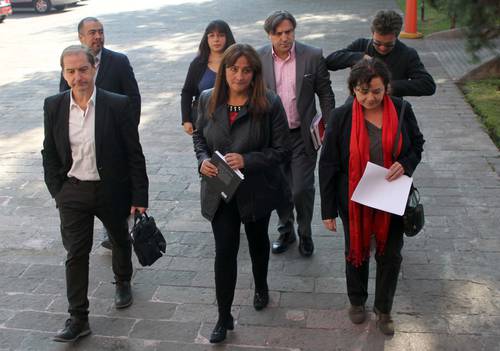
Carlos Beristain, Angela Buitrago, Claudia Paz, Alejandro Valencia and Francisco Cox arriving at the press conference. Photo: Marco Peláez
OBSTACLES “PUT ADVANCES AT RISK IN AYOTZINAPA CASE: GIEI
By: Blanche Petrich and José Antonio Román
Mexico City
The Interdisciplinary Group of Independent Experts (GIEI, the group’s initials in Spanish) denounced a series of obstacles, diverting of information and illegal leaks to the press that “put at risk” the advances in the investigation into the Iguala case and into the whereabouts of the 43 disappeared Ayotzinapa students.
This international body, which is a help to the Mexican State in the investigation of the facts of September 26 and 27, 2014, indicated that the record of the emblematic case –“that is key to justice in Mexico,” in the words of one of its members Carlos Beristain, exposed some examples of the fragmentation of investigation AP001, which instead of being integrated in its totality into a single unit, continues disperse and, moreover, se has continued being dispersed.
It’s the case of the recent arrests of the so-called Cabo Gil [1] and the members of the Los Peques [2] criminal group. The SEIDO [3] opened new investigations, instead of deriving them into AP001, and denies access to the GIEI. In that record that the SEIDO manages, Gil reserved his right to not make a statement. Nevertheless, alleged leaks of those statements were published in some media wherein things he didn’t say are asserted. “It’s erroneous information, which does not correspond to reality,” indicated the criminalist Claudia Paz, a member of the group.
Another example is the protection of the bone remains recovered from 2014 at a site close to the Cocula garbage dump (not inside of it), because of an alert from the parents themselves. Instead of integrating the investigation into the central record, it is being kept in the SEIDO’s possession and the necessary identification work has not been done.
Around these practices of fragmentation and leaks, the GIEI expressed their concern to Attorney General Arely Gómez. The functionary (Arely Gómez), the GIEI’s expert Angela Buitrago asserted, “took attentive notice” of this complaint and promised to investigate “the origin of these practices.”
Almost two months from concluding their second mandate, the five specialists emphasized that this period, which concludes on April 30, is a “crucial moment” that can define the fate of the investigation.
The five members that make up the Group were present at the press conference. In it they also brought up the campaign of “personal slander and insults” on the part of an ultra-conservative sector of which they have been the object. Without directly engaging in a polemic with the protagonists of these attacks or wanting to accuse anyone of being their source, the GIEI did assert that what it’s about “with these acts and accusations is closing space for the search for truth” and generating confusion.
At the same time the group insisted on the necessity that the Mexican authorities deepen an investigation about the alleged traffic of heroine to Chicago in relation to the case of the disappearance of 43 students of the Ayotzinapa teachers college.
“It’s fundamental that the line of shipping heroine from Iguala to Chicago is investigated. It has been put forward, but we insist on the need to carry out the investigative work that we recommend for the clarification of the facts,” said the Colombian lawyer Claudia Paz.
The experts have pointed out as a fundamental element of the investigation the alleged existence of a bus with drugs that it is suspected would have as its destination the U.S. city of Chicago and that would have been taken by the students without knowing its cargo.
“The fifth bus is fundamental. We need to count on information from the investigation that the Chicago prosecutors carry out. On February 15, international assistance was requested” on the part of Mexico’s attorney general, added Paz.
The GIEI recognized that “advances” have been attained with the new investigative team that the prosecutor’s office created and in particular it turns out that the search has been reactivated for the 43 students that disappeared the night of September 26, 2014.
Translator’s Notes:
[1] Cabo Gil – Gildardo López Astudillo, alias El Cabo Gil, is a allegedly member of the Guerreros Unidos criminal group and one of those principally responsible for the attack on the Ayotzinapa students.
[2] Los Peques (The Sinners) – A criminal gang allegedly at the service of Guerreros Unidos and allegedly involved in the attack on the students.
[3] SEIDO – The organized crime division of Mexico’s Office of the Attorney General
———————————————————–
Originally Published in Spanish by La Jornada
Sunday, February 21, 2016
Re-published with English interpretation by the Chiapas Support Committee
Pope Francisco honors Bishop Ruiz in Chiapas
POPE FRANCISCO HONORS BISHOP SAMUEL RUIZ GARCIA, DEFENDER OF THE POOR

Pope Francisco visits the tomb of Bishop Samuel Ruíz García. Bishop Raúl Vera is next to the Pope.
By: Isaín Mandujano
Today, Pope Francisco put an end to decades of exclusion of a Church that opted for the poor, rescued native ancestral roots and inculcated a liberating vision.
At the interior of the Cathedral of the San Cristóbal de las Casas Diocese, Pope Francisco prayed today in front of the tomb of Bishop Samuel Ruiz García and blessed it, which has been interpreted by those closest to jTatik Samuel [1] as an integration or vindication of the work he constructed for 50 years.
“The fact that Pope Francisco has a moment of silent prayer in front of the jTatik Samuel’s tomb is extremely significant, it’s endorsing a work, a path of 40 years. Very similar to the defender of the poor Bishop Fray Bartolomé de las Casas at the beginning of the colonial epoch,” said the parish priest of Bachajón, José Javier Avilés Arreola, a member of the Company of Jesus.
The priest that came to Chiapas in 1984 and was adopted by the indigenous Tzeltal communities, remembered that jTatik Samuel was walking with the people, converting their hearts, letting himself be a pastor for his people. “Thank God that jTatik Francisco has asked to come to this poor Diocese, a Diocese that economically speaking has little to offer. But with a great richness of walking in defense of their rights, an integral pastoral that we have led for many years, that is what comes to strengthen jTatik Francisco, to speak to us about forgiveness, to tell us that we can continue walking with the las illusions of this people, to continue being free and to continue fighting for their own land, for their resources, from the word of God, from the gospel, from the fast, from communion, from forgiveness. jTatik Pope Francisco invites us to that,” said the religious man also known as Father Pepe Avilés.
Avilés remembered that Bishop Samuel Ruiz García was a misunderstood bishop, so much so that the Vatican cancelled the ordination of married deacons, and for 14 years there were no ordinations. It was thanks to the effort of current Bishop Felipe Arizmendi Esquivel that Pope Francisco lifted the veto at the end of last year and the ordination of deacons started again.
He explained the importance of those deacons, and that it’s not the deacon that one sees assisting in the masses because the ones in this Diocese are real pastors that lead their community, but there are also women pastors, because the Deacons walk with their spouses.
“The deacons don’t conceive of service that is individual, the two walk together, they are in communion. In that meaning of gender equity the West would have a lot to learn because they know how to work as a couple,” he emphasized.
According to Father Heriberto Cruz Vera, the Pope’s gesture recognizes that Church that was constructed with an option for the poor. What Papa Francisco now proclaims –he added– Samuel Ruiz already did and made known in the indigenous communities of Chiapas, but Juan Pablo II and Benedict XVI, never wanted to support it.
Cruz Vera pointed out that for many years, the Vatican considered the Church that Samuel Ruiz constructed as an “irregular Church.” Many governors wanted to expel him from Chiapas and many religious hierarchs inside of the Catholic Church itself did everything to remove him but while they were not able to get him out neither did the Vatican do anything that Pope Francisco just did: vindicate him.
Just like Cruz Vera, two of Samuel Ruiz García’s other close collaborators, Joel Padrón and Gonzalo Ituarte emphasized Francisco’s visit, the arrival of a Pope for the first time in its almost 500 years of creation.
Today, Pope Francisco ate where jTatik ate for 40 years, from this Cathedral where Bishop Samuel Ruiz García consolidated and framed his pastoral line with the Diocesan Synod from 1995 to 2000 that the same Bishop Samuel Ruiz headed.
A Synod that framed the standard to follow among all the faithful and the religious structure of the Diocese, in such a way that any Bishop that comes here would not be able to break apart or change theRuiz García’s heritage.
“The Pope’s visit is encouragement, hope and strength to renew our soul in a Diocese that has opted for the poor for more than 50 years, not excluding all the rest, but it is very comprehensible,” concluded Father José Javier Avilés Arriola, parish priest of the Bachajón Mission.
[1] jTatik means Father in a Mayan language, Tzeltal (also spelled Tseltal).
——————————————————————-
Originally Published in Spanish by Chiapas Paralelo
Monday, February 15, 2016
Re-published with English interpretation by the Chiapas Support Committee
http://compamanuel.com/2016/02/18/pope-francisco-honors-bishop-ruiz-in-chiapas/
Pope Francisco says mass in San Cristóbal
FRANCISCO CALLS FOR LEARNING ABOUT THE INDIGENOUS AND ASKING THEIR FORGIVENESS

The Pope headed a mass before a crowd of thousands of indigenous Chiapanecos gathered in the San Cristóbal de las Casas Municipal Sports Center. Photo: Afp
By: Hermann Bellinghausen
San Cristóbal de las Casas, Chiapas
With his presence Pope Francisco made a broad vindication of the indigenous people, about whom, he said, “we have much to learn.” He also called for asking them for forgiveness, and upon finishing the mass that he officiated here, he delivered a decree through which liturgical ceremonies in indigenous languages are formally authorized. With that, and his silent homage afterwards to Tatic Samuel Ruiz García at his tomb in the Cathedral, the Native church and Indian theology receive the recognition that the Vatican denied them for years.
“Your peoples have not been understood and have been excluded from society. Some have considered your values, your cultures and your traditions inferior. Others, dizzied by power, money and the laws of the market, have dispossessed you of your lands or have carried out actions that contaminate them,” he said to the thousands of indigenous, the majority of them from Pueblo Creyente. “It would do all of us well to examine our conscience and learn to ask for pardon, pardon, brothers. Today’s world, dispossessed by the culture of waste, needs you.” In a certain fashion, he called to wake up, because “in many ways they have attempted to anesthetize our soul” to not feel the pain of injustice.
Directing himself to indigenous youth, “Pope Prancisco” (as the Tzotziles pronounce his name because their language does not have the “F” sound) called for recognizing the dignity of their cultures, so “that the wisdom of the elders is not lost.” The world of today, he added, “a prisoner of pragmatism, needs to re-learn the value of gratuity. There is a longing to live in a freedom that has the taste of the Promised Land, where oppression, mistreatment and inequality are not common currency.”
Without ambiguities, with a short biblical psalm in Tzotzil and an explicit mention of the Popol Vuh, Pope Bergoglio officiated a two-hour mass together with indigenous deacons and seminarians of the San Cristóbal de Las Casas Diocese, giving liturgical readings and chants in their languages. Is Tzotzil the new Latin, inaccessible to the also numerous non-indigenous faithful, but close to the people in their communities? Remember that indigenous Catholicism in Chiapas is rural.
Another one of the Pope’s central pronouncements was with respect to the violence and injustice that have provoked “one of the biggest environmental crisis in history,” something also linked to the rights of the native peoples.
Although without the spectacle that his meeting with the indigenous of Bolivia had, his visit to Los Altos (the Highlands) turned out to be, within what’s possible, a successful meeting with the Mayas of the Mexican southeast. It was certainly far from his disagreement with Native peoples of the United States on his visit to Washington months ago, where he canonized the missionary Junipero Serra, who the Indians consider responsible for genocide and an agent of dispossession.
In the Municipal Sports Center, converted into a sacred arena and practically full, the presence of Tzeltales, Tzotziles, Choles, Tojolabales and marginally Mam and Kaqchiqueles is eloquent. Many of them waited since two or three in the morning; there were those that were there for six hours before they started to move in the line to enter the field for the mass, most without losing spirit. One does not perceive an atmosphere of fanaticism or superstitious adoration. Definitely an atmosphere of joy! The Zinacantecans, and especially the Zinacantán women, came by the thousands, not only to the mass; many of were posted themselves very early on the boulevard and the crowded Avenida Insurgentes, behind the steel walls; recognizable and showy with their clothes embroidered in purples and pinks. On the other hand the Chamulas, San Cristóbal’s other Tzotzil neighbors, almost shined for their absence, being perhaps the majority population of this city and its surrounding areas. It happens that they are not usually recognized as Catholics. A few in their native land, 15 kilometers from here, practice the traditional religion; others, in San Cristóbal, children of the exodus due to religious persecution, are Protestants and the Pope sees them the same way.
Listening to a woman read Leviticus in Chol, or the songs of the Acteal Choir, amplified; observing the staging, the monumental reproduction of the Cathedral’s façade on wooden frames, the presence of the Black Christ of Tila, and on the front the colored doves of Amatenango and clay jaguars that from a distance seem like watchdogs. In the symbolic and the real, the indigenous accent is inevitable. So much so that even Coca Cola hung greetings to the Pope in (bad) Tzotzil. The contingents from San Andrés, Chenalhó, Huixtán and El Bosque are large as are those that arrived from different parts of the Lacandón Jungle. But, there are also those from Cancuc, Chilón, Las Margaritas, Altamirano, Oxchuc, Tila, Palenque, Chalchihuitán and Simojovel.
Like El Cid, Tatic Samuel won ecclesiastic battles. Even his favorite marimba group, Las Hermanas Díaz, was the one that harmonized the mass, besides a Mixe band and a local mega-mariachi.
The papal message of asking the indigenous for pardon was on target. A Coleta [1] woman reacted to street television upon hearing Francisco: “In other words I have to ask forgiveness from the man in the market, who is so nasty with me?”
Translator’s Note:
[1] A Coleta is a female resident of San Cristóbal that claims direct descent from the Spanish invaders. You can read into that definition a sense of superiority to the native peoples.
———————————————————–
Originally Published in Spanish by La Jornada
Tuesday, February 16, 2016
Re-published with English interpretation by the Chiapas Support Committee
Zibechi: Everything solid vanishes at the polls
By: Raúl Zibechi
Four decades ago, the Peruvian intellectual and militant Alberto Flores Galindo threshed his opinion about elections, in a brief commentary apropos of the results of the voting for the Constituent Assembly, in which the indigenous campesino leader Hugo Blanco obtained 30 percent of the votes, in June 1978.
“The universal, individual and secret vote has been a genial invention of the bourgeoisie. On voting days the social classes and groups disband into a series of individuals that stop thinking collectively, as occurs in strikes, demonstrations or any other act of protest, and in the ‘secret chamber’ emerge the doubts, fears and uncertainties that lead to opting for what’s established, for the past and not for change” (Obras Completas, tomo V, Lima, 1997, p. 89).
Flores Galindo was one of the consequential and notable thinkers in the 70s and 80s, when Peru was squeeze between State violence and that of the Sendero Luminoso (Shining Path), in a war that had cost more than 70 thousand deaths. His research “Looking for an Inca: identity and utopia in the Andes” (Buscando un Inca: identidad y utopía en los Andes), published in 1986, obtained the House of the Americas Essay Award in Cuba. He was the founder of SUR, House of Socialism Studies, which grouped together a good part of the intellectuals of the epoch, and he belonged to the Mariateguist Unified Party (Partido Unificado Mariateguista, PUM), to which Hugo Blanco also belonged.
His brief reflection on the elections has great currency and shows the crisis of critical thought. In the first place primer, it permits distinguishing between democratic freedoms and the act of founding a political strategy on electoral participation. If the oppressed won freedoms through long and potent collective struggles, elections are the mode for dispersing that plebian potency.
In second place, he doesn’t criticize electoral participation, he just warns about the incontestable fact that it’s about playing on the terrain of the dominant classes. He doesn’t wield an ideological argument, but rather one centered on how the electoral system separates those below into a myriad of isolated individuals that, upon being atomized, stop being a social force to delivering themselves to the manipulation of the powers of the system. The collective thought that emerges in popular actions gives way to individualization, in which fears and prejudices always impose themselves.
It would necessary to develop both arguments. On the one hand, the reflection of Flores Galindo connects with that of Walter Benjamin in his Thesis on history, when he asserts: “The subject of historical knowledge is the oppressed class itself, when it fights” (Thesis XII). It’s not a minor theme. In the turn of history in which he lived, Benjamin understood that if the oppressed are not organized, they are incapable of comprehending the world, they are blind and are prisoners of the way of seeing of the powerful. The problem is not the system’s resources (and boy are they a problem), but rather our inability to get organized, which is our way of being, in other words collectives that fight and, therefore, comprehend.
To my way of seeing, the electoral problem consists in founding a strategy for changes in the participation in elections, in what’s called the accumulation of forces that is summed up in a vote total. On our continent we have experienced a succession of very powerful struggles capable of displacing conservative governments, which are dissolved a little while later in the ballot boxes, installing other governments –at times better, at other times worse– that supplant collective action and the organization of those below.
The better part of the communist parties focused their action on this kind of strategy, placing the popular organization in tow of the electoral accumulation. With time, that strategy was generalized and converted, after the fall of real socialism and the defeat of the Central American revolutions, into the only mode of action of the institutional lefts.
Individualization through the vote has various nefarious consequences. Besides what Flores Galindo mentioned, the dissolution or neutralization of collective organization, another one appears: in the process of changing the collective into the individual the cooptation of leaders is facilitated because they make the bases self-governing in these processes, something practically inevitable when they are converted into representatives. The subject is dissolved when the logic of representation rules, since it’s only possible to represent what is absent.
Nevertheless, “the universal, individual and secret vote” strengthens the legitimacy of those elected, and that is the “geniality” that the Peruvian denounces. When the governments of the dominant classes feel cornered, as happened to president Eduardo Duhalde in June 2002 in Argentina, facing a potent popular attack, they call for elections as a way of dispersing the powers from below. It is a action directed towards the vigilance and control that consists, as Duhalde himself assured, of getting the people out of the street and into to return to their houses and sitting in front of their television sets.
Because the logic of the voter and that of the TV viewer is the same: it doesn’t matter to the power what each one thinks, provided he does it alone from his house, Noam Chomsky pronounced at one time. The problem to those above, then, is collective action and reflection.
It would be marvelous that power born of popular organization/ mobilization were seen and given feedback through electoral participation. The reality says the opposite, as we are able to appreciate in all the processes, and especially these days in the Spanish State, where those who voted for Podemos contemplate how those they elected negotiate in the name of those who elected them, but more distant from them each time. The institutional activity that is derived from electoral processes ends by displacing the organizations of those below from center stage.
———————————————————–
Originally Published in Spanish by La Jornada
Friday, February 5, 2016
Re-published with English interpretation by the Chiapas Support Committee
Las Abejas of Acteal issues statement
LAS ABEJAS: THE PRINCIPAL OBJECTIVE of FRANCISCO HERE IS “TO DEFEND THE PEOPLE of MEXICO”

Las Abejas of Acteal. Photo from La Jornada archives.
By: Hermann Bellinghausen
Acteal, Chiapas
The indigenous of Las Abejas of Acteal are convinced that Pope Francisco, on his visit to Chiapan lands, “brings a most key word: his principal objective is defending the people of Mexico,” expresses Sebastián Pérez Vázquez, president of the board of directors of the Tzotzil organization. He comes “to give his word of peace in order that peace will be established here in Chiapas and in Mexico.” But not just that, also “about how we can take care of our Mother Earth.”
Without removing a finger from the matter in their demand for justice for the massacre that occurred here 18 years ago, the civil society organization Las Abejas de Acteal does not hesitate in greeting Pope Francisco, who their organization will receive in San Cristóbal de Las Casas next Monday. He made it clear that: “as an organization we are always demanding justice, because if there is no justice peace cannot be established. The Church talks about forgiveness. There are forms where yes one can forgive. Not all things can be forgiven. But as a crime was committed, one must apply justice.”
This is the place of the largest and most paradigmatic collective wound in the process of liberation and resistance of the indigenous peoples of Chiapas: the senseless massacre of more than 45 peaceful people (Pérez Vázquez insists on this) perpetrated on December 22, 1997 by a group of paramilitaries encouraged by the federal government. That was also an attack on believing Catholic and, at that time, on the Church that Bishop Samuel Ruiz García represented. That was also about the irregular war the State unleashed against the Zapatista movement, which was crude and brutal in Chenalhó during all of 1997. The unarmed allies of Zapatismo were also targets of this war, which was the case with Las Abejas.
Although there were investigations and eventually more than 70 paramilitaries were condemned to prison for the acts, “the government never disarmed them, they were their hucksters,” the president of the organization says. Now most of the los killers are free, and walk around here.
In statements issued at the Las Abejas headquarters in the camp of Acteal, which its residents call “sacred land,” in the municipio of Chenalhó, in Los Altos of Chiapas, Pérez Vázquez emphasizes: “They only punished the material authors a little bit, but not the intellectual authors, the then president of Mexico, Ernesto Zedillo Ponce de León, and the three levels of government.”
Always in crisis always in a loud voice, always in resistance, the Las Abejas organization has resisted for almost two decades the pressures, promises and betrayals of the state and federal governments, as well as those of the courts of justice. It is an adherent to the Sixth Declaration of the Lacandón Jungle Sexta and it belongs, since its founding in 1992, to Pueblo Creyente (Believing People), the most numerous and representative popular Catholic congregation of Chiapas, with a presence in all the indigenous regions of the San Cristóbal de Las Casas Diocese.
Rumors dissipate
Throughout the night and this morning, the organizations and communities that maintained a collective occupation in the atrium of the San Cristóbal de Las Casas Cathedral withdrew, including the conglomerate of dissident groups united in the Popular Assembly of Los Altos of Chiapas.
Thus, the OCEZ of Venustiano Carranza, the residents of Chanal, the Proletarian and Popular Communist Coordinator, and the families displaced from Shulvó (aka Xul Vó), Zinacantán, [1] set free the space also called Peace Plaza. With that the rumors dissipate, widely spread in San Cristóbal yesterday, that the Pope “would suspend” his visit to the country’s most important indigenous cathedral.
Translator’s Note:
[1] Shulvó or Xul Vó is a community in the official municipality of Zinacantán or, alternatively, the autonomous Zapatista municipio of Vicente Guerrero, in the Highlands of Chiapas. Last December 9, paramilitaries violently expelled 47 people from that community. Those expelled are adherents to the EZLN’s Sixth Declaration of the Lacandón Jungle.
————————————————————
Originally Published in Spanish by La Jornada
Saturday, February 13, 2016
Re-published with English interpretation by the Chiapas Support Committee
Ayotzinapa: No incineration in Cocula
THERE WAS NO INCINERATION IN COCULA, EAAF CONCLUDES

The Argentine Forensic Anthropology Team (EAAF, in Spanish), accompanied by the parents of the 43 Ayotzinapa students and others. Photo: José Antonio López, La Jornada.
By: José Antonio Román
The Argentine Forensic Anthropology Team (EAAF, the team’s initials in Spanish) concluded that there is no scientific evidence that indicates that the mass incineration of the 43 Ayotzinapa teachers college students was carried out in the Cocula garbage dump, as the version defended by the Attorney General of the Republic (PGR) asserts, and with which he sought to consider the case resolved.
Nor was evidence found to establish any correspondence between the elements recovered in said garbage dump –among them the bone remains of 19 persons– and the disappeared students.
Satellite images of the garbage dump obtained by the EAAF, through diverse institutions, show that the area of the fire on said dump’s lower surface –that the PGR indicates as the one utilized to burn the remains of the 43 normalistas– has in reality been used in previous fires at least since 2010. Therefore, one cannot talk about a single event that occurred on September 26 and 27, 2014, the date on which the youths disappeared.
In the expert opinion made public this Tuesday, they took an hour to explain the methodology and principal conclusions derived from this independent study, which required more than a year of work for a team of 30 specialists of different branches and nationalities. They also pointed to diverse and serious irregularities that personnel of the PGR committed. One of them is related to 20 of the genetic profiles from the normalistas’ families that the attorney general’s office sent to the laboratory at Innsbruck, because they were different from those the EAAF sent, although being from the same people.
Another inconsistency was what occurred on November 15, 2014, when experts and agents from the Public Ministry collected evidence at the Cocula garbage dump without the presence of or warning to the Argentine team, when the agreement was to work together. On that occasion, casually, 42 new shells were located ‘‘under a rock’’ placed in an area that had been searched a day before without finding anything.
At a press conference held in the installations of the Pro Human Rights Center (Centro Pro), the experts Mercedes Dorotti and Miguel Nieva pointed out that, in the opinion of the EAAF, sufficient scientific elements do not exist to link the remains found in the Cocula garbage dump with those recovered, according to the PGR, in the bag from the San Juan River, from which comes the only positive identification to date of one of the disappeared students, whose name is Alexander Mora Venancio.
The opinion –in which they incorporated a report about the site as well as a laboratory report– was already delivered to the PGR, a body that was invited to carry out, to analyze and to compare ‘‘together with the experts’’ the results reached for the different studies on the Cocula garbage dump.
Santiago Aguirre, assistant director of the Centro Pro, a body that represents the parents of the 43 disappeared youths, emphasized the public and detailed presentation of the EAAF’s opinion, thus subject to public scrutiny, a situation to which the PGR’s report has not been submitted.
Among its conclusions, the opinion of the Argentine team points out that the investigation on the Ayotzinapa students cannot be concluded, while an important quantity of evidence still lacks processing. More time is needed for analysis of the bone remains and associated evidence. This task will take several months of work. It suggests that this must be interpreted in all of its possibilities, without giving preference to those interpretations that only include a possible agreement with the testimonies from those accused.
Accompanied by the parents, students from the rural teachers college and lawyers, the two members of the EAAF that presented the report said that the interdisciplinary team that participated in its elaboration is specialized in areas like archaeology, criminalistics, entomology and forensic botany, as well as ballistics, fire dynamics and interpretation of satellite images, among others.
Besides, in order to conclude the scientific impossibility of producing a fire at that site with the size and intensity necessary to reduce 43 bodies to ashes, confronting the scientific evidence with the testimonial was determinative. The EAAF points out that the information derived from the statements of the alleged perpetrators ‘‘presented contradictions, like the way in which forma the victims’ remains were placed, the pneumatics (tires), the tree trunks, and the rest of the material; it varies significantly.”
Therefore, ‘‘we do not support the hypothesis that there was a fire of the magnitude required and of the reported duration,’’ the basis of the PGR’s assumption. They pointed out that although 132 shells were found at the site, among them rifle shells, the calibers of the majority do not correspond to what those implicated say they fired.
———————————————————–
Originally Published in Spanish by La Jornada
Wednesday, February 10, 2016
Re-published with English interpretation by the Chiapas Support Committee
People of Faith in resistance await Pope Francisco in Chiapas
BELIEVING PEOPLE IN RESISTANCE AWAIT POPE FRANCISCO IN CHIAPAS

Banner reads: Believing People of the southeast with Pope Francisco against mining and for the defense of our Mother Earth.
By: Enriqueta Lerma Rodríguez
February 2, 2016
Beyond the condemning discourses about the Pope’s visit to Chiapas, accusing the event as a form of control of the masses that responds to the need for recuperating the faith of the few faithful Catholics that are left in the region facing the increase of Evangelicals and of the desire of government authorities to show the “good Indian,” it’s pertinent to analyze the relevance that the Vicar’s presence acquires for an important percentage of indigenous Catholic believers. If the visit to Tuxtla could be omitted from a profound analysis it doesn’t come out the same with the Diocese of San Cristóbal de Las Casas where the largest percentage of the population is indigenous, con a diversified rural economy and grouped together in a diocese that for more than fifty years has shown particularities of significant social resistance.
The influence of the diocese in the region is highly important if one remembers the theological and political tradition inherited from Bishop Don Samuel Ruiz, who presided over it from 1959 to 1999. Many of the political, indigenous and campesino organizations, which currently contend in the state’s political arena have their germination in the 1974 Indigenous Congress, where, for the first time, secular catechists from the different diocesan regions had the opportunity to discuss the common problems about which they complained: mistreatment, discrimination, exploitation on the fincas (estates), dispossession of their land, abuses from those monopolizing crops, a lack of school and health services, threats and violence. The 1974 Congress, organized by the Diocese, was the inaugural parting of waters for a new stage of resistance and empowerment in the communities, generating campesino movements and the formation of numerous groupings demanding agrarian distribution.
One could argue against the importance of the Diocese of San Cristóbal with the decrease of Catholics in the state. Nevertheless, while it’s certain that religious diversity has increased in Chiapas, provoking social problems of expulsions and religious intolerance, it’s also necessary to say that despite that the Catholics continue to represent the most numerous religion among the Indigenous population. The data provided by the INEGI in its latest document on the theme, 2010 Panorama of Religions in Mexico, contradicts the diagnostics that point out that Indigenous Catholics have been exceeded at 60%. It’s possible to observe that in a population of 1,209,057 speakers of any indigenous language Catholics represent 50.35% with 608,819 followers; on the other hand, the total of Presbyterians, Evangelicals, Protestants, Christians, Jehovah’s Witnesses, Mormons, Jews and Muslims is 450,257, in other words 34.25%; the rest don’t point out any religion. Nevertheless, in opposition to the heterogeneity that religious secularization represents, Indigenous Catholics, even with their doctrinal particularities, compose a more cohesive sector, the majority subscribed to the universal church, which has permitted an important number of them to mobilize constantly in order to work in favor of social justice and for the defense of native territories. This organized sector is recognized as “Pueblo Creyente (Believing People);” a name that Bishop Samuel Ruíz designated in his time for the indigenous people of faith that demonstrated in the streets against the unjust incarceration of the parish priest of Simojovel, Joel Padrón, who in 1991 would denounce the numerous human rights violations in the northern part of Chiapas. He was accused of conspiracy against the government, criminal association, plunder, robbery, threats and provocation, among other crimes. Pueblo Creyente’s tenacious resistance attained his freedom despite all the state pressure.
Pueblo Creyente, now with more strength, has added itself to different processes of resistance and solidarity. However, the history of struggle and congruence for the social welfare was made palpable since years ago. For example, in the 1980s, during the period of Guatemalan refuge, through the diocesan Solidarity Committee, camps, basic education courses, workshops for artisans and for analysis of the reality were organized and steps were even taken for the definitive stay of some Guatemalans on lands acquired by diocesan agents. These same agents accompanied the organized return to Guatemala, earning the respect and gratitude of thousands of former refugees forever, a recognition that not even the United Nations High Commission for Refugees attained.
The mediation of the Church of Don Samuel has been so important in the region and so polemical that during the juncture of expulsions of “Christians” in San Juan Chamula, the diocese condemned the acts perpetrated in said municipality, promoting dialogue. That also provoked the expulsion of the Catholic Chamulan followers of Don Samuel and the rupture with the Diocese of San Cristóbal, since the expellers opted for the Orthodox Catholic Church. Within this context the Diocese promoted religious tolerance and supported the re-accommodation of those expelled, thereby showing their first practices towards ecumenism.
The very same territory of this diocese has been the scenario of the Zapatista Uprising, which is not a simple fact: it’s enough remember the notes of Jan de Vos, who Subcomandante Marcos assured in an interview that the meeting between the guerrillas and the catechists of Don Samuel, in the middle of the Jungle, permitted the first ones to transform their “squared” vision of the world into “round.” It’s not too much to say that the tijwanej method of “receiving and returning the word to the community” and “discussing among everyone to interpret the reality and to carry out actions” is a contribution from liberation theology to Zapatismo and not the inverse. At the same time it’s appropriate to remember that the rebellion in the Cañadas (Canyons), had its germ in the migration of indigenous campesinos, supported by the Jesuits, to the Jungle from the fincas of Ocosingo, Altamirano and other places and that many catechists and church agents were accused, after the Zapatista Uprising, of being promoters of the revolt, such as Andrés Aubry, Carmen Legorreta and Xóchitl Leyva point out. The nomination of Samuel Ruiz to participate in the dialogue with the federal government as part of the CONAI was also a demonstration of the analytical ability of the church’s agents and of the trust that the communities had deposited in the Catholic Church, especially in its bishop.
Among other work of great importance the diocese also founded the Fray Bartolomé de las Casas Human Rights Center; the civil association Economic and Social Development of Indigenous Mexicans (DESMI, its initials in Spanish), in charge of incentivizing and advising agro-ecology production in various communities; and the Support Commission for Unity and Community Reconciliation (CORECO) that since the Zapatista Uprising had the charge of promoting the resolution of inter-community conflicts through dialogue and promoting peace.
The response to the diocese’s attempts at pacification and justice, however, has awakened little sympathy in the state and federal governments. It’s appropriate to point out the case of Father Miguel Chateau, the parish priest of Chenalhó, extradited by the federal government after having denounced the characteristics and type of training that the paramilitaries had that perpetrated the massacre of Las Abejas in Acteal. The response was the deportation and condemnation of the diocese for its intervention. Stories like these are repeated in all corners of diocesan territory. There are the recent threats against Father Marcelo Pérez of Simojovel, who is opposed to the increase of organized crime, the cantinas, the sale of drugs and prostitution. Pueblo Creyente supported him with a pilgrimage of dozens of kilometers through various municipios, given that his “enemies” offered a reward of up to a million and a half pesos for his head. Pueblo Creyente’s request that Father Marcelo meet with the Pope to tell him the crime situation in Chiapas was blocked from the current top leadership of the San Cristóbal Diocese: he will not be able to interview with the Pope, although he DID achieve being present at the papal mass as animator of the event.
Beyond the complicated conjunctures, which are not few, it is also necessary to point out the important work that the diocese carries out on a daily basis. Organized in its seven diocesan zones (central, south, Tzeltal, Tzotzil, Chol, Chab and southeast), the pastoral agents, secular deacons and catechists, carry out different tasks: through the social pastoral work they attend to specific problems in matters of human rights; gender equity –from the women’s commission, CODIMUJ-; youth advisory; support to migrants, among other actions. With the recently created Mother Earth Pastoral they seek to coordinate efforts in defense of territory, opposing the sale of land, the monoculture of non endogenous species, the use of genetically modified organisms, the construction of highway and hydraulic mega-projects, the mining extraction, dispossession of land and migration provoked by the poverty that disarticulates the family nucleus. At the same time Pueblo Creyente demonstrates with pilgrimages against the structural reforms, against the genocide reflected in the country’s clandestine graves, against the disappearance of students like in the Ayotzinapa case, against femicides and against the private guards that subject the peoples. On this list of objectives Pueblo Creyente has also added the project of the New Constituent, feeling proud that Bishop Raúl Vera is one of its principal promoters.
Pueblo Creyente nurtures its spirituality starting from Indian theology and continues –to the grumbling of the diocesan leadership and against the suspension dictated from the Vatican- ordaining permanent indigenous deacons: men from the community that serve at the side of their wives and with the support of their families the ministry of imparting the sacraments and of reading the word of God in light of the times; men and women committed to their communities in the project of achieving spiritual liberation, and pledged to eliminating social oppression. Nevertheless, perhaps the biggest challenge that Pueblo Creyente has is the equal proliferation of currents inside the diocese, where renewed and charismatic Catholics are opposed to the tasks of the pastoral agents that seek to construct a liberating church. The dispute inside of Catholicism in San Cristóbal is between these two projects: a liberating church or a conservative one. An example of this contradiction was observed this January 25. Diocesan authorities were opposed to the pilgrimage in memory of the fifth anniversary of the death of Don Samuel Ruiz, with the justification that it was better to channel efforts to the Pope’s visit, but Pueblo Creyente, loyal to their pastor, who they call Caminante, [1] went to remember his work and honor it with the continuation of his work. During the event differences were evident between the current bishops that seek to discourage the Pueblo Creyente organization. For example, before starting the mass, the faithful that showed land-painted signs in defense of territory were asked to put away their banners and slogans.
Among other questions, this is the context that the Pope will encounter during his visit to Chiapas: a Catholic community in resistance starting with the base church communities and a sector of Catholics that seek to finish off Don Samuel’s project. Because of that the controversies are now harsh and unpleasant in San Cristóbal, where the “coletos” [2] feel excluded because the Pope decided to meet only with eight indigenous for sharing food.
The Pope’s visit in San Cristóbal without a doubt represents a key moment for Catholicism in the diocese of San Cristóbal. Pueblo Creyente hopes that he has knowledge of the problems that affect the weight of the indigenous population in the region, that he knows about the work that they have carried out in favor of justice and for the defense of their original territories, that he is witness to the importance that the permanent indigenous deaconship holds for the communities and that he authorizes their ordainment. They hope that the balance inclines in their favor and they attain giving continuity to the path traced by jTatik Samuel Ruíz. And surely the people of faith hope that what they cried out in chorus to Felipe Arizmendi when he started his participation in the fifth anniversary of the death of Don Samuel happens: “We want a bishop on the side of the poor, we want a bishop on the side of the poor!”
[1] Caminante – a walker or, one who walks, a wayfarer
[2] Descendants of the Spanish invaders
—————————————————————–
Originally Published in Spanish by Desinformemonos
Tuesday, February 2, 2016
Re-published with English interpretation by the Chiapas Support Committee
Victory in Oxchuc, Chiapas
THE MAYOR OF OXCHUC RESIGNS AFTER SIX MONTHS OF PROTESTS

Protest yesterday in Oxchuc
By: Isaín Mandujano
Tuxtla Gutiérrez, Chiapas. (apro).
After six months de protests on the part of residents of Oxchuc municipio, María Gloria Sánchez Gómez, mayor-elect of the Green Ecologist Party of Mexico (PVEM, its initials in English), resigned her position.
Local deputy Judith Torres Vera, Vice President of the local (state) Congress, confirmed it. She specified that last night Sánchez Gómez went to the legislative confines to request an indefinite leave of absence, which is interpreted as a definitive resignation according to local law.
Within the framework of the dialogue table installed this afternoon, the local deputy reported to leaders of the dissident movement that the mayor had presented her resignation, as they demanded, and therefore next Wednesday, February 10 it will be sent to the standing commission and on Thursday, February 11 the substitute mayor will be named.
Torres Vera warned that a municipal council would not be formed, but rather through uses and customs, through a plebiscite, the communities would elect their new mayor to propose to the full local Congress.
“What we want if for peace to prevail in the municipio of Oxchuc and in our state, and in that context she gave her resignation,” the legislator pointed out.
She indicated that while only the mayor presented her resignation, it is understood that all her council members leave with her, as 105 of the 115 communities demanded today in a big march, but that will be defined between Wednesday and Thursday.
About the agreements made at the dialogue table this noon, the indigenous accepted returning to classes and the return of those expelled from the municipio, in other words, family members and collaborators of María Gloria Sánchez Gómez (around 22 family members).
Since last July 19, when María Gloria Sánchez was declared the winner after Election Day, groups of dissidents began a series of protests against her. The mayor should have taken possession of the office on September 1, 2015, but she was never permitted.
The first group that initiated the protests was repressed in October, after which new communities joined in, and on January 8 the majority joined when the second attack was perpetrated. In total, the residents of 105 of the 115 communities marched this Friday to demand the abdication of the PVEM’s mayor, who together with her husband, Norberto Sántiz López, former federal deputy and twice mayor for the PRI, maintained a political boss system (cacicazgo) in Oxchuc for 15 tears.
—————————————————————
Originally Published in Spanish by Proceso.com
Friday, February 5, 2016
Re-published with English interpretation by the Chiapas Support Committee
Ayotzinapa investigators face rightwing smears
BUITRAGO: THEY PURSUE US BECAUSE WORK ON THE IGUALA CASE IS UNCOMFORTABLE
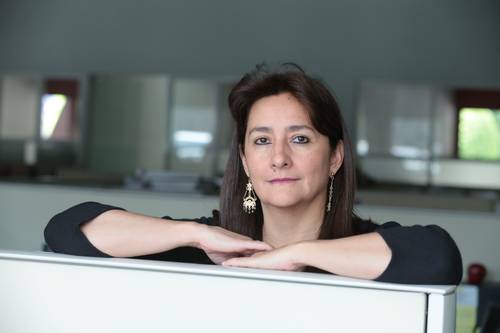
Angela Buitrago, a member of the Interdisciplinary Group of Independent Experts designated by the Inter-American Commission on Human Rights to investigate the Ayotzinapa case. Photo: Sanjuana Martínez
By: Sanjuana Martínez, Special to La Jornada
To former prosecutors Angela Buitrago y Claudia Paz y Paz, members of the Interdisciplinary Group of Independent Experts (GIEI, the group’s initials in Spanish) designated by the Inter-American Commission on Human Rights (IACHR) in the Ayotzinapa case, the campaign to damage their reputation that they currently suffer is related to their work and to the State’s apparently “untouchable” power groups, who are affected by the truth about the whereabouts of the 43 teachers college students.
“In the measure in which we get closer to the truth, to what really happened on September 26 and 27 (of 2014) in Iguala, there are people that can feel fear along with the perpetrators,” the former attorney general of Guatemala, Claudia Paz y Paz, advises in and interview with La Jornada.
In a separate interview, Angela Buitrago agrees: “It’s a persecution that we are experiencing and that is happening at the times in which we are taking inconvenient positions or making uncomfortable decisions. Nevertheless, neither defamations nor injuries are the proper way to try to clarify the facts of Iguala.”
Groups sympathetic to the Mexican Army, the ultra-right and conservative sectors have started a campaign against them. They vaguely accuse Paz y Paz of “violating human rights” in Guatemala, where she incarcerated, among others, the former dictator Efraín Ríos Montt. They accuse Buitrago, of “unjustly” incarcerating former Colonel Luis Alfonso Plazas Vega, recently released in a spurious process.
Both have confronted the military estates of their respective countries in the search for justice and reparations for the victims, something that, they say, has disturbed some groups related to the “perpetrators,” just as in Mexico, where General Salvador Cienfuegos Zepeda, the head of the Secretariat of National Defense (Sedena) still refuses to receive the IACHR’s experts with the argument that they are “foreigners,” and refuses to let them interview the soldiers involved in the Ayotzinapa case.
The dirty campaign, they point out, is directed at the group’s work, but also has a “gender component.” The attacks are directed directly at the GIEI’s two women, at the two prosecutors that have denounced corrupt soldiers and functionaries complicit for committing genocide and grave crimes in Guatemala as well as Colombia.
“We are experiencing moral killings,” Buitrago says without restriction. She adds: “they seek to morally finish off Claudia Paz and me, but when one has a clear conscience and knows that what they are saying is completely false, it makes no sense.”
–Has this defamation campaign affected the GIEI’s work?
–It’s very uncomfortable, it’s absolutely unsupportable that we are receiving these kinds of insults, but we have decided to continue the work permanently, without any obstacle, despite the fact that they want to treat us this way. Anyhow, that spreads a media aura, but we’re trying to continue our work with the same effort, because what interests us is looking for the Ayotzinapa students and find the means to do that.”
Lacking the Army
The GIEI’s latest investigations lead to the Army, an aspect of the investigation that the Sedena has not permitted; it has refused to accept the experts’ presence in the interrogations of the soldiers involved in the case.
Claudia Paz y Paz explains that from the beginning they attempted to interview members of the Army, something that has repeatedly been denied them: “Since the first month we have asked for a direct interview with the soldiers that were on duty that night, because in the case record are all their statements where it’s clear that they had witnessed the capture and detention of the youths that are now disappeared; at another time they had guarded the crime scenes and had visited the police command center.
“It’s fundamental for us to obtain these interviews, not only for the information, but also for the search for the disappeared students,” she adds.
The Attorney General of the Republic (PGR, its initials in Spanish) delivered the interrogations in writing, something that has not dispelled the experts’ doubts: “Many blanks still remain. On the one hand, the questions and answers are not found; on the other hand, there are contradictions with second statements, which instead of clarifying, are even more ambiguous,” the former Guatemalan prosecutor points out.
Their latest attempt has been to ask President Enrique Peña Nieto to “reconsider” the possibility of permitting us to interview the soldiers: “And we still have no answer. The reason is not clear to me. We have been interviewing directly the members of the Federal Police that were on duty those days. We have been present when the PGR has interviewed them; we are in agreement that the prosecutors ask the questions, but the only thing we ask is to be present at that time, as we have done in several ministerial interrogations.”
Despite the fact that time is running and their second investigations period will end next April, the State’s answer has been negative, something that evidently raises suspicions.
The PGR has only acceded to conduct a third interrogation at this time, but repeated the same scheme, something that does not contribute precise data to the investigations into the whereabouts of the 43 students: “It’s important for us to be present, to suggest questions, because there are themes that are not clear to us. It’s the third time that some of them are giving statement. It would be very important for them, and for everyone, that the diligence would be as exhaustive as possible, to not leave any space unclear.”
The injuries
Angela Buitrago, known in Colombia as “The Iron Prosecutor” for having faced the powerful and untouchable military estates and investigating 20 years later crimes of disappearance, torture and extrajudicial executions, with historic and exemplary sentences, has been attacked in Mexico by groups that sympathize with the Army.
Among the defamers are: the National Observatory of the Armed Forces, directed by Rafael Herrera Piedra; the Citizens Council for Public Security and Criminal Justice, headed by José A. Ortega Sánchez; and the Roundtable for Judgment and Peace and White Movement, coordinated by Ramón Hernández Flores.
The latest action of these ultra-conservative and pro-military groups was to organize, last January 12 in the Law School of La Salle University, the conference titled “The truth in the Ayotzinapa investigation,” specifically in charge of recently released Colombian Colonel Luis Alfonso Plaza Vega, incarcerated by former Attorney General Buitrago for enforced disappearance and sentenced to 30 years in prison, but absolved five years later in an irregular process.
The presence of the Colombian military man talking about Ayotzinapa is inscribed inside of this defamation campaign: “It’s a way of trying to question the activities that the group does, which has no relation to my activity. One thing is that I was able to have lived facing a permanent persecution and distortion through attacks on me as a functionary of instruction in Colombia; another is what it’s doing to the GIEI in Mexico, from which they have to distance themselves perfectly,” Buitrago indicated.
Quoting the German philosopher Arthur Schopenhauer, the former Attorney General clarifies that these defamations cannot attack the impeccable work of the group of experts, because they decide to center it on her: “The objective is to attack the work of the GIEI through things that are already more than clarified in Colombia and shown to have never happened. They are generating that dirty war because we are inconvenient at the moment in which we are doing the investigation.”
Among the accusations of the conservative groups is having rejecting “evidence” from the UNAM and from the University of Innsbruck about the Ayotzinapa case.
“I have not disqualified Innsbruck or UNAM; to the contrary, the latest report as a group we specifically based on evidence that the latter (UNAM) pointed out to say that there was no evidence to consider that the Cocula garbage dump would have been the place of the incineration.
We specifically utilized the documents that repose in the investigation to argue and maintain all the assertions that we make.”
–Is there a gender component in this dirty war against the two women members of the GIEI?
–Yes, the attack has been directed for reasons of gender, because of the position that we occupy and the investigations that we carry out, which touch certain sectors that are untouchable in certain parts of the world and for that reason the sentences against the politicians are firm, and other State functionaries that were convicted for corruption are firm. It is a persecution without any valid justification, but rather to simply create an atmosphere, to bring forth an idea that would remain in the collective imaginary and to disparage us. When they have no serious arguments to debate and discuss to the contrary, what they opt for is to attack personally in order to end its ethical and moral concept moral, and also to bring down and cause obstruction in the investigations.
–They attack two strong women, two ex prosecutors that have confronted untouchable estates, like the Army, in their respective countries…
–Yes, because of the discrimination that exists in some conceptions and especially in individuals about the woman, something that leads to attacking this sector to achieve greater adherence to that class of disqualifications when discrimination is taken advantage of as an essential element. The bottom line is trying to delegitimize the group’s work and the GIEI at the same time. When deceit, lies, infamy and insults are used, it is not a good future that awaits us.”
Claudia Paz y Paz clarified the government leaks to the effect that the experts threatened to leave: “We’re not going to leave; rather, we hope to have conditions that will make our work on Ayotzinapa possible.”
———————————————————–
Originally Published in Spanish by La Jornada
Sunday, January 17, 2016
Re-published with English interpretation by the Chiapas Support Committee
 Chiapas Support Committee